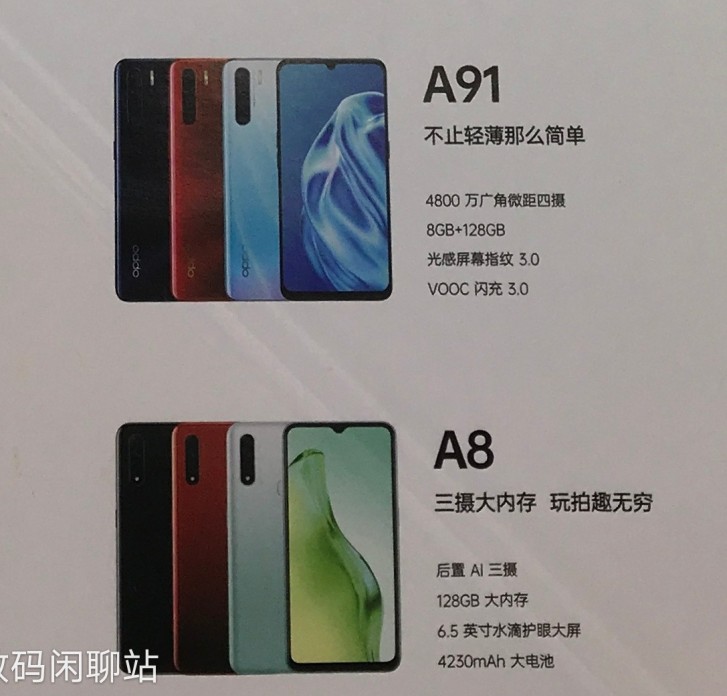
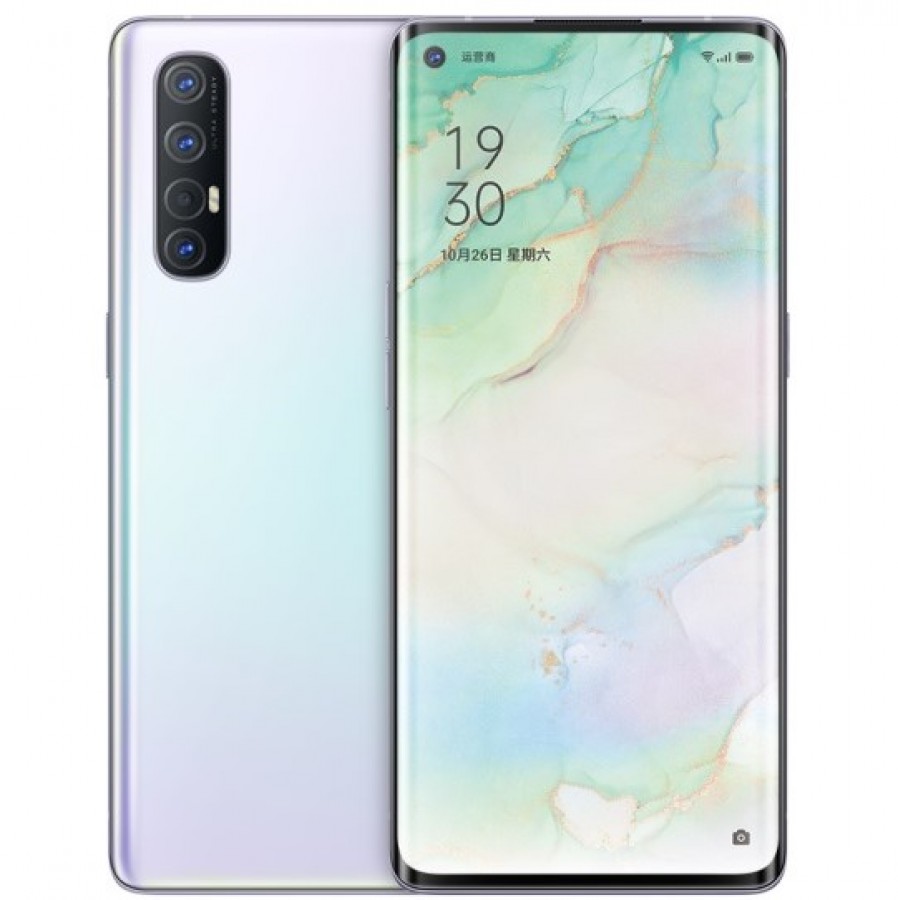
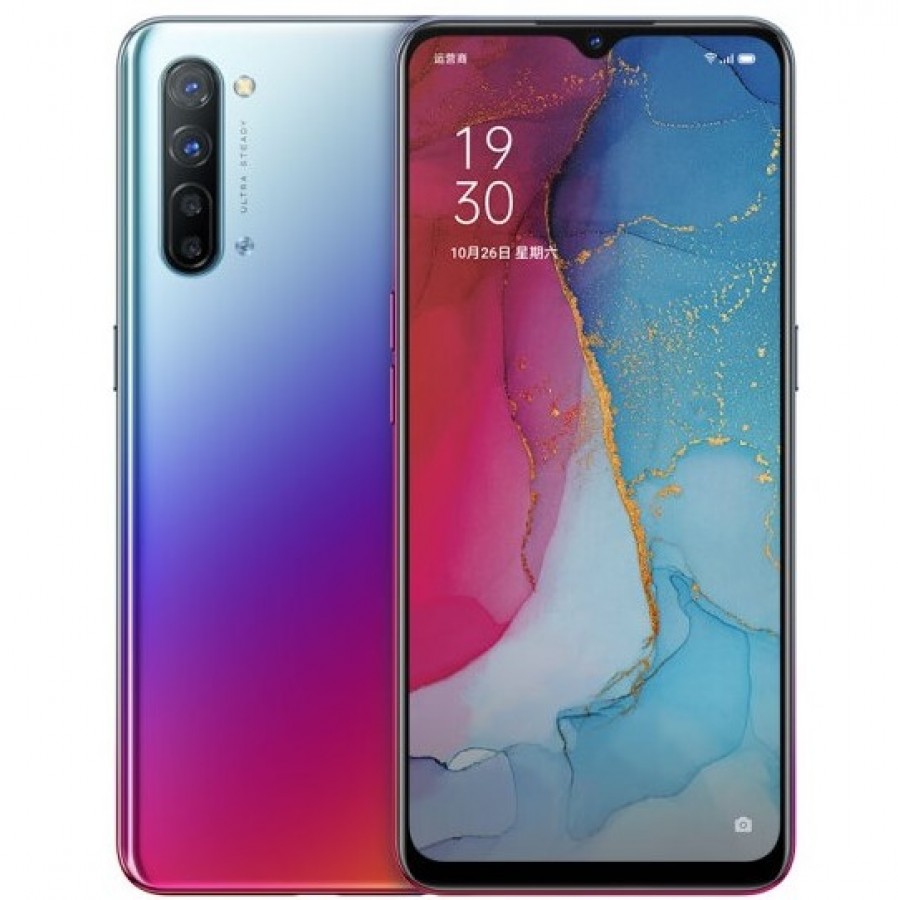
OPPO will be launching the Reno3 series of 5G smartphones on Dec. 26. However, a leaked poster that is now doing rounds on Weibo reveals that apart from Reno3 series, the Chinese firm may also debut two new A-series phones called OPPO A91 and OPPO A8. The key specs and images of these phones can be seen on the leaked poster.
OPPO A91 Specifications
The image of the OPPO A9 reveals that it features a display with waterdrop notch and a ultra-slim chassis. The back panel of the phone has a vertical quad camera setup. There is no fingerprint scanner on the rear shell of the device. The smartphone can be seen in color options like Black, Red and Blue. The key features that of the OPPO A91 include 48-megapixel quad rear cameras, 8 GB of RAM, 128 GB of storage, in-screen fingerprint reader and VOOC 3.0.
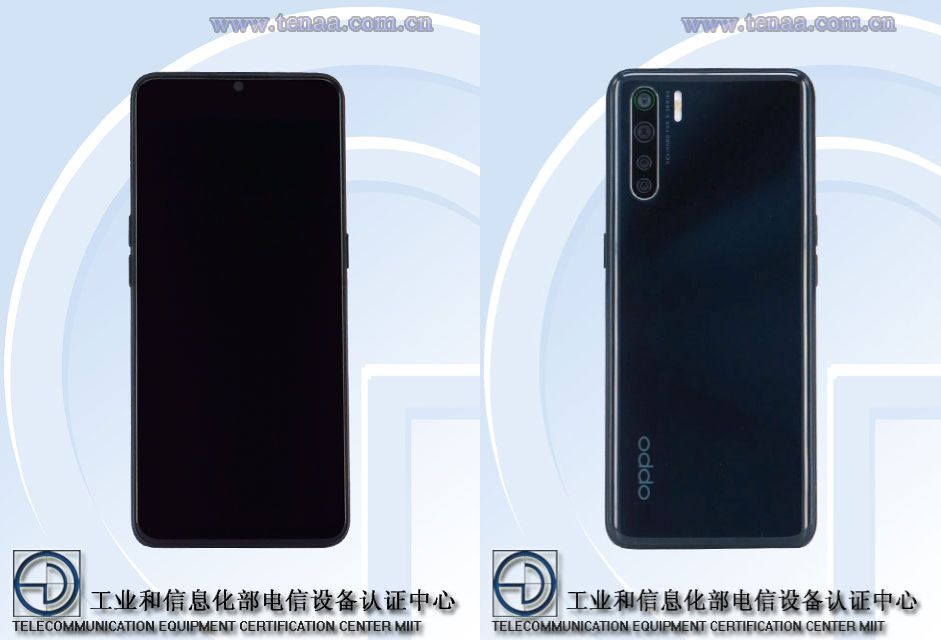
OPPO PCPM00 / PCPT00 TENAA listing
This phone seems to be the PCPM00 / PCPT00 smartphone that was approved by TENAA earlier this month. Its 6.4-inch AMOLED display supports 20:9 aspect ratio and 1080 x 2400 pixels full HD+ resolution. The 2.1GHz octa-core processor powers the smartphone with 8 GB of RAM. It has a native storage of 128 GB and there is a microSD card slot for more storage. The 48-megapixel + 8-megapixel + 2-megapixel + 2-megapixel quad camera setup is placed on the backside of the phone. It has a front camera of 16-megapixel. The device is backed by a minimum rated battery of 3,935mAh capacity.
The OPPO A8 also features a waterdrop notch screen. The rear side of the phone features a triple camera system and a fingerprint reader. Black, Red and White are three the color variants of the OPPO A8. The key features of the smartphone include AI triple rear cameras, 128 GB of storage, 6.5-inch display and 4,230mAh battery.
OPPO PDBM00 TENAA listing
The OPPO PDBM00 phone that was recently certified by TENAA seems to be the OPPO A8 smartphone. The handset features a 6.5-inch display that offers HD+ resolution of 720 x 1600 pixels. The device is powered by 2.3GHz octa-core processor and 4 GB of RAM. It has an internal storage of 128 GB and carries support for additional storage through microSD card slot. It is loaded with Android 9 Pie OS. The rear shell of the smartphone features a 12-megapixel + 8-megapixel + 2-megapixel triple camera system. It has a front camera of 8-megapixel. The smartphone has dimensions and weighs
There is no word on the pricing and launch date of the OPPO A91 and OPPO A8 smartphones.
According to a new report, Huawei is set to play a role in the building of 5G networking in the European country Norway. The company is expected to work with other industry experts on networking in the country despite pressures from the US.
The Chinese tech giant will work alongside Ericsson which is one of the few companies that still operate with the former despites its western complications. Huawei is still suffering from the aftershocks of the US ban and is facing difficulties in European operations as well.
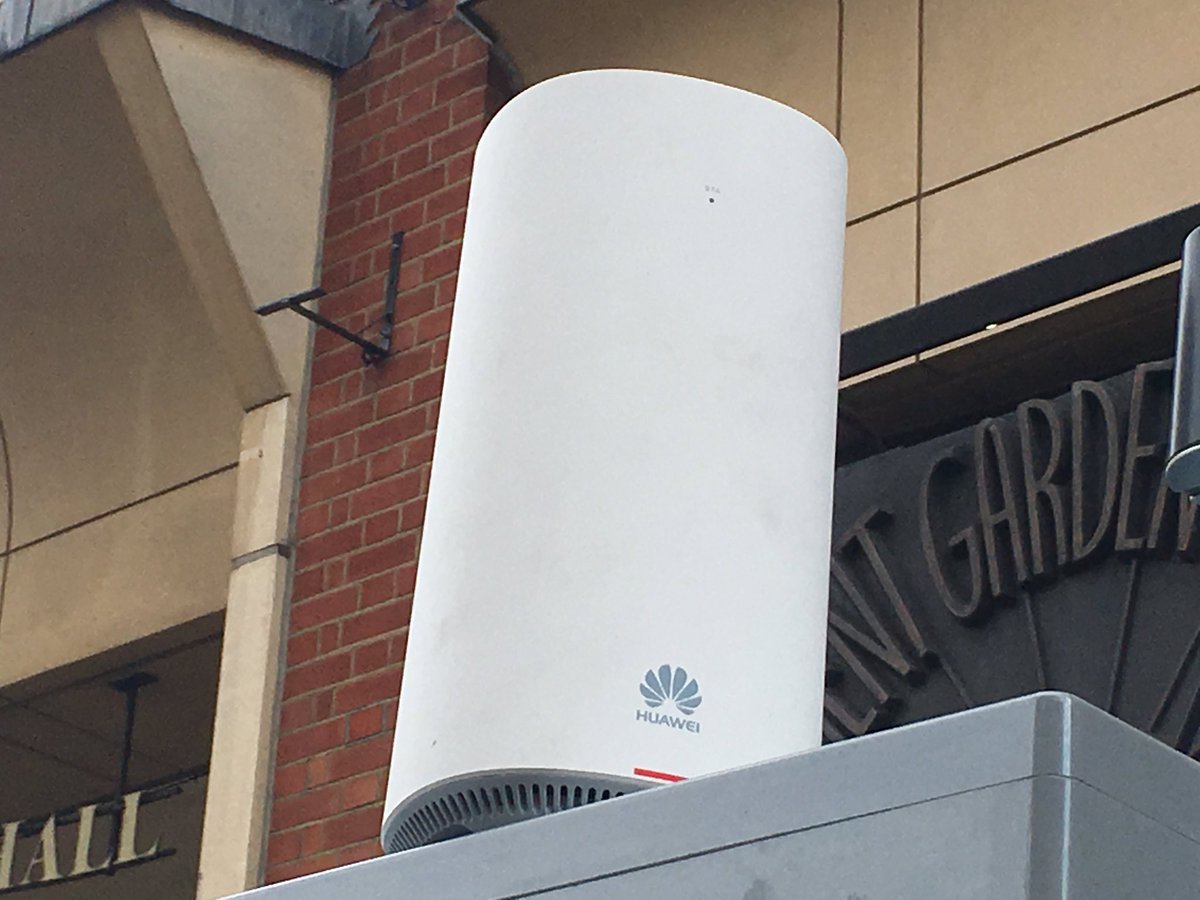
Huawei 5G Modem
Over the past 10 years, Telenor (a Norwegian telecommunications company) has worked with Huawei for 4G networking in Norway, according to Telenor VP for communications. The senior executive also went on to state that, “Ericsson has been introduced as a new vendor for 5G RAN, but we will also work with Huawei both to maintain the 4G network and also upgrade to 5G coverage in selected areas of Norway.”
Notably, Petter-Boerre Furberg, the head of Telenor Norway, stated that the operator would gradually phase Huawei network components in the country over a 4-5 years modernization period. This points to a broader image of Huwaei facing increasing difficulties in European regions amidst the US accusations regarding security threats. The security concerns have also risen in countries like Spain and are hampering the company’s operations in the area.
US-China Trade Disputes
To sum things up, Norway will utilize Ericsson’s technology for the newer and faster bandwidth while having Huawei maintain the existing 4G networking. However, the latter will also help in developing 5G in a few selected areas.
The Amazfit Sports Watch 3 is a smartwatch for sports enthusiasts and professional athletes. It comes in two versions – a Standard Edition and an Elite Edition, and now we get to add another variant to that list, the Star Wars Exclusive Edition which was officially launched earlier today and will go on sale exclusively on Tmall in China.
The watch rocks a 1.34-inch 320×320 JDI Full-Moon™ reflective low-power color display. The display is said to be specially designed for outdoor use and Huami says the stronger the light, the clearer the display. It’s similar to the Elite edition with AF+AR coated sapphire glass and a titanium bezel and features quick-release fluoro-rubber straps.
There’s also, as you’d expect from a Star Wars licensed product, references to Star Wars. The fluoro-rubber custom strap comes with one of Master Yoda’s quotes “Train You Must” inscribed on one side while the short strap says “Vader Is My Motivator”. It also has a custom dial, customized bezel, and comes in a special box with souvenirs.
So, where can you get one and for how much? The Amazfit Sports Watch 3 Star Wars Exclusive Edition will go on sale from December 19 carrying a promo price of 1599 yuan ($230) instead of the standard 1699 yuan ($241). Unfortunately, it’s currently exclusive to the Chinese market, and Amazfit isn’t likely to start having it sold out of China, so your best bet will be to import one after it goes on sale.
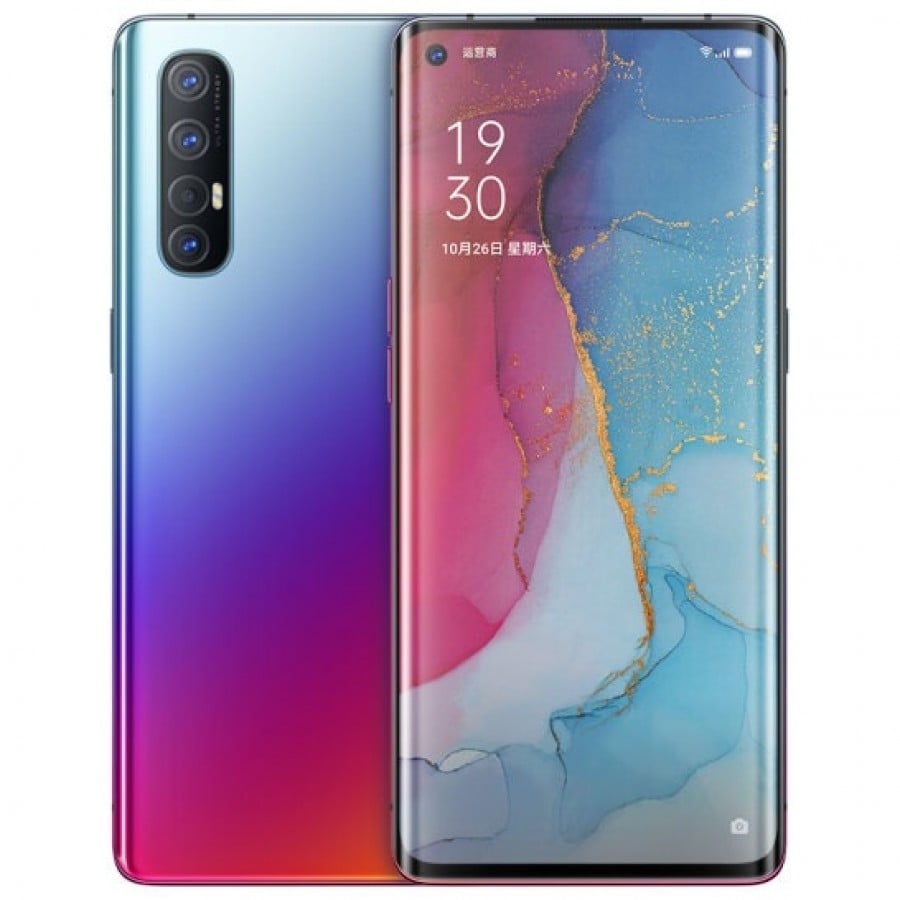
OPPO will be unleashing the Reno3 and Reno3 Pro smartphones in China on Dec. 26 at 3PM (local time). Ahead of the launch, OPPO has revealed the appearance of both phones through official listings. The listings have not only confirmed the color options of the Reno3 and Reno3 Pro phones, but also have revealed their storage and RAM editions. The 5G editions of both phones are listed on JD.com.
OPPO Reno3 and Reno3 Pro 5G Variants and Color Options
The OPPO Reno3 is listed on four colors on OPPOShop.cn website such as Sunrise Impression, Misty White, Moonlight Black and Blue Starry Night. The two RAM and storage editions of the Reno3 include 8 GB RAM + 128 GB storage.
1 of 4
The JD listing of the Reno3 5G and Reno3 Pro 5G have revealed that both phones will have an additional color option of Moonlight White. The 5G variants listings also reveals the existence of an extra variant of 12 GB RAM + 256 GB storage. The pricing information of Reno3 series is currently under the wraps.
The Reno3 with PDCM00 / PDCT00 smartphone features a 6.4-inch S-AMOLED display with waterdrop notch that offers full HD+ resolution of 1080 x 2400 pixels. The Dimensity 1000L that clocks at 2.2GHz powers the smartphone. The rear side of the Reno3 features a 64-megapixel + 8-megapixel + 2-megapixel + 2-megapixel quad camera system. The smartphone measures 160.3 x 74.37 x 7.96mm and it weighs 181 grams.
The Reno3 Pro has a punch-hole AMOLED display of 6.5 inches. It produces full HD+ resolution of 1080 x 2400 pixels. The display of Reno3 Pro carries support for 90Hz refresh rate. The Snapdragon 765G mobile platform powers the smartphone. The 48-megapixel + 13-megapixel + 8-megapixel + 2-megapixel quad camera setup resides on the backside of the Reno3 Pro. The smartphone measures 159.4 x 72.4 x 7.7mm and it weighs 172 grams. The below shown video show on the OPPO Reno3 Pro reveals that the phone will come equipped with video stabilization feature.
The Reno3 and Reno3 Pro smartphones comes with other features such as 32-megapixel primary lens, Android 10 OS, in-screen fingerprint reader and a 4,025mAh battery with 30W VOOC 4.0 enhanced edition fast charging support. The pricing of the Reno3 and Reno3 Pro will be revealed during the launch event.
Redmi K30 5G smartphone went official in China a couple of weeks ago. Now, a Chinese analyst has revealed that the cost of components used to make the device.
It is said that the Redmi K30 5G 6GB RAM and 64GB storage model costs around 1,746 yuan, which is roughly $250. However, the cost estimated is just for the components used and doesn’t include cost of research and development, assembly and after sales expenditure.
This indicates that the company isn’t making much money from the smartphone as the margin for the same is very low. For those who are unaware, the pricing of the Redmi K30 5G smartphone starts at 1,999 yuan which is roughly $284.
Redmi K30
The smartphone features a 6.67-inch punch-hole display and Gorilla Glass 5 panels on its front and rear. The HDR 10 complaint display produces a tall aspect ratio of 20:9 and offers full HD+ resolution of 1080 x 2400 pixels. It is also the first Redmi phone to arrive with support for 120Hz refresh rate.
Under the hood, the device is powered by the new 7nm Snapdragon 765G and comes with up to 8GB of LPDDR4x RAM and inbuilt storage of up to 256GB UFS 2.1. A microSD card slot is available on the device for expanding the storage capacity.
It is the company’s first phone to arrive with Android 10 OS which is overlaid with the latest MIUI 11 skin. The Mi Turbo 2.0 optimised the system performance whereas Game Turbo 2.0 enhances the device for gaming.
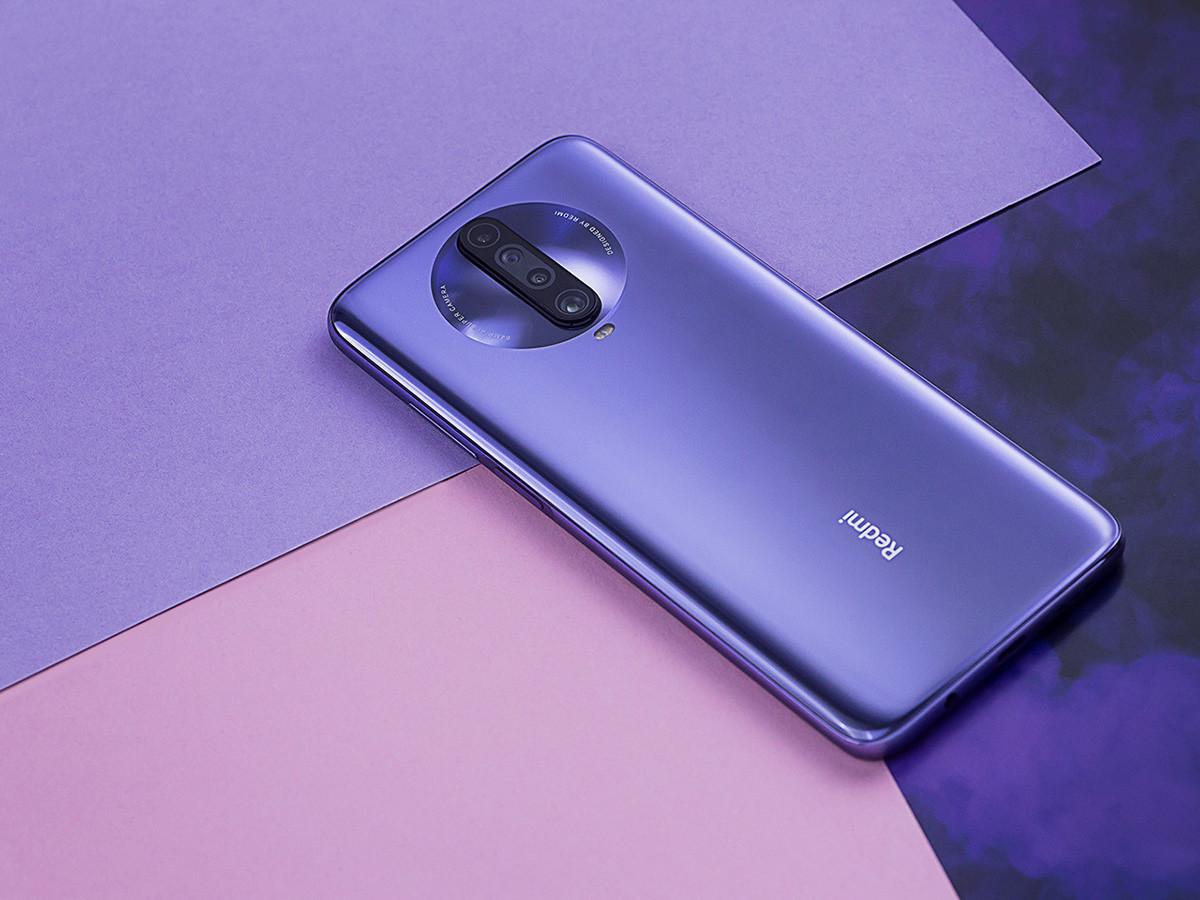
The back panel of the phone features a vertical quad camera setup which is placed inside a glossy round pattern. It features the Sony IMX686 64-megapixel primary lens with an f/1.89 aperture and a 1/1.73″ sensor size. The other sensor of the Redmi K30 5G’s rear camera setup includes an 8-megapixel ultra-wide lens with 120-degree field-of-view, a 5-megapixel macro lens and a 2-megapixel depth assist lens.
The company claims that the Redmi K30 5G has the same camera algorithms that is available on the Xiaomi Mi CC9 Pro that features 108-megapixel penta-lens camera setup. On the front, the Redmi K30 5G features an AI powered dual camera setup that includes a 20-megapixel main lens and a 2-megapixel depth sensor.
The device is powered by a 4,500mAh battery and carries support for 30W fast charging technology. The smartphone is equipped with an independent high-efficiency charge pump with a charging conversion efficiency of up to 97 percent.
The Redmi K30 5G model will be available for purchase in January 2020 while the pre-sale of the 4G model is now available for purchase in the market.
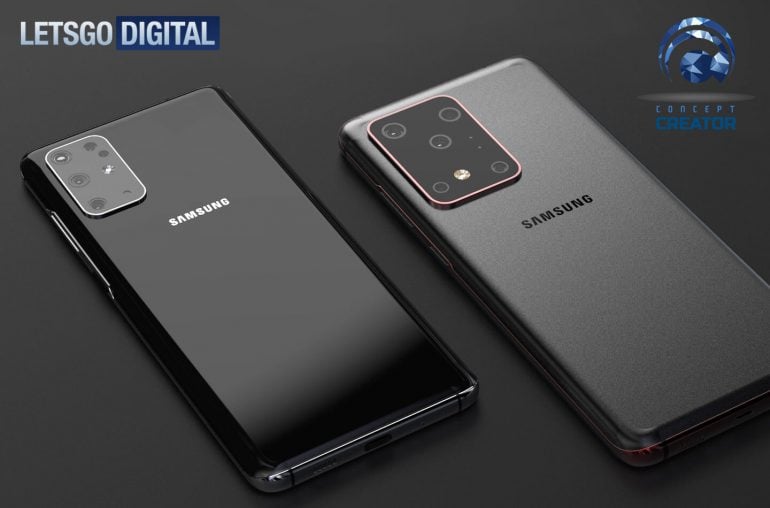
The Samsung Galaxy S11 is launching on the 18th February 2020, and while most of the specs have leaked, the only real-life picture that has leaked did not reveal too much, except that the camera protrusion will be rather significant. That means we are still relying on renders, and today we have an excellent render created by LetsGoDigital and the famed Concept Creator, showing the Samsung Galaxy S11.
The renders gives us another look at the upcoming device, along with its massive camera bump. The render is perfectly in line with previous reports claiming that the rear camera hump adds 1.1mm thickness to the S11’s body. It’s definitely not the prettiest design choice, but it apparently has some pretty sophisticated camera tech behind it.
The Galaxy S11 will feature a large 108MP camera sensor, probably the ISOCELL BRIGHT HMX Samsung sensor at the back. The primary sensor will be further supported by a 5x optical zoom setup on both these devices. There will also be two more sensors, an ultrawide-angle lens and a time-of-flight sensor for depth detection. Both the devices are expected to be launched in February 2020.
The Galaxy S11 will allegedly arrive in two different variants. One with the recently-unveiled Qualcomm Snapdragon 865, and the other with the Exynos 990 (Exynos 9830). Both chipsets are 5G-enabled and feature up to 12GB of RAM and 512GB of native storage depending on the variant.
The Galaxy S11 is also likely to sport wireless charging, IP68 certification, and an in-display fingerprint scanner. Samsung is currently working on its upgraded UI, One UI 2.0, which should also make an appearance on the S11. The smartphone will run on Android 10 out-of-the-box. Samsung will offer the device with both 4G and 5G compatibility, instead of only offering 5G.
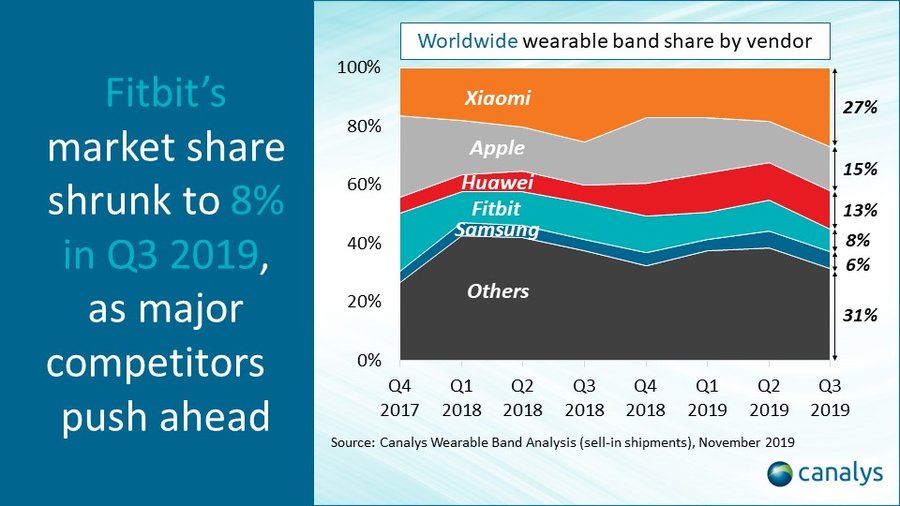
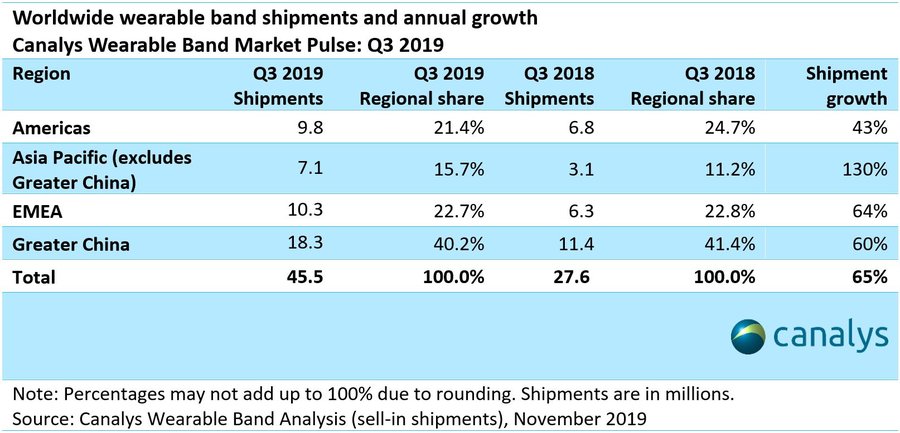
Over the past decade, we’ve seen smartphones become an essential part of our daily lives. Thanks to rapid advancements in technology, we can now say the same about wearable market. Market research firm Canalys has released the latest shipment numbers for the wearables segment in the third quarter, with Xiaomi at the front of the pack as expected.
The massive success of the Mi Band helped Xiaomi to become the number one brand in the global wearables market. Shipments of the company’s smart wearables totaled 12.2 million units for 27 per cent Q3 market share, with an impressive 74 per cent growth year-over-year. The primary reason behind Xiaomi’s success is its good old strategy of selling feature-rich products at competitive price points.
Apple placed second with 15% market share, where 60% of shipments were attributed to the newest Apple Watch Series 5. During the same month, Apple had cut the price of the Watch Series 3 to $199. Canalys notes that Apple recorded its highest year-over-year growth since Q2 2017.
Huawei ranked third with 5.9 million units and 13% market share and saw a 243% annual growth thanks to growing sales in China. Unlike Xiaomi and Apple, Huawei manufactures both fitness trackers and smartwatches, giving them a slight upper hand.
Fitbit (soon to be acquired by Google) made up 8% of the market, and was the only vendor that didn’t see much growth compared to last year. Samsung on the other hand managed to hold its position at number fifth in terms of market share. The research firm notes that the Galaxy Fit was well received by consumers in Asia. Following this we have many other smaller brands that acquired 31% market share.
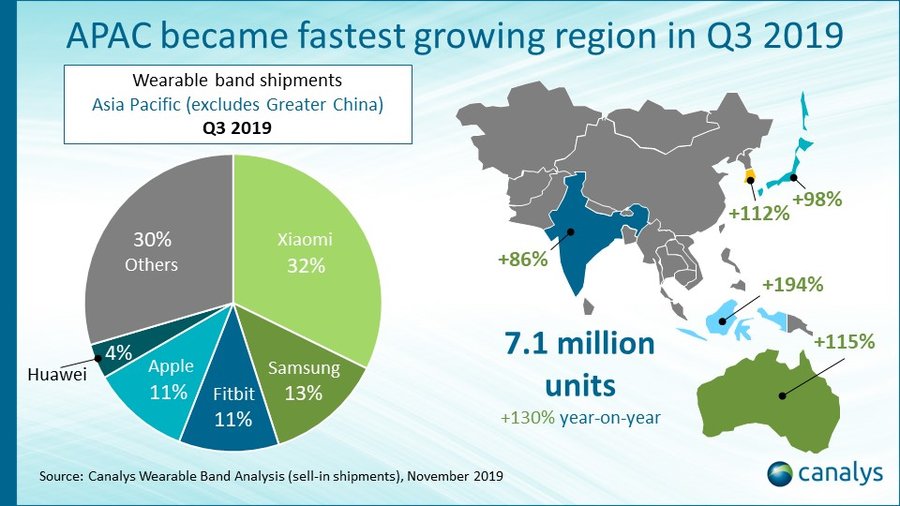
The American market was mostly dominated by Apple. As mentioned above, the Apple Watch Series 5 brought many nifty features like an always-on display, improved customization, and many more. The highly price-sensitive market of Asia-Pacific was mostly ruled by Xiaomi, Samsung, and Fitbit. Surprisingly, both Android and iOS users contributed to the rapid success of Mi Band 4 in India.
Chinese giant Tencent has today officially launched its second-generation eBook reader in the country, named Tencent Pocket Reader II. The product, priced at 1,099 yuan (approximately $158), comes in multiple color options.
The Tencent Pocket Reader II measures 145 × 75 × 8.5mm and weighs around 130 grams. It comes featuring a 5.2-inch e-ink screen that offers 284 PPI pixel density and has 36 backlit reading lights.
It has the latest Carta 2 ink screen along with 2.5D AG process glass optical technology which the company claim improves the paper effect on the screen. Under the hood, the eBook reader is powered by a quad-core A53 CPU. The device also comes with physical keys that enables users to turn the pages UP or DOWN.
The product also supports 4G mobile card / data card networking, along with support for calling, text messaging and WiFi networking. Users also have an option to switch ON the flight mode with just a single click.
The Tencent Pocket Reader II is directly linked to Tencent Reading Group’s book resource library. Between Pocket Reading and mobile QQ reading app, users can synchronise bookshelves, accounts, and reading progress across platforms.
It also enables users to import local books through Bluetooth or USB, and has also strengthened the support of third-party applications in the application system. It can independently select the refresh mode and supports more reading apps.
The device is powered by a built-in 2,000mAh battery and has a USB Type-C port for charging the product. The Tencent Pocket Reader II comes in Black, Green, and Red color for a price of 1,099 Yuan, which is roughly $158.
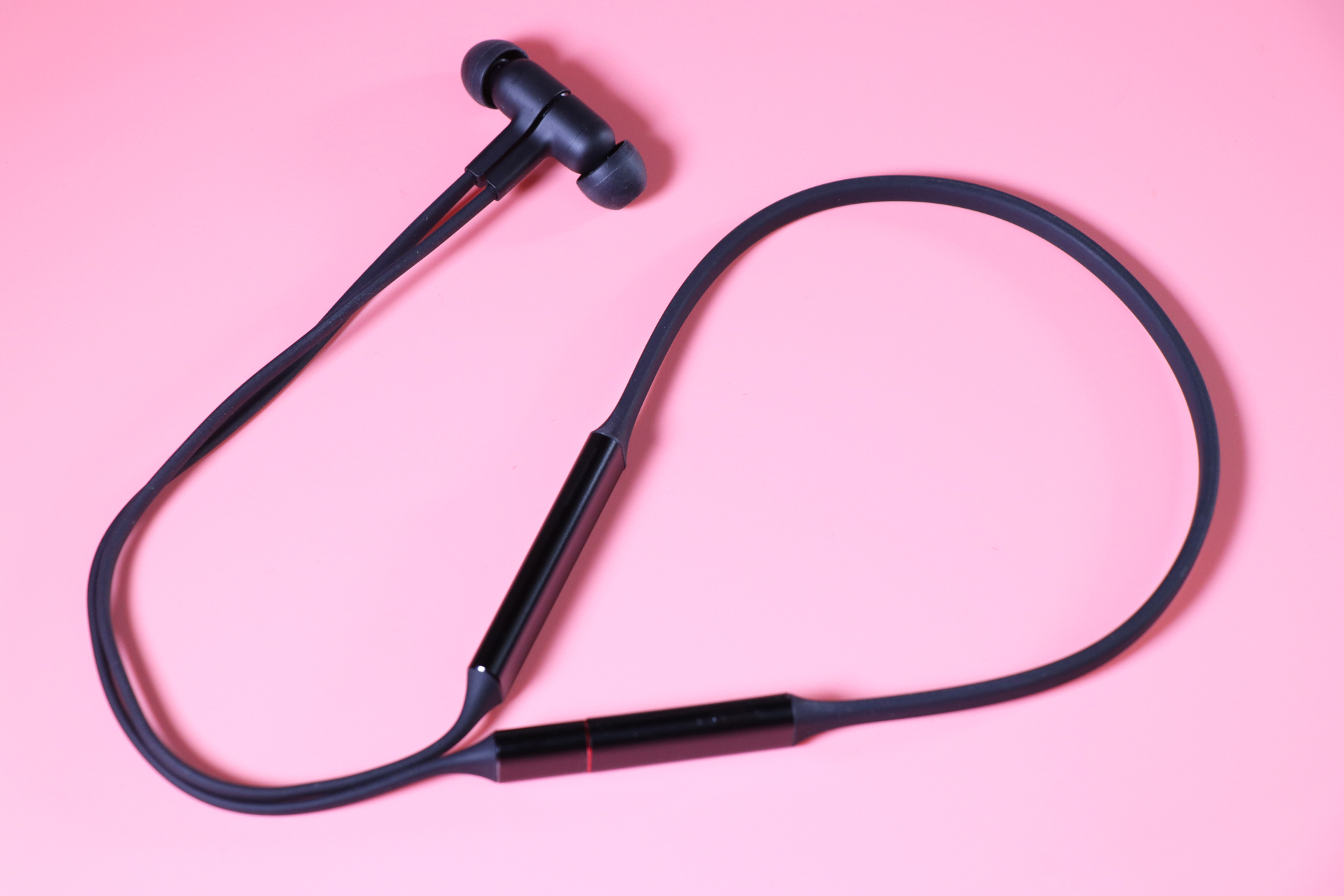
While wireless earbuds are becoming more popular, it doesn’t mean other types of earphones and headphones have become unpopular. Several wireless earphones and headphones, as well as wired types, were also launched this year. Notable examples are the OnePlus Bullets Wireless 2 and the Huawei Freelace which are fantastic wireless neckband-style earphones or the Sony WH-XB900N Wireless Active Noise Cancelling Headphones that takes the top spot in several rankings.
For this week’s poll, we want to know which type of headphones or earphones you use. Have you switched to wireless but prefer over-the-ear headphones to wireless earbuds or do you prefer wireless earphones with the neckband design? Or do you prefer wired earphones even if your phone no longer has an audio jack?
Do take the poll below and also post a comment telling us what influenced your current choice of headphones/earphones?
The OPPO Reno3 launch draws closer and with each passing day more details about the phone surface. The latest are live photos of the phone that reveal some of the phone’s specs.
The images were shared on Weibo by @Digital Chat Station and they show the system app, AIDA64 running on the phone. The Reno3 5G is shown to have a waterdrop notch, a blue power button, and a black frame.
The AIDA64 app confirms the phone is powered by MediaTek‘s MT6885 processor which will be officially known as the Dimensity 1000L. The second image shows the Dimensity 1000L has four Cortex-A55 cores clocked at 2.0GHz and 4 unknown cores clocked at 2.2GHz.
[envira-gallery id=”295252″]
The Reno3’s TENAA listing said the SoC is clocked at 2.2GHz, so these unknown cores are the performance cores and should be the Cortex-A77. Also, the AnTuTu result already revealed the chipset has a Mali-G77 GPU
The phone in the image has 8GB of RAM and 128GB of storage just as the TENAA listing revealed but we won’t rule out OPPO announcing other variants in the future.
The Reno3 will have a 6.4-inch FHD+ AMOLED screen, a 64MP primary rear camera paired with an 8MP ultrawide angle camera, a 2MP macro camera, and a 2MP depth sensor. There will also be a 32MP camera in front for selfies.
OPPO will ship it with a 4025mAh battery and ColorOS 7 based on Android 10. It will also have an in-display fingerprint scanner.
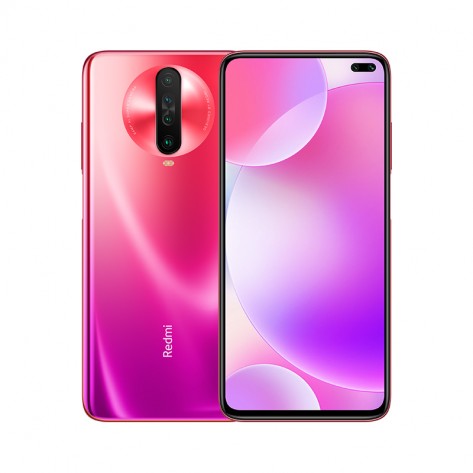
Prior to the launch of the Redmi K30 series, TENAA published the specs of the 4G version of the phone but didn’t do so for the 5G version. The agency has now published the specs of the Redmi K30 5G and it reveals we may get a new variant in the future.
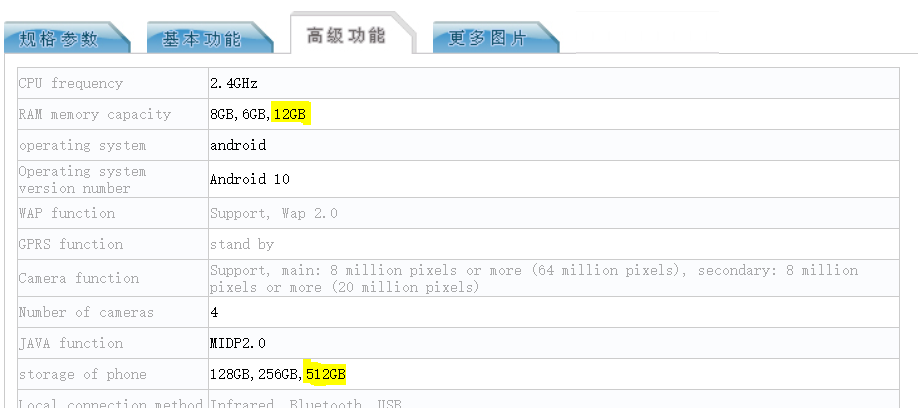
The Redmi K30 5G (M2001G7AE) was announced in four variants – 6GB+64GB, 6GB+128GB, 8GB+128GB, and 8GB+256GB. However, the TENAA listing states there is a 12GB RAM version with 512GB of storage.
That sure is a lot of RAM and storage for an upper mid-range device but there is still no confirmation that Redmi will eventually release this version.
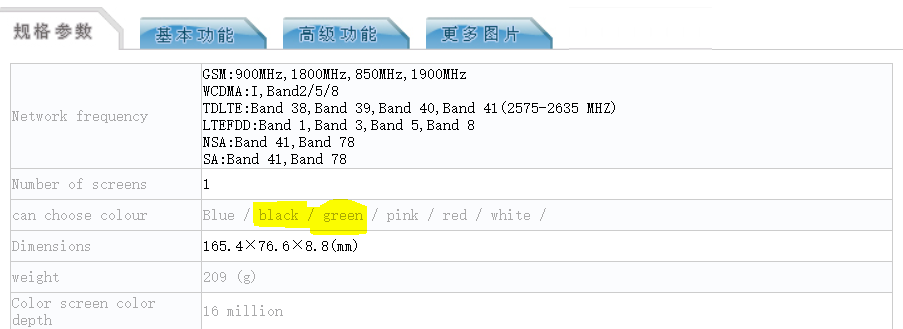
The TENAA listing also reveals there are black and green color variants of the phone which were not announced at the launch. So we may not only get a new 12GB RAM version in the future but also new colorways.
Redmi will not begin selling the phone until January 2020, so there is still a bit of waiting to do before it goes on sale.
The Redmi K30 5G has a 6.67-inch 2400 x 1080 IPS LCD display with two punch-holes. Yes, there are actually two separate holes but Redmi uses software to darken the space between the holes so it appears as a single pill-shaped hole. Also, the display has a 120Hz refresh rate and HDR10 support.
Inside the phone is the Snapdragon 765G processor. There are four cameras on the back of the phone – a 64MP Sony IMX686 primary camera, an 8MP 120° ultrawide angle camera, a 5MP 2CM macro camera, and a 2MP depth sensor. The Redmi K30 5G also has a 20MP primary selfie camera paired with a 2MP depth sensor.
Redmi has included a 4500mAh battery with support for 30W fast charge. There is also NFC, an audio jack, IR Blaster, dual-frequency GPS, Bluetooth 5.0, and a USB Type-C port. The Redmi K30 5G also has a side-mounted fingerprint scanner, Hi-Res Audio and runs MIUI 11 based on Android 10.
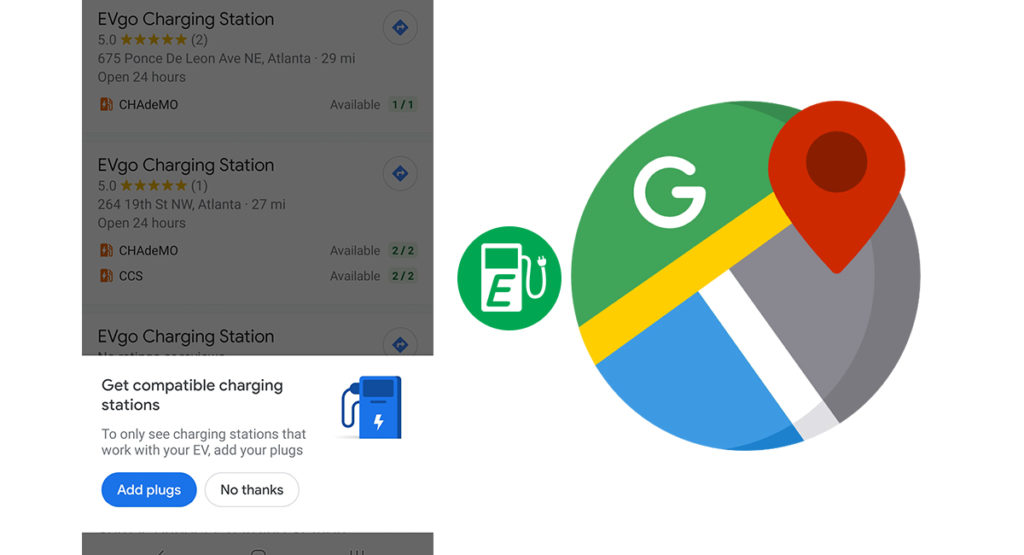
Google always keeps incrementing its services using new features and enhancements. They always tend to make the services user-friendly and feature-rich by listening to users’ demands in real-time. On such a similar note, Google Maps has recently received a new filter to classify the Electronic Vehicles charging stations based on plug type. Google Maps adds filter of plug type for EV charging stations
The search giant finally paid heed to the users’ demand who own an electric vehicle. There are different types of charging connectors used by several car manufacturers. For example, Nissan use CHAdeMO, Tesla uses its connector, and the BMW and VW use CCS plug type for charging their cars. However, the users can choose from different plugs, including J1772, CCS (Combo 1), Type 2, CCS (Combo 2), CHAdeMO, and Tesla.
Since the inception of the EV search facility got over Google, the users were missing out on the ability to filter results based on the connector type. The recent update will surely a sigh of relief for the daily drivers. It will help them to drive card directly to the compatible charging station. Especially, travelers using Electronic Vehicles will surely benefit from such a service.
To use the new feature, the users can head over to the Google Maps > Settings > Electric Vehicle Settings >Your Plugs > Choose and save. This way, users can flawlessly search the compatible EV stations using Google Maps. It’s a crucial feature for the users and will end the users’ reliability of using third-party apps like PlugShare.
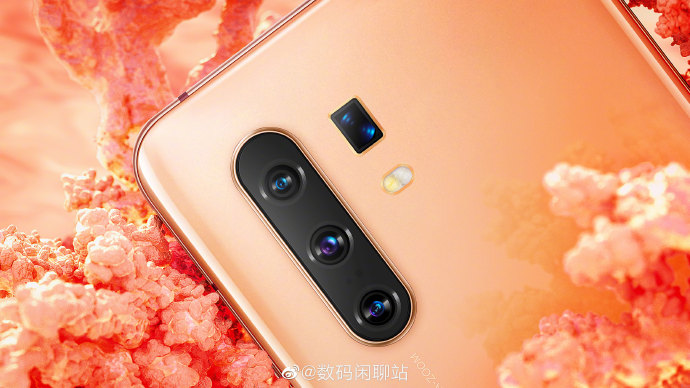
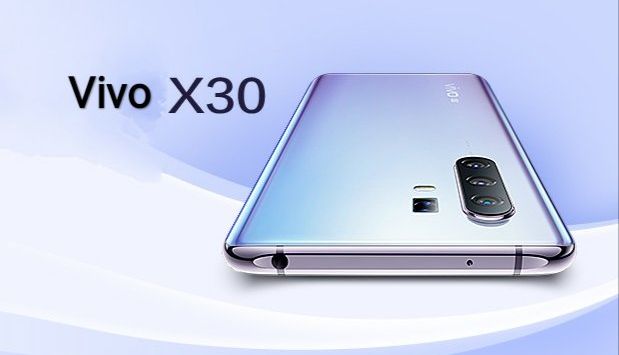
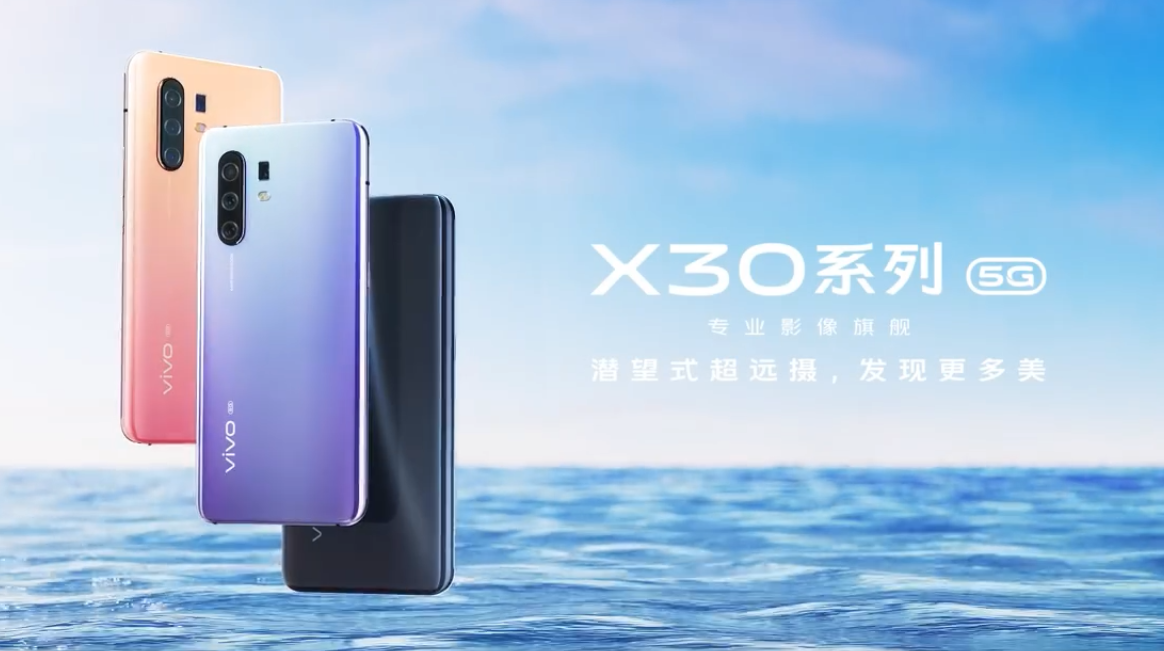
Only a handful of hours is separating us from the official launch of the Vivo X30 series. The new Vivo’s line-up will be composed of Vivo X30 and X30 Pro alongside their 5G variants and it will include the first smartphones from the X series to carry the support to 5G connectivity. Ahead of the launch, a lot of official information and leaks appeared online, so we know almost everything about the specifications of the new handsets. Here is a rumor roundup with all the reliable info about these devices we got in the last period.
Vivo X30 and X30 Pro (5G) Rumor Roundup
Design
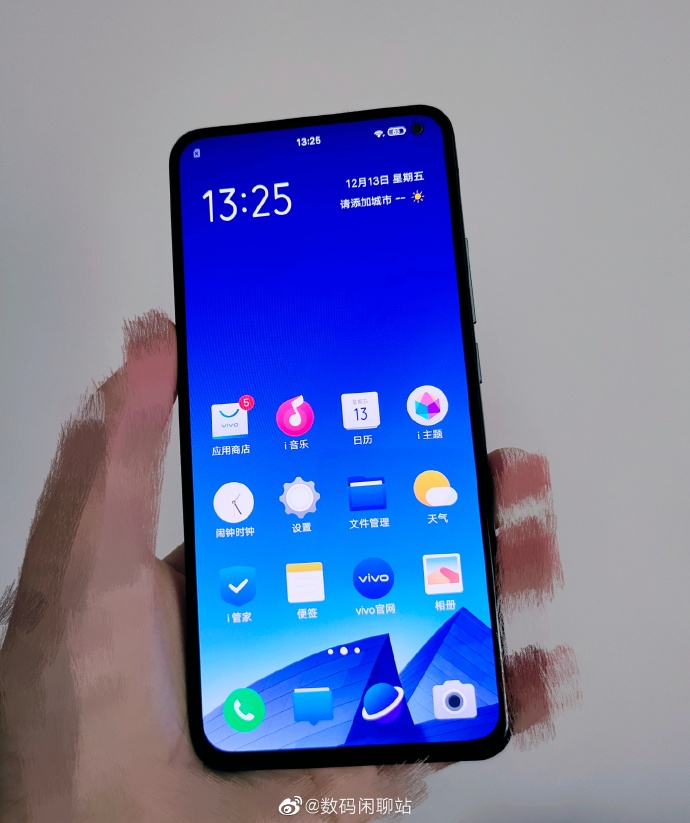
Vivo X30 and X30 Pro will offer very attractive aesthetics. Official teasers confirmed that the new series will offer punch-hole displays and a very high screen-to-body ratio. Just like most of the premium smartphones, Vivo X30 and X30 Pro will come with high build quality, so they will sport a glass back and an aluminum frame.
On the rear side, there will be a quad-camera setup with three sensors placed vertically and a fourth sensor on the right of the main camera module. The LED flash will be placed under the fourth camera module which will be a periscope lens. The phones will arrive in at least three color variants: there will be a Black version as well as two gradient color options: a blue/purple one (Aurora) and Coral Red.
As we already mentioned above, the Vivo X30 series will offer punch-hole displays. There will be no notch and the front camera will be integrated into the screen. Both the Vivo X30 and Vivo X30 Pro are tipped to come with a 6.5-inch Super AMOLED display. The panel should have a 20:9 aspect ratio and a Full HD+ resolution with 1080 x 2400 pixels. It will also integrate an in-display fingerprint reader. Thanks to the punch-hole display, the phones will have very narrow bezels without the need for a notch.
Vivo X30 and X30 Pro will be the first smartphones equipped with the world’s first processor sporting an integrated 5G modem. We are talking about the Exynos 980 developed jointly by Samsung and Vivo. It supports both SA and NSA connectivity and it can reach download speeds of up to 2.55 Gbps. While using both 4G and 5G dual connectivity, it can be even better as it can reach up to 3.55 Gbps download speeds. Besides 5G, Exynos 980 also supports Wi-Fi 6.
It is a chipset composed of Cortex A77 CPUs and a Mali G76 MP5 GPU, so we are talking about a high-end SoC, in case you missed that. It has an octa-core architecture and it reaches a max frequency of 2.2 GHz. Vivo X30 Pro will be equipped with 8 GB of RAM and 128 GB of internal storage, but we still do not know if there will be other memory configurations. Unfortunately, they are tipped to come with Android 9 Pie in a period in which the most important mainstream brands are launching Android 10-powered smartphones.
The OS will be customized by Funtouch OS. Vivo X30 Pro recently surfaced on AnTuTu benchmark: the phone scored more than 326,000 points in the benchmarking platform. While it is not comparable to the most performing flagships, X30 Pro managed to obtain a pretty nice high-end score. It is a total score superior to every Qualcomm’s midrange chipset, even the new Snapdragon 765G found on the Redmi K30.
5G and the camera department will be the main features of the Vivo X30 series. The rear camera department of the X30 Pro will be composed of four sensors: a 64 MP main lens, a 32 MP portrait sensor, an 8 MP ultrawide lens and a 13 MP periscope lens. The smartphone will offer up to 60x digital zoom experience. There will be both OIS and EIS for an excellent stabilization.
Vivo’s product line manager Luan Xinlin has published a photo that looks like the night time moon shot captured with the X30 Pro main camera. As you probably know, it is almost impossible to shoot a decent photo to the moon with almost every smartphone out there. But this device does it pretty well. And thanks to its 32 MP lens it will also be able to shoot great portrait shots. The front camera will be a 32 MP sensor.
Vivo X30 Pro is expected to come with a satisfying 4500 mAh battery and, according to 3C, the smartphone will support a 33W fast charging technology. We are not talking about the highest battery capacity and neither about the fastest charging technology, but everything is above-average on the battery side.
The Vivo X30 series will be officially announced on December 16. On this date, the company will also reveal the official listing prices of both the smartphones, while now we have no info about them. We can only tell you that their predecessors Vivo X27 and X27 Pro were launched in China with CNY 3198 and CNY 3998 prices respectively.
According to rumors, the Pro version may cost less than 3000 Yuan which roughly translates into $426. The smartphones are not expected to leave the Asian market (at least initially) and they will be launched in China. A future launch in the Indian market is expected too. If you want to have all the possible information about the new line-up, head to our dedicated page including all the news we published about the X30 series.
OnePlus is always known for the software stability of its smartphones. The rigorous testing ensures to filter every tinnier flaw in the OxygenOS. Despite such endless efforts, there are always some features that remain un-validated. Similarly, several OnePlus 7T Pro users are complaining about the Adaptive Brightness issue on the community forums.
The users are having an issue with the auto-brightness features of the device. It keeps the display in low brightness mode even while under the direct sunlight. The problem is forcing users to deactivate the feature and return to manual mode for adjusting display brightness.
A user complained about the issue on OnePlus community forums by saying, “I’m not sure if I’m the only one because the adaptive brightness on my brand new One Plus 7T Pro is absolutely abysmal. It goes black when it shouldn’t and is clearly not working as it should. I turned it off and kept the brightness to my liking but I’m really unhappy with how this has been implemented on this phone or is it only my device that’s having this issue?”
Another user feels that he has to adjust the brightness more frequently while using Adaptive brightness mode rather than the manual mode. Here’s the story in his own words, “I have exactly the same issue on 7T. very unpredictable behavior of the adaptive brightness. Unfortunately had to deactivate it as well, as I found that be keeping the brightness to around 30% means I have to tweak it fewer times than when I have it on auto.hipefully this will get fixed at some point.”
There are multiple threads on the community forums about the same issue. On the other side, some units of OnePlus 7T Pro are working fine with the Adaptive Brightness feature. Surprisingly, our OnePlus 7T Pro unit is also behaving normally, both in the full bright and low light environments. However, we expect a quick fix for the units facing this issue via the upcoming updates. There’s no such issue with the OnePlus 7T device as of now.
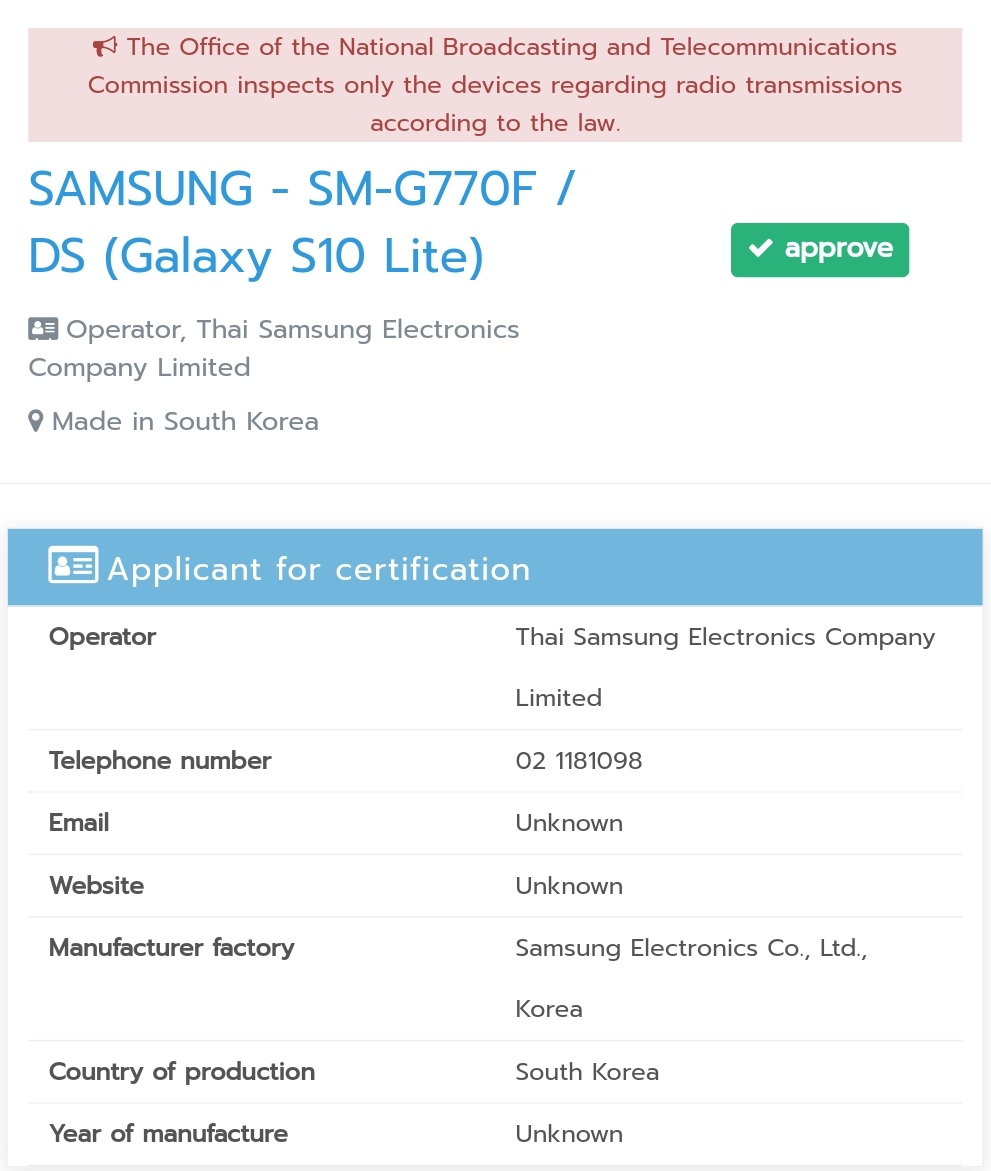
This year, Samsung deviated from its usual tradition when it comes to its flagships. The Galaxy S series got a new affordable variant with the “e” suffix alongside while the Note series was split into a standard version and a “Plus” version. But Samsung isn’t done yet, the world’s number one phone company is set to introduce a Galaxy S10 Lite and Galaxy Note10 Lite. Both phones have been in the news for weeks now and their launch is closer with two new certifications.
First is the Galaxy S10 Lite which has been certified by Thailand’s NBTC. The certificate confirms the name of the device again and reveals that the SM-G770F model us the Global Dual SIM version.
The Galaxy S10 Lite is expected to launch this month with a Snapdragon 855 processor, 8GB of RAM and 128GB of storage. It will have a punch-hole display just like the Galaxy Note10 and triple rear cameras with a similar design to the recently announced Galaxy A71.
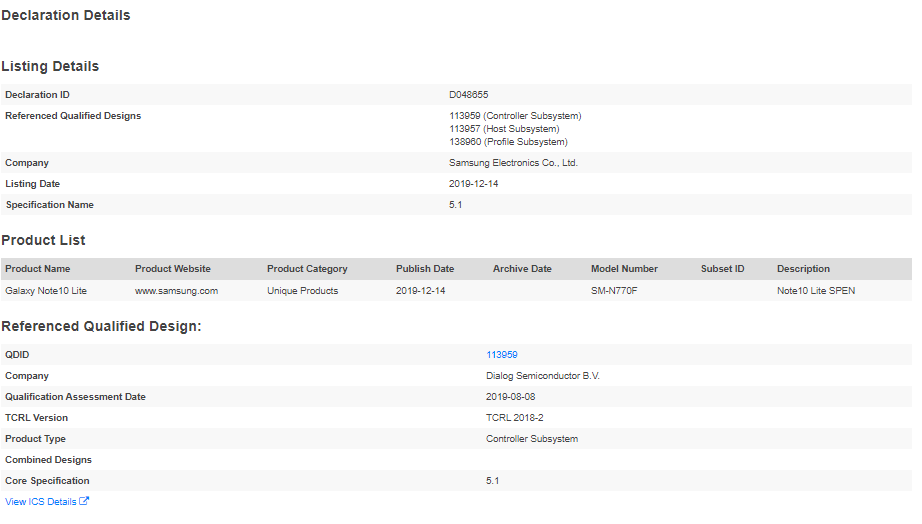
While the Galaxy S10 Lite was getting certified in Thailand, the Galaxy Note10 was certified by the Blue Special Interest Group (SIG). The phone with model number SM-N770F and description name “Note10 Litre SPEN” will come with Bluetooth 5.1.
The Galaxy Note10 Lite appeared on Geekbench last month. The phone will be powered by the Exynos 9810 processor, have 6GB of RAM and run Android 10 out of the box. It will have a punch-hole AMOLED display, an in-display fingerprint scanner, and an S Pen with Bluetooth.
While the S10 Lite is expected to launch this month (also as the Galaxy A91/A81), the Note10 Lite may not arrive until next year.
WhatsApp is one of the most commonly used instant messaging app across the world on different platforms. Since its acquisition by Facebook, the app has received several features improving the overall experience. Recently, the app added support for tasks and reminders in partnership with Any.do. It enables better productivity on WhatsApp, which was never the case. Thus, to utilize this feature, we have come up with this guide on how to add/save reminders and tasks on WhatsApp using Any.do.
Any.do is one of the leading productivity services, and by partnering with them, WhatsApp has made the right decision. However, there is a caveat, as this feature is only available for Any.do premium subscribers, which cost $2.99 / ₹75.82 per month and is billed annually. That being said, the tasks and reminders feature on WhatsApp can be enabled by either visiting whatsapp.any.do or from the integrations section on the Any.do app.
Steps to add/edit reminders and tasks on WhatsApp
Open the Any.do app and navigate to Settings -> Integrations -> WhatsApp.
Add your WhatsApp number and tap on send.
Enter the six-digit OTP received through text to confirm your number.
Now, simply turn on reminders and a new conversation with Any.do bot. It will be added to your WhatsApp account.
Once the WhatsApp integration is set up, you can add/save reminders and tasks by two methods.
Reminders and tasks are added/saved in WhatsApp by directly texting to Any.do bot conversation by typing “Remind me to…” or forwarding a message from a different chat to Any.do bot.
Thus, you will never miss any important things from your family, friends, or colleagues while chatting with them on WhatsApp.
We hope our small guide to add reminders and tasks on WhatsApp would have helped you. If you get any problem while installing or accessing the above services, then do let us know via the comments below.
Huami has had a pretty interesting year. The Chinese manufacturer which makes fitness trackers and smartwatches under the Amazfit brand released no less than 7 watches this year. That is a little short of its 10-watches target but still a lot. Today, the manufacturer announced on Weibo it will be attending CES 2020 and will unveil a new product at the 4-day event.
The teaser poster shared on Weibo shows the figure of a woman running while a text under the image reads “Leap over Limits”. It doesn’t reveal much but a translation of the caption says “…not just smartwatches”. This is a hint that the product isn’t a smartwatch. So if it isn’t a watch (or fitness tracker), what can it be?
We think the new Amazfit product is a pair of running shoes, or to be more specific, a pair of smart running shoes. Amazfit not only makes smartwatches and fitness trackers but also makes sports apparells. In the past, the manufacturer has announced a short-sleeve T-shirt, a sun-proof coat, a pair of athletic shorts, and a pair of running shoes called the Skylark Ultralight Running Shoes.
The upcoming product is most likely a smart version of its running shoes with a step tracker built-in that records your steps. Actually, this product category is not new. Xiaomi has launched a couple of smart running shoes over the past few years and even announced a third-gen version back in August 2019. We believe Amazfit, although late to the party, will announce its first pair at the CES event.
The poster says the launch is on January 7, the first day of CES 2020, and will begin at 16:30 (local time). We hope there will be more details about the new product before the launch day.
Xiaomi is one of the world’s most renowned smartphone makers that continue to live up to the reputation for offering feature-laden mobile devices that fit inside everyone’s budget.
While most of Xiaomi branded phones are reasonably priced as compared to similar offerings from other popular manufacturers, we have listed the top 5 smartphones from the Chinese electronics company that you can buy for under $200. So without wasting more time, let’s dive straight into the details.
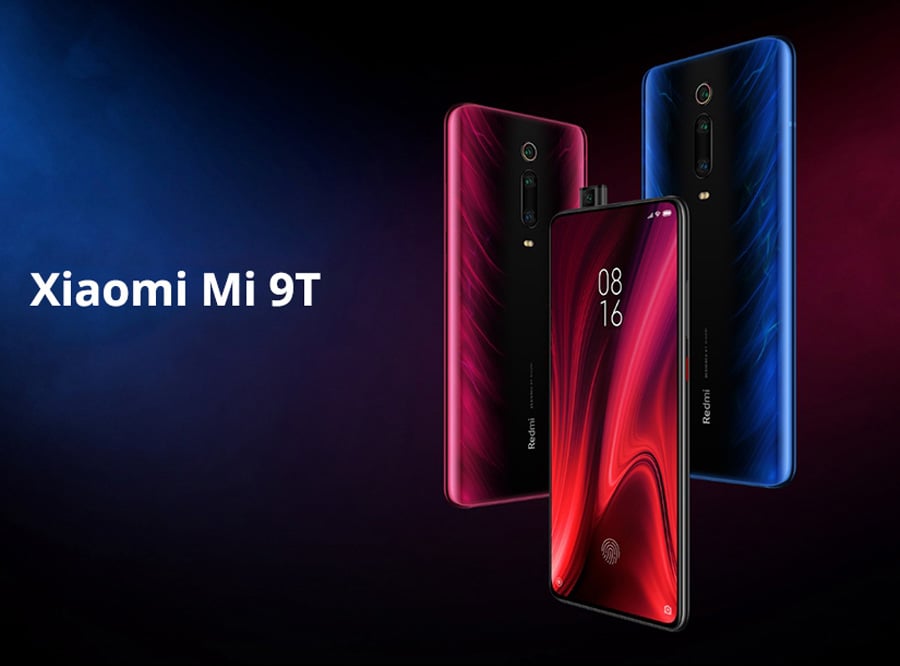
Xiaomi Mi 9T 4G Smartphone – Gearbest
Gearbest is known for offering China’s best electronic items including smartphones at unbeatable prices. The Chinese e-tailer is currently doling out a noteworthy 23 percent off on the global version of the Xiaomi Mi 9T smartphone, which usually retails for $388.65.
Available in black, as well as blue color options, the Mi9T comes with 6GB of RAM and offers 64GB of internal storage space. Thanks to the aforesaid discount, the aforesaid Mi9T variant is currently available for a lowered price of just $299.99 through Gearbest.
An absolute steal at this price, the Xiaomi Mi9T offers the following features:
6.39-inch display with 2340 x 1080 pixels resolution
Snapdragon 730 Octa-Core processor
Adreno 618 GPU
48.0MP + 13.0MP + 8.0MP cameras at the back
20.0MP front camera
Android 9.0
4000mAh battery
You can follow this link to check out the rest of the specifications and place your order before the flash sale comes to an end. As part of the promo, Gearbest had sold out more than 500 pieces at the time of writing. Note that the flash sale will end in three days.
Xiaomi announced the Redmi Note 8T in November this year and as expected, the phone became an instant hit among the company’s huge fanbase. While leading manufacturers attach a steep price tag to their feature-rich mobile devices, Xiaomi is giving its loyal fans a chance to purchase the Redmi Note 8T for an unbeatable price of only $179 through Giztop.
Giztop will be shipping the product from a warehouse based in Europe, which means European consumers will not be able to receive it faster, but will also save a considerable amount of money, they’d normally spend on customs tax. This gray-tinted Note 8T phone comes with 4GB of RAM and 64GB of onboard storage in addition to the following awe-inspiring features.
6.3-inch Dot drop notch screen, FHD+ display
Qualcomm Snapdragon 665 AIE octa-core processor
Adreno 610 GPU
48MP+8MP+2MP+2MP Quad AI rear cameras
13MP front camera
MIUI 10 base on Android 9 OS
4000mAh battery with 18W fast charging through USB-C
You can visit this link to get your hands on the amazing Redmi Note 8T and avail of faster shipping without having to pay customs tax. Note that the phone is a European version, running global software.
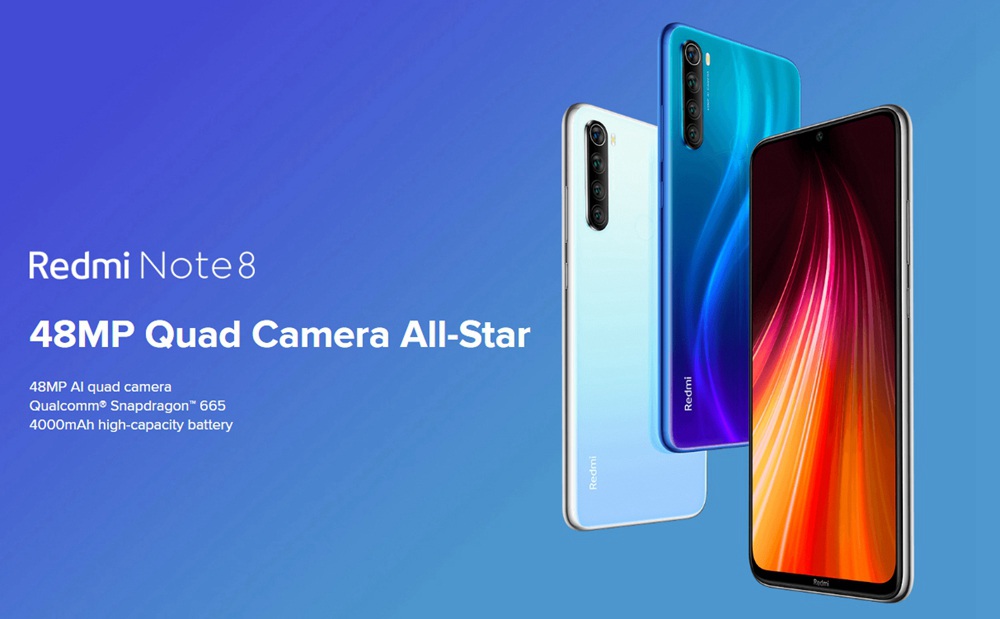
The Redmi Note 8 was launched in August this year. The irresistible smartphone boasts an impressive array of features that we will be talking about in just a bit. Before we check out what the Redmi Note 8 has to offer in terms of features, it might interest you to know that the 4GB RAM+64GB ROM global version of the phone has gone up for sale bearing a reduced price on GeekBuying.
You’d normally end up shelling out $259.99 on the above-mentioned Redmi Note 8 model, but the popular Chinese online store is giving you a chance to purchase it for a reduced price of just $172.99, which translates to a significant 33 percent off. Aside from that, GeekBuying is allowing its new users to save more money at check out.
If this is your first order with GeekBuying, you can take advantage of the 2% OFF New User Coupon by applying it during the check out process. This discount is available for the blue color option of the phone for just four days, which means, you need to visit the promotion page and place your order as soon as possible.
Xiaomi Redmi Note 8 is a 4G-ready smartphone that offers a slew of exciting features that we have listed below:
6.3-inch FHD+ screen with 2340 x 1080 pixels resolution
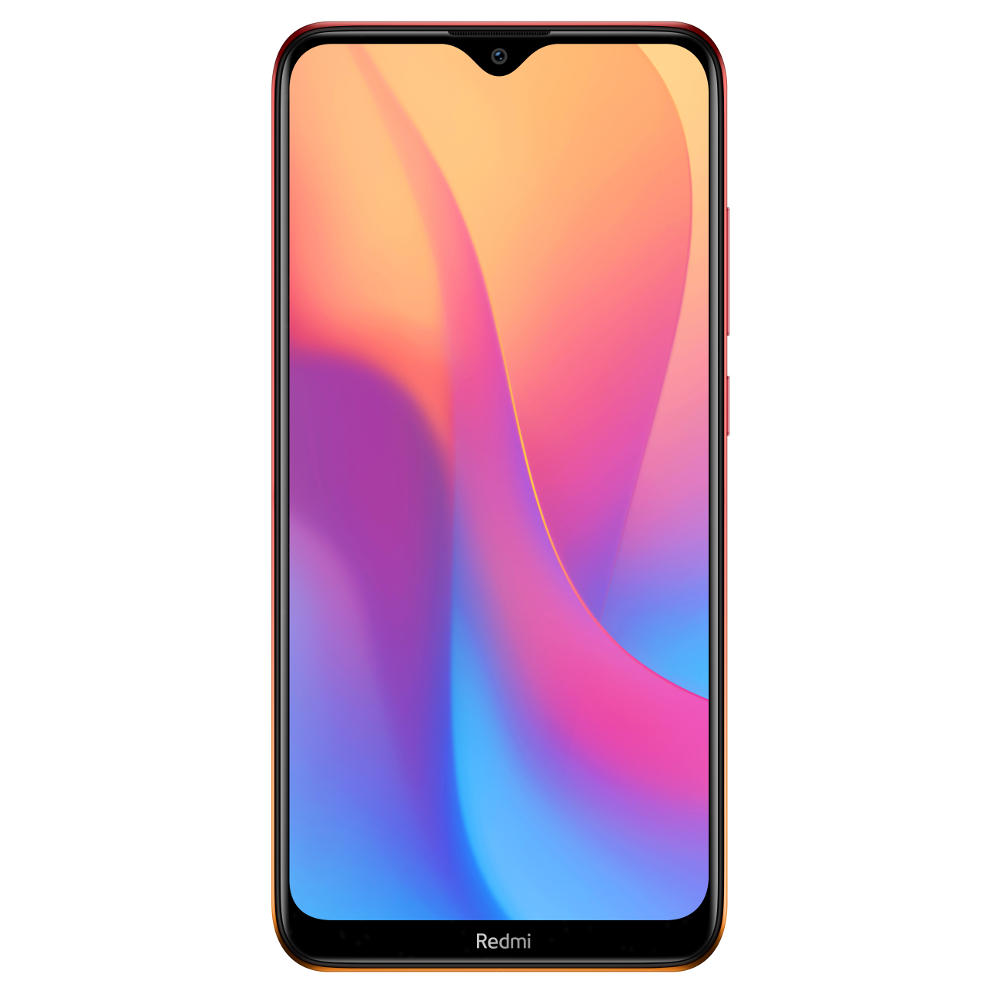
Xiaomi took the covers off the Redmi 8A smartphone earlier this year. Just like the rest of the mobile devices from the Chinese manufacturer, this recently unveiled smartphone is also crammed with top-end specification and exciting features; however, it won’t set you back a pretty penny.
You can buy the global version of the Redmi 8A with 2GB RAM+32GB ROM for just $174.58 from Banggood. Moreover, you can choose between two highly appealing color options including Sunset Red and Ocean Blue.
While the aforesaid model is available in Sunset Red color option, you can go for the Ocean Blue hued variant, which is available for just $174.58 on Banggood. On top of that, the e-tailer known for offering the best bang for your buck is offering free shipping on orders over $19.99. The Xiaomi Redmi 8A offers the following features:
6.22 Inch 19:9 Dot Drop display with 1520 x 720 pixels resolution
Snapdragon 439 Octa-core processor
Adreno 505 GPU
12.0MP camera at the back
8.0MP front camera
MIUI 10 OS
5000mAh battery with 18W fast charge
You can head straight to this link to check out more details about the Xiaomi Redmi 8A smartphone and place your order.
TomTop is doling out a noteworthy 45 percent off on the Redmi 7A, which was launched earlier this year. This discount is valid for the black-tinted, 2GB RAM+32GB ROM model that normally retails for $238.62.
Thanks to the discount, you can now get your hands on the global version of the Redmi 7A for a lowered price of just $132.73. TomTop is offering a 36 percent off on the blue, as well as the red color options as well, bringing their original selling price of $201.99 down to just $130.99.
The Xiaomi Redmi 7A is a well-received mobile phone under $200 that comes with amazing features that we usually associate with steeply-priced handsets.
5.45-inch HD full-screen (720×1440 pixels) with AI Face Unlock
Snapdragon 8-Core processor
5MP front camera
13MP HD camera rear camera
MIUI OS
4000mAh battery
You can follow this link and check out more details about the Xiaomi Redmi 7A mobile phone, which will be available for a lowered price on TomTop for a limited period only. Do let us know what you thought about our list of Xiaomi-branded smartphones that are available for under $200.
OnePlus is rolling out OxygenOS 10.0.7 update on OnePlus 7T packing several new performance tweaks and optimizations. The new incremental upgrade also includes November security patch featuring fixes for several security issues. The update is gradually rolling out to all the OnePlus 7T units.
According to the official changelog, the update improves the speed of app launching and enhances the overall performance. It optimizes the system for more efficient and effective RAM management. OnePlus claims to have optimized the black and white screen issue on some apps via the update. There are certain bug fixes to enhance overall system stability and security.
It is an incremental rollout and will be rolling out in small batches. It may take upto a few days or weeks to reach each OnePlus 7T users. However, the users can manually check for the OxygenOS 10.0.7 update by heading to the Settings > System > System Update > Press Check for Updates. It is recommended to switch to a WiFi network before downloading the update to save additional costs on the carrier network.
OnePlus users can now easily report any bug via the OnePlus Community app or system integrated feedback tool. Moreover, the new update is being received as the OxygenOS 10.3.0 on some OnePlus 7T units. OnePlus is looking into the matter and is working to rectify the issue.
Additionally, OnePlus 7T was launched last month with Snapdragon 855 Plus on the board coupled with 8GB RAM and 128 GB internal storage. It hosts a 6.55-inch Fluid AMOLED display featuring the resolution of 1080 x 2400 pixels and 402 ppi pixel density. There’s a triple camera unit consisting of a 48-megapixel primary camera, 16-megapixel lens and 12-megapixel units. OnePlus 7T is backed with 3800 mAh battery supporting fast Wawrp Charging technology.
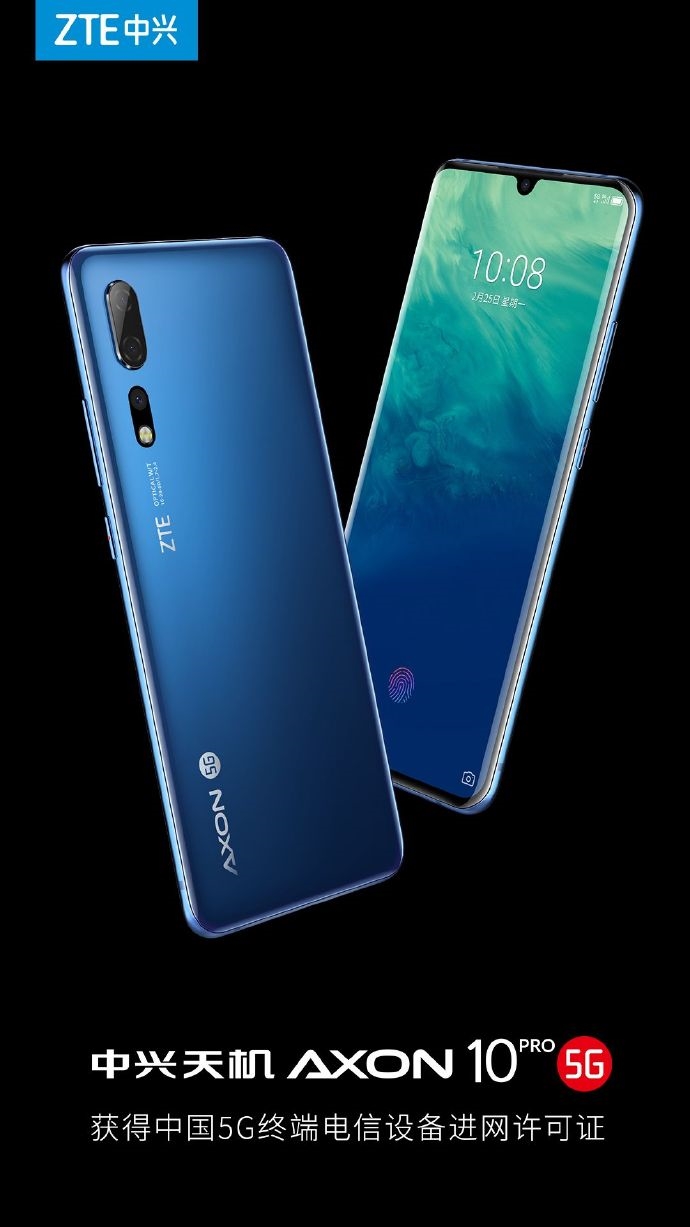
In a recent interview with Xu Feng, the Senior Vice President and head of ZTE’s global business, the executive revealed the name of its next flagship will be Axon 10s Pro. He also revealed some of its features and its launch date.
The Axon 10s Pro will be the successor to this year’s Axon 10 Pro. Unlike the Axon 10 Pro which has a separate 5G version, the Axon 10s Pro will only have a 5G version and that is because it will be powered by the Snapdragon 865 processor which Qualcomm will be shipping with the Snapdragon X55 5G modem to its clients.
The ZTE Axon 10 Pro 5G launched as the first 5G smartphone in China
The phone will come with a feature that allows it to switch seamlessly and intelligently between 4G/5G and dual-band WiFi (including WiFi 6).
Xu Feng says the phone will be announced at Mobile World Congress (MWC) 2020. However, it will not be the only new ZTE product announced at the event. It was also revealed that a new member of the Blade series will be announced as well as a 5G CPE that supports SA and NSA networks.
Mr. Feng also mentioned during the interview that they plan to launch up to 10 5G smartphones in different markets next year. These phones will be priced between ¥2000 (~$287) and ¥3000 (~$430). One of these phones will be launched in the first quarter of 2020 but we do not know if it is the same phone from the Blade series launching at MWC 2020 or a different phone.
The senior executive revealed during the interview that its goal for the 5G era is to return to the top of the mobile industry. It believes its knowledge and investment of 5G can help it achieve this. Mr. Feng said with a new network technology, there will be a reshuffle in the mobile industry. He cited Nokia and Motorola losing their crowns with the advent of 4G as an example and believes a similar thing will happen with 5G.
We use cookies on our website to give you the most relevant experience by remembering your preferences and repeat visits. By clicking “Accept”, you consent to the use of ALL the cookies.
This website uses cookies to improve your experience while you navigate through the website. Out of these, the cookies that are categorized as necessary are stored on your browser as they are essential for the working of basic functionalities of the website. We also use third-party cookies that help us analyze and understand how you use this website. These cookies will be stored in your browser only with your consent. You also have the option to opt-out of these cookies. But opting out of some of these cookies may affect your browsing experience.
Necessary cookies are absolutely essential for the website to function properly. This category only includes cookies that ensures basic functionalities and security features of the website. These cookies do not store any personal information.
Any cookies that may not be particularly necessary for the website to function and is used specifically to collect user personal data via analytics, ads, other embedded contents are termed as non-necessary cookies. It is mandatory to procure user consent prior to running these cookies on your website.