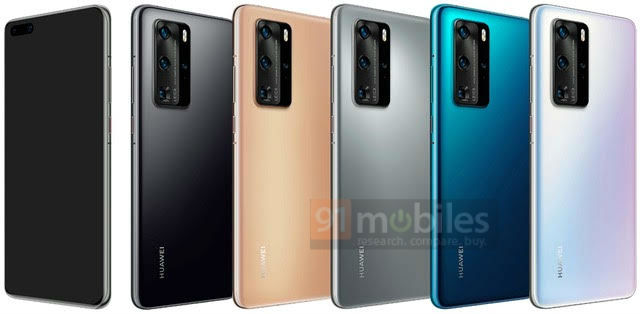
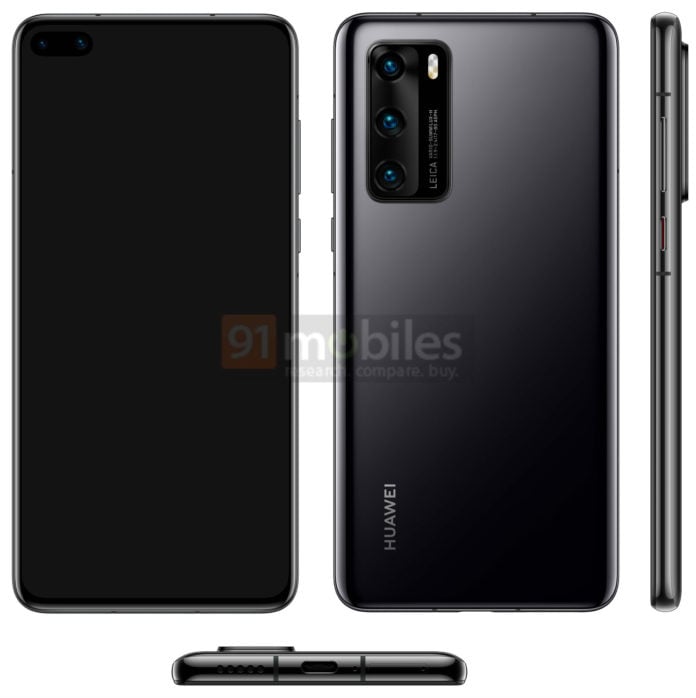
Yesterday, 91mobiles had shared a leaked render of the upcoming Huawei P40 smartphone. It gave a good view of the front and rear design of the smartphone. Today, the publication has shared a leaked poster of the Huawei P40 Pro. It reveals that the smartphone will be available in as many as 5 color variants. It has also claimed that the Huawei P40 will be also available in same hues.
Huawei P40 Pro
The Huawei P40 Pro image that was leaked through a reliable industry source shows that it will be arriving in color options such as Black, Blush Gold, Silver Frost, Deep Sea Blue, and Ice White with gradient finish. As mentioned above, the Huawei P40 will be also available in same color variants.
The Huawei P40 Pro and Huawei P40 are similarly designed smartphones. Yesterday’s leak had revealed that the Huawei P40 has a pill-shaped cutout at the upper-left corner of its display. The Huawei P40 Pro is also equipped with the same styled cutout on its screen. However, the only major visible difference between the display of the two phones is that the Huawei P40 has a flat screen whereas the P40 Pro is blessed with a curved screen. Both smartphones will be equipped with in-screen fingerprint sensors.
The Huawei P40 has a rectangle-shaped camera module at the top-left corner of its back. The same rear design is available on the P40 Pro. The camera housing of the P40 is packed with an LED flash and three cameras. On the other side, the P40 Pro’s camera setup include four cameras and an LED flash. The cameras on both phones are engineered by Lecia.
Huawei P40 and P40 specifications (Rumored)
The Huawei P40 could be coming with an AMOLED screen of around 6.2 inches. The Pro model could be featuring a 6.7-inch AMOLED display. A recent leak that the Huawei P40 Pro could be equipped with a 52-megapixel main lens in its quad camera setup. Its other camera sensors include an ultrawide lens, a periscope telephoto lens with 10x optical zoom and a 3D ToF sensor. The P40 could be featuring a main high-resolution lens, a ultrawide shooter a 3D ToF lens in its triple camera setup.
The Kirin 990 5G chipset will be driving both smartphones. The highest P40 Pro variant may offer users with 12 GB of RAM and 512 GB of native storage. Huawei is expected to announce the P40 series through a launch event in March in Paris.
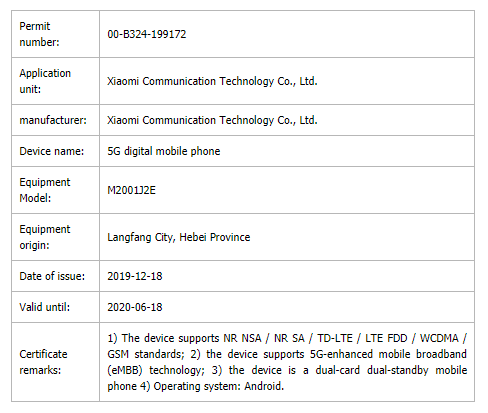
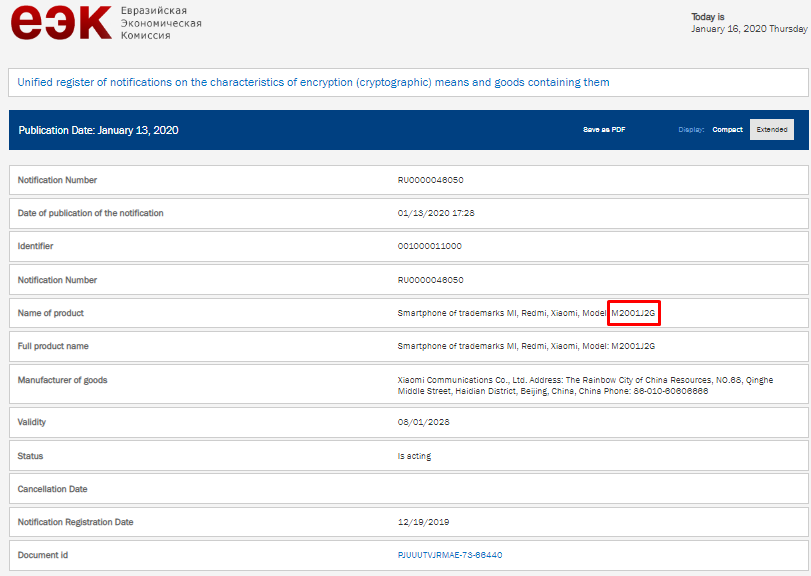
In November 2019, two Xiaomi phones with model numbers M2001J2E/C and M2001J1E/C were approved by the 3C authority of China. Speculations are rife that they are the upcoming Xiaomi Mi 10 Pro and Xiaomi Mi 10 smartphones. Now, the M2001J2E phone has appeared on the database of the China’s TENAA telecom authority. Also, a variant of the same phone has been spotted on the database of Eurasian Economic Commission (EEC) in Russia. It indicates that the Mi 10 series will be also heading to European markets in the near future. A reliable tipster from China has claimed that the Mi 10 series will go official in early February.
The Xiaomi M2001J2E’s appearance on TENAA hasn’t revealed any details on its specs. However, its mere appearance is a good hint that the phone may debut in the coming month. The TENAA listing of the Xiaomi Mi 10 Pro is expected to get updated with full specifications and images in the next few days.
A European variant of the Xiaomi Mi 10 Pro with model number M2001J2G has appeared on EEC. Again, the listing has no information on the specs of the phone.
The 3C listing of the Xiaomi M2001J2E/C had revealed that it may come equipped with a 66W fast charger. On the other side, the M2001J1E/C’s 3C appearance revealed that it could be accompanied with a 30W rapid charger. The M2001J1E/C hasn’t yet appeared on TENAA yet.
A well-known tipster has claimed that the Xiaomi Mi 10 series will be announced early in February. Samsung has scheduled its Galaxy Unpacked 2020 event on Feb. 11. The event will serve as a platform to unleash the Galaxy S20 series of flagship smartphones and the Galaxy Z Flip foldable clamshell phone. There is a possibility that Xiaomi may unveil the Mi 10 series before the Galaxy S20 event. Recently, Xiaomi Product Manager Wang Teng Thomas had hinted the release date and pricing of the Xiaomi Mi 10 series. The Mi 10 and Mi 10 Pro phones could be priced between 3,500 Yuan and 5,000 Yuan. He claimed that the Mi 10 phones will go official after the Spring Festival of China (Jan. 25.).
After working for over a year on Chromium-based Edge Browser, Microsoft has finally made it available for Windows and Mac. The new Edge Browser carries all the Chromium-based features with a refined touch from Microsoft. Microsoft parted ways from its browser engine back in December 2018 and switched to the Chromium codebase. The new browser provides better performance, more privacy, and enhanced productivity.
Microsoft is gradually rolling out the new browser for the users after rigorous testing. It supports all the Edge as well as the Google Chrome extensions. Microsoft Edge offers additional features like Collections to similar group content, and tracking prevention to safeguard your privacy. The users can choose from three different levels – Basic, Balanced, and Strict to avoid being tracked. It is ready for commercial users with enterprise-grade security.
In personalization and customization, the new Edge browser offers different page layouts to Focused, Inspirational, Informational, or can even customize it for a new tab. The users can also change language and can personalize the content feed.
The company has barred some features of the browser for remaining on the safer side from any bugs. The features like history and extension sync from Google Chrome is missing at the launch. However, the users can flawlessly sync favorites, passwords, settings, contact info/addresses, and payment details. Microsoft is also rewarding users for searching for browsing using Microsoft Edge and Bing.
The Chromium-based Microsoft Edge Browser is now available for Windows 10 and Apple macOS on MacBooks, whereas the iMacs users need to download the new Edge web browser manually. It will arrive soon for Linux in the coming days.
Apart from its availability across all Windows and macOS based systems, the new Edge browser will be bundled with the OEM based new PCs and laptop machines. Microsoft is also planning to push Windows Update to bring the Chromium-based Edge browser on Windows 10 by default. It will also become available for Windows 10X supporting foldable and dual-screen devices.
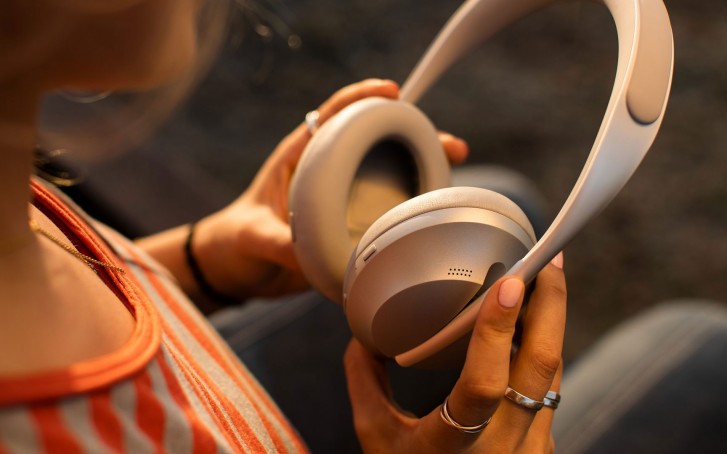
E-commerce and the process of buying products online or offline grown tremendously over the past couple of years. This has led many brands to focus more on own their websites or partner with major e-retail sites to sell online. Now, Bose is also following the same route as the company has issued a statement that it is closing down all of its retail stores in the US, Australia, Japan, and Europe.
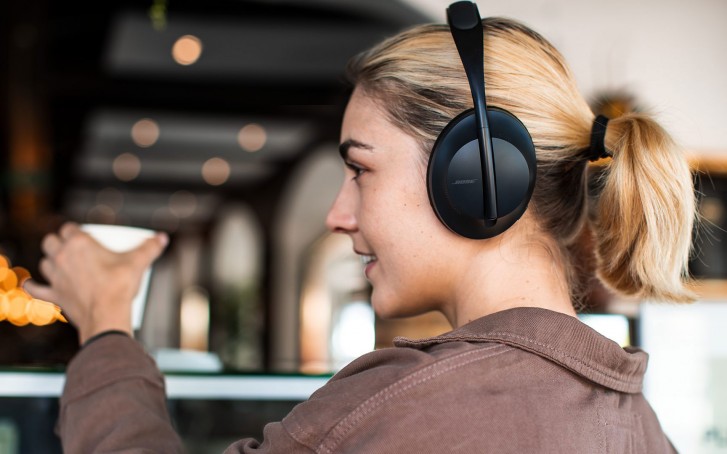
Bose Active Noise Cancelling Headphones 700
The main reason for this as the company stated was due to the fact that most of its speakers, headphones and other audiophilic products were being bought online. This makes the point of physical stores rather obsolete and cumbersome. Notably, the first Bose physical retails store opened back in 1993 and has numerous locations in both shopping centers and malls across the globe.
According to Bose, a total of 119 stores will be shut down over the course of the next few months. However, approximately 130 physical stores will still remain open in various other countries like China, United Arab Emirates, South Korea and a few Southeast Asian regions like India. The company is even offering “outplacement assistance and severance to employees” that will lose their jobs when such physical stores close.
Currently, Bose sells its entire lineup online through Amazon, Best Buy, Target, Apple Stores and various other third party retailers. This includes its signature noise cancelling headphones and its renowned home audio systems to even portable Bluetooth speakers. The company with its stores aimed to deliver a way for customers to experience its products without purchasing first, but the booming growth of e-commerce has since made it outdated.
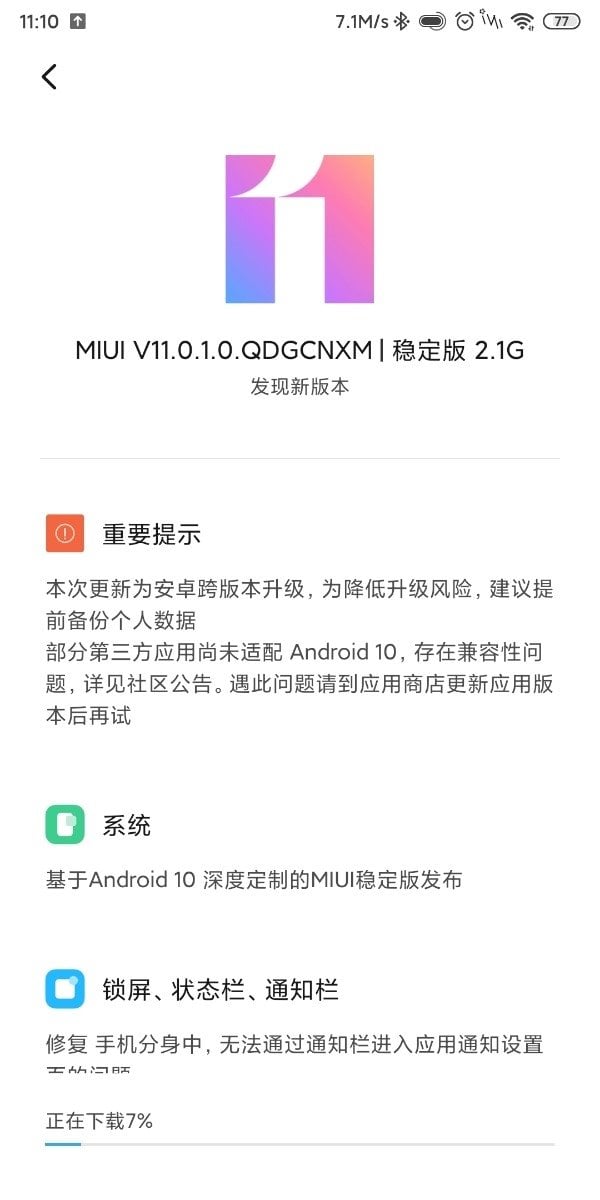
A few months ago, in October 2019, Xiaomi rolled out a stable MIUI 11 update for the Mi MIX 2S smartphone, however, the update was based on Android 9 Pie operating system. Later same month, the company rolled out another MIUI 11 update based on the latest Android 10 OS, in beta phase.
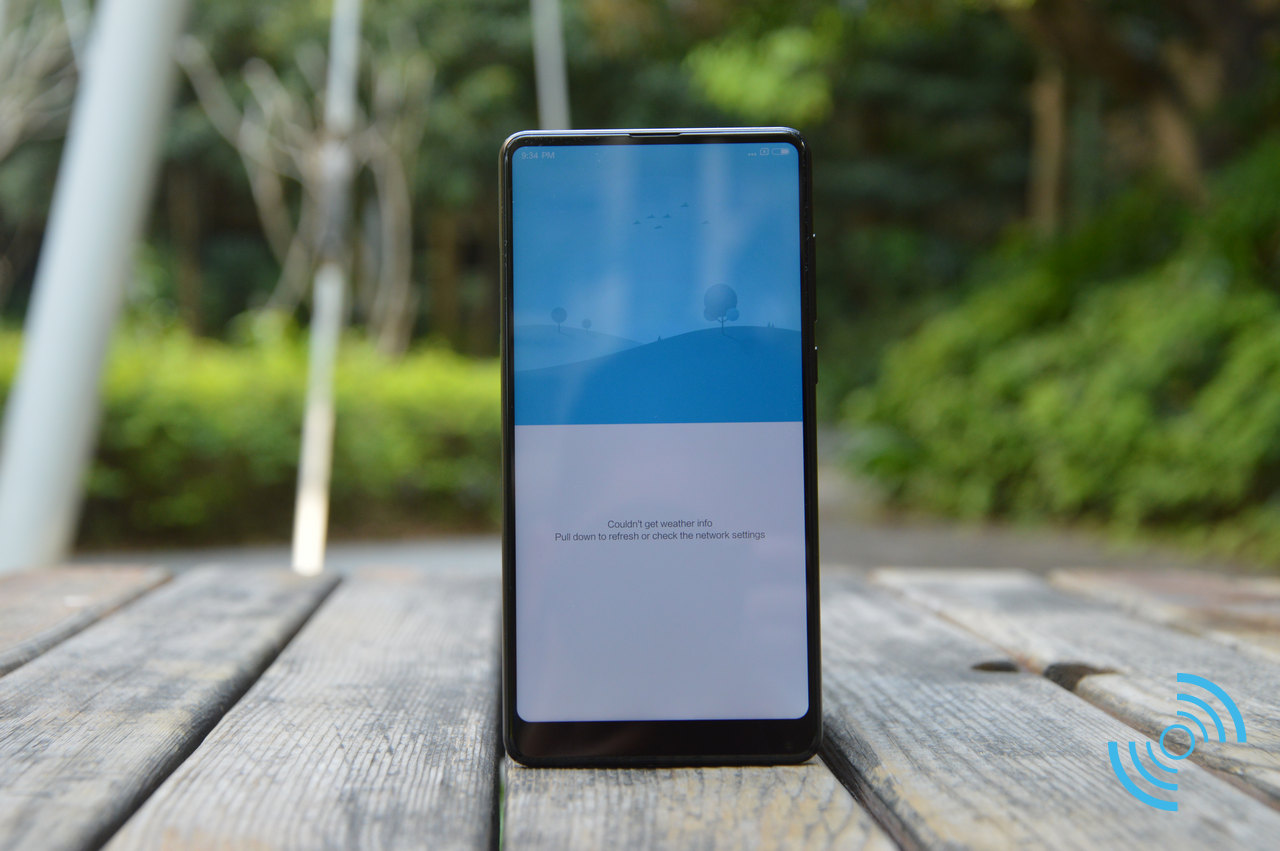
Now, the company has officially started rolling out stable MIUI 11 update for the Mi MIX 2S. The update version MIUI 11.0.1 is based on Android 10 operating system. The update log indicates that some third-party apps have not been pre-installed because of the compatibility issues.
MIUI 11 brings a host of new features to Xiaomi and Redmi devices like new sound effects and alarms, Mi Go travel suite, dark mode, and ambient display. If you want to know everything about the MIUI 11 OS, click here.
As for the specs, the Mi MIX 2S comes with a 5.99-inch Full HD+ IPS LCD Full-Screen display that offers a screen resolution of 2160 x 1080 pixels with 18:9 aspect ratio. The device is powered by Qualcomm Snapdragon 845 AIE chipset.
It features a vertically aligned dual camera setup on the back, consisting of a 12-megapixel Sony IMX363 wide-angle lens and a 12-megapixel secondary telephoto lens. On the front side, there’s an 8-megapixel selfie camera that’s capable of snapping amazing bokeh effect shots through AI. It also includes support for facial recognition for unlocking the device.
The device comes with Xiao AI voice assistant that is claimed to be smart enough to take on the Apple’s Siri. Connectivity options on the device include Dual-SIM, USB Type-C, Bluetooth 5.0, GPS, dual-band Wi-Fi 802.11 b/g/n/ac, and NFC.
The device draws power from a 3,400mAh battery which comes with support for Quick Charge 3.0 fast charging. With 7.5W Qi wireless charging support, it is also the first smartphone from Xiaomi to come with support for wireless charging.
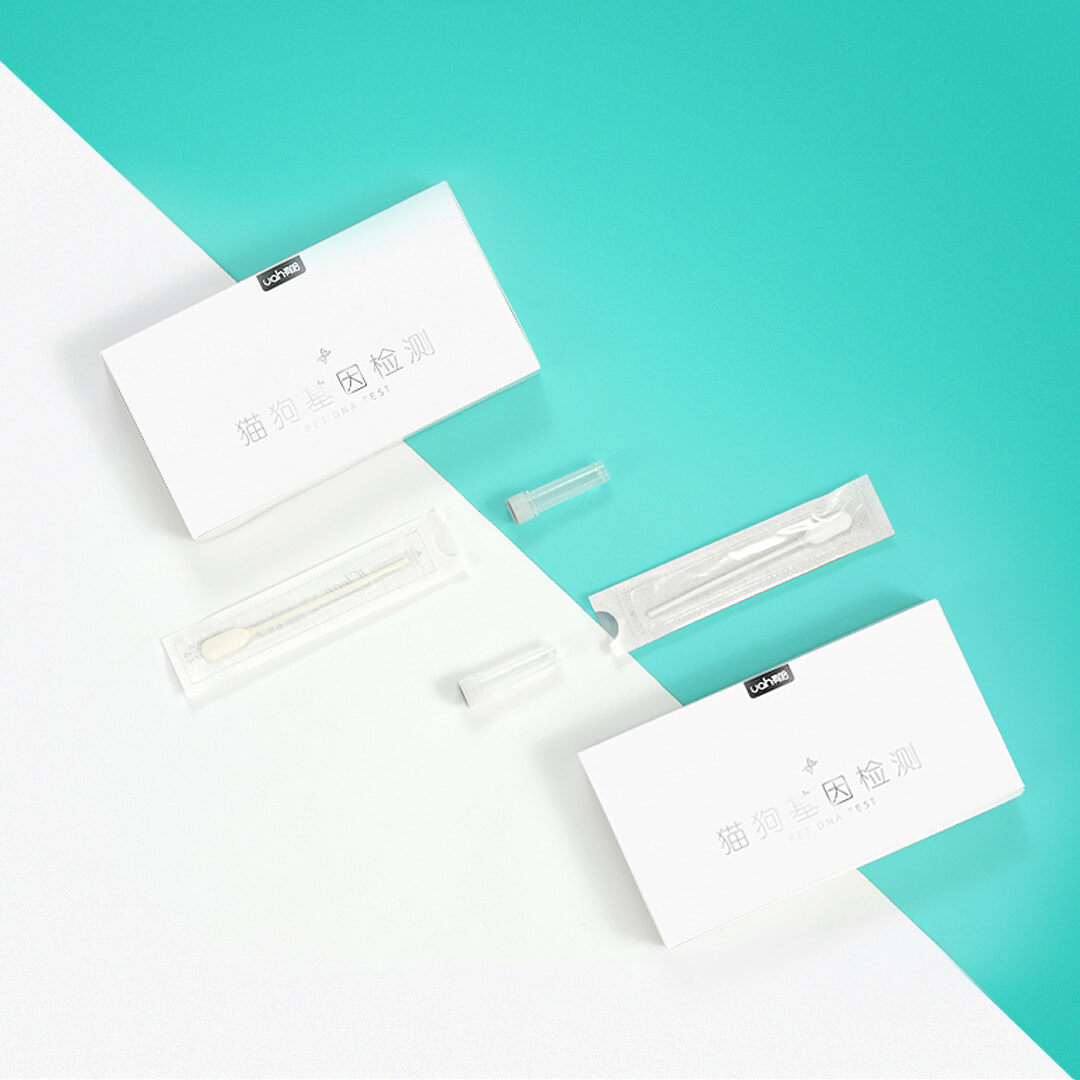
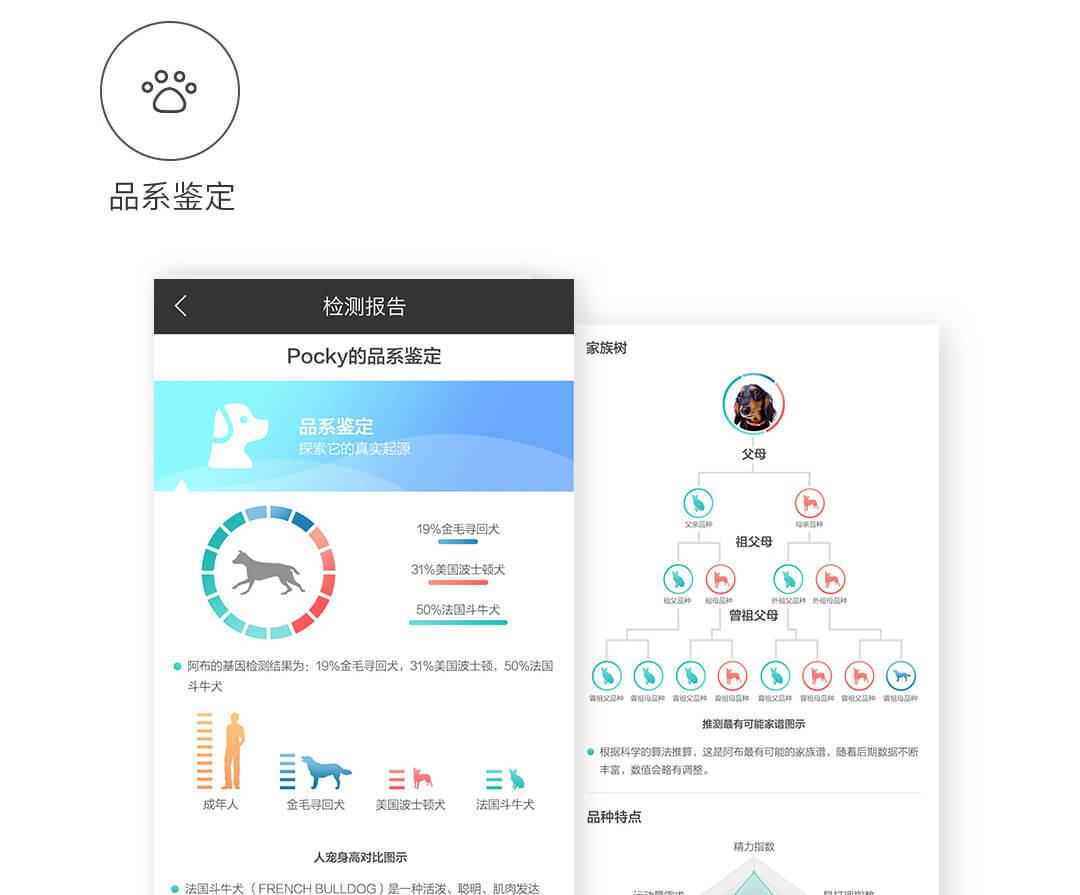
Xiaomi Youpin is back with one of their oddest products yet. The crowdfunding platform’s latest item is the Uah Gene Test for Cats and Dogs, starting at 99 yuan ($15). Genetic testing can allow owners to understand the pet’s pedigree, health risks, and genetic diseases, on top of knowing more about the pet’s personality, behavior, and intelligence. It’s certainly an interesting product.
It’s also very useful to check what allergens your pet cat or dog may have. As an example, many dogs are allergic to ivermectin in anthelmintics, and long-term use can cause poisoning. Pets will have different medication reactions, ranging from rashes and edema to shock poisoning. DNA can be used for scientific medicine and dose evaluation for pets to prevent misuse.
All of these features come bundled via a smartphone app, allowing you to check on your pet’s condition easily. The app is fairly simple to use, showing you relevant information regarding your pet based on the gene test done. It’s a good idea for a product, and one that can be endlessly useful for pet owners.
There are four different packages for the Uah Gene Test for Cats and Dogs, and each one comes with more features. For now the only available is the Early Adopter’s Edition for 99 yuan. The rest haven’t had any pricing details announced. They’re as follows:-
Early adopters Edition (2 genetic screening tests for typical genetic diseases)
Standard Edition (strain identification, corresponding to 3 genetic diseases of cat species, pedigree certificate)
Exploratory Edition (strain identification, full set of 16 genetic diseases, pedigree certificate, intelligence assessment, diet advice, breeding advice, personality behavior, hair beauty, health certificate)
The method of use is also relatively simple. There is no need to collect blood or collect saliva, just hold the sampling swab on the pet’s oral buccal mucosa (The inside of the cheek and mouth) and take 8-10 samples. Uah will extract DNA from the samples, perform gene sequencing, and do multiple tests on cats and dogs based on genetic loci and biological genetic algorithms, resulting in a scientific report.
In December 2019, OPPO had unveiled the OPPO A91 smartphone in China. The same phone has gone official today in India as OPPO A91. The new phone flaunts a gradient rear with quad cameras. It comes with an elongated screen coupled with an in-display fingerprint reader. The large-sized battery of the phone is equipped with fast charging technology.
OPPO F15 specifications and features
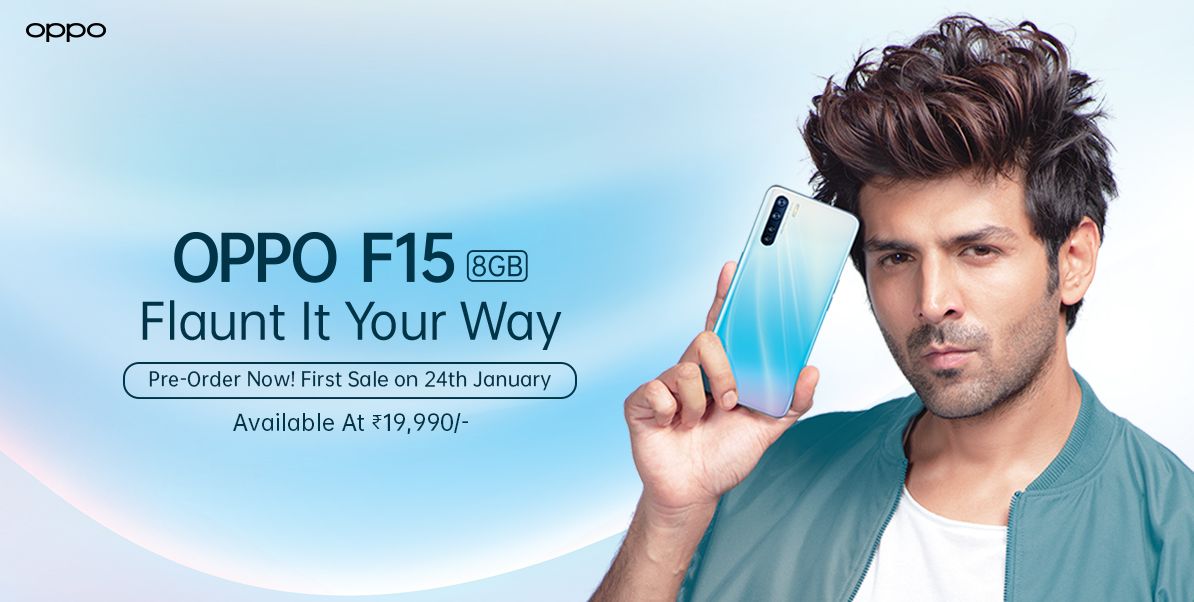
The OPPO F15 measures 160.2 x 73.3 x 7.9mm and it weighs 172 grams. The smartphone is equipped with a gradient colored polycarbonate whereas the display of the phone is reinforced with Gorilla Glass 5. According to OPPO, the 20:9 waterdrop notch display of the OPPO F15 offers a screen space of 90.7 percent. The display measures 6.4 inches and produces full HD+ resolution of 1080 x 2400 pixels. The display of the F15 is embedded with a fingerprint sensor. The TUV Rheinland approved screen can filter harmful blue rays and it also carry support for DC dimming.
OPPO F15
The OPPO F15 is powered by 2.1GHz Helio P70 octa-core processor and 8 GB of RAM. The internal storage of the device is 128 GB (UFS 2.1) For more storage, the phone is equipped with a dedicated slot for adding a microSD card. The ColorOS 6.1 flavored Android 9 Pie OS runs on the device. For optimized gaming performance, the F15 features Game Boost 2.0. The phone is backed by a 4,025mAh battery that supports VOOC 3.0 Flash Charge technology. According to OPPO, its 20W rapid charging technology can charge the phone to 50 percent battery capacity in only 30 minutes. The smartphone supports playback of Widevine L1 content on streaming apps like Netflix and Amazon Prime.
The OPPO F15 has a 16-megapixel with f/2.0 aperture housed inside the display notch. A quad camera system is available on the back panel of the phone. It comprises of a 48-megapixel main lens with f/1.7 aperture, a 119-degree 8-megapixel ultrawide lens with f/2.25 aperture that can capture macro shots of up to 3cm, a 2-megapixel mono lens with f/2.4 aperture and a 2-megapixel depth sensor with f/2.4 aperture. The F15 is capable at shooting stabilized videos as it borrows EIS anti-shake technology from the Reno series. Other photography features available on the OPPO F15 include AI beautification while video shooting, night scene mode and portrait mode.
OPPO F15 price in India
The OPPO F15 carries a price tag of Rs. 19,990 (~$282) and it can be bought in two colors like Lightening Black and Unicorn White. Customers in India can avail it through Amazon India and Flipkart from Jan. 24. Buyers who purchase the device until Jan. 26 can take benefit of a one-time screen replacement offer.
HDFC, ICICI and Yes Bank customers can take advantage of 5 percent cash back on offline purchase of OPPO F15. There is zero down payment EMI options for the buyers of F15 from Bajaj FinServe. Also, Jio is offering 100 percent extra data benefits.
As the Spring Festival is coming up, Huawei has launched a new variant of its Enjoy 10S smartphone, dubbed Huawei Enjoy 10S Custom New Year Gift Box Edition. It comes with eight products inside the box, including the smartphone, cover, cable ties, etc.
Further, the box of this custom edition smartphone also comes with a unique design, which the company says is designed keeping the youth in mind. The red colored box comes with design elements in golden hue. The company has not yet revealed its pricing and availability details, but we expect to get those details in the coming days.
Apart from the different packaging and in-the-box content, everything else remains the same as the standard Enjoy 10S smartphone. It comes with a 6.3-inch OLED display with waterdrop notch, offering 20:9 aspect ratio and Full HD+ screen resolution of 1080 x 2400 pixels. It also features an in-display fingerprint scanner for added security.
The device is powered by the company’s own Kirin 710F chipset along with 6GB of RAM and 64GB of native storage. The phone runs Android 9 Pie operating system out-of-the-box with the company’s own EMUI 9.1 custom user interface on top.
It comes with a triple-camera setup on the back which features a 48-megapixel main lens with f/1.8 aperture, an 8-megapixel ultrawide shooter with f/2.4 aperture and a 2-megapixel f/2.4 aperture lens. On the front side, it houses a 16-megapixel selfie camera.
For connectivity, the Enjoy 10s features options like dual SIM support, 4G VoLTE, Wi-Fi 802.11 b/g/n/ac, Bluetooth 5.0, GPS, USB-C and 3.5mm audio jack. The device is powered by a 4,000mAh battery that supports 10W charging.
Huawei are currently making a big push towards the 5G industry, but the company also has other interests they’re hoping to pursue, namely assisting in building cars. Rotating Huawei chairman Xu Zhijun, the car is changing along with the needs of the users, and that driverless cars are the future. They’re even drawing inspiration from Tesla in their hopes to achieve this.
“Our ultimate goal is to achieve complete driverlessness, but in the process of moving towards the ultimate goal, it can create value. At present, Tesla is already creating value for everyone” says Xu. When asked about whether Huawei can truly go far in this industry, Xu claims that “If Tesla can do it now, we can all do it.”
It’s important to note however that they company doesn’t want to make their own cars. According to Lu Xiaofeng, general manager of Huawei’s V2X product line, Huawei does not build cars, but will help car companies build good cars through collaboration. They’ll achieve this through contributions in ICT technology and becoming a supplier of smart automotive components in making better cars.
As of right now, Huawei are using their expertise in 5G together with SAIC and China Mobile to build 5G connected cars. These cars have 5G / LTE-V capabilities, support C-ITS assisted driving functions, feature intelligent voice interactions and even have live video calling functions built in. We’re hoping to see Huawei grow in the automotive market, and we can’t wait to see what they bring to the table.
Chinese technology giant Huawei has been working on creating alternatives to Google apps and services and is also actively working to reduce its reliance on third-party suppliers. In a similar move, the company has started a new incentive program for developers.
Huawei says that it will be offering £20 million to developers in Ireland and Britain for creating applications and services for its Dublin-headquartered mobile services unit. This announcement from the company was made at a developer conference hosted in London.
This comes at a time when Huawei looks to make itself more self-sufficient after being hit by US sanctions that have left it unable to use Google’s Android operating system on its latest smartphones.
The Chinese company is also focusing to bolster its own mobile services. It has already launched open-source access kits for developers to integrate their apps into the Huawei App Gallery, which is the company’s equivalent service to the Google Play Store.
Huawei Mobile Services (HMS), also known as Huawei ID in some markets, allow users to access the company’s specially designed apps and to store personal information, including payment details, in the cloud.
In April last year, the services were transferred to the Dublin-headquartered subsidiary from the Shenzhen headquarters for the business operations and development for all the group’s mobile service outside of mainland China, with a particular focus on Europe.
The company currently has 600 million mobile active users across more than 170 countries, including 68 million in Europe. In 2018, more than 270 million users downloaded apps from the company’s App Gallery each month.
It is also reported that Huawei is engaging with Indian developers with lucrative incentives to build localised mobile services that can be offered with its smartphones in the country. The Chinese company is reportedly in talks with about 150 top apps in India to get them on its HMS or Huawei Media Services.
The United States has increased its pressure on the Taiwan Semiconductor Manufacturing Company aka TSMC for producing its military-use chips in the country. This is being done to ensure that the world’s biggest contract chipmaker can manufacture the high-security components free from potential Chinese interference.
This isn’t the first time the company is facing similar security requests from the United States and the company sidelined them. For those who are unaware, along with being a key supplier for Apple and Huawei, TSMC also makes computer chips used in American F-35 fighter jets.
TSMC, which holds about 50 percent share of the world’s chip foundry business, supplies computer chips to Huawei and American tech giants such as Google, Qualcomm and Intel. The company also supplies high-performance chips for U.S. military suppliers such as Xilinx, which in turn makes components for American F-35 fighter jets and satellites.
In addition to the F-35 jets, TSMC makes U.S. Defense Department-approved “military grade” chips that may be used by some of its other American clients for classified military purposes.
As per the report, American officials talked with TSMC “several times” ahead of last weekend’s election in Taiwan. The Pentagon has long worried about risks regarding Taiwan and China’s connection and last year contacted several TSMC customers, warning them about the security implications of offshoring production to a Taiwanese company.
On the other hand, while TSMC has not given in on the demand of the United States, the company has repeatedly said that it would not rule out building or buying a high-specification plant in the U.S. to assuage such concerns. However, the company has also cautioned that such a move would need to be weighed carefully given the higher operating costs involved.
The United States accounts for about 60 percent of TSMC’s sales, but the company operates only its subsidiary WaferTech there, which produces chips for mature technologies while the majority of TSMC’s production remains in Taiwan.
In November 2019, Xiaomi launched its first smartwatch named Mi Watch which looks quite similar to the Apple Watch series. Later, on 3rd December, the company rolled out first OTA update for the device with some of the features and bug fixes.
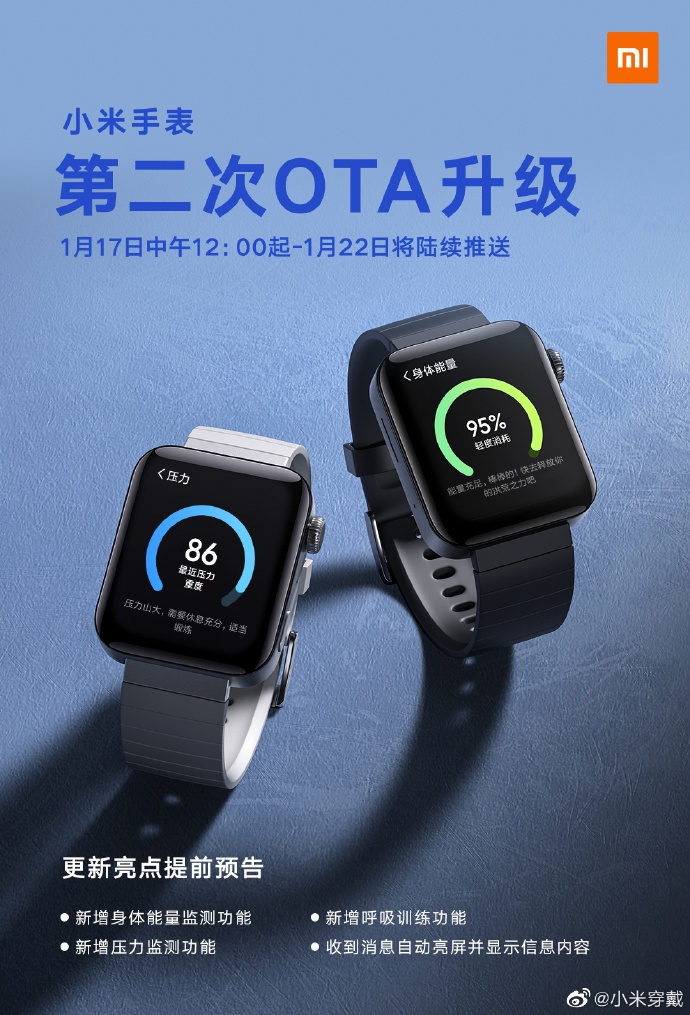
Now, the company is all set to roll out yet another over-the-air (OTA) update for the Xiaomi Mi Watch. The company has announced that the rollout will begin on 17th January and every use will get it by 22nd January.
The official memo from the company reveals that the new update will bring a new feature of body energy and pressure monitoring. Further, the company will also be optimizing the message notification feature to be bright and will be automatically displayed.
The official changelog from the company includes following:
Added body energy monitoring function
Added pressure monitoring function
Added breathing training function
When the message is received, the screen is automatically turned on and the message content is displayed
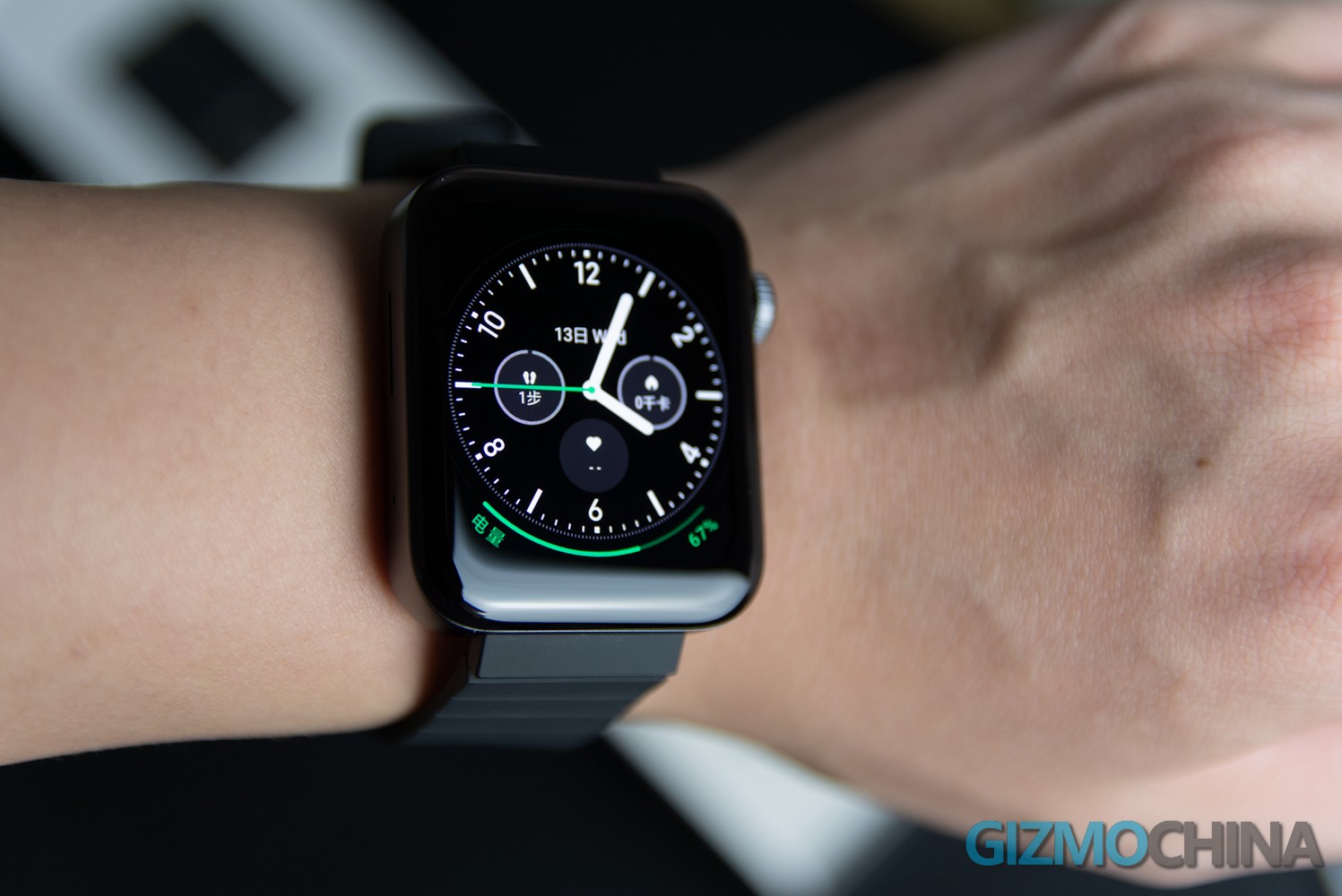
The Xiaomi Mi Watch comes with a square touchscreen display protected by Corning Gorilla Glass 3. It features a 1.78-inch AMOLED curved display with 326 PPI pixel density and the back of the watch is made out of ceramic.
There’s a crown on the right that can be used to navigate through the watch UI. Apart from the crown, there’s a multi-purpose button as well as a microphone on the right side. On the left, you have another microphone hole along with a speaker vent.
It comes powered by the Qualcomm Snapdragon Wear 3100 4G chipset featuring four Cortex A7 cores clocked at 1.2GHz. The watch features one of the biggest batteries ever seen on a smartwatch featuring 570mAh in capacity which the company claims can last up to 36 hours or up to two days on a single charge.
The wearable devices comes loaded with features such as NFC, Bluetooth 4.2, Wi-Fi (n), GPS, an independent vibration motor, and a pretty large speaker. It also supports eSIM, which ensures you can connect to the internet via cellular network as well as make and receive calls independently.
Xiaomi has adopted Google’s WearOS platform for its new smartwatch. However, like its smartphones, the WearOS running on the Xiaomi watch will be customized with its own MIUI for Watch skin. It comes integrated with the company’s own XiaoAI smart assistant.
You can check out our review of the Xiaomi Mi Watch here.
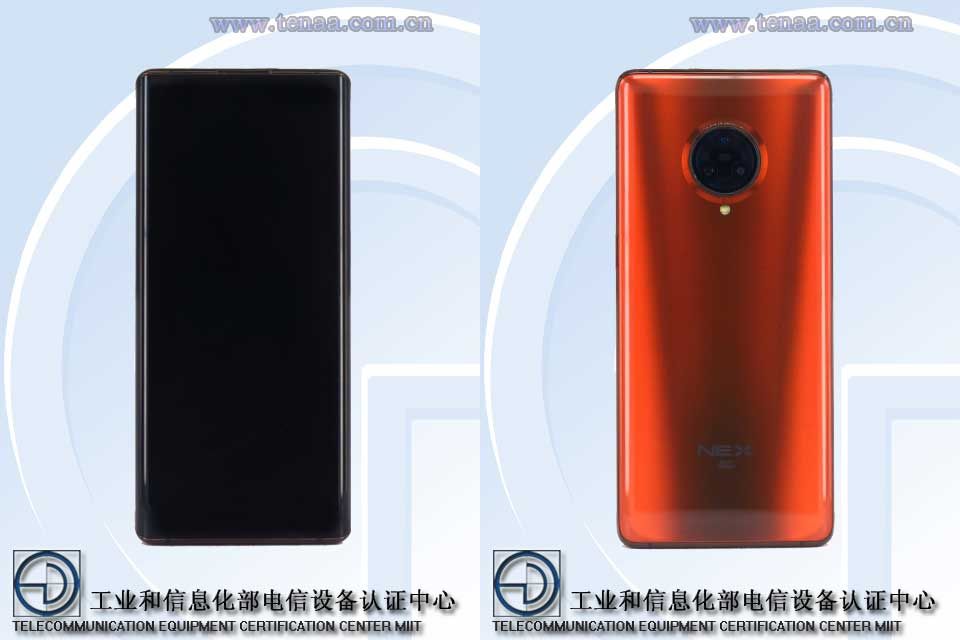
Vivo has couple of smartphones waiting in line to go official in China such as Vivo V1950A, Vivo V1963A and the newly spotted Vivo V1955A. The Vivo V1950A is believed to be the Snapdragon 865 mobile platform edition of the Vivo NEX 3 5G that had gone official in September 2019. The identity of the Snapdragon 765G powered Vivo V1963A is not known yet. The Vivo V1955A has appeared today in the database of the 3C authority of China. It could be the rumored iQOO 3 smartphone.
The Vivo V1955A 3C certification suggests that it could be an upcoming flagship smartphone. It is a 5G phone and it is accompanied by a V550L0A0-CN charger that supports up to 55W fast charger. It appears that the V1955A will be offering the fast charging speeds seen on a Vivo smartphone.
In April 2019, Vivo iQOO gaming smartphone was unveiled in China. The arrival of the phone also introduced the iQOO sub-brand in the home market. The iQOO phone was fueled by the Snapdragon 855 chipset and it came with a very fast 44W charger. Hence, it is likely that the Chinese firm could be planning to offer the Vivo iQOO 3 with the new flagship chipset and a superfast charger. The rumor mill is yet to spill any information on the specs of the Vivo iQOO 3 smartphone. The presence of SD865 on the device will bring support for dual-mode 5G.
Assuming on the basis of the previously released iQOO phones, the upcoming iQOO 3 could be equipped with an AMOLED screen with in-screen fingerprint, triple or quad rear cameras, a large battery with superfast charger and so on. All the iQOO phones in 2019 came with waterdrop notch screen. Probably, the company will switch to punch-hole displays on the 2020 iQOO smartphones.
Vivo NEX 3 5G Snapdragon 865 Edition specifications
The Vivo NEX 3 5G Snapdragon 865 edition (V1950A) has a 1080 x 2256 pixels full HD+ resolution supporting 6.89-inch AMOLED display. It has a minimum rated battery of 4,250mAh capacity and it is likely to ship with a 44W fast charger. The rear shell of the device has a 64-megapixel + 13-megapixel + 13-megapixel triple camera system and it has a pop-up selfie camera of 16-megapixel. The Vivo V1950A has Snapdragon 865 chipset, 8 GB of RAM, and 128 GB / 256 GB storage sizes. There is no word on the launch date of the device.
Earlier this week, OnePlus had a conference in China where it announced its 120Hz Fluid Display which will appear in its upcoming flagship(s). We are pretty pumped about the display as it will not only feature a higher refresh rate than that of the OnePlus 7 series but be a better display all-rounder.
Yesterday, Pete Lau took to Twitter to share a simulation video of the 120Hz display in action and in comparison to a 60Hz display. The aim of the video is to show how the higher refresh rate results in a much smoother scrolling experience.
The OnePlus 120Hz Fluid Display: The smoothest, most effortless scrolling experience ever on a smartphone. pic.twitter.com/I4FWP64NfO
The feature is hard to capture on camera but OnePlus tries to do so with this simulation by slowing down the video at a point, so you can notice the difference.
While OnePlus has not explicitly said which of its upcoming phone will feature the new display technology, we presume it will be limited to just the OnePlus 8 Pro while the standard OnePlus 8 and OnePlus 8 Lite will have a 90Hz display.
There is also a possibility that both the OnePlus 8 and OnePlus 8 Pro have a 120Hz refresh rate but the difference will be the screen resolution. The OnePlus 8 will stick to a FHD+ resolution while the OnePlus 8 Pro will have a 2K+ resolution. This will give OnePlus an edge over the display of Samsung’s Galaxy S20 series which doesn’t support 120Hz when the display resolution is set to WQHD+.
We are almost certain that the OnePlus 8 Pro will adopt WQHD + 120Hz, which is an aggressive company, a young man, and Samsung ’s performance looks like an elderly person, it has lost its vitality. pic.twitter.com/aAyN4FOH61
The 120Hz Fluid Display will also have a peak brightness of more than 1000 nits, a touch sampling rate of 240Hz, MEMC technology, and an industry-leading JNCD (Just Noticeable Color Difference) of less than 0.8.
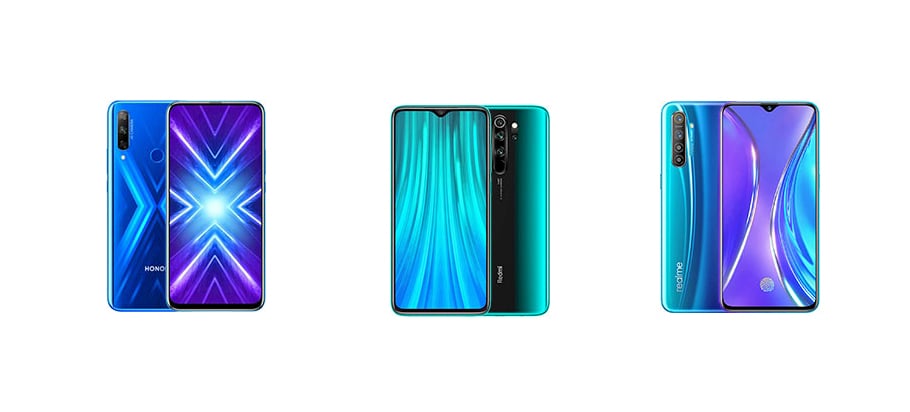
Huawei brought another interesting mid-ranger to the Indian market: the Honor 9X. With its innovative design and its well-balanced specifications, it offers a high value for money. But will it be high enough to be the preferred choice for most of the users searching for a new smartphone in that price range? In order to give you an idea, we decided to compare it with two other devices with a very high value for money: Redmi Note 8 Pro and Realme X2 from Xiaomi’s and Oppo’s sub-brands which became independent from both the famous companies. Let’s see who is the best and the one with the highest value for money.
Huawei Honor 9X vs Xiaomi Redmi Note 8 Pro vs Oppo Realme X2
Quad 64 + 8 + 2 + 2 MP f/1.8, f/2.2, f/2.4 and f/2.4
20 MP f/2.0 front camera
Quad 64 + 8 + 2 + 2 MP f/1.8, f/2.3, f/2.4 and f/2.4
32 MP f/2.0 front camera
Triple 48 + 8 + 2 MP f/1.8, f/2.4 and f/2.4
16 MP f/2.2 front camera
BATTERY
4500 mAh, fast charging 18W
4000 mAh, fast charging 30W
4000 mAh, fast charging 10W
ADDITIONAL FEATURES
Hybrid Dual SIM slot
Dual SIM slot
Hybrid Dual SIM slot
Design
The design is one of the strongest points of the Honor 9X. It is one of the few affordable smartphones to sport a full borderless display without the need of a notch, thanks to the presence of a motorized pop-up selfie camera. It is the most beautiful device not only because of that but also because of its elegant glass back. Well, Realme X2 has an even cleaner rear side thanks to its in-display fingerprint reader, but it is a device with a standard waterdrop notch, so nothing surprising. Redmi Note 8 Pro is born as an affordable gaming device and despite having a nice design, the aesthetics are not its strong point.
Display
A lot of people, including me, would prefer the display of the Realme X2. It is the only smartphone from this trio to sport an AMOLED panel with deep blacks and vivid colors, as well as an in-display fingerprint reader. Both Redmi Note 8 Pro and Honor 9X come with IPS display, but their image quality is still high. Redmi Note 8 Pro is particularly surprising because it is HDR-compliant and it even boasts a very high brightness for the display. But Realme X2 would be my choice due to its AMOLED panel with its in-display fingerprint reader.
Specs & Software
On the paper, the most powerful handset is the Redmi Note 8 Pro. It boasts an Helio G90T providing higher graphics performance and more suitable for gamers and power users. But the Snapdragon 730G on board of the Realme X2 is almost as powerful as the Helio G90T. Further, it has lower energy consumption. Honor 9X has an inferior Kirin 710F, so you should not go for it if you are looking for the best hardware. Talking about the software, Redmi Note 8 Pro is more advanced than Realme X2 with its MIUI, but with ColorOS 7 coming soon things will get a lot better for Realme X2.
Camera
Redmi Note 8 Pro and Realme X2 offer superior cameras to the Honor 9X. Realme X2 is slightly better because it boasts a better selfie camera: a 32 MP snapper with an f/2.0 focal aperture. In both cases, the rear camera setup is composed of a 64 MP main sensor (Samsung ISOCELL Bright GW1), an ultrawide lens, a dedicated macro camera, and a depth sensor, all with the same resolutions. Honor 9X is still a pretty nice camera phone, but it lacks a dedicated macro camera and it comes with inferior sensors.
Battery
The biggest battery belongs to the Redmi Note 8 Pro with 4500 mAh. Despite the handset has a less efficient processor built with a 12 nm production process, it boasts a longer battery life due to its higher capacity. Right after, we got the Realme X2: despite it has the same battery capacity as the Honor 9X, its efficient AMOLED display and its 8 nm chipset make it last longer on a single charge.
Price
Honor 9X costs about €178/$199 in the Indian market, Redmi Note 8 Pro starts from €203/$226, and Realme X2 starts from €215/$240. I would personally discard Honor 9X despite its better design. Realme X2 is my favorite one due to its Snapdragon 730G chipset and AMOLED display, but Redmi Note 8 Pro offers a more interesting software, longer battery life, and even better hardware.
U.S President Donald Trump has signed the first phase of a new trade agreement with China. This is coming after two years of tension between the two superpowers that have unsettled economies around the world.
Trump and China’s chief trade negotiator, Liu He, signed the deal at a packed press conference, attended by Ivanka Trump, much of Trump’s cabinet, Henry Kissinger, and media and business leaders including Stephen Schwarzman, the chairman of Blackstone, and Ajay Banga, the president of Mastercard. The signing came hours after Democrats named the team that will prosecute Trump in an impeachment trial that starts early next week.
During the event, US President, Donald Trump stated: “Today, we are taking a momentous step towards a future of fair and reciprocal trade. Together we are righting the wrong of the past… At long last Americans have a government that puts them first at the negotiating table.” He also claimed that the deal was the biggest deal anybody had ever seen which may just be one of Trump’s many tantrums.
The first phase of the deal will further open the Chinese market to US companies and in turn, will see Chinese firms purchase American goods and service worth roughly $200bn. But it will also leave in place much of the $360bn worth of tariffs that the US has already imposed on Chinese goods, and the threat of additional punishment if Beijing does not live up to the terms of the deal.
Trump campaigned on tackling what he saw as China’s unfair trade practices, accusing the country of “raping” the US and perpetuating “the greatest theft in the history of the world”.
The often rancorous trade dispute has hurt agriculture, manufacturing and other sectors of the US economy, and the uncertainty it has engendered has worried business leaders. But its impact on the broader economy does not appear to have been as dire as some predicted.
The trade deal, if it holds, could be a major political boost for Trump in an election year when he can argue his tough stance with China has paid off. US stock markets hit new record highs ahead of the signing.
The Nubia Z20 launched last October in markets outside China. The following month, Nubia announced a Twilight Blue color along with a limited time $50 discount. Now, the Chinese manufacturer has announced a $50 permanent price cut across all countries.
With the new price cut, the Nubia Z20 will sell for €499 in Europe, £449 in the UK, and $499 in the US. Interested buyers can pick up the phone at the new price on the official global online store.
The Nubia Z20 is a dual-screen phone with a 6.42-inch FHD+ curved AMOLED screen on one side and a 5.1-inch curved HD+ AMOLED screen on the other side. Both screens are covered with Gorilla Glass 5 and the triple cameras above the secondary display are covered with synthetic sapphire glass.
There is a Snapdragon 855+ processor inside along with 8GB of RAM and 128GB of storage. The primary camera is a 48MP Sony IMX586 f/1.7 sensor with OIS and it is paired with a 16MP f/2.2 ultra-wide angle camera, and an 8MP f/2.4 telephoto camera. The phone has 3x optical zoom, 30x digital zoom, and can record in 8K at 15 fps. It can also take macro pictures.
The Nubia Z20 not only has two screens but also has two side-mounted fingerprint scanners. There is a 4000mAh battery powering the device with support for 27W fast charge and Quick Charge 4.0. It doesn’t have an audio jack but Nubia ships the phone with a USB-C to 3.5mm cable. You also get a TPU case.
The phone has dual SIM support, Bluetooth 5.1, and dual-frequency GPS (Europe and Asia models only). It ships with a custom version of Android 9 Pie with Game Space. It also has pressure-sensitive gesture controls.
The Chinese New Year is around the corner and to celebrate this event, Ulefone partnered up with Gearbest to offer discounts up to 50% off from January 13th to 17th. The models participating in the promotion are mainly from the Armor Series, so let’s take a look at what’s on offer.
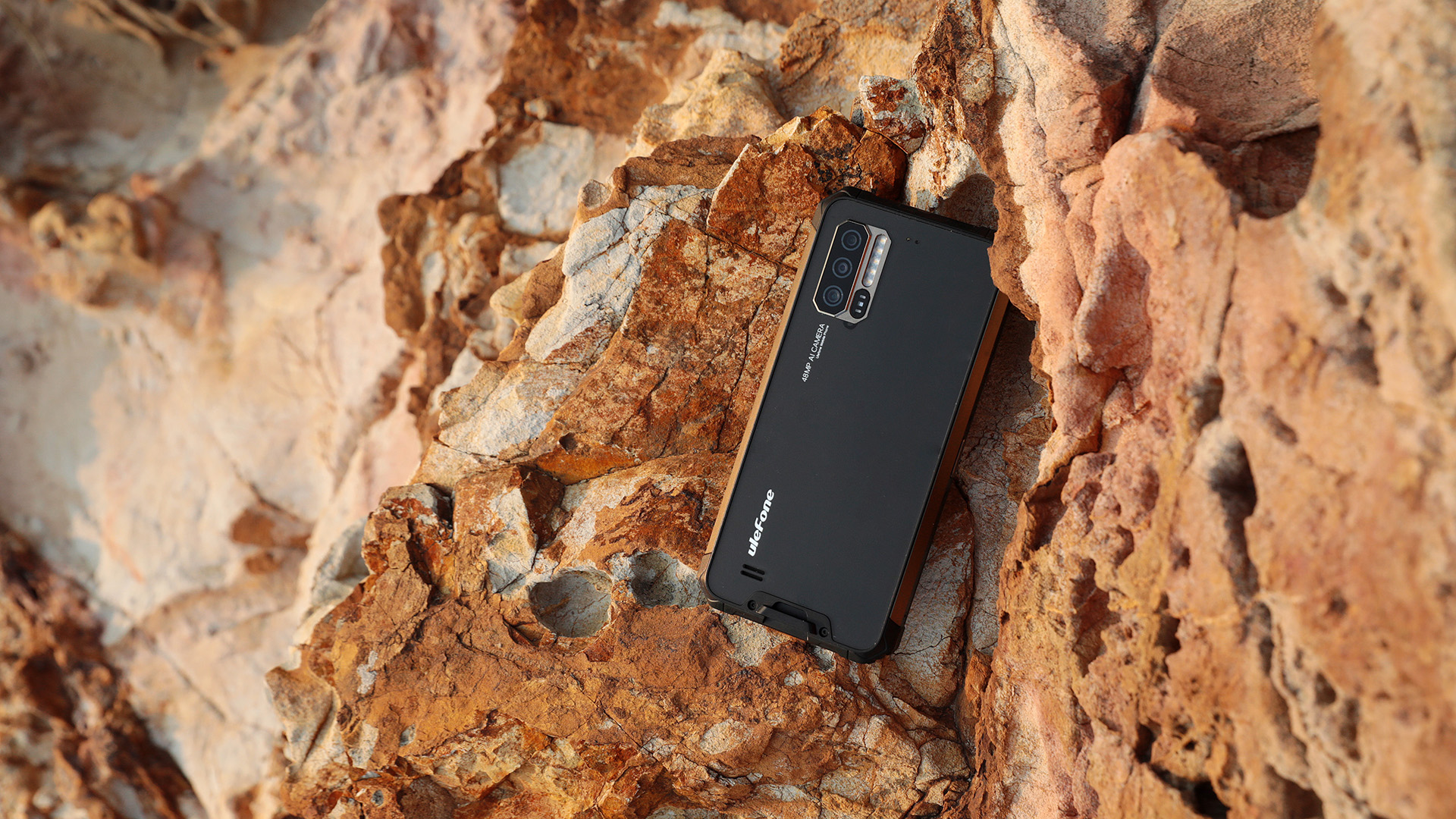
For starters, Ulefone Armor 7, the current flagship of the company. The Armor 7 sports a 48MP triple rear camera and Helio P90 octa-core SoC backed by 8GB of RAM. Besides the powerful SoC and triple camera, it also sports a 16MP selfie shooter, 128GB of internal storage, and a 6.3″ FHD+ display with a waterdrop notch. What’s more, there is a big, 5500mAh battery supporting Qi 10W wireless charging, Face and Fingerprint unlock, NFC with Google Pay, and Android 9.0 Pie. It costs just $359.99 during the promotion.
Ulefone Armor 7
If you prefer the combination of rugged features with a huge battery, Ulefone is also offering Armor 3W/3WT, which come with a massive 10300mAh battery. Both sport the same specs with the 3WT coming with walkie-talkie function added. So, they are powered by the Helio P70 AI SoC backed by 6GB of RAM and 64GB of storage and the camera setups include a 21MP rear camera and an 8MP selfie shooter. Also, there’s face and fingerprint unlock, dual-4G/dual-VoLTE, NFC with Google Pay, global network bands, and run on Android 9.0 Pie. During the promotion, the standard version costs just $239.99 while the walkie-talkie version costs just $279.99.
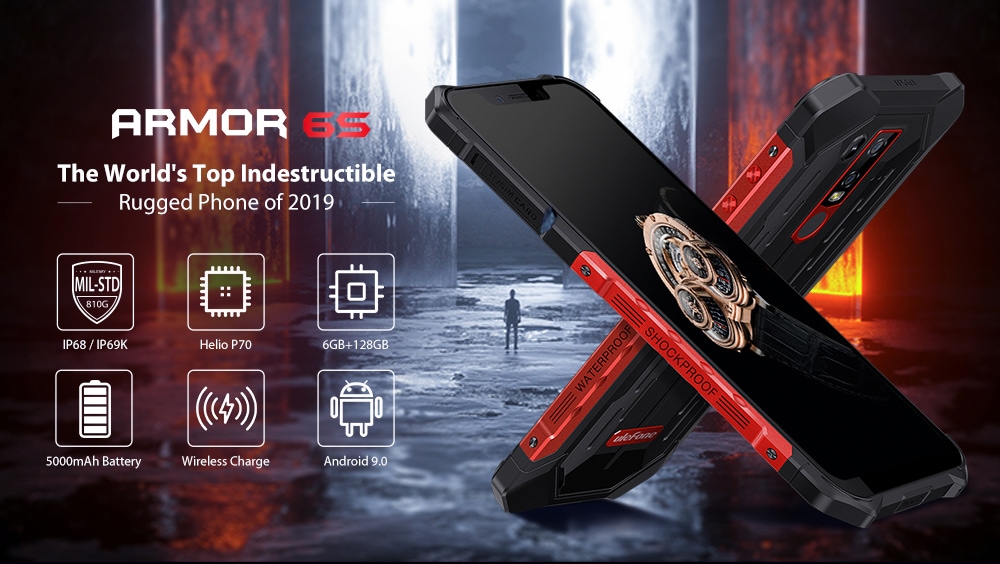
Up next comes the upgraded version of Armor 6, the Ulefone Armor 6S. Powered by the Helio P70 too, has a memory combination of 6GB/256GB and carries a 6.2″ FHD+ display with a notch to host the 8MP selfie camera. On the back lies the 16MP/8MP dual camera while under the hood it packs a 5000mAh battery with 10W Qi Wireless Charging support. Of course, it comes with face/fingerprint support and Android 9 Pie. The price is just $259.99 and if you prefer a cheaper version, you can grab the Armor 6E that comes with 4GB/64GB configuration and $189.99 price tag.
Besides the 5 models mentioned above, you can also find even more affordable models like the Armor 2 with 6GB of RAM for just $159.99, the 5.85″ Armor 5S for just $139.99, the entry-level rugged phone Armor X3 with 5000mAh battery priced at only $89.99, and its 4G version Armor X5 for just $10 more. Lastly, you can obtain the entry-level 4G smartphone Ulefone Note 7P at just $89.99. For more details about the promotion, please visit the dedicated promo page.
Although Ulefone has released Armor 6S -the upgraded version of Armor 6- for quite some time, many users are curious about the Helio P70-powered smartphone performance. The Chinese manufacturer is known for quickly responding to users’ demands so they released a video showing how well it performs. Let’s check it out.
The video showcases the performance of different apps in different scenarios such as performance while gaming and app launch test. It scored 177,528 points in the AnTuTu benchmark test, significantly outperforming its competitors by huge numbers. It also performs very well while playing large online games while the large RAM amount allows for fluid and smooth multitasking.
Being a rugged smartphone, the Armor 6S comes with IP69K/IP68/MIL-STD-810G certifications and a UV sensor. It sports a 6.2″ FHD+ notch display and the Helio P70 SoC is backed by 6GB of RAM and 128GB of internal storage. Also, there is a 16MP dual rear camera, wireless charging, fingerprint and face unlock, global network support, NFC with Google Pay, and Android 9.0 Pie.
Right now, Ulefone Armor 6S is on promotion and sells at just $258.99 on Aliexpress, a big discount compared to the standard retail price. You can get it here.
Mobile World Congress 2020 is still more than a month away but manufacturers have begun sending out invites to give attendees and the general public a heads-up and ample time to plan their schedule. We already got official announcements from Vivo for the APEX 2020 and TCL for its TCL 10 series. Now, it is Sony’s turn.
The Japanese electronics giant has sent out invites to the press for its press conference on Monday, 24th of February, 2020. The event will be held at Sony’s Booth in Hall 3, Fira Gran Via, Barcelona, and will begin at 8:30 am CET (1:00 pm IST/7:30 am GMT).
It has been reported that the Xperia 5 Plus will have a Snapdragon 865 processor, a 6.6-inch display with a tall 21:9 aspect ratio, triple rear cameras, front-facing stereo speakers, and a side-mounted fingerprint scanner.
While there are definitely fans that are looking forward to the launch of new Xperia phones, Sony’s biggest product launch for the year will be the new Play Station 5 game console.
We use cookies on our website to give you the most relevant experience by remembering your preferences and repeat visits. By clicking “Accept”, you consent to the use of ALL the cookies.
This website uses cookies to improve your experience while you navigate through the website. Out of these, the cookies that are categorized as necessary are stored on your browser as they are essential for the working of basic functionalities of the website. We also use third-party cookies that help us analyze and understand how you use this website. These cookies will be stored in your browser only with your consent. You also have the option to opt-out of these cookies. But opting out of some of these cookies may affect your browsing experience.
Necessary cookies are absolutely essential for the website to function properly. This category only includes cookies that ensures basic functionalities and security features of the website. These cookies do not store any personal information.
Any cookies that may not be particularly necessary for the website to function and is used specifically to collect user personal data via analytics, ads, other embedded contents are termed as non-necessary cookies. It is mandatory to procure user consent prior to running these cookies on your website.