Late last year, Huawei launched the budget-oriented Band 3 Pro fitness tracker which is packed with features like an AMOLED display and heart rate monitor. Falling into its footsteps, the company plans to announce its successor, the Huawei Band 4 Pro which will be unveiled alongside the Mate 30 Pro later today.
According to freshly granted patents (rendered by Letsgodigital), the Band 4 Pro will support ten new watch faces which will display the information in different layouts. For reference, all the new faces have been compiled into a single image which is listed below.
Besides, HD renders of the Huawei Band 4 Pro have also been leaked which reveal the device from all angles. Like its predecessor, it also features a tall AMOLED display on the front which is surrounded by narrow plastic bezels. It has a silicone strap with multiple adjustment holes which allow it to snugly fit on the user’s wrist.
The rear of Huawei Band 4 Pro house a SpO2 meter and a heart rate monitor which is also found on its preceding device. Noteworthy, instead of using a proprietary charging connector, the new fitness band has a built-in male USB port that stays concealed within the strap. The said connector can directly be plugged into any wall charger with a USB Type-A port.
While other details including the battery capacity, screen size, and price of the Huawei Band 4 Pro are currently unavailable, we won’t have to wait for long to obtain them, as the fitness accessory is set to launch in a couple of hours from now.
DXOMark has steadily come to be the major benchmark platform for phone cameras. The firm has updated its review process with the addition of two new scores. One of the scores is for ultra-wide-angle cameras and the second one for night mode.
Night mode and ultra-wide-angle cameras are relatively new features onboard phone cameras. The first phone to feature a wide-angle camera is the LG G5 that was launched in April 2016. Since the G5, there have been several other phones with a wide-angle lens. The same thing applies to the Night mode which became popular on smartphones such as the Huawei P20 Pro and Google Pixel 3 even though the Samsung Galaxy Grand Prime released in 2014 features night mode.EDITOR’S PICK:Xiaomi’s bezel-less Mi TV Pro will come in 43”, 55”, and 65” models
DXOMark has tested several phones using the new test protocols and as such, the reviews of phones with either of the features have been updated. The scores have also been recalculated, altering the standings. You can check out the updated scores from the table above. We should emphasize that the Samsung Galaxy Note 10+ continued its dominance of the top spot after the recalculation.It’s score sawan increase of 4 points from 113 pints to 117 points. In terms of specific score, it tied with the Huawei P30 Pro and Galaxy S10 in the Night mode test. For the ultra-wide-angle camera test, the Galaxy Note 10+ sood apart from the pack.
Huawei Mate 30 Pro is all set to meet us a couple of hours later in Munich, Germany. Just before its official launch, the phone has surfaced again in a bunch of beautiful hands-on images. These pictures not only reveals the wide notch on its display but also confirms a bunch of specifications.
We can see that the Mate 30 Pro comes with a pretty wide notch on top of its 6.5-inch display. The bezels aren’t very thick, which is a good sign. Also, the screen looks beautiful as the curve extends to the sides, which is a peculiar design of the waterfall display. These images also confirm most of the phone’s specifications.
The Mate 30 Pro will come with a 6.53-inch OLED display with 2400 x 1176 pixel resolution, 8GB + 128GB and 8GB + 256GB storages, Kirin 990 chipset, and a quad-camera setup consisting of two 40MP cameras, one 8MP ultra-wide-angle camera, and a 3D sensor. This image confirms that the primary f/1.6 40MP shooter, as well as the 8MP wide-angle camera, will have OIS. There will be a 4400mAh battery with 40W fast wired charging and 27W wireless charging. Other features confirmed by these pictures include an 8.8mm thick body, 198 grams weight, EMUI 10 right out of the box, and IP68 certification.
Xiaomi’s MIUI is already 9 years old. Next week, a new version called MIUI 11 will be unveiled alongside the Mi MIX 4/Mi MIX ALPHA and the Mi 9 Pro 5G. Today, MIUI’s product manager revealed a new feature that the new version of the custom Android OS will have.
The new feature that will come to the operating system is called Children’s Space. Xiaomi says it decided to add the feature since many of its earliest users may soon or already have a family. So in order to help with raising kids and keeping them entertained, they are adding a Children’s Space to MIUI.
MIUI 11’s Children’s Space will feature several high-quality educational and entertainment apps designed for kids. Parents will be able to customize app access and duration of use. According to Xiaomi, the Children’s Space will be completely separated from the parent’s own space.
Xiaomi also adds that the special space has a smart eye-protection mode to ensure that the child’s eyes are protected from harmful light. Another feature of MIUI 11’s Children’s Space is the Mi Bunny popping up on the screen and informing the child to take the phone to you when a call comes in.
[envira-gallery id=”277103″]
Children’s Space is a welcome feature for MIUI lovers. The idea is actually not unique as Samsung offers something similar on its devices. Prior to One UI, it was called Kids Mode and can be accessed via an app under the app drawer. Now, it is called Kids Home and can be accessed via the Quick Settings Panel.
Amazon also has a Kids Mode on its Fire Tablets though it also sells special Kids’ Edition Fire Tablets with a specially designed case. Stock Android itself doesn’t have a Kids Mode or dedicated space for kids but there are several apps for kids on the Play Store.
Chinese tech titan, Huawei is set to launch the highly anticipated Mate 30 smartphone lineup which will be unveiled at an event in Munich, Germany today. Like the Mate 20 lineup, Huawei is expected to launch three variants of the smartphone which could be the dubbed the Mate 30, Mate 30 Pro and Mate 30 Lite. Hours before the official announcement, Ishan Agarwal, a known tipster has revealed both the specifications and image renders of the Huawei Mate 30 Pro.
Huawei Mate 30 Pro Design and Specifications
According to the source, the front of the smartphone features a 6.53-inch FHD+ display that has a wide notch up top. Noteworthy, the display on the Mate 30 Pro has an unconventionally steep curvature at the sides which extends to the left and right edges.
The rear of the Mate 30 Pro seems to be made out of glass panel which houses the quad-camera module, an elongated flash, and vertically engraved company branding. As observed with the previously launched P30 and Mate 20 lineup, the rear of the upcoming device also has a gradient back. Going by the images, it will be offered in four color options which include Blue, Green, Black, and Purple.
Exclusive Full Renders of the #HUAWEI#Mate30Pro! Which colour do you like the most? And yes, Slow-Mo at 7680fps@720p and 960fps@1080p along with A LOT of Camera features, all detailed in the specification sheet attached below. Could this become the best camera/video phone? pic.twitter.com/ClBy3XWZll
Under the hood, the Mate 30 Pro will be equipped with the Kirin 990 SoC which succeeds the Kirin 980 released last year. In terms of memory and storage, it will be offered in two variants which are as follows:
In terms of optics, the Mate 30 Pro has an f/2.0 aperture equipped 32 MP selfie camera which is housed in the notch above the display. As previously mentioned, it features a quad-camera setup on the rear which is comprised of the following sensors:
40 MP (f/1.8), Super Wide Angle for video
40 MP (f/1.6), Wide Angle for image
8 MP, Telephoto
3D ToF
The smartphone will support a plethora of camera features, some of which include HDR, Panorama, Night mode, and high-speed photography.
Other key features of the device include 3D face unlock, IP68 rating, DCI-P3 colour gamut, and screen sound technology which, as the name suggests, allows it to emit sound from the display.
All in all, the alleged images and specifications of the smartphone seem legit. However, in order to confirm them and obtain other details including the price and availability information of the Mate 30 Pro, we will have to wait for the official launch which is set for later today. You can read our Mate 30 rumour roundup from here.
In July this year, Xiaomi launched the Redmi 7A budget smartphone in the Indian market. Now, just a couple of months later, the Chinese company is all set to launch its successor — Redmi 8A in India.
Xiaomi has today confirmed through a tweet that the Redmi 8A smartphone will get launched in India on 25th September. Further, the teaser image shared by the company also sheds light on some of its features.
The announcement poster has the front panel of the smartphone, which clearly shows that unlike the Redmi 7A, its successor will come with a waterdrop notch display which the company refers as Dot Notch.
The promotional landing page for the smartphone on the company’s official website highlights the phone’s features, which includes “immersive viewing experience” hinting at bigger display, “more power to you” which hints at bigger battery and faster charging. It is also highlighting the phone’s design philosophy, camera, and others.
The Redmi 8A has already been certified by TENAA, which has revealed some of the key specifications of this upcoming device. The phone will come with a 6.2-inch Dot Notch display with 1520 x 720 pixels screen resolution and will be powered by a 2.0GHz octa-core processor but the exact variant is not yet known.
Mi fans, India’s best-selling smartphones, the Redmi A series, is coming to create waves yet again. 😇
This time around, we've made it all the more dumdaar. 💪 Get ready for #Dumdaar#Redmi8A on 25th September. 😍
As for the memory configuration, it is expected to come in three variants — 2GB + 16GB, 3GB + 32GB, and 4GB + 64GB. It will also have a microSD card slot for expanding the storage capacity up to 512GB.
Coming to the camera configuration, the smartphone will be featuring a 12-megapixel camera on the back and an 8-megapixel snapper on the front side. Running on Android 9 Pie with MIUI 10 out-of-the-box, the device will be powered by a 5,000mAh battery.
The TENAA listing of the Redmi 8A reveals that it measures 156.3 x 75.4 x 9.4 millimeters and the weighs 188 grams. The listing says that the phone will come in eight colors — Black, Red, Blue, Pink, White, Green, Purple, and Grey. However, as usual, only three or four color variant will be made available.
After investigations on Huawei‘s alleged acts of cyberespionage, an authority chief from Malaysia claims that the country still has no qualms with Huawei providing equipment for their 5G network rollout. This takes place as Western countries continue to make accusations that Huawei’s equipment could bring about data leaks.
Malaysia has always sided with Huawei since the beginning of the entire US ban debacle. Malaysian Prime Minister Dr Mahathir claimed earlier this year that “Huawei’s research is far bigger than Malaysia’s capability. We will make use of their technology as much as possible,” he said, adding that Huawei had achieved tremendous advancement over American technology.
Ms Nur Sulyna of the MCMC said “Everyone is racing into 5G technology. In Malaysia, everyone wants to know about its potential – how are we going to use it to ease traffic, to enhance security, in agriculture and health,” at a panel at the 33rd Asia-Pacific Roundtable, a regional conference hosted by Malaysia’s Institute of Strategic and International Studies.
On security risks, said these are not just exclusive to Huawei technology but “any device that has Wi-Fi capability”. Do you share Malaysia’s views on the issue, or do you believe that the West is justified in taking the steps they have taken against Huawei? Tell us your thoughts and opinions down tn the comments section below.
Since they’ve gotten back into the business of making Android phones, Nokia has been accepted as creating some pretty great affordable Android devices on the market. Now Nokia Mobile has officially announced the Nokia 7.2 for the Indian market.
The device touts a premium glass and metal design along with a new triple camera setup with Zeiss optics and a PureDisplay waterdrop screen. The smartphone is powered by Qualcomm Snapdragon 660 SoC along with up to 6GB RAM and 128GB storage. Other features include a 3500mAh battery, a USB-C port, a 3.5mm jack and Android 9 Pie.
One of the more unique things about the Nokia 7.2 — and also found in other recent Nokia devices — is a dedicated Google Assistant button. While not as convenient as having the Google Assistant just a squeeze away via the Active Edge, the dedicated button should still make for easy access to everyone’s favorite voice assistant.
There’s also a very nice photography setup on the Nokia 7.2 with a triple-camera arrangement on the rear including a 48MP main sensor, an ultrawide camera, and a depth-sensing camera for high quality bokeh effect shots.
While the Nokia 7.2 will ship with Pie-based Android One, HMD Global has assured us that the device is “Android Q ready.” No doubt, the phone will be seeing the Android 10 update as soon as Google makes it available to other Android One devices.
The device will go on sale next week, on 23rd September and will be available in Cyan Green and Charcoal colors, as well as two memory configurations. The Nokia 7.2 with 4GB of RAM and 64GB of internal storage will retail at Rs. 18,599 (€236, $261), which is far below the announced global price tag of €299 (Rs. 23,500). The version of the device with 6GB of RAM and 64GB of internal storage will cost Rs. 19,599 (€249, $275).
OnePlus is hosting a launch event on 26th September where the company is all set to launch its new OnePlus 7T series flagship smartphones as well as the all-new OnePlus TV for the first time.
In a rare step, OnePlus CEO Pete Lau recently shared the renders of the OnePlus 7T smartphone on the community forum, revealing the smartphone’s design. Now, the OP7T has appeared on Geekbench with model number OnePlus HD1903.
The listing shows that the smartphone is powered by 8GB of RAM and is running the latest Android 10 operating system out-of-the-box. The phone is certainly running OxygenOS on top of the base Android, as usual.
The benchmark score of the OP7T is slightly higher than the OnePlus 7 given that the new device comes powered by the Qualcomm Snapdragon 855 Plus octa-core processor. The phone has scored 791 points in the single-core test and 2,855 points in the multi-core test. Do note that these scores are from the updated Geekbench version 5.0.1.
The design of the OnePlus 7T (Details) looks familiar given that it has popped online several times. The phone comes with a new circular camera module at the middle on the back side. The circular housing houses the triple camera setup with the three sensors making a perfect symmetry when viewed from any direction.
OnePlus CEO has also hinted that the design was selected after perusing over fifty design iterations. The rear panel is made from the 4th generation matte-frosted glass and the company has also showcased the “Haze Blue” color variant in the shared renders.
The OnePlus launch event is going to take place on September 26th in India and the United States while it’ll be held in London on October 10th. The company’s fans can also purchase tickets to attend the event.
Xiaomi is hosting a launch event on 24th September where the company will be launching the Mi 9 Pro 5G and Mi MIX 4 smartphones. Along with that, Xiaomi will also expected to launch its 8K Smart TV and MIUI 11.
Now, the Mi TV’s official Weibo account has shared a new teaser poster which hints that the company is all set to unveil its 8K Smart TV in the market next week. The poster has a bold font in the center that reads “8K Ready” and below that it teases “We Are Ready!”.
Currently, the highest resolution that Xiaomi Mi TVs have is 4K resolution. If a new Mi TV Pro comes with an 8K resolution, then that firmly places the premium TV on the high-end of Xiaomi’s TV lineup.
Recently, during its ‘Smarter Living 2020’ event in India, Xiaomi launched four new TV models in the Indian market, including the Mi TV 4X 65-inch. Prior to that, its sub-brand Redmi launched its first Redmi TV in China with an aggressive pricing. A couple of days ago, Xiaomi announced a 70-inch model for its Mi TV 4A series.
However, Xiaomi’s won’t be the first company to launch 8K TVs in the market. TCL has already unveiled 8K TV but the device is not going on sale anytime soon. Other brands like Samsung and LG have also launched 8K TVs.
Samsung QLED 8K and LG OLED 8K have been announced by the companies but they are very expensive. While the Samsung’s TV is priced at around $5,000, the LG’s TV will soon go on sale with pricing as high as $30,000.
While Xiaomi has been very popular in the Smart TV category in its home country China as well as in India, the company’s popularity is now under threat given that many smartphone makers are now entering the Smart TV market.
Huawei’s sub-brand Honor has already launched Honor Vision TV powered by HarmonyOS at an aggressive price point while OnePlus is also set to enter this market with its OnePlus TV on 26th September. While the OnePlus TV will first be launched in India, it’s just a matter of time it makes way to the Chinese market.
Realme has already confirmed that the Realme X2 smartphone will be launched in China at a special launch event on 24th September. Hours after the announcement, Francis Wang, Chief Marketing Officer of Realme confirmed that the X2 is the re-branded version of the XT for Chinese market.
While the Realme X2’s design is similar to the XT recently launched in India, the smartphone will come with some major upgrades in terms of specifications. The company has today confirmed that the phone will be powered by Qualcomm Snapdragon 730G SoC.
For the uninitiated, the Realme XT comes powered by the Snapdragon 712 AIE processor. It seems that the variant launching in China is the Realme XT 730G which Realme India CEO Madhav Sheth revealed will launch in India in December this year.
Earlier, the company had also confirmed that the Realme X2 will be featuring a 32-megapixel camera sensor on the front side, an upgrade over the 16-megapixel snapper present in the Realme XT. It remains to be seen if the company uses the same waterdrop notch to house the camera sensor or adopts pop-up mechanism.
Apart from these changes, we expect that most of the specifications on the Realme X2 will remain the same as Realme XT. It will feature 6.4-inch S-AMOLED Full HD+ display with 2340 x 1080 pixels screen resolution, and 19.5:9 aspect ratio. It will come with up to 8GB RAM and 128GB internal storage.
The quad camera system on the phone comes with 64-megapixel Samsung GW1 primary camera sensor, an 8-megapixel ultrawide lens, a 2-megapixel dedicated macro camera and a 2-megapixel depth sensor. The smartphone will be running Android 9 Pie-based ColorOS 6.0.1 out-of-the-box and will be powered by a 4,000mAh battery along with 30W VOOC 3.0 fast charging support.
Huawei’s next-generation Mate series flagship smartphones are getting launched today in Munich, Germany. Now, hours ahead of the launch, Evan Blass has shared the image of Mate 30 RS Porsche Edition’s retail packaging.
From the image, we can see that the phone comes with a premium-looking Matte Black retail box. Inside the box, you’ll find the Mate 30 RS Porsche Design smartphone, hard back cover in the same color as the phone, wall adaptor, data cable, earphones, and a car charger as well. All the accessories included in the box are in Black color.
Recently leaked renders of the Mate 30 RS Porsche Design shows that the phone features quad-camera setup on the back but instead of circular housing on Mate 30 Pro, the camera sensors are housed inside a black-colored narrow strip that runs from the top towards the bottom. The LED flash is placed in the top-left corner, outside the camera housing.
Along with the image of retail packaging of the upcoming smartphone, Evan Blass has also shared new renders of the Mate 30 RS Porsche Edition in both the color options — Black and Red. As for the specifications, just like the Mate 30 Pro, we expect the Porsche Design edition to come powered by the company’s own Kirin 990 SoC and an AMOLED display with 90Hz refresh rate display.
As per the reports, the Huawei Mate 30 Pro will come powered by a 4,500mAh battery with 40W fast charging support and 27W SuperWireless charging support. It is also expected to come packed with 8GB/12GB RAM along with 512GB onboard storage.
The device is also expected to come with IP68 ratings for water and dust resistance. Both the smartphones are expected to come powered by EMUI 10 custom user interface based on the latest Android 10 operating system.
Just like its predecessors, the Mate 30 RS Porsche Design looks premium and thus, it will carry a hefty price tag. The Huawei Mate 20 RS Porsche Design was priced at 12,999 Yuan (approx. $1,838) and we expect similar pricing with the upcoming smartphone as well.
To know for sure about the phone’s specifications, features, pricing and availability details, we will have to wait for the official launch event to take place which will begin today at 2:00 PM local time in Munich, Germany.
Ahead of the launch of Xiaomi Mi 9 Pro 5G smartphone in the company’s home market on 24th September, the company has been teasing features of this upcoming device. In the latest teaser, Xiaomi has confirmed that the Mi 9 Pro 5G will be powered by the new Qualcomm Snapdragon 855 Plus chipset.
Further, the same teaser poster also reveals that the smartphone will come with a custom XL VC Liquid Cooling module with a heat dissipation area of 1,127mm2. It will have 5-layer graphite, high thermal conductivity copper foil, and a thermal gel to offer “three-dimensional cooling system” which will reduce the CPU core temperature by 10.2 °C.
Additionally, it has also been confirmed through a teaser poster that the phone will come with a custom-made “transverse linear motor” to elicit a stronger sense of vibration — a haptic feedback that has start-stop speed of 10ms, just like a mechanical keyboard. With this Vibration HD feature, the phone will offer an 4D immersive gaming experience.
Earlier, the company had revealed that the Mi 9 Pro 5G smartphone will have 40W wired fast charging, 30W wireless fast charging as well as 10W reverse charging support. The 30W Super Wireless Flash charing is claimed by the company to charge the 4,000mAh battery up to 50 percent in 25 minutes and takes around 69 minutes to fully charge. The 40W wired fast charging will bring the phone from 0% to 100% in a mere 48 minutes.
The Mi 9 Pro 5G has already been certified by TENAA, which reveals that the phone will come with a 6.39-inch display and should come with up to 12GB of RAM and 512GB of internal storage. We expect the smartphone to run MIUI 11 out-of-the-box.
Along with the Mi 9 Pro 5G, Xiaomi is also set to introduce its new Mi MIX 4 flagship smartphone which could feature a 100-megapixel camera sensor. The company will also be launching a new Mi TV model and its new MIUI 11 operating system with major updates.
After realizing the growth of Chinese smartphone manufacturers is literally endless, Samsung started focusing a lot on the midrange sector. And the success arrived immediately after: Samsung mid-rangers actually represent most of the best-selling affordable phones ranking globally. The company just unveiled the Galaxy M30s, another amazing device which could become a best-seller in the Indian market. We think it is time to compare it with the most popular mid-rangers in the Indian market at the moment in order to predict its success. We chose the best from sub-brands for this value for money comparison: Realme XT and Redmi Note 8 Pro.
Samsung Galaxy M30s vs Oppo Realme XT vs Xiaomi Redmi Note 8 Pro
Oppo Realme XT
Xiaomi Redmi Note 8 Pro
Samsung Galaxy M30s
DIMENSIONS AND WEIGHT
158.7 x 75.2 x 8.6 mm, 183 grams
161.3 x 76.4 x 8.8 mm, 199 grams
188 grams
DISPLAY
6.4 inches, 1080 x 2340p (Full HD+), 402 ppi, 19.5:9 ratio, Super AMOLED
Quad 64 + 8 MP + 2 + 2 MP f/1.8 and f/2.3 and f/2.4 and f/2.4
16 MP f/2.0 front camera
Quad 64 + 8 + 2 + 2 MP f/1.8, f/2.2, f/2.4 and f/2.4
20 MP f/2.0 front camera
Triple 48 + 8 + 5 MP f/2.0, f/2.2 and f/2.2
16 MP f/2.0 front camera
BATTERY
4000 mAh
Fast charging 20W
4500 mAh, Fast Charging 18W with Quick Charge 4+
6000 mAh, fast charging 15W
ADDITIONAL FEATURES
Dual SIM slot, UFS 2.1 internal storage
Hybrid Dual SIM slot
Dual SIM slot
Design
I think the Realme XT is definitely the most beautiful and elegant device of the trio. It has the cleanest rear side thanks to its in-display fingerprint reader and a slim camera module, and it even has a glass back. While Samsung Galaxy M30s comes with a plastic body, the Redmi Note 8 Pro sports a glass back just like the Realme XT, but the presence of a rear-mounted fingerprint reader and its bigger dimensions make it less attractive than the Realme XT. That is essentially why I would choose the mid-ranger from Oppo’s sub-brand.
Display
While Redmi Note 8 Pro loses the comparison due to the presence of an inferior IPS display, Realme XT and Samsung Galaxy M30s will provide a very similar quality thanks to their AMOLED panels. The display of the Galaxy M30s is taller, but it is overall slightly smaller than the Realme XT. However, the Galaxy M30s looks to have a smaller notch. But the Realme XT is the only to feature an in-display fingerprint reader.
Specs & Software
Redmi Note 8 Pro is the clear winner of the hardware comparison as it features a more powerful and gaming-centric chipset: the Helio G90T. It is a MediaTek SoC, but it is a lot faster, it has way better graphics performance and it is also backed by a very advanced cooling system. The second place goes to the Realme XT equipped with a Snapdragon 712 chipset, up to 8 GB of RAM and an amazing UFS 2.1 internal storage which you can furtherly expand with a micro SD. In each case, you get a customized version of Android Pie out of the box.
Camera
The best cameras are on board of the Realme XT and Redmi Note 8 Pro known as the world’s first phones with a 64 MP rear camera. We won’t choose a winner between these two handsets as they feature a very similar camera department and it mostly depends on the scenario. But note that Redmi Note 8 Pro has a slightly better selfie camera on the paper. The Samsung Galaxy M30s boasts a classic 48 MP triple camera which you can actually find on most of the popular mid-rangers released this year, and it does not even feature a bright focal aperture compared to its opponents. That is why Realme XT and Redmi Note 8 Pro are definitely better choices.
The battery comparison leaves no doubts: Samsung Galaxy M30s lasts a lot longer on a single charge. With a 6000 mAh capacity, it is one of the best battery phones ever. However, its rivals are not disappointing with 4000 and 4500 mAh batteries, respectively. Note that Redmi Note 8 Pro consumes more energy due to its less efficient chipset and the IPS display, so it does not last more than Realme XT with every usage pattern.
Price
Samsung Galaxy M30s debuted in India with a €180/$200 starting price, Realme XT starts from €200/$220 and Redmi Note 8 Pro from about €290/$320. Redmi Note 8 Pro is the best compromise for advanced users given its higher performance and amazing cameras, but if you want the best value for money and a better display, you should go for the Realme XT. Do not mind about the €20 difference with the Galaxy M30s unless you just need infinite battery life.
Samsung Galaxy M30s vs Oppo Realme XT vs Xiaomi Redmi Note 8 Pro: PRO and CONS
At first, it seemed as if the company was clearing out old inventory when the Gionee M11 and M11s were launched earlier this month. But Gionee seems to have made a comeback into the tech industry. A new device dubbed Gionee K3 has launched in China and is already on reservation on Jingdong with the pricing starting at 799 yuan ($112). Reservations have been made by over 411 persons in just 6 hours.
Talking about the hardware, Gionee K3 packs a 6.2-inch display with a waterdrop notch. The notch houses an 8MP selfie camera. At the rear, there is a dual-camera setup nested at the top left corner of the panel. The main sensor is a 16MP AI camera. There is equally a fingerprint sensor at the middle. The device comes with 4GB/64GB and 6GB/128GB memory versions. It is fueled by a 5000mAh battery. The K3 has full Netcom, 4G support as well as dual SIM slots. It is available in Black and Blue colour options.
Apart from the M11/ M11s and this new K3, Gionee has also launched a Smart “Life” watch and the GBuddy powerbank and headphone. The Gionee F9 Plus was also launched in India within this month. Perhaps, it is safe to say Gionee is back and ready for business. As at 2016, the company was ranked as the 8th biggest smartphone maker in China with 22 million shipments but by December 2018, Gionee had already filed for bankruptcy. The company’s messy financials was attributed to the gambling habit of Gionee’s founder. There is likely new management onboard hence this ray of hope. We’ll be on the lookout for more details about the company’s new resurgence.
Xiaomi’s September 24 event is set to be a big one. Not only will we get to see the new Mi MIX flagship, but Xiaomi will also announce the Mi 9 Pro 5G and MIUI 11. But that is not all. Xiaomi will also announce a new TV line, the bezel-less Mi TV Pro. Today, it has revealed more details about the upcoming TVs.
The Mi TV Pro’s highlight is its design and Xiaomi has engraved the words “Designed By Xiaomi” in a tiny font on the right side of the frame. The TV practically has no bezels on three of its sides and boasts a high screen-to-body ratio.
The Mi TV Pro has an anodized aluminum alloy frame, an aluminum alloy base, and a 3D carbon fiber textured back.
[envira-gallery id=”276988″]
Xiaomi has disclosed that the TV will be available in three sizes – 43”, 55”, and 65” and all three will have 4K displays. The rest of the specs are still unknown but we expect more details will surface on the days leading up to the launch.
We don’t expect the Mi Pro TVs to be cheap. However, if you are in need of a new TV, Xiaomi has a TV festival sale that will begin tomorrow and run until Saturday, September 21. The Mi TV 4A series along with some other models will be getting price cuts.
Xiaomi has been in the TV business for a couple of years now. Redmi, its subsidiary, announced its first TV last month – a behemoth 70-inch TV. Today, Xiaomi has also announced a 70-inch model for its Mi TV 4A series.
The new Mi TV 4A 70” has a 4K LCD display with thin bezels and a slim body that makes it appear like its a giant painting when you hang it on the wall.
It has Xiaomi’s XiaoAI assistant built-in which means you will be able to ask it to search and play movies and shows or use it to control smart home devices connected to the same network and account. It also has Xiaomi’s PatchWall system.
The TV has 2GB of RAM, 16GB of storage, and a 64-bit Amlogic processor. It has 3 HDMI ports, 2 USB ports, AV input, and an S/PDIF audio port. There is Dolby Audio and dts-HD too.
The Mi TV 4A 70” is priced at ¥3999 (~$564) and will go on sale tomorrow on the official Xiaomi online store, Jingdong, Tmall, Suning and at Mi Home stores.
In addition to the new 70” size, the Mi TV 4A line is also available in 32”, 43”, 50”, 55”, 58”, and 65” sizes.
Xiaomi launched the MIJIA T500 electric toothbrush under crowdfunding not too long ago, priced at 199 yuan ($28). The Chinese tech giant has now launched the Mijia T100 Sonic electric toothbrush with a cheaper price tag but good features. The toothbrush will be sold for 39 yuan ($5) but under the crowdfunding, it is on offer for 99 yuan ($13) for a set of three electric toothbrushes.
The MIJIA T100 Sonic Electric Toothbrush continues the simple design of its predecessors. It has a lightweight build, weighing just 46g. It features a small brush head with soft bristle which can easily penetrate the spaces between the teeth. The top structure of the bristles is specially treated to better conform to the oral cavity and also keep the gum protected while brushing. The brush also comes with an IPX7 waterproof rating which means it can be rinsed under running water.
In terms of performance, the MIJIA T100 can provide up to 16,500 vibrations per minute, which can effectively remove tooth stains and tartar. The brush adopts two operating modes; standard and gentle mode to meet the needs of different persons. The brush is adjusted to stop shortly after 30 seconds as a way of reminding you to switch position. The toothbrush also stops automatically after 2 minutes. In terms of battery life, the MIJIA T100 Sonic Electric Toothbrush can be fully charged in 4 hours and the battery can last for up to 30 days.
Last week, Ulefone announced its 2 new rugged models that will soon hit the market featuring huge battery and Helio P70: Ulefone Armor 3W and 3WT. Today, the company released an official hands-on video of the devices so let’s take a look at their features and performance.
Following the company’s standards when it comes to rugged phones, both are certified by IP68/IP69K as well as MIL-STD-810G. As you can see in the video, water, dust, and drop resistance are top of the line as it happens with all Ulefone rugged phones. Featuring the powerful all-around Helio P70 SoC helped the user in the video play heavy games like PUBG, listen to music, watch videos, go through social network updates, etc. The phone ran smoothly in all cases with no performance glitches. The 21MP rear camera is adequate for everyday use while GPS, Glonass, and Beidou triple navigation system can quickly and accurately lock on satellites and help you find your way.
1 of 2
In the video, you can also see the walkie-talkie version of Armor 3W -Armor 3WT- that supports 1W/2W hardware intercom with frequency range of 400-470MHz that enables you to communicate with other walkie-talkie devices in the area without the need of cellular coverage.
1 of 2
As far as hardware is concerned, both devices come with a huge, 10300mAh battery with 18W and MTK PE+2.0 fast charge, 6GB of RAM and 64GB of internal storage. The display is a 5.7″ FHD+ one with 18:9 aspect ratio, and there is also an 8MP selfie shooter that supports face unlock. In addition, the devices come with a fingerprint sensor, dual-4G/dual-VoLTE, NFC with Google Pay, global frequency band support, and run Android 9 Pie. And they can be used for underwater photography as well.
According to the company, the global presale should begin next week but until now we don’t know the exact pricing. You can see all the details for Armor 3W here and for its walkie-talkie sibling here.
Huawei has a big event tomorrow in Munich, Germany where it will announce its new flagship phones – the Mate 30 series. While those are the anticipated devices, Huawei will be unveiling more than just phones.
We already know that a successor to the Huawei Watch GT will be arriving as well as the launch of the Harmony OS-powered Huawei TV. Gresh details have revealed that there will also be a new fitness band and a global release of the MediaPad M6. There are also some new details about the ones we already know are launching tomorrow.
Huawei TV
Huawei announced Harmony OS at its Developer Conference last month. The first commercially available product running the new OS is the Honor Vision TV which is already on sale in China.
Images of the 55-inch TV along with new details have now surfaced on the web thanks to AndroidHeadlines. The photos show the TV will have a pop-up camera like the Honor Vision Pro.
1 of 4
There are vents on the sides of the TV and the right side is also home to a plethora of ports including HDMI ports, USB ports, and an ethernet port. The TV is designed to be placed on a surface and not hanged.
The back has a brush metal finish with two giant circles which we are not sure what they do. There is also a large speaker at the base of the screen. Leaked posters on Weibo show the Huawei TV will have Huawei Share and what is called Huawei Sound. The former will allow owners to share files from their phone to the TV.
Huawei Band 4 Pro?
Huawei will also announce a new fitness band tomorrow. The name is unconfirmed but seeing as the Huawei Band 3 Pro was announced alongside the Mate 20 series last year, this may arrive as the Huawei Band 4 Pro.
AndroidHeadlines has also provided images of the band. It has an AMOLED touchscreen display and a silicone strap which appears to be non-replaceable. The one in the images has a bright orange color but there should be other variants available.
1 of 4
The watch has a heart rate sensor and we may see Huawei announce a new version of its TruSeen heart monitoring system. We also expect a new version of its TruSleep sleep monitoring system. AndroidHeadlines adds that it will be able to measure oxygen saturation. The Huawei Band 3 Pro has built-in GPS, so we expect this will have too.
Huawei Watch GT 2
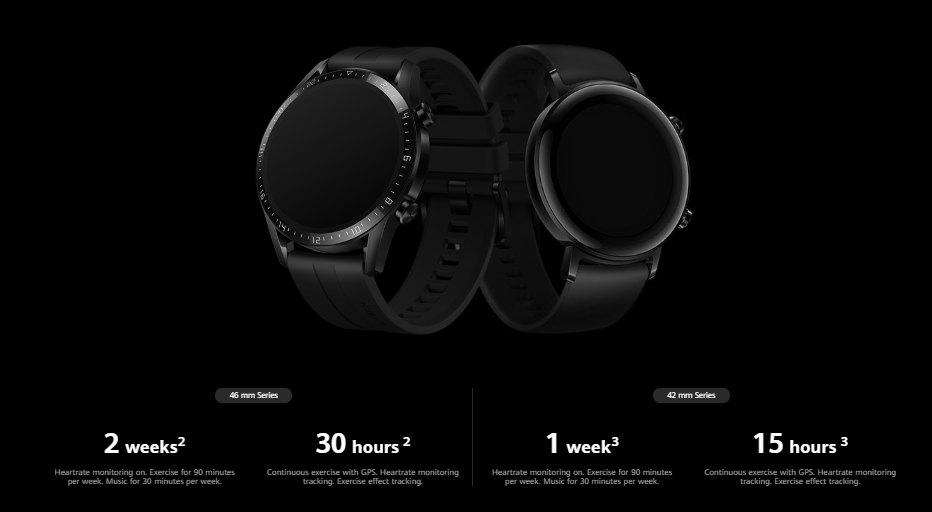
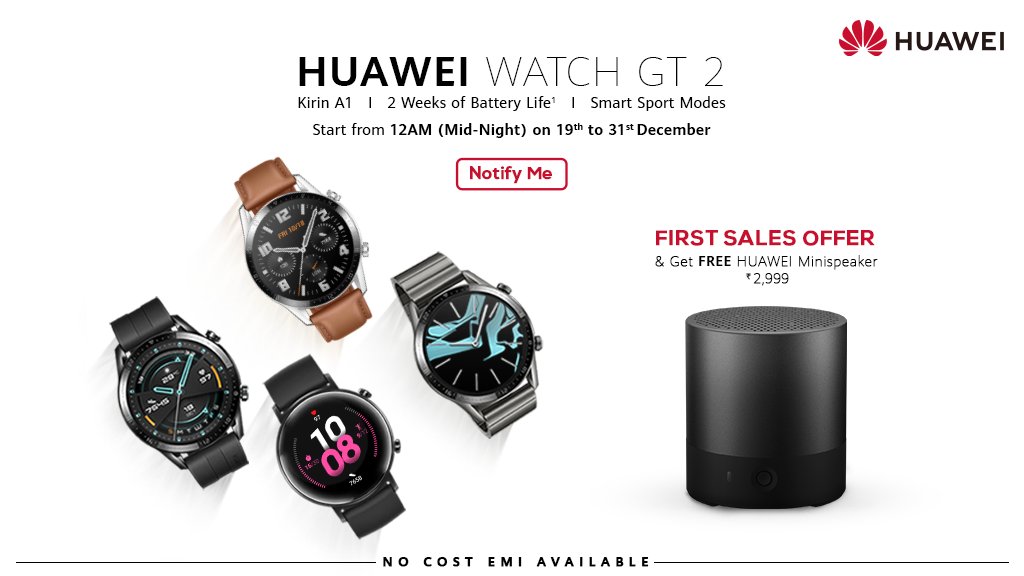
We already covered some leaks of the Watch GT 2 but more details have surfaced. First, the watch will be available in two sizes – a 42mm version with a 1.2-inch 390 x 390 display and 20mm strap and a 46mm version with a 1.39-inch 454 x 454 display and 22mm strap.
Previously, it was reported that the Watch GT 2 will have a speaker and microphone. While there isn’t a confirmation of an LTE modem, there is a high chance it will have one. However, the smaller Watch GT 2 doesn’t have a microphone according to AndroidHeadlines, so that rules out LTE for it.
The two sizes will come with the same Kirin A1 chip present in the Huawei Freebuds 3 announced at IFA 2019. The chipset brings Bluetooth 5.1 and Bluetooth 5.1 LE.
Above are renders of the smartwatch with different straps and styles.
MediaPad M6
The MediaPad M6 is also expected to get a global launch tomorrow. The tablet already launched in China back in June and last month, Huawei announced a Turbo Edition. The MediaPad M6 is powered by the Kirin 980 processor which powers the Huawei P30 Pro and comes in 8.4-inch and 10.8-inch versions with WiFi-only and LTE variants for both sizes.
We use cookies on our website to give you the most relevant experience by remembering your preferences and repeat visits. By clicking “Accept”, you consent to the use of ALL the cookies.
This website uses cookies to improve your experience while you navigate through the website. Out of these, the cookies that are categorized as necessary are stored on your browser as they are essential for the working of basic functionalities of the website. We also use third-party cookies that help us analyze and understand how you use this website. These cookies will be stored in your browser only with your consent. You also have the option to opt-out of these cookies. But opting out of some of these cookies may affect your browsing experience.
Necessary cookies are absolutely essential for the website to function properly. This category only includes cookies that ensures basic functionalities and security features of the website. These cookies do not store any personal information.
Any cookies that may not be particularly necessary for the website to function and is used specifically to collect user personal data via analytics, ads, other embedded contents are termed as non-necessary cookies. It is mandatory to procure user consent prior to running these cookies on your website.