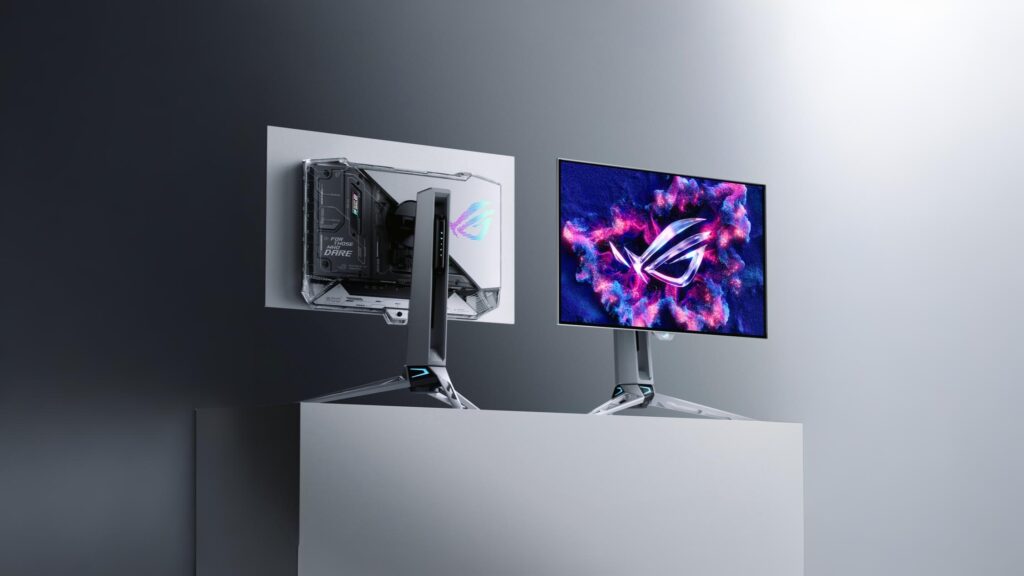
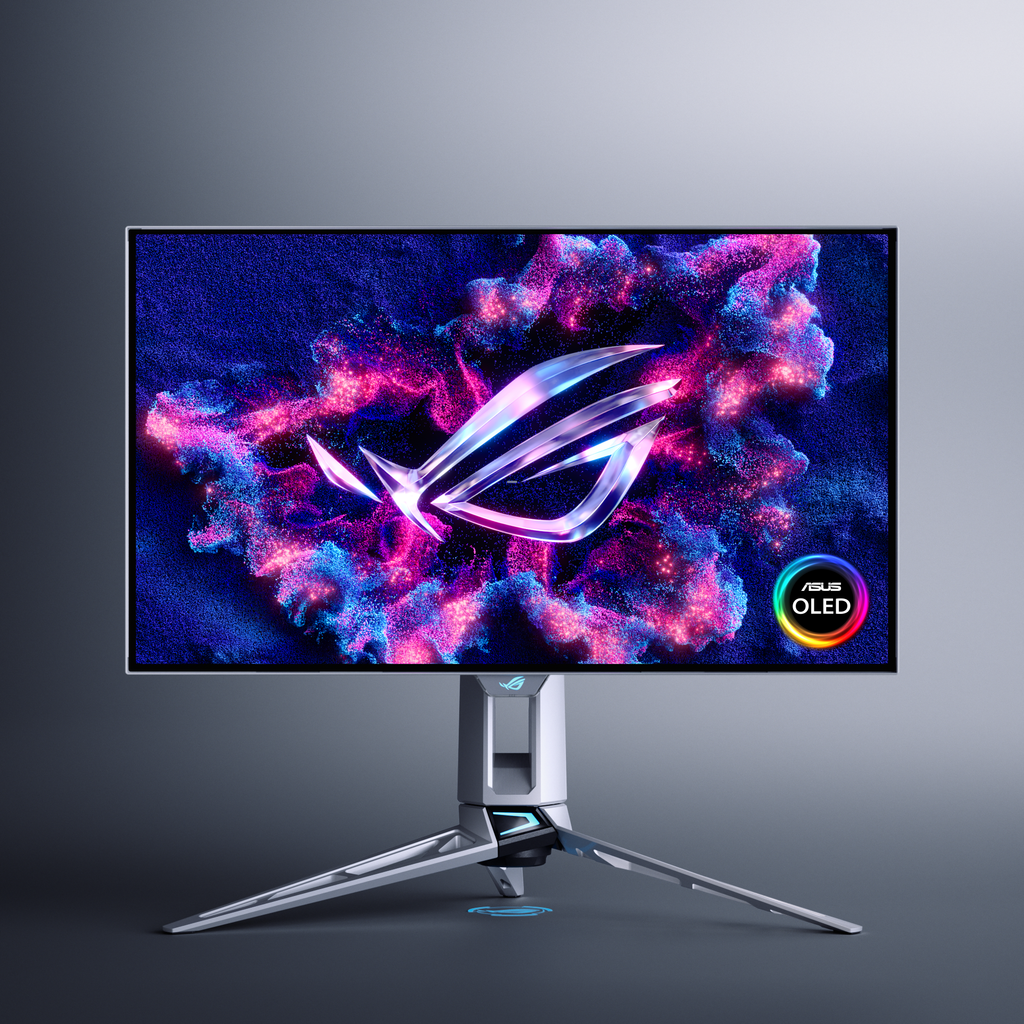
Asus has started selling the ROG Swift OLED PG27AQWP-W, its first 720Hz OLED gaming monitor. The model was first shown at Gamescom 2025. As mentioned, what makes this monitor unique is its ability to output 720Hz refresh rate, at the cost of display resolution.
To access its 720Hz mode, users will have to knock down the resolution to 720Hz. This mode is specifically designed for competitive gaming in mind where players don’t mind reducing the resolution to get better framerates. Normally, the monitor is capable of running at 540Hz at QHD resolution.
The ROG Swift OLED PG27AQWP-W is priced at CNY 8,499 (about $1,197), and buyers can use a launch coupon to get it for CNY 7,998 (about $1,127).
Asus ROG Swift OLED PG27AQWP-W features
The monitor has a 26.5-inch 2560×1440 OLED panel based on LG Display’s 4th Gen W-OLED technology. It runs at 540Hz by default and can reach 720Hz. The new tandem OLED design gives it 15% higher peak brightness, 25% wider color volume, and a 60% longer lifespan than older WOLED panels.
It features a TrueBlack Glossy coating that improves contrast and color depth while reducing glare. The screen supports VESA DisplayHDR 500 True Black, covers 99.5% of the DCI-P3 color space, and has a 0.03ms response time. These specs make it suitable for esports as well as color-critical creative work.
Asus has given this monitor a unique look with a silver stand and a semi-transparent back panel. It includes DisplayPort 2.1a with full 80Gbps bandwidth, HDMI 2.1, and a tripod socket for easy mounting.
The PG27AQWP-W also includes Asus OLED Care Pro, a set of tools to prevent burn-in. It uses a Neo Proximity Sensor that dims the screen when the user steps away. Asus offers a three-year burn-in warranty for added peace of mind.
For more daily updates, please visit our News Section.
Well, a fire incident involving Samsung’s Galaxy S25+ has reignited concerns about smartphone safety, echoing uncomfortable memories of the Galaxy Note 7 saga. This time, the explosion occurred not during charging but during regular use, a troubling development for the company’s latest flagship series.
Not Charging but Still Caught Fire
The incident took place in South Korea and was first reported on Samsung’s official community forum by the device owner, who described a terrifying sequence. According to the user, the S25+ suddenly began to overheat while being held, followed by a loud popping sound. The phone was immediately tossed to the floor, and that quick reaction may have prevented a more serious injury. Despite the effort, flames broke out, and the user sustained minor burns on their fingers.
Photos shared on the forum show a severely damaged S25+, with a charred frame and a warped display. Samsung has since collected the phone and begun an internal investigation, although early findings from the company’s service center cite the cause as “unknown.”
What makes this case more alarming is the absence of charging at the time of the explosion. Typically, such fires are linked to charging malfunctions or third-party cables. This time, the fault may lie deeper, possibly in the battery management system, thermal dissipation, or even abnormal chip heating. Until more information is available, the incident remains an isolated but deeply concerning outlier.
Samsung has reportedly issued a full refund to the affected user. Meanwhile, safety experts and consumers are left wondering whether the Galaxy S25+ or other models in the lineup might be at risk.
For now, if your S25+ starts to run unusually hot or behaves erratically, shut it down immediately and contact Samsung support. This might just be a one-off, but it is a hot one, literally.
For more daily updates, please visit our News Section.
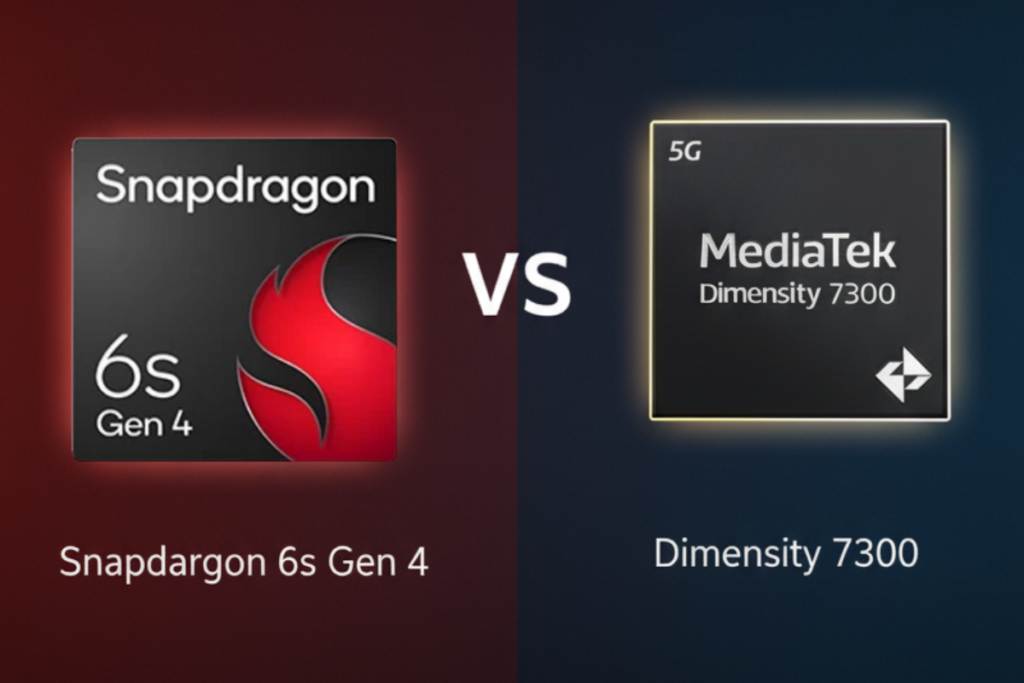
Qualcomm continues to push more power into affordable chips by incorporating modern chip technologies and premium features. The newly announced Snapdragon 6s Gen 4 aims to strengthen Qualcomm’s presence in the affordable and lower mid-range smartphone market. But there’s strong competition from MediaTek in that segment.
The Dimensity 7300, announced in June 2024, has a similar spec sheet, featuring four Cortex-A78 and four Cortex-A55 cores. The chipset already powers many phones from different brands, such as Vivo, Oppo, and Nothing. Here, we’ll compare it against the Snapdragon 6s Gen 4 to see which one has the edge.
Snapdragon 6s Gen 4 vs Dimensity 7300
As of writing this post, no smartphone has been launched with the Snapdragon 6s Gen 4. So, we don’t have the benchmark data as yet. So, we’ll be focusing on the rest of the details for this comparison. We’ll update this comparison with benchmark data once available.
CPU, GPU, & NPU
The Snapdragon 6s Gen 4 is manufactured using Samsung’s 4nm process node, while the Dimensity 7300 uses TSMC’s 4nm process node. The difference here is that TSMC’s manufacturing facility generally produces chips that offer higher performance and power efficiency than Samsung’s.
Furthermore, the Snapdragon chip uses four Cortex-A78 performance cores and four Cortex-A55 power-efficiency cores. The Dimensity 7300 also has the same CPU configuration, but the cores run at higher speeds, which should offer higher peak performance.
The Snapdragon 6s Gen 4 is equipped with an Adreno GPU (the exact model hasn’t been disclosed yet) that promises 59% better performance than its predecessor, the Snapdragon 6s Gen 3. Qualcomm says the chip is capable of delivering ultra-smooth 144fps gaming at FHD+ resolution. Additionally, the chip supports Variable Rate Shading and Qualcomm Game Quick Touch for an enhanced gaming experience.
The Dimensity 7300, on the other hand, uses a dual-core Mali-G615 GPU. It also brings MediaTek HyperEngine optimizations, which improve performance, battery efficiency, and latency. In short, both GPUs promise smooth gaming. However, to see which chip offers better gaming performance, we’ll have to wait until a device with the Snapdragon 6s Gen 4 chip arrives in the market.
Both chipsets also feature NPUs for on-device AI capabilities: Qualcomm Hexagon NPU on the Snapdragon 6s Gen 4 and MediaTek APU 655 on the Dimensity 7300.
Camera & Imaging
The Snapdragon chip features dual 12-bit Spectra ISPs, allowing up to 200MP photo capture and 2K HDR video recording at 30fps. Additionally, it supports 720p slow-motion video recording at 240 fps.
The Dimensity 7300 has a 12-bit Imagiq 950 ISP, which also allows up to 200MP photo capture. It supports hardware-based noise reduction, as does the Snapdragon 6s Gen 4, but the Dimensity chip can record HDR videos at up to 4K resolution, while the Snapdragon chip is capped at 2K.
Connectivity
The Snapdragon 6s Gen 4 uses a 5G modem from Qualcomm that offers up to 2.9 Gbps download speed. The peak speed over a Wi-Fi connection is also limited to 2.9 Gbps. The chip supports Wi-Fi 6E, Bluetooth v5.4, and both 5G mmWave and sub-6 GHz networks. Additionally, it features Qualcomm 5G PowerSave 2.0, Qualcomm SmartTransmit 2.0, and Qualcomm Wideband Envelope Tracking for strong connectivity and improved power saving.
The Dimensity 7300, with its in-house 5G modem and 3CC carrier aggregation, can achieve up to 3.27Gbps download speed over a 5G connection. The chip supports Wi-Fi 6E and Bluetooth v5.4 and features MediaTek 5G UltraSave 3.0+ technology for improved power savings.
Snapdragon 6s Gen 4 vs Dimensity 7300: spec sheet
Snapdragon 6s Gen 4
Dimensity 7300
Announced
October 2025
June 2024
Manufacturing
4nm (Samsung)
4nm (TSMC)
CPU
4 x 2.4 GHz — Cortex-A78 4 x 1.8 GHz — Cortex-A55
4 x 2.5 GHz — Cortex-A78 4 x 2 GHz — Cortex-A55
GPU
Qualcomm Adreno GPU
Mali-G615 MP2
NPU
Qualcomm Hexagon NPU
MediaTek APU 655
Memory
LPDDR5, up to 3.2GHz
LPDDR5, up to 3.2GHz
Storage
UFS 3.1
UFS 3.1
Camera
Dual 12-bit ISPs up to 200MP single camera up to 36MP single camera at 30 fps with zero shutter lag up to 16+16MP dual cameras at 30 fps with zero shutter lag up to 2K HDR video recording at 30 fps Hardware-based noise reduction support
Imagiq 950 ISP (12-bit) up to 200MP single camera up to 4K HDR video recording at 30 fps Hardware-based noise reduction support
Connectivity
Qualcomm 5G modem up to 2.9 Gbps download speed Wi-Fi 6E (peak speed: 2.9 Gbps) Bluetooth 5.4
MediaTek 5G modem up to 3.27 Gbps download speed Wi-Fi 6E Bluetooth 5.4
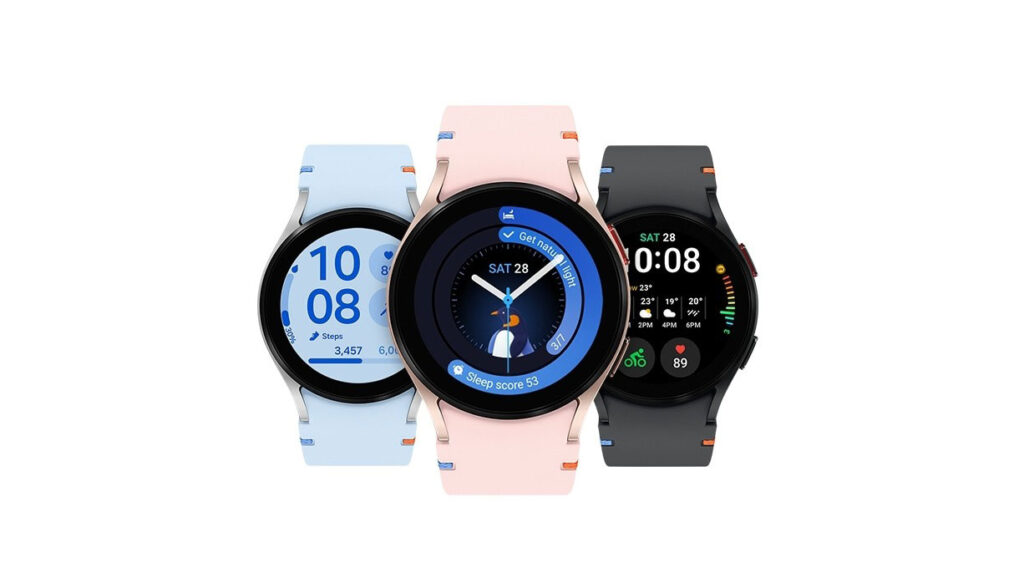
If you are not someone trapped in the Apple ecosystem, then here is the good news for you. The Galaxy Watch FE is now available at Walmart at 50% off. It’s a pretty good deal in this Halloween week if you’re looking for a good smartwatch.
The smartwatch categories have always been a tough one to recommend. Most of the so-called smartwatches were smart bands in disguise, and recommending a smartwatch under budget has always been a challenging task. Not anymore. Now the Galaxy Watch FE is available for around $99 at Walmart. The watch was launched at $199 last year (2024).
We have seen this trend before. Brands launch their product and drop their price on the very next sale. But this is more than any ordinary discounts. The drop is 50% and that’s huge. And if you are someone who is planning to buy a smartwatch, then the Galaxy Watch FE is the one.
As the name suggests, it’s an FE edition, so don’t expect pro-level performance. The Galaxy Watch FE comes with sapphire glass and is only available in one size. 40mm. It comes with an aluminium case, a 1.2-inch 396×396 Super AMOLED touchscreen, the Exynos W920 SoC at the helm, 1.5GB of RAM, 16GB of storage, and a 247 mAh battery. It runs on Wear OS with Samsung’s own One UI 5 Watch on top. The watch has an IP68 rating for dust and water resistance, a 5ATM rating for diving, making it a perfect sporty watch too.
Galaxy Watch FE comes with 100+ different workouts, advanced running analysis, personalised heart rate zones, and body composition analysis. The watch has an advanced sleep tracking with sleep pattern monitoring and sleep coaching. It also comes with a mind-blowing feature called Smart Heart Monitoring, which detects irregular patterns of your heartbeat and gives a notification. However, at the price of $99, the Galaxy Watch FE becomes an easily recommendable watch, and if you are an athlete or someone who is involved in sports regularly, then this is a must-have wearable to track your movements.
OnePlus officially unveiled the OnePlus 15 in China last night. The company has been teasing its international rollout for weeks, and now it’s confirmed that the phone is coming to India on November 13th.
The launch event is scheduled for 7 PM IST, and sales will kick off just an hour later. The teaser also confirms that India won’t miss out on any color options either.
Alongside the OnePlus 15, the company introduced the OnePlus Ace 6 in China. However, it seems so far the Indian event will focus solely on the flagship 15.
OnePlus 15: quick overview
The phone features a 6.78-inch 1.5K LTPO AMOLED display with a 165Hz refresh rate. Thanks to the new Snapdragon 8 Elite Gen 5 chipset, it can push up to 165fps in supported games such as Call of Duty Mobile, League of Legends Mobile, and Naruto Mobile.
Powering the device is a 7,300mAh silicon-carbon battery that can handle 120W wired and 50W wireless charging. On the back, you’ll find a 50MP triple-camera setup, which includes a wide, a 3.5x periscope telephoto, and an ultrawide lens. Selfies are handled by a 32MP sensor.
The OnePlus 15 even has a gyroscope of the same specifications used in the PS5 controller. It offers a 200Hz sampling rate, improving accuracy by 77% and cutting latency by 11%. Other features include an IP69K rating, USB 3.2 Gen 1, and dual stereo speakers.
OnePlus 15 starts at around $560 or some Rs 50,000 in China. So it’s wise to expect that the phone could launch under Rs 60,000 in India.
You can go through our launch coverage to learn in detail about the smartphone. Or better yet, check out our hands-on video of the OnePlus 15 on YouTube.
For more daily updates, please visit our News Section.
1X Technologies, a robotics startup backed by OpenAI, has opened preorders for its first consumer-facing humanoid robot named Neo. The robot costs $20,000, with shipments set to begin in the United States in 2026, followed by a global release in 2027.
Specifications and Design
Neo stands 1.68 meters tall and weighs around 30 kilograms. It uses tendon-driven actuators and features a soft body made of 3D lattice polymer. The robot has a low operating noise of 22 decibels and can operate for up to four hours on a single charge. It can carry loads up to 24.95 kilograms and lift objects weighing up to 69.85 kilograms. Neo is available in three color options: Tan, Grey, and Dark Brown.
1X says Neo can take care of everyday household chores, including folding laundry, organizing shelves, and cleaning rooms. The robot can be operated through voice commands or a dedicated mobile app that supports task scheduling and real-time monitoring. It also includes a built-in large language model that enables contextual conversations, answers user queries, and offers helpful suggestions.
Neo combines audio, visual, and memory-based data to personalize its behavior and recognize when it is being addressed. It can also process visual information to identify kitchen ingredients and suggest recipes accordingly.
During its early stages of development, Neo relies on a feature called Expert Mode for tasks it does not yet understand. Through this system, users can schedule remote assistance sessions where a human operator from 1X can take control using a VR headset. These sessions require user consent, and privacy options let users blur faces, define private zones, and restrict access.
1X says it has implemented multiple security layers to protect user privacy. The company emphasized that early adopters should expect some level of human teleoperation to support Neo’s AI training. CEO Bernt Øyvind Børnich described this as part of a “social contract” between users and the company to help advance the technology.
Pricing and Availability
The robot is now available for preorder on the official 1X website with a refundable deposit of $200. The company also offers a $499 monthly subscription plan for those who prefer not to pay the full price upfront.
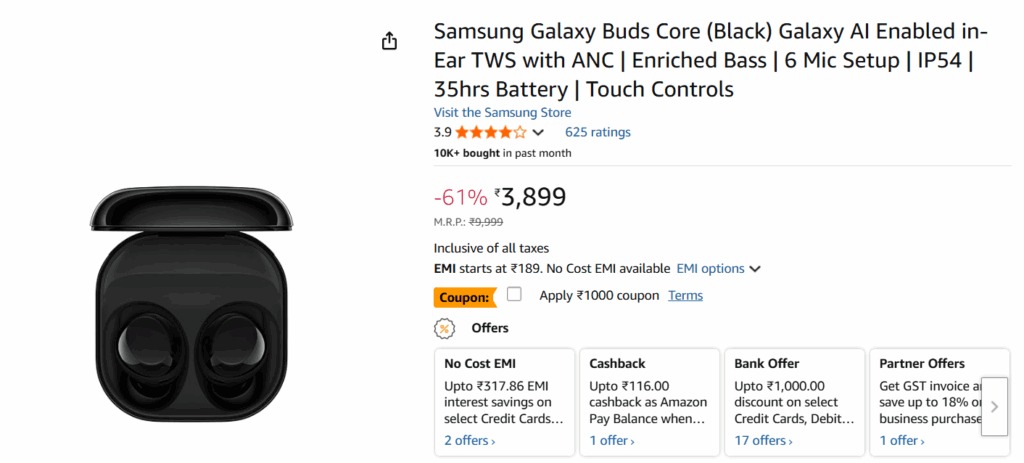
A compelling deal on the Samsung Galaxy Buds Core is unleashed on Amazon India. You could literally take home a brand new Galaxy Buds Core at just ₹2,899 effectively. This massive price drop is unlocked by a limited time coupon offer, so don’t waste any more time and read below to learn how to avail it.
The deal is straightforward and incredibly easy to claim. Customers can instantly apply a special ₹1,000 Off Coupon directly on the Amazon product page (as shown in the image). It brings the final purchase price down to just ₹2,899 (plus any additional bank offers or cashback).
The Galaxy Buds Core offers more for a budget-friendly price tag. It delivers a packed feature set designed for the modern user. Key highlights include AI-enabled noise Reduction for crystal clear calls, a comprehensive 6 Mic Setup, and robust Touch Controls for seamless interaction.
Please Note: When you buy something using the links in our articles, we may earn a small commission at no cost to you.
Samsung has not compromised the build quality for the asking price, so the earbuds come with an IP54 rating for dust and splash resistance, ensuring they can handle workouts and daily commutes. Furthermore, users can enjoy music and calls for up to 35 hours of total battery life with the charging case.
We believe Samsung Galaxy Buds Core offers unmatched value at this discounted rate. Don’t miss this opportunity to own a Samsung earbud at an effective price of ₹2,899. Head over to Amazon India now, click on the coupon, and secure this deal before the offer expires!
Gigabyte has launched the Aorus FO27Q5P gaming monitor in the UK after its earlier release in Europe. It is one of the few monitors to feature UHBR20-capable DisplayPort 2.1 ports, allowing high data transfer and performance without compression.
The Aorus FO27Q5P comes with a 27-inch QD-OLED panel offering a 2560×1440 (QHD) resolution and a 500Hz refresh rate. It reaches 1,000 nits brightness in HDR and meets VESA DisplayHDR True Black 500 certification. The panel covers 99% of the DCI-P3 color gamut, supports 10-bit color, and delivers a 1.5M:1 contrast ratio with a 0.03ms response time (GTG). These specs ensure smooth visuals, deep contrast, and accurate color reproduction.
This monitor’s key advantage is its DisplayPort 2.1 UHBR20 support, which allows it to achieve its full 500Hz refresh rate at QHD without using Display Stream Compression. It is also ClearMR 21000-certified to reduce motion blur and comes factory-calibrated (ΔE<2) for color precision. The FO27Q5P includes two HDMI 2.1 ports, one DisplayPort 2.1 UHBR20, one MiniDP 2.1 UHBR20, one DisplayPort 1.4 output, one USB-C port with 18W power delivery, two USB 3.2 downstream ports, one USB upstream port, and audio jacks for both earphones and microphones. It also features dual 5W speakers and a built-in KVM switch.
The display supports tilt (-5° to +20°), swivel (±20°), pivot (0° to +90°), and height adjustment up to 130mm. It has an anti-reflective coating, flicker-free technology, and VESA 100x100mm mounting.
Pricing & Availability
The Gigabyte Aorus FO27Q5P is now available in the UK for £838.99 (~$1,120) on Amazon and Overclockers UK, priced higher than the AOC Agon Pro AG276QKD2 (£678.95). Gigabyte has not yet confirmed its US launch.
For more daily updates, please visit our News Section.
If you’ve been eyeing a new phone, you might want to buy sooner rather than later. A global memory chip shortage is pushing up costs, and many smartphone makers, including Samsung, one of the largest memory manufacturers, are reportedly planning price hikes across their lineup.
The issue comes down to high-bandwidth memory (HBM), the same ultra-fast RAM used in AI servers that power tools like ChatGPT, Gemini, and Copilot. Demand has exploded thanks to the AI boom, but supply hasn’t caught up. Prices for memory chips are reportedly up by more than 50% this year, and it’s starting to ripple through to consumer hardware.
Samsung, for instance, is expected to raise prices on its upcoming phones and tablets to offset higher chip costs. Even though Samsung makes its own DRAM and NAND, it’s not immune to global supply pressure. The report doesn’t mention exact figures, but the bump will reportedly affect most product lines.
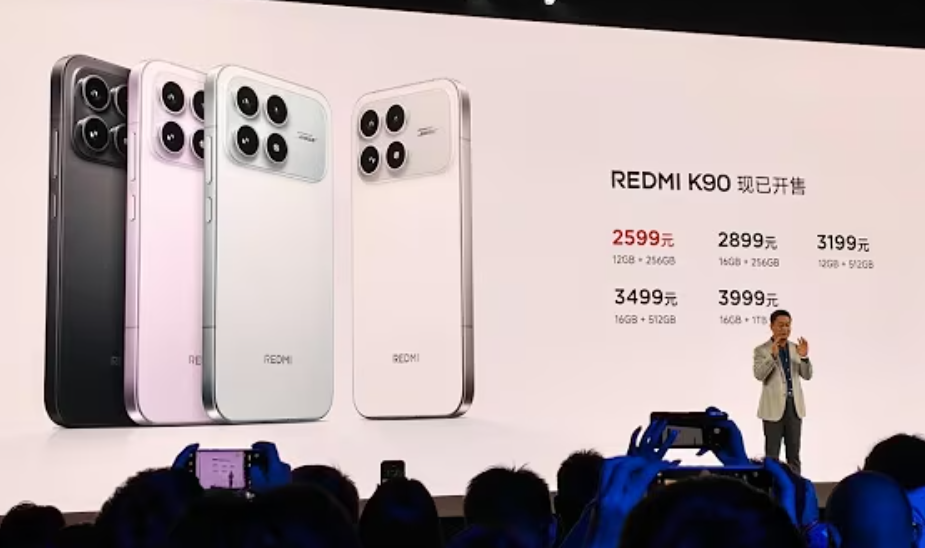
Some brands are already adjusting their prices. Xiaomi’s new Redmi K90 launched with a starting price of 2,599 CNY, a 100 CNY increase over its predecessor with the same 12GB + 256GB configuration.
What does that mean for buyers? Expect similar price hikes on upcoming models — roughly $50 to $100 for a flagship. And this memory crunch isn’t ending anytime soon. As SamMobile reports, the shortage could drag on into 2027 or even 2028, with AI demand showing no signs of slowing down. So, if you’re planning an upgrade, it might be smart to grab your next handset before prices start creeping up.
Motorola is gearing up to launch its latest mid-range contender in India. The Moto G67 Power just had its release date confirmed for next month, with the early teasers revealing a massive battery pack and solid specs. So here’s everything you need to know.
Moto G67 Power Drops on November 5
The brand has just confirmed that it is expanding its Moto G Power series of smartphones with the Moto G67 Power on 5th November 2025. So while we’re just a week away from its release, Motorola has also revealed plenty of key specs and features of this smartphone. The Power series is known for its huge battery packs, and the Moto G67 Power doesn’t disappoint either, with a massive 7,000mAh silicon carbon cell. Motorola is promising up to 58 hours of use on a single full charge.
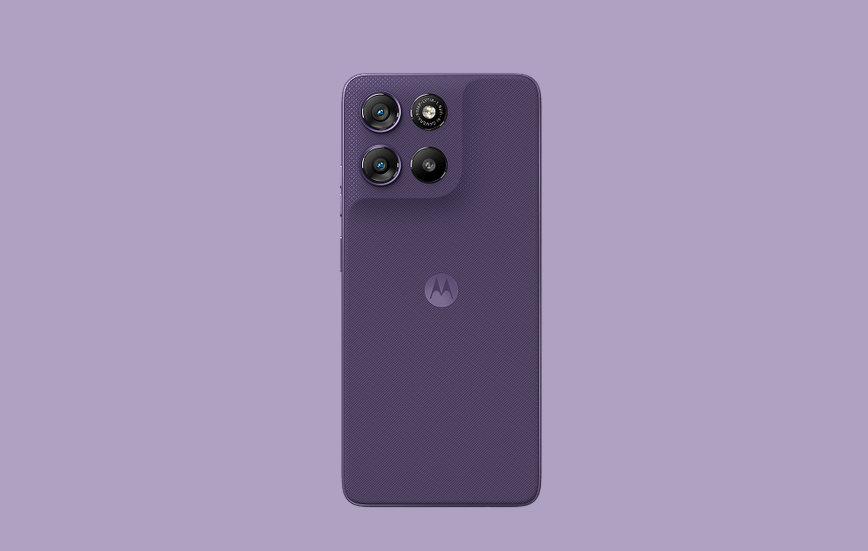
Moto G67 Power in Pantone Parachute
For optics, the rear has a 50MP Sony LYT600 main camera that is paired with an 8MP ultra wide angle lens. Meanwhile, the front houses a 32MP shooter for selfies and video calls. On the front, the Moto G67 Power sports a tall 6.7-inch display with an FHD+ resolution, a 120Hz refresh rate, and Corning’s Gorilla Glass 7i for protection. The company is bringing back vegan leather materials for this model, along with the MIL-810H military grade certification.
It will launch in 3 Pantone certified colors, which include Pantone Cilantro, Pantone Blue Curacao, and Pantone Parachute. Other notable features include Android 15 OS out of the box, stereo speakers with Dolby Atmos, Snapdragon 7s Gen 2, 8GB of RAM, and 128GB of internal storage. Motorola’s next big battery phone will be launched next week via the brand’s official website, Flipkart, and offline stores.
For more daily updates, please visit our News Section.
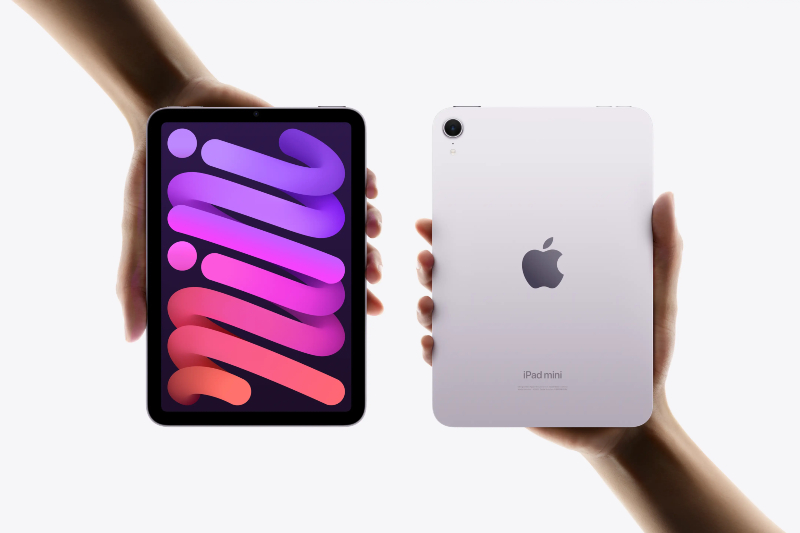
Apple is bringing OLED screens to more of its lineup, but it’s going to take a while. According to Bloomberg, the company is working on OLED versions of the iPad Mini, iPad Air, and MacBook Air, with launches spread out over the next few years.
The iPad Mini is reportedly first in line, set to make the jump in 2026. The iPad Air will follow in its next major refresh — likely 2027 — while the MacBook Air is expected to be last, moving to OLED around 2028. So, if you’re eyeing an upcoming MacBook Air, expect another LCD panel.
OLED displays bring richer colors, deeper blacks, and better contrast — plus a small bump in power efficiency compared to the current Liquid Retina screens. It’s the same display tech already found on the latest iPad Pro, and Apple now seems ready to expand it beyond the “Pro” machines.
Bloomberg also notes Apple is experimenting with a water-resistant design for the next iPad Mini, using vibration-based speakers instead of traditional cutouts. That could make it the first iPad with proper ingress protection — handy for anyone who likes using a tablet outdoors.
There’s a downside, though: cost. OLED panels are pricier to make, and supply chain chatter suggests price hikes across the board. According to reports, this upgrade may result in as much as a $100 price hike.
That puts Apple’s mid-tier devices in tougher competition with Android rivals like Samsung, Lenovo, and OnePlus, which already sell OLED tablets under $500.
Still, Apple’s clearly moving toward an all-OLED lineup — it just won’t happen overnight. By the end of the decade, most of Apple’s portable lineup could share the same rich, contrasty look that’s now reserved for the Pro models.
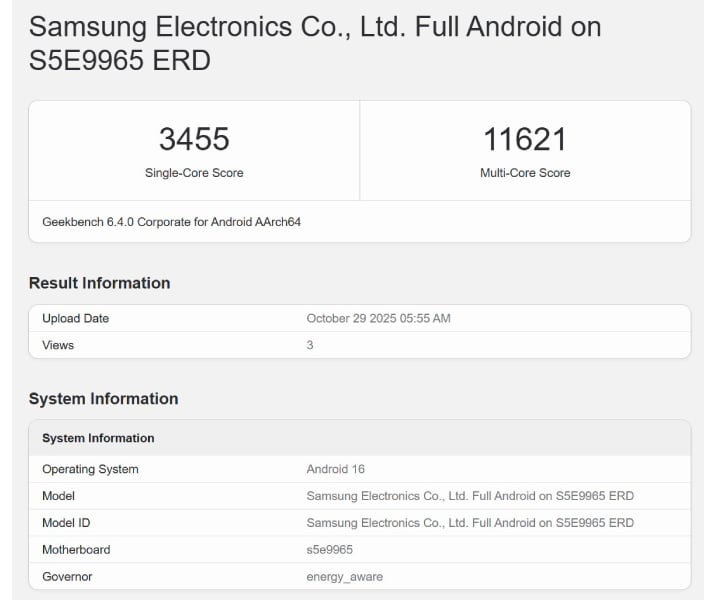
The Exynos 2600 has popped up on Geekbench once again, this time with even better performance numbers.
According to the latest benchmark listing, Samsung’s upcoming flagship chip scored 3,455 points in single-core and 11,621 points in multi-core tests. For comparison, when it first appeared back in August, it managed to get 3,309 and 11,256 points, respectively.
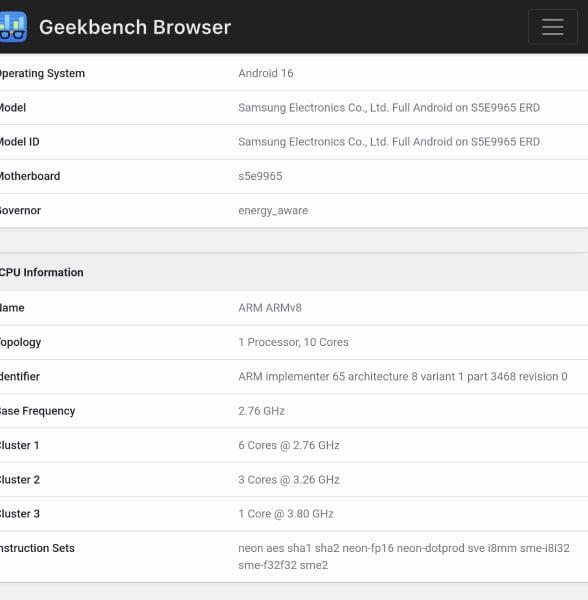
In both runs, the CPU configuration remains the same. The chip’s prime Cortex-X930 core is running at 3.8GHz, three Cortex-A730 performance cores at 3.26GHz, and six Cortex-A730S cores clocked at 2.76GHz. The improvement suggests Samsung has been doing some behind-the-scenes tuning to squeeze more out of the silicon.
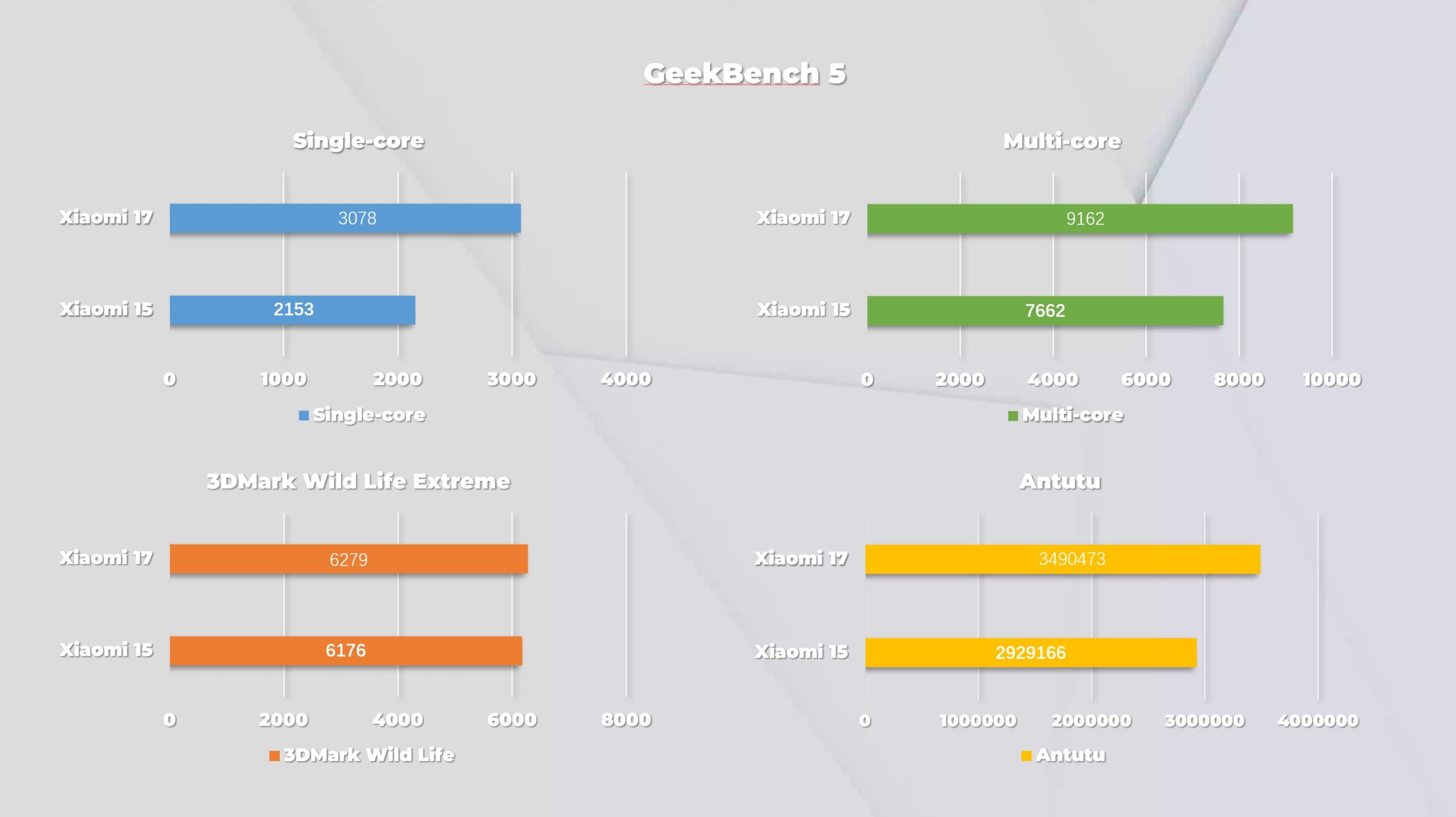
To put those numbers in perspective, our Xiaomi 17 unit with Qualcomm’s Snapdragon 8 Elite Gen 5 reached 3,078 points in single-core and 9,162 in multi-core.
On paper, that means the Exynos 2600 is currently ahead. Still, it’s worth remembering that Samsung’s test setup is a controlled environment, and real-world results could look different once the chip lands in actual phones.
There’s a possibility of two versions
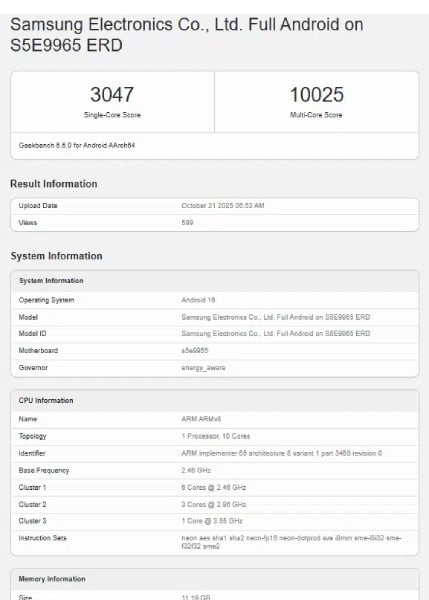
Interestingly, Samsung may be working on two versions of the Exynos 2600. A variant with lower clock speeds also appeared on Geekbench last week, showing prime core at 3.55GHz, three performance cores at 2.96GHz, and six efficiency cores at 2.46GHz. Unsurprisingly, its scores dipped to 3,047 (single-core) and 10,025 (multi-core).
According to SammyGuru, the dual listings could hint that Samsung may be planning to use two versions of the chip across its lineup. The higher-clocked model might be reserved for the Galaxy S26 Ultra, while the S26 and S26 Plus could ship with the toned-down variant. That’s just speculation for now.
For more daily updates, please visit our News Section.
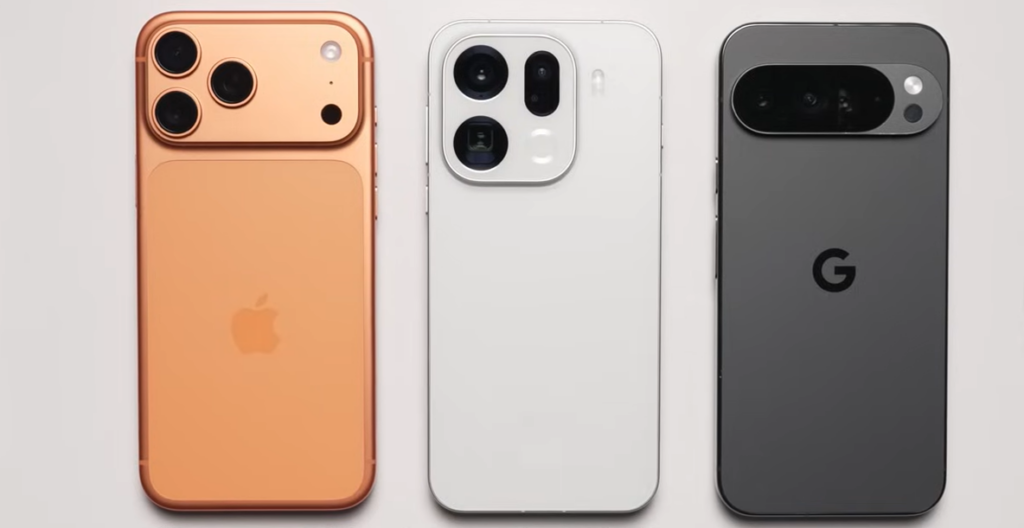
Most phones promise “all-day battery life,” but few can actually back it up once you start gaming, recording 4K video, or streaming. A new endurance test puts those claims to the test — and the results are pretty shocking. Oppo’s Find X9 Pro didn’t just edge out its rivals — it obliterated them, lasting nearly four hours longer than both the iPhone 17 Pro Max and Pixel 10 Pro XL.
The test, conducted by YouTuber Lover of Tech, pushed all three flagships through an identical, hour-by-hour stress routine: one hour of Asphalt 9, one of 4K video recording, another of live social streaming, plus TikTok and YouTube playback — all under the same brightness, cellular network, and volume settings.
Here’s how they stacked up:
Google Pixel 10 Pro XL: tapped out first at 7 hours
iPhone 17 Pro Max: followed closely at 7 hours 17 minutes
That’s more than four extra hours of screen-on time compared to the iPhone — a gap big enough to make a real difference in day-to-day use.
A big part of Oppo’s win comes down to the hardware. The Find X9 Pro packs a massive 7,500mAh silicon-carbon battery, the largest in any flagship right now. But it’s not just about size — Oppo combines that with smart optimization features like AI-based background freezing to limit unnecessary drain.
For content creators, travelers, and gamers, this isn’t just a spec-sheet win — it’s the kind of real-world performance that changes how you use your phone. You can shoot video all afternoon, stream, scroll, and still have enough charge left at night to skip the wall socket.
At €1,299, the Find X9 Pro isn’t cheap, but it delivers something most premium phones don’t. OPPO seems to have realized that lasting longer — without compromising the in-hand experience — might just be the most premium feature of all.
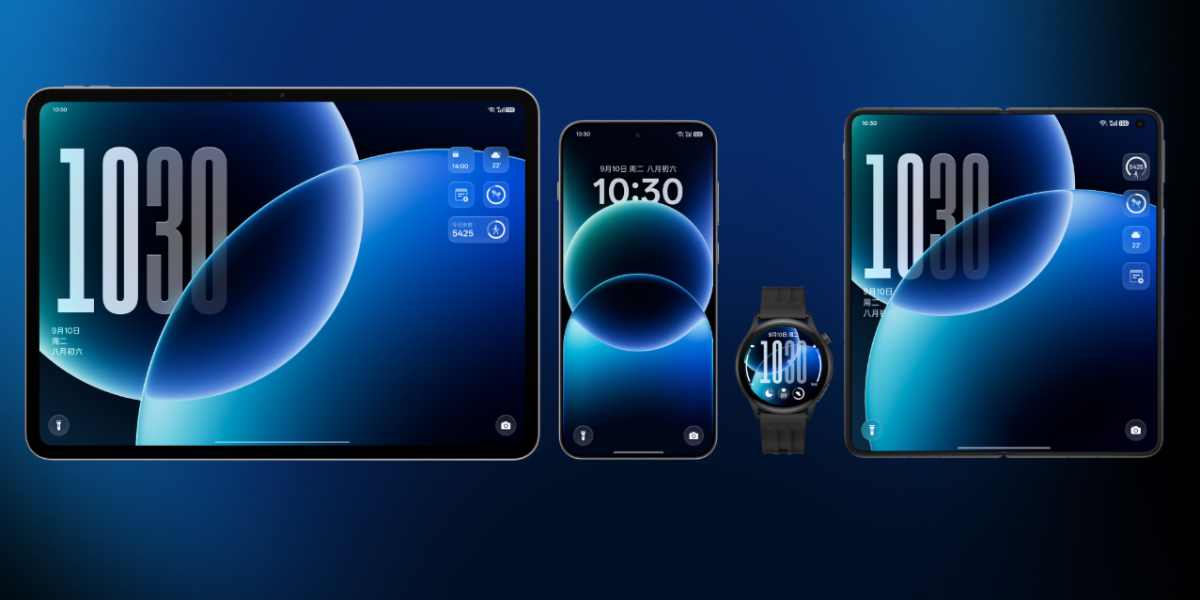
OPPO has officially launched ColorOS 16, the latest iteration of its Android skin, marking a major leap in design, intelligence and device-connectivity. Built on Android 16, this update introduces smoother animations, stronger AI features, improved cross-device workflows and enhanced privacy. The global announcement arrives alongside the brand’s flagship Find X9 and Find X9 Pro. With the roll out set to begin in November 2025 and spanning into early 2026, here’s what the new OS brings and which OPPO devices are first in line.
ColorOS 16 is designed to feel both faster and more refined than its predecessors. At the heart of the update lies a revamped animation system. OPPO is offering seamless animations that are powered by the new Luminous Rendering Engine and Trinity Engine. These components work together to render visual elements more efficiently and reduce lag across apps and transitions.
The goal is to make launching apps feel faster, scrolling smoother, and the interface more fluid overall. OPPO claims double-digit improvements in animation speed and touch responsiveness. Meanwhile, visually the UI takes cues from nature, with elements like light, shadow and motion influencing the design, adding immersive touches like motion wallpapers and full-screen always-on displays.
2. Smarter Features & Deeper Connectivity
Beyond aesthetics and motion, ColorOS 16 introduces meaningful upgrades in intelligence and ecosystem integration. One major focus is on Artificial Intelligence, bringing various AI driven editing tools like AI Portrait Glow, AI Eraser, and Master Cut video editing. All of this gives users one-tap ways to enhance photos and footage.
ColorOS 16 arrives with Oppo AI integration that features tools like AI Mind Space, AI Mind Assistant, and Smart Collections. The system also integrates Google’s Gemini, with Gemini Live allowing for real time interaction with Google’s multimodal assistant. So it can understand and read contextual information available on-screen. On the connectivity front, O+ Connect and improved multi-device workflows allow you to share files, mirror apps and link your phone with Mac and Windows PCs seamlessly. This allows for improved cross platform connectivity.
Additionally, privacy and system security are also getting an upgrade with more granular controls and background optimization. This system includes Oppo Lock for advanced data protection (Call to Lock, Dual Verification, & more) that can secure your device’s data if it gets lost, and Private Computing Cloud that makes sure your private data is processed with Oppos Private Cloud to remain secure.
3. Roll Out Timeline & Eligible Devices
Oppo has also confirmed the official global release timeline of its Android 16 OS based ColorOS 16 custom skin. This update will be arriving for both its smartphones and tablets, with the first stage starting in November 2025. So here are all of the devices that are eligible for this model:
November 2025
Oppo Find N5
Oppo Find N3
Oppo Find N3 Flip
Oppo Find X8 Pro
Oppo Find X8
Oppo Reno 14
Oppo Reno 14 Pro
Oppo Reno 14 Diwali Edition
Oppo Reno 14 F
Oppo Reno 13
Oppo Reno 13 Pro
Oppo Reno 13 F
Oppo Pad 3 Pro
December 2025
Oppo Find N2 Flip
Oppo Reno 13 F 4G
Oppo K13
Oppo K13 Turbo
Oppo K13 Turbo Pro
Q1 2026
Oppo Find X5 Pro
Oppo Reno 12
Oppo Reno 12 Pro
Oppo Reno 12 F
Oppo Reno 12 FS
Oppo Reno 12 F Harry Potter Edition
Oppo Reno 12 F 5G
Oppo Reno 12 FS 4G
Oppo Reno 11
Oppo Reno 11 Pro
Oppo Reno 11 F
Oppo Reno 11 FS
Oppo Reno 10 Pro+
Oppo F31
Oppo F31 Pro
Oppo F31 Pro+
Oppo F29 Pro
Oppo F29 Pro+
Oppo K13
Oppo K13x
Oppo K12x
Oppo Pad 3
Oppo Pad 2
Oppo Pad SE
For more daily updates, please visit our News Section.
Compared to the significant changes in the Pro series, the standard Xiaomi 17’s design hasn’t undergone major alterations from its predecessors—the 13, 14, and 15. It primarily unifies the color scheme, get rid of the prominent black accent modules seen in earlier models.
Yet, the Pro Max version currently dominates China’s bestseller ranks. So, is the standard Xiaomi 17 truly unworthy of purchase due to its ordinary appearance? After a complete test, I have a clear answer.
Design and Appearance
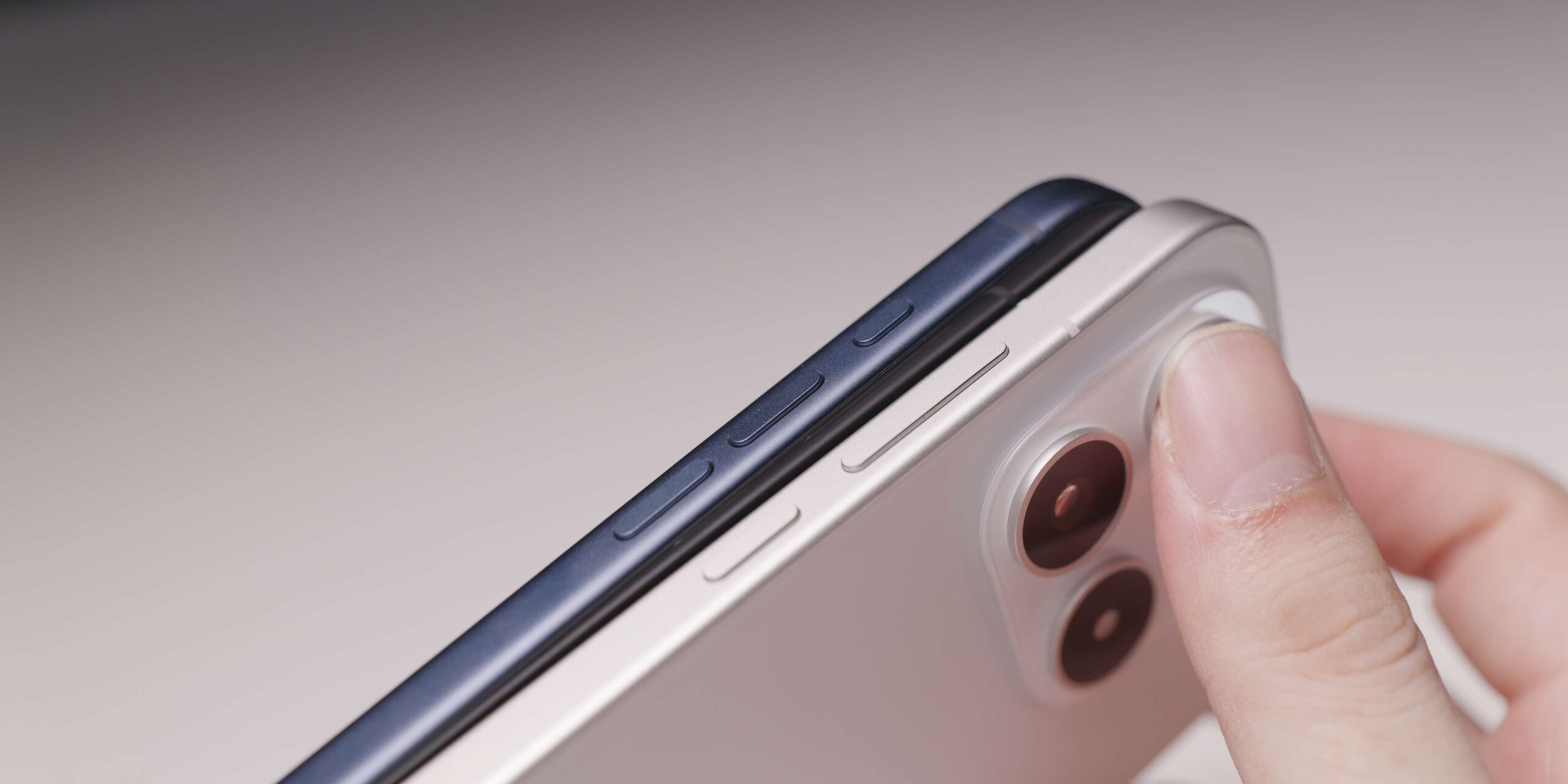
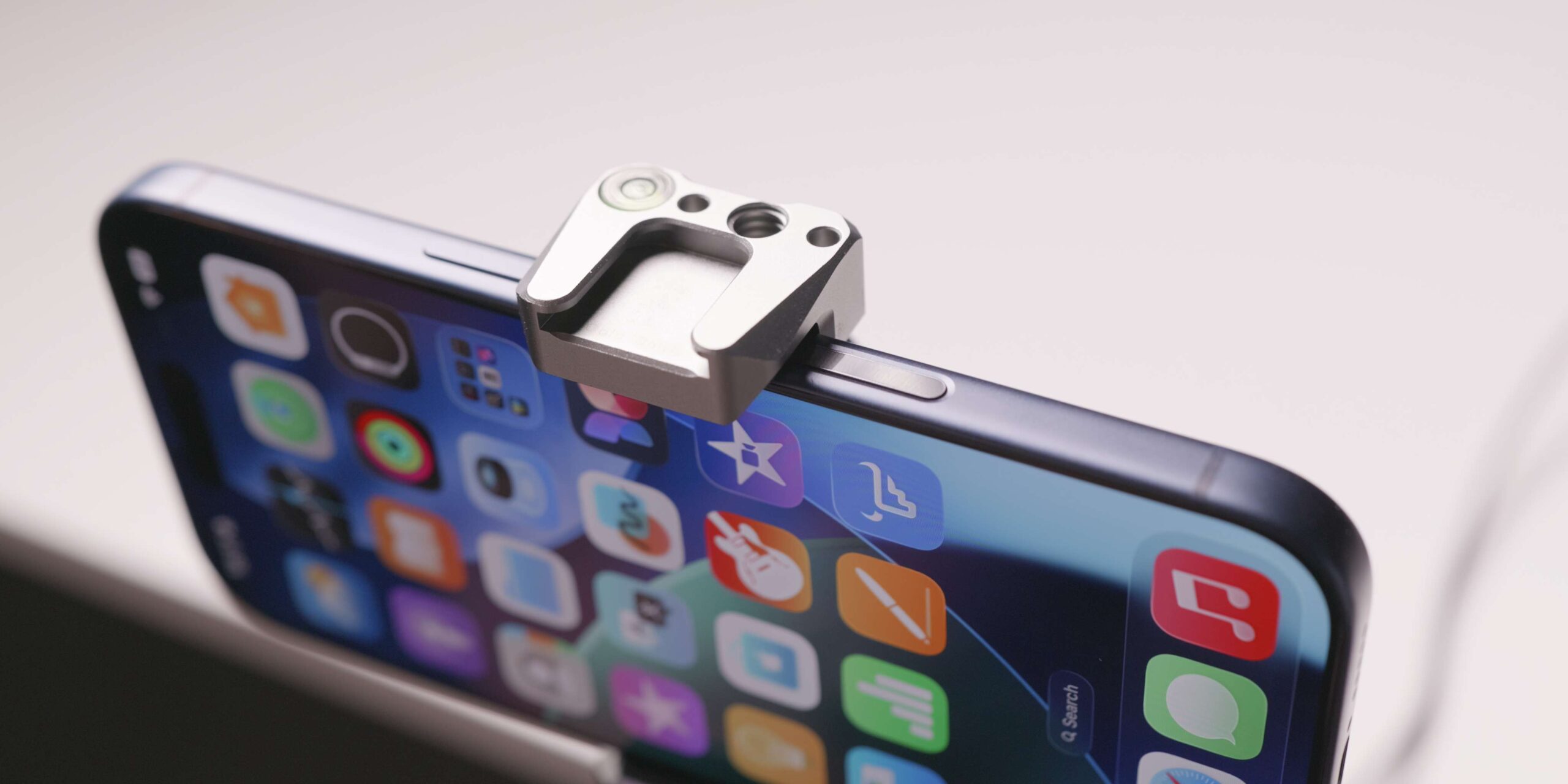
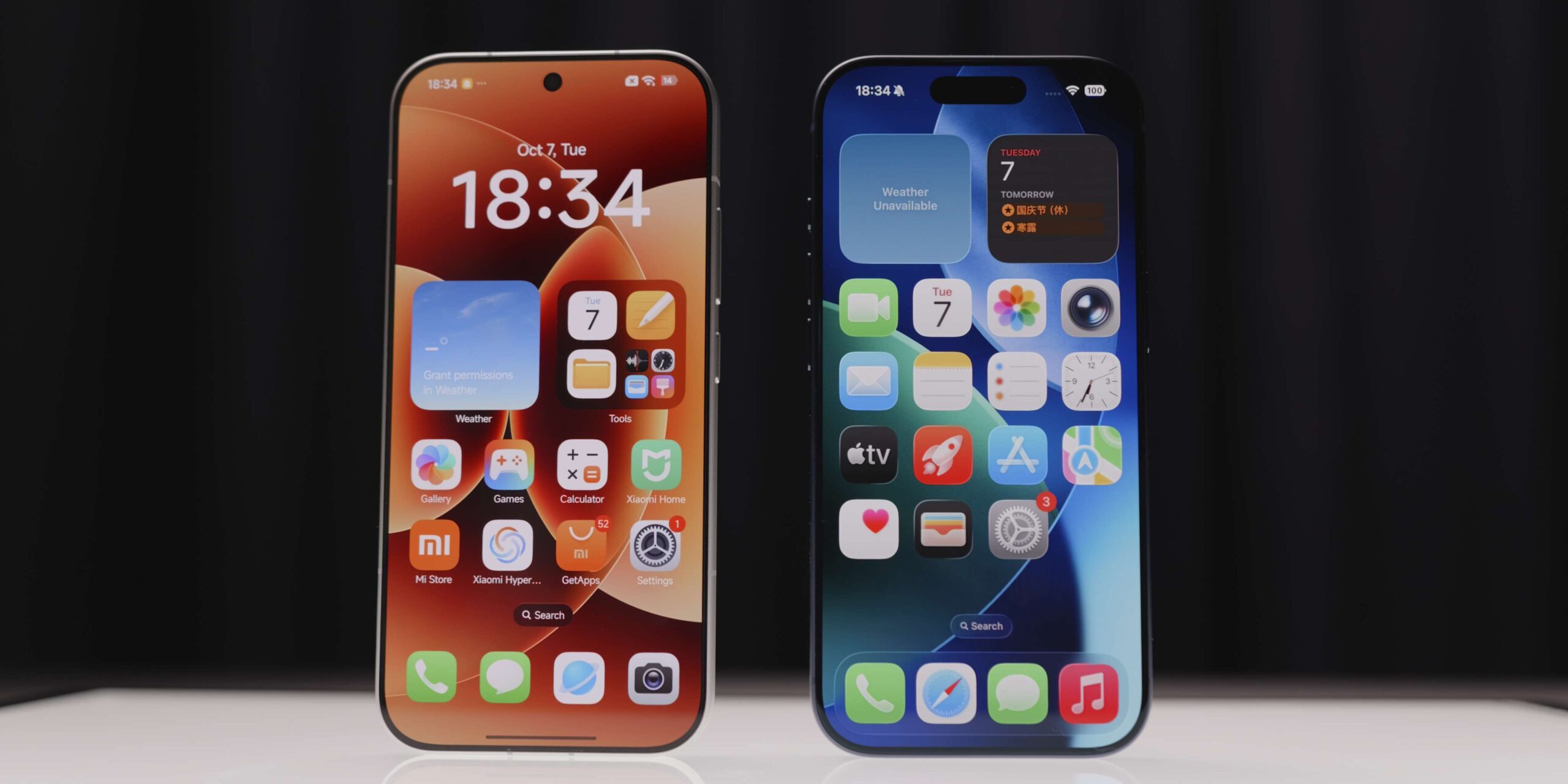
As mentioned earlier, the Xiaomi 17’s changes are subtle. Yet in actual use, I found its overall build quality rivals that of the iPhone 17 Pro. From the texture of the rear glass and frame finish, to the logo design and even the rounded corners of the display, it closely mirrors the iPhone. However, the Xiaomi 17 boasts a highly practical advantage: there isn’t a side button, and camera control button.
For users who always mount their phones on stands, this is a very thoughtful design. You no longer need to adjust the balance position like with iPhones, nor worry about accidental button presses.
Display and Speaker
Although the standard model’s screen doesn’t have the new pixel arrangement used in the Pro Max version, it still holds certain advantages. Compared to the Pro Max, the standard model’s screen is slightly smaller but maintains the same resolution. So its pixel density surpasses the Pro Max and aligns more closely with the iPhone 17 Pro.
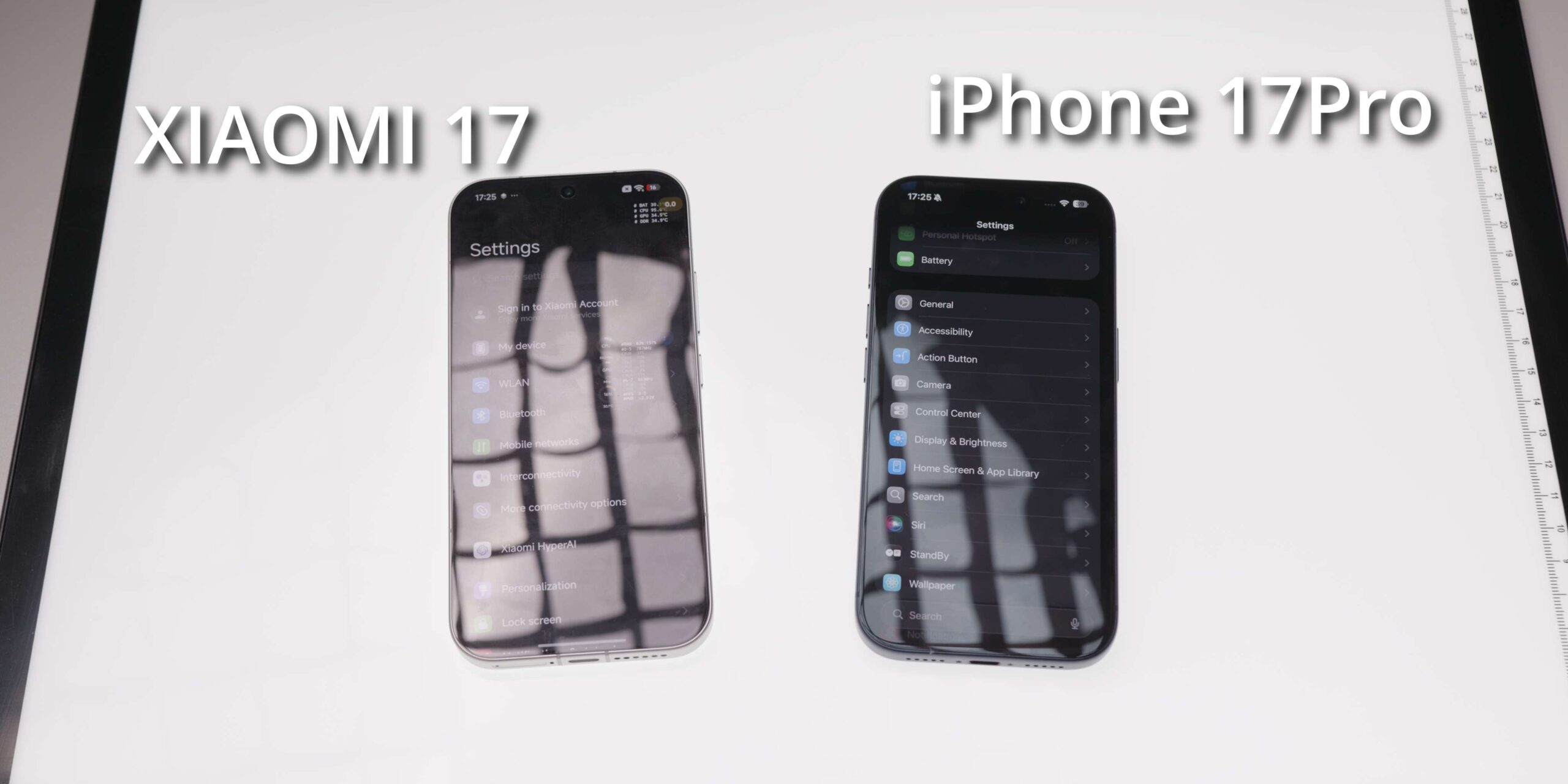
However, this display has a notable drawback: it lacks an anti-reflective coating. In bright outdoor environments, the iPhone’s display offers clearer visibility.
For users prioritizing speaker audio quality, the Xiaomi 17 may disappoint you. To show the actual differences more clearly, I will include a sound quality comparison clip with other models in this review.
Performance and Gaming
Performance-wise, you don’t need to worry too much. Both the standard and Pro Max versions share nearly identical core hardware specs, featuring the Snapdragon 8 Elite Gen5 processor, LPDDR5X RAM, and UFS 4.1 flash storage.
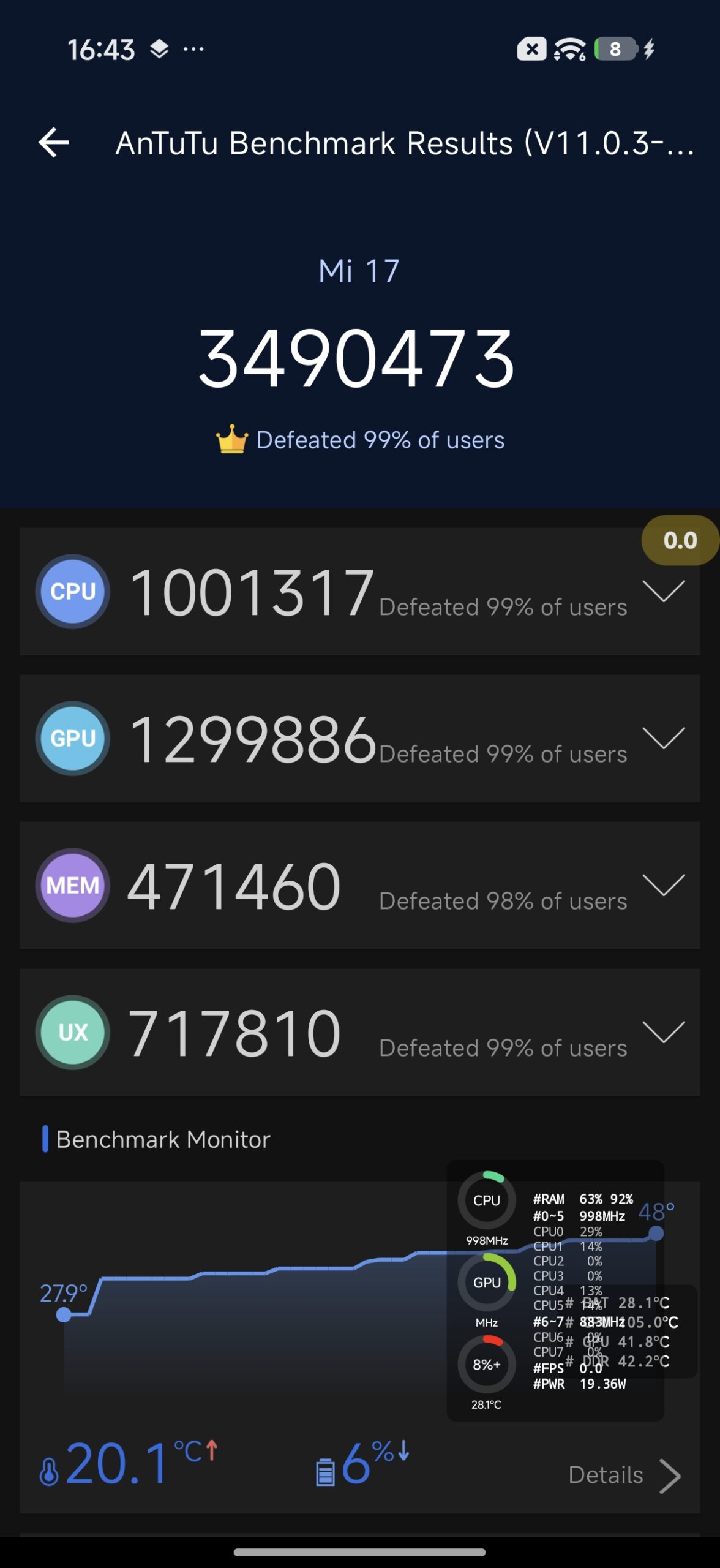
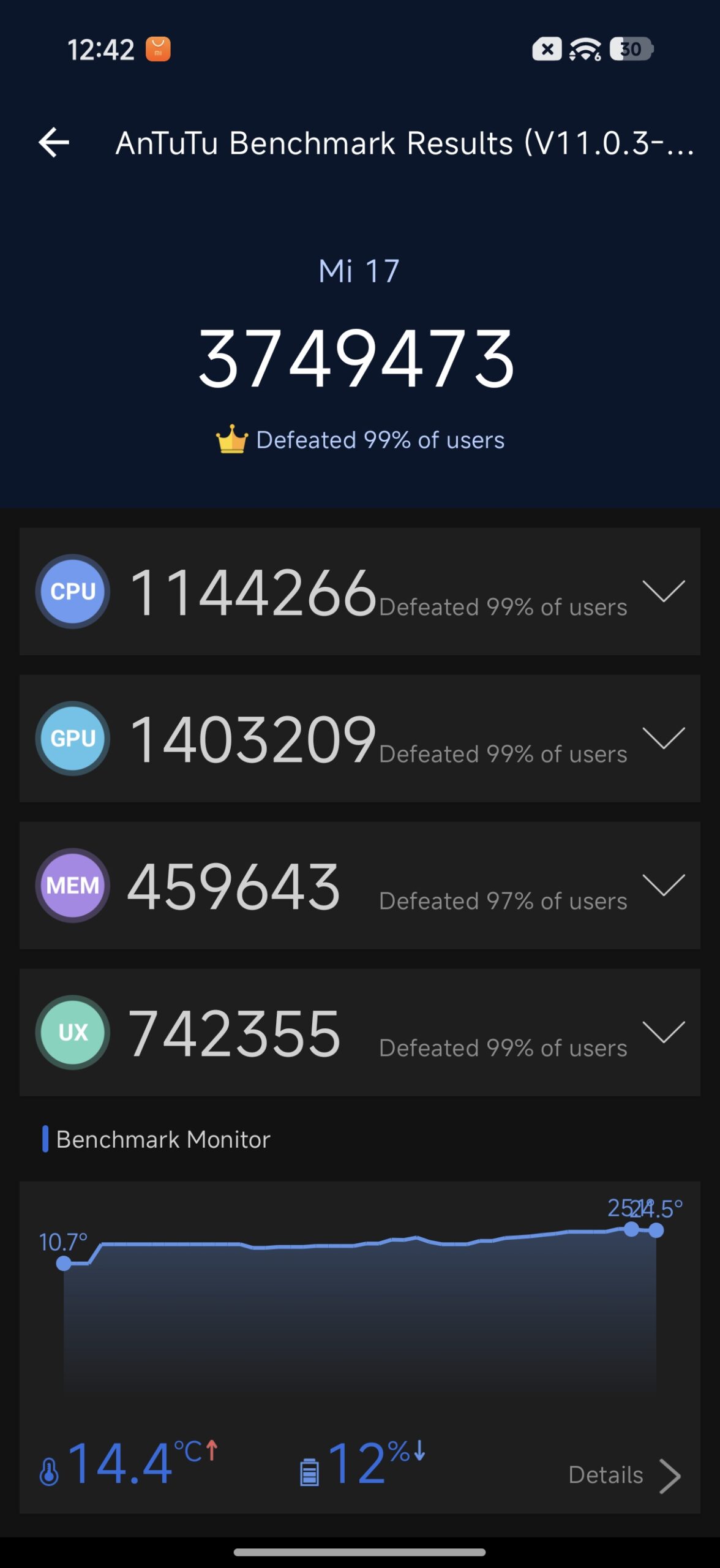
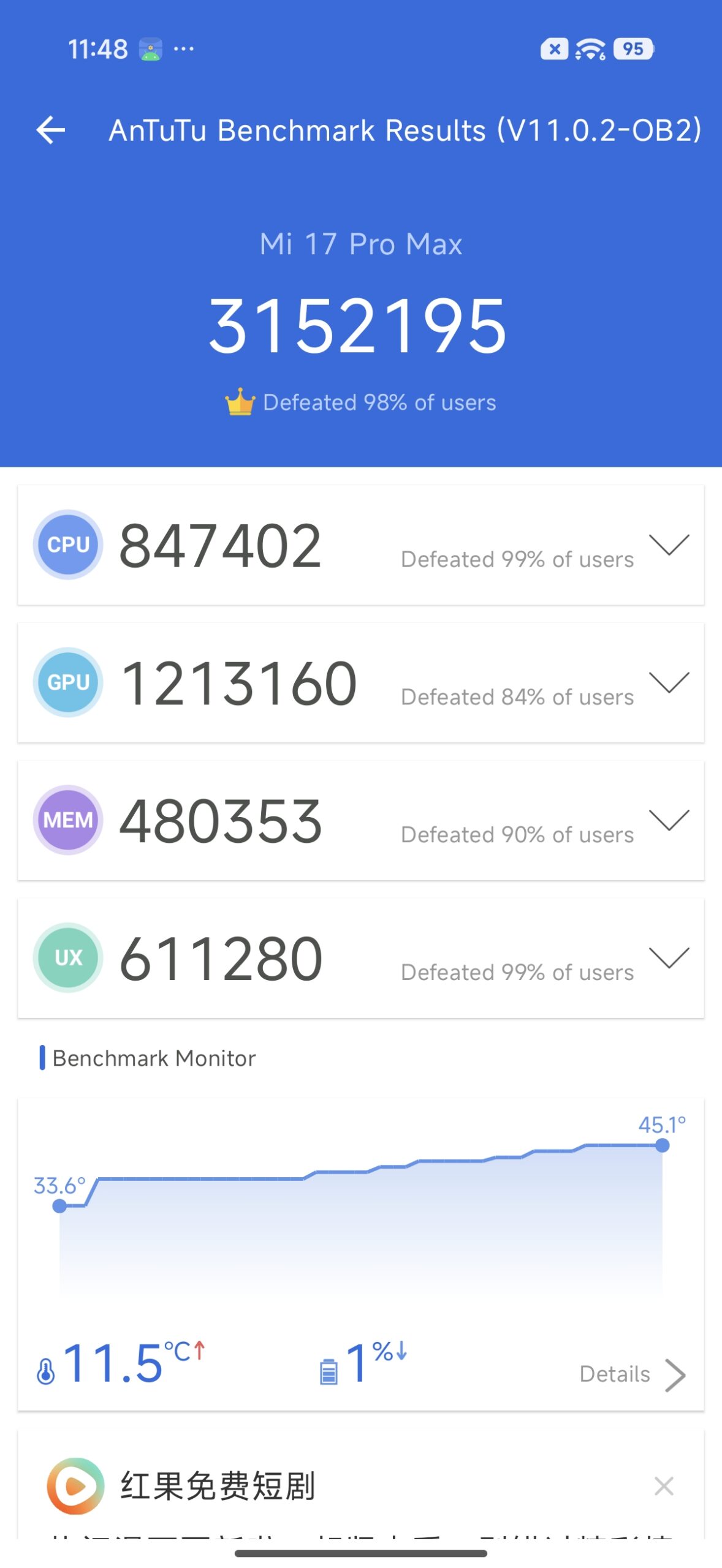
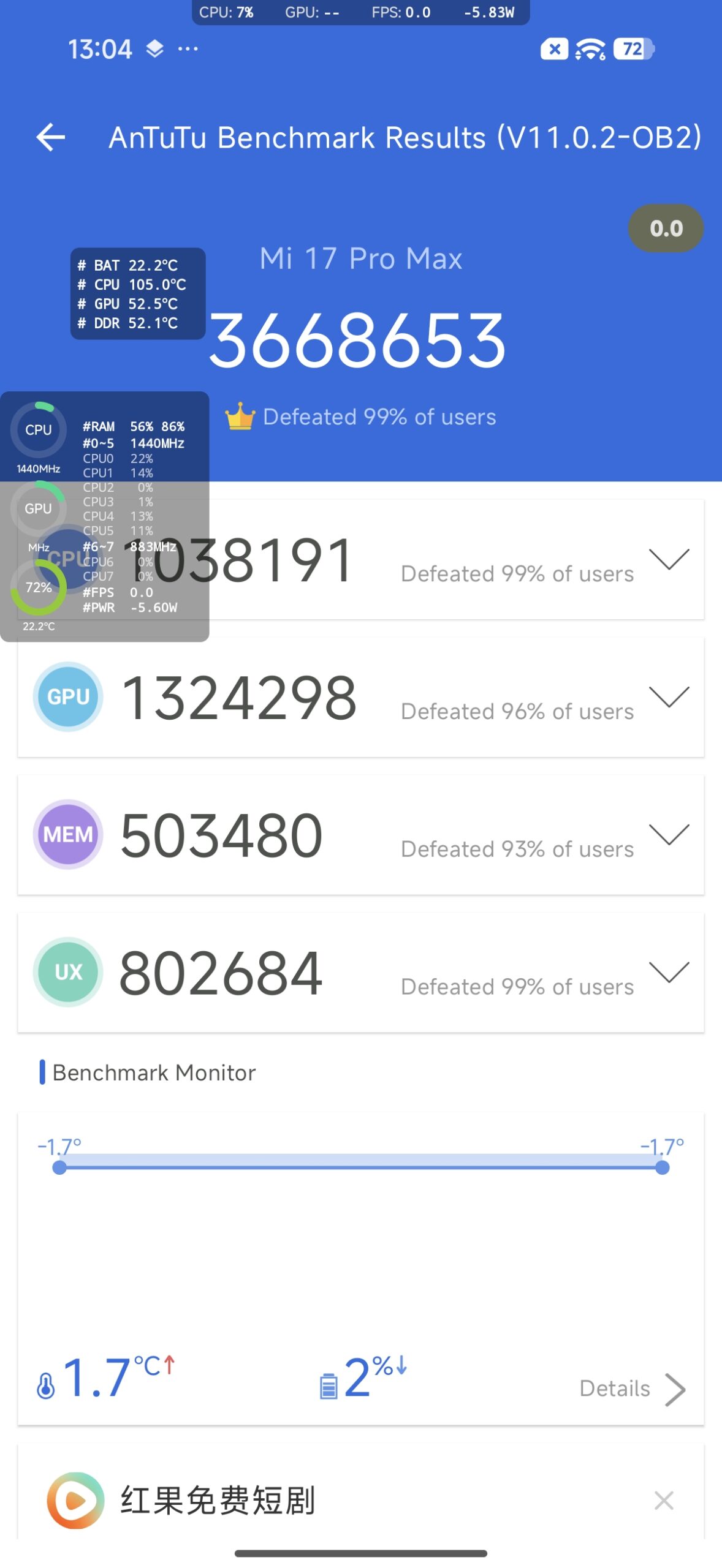
However, during testing, we saw an odd thing: our standard edition achieved approximately 3.5 million points on AnTuTu, while the Pro Max scored only 3.2 million. Yet, AnTuTu’s official benchmark results show a score of 3.7 million. This difference clearly indicates an issue.
After many testing and comparisons, we finally pinpointed the cause: the 3.7 million score could indeed be achieved on our standard Xiaomi 17—but only by putting the phone in a fridge for extreme cooling. Temperature curves in the Antutu benchmark records confirmed that the official score was obtained through fridge cooling. Even when cooled in a fridge, our Pro Max unit could only reach a maximum of 3.5 million points. At the same time, we monitored power consumption during benchmarking: under identical conditions, the Pro Max model consistently consumed less power than the standard version. This performance difference likely stems from two factors: different internal performance scheduling strategies within the system, and the physical difference of Snapdragon 8 Elite Gen5 processor.
XIAOMI 17 Room temperatureXIAOMI 17 Refrigerator
XIAOMI 17 Pro Max Room temperatureXIAOMI 17 Pro Max Refrigerator
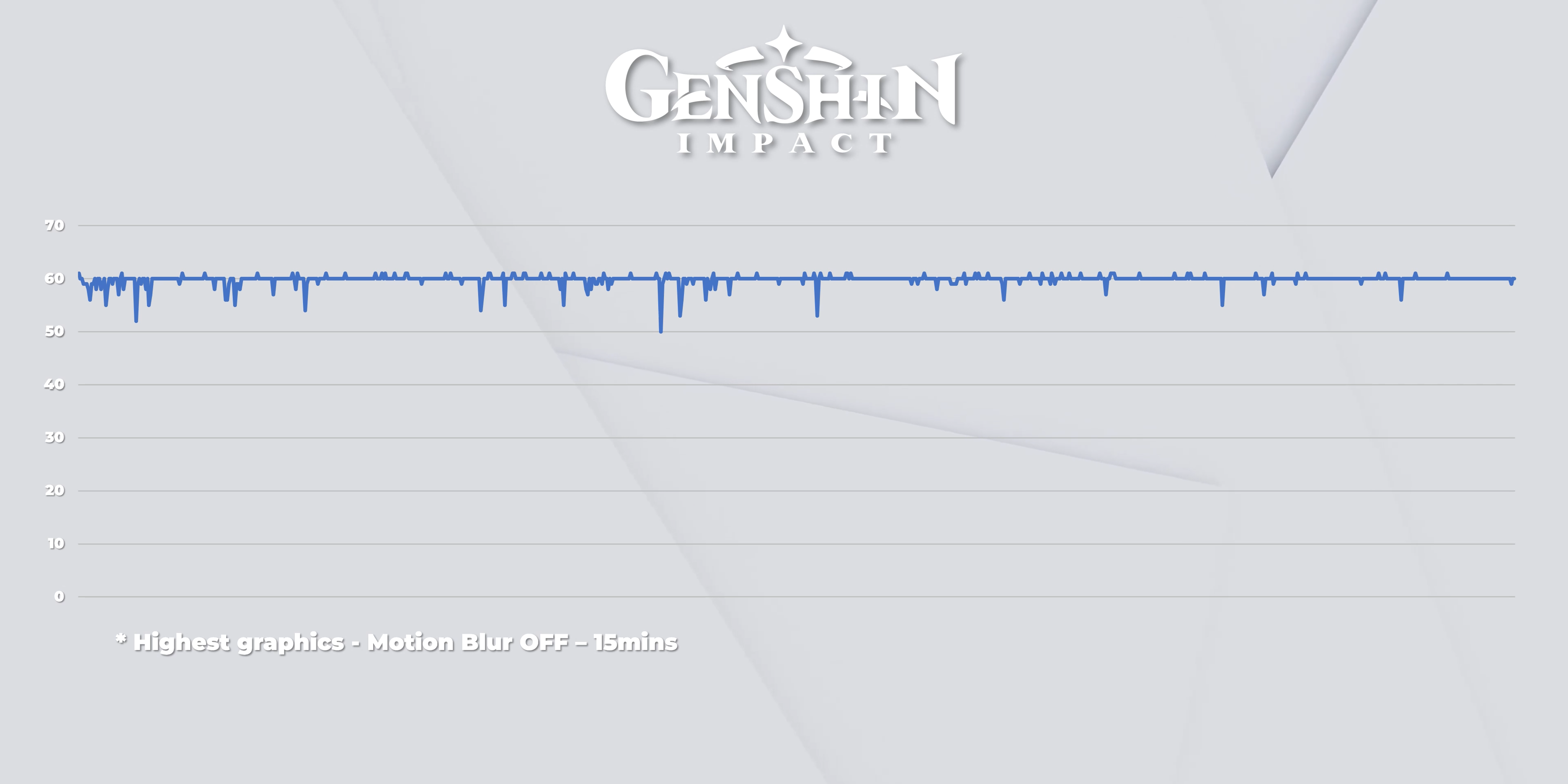
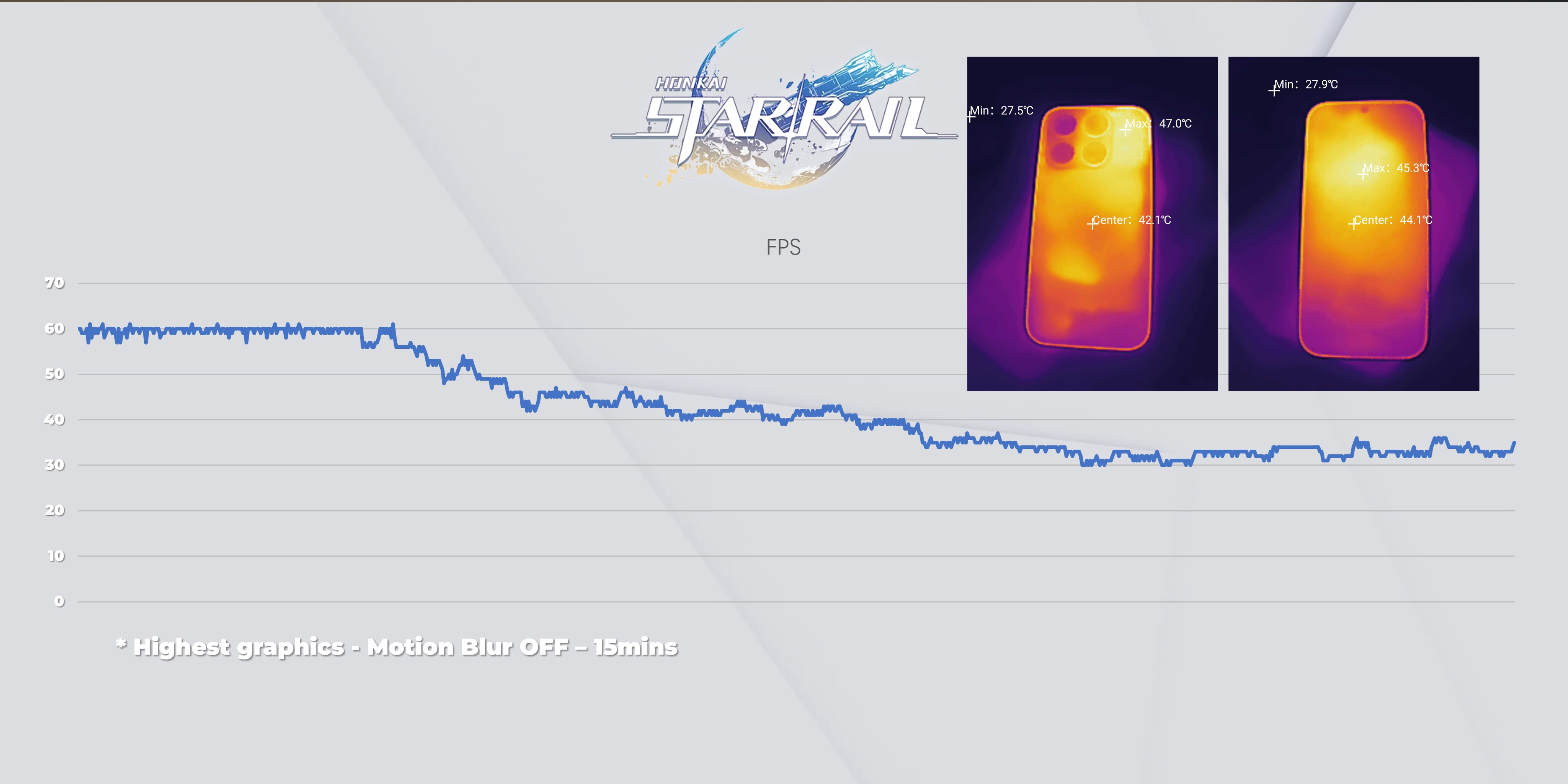
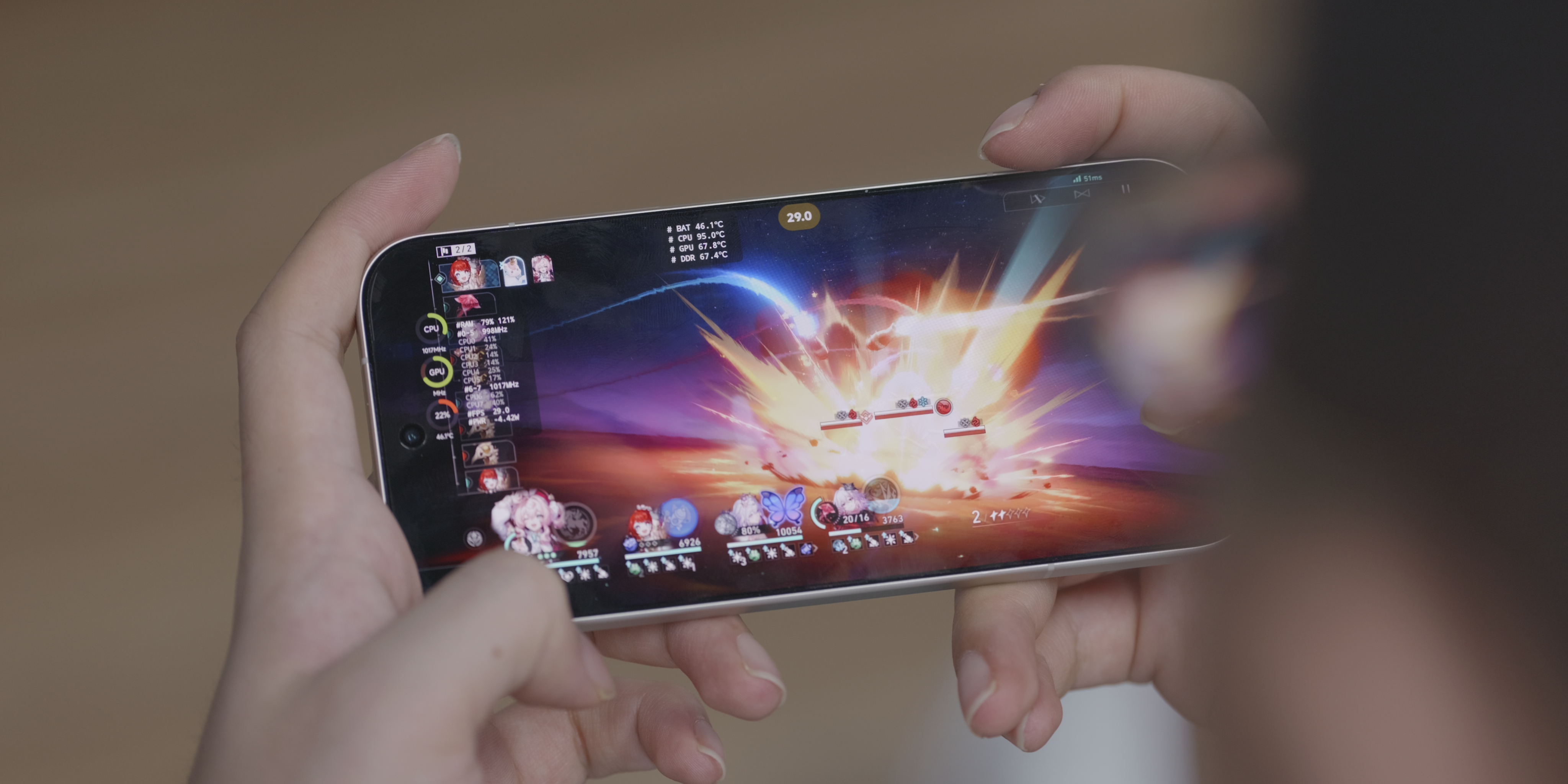
Fortunately, this benchmark gap doesn’t fully translate to real-world gaming performance. In Genshin Impact, the 17 performed nearly identically to the Xiaomi 17 Pro Max, with only slightly lower average power consumption. However, in Honkai: Star Rail, both the 17 and 17 Pro Max began throttling after three minutes of gameplay, with the devices becoming extremely hot to the touch.
Monitoring tools revealed that GPU and memory temperatures remained low during gameplay. This indicates the upgraded vapor chamber effectively dissipates heat. However, the issue lies in Xiaomi’s design redirecting processor heat toward the battery . So when running relatively low-load games like Genshin Impact, internal heat doesn’t yet trigger the battery’s thermal throttling. Conversely, high-load games like Honkai: Star Rail would trigger that quite fast. For smoother gameplay, you must either add external cooling solutions or adjust graphics settings downward.
Additionally, when running Genshin Impact and Honkai: Star Rail, we saw subtle differences in maximum graphics settings between the Xiaomi 17 series and other phones. Comparing it to the OnePlus 13, you won’t see the difference at first glance. However, if we zoom in to check character details or ground textures, the OnePlus 13 preserves more visual fidelity.
Imaging System
The Xiaomi 17 hasn’t seen big upgrades in its cameras. Among the four cameras on the front and back, only the main camera and front-facing camera have been upgraded. The main camera performs exceptionally well in well-lit daytime conditions, with image quality just as good as the Xiaomi 17 Pro Max.
For instance, when taking a photo of a lightbox, I captured three shots, there are noticeable color banding. The shots from the telephoto camera remains unchanged.
However, it makes mistakes in low-light or extreme lighting conditions.
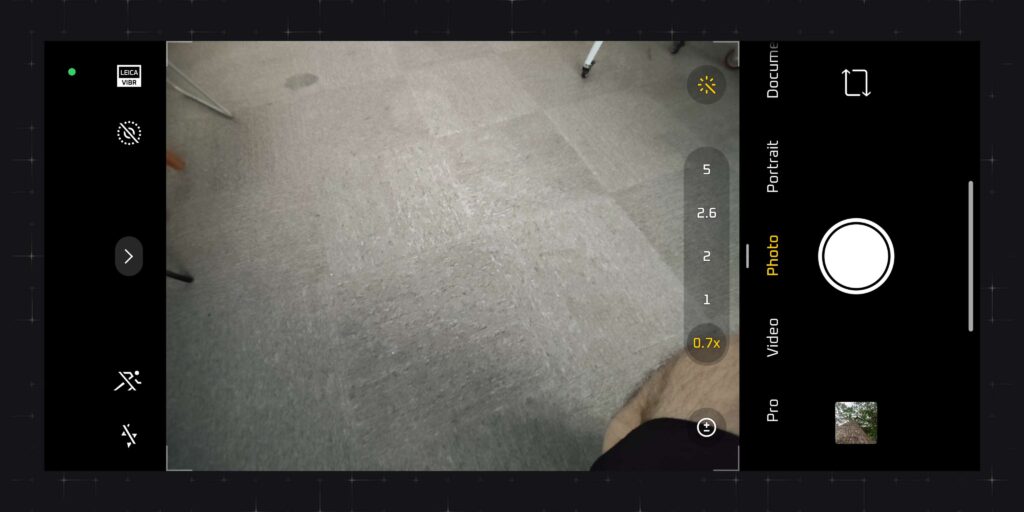
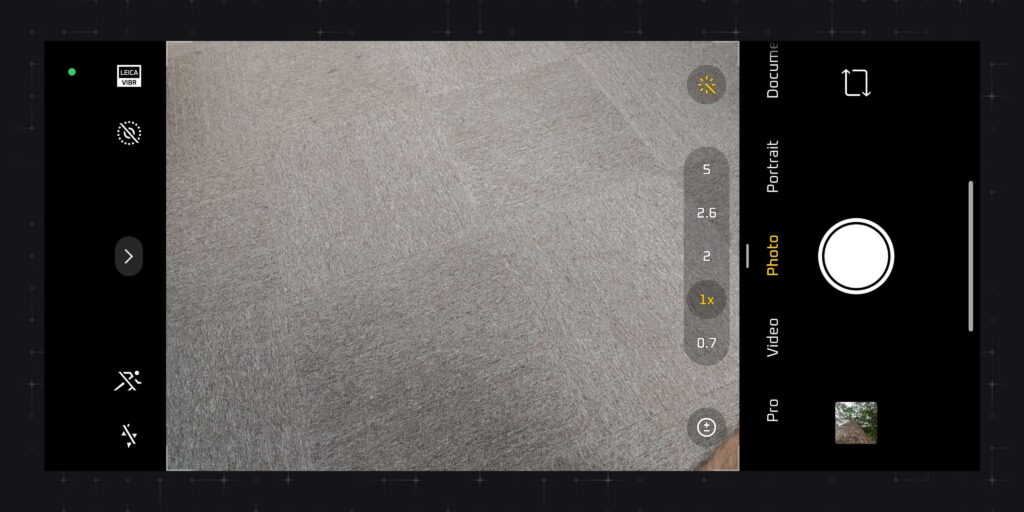
The ultra-wide camera has even regressed in performance. Watch this: Opening the camera app defaults to the main lens. When switching to 0.7x zoom, did you notice anything? Now let’s focus on the carpet area and compare multiple transitions—the difference should be very clear. Worst of all, this ultra-wide lens offers a mere 17mm field of view, which feels severely cramped in today’s market.
Battery Life & Charging
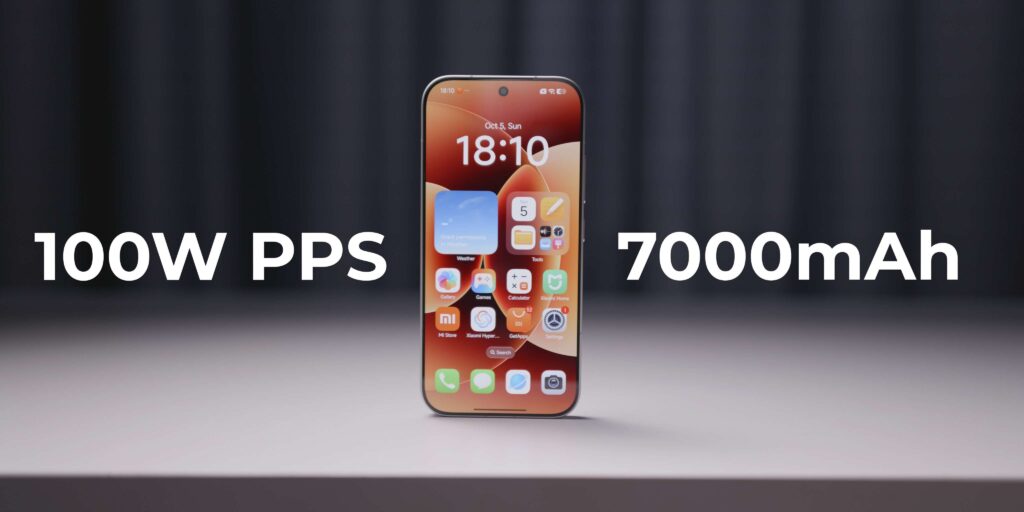
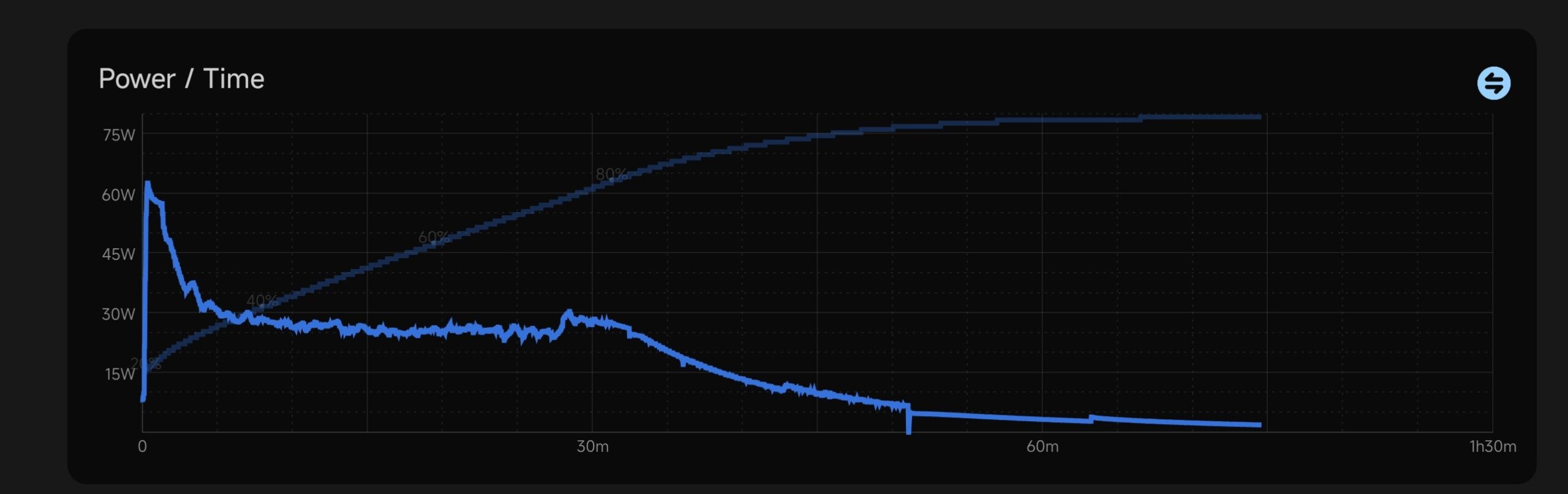
The Xiaomi 17 features a 7000mAh battery and supports 100W fast charging. This means most PPS-compatible chargers on the market can deliver 100W charging power to the device. However, in real-world testing, the peak charging speed doesn’t last long.
While initial charging power can reach 75W, it typically stabilizes around 30W for most of the charging session.
My biggest concern is rumors suggesting the global version may have a smaller battery capacity. If the global Xiaomi 17 fails to meet your endurance needs, you can purchase the Chinese version via the link in the video description.
Conclusion
After testing the Xiaomi 17, I found it isn’t a standard flagship with defined strengths and weaknesses. Compared to last year’s model, it maintains the same price, not like the Pros that have seen a price increase. The Xiaomi 17 isn’t “mediocre” either, it’s a practical flagship focused on performance and battery life.
If these two aspects are your top priorities and you can accept compromises in its imaging system, audio quality, and other details, it delivers a solid, value-driven experience. But if you seek uncompromising, top-tier imaging capabilities, the Pro series remains the better choice. Alright, this is the review of the Xiaomi 17, hope you like it, and don’t forget to like and subscribe. This is Will from Gizmochina, see you soon.
In Gizmochina’s hands-on video with the OPPO Find X9 series, the new flagship was considered a phone with almost no flaws. But after buying the Find X9 Pro and actually using it for a week, I have to apologize—it does have a few shortcomings. The current version of the Find X9 Pro doesn’t offer a great gaming experience. So, let’s start with its performance.
Performance
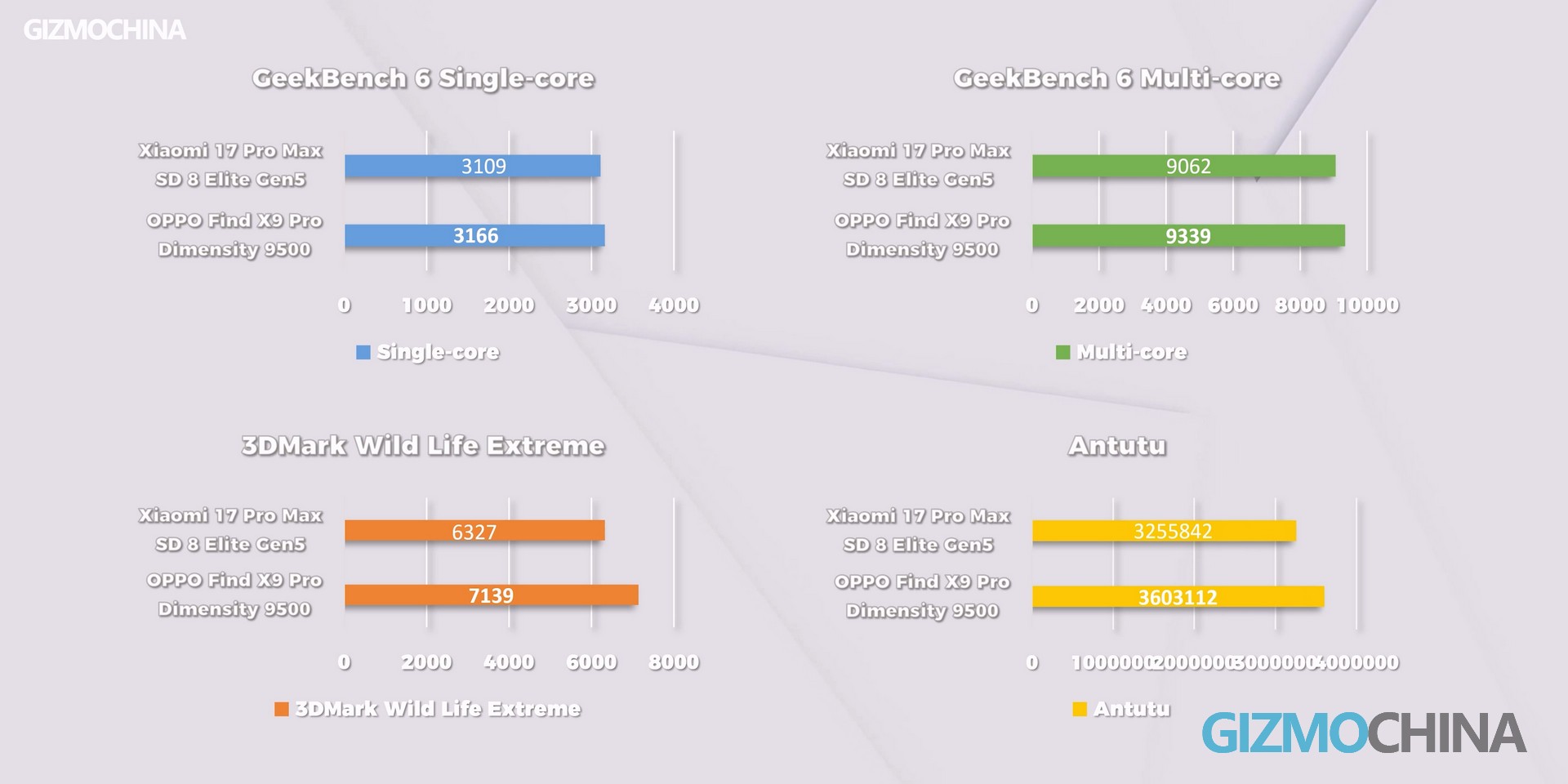
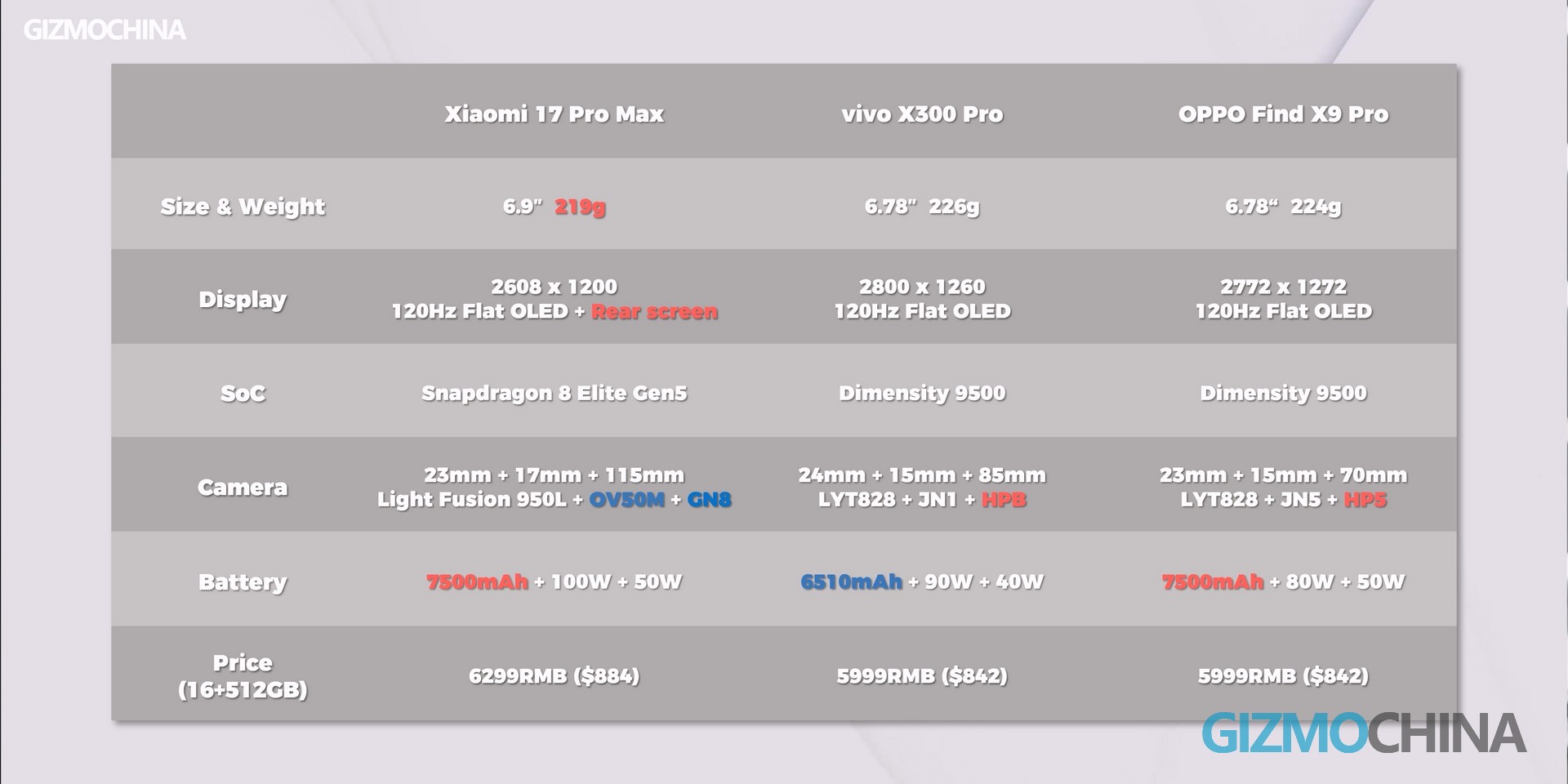
The Find X9 Pro, like the vivo X300 series, uses the Dimensity 9500 processor. Its benchmark score is slightly higher than the Xiaomi 17 Pro Max, which uses the Snapdragon 8 Elite Gen5.
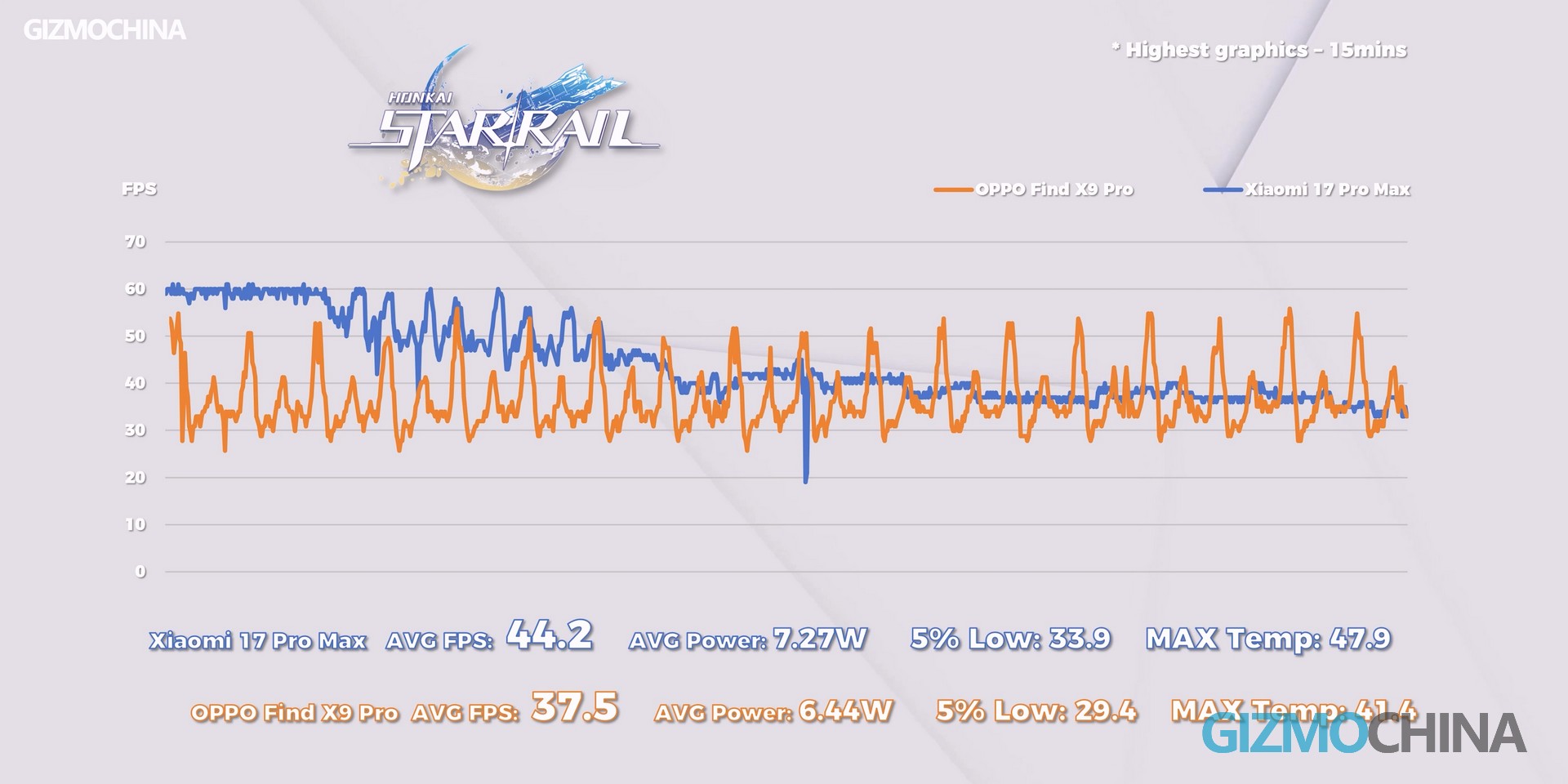
Let’s not waste time—let’s start with the most demanding game: Honkai: Star Rail. Well… things don’t look too optimistic. The frame rate graph looks like an ECG monitor—it fluctuates wildly. The peak frame rate is around 50fps, and it can drop as low as 30fps. In complex scenes, you’ll often feel the Find X9 Pro suddenly lag, which makes the gaming experience less enjoyable.
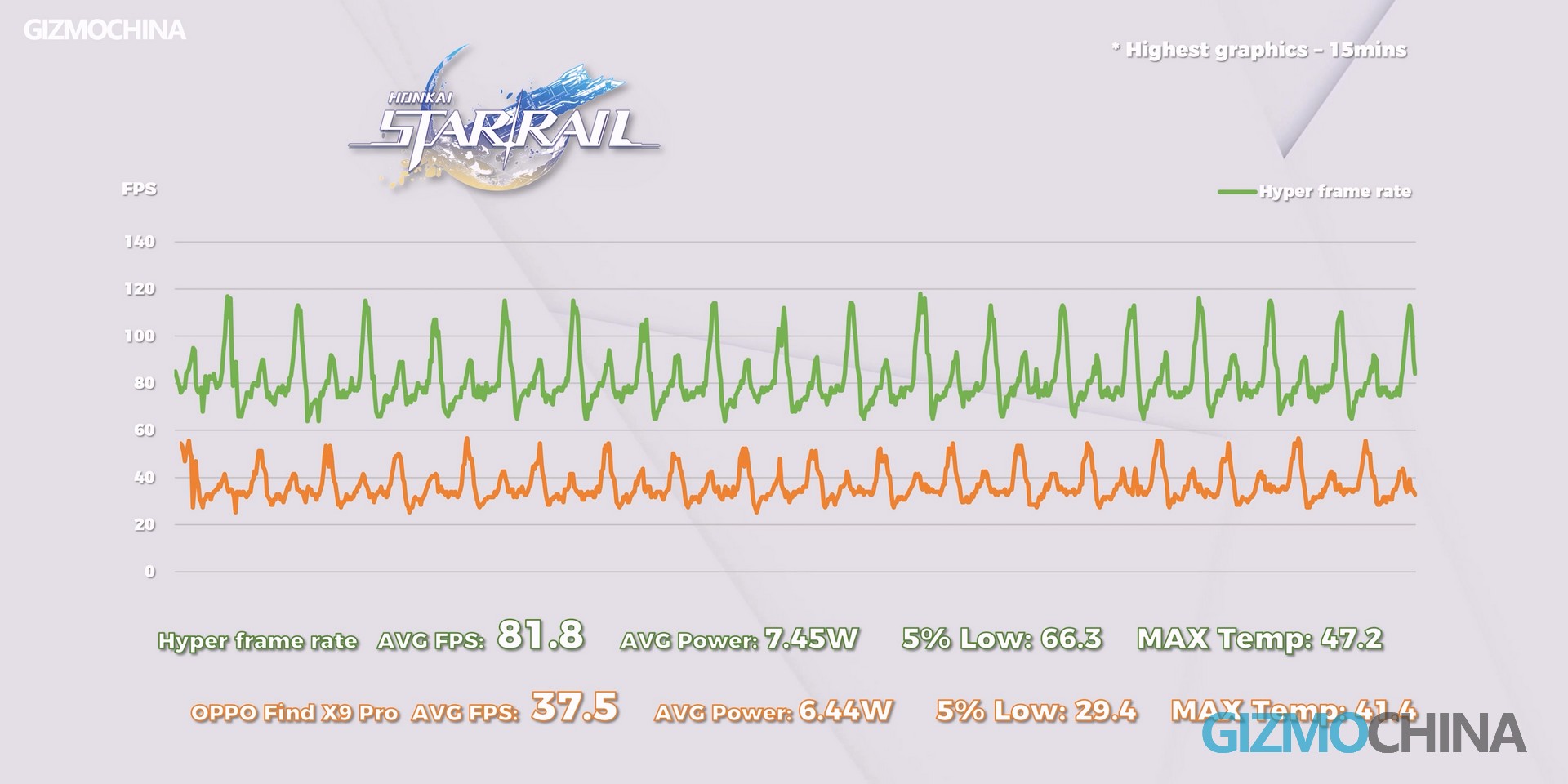
The good news is that the Game Toolbox has a frame interpolation option that doubles the frame rate. While the graph still looks like a roller coaster, the lowest frame rate now stays above 60fps, making stutter nearly invisible. The downside, of course, is higher power consumption and more heat.
There’s another workaround: we found the Find X9 Pro performs better with Vulkan. If you switch the graphics API to “Normal Mode,” the average frame rate improves by about 10fps.
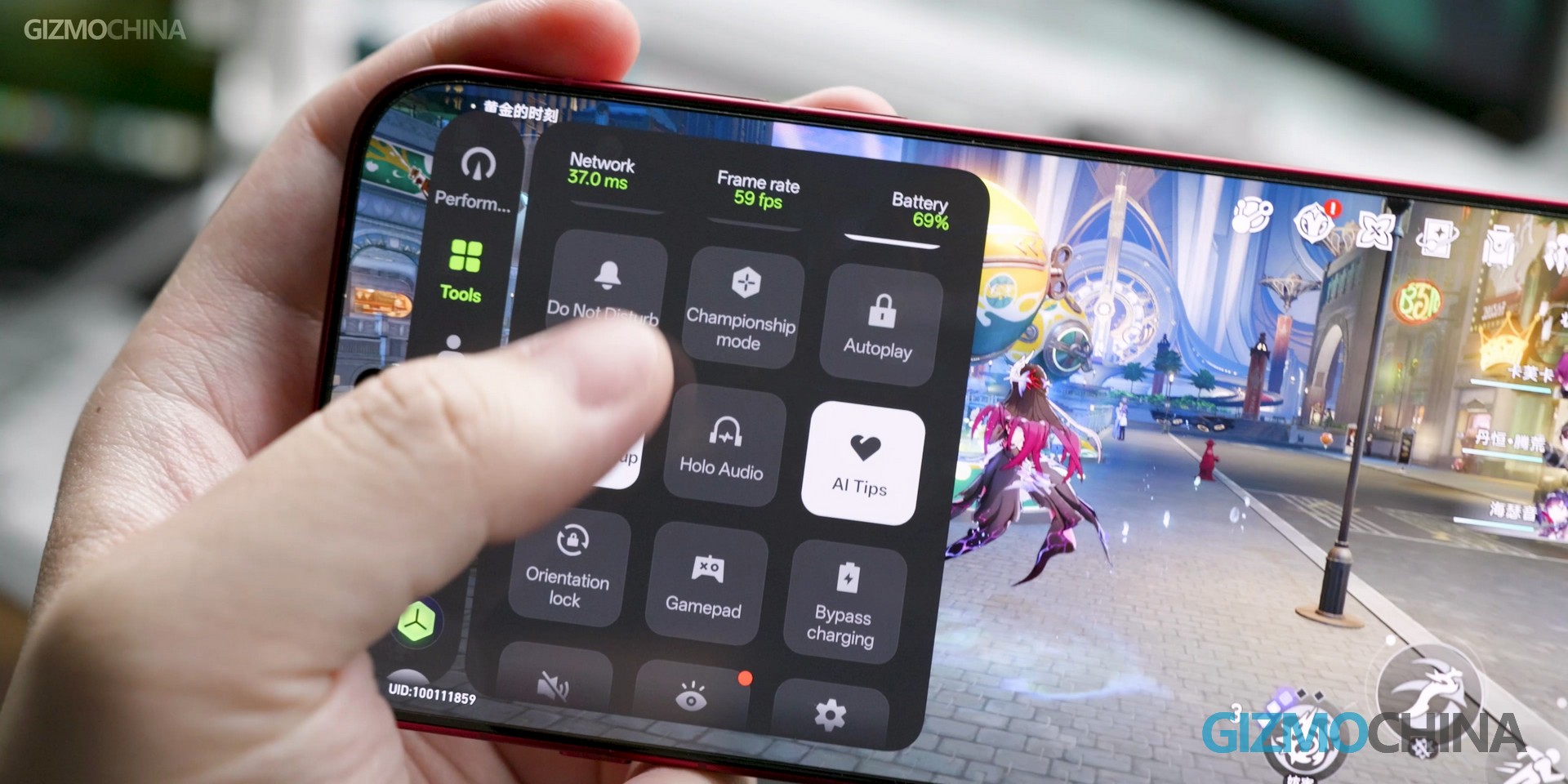
The Find X9 Pro also offers a bunch of gamer-friendly features, like super-resolution, HDR, bypass charging, and more. But if your favorite game isn’t on OPPO’s frame interpolation whitelist, the experience will suffer a lot.
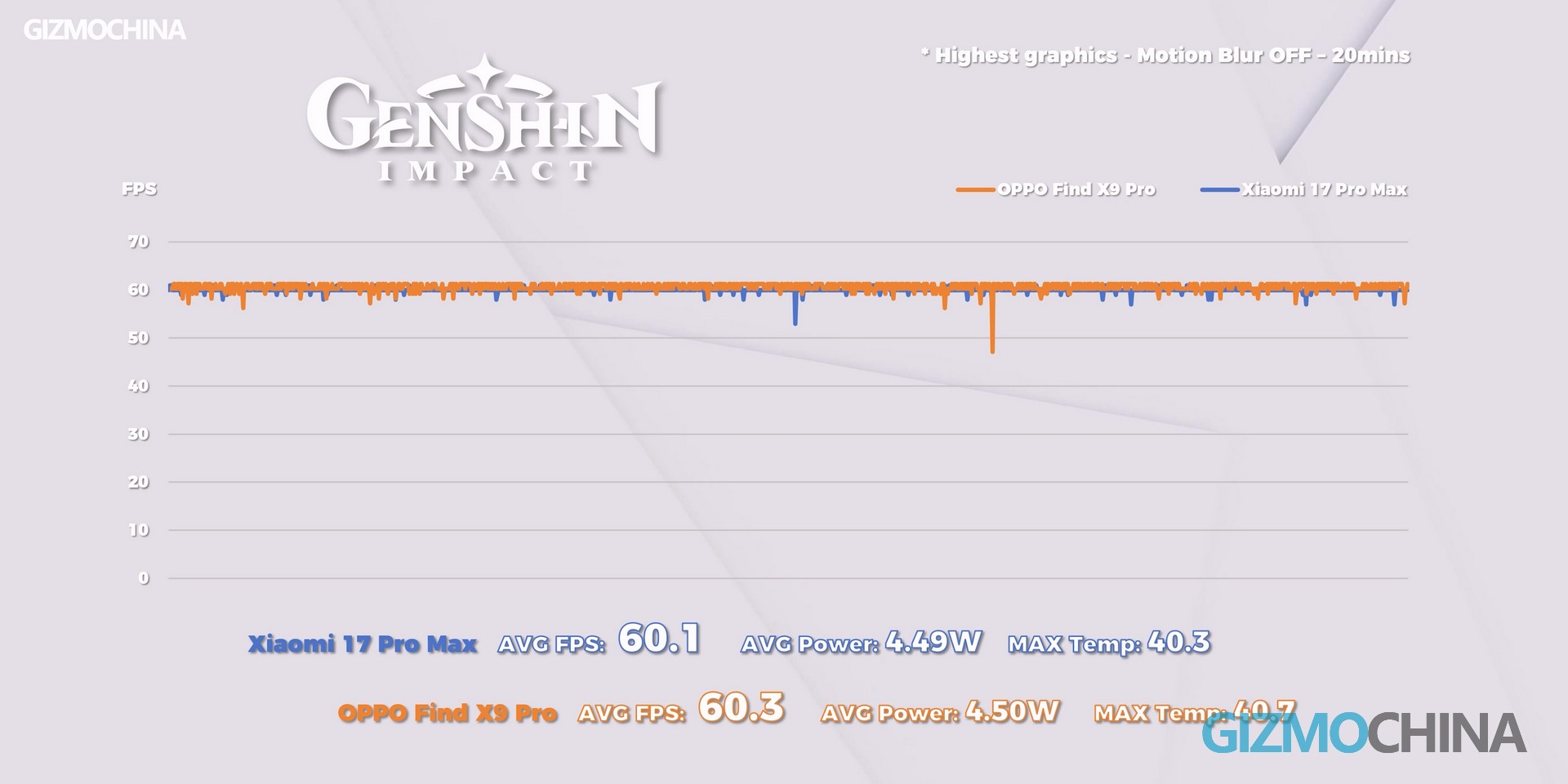
In Genshin Impact, however, the Find X9 Pro had no issues. All the metrics were almost identical to the Xiaomi 17 Pro Max, proving that this game no longer challenges today’s flagship phones.
Design
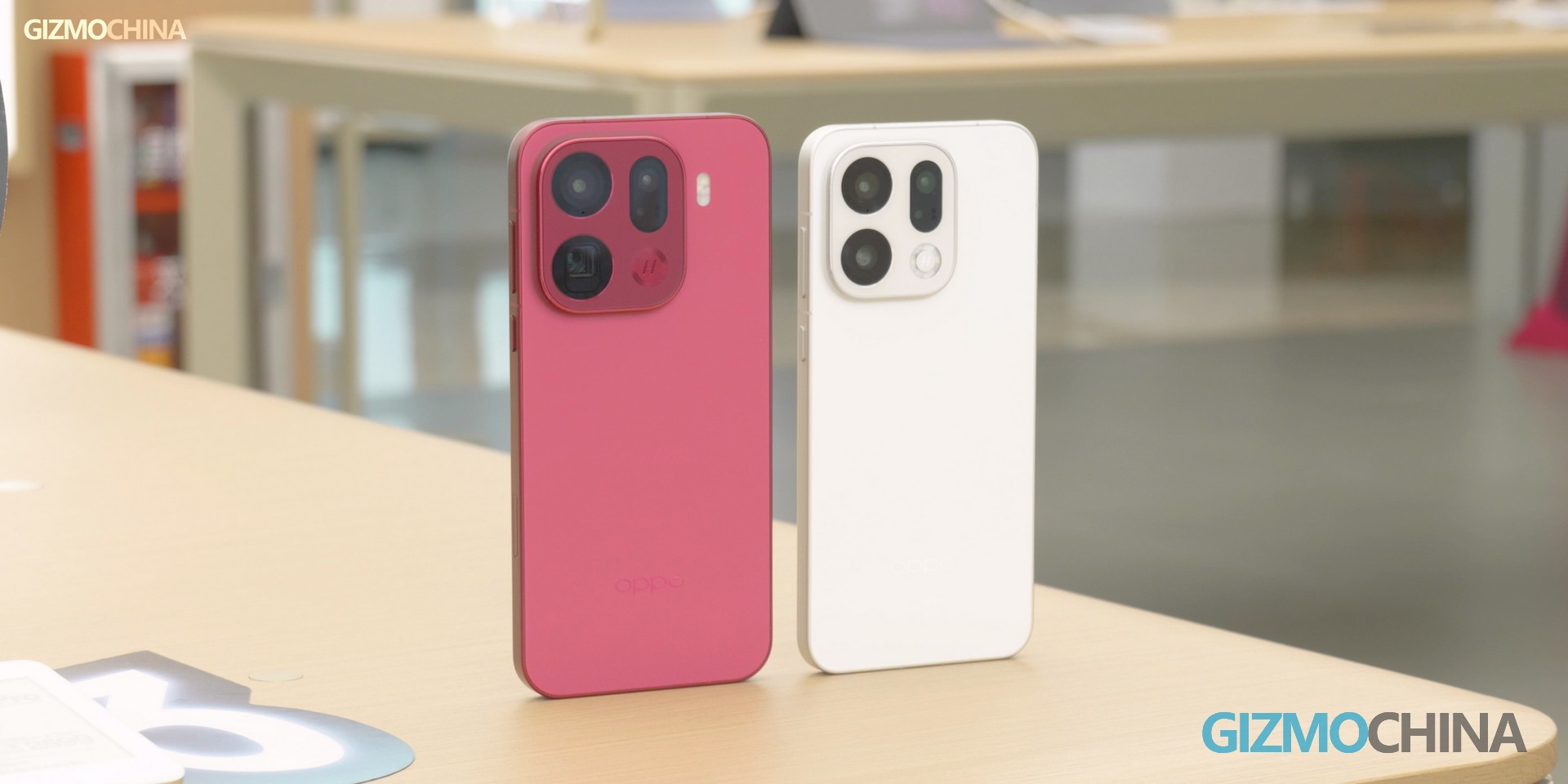
Since the Find X9 Pro’s camera setup went from four sensors on the X8 Pro to three, the module size has been reduced. To prevent your index finger from constantly touching the raised camera area, OPPO moved the module to the side.
Whether this design looks elegant or awkward really depends on personal taste—but from a practical standpoint, it does make the phone more comfortable to use daily. After all, most of the time you’re facing the screen, so comfort matters most.
The Camera Control Button still isn’t in a great position and is somewhat impractical—I often forget it exists. Occasionally, I remember to use it to quickly launch the camera, which might be slightly useful for street photographers.
Display
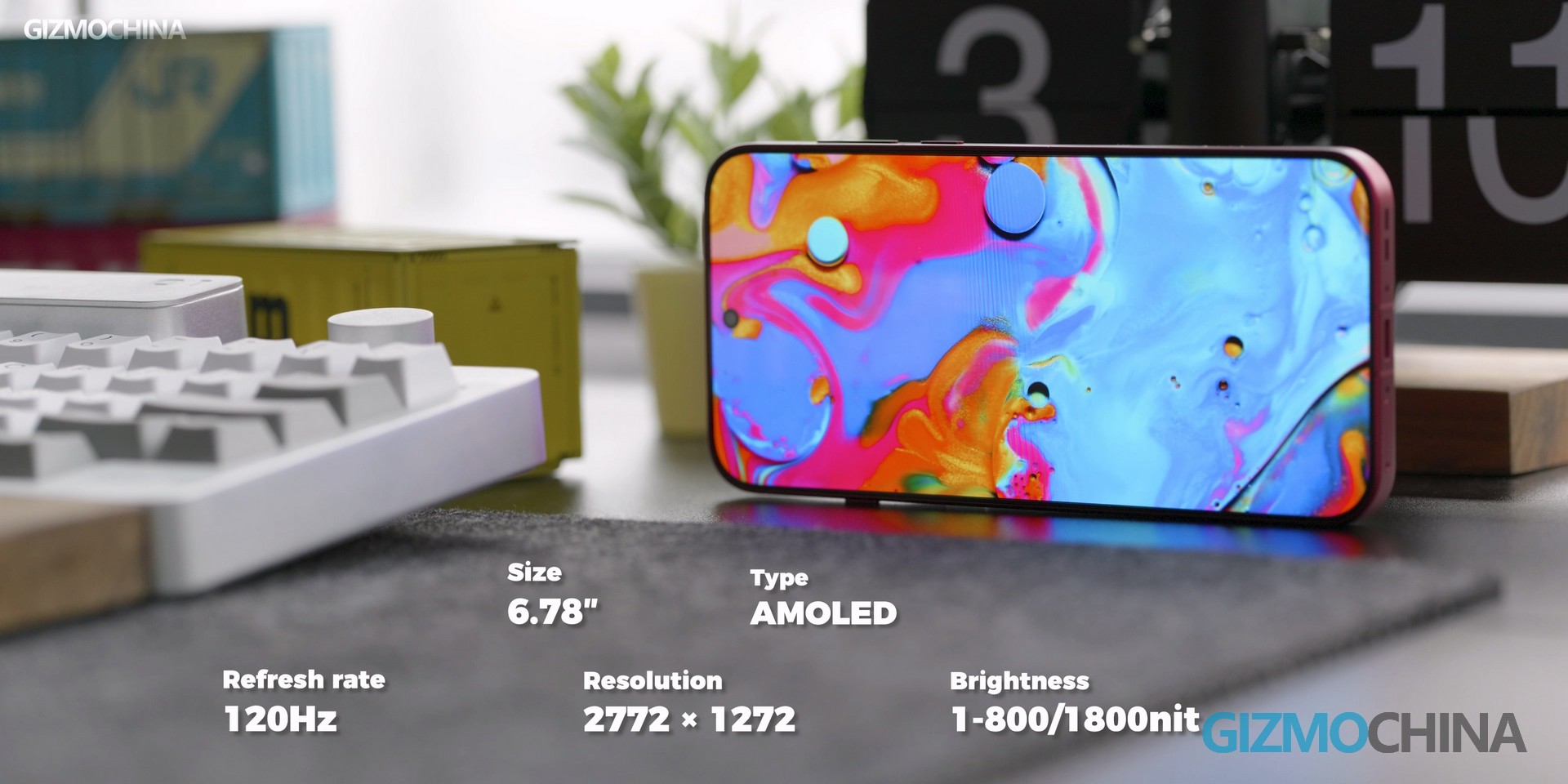
The display is equally unremarkable. The biggest change is that the Find X9 Pro now uses a flat panel. Everything else is a standard upgrade—no 2K resolution, no AR coating on the film, and no new pixel arrangement.
It’s simply a good display, nothing more. So let’s move on to the part that actually improved the most.
Telephoto Camera
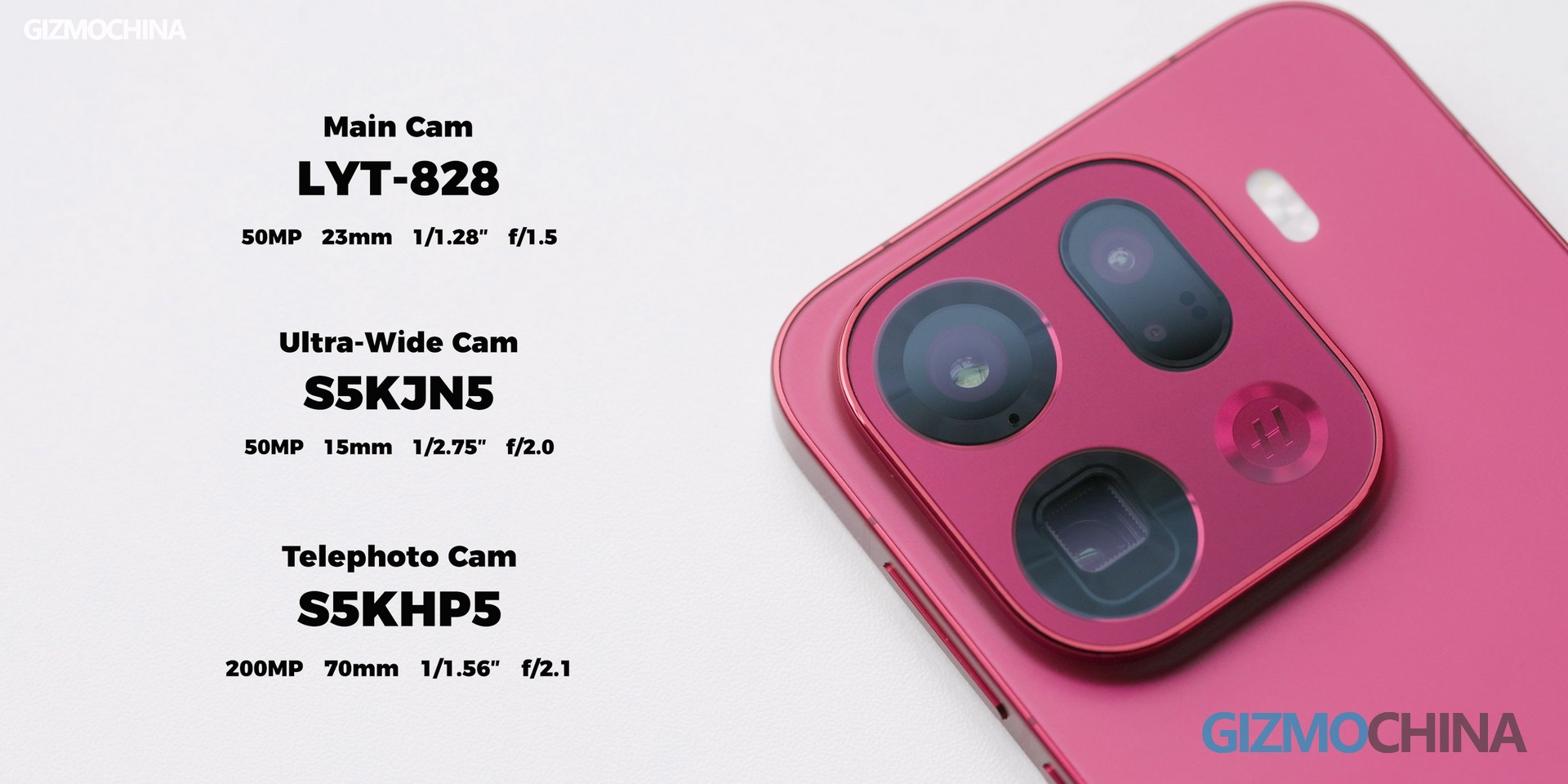
Compared to the Find X8 Pro, the Find X9 Pro’s major upgrades are in its main and telephoto cameras.
Let’s start with the telephoto lens. Many of you might be curious, if the new HP5 sensor can really replace the previous generation’s 6x telephoto? The answer: yes.
Although the sharpening is a bit heavy, the help of In-Sensor Zoom ensures the results are mostly satisfying. The HP5 sensor is a sibling of the HP9 but smaller in size, which theoretically means worse low-light performance when In-Sensor Zoom isn’t active. In reality, it performs better than expected—probably thanks to AI image enhancement.
Overall, losing one telephoto camera doesn’t mean it’s a downgrade. Achieving equal—or even better image quality with a smaller camera module, which is very impressive.
Have you ever wondered what happens when you combine a 200MP sensor with AI enhancement for portrait photography? This photo, taken in HASSELBLAD HI-RES mode, is the answer.
Sharp, detailed, and every strand of hair and pore is visible. Actually, OPPO already introduced portrait AI enhancement with the Find X8 Ultra, which explains why its portraits look far better than most other phones.
But when the lighting is poor, the base detail is lacking, and the AI enhancement effect naturally weakens.
The main camera now has a larger sensor, meaning better image quality in low light. But honestly, flagship phone main cameras are already so good that the difference isn’t dramatic.
That’s why OPPO focused more on software optimization for the Find X9 Pro. For example, the Auto High-Resolution Option.
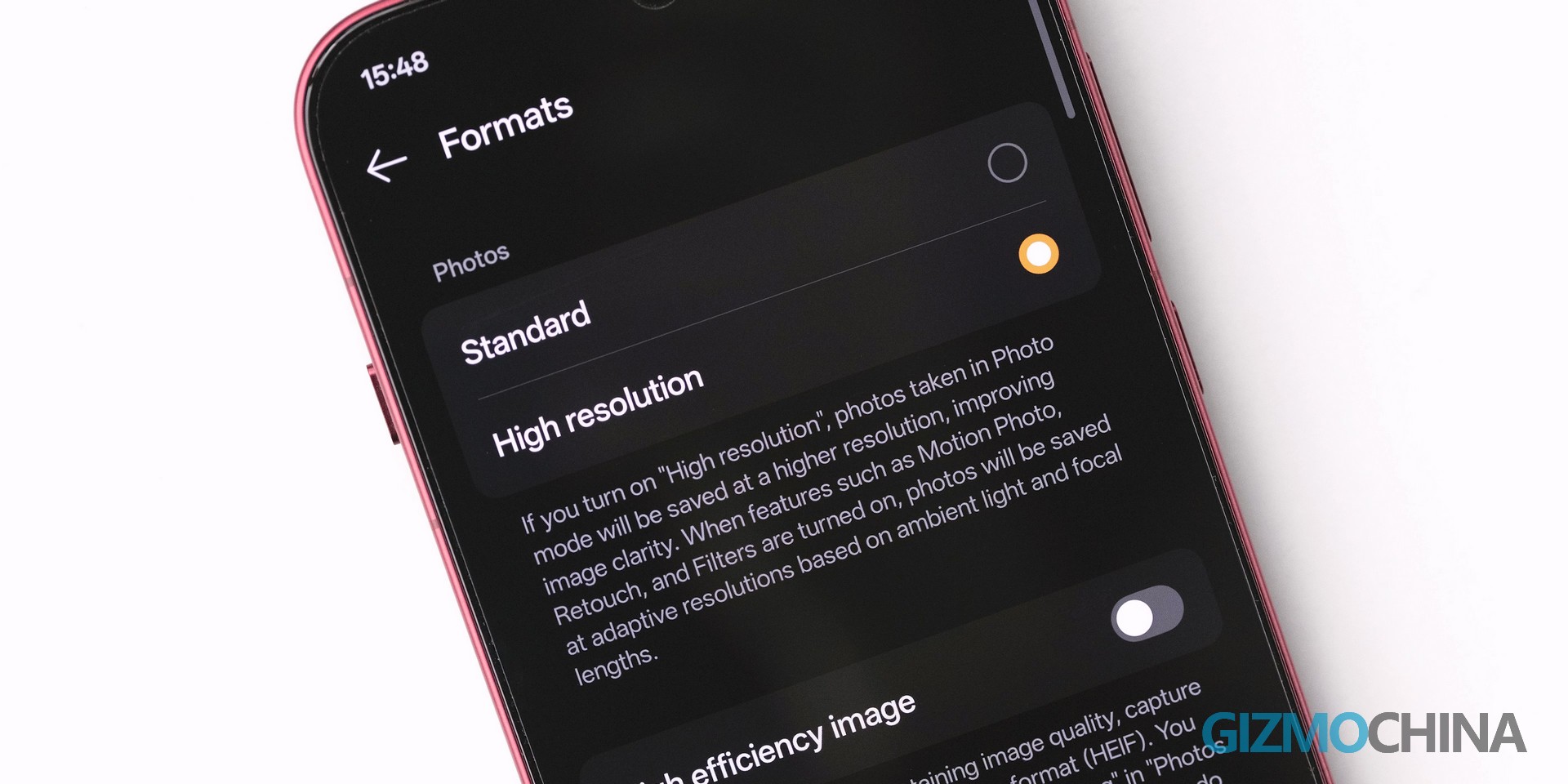
By default, the phone automatically increases resolution to 26MP or 50MP when conditions are right. Unlike other Android phones, this mode is specially optimized—it supports HDR capture and avoids typical demosaic issues like false colors.
When does it not activate and shoot at 12MP instead? Bingo—you guessed it. In very dark environments, it stays at 12MP to ensure each pixel captures enough light.
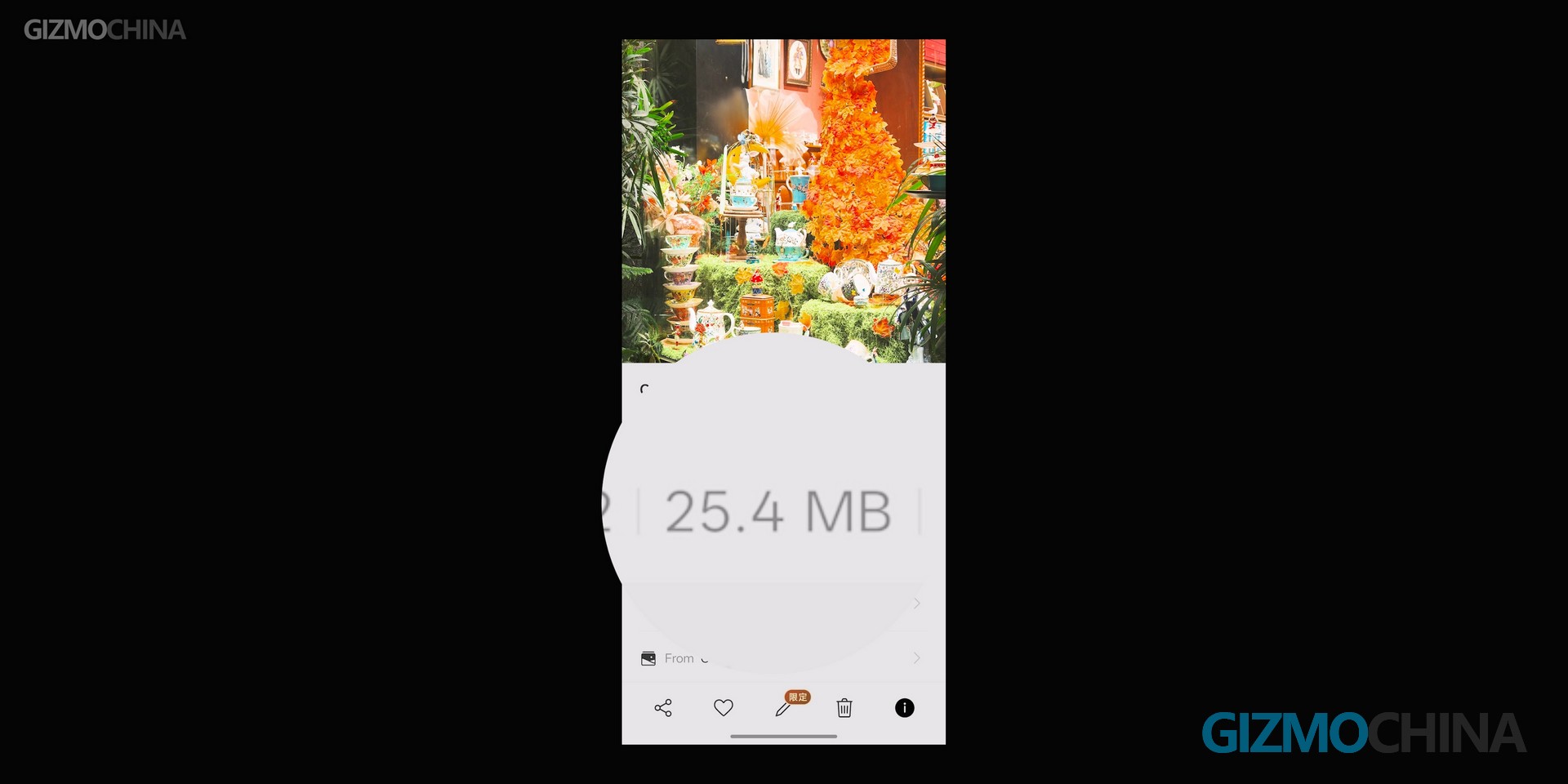
The only major drawback is file size. If you’ve got the 1TB storage version or a home NAS, I’d still recommend keeping this option on. Unfortunately, my favorite Master Mode doesn’t support this option.
As everyone knows, I love OPPO’s Hasselblad color style. It delivers a cinematic look, especially in low light. Highly recommended for anyone who buys the Find X9 Pro.
LIVE Photo
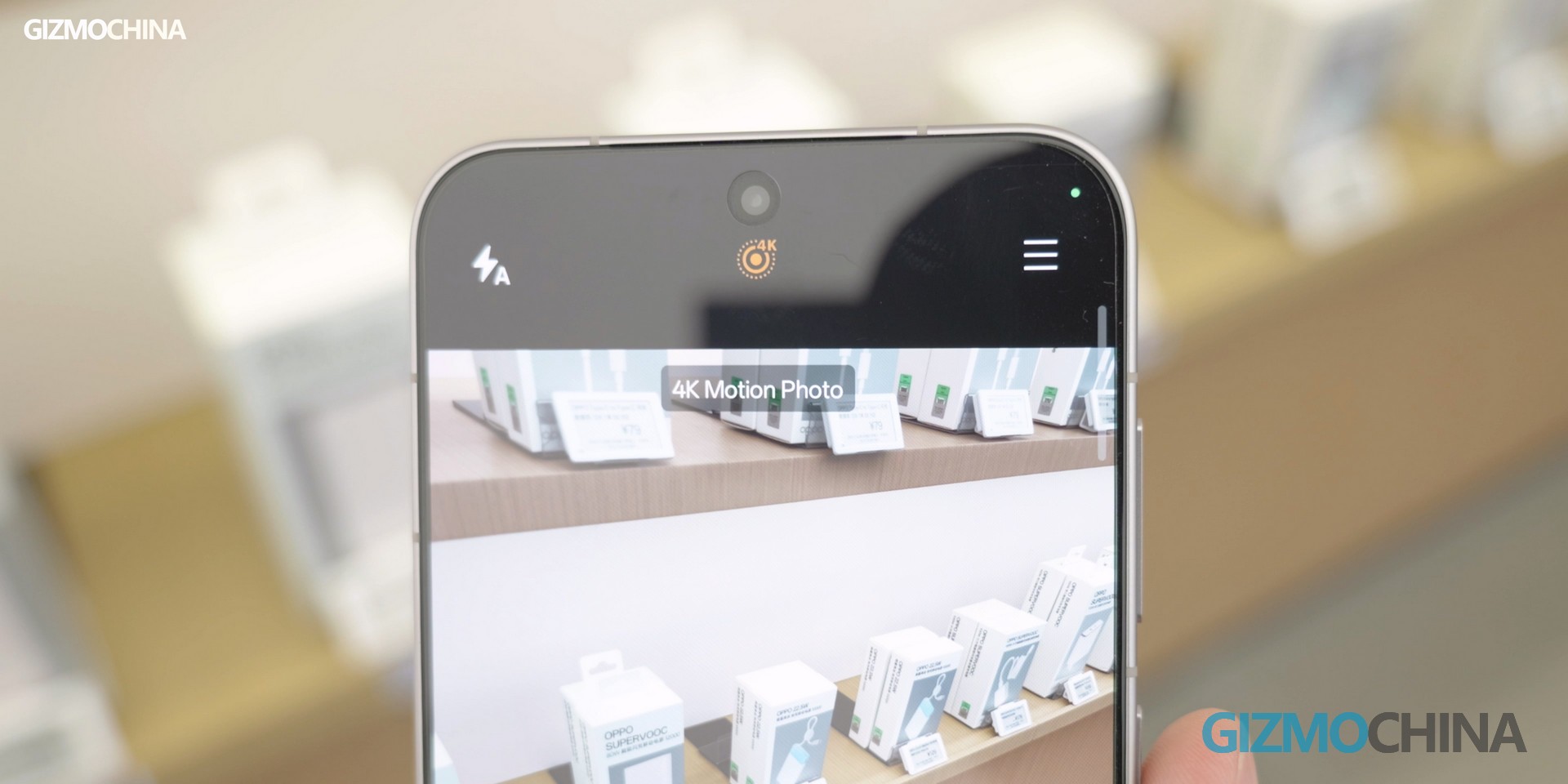
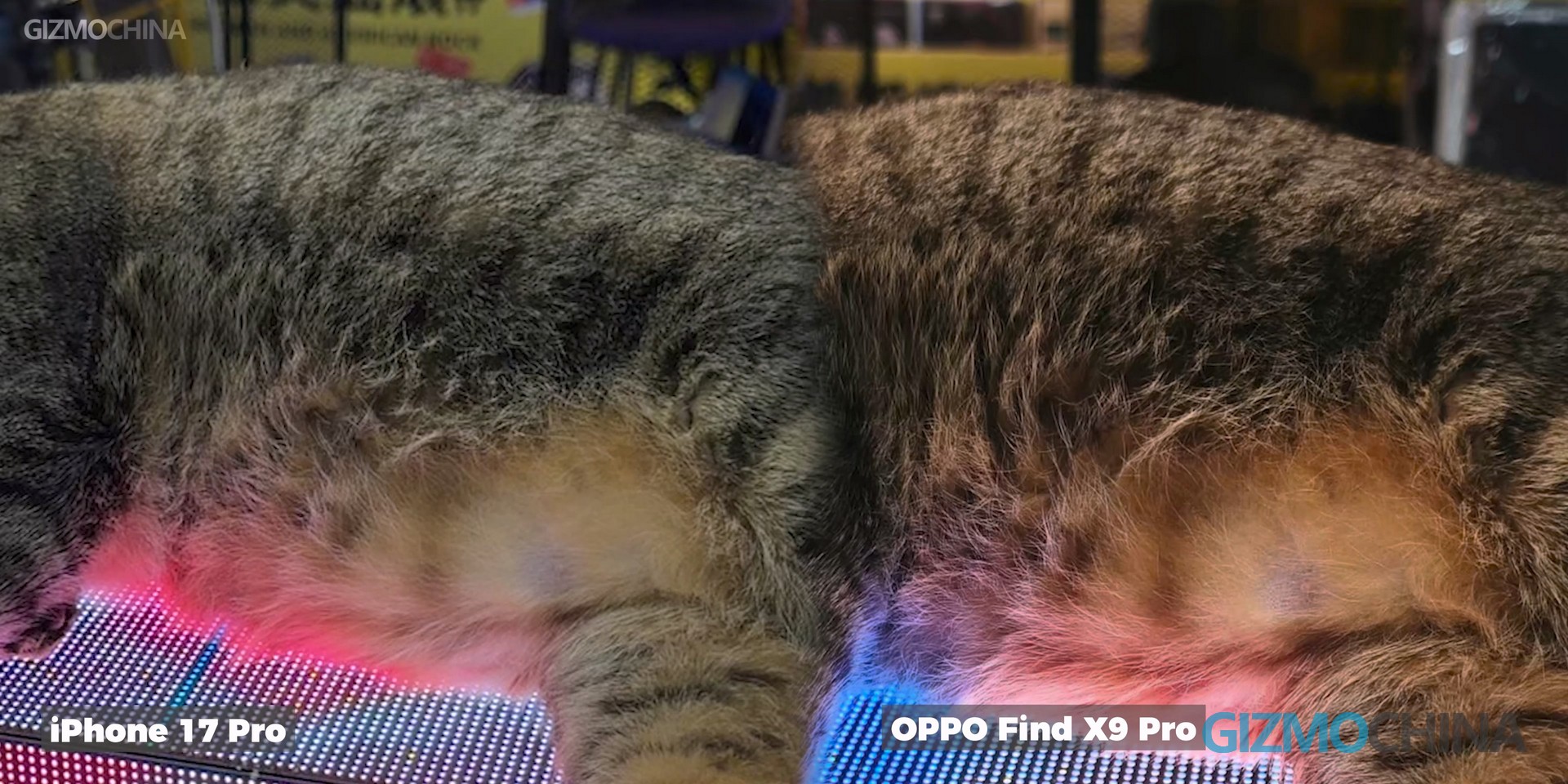
In HASSELBLAD HI-RES mode, there’s a new LIVE Photo feature called 4K Motion Photo. We compared it with the pioneer of Live Photos—the iPhone 17 Pro—to see what OPPO improved.
First, clarity. The difference in the Key Photo isn’t huge, but once the Live Photo starts moving, the Find X9 Pro’s advantage becomes clear. That’s because its motion frames are recorded in 4K, while iPhone’s are 1080P. So even if you change the Key Photo later, the Find X9 Pro’s image retains more quality.
This improvement is most noticeable in good lighting. In dim light, OPPO’s advantage narrows. Also, this mode only supports the three native focal lengths—no zooming in or out.
And the biggest downside, as you might guess, is file size. A Find X9 Pro 4K Motion Photo is roughly four times larger than an iPhone’s. So, if you’re still using a 256GB phone, make sure to go for a higher storage option.
Ultra-Wide & Selfie
The ultra-wide camera still uses the JN5 sensor, and so does the front camera. While the sensor itself isn’t great, the 15mm lens provides a 120° field of view, allowing you to capture visually striking shots when needed.
Selfie quality is also impressive—clarity is on par with the iPhone, but OPPO’s colors are more flattering, with more natural-looking skin tones. By the way, the beauty mode is disabled by default this time. So don’t be surprised—this is the real you.
Photography Kit
To keep up with trends, OPPO also designed a new photography kit for the Find X9 Pro.
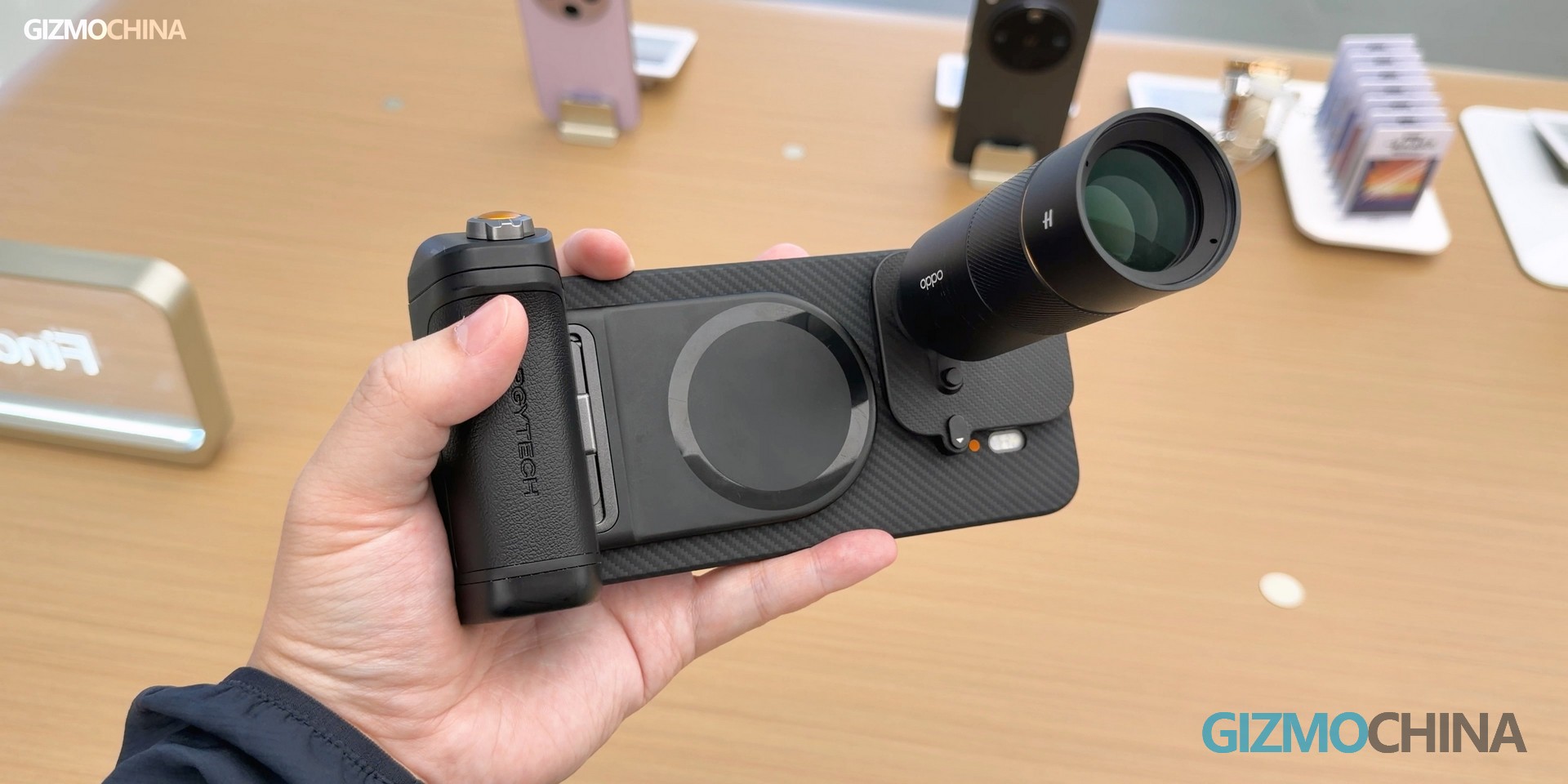
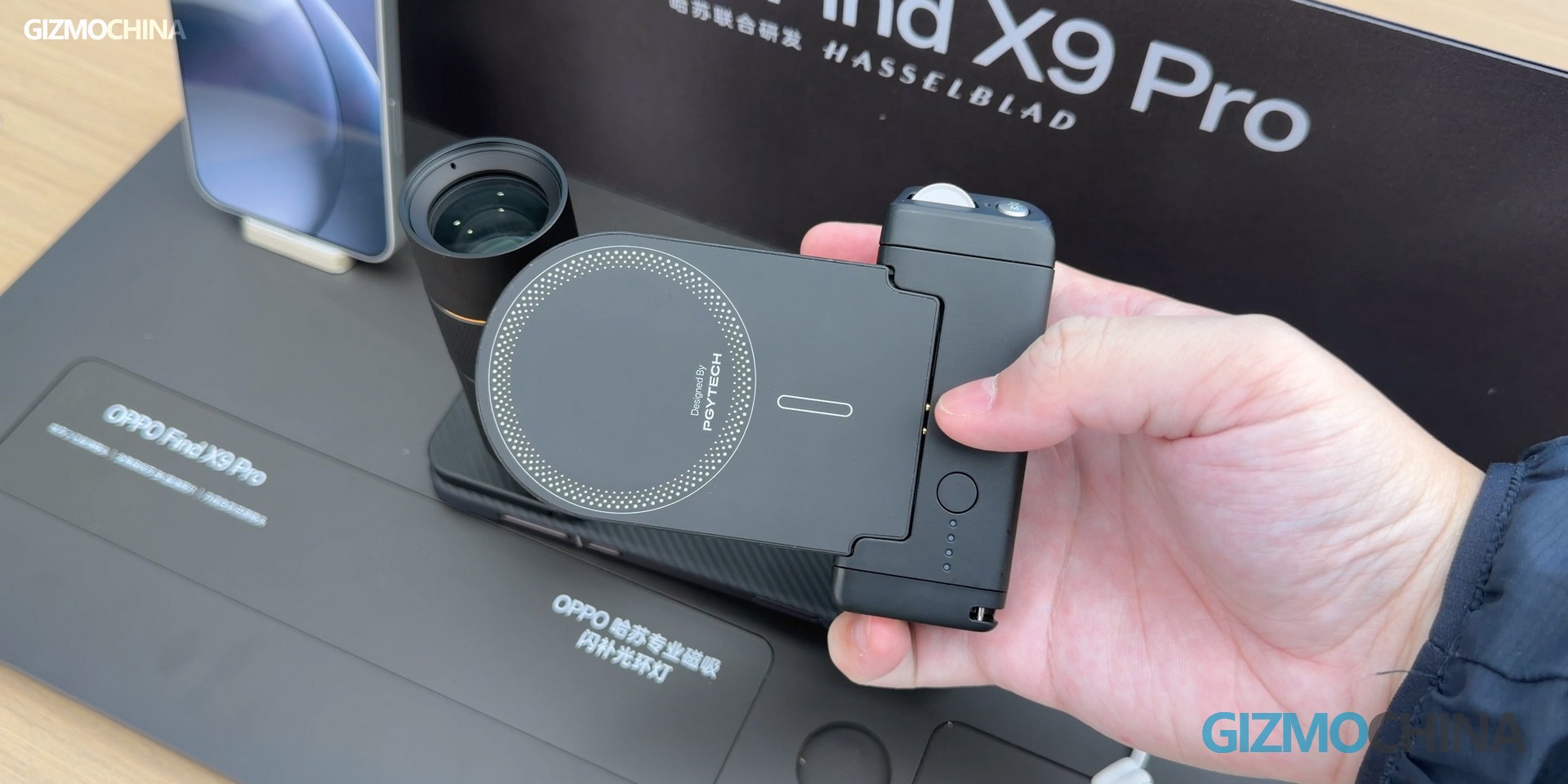
Among its accessories, the magnetic handle is the most interesting one. With its MagSafe-style design, you can quickly attach or detach it—making it more practical to carry daily. If you’ve got money to spare, you can even use it with your iPhone. Just note that without a dedicated MagSafe case, the magnetic force is weaker—so for your phone’s and wallet’s safety, not recommended to do that.
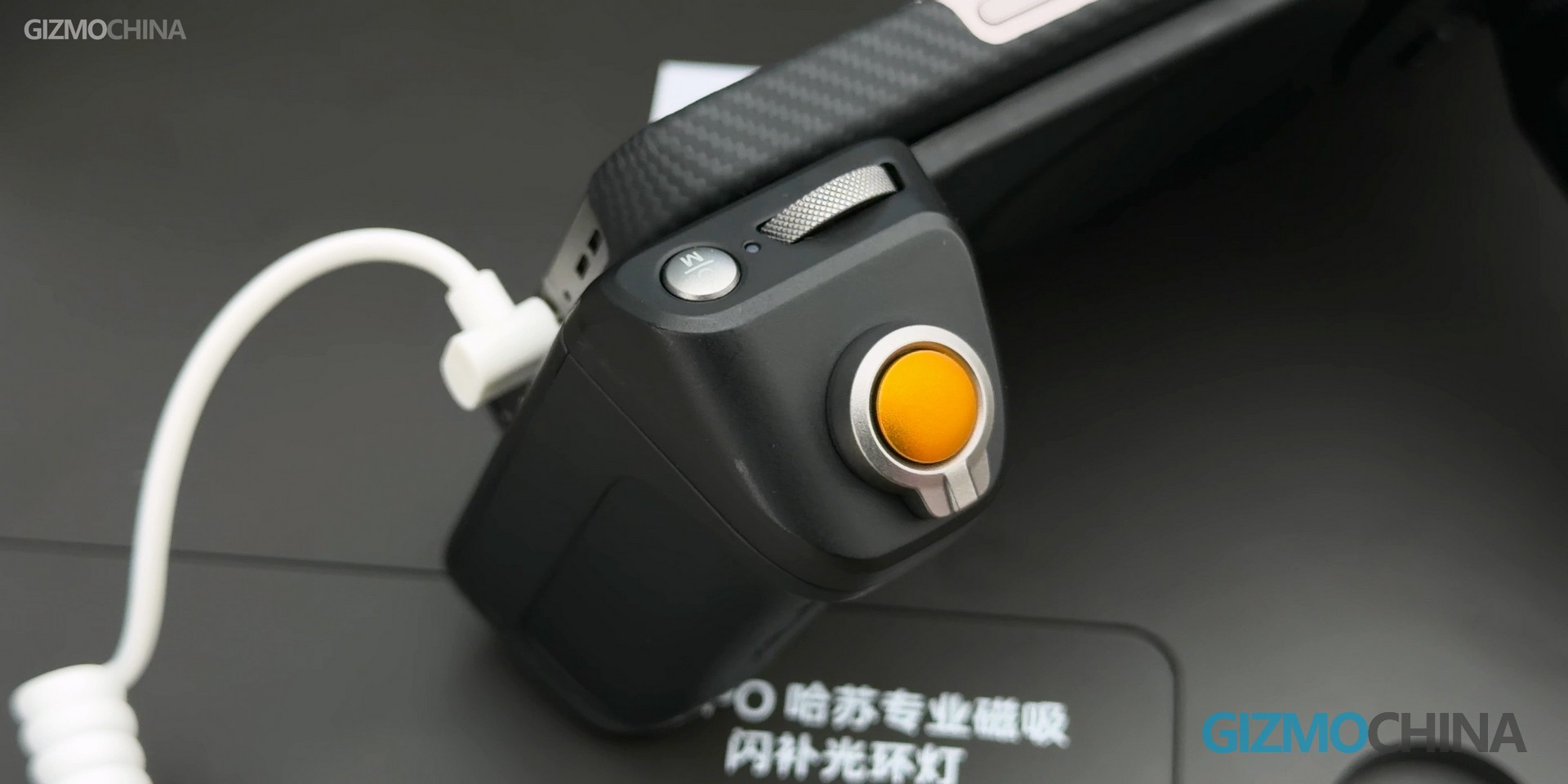
Fans of Hasselblad will probably love the large orange shutter button on the handle. I’m quite happy with the handle itself, though the attachable lens part isn’t that exciting. It’s similar to vivo’s setup, offering the same functions as the Find X9 Pro already does.
The only real downside is that, unlike Xiaomi or vivo, you can’t attach professional camera filters using an adapter ring. Oh, and one more thing—it’s quite expensive, so think twice unless you’re a big spender.
Battery
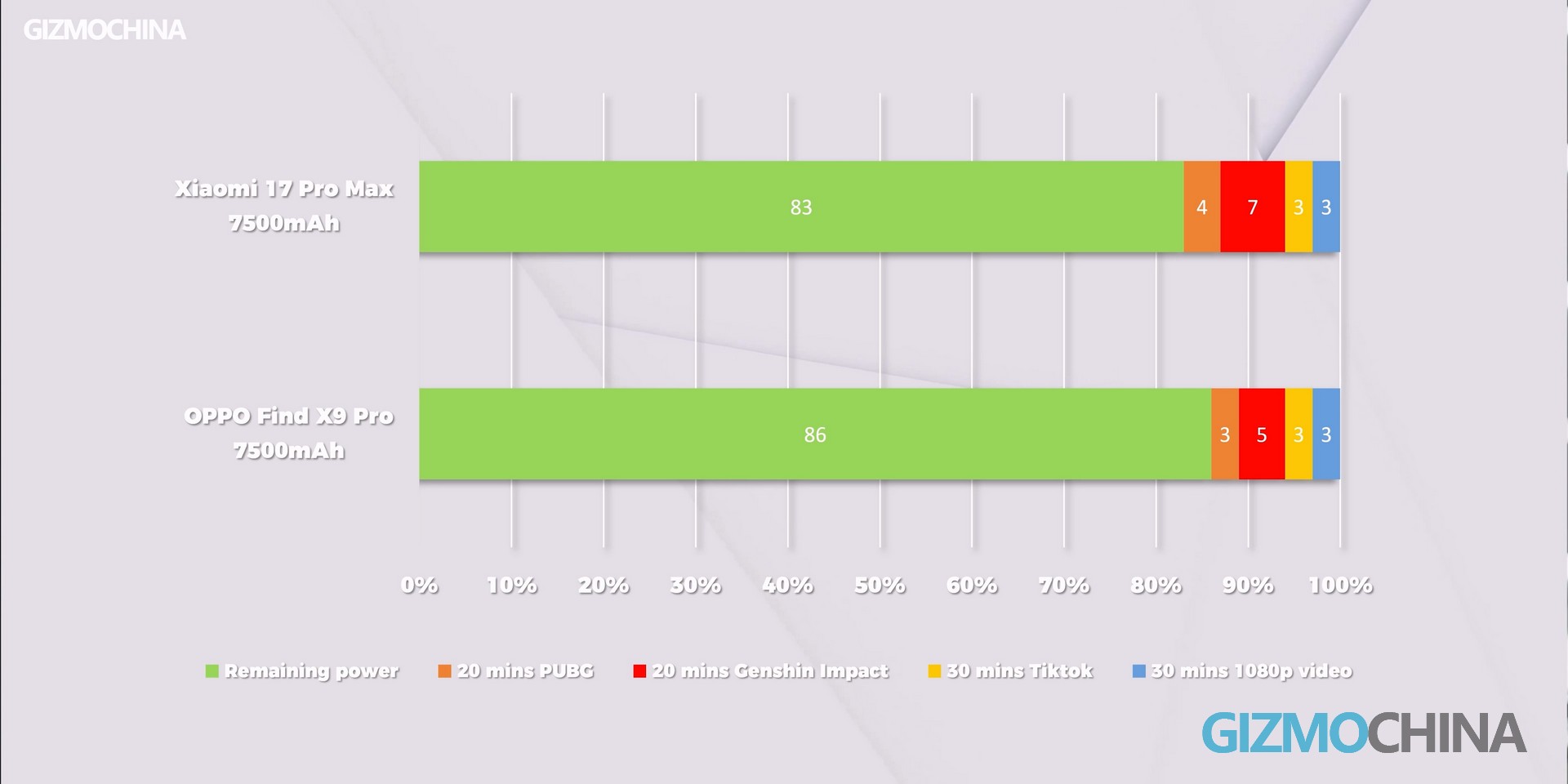
Smartphone batteries these days keep getting bigger. The Find X9 Pro packs a massive 7500mAh cell, which gives it an edge over the Xiaomi 17 Pro Max in long gaming sessions.
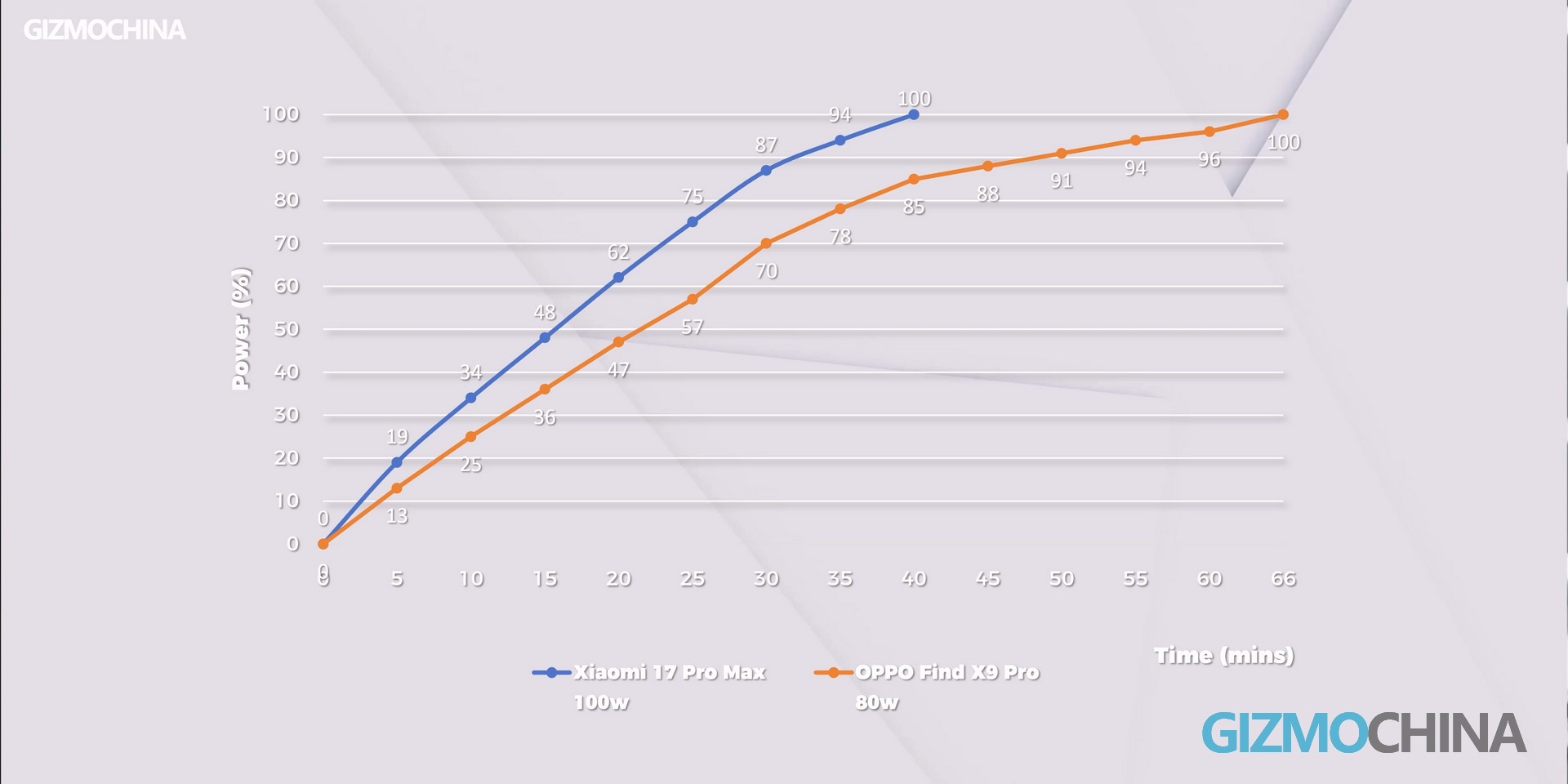
It supports 80W wired and 50W wireless charging. In our test, it takes just over an hour to fully charge, which is a bit slower than Xiaomi’s. Let’s just say—it’s “good enough.”
Final Thoughts
Now that Xiaomi, vivo, and OPPO have all released their flagships, which one is your pick?
Each has its strengths—and one clear weakness. Xiaomi’s camera focal lengths are poorly arranged; vivo’s battery is small; and OPPO’s Find X9 Pro—aside from that buggy-looking frame rate graph—is the most balanced of the three. But meanwhile, having distinct personalities is actually a good thing—it means everyone can find the phone that truly suits them.
Motorola’s next mid-range contender, the Edge 70, is shaping up to be one of the slimmest phones of the year. With its global launch set for November 5, a new batch of press renders and an EU energy label listing have spilled most of the remaining details — from its dimensions to battery life and durability scores.
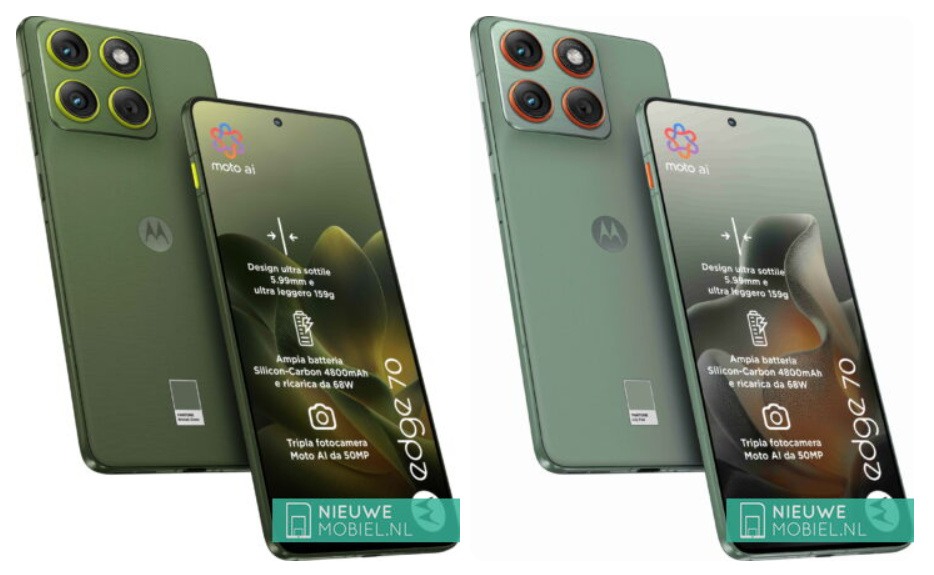
Pantone Bronze Green (left), Lily Pad (right)
According to new leaks shared by NieuweMobiel, the Edge 70 will come in two Pantone-certified finishes — Bronze Green and Lily Pad — and measure just 5.99mm thick while weighing a mere 159g. That makes it one of the thinnest mainstream smartphones on the market, matching the Chinese Moto X70 Air, which it’s reportedly based on. For context, Apple’s iPhone Air and Samsung’s Galaxy S25 Edge weigh 165g and 163g, respectively — yet this Motorola manages to pack in a much larger battery than both flagships.
The secret? A high-density silicon-carbon battery that Apple and Samsung have yet to adopt.
The design sticks to a flat-edged frame with a punch-hole selfie camera and a triple rear setup, led by a 50MP main sensor, joined by a 50MP ultrawide and what appears to be a macro camera. Under the hood, expect the same specs as the X70 Air: a 6.7-inch 120Hz OLED display powered by Snapdragon 7 Gen 4 — a solid combo for Motorola’s mostly clean UI.
Thanks to the X70 Air, the battery capacity is already known to be 4,800 mAh, up from the 3149 mAh battery in the iPhone Air and the 3900 mAh in the S25 Edge. An EU Product Registry for Energy Labelling (EPREL) certification now confirms a certified endurance rating for the global model – 49 hours 34 minutes. Motorola also claims the battery can handle 1,000 charge cycles while retaining at least 80% capacity.
In summary, the Edge 70 isn’t just about being slim — it seems practical for anyone seeking a mid-range that looks and feels good in hand.
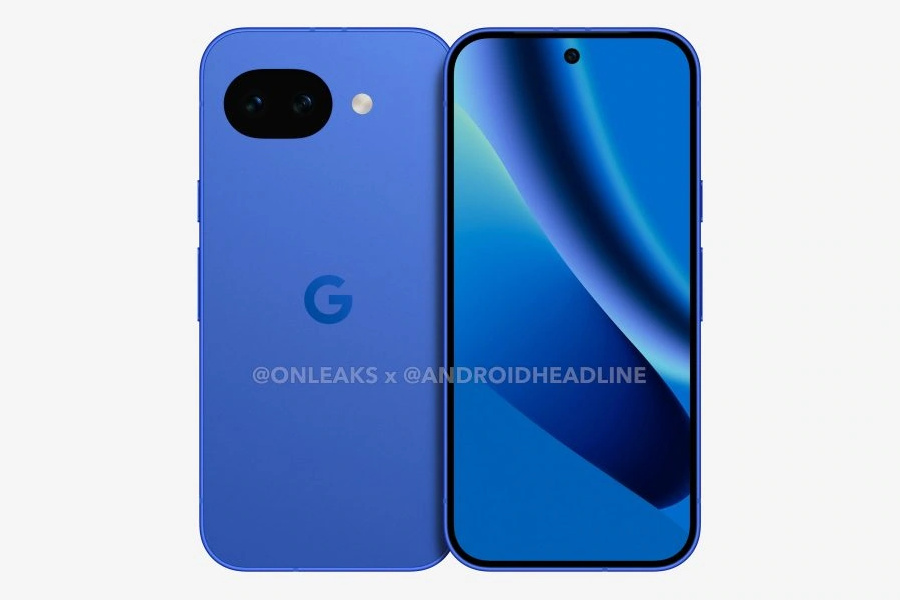
Google’s Pixel 10 series is expected to be rounded out by the Pixel 10a, likely launching in 2026. As usual, we are getting the early details through leaks and rumors rather than official announcements.
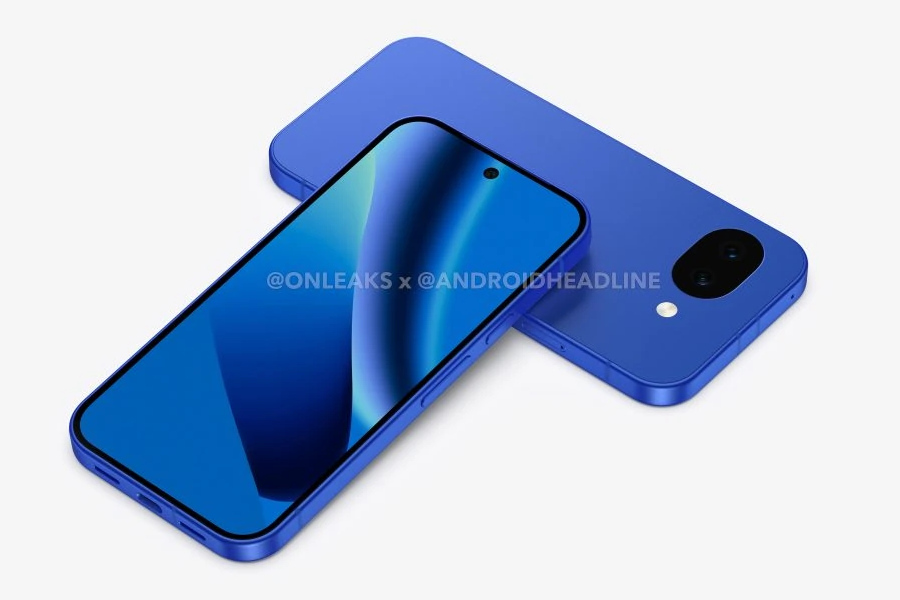
A new leak has now given us a first look at the Pixel 10a’s design. OnLeaks, in collaboration with AndroidHeadlines, shared CAD-based renders of the phone, and on first glance, it doesn’t look much different from the Pixel 9a.
The phone retains the flush rear camera design, with no noticeable bumps. It features chamfered edges with the power and volume buttons sitting on the right. The device is said to measure 153.9 x 72.9 x 9mm and will have a slightly smaller 6.2-inch display, compared to the 6.3-inch panel on the Pixel 9a.
The renders also give away that the Pixel 10a will use a metal frame, as the antenna lines are clearly visible, while the back is expected to remain plastic.
What can we expect?
Specs-wise, there’s not much new to report. The Pixel 10a is expected to use the same Tensor G4 chip as its predecessor. That’s a bit of a letdown since Google’s Tensor chips have generally lagged behind the flagship offerings from Qualcomm and MediaTek.
Meanwhile, other phones in the Pixel 10 series already run on the newer Tensor G5. Historically, Google has used a near-identical chip for its A-series phones, so it’s surprising the company won’t bring those improvements to the 10a.
On the bright side, we hope that the Pixel 10a might bring PixelSnap magnetic accessories support. PixelSnap also makes it easier to use even MagSafe-compatible attachments on the back of the phone.
For more daily updates, please visit our News Section.
OPPO has just introduced the Enco X3s, a new pair of true wireless earbuds that aim to deliver premium audio features without the premium price tag. These affordable pair of TWS earbuds arrive alongside the brand’s latest flagships, the Find X9 and Find X9 Pro. So here’s what we know.
OPPO Enco X3s: What does it offer?
The Chinese brand just unveiled its latest budget TWS earbuds with some features that are often found in premium models. Oppo’s Enco X3s arrives with an in-ear design with a dual driver system with 6mm flat diaphragm high-frequency unit and an 11mm composite diaphragm woofer that promises high end audio and punchy bass. These hearables connect via Bluetooth 5.4 with support for LHDC 5.0, AAC, and SBC audio codecs.
Oppo Enco X3s TWS Earbuds
Oppo has equipped the Oppo Enco X3s with a triple microphone setup for AI clear calls, with the earbuds also support AI Translate (only available with an Oppo smartphone). You also get up to 55 decibels for Active Noise Cancellation (ANC). On a single full charge, these earbuds can last for up to 11 hours with ANC disabled and 45 hours when paired with the charging case. Turning on ANC lowers the playback of the Enco X3s by 6 hours.
Other notable features include the HeyMelody app support, IP55 rating for water and dust resistance, DynAudio tuning for improved sound quality, and spatial audio support. Oppo has just announced the Enco X3s in the global market for 129 Euros, which is around 150 US Dollars. The company will be rolling out these earbuds in other markets outside of Europe soon.
For more daily updates, please visit our News Section.
Casio has started pre-orders for its new G-Shock GST-B1000D analog watches in Europe. The lineup includes three models: GST-B1000D-1A (black), GST-B1000D-2A (blue), and GST-B1000D-3A (green). Each watch costs €399 in countries like the Netherlands, France, and Germany, with shipping set to begin on November 7.
The GST-B1000D series was first unveiled in Japan, but it has not yet gone on sale there. These watches are part of the G-STEEL line and feature a more refined, minimalist look while keeping the toughness G-Shock is known for. The solid stainless steel bezel and bracelet use a mix of mirror, vertical, and circular hairline finishes that change with the light. The logo-free bezel and slim 11.6 mm case give the watch a clean, modern appearance.
The design takes cues from the original 1983 G-Shock DW-5000C. It keeps the brick-pattern dial and octagonal bezel while adding red, blue, and yellow accents that represent challenge, water resistance, and shock resistance. The watch measures 46.9 × 44.2 × 11.6 mm and weighs 118 grams, combining strength and comfort.
The GST-B1000D has a Carbon Core Guard structure with a case made of stainless steel and bio-based resin. Urethane buffers between the case and band improve shock absorption. It also includes a screw-lock crown, mineral glass, and water resistance up to 20 bar.
The watch is powered by Casio’s Tough Solar system, ensuring reliable performance even under low light. It pairs with smartphones via Bluetooth using the CASIO WATCHES app, enabling automatic time correction, phone finder, and location tracking features. Additional functions include a 1-second stopwatch, countdown timer, daily alarm, full auto calendar, and a Super Illuminator LED light for clear visibility in dark conditions.
For more daily updates, please visit our News Section.
We use cookies on our website to give you the most relevant experience by remembering your preferences and repeat visits. By clicking “Accept”, you consent to the use of ALL the cookies.
This website uses cookies to improve your experience while you navigate through the website. Out of these, the cookies that are categorized as necessary are stored on your browser as they are essential for the working of basic functionalities of the website. We also use third-party cookies that help us analyze and understand how you use this website. These cookies will be stored in your browser only with your consent. You also have the option to opt-out of these cookies. But opting out of some of these cookies may affect your browsing experience.
Necessary cookies are absolutely essential for the website to function properly. This category only includes cookies that ensures basic functionalities and security features of the website. These cookies do not store any personal information.
Any cookies that may not be particularly necessary for the website to function and is used specifically to collect user personal data via analytics, ads, other embedded contents are termed as non-necessary cookies. It is mandatory to procure user consent prior to running these cookies on your website.