Lenovo Group’s Vice President Chang Chengfa recently announced that the company’s next flagship smartphone Lenovo Z6 Pro will be unveiled on March 27. Earlier, the company had teased the phone’s launch during MWC 2019 last month but instead of launching the smartphone, the company just revealed that the phone will make its debut soon.
Today, a teaser of the Z6 Pro smartphone was shared on Chinese microblogging platform Weibo, which hints at the support for 100-megapixel images captured using the phone’s camera. As the phone is unlikely to have 100 MP camera sensor, we expect that some kind of a software trick is in the play.
This could be related to the HyperVision camera that the company has been talking about since last month. However, no details about the said HyperVision Camera or the ‘Hyper Video’ which the company has been teasing, is known.
Recently, a video teaser was posted on Weibo which showcases the Hyper Video feature of the smartphone. The short video seems to be using macro and slow-mo effect. The text posted along with the video suggests that it took over a year for the company to develop this Hyper Video feature.
Although none of the details related to this Hyper Videos feature have been revealed, the company had previously said that it will be transferred at a higher speed than the current videos. This new feature will be added as a new camera technology to Lenovo smartphone, starting with Z6 Pro.
Previous teasers related to the smartphone implies that the device will come with an in-display fingerprint sensor, which is now in almost all flagship smartphones. The phone is also expected to be powered by Qualcomm Snapdragon 855 SoC and support wireless charging. The Lenovo Z6 Pro will officially make its debut next month.
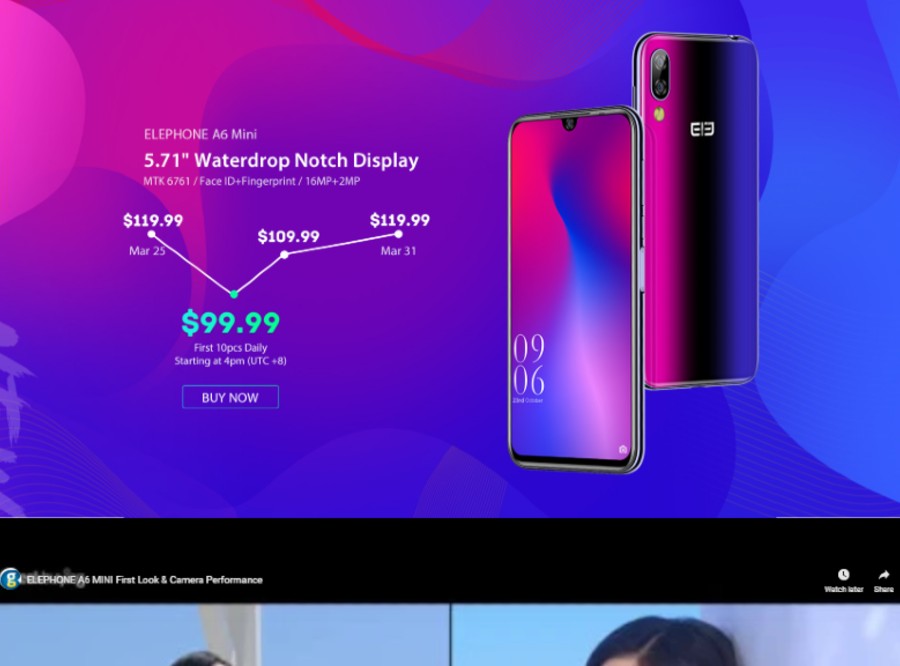
The A6 Mini was launched in February 2019. Just about a month after hitting the store shelves, this Elephone-branded smartphone has become a hit, particularly among those who fancy using a big-screen mobile device to watch their favorite videos and play popular games.
Taking the phone’s undying demand into consideration, Elephone is offering its well-received A6 Mini phablet at a lowered price on GeekBuying.
The professional Android smartphone manufacturer has teamed up with the Chinese online store to launch a new promotion called, Elephone A6 Mini Only $99.99.
As part of the promo, GeekBuying users will be able to pre-order the Elephone A6 Mini smartphone at a lowered price of only $99.99.
This is a significant drop in the device’s original asking price of $181.99. Note that the discount will specifically be valid for the 4GB RAM, 32GB ROM model, which comes in the black color version. This amazing offer will be valid only for the first 100 pieces on a daily basis starting at 4 PM (UTC+8).
Alternatively, you can go for the blue-tinted model A6 Mini smartphone. This variant would normally set you back $169.99, but you can now pre-order it for only $119.99. This noteworthy discount will be valid only for the 4GB RAM, 32GB ROM variant. If you like having more storage capacity to save your favorite music, videos, and other multimedia content on your phone without breaking the bank, we got good news for you.
The rainbow color version of the A6 Mini smartphone that has 4GB of RAM, paired with 64GB ROM is now available for a reduced price of $155.99 on GeekBuying.
This is a 26 percent reduction in the model’s original asking price of $210.99. An absolute bargain at this price, the A6 Mini is loaded with top-end features. Here’s what the phablet has to offer:
5.71-inch display with 1520 x 720 pixels resolution
MT6761 Quad Core 2.0GHz processor
IMG GE8300 GPU
4GB RAM / 32GB ROM
16.0MP+2.0MP rear-mounted camera
16.0MP front camera
Android 9.0 Pie OS
3180mAh Li-ion battery
Nano SIM card + Nano SIM / TF card
Proximity sensor, e-compass, fingerprint sensor, a laser sensor, and g-sensor
You can head straight to this link to check out more details about the A6 Mini and avail the discount before the promotion comes to an end.
Yesterday, Huawei had held a global launch event to announce the P30 and P30 Pro flagship smartphones. The Chinese manufacturer will be holding a dedicated unveil event in Shanghai on April 11 to announce the Huawei P30 series for the home market. The base model of the Huawei P30 comes with 6 GB of RAM for the European market. However, the Vmall listing of the Huawei P30 series show that the base model of the P30 will feature 8 GB of RAM in China.
The Huawei P30 will be arriving in three storage models in China such as 64 GB, 128 GB and 256 GB. These three variants are equipped with 8 GB of RAM. The P30 will be available in multiple colors like Bright Black, Aurora, Breathing Crystal, Amber Sunrise and Pearlescent Fritillary. The handset is now available for pre-sale in China with a deposit of 100 Yuan (~$112).
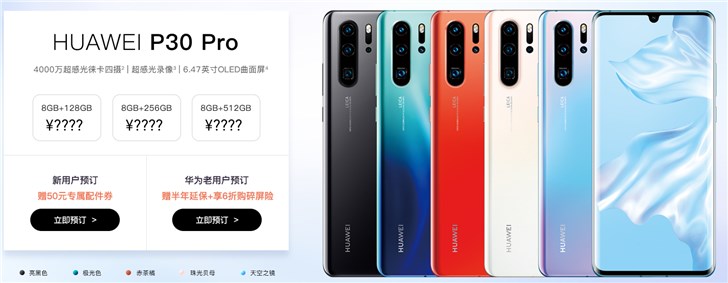
The Huawei P30 Pro is also listed in three storage variants for China such as 128 GB, 256 GB and 512 GB. In Europe, Huawei will be selling the smartphone in 128 GB and 256 GB editions only. Like the P30 for China, the P30 Pro variants come with 8 GB of RAM. The P30 Pro will be also available in five colors like the P30. The Chinese manufacturer is also receiving pre-orders of the smartphone with a deposit of 100 Yuan.
TENAA telecom authority of China had recently approved another variant of the P30 Pro with 12 GB of RAM and 512 GB of storage. This variant is not yet listed on Vmall. Probably, it will be made available later.
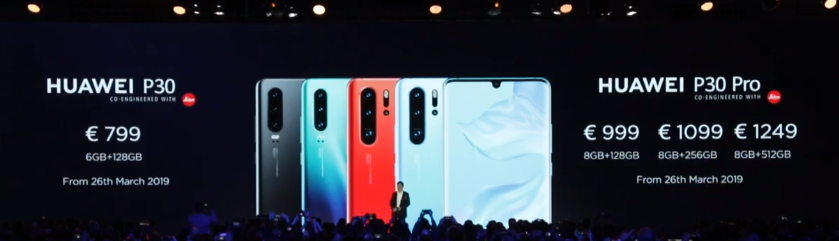
The pricing of the Huawei P30 and P30 Pro variants for China are still under the wraps. In Europe, the P30 comes in a single version of 6 GB RAM + 128 GB storage and it is priced at 799 euros (~$899). The P30 Pro is available in three models in the Europe such as 8 GB RAM + 128 GB storage, 8 GB RAM + 256 GB storage and 8 GB RAM + 512 GB storage. They are respectively priced at 999 euros (~$1,124), 1,099 euros (~$1,237) and 1,249 euros (~$1,405).
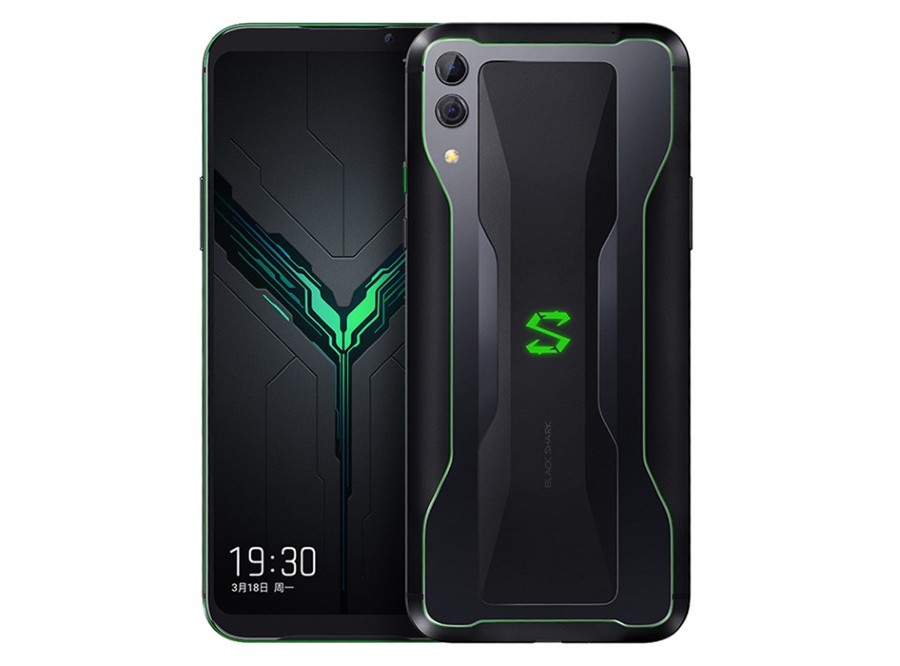
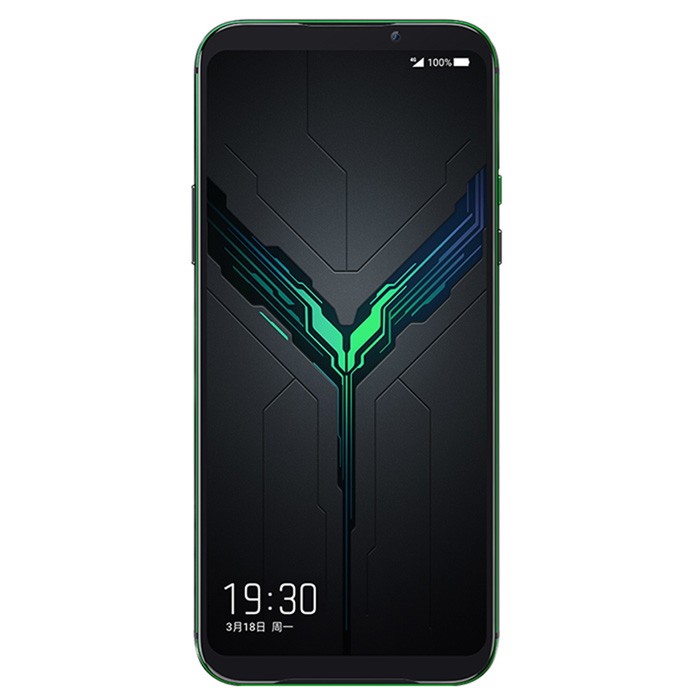
Avid gamers, rejoice! Xiaomi has revived its gaming phone lineup with the long-awaited Black Shark successor, dubbed the Black Shark 2. Much to the delight of Xiaomi fans and those who fancy playing popular games on a mobile device, the Chinese tech giant announced the Black Shark 2 gaming phone earlier this month.
If you are interested in getting your tech greedy hands on the recently unveiled gaming phone, here are the top online stores where you can pre-order the Black Shark 2 without breaking the bank.
Xiaomi Black Shark 2 on Giztop
You can buy multiple variants including 6GBRAM/128GB ROM, 8GB RAM/128GB ROM, and 8GB RAM/256GB ROM of the Xiaomi Black Shark 2 on Giztop. Aside from that, you can go for the 12GB RAM, 256GB ROM model that sells for $849. This variant is available in black and silver color versions.
The 6GB RAM, 126GB ROM variant of the Black Shark 2 comes in black color version and carries a $549 price tag. Those willing to shell out $599 can go for the slightly larger model that ships with 8GB of RAM and offers 128GB of internal storage capacity.
The Xiaomi Black Shark 2 gaming phone also comes in 8GB RAM, 256GB ROM variant. The aforesaid model would set you back $649 on Giztop. Note that the models that are currently in stock will ship in 48 hours after you’ve placed your order. You can follow this link to purchase your favorite model.
Known for offering China’s best electronic items at unbeatable prices, GeekBuying is now doling out a noteworthy discount on the Xiaomi Black Shark 2. As a result, you can now pre-order the feature-rich gaming smartphone for a lowered price of only $685.99.
This is a noteworthy reduction in the device’s original asking price of $813.99. It is worth noting that the discount will specifically be valid for the black-tinted model that features 6GB RAM and 128GB of onboard storage capacity. You can visit this link to avail the discount before the promo wraps up!
The 6GB RAM, 128GB ROM variant of the Black Shark 2 gaming smartphone has gone up for sale on AliExpress. The Official Standard model retails for $579.99, while the Type C earphone equipped carries a slightly steeper price sticker of $626.99. The Alibaba-owned online service is offering its users who shop for more than $50 on AliExpress.com a chance to use an $8 off coupon and save a considerable amount of more money at the time of checking out. New users, on the other hand, can take advantage of $5 off coupon.
You can follow this link to check out more details about the coupons and avail the discount before they expire.
Looking for a cost-effective drone that doesn’t disappoint in terms of overall performance? Banggood’s got your back!
Staying true to its reputation for offering the best bang for your buck, Banggood is giving its users an unmissable chance to get their hands on the Hubsan H117S Zino RC drone at an unbeatable price. Carrying a $489.99 price tag, the high-quality H117S Zino was added to Hubsan’s affordable price segment.
Much to the delight of those who aren’t willing to spend that kind of money on an RC drone, the leading manufacturer of easy-to-fly drones has reduced the original asking price of the H117S Zino to only $459.99 in collaboration with Banggood. In other words, Hubsan is doling out a noteworthy 8 percent discount on its well-received Quadrocopter.
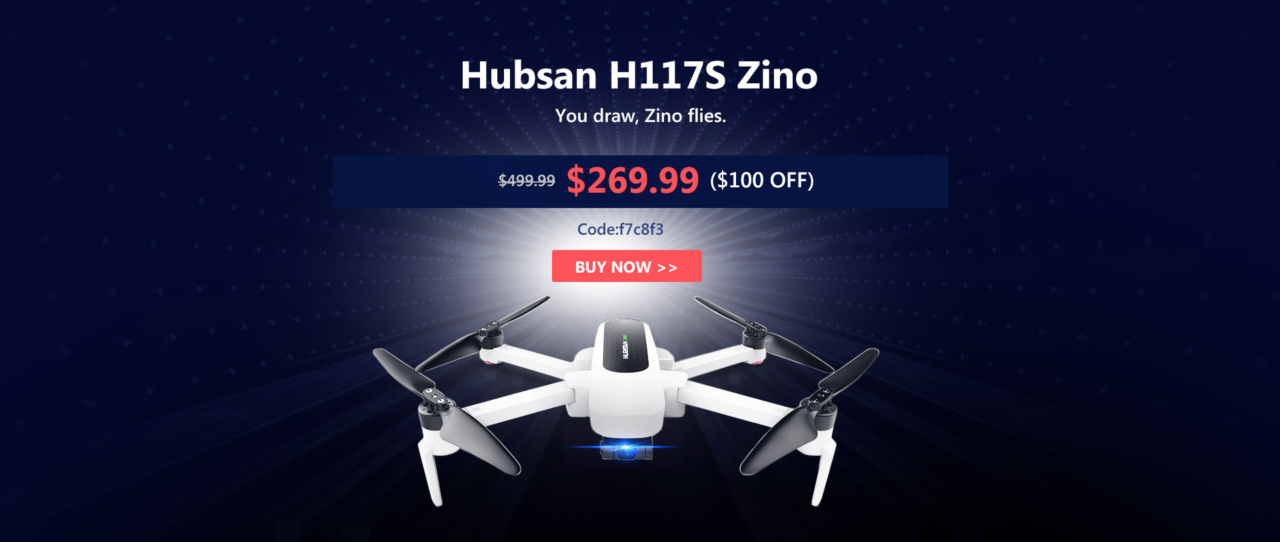
If the aforesaid reduction in the H117S Zino RC drone’s original asking price doesn’t impress you much, you can use coupon code f7c8f3 and grab an extra $100 off without breaking a sweat. The coupon helps you bring the already reduced selling price of the Hubsan-branded RC drone further down to just $269.99.
An absolute steal at this price, the H117S Zino adopts a folding design that not only makes convenient but also an easy-to-carry RC drone. It houses a 4K UHD Ultra High Definition 3840X2160 30FPS Ambarella Sports Image Processor on a 3-axis gyroscopic suspension with an impressive range of 2.5 km, ensuring crystal clear images every time.
Moreover, six lucky Banggood users stand a chance to win big coupons on a couple of top-selling drones. In order to participate, all you need to do is to follow a post on Banggood’s official Facebook page and leave your comment. Winners will receive great discount coupons on the Zino H117S and the Xiaomi Fimi X8.
The first three winners will be eligible for receiving a $110 discount coupon on the Zino H117S, while the remaining three winners will get a $90 discount coupon on the Xiaomi Fimi X8. This activity will be valid until April 2nd and winners will be announced on Banggood’s official Facebook page.
You can click here to visit the promotion page and check out more details about the Hubsan H117S Zino RC drone and how you can win awesome coupons on two of Banggood’s top-selling drones.
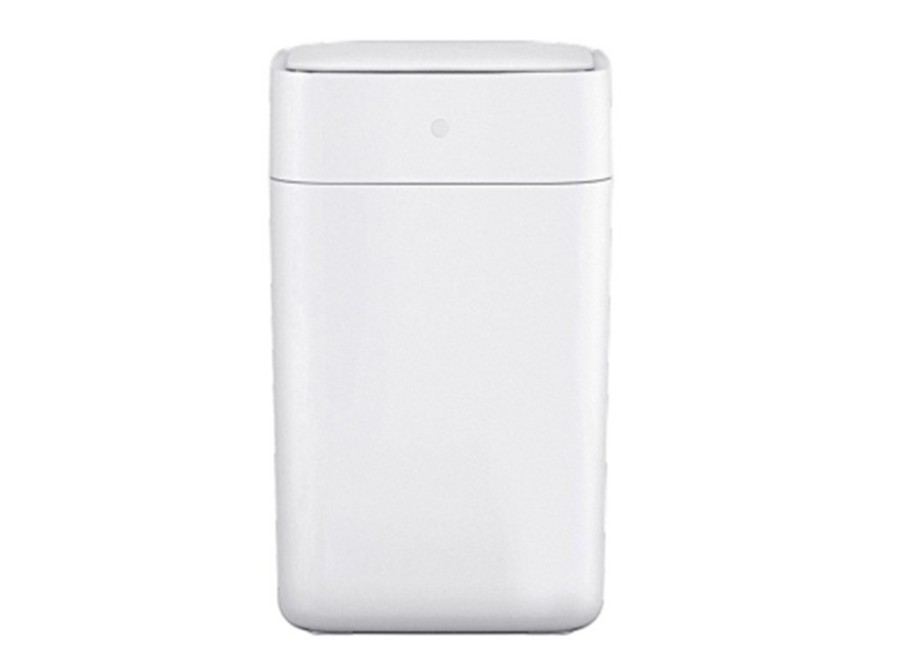
Xiaomi is primarily known for making top-end mobile devices, but the Chinese electronics company also manufactures a slew of other smart devices including wearables, mobile accessories, and appliances such as speakers, TV and even a smart trash can. Dubbed as the Xiaomi Townew T1, this smart trash can is housed in a sturdy case made using superior quality and highly durable ABS material, making it an environmentally friendly product. One of the USPs of the smart trash can is that it features a lid that opens automatically when you move closer to it.
In other words, you can dispose of the trash without bending or touching the trash can. The trash can sense movement and approaching objects even from the distance of 0-35 cm, thanks to its smart sensor. On top of that, the Xiaomi Townew T1 smart trash can automatically seal the garbage in a waste bag as soon as it is full.
This is an extremely useful feature that ensures you don’t need to get your hands dirty while putting the trash in the waste bag. While you take the trash out, the smart trash can will automatically place a new waste bag in a bid to save your time and effort.
Aside from being loaded with advantageous features that come in hand in day to day life, the Xiaomi-branded trash can sport quite an eye-catching appearance. Made entirely in matte beige, the home appliance is designed to enhance the overall appearance of your home.
The feature-laden Xiaomi Townew T1 Smart Trash Can carry a steep $149 price tag. Much to the relief of those who aren’t willing to shell out that kind of money on a smart trash can, Giztop is now offering its users a chance to get a noteworthy $50 off on the home appliance.
In other words, you can now buy the Xiaomi Townew T1 Smart Trash Can for just $99 on Giztop. So if you are interested in buying a smart trash can with an automatic lid and bag replacement feature at a reduced price, all you need to do is to follow this link without wasting time.
A few days ago, we reported that a new phone called the Redmi Y3 received its Wi-Fi certification. The phone which will run Android Pie out of the box may actually go by another name in some markets. To be specific, this may be the same device that will be sold as the Redmi 7 Pro.
Redmi Y3 may also launch as the Redmi 7 Pro
A finding carried out by XDA-Developers has shown that the unreleased Redmi Y3 has nearly the same model number as the Redmi 7 but its actually their codenames that shows the key info. The Redmi Y3’s model number is M1810F6G and its device codename is “onc_global”.
The already released Redmi 7 has multiple model numbers – M1810F6LG for the global variant, M1810F6LI for the Indian variant, and there is M1810F6LH which is also a global variant. You can see they all share the first seven characters with the Redmi Y3. The codenames for all three Redmi 7 phones are “onclite”, “onclite_india”, and “onclite_global_b” respectively.
The “lite” in the codenames shows they are less-specced models of “onc_global”. So if “onclite” is the Redmi 7, “onc” should be the Redmi 7 Pro.
Let’s also not forget that last year’s Redmi 6 Pro is known outside China as the Android One Mi A2 Lite. Does this mean the Redmi Y3 a.k.a. Redmi 7 Pro, is also the Mi A3 Lite? Since none of the aforementioned codenames have the suffix “ _sprout” which is a trait of Android One phones, one can hold the thought.
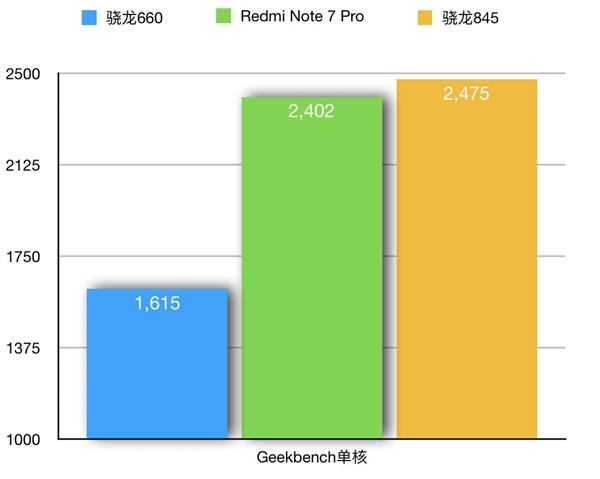
Since the splitting of the Redmi brand into an independent brand, three Redmi models have been announced – the Redmi Note 7, Note 7 Pro and Redmi 7. out of the three, the Redmi Note 7 Pro is undoubtedly the star of the pack, packing a premium finish and a new Snapdragon 675 chipset at its heart. Redmi has released the performance of the SDM675 SoC inside the Note 7 Pro and it isn’t disappointing.
The Snapdragon 675 is manufactured based on the 11nm process. It uses the new Kryo 460 CPU, which is the only fourth-generation Kryo CPU which is also on the Snapdragon 855. The chipset obviously belongs to the Snapdragon 600 series but its computing power is shown to be superior to other products on the series. Interestingly, the single-core computing power is comparable to the previous generation flagship Snapdragon 845. The Snapdragon 675 utilises an octa-core architecture with two big Kryo 460 cores clocked at 2.0GHz and six smaller Kryo cores clocked at 1.7GHz. The computing power is 50% higher than that of the Snapdragon 660.
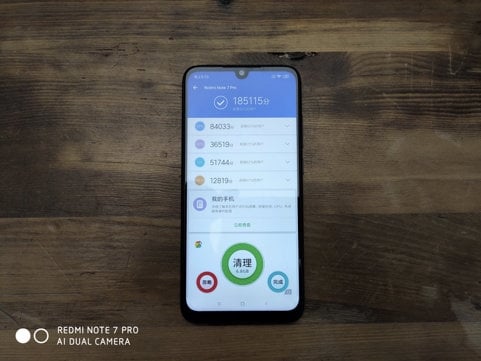
The Redmi Note 7 Pro was run through GeekBench and it scored a single core score of 2402 points which is very close to the single core test score of the Snapdragon 845. This is far higher than the Snapdragon 660’s 1615 single core score. On AnTuTu test, the device raked in a score of 185115 points whereas the SDM660 score sits in the region of 140K.
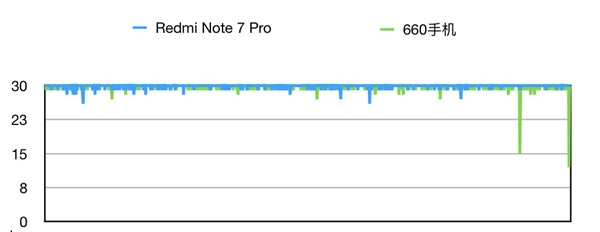
Further, the Snapdragon 675 is equipped with an Adreno 612 GPU which supports OpenGL 3.2 and Vulkan API. Thus, the Redmi Note 7 Pro performance during hardcore gaming is seamless ensures the device Another aspect where the Snapdragon 675 benefits the Note 7 Pro is the AI functions such as super night scene which it brings onboard.
About this time last year, Samsung announced the Exynos 9610 – a 10nm chipset that actually belongs to the Exynos 7 series. The chipset powers the new Galaxy A50 and is expected to also power the Motorola One Vision. A new leak has revealed Samsung is working on a successor called the Exynos 9710.
According to Ice Universe, one of the top sources for Samsung-related leaks, the Exynos 9710 will be an 8nm chipset. It will have 8 cores – 4 x Cortex A76 cores clocked at 2.1GHz while the rest are Cortex-A55 cores clocked at 1.7GHz. This is a huge upgrade when compared to the Exynos 9610 which has 4 x A73 cores and 4 x A53 cores. So expect some serious processing power from this new chipset along with better power management.
For the GPU, the Exynos 9710 will have a Mali-G76 MP8 GPU clocked at 650MHz a boost from the 9610 which has a 2nd-gen Bifrost-based Mali G72 GPU. We expect the new chipset will also have a more powerful ISP that can handle more cameras with higher pixel resolutions.
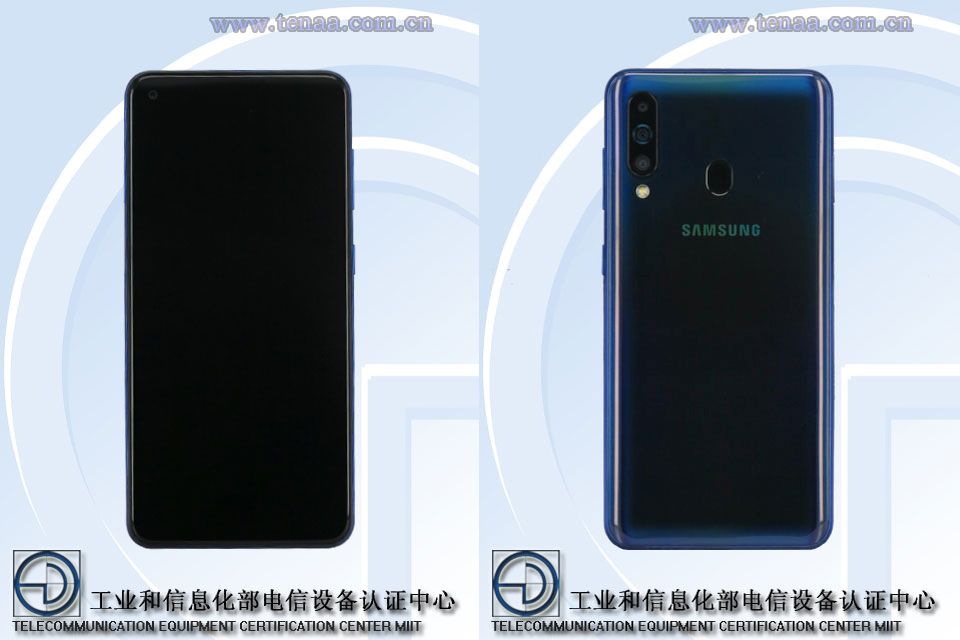
The Galaxy A60 and Galaxy A70 had recently appeared on TENAA with preliminary specs. A day after TENAA appearance, Samsung had officially unveiled the Galaxy A70 smartphone. The Galaxy A60 is yet to go official. The entire specifications of the A60 has appeared on its TENAA listing.
The Galaxy A60 measures 155.2 x 73.9 x 7.9mm and it weighs 162 grams. It is equipped with a 6.3-inch display that produces full HD+ resolution of 1080 x 2340 pixels. Its packed with a 3,410mAh battery.
An octa-core processor with a set of CPU cores working at 2.0 GHz and the remaining cores clocking at 1.7 GHz powers the Galaxy A60. The device could be featuring an Exynos chipset. The 64 GB edition of the phone features 6 GB of RAM whereas the 128 GB variant has 8 GB of RAM. The Android 9 Pie OS comes loaded on the device. The device is equipped with an external storage slot.
The Samsung Galaxy A60 is equipped with a 16-megapixel + 8-megapixel + 5-megapixel triple camera module. The frontside of the phone features a 32-megapixel camera. The other features that are available on the device include a rear-mounted fingerprint reader and fast charging technology. The handset will be releasing in China in color options such as Black, Blue and Orange.
As of this writing, there is no official confirmation on the existence of the Galaxy A60 smartphone. On April 10, Samsung will be announcing new Galaxy A-series smartphones. Probably, the South Korean company may announce the Galaxy A60 and A70 smartphones on the said date.
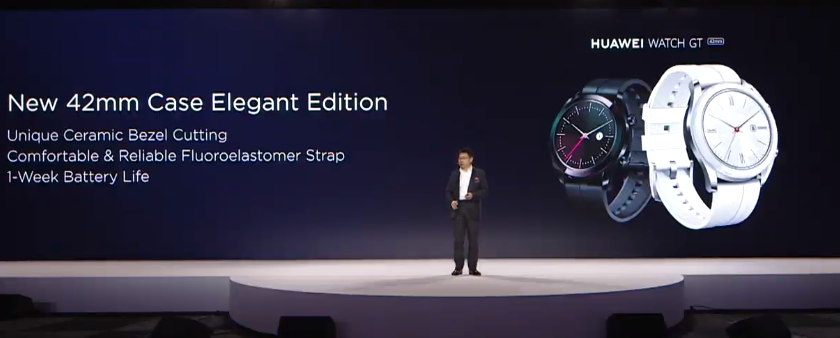
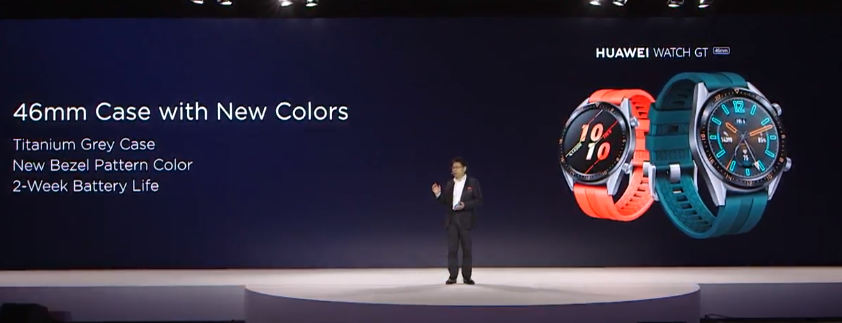
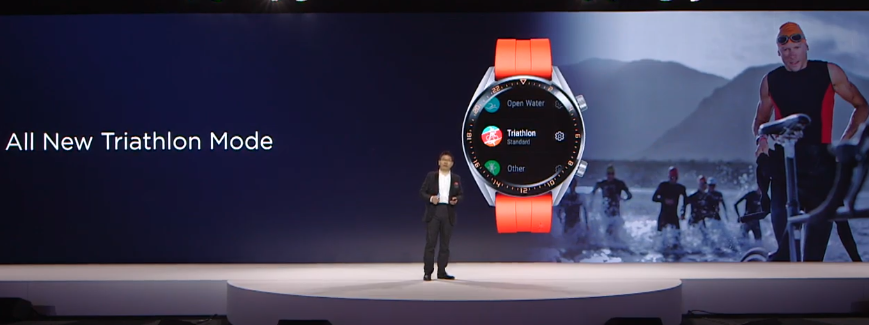
Huawei launched the Watch GT in October alongside the Mate 20 series. Today, Huawei announced two new variants – the Watch GT Active Edition and a smaller version, called the Watch GT Elegant Edition for those with smaller wrist sizes.
The Huawei Watch GT Elegant Edition has a 42mm ceramic bezel, a 1.2 inch 390 x 390 AMOLED display, and a fluoroelastomer strap. It also has a smaller battery capacity which lasts up to 1 week on a single charge, unlike the 46mm model which has a 2-week battery life. The rest of the specs are the same as the original Watch GT. The Watch GT Elegant Edition comes in white and black and is priced at €229.
The Watch GT Active Edition comes in two new color variants – green and orange. These new variants also have a Titanium gray case and a redesigned bezel but the internals hasn’t changed and battery life remains 2 weeks. Huawei says this new variant will sell for €249. There is no info on when it will be available for purchase.
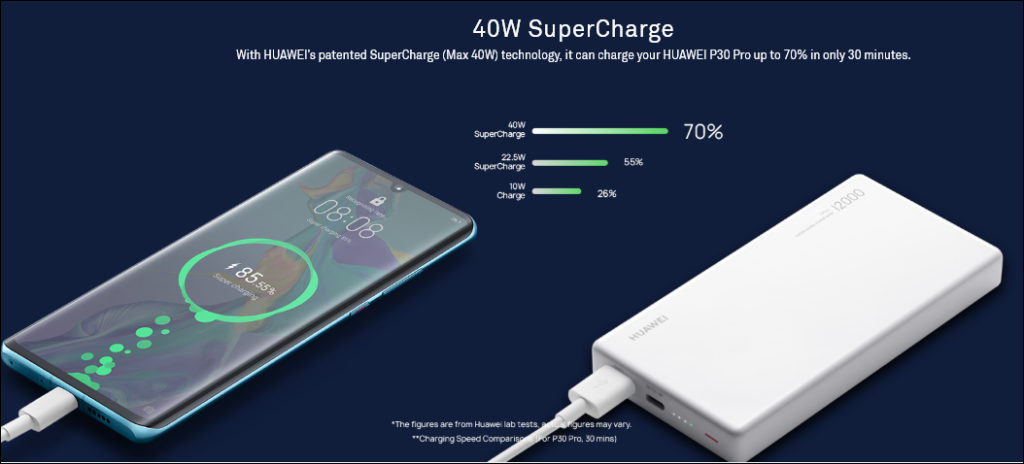
In addition to the FreeLace and Freebud earbuds, Huawei also unveiled a 40W Powerbank with a massive 12000mAh battery under its hood. There are occasions where a power bank becomes useful, while travelling, camping and several other instances. Often times, there are always limitations to the type of gadgets you can fire up using a Power bank but that is gradually changing. The Huawei 12000 40W SuperCharge power bank cannot only charge smartphones, smartwatches, cameras, tablets but also your laptop! The device is said to be the first Power bank that gets the safety certification of Germany’s TUV Rheinland.
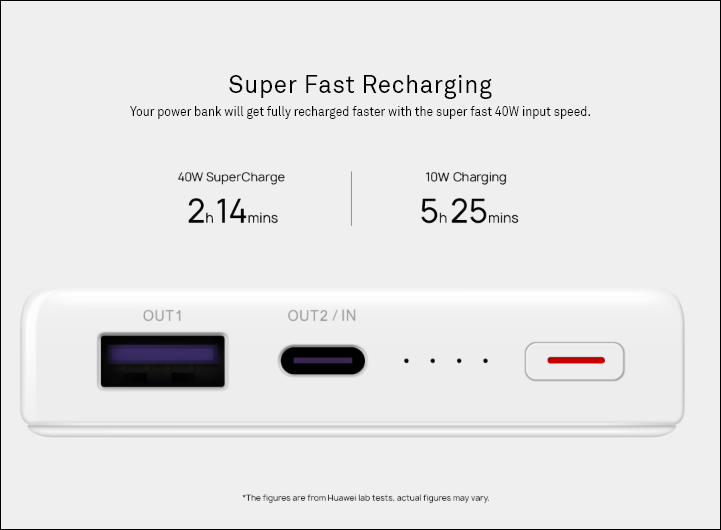
The 40W power bank delivers super fast charging to supported gadgets. Huawei says the power bank can charge the new P30 Pro up to 70%vin just 30 minutes when a 10W charger can deliver just 26% to the device in the same period. Even the 22.5W SuperCharge power bank that Huawei has can deliver 55% charge in 30 minutes. The Huawei 12000 SuperCharge power bank comes with a bi-directional 40W charge and recharge capabilities. This means that while it can deliver 40W output to supported devices, it also has a super fast 40W input speed. Thus, it can become fully charged in just 2 hours 14 minutes as against 5 hours 25 minutes which a 10W 12000 power bank takes to charge from zero to full charge.
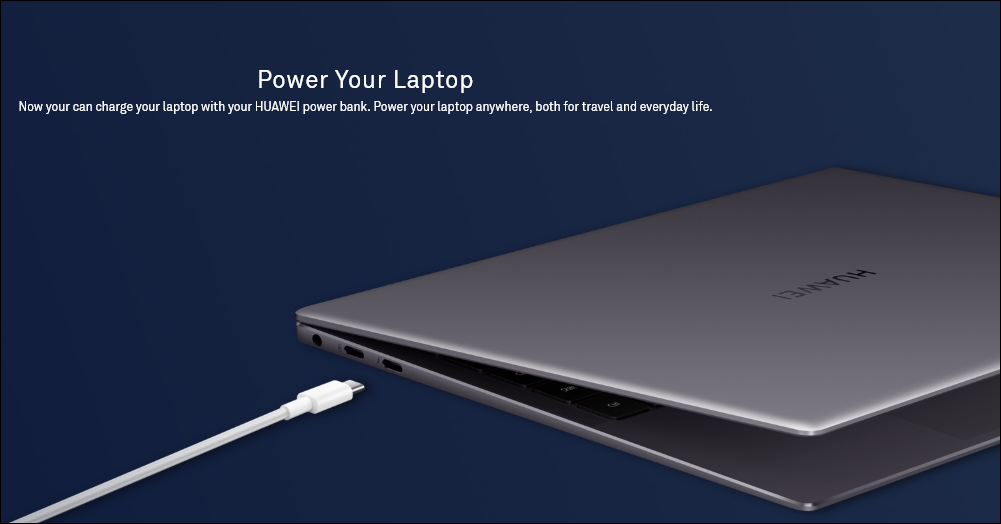
Furthermore, the powerbank is crammed with a mammoth 12000mAh Lithium-Cobalt oxide battery which is similar to the one used on the premium Huawei P20 Pro. Despite the big battery, the powerbank weighs just 227g. The weight won’t pose a problem if you are on the go. The powerbank supports both Type-A and Type-C outputs. So, it can charge laptops that use USB-C charging ports.
The Power bank is available in White and Blue colours. Huawei is yet to release details of its pricing and availability.
Huawei just released the P30 duo and as expected, they are one of the best flagship smartphone series that you can buy today. The company continued the tradition of releasing a slightly smaller P30 model alongside a larger and more powerful P30 Pro. They are similar in a lot of aspects but there are a few differences as well. The big difference is in the pricing, with P30 starting at just €799, a healthy €200 cheaper than the base 8GB + 128GB Huawei P30 Pro model. But at this price, what are you losing out? Do you sacrifice too much on features to save a couple of hundred Euros? That’s what we try to find in this article.
I’ll keep this article short since the Huawei P30 vs P30 Pro specs table tells you the whole story. So, let’s check that out first.
In all essence, the Huawei P30 and P30 Pro share the exact same design. So you have a fancy AMOLED display up front with teardrop notches and a glass back.
So how do you differentiate between the two models?
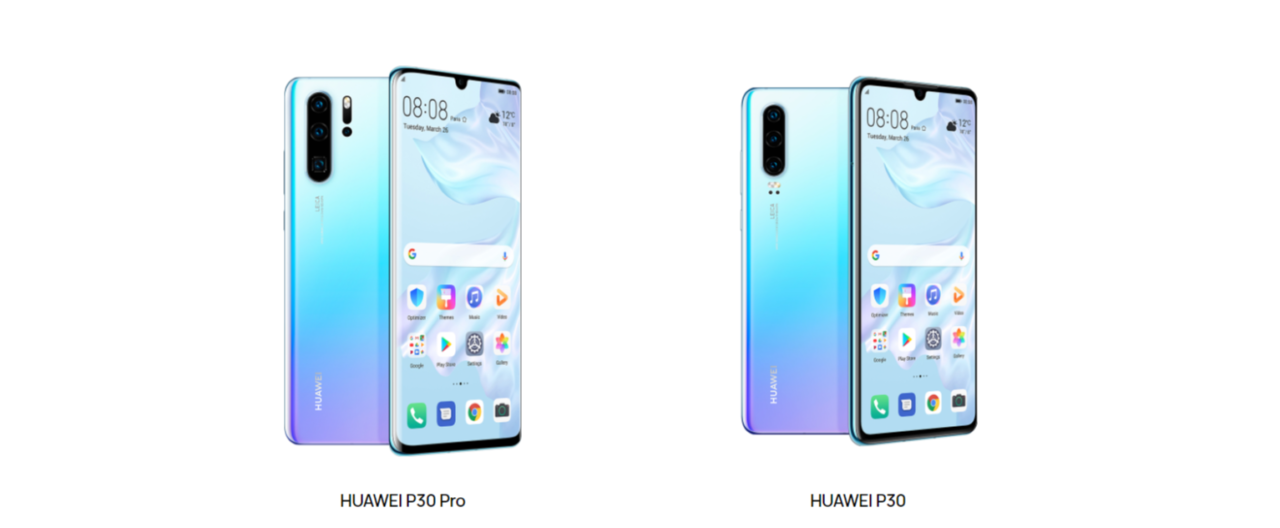
Since the P30 has a triple camera setup, the flash and other sensors lie right below the camera housing. On the other hand, the larger P30 Pro comes with a quad camera setup. This includes a unique looking periscope camera in place of the third sensor in the camera housing. Then there’s an additional ToF camera alongside flash and other sensors on the right.
Of course, there’s a big difference in the form factor too. The Huawei P30 is not only smaller, all thanks to its 6.1-inch display (vs ~6.5-inch on the P30 Pro), it is also significantly lightweight. There’s nearly a difference of 30 grams between the two models, and that’s quite a lot in everyday usage.
Further, the Huawei P30 comes with a dedicated 3.5mm headphone jack, which its powerful sibling lacks.
As for durability, Huawei P30 is just IP53 certified as opposed to P30 Pro’s IP68 rating.
Huawei P30 vs P30 Pro: Cameras
There’s no doubt that the P30 Pro has a better camera setup than the P30. While the P30 model is no slouch with a powerful triple camera setup, the Pro version takes things up a notch with better features and quad cameras. Here’s a quick look at the differences in their cameras.
P30 vs P30 Pro
Triple Cameras vs Quad Cameras
Primary Lens Aperture: f/1.8 vs f/1.6 (lower is better)
No ToF vs dedicated ToF sensor (fourth sensor)
ISO: 204800 vs 409600
3X Optical Zoom vs 5X Optical Zoom
5X Hybrid Zoom vs 10X Hybrid Zoom
30X Digital Zoom vs 50X Digital Zoom
Huawei P30 vs P30 Pro: Battery
The thing that makes P30 Pro heavier gives it an edge here. The larger model has a larger battery too: 4200mAh vs 3650mAh on the P30. Both feature 40W Huawei Super Charge fast charging. However, P30 doesn’t have Wireless Charging, which is really a shame. So, naturally, it doesn’t have reverse Wireless Charging either, which the larger model brags about. Huawei has ensured wireless charging on the Pro model isn’t painfully slow, as it goes up to 15W.
Huawei P30 vs P30 Pro: Pricing
The P30 starts at €799, while the P30 Pro starts at €999.
For me, that’s a very solid price difference. While the P30 Pro really shines in the camera department, the P30 shouldn’t be a slouch. It should still be one of the better cameras in the market. So, if you can forgive the lack of Wireless Charging support, the smaller model makes a really strong case with its specs. Not to mention that it’s pretty compact and light, making it a more comfortable option for everyday use.
But if you don’t mind the larger sibling’s beefy form factor and can shell out nearly a thousand Euros, look no further than the P30 Pro.
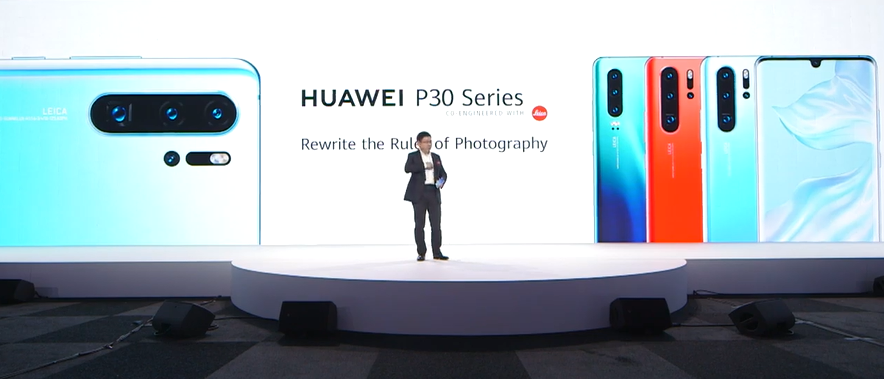
Huawei has just announced the Huawei P30 and Huawei P30 Pro at an event in Paris today. Over the past few weeks, there have been lots of leaks about both phones but today’s event reveals new details. The Huawei P30 series, just like their predecessors are camera beasts and with what we have seen today, competitors have a lot of catching up to do.
Specs
The Huawei P30 has a 6.1-inch FHD+ (2340 x 1080) OLED DCI-P3 HDR display with a 19.5:9 aspect ratio. The Pro version has a larger 6.47-inch FHD+ curved OLED display. Both screens have low-power consumption. The P30 Pro doesn’t have an earpiece, instead, it uses Acoustic Display Technology which emits sounds through the display using magnetic levitation.
Powering both phones is the Kirin 980 with up to 8GB of RAM and 512GB of storage. There is support for storage expansion using Huawei’s NM Card. Huawei has redesigned the tray: rather than a SIM tray where the two SIMs and or the NM Card are side-by-side, the tray of the P30 series is designed to fit in one Nano SIM on top and the NM Card or a second Nano SIM underneath.
The Huawei P30 Pro has an IP68 rating while the P30 has an IP53 rating. Both have an in-display fingerprint scanner which is 30% faster than that of the previous generation.
The P30 has a 3,650mAh battery with support for 22.5W fast charging while the P30 Pro has a 4,200mAh battery with support for 40W fast-charging and support for 15W wireless fast charging. The P30 might not have the Pro’s 40W fast charging but it has an audio jack.
Both phones run EMUI 9.1 based on Android Pie. We will have a separate article talking about the new features of EMUI 9.
Cameras
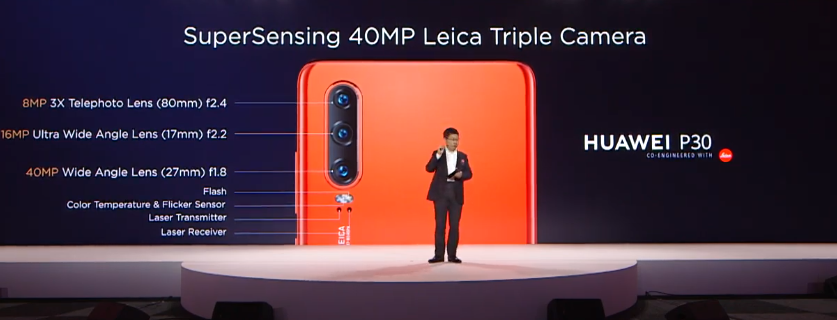
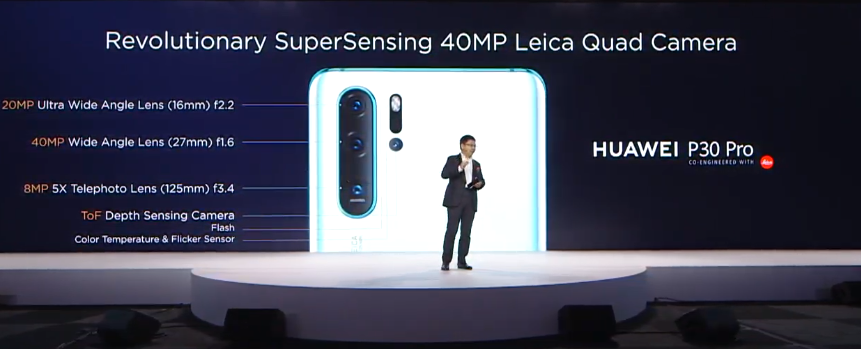
This is the selling point of the P30 and P30 Pro and Huawei doesn’t hold back on both devices. The P30 has three cameras – an 8MP f/2.4 3X telephoto lens, a 16MP f/2.2 ultra wide angle lens, and a 40MP f/1.8 wide angle lens. The P30 Pro has four – a 20MP f/2.2 ultra wide angle lens, a 40MP f/1.6 wide-angle lens, an 8MP f/3.4 5X telephoto, and a ToF depth-sensing camera.
For the selfie camera, both the Huawei P30 and Huawei P30 Pro come with a 32MP sensor with AI HDR+.
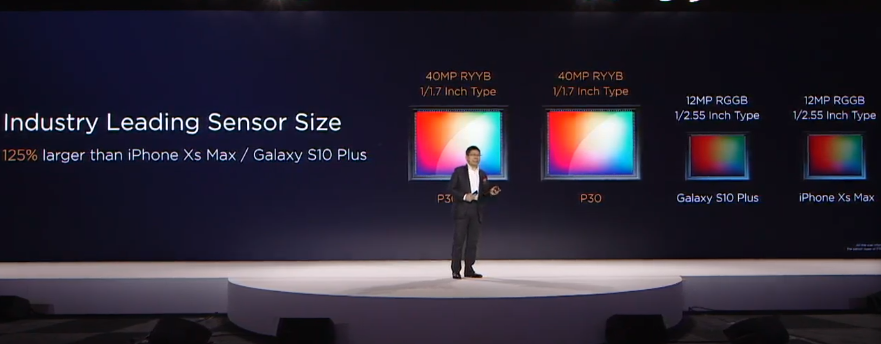
Unlike other cameras that use an RGGB sensor, the Huawei P30 series use RYYB sensors. They are the first phones in the world to do so. The RYYB sensor is able to absorb 40% more light than the RGGB sensor. The sensor size is also bigger at 1/1.7 inches, 125% more than that of the Galaxy S10 Plus and the iPhone Xs Max.
The 40MP main camera and the 8MP telephoto lens on the P30 Pro both have OIS for better low-light performance. Both the P30 and P30 Pro also have the highest ISO value of any phone. Huawei shared some camera samples that show how both phones perform in low-light and even did a live demo during the launch. They really do blow the competition out of the water.
The P30 and P30 Pro are not only low-light camera champs but also masters of zoom. The P30 has 3X optical zoom, 5X hybrid zoom, and 30X digital zoom. The Pro model has 5X optical zoom, 10X hybrid zoom, and 50X digital zoom. Below are sample photos taking with the zoom lens. The SuperZoom lens also allows you to record timelapse videos from a distance.
[envira-gallery id=”242898″]
Just like their predecessors, the P30 series have AIS which allows you to take professional long exposure photos without a tripod. The feature now also works in daytime. There is also a feature called Dual-View video which allows you to record a wide-angle and close-up view simultaneously.
The P30 Pro has a fourth camera – the ToF sensor which allows for better depth capturing for portrait images. With the ToF sensor, the P30 Pro has a new Pro-Bokeh mode for portrait images with a high level of detail. Both phones also have a 2.5cm super macro mode that allows you to capture close up images with incredible details.
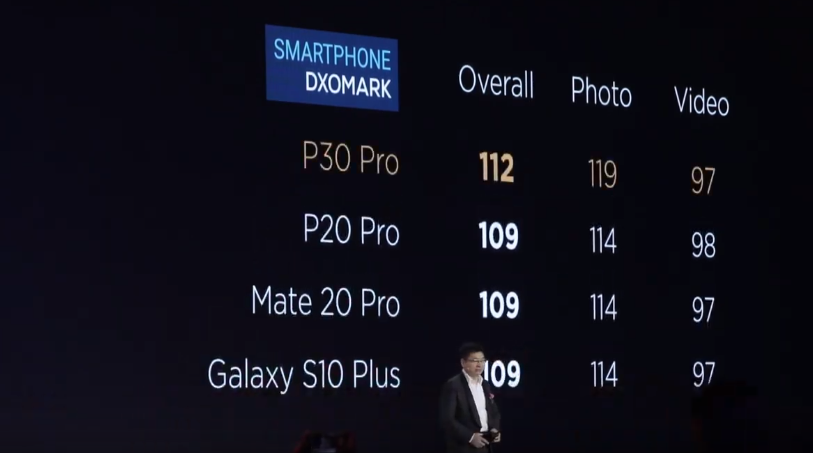
Huawei didn’t fail to brag about its DxOMark scores too. The P30 Pro has a photo score of 119 and a video score of 97 for an overall score of 112. Notice that the video score of the P30 Pro is even lower than that of the P20 Pro?
Another midrange phone by Samsung is here to challenge the unrestrainable growth of Chinese manufacturers: its name is Samsung Galaxy A70 and it is the most interesting phone from the A-series released so far. But there will be two main devices which will rival the Galaxy A70 and will represent a menace to its sales, at least in the Asian market. We are talking about the Huawei Nova 4e which should soon land in Europe under the Huawei P30 Lite moniker, and the Xiaomi Redmi Note 7 Pro which will remain an Asian exclusive unlike its inferior sibling Redmi Note 7. Through this specs comparison, you will learn the differences between these devices.
Samsung Galaxy A70 vs Huawei Nova 4e vs Xiaomi Redmi Note 7 Pro
Samsung Galaxy A70
Huawei Nova 4e
Xiaomi Redmi Note 7 Pro
DIMENSIONS AND WEIGHT
164.2 x 76.7 x 7.9 mm
152.9 x 72.7 x 7.4 mm, 159 grams
159.2 x 75.2 x 8.1 mm, 186 grams
DISPLAY
6.7 inches, 1080 x 2340p (Full HD+), 385 ppi, Super AMOLED
Triple 32 + 8 + 5 MP f/1.7 and f/2.2 and f/2.2
32 MP f/2.0 front camera
Triple 24 + 8 + 2 MP f/1.8 and f/2.4
32 MP f/2.0 front camera
Dual 48 + 5 MP f/1.7 and f/2.4
13 MP front camera
BATTERY
4500 mAh, fast charging 25W
3340 mAh, fast charging 18W
4000 mAh, Fast Charging with Quick Charge 4
ADDITIONAL FEATURES
Dual SIM slot
Hybrid Dual SIM slot
Hybrid Dual SIM slot
Design
Listen to your tastes, as each of these devices come with a nice and premium design. Do you prefer the “3D Glasstic” of the Samsung Galaxy A70 or the gradient glass backs of the Huawei Nova 4e and Xiaomi Redmi Note 7 Pro? While you choose, it is worth noting that the really important difference between these handsets is the build quality. Redmi Note 7 Pro comes with more protection, despite it is not among the most resistant devices. Its display is protected by Gorilla Glass 5 and the phone is also water resistant. Instead, for the Samsung Galaxy A70 and Huawei Nova 4e, you do not get any kind of protection against water, neither for the display.
Display
Do you want the most brilliant and vivid display? Go for the Samsung Galaxy A70, there is no challenge. The Super AMOLED makes the colors much more pleasant and the blacks deeper. The kind of panel is often the only thing that really makes a difference when it comes to midrange displays. Further, the Samsung Galaxy A70 comes with a slightly taller 20:9 aspect ratio and a superior 6.7-inch diagonal.
Specs & Software
If we only consider the base variants, Redmi Note 7 Pro wins the hardware comparison because it sports a more powerful processor than both the Snapdragon 675 and the Kirin 710 of the Huawei Nova 4e. We are talking about the Snapdragon 675 that is one of the best Qualcomm’s mid-range chipsets. But Samsung Galaxy A70 comes in a configuration with Snapdragon 670 (that is just slightly inferior to the SD675) and 8 GB of RAM while Redmi Note 7 Pro stops at 6 GB of RAM, that is why, if we consider the most expensive variants, Samsung Galaxy A70 wins. All the phones come with a customized Android version based on Pie.
Camera
On the paper, Samsung Galaxy A70 seems to be the winner of the camera comparison. It sports a rear setup with a main 25 MP sensor coming with a bright f/1.7 aperture, a useful 8 MP ultrawide lens and a 5 MP depth sensor. It is a rear department which should be slightly better than the triple camera of the Huawei Nova 4e that consists of a similar setup. Redmi Note 7 Pro should focus more on the photo detail thanks to its 48 MP main sensor, but it should be less surprising than Samsung Galaxy A70 despite it doubles the sensor resolution. Coming to the front camera, it will be a hard fight between Samsung Galaxy A70 and Huawei Nova 4e.
Battery
With a huge 4400 mAh battery and its efficient Super AMOLED display, Samsung Galaxy A70 should provide a higher battery life. Right after, there should be Redmi Note 7 Pro with its above-average 4000 mAh battery and the low energy consumption of its Snapdragon 675 chipset. Huawei Nova 4e loses the comparison due to its too small 3300 mAh battery.
Price
While we still do not know Samsung Galaxy A70’s price and availability, we know that Huawei Nova 4e debuted with a €270/$305 price tag and Redmi Note 7 Pro starts from €200/$225. At the end of the day, Samsung Galaxy A70 shows to be a more interesting mid-ranger due to its better display, great rear cameras, and bigger battery, despite its performance may be disappointing compared with the Redmi Note 7 Pro.
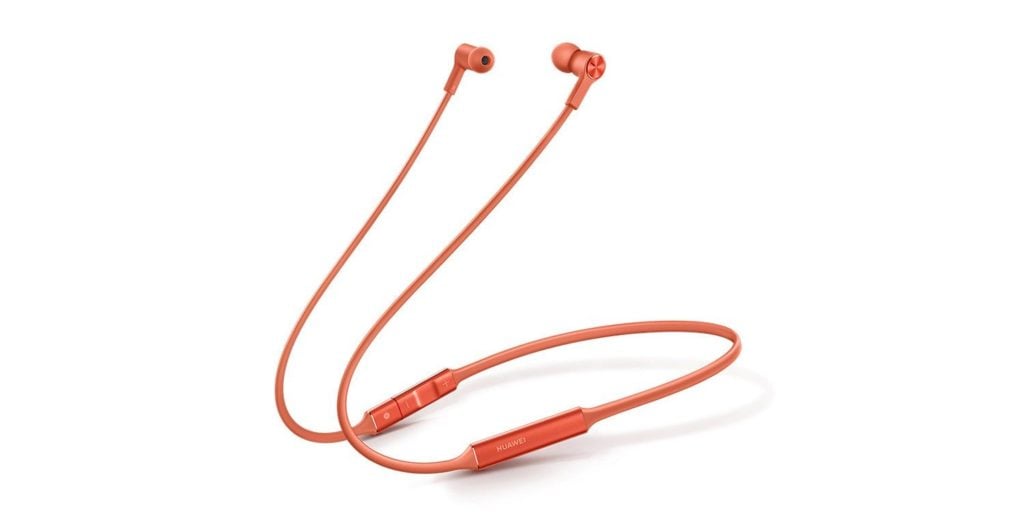
Huawei finally launched the long-anticipated P30 and P30 Pro today in Paris. The flagship phones made their entry alongside a number of interesting products including wearables. The Huawei FreeLace Bluetooth headset was launched as well as the Freebud Lite which looks very much like the Apple AirPods 2.
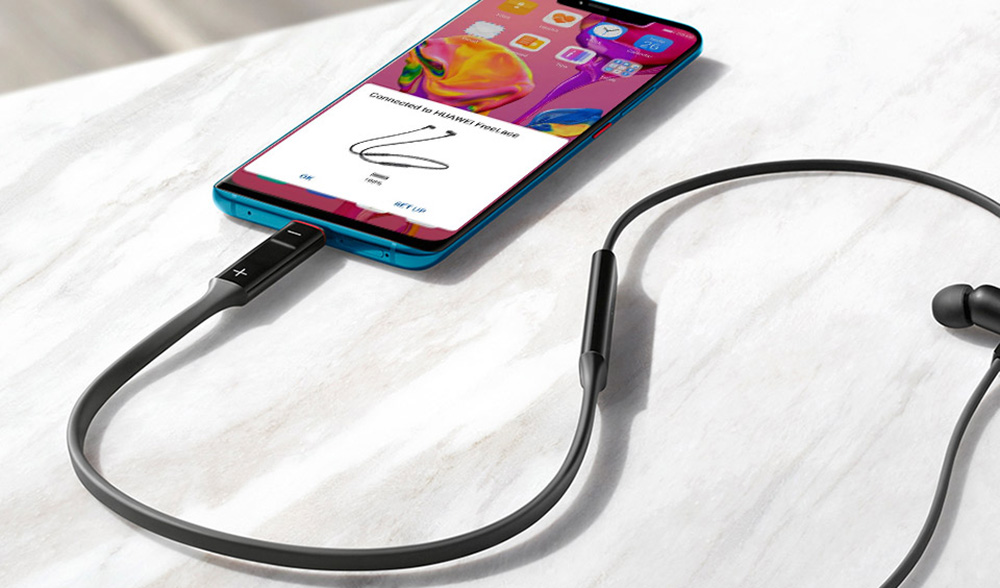
The FreeLace headset has a designed that would be most appealing to sportspersons and those who like listening to music while exercising. It comes with a collar (over-the-shoulder design) which would prevent it from falling off easily while running. There is also a magnetic clasp in each ear which helps keep the earbuds together. Apart from organising the earbuds, the magnetic clasp also functions during calls. It allows users to receive calls by just detaching the pair and placing them on your ears. After the call, you just need to remove the buds from your ears and attach the two and the call will be ended. The same feature will also start or stop music depending on whether you’re placing them in your ears or removing them. The cables are anti-tangling specs which won’t tangle easily.
The Huawei FeeLace bud comes with a USB-C port which offers fast data transfer and fast charging of the gadget. Just 5 minutes of charge can deliver up to 4 hours of audio playback. A full single charge can deliver up to 18 hours of continuous playback. This is slightly lower than the 24 hours which the iTeknic BH001 headset claims to deliver at 70% volume. We don’t know if the FreeLace earbuds will go up the entirely 18 hours at full blast or moderate volume levels. Apart from the fast wired connection, the headset can also be paired with other gadgets wirelessly using Bluetooth.
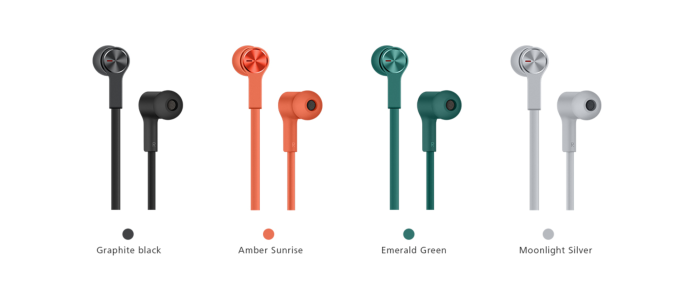
As for the audio quality, the earbuds are powerful, driven by the 9.2mm titanium-plated drivers, which brings solid audio for anyone that simply wants a pair of workout earbuds. The design delivers wind noise reduction capability which cuts out audible audio infractions. There is an in-line remote for various controls, including activation of Google Assistant. The Huawei FreeLace earbuds is available in four cool color options: Black, Amber Sunrise, Emerald Green, and Moonlight Silver. No word yet on when it will go on sale.
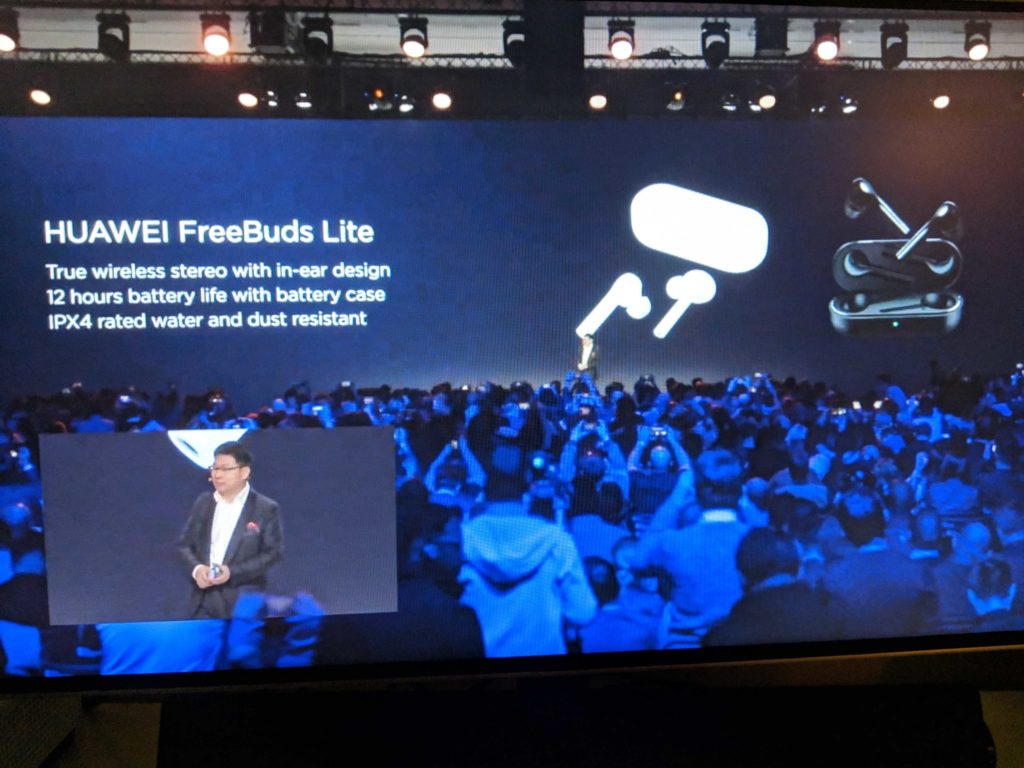
Huawei Freebuds Lite
Another earbud launched is the Huawei Freebuds Lite would definitely be out to take on Apple’s AirPods 2. The Freebuds Lite has a true wireless (TWS) design which means there is no wire that’ll disturb your fun. The pair of true wireless buds offer 12 hours of battery life which is quite vague. We can’t say if the 12 hours will be without charging or if you’ll need to recharge intermittently. It is unlike that the gadget will be capable of 12 hours of audio playback. Perhaps, it can withstand 12 hours on standby only. The Freebuds also come with IPX4 rating which means they are water resistant and not necessarily waterproof. That means you can get all sweaty while using the earbuds without any worry. As for the price, the Freebuds Lite will be sold for €119 (about £100).
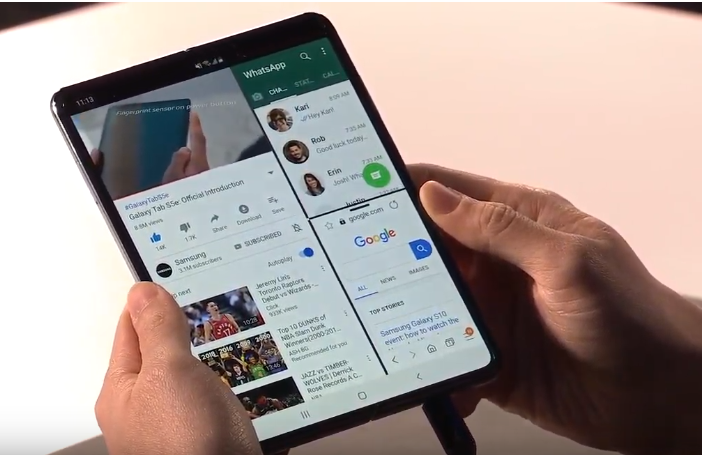
Samsung set the pace in the race to release a foldable phone when it announced the Galaxy Fold during the Galaxy Unpacked event last month. The Fold is expected to be released in several markets this year. It was revealed last week that the Galaxy Fold for the international market (Europe) and North America will not have an Exynos chipset. Instead, it will feature a Qualcomm Snapdragon 855 chipset. More details have emerged to confirm that claim.
The Galaxy Fold firmware was analysed recently where it was observed that it was similar to the CPU on the North American version of the Galaxy S10. The analysis was done by the guys at XDA-Developers who conducted a thorough analysis of the combination firmware for the International model of the Galaxy Fold (SM-F900F) and unearthed a reference to SM8150 which is the model name by which the Snapdragon 855 is known internally.
The Fold was initially announced with an Exynos 9820 CPU but this discovery seems to have confirmed earlier speculations that the Galaxy Fold will come in two models, one with LTE and the other with 5G. Since the Snapdragon 855 has a 5G chip, it will be onboard the 5G variant. In addition to hitting Europe, earlier rumour says the 5G version will also be released in Samsung’s home country – South Korea.
A recent report from XDA Developers had revealed that Xiaomi is working on a new smartphone that is codenamed as “pyxis.” The mysterious phone is expected to arrive in China as the successor of Mi 6X that was made available as Mi A2 Android One smartphone outside of home market. The Xiaomi Pyxis is expected to release in Android One editions such as Mi A3 and Mi A3 Lite. A new leak claims that the Xiaomi Pyxis could be unveiled in China in April with Xiaomi Mi 9X moniker. The leak has also revealed the full specifications of the Xiaomi Mi 9X along with its pricing.
In 2017, the Chinese firm had launched the Xiaomi Mi 5X and it was succeeded by the Mi 6X in the next year. The new leak states that the successor of the Mi 6X won’t be called Mi 7X or Mi 8X, but it will be releasing in the market as Xiaomi Mi 9X.
Xiaomi Mi 9X Specifications and Price
The Xiaomi Mi 9X is expected to house a 6.4-ich AMOLED display with COF packaging technology. The waterdrop notch screen will be embedded with a fingerprint scanner. The Snapdragon 675 that powers the Redmi Note 7 Pro is also speculated to power the Xiaomi Mi 9X along with 6 GB of LPDDR4x RAM.
Xiaomi Mi 9
The Mi 9X may feature the latest MIUI10 based Android 9 Pie OS. It is likely to fueled by 3,300mAh battery that will carry support for 18W Quick Charge 4.0+. The Mi 9X may house a 32-megapixel S5KGD1 sensor with a pixel size of 0.8micron inside the frontal notch. A triple camera setup could be available on the back panel of the smartphone. It may include a 48-megapixel Sony IMX586 main sensor, an 8-megapixel secondary sensor and 13-megapixel super wide-angle lens. The front-facing camera and the main sensor in the triple camera setup are expected to be equipped with support for 4-in-1 pixel binning technology.
The base model of the Xiaomi Mi 9X is expected to come with an internal eMMC 5.1 storage of 64 GB. It may carry a price tag of 1,699 Yuan (~$253). The smartphone may sport a 2.5D glass enabled body with holographic color. It is expected to sport a slim profile of 7.5mm. The very same phone may hit the international markets as Xiaomi Mi A3.
There is no official confirmation on the existence of the Xiaomi Mi 9X yet. Readers are advisable to digest the report with a grain of salt since the leaked details of the Mi 9X could not be verified. It is recommended to wait for further leaks to confirm on its specs.
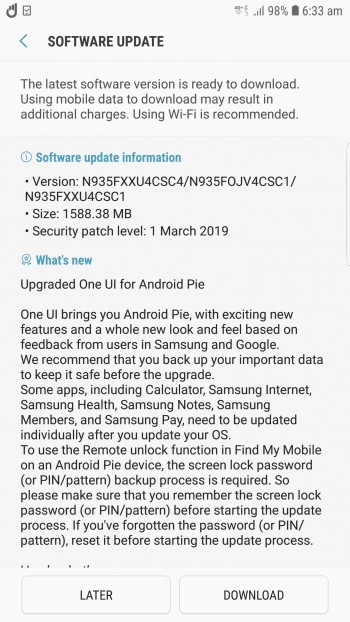
Samsung is rolling out the Android 9.0 Pie update on Galaxy Note FE ( Galaxy Note 7 sequel). It’s the same device featuring same specs, came into origin after Galaxy Note 7 disaster in 2017. Starting today, Samsung Note FE users are receiving the update notifications in some countries. It was spotted running Android Pie on WiFi Alliance last year.
The new update carries various improvements including Android P features such as refined permission control, gesture navigation, notch support, smarter notification channels, and better security. Moreover, upgraded OneUI brings an exciting new look and feel based on feedback from users.
Samsung recommends to backup important data before proceeding for the update weighing 1588 MB. The March security patch is also bundled with the update.
After updating make sure to upgrade Calculator, Samsung Internet, Samsung Health, Notes and other apps for a better experience.
It proves that Samsung still supports its high-end devices for more than two years. The update is available in Saudi Arabia and is likely to hit more devices in other countries soon. Make sure to charge your device for at least upto 70%, and also switch to a WiFi connection to save additional charges on carrier network before updating.
In February, Lenovo owned Motorola had announced the Moto G7, G7 Plus, G7 Play and G7 Power phone through an unveil event in Brazil. Today, Lenovo Group VP Chang Cheng has confirmed through a Weibo post that the company will be launching the Moto G7 Plus in China on April 8. The company will be holding a launch event in Beijing to announce the new G7 Plus.
The launch poster precisely mentions that the Moto G7 Plus will be heading to China. There is no confirmation on whether the G7 series will be also announced through April 8 event in the country. The poster reveals that the phone will be arriving in China in color like Deep Indigo and Viva Red. A recent report had claimed that the Moto G7 Plus will be the only G7 series phone coming to China this year.
Moto G7 Plus Specifications
The Moto G7 Plus comes with a 6.2-inch IPS LCD display with waterdrop notch. It supports 19:9 aspect ratio and full HD+ resolution of 1080 x 2270 pixels. The display offers a screen-to-body ratio of around 81 percent. The screen is shielded by a layer of Gorilla Glass 3. The Snapdragon 636 powers the phone along with 4 GB of RAM. The native storage of the G7 Plus is 64 GB. It will be equipped with a microSD card slot for additional storage. The Android 9 Pie OS that offers stock-like experience comes preloaded on the G7 Plus.
The back panel of the Moto G7 Plus is fitted with an LED flash enabled dual camera setup. It includes an f/1.7 aperture 16-megapixel primary sensor with OIS and a depth sensor of 5-megapixel. For capturing selfies, a front-facing snapper of 12-megapixel is available inside the frontal notch. It includes a 3,000mAh battery that supports 27W Quick Charge 4 charging. The other features present on the G7 Plus are stereo speakers, rear-mounted fingerprint reader, dual 4G VoLTE, Wi-Fi 802.11ac, Bluetooth 5.0, GPS, USB-C, NFC and 3.5mm audio jack. The handset measures 157 x 75.3 x 8.3mm and weighs 176 grams.
There is no information available on the pricing of the G7 Plus for China. In Europe, it was made available for 299 euros (~$338).
We use cookies on our website to give you the most relevant experience by remembering your preferences and repeat visits. By clicking “Accept”, you consent to the use of ALL the cookies.
This website uses cookies to improve your experience while you navigate through the website. Out of these, the cookies that are categorized as necessary are stored on your browser as they are essential for the working of basic functionalities of the website. We also use third-party cookies that help us analyze and understand how you use this website. These cookies will be stored in your browser only with your consent. You also have the option to opt-out of these cookies. But opting out of some of these cookies may affect your browsing experience.
Necessary cookies are absolutely essential for the website to function properly. This category only includes cookies that ensures basic functionalities and security features of the website. These cookies do not store any personal information.
Any cookies that may not be particularly necessary for the website to function and is used specifically to collect user personal data via analytics, ads, other embedded contents are termed as non-necessary cookies. It is mandatory to procure user consent prior to running these cookies on your website.


 If you like having more storage capacity to save your favorite music, videos, and other multimedia content on your phone without breaking the bank, we got good news for you.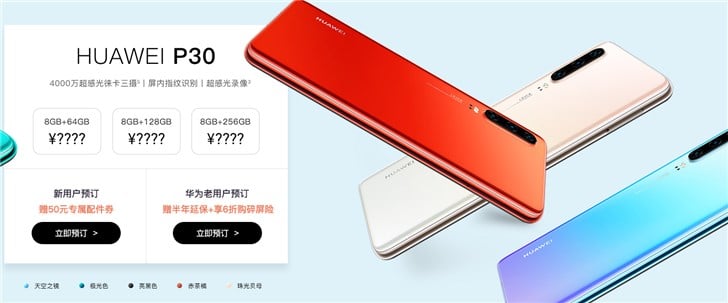
 Much to the delight of Xiaomi fans and those who fancy playing popular games on a mobile device, the Chinese tech giant announced the Black Shark 2 gaming phone earlier this month.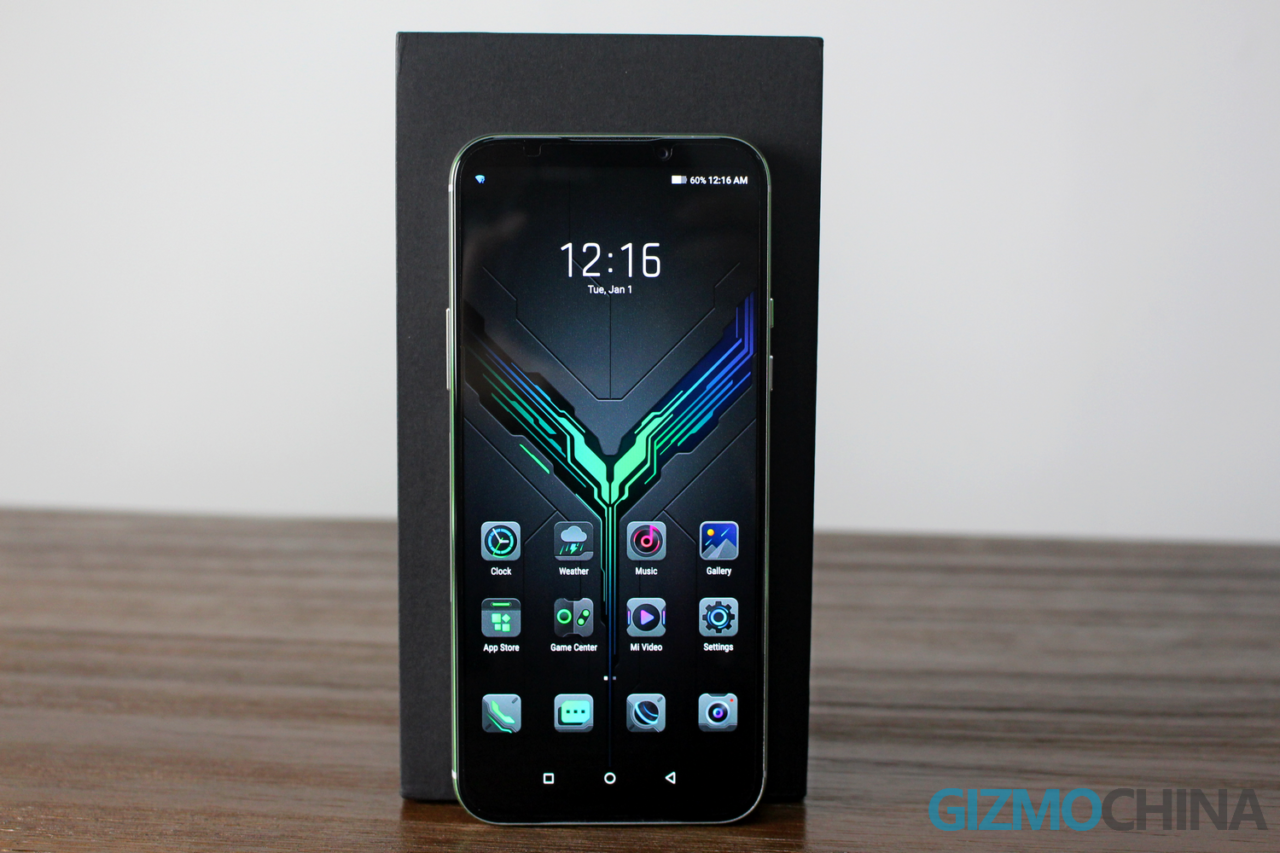
 The Alibaba-owned online service is offering its users who shop for more than $50 on AliExpress.com a chance to use an $8 off coupon and save a considerable amount of more money at the time of checking out. New users, on the other hand, can take advantage of $5 off coupon.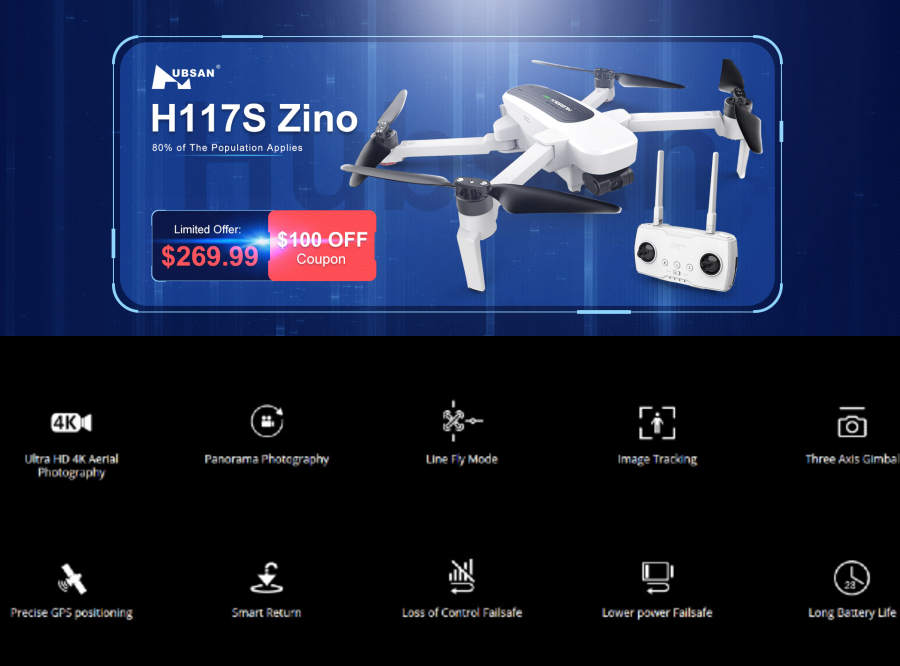
 Dubbed as the Xiaomi Townew T1, this smart trash can is housed in a sturdy case made using superior quality and highly durable ABS material, making it an environmentally friendly product. One of the USPs of the smart trash can is that it features a lid that opens automatically when you move closer to it.