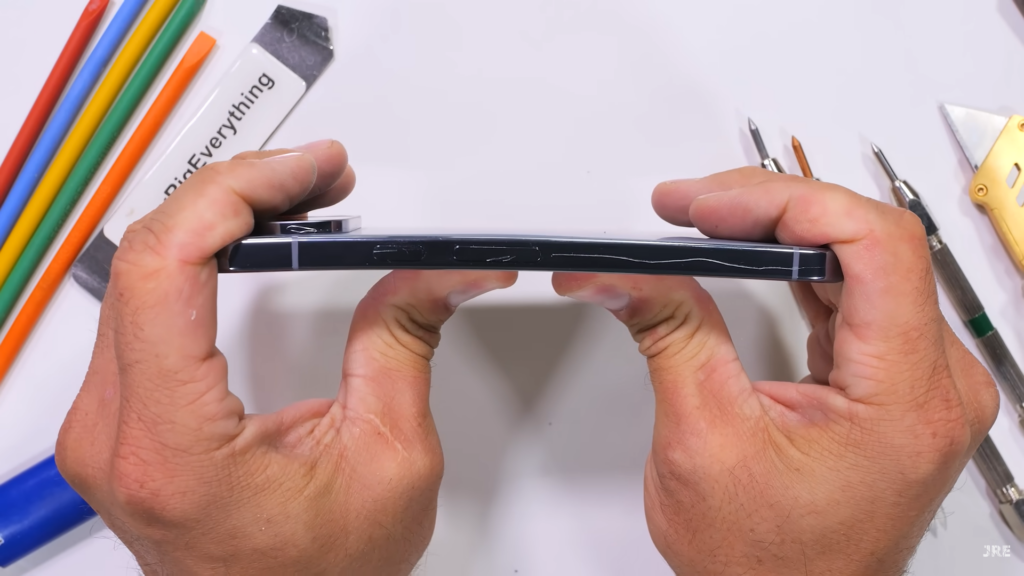
The Google Pixel 10 Pro XL has gone through YouTuber JerryRigEverything’s durability test, and the results show a device built to last. Alongside the usual scratch, burn, and bend trials, the test also revealed a new magnetic charging system that is one of the Pixel’s biggest hardware shifts yet.
The Pixel 10 Pro XL’s 6.8-inch AMOLED display, shielded by Gorilla Glass Victus 2, handled scratches and even the flame test without permanent damage. Its aluminum frame and buttons also held up well, and during the bend test, the phone showed no flex or weak points. Combined with Google’s promise of seven years of software updates, the solid build reinforces the Pixel 10 Pro XL as a long-term option for buyers.
Pixelsnap: magnetic wireless charging
What stood out in the video, however, wasn’t just durability. Zack Nelson pointed to internal changes hinting at “Pixelsnap,” a MagSafe-style magnetic charging system. Using magnetic field viewing film, a circular array of magnets can be seen inside the back panel, designed to align the phone with Qi2 wireless chargers and compatible accessories.
While the HMD Skyline technically introduced Qi2 support first, the Pixel 10 Pro XL becomes the first mainstream Android flagship to bring full compatibility, putting it on equal footing with Apple’s iPhone lineup. For those wondering, Samsung’s upcoming Ultra flagship is rumored to adopt built-in magnets as well — a more surprising move given that magnetic cases have historically interfered with the S Pen.
Nelson also hinted at further changes around the battery, which he plans to detail in an upcoming teardown. For now, the mix of strong durability and the debut of Pixelsnap makes the Pixel 10 Pro XL one of Google’s most forward-looking flagships yet — despite being largely similar to its predecessor.
Vivo has officially launched the Y500 smartphone in China. It features the largest battery ever on a Vivo phone, yet keep things slim and ergonomic.
The Vivo Y500 carries an 8,200mAh “Blue Ocean” battery, which Vivo says can last up to six years thanks to its semi–solid-state tech. The company also claims it can handle extreme conditions — up to 22 hours outdoors at 40°C and 16.7 hours of video playback at -20°C. The phone supports 90W fast charging.
Despite its large battery, the Y500 is relatively slim at 8.23mm thick and 213g. The phone is rated IP68 and IP69, meaning it can survive water immersion and high-pressure sprays. It has also passed a 1.5-meter, 24-hour immersion test and carries a five-star drop-resistance certification.
Vivo further says the frame is built with its new “Diamond Rock” architecture, which is tougher than its predecessor and offers up to 100 percent better compression resistance and 70 percent better drop resistance.
On the front, the Y500 features a 6.77-inch flat AMOLED display with a 120Hz refresh rate and 3840Hz PWM dimming. Inside, it’s powered by the MediaTek Dimensity 7300 chipset, paired with up to 12GB of RAM and 512GB of storage.
The phone has a modest dual-camera setup on the back, headlined by a 50MP main lens and a 2MP depth sensor. On the front, there’s an 8MP selfie camera. The lenses are reinforced with aircraft-grade aluminum and a raised outer ring for protection.
Other features include dual speakers tuned by Vivo’s Golden Ear Acoustic Lab, AI-powered network switching, a 360° antenna design, and full-function NFC. The phone ships with Android 15 and OriginOS 5 out of the box.
8,200mAh (single-cell) Blue Ocean battery, 90W fast charging, OTG reverse charging
OS
Android 15, OriginOS 5
Audio
Dual speakers, Hi-Res certified, Golden Ear Acoustic Lab tuning
Connectivity
Wi-Fi 6, Bluetooth 5.4, NFC, USB-C
Build & Protection
Plastic frame, IP68 / IP69, SGS drop and fall resistance certification
Security
In-display fingerprint sensor
Dimensions & Weight
163.1 × 75.9 × 8.23mm, 213g
Colors
Glacier Blue, Dragon Crystal Purple, Basalt Black
Price and Availability
The Vivo Y500 comes in three color options: Glacier Blue, Dragon Crystal Purple, and Basalt Black. Prices in China start at 1,399 yuan (approximately $190), with sales commencing on September 5th.
Here’s the full breakdown:
8GB + 128GB: 1,399 CNY (~Rs 17,200 | ~$190)
8GB + 256GB: 1,599 CNY (~Rs 19,000 | ~$220)
12GB + 256GB: 1,799 CNY (~Rs 21,500 | ~$250)
12GB + 512GB: 1,999 CNY (~Rs 23,800 | ~$280)
For more daily updates, please visit our News Section.
Xiaomi is lining up the Redmi K90 series for release in China before the year ends, with the global rollout expected soon after under the Poco F8 branding. The top-end model, the Redmi K90 Pro, is set to reappear as the Poco F8 Ultra and early leaks suggest some serious upgrades over last year’s K80 Pro.
Chipset, battery, and camera upgrades tipped
The phone is rumored to be powered by Qualcomm’s next flagship processor, the Snapdragon 8 Elite 2. If accurate, that would bring a clear step up in performance and efficiency, especially for gaming and multitasking.
Battery life is also getting a major boost. Xiaomi is said to be moving from the 6,000 mAh unit on the K80 Pro to a 7,000 mAh cell. Unfortunately, wired charging looks like a slight downgrade, dropping to 100W from 120W on the predecessor. Wireless charging (likely 50W) and the ultrasonic fingerprint sensor are expected to remain in place.
For photography, the K90 Pro is rumored to include a periscope zoom lens — a first for the Redmi lineup. This would bring advanced zoom capabilities usually reserved for Xiaomi’s premium flagships. The tipster also points to improved image processing, which could boost results across all cameras, including the selfie. On the multimedia side, audio hardware is tipped for an upgrade as well. The phone will continue to feature a 2K OLED display, similar to the K80 Pro.
More information, including the exact launch dates of the Redmi K90 Pro and its Poco rebrand, will likely surface as the development progresses, so stick around.
Dyson has launched its new Pencil Vacuum Cleaner in China, following its recent global debut. It features a slim 38mm cylindrical body and houses Dyson’s smallest and fastest vacuum motor to date. The device is priced at 3999 yuan ($560) and is now available for pre-order on JD.com. It will go on open sale starting September 8 at 10:00 AM.
Dyson Pencil Vacuum Specifications
The Dyson Pencil Vacuum uses a compact motor capable of spinning at up to 140,000 revolutions per minute. The main unit weighs only 0.92 kilograms and has dimensions of 1160 × 226 × 78 mm, making it roughly the size of a 13-inch laptop in weight. Dyson says the vacuum is designed for precision cleaning across tight spaces and around furniture.
The vacuum provides a maximum suction power of 55AW in Boost mode and offers up to 30 minutes of runtime in Eco mode. It requires 3.5 hours for a full charge. The dustbin has a capacity of 0.08 liters and uses an air-compression chamber with a piston-style ejection mechanism that pushes debris directly into the trash.
Dyson has included a dual-layer sealed filtration system that captures up to 99.99% of particles as small as 0.3 microns. The vacuum also uses a straight-line dust separation design to improve airflow efficiency and reduce clogging.
The Pencil Vacuum introduces a new Fluffycones multi-cone roller head, which features four tapered brushes and two sets of dual-drive motors. Dyson has designed this head to resist hair tangling by guiding strands away from the rollers. Nylon fibers on the cones further help prevent long hair from wrapping around the brush.
The vacuum supports 360-degree omnidirectional movement and allows edge-to-edge cleaning with zero-millimeter clearance. It comes with one main cleaning head and two additional attachments for detailed cleaning. Dyson includes a magnetic wall-mounted dock for charging and storage.
The unit includes an LCD screen that shows the current cleaning mode, remaining battery life, and any filter alerts. It allows users to switch between Eco, Medium, and Boost modes using a single button. It also supports connectivity with the MyDyson app, providing maintenance notifications and performance insights.
In related news, Dyson has launched the V8 Cyclone flagship vacuum cleaner with 150AW suction power and a swappable battery. The company also introduced the Dyson Cool CF1, marking the return of its fanless table fan design.
For more daily updates, please visit our News Section.
Minisforum has introduced the high-end Ultra 9 285H version of its M1 Pro mini PC in both China and global markets. In China, the 32GB RAM + 1TB SSD model is priced at 5489 yuan (approximately $769), while the 64GB RAM + 1TB SSD version is available for 6159 yuan (around $864).
For international buyers, the barebone variant is listed at $695, and the 32GB RAM + 1TB SSD configuration is priced at $879. The M1 Pro series originally launched in global markets back in July, and this new release brings a more powerful configuration designed specifically for creators and professionals.
Minisforum M1 Pro Mini PC Specs
The M1 Pro-285H features Intel’s latest Core Ultra 9 285H processor. This 16-core, 16-thread chip reaches clock speeds up to 5.4GHz and delivers up to 99 TOPS of AI performance.
It uses the integrated Intel Arc 140T GPU and supports dual-channel DDR5 memory at 6400MHz, with a maximum capacity of 128GB. Minisforum equips the device with two M.2 2280 PCIe 4.0 x4 SSD slots. The storage system supports up to 4TB.
The cooling setup includes dual fans, copper heat pipes, and phase-change thermal material. The brand claims idle temperatures average around 47°C, while full load temperatures remain under 86°C with noise levels below 45dB.
The compact chassis measures 128 × 126 × 52 mm and weighs 0.6kg. It features an anodized aluminum unibody with a silver finish and a black rear I/O panel. The mini PC supports VESA mounting and comes with a 120W power adapter.
In terms of connectivity, the mini PC includes two USB4 ports (40Gbps with PD in/out), two USB 3.2 Gen 2 Type-A ports, one USB 2.0 Type-A port, HDMI 2.1, DisplayPort 1.4, and a 2.5G Ethernet port using the Intel i226-V controller.
The front panel features the power button, USB-A ports, one USB4 port, and a 3.5mm audio combo jack. The rear panel includes the second USB4 port, DisplayPort, HDMI, USB 2.0, LAN, and an OCulink port for GPU expansion.
The device also supports Wi-Fi 7 and Bluetooth 5.4 for ultra-fast wireless connectivity and is equipped with dual digital microphones, stereo speakers, and a built-in sound card with noise cancellation. It runs Windows 11 Pro out of the box and supports Microsoft Copilot for productivity tasks.
In related news, Geekom has recently launched the A9 Mega Mini PC featuring the AMD Ryzen AI Max+ 395 processor and support for up to 128GB of RAM. Meanwhile, Beelink has introduced the EQi13 Pro Mini PC, offering configurations with either the Intel Core i5-13500H or i7-13620H CPUs.
There is plenty of competition in the Indian mid-range smartphone market, with brands like iQOO, Motorola, and Realme actively launching new phones, all pushing performance and features at attractive prices. Honor, meanwhile, has chosen a slightly different path with the Honor X9c 5G, focusing on durability, display quality, and long-lasting battery life. Positioned as the successor to last year’s Honor X9b, the X9c isn’t a radical departure but rather a refined variant with a few targeted upgrades. Let’s take a closer look at how the phone performs across design, display, performance, and cameras.
1Vivo Buds Ultra brings 60dB noise cancellation and 50-hour battery life
Vivo has unveiled its Buds Ultra true wireless earbuds in Europe, bringing premium audio features and advanced noise cancellation to the market. The new earbuds focus on sound quality, long battery life and convenient controls. They are available in two color options, with introductory discounts offered in select European markets. Vivo Buds Ultra specifications and […]
For more daily updates, please visit our News Section.
Samsung may be gearing up to launch its flagship Galaxy Tab S11 this week, but it also has something more modest in the pipeline. The upcoming Galaxy Tab A11 4G has just shown up on Geekbench with the model number SM-X135F.
The benchmark reveals that the Tab A11 4G is powered by the MediaTek Helio G99, the same processor that runs inside the Galaxy Tab A9. It’s paired with 4GB of RAM, Android 15, and a Mali-G57 MC2 GPU. On Geekbench 6, the tablet posted 729 points in single-core and 1962 points in multi-core tests.
Samsung is not alone in this
However, it’s not just Samsung that relies on this chip, or on MediaTek in general, for entry-level tablets. Devices like the OnePlus Pad Go and Lenovo Tab Plus are powered by the same Helio G99, while the Redmi Pad 2 uses the Helio G100, which is essentially a rebranded version of the G99.
We’ve broken that down in detail in a separate piece, but the gist is that the Helio G-series has become the go-to option in the entry-level tablet market.
As for the specs, the Helio G99 is an octa-core silicon with two performance cores clocked at 2.2GHz and six efficiency cores at 2.0GHz. It’s capable enough for streaming, browsing, and light gaming, though it obviously can’t compete with higher-end Snapdragon or Apple silicon chips.
The Tab A11 will succeed the Galaxy Tab A9, which features an 8.7-inch TFT LCD display, a 5,100mAh battery with 15W charging, stereo speakers, and even a 3.5mm headphone jack.
If not the chipset, Samsung should at least introduce meaningful upgrades in other areas of the Galaxy Tab A11. A slightly larger display, slimmer bezels, or improved cameras could make it a more compelling buy. The device will target budget-conscious users who just want a reliable tablet for casual use.
Viltrox has launched its new AF 56mm F1.2 Pro lenses for Sony E-mount and Fujifilm X-mount APS-C camera systems. The new portrait-focused primes feature a large F1.2 aperture and a pro-grade optical design aimed at photographers and videographers who want high resolution and shallow depth of field in a compact form factor.
Viltrox AF 56mm F1.2 Pro Specifications
The lenses use a 13-element, 8-group construction that includes one aspherical element (UA), one ED element, and three high-refractive elements to reduce chromatic aberration and improve edge-to-edge sharpness. Viltrox applies its HD nano coating to suppress glare and maintain clarity in high-contrast environments.
The 56mm focal length delivers an 85mm full-frame equivalent field of view, which is considered ideal for portrait photography. The F1.2 aperture allows for a shallow depth of field and strong subject-background separation. Viltrox says the lens maintains consistent image quality across the frame, even at wide open aperture.
Viltrox equips both versions of the lens with its patented Dual HyperVCM autofocus motor. The system supports fast, accurate, and nearly silent focusing. The autofocus design also minimizes focus breathing, which helps maintain stable framing in video recordings.
The lens body is made of forged aluminum alloy and is fully weather-sealed. It includes protective coatings to resist scratches, smudges, and moisture. The E-mount version features a dedicated function button, an AF/MF switch, and a de-click switch for aperture adjustment. Both versions include a USB-C port for firmware upgrades.
Pricing and Availability
The lenses support a minimum focusing distance of 0.5 meters and use a standard 67mm filter thread. Viltrox lists the MSRP at $580 in the US, €599 in Europe, and £530 in the UK.
In related news, Viltrox recently launched the AF 15mm F1.7 Air, a compact and lightweight wide-angle prime lens for APS-C cameras. We also recently reviewed the Viltrox AF 135mm F1.8 LAB FE, examining whether it could rival Sony’s top portrait lenses.
For more daily updates, please visit ourNews Section.
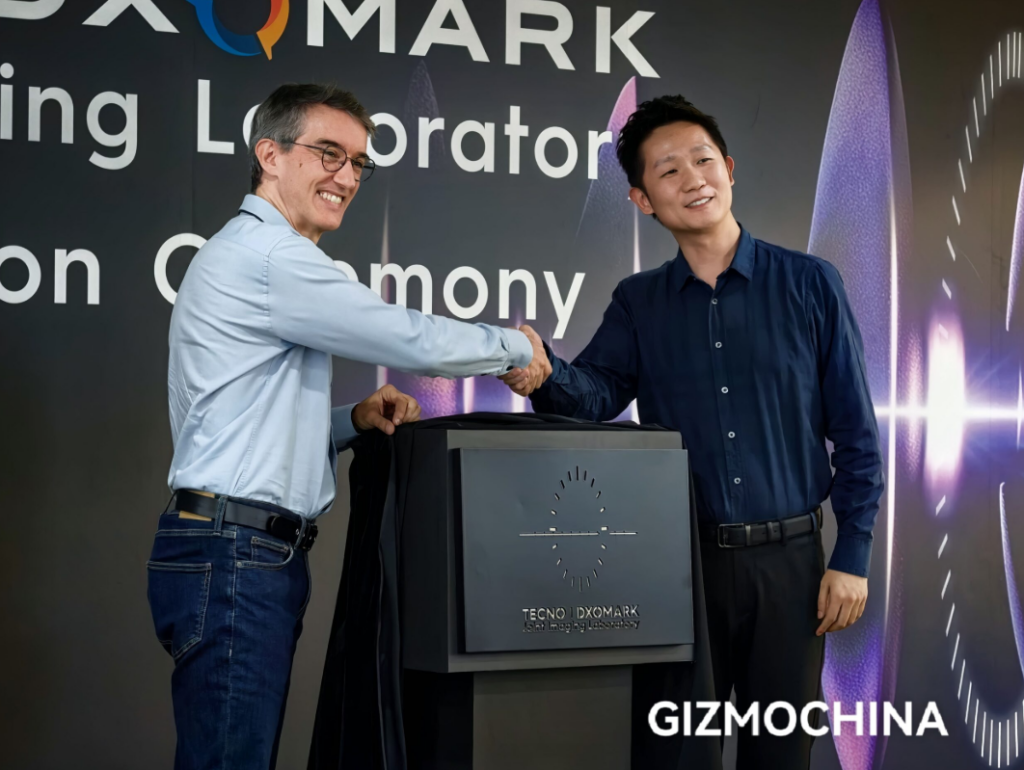
Global smartphone brand TECNO has partnered with imaging authority DXOMARK to launch the world’s first fully automated smartphone imaging lab in Chongqing, China. The new lab is built entirely on DXOMARK’s sixth-generation Smartphone Camera Evaluation Protocol. This milestone aims to drive innovation, accuracy, and inclusivity in mobile photography.
Inside the Lab: Features and Technology
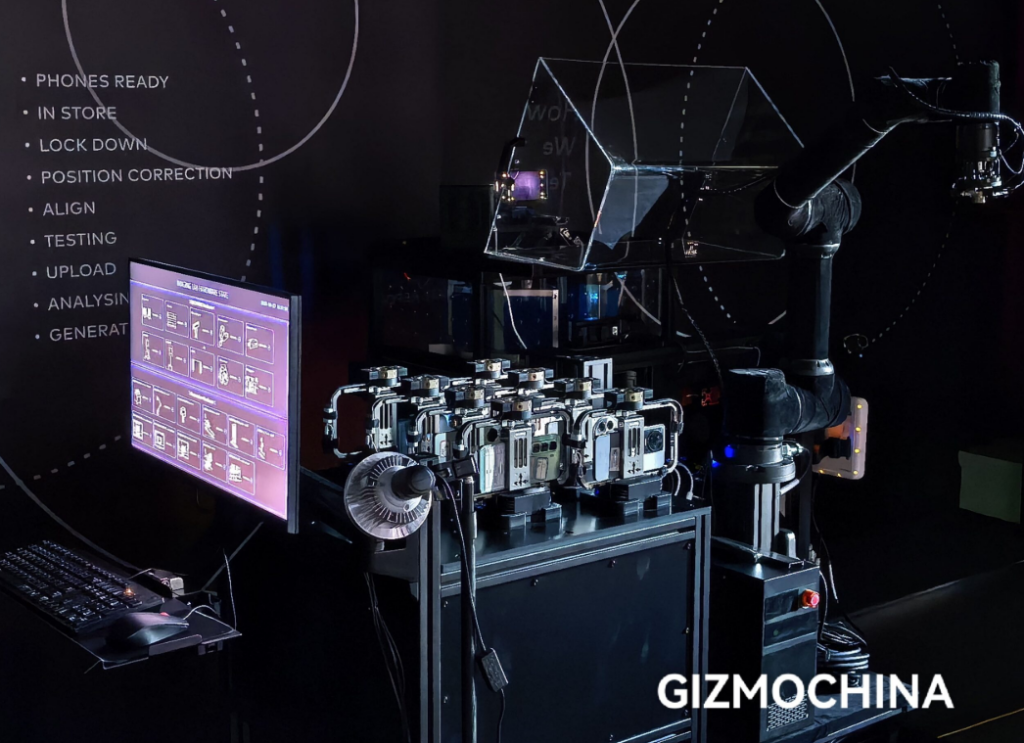
The imaging lab is designed with advanced robotic systems that allow testing without human involvement. Robotic arms control device positioning, angles, and movement, while motorized sliders and gimbals simulate real shooting conditions. This ensures consistency and eliminates errors caused by manual testing.
Lighting plays a key role in camera evaluation, and the lab is equipped with professional lighting arrays that replicate diverse conditions such as bright sunlight, indoor light, and golden hour. Testing also involves comprehensive scenarios like color charts, texture plates, and multi-tone calibration targets to evaluate color accuracy, detail, and noise performance. To ensure inclusivity, the lab also uses human models with different global skin tones.
Another highlight is video stabilization testing. Devices are placed on robotic platforms that apply uniform vibration, allowing engineers to measure stabilization consistently and reliably.
Breakthroughs in Imaging Testing
The lab introduces three breakthroughs. First, full automation allows robotic workflows to manage positioning, lighting, scene switching, and image capture with micron-level precision. This speeds up research and development cycles.
Second, inclusive testing ensures that skin tones are represented naturally across global markets. Six realistic head models and special calibration charts help deliver flattering and accurate results for all users.
Third, the lab enables region-specific customization. For example, cameras can be tuned for authentic skin tones in Africa and for bright, clear exposure in Southeast Asia. This means smartphones can be optimized for different user preferences.
Industry Insights and User Impact
TECNO and DXOMARK explained that automation brings faster and more reliable testing, reducing setup times from hours to minutes. The partnership combines DXOMARK’s global standards with local input, creating devices that work well in real-world conditions.
For users, this means better camera performance in all types of lighting, improved HDR, faster autofocus, and more accurate skin tones. Testing is informed by real-world surveys to reflect what users actually want. The companies also revealed that the TECNO CAMON 40 Pro recently received the DXOMARK Smart Choice Award 2025, ranking as the best-scoring smartphone camera under $600.
DXOMARK’s Expertise and Future Roadmap
With over 25 years of imaging expertise, DXOMARK provides the testing foundation through its Camera V6 protocol. This protocol focuses on real-world scenarios such as portraits, low light, zoom, HDR, and video. DXOMARK is also the first in the industry to fully support HDR photo and video testing.
TECNO and DXOMARK plan to develop AI-enhanced imaging algorithms, next-generation evaluation methods, and perceptual metrics that go beyond lab conditions. The roadmap also includes promoting transparency and open standards for the global imaging industry.
DeepSeek, the AI company, has just rolled out new rules in China requiring all AI-generated content on their platform to be clearly marked as artificial. This change comes as part of broader efforts to make AI content more transparent and prevent people from misusing it.
The company sent out an official notice explaining that anything created by their AI systems must now include clear signs showing it wasn’t made by humans. These markers come in two forms: obvious ones that people can easily see, and hidden technical ones built into the content itself.
Image Credit: Reuters
The visible markers might be text saying “AI-generated,” audio announcements, or graphics that appear somewhere in the content. The hidden markers are tucked away in the technical data and include details like what type of content it is, which company made it, and a unique ID number.
Users aren’t allowed to mess with these labels in any way. They can’t remove them, change them, fake them, or try to hide them. DeepSeek has also banned any tools or services that would help people tamper with the labels. If someone breaks these rules, they could face legal consequences.
Along with this announcement, DeepSeek also released a detailed technical guide explaining how their AI actually works. The document covers things like how they train their models, what data they use, and the process behind creating content. They say this is meant to help people understand the technology better, use it more responsibly, and give everyone the right to know where content comes from.
These new requirements aren’t just DeepSeek’s idea. They are following the new Chinese government regulations. The rules were put in place by several government agencies and require all AI-generated content to have labels that can be tracked and cannot be tampered with. The companies providing these AI services are responsible for making sure everyone follows the rules.
In related news, DeepSeek has recently released V3.1 with a 128K token context and 685B parameters, unifying reasoning and general tasks while the R2 model remains delayed. Meanwhile, Nvidia’s GB300 GPUs reportedly achieve 6x the performance of H100s on DeepSeek R1, offering major efficiency and scalability gains for enterprise AI.
For more daily updates, please visit ourNews Section.
After a series of leaks and rumors, Poco has officially unveiled its latest Poco C85 smartphone. It’s an entry-level handset that covers just the basics.
The phone features a 6.9-inch display with up to a 120Hz AdaptiveSync refresh rate. The panel also carries TÜV Rheinland certification for eye care and sports a U-shaped notch housing an 8MP selfie camera. On the back, there’s a 50MP AI-assisted dual camera setup.
Powering the device is a 12nm MediaTek Helio G81 Ultra chip. Storage options include 6GB RAM with 128GB storage or 8GB RAM with 256GB storage, with the former expandable up to 16GB via virtual memory.
The Poco C85 packs a 6000mAh battery that the company claims can deliver up to 82 hours of music playback. When it’s time to recharge, it supports 33W fast charging, along with Battery Health 3.0 for improved longevity. Poco has also added 10W reverse wired charging, allowing you to top up other devices in a pinch.
Despite the large battery, the phone measures just 7.9mm thick. It also comes with an IP64 rating and is available in three finishes: Green, Purple, and Black.
Poco C85 Specifications
Feature
Details
Display
6.9-inch LCD, up to 120Hz AdaptiveSync refresh rate, TÜV Rheinland certified, U-shaped notch
Processor
MediaTek Helio G81 Ultra (Octa-core)
RAM & Storage
6GB + 128GB / 8GB + 256GB (up to 16GB with memory extension)
Rear Cameras
50MP AI dual camera system
Front Camera
8MP
Battery
6,000mAh with 33W fast charging, 10W reverse wired charging
Dimensions
7.99mm thickness
Build & Design
IP64 dust and water resistance
Colors
Green, Purple, Black
As for pricing, the Poco C85 starts at $109 for the 6GB/128GB model and $129 for the 8GB/256GB variant during the early bird offer.
For more daily updates, please visit our News Section.
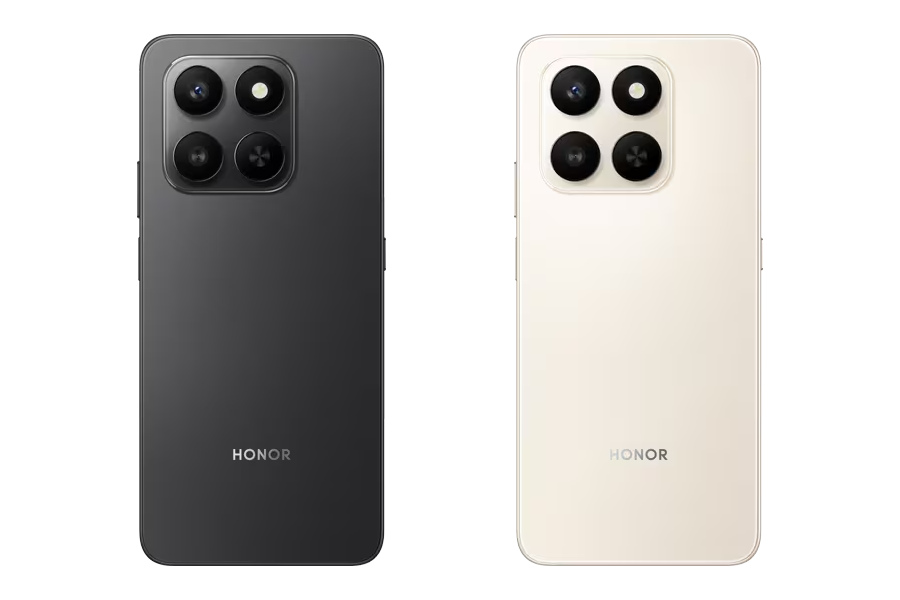
Just last week, Honor launched the X7d 4G smartphone. Now, the company is bringing a 5G version. Honor has introduced its X7d 5G smartphone in Malaysia, and while pricing is still under wraps, the company has revealed the full picture of what this new budget-friendly device packs.
Honor X7d 5G Specifications
At the front, the X7d 5G features a 6.77-inch TFT LCD panel with a 1610 x 720 resolution. The screen lits up to 850 nits at peak and has eye comfort tech, which should make reading or streaming a little easier on your eyes.
Under the hood, it runs on Qualcomm’s Snapdragon 6s Gen 3 processor clocked at 2.3GHz, paired with an Adreno 619 GPU. There’s only one storage configuration this time: 6GB of RAM and 128GB of storage.
Software-wise, it boots Android 15 out of the box with Honor’s MagicOS 9.0 layered on top of it.
On the back, you’ll find a dual-camera setup featuring a 50MP main sensor alongside a 2MP depth sensor. Up front, a 5MP selfie camera handles video calls and quick snaps.
The real highlight, though, is the battery. Honor has squeezed in a massive 6,500mAh dual-cell unit with support for 35W SuperCharge fast charging.
Other specs round out the package nicely. It has dual SIM support, 5G connectivity, Wi-Fi 5, NFC, dual speakers with what Honor claims is “400 percent volume,” IP65 water resistance, and a side-mounted fingerprint scanner. The phone weighs 206 grams and comes in two finishes, Velvet Black and Desert Gold.
Honor hasn’t revealed when or how much the X7d 5G will cost, but given its specs, it’s certainly an entry-level 5G phone. We will update the details as soon as we hear more on it.
For more daily updates, please visit our News Section.
Amazfit has announced two new products for the Indian market, expanding its ecosystem of smart wearables designed for athletes and fitness enthusiasts. The brand has introduced the Amazfit Helio Strap, a screen-free training and recovery tracker, alongside the Amazfit Balance 2, a premium multisport smartwatch. Together, these devices are aimed at delivering accurate performance monitoring, advanced recovery insights, and smart fitness tools.
Amazfit Balance 2 and Helio Strap specifications and features
Amazfit Balance 2
According to the brand, the Amazfit Balance 2 is a flagship-level smartwatch designed to handle everything from casual workouts to endurance sports. It is equipped with a sapphire glass display offering 2000 nits peak brightness, dual-band GPS, and 10ATM water resistance.
The watch supports over 170 sports modes, including the HYROX mode that features training and race options. Other highlights include a 21-day battery life, 24/7 heart rate monitoring, military-grade durability, and 32GB internal storage for offline music and maps. The watch also integrates two built-in speakers for Bluetooth calling and Zepp Flow voice interactions.
Amazfit Helio Strap
The Amazfit Helio Strap complements the Balance 2 by focusing on screen-free training. It is designed for athletes who prefer distraction-free performance tracking. The strap provides continuous heart rate monitoring, supports 27 workout modes, and includes advanced features such as strength and HYROX training support.
Its standout feature is the BioCharge Score, which evaluates body energy levels by analyzing sleep, exertion, and stress data. With a 10-day battery life, it syncs seamlessly with the Zepp App for performance insights and recovery guidance.
Amazfit Balance 2 and Helio Strap price and availability in India
The Amazfit Balance 2 is priced at Rs 24,999 (~$285), while the Amazfit Helio Strap will retail at Rs 8,999 (~$102). Both devices are available for purchase through Amazfit.in, major online platforms, and leading tech and sports retail outlets.
OnePlus unveiled the OnePlus Pad 3, its flagship tablet, back in June. While the company disclosed all of its specifications at launch, it did not reveal the price or availability details. Recently, OnePlus confirmed that the device would go on sale from Sept. 5. Now, the brand has officially announced the pricing along with the offers available for interested buyers.
OnePlus Pad 3 price in India
OnePlus Pad 3 price in India
The OnePlus Pad 3 has arrived with a price tag of Rs 47,999 (~$545) for the 12GB+256GB edition. The 512GB version, offering the same amount of RAM, is priced at Rs 52,999 (~$600). The tablet can be bought in two shades, such as Storm Blue and Frosted Silver.
Customers purchasing the tablet between Sept. 5 and Sept. 7 can get Stylo 2 and Folio worth Rs 7,198 at no additional cost. Buyers can also take advantage of Rs 5,000 instant cashback via select credit cards and up to 12 months of no-cost EMI.
The OnePlus Pad 3 can be purchased through the OnePlus India website, the OnePlus Store app, and the OnePlus Experience Stores. It is also available through platforms like Amazon, Flipkart, Croma, Reliance, Vijay Sales, Bajaj Electronics, and other leading stores.
OnePlus Pad 3 specifications
The OnePlus Pad 3 has a 13.2-inch LTPS LCD panel that supports a 3.2K resolution, a 144Hz refresh rate, and 900 nits of brightness. Under the hood, the device is equipped with the Snapdragon 8 Elite, LPDDR5T RAM, UFS 4.0 storage, and a 12,140mAh battery with 80W charging.
The Pad 3 comes preloaded with OxygenOS 15 for Pad based on Android 15. It comes with other features, such as a 34,857mm² vapor chamber unit, a 13-megapixel rear camera, an 8-megapixel front camera, an eight-speaker Dolby system, and stylus support. Its connectivity features include Wi-Fi 7, Bluetooth 5.4, NFC, and USB-C (3.2 Gen 1).
For more daily updates, please visit our News Section.
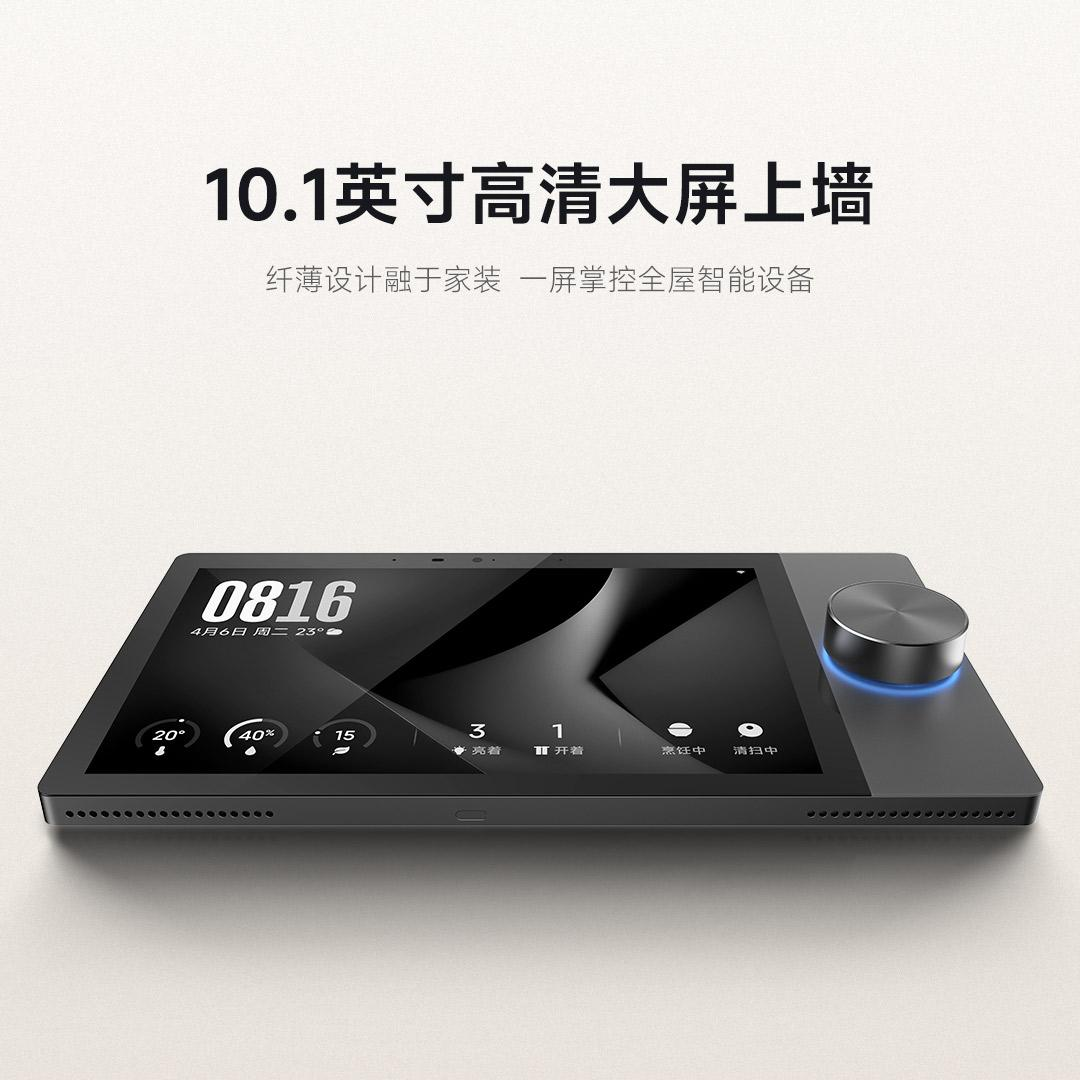
Xiaomi has unveiled the Smart Central Control Screen Max, its first official large-screen control hub for smart homes in China. Designed to manage connected devices across the home, it comes with a 10.1-inch HD display, support for wall mounting, and multiple control methods such as touch, a side rotary knob, and voice commands. The device is positioned as a centralized solution for lighting, temperature, and appliance management, giving users a simplified way to interact with the Xiaomi smart home ecosystem.
Xiaomi Smart Central Control Screen Max specifications and features
Xiaomi Smart Central Control Screen Max
The Xiaomi Smart Central Control Screen Max features a 10.1-inch display with a 1920 × 1200 resolution. It integrates a 5-megapixel camera with a physical shutter for privacy and also includes an ultrasonic sensor for presence detection that wakes the screen when a user approaches.
It is powered by an A53 quad-core AI processor, paired with 2GB RAM and 16GB storage. For audio, it has a built-in speaker and microphone system that supports voice control through Xiao Ai. The side rotary knob features a matte glass finish, allowing for precise adjustments to brightness, colour temperature, and climate settings.
In terms of connectivity, the screen supports Wi-Fi (2.4GHz/5GHz), Bluetooth 5.3, and a wired Ethernet option. It is compatible with the standard 86-type wall box and uses zero-fire wiring. For lighting load, it supports incandescent bulbs up to 2,100W (1–700W per channel) and LED/energy-saving bulbs up to 390W (1–130W per channel).
The device comes with Mi Mesh 2.0, offering 50 percent faster response times and quicker network setup compared to the first-generation Mesh hub. With local hub functionality, it can manage devices even when offline. The screen also supports WeChat voice and video calls, household intercom, and AI-driven responses for everyday queries.
Xiaomi Smart Central Control Screen Max price and availability
The Xiaomi Smart Central Control Screen Max is available on the company’s crowdfunding platform. The crowdfunding price is 1,999 Yuan (~$280) while the suggested retail price is 2,499 Yuan (~$350). The crowdfunding campaign will run from Sept. 8 to Sept. 15. The product is offered in a neutral finish that complements a range of home styles.
For more daily updates, please visit our News Section.
A recent report revealed the upcoming Samsung Galaxy F17 5G’s variants and price for India. The device has also appeared on Geekbench, indicating that the company could be internally testing its performance before launch. Now, a new report by SmartPrix has revealed the entire specifications of the device.
Samsung Galaxy F17 5G specifications (rumored)
Samsung Galaxy A17 5G
According to the publication, the Galaxy F17 5G will feature a 6.7-inch Super AMOLED screen that supports an FHD+ resolution and a 90Hz refresh rate. On the front, it will have a 13-megapixel selfie camera, while the back will feature an OIS-assisted 50-megapixel + 5-megapixel (ultra-wide) + 2-megapixel (macro) triple-camera setup.
The Galaxy F17 5G will be powered by the Exynos 1330 chipset and a 5,000mAh battery with 25W charging. However, the charger will not be included in the package, claims the report.
The Galaxy F17 5G will ship with Android 15 and One UI 7. It is expected to support six years of Android OS upgrades and six years of security updates. For durability, the device will come with Gorilla Glass Victus protection for the screen and an IP54 rating for dust and water resistance.
Samsung Galaxy F17 5G price in India (rumored)
As per a recent report, the Galaxy F17 5G will arrive in two variants: 4GB+128GB and 6GB+128GB storage. These variants are likely to cost Rs 14,499 ($165) and Rs 15,999 ($180), respectively.
Being an F-series device, the F17 is expected to be sold via Flipkart in India. The above specs leak indicates that it will be a rebranded version of the Galaxy A17 5G, which is sold with a 25W in-box charger in India. Meanwhile, the Galaxy M17 5G — another sibling in Samsung’s budget lineup — is also expected to make its launch soon, but the F17 is expected to launch first.
For more daily updates, please visit our News Section.
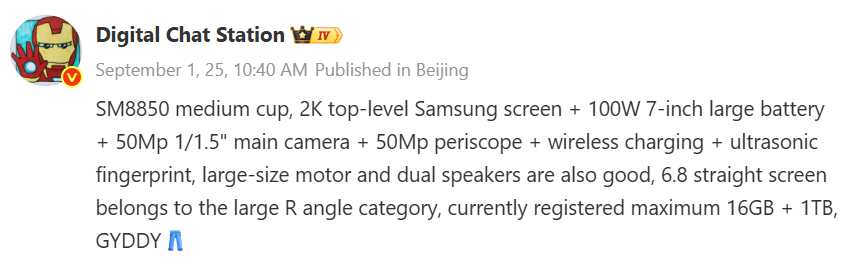
iQOO is one of the brands expected to launch a Snapdragon 8 Elite Gen 5-powered flagship phone in October in China. According to reports, while the iQOO 15 is expected to launch next month, the iQOO 15 Mini and 15 Ultra are expected to debut in Q2 2026. Today, tipster Digital Chat Station released the following Weibo post to share the key specifications of the iQOO 15.
The performance-focused flagship is said to pack a battery of around 7,000mAh capacity, which will have support for 100W charging. The leak states that the device will also support wireless charging. The topmost variant is expected to offer a 16GB+1TB configuration.
Previous reports have claimed that the iQOO 15 will feature a 50-megapixel triple camera setup. The setup is said to be equipped with a 1/1.5-inch primary camera and a periscope camera. While the tipster did not mention it, the setup will also include an ultra-wide snapper. The iQOO 15 is also expected to arrive with other features, such as an ultrasonic fingerprint scanner, a large haptic motor, and dual speakers. A previous report claimed that it will also feature the company’s in-house gaming chip.
A recent report revealed that the iQOO 15 Mini arriving next year will have a 6.31-inch display, a 7,000mAh battery, and a Dimensity 9500+ or Snapdragon 8 Elite Gen 5 SoC. The iQOO 15 Ultra, on the other hand, is expected to pack the same specs along with additional features like a built-in cooling fan and gaming trigger buttons.
For more daily updates, please visit our News Section.
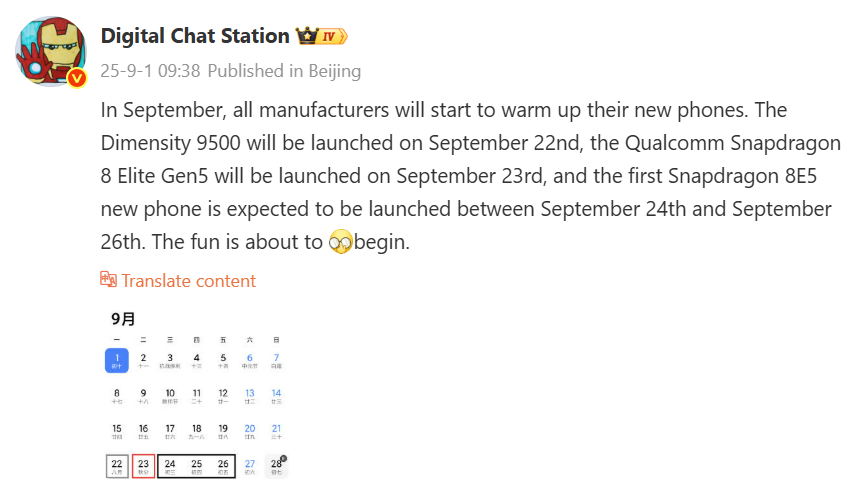
Reliable tipster Digital Chat Station has yet again hinted that the Xiaomi 16 series may launch in late September, sparking a wave of speculation about its exact debut date. His post has led many to believe that the lineup will be introduced around Sept. 24–26. This is earlier than last year’s Xiaomi 15 series, which arrived in October, indicating that the company could be accelerating its flagship schedule this year.
Xiaomi 16 series launch timeframe (rumored)
Xiaomi 16 series launch timeframe
Based on the speculations in the comments section of the said Weibo post, the Xiaomi 16 series launch date could be Thursday, Sept. 25. The lineup is expected to include three models: the Xiaomi 16, Xiaomi 16 Pro, and Xiaomi 16 Pro Mini (tentative name).
Xiaoim 16 series may launch on Sept. 25
These devices have already passed 3C certification and are confirmed to support 100W wired fast charging across all variants. The standard 16 and Pro Mini are said to feature 6.3-inch displays, while the Pro Max will offer a larger 6.8-inch screen.
The series will debut with Qualcomm’s Snapdragon 8 Elite Gen 5 chipset, also referred to as Snapdragon 8 Elite 2. Xiaomi has also confirmed that the 16 series will ship with the stable version of Hyper OS 3. The system delivers a smoother user experience through hotspot compilation acceleration, reducing CPU instructions by up to 4 percent and improving efficiency by as much as 10 percent. Testing shows that it can handle demanding multitasking, such as launching 22 applications back-to-back with floating windows, without visible stutter.
As seen in DCS’ post, Qualcomm is expected to unveil the Snapdragon 8 Elite Gen 5 on Sept. 23, whereas MediaTek is said to announce the Dimensity 9500 on Sept. 22. DCS added that official teasers of the upcoming flagship phones powered by the Snapdragon 8 Elite Gen 5 and Dimensity 9500 will begin this month. The Vivo X300 series and the Find X9 lineup featuring the Dimensity 9500 are expected to launch in October, whereas the Honor Magic 8 series, OnePlus 15, iQOO 15, and Realme GT 8 series, all equipped with the Snapdragon 8 Elite Gen 5, are expected to debut in October.
For more daily updates, please visit our News Section.
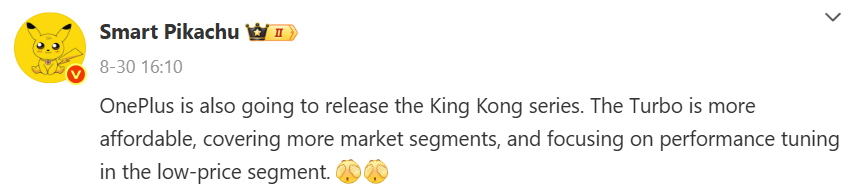
OnePlus is expected to announce the OnePlus 15 along with the OnePlus Ace 6 in October in China. These devices are said to be powered by the Snapdragon 8 Elite Gen 5 (aka Snapdragon 8 Elite 2) and Snapdragon 8 Elite, respectively. A new development reveals that the brand is also working on a Turbo-branded series, which aligns with a previous report. It is likely to debut before the end of this year in China.
OnePlus Turbo series in works
OnePlus Turbo series in works
According to tipster Smart Pikachu, OnePlus is preparing to launch a new OnePlus Turbo series, positioned as a more affordable lineup. It is expected to be priced more competitively, making it accessible to a wider range of markets. Despite its lower pricing, the device will reportedly focus on performance tuning to deliver strong performance in the budget segment.
Back in June, tipster Digital Chat Station claimed OnePlus was planning to launch a brand-new mid-range series by the end of this year. He added that the new lineup will compete directly with the Redmi series in China. The device will be priced under 2,000 Yuan (~$280) and will pack a flagship-grade chipset.
In related news, OnePlus’s upcoming flagship phone, the OnePlus 15, was recently spotted on Geekbench. The Chinese variant, which bears the PGL110 model number, was found to be equipped with the Snapdragon 8 Elite Gen 5, 16GB of RAM, and Android 15.
Another report revealed that the OnePlus 15 will arrive in multiple configurations, such as 12GB+256GB, 16GB+256GB, 12GB+512GB, 16GB+512GB, and 16GB+1TB. It will be available in shades like Black Eclipse, Arctic Dawn, and Midnight Ocean.
For more daily updates, please visit our News Section.
The Pixel 10 series is Google‘s most refined lineup to date, featuring upgraded displays, a new Tensor G5 processor, and improved on-device AI capabilities. The phones also support Qi2 magnetic charging and come with fresh features like Magic Cue, Camera Coach, and Pixel Journal.
But despite these additions, the Pixel 10, 10 Pro, and 10 Pro XL are not the right fit for everyone. Several compromises and missing features could make this lineup less appealing depending on user needs and expectations.
Power Users Who Demand Snapdragon-Level Performance
The Pixel 10 lineup runs on Google’s in-house Tensor G5 chipset, which focuses on AI and efficiency rather than raw power. While the G5 shows improvement over last year’s Tensor G4, it still cannot match the performance of the Snapdragon 8 Elite or Apple A18 Pro.
Benchmark scores tell the story. On AnTuTu, the Tensor G5 scores around 1.2 million, which falls well below the Snapdragon 8 Elite’s score of over 2.2 million. GPU performance remains a weak spot, making the Pixel 10 series less suitable for graphics-intensive gaming or demanding creative workflows.
Thermal management also continues to lag behind competing flagship devices. Anyone looking for top-tier performance for gaming, rendering, or intensive multitasking may find the Pixel 10 series underwhelming.
Photographers Hoping for a Big Camera Leap
Google maintains its strong camera reputation with the Pixel 10 series, but it did not introduce groundbreaking changes. The Pixel 10 adds a telephoto camera, which is new for a non-Pro Pixel, but the main and ultra-wide sensors are smaller than those in the Pixel 9.
The Pro models carry over much of the Pixel 9 Pro’s hardware. The main, ultra-wide, and telephoto sensors remain the same, although software improvements attempt to enhance the overall output. Features like Auto Best Take and Camera Coach assist with better compositions, but they do not compensate for the lack of hardware upgrades. Users upgrading from the Pixel 8 Pro or Pixel 9 Pro may not notice a significant difference in image quality or versatility.
Travelers and SIM Swappers
Google has moved to an eSIM-only setup for Pixel 10 devices in the United States. This decision could cause problems for users who frequently travel or switch SIMs. Many global carriers still rely on physical SIM cards, and eSIM compatibility remains inconsistent in several regions.
While physical SIM support continues in some markets like India, the transition to eSIM-only hardware suggests that future Pixel models may drop the SIM tray altogether. For users who rely on dual SIMs or frequently swap SIM cards while traveling, this change can be frustrating.
Buyers Expecting Class-Leading Battery or Charging
Battery life and charging speeds remain moderate in the Pixel 10 series. The Pixel 10 has a 4970mAh battery, the Pro has 4870mAh, and the Pro XL tops out at 5200mAh. While these capacities are competitive, real-world endurance does not outperform rivals.
Wired charging speeds max out at 29W for the Pixel 10 and 39W for the Pro XL. Wireless charging supports the new Qi2 standard with Pixelsnap, but the maximum speeds are limited to 15W (Pixel 10 and 10 Pro) and 25W (Pro XL).
Competitors like OnePlus, Xiaomi, and Samsung already support faster charging speeds both wired and wireless. Google also does not include a charger in the box, which may add to the cost for users who want to take full advantage of the new charging tech.
Anyone Expecting AI to Fix Everything
AI is central to the Pixel 10 experience. Google introduced features like Magic Cue, Add Me, Camera Coach, and Pixel Journal, all powered by on-device generative models. Some of these tools work well in specific scenarios, like guided photo tips or private journaling prompts. However, many features are still in their early stages and may not consistently deliver results.
Inconsistent detection, occasional UI glitches, and limited language support affect the overall experience. Add Me struggles in low light, Camera Coach fails in unpredictable scenes, and Pixel Journal can feel too generic to be meaningful. Google will likely improve these features over time, but users expecting flawless AI integration from day one may be disappointed.
So, Who Should Wait?
Users of Pixel 8 or 9 Pro devices will see only modest gains with the Pixel 10 series. Anyone prioritizing hardware performance, fast charging, or camera breakthroughs may want to wait for future models or explore alternatives like the Galaxy S25 Ultra or Xiaomi 15 Ultra.
The Pixel 10 lineup brings smart features, improved software, and longer update cycles, but it still has room to grow in terms of performance, battery innovation, and global usability.
We use cookies on our website to give you the most relevant experience by remembering your preferences and repeat visits. By clicking “Accept”, you consent to the use of ALL the cookies.
This website uses cookies to improve your experience while you navigate through the website. Out of these, the cookies that are categorized as necessary are stored on your browser as they are essential for the working of basic functionalities of the website. We also use third-party cookies that help us analyze and understand how you use this website. These cookies will be stored in your browser only with your consent. You also have the option to opt-out of these cookies. But opting out of some of these cookies may affect your browsing experience.
Necessary cookies are absolutely essential for the website to function properly. This category only includes cookies that ensures basic functionalities and security features of the website. These cookies do not store any personal information.
Any cookies that may not be particularly necessary for the website to function and is used specifically to collect user personal data via analytics, ads, other embedded contents are termed as non-necessary cookies. It is mandatory to procure user consent prior to running these cookies on your website.