
Add GIZMOCHINA on Google:
Earlier this month, the Russian source Rozetked revealed the first live photos of the Google Pixel 9 phones. Now, the same source has shared core architecture details and preliminary benchmarks of Google’s Tensor G4 chips powering these devices.
The leak shows that the Tensor G4 uses a 1+3+4 core configuration, with the powerful Cortex-X4 as the primary core, three mid-range Cortex-A720 cores, and four energy-efficient Cortex-A520 cores.
This architectural layout differs completely from the original Tensor and G2’s 2+2+4 setup and the Tensor G3’s 1+4+4 configuration. Interestingly, Google appears to be returning to an octa-core CPU layout from the nine-core design used in the Tensor G3.
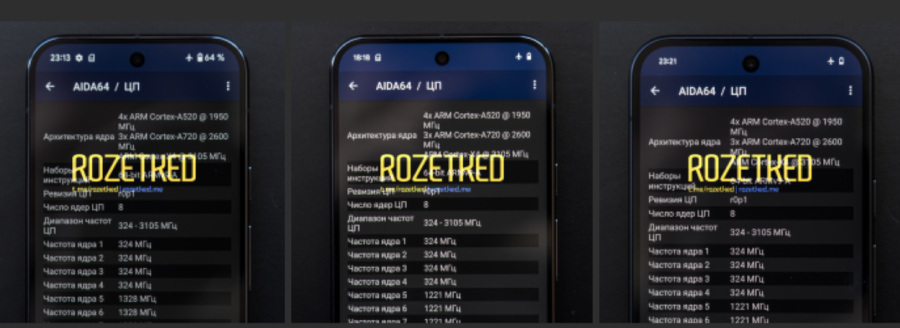
Here’s a comparison table of the Tensor G4 against previous Tensor SoCs (via 9to5Google):
| Tensor | Tensor G2 | Tensor G3 | Tensor G4 |
| 2x Cortex-X1 (2.8 GHz) | 2x Cortex-X1 (2.85 GHz) | 1x Cortex-X3 (2.91 GHz) | 1x Cortex-X4 (3.1 GHz) |
| 2x Cortex-A76 (2.25 GHz) | 2x Cortex-A78 (2.35 GHz) | 4x Cortex-A715 (2.37 GHz) | 3x Cortex-A720 (2.6 GHz) |
| 4x Cortex-A55 (1.8 GHz) | 4x Cortex-A55 (1.8 GHz) | 4x Cortex-A510 (1.7 GHz) | 4x Cortex-A520 (1.95 GHz) |
Regarding benchmarks, all devices scored over 1 million points on AnTuTu. To be specific, the base Pixel 9 scored 1,016,167 points, the Pixel 9 Pro scored 1,148,452 points, and the Pixel 9 Pro XL scored 1,176,410 points.
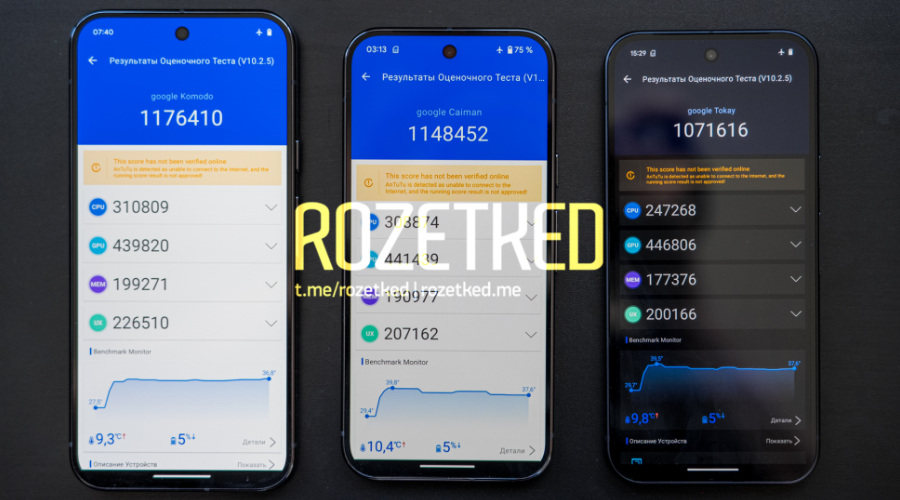
The vanilla Pixel 8 scores about 900,000 points on AnTuTu so the performance gain on the Pixel 9 is not very significant.
However, these are early benchmarks on devices running pre-release software. Further software optimization and tuning are still to come that should make the phone’s overall performance even better.
Related:
- Google to source Tensor G5 chips from TSMC, leaked documents reveal
- Android 15 improves battery standby time up to 3 hours with faster Doze mode
- How to hide WhatsApp chats without archive
- Grab Apple iPad Air 6th Gen with M2 Chip at record-low prices
- MacBook Air M2 now available at a discounted price
(Source)




Comments