
Add GIZMOCHINA on Google:
Chinese astronomers have revealed new findings about the size of the Milky Way galaxy, suggesting it’s significantly larger than previously thought. Their research, published in the prestigious journal Nature Astronomy, utilized data from the world’s first large near-infrared stellar spectral survey, APOGEE.
The survey team analyzed the distribution of stars across the Milky Way
This survey allowed the team, led by Associate Professor Lian Jianhui of Yunnan University, to account for dust and other factors that can impede traditional measurements. By analyzing the distribution of stars across the Milky Way, they were able to reconstruct a more complete picture of its structure.
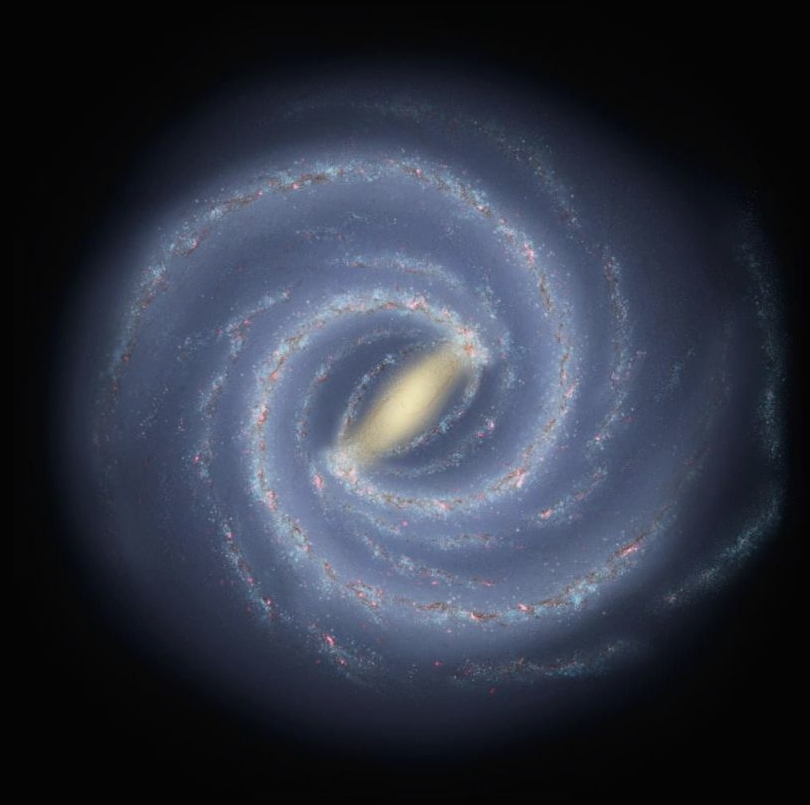
Their findings challenge the long-held assumption of the Milky Way having a single exponential disk – a flat structure where stellar density decreases steadily moving outwards. Instead, the research suggests a more complex structure. The outer disk (beyond 24,000 light-years from the galactic center) appears to conform to the exponential model. However, the inner disk (between 11,000 and 24,000 light-years) exhibits a flatter distribution, with stellar density remaining relatively constant.
This revised understanding has significant implications. Previous estimates based on the exponential disk model placed the Milky Way’s radius at around 10,000 light-years, making it appear denser than galaxies of similar mass. The new data, however, suggests a nearly doubled radius of 19,000 light-years, bringing the Milky Way in line with other galaxies of its type.
Professor Lian emphasizes the importance of near-infrared observations in overcoming the limitations of traditional methods. Dust particles significantly affect visible light, but their impact on near-infrared wavelengths is much smaller. This allows for a clearer picture of stellar distribution, particularly within the Milky Way’s dusty inner regions.
(Via)




Comments