
Add GIZMOCHINA as Preferred Source on Google
Samsung appears to be gearing up for the launch of its Galaxy S25 series, expected in early 2025, likely around January. While the Galaxy S25 Ultra is almost confirmed to feature the latest Snapdragon 8 Elite chipset, the standard Galaxy S25 and Galaxy S25+ models may use different processors.

Samsung’s latest strategy for its non-Ultra models has stirred speculation around chipsets, with reports indicating they may use either the MediaTek Dimensity 9400 or Samsung’s own Exynos 2500.
Galaxy S25+ tested with Exynos 2500
The latest update came from the benchmarking platform Geekbench, where a Samsung Galaxy S25+ model powered by the Exynos 2500 was recently spotted. Listed under model number SM-S936B for the European market, the Galaxy S25+ achieved a single-core score of 2,359 and a multi-core score of 8,141 on Geekbench 6. This configuration includes 12GB of RAM and runs Android 15, providing a glimpse into the phone’s hardware specifications.
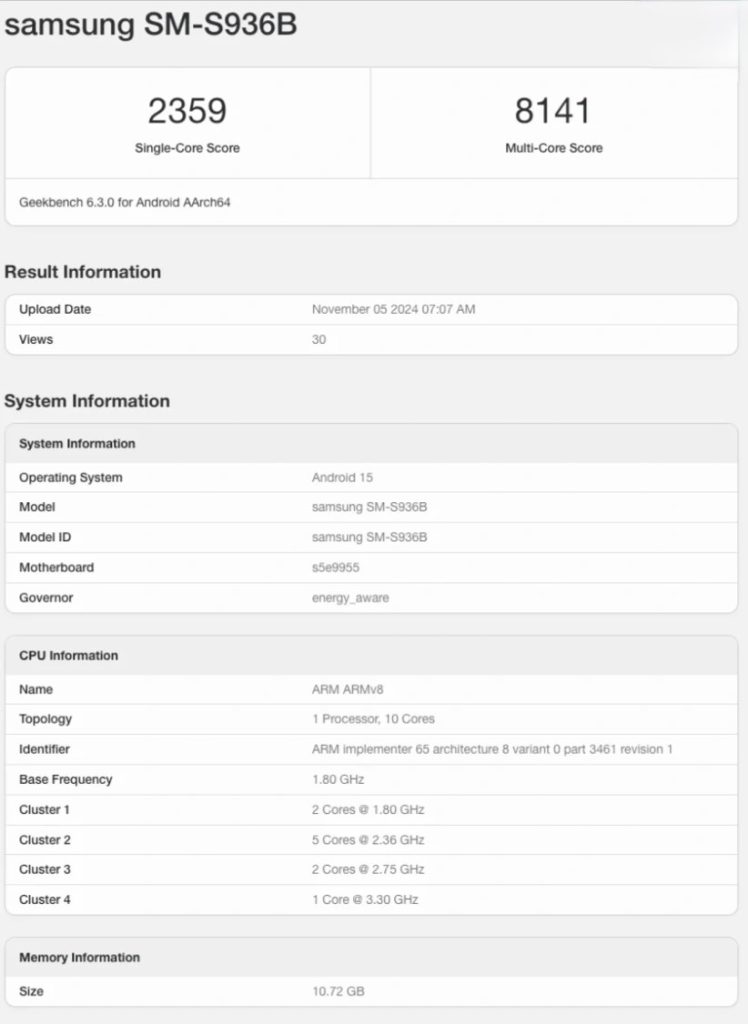
The Exynos 2500 powering the device has a 10-core CPU architecture, clocked up to 3.3GHz. This chipset also features Samsung’s Xclipse 950 GPU, based on AMD’s RDNA architecture, suggesting a focus on improved graphics performance.
In terms of raw performance, the Exynos 2500’s multi-core score puts it in close proximity to the top-tier Snapdragon 8 Elite. However, Exynos 2500 lags significantly behind the 8 Elite chip, when it comes to the single core performance.
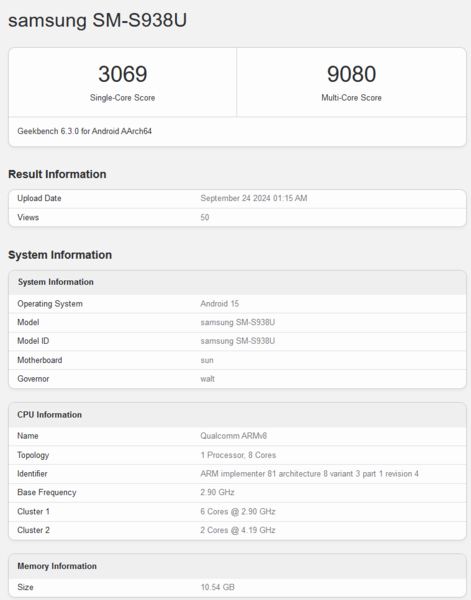
For instance, an earlier test on the Galaxy S25 Ultra recorded scores of 3,096 for single-core and 9,080 for multi-core. Not to mention, a phone with the latest Exynos chip may lag behind most of its competitors with the Snapdragon 8 Elite or the Dimensity 9400 chip, in resource-intensive tasks like gaming or recording with high resolution or frame rate.
Additionally, readers should remember that this is just a benchmark result. These tests typically take only a couple of minutes to complete—often not enough time for the phone to overheat. Moreover, several brands have been known to apply targeted optimizations aimed at achieving impressive numbers in these tests, which often don’t reflect real-world performance. So, take these numbers with a pinch of salt as we await the company’s unveiling of its new flagship devices in January.
(Via)




Comments