
Add GIZMOCHINA as Preferred Source on Google
A recent report from Nikkei suggests that Google has managed to produce its latest flagship, the Pixel 9 Pro, at a lower cost compared to previous generations despite improvements in several aspects across hardware and software.
The Pixel 9 Pro’s Bill of Materials (BOM) is estimated to be around $406, an approximate 11% drop from the Pixel 8 Pro‘s BOM cost. This reduction primarily reflects cost savings on the display and camera components, key areas where manufacturers can often optimize to make high-end devices more affordable for consumers.
Cost breakdown: How Google reduced Pixel 9 Pro’s BOM
According to a detailed component analysis, the Pixel 9 Pro’s BOM is distributed across essential parts like the Tensor G4 processor, display, and camera. The display, manufactured by Samsung, is now priced at $75, while the camera system costs $61. These prices are notably lower than in previous Pixel models.
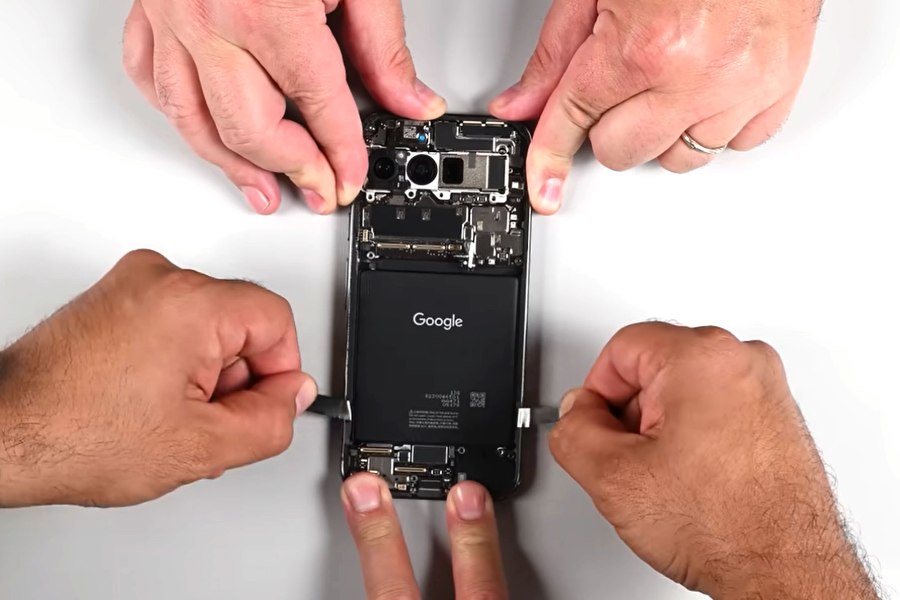
In contrast, the custom-designed Tensor G4 chipset, which powers the Pixel 9 Pro, reportedly costs Google around $80. This is slightly more than what the company allocated for its processor in past iterations, indicating a small increase to enable more processing power and efficiency.
Comparison with iPhone 16 Pro’s BOM cost
Apple reportedly spends around $568 to manufacture the iPhone 16 Pro, a device known for its high-quality build and premium pricing. The breakdown for Apple includes $110 for the same Samsung M14 display, $91 for its advanced camera components, and $135 for the A18 Pro chipset. The iPhone’s higher BOM is partly due to Apple’s reliance on more expensive parts to differentiate its high-performance devices in the premium smartphone market.

Google’s Pixel devices, while often surpassing Apple’s best in imaging performance, most of the credit goes to the software processing, while the company focuses on cost-effective component selection while emphasizing features like AI-driven software enhancements. That said, the company invests significantly in software (including AI) to make the most of the hardware, which isn’t included in the BOM cost.
The costs of processors are also central to the BOM equation, as they impact both performance and energy efficiency. The Pixel 9 Pro’s Tensor G4, though priced competitively at $80, may not match the raw power of Apple’s $135 A18 Pro chipset or the Snapdragon 8 Elite, which costs close to $200. This pricing gap highlights differences in each company’s approach to chipset design and the real-world performance expectations for their flagship devices.
Despite the lower BOM for the Pixel 9 Pro, Google’s decision to save on materials like the display and camera does not necessarily mean a compromise on quality. The Pixel series continues to be known for its excellent photography and integration with Google’s AI software, making it competitive in terms of user experience without inflating costs.
Future implications: potential BOM increase for Tensor G5
While the current Tensor G4 has maintained affordability, rumors suggest that Google’s upcoming Tensor G5 processor will be produced using TSMC’s 3nm node. This fabrication shift from Samsung Foundry’s 4nm process is expected to yield improvements in performance and efficiency. However, the change is also likely to drive up production costs due to the increased expense associated with advanced semiconductor nodes.
If this cost increase occurs, it could have pricing implications for future Pixel devices. Although more expensive, the 3nm Tensor G5 could bring crucial optimizations, addressing some long-standing issues that Pixel users have faced with previous Tensor processors, such as heat management and battery life.
(Source)




Comments