
Add GIZMOCHINA as Preferred Source on Google
OnePlus 13
This might be the most un-iPhone-like Android flagship this year, It’s also the most well-rounded flagship of the year. Now let’s take a look and see what it’s all about.
Unboxing
This is the packaging box for the OnePlus 13. Let’s remove the plastic wrap and gently open it. First, we see the “NEVER SETTLE” slogan as always. After removing it, there is the phone.


Let’s power it on and put it aside for now, and see what else is inside the package. Along with the “NEVER SETTLE” slogan, there’s a warranty card and a frosted semi-transparent silicone case.


Compared to regular transparent silicone cases, it feels much better in hand and doesn’t collect fingerprints and oil easily.


Getting back to the phone itself, compared to other brands’ white frosted glass, we can see that the white frosted glass at the back has a slightly rougher texture. Other than that, the camera module is traversed by a line.


Design
This year’s blue variant features a leather-like material, it is named “Blue Hour”. The white and black versions use frosted glass, but with different texture and details. The black looks like wood grain, while the white is more ordinary.


My colleague really likes this kind of frosted, leather-like texture, because the Xiaomi 15 Pro’s shiny silver back panel usually gets ruined by his hands in just a second.

After getting the OnePlus 13, I found that the white has a sand gold effect under certain angles. In terms of the frame, both the blue and white versions are silver polished, which is more prone to fingerprints compared to the black version’s brushed texture.
The traditional three-stage switch is still here, and it still feels great. Sliding it up and down is very satisfying. I also took the OPPO Find X8 for comparison, to see how they feel in hand.


The waterproof rating has been greatly improved, from IP65 to IP69. Compared to the IP68 rating, IP69 can even prevent water impact in some cases. I believe this will be very suitable for gamers, they can run the phone through the tap water when the phone gets too hot. Just joking, I wouldn’t suggest that.This is because the equipment is not covered by the after-sales guarantee if it is damaged by water ingress.

Cameras
The sensor changes in the camera are not very significant. The front camera is 32MP with a Sony IMX615.

For the rear camera, both have the same 50MP main camera, Sony LYT-808, but the ultra-wide and telephoto lenses have changed. The sensors have been replaced with ones from Samsung and Sony, and the pixel count has also increased to 50M.


However, compared to the hardware upgrades, OnePlus has added many interesting software features. For example,
glass glare elimination,


AI removal,


and Live Photos .

Display
Judging from the release event, they are very confident in the screen. It has a 6.82-inch display, QHD+ resolution, 510 PPI, 120Hz adaptive refresh rate, very high peak brightness, 10-bit color, and covers 100% of the DCI-P3 color gamut, along with many other features.


There are also some great details in terms of eye protection. There are three levels of eye protection modes in the settings, that allow you to choose between eye protection and smoothness.

Performance and Battery Life
In terms of performance, there’s the Snapdragon 8 Elite, 8533Mbps memory, UFS 4.0 flash storage, nearly 10,000 square millimeters of cooling system,
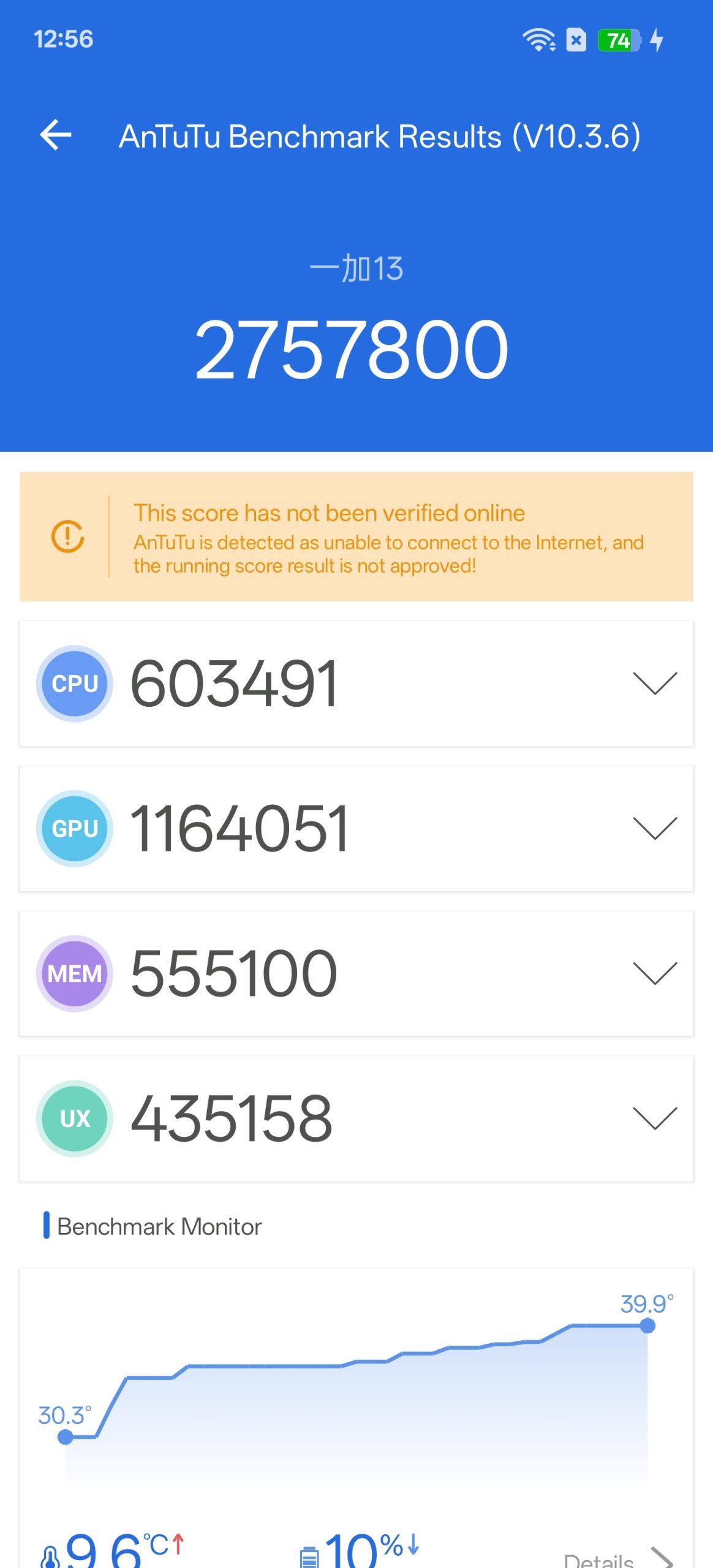

a 6000mAh battery, and 100W wired and 50W wireless charging.

The hardware specs are as high as ever. In the limited time, we tested the performance of “Honkai: Star Rail” in a Divergent universe. During the test, we found that in most scenes, the frame rate was at 60 FPS.


Most of the frame drop occurred during transitions between game scenes. If I turn off the FPS counter, I might not even notice the lag actually. But what surprised me more was its power efficiency.

In this gaming mode, the power consumption was only an average of 4.44W, and a 21 minutes of gameplay only consumes 7% of the battery, with very little heating. If you lower some of the graphics and turn on the balanced mode, its power efficiency will be even better.

Charging speed has always been a strong point of Chinese phones. So, I tested the OnePlus 13’s compatibility with PD/PPS chargers. In the end, we found that it can charge at a maximum speed of 30W. So, what do you think of this speed?


Conclusion
Finally, let’s talk about its price. When we see the specs, OnePlus seems to focus more on performance and display. The starting price is 4499 RMB, about 631 USD, and the top configuration, the 24G+1T is 5999 RMB, about 842 USD.

This is basically close to the price of the Xiaomi 15 standard version. But considering the bootloader unlock being the easiest one, perhaps the OnePlus 13 is also worth buying. What do you think?

Comments