
Add GIZMOCHINA as Preferred Source on Google
Google has used its custom-designed Tensor chips to power Pixel phones since the Pixel 6. But so far, these chips haven’t matched the performance or efficiency of their competitors.
This may change soon, as leaked internal documents obtained by Android Authority reveal Google’s plans to improve with its upcoming Tensor G6 chip, codenamed “Malibu.”
The changes for the Tensor G6 are expected to focus on thermals and efficiency gains. Major performance improvements are not in the cards, and even the Tensor G5 is only expected to offer a modest performance boost over the current chip.
So it looks like Google’s SoC strategy isn’t prioritizing performance gains for now. In fact, Android Authority reports that the Tensor G6 chip may even see some “downgrades” in certain areas.
Tensor G6 with improved efficiency?
For instance, Google is reportedly forgoing a new GPU for the Tensor G6 and opting for an older design initially intended for the Tensor G4. If so, the Tensor G6 might lack ray tracing support, which the Tensor G5 is expected to have. So it’s a step backward in that regard.
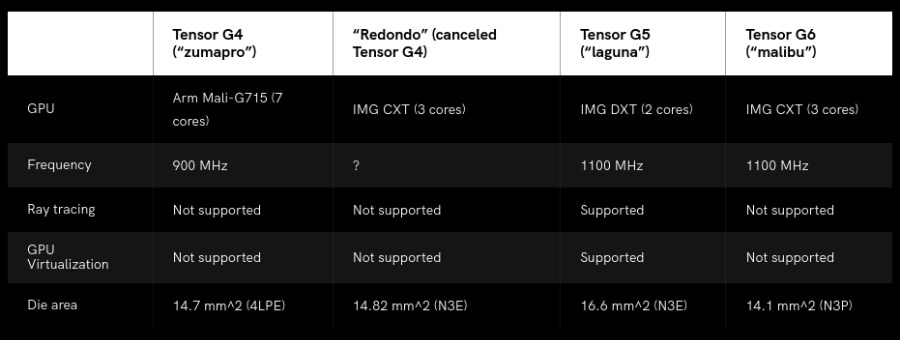
The decision to use the G4’s GPU in the G6 is reportedly driven by Google’s goal to reduce the chip’s die area. The Pixel 10’s chip is said to be quite large at 121 mm² when built using TSMC’s 3nm process node, while Apple’s A18 Pro, which uses the same process, measures just 105 mm².
Google’s target for the Tensor G6 is a 105 mm² die size, factoring in a 4% area saving from TSMC’s newer N3P process node (the G5 uses N3E).
To achieve this, using the G4’s GPU is said to reduce the die area by approximately 12%. Google is also reportedly cutting space by reducing the DSP (digital signal processor) by one core and halving the SLC (system-level cache) to 4MB. However, the report suggests there won’t be changes to the CPU size.
All in all, Google is trying to make smaller, more efficient chips, focusing on space-saving rather than performance improvements.




Comments