
Add GIZMOCHINA as Preferred Source on Google
5G Coverage in Iconic Skyscrapers: Study Reveals Strengths and Weaknesses
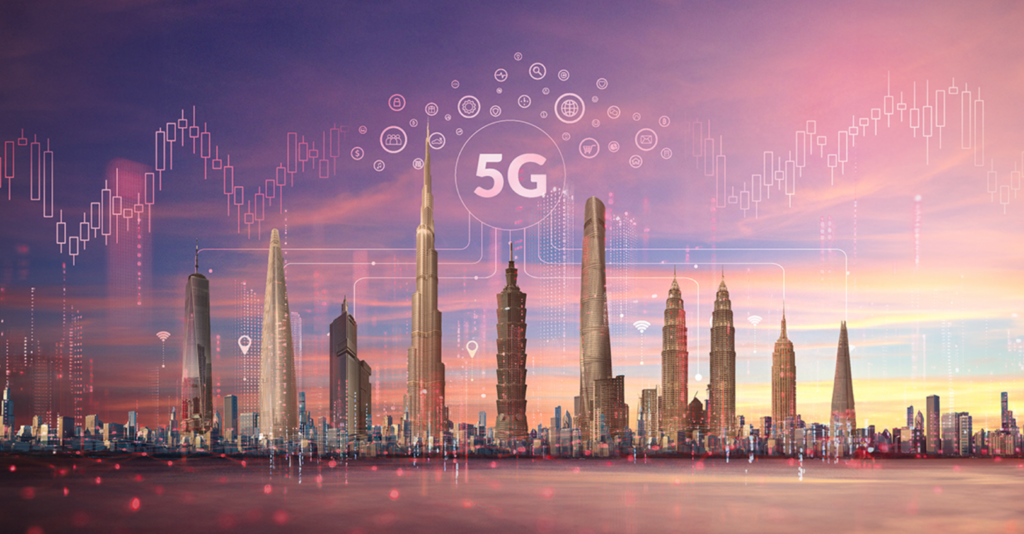
A new study by Ookla’s Cell Analytics™ examined 5G indoor coverage in nine famous skyscrapers worldwide. Skyscrapers pose challenges for telecom networks due to their height and construction materials. The study measured signal strength (RSRP) and quality (RSRQ) to evaluate 5G performance.
Best Performing Skyscrapers
Shanghai Tower in China leads in 5G coverage with an RSRP of -71.04 dBm, showcasing excellent signal strength. The building is well-optimized with small cells and a Distributed Antenna System (DAS), ensuring strong connectivity. Burj Khalifa in the UAE follows closely with an RSRP of -85.53 dBm and RSRQ of -11.07 dB, benefiting from Dubai’s advanced 5G infrastructure. The Empire State Building in the USA also ranks among the best with an RSRP of -83.19 dBm and RSRQ of -11.95 dB, having been upgraded with modern telecom infrastructure.

Skyscrapers with Weaker 5G Coverage
The Shard in the UK has the weakest signal among all buildings, with an RSRP of -96.69 dBm and the bottom 10% RSRP reaching -113 dBm, leading to poor coverage in some areas. Its heavy use of glass significantly affects signal penetration. Taipei 101 in Taiwan and the Petronas Twin Towers in Malaysia have good average RSRP, but weaker signals in certain areas, with the bottom 10% RSRP below -100 dBm. Taipei 101’s thick concrete and steel construction block signals, while the Petronas Twin Towers lack a dedicated 5G indoor solution. One World Trade Center in the USA and Autograph Tower in Indonesia offer RSRP around -85 dBm, indicating very good coverage, though some areas still experience weak signals or dead zones.
5G Signal Performance at Different Heights
In skyscrapers like Burj Khalifa, Taipei 101, Empire State Building, and One World Trade Center, there is minimal difference in signal strength between floors, with variations of 3 dBm or less. For instance, Burj Khalifa’s RSRP on the bottom floor is -77.09 dBm, while the top floor sees a slight improvement at -76.30 dBm. However, in Petronas Twin Towers, Lotte World Tower, and Autograph Tower, there is a significant drop in signal strength on higher floors. Petronas Twin Towers’ RSRP drops from -80.44 dBm on the bottom floor to -92.67 dBm at the top, due to its reliance on outdoor towers. Similarly, Lotte World Tower’s RSRP weakens from -71.14 dBm at the bottom to -92.54 dBm at the top.
Challenges for 5G in Skyscrapers
The main obstacles to 5G coverage in skyscrapers are building materials like glass, concrete, and steel, which block signals. High-frequency 5G bands (mmWave) struggle with penetration, leading to dead zones in certain areas or floors. These factors make achieving consistent coverage difficult.
Solutions to Improve Indoor 5G Coverage
To address these issues, telecom providers can deploy small cells and Distributed Antenna Systems (DAS) to enhance indoor network coverage. Upgrading indoor network infrastructure can help distribute signals more effectively. Additionally, Wi-Fi offloading can provide a seamless experience by supporting connectivity in areas where 5G signals are weak.
Shanghai Tower stands out as the leader in 5G coverage among skyscrapers. While most buildings offer good connectivity, some still have weak spots. To ensure full 5G coverage, better indoor network solutions are required. Collaboration between operators and developers is crucial for improving connectivity. Ookla’s Cell Analytics™ helps identify and resolve coverage gaps, contributing to more reliable 5G networks in skyscrapers.
Read More:



Comments