
Add GIZMOCHINA as Preferred Source on Google
India’s love affair with smartphones is only growing stronger, but there’s a rising undercurrent that brands are still ignoring: users want compact phones, and not just budget-friendly ones. According to a new consumer survey from Counterpoint Research, there’s a real appetite for compact smartphones that don’t cut corners on performance. In fact, 88 percent of respondents said they would buy a smaller device if it could match the power and battery life of today’s larger flagships.
Here’s the thing: the definition of “compact” has changed. The survey finds that a majority of Indian users, especially younger professionals and early jobbers, consider a 6 to 6.5-inch display to be the sweet spot. That might sound big, but in a world where most devices hover closer to 6.7 or 6.8 inches, shaving off even half an inch can dramatically improve one-handed usability.
And that’s exactly the point. Over 55 percent of respondents cited ease of handling and one-handed use as key reasons for preferring smaller phones. Add to that the comfort factor during long usage sessions, and it becomes clear that form factor isn’t just about portability, it’s about daily practicality.
Yet, the options are slim. In 2024, nearly 90 percent of smartphones launched had displays larger than 6.5 inches. Brands continue to chase bigger screens, louder specs, and flashier designs while overlooking a large chunk of the user base that just wants something that fits better in the hand, doesn’t strain the wrist, and still runs like a beast.
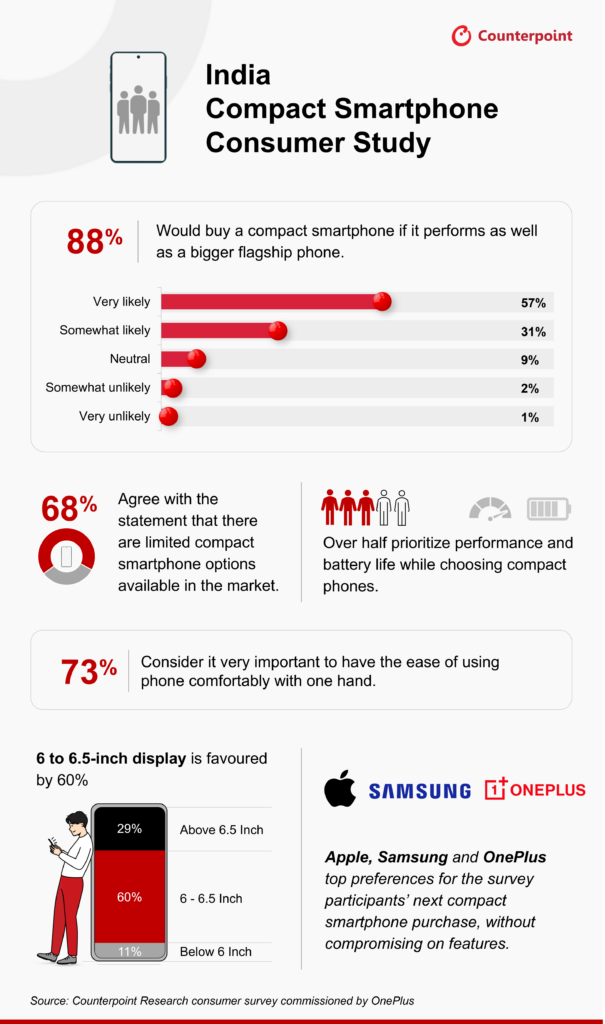
Consumers aren’t willing to compromise, either. Over half of the surveyed users won’t settle for a phone that sacrifices processor strength or battery life for size. And this isn’t just about productivity. A surprising 86 percent of respondents said they would actually prefer compact devices for mobile gaming, citing better ergonomics and reduced hand fatigue. AI-powered features, customizable shortcuts, and advanced thermal designs are also in demand, reflecting just how high the bar has been set even for a smaller phone.
So who’s in the running to meet this demand? Apple, Samsung, and OnePlus came out on top as the brands users trust most to get the compact formula right. But as things stand, the gap is wide open and ripe for disruption.
While nothing shifts overnight, there’s reason to be optimistic. Battery tech has improved drastically over the past year with the introduction of silicon-carbon batteries, and thermal management in phones has also seen a leap forward. These advancements give brands the headroom to experiment with more compact yet capable phones.
That said, making devices smaller than 6.1 or 6.2 inches might not make much sense anymore, given how much content people consume and how central gaming has become. If there is a new compact flagship wave coming, it will likely hover around the 6.3-inch mark, arguably the new goldilocks zone for phones in 2025.
In related news, you might also want to check out how the Vivo X200 Ultra blurs the line between smartphones and real cameras.
For more daily updates, please visit our News Section.
Stay ahead in tech! Join our Telegram community and sign up for our daily newsletter of top stories! 💡




Comments