Add GIZMOCHINA on Google:
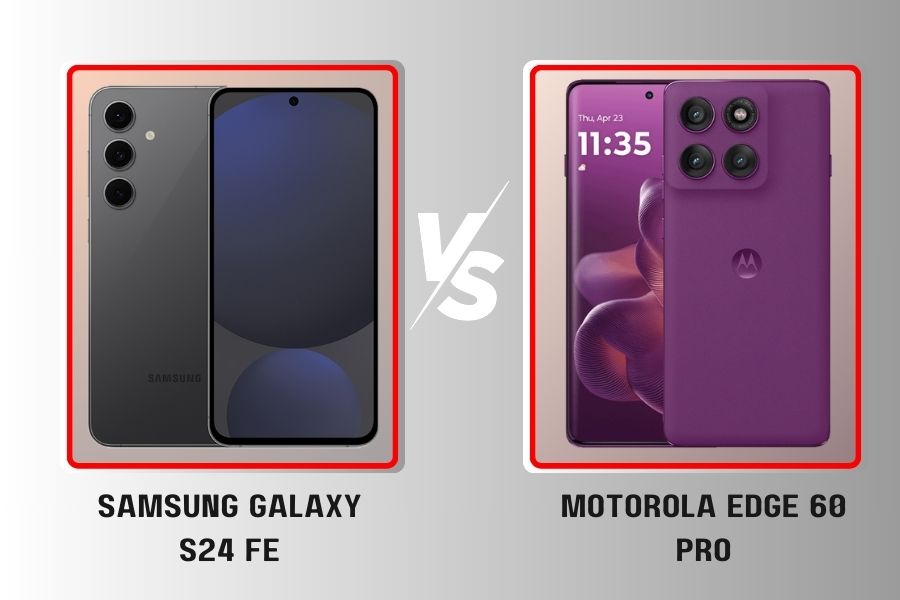
The Motorola Edge 60 Pro and the Samsung Galaxy S24 FE land in the same general category: premium mid-range phones that try to do a little bit of everything while looking the part.
Both phones offer large OLED displays, capable triple-camera systems, and a splash of flagship DNA, but they go about things very differently. One leans on sheer hardware specs and big battery numbers, the other rides on brand reputation and software support.
If you’re trying to choose between these two, here are five key ways the Motorola Edge 60 Pro is different from the Galaxy S24 FE.
1. Display Brightness and Visual Specs
Both phones come with 6.7-inch OLED panels that refresh at 120Hz and support the HDR10+ standard. So at first glance, they seem evenly matched. But Motorola pushes the panel much further in terms of peak brightness and resolution.
The Edge 60 Pro’s P-OLED display hits up to 4500 nits of peak brightness. It’s several times brighter than what most phones can manage, and more than double the 1900 nits peak brightness of the S24 FE.
It also has a higher resolution at 1220 x 2712 pixels (444 ppi), compared to the FE’s 1080 x 2340 pixels (385 ppi). So you should get sharper visuals and better daylight legibility on the Motorola, even though the S24 FE uses Samsung’s high-end Dynamic AMOLED 2X panel tech.
Samsung’s strength is likely in display tuning and color science, but for sheer specs on paper, Motorola has the more technically impressive screen. Not to forget, it also has a higher screen-to-body ratio (92.2% vs 88%).
2. Performance: Dimensity vs Exynos
This might be the most divisive difference between the two. The Edge 60 Pro runs on the MediaTek Dimensity 8350 Extreme, while the Galaxy S24 FE uses Samsung’s Exynos 2400e.
On paper, both chipsets are built on a 4nm process and feature modern cores, but their performance profiles differ. The Dimensity 8350 Extreme is structured around Cortex-A715 and Cortex-A510 cores that hit up to 3.35 GHz on the prime core. It’s paired with a Mali-G615 MC6 GPU.
The Exynos 2400e, meanwhile, is a 10-core setup with a peak 3.1 GHz performance core and uses AMD’s Xclipse 940 GPU. It also supports hardware ray tracing, though that’s more aspirational than useful right now.
In reality, neither chip will match the performance of recent flagship chips. But both of them will handle your tasks, light or demanding, fairly easily.
The Edge 60 Pro is available with up to 12GB of RAM, whereas the S24 FE tops out at 8GB. Both have UFS 4.0 storage.
3. Battery Life and Charging
Battery is one area where the Edge 60 Pro pulls ahead. Motorola has stuffed in a 6000 mAh silicon-carbon (Si/C) battery inside the phone, while the Galaxy S24 FE makes do with 4700 mAh.
That’s a substantial difference in raw capacity. In daily use, this should translate into longer screen-on time and less frequent charging.
The charging story is equally lopsided. The Edge 60 Pro supports 90W wired charging, 15W wireless, and 5W reverse wired charging. Samsung, by comparison, sticks with its usual 25W wired and 15W wireless, with reverse wireless but no wired reverse option.
It’s clear that Motorola wins by a great margin in the charging and battery department.
4. Camera Hardware and Features
The two phones differ significantly in terms of cameras as well.
Motorola’s main shooter is a 50MP sensor with OIS, flanked by a 10MP 3x telephoto and a 50MP ultrawide with autofocus. Samsung matches the main camera resolution at 50MP but offers an 8MP 3x telephoto and a 12MP ultrawide.
On pure megapixel count and ultrawide versatility, Motorola wins here. Both have optical zoom, but the FE’s telephoto sensor is smaller and likely to show more noise in tricky lighting. That’s on paper, though. For a real comparison, it’s best to go through some reviews for a better sense of performance.
On the flip side, Samsung pulls ahead in terms of video resolution. It supports recording up to 8K@30fps, whereas Motorola caps at 4K@30fps. So, if you’re shooting a lot of high-res video, Samsung might be the better tool.
As for selfies, Motorola uses a 50MP front camera with 4K recording. Samsung’s is a 10MP unit that also shoots in 4 K. Again, spec-wise, Motorola gives you more.
5. Build, Software, and Ecosystem Perks
When it comes to build quality, Samsung still feels more premium in hand. The Galaxy S24 FE uses Gorilla Glass Victus+ on both sides and a solid aluminum frame, while the Edge 60 Pro opts for Gorilla Glass 7i on the front but lacks the same grade on the back.
Both phones are IP68-rated, but Motorola adds IP69 and MIL-STD-810H compliance, which implies more durability under extreme conditions.
Software is another area where Samsung plays a different game. The S24 FE shipped with Android 14-based One UI 6.1 out of the box. And it promises seven years of OS and security updates.
Motorola’s offering comes pre-installed with Android 15, but you only get three OS upgrades and a year more of security patches after that. Samsung’s track record in updates is currently unmatched in the Android space.
Samsung also supports DeX, Circle to Search, and other software features that tie into its ecosystem of tablets, watches, and laptops. Motorola offers a cleaner Android experience, but it lacks the deeper ecosystem hooks, though that may not matter to everyone.
6. Final Thoughts
The Motorola Edge 60 Pro is a well-specced device in this matchup. It gives you more RAM, more pixels, more battery, faster charging, and a brighter screen. It’s also cheaper at Rs 29,999 starting price in India, compared to Rs 36,999 for the S24 FE.
But Samsung counters with better long-term software support, more refined build quality, a stronger brand, and a few high-end features like DeX and 8K video recording. So if you want a phone that just works and will keep getting updates for years, the Galaxy S24 FE is still the safer bet.
For more daily updates, please visit our News Section.
Stay ahead in tech! Join our Telegram community and sign up for our daily newsletter of top stories!