
Add GIZMOCHINA as Preferred Source on Google
Announced in October 2023, the Snapdragon 8 Gen 3 is one of the best flagship smartphone chips right now, rocking a high-performance octa-core CPU with a peak frequency of 3.3GHz. The Adreno 750 GPU also does an excellent job, delivering superb performance in demanding titles.
The Snapdragon 888, on the other hand, is a relatively older chip, announced in December 2020. It was also announced as a flagship-class chipset, but thanks to chip advancements, modern mid-range chips offer the same (or better) performance, while flagship chips are on a whole different level.
While it’s clear that the Snapdragon 8 Gen 3 is more powerful, the real question is — how big is the performance gap? To find the answer, we ran several benchmark tests. Let’s look at the results.
Snapdragon 8 Gen 3 vs Snapdragon 888: Benchmark comparison
Note: The tests were conducted on the Xiaomi 14 Ultra (powered by Snapdragon 8 Gen 3) and OnePlus 9 Pro (powered by Snapdragon 888).
AnTuTu comparison
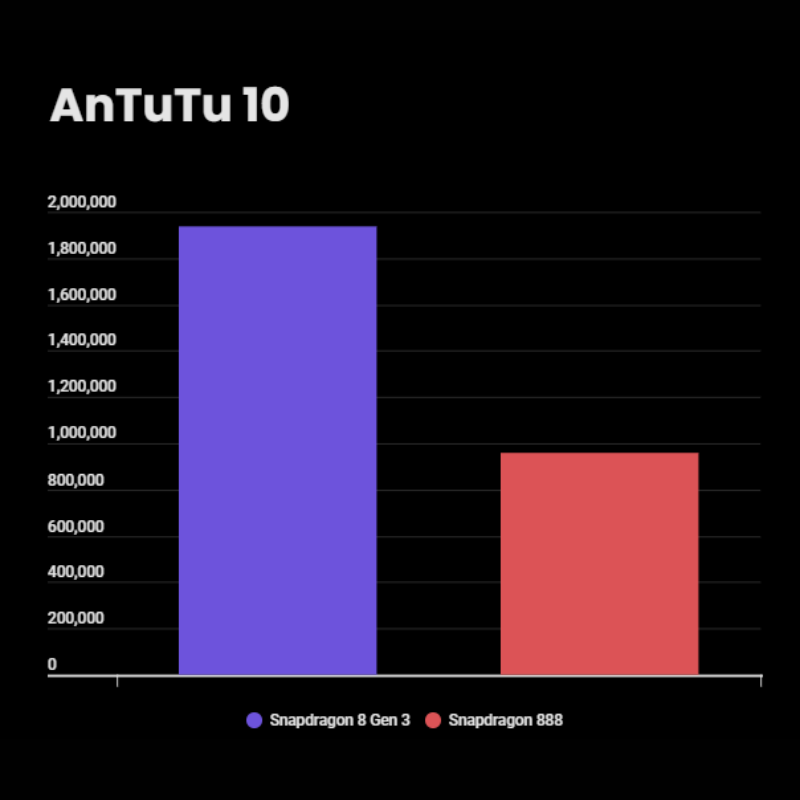
The Snapdragon 8 Gen 3 absolutely dominates the Snapdragon 888 on the AnTuTu benchmark, nearly doubling the total score. It offers a 63% higher CPU score and a staggering 172% boost in GPU performance, making it a powerhouse for gaming and intensive tasks. Memory and UX scores are also significantly better—up by 120% and 38%, respectively —highlighting major improvements in speed, responsiveness, and multitasking. This comparison clearly shows how far flagship chips have come in just a few generations.
| SD 8 Gen 3 | SD 888 | |
|---|---|---|
| AnTuTu score | 1,937,417 | 958,743 |
| CPU | 419,604 | 257,236 |
| GPU | 829,698 | 305,351 |
| Memory | 382,043 | 174,153 |
| UX | 306,072 | 222,003 |
Geekbench comparison
| SD 8 Gen 3 | SD 888 | |
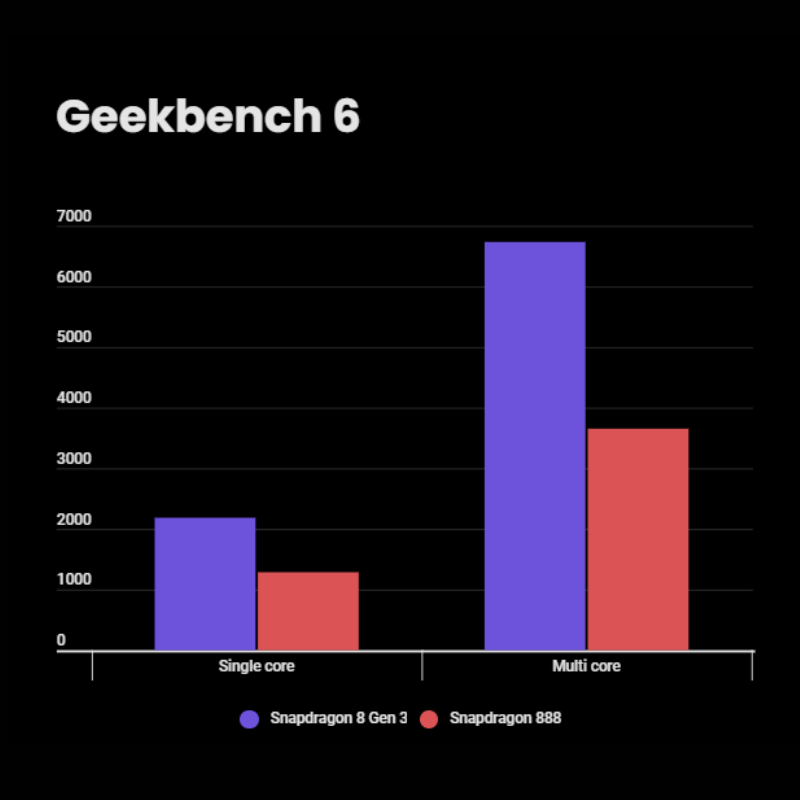
| Single core | 2,185 | 1,286 |
| Multi core | 6,735 | 3,654 |
In Geekbench 6, the Snapdragon 8 Gen 3 shows a massive leap in performance over the Snapdragon 888. It delivers a 70% higher single-core score and an 84% improvement in multi-core performance. This means the 8 Gen 3 offers not only faster everyday performance but also excels in heavy multitasking and demanding workloads, thanks to its significantly more powerful CPU architecture.
Snapdragon 8 Gen 3 vs Snapdragon 888: Key differences that matter!
Why is there a significant gap in benchmark results? Let’s break things down to understand this.
CPU
Both Snapdragon 8 Gen 3 and Snapdragon 888 are octa-core processors, but they greatly differ in terms of core design, manufacturing process, and architecture.
The Snapdragon 8 Gen 3, for instance, uses 1+5+2 core configuration, featuring one high-performance Cortex-X4, five Cortex-A720 performance cores, and two Cortex-A520 efficiency cores.
On the other hand, the Snapdragon 888 uses a 1+3+4 CPU design consisting of one Cortex-X1 high-performance core, three Cortex-A78 performance cores, and four Cortex-A55 efficiency cores.
The 8 Gen 3 uses a newer ARMv9.2-A instruction set (vs. ARMv8.4-A on Snapdragon 888), making it faster and more efficient. Additionally, the newer chip is made using TSMC’s 4nm process, which is more efficient than Samsung’s 5nm process used for the other chip.
GPU
The Snapdragon 8 Gen 3 has an Adreno 750 GPU, which is much superior to the Adreno 660 on the Snapdragon 888. The former has significantly higher shading units, total shaders, and floating point operations per second (FLOPS), which translates to superior performance with smoother frame rates and advanced graphics.
The Snapdragon 8 Gen 3 also features hardware-based ray tracing and Global Illumination for improved lighting and shadows. With Unreal Engine 5.2 MetaHumans, the games show realistic human characters, further enhancing the gaming experience. The chip also brings improved Snapdragon Elite Gaming features.
There are just so many gaming advancements to the Snapdragon 8 Gen 3 that the Snapdragon 888 can’t match. You’ll experience significant differences in the gaming performance and visuals.
Connectivity
The two Qualcomm chips also bring notable differences on the connectivity front. For instance, the Snapdragon 8 Gen 3 has an X75 5G modem with up to 10Gbps download and up to 3.5Gbps upload speeds versus 7.5Gbps download and 3Gbps upload speeds on the Snapdragon 888 (X60 5G modem).
Additionally, the newer chip supports Wi-Fi 7 with a maximum speed of 5.8Gbps, whereas the Snapdragon 888 supports up to Wi-Fi 6E with 3.6Gbps maximum speed. The Snapdragon 8 Gen 3 also brings a newer Bluetooth standard for reliable connectivity.
In addition, the newer chip brings Qualcomm 5G Ultra-Low Latency Suite and improvements to existing features for reliable and faster connectivity.
Camera
The cameras also show significant differences between the two. The Snapdragon 8 Gen 3 has a higher bit depth, which means it can capture more color and brightness information from the camera sensor.
Both chips support up to 200MP single cameras. However, the Snapdragon 8 Gen 3 supports noise reduction for multiple cameras at higher camera resolution, which means low-light or fast-faced moments would look cleaner. Additionally, the chip brings more advanced AI for auto-focus, face detection, and auto-exposure.
A significant upgrade to the 8 Gen 3 is the real-time semantic segmentation support for up to 12 layers. It enables the chip to understand an image by breaking it into parts and applying tailored enhancements to each layer. It applies to photos as well as videos.
Snapdragon 8 Gen 3 vs Snapdragon 888: Conclusion
The Snapdragon 8 Gen 3 is a true leap forward compared to the Snapdragon 888. From raw performance and GPU power to AI capabilities, connectivity, and camera enhancements — the differences are massive. Benchmarks show that the 8 Gen 3 nearly doubles the 888’s scores in several key areas, especially in gaming and multitasking. It’s not just faster — it’s smarter, more efficient, and better suited for a high-end mobile experience.
That said, the Snapdragon 888 still holds up fairly well for general tasks and light gaming, especially in older flagship devices. But if you’re after cutting-edge features, buttery smooth gameplay, faster connectivity, and a better all-around smartphone experience, the Snapdragon 8 Gen 3 is clearly the better choice.
| SD 8 Gen 3 | SD 7+ Gen 3 | |
|---|---|---|
| Announced | October 2023 | December 2020 |
| Manufacturing | 4nm (TSMC) | 5nm (Samsung) |
| CPU | 1 x 3.3 GHz — Cortex-X3 3 x 3.15 GHz — Cortex-A720 2 x 2.96 GHz — Cortex-A720 2 x 2.27GHz — Cortex-A520 | 1 x 2.84 GHz — Cortex-X1 3 x 2.42 GHz — Cortex-A78 4 x 1.8 GHz — Cortex-A55 |
| GPU | Adreno 750 GPU Support for Unreal Engine 5.2 Lumen Global illumination Ray tracing support Snapdragon Elite Gaming features | Adreno 660 GPU Snapdragon Elite Gaming features |
| NPU | Qualcomm Hexagon NPU | Hexagon 780 NPU |
| Memory | LPDDR5x, up to 4.8GHz | LPDDR5, up to 3.2GHz |
| Camera | Spectra Cognitive triple 18-bit ISP Up to 200MP single camera Real-time semantic segmentation (max 12 layers) Up to 8K video recording | Spectra triple 14-bit ISP Up to 200MP single camera Up to 8K video recording |
| Connectivity | Snapdragon X75 5G modem Download: 10Gbps Upload: 3.5Gbps Qualcomm FastConnect 7800 Wi-Fi 7 (peak speed: 5.8Gbps) Bluetooth 5.4 | Snapdragon X60 5G modem Download: 7.5Gbps Upload: 3Gbps Qualcomm FastConnect 6900 Wi-Fi 6E (peak speed: 3.6Gbps) Bluetooth 5.2 |
Snapdragon 8 Gen 3 phones:
Samsung Galaxy S24 Ultra (review)
OnePlus 12 (review)
Asus ROG Phone 8
Galaxy Z Fold 6
Galaxy Z Flip 6 (review)
Xiaomi 14 Ultra (review)
iQOO 12
Snapdragon 888 phones:




Comments