
Add GIZMOCHINA as Preferred Source on Google
We just finished testing Xiaomi’s brand-new XRING O1 chipset, and no surprise, it’s a flagship-class through and through. In fact, it even outperforms Qualcomm’s Snapdragon 8 Elite in both single-core and multi-core Geekbench 6 tests.
Xiaomi designed the XRING O1 from the ground up with a 10-core CPU setup and TSMC’s 3nm process. While that is impressive for its first mobile SoC, the company might be stuck at this node for the foreseeable future. Why?
Trump’s ban on EDA tools is a major blow to Xiaomi and Lenovo
The U.S. has officially blocked the export of advanced Electronic Design Automation (EDA) tools to China. EDA is the backbone of modern chip design, enabling simulation, verification, and optimization of complex integrated circuits.
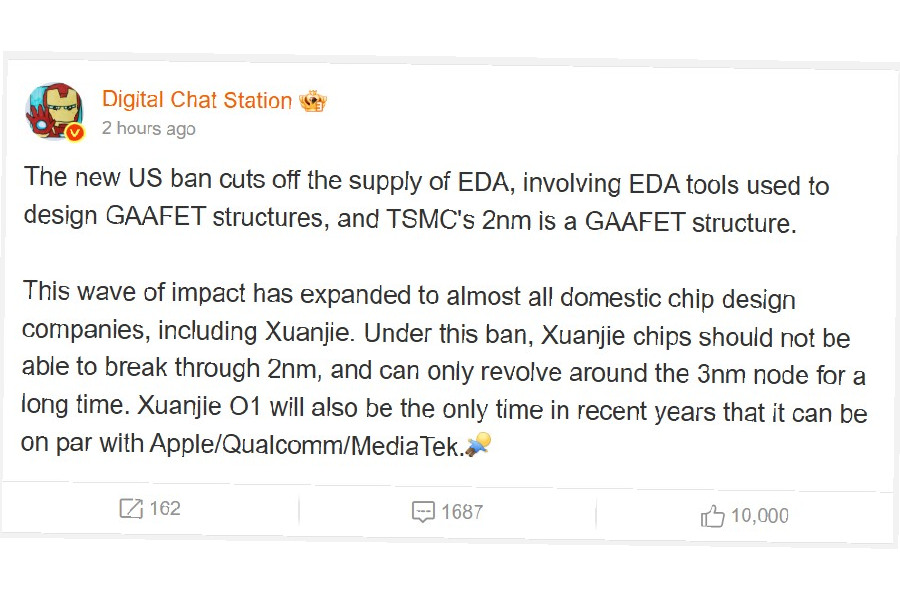
More importantly, it is what’s used to design Gate All Around Field Effect Transistor (GAAFET) structures. And since TSMC’s 2nm node process is a GAA product, the ban on EDA tools implies a ban on the use of TSMC’s 2nm node as well.
That effectively means Xiaomi (and others) won’t be able to tap into TSMC’s 2nm or lower nodes for their custom chips. For now, the XRING lineup is likely to remain locked into the current ‘N3E’ 3nm process for the long haul.
It’s not just Xiaomi in the crosshairs. Lenovo, which is also rumored to be developing its own in-house silicon, will feel the heat too. In many ways, this puts them on the same restricted path that Huawei has been navigating since the U.S. sanctions began in 2019.
But it’s not all bad news for China. With foreign EDA tools off the table, there’s now a major push to build domestic alternatives. Huawei has already been investing in its own EDA platforms and backing local players like Empyrean to fill the gap.
For more daily updates, please visit our News Section.
Stay ahead in tech! Join our Telegram community and sign up for our daily newsletter of top stories! 💡



Comments