
Add GIZMOCHINA as Preferred Source on Google
Xiaomi appears to be taking another step toward a vertically integrated hardware ecosystem. Following the debut of its custom XRING 01 chip, the company is reportedly working on its successor, and it could power not only smartphones, tablets, and smartwatches but also future vehicles and possibly other categories.

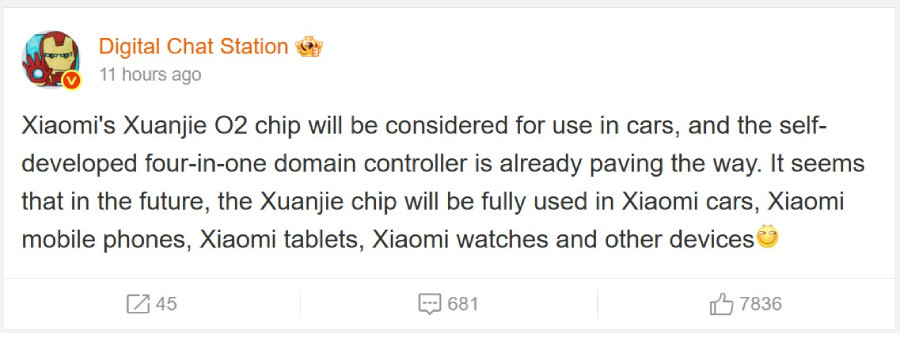
The information stems from a leak shared on Weibo by Digital Chat Station, a regular source of hardware rumors in China. While Xiaomi has not officially acknowledged the XRING O2’s existence, the chip has appeared in a trademark listing in China, lending some weight to the speculation.
An XRING for everything Xiaomi
What’s more interesting is the idea that a single chip design could be customized for wildly different product categories. In theory, a phone, a smartwatch, and a car could all run variants of XRING O2. This should make it easier for Xiaomi to integrate software and services across devices.
The XRING O2 is expected to be built on TSMC’s 3nm N3E process node, an iteration of the same family used for the XRING 01. Even competitors like Qualcomm, MediaTek, and Apple are likely to use the N3P node for their next flagship processors.
After that, all major silicon manufacturers are rumored to transition to 2nm chips. However, Xiaomi may not be able to access newer nodes like 2nm due to export restrictions on the EDA tools required for advanced chip design. While this wouldn’t necessarily cripple performance, it could impact how future-proof the platform truly is.
There’s no clear timeline for XRING O2 or the products it may power, and Xiaomi has yet to make anything official. But if the chip ends up in cars and consumer electronics alike, it’s likely the company is taking its ecosystem ambitions seriously.
For more daily updates, please visit our News Section.
Stay ahead in tech! Join our Telegram community and sign up for our daily newsletter of top stories.


Comments