
Add GIZMOCHINA as Preferred Source on Google
The Snapdragon 8 series packs some of the most powerful smartphone chipsets on the market, offering impressive performance and energy efficiency. But with multiple generations out there, picking the right one isn’t always straightforward.
Sure, newer chips are expected to be faster — but just how much faster are they? Are we looking at true generational leaps, or are these upgrades more incremental than they seem? In this comparison, we’ll dive into benchmarks and real-world differences between the Snapdragon 8 Gen 3, Gen 2, and Gen 1 to find out the answer.
Here’s the spec sheet:
| SD 8 Gen 3 | SD 8 Gen 2 | SD 8 Gen 1 | |
|---|---|---|---|
| Announced | October 2023 | November 2022 | December 2021 |
| Manufacturing | 4nm (TSMC) | 4nm (TSMC) | 4nm (Samsung) |
| CPU | 1 x 3.3 GHz — Cortex-X3 3 x 3.15 GHz — Cortex-A720 2 x 2.96 GHz — Cortex-A720 2 x 2.27GHz — Cortex-A520 | 1 x 3.2 GHz — Cortex-X3 2 x 2.8 GHz — Cortex-A715 2 x 2.8 GHz — Cortex-A710 3 x 2.0 GHz — Cortex-A510 | 1 x 3.0 GHz — Cortex-X2 3 x 2.5 GHz — Cortex-A710 4 x 1.8 GHz — Cortex-A510 |
| GPU | Adreno 750 GPU Ray tracing support Snapdragon Elite Gaming features | Adreno 740 GPU Ray tracing support Snapdragon Elite Gaming features | Adreno 730 GPU Snapdragon Elite Gaming features |
| NPU | Qualcomm Hexagon NPU | Qualcomm Hexagon NPU | Qualcomm Hexagon NPU |
| Storage/Memory | UFS 4.0 LPDDR5x, up to 4.8GHz | UFS 4.0 LPDDR5X, up to 4.2GHz | UFS 3.1 LPDDR5, up to 3.2GHz |
| Camera | Spectra Cognitive triple 18-bit ISP Up to 200MP single camera Real-time semantic segmentation Up to 8K/30fps video recording | Spectra Cognitive triple 18-bit ISP Up to 200MP single camera Real-time semantic segmentation Up to 8K/30fps video recording | Spectra triple 18-bit ISP Up to 200MP single camera Real-time semantic segmentation Up to 8K/30fps video recording |
| Connectivity | Snapdragon X75 5G modem Download: 10Gbps (peak) Upload: 3.5Gbps (peak) Wi-Fi 7 (peak speed: 5.8Gbps) Bluetooth 5.4 | Snapdragon X70 5G modem Download: 10Gbps (peak) Upload: 3.5Gbps (peak) Wi-Fi 7 (peak speed: 5.8Gbps) Bluetooth 5.3 | Snapdragon X65 5G modem Download: 10Gbps (peak) Upload: 3.6Gbps (peak) Wi-Fi 6E (peak speed: 3.6Gbps) Bluetooth 5.2 |
| Display | 4K Ultra HD @ 60Hz, QHD+ @ 144Hz 10-bit color depth HDR10, HDR10+, HDR Vivid | 4K Ultra HD @ 60Hz, QHD+ @ 144Hz 10-bit color depth HDR10, HDR10+ | 4K Ultra HD @ 60Hz, QHD+ @ 144Hz 10-bit color depth HDR10, HDR10+ |
Snapdragon 8 Gen 3 vs 8 Gen 2 vs 8 Gen 1: Benchmark comparison
Note: The following benchmark tests were conducted on the Xiaomi 14 Ultra (Snapdragon 8 Gen 3), iQOO Neo 9 Pro (Snapdragon 8 Gen 2), and Galaxy S22 Ultra (Snapdragon 8 Gen 1).
AnTuTu performance
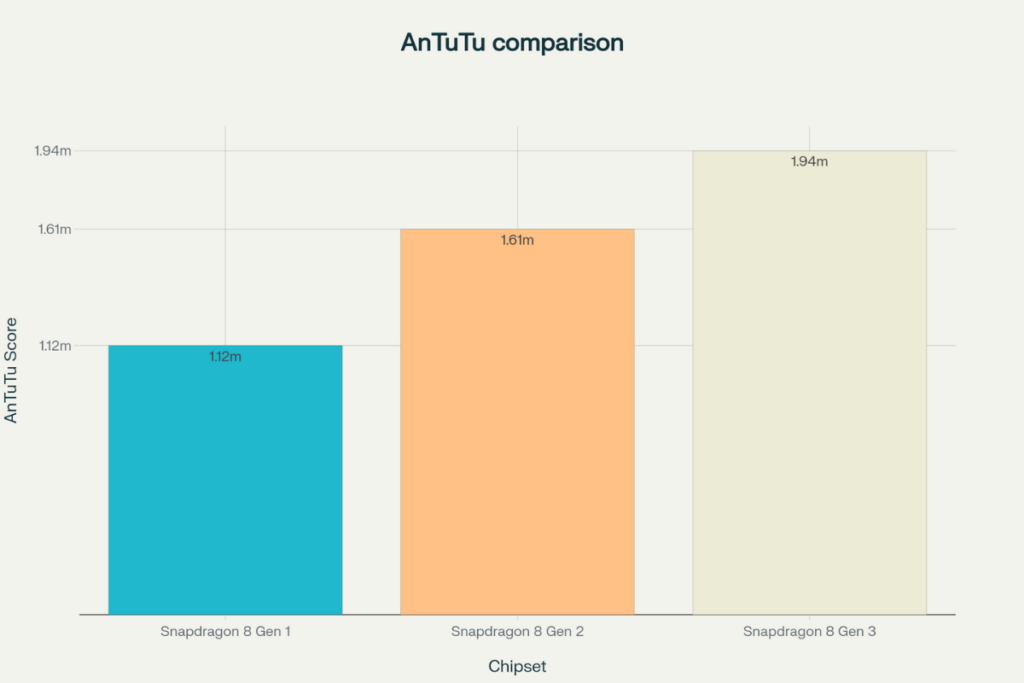
The AnTuTu benchmark (v10) shows a clear and consistent generational leap from the Snapdragon 8 Gen 1 to the 8 Gen 2, and then to the latest 8 Gen 3. The Snapdragon 8 Gen 3 leads the pack with a total score of 1,937,417, followed by the 8 Gen 2 at 1,609,763, and the 8 Gen 1 trailing at 1,123,750.
The biggest improvements can be seen in the GPU scores. The 8 Gen 3 posts a massive 829,698, showing how Qualcomm has significantly ramped up graphics performance — more than 2x the GPU score of the 8 Gen 1 (409,725), and about 35% higher than the 8 Gen 2 (612,954). This kind of jump translates directly to smoother gaming, faster rendering, and better thermal performance under load.
CPU performance has also steadily improved across generations. The 8 Gen 3 leads with 419,604, followed by the 8 Gen 2 at 387,038, and the 8 Gen 1 at 289,636 — showing a clear trajectory of enhanced processing power and efficiency.
Memory and UX scores also scale up with each generation, but the gains here are more modest. Still, the 8 Gen 3 shows notable improvements with 382,043 in memory and 306,072 in UX, which contribute to faster app load times, smoother UI transitions, and better multitasking.
| SD 8 Gen 3 | SD 8 Gen 2 | SD 8 Gen 1 | |
|---|---|---|---|
| AnTuTu score | 1,937,417 | 1,609,763 | 1,123,750 |
| CPU | 419,604 | 387,038 | 289,636 |
| GPU | 829,698 | 612,954 | 409,725 |
| Memory | 382,043 | 306,124 | 202,994 |
| UX | 306,072 | 303,647 | 221,402 |
Geekbench performance
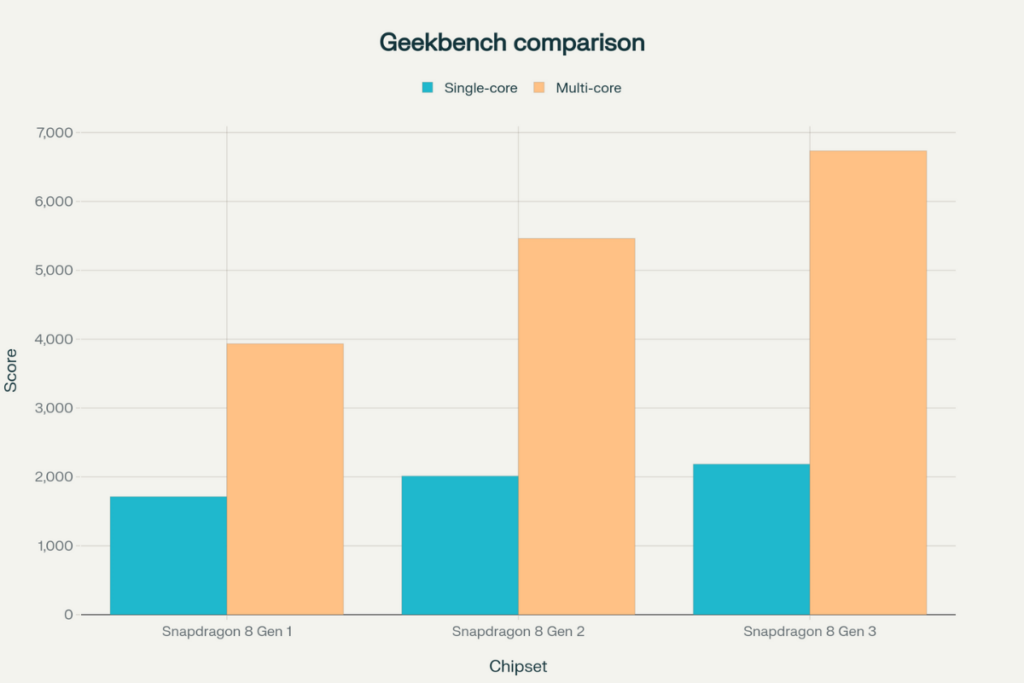
On Geekbench (v10), we again see a clear generational progression, especially in multi-core workloads. The Snapdragon 8 Gen 3 takes the lead with a single-core score of 2,185 and a multi-core score of 6,735, marking it as the most capable CPU performer in this lineup.
Compared to its predecessor, the 8 Gen 2, which scores 2,012 (single-core) and 5,461 (multi-core), the Gen 3 brings a roughly 8.5% boost in single-core and over 23% in multi-core performance. These gains are particularly meaningful for demanding tasks such as video editing and multitasking.
The Snapdragon 8 Gen 1, while still decent, shows its age with 1,713 (single-core) and 3,933 (multi-core). That’s nearly 27% lower in single-core and over 40% behind in multi-core performance compared to the Gen 3.
| SD 8 Gen 3 | SD 8 Gen 2 | SD 8 Gen 1 | |
| Single core | 2,185 | 2,012 | 1,713 |
| Multi core | 6,735 | 5,461 | 3,933 |
While benchmark scores are helpful, they don’t give the complete picture. Let’s dive into the real-world differences that separate these chips.
Snapdragon 8 Gen 3 vs 8 Gen 2 vs 8 Gen 1: Key differences you should know
Performance
The Snapdragon 8 Gen 3 and 8 Gen 2 are fabricated using TSMC’s 4nm process, while the 8 Gen 1 uses Samsung’s 4nm. The former has more cutting-edge technology, resulting in more efficient chip production. They also have different sets of CPU cores, with the 8 Gen 3 obviously having the most powerful of the three. Here’s what that looks like:
- SD 8 Gen 3: 1 x Cortex-X4, 5 x Cortex-A720, 2 x Cortex-A520
- SD 8 Gen 2: 1 x Cortex-X3, 2 x Cortex-A715, 2 x Cortex-A710, 3 x Cortex-A510
- SD 8 Gen 1: 1 x Cortex-X2, 3 x Cortex-A710, 4 x Cortex-A510
Not only does the 8 Gen 3 feature powerful CPU cores, but it also boasts a larger cache size, higher CPU speed, and increased memory speed, giving it a performance edge.
For visual rendering, the 8 Gen 3 features an Adreno 750 GPU, the 8 Gen 2 has an Adreno 740 GPU, and the 8 Gen 1 has an Adreno 730 GPU. The Adreno 750 is the most powerful of the three, featuring a higher peak frequency, more shading units, and higher FLOPS. In short, the 8 Gen 3 has received better GPU upgrades than the 8 Gen 2.
All three Qualcomm chips have a hexagon NPU, although their capabilities differ. The 8 Gen 3 has 98% faster hexagon NPU than 8 Gen 2, while the latter is 4.35x faster than 8 Gen 1. These NPUs enable support for generative AI, AI voice recognition, and various large language models (LLMs). The chip also uses AI for photo enhancements.
Camera
All three Snapdragon 8-series chips come with an 18-bit Qualcomm Spectra ISP, supporting up to 200MP cameras and 8K video recording. They also support real-time semantic segmentation that allows the device to refine images and videos at a granular level. Notably, the 8 Gen 1 doesn’t have a Cognitive ISP, while the other two do, resulting in better photos and videos. The Gen 3 chip has a more sophisticated set of camera features than earlier chips.
Connectivity
The Snapdragon 8 Gen 3 features the newer X75 modem, allowing up to 10Gbps download speed and up to 3.5Gbps upload speed. The 8 Gen 2 and 8 Gen 1, despite featuring relatively older modems, also support 10Gbps download speed. The maximum upload speed remains largely unchanged, at 3.5 Gbps on 8 Gen 2 and 3.6 Gbps on 8 Gen 1.
Over a Wi-Fi connection, the 8 Gen 1 can download at up to 3.6Gbps, while the other two support a higher peak speed of 5.8Gbps. One key difference here is that the 8 Gen 3 and 8 Gen 2 support the latest Wi-Fi 7, but the 8 Gen 1 supports Wi-Fi 6E.
The Snapdragon 8 Gen 3 benefits from a newer Bluetooth standard for reliable connection and a triple-band GNSS for improved location accuracy. It also brings a robust set of connectivity features for signal boosting and improved power efficiency.
Snapdragon 8 Gen 3 vs 8 Gen 2 vs 8 Gen 1: Conclusion
If you’re after the best performance, the Snapdragon 8 Gen 3 is clearly in a league of its own. It delivers massive gains across the board — CPU, GPU, AI, and connectivity — making it a top choice for power users and gamers.
The 8 Gen 2 still holds its own with excellent performance and efficiency, making it a great pick for high-end phones without the hefty price tag.
Meanwhile, the Snapdragon 8 Gen 1, while still capable, is starting to show its age, especially in GPU and multi-core workloads. It’s still fine for everyday use, but not suited for future-proof performance.
Overall, each generation brings more than just minor upgrades — they deliver tangible improvements you’ll notice in real-world use.



Comments