
Add GIZMOCHINA as Preferred Source on Google
The Exynos 2500 chipset, released earlier this month with the Galaxy Z Flip 7, brings serious upgrades across the board over its predecessor, Exynos 2400. However, it couldn’t stand strong against the Snapdragon 8 Elite (see the comparison here). Can it beat the Snapdragon 8 Gen 3 from 2023?
We’ll examine the benchmark data and real-world differences to find out who has the edge.
Let’s begin with the spec sheet:
| Exynos 2500 | Snapdragon 8 Gen 3 | |
|---|---|---|
| Announced | June 2025 | October 2023 |
| Process node | 3nm | 4nm |
| Manufacturer | Samsung | TSMC |
| CPU | 1 x 3.3 GHz — Cortex-X925 2 x 2.74 GHz — Cortex-A725 5 x 2.36 GHz — Cortex-A725 2 x 1.8 GHz — Cortex-A520 | 1 x 3.3 GHz — Cortex-X4 3 x 3.15 GHz — Cortex-A720 2 x 2.96 GHz — Cortex-A720 2 x 2.27 GHz — Cortex-A520 |
| GPU | Samsung Xclipse 950 GPU Ray tracing support | Adreno 750 GPU Ray tacing support Snapdragon Elite Gaming features |
| NPU | Yes 59 TOPS | Qualcomm Hexagon NPU |
| Memory | LPDDR5x, up to 4.2 GHz | LPDDR5x, up to 5.3 GHz |
| Storage | UFS 4.0 | UFS 4.0 |
| Camera | Up to 320MP single camera Up to 8K video recording | Spectra triple 18-bit ISP Up to 200MP single camera Real-time semantic segmentation Up to 8K video recording |
| Connectivity | Download speed: 12.1 Gbps (peak) Upload speed: 3.67 Gbps (peak) Wi-Fi 7 Bluetooth v5.4 Satellite messaging support | Download speed: 10 Gbps (peak) Upload speed: 3.5 Gbps (peak) Wi-Fi 7 (peak speed: 5.8 Gbps) Bluetooth v5.4 |
Exynos 2500 vs Snapdragon 8 Gen 3: Benchmark comparison
Note: The tests were conducted on the Galaxy Z Flip 7 (Exynos 2500) and Galaxy S24 Ultra (Snapdragon 8 Gen 3).
AnTuTu performance
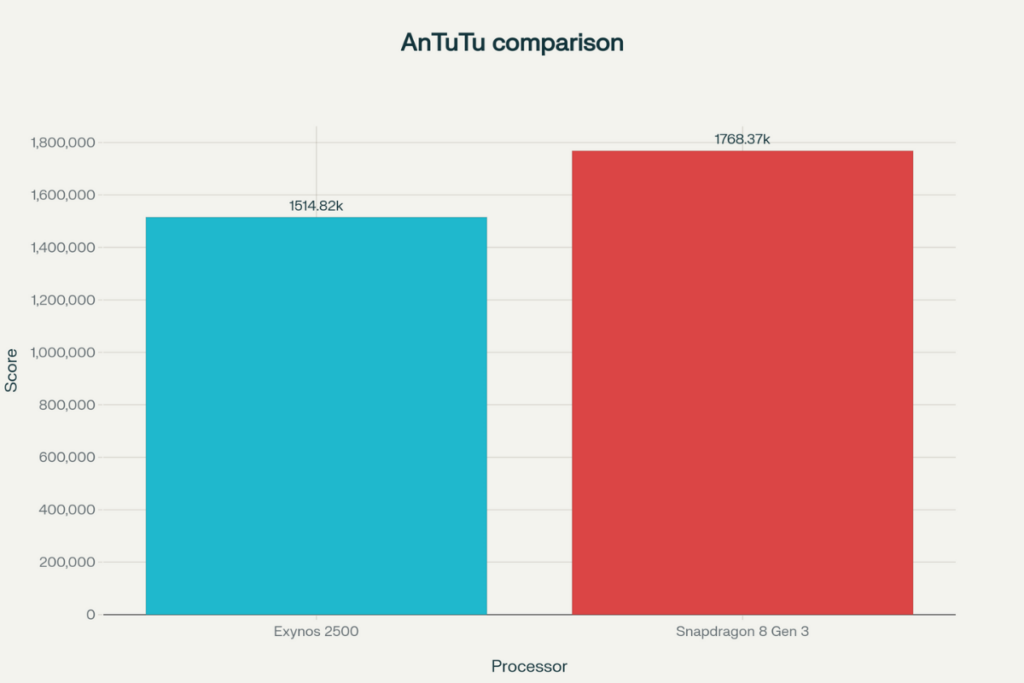
The Snapdragon 8 Gen 3 outperforms the Exynos 2500 on AnTuTu with a score of 1,768,372 vs 1,514,821, showing about a 17% overall performance lead. It leads across all key areas — CPU is 16% higher, while GPU performance is 23% better, which directly benefits gaming and graphics-heavy tasks. Memory and UX scores are also slightly in Qualcomm’s favor.
So, while the Exynos 2500 brings solid improvements over past Exynos chips, the Snapdragon 8 Gen 3 remains strong in synthetic benchmarks.
| Exynos 2500 | Snapdragon 8 Gen 3 | |
|---|---|---|
| AnTuTu score | 1,514,821 | 1,768,372 |
| CPU | 379,468 | 441,650 |
| GPU | 529,420 | 653,105 |
| Memory | 360,718 | 371,609 |
| UX | 245,215 | 302,008 |
Geekbench performance
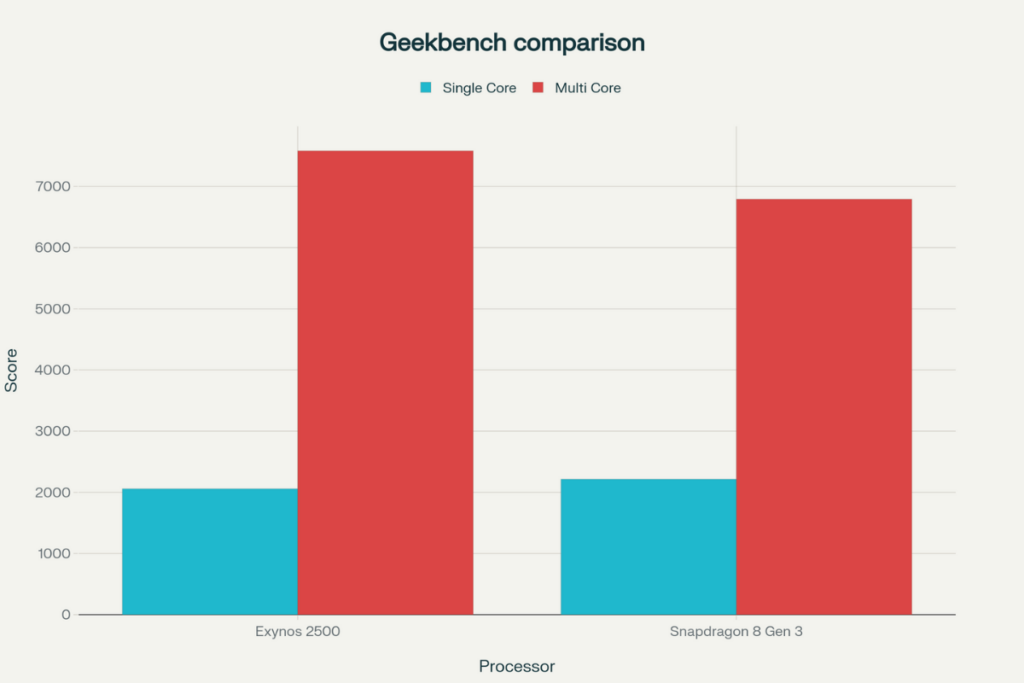
In Geekbench testing, the results show an interesting split: the Snapdragon 8 Gen 3 leads in single-core performance with a score of 2,216, about 7.7% higher than the Exynos 2500’s 2,058.
However, the Exynos 2500 fights back in multi-core performance, scoring 7,583 versus Snapdragon’s 6,791 — an 11.7% advantage. That suggests Samsung’s 10-core CPU architecture performs better in handling sustained workloads, such as multitasking, background processing, and content creation.
| Exynos 2500 | Snapdragon 8 Gen 3 | |
| Single core | 2,058 | 2,216 |
| Multi core | 7,583 | 6,791 |
While benchmark data are helpful, they don’t tell about the camera capabilities, connectivity, and other important aspects of a chip. So, let’s look at the real-world differences to get the complete picture.
Exynos 2500 vs Snapdragon 8 Gen 3: Key differences explained!
Manufacturing
The Exynos 2500 is built on Samsung’s second-generation 3nm GAA process, whereas the Snapdragon 8 Gen 3 uses TSMC’s proven 4nm process (N4P).
While Samsung’s chip uses a more advanced process node, TSMC’s 4nm process is widely regarded for its reliability and consistent performance.
CPU
The two chips greatly differ in terms of CPU. The Exynos 2500 features two additional CPU cores and uses a different set of cores.
Here’s what the Exynos 2500’s CPU looks like:
- 1x Cortex-X925 @ 3.3 GHz
- 2x Cortex-A725 @ 2.74 GHz
- 5x Cortex-A725 @ 2.36 GHz
- 2x Cortex-A520 @ 1.8 GHz
The Snapdragon 8 Gen 3 features an 8-core CPU, which includes:
- 1x Cortex-X4 @ 3.3 GHz
- 3x Cortex-A720 @ 3.15 GHz
- 2x Cortex-A720 @ 2.96 GHz
- 2 x Cortex-A520 @ 2.27GHz
On paper, the Exynos 2500 has a powerful CPU, but the AnTuTu score suggests otherwise. Geekbench, however, prefers the Exynos 2500 chip over the Snapdragon 8 Gen 3 for multi-core tasks.
GPU
The Exynos 2500 features a 4th-generation Xclipse 950 GPU, offering higher pipeline and floating-point operations per second (FLOPS) than the Adreno 750 GPU on the Snapdragon 8 Gen 3. The latter, though, has higher shading units.
The Snapdragon 8 Gen 3 also features a full range of Snapdragon Elite Gaming features, providing an enhanced gaming experience. Both chips, however, bring support for hardware ray tracing.
NPU
The Exynos chip has a powerful NPU that can run up to 59 trillion operations per second (TOPS). The on-device AI performance is 39% better than its predecessor. On the other hand, the Snapdragon 8 Gen 3 features a hexagon NPU that’s 98% better than its predecessor. Both NPUs support various LLMs and on-device generative AI.
Camera
The Exynos 2500 supports up to 320MP camera resolution and up to 8K/60fps video recording. While not going into detail, Samsung states that there’s a new ISP capable of capturing vivid images and videos in high resolution. It also features several on-device generative AI capabilities, including removing unnecessary objects and expanding the background.
The Snapdragon 8 Gen 3, on the other hand, has an 18-bit Spectra triple ISP with support for up to 200MP camera and 8K/30fps video recording. The chip offers a range of camera features, including real-time semantic segmentation, Video super resolution, Mega low-light photography, and Multi-frame Noise Reduction (MFNR).
Connectivity
The Exynos chip offers higher speeds on a 5G connection, with download speeds of up to 12.1 Gbps and upload speeds of up to 3.67 Gbps, while the Snapdragon 8 Gen 3 peaks at 10 Gbps (download) and 3.5 Gbps (upload). It also supports satellite messaging.
On the plus side, the Snapdragon chip integrates premium audio features, including aptX Lossless and XPAN, for enhanced spatial audio. Wi-Fi 7 and Bluetooth 5.4 are present on both chipsets.
Exynos 2500 vs Snapdragon 8 Gen 3: Which one should you choose?
The Exynos 2500 is a big step forward for Samsung’s in-house silicon. With a more advanced 3nm process, a 10-core CPU, improved AI performance, and support for cutting-edge camera and connectivity features, it finally feels like a competitive flagship chip — something that couldn’t always be said about past Exynos offerings.
However, when stacked up against the Snapdragon 8 Gen 3, Qualcomm’s chip still holds a lead where it matters most. It delivers stronger benchmark scores in AnTuTu, better GPU performance for gaming, and more mature software and thermal optimizations, thanks to TSMC’s rock-solid 4nm process. However, the Exynos 2500 does pull ahead in multi-core CPU performance and offers faster 5G connection speed.
So, while the Exynos 2500 narrows the gap, the Snapdragon 8 Gen 3 continues to offer a more balanced and proven performance package, particularly for users who prioritize gaming and stability.




Comments