
Add GIZMOCHINA as Preferred Source on Google
The Snapdragon 8 Elite Gen 5 is the latest flagship chipset from Qualcomm, promising serious upgrades to performance and power efficiency. It’s already stirring up excitement, but on the other hand, the Snapdragon 8 Elite is still fresh, while the Snapdragon 8 Gen 3 still powers some of today’s flagship phones.
With these three powerhouses in the mix, it might be confusing to pick the correct one based on your needs. So, we compared them to find out how Qualcomm’s Snapdragon flagships have improved over the years. Whether you’re eyeing your next upgrade or just want to know how far Qualcomm has pushed its mobile silicon this year, this comparison should provide more clarity.
Snapdragon 8 Elite Gen 5 vs 8 Elite vs 8 Gen 3: benchmark comparison
Note: For benchmark testing, we used the Xiaomi 17 (Snapdragon 8 Elite Gen 2), Xiaomi 15 (Snapdragon 8 Elite), and Xiaomi 14 (Snapdragon 8 Gen 3).
Geekbench score
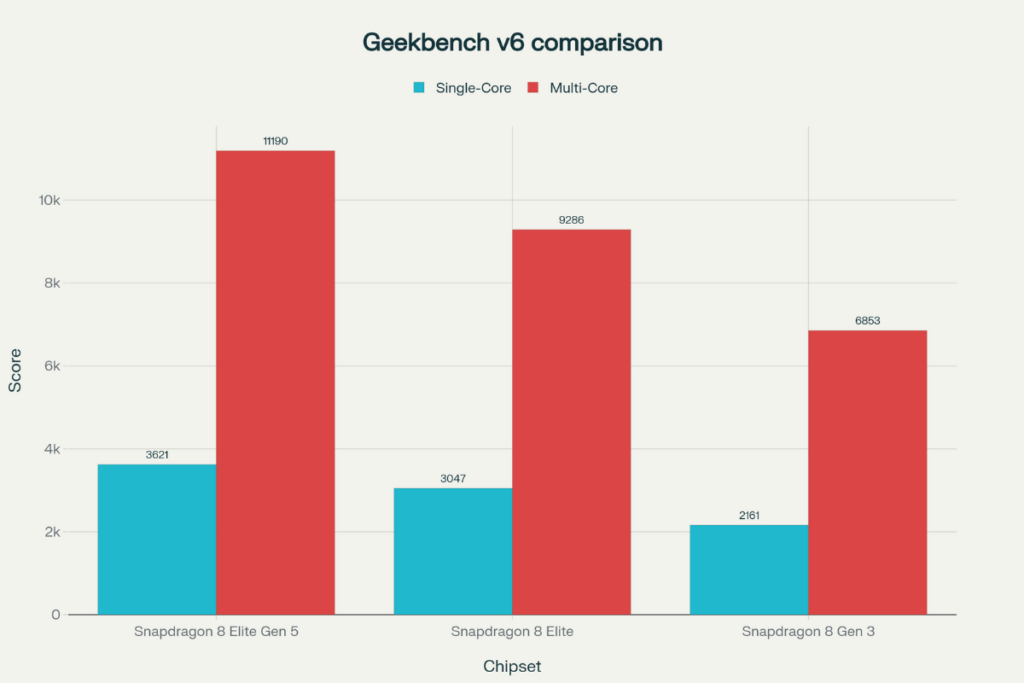
The fifth-gen Elite chipset posts a total of 3,621 single-core points, which is about 19% higher than Snapdragon 8 Elite (3,047 points) and 68% higher than the Snapdragon 8 Gen 3 (2,161 points). The increase over last year’s Elite chipset may seem modest, but that’s a massive leap over 8 Gen 3.
The multi-core performance also tells a similar story. The Snapdragon 8 Elite Gen 5 gets 11,190 multi-core points. In contrast, the Snapdragon 8 Elite gets 9,286 points, and the Snapdragon 8 Gen 3 gets 6,853 points. That’s a solid 19% increase for the latest Elite chip over 8 Elite and a massive 63% increase over 8 Gen 3.
| Geekbench 6 | SD 8 Elite Gen 5 | SD 8 Elite | SD 8 Gen 3 |
|---|---|---|---|
| Single core | 3,621 | 3,047 | 2,161 |
| Multi core | 11,190 | 9,286 | 6,853 |
AnTuTu score
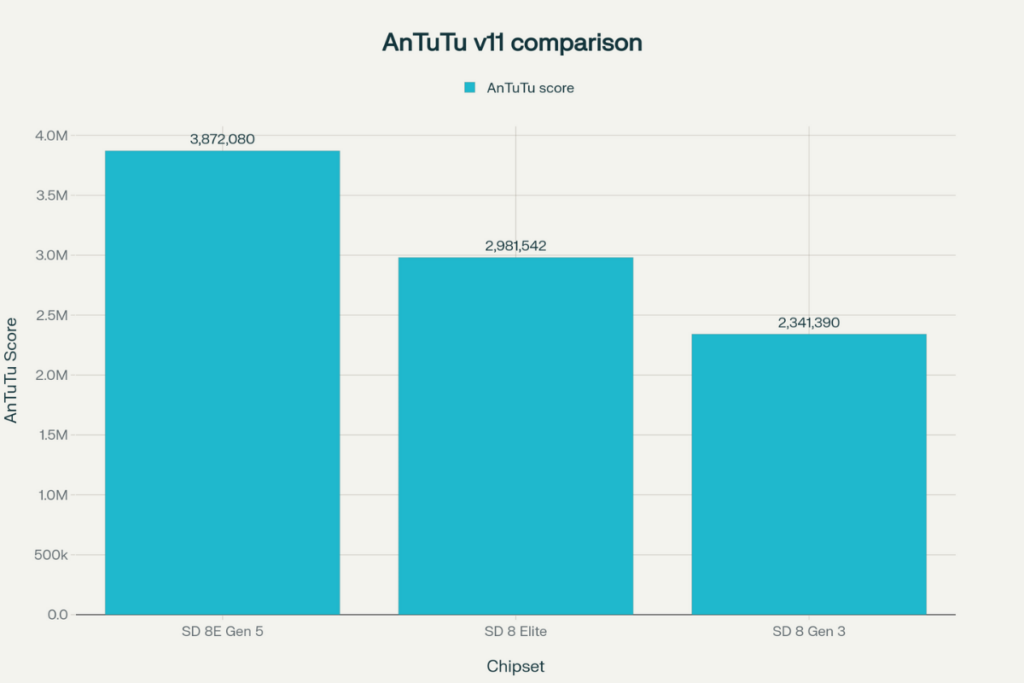
On the AnTuTu v11 benchmarking platform, the Snapdragon 8 Elite Gen 5 gets a total score of 3,872,080 points, which is about 30% higher than Snapdragon 8 Elite (2,981,542 points) and 65% higher than Snapdragon 8 Gen 3 (2,341,390 points).
The breakdown reveals that the newest Snapdragon 8-series chip gets a 21% higher CPU score over the Snapdragon 8 Elite and a 62% higher CPU score over the Snapdragon 8 Gen 3. The GPU gets an even better upgrade, with the 8 Elite Gen 5 posting a 27% boost over the 8 Elite and a 73% boost over the 8 Gen 3.
| SD 8 Elite Gen 5 | SD 8 Elite | SD 8 Gen 3 | |
|---|---|---|---|
| AnTuTu score | 3,872,080 | 2,981,542 | 2,341,390 |
| CPU | 1,100,475 | 909,797 | 679,594 |
| GPU | 1,380,010 | 1,091,509 | 798,047 |
| Memory | 533,709 | 392,463 | 353,832 |
| UX | 857,866 | 587,773 | 509,917 |
Snapdragon 8 Elite Gen 5 vs 8 Elite vs 8 Gen 3: spec sheet and key differences
| Snapdragon 8 Elite Gen 5 | Snapdragon 8 Elite | Snapdragon 8 Gen 3 | |
|---|---|---|---|
| Announced | September 2025 | October 2024 | October 2023 |
| Process node | TSMC’s 3nm (N3P) | TSMC’s 3nm (N3E) | TSMC’s 4nm |
| CPU cores | 8-core | 8-core | 8-core |
| CPU cores | 2 x 4.61 GHz — Oryon (3rd gen) 6 x 3.63 GHz — Oryon (3rd gen) | 2 x 4.32 GHz — Oryon (2nd gen) 6 x 3.53 GHz — Oryon (2nd gen) | 1 x 3.3 GHz — Cortex-X4 3 x 3.15 GHz — Cortex-A720 2 x 2.96 GHz — Cortex-A720 2 x 2.27 GHz — Cortex-A520 |
| GPU | Adreno 840 Ray tracing support Snapdragon Elite Gaming features | Adreno 830 Ray tacing support Snapdragon Elite Gaming features | Adreno 750 Ray tracing support Snapdragon Elite Gaming features |
| NPU | Qualcomm Hexagon NPU Agentic AI support | Qualcomm Hexagon NPU | Qualcomm Hexagon NPU |
| Memory | LPDDR5X, up to 5.3GHz | LPDDR5X, up to 5.3GHz | LPDDR5X, up to 4.8GHz |
| Storage | UFS 4.1 | UFS 4.0 | UFS 4.0 |
| Camera | Qualcomm Spectra ISP (20-bit) Up to 320MP single camera up to 108MP single camera (MFNR, ZSL, 30fps) Up to 48MP triple camera (MFNR, ZSL, 30fps) Up to 8K video recording real-time semantic segmentation (limitless) Advanced Professional Video (APV) codec | Qualcomm Spectra ISP (18-bit) Up to 320MP single camera up to 108MP single camera (MFNR, ZSL, 30fps) Up to 48MP triple camera (MFNR, ZSL, 30fps) Up to 8K video recording real-time semantic segmentation (limitless) | Qualcomm Spectra ISP (18-bit) Up to 200MP single camera up to 108MP single camera (MFNR, ZSL, 30fps) Up to 64+36MP dual cameras (MFNR, ZSL, 30fps) up to 36+36+36MP triple camera (MFNR, ZSL, 30fps) Up to 8K video recording real-time semantic segmentation (up to 12 layers) |
| Connectivity | Snapdragon X85 5G modem Download speed: 12.5 Gbps (peak) Upload speed: 3.7 Gbps (peak) Wi-Fi 7 (peak speed: 5.8 Gbps) Bluetooth 6.0 | Snapdragon X80 5G modem Download speed: 10 Gbps (peak) Upload speed: 3.5 Gbps (peak) Wi-Fi 7 (peak speed: 5.8 Gbps) Bluetooth 6.0 | Snapdragon X75 5G modem Download speed: 10 Gbps (peak) Upload speed: 3.5 Gbps (peak) Wi-Fi 7 (peak speed: 5.8 Gbps) Bluetooth 5.4 |
The Snapdragon 8 Elite Gen 5 uses TSMC’s 3nm (N3P) process node, which offers slightly better performance and power efficiency over TSMC’s 3nm (N3E) process node (used for the Snapdragon 8 Elite). The gap widens with TSMC’s 4nm process, used for 8th Gen 3.
The Snapdragon chips have received significant changes to the CPU. The 8 Gen 3 is the last Snapdragon 8-series chip to feature CPU cores designed by ARM. The Snapdragon 8 Elite introduced Oryon cores for the first time on a mobile chipset, which brought substantial gains to performance and power efficiency, and that got even better with the third-gen Oryon CPU inside the 8 Elite Gen 5.
Gaming has also been greatly improved over the years, thanks to newer Adreno GPUs, featuring higher performance, power efficiency, and improved latency. On top of that, Qualcomm has also improved the gaming features over the years to make Snapdragon flagships a no-brainer choice for smartphone gaming.
All three Snapdragon chips feature hexagon NPUs, but they have been greatly improved over the years to offer better performance and extended AI capabilities. The latest 8 Elite Gen 5 introduces support for Agentic AI.
The camera has also had significant upgrades over the last three generations. The 8 Gen 3 introduced a Cognitive ISP with triple 18-bit ISPs and focused on AI-driven photography. The 8 Elite took it a step ahead by introducing AI ISP. The latest 8 Elite Gen 5 introduces triple 20-bit AI ISPs and Advanced Professional Video (APV) codec for near-lossless video. The real-time semantic segmentation and video recording capabilities have also greatly improved year over year. The same goes for connectivity, as the newer modems feature increased download/upload speed, newer Bluetooth standards, and improved connectivity features.




Comments