
Add GIZMOCHINA as Preferred Source on Google
Huawei Mate 80 Pro and Google Pixel 9 Pro represent two very different flagship philosophies, making this comparison especially relevant for buyers choosing between cutting-edge hardware innovation and long-term software reliability. These phones attract power users, mobile photographers, and anyone seeking a premium experience with distinct ecosystem strengths. Comparing them matters because each excels in areas the other approaches differently, helping buyers decide whether they prefer Huawei’s fast-evolving hardware-first strategy or Google’s polished, software-driven consistency.
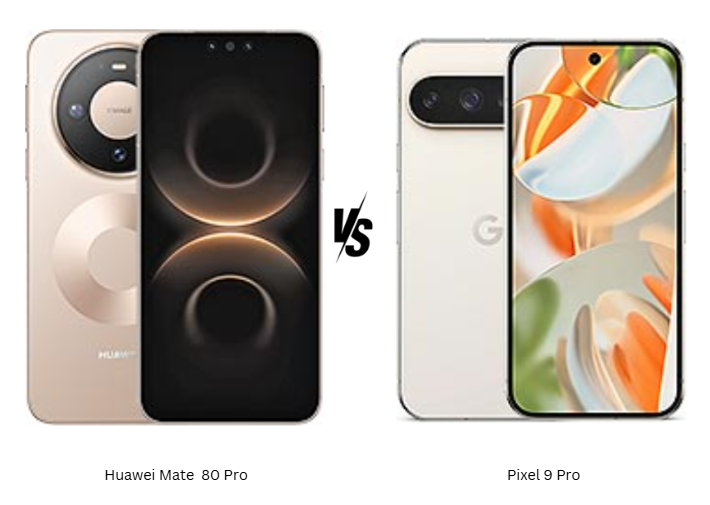
1. Design and Display
Build and Feel
Huawei’s Mate 80 Pro arrives as a newer flagship with a tougher overall construction, offering high-grade durability and a more modern materials mix. Its side-mounted biometrics and fiber-backed finish give it a firmer, more confident hand feel. The Pixel 9 Pro sticks to its familiar glass-and-metal approach, but its cleaner shape and more refined build still feel premium. Pixel’s design leans minimalistic, while Huawei feels engineered for rugged long-term use, especially with its higher water-resistance rating.
Display Quality
Huawei’s LTPO OLED delivers richer motion handling thanks to high-frequency PWM and HDR Vivid certification, creating a more comfortable viewing experience. Pixel counters with stronger peak brightness and excellent color accuracy, ideal for outdoor readability. Despite being older, Pixel’s tuning remains one of the most balanced in the segment.
Verdict
Huawei’s display feels more advanced overall, while Pixel prioritizes brightness and color precision. Those wanting a fresher design approach may lean toward Huawei; those seeking calibrated accuracy may prefer Pixel.
2. Specifications
Performance
The Mate 80 Pro uses Huawei’s latest Kirin 9030 series chipsets, giving it an efficiency boost that reflects its newer-generation architecture. Everyday operations feel smoother due to HarmonyOS optimizations. Pixel’s Tensor G4 delivers strong on-device AI and camera computation, but as a 2024 chipset, it lacks the raw efficiency gains newer silicon tends to bring. Still, Pixel’s software longevity, up to seven major Android upgrades, makes it appealing for long-term use.
Battery and Charging
Huawei easily dominates charging and endurance with a significantly larger cell and extremely fast wired and wireless speeds. Pixel provides respectable endurance, but its charging system feels conservative next to Huawei’s rapid power delivery and advanced reverse charging features.
Verdict
For power users and heavy multitaskers, Huawei feels clearly more future-ready. Pixel’s strength lies in long-term software support rather than hardware muscle.
3. Camera
Main and Secondary Lenses
Huawei’s camera system leans heavily on variable aperture flexibility and strong periscope optics, delivering more consistent low-light and portrait depth control. Its color accuracy has also improved, giving images a more natural dynamic range. Pixel 9 Pro offers excellent computational photography with 5x optical zoom and features like Zoom Enhance and Pixel Shift.
While Huawei relies more on hardware upgrades, Pixel compensates through software brilliance, though being a 2024 model, its hardware now faces stiffer competition from Huawei’s newer sensor tuning.
Selfie Camera
Huawei’s dual-module setup with TOF depth sensing gives it superior facial mapping and more reliable autofocus. Pixel’s high-resolution 42MP shooter produces sharper selfies with excellent skin tones, making it better for social media clarity.
Verdict
Huawei feels more versatile for mixed lighting and telephoto precision, while Pixel still leads in natural processing and selfie sharpness.
4. Pricing
Huawei positions the Mate 80 Pro at around $900, offering newer hardware, faster charging, and a more advanced camera system at a lower launch price. Pixel 9 Pro, at roughly $1000, costs more despite using a 2024 chipset and slower charging options.
However, Google’s extensive update roadmap adds long-term value, particularly for users who prioritize software stability and global app compatibility. Huawei’s appeal is stronger for buyers seeking cutting-edge hardware per dollar, while Pixel caters to those who value ecosystem consistency and premium computational photography.
Disclaimer:
Prices are approximate and may vary based on country, region, and applicable taxes.
5. Conclusion
Huawei stands out with satellite messaging (regional), ultra-fast charging, variable aperture optics, and high-frequency PWM for eye comfort. Its position as the newer device gives it clear hardware advantages.
Pixel counters with unmatched software support, UWB capabilities, polished computational photography, and reliable global services, areas where Huawei’s ecosystem remains more region-dependent.
Verdict
Huawei Mate 80 Pro feels like the stronger hardware-focused choice, offering more innovation at a lower price. Google Pixel 9 Pro remains the better pick for users prioritizing long-term updates, stable Google services, and computational imaging finesse.
Both are excellent, but the Mate 80 Pro feels more forward-leaning, while the Pixel maintains a premium, consistent experience. If you travel internationally or rely heavily on Google services, Pixel 9 Pro is the safer and more convenient choice. Huawei makes sense mainly if you stay within regions where its ecosystem is fully supported.
Read More:


Comments