Huawei Mate 80 series attracts buyers ranging from everyday users to power-focused enthusiasts, making it essential to understand how each model differs. With the Mate 80, Mate 80 Pro, and Mate 80 Pro Max targeting slightly different needs, this comparison helps buyers choose the version that delivers the best balance of performance, value, and premium features. Whether someone wants a budget-conscious option, a performance upgrade, or a full flagship experience, comparing these three models ensures they pick the one that truly matches their priorities.
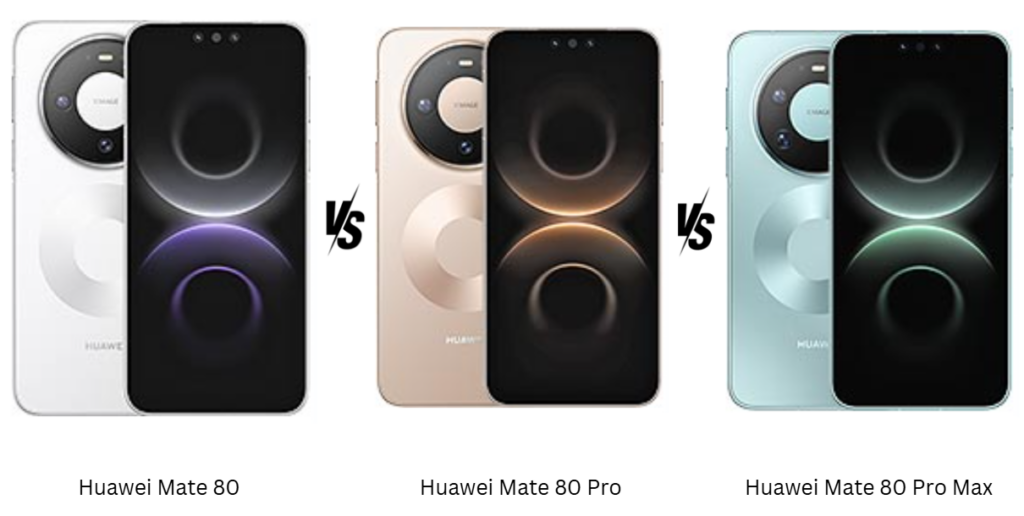
Mate 80 vs Mate 80Pro vs Pro Max: Quick Comparison
All three Mate 80 models share a rugged IP68/IP69 build with premium materials, but the Pro Max introduces a more robust metal-backed design that feels notably higher-end. The Mate 80 and Mate 80 Pro look nearly identical, though the Pro subtly feels more refined due to its upgraded camera housing and overall finish. The Pro Max stands out as the most luxurious, appealing to users who want a flagship presence with added durability.
Display Quality
The Mate 80 and Mate 80 Pro use the same LTPO OLED panel with smooth 120Hz refresh and HDR Vivid support. The Pro Max upgrades the experience with a larger screen and a massive 8000-nit peak brightness, giving it a clear edge outdoors and in HDR playback. It’s slightly higher resolution also makes visuals appear richer. Between the Mate 80 and Pro, the display experience stays largely unchanged.
Verdict
For the best viewing upgrades, the Pro Max is the meaningful step up. Those satisfied with a premium display without extreme brightness will find the Mate 80 and Mate 80 Pro equally capable.
2. Specifications
Performance
The Mate 80 runs on the Kirin 9020, while the Mate 80 Pro upgrades to the newer Kirin 9030 series with a stronger CPU cluster and a more advanced Maleoon 935 GPU. This results in snappier multitasking and improved gaming smoothness on the Pro models. The Pro Max mirrors the Pro’s chipset but benefits from higher-end configurations and better sustained performance thanks to its enhanced thermal design. Users seeking heavier productivity or graphics workloads will notice the Pro and Pro Max pushing ahead comfortably.
Battery and Charging
The Mate 80’s charging peaks at 66W wired and 50W wireless, which feels adequate but noticeably behind the Pro and Pro Max. Both upgraded models support 100W wired and 80W wireless charging, making them far more convenient for fast top-ups. The Pro Max adds another upgrade with its larger 6000mAh battery, giving it significantly better endurance.
Verdict
The Mate 80 suits everyday workloads, but the Mate 80 Pro and Pro Max deliver clear upgrades in power and charging efficiency, with the Pro Max offering the strongest balance overall.
3. Camera
Main and Secondary Lenses
The Mate 80 starts strong with a capable triple camera system, but the Mate 80 Pro improves zoom performance through a higher-resolution 48MP telephoto lens with better stabilization. Image sharpness and low-light clarity see noticeable upgrades. The Mate 80 Pro Max takes the biggest leap with a quad-camera system including dual periscope lenses, one for mid-range and one for long-range zoom, resulting in more versatile framing and cleaner detail at extended distances. This setup clearly caters to users who prioritize advanced mobile photography.
Selfie Camera
All three models share the same 13MP ultrawide selfie camera paired with a TOF 3D sensor, meaning the front-facing experience remains consistent. The Pro and Pro Max, however, benefit from enhanced image processing thanks to the updated chipset, giving selfies a slightly more refined look.
Verdict
The Mate 80 Pro brings meaningful zoom and processing upgrades, while the Pro Max represents the biggest generational jump, especially for telephoto performance.
4. Pricing
The Mate 80 enters at around $700 and offers strong value, but the $900 Mate 80 Pro adds upgrades in performance, zoom capabilities, and charging that justify the higher tier. The Mate 80 Pro Max, priced at nearly $1100, firmly pushes into ultra-premium territory with clear improvements in screen brightness, advanced camera hardware, and battery capacity.
Each model aligns with a different user segment, but the value-per-upgrade ratio grows more niche as you move up the ladder.
Disclaimer: Prices are approximate and may vary based on country, region, and applicable taxes.
Verdict
The biggest jump in meaningful upgrades comes from Mate 80 to Mate 80 Pro. The Pro Max is best for users who want every possible enhancement, especially display brightness and telephoto versatility.
5. Conclusion
All three phones share HarmonyOS 6, satellite messaging (China-only), and premium durability, but the upgrades become clearer as you move upward. The Mate 80 Pro adds faster silicon, better zoom, and faster charging, making it a balanced upgrade. The Pro Max extends these gains further with a brighter display, larger battery, and a unique dual-telephoto system that dramatically improves shooting flexibility. Each step up introduces meaningful improvements rather than cosmetic ones, giving users clear choices based on their priorities.
Verdict
Choose the Mate 80 for value, the Mate 80 Pro for the best upgrade-per-dollar, and the Mate 80 Pro Max if you want Huawei’s most complete flagship experience. Honestly, Mate 80 Pro offers the best upgrade-for-price balance, while the Pro Max is ideal only if you want Huawei’s most advanced camera and display package.
We use cookies on our website to give you the most relevant experience by remembering your preferences and repeat visits. By clicking “Accept”, you consent to the use of ALL the cookies.
This website uses cookies to improve your experience while you navigate through the website. Out of these, the cookies that are categorized as necessary are stored on your browser as they are essential for the working of basic functionalities of the website. We also use third-party cookies that help us analyze and understand how you use this website. These cookies will be stored in your browser only with your consent. You also have the option to opt-out of these cookies. But opting out of some of these cookies may affect your browsing experience.
Necessary cookies are absolutely essential for the website to function properly. This category only includes cookies that ensures basic functionalities and security features of the website. These cookies do not store any personal information.
Any cookies that may not be particularly necessary for the website to function and is used specifically to collect user personal data via analytics, ads, other embedded contents are termed as non-necessary cookies. It is mandatory to procure user consent prior to running these cookies on your website.



Comments