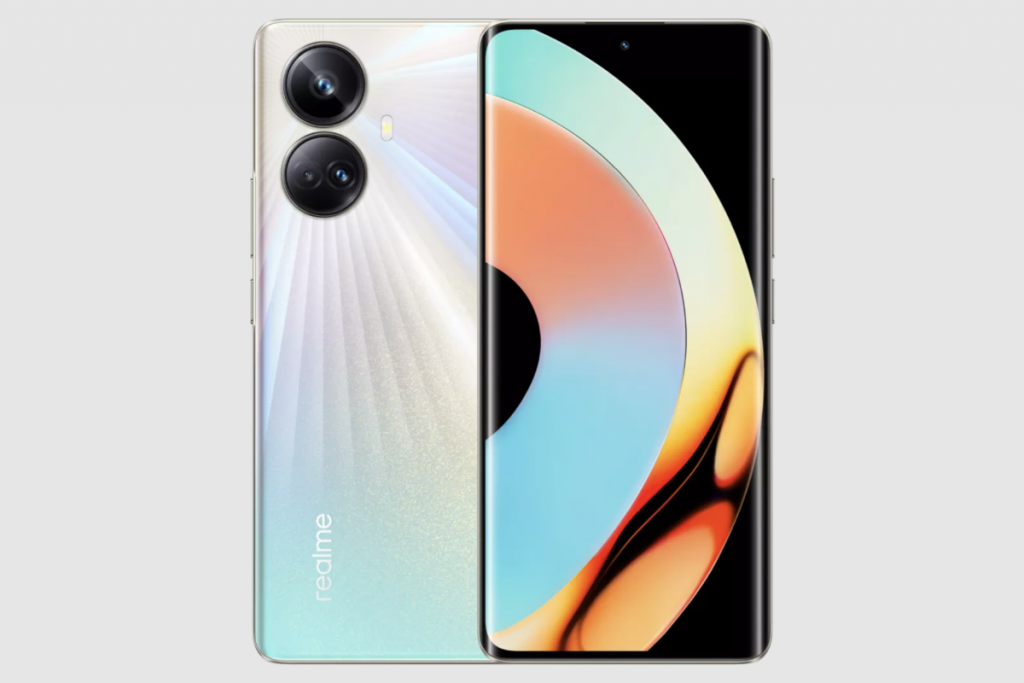
Last week, Realme launched the Realme 10 Pro series in the Chinese market. The lineup consists of the Realme 10 Pro and the Realme 10 Pro+. Out of the two, the 10 Pro+ is undeniably the most attractive one as it is the first device in the company’s numbered lineup to feature a curved-edge AMOLED display.
The device is yet to reach international markets like Asia and Europe. The Indian launch was recently teased by the brand via Twitter. Now, Weibo tipster 肥威 has shared the camera hardware specifics of the Realme 10 Pro+.
As we know, the 10 Pro+ features a 108-megapixel (main) + 8-megapixel (ultra-wide) + 2-megapixel (macro) triple camera unit. The tipster adds to this information by revealing that the 108MP sensor on the device is a Samsung HM6 sensor, while the ultrawide lens is an IMX355 and the macro camera has the GC02 sensor.
Additionally, the tipster also informs that the curved-edge AMOLED panel is from the China-based display manufacturer Tianma.
Realme 10 Pro+ specs
The Realme 10 Pro+ features a 61° curved-edge AMOLED panel, with FHD+ resolution, a 120Hz refresh rate, 2160Hz PWM dimming, and an under-display fingerprint scanner. It has a Dimensity 1080 at its heart, accompanied by up to 12 GB of LPDDR4x RAM and up to 256 GB of UFS 2.2 storage.
The Realme 10 Pro+ ship with Android 13 OS preinstalled, which is layered with the current Realme UI 4.0. A 5,000mAh battery complemented by 67W fast charging powers the device. For connectivity, the device features a USB-C port, dual SIM support, 5G, Wi-Fi 802.11ac, Bluetooth 5.1, GPS, and NFC.
Which brand will launch the first Snapdragon Gen 2-powered gaming phone? The expected candidates include the Redmi K60 Gaming, Red Magic 8 series, ASUS ROG 7 series, and Black Shark 6 series. The K60 Gaming is expected to debut in February 2023. While there is no word on expected launch timeframe for the ROG 7 series, the Black Shark 6 series is likely to arrive by the end of Q1. A new development suggests that the Red Magic 8 Pro may debut soon as the world’s first Snapdragon 8 Gen 2 phone.
A new Nubia device with model number NX729J has been certified by the TENAA authority of China. The same device has been spotted at the Bluetooth SIG authority with the Red Magic 8 Pro moniker.
[envira-gallery id=’497129′]
Usually, devices are known to debut around one month after their appearance in Bluetooth SIG’s database. Hence, it is likely that the Red Magic 8 Pro may debut as early as December this year in China. Hence, it appears that the Red Magic 8 series may debut earlier than its predecessor, the Red Magic 7 lineup, which was announced in February 2022.
At present, there is no information on the specifications of the Red Magic 8 Pro. Being a gaming phone, the device is equipped with a high refresh rate display and a big battery with fast charging support.
The Red Magic 7S Pro is the last gaming phone from Nubia. It has a 6.8-inch AMOLED FHD+ 120Hz display, a Snapdragon 8 Plus Gen 1 chipset, 18GB of RAM, 1TB of storage, and a 5,000mAh battery with 135W charging. The global edition of the device supports 65W charging. It has a 16-megapixel front camera and a 64-megapixel (main) + 8-megapixel (ultra-wide) + 2-megapixel (macro) triple camera unit.
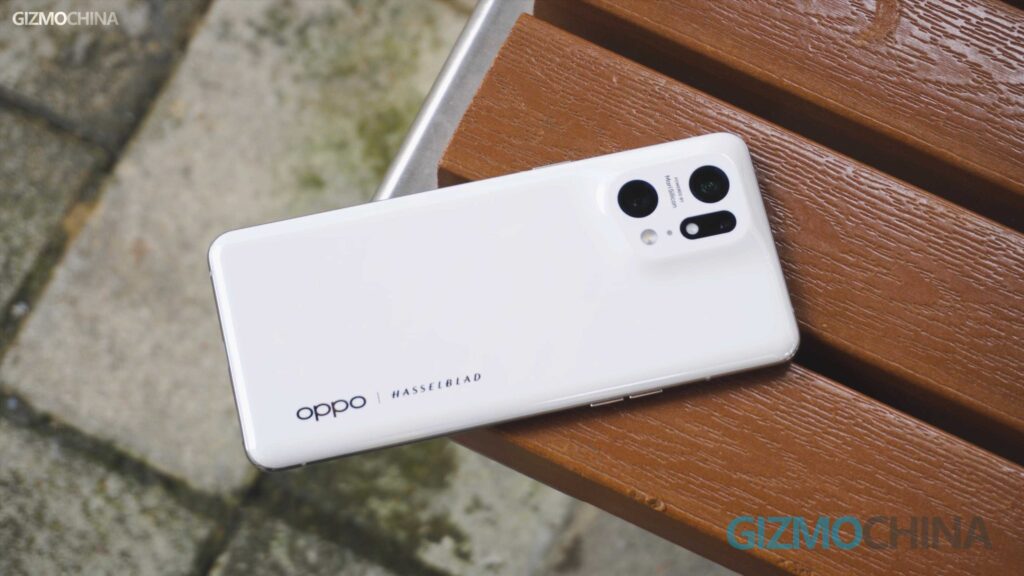
Earlier this month, a report revealed the majority of the specifications of the upcoming Oppo Find X6 Pro flagship smartphone. Currently, there is no news on the launch timeline of the smartphone, however, more detailed leaks have started to emerge, meaning that it could debut sooner rather than later.
The latest leak comes from popular Weibo tipster DCS (via), which details the camera hardware specs of the Oppo Find X6 Pro. According to the tipster, the device will use a Sony IMX 989 1-inch sensor with a 7P lens and OIS for the primary camera. A Sony IMX890 sensor will be housed in the ultrawide module, while a Sony IMX890 lens with 2.7x optical zoom and OIS is anticipated to be housed in the third module. In order to aid in-depth mapping, Oppo will also include a ToF (time of flight) sensor.
Previous leaks have revealed that the device will feature a 6.7-inch display, which will be an E6 OLED panel with 2K resolution and 120Hz refresh rate. The front would also house a 32-megapixel selfie shooter. All three cameras on the rear will have 50-megapixel resolutions.
Under the hood, we can expect a Qualcomm Snapdragon 8 Gen 2 chipset. However, going by Oppo’s recent trends, there could also be a Dimensity version of the device housing the latest Dimensity 9200 chipset. Up to 8GB or 12GB of RAM and either 128GB, 256GB, or 512GB of internal storage are expected to be offered on the Find X6 Pro.
On the software front, we can expect an Android 13-based operating system layered with ColorOS 13 on top. The device will also be powered by a large 5,000mAh battery pack that supports 100W fast charging and 50W wireless charging as well.
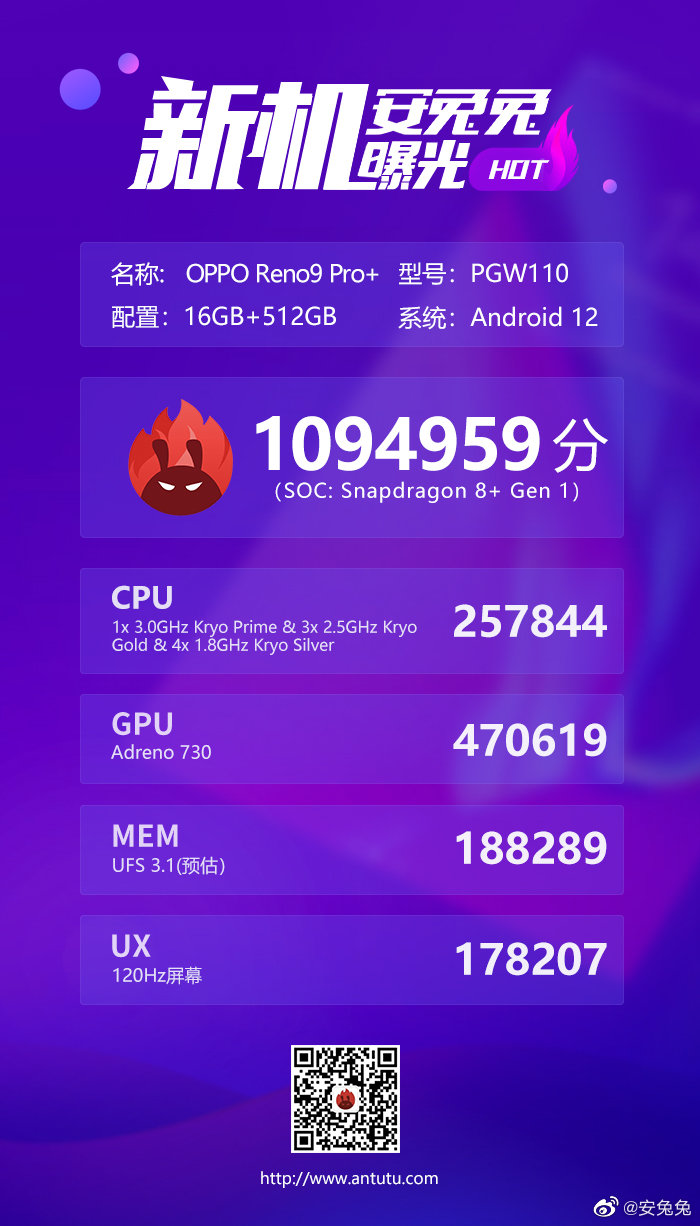
Oppo Reno 9 series will be unveiled this Thursday (Nov. 24) in China. Today, the company released a couple of posters to reveal the key features of the Reno 9 Pro+. At the same time, the AnTuTu listing of the device has appeared (via. TechGoing) to reveal key information about the phone’s processor.
The Reno 9 Pro+ posters show that it is powered by the Snapdragon 8 Plus Gen 1 mobile platform. To recall, the SD8+G1, built with TSMC’s 4nm process, was introduced as a faster and more power-efficient version of the Snapdragon 8 Gen 1, which was manufactured by Samsung. The SD8G1 has a 3.00GHz Cortex-X2 prime core, whereas the newer Plus edition of the chip has a 3.19GHz Cortex-X2 prime core.
The official posters further show that the device has 16GB of LPDDR5 RAM, 256 GB of UFS 3.1 storage, and ColorOS 13.
The model number of the Reno 9 Pro+ is PGW110. The device was recently spotted at Geekbench with a 3.0GHz Snapdragon 8-series chip, which gave birth to rumors that it could be equipped with the SD8G1. However, the AnTuTu listing shown confirms that the Reno 9 Pro+ has the Snapdragon 8 Plus Gen 1 chip with a 3.0GHz Cortex-X2 prime core. This indicates that the phone is equipped with a low-frequency version of the SD8+G1.
OPPO Reno 9 Pro Plus AnTuTu listing
While the Geekbench listing revealed that the device has Android 13 onboard, its AnTuTu appearance reveals that it runs on the Android 12 OS. The listing further reveals that the device has a 120Hz display, 16 GB of RAM, and 512 GB of UFS 3.1 storage. The device recorded an impressive score of 1,094,959 on AnTuTu benchmarks.
Other reports have revealed that the Reno 9 Pro+ will come with a 4,700mAh battery, which will support 80W charging. For photography, it will feature an autofocus-enabled 32-megapixel front camera and a 50-megapixel (Sony IMX890, with OIS) + 8-megapixel (ultra-wide) + 2-megapixel (macro) triple camera unit.
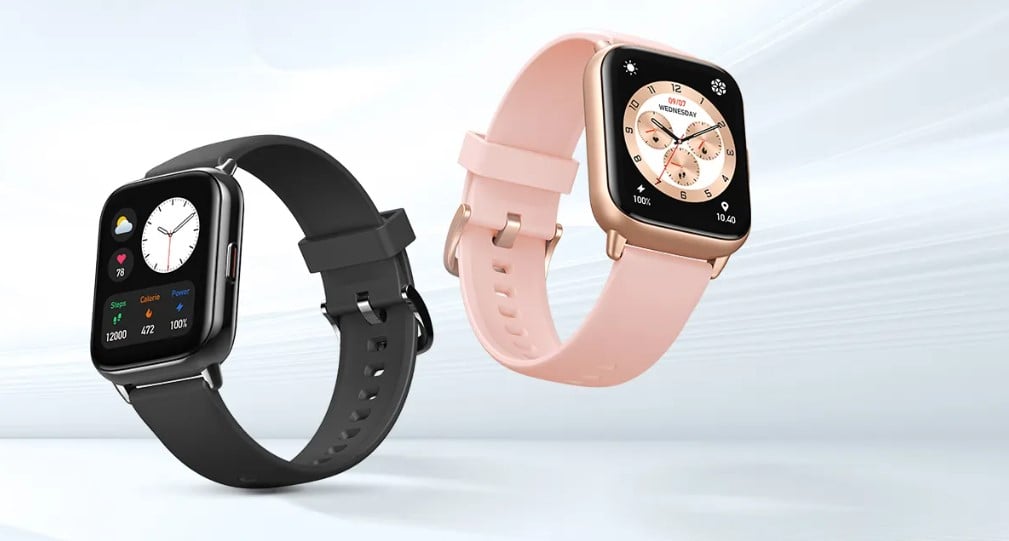
Last week, Amazfit unveiled the POP 2 smartwatch, which is its latest budget-oriented offering in India. The smartwatch is priced below Rs 4,000 and competes with the likes of the Noise ColorFit Pro 4, Realme Watch 3 Pro, OnePlus Nord Watch, etc. Now, the smartwatch will finally be available to purchase via online channels. So, let’s take a look at the pricing & offers.
Amazfit POP 2 Pricing & availability
The Amazfit POP 2 costs Rs 3,999, but it will be available for Rs 3,299 from Flipkart and the brand’s official website for an initial period. It will go on sale at 12 PM today (November 22). The smartwatch is available in two colors: black and pink.
Amazfit POP 2 specs & features
The Amazfit POP 2 has a square dial with a 1.78-inch HD quality AMOLED display. It provides 150+ customizable watch faces and an always-on display. The smartwatch has a 5-meter water resistance rating and a body made of aluminum alloy with a button on the right side.
The Amazfit POP 2 has a heart rate monitor, SpO2 sensor, sleep tracker, and inactive reminder on the health-related front. The watch can track more than 100 different sports modes.
For Bluetooth phone calls, the Amazfit POP 2 has a built-in speaker and microphone. Additionally, it has a built-in voice assistant. Both the camera shutter and audio playing can be controlled by users. The smartwatch also provides notifications for social media, weather, calendar reminders, and other things. A 270mAh battery that powers the wearable device is said to last 10 days on a full charge. It features Zepp OS out of the box and supports Bluetooth 5.2.
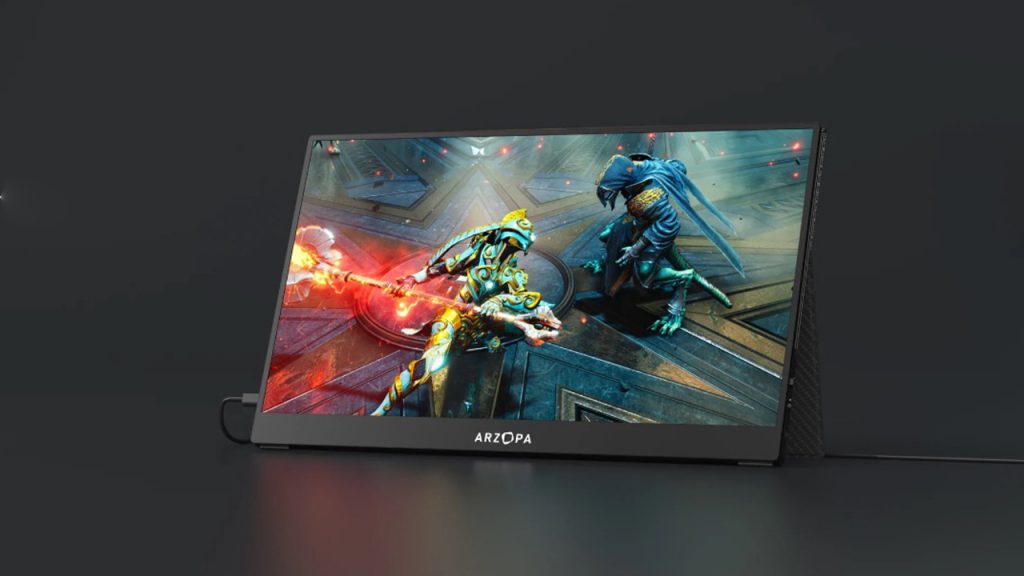
Hello guys, I want to show you an attractive portable monitor, the Arzopa G1. It has a 15-inch-sized panel with up to 144Hz high refresh rate support. If you’re a gamer or creator, you’ll love it, so let’s get right to the point.
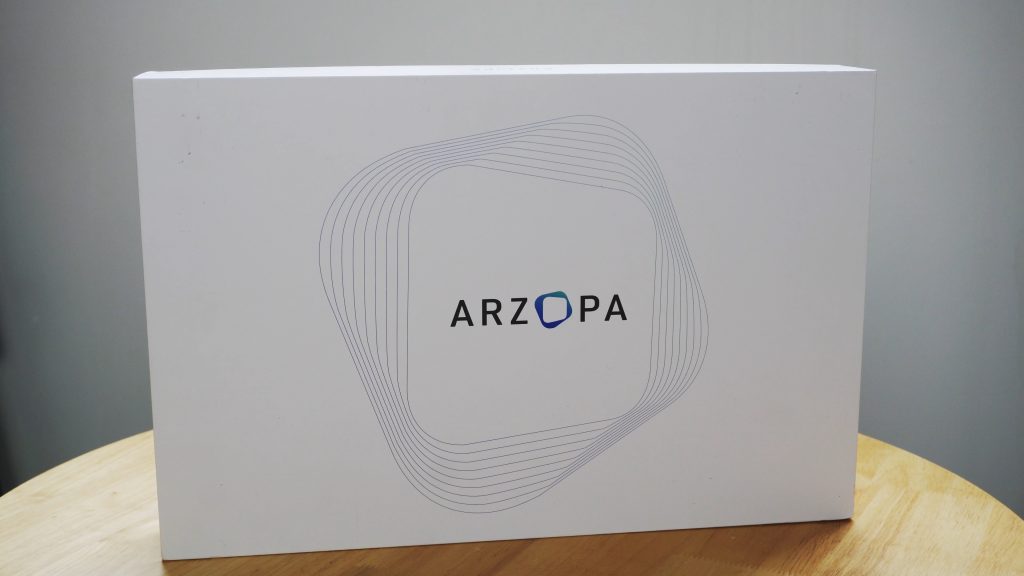
The package is almost the same as the Arzopa A1 that we reviewed before. It’s so compact that you may not imagine that there is a 15.6-inch monitor inside.
In addition to the monitor, we also get an HDMI To Micro HDMI cable, a USB-C cable, and a power adapter.
And it also thoughtfully comes with a cloth for cleaning the screen.
The G1 monitor looks pretty much like its predecessor. We can see a magnetic cover is already attached to the Arzopa G1 Game edition out of the box.
It’s pretty easy to remove it with the magnetic attachment. But here I prefer to attach it to the monitor for better screen protection.
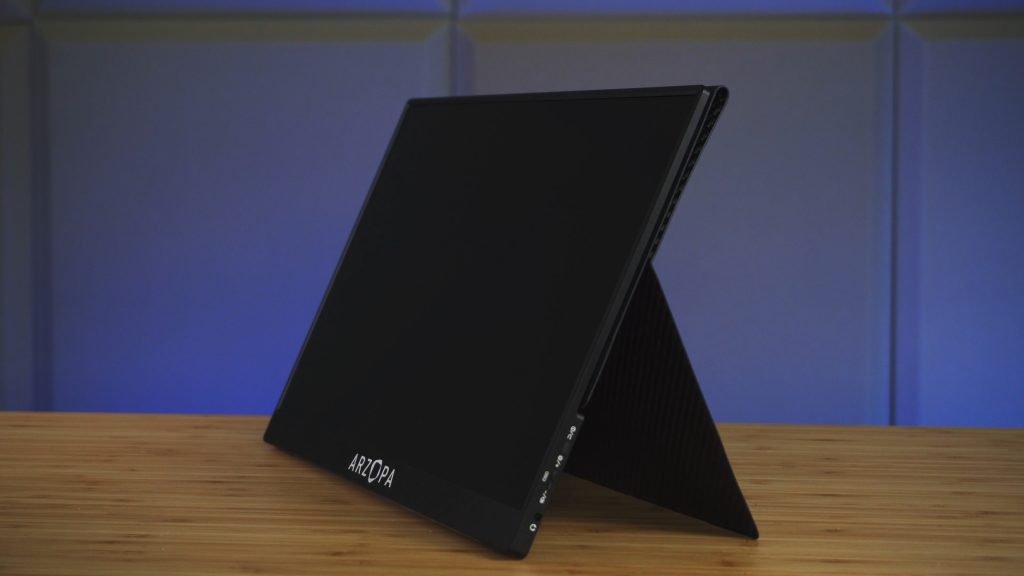
When you place it on the ground or table, it can be turned into a holder for the screen. And you can freely adjust the angle to get the best viewing.
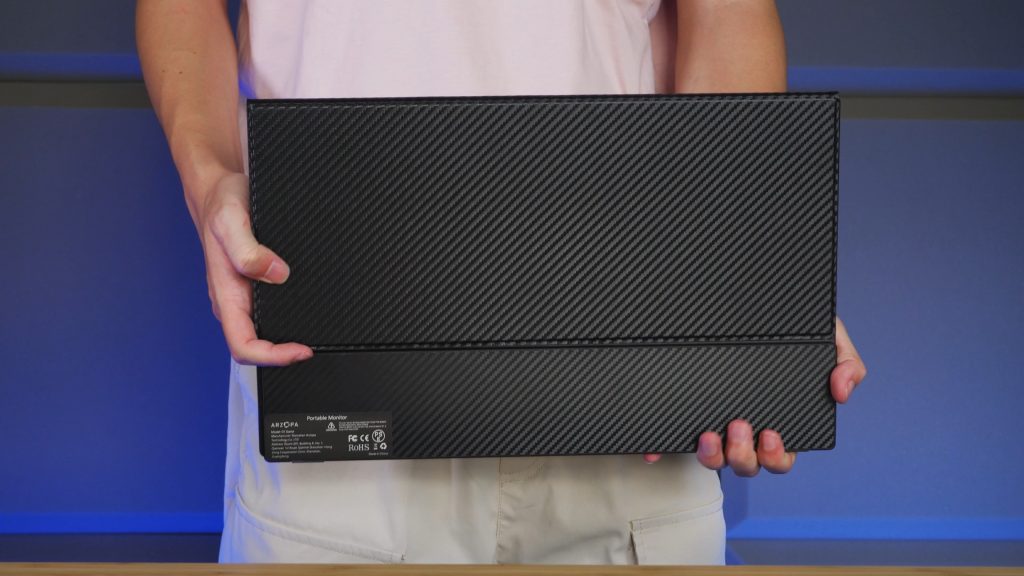
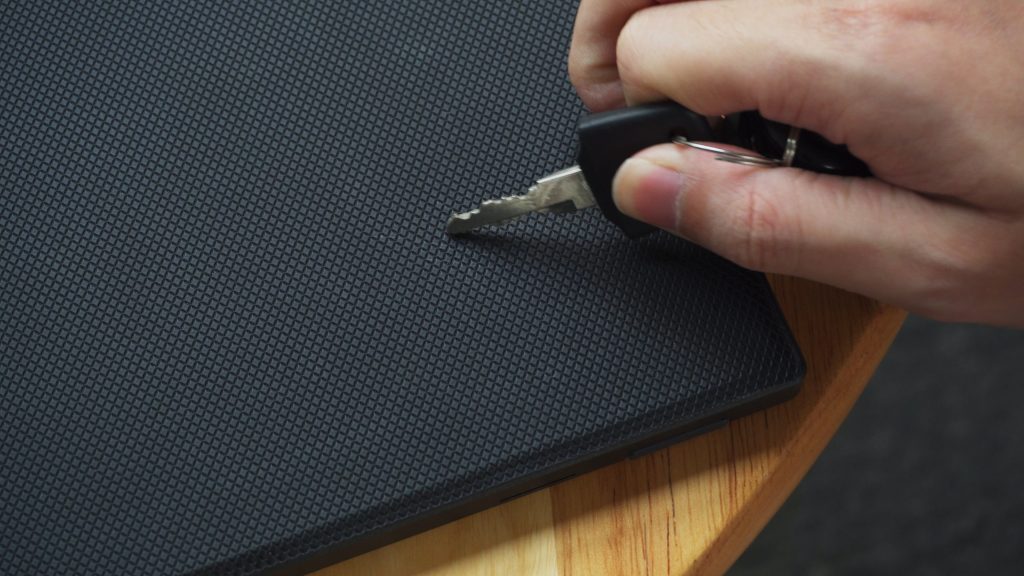
It looks fine when attached to the Arzopa G1 Game monitor. The carbon fiber texture feels special and protects the monitor well, especially when you put it together with other sharp objects.
The monitor is wrapped in a middle frame made of aluminum, making it feel solid and durable. It’s also lightweight at about 600g and only 0.3 inches thick at the thickest part of the body.
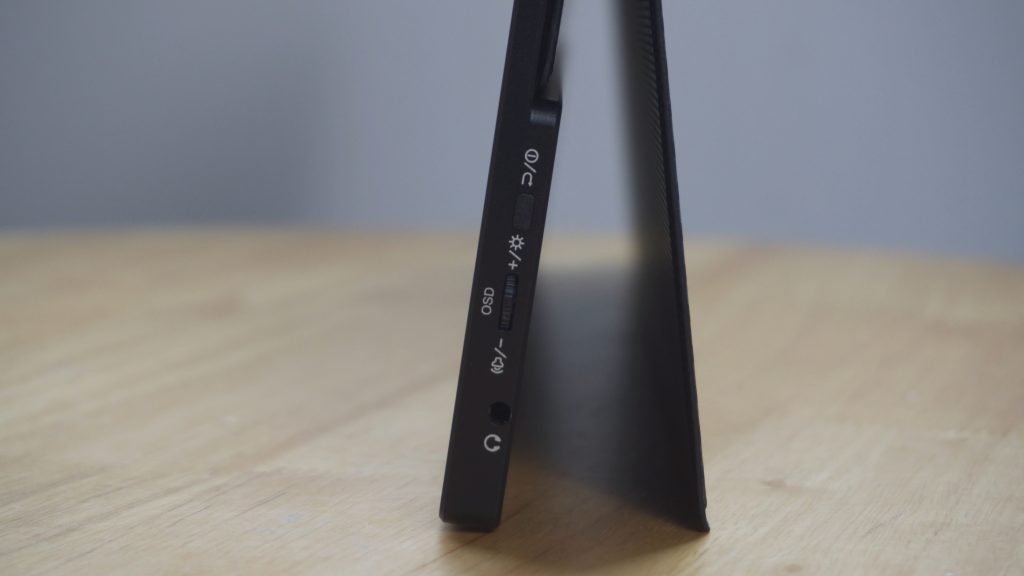
On the right side, we have a 3.5mm headphone jack, and a scrolling wheel that adjusts the brightness and volume of the built-in speaker. It can be pressed for option selection as well as waking OSD manual and then we have another 2-in-1button that controls the power and works as a back button.
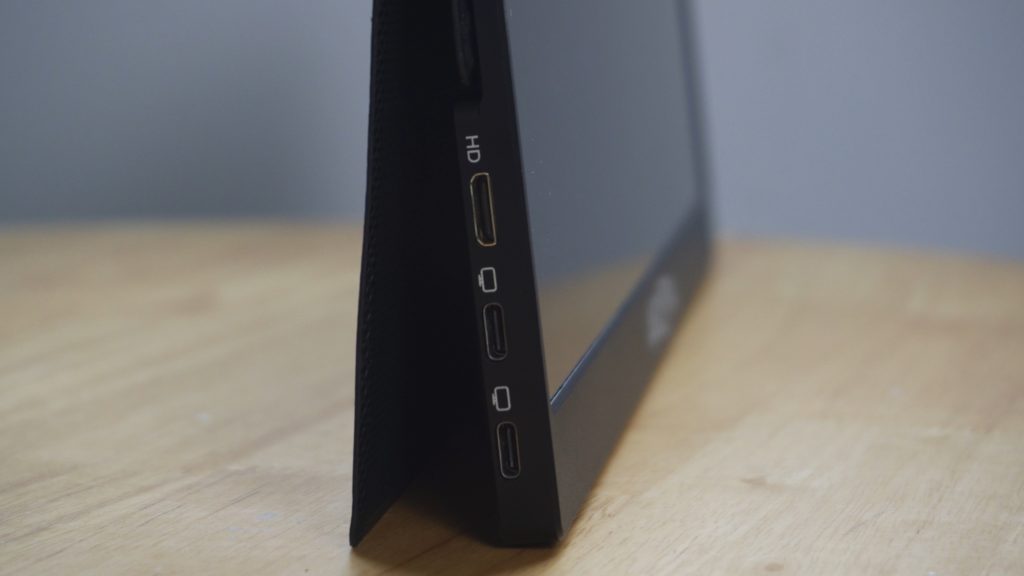
On the opposite side, we can see there are two USB-c ports, one for video-in to connect devices like laptops and phones, and the other one for the power connector. And there’s also a mini HDMI port for devices that only support HDMI connection.
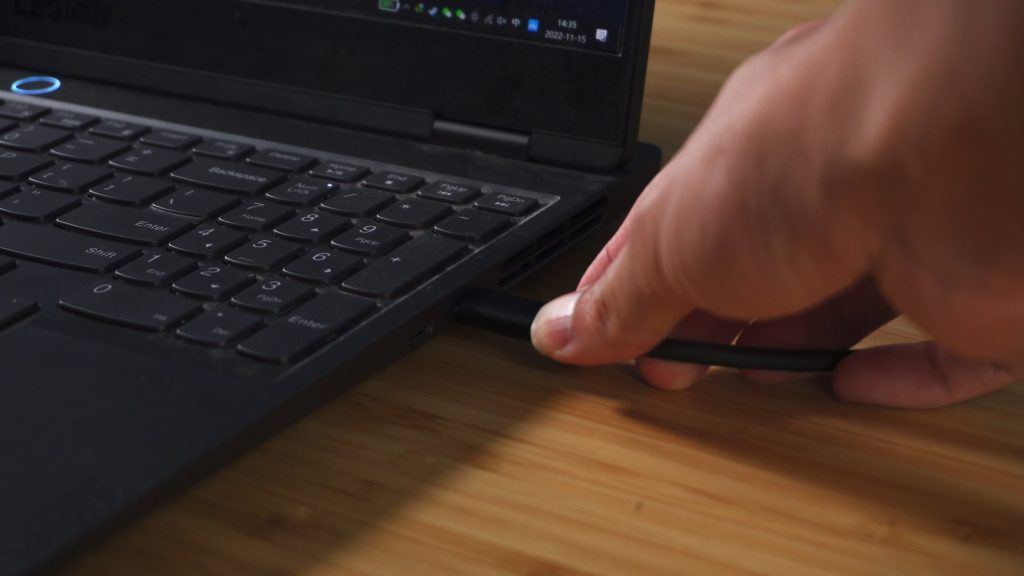
The display doesn’t equip a built-in battery, but this doesn’t mean that it must have a separate power supply. For example, if you want to connect it to your laptop via a single thunderbolt port, or a USB 3.2 port or above, it can provide a stable power supply separately while transmitting video signals. Then you will find that even if the monitor doesn’t need an extra power supply, it can still work correctly because the monitor requires really low power consumption.
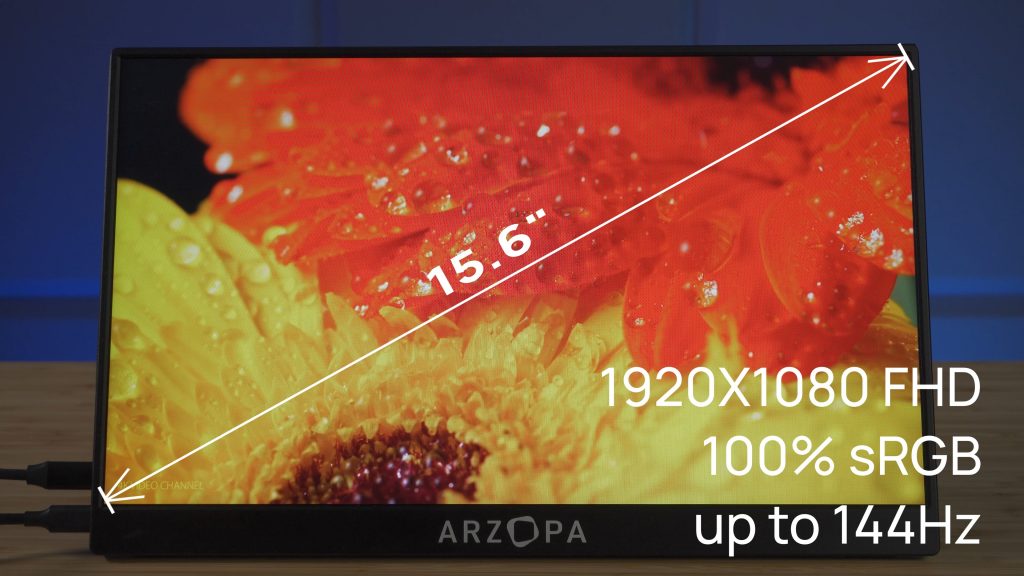
Now let’s talk about some key specs of the monitor, the Arzopa G1 comes with a 15.6-inch FHD screen, a size even larger than many laptops, and thanks to the FHD resolution, the contents displayed on the monitor are very sharp.
More importantly, the monitor’s maximum brightness is close to typical laptop screens, which reach up to 300nit. Considering that you may use it on the go, the Arzopa G1’s panel looks fine outdoors with fewer reflections.
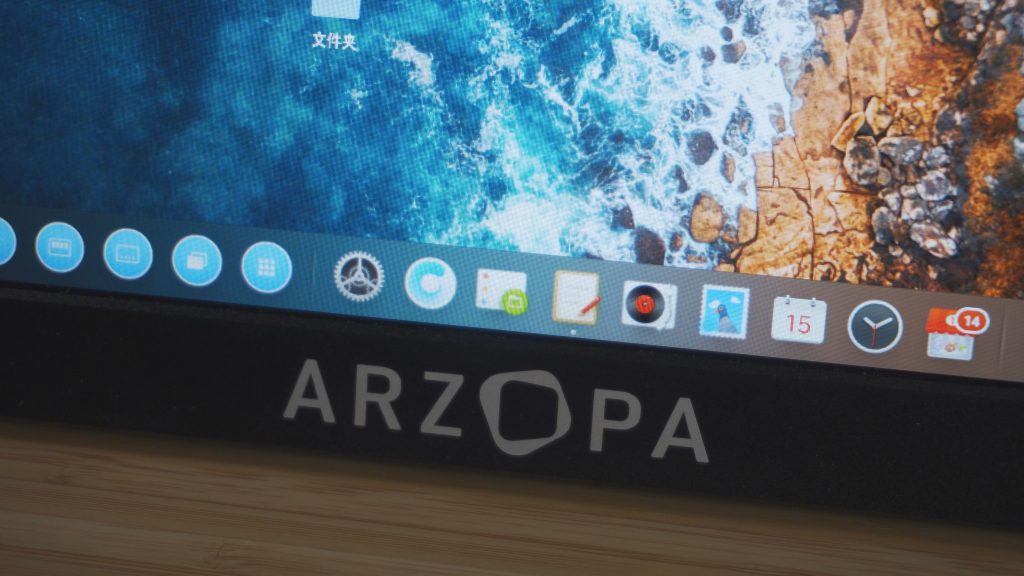
If you find that the display of the G1 is a bit different from your laptop, don’t worry, you can adjust the color, contrast, and white balance through the OSD. Although its color is not as good as some high-end laptop screens, as a portable monitor, I think it’s already done a good job.
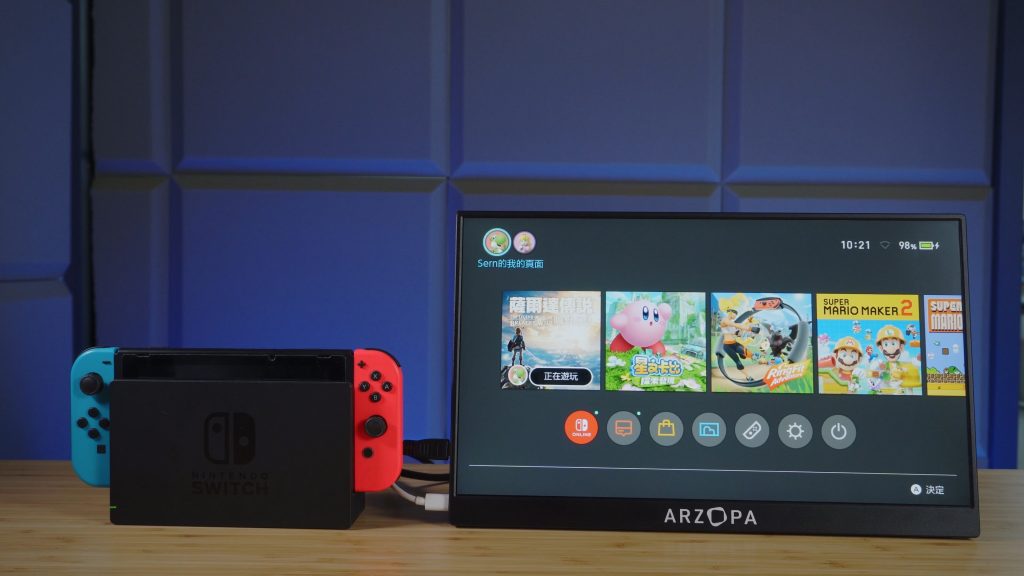
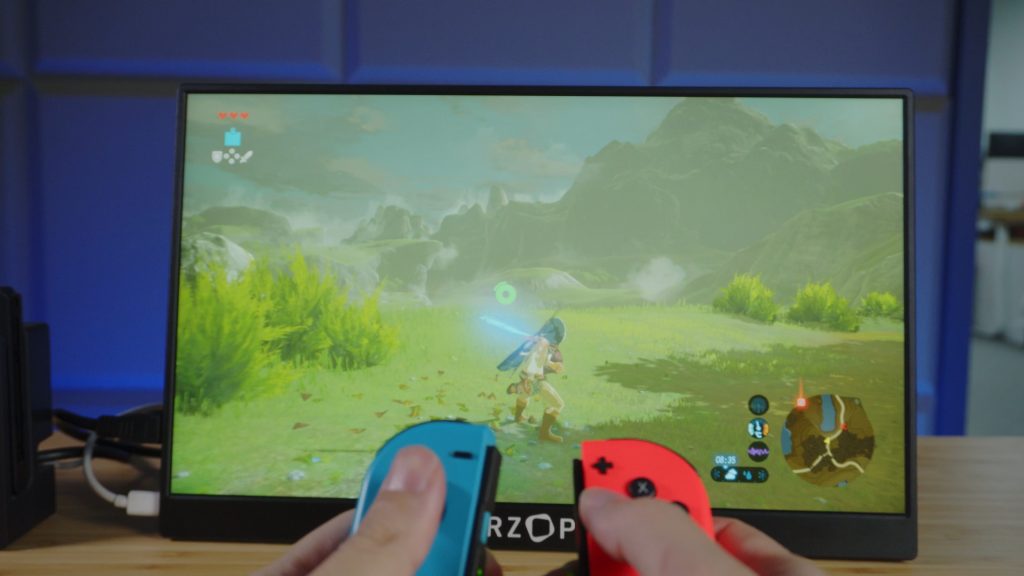
For Nintendo Switch owners, I really recommend you buy a portable monitor since the screen of the game console itself is too small for most games, especially when playing games with friends. With the Arzopa G1, you can share a more stunning gaming experience with more friends while camping. Thanks to the stable HDMI wired connection, you won’t feel any operating lag when playing switch games on the Arzopa G1.
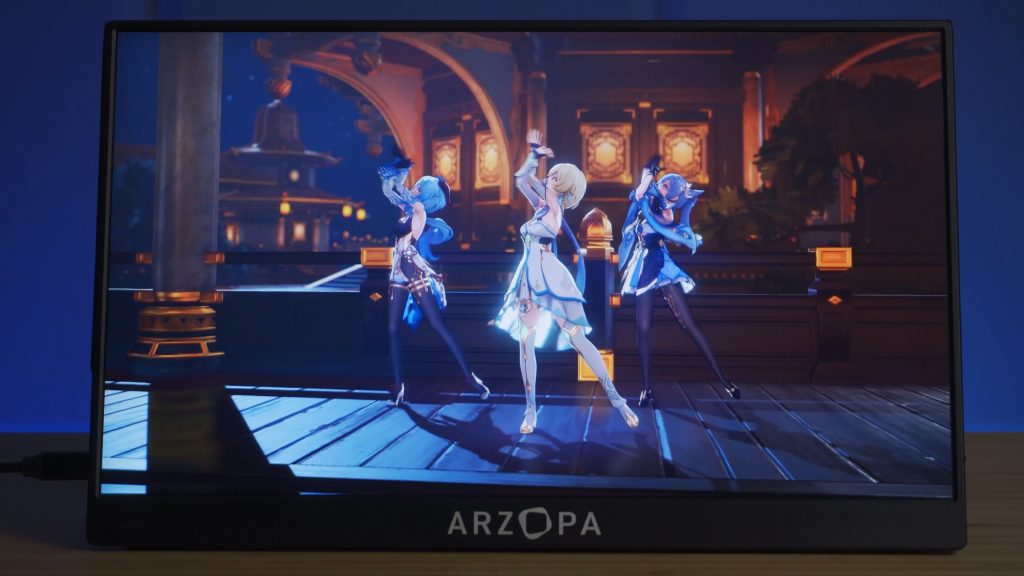
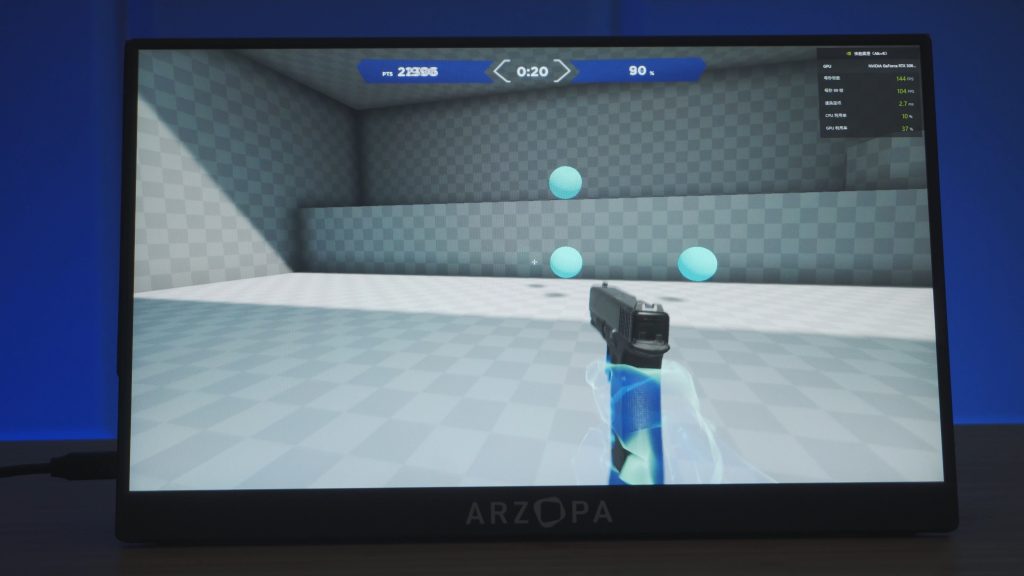
The main difference between the G1 Game monitor and another portable monitor from Arzopa that we reviewed earlier is that it supports a high refresh rate of up to 144Hz with no loss of resolution, which is definitely exciting news for gamers. If you have a laptop that doesn’t support high refresh rates, then the G1 Game monitor makes perfect sense. The 144Hz high refresh rate proves that the G1 is born for gaming, which gives gamers a smoother gaming experience, especially in some FPS games.
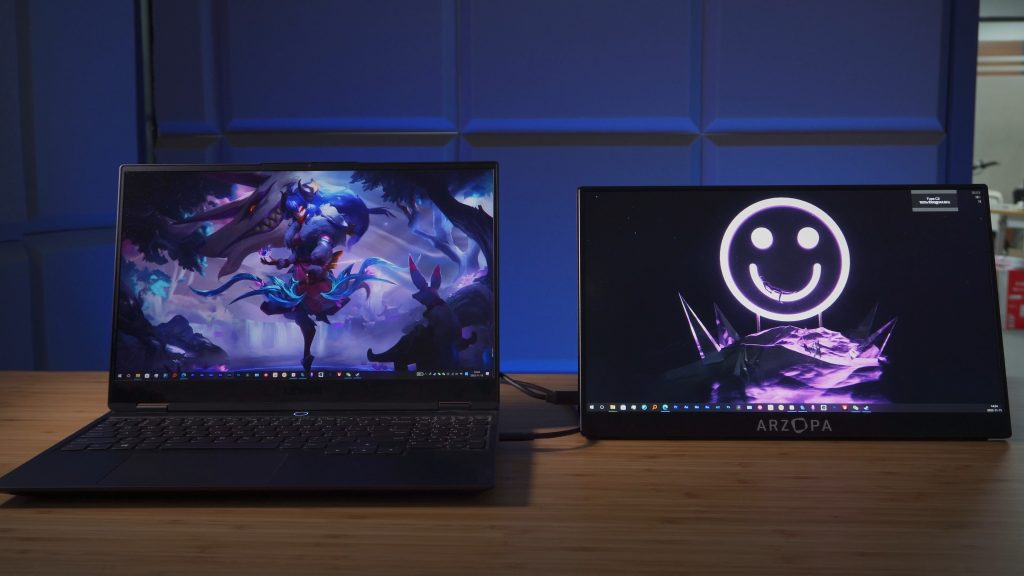
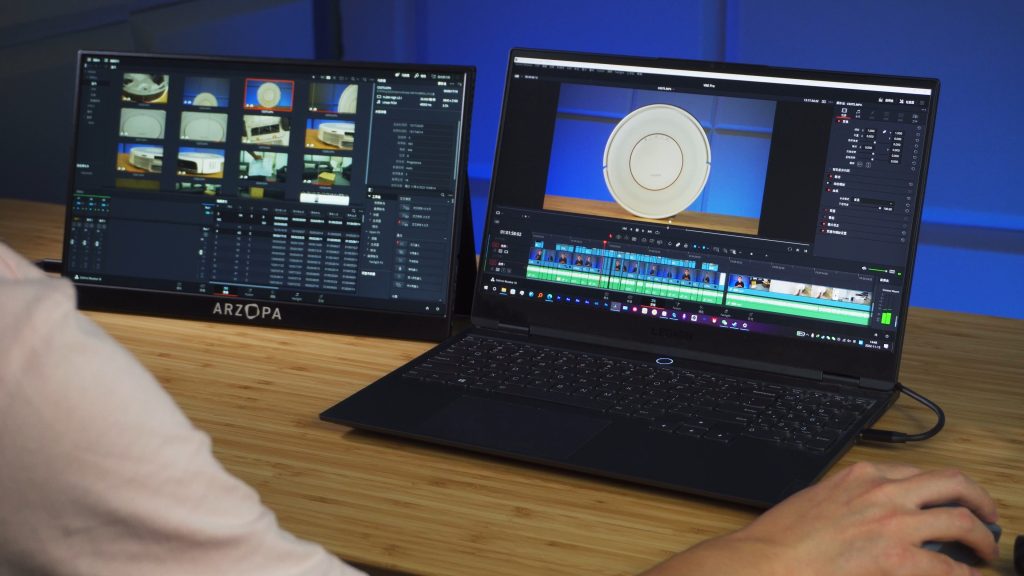
Even if you are a creator who already has a high-performance laptop with high refresh rate support, the G1 Game monitor can still help you. For example, I usually use dual monitors throughout my work, which allows me to be more efficient in video editing. Even just using the G1 as a preview window, the whole experience is completely different. And compared to standard monitors, the G1 Game monitor can be used on the go, which greatly enhances the flexibility of a video creator’s work.
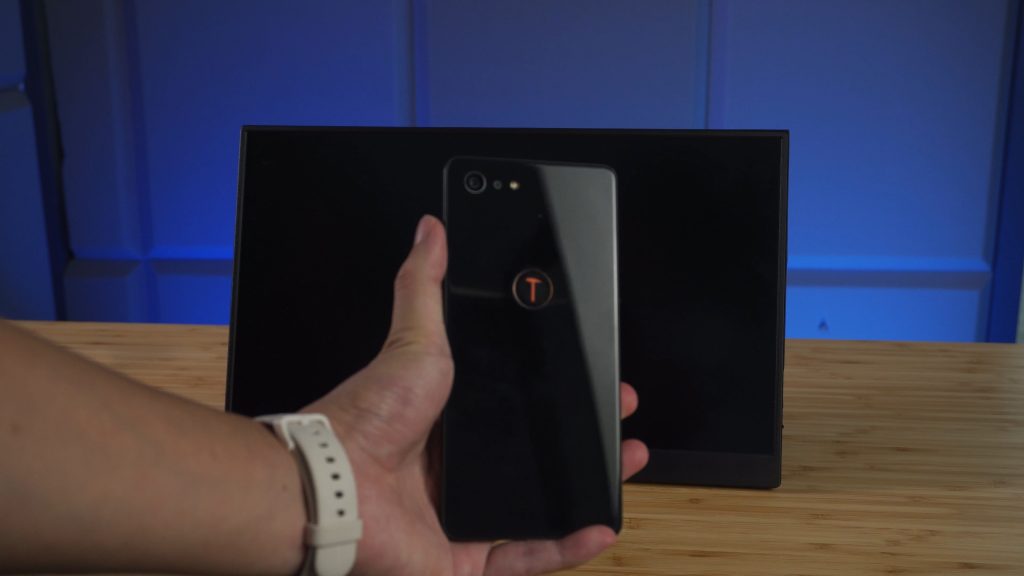
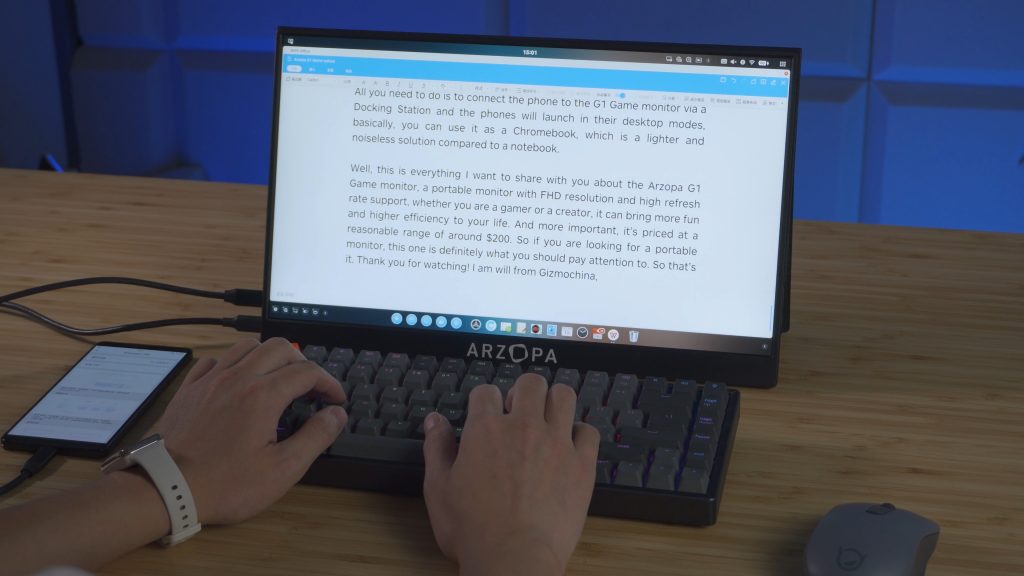
I’d also like to share with you an interesting use for portable monitors, especially if you’re a wordsmith and have a smartphone that supports desktop mode, such as Samsung and the Smartian Pro 2S I’m holding in my hand.
All you need to do is to connect the phone to the Arzopa G1 Game monitor via a Docking Station and the phones will launch in their desktop modes, basically, you can use it as a Chromebook, which is a lighter and noiseless solution compared to a notebook.
Well, this is everything I want to share with you about the Arzopa G1 Game monitor, a portable monitor with FHD resolution and high refresh rate support, whether you are a gamer or a creator, it can bring more fun and higher efficiency to your life. And more important, it’s priced at a reasonable range of around $200. So if you are looking for a portable monitor, this one is definitely what you should pay attention to.
In September, a Samsung tablet with model number SM-X506B was spotted in the database of the Geekbench benchmarking site. It was speculated at the time that it could be the upcoming Galaxy Tab S8 FE. Now, tipster Roland Quandt has shared new details about the device.
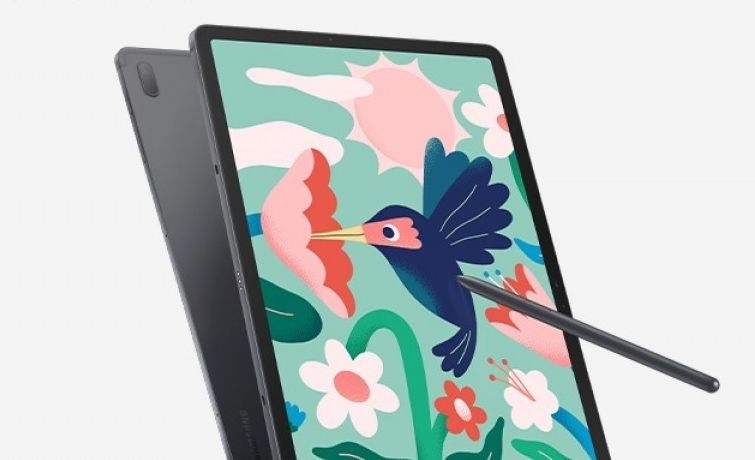
First, the tipster claims that the Samsung tablet with the SM-X506B model number and the codename “Birdie” will debut in the market with the Galaxy Tab S8 FE moniker. The Galaxy Tab S8, Tab S8+, and Tab S8 Ultra are all equipped with AMOLED panels. However, the Galaxy Tab S8 FE, being an affordable model, will feature an LCD panel. It will come with stylus support since it will have a Wacom digitizer.
Samsung Galaxy Tab S7 FE
The previously seen Geekbench listing revealed that the Galaxy Tab S8 FE will feature a MediaTek octa-core chip, which comprises 2 x Cortex-A78 (2.6GHz), 6 x Cortex-A55 (2.0GHz), and a Mali-G68 MC4 GPU. It appears that the device will come equipped with the Kompanio 900T chipset.
The inclusion of the Kompanio 900T suggests that the Galaxy Tab S8 FE will support 5G connectivity. The Geekbench listing has 4 GB of RAM and Android 13 OS, which is likely to be overlaid with One UI 5. At present, there is no word on the launch date of the device.
To recall, the Galaxy Tab S7 FE, which debuted in May 2021, features a 12.4-inch LCD display that supports a 1600 x 2560 pixels resolution. It is powered by the Snapdragon 778G chip, up to 8 GB of RAM, and a 10,900mAh battery that supports 45W charging. The Tab S7 FE offers up to 256 GB of storage and a microSD card slot for more storage. It has a 5-megapixel front camera and an 8-megapixel rear camera.
After launching the ZTE Axon 40 Ultra flagship smartphone earlier this year, the Chinese company is now gearing up to launch yet another model in the lineup, dubbed ZTE Axon 40 Ultra Aerospace Edition.
The phone will be launched as a successor to the Axon 30 Ultra Aerospace Edition launched last year. The smartphone, which is endorsed by Wu Jing, has already been confirmed by the company, and now it has revealed the official launch date.
The ZTE Axon 40 Ultra Aerospace Edition smartphone will be officially launched in the Chinese market on 29th November. As the name itself indicates, most of the phone’s specifications will be similar to the Axon 40 Ultra smartphone.
We don’t expect any major design changes in the smartphone, and most of the specifications will also remain the same, apart from increased RAM and internal storage support, most likely to be 18GB of RAM and 1TB of storage.
The ZTE Axon 40 Ultra, which was launched a few months ago, features a 6.81-inch AMOLED display with a Full HD+ screen resolution of 2480 x 1116 pixels, a 120Hz refresh rate, and an in-display fingerprint sensor.
In the camera department, there’s also a 16-megapixel under-display camera with 2.24μm large pixels, and it uses a third-generation of under-display camera from ZTE. On the back, there’s a triple-camera setup consisting of a 64MP Sony IMX787 primary sensor, another 64MP Sony IMX787 sensor, and a 64MP telephoto periscope lens.
The device is powered by the Qualcomm Snapdragon 8 Gen 1 chipset and has a dual-channel VC liquid cooling system. The smartphone runs the Android 12 operating system out-of-the-box with the company’s own MyOS 12 custom interface on top and is powered by a 5,000mAh battery with 80W fast charging.
Xiaomi is gearing up to launch its latest flagship smartphone in the form of the Xiaomi 13 series in its home market in China. While the exact launch date is not yet known, the lineup is expected to go official in the coming weeks.
Ahead of the launch, some of the key details about the upcoming Xiaomi 13 series smartphones have leaked online, revealing what we should expect from the premium devices.
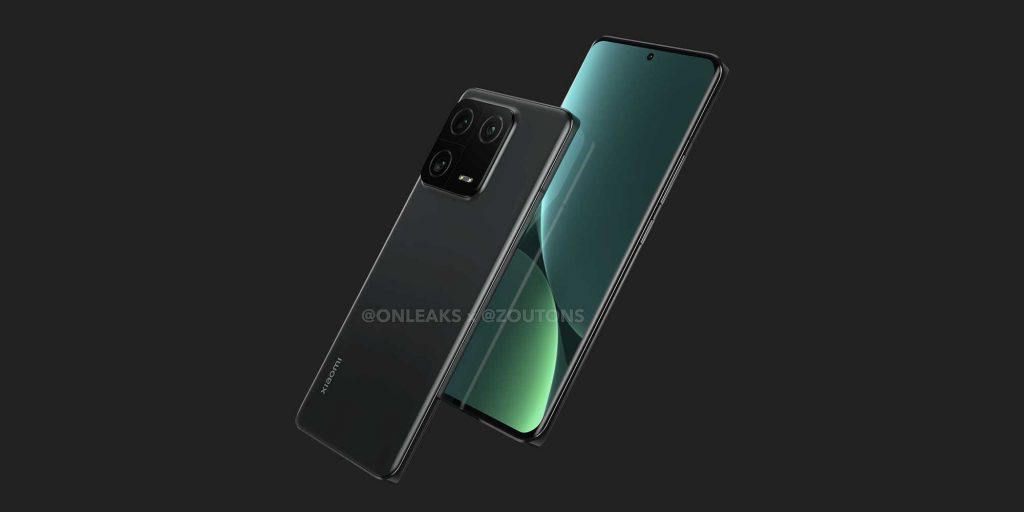
Xiaomi 13 Pro Render by @OnLeaks
The latest report from Digital Chat Station claims that all the models in the Mi 13 series will come powered by the newly announced Qualcomm Snapdragon 8 Gen 2 processor, which is manufactured using the 4nm process.
Further, it is said that all the Xiaomi 13 series smartphones will be equipped with a camera module tuned by Leica. This means that Xiaomi and Leica are continuing their partnership after the Xiaomi 12S smartphone.
Coming to the software department, the smartphones will be running the MIUI 14 custom user interface on top of the new Android 13 operating system. This new UI is currently being tested by the company, which reportedly has a new design and is lightweight. We will know more about it once the company officially launches this new operating system.
Based on the previous leak, the Xiaomi 13 Pro is expected to come with a Sony IMX989 primary camera sensor which the company has used for the Mi 12S Ultra. The Pro model could feature a 6.7-inch OLED 2K E6 curved display made by Samsung.
We will get to know the phone’s specifications and features for sure when the devices go official. While Xiaomi has not yet revealed the launch date for the Mi 13 lineup, we expect the phones to go official in late November or early December.
Apple has been launching a budget iPhone model in the form of iPhone SE and so far, the technology giant has launched three iterations of the device. Now, for the upcoming phone, which will be the iPhone SE 4, the company has a few major changes for the device.
If the latest report is to be believed, then the upcoming Apple iPhone SE 4 smartphone, which is expected to go official in Spring 2023, will be a flagship killer smartphone, and will be a threat to many Android smartphones.
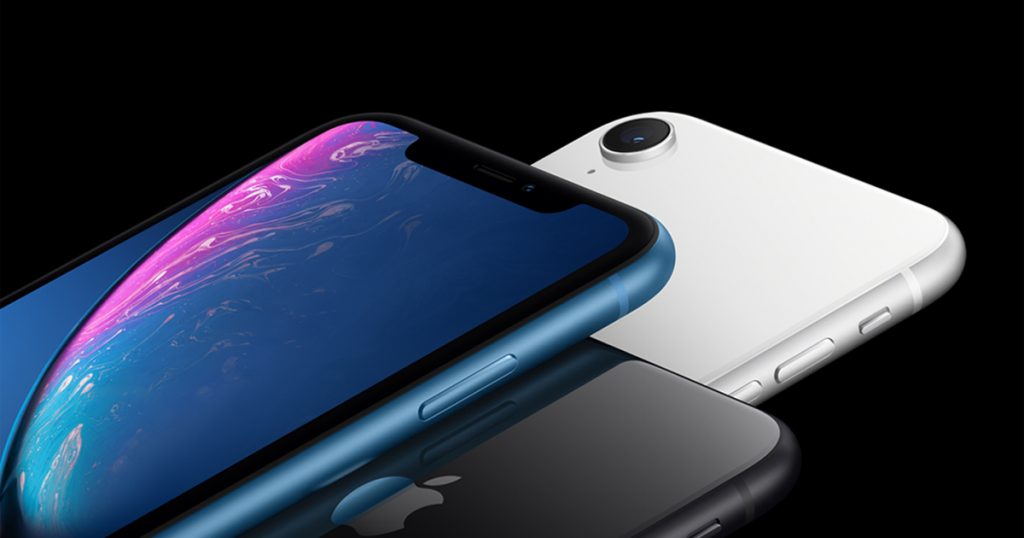
Apple iPhone XR
The Apple iPhone SE models launched so far have managed to sell well but the devices have never been a flagship killer or best value-for-money offering, but that is about to change with the upcoming model, reveals a new report.
The phone will likely come with an updated design, at least for the SE series lineup. Based on the reports, the device will adopt a design similar to the iPhone XR. In that case, there’s a possibility that the tech giant may finally offer Face ID on the SE lineup instead of relying on the Touch ID.
As for the specifications, the device is likely to keep the 6.1-inch 720p LCD display of iPhone XR for the upcoming iPhone SE 4, which will be really disappointing for a 2024 smartphone when most phones nowadays come with Full HD 1080p display and a high refresh rate. The phone could be rated IP67 and be powered by a 3,000mAh battery with support for 20W fast charging and 7.5W wireless charging.
Internally, the device is expected to powered by the latest Apple A16 Bionic processor, which is powering the newly launched Apple iPhone 14 Pro series but could end up using the A15 SoC found on the iPhone 14 lineup. In the camera department, there could be a single 12-megapixel sensor on the back and a 7-megapixel selfie shooter up front.
Although Apple iPhone SE 4 is reported to go official sometime next year, the timeline doesn’t make sense going by Apple’s track record. While earlier reports pointed to 2024 as the launch for new iPhone SE model, the underwhelming sales of the iPhone 14 series could end up being a reason for the early launch of Apple iPhone SE 4. For now, we’ll just have to wait a bit longer to get more information.
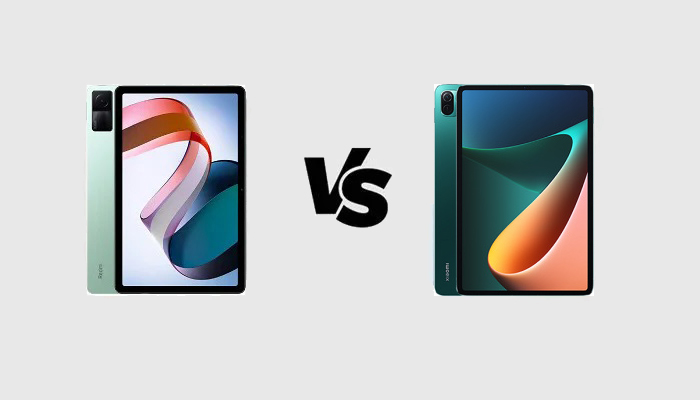
Xiaomi has been in the tablet market for years, but this year is special because its sub-brand Redmi released its first tablet ever: the Redmi Pad. As you probably expected, it is an affordable tablet, but it provides high performance and a pretty good specs sheet. Xiaomi released a tablet in a similar price range the last year, and now, it is available at very interesting street prices. We are talking about the Xiaomi Pad 5. A lot of people are asking whether they should go for the new Redmi tablet because of its value for money or the older Xiaomi one from last year due to its interesting street prices. We will try to let you find out through this comparison between the specifications of the Redmi Pad and the Xiaomi Pad 5.
If you are looking for one of the most beautiful tablets, then your choice in this comparison is the Xiaomi Pad 5. It has a good build quality including an aluminum frame and it comes with a higher screen to body ratio, so the bezels around the display are narrower. The tablet is very thin: the thickness is just 6.9 mm, and it is not so heavy as it weighs just 511 grams. The camera module is not so invasive and it takes just a small portion on the upper left corner of the rear cover. The Redmi Pad has thicker bezels around the display, as well as a bigger camera module, but you should note that it is more compact than its internal rival because it has a smaller display. It is also lighter with a weight of just 465 grams.
Display
Unfortunately, affordable tablets do not provide the best displays out there and they are far from the quality provided by the phones. But these two devices still come with good panels on the front side. The best display of the duo belongs to the Xiaomi Pad 5. It is an IPS LCD panel with a diagonal of 11 inches, a Quad HD+ resolution of 1600 x 2560 pixels, a 120 Hz refresh rate, HDR10 certification, and Dolby Vision. This display does not show the brilliant colors and the deep blacks provided by OLED panels, but it is able to show up to one billion colors. The Redmi Pad still comes with an IPS panel, but with a smaller 10.61-inch diagonal. It has a Full HD+ resolution of 1200 x 2000 pixels, a 90 Hz refresh rate, and it is able to show up to one billion colors. It is an inferior panel due to its lower resolution and refresh rate, and it does not have advanced video certifications. Both tablets feature four stereo speakers.
Specs & Software
The most powerful hardware belongs to the Xiaomi Pad 5. It is fueled by the Snapdragon 860 mobile platform by Qualcomm built with a 7 nm production process and sporting an octa-core architecture. The chipset is composed of a Kryo 485 Gold CPU running at a maximum frequency of 2.96 GHz, three Kryo 485 Gold CPUs with a 2.42 GHz frequency, four Kryo 485 Silver cores running at 1.78 GHz, and an Adreno 640 GPU. It is a high-end chipset paired with 6 GB of RAM and up to 256 GB of native storage (UFS 3.1). The Redmi Pad is powered by a MediaTek Helio G99 chipset running at 2.2 GHz and supported by up to 6 GB of RAM and up to 128 GB of native storage (UFS 2.2). The Xiaomi is more powerful, but it runs Android 11 out of the box, while the Redmi Pad ships with Android 12.
Camera
Another important advantage of the Xiaomi Pad 5 is the presence of a better main camera. On the rear side, this tablet sports a 13 MP shooter: nothing compared to the phones, but a pretty good sensor for tablets, able to record videos with a 4K resolution. The Redmi Pad has an 8 MP rear camera.
Last but not least, the Xiaomi Pad 5 has a bigger battery, with a capacity of 8720 mAh. It also charges quicker thanks to 33W fast charging. The Redmi Pad has a smaller 8000 mAh battery with 18W charging.
Price
The starting price of the Redmi Pad roughly translates into €250/$250, while you need €350/$350 to purchase the Xiaomi Pad 5. Which one would you pick?
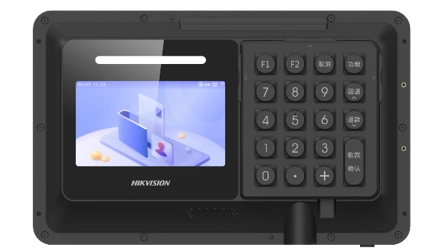
Hikvsion has released its double-sided wall-mounted retail machine in China. The new gadget is well-suited for use in restaurants, canteens, and similar places. It can operate in such places even when the power is off.
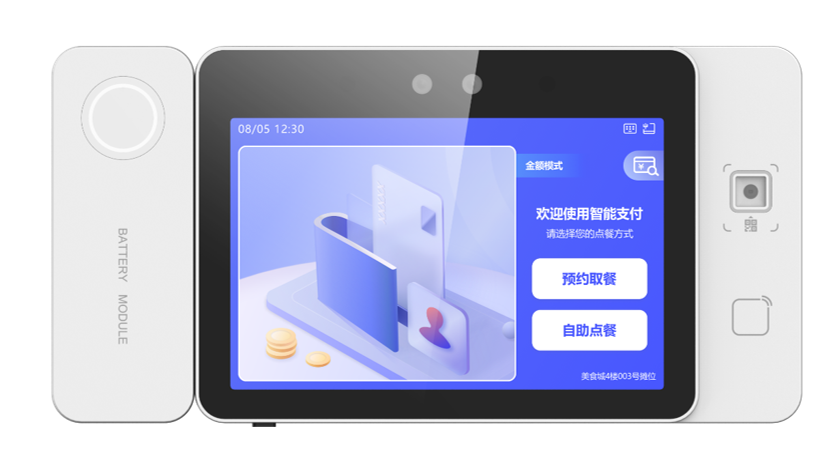
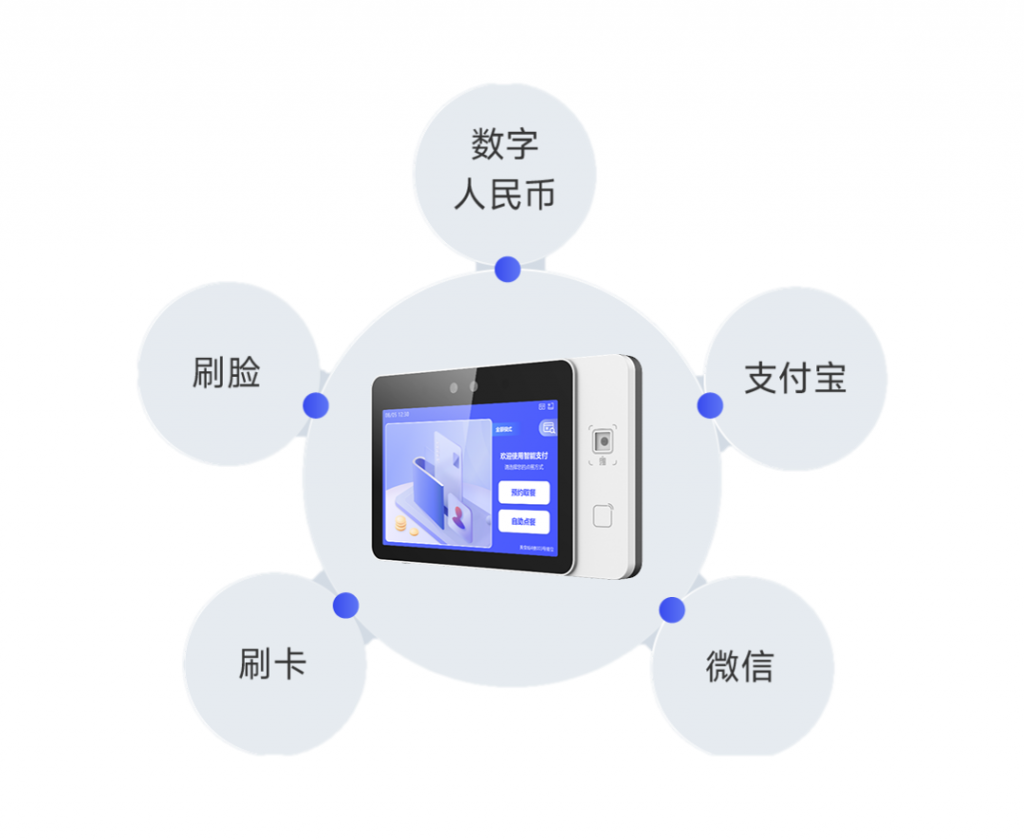
The new Hikvision wall-mounted retail machine runs on Android 11 and can be operated on dual screens. The secondary screen is an 8-inch high-definition touchscreen with a small keyboard. It provides a seamless interface for customers to interact with the canteen or restaurant and make payments for purchases. The Hikvision double-sided wall-mounted consumer machine is compatible with multiple payment methods including credit cards, Alipay, WeChat, digital RMB, and facial recognition.
The retail machine supports various modes of consumption, as well as ordering and taking meals. The device comes with a detachable battery which serves as backup power for the consumer machine. The duration of the backup support of the battery is however not disclosed by Hikvision. The battery allows the device to continue interacting with customers even during a power outage from the mains electricity supply.
The device is rated IP65 waterproof protection, as well as insect-proof and oil-proof. It is thus almost maintenance-free even in a restaurant or canteen environment.
The Hikvision Double-sided Wall-mounted Retail Machine was launched in China recently but pricing details are lacking. It is also unclear whether the gadget will be available subsequently in overseas markets. Hikvision will however expect a decent reception for the product in the Chinese market.
Chinese automaker Geely is set to unveil the cute Panda electric vehicle into the Chinese market. The Panda will debut under the Geometry brand name of Geely and its photos were released recently. The new EV has similar proportions as the Wuling Hongguang Mini EV, already a bestseller in China. The photos of the Panda EV were released by China’s Ministry of Industry and Information Technology.
The new Geely Panda has a length of 120.6 inches and a width of 59.9 inches. Together with its 79.3 inches wheelbase, the Panda has a height of 79.3 inches. The traditional front grille is absent in the EV but it has a pair of circular headlights. The Panda has four-spoke wheels and is a two-door vehicle, like its competitor, the Mini EV. There is a dramatic E-pillar together with black side window surrounds. There are other noticeable features like a pair of square taillights, a third light at the rear windscreen, and a blacked-out section with a bumper at the rear.
There are indications that the Geely Panda is powered by a 30kW electric motor and will come with a Lithium-ion battery manufactured by Gotion Hi-Tech. There are lots of technical details of the Geely Panda that are lacking. Importantly, Geely has been silent on the top speed and range of the Panda but it is expected to square up with the Hongguang Mini EV. Pricing information and the release date of the Geely Panda are also unknown at this time.
Lenovo has provided another preview of its yet-to-be-released YOGA Paper E-ink tablet. The new release confirms some new details about the tablet that is expected to launch first in China. The Lenovo Preview of the YOGA Paper was via Weibo as it released a few pictures of the device. The images confirm the design setup and other features of the YOGA Paper.
Lenovo had previously teased the new E-ink tablet earlier this month, leaving fans salivating for more. The YOGA Paper comes with a 10.3-inch display with adjustable color temperature. The tablet supports a decent 4,096 levels of pressure sensitivity. In addition, the YOGA Paper’s accompanying stylus pen works without being paired beforehand. It is thus compatible with the Wacom EMR standard. Lenovo has also included a space for storing the stylus when not in use inside the device’s case. There is also a cutout in the case for carrying the device.
Lenovo says that the YOGA Paper’s CNC-machined chassis is as thick as the Samsung Galaxy Tab S8 Ultra. The chassis is 5.5mm thick and it is unclear what is the weight of the device. There are still details about the E-ink tablet that are still lacking at this time.
Although it is expected to be released in China soon, there are no specifics yet. It is also unclear whether the product will be available outside China. We expect more details to trickle in for the YOGA Paper as expectations continue to rise.
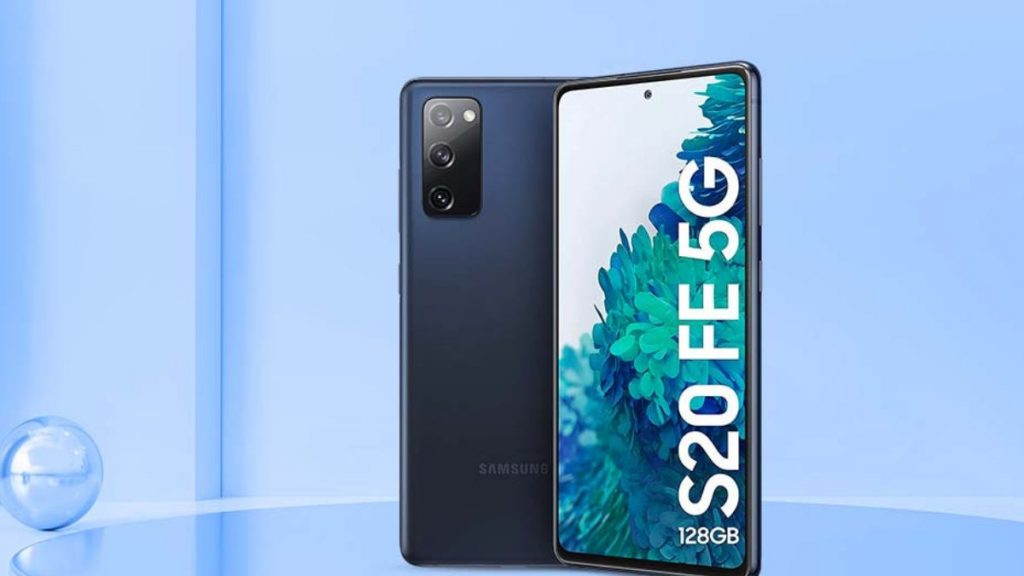
Earlier this month, Samsung rolled out a stable One UI 5 update to the flagship Galaxy S20 series, but the affordable Galaxy S20 FE wasn’t part of the rollout. Now, the fan edition smartphone is finally receiving One UI 5 update based on Android 13. The update is currently seeding in Europe and Russia. Separately, the Galaxy Tab S6 Lite is receiving One UI 4.1.1 based on the tablet-optimized Android 12L in India. Here are the details.
As reported by SamMobile, the One UI 5 update, for the Galaxy S20 FE is currently rolling out to users in Russia with firmware version G780FXXUAEVK3. It will likely reach other regions in a few days. As of writing this, the update is only available for the 4G Exynos variant of the device with model SM-G780F. Other variants should receive the software shortly.
We don’t have access to the changelog of the update but, just like One UI 5 releases for other Samsung flagship devices, the Galaxy S20 FE update should include all the new features introduced by Google in Android 13, a few Samsung-exclusive features, and Android security patches for November 2022.
Moving to the Galaxy Tab S6 Lite, it is receiving the One UI 4.1.1 update based on the tablet-first OS Android 12L. The update is rolling out to users in India with firmware version P619XXU1AVJ2. This update does not include the November security patch, but rather the September patch. As of right now, the update is only available for the LTE-equipped model, while the Wi-Fi-only version will follow soon.
Android 12L comes with a redesigned multi-tasking experience with a taskbar and resizable windows. Two-finger swipe gestures will also be available to switch between multitasking view and full-screen mode.
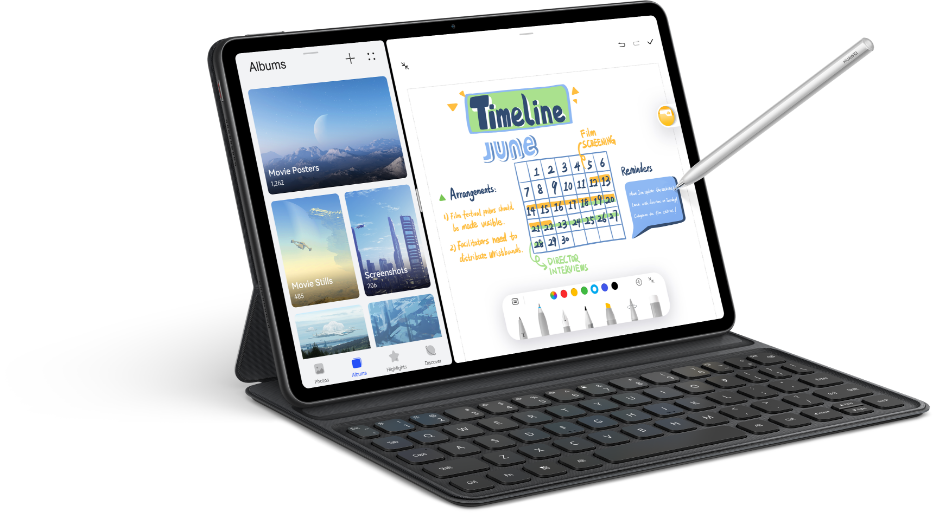
Huawei MatePad 11 debuted back in 2021 with a 10.95-inch LCD, a 120Hz refresh rate, a Snapdragon 865 processor, and more. Initially, it came with 6GB RAM and up to 256GB storage, and now the company has launched the 8GB+256GB Wi-Fi version of the tablet in its home country. Let’s look at the details.
Huawei has launched the 8GB+256GB version of the MatePad 11 in China. It is currently listed on Jingdong with a price tag of 3399 yuan (about $474). For reference, the 6GB + 256GB WIFI version of Huawei MatePad 11 is priced at 3099 yuan ($432).
Huawei MatePad 11 Specifications
Huawei MatePad 11 comes with a 10.95-inch LCD display that offers a 2560 x 1600 resolution and a 120Hz refresh rate. The device comes with moderately sized bezels of equal thickness on all sides. There’s an 8MP camera on the front for selfies and video calls.
Under the hood, the tablet is powered by the Snapdragon 865 processor paired with 8GB/6GB of RAM. It comes in 64GB, 128GB, or 256GB storage variants. In addition, the tablet has a MicroSD card slot that allows users to add up to an extra 1TB of storage.
MatePad 11 sports a 13MP rear camera with an f/1.8 aperture accompanied by an LED flash. The tablet comes with four microphones as well as four Harman Kardon-tuned speakers. It works with the M-Pencil 2nd Generation and has an optional magnetic keyboard so you can use it as a laptop.
Other notable features of the tablet include Wi-Fi 6, Bluetooth 5.1, and OTG with reverse charging support. It is fueled by a 7250mAh battery with support for 22.5W fast charging. The tablet is offered in Island Blue, Dark Lime, and Frosted Silver colors.
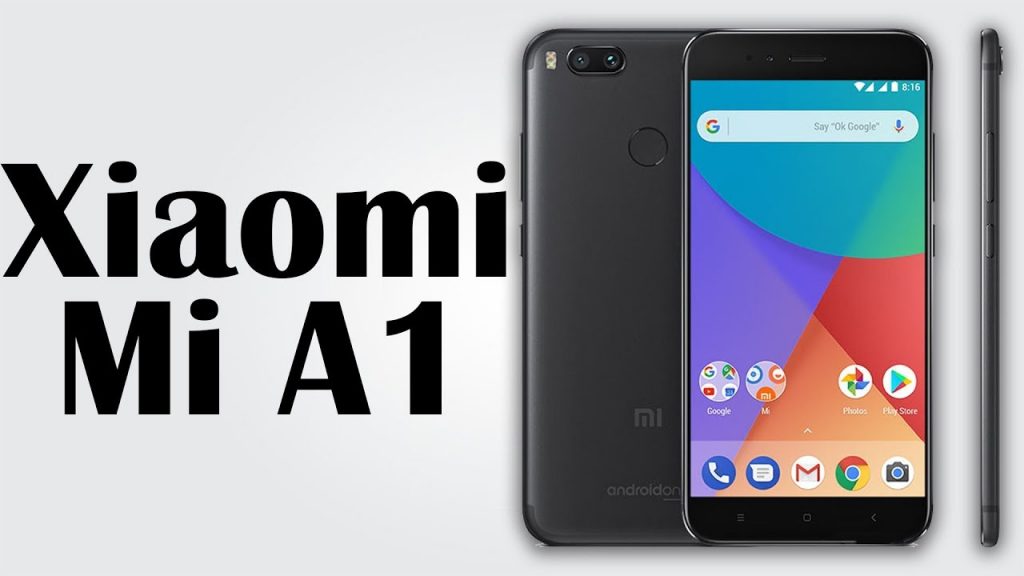
The Xiaomi Mi A1 smartphone was unveiled in 2017 and is still enjoying top-grade software support with its Android 13 upgrade. The smartphone debuted with Android 7 back in 2017 but will now enjoy software support for Android 13.
Indeed, the MI A1 has enjoyed multiple ROM upgrades and has been kept alive by support from the custom ROM community. The smartphone is powered by the Qualcomm Snapdragon 625 chipset. It had run previously on the Android 10-based Lineage OS 17.1. Some of the available Android 13 ROMs available in XDA Forums include Spark OS, PixelPlusUI, PixelExperience, and ArrowOS.
The Spark OS is based on AOSP and offers a wider array of customization options and features. It comes with the Pixel launcher and dialer. The PixelPlusUI is inspired by different Android skins in the market and is well-optimized. It comes with up-to-date security patches for enhanced safety. The PixelExperience has Gapps included together with wallpapers, icons, fonts, as well as launch and boot animation. It is stable and is based on AOSP. The ArrowOS is another ROM based on AOSP but is available without Gapps.
It is noted that users of the Xiaomi MI A1 who migrate to the custom ROM, may lose the advanced features of the camera app, VoLTE, FM Radio, and some other features. However, there are a few choices open to users and some of these could be perfect options. There are a few other ways to also overcome the features lost due to migrating to a customized ROM. For example, you can use Open Camera or Google Camera.
If you are a person who travels a lot, you may be staying away from the comfort of your home. Especially if you enjoy big and quality screens, your smartphone may not be enough for you. Fortunately, Arzopa is solving this problem with its portable monitors. In addition, the Black Friday campaign offered by the company brings the portable monitor experience together with an affordable price. If you need a second screen to increase your work efficiency or if you are looking for a portable and cost-effective product, you can take a look at Arzopa’s Black Friday campaign.
Arzopa Black Friday campaign has started
Established in 2020, Arzopa is one of the world’s leading portable monitor brands. Operating in many countries, the company is driven by providing convenience to customers and bringing productivity. Arzopa’s cost-effective, high-quality products are as follows:
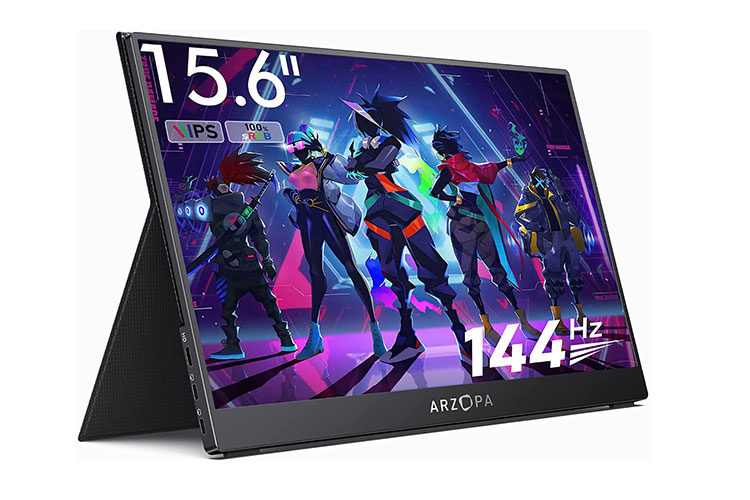
The G1 15.6 is undoubtedly one of Arzopa’s products that deserves its price the most. G1 Game provides the best gaming experience. Up to 144Hz screen fresh rate gives you the smoothest gaming feeling; it also has 1080P FHD resolution and 100% sRGB & 178° IPS screen. These features can help you maximize your performance in competitive and online games. You can click here to have this very light portable monitor to $149.99.
If what you need is a slightly more professional-looking and cost-effective monitor, the Arzopa S1 15.6 is the product for you. The FHD portbale display features 1920×1080 resolution at 60Hz and 300cd/m² brightness. You can use it as a second screen while traveling or in your office, increasing the work efficiency. Click here to get this monitor for $118.99 on Black Friday.
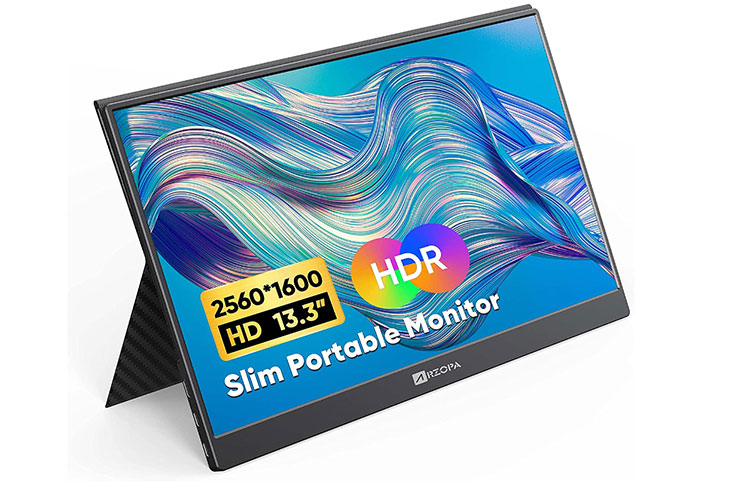
If you want a sharper image and an even smaller monitor, you can check out the Arzopa A1 2k 13.3. This product, especially appealing to MacBook users, draws attention with its small, lightweight and portable structure. Like other Arzopa products, the monitor, which has a wide usage area, works seamlessly with Windows PC, smartphone, PlayStation or Xbox. Click here to get the eligible Arzopa A1 2k 13.3 for $135.99 via Black Friday.
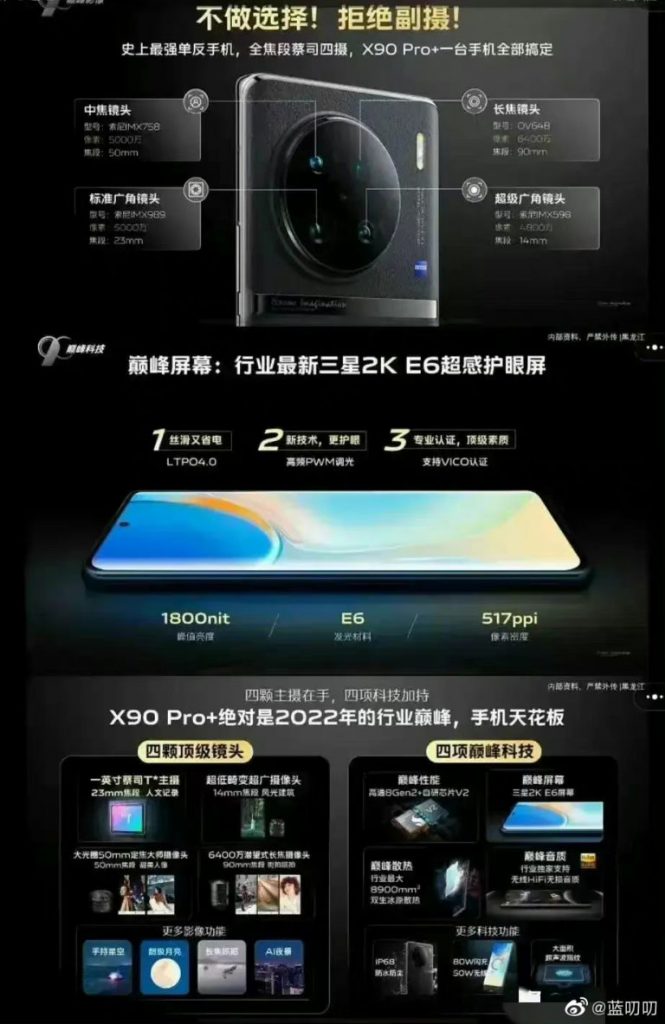
Vivo X90 Pro+ is confirmed to launch in China on November 2022 as the top-of-the-line model in the series. It is expected to debut as the world’s first smartphone equipped with the latest Snapdragon 8 Gen 2 processor. Ahead of its formal debut, a leaked poster, likely designed for the official web page, has revealed the X90 Pro+’s full camera and display specs. Here are the details.
The leaked poster reveals the upcoming Vivo X90 Pro+ will flaunt a Samsung E6 AMOLED display with LTPO 4.0 technology, PWM dimming, up to 1800 nits of brightness, and 517ppi pixel density (via Playfuldroid).
The handset will be powered by the Snapdragon 8 Gen 2 chipset. It will also feature a Vivo V2 ISP chip that will enhance photos and videos in low-light environments. The handset will come with some impressive cameras. It will have a 1-inch Sony IMX989 50MP primary camera, a 50MP telephoto camera with a Sony IMX758 sensor, a 64MP periscope camera, and a 48MP Sony IMX598 ultrawide-angle unit.
There is a 23mm equivalent focal length for the main camera, a 50mm equivalent for the 2x telephoto, a 90mm equivalent for the periscope, and a 14mm equivalent for the ultra-wide.
Further, the poster suggests the X90 Pro+ will come with Hi-Fi audio and an improved under-display fingerprint scanner. The handset will support 80W wired fast charging, and 50W wireless support, and an IP68 rating. It will also have an 8900mm2 heat dissipation unit.
Although the specifications of the handset are all out, there is still no word on its price. In any case, we are bound to know it all tomorrow. We’ll keep you posted.
To make online engagement and e-commerce more real and less deceptive for customers, the Government of India initiated a campaign against bogus reviews and unverified ratings. The government has set up a system for businesses like Google, Facebook and Meta Platform, Amazon.com, travel websites, and food delivery applications that rely on customer evaluations to verify goods and services. Sales and interest from prospective customers are increased by favourable ratings.
But often, the brand displays fake reviews that are consistently positive about the goods and services, and this undoubtedly influences the user’s purchasing choice. Consumers and other industry professionals have criticised some businesses for suppressing bad reviews or accepting fake ratings, which makes the due diligence process for buyers challenging.
According to the Ministry of Consumer Affairs, Food & Public Distribution, the Department of Consumer Affairs established a committee in June to create a framework for identifying fraudulent and misleading reviews in e-commerce. The founder of LocalCircles, a community platform and pollster that made the initial submission to the Department of Consumer Affairs and participated in the committee drafting the guidelines, Sachin Taparia, stated that the new rules for online reviews are “designed to drive increased transparency for both consumers and brands and promote information accuracy.”
According to Taparia, “the new regulations will force platforms like Google and Facebook to verify the genuine person behind the review by established 6-8 procedures, meaning fraudulent accounts created only for review authoring will eventually disappear or won’t be allowed to review. He further notes that if the standards are made mandatory, businesses may be held liable for unfair business practices, the suppression of bad reviews, or the facilitation of the planting of false reviews.
“This should not be bulldozed, please. We shall first observe that these rules are being followed voluntarily. And should the threat persist, we may make this a requirement “Reporters in New Delhi were warned by Rohit Kumar Singh, secretary of the Department of Consumer Affairs. However, there are no proper information about the draft framework yet. We will update you if the law gets imposed officially.
We use cookies on our website to give you the most relevant experience by remembering your preferences and repeat visits. By clicking “Accept”, you consent to the use of ALL the cookies.
This website uses cookies to improve your experience while you navigate through the website. Out of these, the cookies that are categorized as necessary are stored on your browser as they are essential for the working of basic functionalities of the website. We also use third-party cookies that help us analyze and understand how you use this website. These cookies will be stored in your browser only with your consent. You also have the option to opt-out of these cookies. But opting out of some of these cookies may affect your browsing experience.
Necessary cookies are absolutely essential for the website to function properly. This category only includes cookies that ensures basic functionalities and security features of the website. These cookies do not store any personal information.
Any cookies that may not be particularly necessary for the website to function and is used specifically to collect user personal data via analytics, ads, other embedded contents are termed as non-necessary cookies. It is mandatory to procure user consent prior to running these cookies on your website.