Advertisement

TicWatch Pro X packing dual AMOLED & LCD screens, Wear 4100, WearOS launched

Mobvoi was previously reported as planning to launch TicWatch Pro 3 Ultra, TicWatch GTH+, and TicWatch GTH Pro with advanced blood pressure measurement parameters. While that is yet to happen, the popular smartwatch manufacturer has now launched the TicWatch Pro X in China.TicWatch Pro X

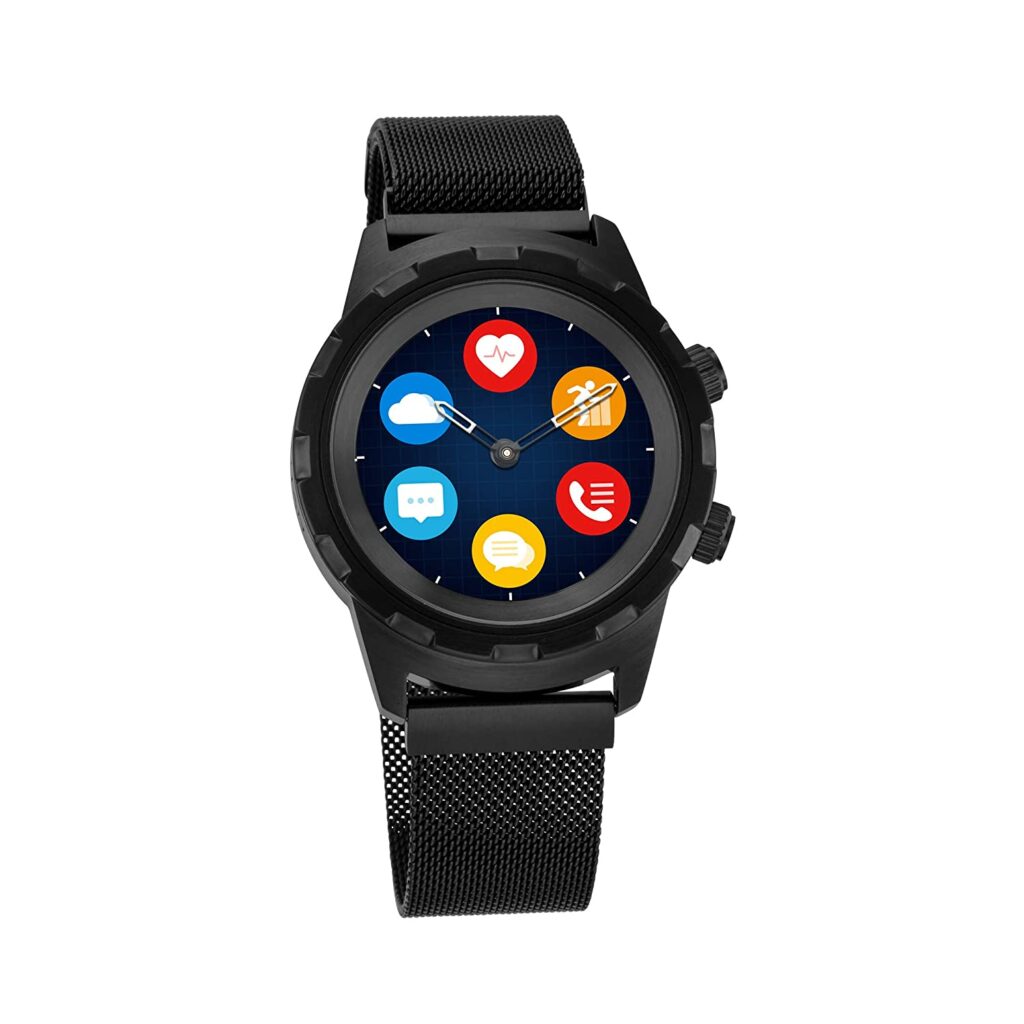
TicWatch Pro X is a flagship watch by all standards. The smartwatch packs a well-studded specs lineup consisting of a Qualcomm Snapdragon Wear 4100 chipset. The device features a dual-display design which saw it pack a 1.39-inch AMOLED screen with a retina-level pixel density of 326ppi. The secondary display is an FSTN LCD screen which extends battery light and makes it more convenient to use. TicWatch Pro X

How the two screens play out is that there are two user modes, a Smart mode, and a Durable mode. The 1.39-inch AMOLED screen is deployed in the Smart Mode with all functions fully fired, including weather monitoring. In this mode, the device has a battery life of up to 4 days.

If you are in a terrain where it will be impossible to charge the smartphone for days, then the Durable mode comes in handy. In this mode, the FSTN LCD screen is put to use and features a colorful backlight while preserving the battery life for up to 45 days.

In terms of performance, the TicWatch Pro X is equipped with a new generation of Qualcomm Snapdragon SD4100  and runs on Google’s WearOS. It comes with 1GB RAM while three is 8GB of storage space onboard. The watch also has an IP68 waterproof build.

In terms of sports support, the smartwatch arrives with support for over 20 professional sports routines, including outdoor running, walking, mountain climbing, swimming, cycling, yoga, etc. It also provides professional and detailed exercise data, including exercise time, calories, heart rate, and exercise-related indicators. It also has regular features such as a heart rate monitor, blood oxygen monitor, sedentary reminder, etc.Ticwatch Pro X

Further, TicWatch Pro X supports eSIM-number dual terminals, sharing numbers with mobile phones, and 4G communication. Whether running, swimming, or outdoor riding, you will not miss important calls and messages when you put down your mobile phone. It also features support for high-definition voice VoLTE calls with high fidelity voice output.

The TicWatch Pro X is presently on pre-sale in China via Jingdong (JD.com) for 1,999 yuan (~$310). The flagship smartwatch will be sold for 2399 yuan (~$372) when it eventually goes on sale.

RELATED:


Toyota unveils a three-wheeled C+walk e-scooter in Japan

Japanese automaker Toyota is unveiling its new e-scooter targeting users with limited mobility. The new Toyota C+walk three-wheeled electric scooter will be available in the company’s home market of Japan from next month, November 2021.Toyota C+walk e-scooter

The new e-scooter bears some semblance with some other brands like the Segway PT, and it seems to be a successor to the Toyota Concept-i Walk from 2017. The Toyota C+walk comes with some features that would appeal to the elderly and others with limited mobility. It has a top speed of 6 miles per hour which can be reduced to 1 mph if needed. The range of the C+walk is 8.5 miles on a full charge. The removable battery makes it possible to double the range of the e-scooter with an additional battery. It takes about 2 hours to fully charge the battery.Toyota C+walk e-scooter

Toyota conceptualized the C+way to help elderly workers move across large facilities like warehouses, factories, and airport terminals in a safe and efficient manner. The e-scooter also has an obstacle avoidance system, which beeps when it detects something on the path of the scooter. The obstacle avoidance system will slow down the scooter if a collision is imminent.

The Toyota C+way e-scooter is priced from ¥341,000 ($3,100). In Japan, outright purchase or lease arrangements are available from next month. Toyota is silent on the global availability and pricing of the C+way, although we expect more details to be provided as time goes on.

RELATED;


Boult Audio unveils the AirBass SoulPods TWS earbuds with ANC for Rs. 2499 ($34)

Boult Audio has had a raft of releases on the Indian market lately. The audio accessories maker is introducing another product into the market with a price tag of just Rs. 2,499 (~$34).Boult Audio AirBass SoulPod

The Boult Audio AirBass SoulPods truly wireless (TWS) earbuds feature active noise cancellation (ANC), extended battery life, IPX7 water-resistant rating, and an angled bud design with extra-soft silicone tips to guarantee a comfortable user experience.

The Boult Audio AirBass SoulPods TWS earbuds with ANC are available in India via Flipkart in two color variants – black and white.Boult Audio AirBass SoulPods TWS Earbuds

The SoulPods truly wireless earbuds have 10mm drivers, Bluetooth 5.0 support, and an active noise filtering processor. Users can carry out most of the tasks by using the touchpads on the earbuds. With the touchpads, the user can adjust the volume, change tracks, receive calls or activate the voice assistant.

The Boult Audio AirBass SoulPods offers 6 hours of activity on a full charge. With the charging case attached, up to 30 hours of playback is assured. The device is charged via USB Type-C input.Boult Audio AirBass SoulPods TWS Earbuds

As stated earlier, interested buyers in the subcontinent should visit Flipkart to get the budget-friendly Boult Audio AirBass SoulPods TWS ANC earbuds.

RELATED:


(via)


Madhav Sheth confirms realme UI 3.0 will bring Android 12

A few weeks ago, Realme announced that it will unveil a new version of its custom user interface, realme UI, in October. The new version will launch as realme UI 3.0 and will bring new features to eligible devices. If you didn’t know already, Realme has now confirmed that the new UI will be based on Android 12.

According to Madhav Sheth, the CEO of Realme India, Europe, and Latin America, realme UI 3.0 will be based on Android 12. However, there is still no specific date for the unveiling of the Android fork.

The stable version of Android 12 is yet to be announced but there are speculations it may be released today. Following its announcement, manufacturers are expected to announce which of their phones will get the OS upgrade. Most manufacturers usually announce a new version of their UI when there is a new version of Android, so it is no surprise that Realme is doing the same with realme UI 3.0 as Android 12 arrives.

We expect a release date for realme UI 3.0 soon as well as details of devices that will receive the update.
 

RELATED:

DJI Mavic 3 Pro Roundup: Features, Specifications, & Pricing – What to Expect!

The specifications of the soon-to-release DJI Mavic 3 Pro drone are already out in the open, thanks to a couple of leaks in the recent past. The drone is said to offer drastically improved battery life and two cameras instead of one, over the three-year-old Mavic 2 Pro and even the Mavic Air 2S introduced earlier this year.

Specifications

Sources report that the DJI Mavic 3 Pro will be increasing the flight time to an impressive 46 minutes when flying in ideal conditions (no wind and speed of 15.5mph). And that’s despite the additional camera.

The drone has a large Four Thirds sensor behind its 24mm f/2.8-f/11 camera that’s joined by a telephoto lens in front of its new 1/2” secondary sensor. The latter stretches out to 160mm for a 150-degree field of view.

The sensors are 20-megapixel for primary and 12-megapixel for telephoto. They both appear to offer 5.2K video.

The Mavic 3 Pro sports a full array of DJI proprietary features including obstacle avoidance and intelligent flight mode. There will be modes such as HyperLapse, ActiveTrack, QuickShot, Panorama, and Advanced Pilot Assistance to help take the video recording experience a notch above.

Also new this time are the forward obstacle avoidance sensors that no longer point ahead and are now slightly angled. This has been done to assist the drone with an enhanced field of view for better obstacle avoidance.

All in all, the drone weighs in at 920 grams.

Controller

A drone is obviously incomplete without its controller and the DJI Mavic 3 Pro will be coming with a Smart Controller V2. With the latest version of DJI’s OcuSync video transmission technology, it will be able to transmit real-time HD video up to 15km and will sport a 1000nits bright built-in screen with an FHD resolution.

mavic-3-pro-controller

The controller will be Android and will be able to connect to the internet using WiFi or via an LTE dongle. It will be powered by a 5000mAh battery at 9.2V and will offer a runtime of 3 hours. There will be customizable buttons, gimbal control features, and a USB-C port for charging.

Accessories

Leaked documents suggest that DJI also has plans for a Fly More combo for the Mavic 3 Pro. This combo brings along accessories like extra propellers, 3 batteries, a carrying bag, and more.

The full list of accessories has been given in the image below.

mavic-3-pro-accessories

Pricing & Availability

The DJI Mavic 3 Pro should start at $1,600, which is the same price as Mavic 2 Pro. However, getting your hands on the Cine package could easily cost an additional $1,000. The existing DJI Smart Controller costs $750 all by itself.

The drone is expected to be launching on November 15th, an entire month after its earlier expected October release date.

RELATED:

Google Pixel 6 series and Tensor SoC details leaked ahead of launch this month

Google unveiled the upcoming Pixel 6 and Pixel 6 Pro smartphones sometime back but the phones haven’t been officially launched. Reports indicate that the search engine giant is gearing up to launch the latest Pixel 6-series phones on 19th October but the company is yet to officially confirm this.

While the technology giant has revealed the phones, it is yet to share full details. But ahead of the launch, more details about the Pixel 6 and Pixel 6 Pro smartphones as well as the Tensor chipset have leaked online.

Google Pixel 6 Pro Teaser

It is being claimed that the Google Pixel 6 features a 6.4-inch Full HD+ AMOLED display with a 90Hz refresh rate while the Pro variant is said to have a 6.71-inch QHD+ curved AMOLED display having a 120Hz refresh rate.

Under the hood, both the devices are confirmed to come powered by Google’s own Tensor chipset. It is expected to feature two X1 cores clocked at 2.8GHz, two A78 cores clocked at 2.25GHz, and four A55 cores clocked at 1.8GHz. Taking care of the graphical needs will be the Mali G78 GPU. The chipset is said to be an unreleased Samsung Exynos 9855 SoC.

The standard model is tipped to come with a 50MP Samsung ISOCELL GN1 primary camera along with a 12MP Sony IMX386 ultra-wide-angle lens. On the other hand, the Pro model will have a triple-camera setup consisting of an additional 48MP 4x zoom lens. On the front side, the devices will feature an 8MP snapper for taking selfies and video calling.

Google Pixel 6 series featured

For connectivity, there’s Wi-Fi 6E, mmWave 5G, and the Ultra-wideband (UWB) technology. The device will be powered by a 5,000mAh battery and it was recently confirmed that the phone will have 33W fast charging support. In the software department, it will be running the latest Android 12 operating system out-of-the-box.

Recently, the upcoming phone’s pricing details in the European market were leaked. It claimed that the Pixel 6 Pro will come in three options such as 12GB RAM + 128GB storage, 12GB RAM + 256GB storage, and 12GB RAM + 512GB storage, costing 899 euros, 999 euros and 1,099 euros, respectively.

If the reports are to be believed, then the Pixel 6 series will be launched on 19th October and the first sale could take place on 28th October. To know for sure, we will have to wait for a couple of weeks for an official confirmation from Google.

Huawei files appeal against Swedish court over ban of its 5G gear

Earlier this month, Huawei stated that it had filed an appeal against a ruling by a Swedish court back in June 2021. The initial ruling upheld the ban of sale of the company’s 5G telecommunications equipment.

Huawei

For those unaware, back in January 2021, Supreme Administrative Court of Sweden had dismissed an appeal by Chinese tech giant against its exclusion from the country’s 5G network rollout. The company’s equipment was banned from Sweden’s network and the sale of its 5G gear was also prohibited. The primary reason for the ban was to safeguard the security of Sweden. Huawei insisted that it is being targeted unfairly on false suspicion of links to the Chinese government.

In June, it faced another blow in the region as the court dismissed its second appeal as well. Now, the company has filed another appeal stating that it has requested an oral hearing in the case. Although, the Court of Appeal can decide whether such a hearing should be held or a preliminary ruling from the European Court of Justice should be requested. This marks another region in Europe where the company is facing a ban.

Huawei Logo MWC 2019

Furthermore, the situation is made worse by the US legalization against Huawei and ZTE telecom infrastructure in Europe. This move from the US seeks to provide support and funds to its allies in the Eastern Europe that are vulnerable to low cost telecom equipment from these Chinese firms. Meaning, the company is facing increased tensions and scrutiny in the west, as the US continues to pressure its allies to ban Huawei.

RELATED:


Samsung to produce 20 million Galaxy S22 series smartphones: Report

Samsung is gearing up for the launch of its next gen Galaxy S22 series of smartphones. The lineup is set to launch in early 2022 and is expected to include three models. Now, a new report has suggested that the company is planning on producing 20 million units of the latest flagship phones.

Samsung
Galaxy S22 render

According to TheElec, the South Korean tech giant is planning on producing 20 million units of its Galaxy S22 series. Although, around 50 percent or more of the production and shipping will be for a single model alone. The version in question is the base Galaxy S22. This model will reportedly sport a smaller 6.1 inch display compared to the 6.2 inch on its predecessor, the Galaxy S21.

The base variant will account for around 50 to 60 percent of the total number of Galaxy S22 series that will be shipped. Similar to the Galaxy S22, the Galaxy S22+ is also losing 0.1 inch off of its display, with its screen size going from 6.7 inches to 6.6 inches. The Plus version would account for 20 percent of the total units of the entire series being produced and shipped while the Galaxy S22 Ultra will make up for the remaining 20 to 30 percent.

Samsung Galaxy S22 Plus
Galaxy S22 Plus render

Notably, the Galaxy S22 Ultra will still sport a similar 6.8 inch display over its previous iteration, but will also feature a housing for the S Pen. On the other hand, the 20 million units production figure also marks a 33 percent decline in production over the 30 million units produced for the Galaxy S21 series earlier this year. Going by this figure, around 10 to 12 million units will solely comprise of the based variant, while the Plus and Ultra would account for 4 to 6 million units respectively.

RELATED:


China EV market continues to surge, latest BYD & XPeng figures underscore massive demand

Sales from two of China’s fastest-growing electric vehicle suppliers – BYD & Xpeng – continued to grow this month, continuing a year-long surge and highlighting the massive EV demand in the world’s largest auto market.

Shenzhen-based BYD that builds vehicles along with batteries said on Sunday that the sales of its new energy vehicles have more than tripled in September 2021 to 71,099 compared to last year’s figure of 19,881. The Warren Buffet-backed company sold 337,579 EVs, which is an increase of 204.3% from a year earlier (via: Forbes).

Meanwhile, Alibaba-backed XPeng reported a 200% rise in its shipments to 10,412 units. They also gained 301% to 56,404 for the first nine months.

Xpeng recently even unveiled the X2 prototype autonomous flying car – a culmination of progressive, innovative efforts by the company to ultimately produce a safe driverless fifth-generation flying car that will be commercially viable.

China’s vehicle market has continued to change over the past few years with EV sales surging despite the drop in overall vehicle shipments. EVs accounted for approximately one-fifth of sales of 1.8 million motor vehicles in China in August, an increase even as overall vehicle shipments fell nearly 18% that month.

xpeng-g3-featured
Xpeng G3

It is worth mentioning here that BYD’s business is more diversified than its rivals. The company also makes handset components and photovoltaics for the likes of Dell, Apple, Xiaomi, and Huawei.

The Honor 50 series that was launched this year was assembled by none other than BYD Electronics. In other news, Samsung last month sold its $1.3 billion stake in BYD, in an odd move.

BYD Chairman Wang Chuanfu is worth $20.6 billion on the Forbes Real-Time Billionaires List today, while XPeng’s chairman He Xiaopeng is worth $6.2 billion.

RELATED:

Windows 11 security feature could impact gaming performance in pre-built PCs

While Microsoft‘s latest version of Windows operating system was touted to offer the best gaming performance out of any of its predecessors, one of its new security feature might actually have the Windows 11 PCs take a hit in gaming performance.

Windows 11

The latest version of Windows aims to bring an increased focus on its security systems. However, this might impact the gaming performance of Windows 11 based PCs. According to a HotHardware report, pre built systems that feature the latest Windows OS will ship with Virtualization Based Security (VBS) that can impact gaming performance on these PCs. A series of tests were conducted to see the impacts of this new security feature.

The titles and benchmarks included 3DMark Time Spy, Far Cry New Dawn, Metro Exodus, Shadow of the Tomb Raider, and Horizon: Zero Dawn. While the impacts in Far Cry was barely noticeable, the impact on performance was much more noticeable in 3DMark, with a 10 percent drop in performance. Similarly, Metro Exodus saw a 24 percent impact in gaming, while Horizon: Zero Dawn saw a hit of 25 percent, and Shadow of the Tomb Raider with a greater 28 percent impact.

Microsoft windows 11

As of right now, this is only a small sample set but these games are current gen titles, so they do offer us a look at the possible implications of the new security tech. In other words, 2 out of every 3 games might work well with the new security feature. Although, the users can disable this feature with a registry tweak. The VBS system is not activated on systems upgrading from Windows 10, but it will be an issue for pre built systems.

RELATED:


Moto E40 new renders emerge before launch

Motorola is expected to soon the Moto E40 as its next E-series smartphone. The rumor mill has already spilled a lot of information about the smartphone. Now, reliable tipster Evan Blass has shared new renders of the E40.
The first image of the Moto E40 showcases its punch-hole display that has a noticeable chin. The right edge of the device has a voice assistant key, a volume rocker, and a power button. The top edge of the device has a 3.5mm audio jack.

The rear side of the phone features a 48-megapixel triple camera unit. The batwing logo available on the backside of the device is integrated with a fingerprint scanner. The back panel of the device features diagonal stripes.

Moto E40 specifications (Rumored)

Past reports have revealed that the Moto E40 has a 6.5-inch IPS LCD panel that offers an HD+ resolution and a 90Hz refresh. The Unisoc T700 chipset is present under the hood of the smartphone. It will arrive with 4 GB of RAM and 64 GB of native storage.

The Moto E40 has a front-facing camera of 8-megapixel. The rear camera setup of the phone features a 48-megapixel main camera, a 2-megapixel macro camera, and a 2-megapixel depth assist lens. It is expected to run on Android 11 Go Edition

The E40 is backed by a 4,000mAh battery that supports 10W charging. It offers other features such as an IP52 rating, Wi-Fi, Bluetooth 5.0, GPS, USB-C, and a 3.5mm audio jack. The handset is likely to be priced under €200.

RELATED:

Lenovo working on handheld Android gaming console called Legion Play

Lenovo is apparently aiming on entering the handheld gaming console market with its own offering. A new leak has revealed the Legion Play that is an Android based handheld gaming console.

Lenovo

According to an AndroidAuthority report, the images of the upcoming Android gaming console was spotted on GBA Temp by a user, who found that the images were linked to the Chinese tech giant’s own website which suggested the Legion Play branding. The report further adds that the images were uploaded by the company’s German and Japan unit’s MWC 2021 webpages. In other words, the brand was initially considering on launching this device earlier this year but its plans changed due to unknown reasons.

Looking at the images, the Legion Play is a handheld gaming console that runs Android with what appears to be a custom launcher. We can even see icons for NVIDIA GeForce Now, the Play Store, along with several other Google applications. Apart from this, we can see  that it sports a USB Type C port, a 3.5 mm headphone jack, dual analog sticks, four face buttons, a D pad, and even shoulder buttons.

Lenovo

Notably, the website also had a description for the product which stated that “Designed for AAA gaming, the Lenovo Legion Play is the first Android cloud gaming console. The console lets users play hundreds of cloud games, stream their game library, or play mobile games. It features a 7 inch 16:9 FHD bezel less display, HDR 10, built in controllers, dual speakers, dual vibration, and 7,000mAh battery to provide the best gaming experience. Our developer program is open to all game developers. Coming soon in select markets.” As of right now, it is unclear when the company will launch the product, so stay tuned for more updates.
RELATED:


iPhone 13 Pro 120Hz solution stands out due to the implementation of this unique feature

Apple‘s 120Hz solution for the iPhone 13 Pro and iPhone 13 Pro Max is not just determined by content (as on Android devices), but also by the speed of the finger when swiping or scrolling through content.

This makes it possible for the refresh rate to dip down all the way to 10Hz or lower while having the ability to jump up all the way to 120Hz dynamically, based on user inputs. The tech seems specific so far to Apple devices considering most Androids, including Samsung, only switch between 60Hz and 120Hz (or 90Hz) depending on the app being used.

vivo x70 pro plus vs iphone 13 pro featured 2

As a result, the 120Hz on the iPhone 13 Pro/Pro Max should be far less taxing on the battery. This has actually proven to be true – the iPhone 13 Pro Max gives over 12 hours of screen on time – one of the highest in the mainstream smartphone market. But of course, the dynamic refresh rate isn’t the only contributor here since both Apple’s optimization and the usage of an efficient chip also have a major role to play.

The implication of this is that while Apple has been rather late to the high refresh rate party, its ‘ProMotion’ panels have been optimized quite well. However, the 120Hz implementation from Cupertino does have a couple of shortcomings.

Unlike Android where 120Hz or 90Hz gets enabled automatically on third-party apps that might as well have been last updated during the Stone Age, Apple’s 120Hz solution is limited to system apps. iOS apps need to be manually updated by the developers with the injection of a line of code to enable 120Hz. There is also a bug in Core Animation that needs to be fixing, if it hasn’t already been fixed.

Apple iPhone 13 Pro Max Display

That said, it is worth mentioning here that while Apple is rather late in joining the high refresh rate camp, the iPhone 13 Pro isn’t its first portable device to sport the same. The title is held by the 2017 iPad Pro lineup that was also one of the first mobile devices, in general, to come with LCD 120Hz panels.

RELATED:

Galaxy S20 FE 5G available with up to Rs 16,000 (~$215) discount, deal to end soon

Samsung Galaxy S20 FE 5G is available with an attractive discount on Amazon India through the ongoing Great Indian Shopping Festival. The affordable flagship phone is now available with a discount of up to Rs 16,000 through the ongoing shopping festival.

The Galaxy S20 FE 5G was introduced with a price tag of Rs 49,990 (~$672). With a discount of Rs 13,000 (~$175), the smartphone is now listed with a price tag of Rs 36,990 (~$498) on Amazon India. In addition, buyers with HDFC Bank credit or debit cards can benefit from Rs 3,000 (~$40) cashback.

The above pricing is for 8 GB RAM + 128 GB storage version of the S20 FE 5G. It is available in two colors as Cloud Navy and Cloud Mint. The deal is available only for a couple of hours.

Samsung Galaxy S20 FE 5G China
Samsung Galaxy S20 FE 5G

Samsung Galaxy S20 FE 5G specifications

The Galaxy S20 FE 5G has a 6.5-inch S-AMOLED display that produces a Full HD+ resolution and a 120Hz refresh rate. It runs on One UI 3.1 based Android 11 OS.

The Snapdragon 865 mobile platform is present under the hood of the S20 FE 5G. It has 8 GB of RAM, 128 GB of storage, and a dedicated microSD card slot. It is backed by a 4,500mAh battery that supports 25W fast charging. The handset also supports wireless charging and reverse wireless charging.

The S20 FE 5G has a 32-megapixel front-facing camera. Its rear camera setup has a 12-megapixel main camera, a 12-megapixel ultrawide lens, and an 8-megapixel telephoto lens. It comes with other features like an IP68 rated chassis, stereo speakers, NFC, and an in-screen fingerprint scanner.

RELATED:

MediaTek Dimensity 2000 will be 20% more power efficient than Snapdragon 898: Report

A new report has revealed interesting details regarding the upcoming MediaTek Dimensity 2000 series SoC. Apparently, the chip will arrive with great improvements to power efficiency that would allow it to even best the next gen Qualcomm Snapdragon 898 processor.

MediaTek

According to a MyDrivers report, the Taiwanese chipmaker is gearing up to launch the new Dimensity 2000 at the end of this year at the soonest or in early 2022. The report adds that the new Dimensity 2000 series 5G chip will be a more efficient as well, consuming much lower power than the Snapdragon 898 SoC. Reportedly, the difference between the two chips will reportedly be around 20 to 25 percent, in favor of the MediaTek processor.

Furthermore, apart from power efficiency, the overall performance of the chip will also be improved as well. The report states that the improvements will be notable enough to make the new Dimensity 2000 chips a great choice for flagship smartphones that will launch next year. As per recent reports, the upcoming chipset will be arrive with a Cortex X2 and Cortex A79 cores while its GPU is based on the Mali G79 architecture.

MediaTek Dimensity logo

Notably, the processor will reportedly be built on a 4nm process from TSMC, which enables it to offer better efficiency and performance. Additionally, improvements in technology would also have it offer advanced AI, multimedia IP, and exclusive Dimensity 5G open architecture as well. Keep in mind that this is still an unconfirmed report so take it with a pinch of salt for now and stay tuned for more updates.

RELATED:

Samsung Galaxy M22 could soon launch in India

Samsung silently announced the Galaxy M22 last month. This smartphone is a slightly tweaked version of the Galaxy A22. According to a new finding, the handset could soon launch in India.

Samsung Galaxy M22
Samsung Galaxy M22

According to a report by 91Mobiles, the support page of Galaxy M22 has gone live on Samsung India’s website. The device is listed with model number SM-M225FV/DS. Hence, we can expect the South Korean tech giant to soon debut this phone in India.

The Galaxy M22 will be likely placed below the Galaxy M32 in the country. The latter starts at ₹14,999 in the country. Therefore, the former should be cheaper than that.

As far as specifications are concerned, the Galaxy M22 arrives with a 6.4-inch HD+ Super AMOLED display with a 90Hz refresh rate, a MediaTek Helio G80 chipset, and One UI Core 3.1 based on Android 11. Further, it has a 48MP + 8MP + 2MP + 2MP quad-camera setup on the rear and a 13MP front-facing camera inside a dewdrop notch.

The phone is limited to 4G connectivity but has a MicroSD card slot and a 3.5mm headphone jack. Lastly, it draws its power from a 5,000mAh battery with support for 25W fast charging via a USB Type-C port.


RELATED:


South Korean internet service provider sues Netflix over ‘Squid Game’

SK Broadband, a South Korea based internet service provider, is suing Netflix over its popular series “Squid Game.” The reason behind the lawsuit was the alleged surge in network traffic that it had faced due to the recently released show.

Squid Game

The South Korean internet service provider is demanding Netflix to pay for the associated maintenance costs due to the spike it faced in networking traffic. For those unaware, Squid Game is a new Netflix series is based on the dystopian thriller type genre. Notably, the Netflix co-CEO Ted Sarandos said is on pace to become the online movie streaming platform’s “biggest show ever.”

A Netflix spokesperson stated in an email to CNBC that “We will review the claim that SK Broadband has filed against us. In the meantime, we continue to seek open dialogue and explore ways of working with SK Broadband in order to ensure a seamless streaming experience for our shared customers.” Interestingly, this statement arrives after a South Korean court stated that Netflix should “reasonably” pay an amount to SK Broadband for network usage.

Squid Game

Furthermore, lawmakers in the region has also been calling out content providing platforms like Netflix that do not pay network usage fees. Although, Netflix revealed earlier this week that it helped create 16,000 jobs in South Korea. Unfortunately, SK Broadband did not respond to CNBC’s request to comment on the matter.

RELATED:


Apple makes more money via gaming than Sony, Nintendo, Microsoft, Activision combined

Apple’s recent antitrust trial revealed that the company raked in more profits from gaming than Xbox’s Microsoft Corporation, Nintendo Co., Activision Blizzard Inc., and PlayStation maker Sony Corp. combined in 2019.

This has been made possible thanks to the 30% cut of the sales made through games on the App Store. The implication of this is that the Cupertino-based company has turned out to be a major player in the gaming world, despite not having a single gaming title of its own.

Analysis from the Wall Street Journal put Apple’s operating profits from gaming alone at $8.5 billion during that fiscal year, which is greater than the other four companies’ combined gaming operating incomes in the same period.

However, Apple had rubbished the report during the trial saying that the figures were not right and were higher than reality. The company explained this by saying that the operating margins discussed in the trial were produced without taking into account the numerous joint costs associated with the App Store. In effect, the analysis included all of the game-related revenue but only a tiny fraction of the possible cost.

An earlier report via Sensor Tower, an analytics firm, set Apple’s total revenue from the App Store at $15.9 billion, effectively making its $8.5 billion figure a massive 69% of the total. Using Apple’s operating margin calculation described in court records, the company’s App Store approximately generated an operating profit of $12.3 billion that year.

During trial, the judge ruled that Apple wasn’t a monopoly partly due to the fact that the mobile gaming market is growing far too quickly. Further, the likes of Microsoft and Nvidia are pushing gaming subscription services that can be accessed through websites, thus bypassing the App Store.

It was thus concluded that Apple does enjoy a “considerable market share of over 55% and extraordinarily high profit margins,” but that Epic Games failed to prove Apple as an “illegal monopolist” in the gaming market. Epic has filed to appeal against the ruling.

RELATED:

Realme GT Neo2 set to soon launch in Europe; memory variants and pricing leaked

A couple of weeks ago, Realme launched its latest smartphone in its home market in China — Realme GT Neo2. As the name itself indicates, the device is launched as a successor to the GT Neo that was launched earlier this year.

The company is now gearing up to launch the smartphone in the Indian market later this month but that’s not the only region where it’ll be made available soon. The Chinese firm is gearing up to launch the Realme GT Neo2 in Europe and its details have surfaced online.

realme-gt-neo2-blackmint

As per the report, the smartphone will come in three color options in the European market — Black, Blue, and Green. The base variant will pack 8GB of RAM and 128GB of internal storage and cost EUR 369. On the other hand, the 12GB RAM and 256GB storage variant will be available for a price of EUR 459. However, the date of announcement and availability haven’t been revealed yet.

The Realme GT Neo2 features a 6.62-inch Full HD+ Samsung E4 AMOLED display that offers a 120Hz refresh rate, offering a peak brightness of 1300 nits. Under the hood, the device is powered by the Qualcomm Snapdragon 870 chipset.

It also supports dynamic memory expansion, allowing virtual expansion of the RAM by up to 7GB. The phone also comes with a diamond ice core cooling system that covers 17932mm² in terms of surface area with aerospace-grade cooling gel. It also uses tempered VC and three-dimensional graphene layers for better heat dissipation.

As for the optics, there’s a triple-camera setup on the back that features a 64-megapixel  primary camera with an 8-megapixel ultra-wide-angle lens and a 2-megapixel macro sensor. On the front, there’s a 16-megapixel selfie shooter for video calling.

The phone arrives with dual stereo speakers and Dolby Atmos Games support as well. It runs the Android 11 operating system out-of-the-box with the company’s own Realme UI 2.0 on top. The device is powered by a 5,000mAh battery with support for 65W fast charging technology.

RELATED: 

Starlink to offer services in India from Dec 2022, will focus on rural areas

Starlink, a satellite based company from Elon Musk, is planning on entering India to offer its internet services. A top official revealed that the company will focus on bringing its broadband connectivity to rural Lok Sabha constituencies first in the region.

Starlink

According to a MoneyControl report, the satellite company is looking to hold virtual conversations with Members of Parliament, ministers and other top government officials about how broadband connectivity can change lives in rural areas. Furthermore, SpaceX’s satellite broadband unit also seeks to bring its own services in India from December 2022, with around 200,000 active terminals subject to permission from the local government.

Starlink Country Director for India Sanjay Bhargava stated that “In October I am also keen to have 30-minute virtual conversations with MPs, ministers, secretaries to GOI (government of India), or principal secretaries to states to see if they think 100 per cent broadband would help improve lives. We will probably focus on ten rural Lok Sabha constituencies for 80 per cent of the Starlink terminals shipped to India.” Previously, Bhargava has also said that the pre order from India has crossed 5,000 and the company was keen to work in rural areas for providing broadband services.

Starlink

Starlink’s arrival in India would have it compete with local telecom operators like Reliance Jio, Bharti Airtel, Vodafone Idea in broadband. Bhargava added that “”Most of this will be provided by terrestrial broadband, but the hard-to-serve areas will be handled by Satcom providers like Starlink. We look forward to the day a rural constituency in India can declare itself to be 100 percent broadband.”

RELATED: