Vivo has been rolling out the Android 16 update since early November, and it has already reached dozens of eligible smartphones. The update comes with the OriginOS 6 skin at the top, which brings pretty significant upgrades and new features across the software.
Most of the eligible high-end devices are already running Android 16, and the update is now expanding to mid-range and cheaper models. Here, we’ve curated a list of Vivo and iQOO devices that have received the Android 16 update.
These Vivo, iQOO phones have received the Android 16 update
Vivo phones
Vivo X Fold 5
Vivo X Fold 3 Pro
Vivo X200
Vivo X200 Pro
Vivo X200 FE
Vivo X100
Vivo X100 Pro
Vivo X90
Vivo X90 Pro
Vivo V60e
Vivo V60 Lite 5G
Vivo V50
Vivo V50e
Vivo V40
Vivo V40 Pro
Vivo T4 Pro
Vivo T4 Ultra
iQOO phones
iQOO 13
iQOO 12
iQOO Neo 10
iQOO Neo 10R
iQOO Neo 9 Pro
Vivo has started rolling out Android 16 to these devices. However, note that the updates are usually released in batches, so it may take a couple of days to a few weeks to receive the update, even if your phone is on the list. To check for the latest update, go to Settings > System update.
There are still a bunch of Vivo phones waiting for the OriginOS 6 update. Vivo has promised that those devices will receive the update in the first half of this year, which means by the end of June 2026.
If you’re unsure about whether your Vivo or iQOO phone is eligible for the Android 16 update, check the official rollout schedule for clarity. If it’s there on the list, all you need to do is wait patiently for the update. Anyway, we’ll try to keep updating this list regularly so that you can revisit this page later for fresh information.
Remember to regularly visit the Android 16 section on Gizmochina to get the latest updates. Or, if you prefer your news instant and on-the-go, hop into our Telegram channel for rapid-fire software updates and all the biggest tech headlines.
Sony has introduced the LinkBuds Clip, a new addition to its open-ear audio lineup. The company announced the earbuds at a launch event in Europe. The LinkBuds Clip is priced at $229.99 and comes in four color options: Black, Taupe, Green, and Lavender.
Sony LinkBuds Clip Specifications
The earbuds use a C-shaped clip-on design that attaches to the outer ear. Sony says this structure provides a secure fit and all-day comfort. The open-ear design allows users to hear ambient sounds while listening to music or taking calls, making the earbuds suitable for daily commuting, workouts, or extended wear.
The LinkBuds Clip supports up to 9 hours of playback on a single charge. The charging case adds another 28 hours, bringing the total battery life to approximately 37 hours. It also supports fast charging, and a quick 3-minute charge gives users up to 1 hour of playback time. The earbuds support USB charging and feature an IPX4 water resistance rating.
Sony has equipped the LinkBuds Clip with AI-powered Voice Pickup Technology. The earbuds use dual microphones and a bone conduction sensor to isolate the user’s voice during calls. The company developed the noise reduction algorithm using AI training data from various voice and ambient sound samples.
The earbuds offer three tap-controlled listening modes, including Standard Mode for everyday use, Voice Boost for clearer speech in noisy environments, and Sound Leakage Reduction to limit audio spill in quiet spaces, along with Adaptive Volume Control and scene-based listening.
The LinkBuds Clip supports Bluetooth 5.3 and multipoint connectivity, allowing users to pair with two devices simultaneously. The earbuds are compatible with the Sound Connect app, which enables customization through a 10-band equalizer and tap control settings. The app also supports 360 Reality Audio and personalized sound tuning based on ear shape.
Sony says the LinkBuds Clip uses recycled plastics in both the earbuds and the charging case. The packaging does not include any plastic, aligning with the company’s sustainability goals.
OnePlus India CEO dismisses shutdown and “disintegration” claims
Rumours triggered by restructuring and reduced global activity
India remains a key market despite strategy changes
OnePlus India has strongly denied reports claiming that the company is shutting down or being dismantled. Robin Liu, CEO of OnePlus India, addressed the rumours on January 21, stating that all operations and business activities in India are running as normal. He described the circulating claims as false and misleading, urging people to rely only on official communication.
Where the Rumours Came From The controversy began after a report by a foreign tech outlet, Android Headlines, suggested that OnePlus was being gradually dismantled under parent company OPPO. The report cited internal restructuring, reduced teams, cancelled products, and centralised decision-making, which led to speculation about OnePlus’ future in several markets, including India.
Strategy Changes, Not a Shutdown OnePlus has been adjusting its product and business strategy to respond to market pressures. Upcoming devices are expected to focus more on performance rather than being all-around flagships. The company says these changes are strategic and do not indicate any plan to exit India.
Why the Rumours Spread So Fast The situation shows how quickly rumours can spiral in the tech industry. Quieter launches and restructuring are often mistaken for collapse, creating unnecessary panic. Despite the speculation, OnePlus India continues to operate normally and remains committed to the Indian market.
The Dimensity 9500s is a powerful high-end smartphone chipset, promising strong performance and solid power efficiency. That, paired with an upgraded NPU supporting agentic AI and a fully modern connectivity stack, positions it as a flagship-tier contender, directly competing with powerful Qualcomm chips.
The Dimensity 9500s go head-to-head with some powerful Snapdragon 8-series chips, including the Snapdragon 8 Gen 5 and Snapdragon 8 Elite. We’ve already compared it with the Snapdragon 8 Gen 5 (more about it here), and now it’s time for another high-end chip battle. In this comparison, we’ll see how the Dimensity 9500s stack up against the Snapdragon 8 Elite, with its Oryon CPU, Adreno 840 GPU, and advanced imaging capabilities.
Here’s the spec sheet to begin with:
Dimensity 9500s
Snapdragon 8 Elite
Announced
January 2025
October 2024
Process node
TSMC’s 3nm (N3E)
TSMC’s 3nm (N3E)
CPU
1 x 3.73GHz — Cortex-X925 3 x 3.30GHz — Cortex-X4 4 x 2.0GHz — Cortex-A720
2 x 4.32GHz — Oryon (2nd-gen) 6 x 3.53GHz — Oryon (2nd-gen)
GPU
Immortalis-G925 MP12 ray tracing support MediaTek Adaptive Gaming Technology 3.0
Adreno 830 ray tacing support Snapdragon Elite Gaming features
NPU
MediaTek NPU Agentic AI support
Qualcomm Hexagon NPU
Memory
LPDDR5x, up to 5.3GHz
LPDDR5x, up to 5.3GHz
Storage
UFS 4 + MCQ
UFS 4.0
Camera
MediaTek Imagiq ISP (18-bit) up to 320MP single camera up to 108MP single camera (30fps) up to 36MP triple cameras (30fps) semantic segmentation support up to 8K/60fps video recording
Qualcomm Spectra Triple ISP (18-bit) up to 320MP single camera up to 108MP single camera (30fps, zero shutter lag) up to 48MP triple cameras (30fps, zero shutter lag) limitless real-time semantic segmentation (up to 250 layers) up to 8K/30fps video recording
Connectivity
3GPP Release 17 standard download speed: 7Gbps (peak) Wi-Fi 7 (peak speed: 6.5Gbps) Bluetooth 5.4
Snapdragon X80 5G modem download speed: up to 10Gbps upload speed: up to 3.5Gbps Wi-Fi 7 (peak speed: 5.8Gbps) Bluetooth 6.0
Dimensity 9500s vs Snapdragon 8 Elite: Benchmark scores
There’s no Dimensity 9500s-powered smartphone on the market right now. However, the upcoming Redmi Turbo 5 Max, which would carry the same chipset, was recently spotted in AnTuTu and Geekbench listings.
According to leaked benchmark listings, the upcoming Redmi phone powered by the Dimensity 9500s achieves 2,862 points in the single-core test and 9,130 points in the multi-core test. In contrast, the OnePlus 13 (powered by the Snapdragon 8 Elite) bags higher scores: 3,026 (single-core) and 9,306 (multi-core).
Dimensity 9500s
Snapdragon 8 Elite
Single core
2,862
3,026
Multi core
9,130
9,306
The leaked AnTuTu listing for the Redmi Turbo 5 Max shows rather surprising results. The Dimensity 9500s-powered device achieves a total score close to 3.3 million, while the Snapdragon 8 Elite-powered OnePlus 13 scores a little under 3 million. The breakdown of the AnTuTu score shows that the Dimensity 9500s achieves higher scores across all tests, including CPU, GPU, memory, and user experience.
Dimensity 9500s
Snapdragon 8 Elite
AnTuTu score
3,298,445
2,994,563
CPU
952,789
862,692
GPU
1,130,421
1,095,049
Memory
502,375
393,623
UX
712,860
643,199
Please note that benchmark scores for the Dimensity 9500s are based on leaks, not on real testing. We’ll update the score once we’ve reviewed a device powered by the same MediaTek chipset.
Dimensity 9500s vs Snapdragon 8 Elite: Key differences you should know
CPU
Starting with the CPU, the Dimensity 9500s opts for a 1+3+4 configuration, featuring one Cortex-X925 prime core, three Cortex-X4 performance cores, and four Cortex-A720 efficiency cores. In contrast, the Snapdragon 8 Elite uses a 2+6 configuration, with two Oryon prime cores and four Oryon performance cores.
The second-gen Oryon core generally outperforms Cortex-X925 in peak performance. The Snapdragon 8 Elite also benefits from a higher CPU clock speed. In terms of peak CPU performance, the Snapdragon 8 Elite has the edge. However, in day-to-day tasks like browsing the internet, scrolling through social media apps, and video streaming, there shouldn’t be a performance gap.
GPU
For graphics rendering, the Dimensity 9500s integrates Immortalis‑G925 GPU with up to 12 cores. MediaTek claims ray tracing support with console-grade lighting and reflections. MediaTek Adaptive Gaming Technology 3.0 (MAGT 3.0) and MediaTek Frame Rate Converter 3.0 (MRFC 3.0) further enhance the gameplay and power efficiency.
The Snapdragon 8 Elite features Adreno 830 GPU with Qualcomm’s sliced GPU architecture for better power efficiency and higher sustained performance. The chip also supports real-time hardware ray tracing and includes a full suite of Snapdragon Elite Gaming features to achieve higher frame rates, improved power efficiency, and lower latency.
AI and on-device capabilities
Both chipsets have capable NPUs with multimodal GenAI capabilities and support for modern LLMs. Additionally, MediaTek claims Agentic AI support for the Dimensity 9500s, whereas Qualcomm has made no such claims.
Camera
The Dimensity 9500s and Snapdragon 8 Elite feature 18-bit ISPs with support for up to 320MP resolution. One key advantage of the Qualcomm chip here is that it allows three 48MP cameras at 30fps, while the Dimensity chip limits them to 36MP. The Dimensity 9500s, however, supports 8K video recording at 60fps, while the Snapdragon 8 Elite can do 8K/30fps recording.
The Snapdragon 8 Elite supports limitless real-time semantic segmentation up to 250 layers. MediaTek hasn’t mentioned semantic segmentation on its official page, but it’s safe to say the Dimensity 9500s support it based on the chip’s capabilities. Furthermore, both chips bring numerous features to improve photos and videos.
Connectivity
The Snapdragon 8 Elite and Dimensity 9500s feature flagship-class connectivity platforms, but the Snapdragon 8 Elite is specced more aggressively for cellular peak speeds, Bluetooth standard, and integrated UWB, while Dimensity 9500s emphasizes higher Wi-Fi speed and long-range Bluetooth.
Dimensity 9500s vs Snapdragon 8 Elite: Conclusion
The Dimensity 9500s prove that MediaTek is no longer playing in the shadows of Qualcomm’s flagship lineup. It offers strong benchmark scores, modern CPU and GPU architectures, advanced AI capabilities, and robust connectivity, positioning itself as a true competitor to Snapdragon 8-series chips.
That said, the Snapdragon 8 Elite may still hold advantages in peak CPU performance, a mature ISP, and modem features, backed by Qualcomm’s mature software ecosystem and long-standing OEM trust.
Please note that there’s no Dimensity 9500s-powered smartphone on the market as of writing this post. So, this comparison may not give you the complete picture. We’ll update it after thoroughly testing a device powered by this new Dimensity chip.
A new premium OnePlus smartphone with a compact form factor is in the works. The brand is expected to launch the OnePlus 15T in its home market of China soon, and ahead of its release, a fresh leak has hinted at some of its key specs and features. So here’s what we know.
OnePlus 15T Leaked Specifications
The latest leak arrives from known tipster Digital Chat Station, who shared the details on Weibo. Looking at his post, the OnePlus 15T will reportedly sport a 6.32-inch flat display with a 1.5K resolution. This is similar to its predecessor, the OnePlus 13T, so we can expect a flat OLED panel with at least a 120Hz refresh rate. Apart from this, DCS claims that the compact flagship will feature Qualcomm’s latest and greatest Snapdragon 8 Elite Gen 5.
OnePlus 13T
For photography, the rear has a dual 50MP camera setup that includes a primary shooter and a telephoto lens. Meanwhile, the front could house a 16MP camera for selfies and video calls. The battery capacity and charging speeds haven’t been revealed, but the tipster stated that these will likely be an upgrade over its predecessor. Based on recent rumors, the OnePlus 15T may be powered by a gigantic 7,500mAh battery pack.
Thanks to a 3C certification, we can also expect this model to offer around 100W wired fast charging speeds. A previous leak from Digital Chat Station had revealed the launch timeline of this upcoming device. The brand might announce the OnePlus 15T in China sometime in the middle of March 2026. Keep in mind that this is still just an unconfirmed report, so take this report with a pinch of salt.
For more daily updates, please visit our News Section.
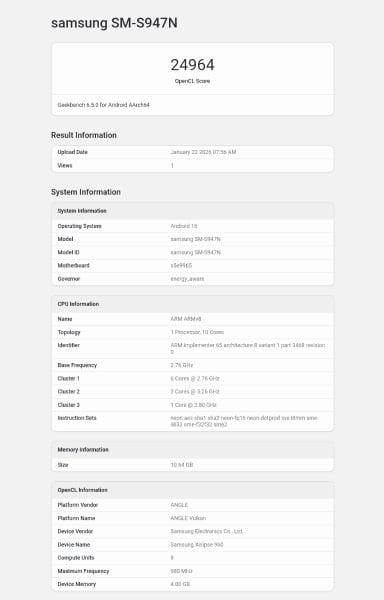
Spotted by tipster Abhishek Yadav on X, the listing is believed to correspond to the South Korean variant of the Galaxy S26 Plus. As a result, unlike the standard S26 and S26 Ultra seen earlier, this model is powered by Samsung’s in-house Exynos 2600.
Exynos 2600 vs Snapdragon 8 Elite Gen 5
The Exynos 2600, as we know, uses a 10-core CPU setup and is built on a 2nm GAA process. It includes one C1 Ultra core clocked at 3.80 GHz with a 3 MB L2 cache, three C1 Pro cores running at 3.26 GHz, and six more C1 Pro cores at 2.76 GHz.
On the graphics side, the chip is paired with the Xclipse 960 GPU. The Geekbench entry also confirms that the Galaxy S26 Plus is running Android 16 and comes with 12GB of RAM.
One important thing to note is that this particular Geekbench run is an OpenCL test, which measures GPU performance. The Exynos 2600 scored 24,964 points in this test.
The Snapdragon-powered Galaxy S26 and S26 Ultra listings focused on CPU single-core and multi-core results instead, making direct comparisons difficult for now.
Separately, the Exynos-powered Galaxy S26 models are rumored to be exclusive to South Korea. The rest of the world will get the Snapdragon 8 Elite Gen 5-powered devices.
Meanwhile, a recent leak has reportedly revealed the full specifications of both the Galaxy S26 and Galaxy S26 Plus. We’ve covered those details separately if you want a deeper look at what Samsung’s next flagships may offer.
For more daily updates, please visit our News Section.
Samsung‘s next generation of flagship smartphones are right around the corner. But ahead of any official announcement or teaser, the upcoming Galaxy S26, Galaxy S26+, and Galaxy S26 Ultra just had their Indian launch date revealed along with the pre-order details and first sale date.
Samsung Galaxy S26 Series India Launch Details
The latest leak arrives from known tipster Ice Universe, who shared the details on X (formerly Twitter). Looking at this tweet, he claims that the South Korean tech giant will announce the Galaxy S26 lineup globally and in India on 25th February 2026, during its first 2026 Galaxy Unpacked event. After the initial announcement, Samsung will offer the Galaxy S26 models for pre-orders that start from February 26 and end on March 4. There will also be a pre-sale period for these premium smartphones, which will be live between March 5 and March 10.
And finally, the first official sale of the Galaxy S26, Galaxy S26+, and Galaxy S26 Ultra kicks off on 11th March 2026. This was all the information shared in the tweet, but in a previous report, finer details of the Galaxy S26 and Galaxy S26+ were revealed. The former is a compact flagship with a 6.3-inch AMOLED display, while the latter has a taller 6.7-inch panel. Both models are barely seeing any updates, with specs being nearly identical to the older S25 series.
But one noticeable change is the rumored shift back to the Exynos 2600 chipset. To recall, Samsung used to release its flagship phones in two variants, with markets like the US and China getting the Snapdragon variant, while the rest of the world received the Exynos chip. Over the last couple of generations, Samsung has only released the Galaxy S series with Snapdragon processors, but this might not be the case this year.
For more daily updates, please visit our News Section.
China has instructed customs to block Nvidia H200 AI chips despite US export approval
Chinese firms face a choice between costly black-market GPUs and weaker domestic chips
The move signals Beijing’s push for long-term chip self-reliance over short-term performance
Source: Nvidia.com
H200 Caught in the Middle of Politics
China has quietly blocked Nvidia’s H200 AI chips at customs, days after the United States approved their export under strict conditions. According to multiple sources, Chinese customs officials were told not to allow H200 shipments into the country. No formal ban has been announced, but the instructions are being treated as a de facto restriction.
Pressure on Chinese Tech Firms
Chinese technology companies have also been told not to buy H200 chips unless absolutely necessary, with narrow exceptions for university or joint research projects. This has left firms with urgent AI needs considering black-market purchases, where an eight-chip H200 server reportedly costs about 2.3 million yuan, around 50% above official prices. Even this supply is becoming harder to secure due to tighter enforcement.
Why the H200 Matters
The H200 is Nvidia’s second-most powerful AI chip and is critical for training large AI models. It is far more capable than most Chinese alternatives, especially for training tasks, though domestic chips are improving in AI inference workloads.
Analysts say Beijing is willing to accept short-term disruption to reduce reliance on US-controlled technology. The H200 episode shows how advanced chips are no longer just products, but tools of geopolitics, with market logic increasingly shaped by national strategy.
Xiaomi has officially confirmed the Redmi Note 15 Pro series’ launch date for the Indian market. The company is set to launch the Redmi Note 15 Pro and Note 15 Pro+ in the region at the end of this month. So here’s everything you need to know.
Redmi Note 15 Pro & Note 15 Pro+ India Launch Date
The Chinese tech giant will unveil the Redmi Note 15 Pro lineup in India on 29th January 2026. Looking at the official teaser poster, we also get a slight glimpse of both models. To recall, the Redmi Note 15 Pro series first made its debut in China last year, with a global release arriving last month. Now, the popular mid range phones are finally making their way to India, and we also got confirmation on some of their key specs.
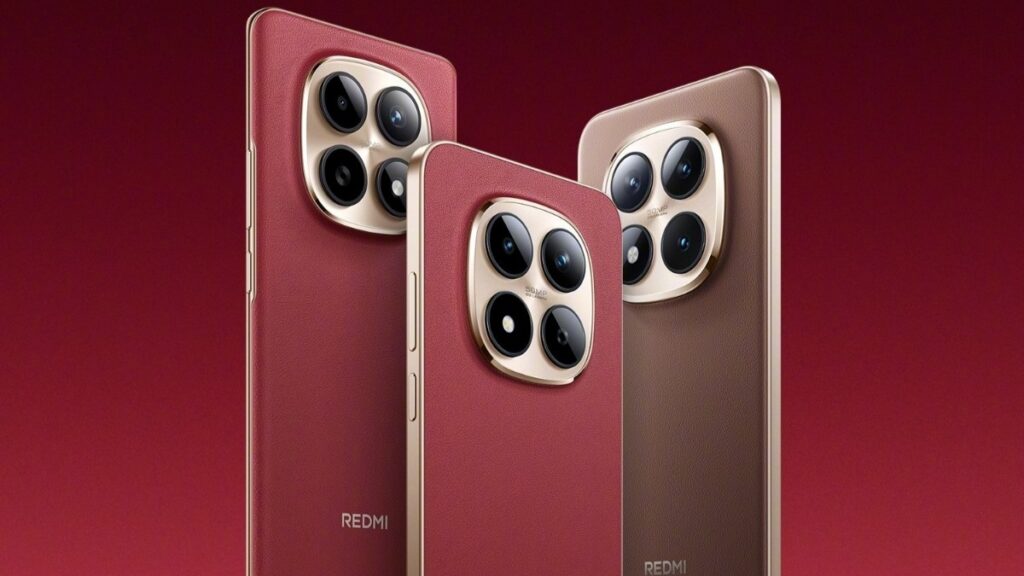
Redmi Note 15 & Redmi Note 15 Pro in Cherry Red, Redmi Note 15 Pro+ in Mocha Brown
This timing places the phones alongside other mid range devices like Oppo’s Reno 15 lineup. Xiaomi has confirmed that both models will feature a large 200MP primary camera, which is an upgrade over the 50MP shooters from their predecessors. Apart from this, the Redmi Note 15 Pro+ will be powered by a massive 6,500mAh battery pack with 100W wired fast charging and 22.5W reverse wired charging. Under the hood, it is equipped with the Snapdragon 7s Gen 4.
Meanwhile, the standard Redmi Note 15 Pro will pack the MediaTek Dimensity 7400 Ultra SoC. Both phones likely run on the Android 16 OS based HyperOS 3 custom skin out of the box. Other notable features include Corning Gorilla Glass Victus 2 for protection, a tall 6.83-inch AMOLED display with 3200 nits peak brightness, 3840Hz PWM dimming, Hydro Touch 2.0, AI powered tools, and much more.
For more daily updates, please visit our News Section.
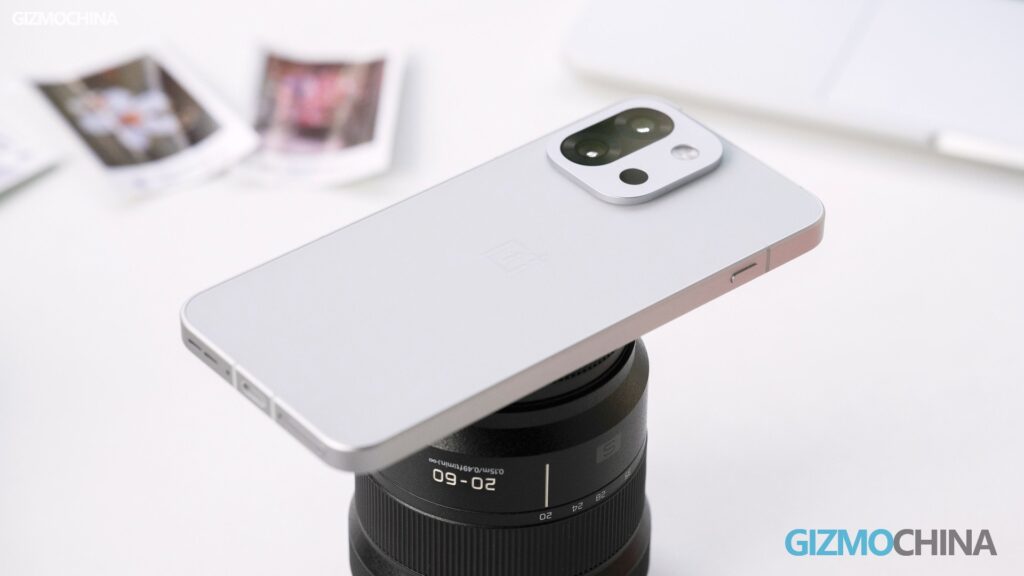
Recent reports have claimed that Oppo is accelerating the China launch of the Oppo Find N6 foldable phone. The same is also being said about the OnePlus 15T. Now that both devices have bagged 3C certification in China, these devices are expected to break cover in the coming weeks.
Oppo Find N6, OnePlus 15T 3C certified
Oppo Find N6 3C listing
As can be seen above, devices bearing model numbers PLP110 and PLP120 have received approval from China’s 3C certification platform. While the PLP110 is said to be the regular version of the Oppo Find N6, the PLP120 could be its Beidou Edition, which may support satellite connectivity.
The 3C certification reveals that the Find N6 may come with support for 80W fast charging. Considering that the Find N5 from last year also supported 50W wireless charging alongside 80W wired charging, the Find N6 may continue to offer wireless charging as well. Reports suggest that the N6 will be the world’s first foldable phone to feature the Snapdragon 8 Elite Gen 5 chipset.
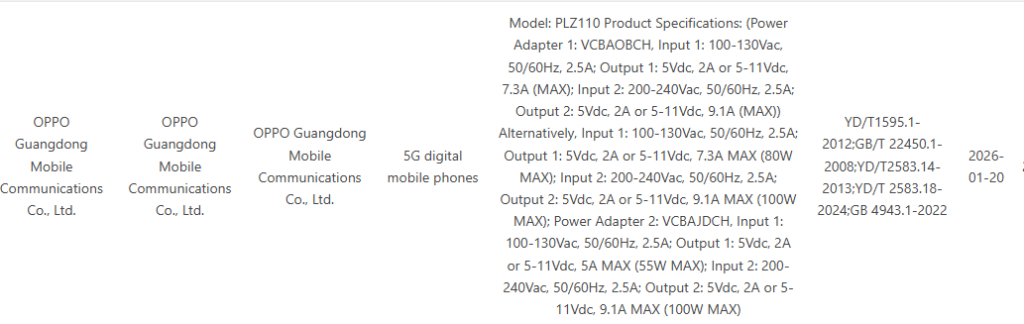
OnePlus 15T 3C listing
Moving on to the PLZ110 device, it is said to carry the OnePlus 15T branding when it hits the Chinese market. Its 3C certification suggests that it may support 100W wired charging. However, multiple reports have claimed that it will lack wireless charging.
Fresh rumors suggest that the Oppo Find N6’s arrival has been delayed. While it was previously expected to launch in January, its release may have been pushed to March. The OnePlus 15T, on the other hand, is expected to launch after the Chinese Spring Festival, which suggests that it may also debut in March. This would still be earlier compared to last year’s OnePlus 13T, which was announced in April.
No global availability rumors
Ideally, the Oppo Find N6 and OnePlus 15T were expected to release globally as the OnePlus Open 2 and OnePlus 15T, respectively. However, recent reports state that these global variants have been cancelled. Some markets may still receive the Find N6 under the same branding.
For more daily updates, please visit our News Section.
A fresh GeekBench listing has revealed some key details regarding the upcoming OnePlus Nord 6. This is the brand’s next mid-range smartphone model, and its benchmark sighting has revealed a high end chipset along with its RAM and Android iteration. So here are all the details.
OnePlus Nord 6 launching with Snapdragon 8s Gen 4
The OnePlus Nord 6 has appeared on the GeekBench 6.5 benchmarking platform under the model number CPH2795, offering us a glimpse into its hardware configuration. It can be seen equipped with the Snapdragon 8s Gen 4, which is paired with 12GB of LPDDR5X RAM. The smartphone scored around 2,019 points in single-core tests and 6,503 points in multi-core benchmarks. This listing also confirmed that the device will run on the Android 16 OS out of the box, which is likely with the OxygenOS 16 custom skin for the global market.
OnePlus Nord 5
OnePlus’ new Nord 6 was spotted by Gadgetsdata, who shared more details on X (formerly Twitter). Looking at this tweet, the device will reportedly sport a flat OLED display with a 1.5K resolution and a 165Hz refresh rate. Meanwhile, the rear features a 50MP main camera and an 8MP ultra wide angle lens. While the storage capacity wasn’t confirmed, the tipster believes that the device will offer UFS 3.1 storage. It is expected to house a gigantic 9,000mAh battery pack that could support 80W wired fast charging.
For selfies and video calls, the front houses a 32MP shooter. The GeekBench listing did not reveal any other finer details like its launch timeline, but this does hint at its imminent release. OnePlus is probably is in the final stages ahead of release, and we can expect an early 2026 debut.
For more daily updates, please visit our News Section.
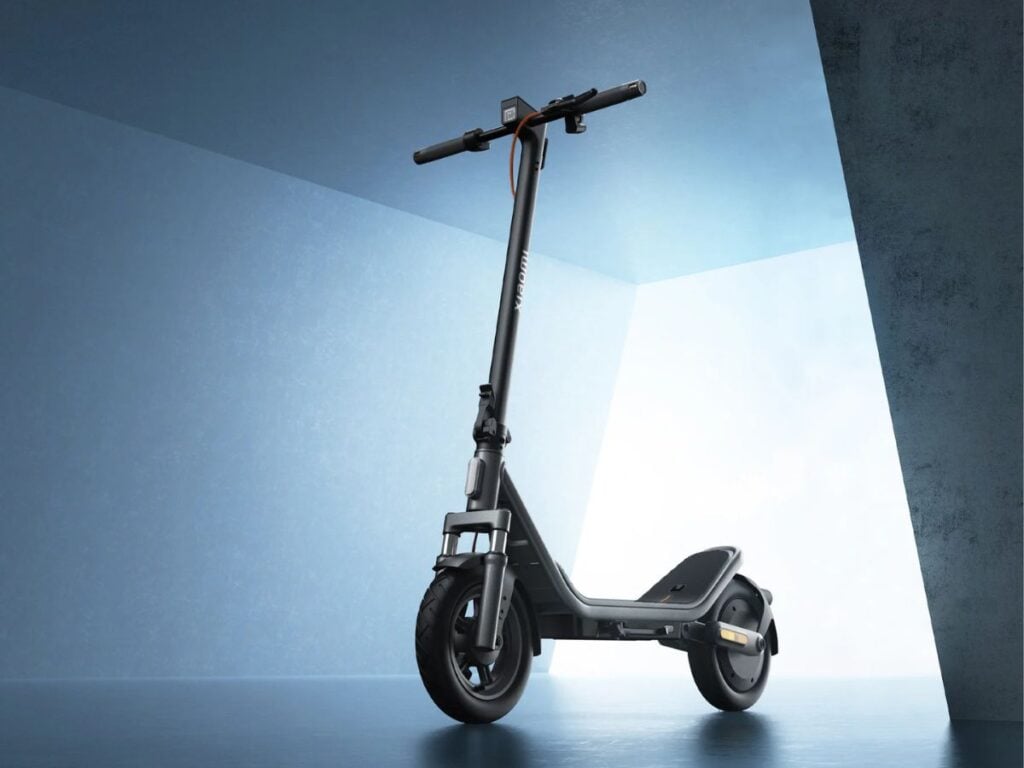
Xiaomi has quietly listed its Electric Scooter 6 on its global website, marking the worldwide rollout of the latest model in its commuter e-scooter lineup. Positioned between the 6 Lite and 6 Max variants, this new scooter brings boosted motor power, larger tires, dual suspension, and more. So let’s check it out.
Xiaomi Electric Scooter 6 Specifications
The newly listed Xiaomi Electric Scooter 6 builds on its predecessor with a more powerful drivetrain that peaks at around 800W and delivers a typical 400W of continuous motor output. This upgrade supports a top speed of approximately 25 km/h (or about 16mph), which is the legal cap in many regions for license free electric scooters. So riders can switch between pedestrian, standard, and sport modes to suit different environments.
Xiaomi Electric Scooter 6
Compared with the previous Xiaomi Electric Scooter 5, which used a lower-powered motor, the Scooter 6’s enhanced performance should make acceleration smoother and handling on varied terrain more confident. Its rating for tackling inclines up to about 18% ensures it won’t shy away from moderate hills on city commutes. One of the biggest visual and functional changes comes with its 12-inch tubeless tires, which are 2 inches larger than those on the older model. This increase, paired with the spring suspension on the front and rear, helps improve the riding experience.
The Electric Scooter 6 retains a foldable structure, making it convenient for parking or carrying onto public transport, and its kicktail design gives it a distinctive silhouette compared with other Xiaomi scooters. Unlike its predecessor, the Scooter 6 is equipped with a 360Wh battery that supports a range of up to around 45km, which is down from 60km on its predecessor. But you do get faster charging speeds. Unfortunately, the pricing and launch date are still at large.
For more daily updates, please visit our News Section.
After teasing the arrival of the iQOO 15 Ultra for the past few days in China, iQOO has finally unveiled the design of its upcoming Ultra flagship. The official reveal confirms two distinctive color options and offers the clearest look yet at the phone’s design direction, ahead of its expected launch in early February.
iQOO 15 Ultra design and color options revealed
The iQOO 15 Ultra will be available in two color variants called 2077 Flowing Orange and 2049 Cold Blue. From the naming itself, both finishes appear to draw inspiration from iconic science fiction themes, with iQOO positioning the phone as a device that reflects futuristic design aesthetics. The Flowing Orange variant leans towards a bold and energetic look, while the Cold Blue version presents a cooler and more restrained visual style.
Design-wise, the phone features a large square camera module with a transparent finish. Inside the camera housing sits a horizontal light strip that functions as a breathing light, adding to the device’s gaming-oriented appeal. The intake vent for the active cooling system is also discreetly integrated beneath the camera module.
On the back, the phone carries a hexagonal honeycomb texture, further reinforcing its performance-focused identity. The frame houses dual shoulder buttons, suggesting a clear emphasis on gaming controls and responsiveness.
Alongside the design reveal, iQOO Product Director Galant V has shared AnTuTu benchmark figures for the iQOO 15 Ultra, indicating a score that crosses 4.51 million points. According to him, this is not the device’s peak performance, with further optimisation still underway. The phone is expected to be powered by Qualcomm’s Snapdragon 8 Elite Gen 5 chipset and will include an active cooling fan to sustain high performance during extended gaming sessions.
Leaks suggest that the iQOO 15 Ultra will start with a base configuration of 16GB RAM and 512GB storage, while the top variant could go up to 24GB RAM and 1TB storage, a combination that remains rare even among flagship phones.
The company has also hinted at several first-time gaming technologies related to sound, visuals, and control latency. With the launch confirmed for early February, more official details are expected to surface soon.
For more daily updates, please visit our News Section.
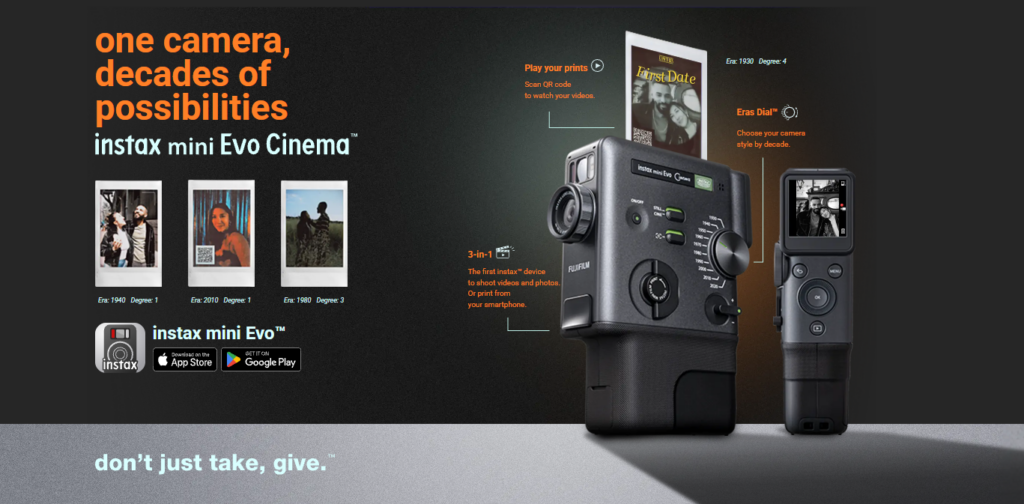
FUJIFILM India has launched the instax mini Evo Cinema, a new hybrid instant camera that shoots photos and videos while also printing them instantly. The camera builds on the existing instax Evo lineup by adding video recording and creative effects based on different decades.
The instax mini Evo Cinema has a hybrid design with a 1.54-inch rear LCD display for previewing photos before printing. It captures still images at 1920 × 2560 resolution using a 1/5-inch 5 MP CMOS sensor. For video, it records at 600 × 800 in Standard mode or 1080 × 1440 in High-Quality 2020 mode at 24p in MP4 format. The camera has an ISO range of 100 to 1600 on auto, shutter speeds from 1/4 to 1/8000 sec, and an F2.0 aperture. It uses Program AE exposure with ±2 EV compensation, TTL 256 split metering, and Single AF with face recognition from 10 cm to infinity.
The video-to-print feature lets you turn recorded videos into QR codes that print alongside a still frame on instax mini film. You can scan the QR code with your smartphone to replay the video inside an instax-style frame or download it for sharing.
The camera connects to a dedicated smartphone app for iOS and Android through Bluetooth 5.4 and 2.4 GHz Wi-Fi. The app supports remote shooting, image and video transfer, firmware updates, and direct printing of smartphone photos in JPEG, PNG, or HEIF formats. You can merge multiple clips into a single video up to 30 seconds long, apply opening and ending templates, and create poster-style prints with custom text.
The Eras Dial provides 10 effects inspired by different decades from 1930 to 2020. Options include a 1960s 8mm film look and a 1970s CRT television effect. Each effect has adjustable intensity and adds matching audio elements like noise, tape flutter, and mechanical sounds during recording.
The camera has a vertical grip design inspired by the FUJICA Single-8, finished in black and gray. It includes a clickable Eras Dial, a Print Lever, an attachable viewfinder, and a grip accessory. Prints are produced at 1600 × 600 resolution in about 16 seconds. The internal lithium-ion battery can handle around 100 prints per full charge.
The instax mini Evo Cinema Premium Edition is priced at Rs. 47,999 in India. It comes as a combo box with the camera and two packs of instax mini glossy film. Pre-bookings are open from 21 to 27 January 2026 on the official instax website. The camera will be available and start shipping on 28 January 2026. Customers who pre-book will receive two additional designer instax mini film packs.
For more daily updates, please visit our News Section.
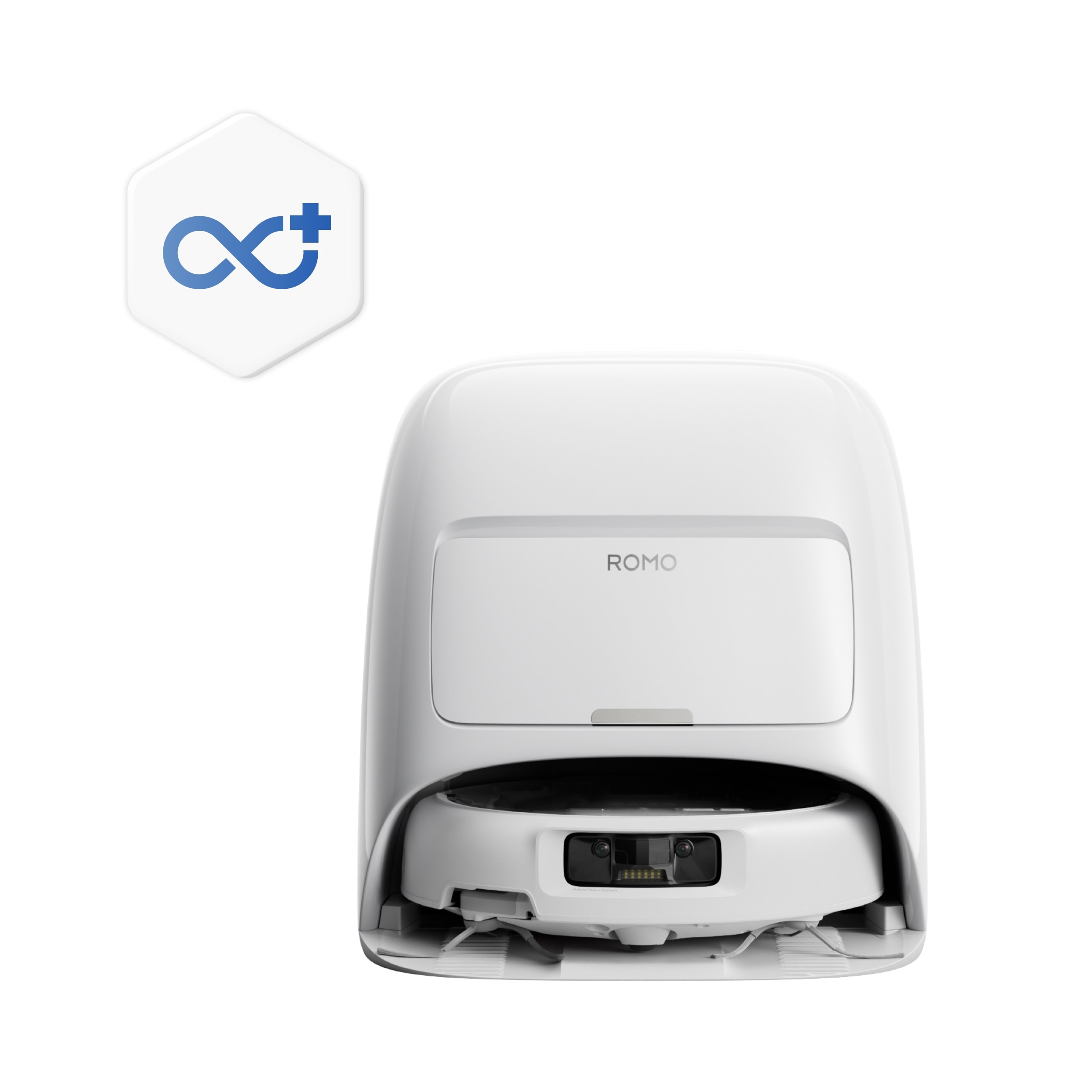
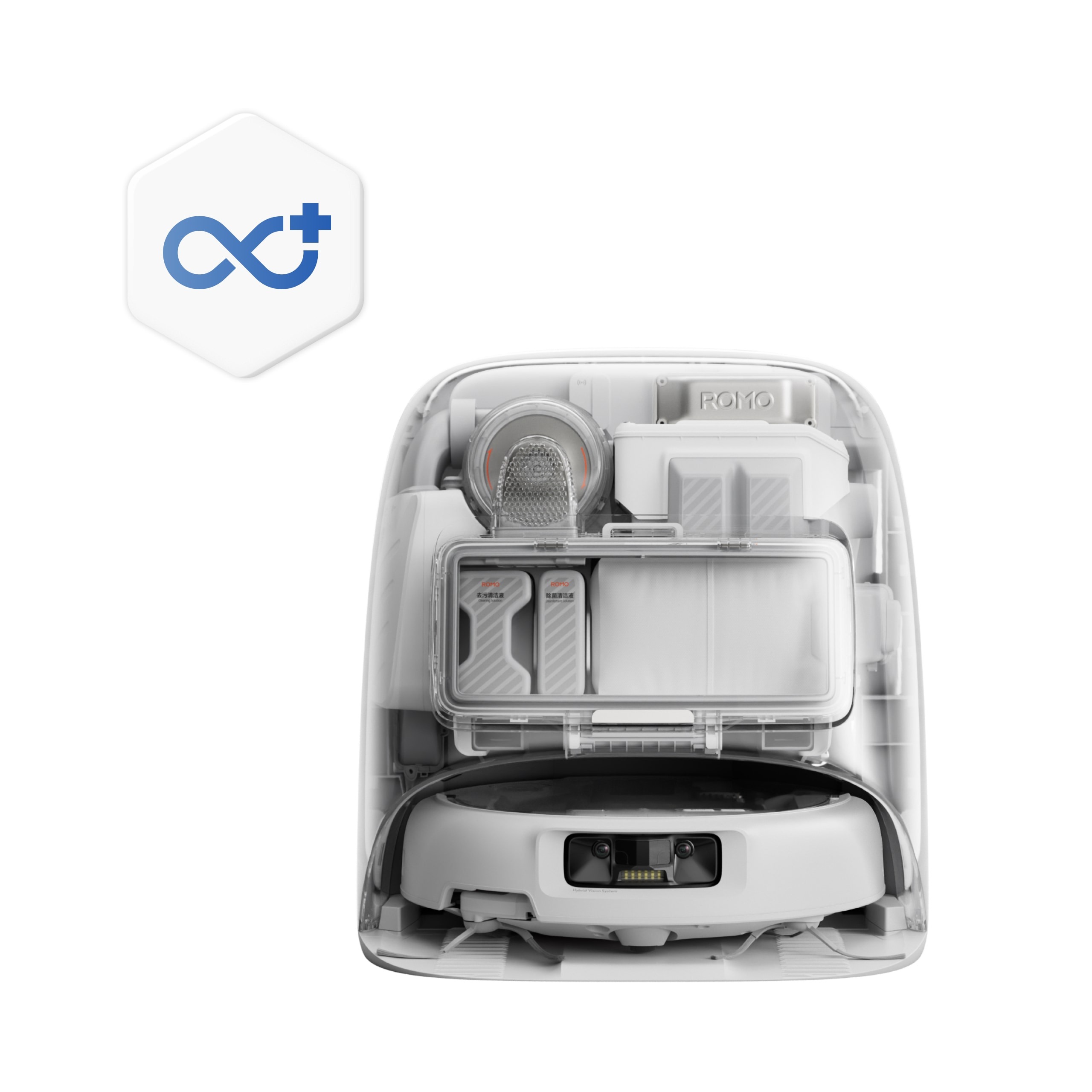
DJI has launched its ROMO robot vacuum cleaners in Korea. The lineup focuses on complete floor coverage, strong suction, and minimal maintenance. The top ROMO P model has transparent panels on the robot and base station so you can see the internal components.
ROMO uses dual fisheye vision sensors and wide-angle dual-transmitter solid-state LiDAR for millimeter-level obstacle sensing. With machine learning, it detects and avoids objects as thin as 2 mm, including charging cables and playing cards. The sensors let the robot navigate under beds, sofas, and other low-clearance furniture, even in dim lighting. The wide field of view helps it move around irregular furniture without missing spots.
The cleaning routes use DJI’s mapping and navigation technology. ROMO adjusts its path in real time based on obstacles and room layout. It cleans close to table legs, wires, and corners while avoiding items like socks or liquid spills. Dual flexible arms extend and retract automatically to clean along edges, under cabinets, and around furniture legs. The sweeping coverage is wider than the mop path, so dirt gets removed before mopping starts.
ROMO delivers up to 25,000 Pa of suction with 20 liters per second airflow. When the vision system spots loose debris like cat litter, the robot slows down and reduces side brush rotation to prevent scattering. Twin high-torque motors power the roller brushes, guiding hair, dust, and larger debris into a hollow center for better pickup and less tangling.
The self-cleaning base station handles long-term use with minimal effort. It uses four high-pressure water jets, a 16 mm waste outlet, and applies 12 newtons of downward force on the mop pads for effective dirt removal. This setup supports up to 200 days of maintenance-free operation. A three-stage sound suppression system cuts dust collection noise by up to 80 percent.
ROMO has a 164 ml onboard water tank to keep mop pads evenly damp and automatically adjusts water flow for tougher stains. ROMO P adds a separate compartment for floor deodorizer, allowing different routines for kitchens or full-home cleaning. The DJI Home app handles control and offers preset and customizable modes for carpets, thresholds, kitchens, bathrooms, and pet areas. Privacy features include encrypted video transmission and two-factor authentication for camera access. ROMO supports 55 W fast charging and reaches full charge in about 2.5 hours.
Pricing & availability
The DJI ROMO series is available for pre-order in Korea. Prices start at 1,590,000 KRW for ROMO S, 1,790,000 KRW for ROMO A, and 1,940,000 KRW for ROMO P.
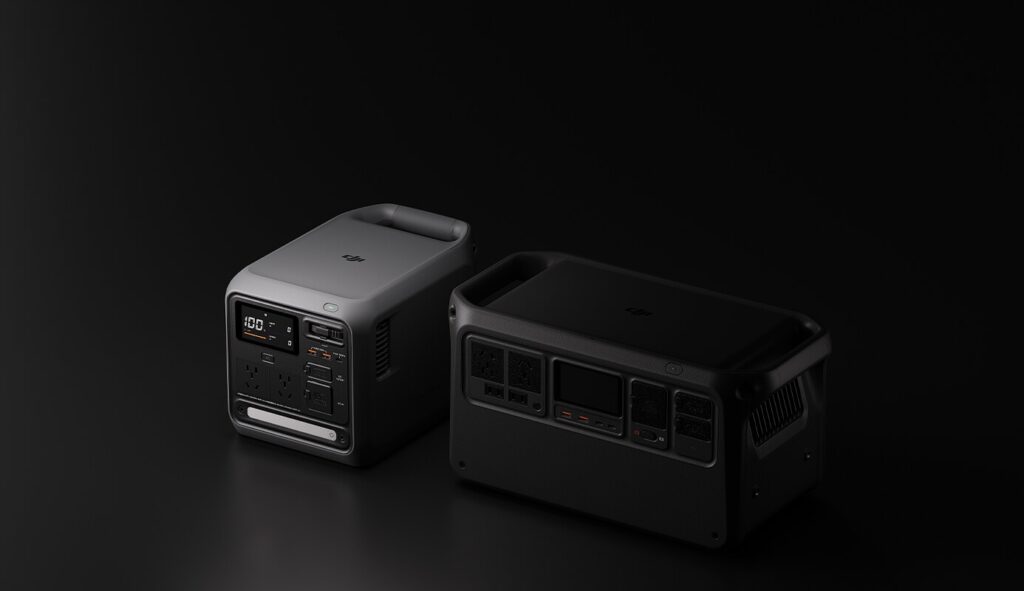
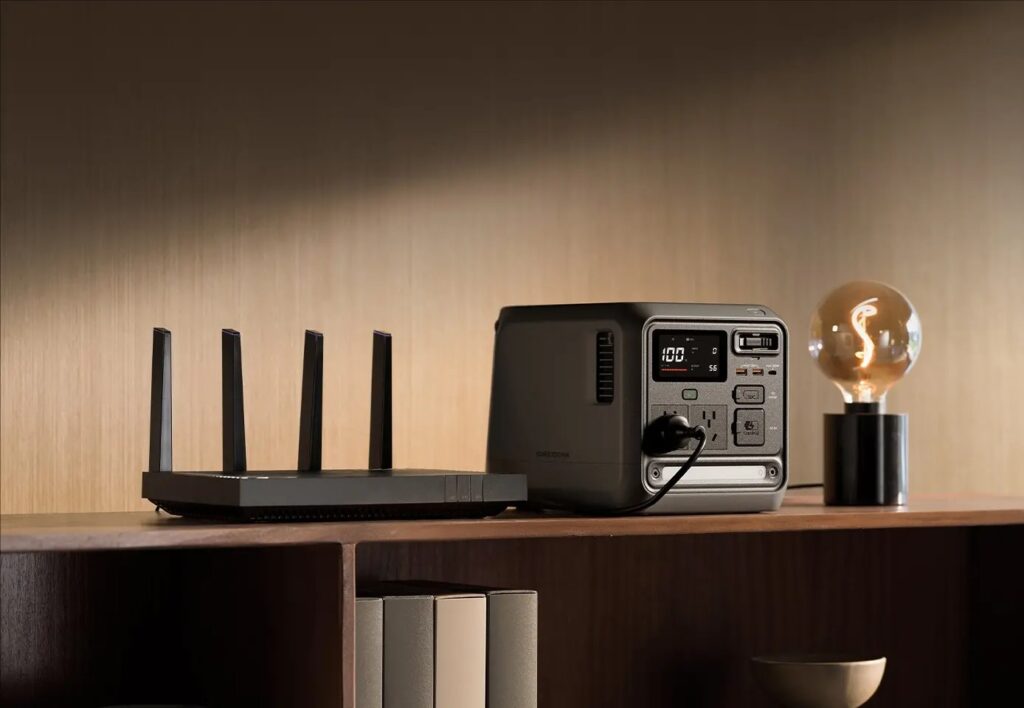
DJI has launched the Power 1000 Mini, a new portable power station that sits between compact power banks and larger power stations. The product has debuted in China, with a wider rollout expected later. It follows the launch of the Power 1000 V2, which reached markets like Europe in July 2025.
The Power 1000 Mini focuses on reducing size and weight while keeping a large battery. It uses a lithium iron phosphate battery with a capacity of around 1,000 Wh. The battery is rated to retain at least 80% capacity after 4,000 charge cycles. Power output is rated at 1,000 W, with support for an 800 W continuous load. This is enough to run laptops, cameras, drones, and other mid-power devices.
Compared to the Power 1000 V2, the Mini is smaller and lighter. It measures 314 × 212 × 216 mm and weighs 11.5 kg. For reference, the Power 1000 V2 measures 448 × 225 × 230 mm and weighs 14.2 kg. The Mini also includes an integrated handle to make carrying easier.
One of the key new features is a retractable USB-C cable built into the body. It supports up to 100 W bidirectional charging. The rest of the port selection includes one additional 100 W USB-C port, two 12 W USB-A ports, and two AC output sockets. This is half the number of AC outlets found on the Power 1000 V2. There is also an SDC port.
Charging is fast for a power station of this size. DJI states that a full charge takes about 75 minutes, while an 80% charge can be reached in under one hour. The unit can be charged using AC power, USB-C input, or solar panels.
The Power 1000 Mini also includes a built-in LED light, which can be useful for camping or low-light conditions. An SOS flashing mode is included for emergencies.
In China, the Power 1000 Mini is priced at CNY 2,499, or about $359. DJI has not yet confirmed when it will be available in other regions.
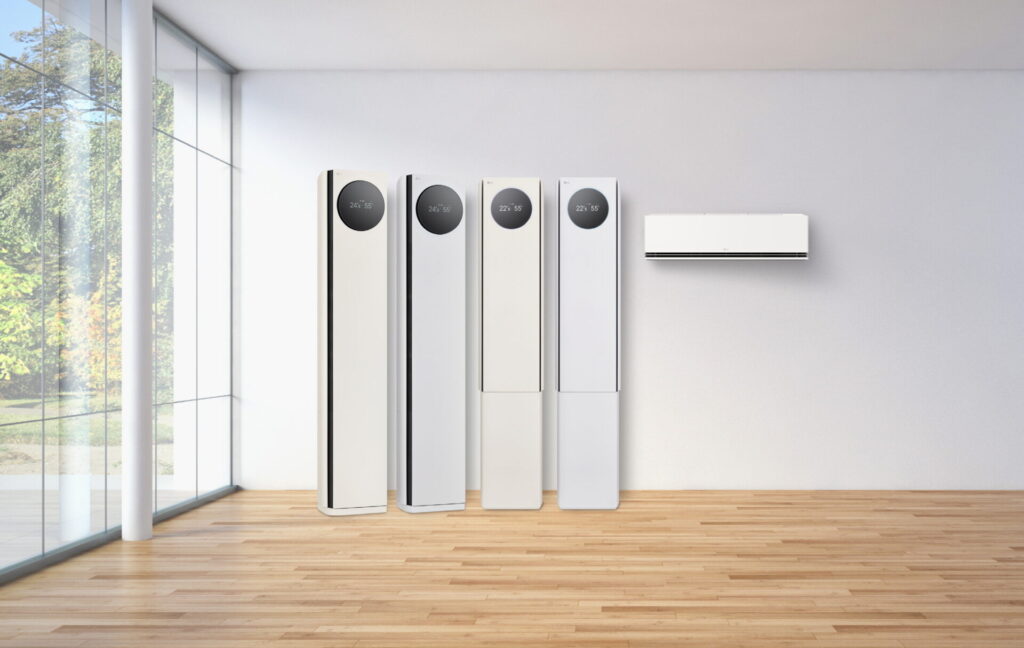
LG Electronics has officially launched its 2026 LG Whisen Objet Collection Tower I and View I Pro air conditioners in South Korea. The new models debut a proprietary cooling system called AI Cold Free, which adjusts both temperature and humidity to provide a more comfortable indoor climate.
Specifications
The new AI Cold Free addresses a long-standing limitation of conventional air conditioners. Traditional systems lower humidity by reducing the air temperature, often making rooms feel uncomfortably cold. LG’s two-stage heat exchanger design removes moisture in the first stage and reheats the air in the second stage to maintain a steady, user-defined temperature. This process delivers dry, cool air that avoids the sharp chill of standard dehumidification.
The company has also upgraded its AI Airflow system. It uses radar sensors to detect the user’s location and surrounding conditions. When the space is hot, the system activates strong airflow. As the room cools, it shifts to gentler or directional airflow to maintain comfort while improving energy efficiency.
The new models add AI Voice Recognition powered by a GPT-based engine, allowing natural language commands, usage queries, and mode suggestions based on room conditions. An AI Sleep mode learns user sleep patterns and adjusts cooling behavior to minimize interruptions.
The lineup also integrates cleanliness and energy management features, including a Filter Clean Bot that clears dust from the fine filter weekly and AI Heat Exchanger Cleaning that triggers automatic cleaning based on environmental data, alongside Away Energy Saving and Pet Care modes.
The display panel has increased in size from 4.3 inches to 6.8 inches, showing temperature, humidity, and dehumidification status.
Pricing and Availability
The Tower I and View I Pro models will roll out starting January 22, with prices ranging from KRW 4.2 million to KRW 5.97 million ($2,856 to $4,060), depending on configuration.
Rogbid has announced the Apex S, a new GPS smartwatch that features dual-band positioning, a vivid AMOLED display, and a slim, minimalist design. The watch aims to offer premium features at an affordable price of $59.99.
Rogbid Apex S Specifications
The Apex S features a 1.75-inch AMOLED screen with a 466 x 466 resolution. The display uses Panda Glass for scratch protection and delivers sharp, bright visuals in both indoor and outdoor settings. The watch includes two physical buttons, a rotating crown for navigation, and a dedicated GPS button for quick access to tracking features.
Rogbid has equipped the Apex S with a dual-band (L1/L5) GPS system that supports six satellite networks. The watch also includes a built-in compass and route import support for reliable navigation during outdoor activities.
The smartwatch supports over 100 sports modes and tracks key metrics like heart rate, blood oxygen, pace, and distance. Rogbid has included AI-powered heart rate alerts that provide real-time feedback during workouts. The Apex S also monitors sleep, stress levels, and breathing patterns.
The watch uses the ATS3085S4 chip and supports Bluetooth 5.3 for stable connectivity. It includes a built-in microphone and speaker for Bluetooth calling. The 800mAh battery supports up to 15 days of regular use or 30 days of standby time. The watch carries a 3ATM water resistance rating.
Rogbid has launched the Apex S in Premium Black. The watch is now available exclusively through the brand’s official store.
In related news, Xiaomi has recently launched a new kids smartwatch featuring flip dual cameras, an AMOLED display, and floor-level GPS, while Motorola has confirmed the Moto Watch will arrive in India on January 23 with Polar fitness features.
For more daily updates, please visit our News Section.
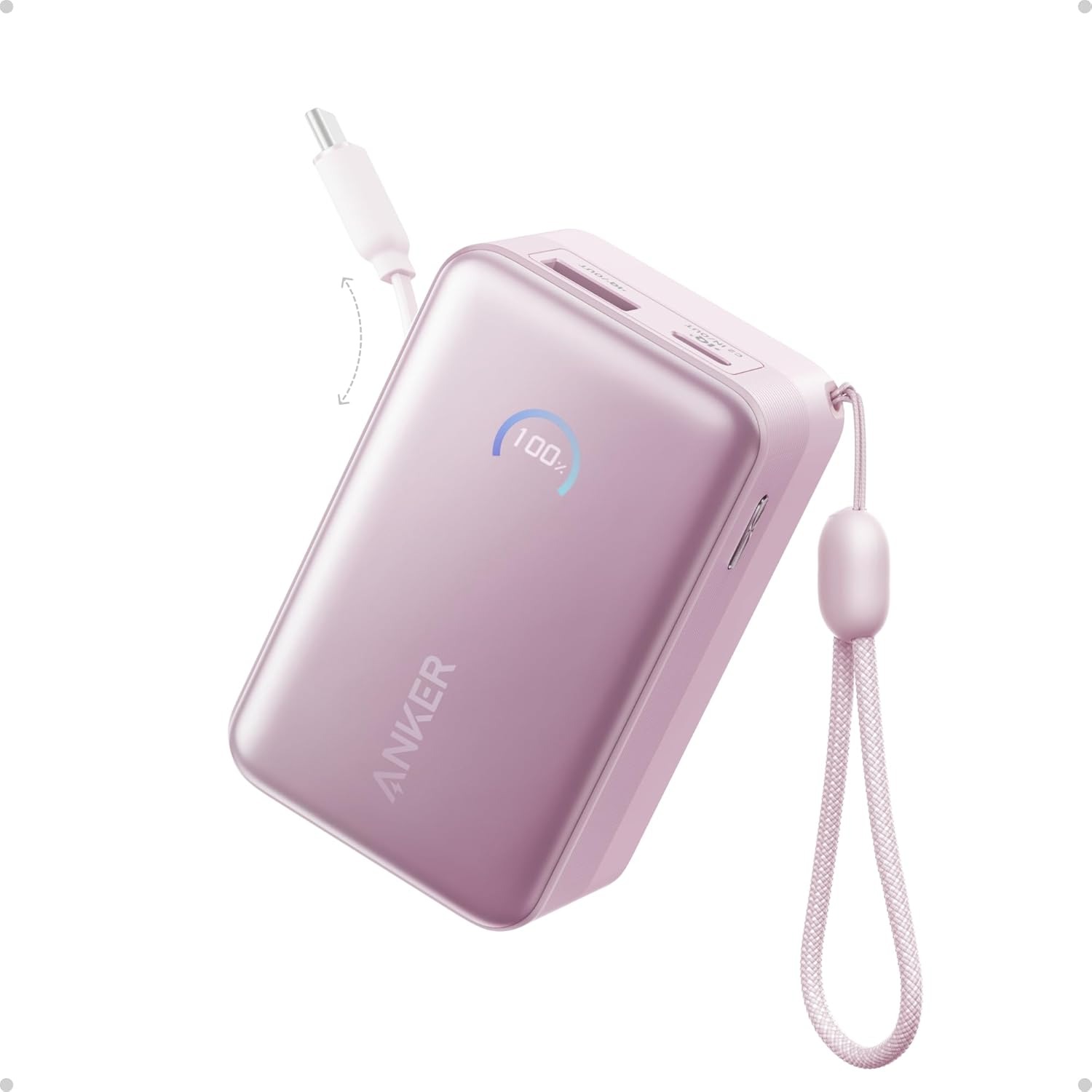
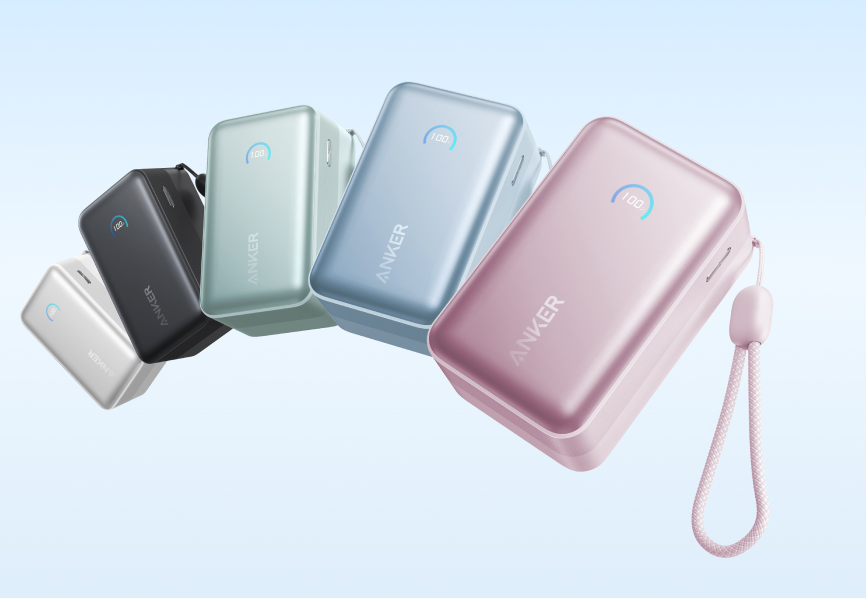
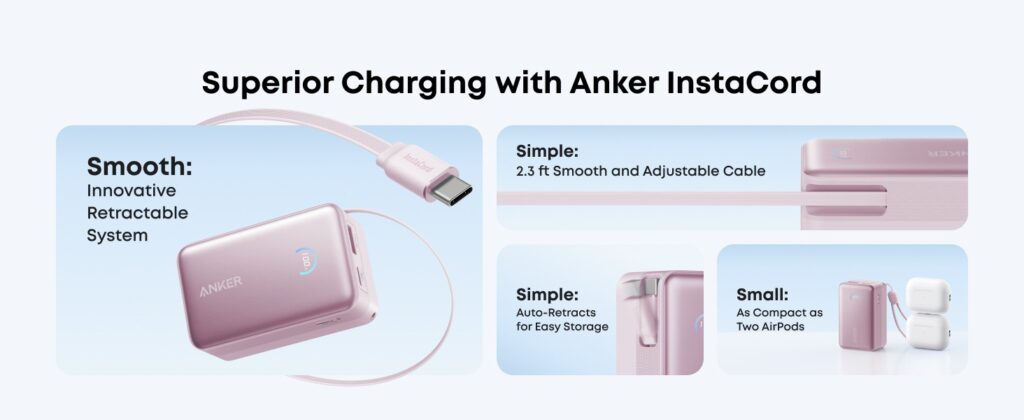
Anker has released a new pink version of its Nano Power Bank (10K, 45W, Built-In Retractable USB-C Cable) in the US. The power bank originally launched in July 2025 and was first sold in black, white, and green color options. The new pink model expands the lineup without changing any of the hardware or charging features.
The pink Nano Power Bank is priced at $59.99 and is currently available only through Anker’s official Amazon storefront. While the new color is selling at full price, the earlier black, white, and green versions are now discounted (down to $49.99).
Anker Nano Power Bank features
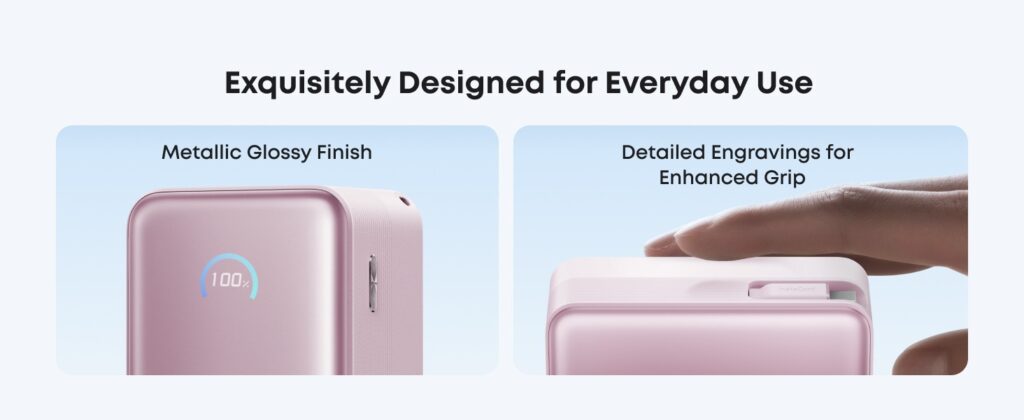
The Nano Power Bank 10K is designed for users who want a compact and easy-to-carry charging accessory. It weighs 232 grams and measures 3.2 x 2.0 x 1.4 inches. This makes it small enough to carry in a pocket or bag without adding much weight. Inside, it packs a 10,000mAh battery that supports Power Delivery, Quick Charge, and Samsung Fast Charging 2.0.
One of the main features is the built-in USB-C cable. The cable is retractable, which helps reduce clutter and removes the need to carry an extra charging cable. This USB-C cable supports charging speeds of up to 45W. Anker claims that using this cable allows the power bank to charge an iPhone 16 Pro to 50 percent in 27 minutes.
The power bank also includes a USB-A port. When charging through the USB-A port, the maximum output is limited to 22.5W. If all three outputs are used at the same time, the total output drops to 7.5W. This helps manage heat and power distribution when multiple devices are connected. Recharging the Nano Power Bank 10K is also quick. When connected to a USB-C charger that supports 30W input, the power bank can be fully charged in around two hours.
For more daily updates, please visit our News Section.
Oppo started pushing ColorOS 16 globally in November, first targeting the Find N5, Find N3 Flip, and Find X8 series. After updating most 2025 devices, the company is now bringing the Android 16-based update to older models.
According to posts on Oppo Community, the stable ColorOS 16 update is now available for the Reno 11 Pro (CPH2607_16.0.2.401), Reno 11 (CPH2599_16.0.2.400), Reno 10 Pro Plus (CPH2521_16.0.2.400), and F25 Pro (CPH2603_16.0.2.400). The rollout happens gradually and may take days or weeks to reach all devices across different regions. Users can check manually by going to Settings > System & Updates > Software Update.
ColorOS 16 features
ColorOS 16 (Global Version) is based on Android 16 and puts a clear emphasis on speed, smarter features, and smoother interaction across devices. At the core of the update are the new Luminous Rendering Engine and an updated Trinity Engine. Together, they improve overall system stability by 37% and make animations feel noticeably smoother, whether the phone is an entry-level model or a flagship.
The “Luminous” design idea also carries over to the interface. ColorOS 16 introduces a new Flux Home Screen with resizable, adaptive icons that adjust more naturally to different layouts. The Always-On Display has also been expanded to full screen and now transitions smoothly into the lock screen, which makes the entire unlock experience feel more fluid and connected.
AI plays a much bigger role this time, with deeper integration of Google Gemini. AI Mind Space acts as a central hub where users can collect, organize, and revisit notes or saved information. On the creative side, features like AI Portrait Glow and Master Cut aim to make advanced photo and video editing easier, without requiring much manual effort.
Connectivity has also been improved. O+ Connect offers better integration with both Mac and Windows systems, while the enhanced Touch to Share feature simplifies file transfers to iOS devices. For privacy, ColorOS 16 relies on a Private Computing Cloud to handle sensitive AI tasks securely. Overall, the update feels faster, more practical in daily use, and better suited for users who rely on multiple devices.
For more daily updates, please visit our News Section.
We use cookies on our website to give you the most relevant experience by remembering your preferences and repeat visits. By clicking “Accept”, you consent to the use of ALL the cookies.
This website uses cookies to improve your experience while you navigate through the website. Out of these, the cookies that are categorized as necessary are stored on your browser as they are essential for the working of basic functionalities of the website. We also use third-party cookies that help us analyze and understand how you use this website. These cookies will be stored in your browser only with your consent. You also have the option to opt-out of these cookies. But opting out of some of these cookies may affect your browsing experience.
Necessary cookies are absolutely essential for the website to function properly. This category only includes cookies that ensures basic functionalities and security features of the website. These cookies do not store any personal information.
Any cookies that may not be particularly necessary for the website to function and is used specifically to collect user personal data via analytics, ads, other embedded contents are termed as non-necessary cookies. It is mandatory to procure user consent prior to running these cookies on your website.