Advertisement

Europe aims to produce 20% of world’s semiconductor and build its first quantum computer

The European Union seeks to grow its presence in the semiconductor industry. It aims to produce 20 percent of the global output of cutting edge advanced semiconductors by the end of this decade, with the plans also including its first quantum computer in five years.

Europe

According to a Reuters report, the move from the EU arrives as a part of its efforts to reduce its dependence on non European technologies. The EU plan titled 2030 Digital Compass arrives after the pandemic exposed the reliance of the union on key technologies owned by Chinese and American based companies. In the plan, the EU emphasized the importance of semiconductors, which are used in a wide range of industries and fields.

Semiconductors are used in connected cars, smartphones, IoT devices, and high performance computers, and artificial intelligence fields as well. The news also arrived as the world is suffering from one of the worst shortages of semiconductors, which has even led to automobile makers having to halt production due to lack of chips. As per the document from the EU, “It is our proposed level of ambition that by 2030 the production of cutting-edge and sustainable semiconductors in Europe including processors is at least 20% of world production in value.”

Europe

In the plan, the EU also recommended investing in quantum technologies, saying that these could be a ‘game changer’ in developing new medicines and even speed up genome sequencing. The document also added that “It is our proposed level of ambition that by 2025, Europe will have the first computer with quantum acceleration paving the way for Europe to be at the cutting edge of quantum capabilities by 2030.”

RELATED:


Super Deal: Get $62 OFF on Mi Robot Vacuum-Mop 2 Pro+ from AliExpress (Coupon)

AliExpress is giving out a fantastic deal on Xiaomi Mi Robot Vacuum-Mop 2 Pro+. The device which is listed at $461 is now available for $399 via coupon code: 2PRO62.

WHERE TO BUY
Xiaomi Mi Robot Vacuum-Mop 2 Pro+ at $399 (after discount)@Aliexpress

Mi Robot Vacuum-Mop 2 Pro+ 3

Xiaomi Mi Robot Vacuum-Mop 2 Pro+ has a unique 3D Explore function which helps it to conduct 3D visual navigation and intelligent route planning. Equipped with S-Cross 3D technology it can accurately avoid obstacles and collisions just like a self-driving vehicle and a photon level sensor, helps it to detect any obstacles in its surroundings resulting in anti-collision and anti-fall functions which are 10 times more accurate than any infrared sensors. Mi Robot Vacuum-Mop 2 Pro+ 1

Fitted with a Cortex-A53 high-performance chip Xiaomi Mi Robot Vacuum-Mop 2 Pro+ can simultaneously locate the robot, plan the floor map and navigate through obstacles. With a 3000pa strong suction and Japanese high-tech brushless motors, the robot gives you a strong and neat suction leaving zero dirt behind. Additionally, an electronically controlled 250ml smart water tank helps to mop different types of floors like marble, tile, wood, etc, which at full capacity, can mop almost 160㎡ of the floor space. With a built-in 5200mAh large capacity battery that supports 180 minutes of standard cleaning and remote control function through the Mijia App, this robot vacuum cleaner is a one-stop solution for your daily cleaning and mopping needs. 

Mi Robot Vacuum-Mop 2 Pro+Xiaomi Mi Robot Vacuum-Mop 2 Pro+ is retailing at AliExpress at $461 but as a limited time offer you can buy this product for $399 only by using the discount coupon code:  2PRO62

Please note that this offer is valid only on orders made from EU warehouses and additional new user coupons and free shipping is available on this deal. So go get your robot vacuum cleaner before the deal expires.  

For more information on such exciting deals and offers check out our deals hub.


*Please Note: When you buy something using the links in our articles, we may earn a small commission at no cost to you.

Android 11 reportedly has the fastest adoption rate

Google’s Android mobile operating system is notorious for its slow adoption of newer version but that is now getting changed. As per the latest data from StatCounter, the latest Android 11 has the fastest adoption rate out of any Android version so far in the U.S.

As per the report, Google‘s Android 11 has more than 25 percent of the smartphones and tablets in the Android market as of this month, that too in just six months after the official release of this version of Android.

Android 11

However, Android 10 is still the most widely used version of the mobile operating system in the United States with more than 33 percent of the market share. Globally, it holds more than 41 percent market share.

Prior to this, Google had confirmed that the Android 10 was having the fastest adoption rate last year, signaling that Google and its partners are doing a much better job at rolling out the newer version.

Do note that the numbers related to the adoption of Android 11 is from a private research firm StatCounter and not the official numbers from Google. We expect the Mountain View-based tech giant to reveal the numbers in the coming months.

Google is currently working on a newer version of Android operating system — Android 12 and has already released the first Developer Preview. After a couple of developer previews and beta version, the stable version will be rolled out.

RELATED: 

Tesla and hundreds more face security breach, hackers gain access of Verkada security cameras

A small group of hackers has managed to cause a security breach, which has affected hundreds of businesses. This includes the popular electric vehicle maker Tesla after hackers gained access to surveillance cameras from Verkada.

Tesla Logo

According to a Reuters report, the hacker group gained access to the live feed of the security cameras and even archived surveillance footage from hundreds of businesses. The group even managed to breach Tesla by gaining administrative access to the camera maker Verkada over the past two days, as per sources involved in the security breach incident. Tillie Kottmann, a Swedish software developer, shared screenshots on Twitter from inside a Tesla warehouse in California and an Alabama jail.

Kottman gained attention for finding security flaws in mobile applications and other systems. As per the software developer, the breach was to draw attention to the pervasive monitoring of people after having found login information for Verkada’s administrative tools publicly online earlier this week. Verkada has since acknowledged an intrusion and said that it has disabled all internal administrator accounts to prevent any unauthorized access.

Tesla

As per an official statement “Our internal security team and external security firm are investigating the scale and scope of this issue, and we have notified law enforcement.” Notably, the hacker group could have used its access to control the camera gear to access other parts of the company’s networks with Tesla and even software makers Cloudflare and Okta, as per Kottman.

RELATED:


Apple AirPods 3 renders leak showcases its design; expected to launch later this month

Apple AirPods lineup has become very successful and is generating billions of dollars in revenue for the company. To keep the momentum going, the Cupertino-based giant keeps introducing a new models.

Now, Apple is gearing up to launch the third-generation of the AirPods, aka AirPods 3. If the reports are to be believed, then the company is expected to officially launched them at an event later this month, most likely on 23rd March.

Apple AirPods 3 Render

Ahead of the launch, we have got our hands on a new set of AirPods 3 renders from suppliers. The design showcased in the renders is likely the final version which will be released in the market for everyone to purchase.

The design is pretty much in line with the previous render leaks, resembling the design of the AirPods Pro. It appears that the AirPods 3 will have a shorter stem and come with replaceable ear tips, similar to what we have seen with the company’s AirPods Pro.

Apple AirPods 3 Render

There is also a possibility that the next-generation AirPods may come with support for Active Noise Cancellation (ANC). In that case, Apple to have something major to offer with the next-generation AirPods Pro to justify the “Pro” tag and higher pricing.

If the recent reports are to be believed, then along with the AirPods 3, the company is also expected to launch the second-generation AirPods Pro. Along with these true wireless earphones, Apple will also be launching new iPad models.

RELATED: 

Nokia G10 gets certified by Malaysia’s SIRIM

A few days back, news broke out that HMD Global will be releasing a new smartphone called Nokia G10. This handset is expected to be the first model in the Nokia G series. The said phone has been now spotted on Malaysia’s SIRIM certification bureau.

Nokia Logo Featured

HMD Global, the brand licensee of Nokia feature phones and smartphones has been releasing unimpressive products lately. Above all, the company has now become way slower in updating its lineup to the latest version of Android. For those unaware, it was the brand’s only major plus point.

But an interesting report recently revealed that the firm will be launching a new handset called Nokia G10 with model number TA-1334. The report suggested it to be a gaming smartphone. However, another leak tipped that HMD Global will be using new branding for its upcoming smartphones, just like the Lenovo-owned Motorola’s new Moto G lineup.

Hence, the Nokia G10 could be the first-Nokia branded smartphone under HMD Global with the new branding. Unfortunately, not much is known about this phone except for the fact that it could feature a 6.4-inch display, an octa-core processor, and a 48MP quad-camera setup.

Lastly, since the Nokia G10 (TA-1334) has been certified in Malaysia and Thailand (earlier) by SIRIM and TÜV Rheinland, we can expect this handset to launch in these markets.


RELATED:


(Via)

Samsung and Apple face trouble after Austin chip plant halts production

Samsung and Apple may face troubles in their smartphone production after the former’s Austin chip plant has halted production for an extended period of time. This plant manufactures chips used in smartphones from both of the major brands.

Samsung

According to TheElec report, the suspension of the chip plant was caused by major power outages in the region, which was due to the cold wave that hit North America recently. The Austin plant is responsible for manufacturing chips used in the South Korean tech giant’s flagship handsets that it sells in America. Furthermore, this site is also the one that produces display driver IC for organic light emitting diode (OLED) panels, which are used by Apple for its latest iPhones.

Notably, the chip plant has a production capacity of 20,000 wafers per month. Usually, the company stocks up a month and a half of inventory for components, so that they won’t be affected by any short term suspension of production. However, the Austin site halted operations around two weeks ago. In other words, if it takes too long to restart operations, this may eventually affect smartphone production as well.

Samsung

As per sources close to the matter, it would take around two months for the plant to restarting production at its usual pace. This means that the company will have until mid April to have the production reach normal levels before it starts to affect its smartphone production. Additional sources from within the company’s supply chain have also added that Samsung is expected to ship around 30 million units of the Galaxy S21 series, which is around 15 percent higher than its predecessor. But with the halting of its Austin chip plant, this could be lowered to around the high 20 million units.

RELATED:


Xiaomi Mi 10S with 90Hz display, Snapdragon 870, and 108MP quad cameras launched for ~$506

Xiaomi has taken off covers from a new handset called the Xiaomi Mi 10S in China. In terms of design, the handset looks like the Xiaomi Mi 10 Ultra. Except for the inclusion of the Snapdragon 870 chipset, the Mi 10S borrows the other specifications from the Mi 10 5G handset that debuted back in February 2020. It has arrived with a starting price of 3,299 Yuan (~$506) in China.

Xiaomi Mi 10S specifications and features

The Xiaomi Mi 10S measures 162.6 x 74.8 x 8.96mm and it weighs 208 grams. It has a 6.67-inch AMOLED display with curved edges and a hole-punch placed at the upper-left corner. The screen delivers a Full HD+ resolution of 1080 x 2340 pixels, a 90Hz refresh rate, 180Hz touch sampling rate, 1120nits brightness, 5000000:1 contrast ratio, and 100 percent DCI-P3 color gamut. The screen is shielded by Gorilla Glass 5 panel.

The Snapdragon 870 mobile platform powers the device with up to 12 GB of LPDDR5 RAM. The phone offers users up to 256 GB of UFS 3.0 storage. The 4,780mAh battery of the smartphone carries support for 33W wired fast charging (charges fully in 56 minutes), 30W wireless charging (charges fully in 69 minutes), and 10W wireless reverse charging. It is equipped with vapor chamber liquid cooling technology for heat dissipation.

Xiaomi Mi 10S
Xiaomi Mi 10S

At the front, the Xiaomi Mi 10S features a 20-megapixel selfie camera. The back panel of the device has a camera housing, which looks similar to the one available on the Mi 10 Ultra. The vertically ranged camera module has a 108-megapixel primary camera with OIS support and f/1.69 aperture, a 13-megapixel ultrawide lens with a 123-degree FOV, a 2-megapixel macro lens, and a 2-megapixel depth of field lens. The phone carries support for 8K video shooting at 30fps.

The MIUI 12 based Android 11 OS comes preinstalled on the Xiaomi Mi 10 OS. It offers other features like an in-screen fingerprint scanner, dual SIM support, 5G, Wi-Fi 6, Bluetooth 5.1, dual-frequency GPS, NFC, IR blaster, X-axis linear motor, and USB-C. For audiophiles, the Mi 10S features Harman Kardon tuned dual linear stereo speakers that can offer a 360-degree surround sound experience. The company proudly claims that the device has recorded 80 points in the audio benchmarks of DxOMark.

Xiaomi Mi 10S price and availability

The Xiaomi Mi 10S variants such as 8 GB RAM + 128 GB storage, 8 GB RAM + 256 GB storage, and 12 GB of RAM and 256 GB storage are priced at 3,299 Yuan (~$506), 3,499 Yuan (~$537), and 3,799 Yuan (~$583). Its color variants are black, blue, and white.

The handset is now up for pre-orders and its first sale is scheduled to take place in China starting at 10 AM on March 12. Customers who pre-order the device will get a 30W wireless charger among other purchase benefits. There is no word on the global availability of the Mi 10S.

RELATED:

Apple patent auto diffusing flash tech for improved low light shots on future iPhones

Apple iPhones might arrive with a new flash technology in the near future. The company has recently filed for a patent for an auto diffusing flash module, which would enable improved photography during low light scenarios.

Apple

According to an AppleInsider report, the Cupertino based giant might be working on a new flash technology that could help its iPhone’s performance in night scenes. Generally, using flash in low light scenes tends to over illuminate the subject in an image and the result can even be a flattened shot, which would also suffer from a white tint and lack of depth. So, while it is usually used sparingly, there are times when one has to use the flash.

Looking at the patent filing, it is for a “Light source module with adjustable focus.” This implies that the flash mechanism can be altered or adjusted depending on the subject being photographed. While the patent does not mention the word LiDAR, it does mention “auto-focus information from the camera.” Furthermore, the patent also indicates that the new flash will rely on the iPhone camera to calculate distances to different objects within the frame.

Apple iPhone 12

The patent also stresses that this tech can be applied to cameras in various different types of devices, which includes “larger electronic device, including a mobile electronic device, which can include a mobile telephone, smartphone, notebook, etc.” It further adds that the flash would feature a “light source module [that] includes an illumination element and an adjustable light diffusing material.” This module may be made from “a polymer stabilized cholesteric texture (PSCT), a smectic phase liquid crystal, a polymer network liquid crystal (PNLC), or other suitable material.”

RELATED:


Google Pixel 5a could launch on June 11; Pixel 6 to have center punch-hole cutout

After launching the Pixel 4a last year, Google is now gearing up to launch its successors. While the launch of the Pixel 5a may seem a bit early, it’s noteworthy that the Pixel 4a launch was delayed a couple of times before getting launched in August 2020.

A new report claims that the upcoming Pixel smartphone from Google, the Pixel 5a could be officially launched on 11th June. We expect that this will be the only device getting launched at the event and the Pixel 6 will be launched a bit later.

Google Pixel 4a Barely Blue Featured
Google Pixel 4a

As for the Pixel 5a design, it is being reported that the punch-hole cutout for the front-facing camera may be smaller compared to its predecessor. It is still expected to be placed in the top-left corner of the screen.

Based on the recent renders leak, it appears that the smartphone may feature a 6.2-inch OLED display and could have support for a higher refresh rate. At this moment, nothing much is known about the phone’s specifications.

Another report sheds light on the upcoming Pixel 6 smartphone. It is revealed that the phone may feature a punch-hole cutout in the top-center position. Further, it states that the device will have support for 4K video shooting using the front-facing snapper.

Apart from these two Pixel series smartphones, Google is also gearing up to launch its wearable device — the next-generation Google Pixel Buds, which are set to get launched next month. However, we are yet to get official confirmation from the company.

RELATED: 

Qualcomm working on next-gen Snapdragon 8cx chipset to take on Apple M1

Apple recently started shifting away from Intel chips for its Mac devices and has started transitioning to its in-house Apple Silicon, starting with the Apple M1 chipset. The move has been well-received by the customers and the company plans to completely shift to its own Apple Silicon platform soon.

Now, as per the reports, Qualcomm is also working on a next-generation Snapdragon 8cx chipset with an aim to take on the likes of Apple M1. It will be used for Windows notebooks as well as 2-in-1 devices.

Qualcomm Logo

The Qualcomm Snapdragon 8cx hasn’t matched up to the performance offered by Intel and AMD and thus the devices powered by the said chipset could be used for light workloads only. The Microsoft Surface Pro X is powered by the SD8cx SoC.

With the next-generation Snapdragon 8cx chip, we are expecting the company to make it more powerful. As per the reports, the chipset is currently being developed and has at least two different variants.

The Snapdragon SC8280XP, one of the two variants being tested, reportedly has four absolute high-end cores called “Gold +” running at 2.7GHz. These cores are paired with four more high-end cores, which are referred to as “Gold” cores clocked at 2.43Ghz.

This means that the company is ditching the energy-saving cores in favor of higher performance. This leads us to believe that the chipset may not score much points when it comes to power efficiency.

The chipset is also said to include an integrated NPU to handle AI-based tasks with up to 15 TOPs of performance. The testing is being carried out on devices with 14-inch display and 32GB of RAM, running Windows operating system.

RELATED: 

Realme GT 5G crosses 100 million Yuan sales revenue in 10 seconds

In the previous week, Realme announced the Realme GT 5G flagship phone with an exciting starting price of 2,899 Yuan. As scheduled, it went on sale for the first time at 12 AM (local time) today in the home market. It appears that the company sold around 33,019 units of the smartphone in the first sale.

A few minutes after making the Realme GT 5G through multiple online retailer platforms in China, Realme confirmed that it achieved 100 million Yuan sales revenue in 10 seconds. The Realme GT 5G comes in two variants such as 8 GB RAM + 128 GB storage and 12 GB RAM + 256 GB storage for 2,899 Yuan (~$445) and 3,399 Yuan (~$522), respectively

During the first sale, the base model was priced at 2,799 Yuan (~$430), while the higher variant carried a price tag of 3,299 Yuan (~$507). It appears that the Chinese manufacture may have sold 35,727 and 30,312 units of both models, respectively, in the first sale. The handset is available in colors like blue, silver, and gold/black vegan leather.

Realme GT first sale

Realme GT 5G specifications

The Realme GT 5G offers users a 6.43-inch FHD+ AMOLED E4 screen with a 120Hz refresh rate and in-display fingerprint sensor. The Snapdragon 888 mobile platform drives the smartphone along with a 4,500mAh battery, which supports 65W rapid charging. It runs on Android 11 OS and Realme UI 2.0.

The Realme GT 5G’s rear camera housing has a Sony IMX682 64-megapixel main camera, an 8-megapixel superwide snapper, and a 2-megapixel macro lens. It has a front-facing camera of 16-megapixel.

In related news, the Chinese firm is gearing up to launch the Realme GT Neo smartphone in China. While it is confirmed to feature the Dimensity 1200 chipset, its specifications are not known yet.

RELATED:

Huawei Mate 40E 5G with 90Hz display, Kirin 990E, and 64MP triple cameras launched in China

Last year in October 2020, Huawei announced the Mate 40, Mate 40 Pro, Mate 40 Pro+, and Mate 40 RS Porsche Design flagship phones. Today, the company unleashed the Mate 40E as the fifth model in the Mate 40 family. The newly unveiled smartphone is slotted between the vanilla model and the Mate 40 Pro.

Huawei Mate 40E 5G specifications and features

The Huawei Mate 40E 5G has a 6.5-inch OLED screen with curved edges and a punch-hole design. It supports a Full HD+ resolution of 1080 x 2376 pixels, a 90Hz refresh rate, a 240Hz touch sampling rate, and an in-screen fingerprint scanner.

The Mate 40 and Mate 40 Pro are fueled by Kirin 9000E and Kirin 9000 chipsets, respectively. The Mate 40E 5G is equipped with Kirin 990E. It boots to EMUI 11 based Android 10 OS and it comes with an NM card slot for additional storage. The Mate 40E is backed by a 4200mAh battery that supports 40W fast charging, 40W wireless charging, and 5W reverse wireless charging.

Huawei Mate 40E
Huawei Mate 40E

It has a front camera of 13-megapixel and its round-shaped rear camera module has a 64-megapixel main camera with an f/1.9 aperture, a 16-megapixel ultrawide lens, an 8-megapixel telephoto camera with 3x optical zoom, and OIS support. It comes with other features like dual SIM support, 5G, Wi-Fi 802.11ac, Bluetooth 5.2, dual-frequency GPS, NFC, USB-C, and face unlock.

Huawei Mate 40E 5G pricing and availability

The Mate 40E 5G comes in two options such as 8 GB RAM + 128 GB storage and 8 GB RAM + 256 GB storage. They are priced at 4,599 Yuan (~$706) and 5,099 Yuan (~$782), respectively. It is now up for pre-orders in China through Vmall and other Chinese retailer sites. Its first sale will take place on March 18. The Mate 40E comes in colors like Bright Black, Glaze White, and Secret Silver

In related news, the company also confirmed the arrival of a new base model for the Mate 40 RS Porsche Design. The 8 GB RAM + 256 GB storage variant that went official today is priced at 10,999 Yuan (~$1,688) in China. The existing 12GB+256GB and 12GB+512GB variant of the smartphone are available for 11,999 Yuan (~$1,842) and 12,999 Yuan (~$1,995), respectively. The new variant will go on sale from March 18 in China.

RELATED:

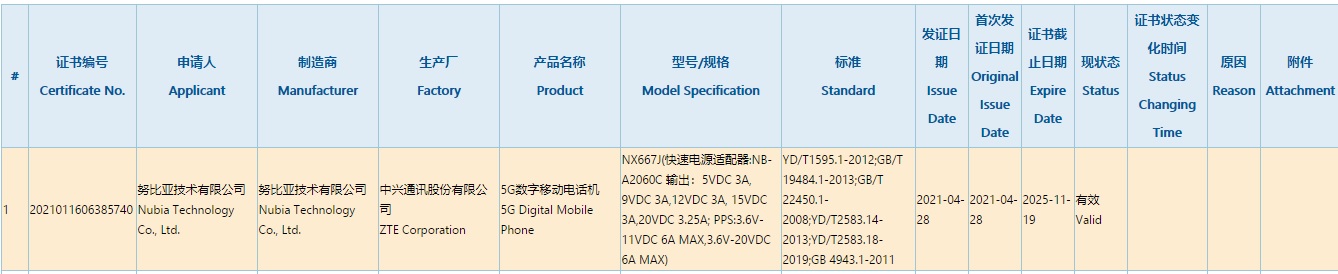
Purported ZTE Axon 30 Pro likely to support 55W charging, reveals 3C certification

In January, ZTE confirmed that its Axon branded flagship phone will be called the Axon 30 Pro. The handset had appeared with its A2022PG model number at the database of the Eurasian Economic Commission (EEC) recently. Its Chinese variant with the A2022 model number has now received approval from the 3C authority of China.

The ZTE A2022’s 3C listing states that it is a 5G-ready device. It further reveals that the phone may arrive with support for 55W rapid charging. It has no other information on the specifications of the smartphone.

ZTE Axon 30 Pro 3C certification

The Snapdragon 765G powered ZTE Axon 20 5G that debuted back in September 2020 was the world’s first phone to feature an in-display camera. The Axon 30 Pro is expected to launch as the world’s first flagship smartphone with an in-display camera. The handset will be driven by the Snapdragon 888 mobile platform.

The Axon 30 Pro is expected to arrive with the second-generation version of in-screen camera technology. A recent leak suggested that it could be equipped with a big display of 6.92 inches. It is unclear whether the phone supports FHD+ or QHD+ resolution, but it is speculated to arrive with 120Hz refresh rate support.

The Axon 30 Pro also promises to offer a stellar photography experience. There are speculations that it could be equipped with a 200-megapixel camera. The device will boot to Android 11 OS. It could be equipped with a 4,700mAh+ battery.

After its 3C certification, it is likely to soon appear in TENAA’s database in the coming days. It is still unclear whether it will be launching later in March or in the coming month.

RELATED:

Galaxy Awesome Unpacked event to be held on March 17, Galaxy A52 and Galaxy A72 incoming

The rumor mill has been leaking information on the Galaxy A52 and Galaxy A72 smartphones for a couple of months. Recent reports claimed that Samsung will announce these A-series smartphones in March. The company has now sent out invites for the upcoming Galaxy Awesome Unpacked event that will take place at 10 AM ET on March 17. It is highly likely to announce the Galaxy A52 and Galaxy A72 smartphones through the upcoming virtual unveiling event.

The Galaxy A52 and Galaxy A72 will be arriving as the successors to the well-received Galaxy A51 and Galaxy A71 smartphones from last year. Both phones are expected to arrive as the first IP67 rated A-series smartphones. The Galaxy A52 and A72 are likely to feature 90Hz refresh rate supporting displays. Reports have claimed that the Galaxy A52 will come in 4G and 5G versions, but the Galaxy A72 will only come in 4G.
Samsung Galaxy A52 and Galaxy A72 specifications (Expected)

The Samsung Galaxy A52 and Galaxy A72 are equipped with 6.5-inch and 6.7-inh S-AMOLED FHD+ displays with Infinity-O design, respectively. Both phones have a 32-megapixel front-facing camera. The quad-camera setup of the Galaxy A52 will include a 64-megapixel primary camera with OIS support, an 8-mgeapixel ultrawide lens, a 5-megapixel macro lens, and a 5-megapixel depth sensor.

The Galaxy A72’s quad-camera setup may include a 64-megapixel main lens with OIS support, an 8-megapixel telephoto lens with 2x optical zoom support, a 12-megapixel ultrawide shooter, and a 2-megapixel macro sensor. The Galaxy A52 has a 4,500mAh battery, whereas the A72 has a 5,000mAh battery. Both phones support 25W fast charging.

The Galaxy A52 4G is powered by the Snapdragon 720Gv chipset, whereas its 5G model has Snapdragon 750G SoC. The Snapdragon 720G will be powering the Galaxy A72. Both phones are expected to arrive with up to 6 GB / 8 GB of RAM and up to 128 GB / 256 GB of storage. Both phones will also feature an in-screen fingerprint sensor.

RELATED:

Sony unveils the CMOS IMX661 image sensor with a 127.68MP pixel count

There has been a growing need for high-quality camera sensors that could be used in industrial applications where high-pixel requirements eclipse the existing capacity of conventional image sensors. In pursuit of its desire to impact on the industrial equipment camera market, Sony is making a huge statement with the release of its CMOS image sensor which can be deployed in a number of important industrial applications, as it seeks to solve some of the existing problems encountered with filming on such a large scale. The IMX661 image sensor has a global shutter function and has the highest pixel count of 127.68 megapixels.

This intervention by Sony into the industrial camera equipment space for greater efficiency is expected to produce some dramatic changes in the industry. With this new technology, coupled with its Pregius shutter pixel technology, Sony says, the IMX661 will enable high-speed image processing at a pace about four times faster than what obtains presently. The color, as well as the black and white version of the image sensor, is expected to begin shipment between April and May of 2021.

The image sensor is equipped with an array of signal processing functionalities that makes it an obvious choice in several industrial applications. The various functionalities make it possible for the device to be deployed to various high-speed and ordinarily difficult to access scenarios, with ease.

The CMOS image sensor IMX661 is clearly a reflection of the hard work and commitment of the research and development (R&D) unit of the Japanese electronics giant. Sony’s R&D unit performed greatly in conceptualizing and designing this innovative product that snugly fills the huge void currently existing in the complex world of industrial camera applications. The forecasts are bright that the IMX661 will be well received by the industry, as orders are being received and shipments will commence in April 2021.

RELATED;

Insta360 Go 2 action cam as well as a “Minions Edition” launched

The world of action cameras has been in a state of constant development as equipment manufacturers seek innovative ways to improve their various product offerings in that segment of the tech market. Insta360 is not ready to be left behind and has been making strong inroads by releasing a number of compact and elegant 360 action cams. Although previous versions of the action cam had been bogged with several drawbacks ranging from shorter recording capacity to lack of memory and several other fine details, the newest release from Insta360, which is already being hailed as the World’s smallest action camera, the Insta360 Go 2 comes well loaded to match the hype it has enjoyed so far.Insta360 Go 2 action cam

The compact Insta360 Go 2 is a compact, thumb-sized magnetic camera which is a huge departure from its predecessors in terms of improvements and overall performance. There is a huge leap from its predecessors in terms of the maximum clip length that can be accommodated, which goes as high as 15 minutes with the basic stabilization mode activated, while it has a maximum clip length of 10 minutes with the Flowstate stabilization mode, while the base version had a meagerly 30 seconds limit when it was first unveiled which was later upgraded to 60 seconds in later versions.Insta360 Go 2 action cam

Indeed putting the original Go and the much improved Go 2 side by side, the specs are miles apart. The Go 2 comes with greater accessibility, with a better layout of the click button on the front, improved waterproof capability, which makes it very versatile for use underwater up to depths of 13 feet, a run time of about 30 minutes, and a greater visual quality in different camera modes.Insta360 Go 2 action cam

The charging case adds some dimensionality to the Go 2 as it serves as both a kickstand and a Bluetooth remote. It can also extend the runtime up to 150 minutes of basic stabilization mode when the camera is used while attached to the case. There are lots of accessories that come with the package, as well as some optional ones, which are all meant to give the Go 2 the needed bite and power.Insta360 Go 2 action cam

The basic Go 2 is now available for order at $300 from Insta360’s official website. However, there is talk of the release of a Minions edition of the Go 2 in the second half of 2021, which is expected to go for around $330 exclusively on the Insta360 website for a few countries it is believed. The Minions edition will be cooler and a more fitting culmination of the efforts of Insta360 in developing high-quality action cams.

RELATED;

Xiaomi Mi 10S to come with 50W wired, 30W wireless & 10W reverse fast charging

Xiaomi is expected to launch the Mi 10S on March 10 and ahead of the launch, the company has disclosed on its official WeChat page that the device will be a charging powerhouse. In clear terms, the Mi 10S will come with fast charging on three fronts – a 50W wired charging support, 30W wireless charging and 10W reverse charging support.

The battery capacity of the device is yet to be revealed but with a big battery, you won’t have cause to worry about your device while on a road trip o r there is an outage. The phone can be used to charge other devices and is swift manner.

The flexible fast charging options are not the only interesting feature to look up to on the Mi 10S. Xiaomi’e CEO Lei Jun had earlier revealed three exciting features that the device pack. One of them is that the Mi 10S will be powered by the Snapdragon 870 chipset. Secondly, the device will utilise the legendary Harmon Kardon speakers. It is no surprise then, tat an early DXOMark audio ranking placed the Mi 10S as having the best audio presently, even before it is official. Xiaomi Mi 10S

Finally, the design will be similar to that of the headline-topping Mi 10 Ultra launched last year. In that case, the phone should have a 6.67-inch 90Hz AMOLED screen with FHD+ resolution. The selfie camera on the Mi 10 Ultra is a 20MP shooter while at the back , there is a quad-camera setup featuring a 108MP primary camera, a 13MP ultrawide camera, a 2MP macro lens, and a 2MP depth sensor.

RELATED;

(via)


TCL X12 8K Mini LED Starlight Smart Screen with up to 2000nits Brightness launched

TCL earlier today held a product launch conference where it unveiled its flagship Mini LED smart TV dubbed TCL X12 8K Mini LED Starlight Smart Screen. The smart TV is indeed a high-end product that utilizes an 85-inch screen. The price is also hefty – 9,999 yuan (~$1,536).TCL X12 8K Mini LED Smart Screen

The TCL X12 8K Mini LED Smart Screen is said to be the world’s first OD Zero Mini LED smart screen as well as the thinnest Mini LED smart TV around. It is also the Mini LED smart screen with the most LED chips.

The TV uses OD Zero technology which refers to the distance between the TV backlight and the screen. The OD value of ordinary LED TVs is about 20-30 mm. TCL X12 8K Mini LED TV is said to be capable of achieving “zero distance”. Thus, even though it is a huge 85-inch super-sized screen, the thickness can still be kept within 1cm, which is very slim.

The mini LED TV is equipped with 96,000 LED chips with an amazing brightness of 2000nits. It also comes with 1920 physical partitions, 10,000,000:1 high contrast ratio and can output high-precision picture presentation. In terms of picture quality, the TCL X12 8K Mini LED Smart Screen uses Quantum Dot Pro technology, with an ultra-high color gamut of 157% (BT.709).

For audio, the TCL X12 8K Mini LED star screen is equipped with theater-level Onkyo 5.1.2 Hi-Fi audio, 8 channels, and 25 unit speakers, and the subwoofer unit has a cavity of 7 liters. TCL X12 8K Mini LED Smart Screen

In addition, the TCL X12 8K Mini LED Starlight Smart Screen is equipped with a 48-megapixel 3D ToF camera, the industry’s first 3D ToF camera, which can more accurately recognize air gestures, support user play and pause gestures, and can also accurately recognize the person’s viewing posture and distance.

There is no word yet as to when it will be launched for sale.

RELATED;

Google celebrates 10 years of Chrome OS with new features

Chrome OS is 10 years old and to celebrate, Google is rolling out some new features to the operating system. These new features include Phone Hub, Quick Answers, an improved clipboard, and more. Here are the key new features coming to Chrome OS:


Directly control your Android phone

Phone Hub

With Phone Hub, users will be able to control their connected phones from their Chromebooks. There will be a phone icon right next to the status information pill. When you click it, you will get information such as network signal, battery level, and Quick Settings shortcut for Hotspot, ring mode, and a way to easily locate your phone. It will also show the last two open Chrome tabs from your phone and also allow you to respond to texts from your device

Screen Capture and an Annotation mode

Users will be able to record what is on their screen. They will be able to access this feature from a tile in the Quick Settings menu. You will be able to quickly access recorded videos or screenshot items from a Tote space in the Chrome OS Shelf.

Get online faster with Wi-Fi Sync

Wi-Fi Sync

The new update makes it easier to connect to Wi-Fi networks. If your phone or other Chrome OS device with the same Google account has been connected to a Wi-Fi network, you don’t have to enter the password for that network on your Chromebook again. With Wi-Fi Sync, your device connects automatically to the trusted network. The feature can be accessed by going to Settings > Connected devices. Click the arrow next to the phone and turn on Wi-Fi Sync.

Media Controls

Google has added media controls to the Quick Settings many, making it easy to control the playback of whatever you are listening to.

Revamped Icons

Another new feature is redesigned icons. Icons on the shelf and in the app launcher are now circular or placed in a circle with a white background. There are also new icons for the calculator and canvas app.

Improved Clipboard

Chrome OS gets an improved clipboard that shows the last five things you copied including images. Copied items, as well as recent downloads, screenshots, and pinned files, will appear in a space called Tote which is a sort of holding space.

Quick Answers

When you right-click on a word, Chrome OS will provide a definition or translation of the said word. Depending on what is highlighted, it will also provide the unit conversion.

Nearby Share

When Google announced Nearby Share for Android devices last year, it said the feature will be available later for Chromebooks. The feature will allow you to share apps, photos, and links to nearby Chromebooks and Android devices. Unfortunately, this feature is still touted as coming soon.

These features and more are rolling out with the Chrome OS 89 update.


RELATED: