Google Lens is one of the many free useful tools provided by Google. A standalone app for this service was released on the Play Store in June 2018. Now, over two and a half years later, this application has reached 500+ million installs on Android’s official app store.
For those unaware, Google Lens is an image recognition tool that was first showcased at Google I/O 2017. Later that year, the search giant integrated this service into Google Assistant on Pixel 2 and Pixel 2 XL.
Then, it became available in Google Photos for both Pixels and other Android devices a few months later in 2018. At around the same time, Google’s partner OEMs began to integrated Google Lens into their smartphones’ camera app.
Only after that, Google Lens debuted as a standalone app on Google Play Store. Despite being an independent app, it depends on Google app for working, just like Google Assistant and Google Podcasts.
Apart from scanning texts and translating them, Google Lens also allows users to copy the scanned text to their computer, search for a particular object, solve maths and science questions, recognize handwritten notes, and more.
That said, it is interesting to note that though Google Lens is available on all Android phones with Google Assistant, users have been downloading the standalone application from the Google Play Store since its debut. As a result, it has hit over 500 million downloads within a short period of time.
Facebook recently updated the privacy policy for WhatsApp which was set to go in effect from 8th February but it has now been delayed because of the strong opposition to the new terms by the users. Turkey has even started an antitrust investigation over it.
Now, the Indian government is also getting involved. India’s technology ministry has written to Facebook, asking the company to withdraw the new privacy policy of the WhatsApp messaging platform.
The ministry says that the new terms are taking away choice from the Indian users. In the letter, it wrote that “the proposed changes raise grave concerns regarding the implications for the choice and autonomy of Indian citizens.”
It also points out that the users don’t have the choice to opt-out of these new data-sharing terms with Facebook and the Indian users are given less choice compared to the app’s users in the Europen market.
The technology ministry has also asked WhatsApp to respond to 14 questions including details on the categories of user data it collected, whether it profiled customers based on usage and cross-border data flows, and more.
In a statement, WhatsApp said that the company is working to address misinformation and remains available to answer any questions. It added: “We wish to reinforce that this update does not expand our ability to share data with Facebook.”
For those who are unaware, WhatsApp recently updated its privacy policy, giving users until 8th February to accept the new terms or lose access to the platform. However, after facing criticism for the move and millions of users switching to its competitors, the company recently announced that it is postponing the rollout of new terms to May.
The POCO M3 went official in the European markets in November. Tomorrow, the handset will be landing in Asian markets like Taiwan and Indonesia. A tweet by popular tipster Mukul Sharma suggests that the handset could be landing in India in February.
As it can be seen in the tweet, the tipster has not mentioned the exact launch date of the POCO M3, but only revealed that it will land in India in February. If the phone is really set to launch in India in the coming month, the company may start teasing its arrival by the end of January.
The model number of the Indian variant of the POCO M3 is M2010J19CI. It has been spotted at various places like the Bluetooth SIG, Google Play supported device list, the Bureau of Indian Standards (BIS), and TUV Rheinland certification in the recent past. Hence, it appears that the POCO M3’s India launch could be drawing near.
The POCO M3 was introduced with a price tag of $129 (~Rs 9,430) for the 4 GB RAM + 64 GB UFS 2.1 storage model and its 6 GB RAM + 128 GB UFS 2.2 storage variant was priced at $149 (~Rs 10,890). There is a possibility that the POCO M3 may start at Rs 9,999 in India.
POCO M3 specifications
The POCO M3 has a 6.53-inch IPS LCD screen with Full HD+ resolution support. It runs on MIUI 12 based Android 10 OS. The Snapdragon 662 mobile platform powers the device with LPPDR4x RAM and UFS 2.1/2.2 storage. It has a front camera of 8-megapixel and it has a 48-megapixel + 2-megapixel + 2-megapixel triple camera system. The 6,000mAh battery of the POCO M3 supports 18W fast charging.
Apple has just been granted a new patent that is related to its Face ID biometric security system. The patent details a next gen advancement in facial recognition technology, which apparently uses facial heat mapping for authentication.
According to a PatentlyApplereport, the US Patent and Trademark Office awarded the Cupertino based giant the new patent. At the moment, a biometric form of security is a highly common feature in most smartphones and exists in one form or the other. Examples being both fingerprint recognition or facial recognition technology. Now, Apple seems to be working on the next gen Face ID technology, which maps heat on the users’ face for authentication.
Traditionally, the facial recognition technology we see today mostly uses the user’s face in a captured image. However, a major drawback to this method is that any obstruction like glasses, masks, or hair could potentially hamper the authentication process. This is where the new Apple patent comes in, which maps heat from the users’ face. The occlusion heat map may be in the form of a grid that represents different regions of the face’s surface.
In other words, a determined value of occlusion for these regions might be taken as the unique signature which is recorded by a device. Meaning, each persons’ unique facial heat signature can be used to unlock an Apple device. This could help remove the issues faced by conventional facial recognition technology and also enable the company to continue using its Face ID system, which has become rather impractical after the pandemic due to the more common use of face masks.
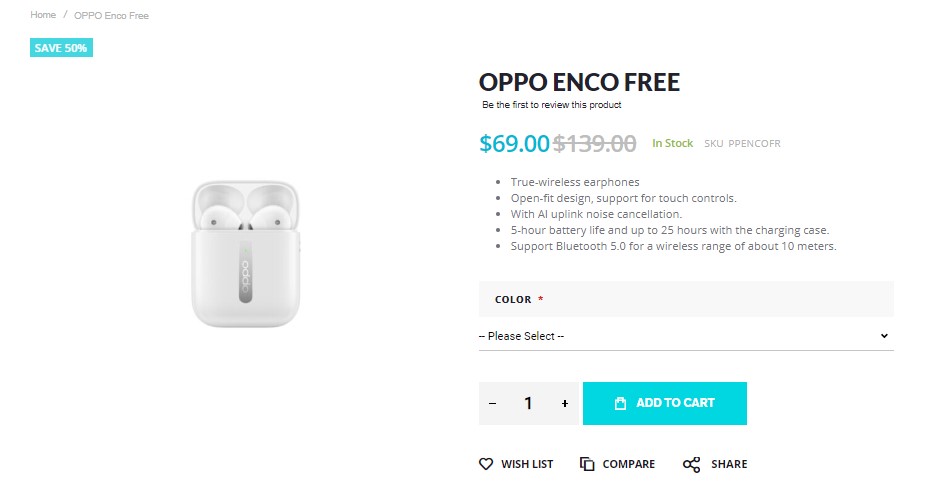
Giztop is offering a massive discount of 50% on Oppo Enco Free under its clearance sale. The interested users can grab these true-wireless earbuds for the effective price of $69. However, it usually retails for $139 n ordinary days. The wireless earbuds offer several useful features such as noise cancellation, open-fit design, Bluetooth 5.0 support and much more. Make sure to grab it soon otherwise it may get out of stock.
Oppo Enco Free is available in three color options of Black, Pink and White. The users need to shell $10 extra if you opt for the white color variant.
The Enco Free are nifty, and lightweight earbuds which are comfortable to wear. The charging case comes with the smooth-matte surface, houses a USB-C charging port at the bottom and it even acts as a charger for the earphones. The device offers seamless connectivity up to a range of 10 metres, thanks to Bluetooth 5.0.
Oppo Enco Free buds packs a 13.4mm dynamic drivers which delivers premium sound. To further enhance the listening experience, the device uses AI uplink Noise cancellation and Wear detection which pauses and resumes playback upon removing it from ears.
It features a useful open-fit design controls enabling touch control using fingers. The user can toggle music and switch tracks using the touch controls. Moreover, the Oppo Enco Free offers 25 hours of battery backup once the case and buds are fully charged. There’s a 31mAh battery in each earbud and a 410 mAh battery capacity is present inside the case.
Overall, it’s worth each cent at the super discounted price of $69. The discount is applicable without any coupon code or any other activity.
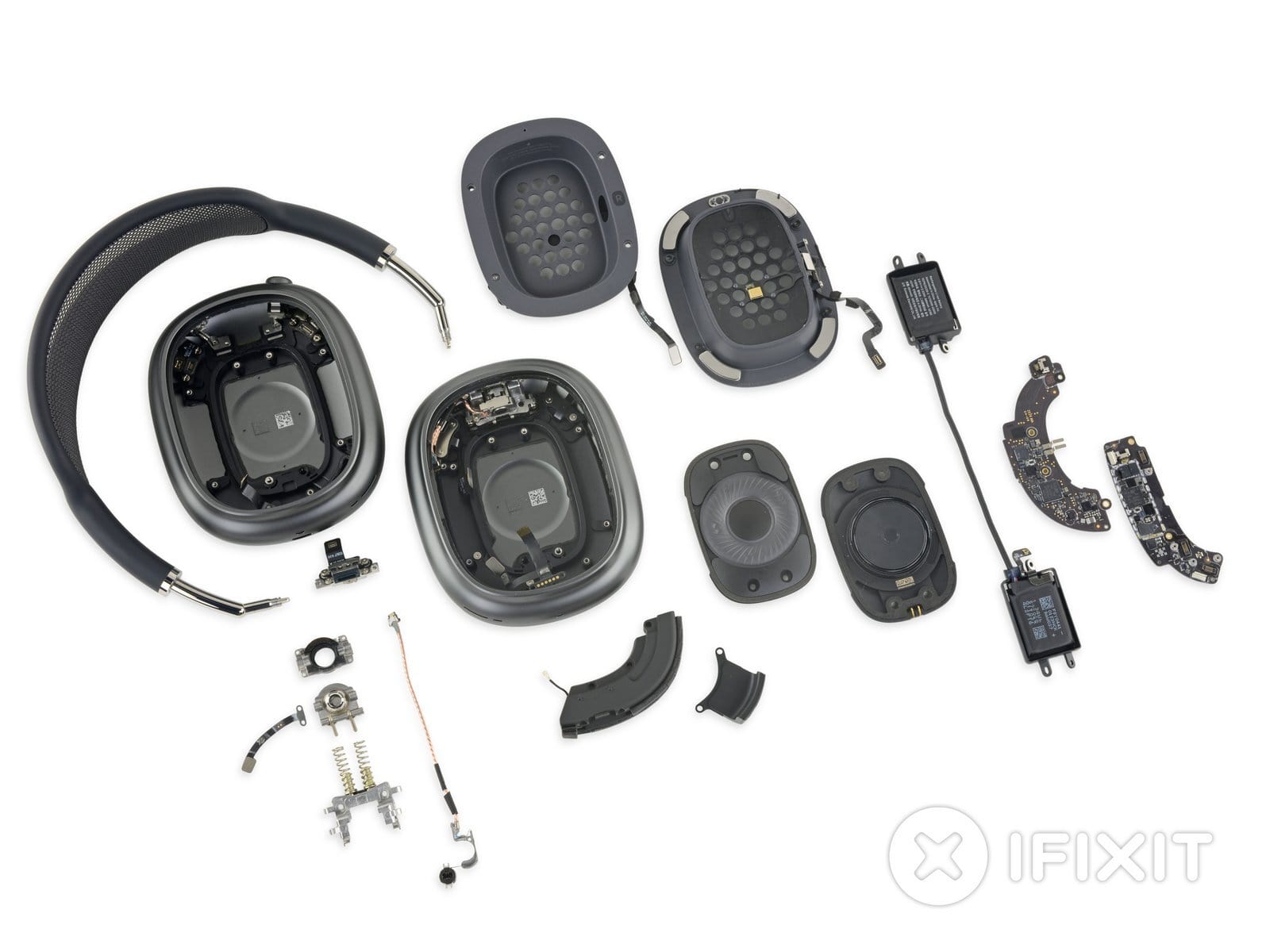
Apple recently launched the AirPods Max headphones in the market, expanding the portfolio of its audio offerings under the popular AirPods lineup. Now, weeks after the device getting launched, iFixit has completed its teardown.
In the teardown overview report, iFixit discovered some interesting details. However, the most surprising thing is the repairability score of six out of ten. This is the only AirPods product has doesn’t have a repairability score of zero.
So, why is that? The report reveals that a lot of internal components in the AirPods Max are held together through screws instead of glue, making it easier to swap them out. Also, the ear cushions are attached through magnetics. So, after wear-and-tear, if you want to replace them, that can be done quite easily.
Another thing that impressed the team of iFixit is the headband hinge mechanism which connects the band and the ear cups. It can be detached with just a SIM card removal tool without the need to open the ear cup.
However, not everything is easy and straightforward, as you expect from Apple. Although several components are tied up with screws, there are many different types involved. So, you need to be equipped with several screwdriver heads if you want to open it.
Also, for opening the AirPods Max, you will have to deal with adhesives which isn’t an easy job for everyone and pose a risk of breaking things down when attempting to do so. However, it notes that compared to popular offerings in this space — Sony WH-1000XM4 and Bose NC 700, the AirPods Max from Apple fares well.
POCO, which started off as a sub-brand of Xiaomi, has today confirmed that the company will be hosting a launch event on 21st January which will be broadcast online. At the event, the company will officially launch the POCO M3 smartphone.
This is the same launch date for the POCO M3 smartphone in Indonesia. For those who are unaware, the smartphone was first launched in November last year as the successor to the POCO M2 and carries a starting price of $129.
POCO M3
The phone features a 6.53-inch IPS LCD waterdrop display and offers Full HD+ screen resolution and Gorilla Glass 3 protection. The phone also comes certified with TUV Rheinland’s Low Blue Light Certification.
Under the hood, the device is powered by the Qualcomm Snapdragon 662 SoC, which is clocked at 2.0GHz. It comes packed with 4GB of RAM and up to 128GB of internal storage. We expect the phone to have multiple variants based on memory configuration in Taiwan.
Coming to the camera department, the device has a triple-camera setup on the back that consists of a 48MP f/1.79 primary camera. It is coupled with a 2MP macro camera and another 2MP depth sensor. On the front, there’s an 8MP f/2.0 selfie shooter.
As for the software, the device comes with an Android 10 pre-installed along with the company’s own MIUI 12 custom user interface on top of it. The phone is powered by a massive 6,000mAh battery and supports 18W charging.
Honor, the newly independent company in China, is currently streamlining its business and forming new relationships with partners and suppliers. While it is making deals with component suppliers, the company is also working on getting the support of Google.
As per the latest report coming from Russia, Google Mobile Services (GMS) could soon make a comeback on Honor devices. This is primarily because the company is no longer a part of Huawei and thus, sanctions imposed by the United States on the Chinese giant no longer apply to Honor.
It further mentions that the return of Google services of Honor smartphones could happen around Spring. The company is already working on two new phone lineups that will have support for Google Mobile Services. This should bring back official Android support as well as a host of other Google applications.
With the introduction of Google services on Honor smartphones, new devices getting launched by the company will no longer have Huawei AppGallery pre-installed. However, the older devices will continue to have AppGallery.
For those who are unaware, in May 2019, US President Donald Trump signed an executive order banning Huawei from dealing with American companies, cutting off access to Google’s services as well as many others. Since Honor was a sub-brand of Huawei, its devices were also not able to use GMS. To make sure that the brand survives, Huawei sold off Honor in November last year.
Apart from establishing relations with suppliers, the company is also working on establishing its presence in the market. The company has started its own online store named Honor Mall and is planning to launch several offline stores.
After announcing its latest Mi 11 flagship smartphone a few weeks ago, Xiaomi started selling the device earlier this month. Now, the Chinese company is gearing up to launch a new variant in the lineup, dubbed Mi 11 Pro.
Now, the latest report coming from popular leaker ‘Digital Chat Station’ reveals that the upcoming Mi 11 Pro will have support for 120x zoom through its rear-facing camera setup. This seems to be pretty much in line with what has been rumored so far.
Instead of the triple-camera setup on the Mi 11, the Pro variant will come with a quad-camera configuration on the back panel. Also, the company seems to have ditched the design of the vertically-aligned sensor found on Mi 10 Pro to a 2×2 grid design.
As for the other specifications, reports indicate that the Mi 11 Pro smartphone will have the same display as the Mi 11. It will feature a 6.81-inch 2K curved display offering a 120Hz refresh rate, 515PPI pixel density, and a peak brightness of 1500nits. Additionally, the device is also expected to have support for MEMC and SDR to HDR conversion.
Given that it’s a flagship offering from Xiaomi and Qualcomm Snapdragon 888 is the most advanced chipset out there in the market, the device will be powered by the Snapdragon 888 chipset, the same as the Mi 11. We also expected to see multiple versions of the phone based on the memory configuration.
In the software department, the phone is likely to be running the latest Android 11 operating system along with the company’s own MIUI custom user interface on top. More information about the device is expected to surface online ahead of its official launch, which will take place after the Spring Festival in China, after mid-February.
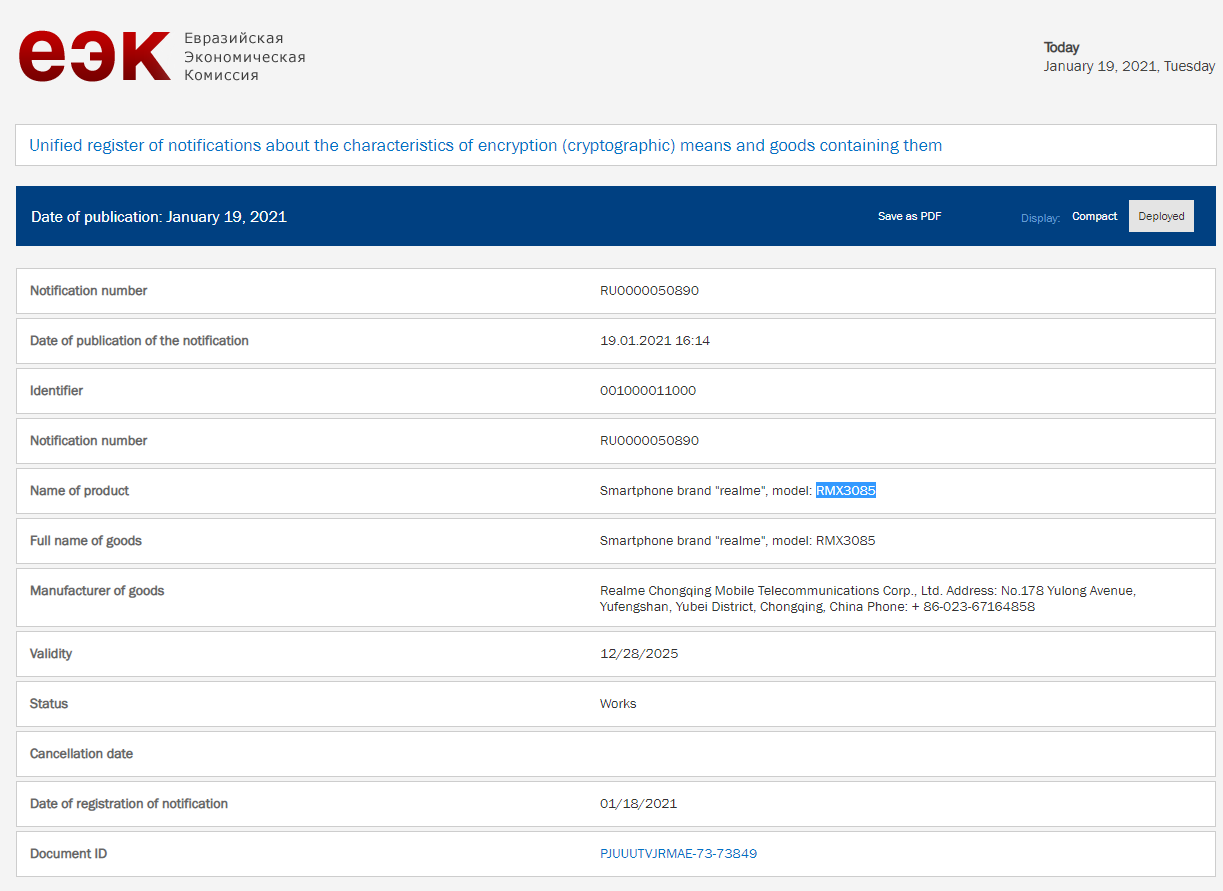
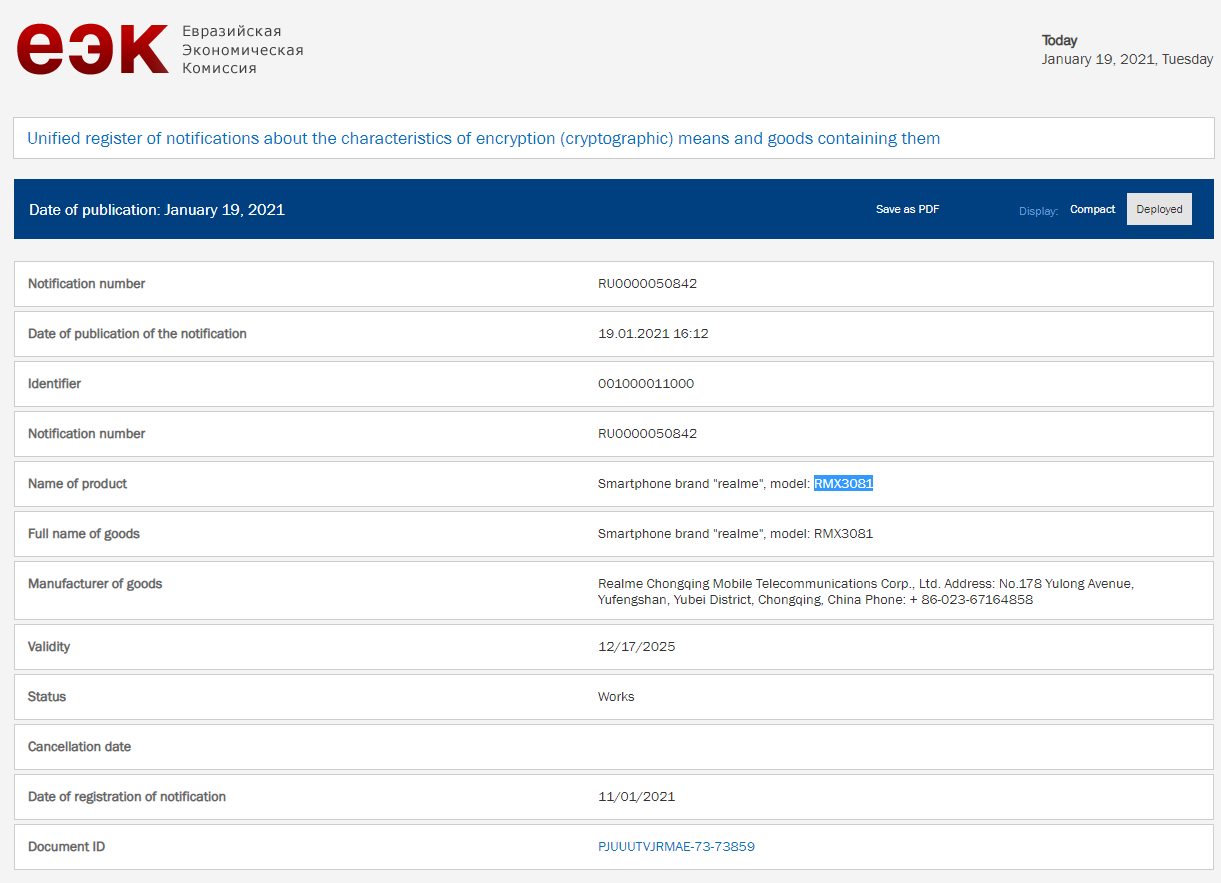
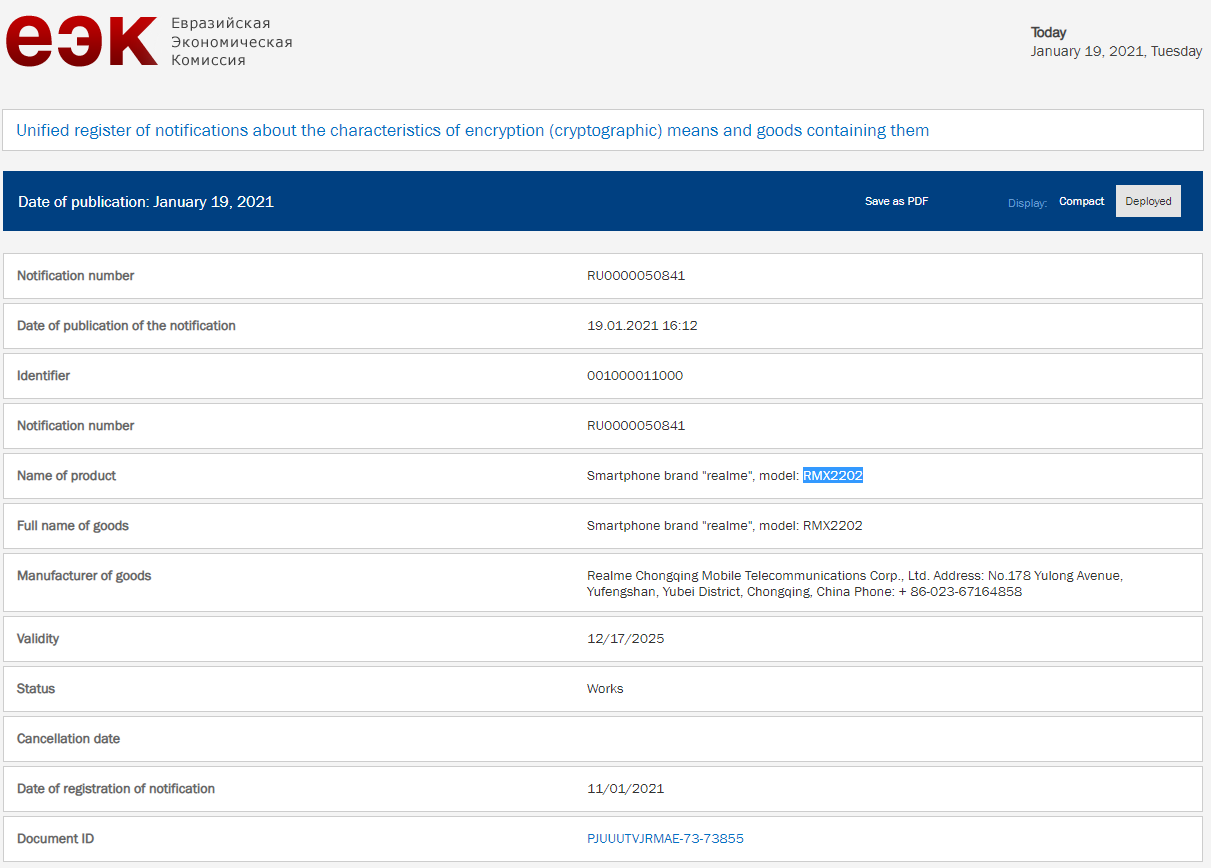
Last month, GSMArena shared the leaked images of the upcoming Realme Race flagship phone. One of the images revealed that its model number is RMX2202. Four new handsets including the Realme Race has emerged in the database of the Eurasian Economic Commission (EEC). The EEC listings suggest that these devices will be heading in the European markets.
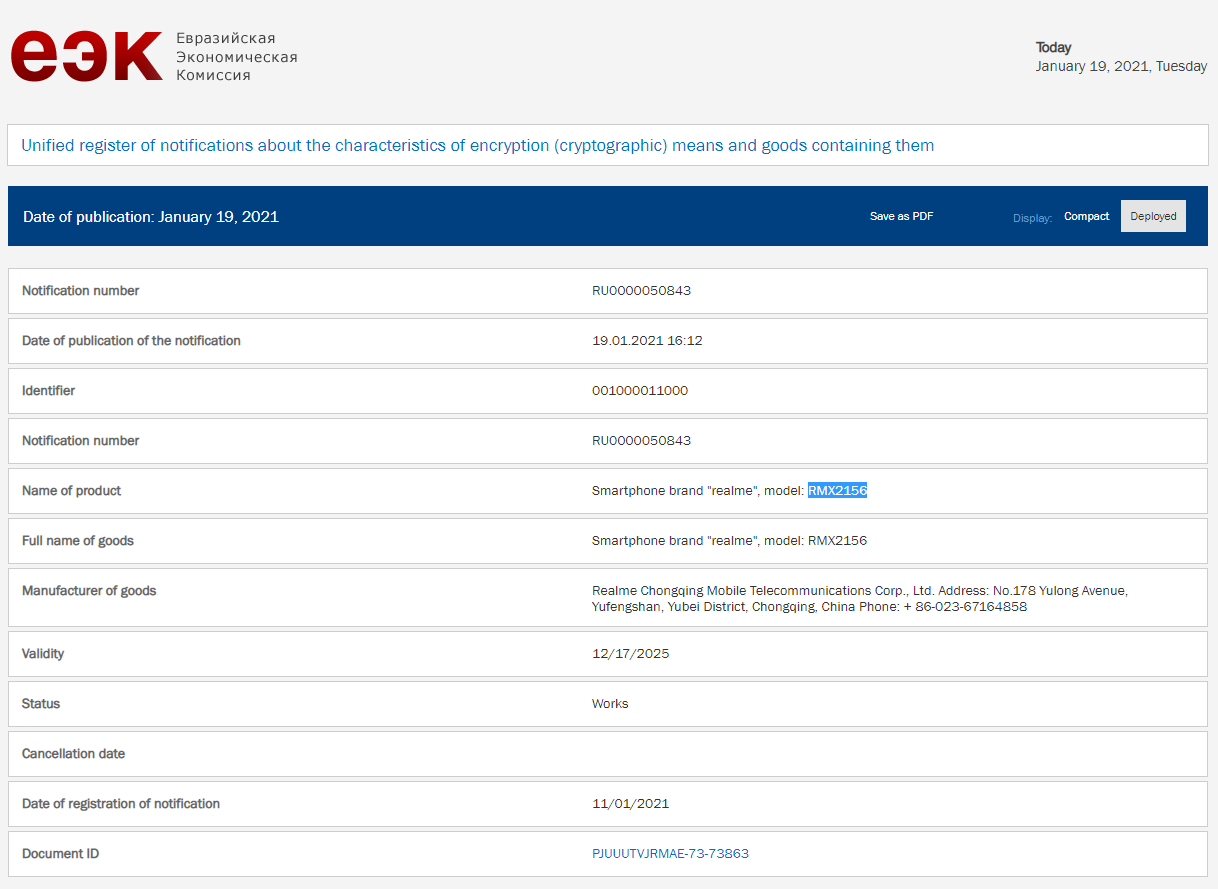
Apart from RMX2202, the EEC authority has also approved Realme phones such as RMX3085, RMX3081, and RMX2156. The EEC listings of these phones have not revealed any information on the specs of these smartphones.
The Realme RMX2156 has been previously spotted at other certification platforms such as the FCC (US), TKDN (Indonesia), and BIS (India). The FCC listing of the phone had revealed that it has a 5,000mAh battery and it carries support for dual-band Wi-Fi and Bluetooth 5.0.
The RMX3085 has appeared for the first time at EEC, whereas the RMX3081 has been previously seen at TKDN. The identity of the RMX3085, RMX3081, and RMX2156 are under wraps.
Coming to the Realme RMX2202 (aka Realme Race) will be arriving with Snapdragon 888 SoC. The handset is expected to offer users other specs like 12 GB of RAM, 256 GB of built-in storage, and Realme UI 2.0 based Android 11 OS.
The image that showcased the rear design of the Realme Race phone revealed that it will be sporting a round-shaped camera module for its quad-camera system. The handset may carry support for 125W rapid charging technology. The device seems to be equipped with an OLED screen and an in-screen fingerprint reader. Rumors are rife that the Realme Race will be debuting as the company’s first Ace series smartphone. It is expected to launch in Q1 this year.
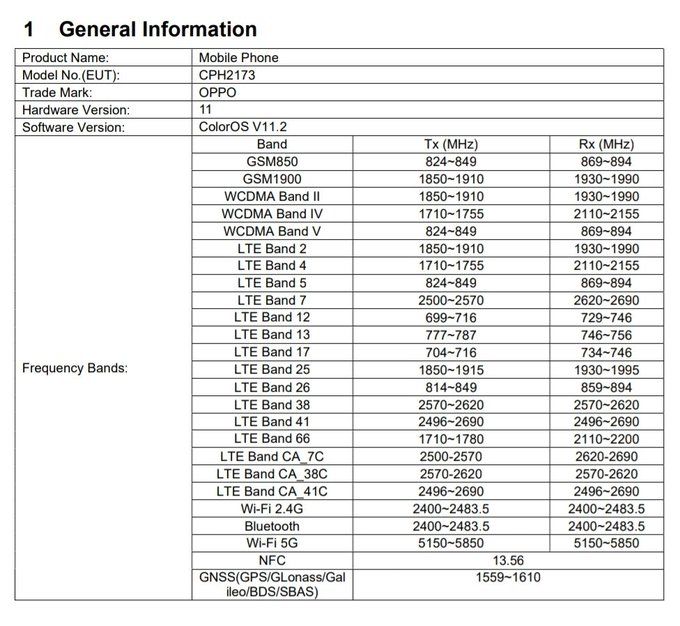
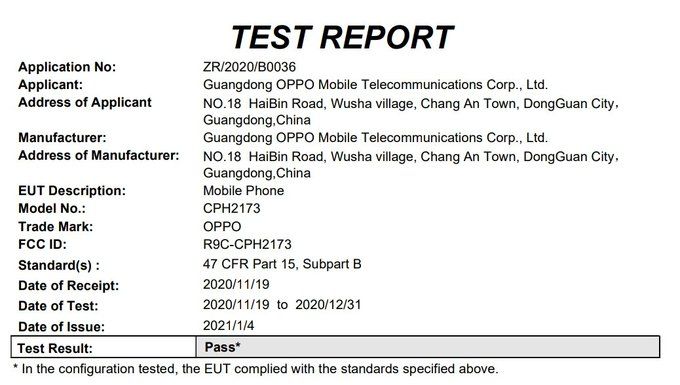
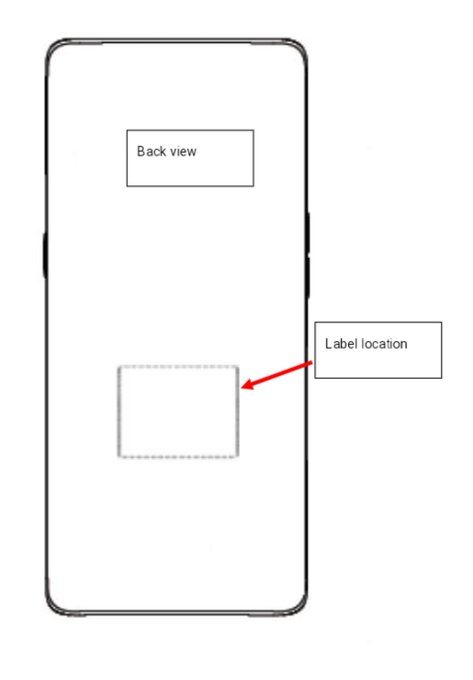
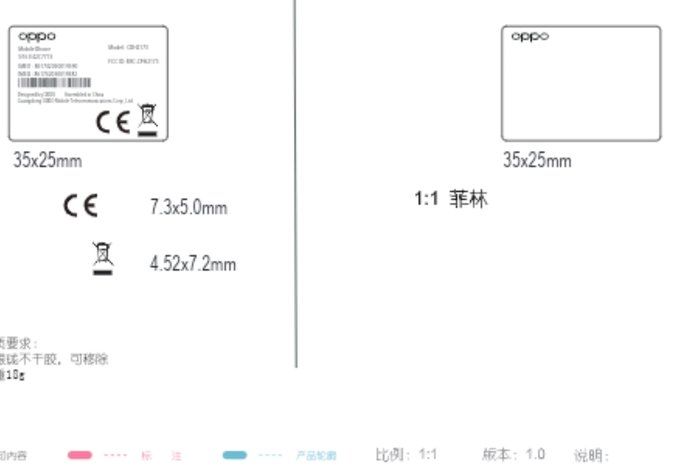
Earlier this month, a mysterious OPPO phone with model number CPH2173 was spotted at Geekbench benchmarking platform. Since it was found with Snapdragon 888 SoC onboard, it was speculated that it could either be the upcoming OPPO Find X3 or Find X3 Pro smartphone. The OPPO CPH2173 has now appeared in the database of the Federal Communications Commission (FCC) ahead of its expected launch in March.
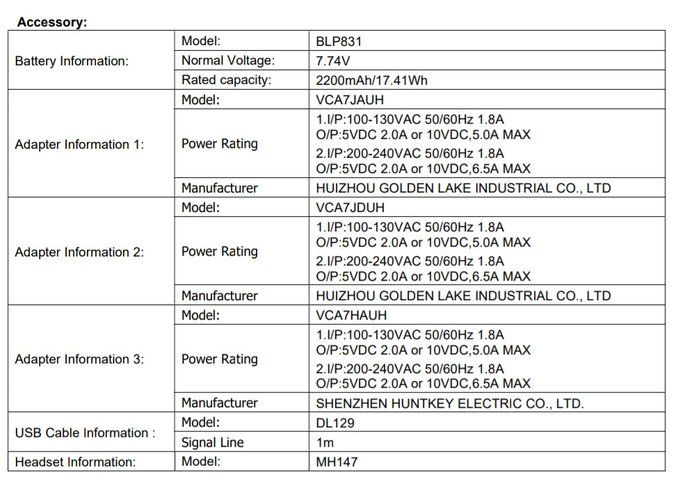
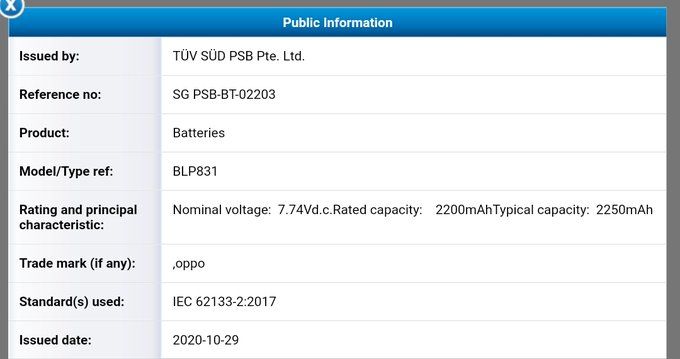
The FCC listing has revealed only a few pieces of information on the specs of the OPPO CPH2173 smartphone. It mentioned that the device may arrive preloaded with the latest ColorOS 11.2 UI and it may ship with a charger that has a model number VCA7JAUH / VCA7DUH / VCA7HUAH. The charger offers maximum charging speeds of up to 65W. The BLP831 battery that powers offer a rated capacity of 2,200mAh could be powering the Find X3 Pro. This indicates that the device is backed by a dual-cell battery.
Recent leaks by popular tipster Evan Blass have revealed that the OPPO Find X3 Pro is codenamed as Fussi. The handset is expected to house a 6.7-inch OLED display that will offer 1440 x 3216 pixels, a 1.07 billion color support, and up to 120Hz adaptive refresh rate.
The Snapdragon 888 mobile platform along with 12 GB of RAM will fuel the Find X3 Pro. It may come with a 4,500mAh dual-cell battery that will also support 30W VOOC Air wireless charging along with 65W SuperVOOC 2.0 rapid charging. The quad-camera setup of the phone is expected to include a Sony IMX766 50-megapixel primary camera, another Sony IMX766 50-megapixel lens for ultrawide shots, a 13-megapixel telephoto lens with 2x optical zoom, and a 3-megapixel lens that will deliver 25x zoom.
Leaked OPPO Find X3 Pro render by Evan Blass
Leaked OPPO Find X3 Pro render by Evan Blass
Apart from launching the Find X3 and Find X3 Pro, the company is also expected to announce Find X3 Neo and Find X3 Lite by April. The X3 Lite is believed to be a rebranded version of China’s OPPO Reno5 5G handset.
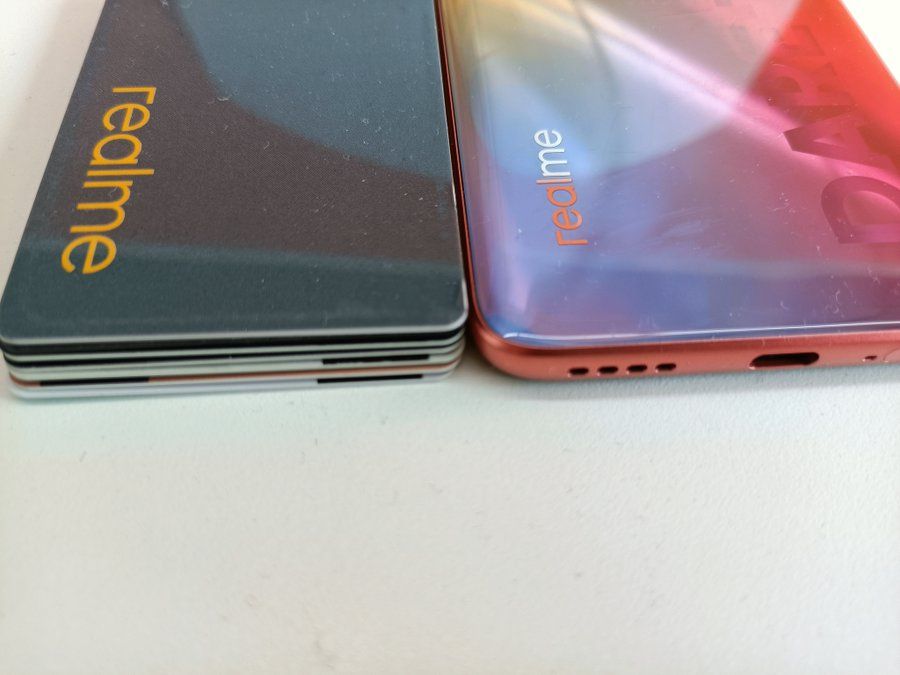
Yesterday, Realme CEO Madhav Sheth shared an image of a new Realme phone alongside a stack of credit cards to tease its slim profile. While Sheth did not reveal the name of the device, GSMArenareported that it learned from internal sources that it will be arriving in the market as the Realme X9.
As can be seen in the image, the Realme X9 is only as thick as six credit cards. The phone sports a colorful rear along with “realme” and “Dare to Leap” brandings. The bottom edge of the Realme X9 has a loudspeaker grille, a USB-C port, and a microphone. There is no 3.5mm audio jack on the bottom edge of the phone. It is unclear whether the headphone slot is available on the top edge of the phone.
Realme X9
The appearance of the Realme X9 is quite like the Realme V15 5G that went official in China at the beginning of this month. The handset is yet to be made available outside the home market. It remains to be seen whether the Realme X9 arrives as a rebranded version of the Realme V15 5G, which neither features a 3.5mm audio jack or a microSD card slot.
The Realme V15 5G has a 6.4-inch S-AMOLED display with a punch-hole design. It offers a Full HD+ resolution of 1080 x 2400 pixels and a 20:9 aspect ratio. The Realme UI based Android 10 OS comes preloaded on the Realme V15 5G.
Realme X9
The Dimensity 800U chip along with 6 GB / 8 GB of RAM powers the device. It has 128 GB of internal storage and it is backed by a 4,310mAh battery that supports 50W fast charging. For photography, it has a 16-megapixel front camera and a 64-megapixel + 8-megapixel + 2-megapixel triple camera system. The handset weighs only 176 grams and it measures only 8.3mm in thickness.
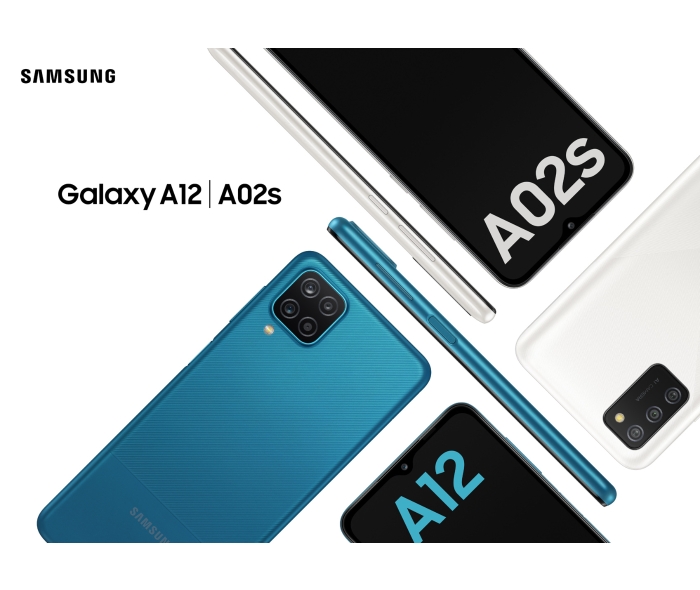
Samsung has announced three new Galaxy A phones for the UK market today. However, only one of them can be purchased right away. The phones are the Galaxy A12, Galaxy A02s, and Galaxy A32 5G.
Galaxy A12
The Samsung Galaxy A12 is a 4G smartphone with an Infinity-V display and four cameras that stick out on the back. It also packs a 5000mAh battery that powers the Helio P35 processor under the hood.
The Galaxy A12 rocks a 6.5-inch display with an HD+ resolution. The Helio 035 processor is paired with 4GB of RAM and buyers will be able to choose between having 64GB of storage or 128GB of storage.
There is a 48MP main camera on the rear and it comes along with a 5MP ultrawide angle camera, a 2MP macro camera, and a 2MP depth camera. The notch in the display is for an 8MP camera.
Samsung has added a side-mounted fingerprint scanner and its signature security framework, Knox, for device security. You also get 15W Adaptive Fast Charging and support for storage expansion (up to 1TB). Disappointingly, it ships with Android 10 out of the box.
The Galaxy A12 is available at Samsung channels and major UK retailers for £169. It comes in Black, Blue, and White, all of which have a glossy finish.
The Galaxy A02s which was announced alongside the Galaxy A12 will be available “in the coming weeks” in the UK. It also has a 6.5-inch HD+ Infinity-V display but swaps the Helio P35 for the Snapdragon 450. It has 3GB of RAM and 32GB of expandable storage
On the back of the phone are a 13MP primary camera, a 2MP macro camera, and a 2MP depth camera. It also has a 5MP selfie camera, a 5000mAh battery, and 15W Adaptive Fast Charging. It skips the fingerprint scanner and comes in Black and White. It will sell for £139 when it goes on sale.
Samsung Galaxy A32 5G
Galaxy A32 5G
The Galaxy A32 5G launched in Germany last week and now it has landed in the UK. However, just like Germany, it won’t be available for purchase until next month – February 19th to be precise.
The phone also has a 6.5-inch HD+ Infinity-V display and a 5000mAh battery with 15W fast charging support. Its processor is the Dimensity 720 and it is paired with 4GB of RAM and 64GB of expandable storage.
Its camera configuration is almost identical to that of the Galaxy A12 but its macro camera is a 5MP sensor and you get a 13MP camera in front for selfies. It also has a side-mounted fingerprint scanner.
The UK gets the same colorways as Germany – Awesome Black, Awesome White, Awesome Blue, and Awesome Violet. It will sell for £249 when it goes on sale.
Earlier today, Qualcomm announced the new Snapdragon 870 processor. The press release revealed that among the manufacturers signed up for the chipset is Motorola. Now, it has been confirmed that the Motorola Edge S will be powered by the chipset when it is unveiled on January 26.
The Edge S is Motorola’s first flagship phone in a while for the Chinese market and the first Moto Edge smartphone to launch in China. The official Lenovo China Weibo account says it will also be the first phone in the world to be powered by the Snapdragon 870.
The Snapdragon 870 is a 7nm chipset with a clock speed of 3.2GHz. It is an overclocked version of the Snapdragon 865 Plus which itself is an overclocked version of the Snapdragon 865.
The Motorola Edge S has been reported to have a 6.7-inch display with an FHD+ resolution, two holes in the screen for dual front-facing cameras, and an unusual 105Hz refresh rate. The chipset is expected to be paired with 8GB or 12GB of RAM and be available in multiple storage options.
It has also been revealed that the phone has a quad-camera system that includes a 64MP main camera and a 16MP ultrawide angle camera. In front, the main camera is a 16MP sensor paired with an 8MP ultrawide angle camera. It should also have a side-mounted fingerprint scanner and a 5000mAh battery but there is no info on the fast charging technology. However, we expect the phone will run ZUI based on Android 11 out of the box.
At the moment, we do not know if the phone will get a global release but there is a chance that if it does, it will arrive under the Moto G umbrella. Motorola announced last month that it has a Snapdragon 800 series-powered Moto G phone planned for 2021. We want to believe the Moto G phone will be powered by the Snapdragon 870.
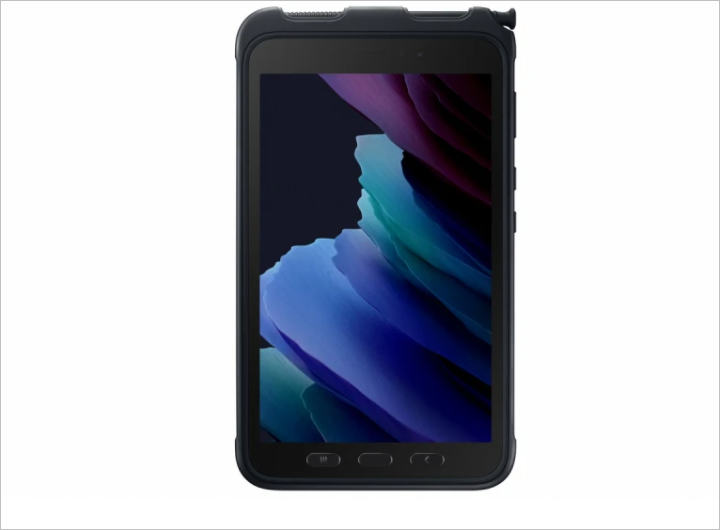
Samsung has launched the Galaxy Tab Active3 in the U.S. The rugged tablet was first launched in Europe and some Asian countries in September 2020. It is the successor to the Galaxy Tab Active 2 released in 2017. The new table can also be regarded as the budget-friendly alternative to 2019’s Tab Active Pro.
The Galaxy Tab Active3 features an 8-inch IPS LCD screen just like its predecessor but the resolution has been bumped up from 1280 x 800 to 1920 x 1200 pixels. The display has a touch sensitivity option that allows users to operate it even with gloves on.
Under the hood is the Exynos 9810, the chipset that powered the Galaxy S9 series released in 2018. The tablet will be available in two configurations – 4GB RAM+64GB and 4GB RAM+128GB. There is a MicroSD card slot that allows users to add up to an additional 1TB of storage.
The Galaxy Tab Active3 has a single 13MP autofocus camera on the back and a 5MP front-facing camera. The camera app has certain features such as barcode scanning.
Samsung has also included NFC, face recognition, a fingerprint scanner, an IP68 S Pen that is stored at the top of the tablet, an extra button called the Active Key which can be programmed to launch most used apps or for launching Push to Talk. The tablet also has Wi-Fi 6, Samsung DeX, support for ARCore, runs Android 10, and is MIL-STD-810H certified.
The Galaxy Tab Active3 has a removable 5050mAh battery with support for fast charging via USB and POGO pins. Samsung says that the tablet also has a “No Battery Mode” which allows it to work without a battery. This feature was added for businesses that use the tablet in a fixed location such as a kiosk.
As for the price in the U.S, the Galaxy Tab Active3 will be sold for $489.99 for the base model. The tablet is expected to be available to buy soon.
Xiaomi and OPPO launched very affordable flagship killers in China during the second half of 2020. If you are looking for an affordable phone but need a very high level of performance, then choosing OPPO Reno5 Pro 5G or Xiaomi Mi 10T Pro is one of the best choices you can do. That is why we decided to publish this comparison: through it, we will try to let you know which flagship killer is the best for your actual needs. After comparing the Xiaomi Mi 10T Pro to the Zenfone 7 and the Mate 40, here is a comparison between the specifications of the Xiaomi Mi 10T Pro 5G and the OPPO Reno5 Pro 5G.
Quad 64 + 8 MP + 2 + 2 MP f/1.7 and f/2.2 and f/2.4 and f/2.4
32 MP f/2.4 front camera
Triple 108 + 13 + 5 MP f/1.7 + f/.4 + f/2.4
20 MP f/2.2 front camera
BATTERY
4350 mAh
Fast charging 65W
5000 mAh, Fast Charging 33W
ADDITIONAL FEATURES
Dual SIM slot, 5G, reverse charging
Dual SIM slot, 5G
Design
The OPPO Reno5 Pro 5G is definitely a more raffinate device in terms of design. Its curved screen makes it look way more elegant than its rival. Further, it is thinner and lighter than the Xiaomi Mi 10T Pro 5G. Both are made of the same materials: glass for the back and aluminum for the frame. The camera module is less invasive and its color is the same as the rest of the body. Besides coming with a more elegant look, the OPPO Reno5 Pro 5G has a higher screen-to-body ratio with narrower bezels around the display. Last but not least, unlike the Xiaomi Mi 10T Pro 5G, it features an in-display fingerprint reader (on the Xiaomi flagship it is side-mounted).
Display
The OPPO Reno5 Pro 5G wins the display comparison in advance thanks to its AMOLED panel. With the Xiaomi Mi 10T Pro 5G, you actually get an IPS panel, and this is the weakest point of this device. We are not saying IPS panels are bad, but actually, AMOLED is the trending one as it shows more brilliant colors and deeper blacks. Despite the OPPO Reno5 Pro is the winner (and it even features a higher brightness, up to 1100 nits), Xiaomi Mi 10T Pro 5G has one of the most interesting displays out there. It supports a high 144 Hz refresh ratio, the highest ever seen on a phone. Further, it has the HDR10+ certification.
Specs & Software
If we talk about the hardware department, then Xiaomi Mi 10T Pro 5G is superior. The Snapdragon 865 found on the flagship killer is actually superior to the Dimensity 1000+ mounted on the OPPO Reno5 Pro 5G. Further, it has a faster UFS 3.1 internal storage. But the OPPO Reno 5 Pro 5G comes in a variant with 12 GB of RAM, while the Mi 10T Pro 5G offers a max of 8 GB of RAM. The Xiaomi flagship runs Android 10 out of the box, while the OPPO Reno5 Pro 5G runs Android 11 as it is a more recent handset.
Camera
Both Xiaomi Mi 10T Pro 5G and OPPO Reno5 Pro 5G are good camera phones, but they are not top-end camera phones. Between these devices, the better one is the Mi 10T Pro 5G. It is equipped with a 108 MP main sensor with OIS, a 13 MP ultrawide sensor, and a 5 MP macro camera. The Mi 10T Pro 5G is able to record videos in 8K resolution and its main camera has a bright f/1.7 aperture. Unfortunately, both the phones lack a telephoto sensor, so you do not get optical zoom. While the Mi 10T Pro 5G provides a better rear camera department, OPPO Reno5 Pro 5G has a better selfie camera with its 32 MP resolution.
The Xiaomi Mi 10T Pro 5G is equipped with a bigger 5000 mAh battery and it is able to guarantee a longer battery life in a lot of scenarios. It is not among the best battery phone, but its battery life is very satisfying. But the OPPO Reno5 Pro 5G remains a pretty nice battery phone with its 4350 mAh capacity. Further, it features a way faster charging technology with 65W power. Last but not least, it supports reverse charging so that you can use it as a power bank to charge other devices (wired charging only).
Price
OPPO Reno5 Pro 5G is priced at €410/$500 in the Chinese market and it will probably hit the global market under the Find X3 series later this year. The Mi 10T Pro 5G costs €500/$605 in the global market. Overall, I would go for the OPPO Reno5 Pro 5G because of the AMOLED display, but the Mi 10T Pro 5G provides a better main camera and battery.
OPPO Reno5 Pro 5G vs Xiaomi Mi 10T Pro 5G: PRO and CONS
With an estimated 600 million players worldwide, PlayerUnknown’s Battlegrounds (PUBG) is the most-played battle royale game in the world, beating Fortnite Battle Royale, NetEase’s mobile game Knives Out, and others. With its popularity comes a big challenge – cheating. hackers have continued to devise new ways to exploit bugs in order to create cheats. However, Tencent continues to clamp down on cheaters.
In its latest Anti-Cheating report for January 8 to January 14, 2021, the tech giant hinted that a total of 1,217,342 accounts were permanently suspended within the period for using hacks and cheats.
About 48 percent of these hackers were banned for using auto-aim hacks or changing their character models. Twenty-two percent of the hackers were banned for using X-ray vision, 12 percent for speed hacks, and seven percent for modifying the area damage.
The report also shows the ranks the hackers were in when they were banned. This distribution is as follows: Bronze: 38 percent, Silver: 11 percent, Gold: Nine percent, Platinum: 11 percent, Diamond: 12 percent, Crown: 10 percent, Ace: Six percent, and Conqueror: Three percent.
Last week, Tencent also released PUBG Mobile’s patch 1.2 which featured a new mode, weapon, and much more. The new mode is called Runic Power, which gives players certain abilities to use for getting the chicken dinner.
PUBG Mobile’s 17th season is also around the corner. It is called Runic Power and will kick-off on Jan. 19. As usual, a new Royale Pass will also be coming with the season which will have new skins, emotes, and more.
Meanwhile, there is still no word yet on when PUBG mobile will make its much-anticipated return to India after PUBG Corporation revoked the license granted Tencent to distribute the game in India.
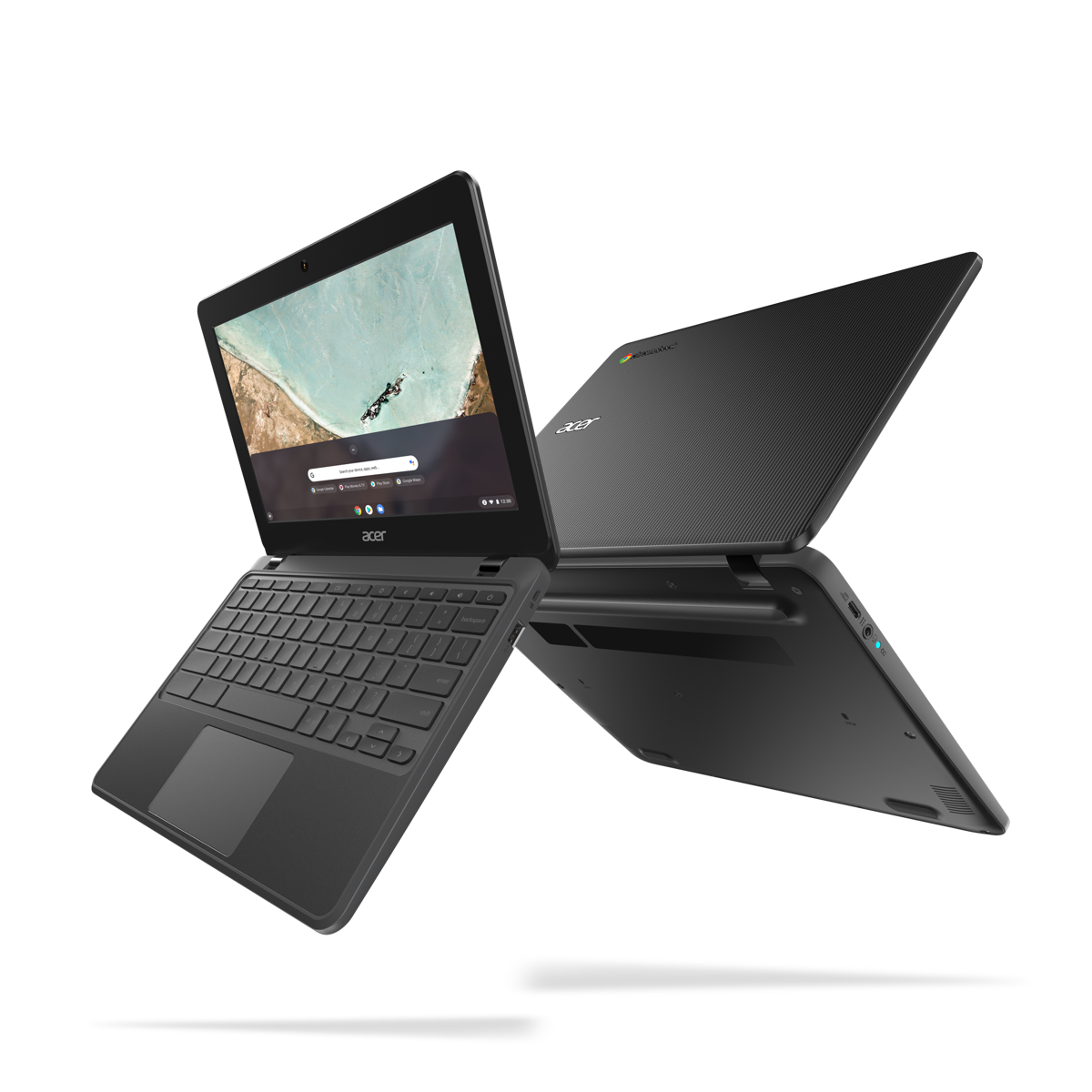
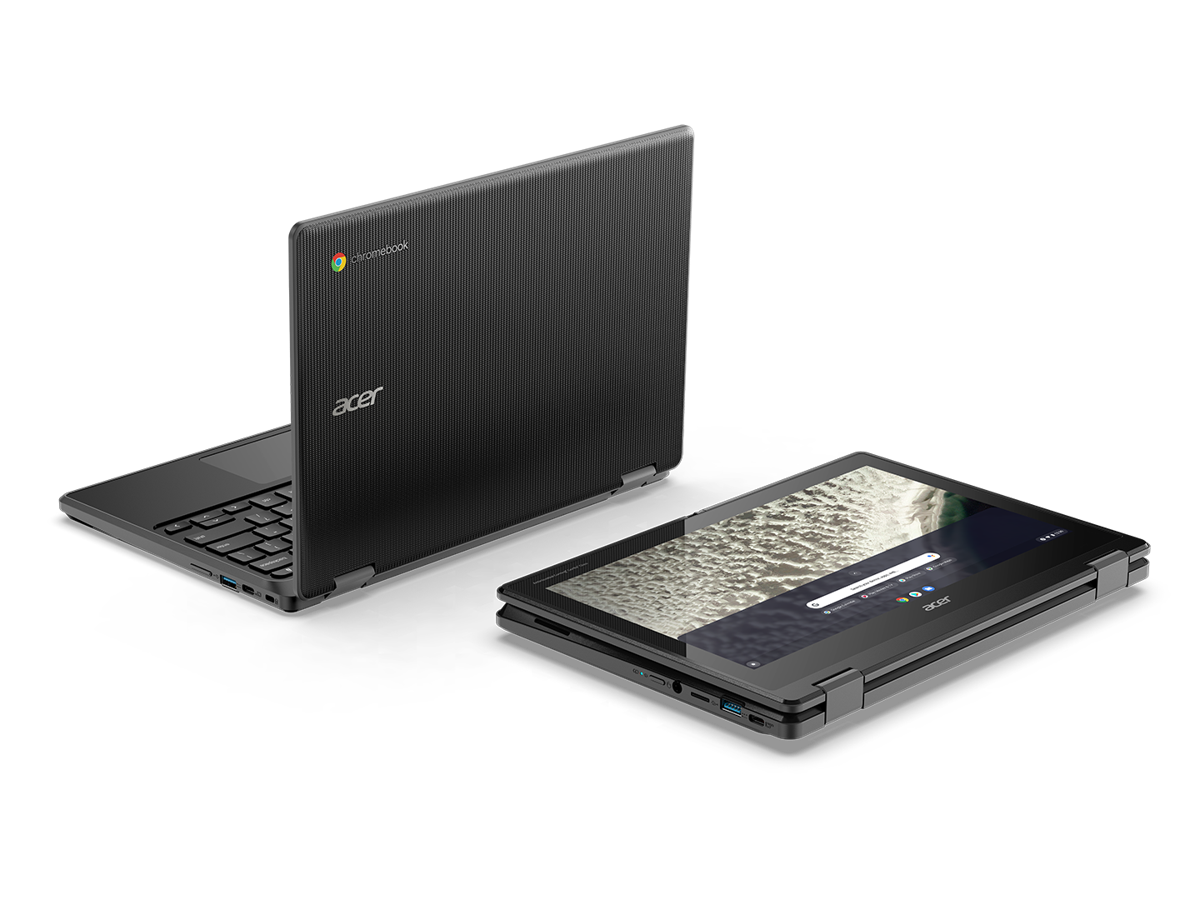
Acer is on a launch spree today. The company already announced its new TWS earbuds in India. It has also announced a bunch of new Products like multiple Chromebooks, and a Laptop. The models include Acer Chromebook 311 & 511, Chromebook Spin 511, 512, and TravelMate Spin B3 laptop.
Acer’s new Chromebook Spin 511(R753T), 512(R853TA) are convertible Chromebooks. These two Chromebooks will start at $399.99, and $429.99 respectively. You can purchase the laptop across EMEA* from March 2021 and NA* from April 2021.
Besides, Acer’s Chromebook 311(C722) & 511(C741L) are entry-level devices aimed at Educational purposes. They will be available starting at $299.99 and $399.99 respectively. Similar to Chromebook Spin, you can get this in EMEA from March and NA from April of 2021.
The TravelMate Spin B3 (TMB311R-32) will start at $329.99/RMB 2,499. You can expect it to go on sale in China, NA, Europe from February, April, and Q2 of 2021 respectively.
Acer Chromebook 311, 511 Features
Acer says it’s aiming the 311, 511 covers the basics of the digital learning environment and is aimed at students and school administrators. The main difference between them is the chipset. That is, the former sports MediaTek SoC while the latter has Qualcomm Snapdragon with 4G LTE.
1 of 2
The Acer Chromebook 511 has a textured cover panel on the back of the 11-inch display. It is also MIL-STD 810H certified like the Chromebook 311 meaning it has impact-resistant chassis. Weighing just 1.3kg, Chromebook 511 sports a Snapdragon 7c chipset, Mechanical keyboards with Drainage system(for Accidental Spills), and has 4G LTE in addition to Wi-Fi, Bluetooth for Connectivity.
Chromebook 311, on the other hand, features a MediaTek MT8183 processor and has an optional Touch screen variant. With MIL-STD 810H, it can also withstand up to 60kg pressure.
Both the laptops have common features like 20Hr battery life, HD Webcam, Chrome OS zero-touch enrollment(for Admins), ASTM F963-16 Toy Safety Standard and UL/IEC 60950-1standards, malware protection, Google Play with loads of Android Apps and more.
Acer says the Chromebook Spin 511, 512 are slightly higher priced but are a great deal for the school environment, including features such as a MIL-STD 810H rating, a tamper-resistant keyboard, and Antimicrobial coating on display, etc.
Being a Convertible, they sport a 360-degree hinge that also has four usage modes. The company says students can angle it anyway and continue their productivity. Talking about Specs, the Chromebook Spin 511 has an 11.6-inch HD IPS display in a 16:9 format whereas the Spin 512 has a 2-inch HD+ screen with a 3:2 aspect ratio.
1 of 2
This 3:2 supposedly has 18% more screen real estate for productivity. Both the displays are Corning Gorilla Glass protected Touch screens with Spin 512 including an antimicrobial coating. Powering the devices are Intel® N4500 and N5100 Processors with a promised battery life of 10hrs. Other features include HDR webcam(5MP-511, 8MP-512) with 88-degree FOV, ChromeOS features, 8GB RAM, 64GB eMMC storage.
They also have Wi-Fi 6 802.11ax MU-MIMO, 2xType-C USB 3.2 reinforced ports, Bluetooth 5.1 2x USB-A 3.2 ports for connectivity.
Acer TravelMate Spin B3 Laptop Features
Unlike the Chromebooks, this TravelMate Spin B3 laptop runs on Windows 10 OS. However, this laptop is also MIL-STD 810H-compliant, has mechanically anchored keyboards, Touch display with Antimicrobial Corning Gorilla Glass, a moisture-resistance touchpad, and is spill-resistant as well.
1 of 2
Also, this laptop can fold 180-degree like the Chromebook Spin. This makes it easy to use during Travel as you can fold it into a tablet-like form factor. Powering the device is Intel Pentium Silver processors with promised 12hrs battery life.
Other features include HDR 5MP Webcam, Wi-Fi 6 2×2 MU-MIMO, optional 4G LTE & optional Wacom AES pen, USB 3.2 Gen 1 Type-C, Rj45 & HDMI ports.
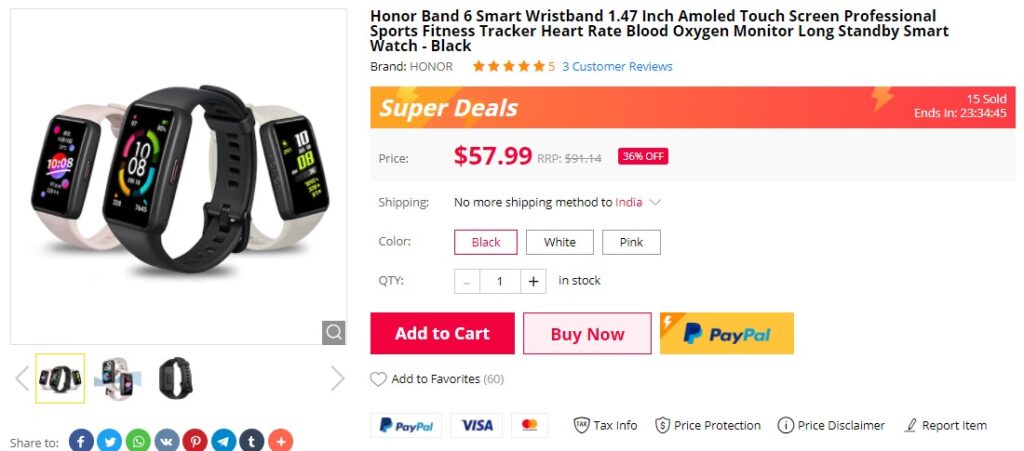
Are you looking for an impressive fitness band at an affordable price? Then the Honor Band 6 could be a perfect fit as it is available with a 36% discount offer. Gearbest is offering the fitness band for $57.99 in three different colors of Black, White and Pink.
It supersedes other fitness bands as it carries a large display, instead, it ranks well in the entry-level smartwatches segment in the same price range. Honor Band 6 is fully packed fitness trackrer which offers wider viewport with 1.47-inch display. It uses an OLED panel with 194 x 368 pixel resolution.
Honor Band 6 houses a strong and fast magnetic suction charging which replaces primitive methods of charging. It furher provides supports for detecting 10 different professional sports and outdoor activities. It houses a 180 mAh battery for 10-14 days of backup time.
Honor Band 4 comes with Bluetooth 5.0 facilitating seamless connectivity. It can be operated wither via touch screen or via button press. The smart fitness Band is 5ATM waterproof and sweatproof. It measures 1.69 x 0.98 x 0.43 in size and wieghs 0.05kg.
You can get it for the discounted price of $57.99 via Giztop.
We have to appreciate Samsung for shooting the gun on One UI 3.0 updates well despite facing recoils in the form of Beta bugs. The company has already started moving to the budget devices like the Galaxy M31. Out of nowhere, it has advanced into the next version i.e, the One UI 3.1 update. The first ones to receive it via OTA update are the Galaxy Tab S7, S7+ devices.
If you recall, Samsung launched the One UI 3.1 with the Galaxy S21 flagship devices. The new UI has features like Private Share, improvements to performance and memory allocation, and more. Samsung is now rolling out this version along with the Android 11 update for Samsung Galaxy Tab S7(SM-T875), Galaxy Tab S7+ LTE (SM-T975N), and the Galaxy Tab S7+ 5G(SM-T976N).
The respective firmware versions are T875NKOU1BUA8, T975NKOU1BUA8, and T976NKOU1BUA8. Weighing over 2.4GB, it is currently rolling out in South Korea but the OTA(Over The Air) update should expand to other regions soon. Talking about the important features, let’s quickly see what One UI 3.1 brings to the table:
Private Share
Feature to remove GPS location data from Images(When Sharing)
Improved performance and memory allocation
Lock Screen Widgets(More new Functionality added)
Background Video Calling
In addition to these, we can also expect the usual Android 11 perks like chat bubbles(conversations), media controls, improved permission management, improved Digital Wellbeing, and organized notifications. Besides, the Galaxy Tab S7, S7+ have also received an important feature called Second Screen support.
Typically, this allows the Tablets to operate as a second screen(like Apple Sidecar) with Select Samsung Windows PCs. They are Galaxy Book Flex, Galaxy Book Flex Alpha, Galaxy Book Ion, Galaxy Book S, and Notebook Plus.
Nonetheless, expect the One UI 3.1 to start tricking to other devices in the future. Speaking of which, a report says devices like Galaxy S20, Note 20, Z Flip 4G and 5G, S10 Series, and Note 10 devices are sure to get it.
We use cookies on our website to give you the most relevant experience by remembering your preferences and repeat visits. By clicking “Accept”, you consent to the use of ALL the cookies.
This website uses cookies to improve your experience while you navigate through the website. Out of these, the cookies that are categorized as necessary are stored on your browser as they are essential for the working of basic functionalities of the website. We also use third-party cookies that help us analyze and understand how you use this website. These cookies will be stored in your browser only with your consent. You also have the option to opt-out of these cookies. But opting out of some of these cookies may affect your browsing experience.
Necessary cookies are absolutely essential for the website to function properly. This category only includes cookies that ensures basic functionalities and security features of the website. These cookies do not store any personal information.
Any cookies that may not be particularly necessary for the website to function and is used specifically to collect user personal data via analytics, ads, other embedded contents are termed as non-necessary cookies. It is mandatory to procure user consent prior to running these cookies on your website.