Advertisement

Report: Qualcomm can only supply 4G chips to Huawei

A week ago, Qualcomm confirmed that it has applied for a license to supply chips to Huawei. Now, a report from China says that the company has been given the green-signal for 4G instead of 5G chips.
Qualcomm Snapdragon

According to a report from China, Supply Chain manufacturers say that Qualcomm has got the license to sell 4G chips to Huawei. The company had previously worked closely with Huawei in 4G chips mainly undertaken by Xi’an Research Center.

Now, after obtaining the license, it will look to increase the supply for 4G mobile phones further. A couple of days back, reports said Qualcomm already got the license to do business with Huawei. However, the new report suggests that it can only sell 4G chips at least for now.

Many companies have been getting permission to do business with Huawei lately. Among them, notable ones are AMD, Intel, Samsung Display, and more. If the report is true, there are approximately 300 companies waiting to get approval from the US government.

For the unware, US Government has been in a tussle with Huawei. After banning its companies from using Huawei’s 5G equipment over security concerns, it recently blocked the company’s chip business too. Due to this, Huawei came under a lot of pressure. It couldn’t use Google’s services, manufacture its own Kirin chipsets through TSMC, and spread its 5G technology world-wide.

Coming back, the report says Qualcomm will benefit a lot from this approval. The company, which was once a major QTL(patent business) partner of Huawei, lost business after the latter started growing up. Following this, a ban on chipset business(QCT) had further weakened the tie-up. That said, as per the company’s early statement, a license to sell chips to Huawei will be of greater significance in the future.

Furthermore, close to 10 manufacturers across regions including TSMC, SMIC, SK Hynix, Samsung Electronics, Western Digital have lineup for approval. That said, this news falls in line with earlier reports which said US Government is granting license as long as the components aren’t for Huawei’s 5G business.

Although it’s a relief for Huawei, which is diving towards scarcity of chips, adopting 4G instead of 5G will be difficult. Anyway, let’s wait and see how Huawei and Qualcomm leverage this opportunity to expand their business.

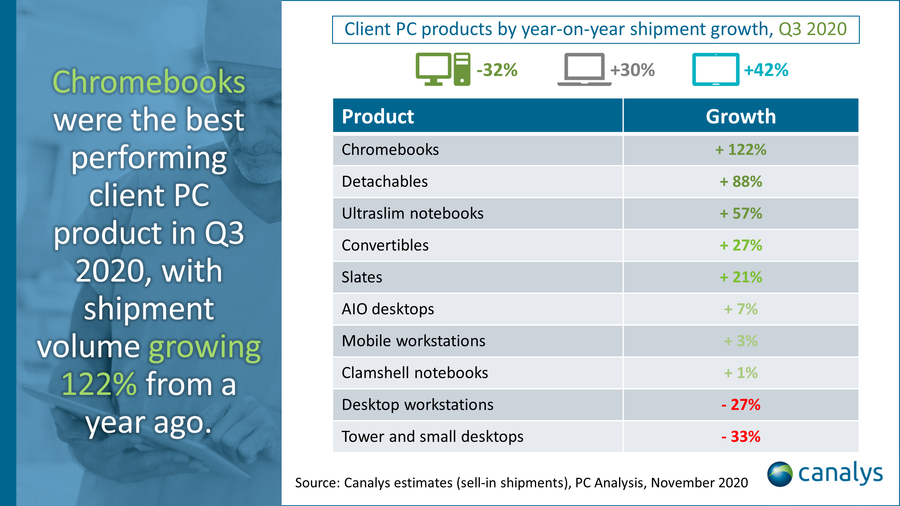
Chromebooks performed exceptionally well in Q3 2020 by growing 122% YoY

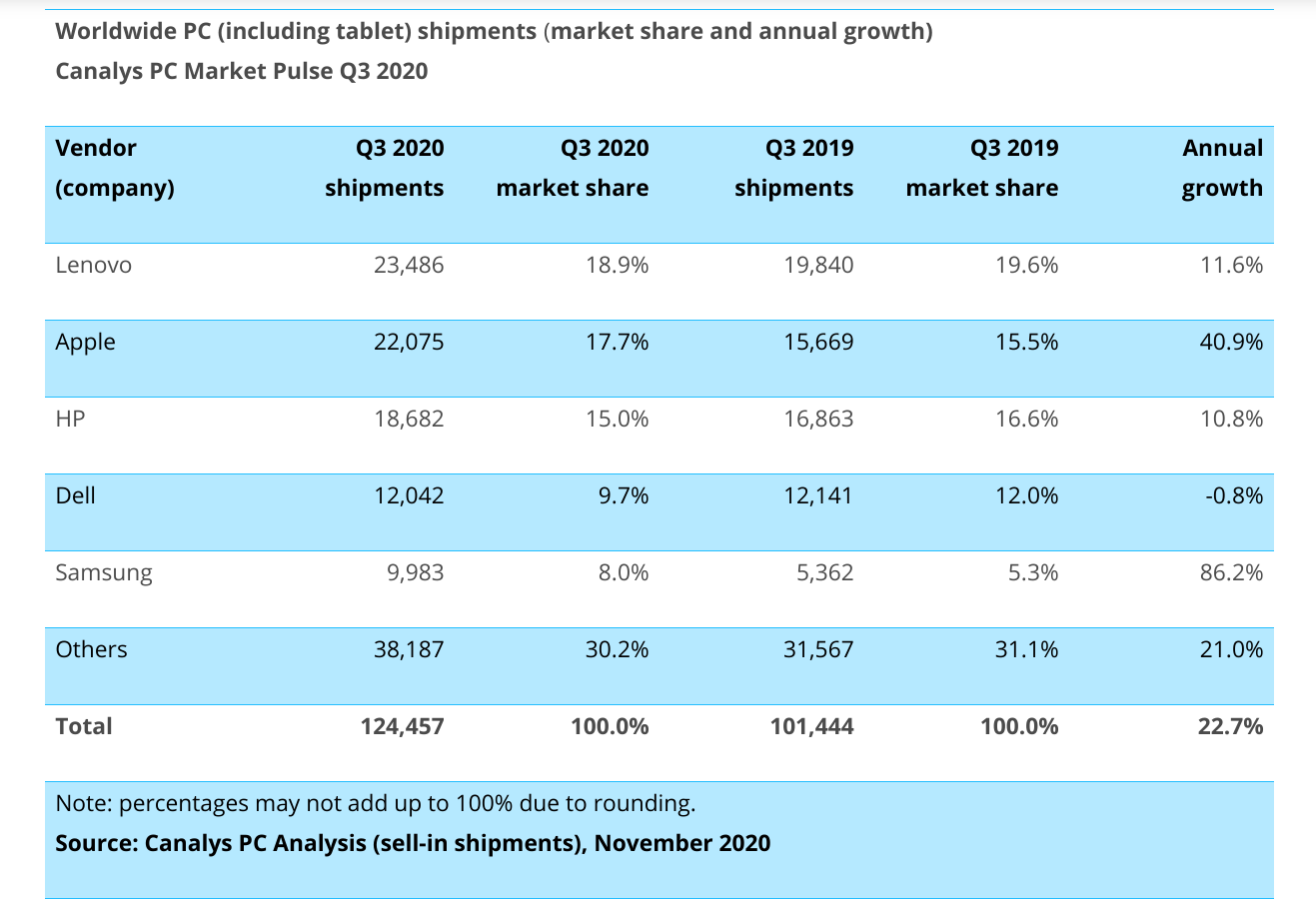
Canalys has published a report on Global PC Market Q3 2020. This report not only consists of notebooks and desktops but also includes tablets. According to it, the entire market grew by 23% YoY with 124.5 million units in shipments. Chromebooks were the best-performing client PC product and the tablet market remained strong second quarter in a row.

HP Elite c1030 Chromebook Featured
HP Elite c1030 Chromebook

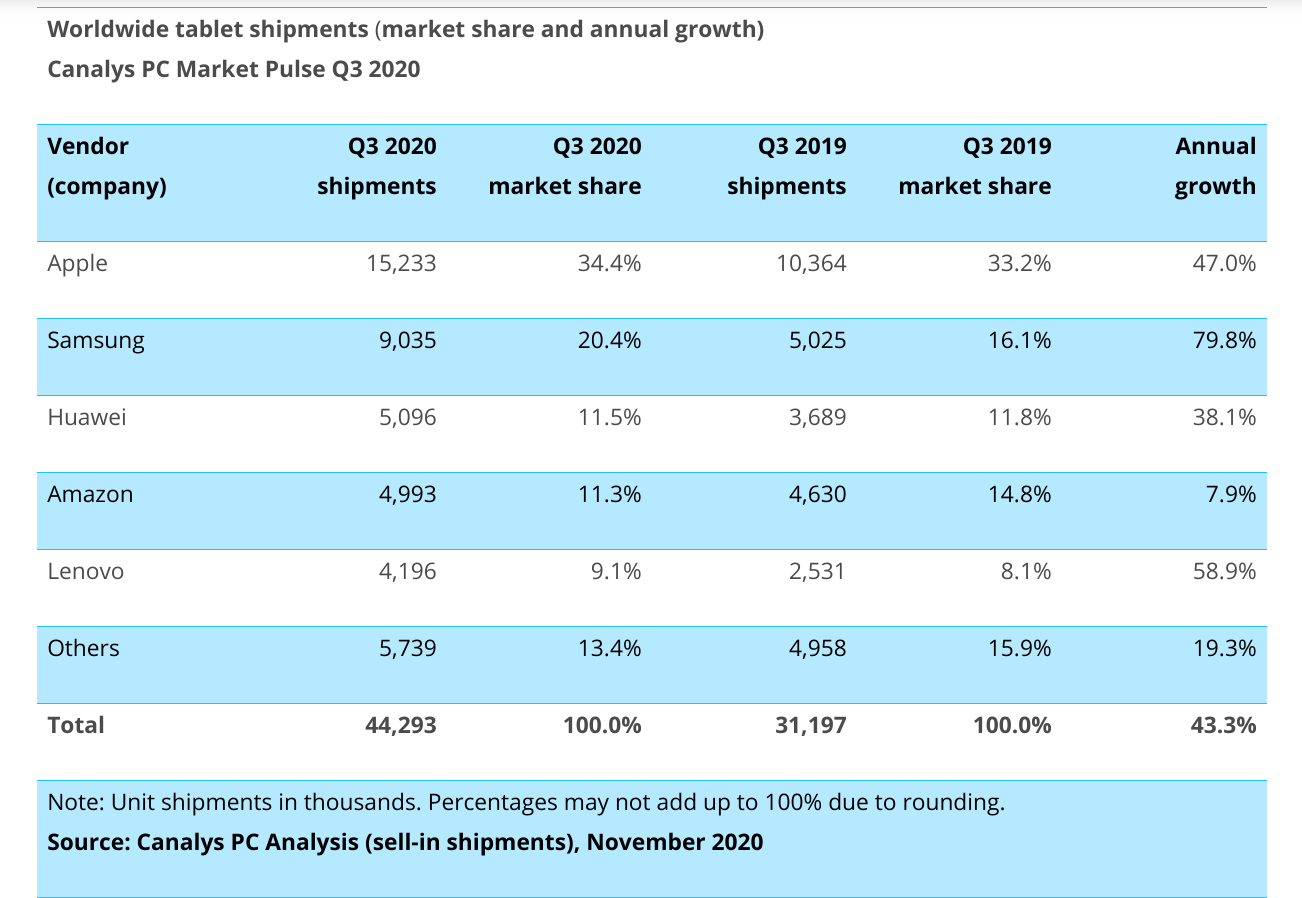
As per the report, Lenovo led the overall PC market by shipping 23.5 million units. Whereas, Apple, HP, Dell, and Samsung came second, third, fourth, and fifth respectively. Apple and Samsung made the top 5 list solely because of their tablets. This clearly explains the tablet market’s 43% YoY growth as the shipments reached 44.3 million units.

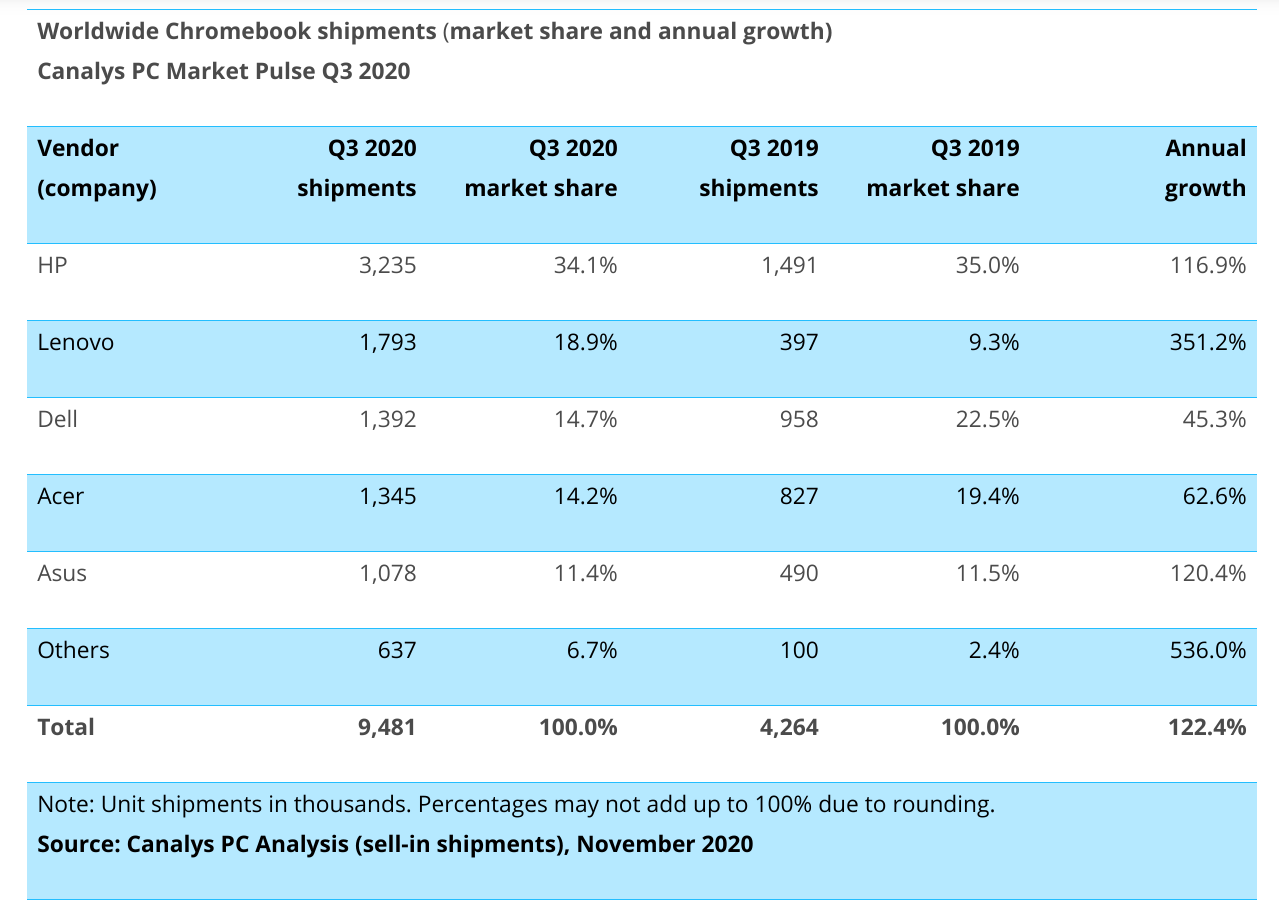
Talking about client PC products, Chromebooks performed exceptionally well by growing 122% YoY with shipments of 9.5 million units. Their success was mostly because of educational institutions and SMBs. HP was the market leader by shipping 3.2 million units, followed by Lenovo, Dell, Acer, and Asus. However, Lenovo was the best-performing brand with a whopping 351.2% YoY growth.

Coming to tablets, unsurprisingly, Apple led the market with 15.2 million units in shipments. Whereas, Samsung in second place only shipped 9 million units. Further, Huawei, Amazon, and Lenovo captured third, fourth, and fifth positions respectively. Interestingly, Huawei continued to remain strong in Europe even with the lack of GMS (Google Mobile Services) on its tablets.

Also, it is worth noting that Q3 2020 was the only quarter other than Q2 2020 in which the tablet market grew since 2015. So we can say that the pandemic resurrected tablets from the dead after five years.

Last but not least, the overall desktop market declined by 32% YoY, however, AIO (All-in-One) category grew by 7% YoY.


OPPO’s upcoming OPPO CybeReal AR App merges navigation and entertainment

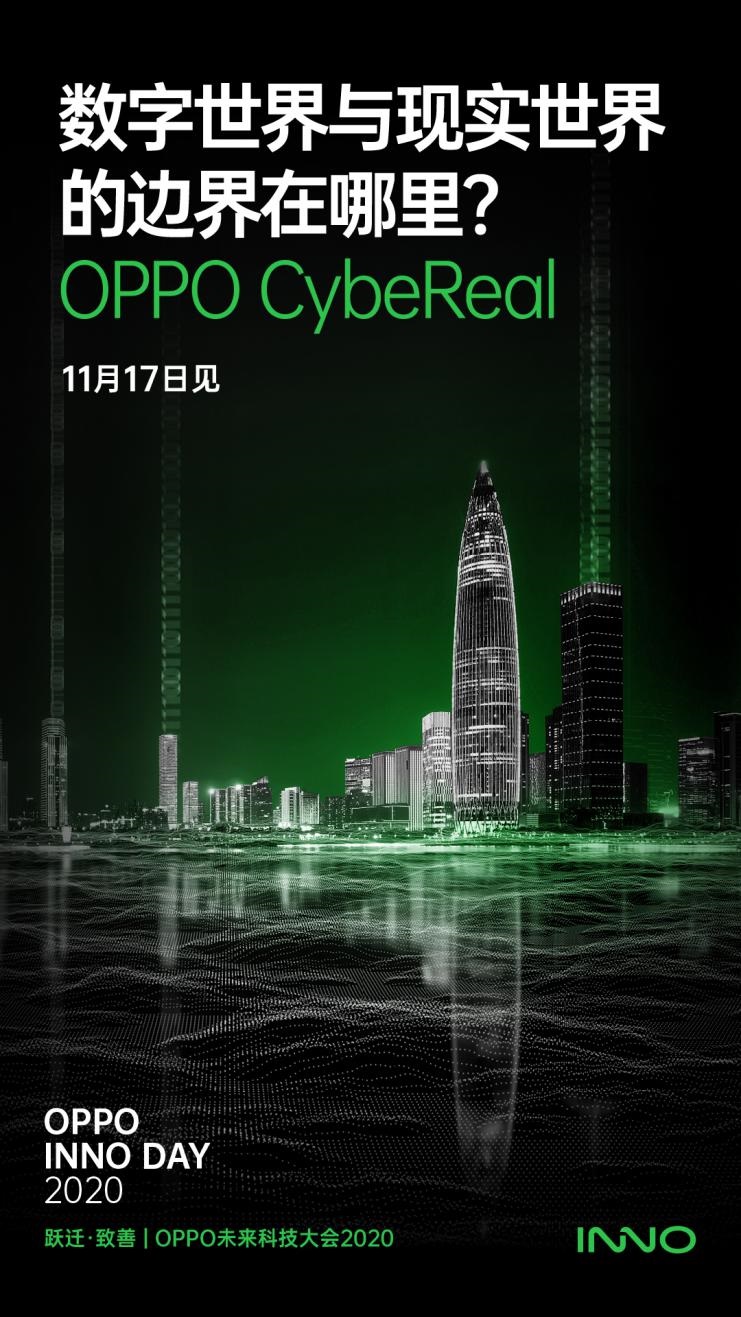
Earlier today (13th November 2020), OPPO officially announced a new concept application called CybeReal. It is an AR (Augmented Reality) based platform that will help bridge the boundaries between the digital and real world.

OPPO

During the conference, the Chinese tech giant unveiled its new real time high precision positioning and scene recognition technology, which will be used in CybeReal. The company is calling it an AR super application. According to the company’s official notes, CybeReal can display information regarding the scene being displayed on the screen through a device’s cameras.

This would help in various aspects like navigation, information regarding stores and their activities, and even introduction to local attractions or landmarks. Simply put, users can just open the camera through an app, which will allow them to see information regarding their surroundings in real time. The technology is also somewhat similar to Huawei AR Maps 2.0, which was announced back in October.

OPPO

AR applications have been growing in recent times with OEMs working to include in many forms like marketing, launches, and even commerce to a certain degree. Unfortunately, finer details regarding the AR platform from OPPO is currently unknown. The company has emphasized its functionality with entertainment and navigation, but further applications can only be speculated at the moment.


Ghost of Tsushima is the Fastest Selling PS4 Original with over 5 million copies sold

Ghost of Tsushima has achieved another record, as the game becomes the fastest selling PlayStation 4 Original title. It has already sold over 4 million copies worldwde and has even beaten other notable titles like Horizon Zero Dawn.

Earlier this week, PlayStation Worldwide Studios head Hermen Hulst shared a tweet that revealed that Ghost of Tsushima has become the fastest selling first party PS4 game with more than 5 million copies sold, despite being launched back in July 2020. This also marks an incredible achievement for the Sucker Punch game studio (which has also developed the popular Infamous series).

Ghost of Tsushima

An important aspect to note here is the “Original” tag on the game since other titles have performed better than Ghost of Tsushima. A great example being Marvel’s Spider-Man, which sold over 3.3 million copies in just three days alone. Although, the IP is owned by Marvel and not Sony. Furthermore, Naughty Dog’s The Last of Us Part II had also released a month prior to Ghost of Tsushima and had sold over 4 million copies in three days. However, it was not considered an original title as it was a sequel.


OnePlus and Snapchat team up for new Diwali themed AR Lenses

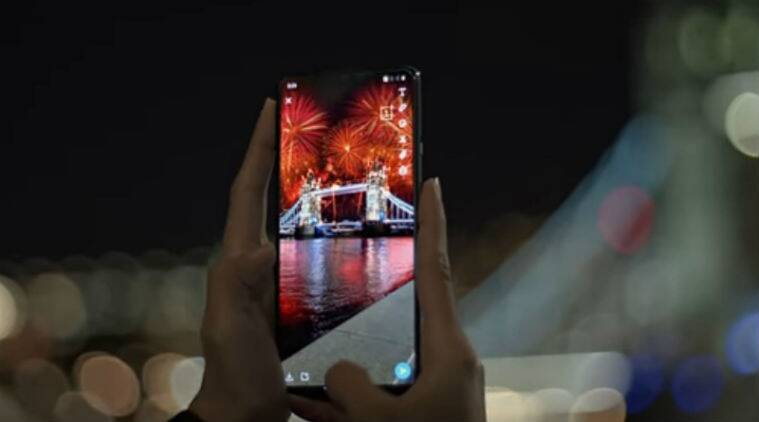
Just prior to Diwali (one of India’s largest festivals), OnePlus launched a new campaign alongside social media giant, Snapchat. The two companies have teamed up together to launch new Diwali themes AR (Augmented Reality) lenses.

These lenses will allow users to transform iconic and globally known landmarks like the Tower Bridge in London, the Eiffel Tower in Paris, the Taj Mahal in Agra, and the Gateway of India in Mumbai, into special festive themed spots. The Chinese smartphone maker has also released a short video commemorating the same, while also demonstrating the lens in action in the aforementioned locations and is an effort to bring the warm festivities amid social distancing.

Snapchat is a major social media app with hundreds of million daily users, which also heavily utilizes its AR features. Thus, this partnership allows a vast number of users to access the special AR experiences that can transform the known landmarks in real time. The OnePlus’ Snapchat’s AR Lenses is live from 11th November 2020 and will be available to Snapchat users across India. Following the ‘Open your palm to release the wishes’ gesture, users can also send words of positivity like peace, joy, hope, and more that would float up to the sky to form the Diwali message to share with friends and family.

OnePlus

According to Siddhant Narayan, Head of Marketing, OnePlus India said, “As a brand that is dedicated to its community we have leveraged technology to bring our global user base together and share the love forward this Diwali. Through this campaign with Snapchat, we wanted to enable users across the world to celebrate the festival of lights in a safe and secure manner during the time of social distancing. In the wake of the pandemic, we also aim to share the message of hope with our global community as we prepare to celebrate one of India’s biggest festivals.”


Group of 165 companies call for strict antitrust actions against Google

A group of 165 companies and industry bodies have called for stricter action and tougher lines against Google, stating that the US search engine giant unfairly favors its own services on its web searches.

According to a Reuters report, the group includes companies from both the US and UK, along with others from over 21 different European countries. These firms sent a joint letter to EU antitrust chief Margrethe Vestager earlier this week. In the letter, the group expressed that Google was giving unfair preference to its own services such as accommodation, travel, and jobs, in terms of placements in search results and have called for swift action against the company to end the practice.

google

Google has since refuted the allegations of it favoring its own services. The tech giant further added that its users are not locked in and that competition to its services is just one click away on the internet. As per a Google representative, “People expect Google to give them the most relevant, high quality search results that they can trust.”

The representative also stated that “They do not expect us to preference specific companies or commercial rivals over others, or to stop launching helpful services which create more choice and competition for Europeans.” Notably, Vestager has already levied fines of over 8.25 billion euros (roughly 9.7 billion US Dollars) against Google in the past three years alone for abusing its market dominance, through Android and other platforms.

Notable members of the 165 strong group include Yelp, Expedia, Trivago, Kelkoo, Stepstone, and Foundem, which are a part of the largest ever consortium to write to the EU competition chief for action. The European Commission said it had received the letter and a reply will arrive in due time. It further added that the market will be carefully assessed as well.

Google

In the letter titled ‘UNJUSTIFIED ADVANTAGES,’ the group called out the search giant stating that “While we compete amongst ourselves for the best consumer experience, there is one common competitor that does not compete fairly – Google. It gained unjustified advantages through preferentially treating its own services within its general search results pages by displaying various forms of grouped specialized search results (so-called OneBoxes).”


Samsung Galaxy S20 Ultra and Note 20 Ultra units are facing wireless charging issues after recent update

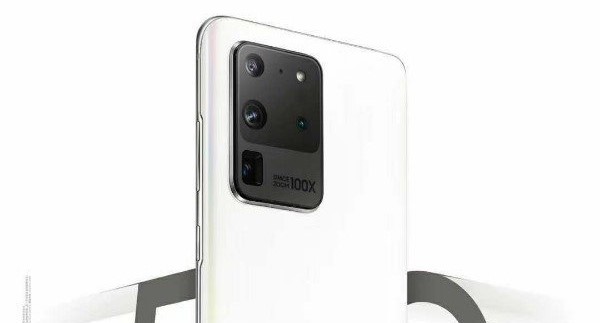
Back in October, a new software update had been rolled out for the Samsung Galaxy S20 Ultra and the Galaxy Note 20 Ultra. However, since the update was made available, certain units have been facing troubles with the devices’ wireless charging.

Galaxy S20 Ultra Cosmic White China Featured
Samsung Galaxy S20 Ultra Cosmic White

According to a PhoneArena report, a number of Samsung users have been facing this issue. This problem has even been shared on official and unofficial forums. The primary issue is related to the third party wireless chargers that have stopped working with their Galaxy Note 20 Ultra or Galaxy S20 Ultra handsets after the new update. Although, this problem has seemingly not affected the wireless chargers made by Samsung.

Users have reported that the wireless charging gets interrupted constantly every few seconds, with affected users stating that the issue was not present previously with any third party wireless chargers. While up until recently, it was unknown what was causing the issue for the high end premium grade flagship models from the South Korean tech giant, but now, a fix has been found.

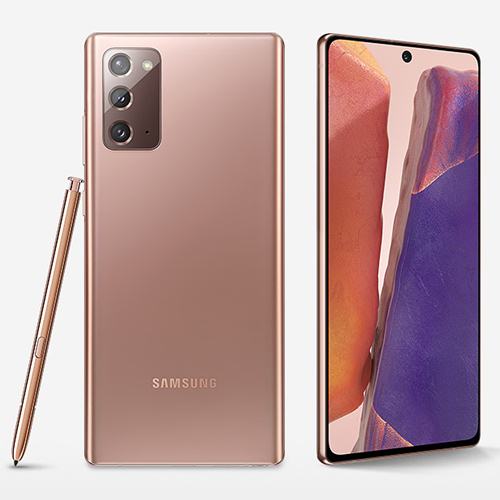
Samsung Galaxy Note 20 Ultra

Apparently, the wireless charging problem is fixed by turning off NFC. This workaround was discovered by James Drissel on XDA Developers Forums and is the unofficial fix for the issue at the moment. Unfortunately, it still doesn’t explain how the problem began in the first place and an official update to fix the bug has yet to be rolled out. So stay tuned for more updates.


US Commerce Department delays its ban order against TikTok

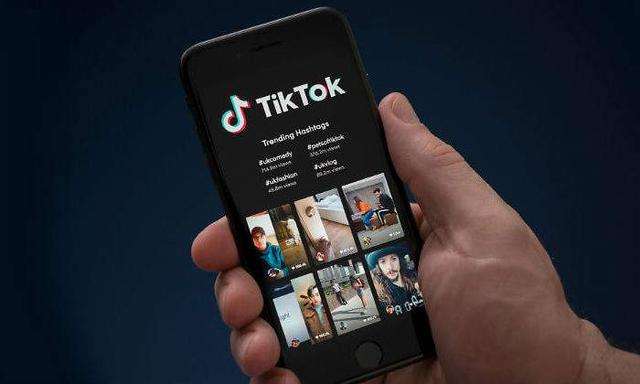
Earlier this week, the US Commerce Department announced that it would not be enforcing its orders that would’ve had the Chinese short video sharing app, TikTok, be banned from the region.

TikTok

According to a WallStreetJournal report, the Commerce Department is backing down and delaying its implementation of the order, which was set to take effect on Thursday (12th November 2020). The order would have had the social media platform be banned from app stores offered by major companies, namely Google, Apple, and even Amazon. In other words, this would’ve effectively ended the US operations of TikTok.

For those unaware, the Trump administration has been behind the action that was being taken against the ByteDance owned app. However, with changes in leadership after the recent US elections, it is unknown how Joe Biden will handle the situation regarding TikTok. Although, many members of Congress have already voiced their concerns regarding the Chinese app stealing users’ data and being a national security risk as well.

TikTok

Furthermore, this isn’t limited to just TikTok, as it remains to be seen what stance and direction the newly elected President would take regarding the current state of the US and China relations. This news also arrives amid the lawsuit filed against the Commerce Department’s orders by popular TikTok users and the preliminary injunction towards the order by US District Judge Wendy Beetlestone.


Samsung Galaxy A02, Galaxy M02 Wi-Fi certified, Launch could be nearing

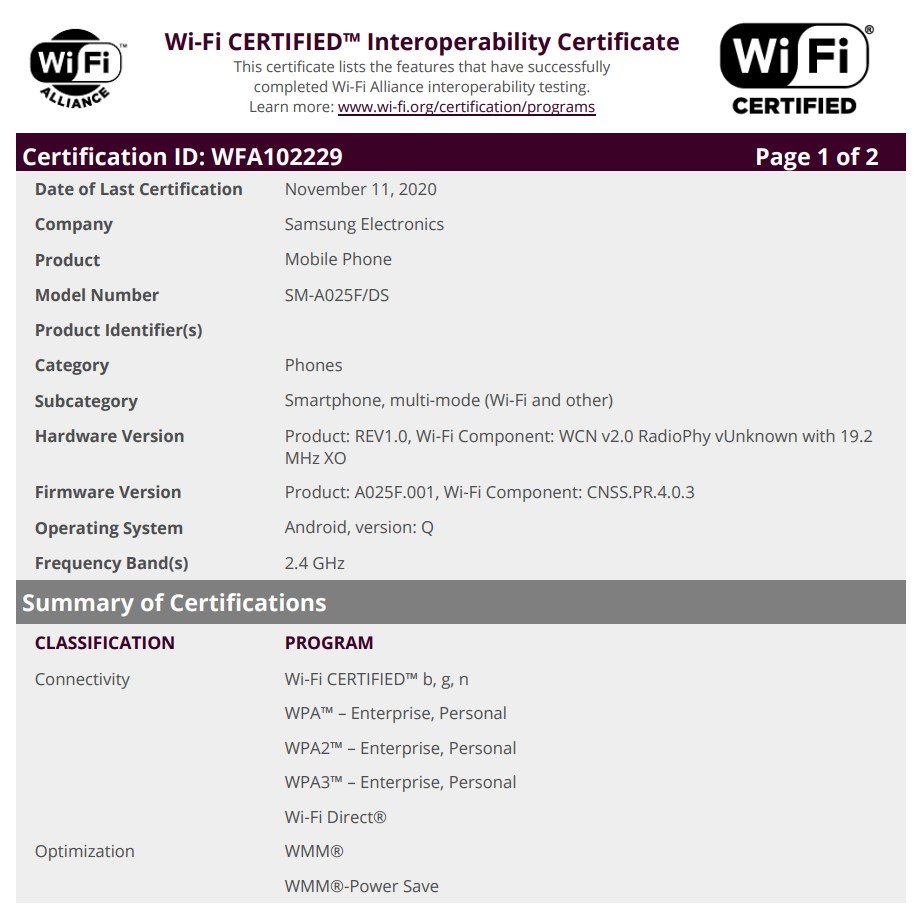
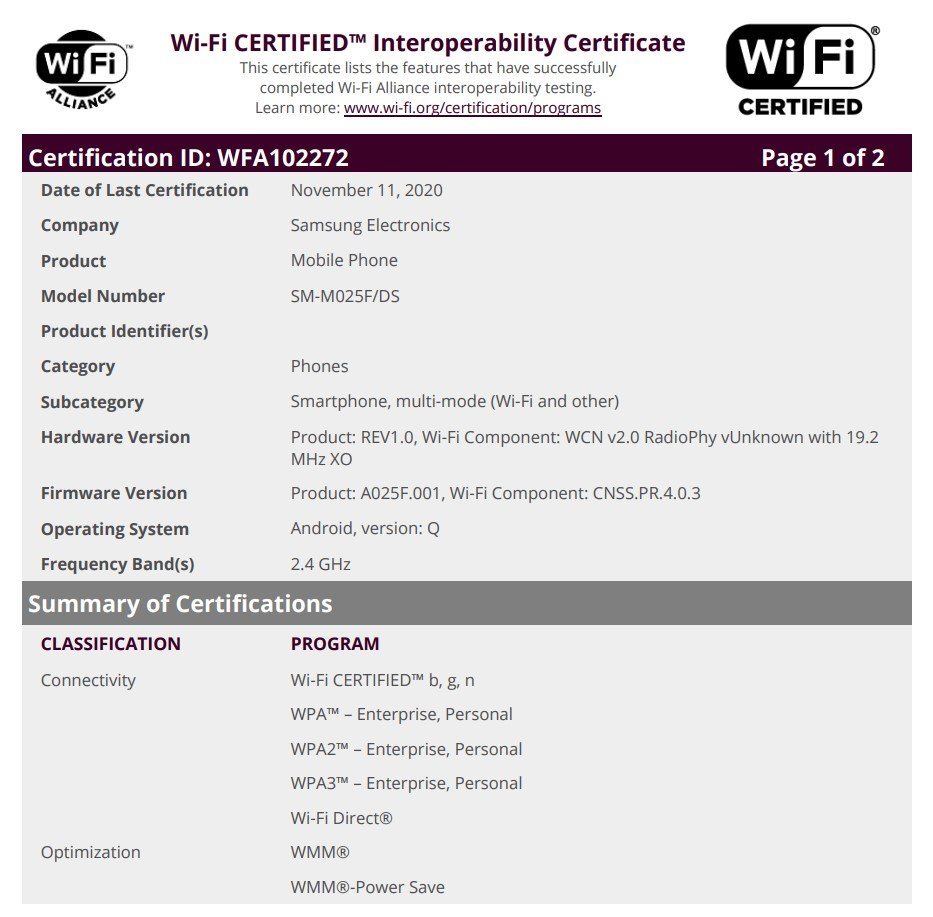
Recent reports have revealed that Samsung is working on two entry-level phones named the Galaxy A02 (SM-A025F) and Galaxy M02 (SM-M025F). Both phones were certified by the Bluetooth SIG authority last month. Later, the A02 appeared at Geekbench and certification platforms such as the FCC and NBTC. The M02 has also been spotted at Geekbench and BIS. Both phones seem to have identical specs. The Galaxy A02 and Galaxy M02 phones have now received approval from the Wi-Fi Alliance certification platform.

The Wi-Fi listings have revealed that the Galaxy A02 and Galaxy M02 carry support for Wi-Fi b/g/n and Android 10 OS. With yet another important certification in tow, the A02 and M02 are expected to go official soon.

Past reports have revealed that the Galaxy A02 and Galaxy M02 could be driven by the Snapdragon 450 chipset. These phones are expected to sport 5.71-inch displays with HD+ resolution support.

The Galaxy A02 and M02 could be equipped with 2 GB / 3 GB of RAM. Both phones are likely to come with 32 GB of internal storage and a microSD card slot for additional storage.

The Galaxy A02 and M02 phones are speculated to sport a 13-megpaixel + 2-megapixel dual camera setup and an 8-megapixel front-facing. These handsets could be fueled by 3,500mAh batteries. There is no word on the pricing of these handsets. These handsets will be arriving successors to Galaxy A01 and M01 phones.


Vivo starts OriginOS beta testers recruitment process in China

Vivo has confirmed that the company will be launching its new OriginOS in China on 18th November, which will replace the existing FunTouch OS user interface that we see on all of the company’s smartphones.

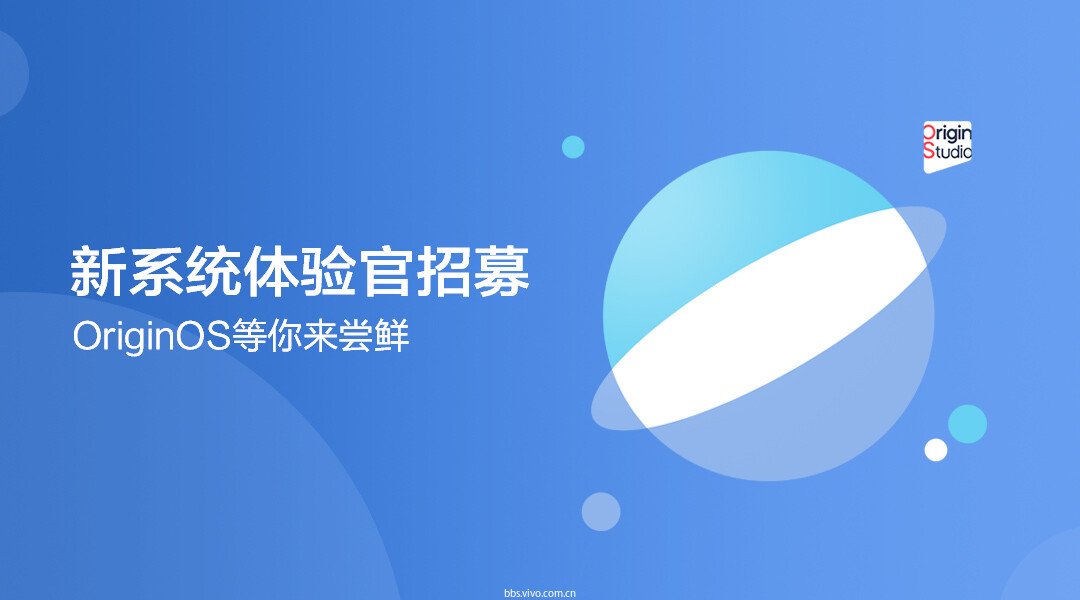
Now, ahead of officially unveiling the new mobile operating system, the Chinese company has started the beta testers recruitment process in its home country. Vivo has started accepting applications from those who are interested in beta testing the software.

Vivo OriginOS Beta Tester Application

The application process started on 12th November and will be open till 18th November. The company has confirmed that the shortlist will be published on 20th November while the unit shipments will being from 23rd November.

EDITOR’S PICK: PUBG Mobile is coming back to India with a $100 million investment, in-game content, and more

The project is being developed under Origin Studio carries the tagline “Brave New World”, which confirms a complete rehaul of the user interface. Earlier reports have revealed that Vivo will be offering two different types of interface for the users — OriginOS and Stock Android. Interestingly, the users will be able to choose and switch between the two options.

The company had previously stated that the upcoming custom user interface will be available for Vivo’s existing smartphones as well. To know for sure which devices will be compatible with the OriginOS, we will have to wait for the official launch.

Vivo‘s upcoming OriginOS is set to get launched on 18th November at a special event in Shenzhen, China. The new system is said to have an Anthropomorphic design and aims to offer a new experience to the users. We will know what the company has planned to offer once it is officially announced in a few days.


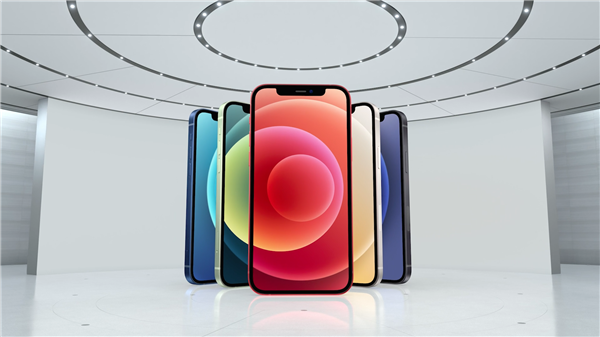
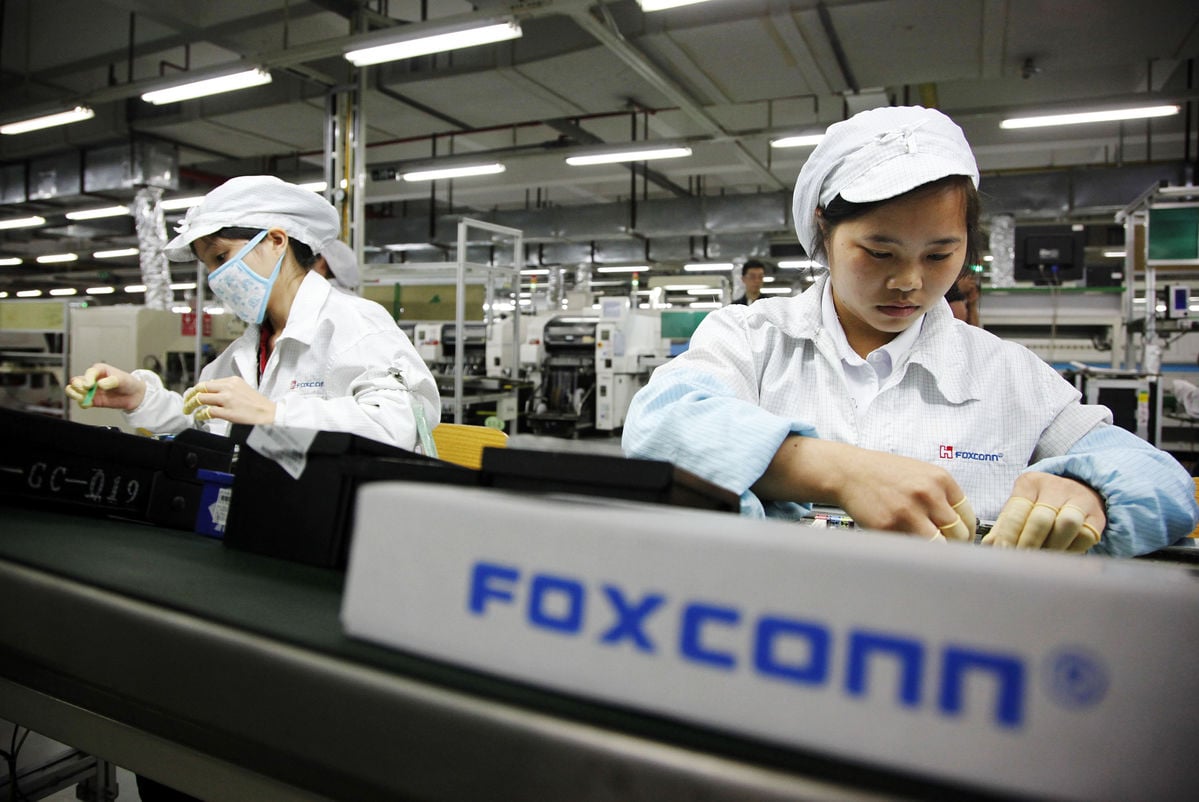
Apple iPhone 12 to bring strong earnings for Foxconn, firm to continue US investments

The Apple iPhone 12 series launch is set to have its primary supplier, Foxconn, see strong earning through the holiday and final quarter of 2020. The firm also announced that it would continue its investments in the United States.

Apple

During Q3 of 2020, Foxconn raked in a profit of 1.08 billion US Dollars, which was nearly identical to its profits in the same quarter back in 2019. The Coronavirus pandemic is likely to be the primary reason for the flat year on year growth, as the Apple supplier faced costly delays as the product launch was rescheduled, as per an AppleInsider report.

Liu Young-way, Foxconn Chairman, stated that the company is witnessing a “stronger than expected” demand for smartphones and servers in 2020. The former was likely due to the launch of the iPhone 12 series. According to Liu and analysts as well, the trend is expected to continue, with consumer electronics revenue projected to rise by as much as 10 percent in the fourth quarter and rise in early 2021.

Apple

Furthermore, Foxconn is also likely to assemble all of the iPhone 12 Pro and iPhone 12 Pro Max models along with 70 percent of all the other models as well, as per certain analysts. The company stated that the projected demand for the new lineup has also encouraged it to continue its investments in US based projects. This includes its Wisconsin factory, which has been facing troubles, as an effort to keep moving forward in the region.


China claims to have installed 700,000 5G base stations this year

5G technology is going mainstream this year but at the same time, only a handful of countries are offering commercial 5G service to the users. One of the leading countries in offering 5G is China and it continues the infrastructure development to gain the lead for next-generation wireless communication technology.

Now, China is claiming that it has built around 700,000 5G base stations in the country so far this year, which has exceeded the company’s original plan of installing 500,000 5G base stations in the country.

5G Logo

EDITOR’S PICK: Samsung Electronics could become Apple Silicon’s M1 chipset manufacturer as TSMC cannot meet demand

Liu Liehong, Vice-Minister at the Ministry of Industry and Information Technology in China said that the number is more than double the number of 5G base stations installed this year in the rest of the world. However, he has not cited the source for this information.

Last month, MIIT had revealed that more than 690,000 5G base stations are operational in China and over 160 million devices are connected. Liu Liehong has now revealed that more than 180 million devices are connected to 5G.

For complete 5G coverage across the country, China will need to install 10 million 5G base stations, which will require an investment of around 2 trillion yuan ($280 billion).

As said, China wants to be a leader when it comes to cutting-edge technologies like 5G, Internet of Things (IoT), Artificial Intelligence (AI), and more. These technologies are considered to be a key factor for the modern economy and China is competing with other countries like the United States to dominate the market.


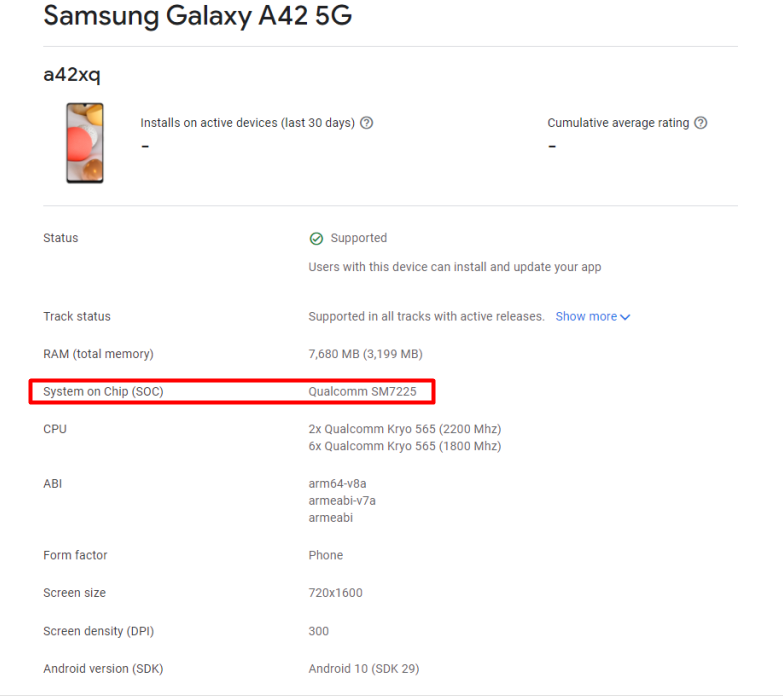
Samsung Galaxy A42 5G has Snapdragon 750G, confirms Google Play Console listing

In September, Samsung announced the Galaxy A42 5G. While the company revealed the entire specs of the phone, it is yet to confirm the name of the chipset that powers it. Before its launch, there were rumors that it is fueled by the Snapdragon 690 chipset. However, a Geekbench listing that appeared after its launch revealed that it is driven by the Snapdragon 750G. The handset has now appeared at the Google Play Console with some of its key specs including the chipset.

As it can be seen in the screenshot, the Qualcomm processor that fuels the Galaxy A42 5G is mentioned with its SM7225 model number. This confirms that the device is drive by the Snapdragon 750G chipset. The Xiaomi Mi 10T Lite and Motorola Moto G 5G are the only other phones that feature the SD750G chip.

Samsung Galaxy A42 5G Google Play Console

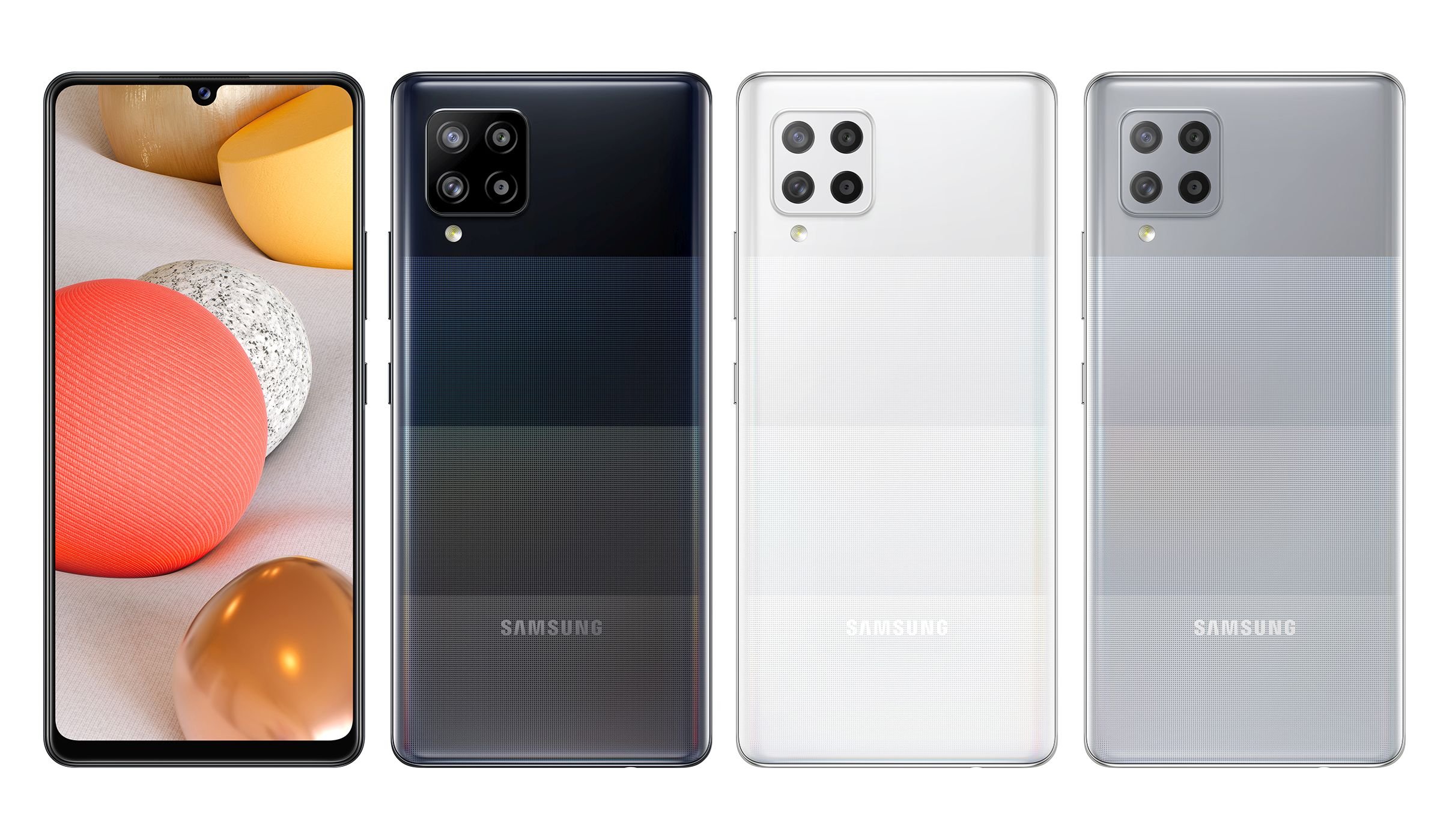
The Galaxy A42 5G is available in Europe with a price tag of £349. It comes in colors like Prism Dot Black, White, and Gray colour options.

The Samsung Galaxy A42 5G has a 6.6-inch S-AMOLED display that delivers an HD+ resolution of 720 x 1600 pixels and a 20:9. A fingerprint sensor is embedded under the display of the phone. The SD750G chip is assisted by up to 8 GB of RAM. The handset has an internal storage of 128 GB and a microSD card slot for additional storage.

Samsung Galaxy A42 5G color variants
Samsung Galaxy A42 5G

The Galaxy A42 5G has a 20-megapixel front-facing camera and a rear camera setup that includes a 48-megapixel main camera, an 8-megapixel ultrawide lens, a 5-megapixel macro lens, and a 2-megapixel depth sensor. The 5,000mAh battery of the A42 5G is coupled with 15W charging.


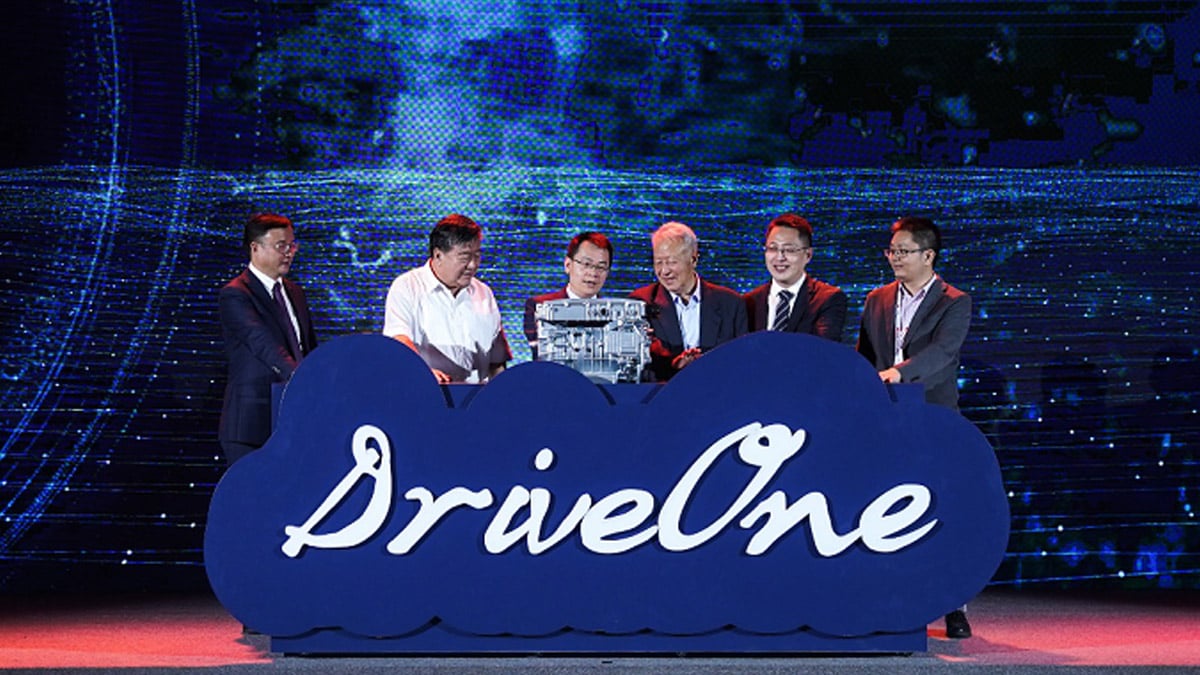
Huawei DriveOne unveiled as the company’s first all-in-one electric drive system

Huawei, the Chinese giant which is one of the leading companies in the world when it comes to telecom equipment and smartphones, has expanded its product offering in various other categories. The company is now also focusing on IoT and AI. In line with that, it has announced its all-in-one electric drive system — Huawei DriveOne.

Huawei DriveOne

The company claims that DriveOne is the industry’s first hyper-converged power domain solution. It integrates seven mechanical and power components — Micro Control Unit (MCU), Motor, Reducer, DC Converter (DCDC), On-board Charger (OBC), Power Distribution Unit (PDU), and Battery Control Unit (BCU).

The system is aimed at achieving simple development, simple adaptation, simple layout, and simple evolution. Huawei has also a self-developed AutoSar system which is offering end-cloud collaborative development that significantly improves development efficiency.

EDITOR’S PICK: Samsung Electronics could become Apple Silicon’s M1 chipset manufacturer as TSMC cannot meet demand

It is said that DriveONE can minimize the layout of the vehicle power domain, save 220mm in the Z direction, reduce 2 mounting brackets, shorten wiring harness by 5m, reduce 3 connectors, and reduce water nozzles and 2 water pipes.

The system adopts a centralized and flat OTA architecture that simplifies the path and reduces the complexity of versioning while ensuring performance improvement. This shortens 10min upgrade time to 30s and enables one-key speedy upgrades.

Huawei says that it is the industry’s first high-voltage all-in-one electric drive system that can meet the 2C fast-charging experience and offer 200km range in 10 minutes of charging. It is said to be more efficient, more accurate, and more power-efficient than the previous similar solutions.


Samsung Electronics could become Apple Silicon manufacturer

Apple has already announced its new M1 chipset as a part of Apple Silicon and with that, it has officially begun the process of transitioning from Intel to its own chipsets for the Mac devices. This seems to be a move that could help Samsung Electronics as well.

According to the report coming via BusinessKorea, there’s a strong possibility that the South Korean giant Samsung Electronics could become the manufacturer for the M1 chipset. If this turns out to be true, then Samsung will be making chipsets for Apple after about five years.

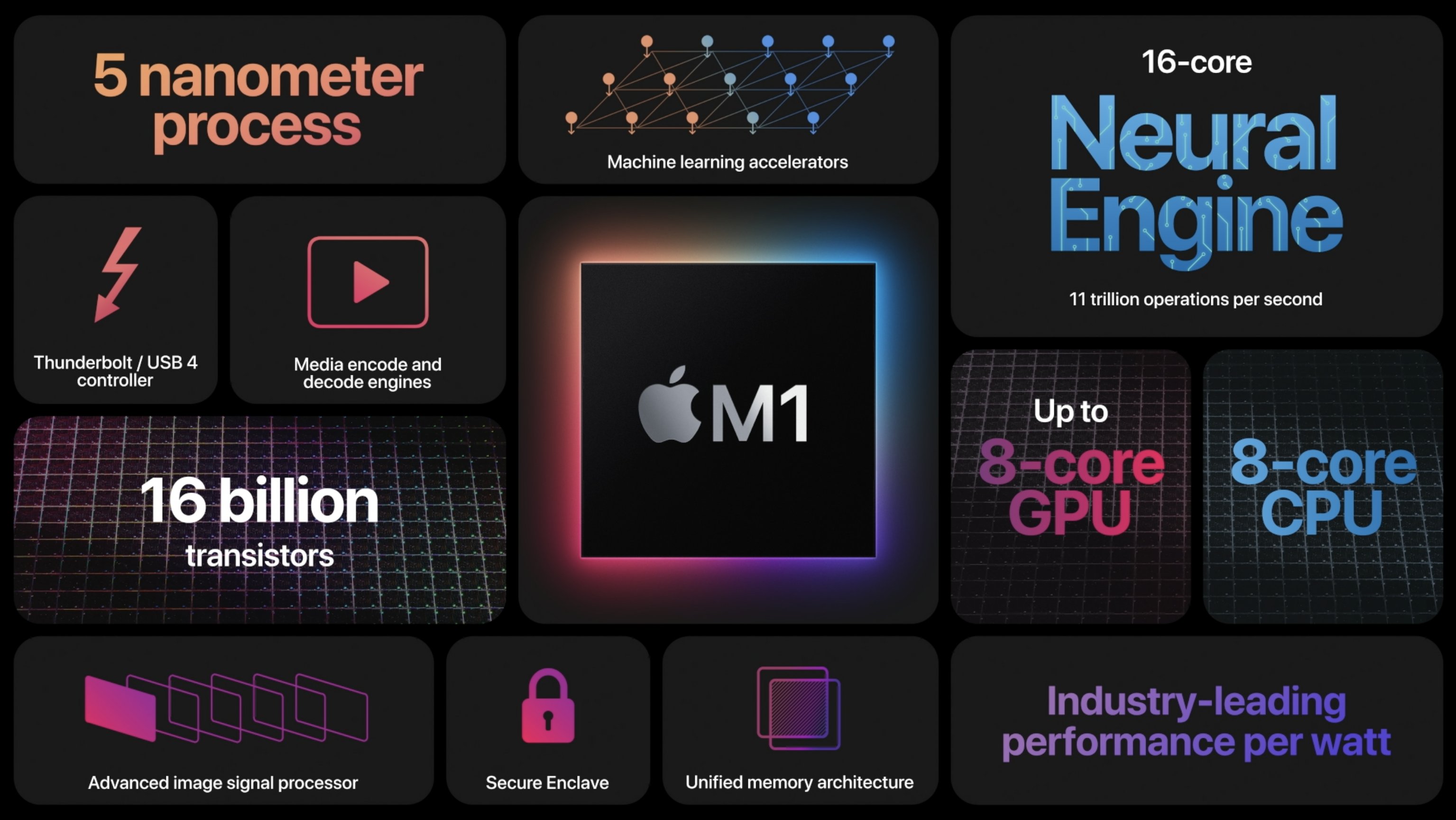
Apple M1 chip features

Currently, the M1 chips are being manufactured by Taiwan Semiconductor Manufacturing Company (TSMC). But since the company is having difficulty meeting the demand for the while order volume, Apple could shift some of the orders to Samsung.

It’s noteworthy that the newly launched M1 chipset is made using the 5nm process and TSMC and Samsung are the only two companies in the world right now that have the capabilities to manufacture 5nm chips.

EDITOR’S PICK: PUBG Mobile is coming back to India with a $100 million investment, in-game content, and more

The M1 chipset packs a staggering 16 billion transistors, which is significantly higher than the 11.8 billion used in the iPhone 12’s A14 Bionic. The CPU core has an eight-core arrangement, which includes four high-performance cores for heavy-duty work and four high-efficiency cores for low-priority tasks.

It also has dedicated circuitry for graphics and artificial intelligence processing. The memory chips are also housed within the same chip package alongside the processor, which should result in better speed.

Apple Silicon’s M1 chipset-powered Mac devices are claimed by the company to be three and a half times faster than the previous Intel-based models. The graphics speed also comes in five times faster, according to Apple.


OPPO Reno5 4G (CPH2159) bags NBTC, EEC, and TKDN certifications

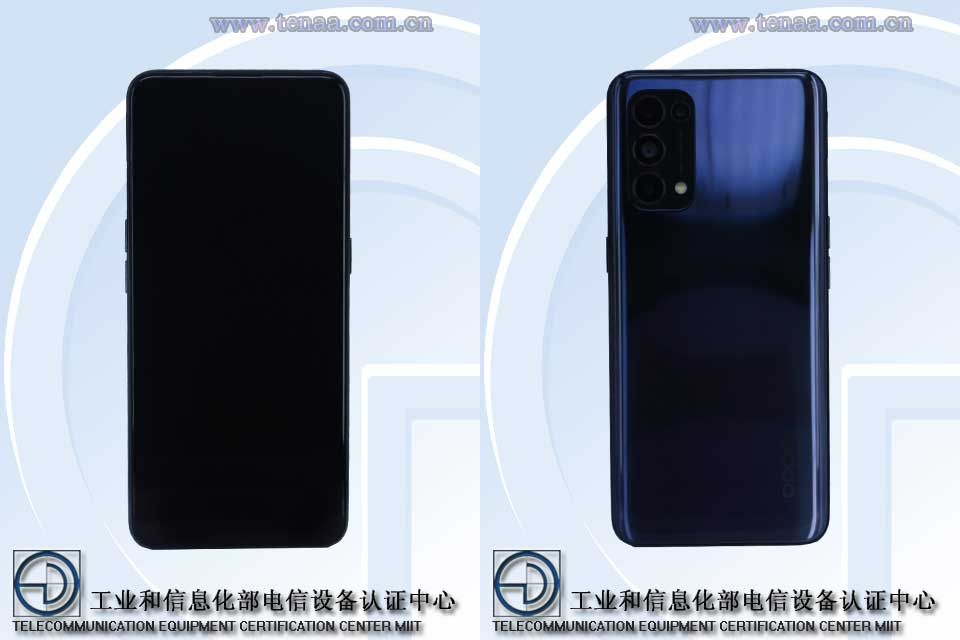
OPPO is reportedly gearing up to launch the Reno5 series of smartphones in China. It is believed that the OPPO PEGM00 / PEGT00 phone that was recently approved by China’s TENAA authority could be the Reno5. The PDSM00 phone that appeared on Geekbench could be the Reno5 Pro for China. In some markets outside of China, it may sell the 4G version of the Reno5 series. Today, an OPPO phone with a CPH2159 model number appeared in the database of Thailand’s regulatory body. The listing has revealed that the phone will be arriving in the country as the OPPO Reno5.

The NBTC listing shows that the device only supports LTE connectivity. Hence, the CPH2159 model number belongs to the OPPO Reno5 4G smartphone. The CPH2159 model number has been previously seen at certification platforms like EEC of Europe and Indonesia’s TKDN authority. It has also surfaced in the import/export database of Pakistan. None of the listings have revealed the specifications of the Reno5 4G.

OPPO Reno5 5G specifications (Rumored)

The OPPO Reno5 5G has a 6.43-inch OLED display that produces a Full HD+ resolution. The punch-hole on the screen houses a 32-megapixel selfie camera. The back panel of the phone is fitted with a 64-megapixel + 8-megapixel + 2-megapixel + 2-megapixel quad-camera system.

OPPO PEGM00, PEGT00

It is rumored to be powered by the Snapdragon 765G chipset and 8 GB / 12 GB of RAM. The handset is expected to land in China in 128 GB and 256 GB storage options. It lacks a microSD card slot. The phone comes preinstalled with Android 11 OS. Its 4,300mAh battery is coupled with 65W fast charging.

The PDSM00 that appeared at Geekbench could be the Reno5 Pro handset. It was spotted with specs like Dimensity 1000+, 8 GB of RAM, and Android 11 OS.


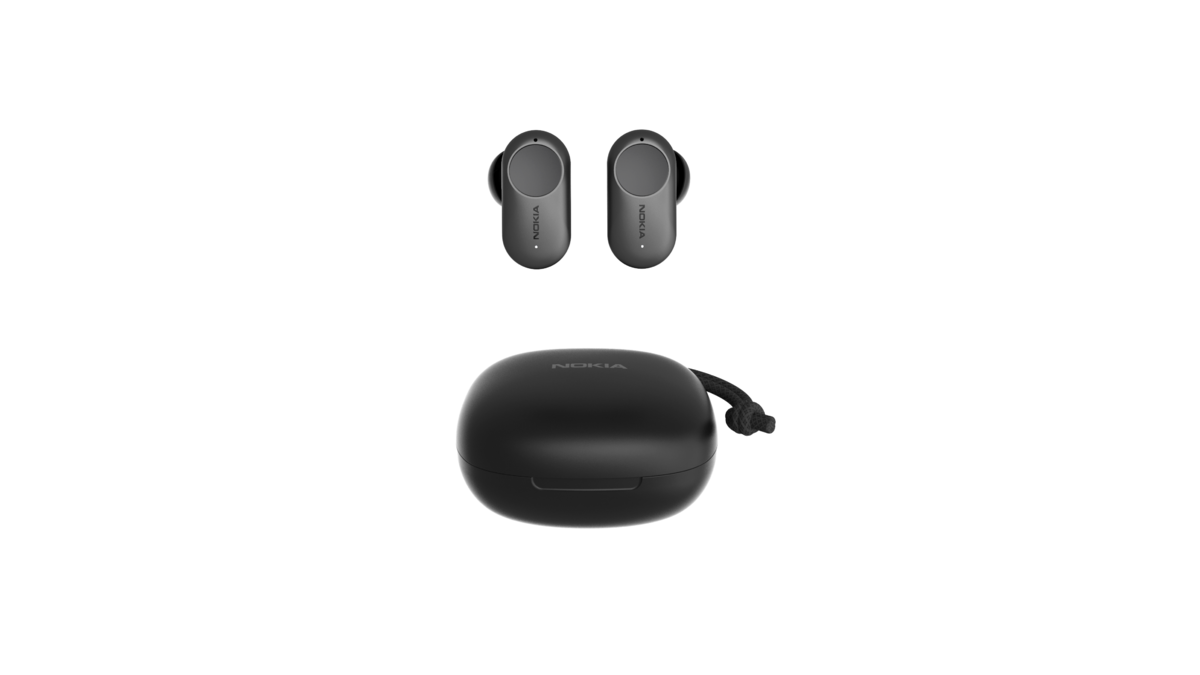
Nokia Pro True Wireless Earphones P3802A TWS earphones now available in China

Earlier this year, Nokia confirmed its licensing deal with the Chinese company RichGo and as a part of that, the company will be launching Nokia-branded earphones in the market. After launching a few such devices in China, the company has now launched a new earphone — Nokia Pro True Wireless Earphones or Nokia P3802A.

Nokia Pro True Wireless Earphones P3802A

It seems that the device is the same as the original model and the only difference seems to be the support for the Active Noise Cancellation feature. The device is now available for purchase in China for a price of 499 yuan, which is roughly $75.

The product features six microphone system that is claimed to enhance voice clarity while eliminating unwanted background noise for crystal clear calls. The Active Noise Cancellation feature is apparently powered by AI.

EDITOR’S PICK: Best ANC Earbuds Comparison — Xiaomi Air 2 Pro vs Huawei Freebuds Pro vs OPPO Enco X vs Airpods Pro

It packs a 12.5mm dynamic driver that enhances bass notes while the composite diaphragm delivers more detailed sound. This offers clear yet balanced audio that performs at any volume for an immersive listening experience.

There’s also support for voice commands to trigger applications like Google Assistant and Siri, which can be sued to get directions, check calendars, or even make a phone call without needing to take the device out of the pocket.

The Nokia P3802A earphones have an IPX5 rating, making them dust and sweatproof. They are powered by a 720mAh battery that the company promises can offer 35 hours of music playback on a single charge.


BOE launches a 55-inch ultra-high-definition active Quantum Dot display

Chinese display maker BOE technology has achieved yet another milestone in LCD technology with the unveiling of a 55-inch 4K active-matrix Quantum Dot light-emitting diode (AMQLED) display. Officially, this is another major progress in the field of BOE electroluminescent quantum dots.BOE display

According to the official introduction (via), the 55-inch 4K AMQLED display product launched by BOE this time adopts electroluminescent quantum dot technology and has a resolution of 3840×2160 pixels, a colour gamut of up to 119% NTSC, and a contrast ratio of 1000000:1, which is broad in the field of large-size displays.

At present, the applications of Quantum Dot technology in display products mainly include photoluminescence Quantum Dot backlight technology and active electroluminescence quantum dot diode technology (AMQLED). Different from the photoluminescence quantum dot backlight technology, AMQLED displays do not need a backlight, and the quantum dots can emit light by injecting current. It has the advantages of self-luminescence, wide colour gamut, and long life, which has become the development direction of quantum dot displays.

In case you don’t know, quantum-dot televisions are a new type of LED-backlit LCD TV. The image is created just like it is on an LCD screen, but quantum-dot technology enhances the colour. The backlight system on an LCD TV is a bank of LEDs mounted at the edge of the screen or immediately behind it. That light is diffused, directed by a light-guide plate and beamed through a polarizing filter. The photons then hit a layer of liquid crystals that either blocks the light or allow it to pass through a second polarized filter.

The light passes through a layer of before it meets the second polarizer, light passes through a layer of red, blue, and green (and sometimes yellow) colour filters. These are the subpixels. Electrical charges applied to the subpixels moderate the blend of coloured light visible on the other side. This light cocktail creates the colour value of each pixel on the screen.

UP NEXT: Xiaomi XiaoAI Speaker Art Battery Edition launched for 399 yuan ($59)


Vivo Y51 (2020) bags certifications in Indonesia and India

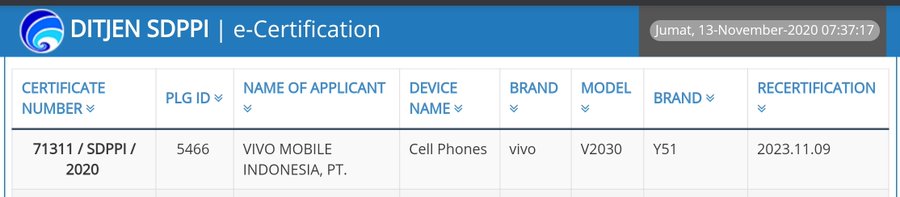
A tipster has revealed that the Vivo Y51 smartphone that has a model number of V2030 has received SDPPI certification in Indonesia. The Bureau of Indian Standards (BIS) has also approved the device. Hence, it is likely that the Vivo Y51 will break cover soon in Indonesia and India.

Vivo Y51 SDPPI certified

The SDPPI and BIS certifications have not revealed any information on the specifications of the Vivo Y51. This Y-series phone does not seem to be an entirely new device since it has already gone official in Pakistan in September.

Vivo Y51 BIS certified

Vivo Y51 (2020) specifications and price

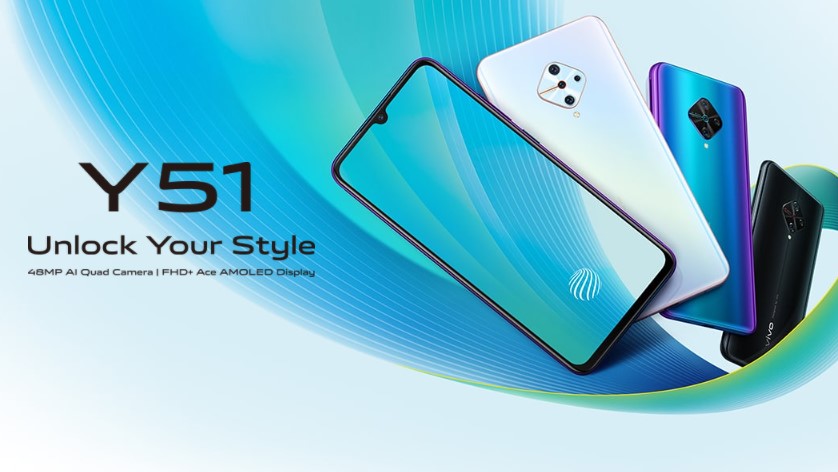
The Vivo Y51 (2020) that debuted in Pakistan features a 6.38-inch AMOLED display that produces a Full HD+ resolution of 10880 x 2340 pixels. The screen of the device is integrated with a fingerprint reader.

The Vivo Y51 (2020) receives power to perform from the Snapdragon 665 mobile platform. The device arrived in Pakistan with 4 GB of RAM and 128 GB of storage. It features a microSD card slot for more storage. The handset comes with a FunTouch OS based Android 10 OS.

Vivo Y51 (2020) featured

The handset is backed by a 4,500mAh battery that is coupled with 18W dual-engine fasts charging technology through USB-C. It has a front camera of 16-megapixel and a 48-mgeapixel + 8-megapixel (ultrawide) + 2-megapixel (macro) + 2-megapixel (depth) quad camera setup. The handset possesses an impressive rhombus-shaped design for its quad rear cameras.

In terms of specs and design, it is like the Vivo S1 Pro that went official in India in January. The only differing features available on the S1 Pro include a 32-megapixel selfie camera and 8 GB of RAM. The rest of the specs of the Y51 (2020) are identical to the S1 Pro. In Pakistan, it is available with a price tag of PKR 36,999 (~$234; ~Rs 17,500).


Honor HJC-AN00 / TN00 specifications leak reveals it’s a rebadged Nova 8 SE

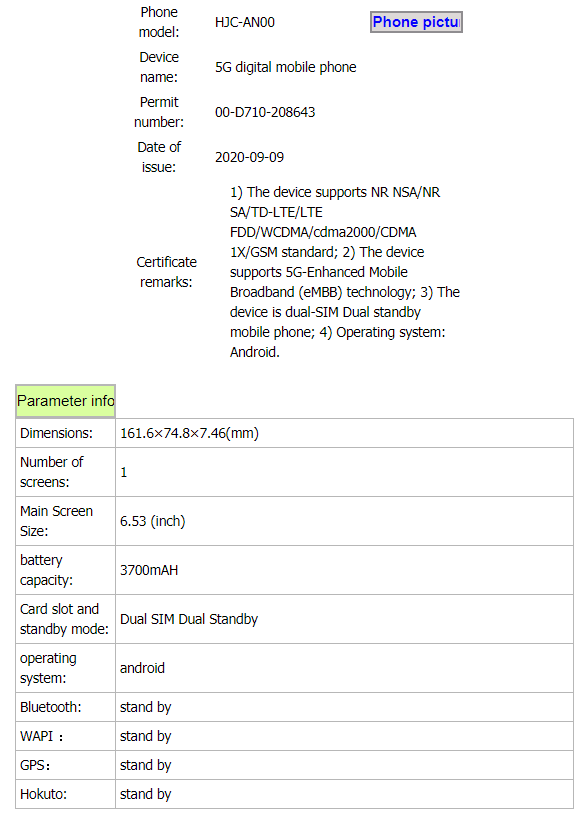
In September, two phones with model numbers JSC-AN00 / JSC-TN00 and HJC-AN00 / HJC-TN00 were spotted in the database of China’s TENAA telecom regulatory body. The JSC-AN00 / TN00 has already as the Huawei Nova 8 SE recently. The specifications of the HJC-AN00 / TN00 phone have been revealed today by a Chinese tipster. The leak reveals that it is an Honor branded phone and it will be arriving as a rebadged version of the Nova 8 SE.

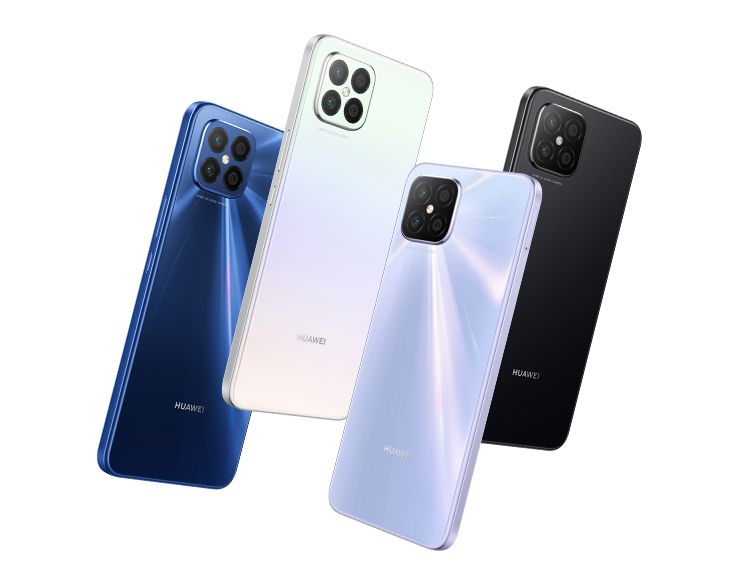
The Huawei Nova 8 SE is available in Standard and High versions. These models have identical specs, but they only differ in the chipset department. The Standard model has Dimensity 720, whereas the Dimensity 800U powers the top variant.

Huawei Nova 8 SE
Huawei Nova 8 SE

Coming to the Honor HJC-AN00 / TN00 specs leak, it reveals that the device has a 6.53-inch FHD+ OLED screen with a waterdrop notch. It has a 3,800mAh battery with 66W fast charging support. The Dimensity 800U chipset is present under the hood of the device.

The Honor HJC-AN00 / TN00 possesses a selfie camera of 16-megapixel and a 64-megapixel + 8-megapixel + 2-megapixel + 2-megapixel quad-camera setup on its back. The handset measures 7.46mm in thickness and it weighs 179 grams. It will be available in colors like Magic Night Black, Iceland Fantasy, Titanium Silver, and Emerald Blue.


Honor HJC-AN00, HJC-TN00 TENAA

The leaked specs reveal that the Honor HJC-AN00 / TN00 is nothing but a rebranded version of the Dimensity 800U variant of the Nova 8 SE. At present, there is no word on the actual product name of the Honor phone. The handset has appeared today in TENAA with a few specs as shown above. With TENAA certification in tow, the Honor phone is expected to break cover soon in China.