Advertisement

OnePlus Nord users can now sideload OnePlus Messages & OnePlus Contacts apps

OnePlus Nord is probably the most hyped smartphone of 2020 though it is just another mid-range 5G smartphone. That said, despite running OxygenOS 10 based on Android 10, it comes with Google’s own suite of apps for dialer, contacts, and messages. But now, interested users can install OnePlus’ first-party apps if they want to.
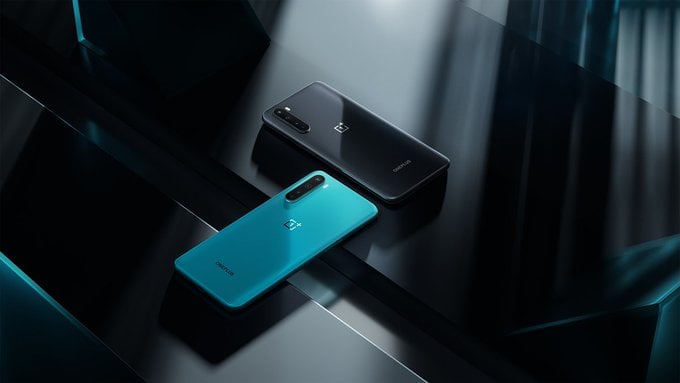
OnePlus Nord featured

The OnePlus Nord is the brand’s first-ever mid-range smartphone in years. But it isn’t the most affordable OnePlus handset as the company announced two more phones even cheaper than the Nord going by the names of OnePlus Nord N10 5G and OnePlus Nord N100.

Anyway, the other two phones are yet to hit the shelves. Hence, there’s nothing known about their software except for the fact that they run OxygenOS 10. On the other hand, the OnePlus Nord has been on sale in a number of countries for a while now.


Turns out some users don’t like the Google suite of apps. According to PiunikaWeb (via XDA Developers), with feedback from these users, OnePlus has finally updated the OnePlus Messages and OnePlus Contacts to support the OnePlus Nord.

Hence, if you are one of those users, you can download and install the latest version of these two OnePlus first-party applications on your Nord. Since these apps are not part of system apps on Nord, you cannot get it from the Play Store.

Therefore, you will have to download the APKs from APKMirror, a reputed website handled by Android Police. Further, for the OnePlus Messages to work, you will have to set it as the default messaging app. As for OnePlus Contacts, it currently buggy as it requires OnePlus Phone apps to work properly, which is yet to add support for the OnePlus Nord.

Download OnePlus Messages

Download OnePlus Contacts


HMD Global announces Nokia 8 V 5G UW; a Nokia 8.3 5G for Verizon

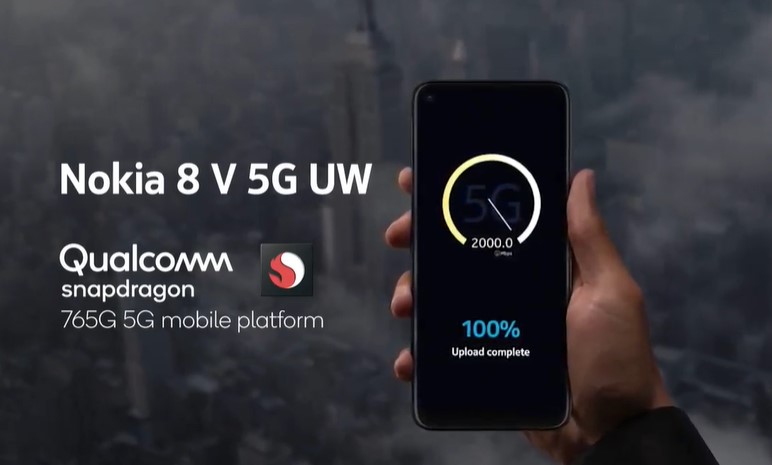
HMD Global had a launch event today in the US. The pre-recorded announcement was for the US-exclusive Nokia 8 V 5G UW, a smartphone designed to take advantage of Verizon’s mmWave 5G network.

Nokia 8 V 5G UW

The Nokia 8 V 5G UW (this is a mouthful) has a massive 6.81-inch FHD+ display with a hole punch at the top left corner and Gorilla Glass protection. It is powered by the Snapdragon 765G processor and comes with 6GB or 8GB of RAM and 64GB or 128GB of storage.

The phone packs four cameras on the back – a 64MP primary sensor, a 12MP ultrawide angle camera, a 2MP macro lens, and a 2MP depth sensor. Nokia says it uses PureView imaging system and ZEISS optics for both the rear cameras and 24MP front-facing camera.

Nokia 8 V 5G UW processor

The Nokia 8 V 5G UW also has a side-mounted fingerprint scanner, a dedicated Google Assistant button that is also programmable, NFC, Bluetooth 5.0, an audio jack, OZO audio, and a 4500mAh battery with support for 18W fast charging. It runs Android 10 out of the box but is said to be Android 11 ready.

Does the spec sheet sound familiar? Yes, it does, as this is just the Nokia 8.3 5G with support for Verizon’s mmWave bands n61 and n260. This is a big deal for HMD global as it is the first Nokia flagship on Verizon Postpaid in more than six years.

The phone comes in a single color variant – Meteor Gray – and is priced at $699. However, it is not stated if that is the price of the 6GB RAM or 8GB RAM version. The Nokia 8.3 5G with 8GB of RAM and 128GB storage is also priced at $699.


Xiaomi Mi 10T Lite certified by Thailand’s NBTC, Asian launch imminent?

Xiaomi first launched the Mi 10T Lite and Mi 10T Lite Pro in Europe on September 30. The models were recently put up for sale in the UK. The Mi 10T Lite is also expected to be launched in India soon. Apparently, India isn’t the only market the models are expected to launch. The Mi 10T Lite has been certified by NBTC in Thailand. The certification is an indication that the model will hit other Asian markets as well.

Xiaomi is expected to launch the Redmi Note 9 High-end version as a rebadged Mi 10T Lite in China going by recent leaks. Outside China, we now expect the Mi 10T Lite in other markets.

as a reminder, the Mi 10T Lite features a 6.67-inch LCD with an adaptive refresh rate of 120Hz which can also be reduced down to 30Hz. The display comes with an FHD+ resolution of 1080p+, an aspect ratio of 20:9 and is covered with a layer of Corning’s Gorilla Glass 5.

The display is HDR10-certified and has 450 nits of brightness and equally promises 84% NTSC colour coverage. The phone is also armed with dual speakers and a Hi-Res Audio certification.

For photography, the Mi 10T Lite packs a Quad-camera setup at the rear comprising a 64MP main camera with a 1/1.7-inch sensor. There is also an 8MP ultrawide camera as well as a 2MP macro cam and 2MP depth sensor. At the front, the phone packs a 16MP selfie camera is inside a centrally placed punch hole.

Xiaomi Mi 10T Lite
Xiaomi Mi 10T Lite

As stated earlier, the Mi 10T Lite is the first phone to be powered by the new Snapdragon 750G chipset. The chipset is built on the 8nm silicon wafer and has a built-in 5G modem. It offers sub-6 connectivity along with a slight performance boost over the S730G (+20% CPU performance, +10% GPU). The processor is paired with 6GB of RAM while there is the option of 64GB storage and 128GB storage.

Under the hood, there is a 4,820mAh battery with 33W fast charger.


Xiaomi launches the MIJIA Supercharged Steam Garment Ironing Machine

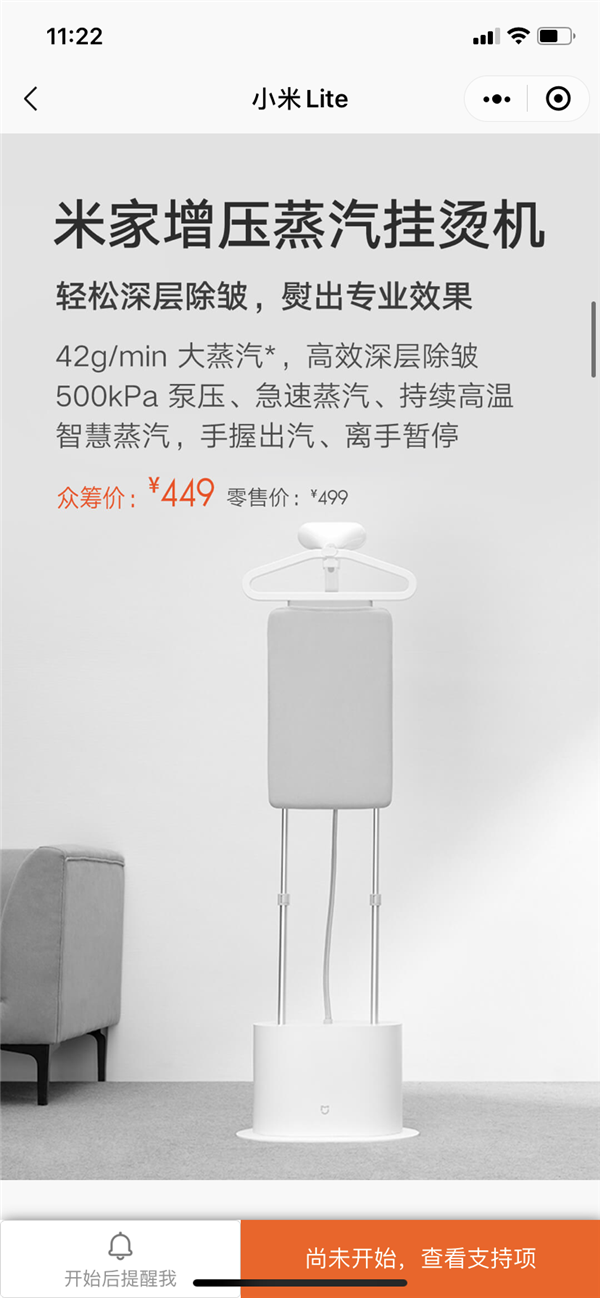
Xiaomi has officially launched a new innovative product under crowdfunding on Xiaomi Mall which would go on sale during the 11.11 shopping festival. The product dubbed MIJIA Pressurized Steam Garment Ironing Machine will retail for 499 yuan (~$75) which is pretty affordable.

The MIJIA Pressurized Steam Garment Ironing Machine uses a pump pressure of up to 500kPa to generate high-pressure steam to avoid the sudden increase and decrease of the steam. The strong penetrating power reaches the depth of the fibre due to the large steam volume of 42g/min that can quickly soften the fibre and smoothen deep wrinkles.

The entire machine has a high power of 2200W which enables the iron to quickly atomize the moisture into full steam. The steam iron has an average temperature is 135°C. Xiaomi claims the iron is easy to use without any professional skills.MIJIA Supercharged Steam Garment Ironing Machine

For ease of use, the MIJIA Steam Iron Machine is equipped with an integrated adjustable ironing board, 0-90° stepless adjustment, making it easy to flat iron long clothes without squatting, and diagonally iron pants without clips.

It is also equipped with a 2L water tank which makes it possible to continuously use it for more than 40 minutes at a stretch when filled with water. It can iron 18 tops or 15 pants, continuously full steam, and has a built-in water shortage protection function. In addition, the water inlet is equipped with a water temperature detection sensor and an intelligent dynamic water inlet speed, which can achieve high-temperature stability of steam regardless of winter or summer.MIJIA Supercharged Steam Garment Ironing Machine

When you leave the sensing area when using it, the garment steamer will automatically pause the steam output. When the handle sensing area is held again, the steam output resumes. Also, after a pause of more than 30 minutes, the garment steamer will automatically shut down.

UP NEXT: Xiaomi XiaoAI Speaker Art Battery Edition launched for 399 yuan ($59)


Amazfit GTS 2 Mini spotted at the FCC; looks like the Amazfit Bip

Huami recently took the wraps off the global version of the Amazfit GTR 2 and Amazfit GTS 2 smartwatches. So far, the Chinese manufacturer has launched nothing less than 6 smartwatches this year but it doesn’t seem to be done yet. A listing on the FCC website has revealed there is a new smartwatch coming called the Amazfit GTS 2 Mini.

The original Amzaift GTS didn’t have a mini version or lite version but the Amazfit GTR had a lite version that didn’t have built-in GPS. It seems this year, Huami is taking a different path by launching a more affordable version of the square-face GTS 2.

Amazfit GTS 2 Mini

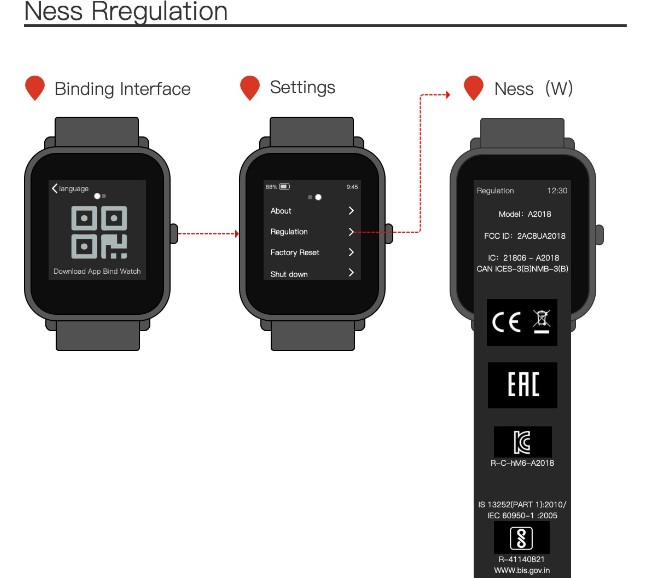
The FCC documents reveal the model number of the watch is A2018 and the included diagrams of the upcoming smartwatch show the watch’s design is similar to that of the Amazfit Bip. The watch has thick bezels around the display and a single button on the left side of the frame. The frame itself has rounded corners and is attached to straps that are most likely 20mm in size.

There is still a lot we do not know about the watch but we believe more details will surface in the coming weeks. There is also no news yet as to when the watch will be announced but we believe it will launch this year.


realme X7 series might be the only Dimensity-Powered devices for India this year

realme CEO Madhav Sheth has already hinted at the arrival of the realme X7 series smartphones to India. Following it, the X7 Pro 5G has hit India’s BIS certification along with others like NBTC, NCC hinting at a Global launch. Now, Anku Jain, MD, MediaTek India, hints that the X7 series might be the only Dimensity SoC Powered devices for India in 2020.

Realme X7 and Realme X7 Pro
Realme X7 (left) and Realme X7 Pro (right)

Anku Jain has given an exclusive interview to TechRadar. In that, he has brushed upon topics like MediaTek’s evolution, Dimensity SoCs, the future of 5G in India, and more. Regarding Dimensity SoCs, he says that the company is getting very good traction in China. This is evident with its staggering 61.2% YoY surge in September revenue report.

However, the Dimensity SoCs haven’t managed to break the barriers elsewhere. The company only recently announced the MediaTek Dimensity 1000C 5G SoC in the United States. Besides, Anku Jain notes that the company requires OEM partners’ support for Dimensity SoCs to flourish in countries like India. The reason for the delay of Dimensity SoCs is reportedly due to the delay in 5G rollout, perception of the companies, and their outlook on the market.


That said, regarding the Dimensity partnerships, he says the company is working with a lot of partners. And expects to see few phones before 2020 ends. In fact, when asked about the realme X7 Pro topic, he has hinted at a few things here. He expects the company’s existing 4G partners like Xiaomi, Vivo, Oppo. And realme to launch the devices soon.

However, when asked if we would see other brands bring Dimensity SoCs this year, he hints that it might happen only in 2021. This suggests that the realme X7 series, if they launch as expected in December, will be the only smartphones in India with Dimensity SoC this year. Accordingly, realme X7 5G features Dimensity 800U SoC while the X7 Pro 5G has Dimensity 1000+. Anyway, it looks like realme is going to pull the trigger for the wave of Dimensity-powered devices in India.

Samsung is now the US’ largest smartphone brand after 3 years

Various research firms have been releasing their reports on key smartphone markets in the past few days. Earlier today, Strategy Analytics published a report on the US Smartphone Market for Q3 2020. According to that., Samsung beat its archrival Apple for the first time in three years to become the country’s largest smartphone maker.

Samsung Logo Blue Featured

As per the report, Samsung captured the first position in the US Smartphone Market in the third quarter of 2020 with a 33.7% share. Whereas, Apple came second with a 30.2% market share, followed by LG in the third place with a 14.7% share.

The report says that Samsung’s market share grew 6.7% YoY. The company achieved this feat with the help of its budget and mid-range devices, in addition to flagship models like Galaxy Note20 and Galaxy Z Fold2.

Above all, Apple’s delayed iPhone 12 series launch further helped the South Korean tech giant to become the US’s largest smartphone brand after 3 years. Samsung was in this position back in Q2 2017.

That’s not all, Samsung was also the world’s largest smartphone brand in the last quarter. That said, the company’s market share may drop in this quarter in the US as the iPhone 12 series is expected to sell exceptionally well despite the economic crisis caused by the COVID-19 pandemic.


Galaxy S21 Ultra could be the first Samsung device to support 120Hz at QHD+ resolution

Samsung is gearing up to be the frontrunner of launching Flagship Smartphones in 2021. The company’s next S series of flagships, touted to be the Galaxy S21 series will have three smartphones. Amongst them, the Galaxy S21 Ultra(Tentative) is now tipped to sport a 120Hz refresh rate screen.

Galaxy S21 Ultra
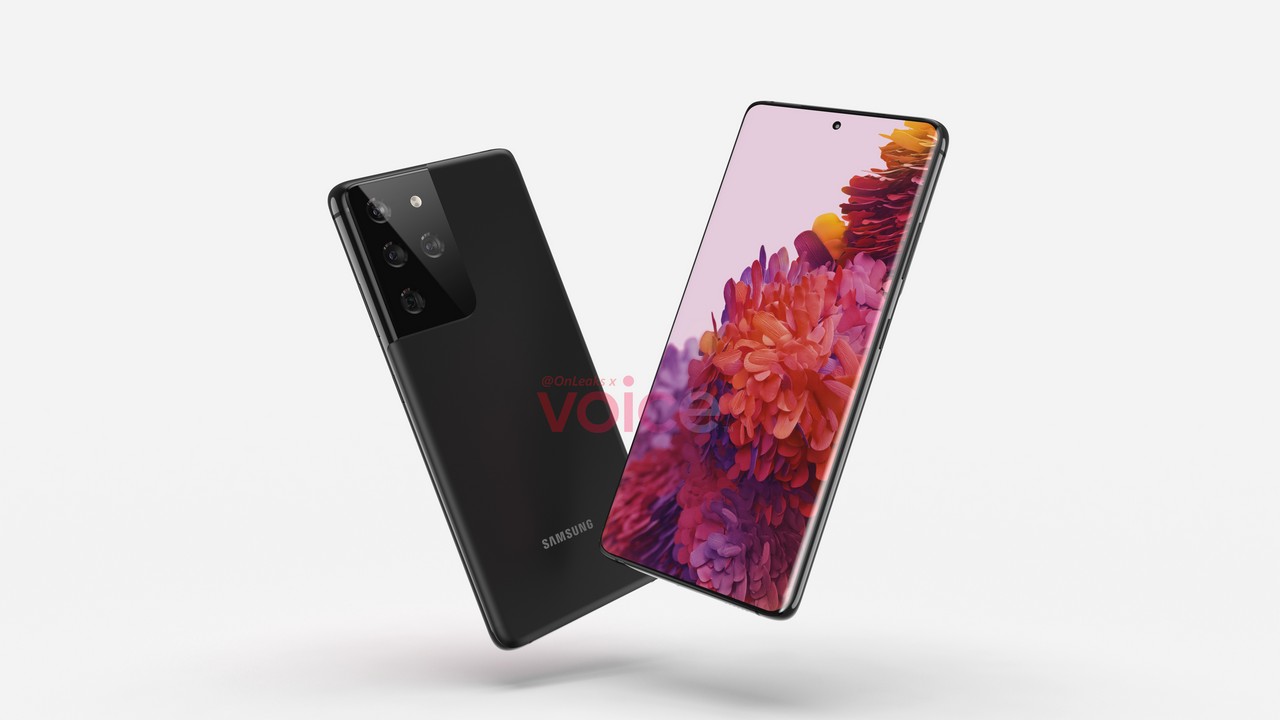
Galaxy S21 Ultra render

The new tip comes from a well-known Ice Universe who says(via Sammobile) that Galaxy S21 Ultra will have a display up to 2K resolution. For the unware, 2K is between 1080p and 4K. Depending on the size of the display panel, it can be up to 1440×3088 pixels. Plus, the tweet reads, “2K+120Hz”. This could mean that the display will support 120Hz at 2K resolution. If this is true, then it will be the first of its kind for a Samsung device.

First-ever Samsung to sport 120Hz at 2K?

This is because Samsung’s flagships or any other devices, albeit having a 120Hz refresh rate screen, don’t support it on the highest resolution. In fact, if you select 120Hz as a refresh rate on Samsung, you are basically downscaled and locked to FHD+(1080p) resolution. And its latest flagships like Galaxy Note 20 Ultra is no exception to this. The best Samsung has done so far, is having an “Adaptive Mode” on devices like the Note 20 Ultra.

This basically toggles(60Hz or 120Hz) the refresh rate based on what you do. This is probably to help the panel, and battery last longer. However, with Galaxy S21 Ultra, it looks like Samsung is going to break the barriers. If the tip is true, the next flagship could have an option to lock the 120Hz at 2K resolution which is a first in any phone.

Galaxy S21 Ultra: Specifications(Expected)

The Galaxy S21 series, as a whole, will reportedly enter production by mid-December. However, a tip says that the part production of Galaxy S21 Ultra like DVT/PVT might have already begun. Anyway, the device(SM-G998U), which has already got NFC certification, will likely sport a 6.8-inch display with a centered punch-hole.

Besides, leaked specifications of the device say the display will be dynamic AMOLED. For cameras, we can expect a new 108MP 0.8µm HM3 primary sensor, laser autofocus, and no ToF sensor inside the quad/Penta camera setup. Other expected specifications include a 40MP selfie shooter, Qualcomm Snapdragon 875/Exynos 2100 SoC based on regions, 5,000mAh battery with 60W charging, Android 11, and more. It is expected to launch on January 14 and open for sale by January 29.

Panasonic builds vacuum to rescue earbuds like AirPods from Train Tracks

With technology becoming more compact and expensive, replacing lost items like an expensive TWS earbuds could be quite the financial burden for some. Luckily, Panasonic has built a new vacuum device that is designed to rescue such small gadgets from train tracks in Japan.

Panasonic

The known consumer grade electronics maker has developed a new device with the help of Japan’s JR East rail group to recover small cordless devices like AirPods, as per an Engadget report. Usually, the rail authorities utilize a mechanical grabber to recover lost objects or other things that might have fallen on train tracks. But unfortunately, this only works well with items like shoes or other relatively large products. Small gadgets like truly wireless earbuds are too small to be picked up, as they can even get stuck in between gravel.

This is where the new Panasonic vacuum comes in handy, as it features finger sized tubes that can pick the earbuds up through suction. After picking them up, the suction also holds the device in place long enough to be recovered by the authorities. Apparently, the need for such a device was required since JR East had reported over 950 incidents of earbuds being dropped in 78 stations between the period of July and September 2020 alone.

AirPods Pro case

Thus, the new gadget arrives to reduce the “burdensome” task, as per workers. The issue isn’t limited to only Japan as other nations like the US are also dealing with a similar issue, especially in regions like New York. It has become quite a big issue and “It happens all the time,” according to officials. This has also led to commuters making risky and dangerous situations like jumping off the platform and onto the tracks.


Latest OnePlus 8/8 Pro Open Beta update wipes user data

In late October, OnePlus released OxygenOS 11 Beta 3 for OnePlus 8 and OnePlus 8 Pro. Turns out the company mistakenly pushed OxygenOS 11.0.1.1 stable update to open beta users. This resulted in a factory reset for many users as changing the build channel wipes the entire phone. Anyway, the company quickly responded with a workaround on Saturday (November 7).

oneplus 8 pro featured

In case you are not aware, OnePlus has three OxygenOS release channels namely Closed Beta, Open Beta, and Stable. The brand releases two builds per month in the first channel and a single build in the other two channels.

Users can switch between Open Beta and Stable channel by downloading and installing the appropriate update file from OnePlus community. But this process wipes the entire phone.

Further, new OnePlus smartphones ship with “Automatic system updates” turned on in Developer options. Because of these two reasons, as the company wrongly pushed OxygenOS 11.0.1.1 stable build in the Open Beta channel, the units that got the update downloaded and installed it automatically.


Normally, once the update gets installed, users are prompted to reboot the phone. So when the affected users rebooted their device, they were surprised to see their phone booting with the setup screen.

These users quickly reported the issue on OnePlus Community and Oneplus released an APK as a workaround. In case you are using OnePlus 8 or OnePlus 8 Pro running the Open Beta build and the latest update got installed automatically, then you  need to download this APK, launch the app, and select “KEEP DATA”.

Once done, you can now reboot the phone without losing the data. As per OxygenUpdater (via Aamir Siddiqui of XDA), this application blocks the system from completing the entire installation process of the update.

That said, the company has now suspended the build from the OTA server. Anyway, if you happen to install it by mistake, make sure to follow the above steps to avoid losing your data.


China tech industry relieved by Biden’s win, but are still cautious

The tech industry in China has breathed a sigh of relief as Joe Biden won the US Presidency. This arrives as the previous President, Donald Trump, had been targetting the Chinese industry as a part of the US-China trade wards and political disputes.

China

According to a Reuters report, analysts have stated that the Chinese tech industry is hoping that Joe Biden would be more welcoming of a more constructive relationship and would de-escalate the rivalry between both nations. The four year long Trump term had been a major obstacle for numerous Chinese companies and had taught the importance of self reliance as well. Although, despite Biden winning, the nation still plans on focusing on its domestic tech capabilities, as per executives and analysts.

Fang Xingdong, director of the Consortium of Internet and Society at the Communication University of Zhejiang, stated that “When Biden takes office, tech companies in China might be relieved. At least, the United States is supposed to re-advocate openness, re-respect fair competition, and re-advocate innovation. However, in the high-tech field, competition and game theory will not end, and China and the U.S. will compete with each other with true innovation capabilities in the next decade.”

China

The position the new US President takes on the trade tensions between both nations remains to be seen. Furthermore, the impact of the new leadership on Huawei, ByteDance’s TikTok, or even WeChat is still unknown as well. So we will have to wait and see how Joe Biden handles the alleged security risk that these companies pose to the United States.


Apple supplier Pegatron put on probation over student workers

Earlier today (9th November 2020), Apple announced that it has put its Taiwanese supplier, Pegatron, on probation after the company was found violating its supplier code for employing student workers and asking them to work overtime and on night shifts.

Apple

According to a Reuters report, Pegatron had wrongly classified its student workers and even provided false paperwork to disguise its violations. This led to a breach in contract on multiple counts as well, as students were even working on cases that were not related to majors. For those unaware, the supplier is one of the handful of firms that the Cupertino based giant employs from Taiwan, which also dominates its supply chain.

An Apple spokesperson stated in a conference that “Several weeks ago, we discovered Pegatron – one of Apple’s suppliers in China – violated Apple’s Supplier Code of Conduct in its administration of a student work study programme.” It was further added that “Apple has placed Pegatron on probation and Pegatron will not receive any new business from Apple until they complete all of the corrective actions required.”

Apple

At the moment, the terms of the probation are unknown. Furthermore, an investigation from Apple has not found any evidence of forced or contracted labor of underaged individuals. Pegatron has since fired its executives that were directly involved with the oversight of the program and the minors have also been taken off production lines, and have also received “proper compensation.”


Chinese company patents a smartphone with an Octa camera setup

Smartphone manufacturers are constantly raising the bar and level of innovation with each passing year. A few years back smartphones only had a single camera. But in recent times, a triple and quad camera setup is all but common, especially in flagship models. Now, a Chinese company might be pushing the bar even higher as it patents a smartphone with 8 cameras on the rear.

smartphone

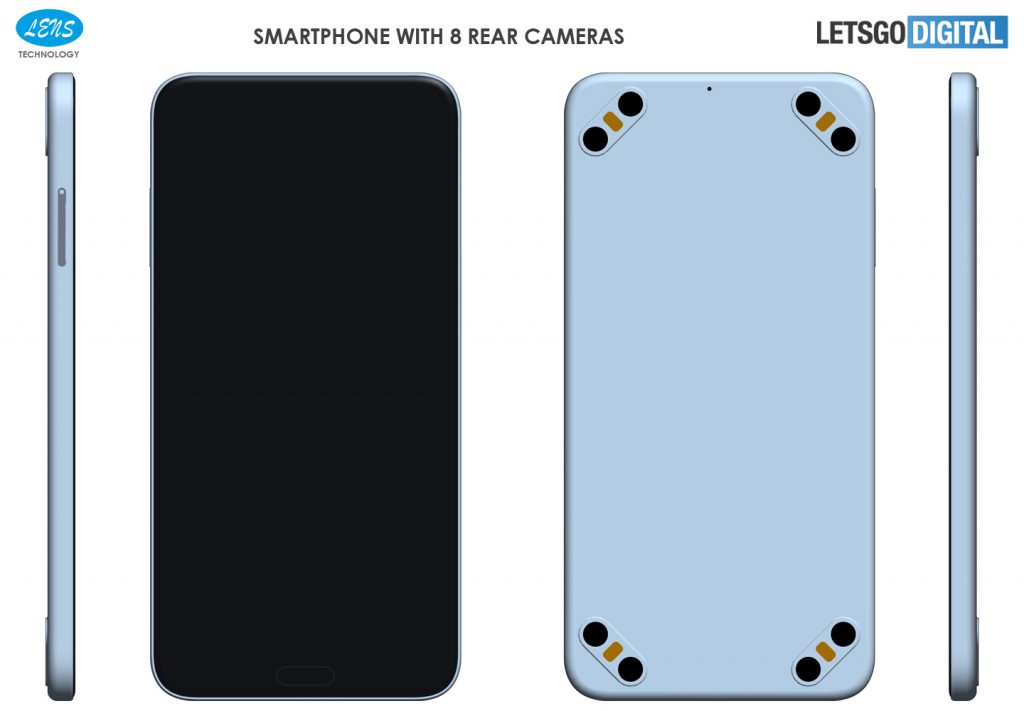
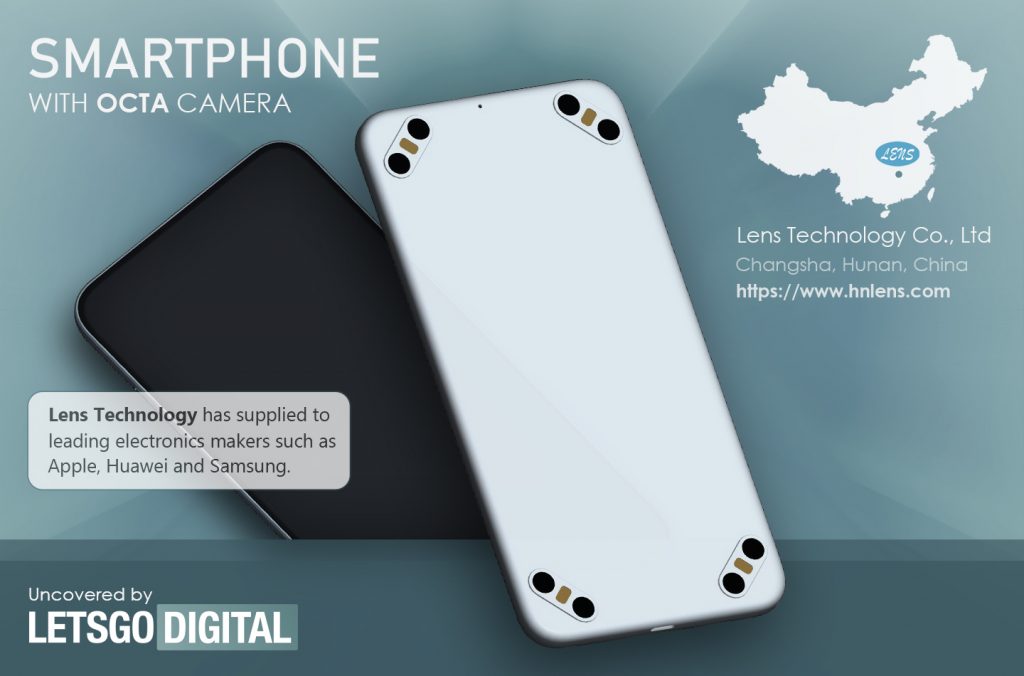
According to a LetsGoDigital report, a Chinese brand called Lens Technology recently filed a patent with the WIPO (World Intellectual Property Organization) for a device with an octa camera setup. For those unaware, Lens Technology is a brand not known for smartphones, but rather it supplies to other OEMs like Apple, Samsung, and Huawei. The company has also supplied the display for the Apple Watch.

Looking at the patent, the device in question looks quite futuristic, with a full body screen on the front, which also houses what appears to be a physical button, while no notch can be observed from the patented images. Arriving at its most notable aspect, the rear features a total of eight camera sensors, with two sensors on each corner of the smartphone. Furthermore, each of these pairs also houses an LED flash in between.

Smartphone

As its name suggests, Lens Technology also makes camera modules and lenses apart from just cover glass for touch displays. So, we might see a device with 8 cameras in the near future. Although, it would most likely be through another OEM that the company has partnered with. Unfortunately, it is still too early to confirm anything at the moment, so stay tuned for more updates.


Micromax IN Note 1, IN 1b pre-orders start from tomorrow in India

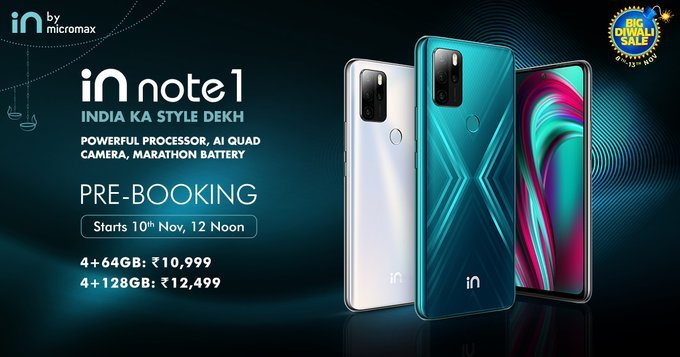
At the beginning of this month, Micromax announced its comeback to the Indian smartphone market by announcing the Micromax IN Note 1 and IN 1b phones. Both phones arrived with aggressively price tags and impressive specs. The IN Note 1 and IN 1b smartphones will be available for purchase later this month. Starting from tomorrow, Flipkart will be carrying out the pre-orders of both smartphones.

Micromax IN 1b pre-order

Flipkart will begin with the pre-orders of the Micromax IN Note 1 and IN 1B at 12 PM on Nov. 10. The IN Note 1 comes in two models such as 4GB RAM + 64GB storage and 4GB RAM + 128GB storage. They are priced at Rs 10,999 (~$148) and Rs 12,499 (~$169), respectively. On the other side, the IN 1b variants like 2 GB RAM + 32 GB storage and 4 GB RAM + 64 GB storage. They are priced at Rs 6,999 (~$94) and Rs 7,999 (~$108), respectively.

Micromax IN Note 1 pre-order

Micromax IN Note 1 and IN 1b specifications and features

The Micromax IN Note 1 has specs like a 6.67-inch IPS LCD FHD+ punch-hole display that offers a 21:9 aspect ratio. It has a 16-megapixel front camera and a 48-megapixel + 5-megapixel + 2-megapixel + 2-megapixel quad camera system. The Helio G85 chipset and a 5,000mAh battery powers the IN Note 1. It comes with support for 18W fast charging through USB-C.

The Micromax IN 1b is packed with specs such as a 6.52-inch IPS LCD HD+ display and a 20:9 aspect ratio. It has a front camera of 8-megapixel and a 12-megapixel + 2-megapixel dual-camera system. The Helio G35 SoC drives the device with a 5,000mAh battery.

The Micromax IN Note 1 and IN 1b comes loaded with a stock version of Android 10 OS. They are also equipped with a dedicated button for accessing Google Assistant. They also feature a rear-facing fingerprint scanner.


Vivo to double its local sourcing in India by 2021

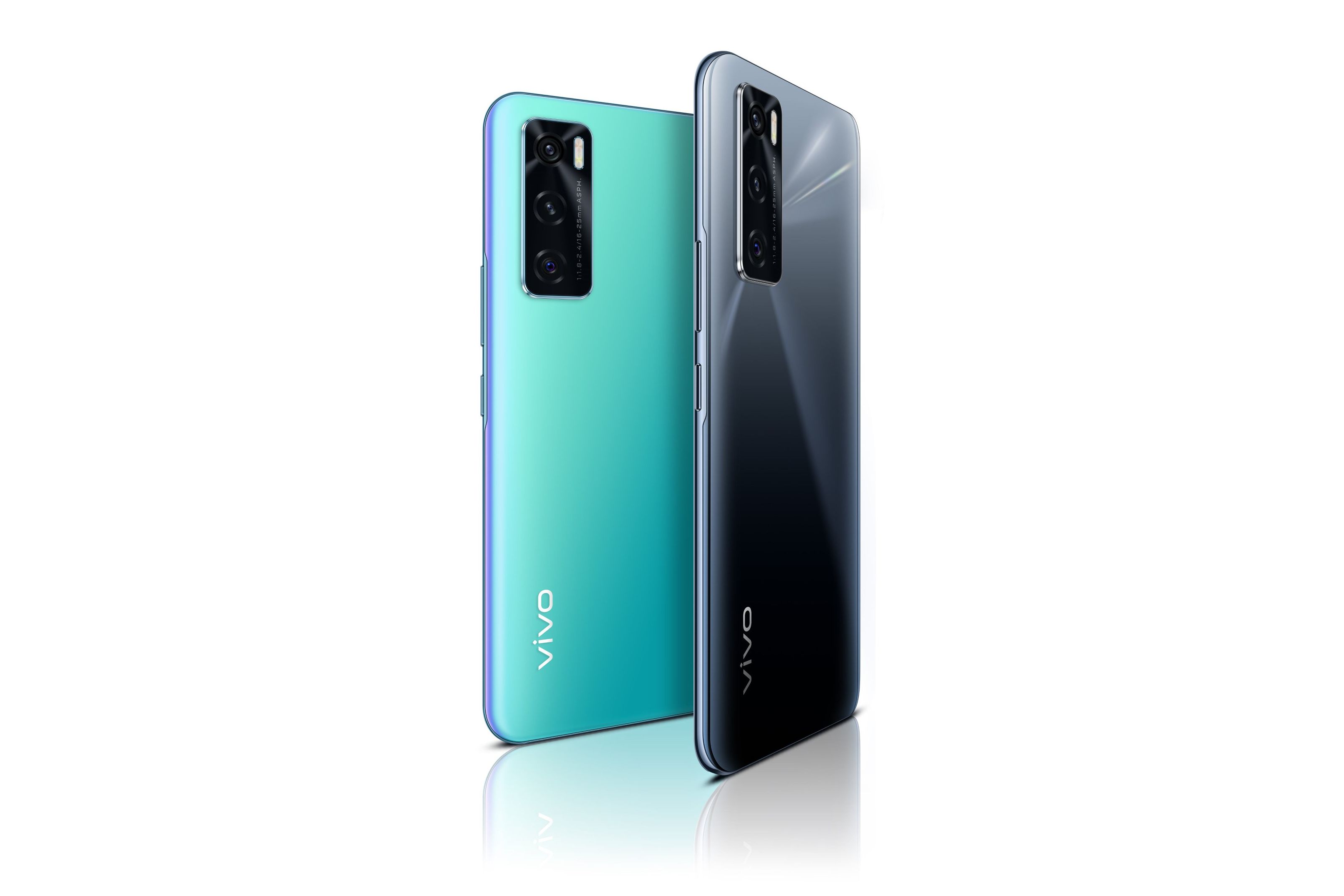
Chinese smartphone manufacturer, Vivo, is set to increase its local sourcing to about 40 percent for its production capacity in India by next year. The move will be a significant jump from its current sourcing that amounts to about 15 percent.

Vivo V20 SE
Vivo V20 SE

According to Nipun Marya, Director-Brand Strategy, Vivo India, “continuing our commitment to Make in India, Vivo will manufacture all the V20 SE devices at the Greater Noida facility that employs nearly 10,000. The company has an annual capacity to manufacture nearly 33 million mobile phones. All the phones sold in India are made in India.” At the moment, Vivo accounts for 28 percent of the market share by sales volumes in India, which also makes it the largest brand in the country in mainline retail.

Thus, the move to increase local sourcing would only seem more logical and beneficial for the company in the longer run. The senior executive further added that the state of Tamil Nadu, which accounts for 7 percent of overall smartphone sales in India, is one of its key markets in the region and also contributes about 8 percent of the company’s total revenue.

Vivo V20 SE color variants

The announcement arrived with the launch of the Vivo V20 SE in the state, where the company has over 4,000 retailers and 25 exclusive stores. Vivo is expecting to grow further in the market and is already “receiving great response from customers for our customer-centric innovations in design and camera.”


OxygenOS 11.0.1.1 for OnePlus 8/8 Pro brings Canvas feature & October 2020 security patch

At the end of October, OnePlus rolled out OxygenOS 11 Open Beta 3 for OnePlus 8 and Oneplus 8 Pro. Now, the duo is receiving a new update in the stable channel with build number OxygenOS 11.0.1.1. Unfortunately, though the update has been released in November, it comes with October 2020 security patch.

oneplus 8 pro

The new stable update for the OnePlus 8 series brings the Canvas feature that was introduced in the beta channel in late September. That’s not all, it also changes the quick settings to three lines. Other than these two additions, the latest system update brings a number of optimizations and fix for Bluetooth mute issues. 

These optimizations are for frame stability algorithm, adaptive brightness algorithm, background process management, 5G connectivity,  and WiFi connection.


That said, the new update comes with the following build numbers for all the regions.

  • OnePlus 8

    • IN –  11.0.1.1.IN21DA
    • EU – 11.0.1.1.IN21BA
    • NA – 11.0.1.1.IN21AA
  • OnePlus 8 Pro

    • IN –  11.0.1.1.IN11DA
    • EU – 11.0.1.1.IN11BA
    • NA – 11.0.1.1.IN11AA

OnePlus 8/8 Pro OxygenOS 11.0.1.1 Official Changelog

  • System
    • Optimized the frame stability algorithm to make the experience smoother
    • Optimized adaptive brightness algorithm, making 8,192 levels of automatic brightness adjustment more comfortable
    • Optimized background process management mechanism to improve standby-by performance
    • The quick setting has been adjusted to three lines
    • Updated Android Security Patch to 2020.10
    • Improved system stability
  • Ambient display
    • Newly added Canvas feature that can automatically draw a wireframe picture based on a lock screen photo on your phone(Path:Settings-Customization-Wallpaper-Canvas-Choose photo preview and it can be generated automatically
  • Network
    • Optimized the intelligent 5G function to extend battery endurance capacity
    • Optimized Wi-Fi connection to improve stability of connectivity
  • Bluetooth
    • Optimized Wi-Fi connection to reduce transfer delay
    • Fixed the low probability issue that it was muted after connecting to Bluetooth

The first update for the OnePlus 8 and OnePlus 8 Pro after the Android 11 update is currently being pushed in batches. It should reach every user in the coming days.


Samsung Galaxy Note 10 price in India slashed massively to Rs 45,000 (~$608) in offline markets

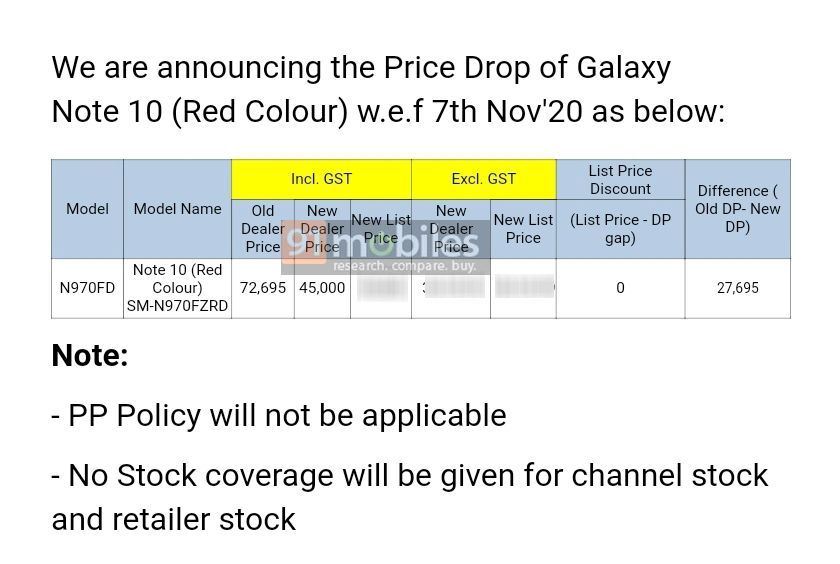
The Galaxy Note 20 series of stylus-totting flagship phones by Samsung was made official in August in various markets including India. The Note 20 and Note 20 Ultra arrived as successors to the Galaxy Note 10 and Galaxy Note 10+ phones from last year. Fresh information shared by 91mobiles reveals that Samsung has significantly slashed the price of the Note 10 in the offline markets in India.

Samsung Galaxy Note 10 price in India slashed

The Galaxy Note 10 was made official with a price tag of Rs 69,999 (~$945) for its sole 8 GB RAM + 256 GB storage trim. It is currently available on Samsung India’s website with a discounted price of Rs 57,100 (~$771). On Amazon India, it is currently listed for Rs 73,600 (~$994).

Samsung Galaxy Note 10 price cut

In offline markets, the Galaxy Note 10 has been available for Rs 72,695 (~$982). The publication reported that Note 10 has received a heft price cut of Rs 27,695 (~$374). Hence, the smartphone is now available at an irresistible price of Rs 45,000 (~$608) in the offline markets in India. The publication claims only the Aura Red, but also its other color variants are available with the revised pricing.

Samsung Galaxy Note 10 specifications and features

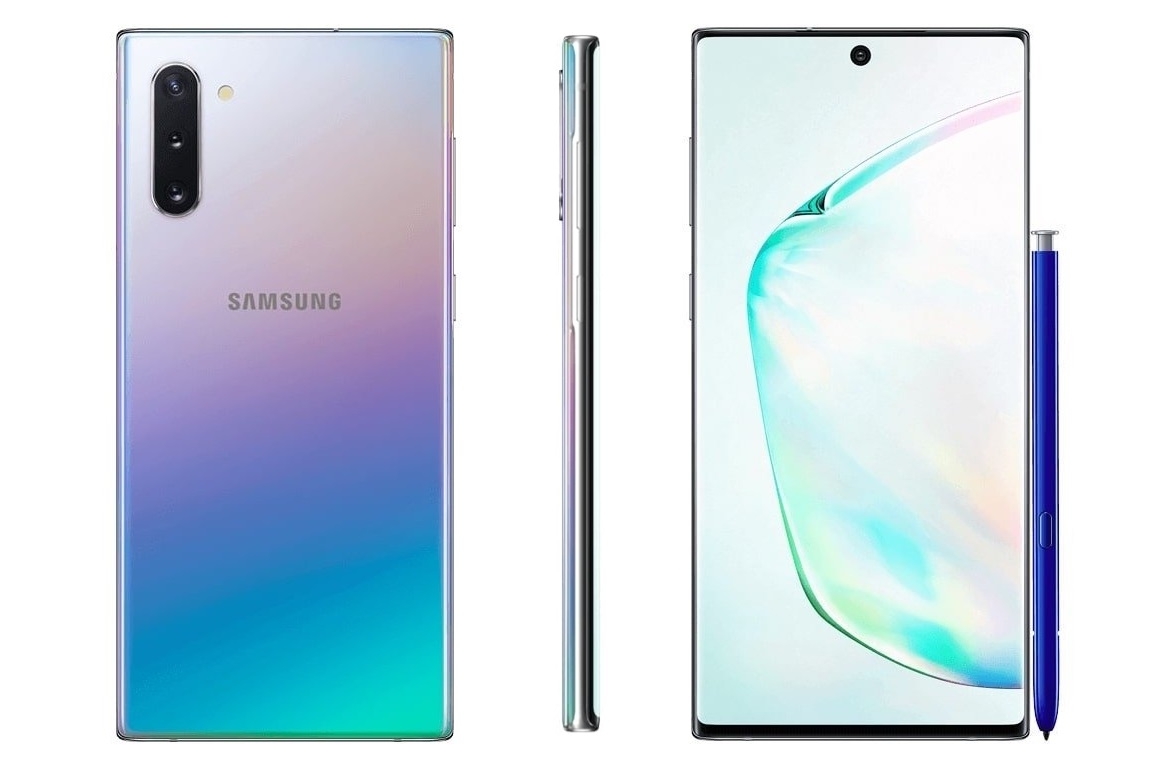
Samsung Galaxy Note 10

The Galaxy Note 10 has a 6.3-inch Dynamic AMOLED display that produces a 19:9 aspect ratio and a Full HD+ resolution of 1080 x 2280 pixels. The Exynos 9825 chipset is present under the hood of the device. It has a 10-megapixel front camera and a 12-megapixel + 12-megapixel (telephoto) + 16-megapixel (ultrawide) triple camera system. The phone comes with a 3,500mAh battery that supports 25W fast charging, 12W wireless charging, and 4.5W reverse wireless charging.


Huawei Mate 40 series repair charges announced, Get a case immediately

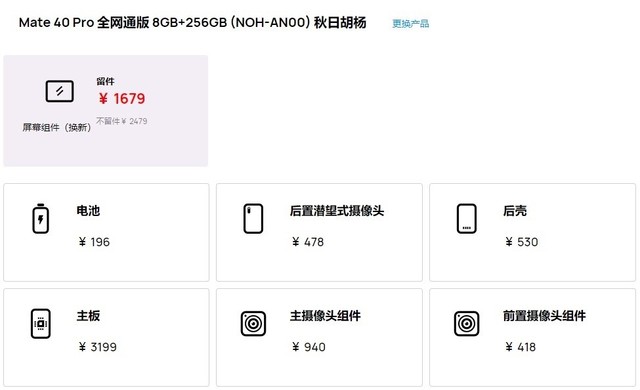
The Huawei Mate 40 series was recently announced and is positioned as the company’s current flagship lineup. Now, the Chinese tech giant has revealed the repair charges for the premium grade handset, which carries a price tag just as hefty as the smartphones.

Huawei

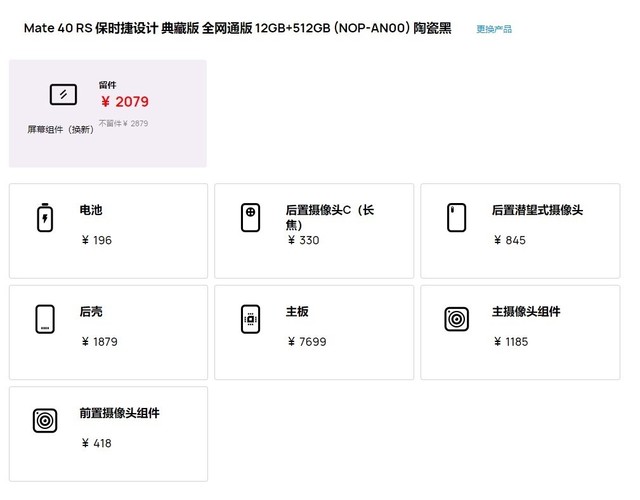
Looking at the prices, we can observe that the display and motherboard are by far one of the most expensive components of the device. For example, the motherboard for the Mate 40 RS Porsche Edition costs about 6,699 Yuan (roughly 1,020 US Dollars). Even the most affordable motherboard replacement costs about 3,199 Yuan (roughly 483 US Dollars) for the Mate 40 Pro.

Furthermore, the selfie shooter costs 418 Yuan (roughly 63 US Dollars) for repairs across the entire lineup. However, the rear camera setup costs vary between different variants, like the Mate 40 Pro (940 Yuan or 143 US Dollars) and Mate 40 Pro+ (1185 Yuan or 180 US Dollars). The battery is another aspect that remains the same between the Pro series and the RS Porsche Edition, costing just 196 Yuan (roughly 30 US Dollars).

Huawei

The prices for some of the components seem especially high, especially the Mate 40 RS Porsche Edition as its motherboard costs nearly half of its total 11,999 Yuan (roughly 1,814 US Dollars) price tag. So if you own a Mate 40 device, do be careful and consider grabbing a good case for your smartphone or you might end up shelving out a lot of money on repairs.


Redmi Note 9 Series tipped to start around 1000 yuan($151) in China

Xiaomi is gearing up to launch the Redmi Note 9 series of Smartphones in China. A Standard and High spec variant of the 5G devices are likely to break cover. Ahead of this, the pricing of the smartphones have now been tipped.

Redmi Note 9 Series China
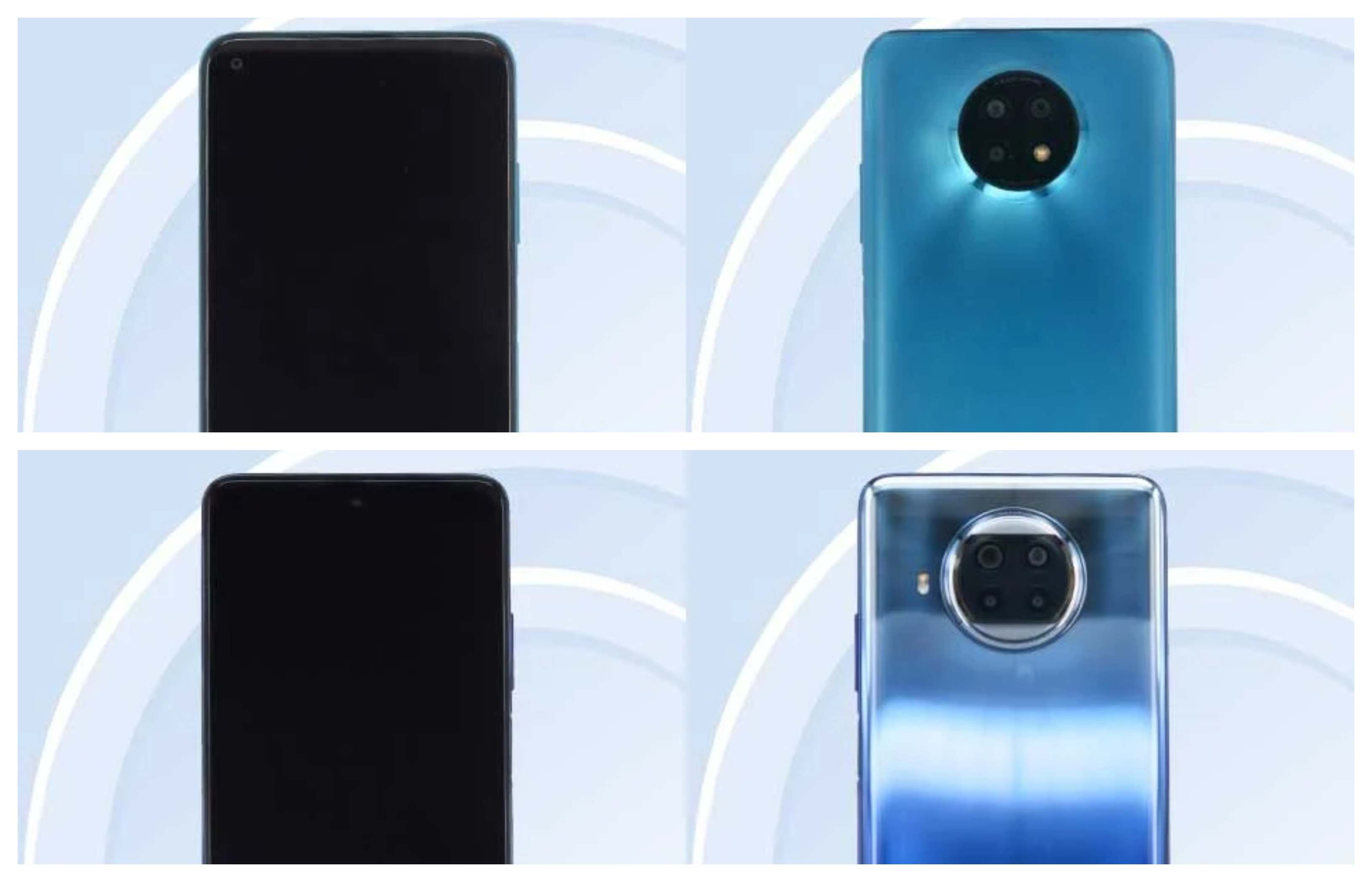
CC: TENAA Top: Redmi Note 9 Standard Edition Bottom: Redmi Note 9 High Edition

According to a post on Weibo(via Twitter), the Standard variant of the Redmi Note 9 5G will cost about 1000 yuan($151). And a higher version with a 108MP camera sensor will be around 1500 yuan($227). This pricing corroborates with an internal document leak that earlier said that Xiaomi will launch a 999 yuan 5G device towards the end of 2020.

Anyway, the report says the entire Note 9 series will support 5G connectivity which is obvious by now. Coincidentally, Redmi’s GM Lu Weibing has already teased its arrival. So, if the report is true, we might see the devices hitting the shelves as early as mid-November.

Besides, the Redmi Note 9 Series is expected to get a Standard, and a High Edition. That said, Xiaomi might just call it the Redmi Note 9, and Note 9 Pro 5G but we will have to wait for the confirmation. Anyway, the TENAA listings of the Redmi Note 9 series reveals key specifications of the device. Both the devices share similar features like a side-mounted fingerprint sensor, micro-SD card, and will likely run MIUI 12 based on Android 10.

Redmi Note 9 Series China Specifications

According to the listings, Redmi Note 9 Standard Edition will feature a MediaTek Dimensity 800U 5G SoC. It will likely have 4/6/8GB RAM and 64/128/256GB storage. For cameras, it will have a 48MP rear sensor and a 13MP selfie shooter. Plus, it will have a 6.53-inch LCD FHD+ display with a top-left punch-hole unlike the High Edition(centered punch-hole). Other Specifications include SA/NSA 5G, 5,000mAh battery with 22.5W charging support.

The High Edition(likely Redmi Note 9 Pro) of the 5G series will have Qualcomm Snapdragon 750G SoC. It is likely to be a rebrand of Xiaomi Mi 10T Lite 5G. Accordingly, the TENAA listing says that it will feature a 6.67-inch FHD+ LCD display. If it’s indeed a rebrand, we can expect the display to have a 120Hz refresh rate. It will boast 6/8/12GB RAM and 64/128/256GB storage.

Additionally, it will have a 4,720mAh battery with 33W fast charging support. Other specifications expected are 108MP Samsung HM2 rear sensor, 16MP front camera, and more.

Realme RMX2194 with Snapdragon 460 spotted at Geekbench

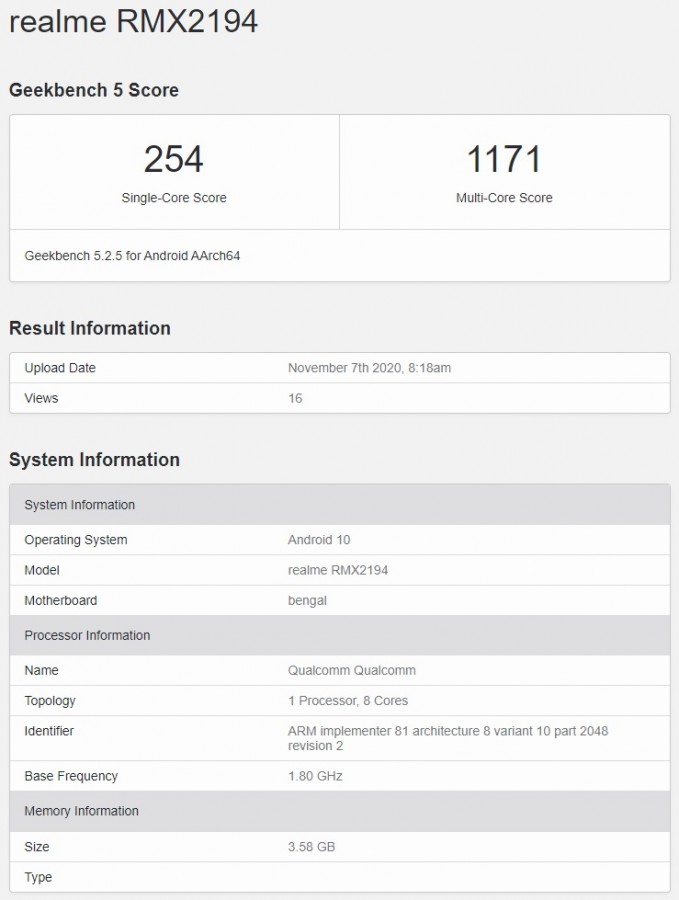
A new Realme phone with model number RMX2194 has surfaced on the Geekbench benchmarking platform. The handset seems to be a C-series smartphone. Also, the listing suggests that it could be powered by a Qualcomm chipset.

The Geekbench 5 appearance of the Realme RMX2194 reveals that it is powered by an octa-core processor by Qualcomm chipset. The base frequency of 1.80GHz and ‘bengal’ codename mentioned in the listing suggests that the device is powered by the Snapdragon 460 chipset.

Currently, Realme is selling two Qualcomm powered C-series smartphones such as the Realme C17 and the recently announced Realme C15 Qualcomm Edition (RMX2195 model number). The RMX2194 model number suggests that it could be a country of the Realme C15 Qualcomm Edition. It is advisable to wait for further reports to know the identity of the Realme RMX2194.

Realme RMX2194

The Realme RMX2194’s Geekbench listing has further revealed that it has 4 GB of RAM and Android 10 OS. On the benchmarking platform, the RMX2194 has scored 254 and 1171 points in the single-core and multi-core tests, respectively.

Realme C15 Qualcomm Edition specifications

The Realme C15 Qualcomm Edition has a 6.5-inch IPS LCD display that offers an HD+ resolution and a 20:9 aspect ratio. It is loaded with Android 10 OS and Realme UI 1.0. The Snapdragon 460 SoC powers the device with 3 GB / 4 GB of RAM. The phone comes with 32 GB / 64 GB / 128 GB storage and a microSD card slot.

The Realme C15 Qualcomm Edition has a front camera of 8-megapixel. Its rear is fitted with a 13-megapixel + 8-megapixel + 2-megapixel + 2-megapixel quad-camera system. It houses a 6,000mAh battery that supports 18W fast charging. It has a rear-mounted fingerprint reader.