Lenovo is apparently planning on launching a new laptop to boost its thin and light ultrabook portfolio. A recent video leak revealed the Yoga Slim 7i Carbon, which features an ultra thin design with the branding, “Whatever you have learned about laptops, unlearn them.”
According to a Neowin report, a Twitter leak from WalkingCat (@_h0x0d_) revealed that the laptop maker is launching a new ultrabook within its Yoga 7 series. While the Yoga 9 series is generally known for the premium high end models, the company is promising the new Yoga 7i Carbon to be “strikingly white”, “made of unyielding carbon”, “ultra-light”, “uncompromisingly durable”, “sleek”, and “with unmatched performance,” among other buzz words.
However, the teaser video leaked by WalkingCat shared no other details regarding the laptop. So, we do not have a lot of information to go on at the moment. Although, the laptop is likely to be a high end ultrabook, which would probably arrive with Intel’s latest 11th Gen Tiger Lake processors. But that is just speculation, so take this report with a pinch of salt. The only thing known about the laptop is its external design, ith dominant white accents. So, stay tuned for more updates, which are likely to arrive soon as a teaser video is indicative that Lenovo may soon unveil more details.
The big launch event that Realme held in India has marked the arrival of the Realme 7i smartphone in India. Alongside it, the company also announced the Realme 7 Pro SE (Special Edition) smartphone with the sun-kissed leather rear. The Realme 7i is a mid-range phone that comes with exciting features like a 90Hz refresh rate display, a 64-megapixel quad-camera system, and fast charging support. On the other side, the Realme 7 Pro SE comes with an attractive leather back.
Realme 7 Pro SE specifications and features
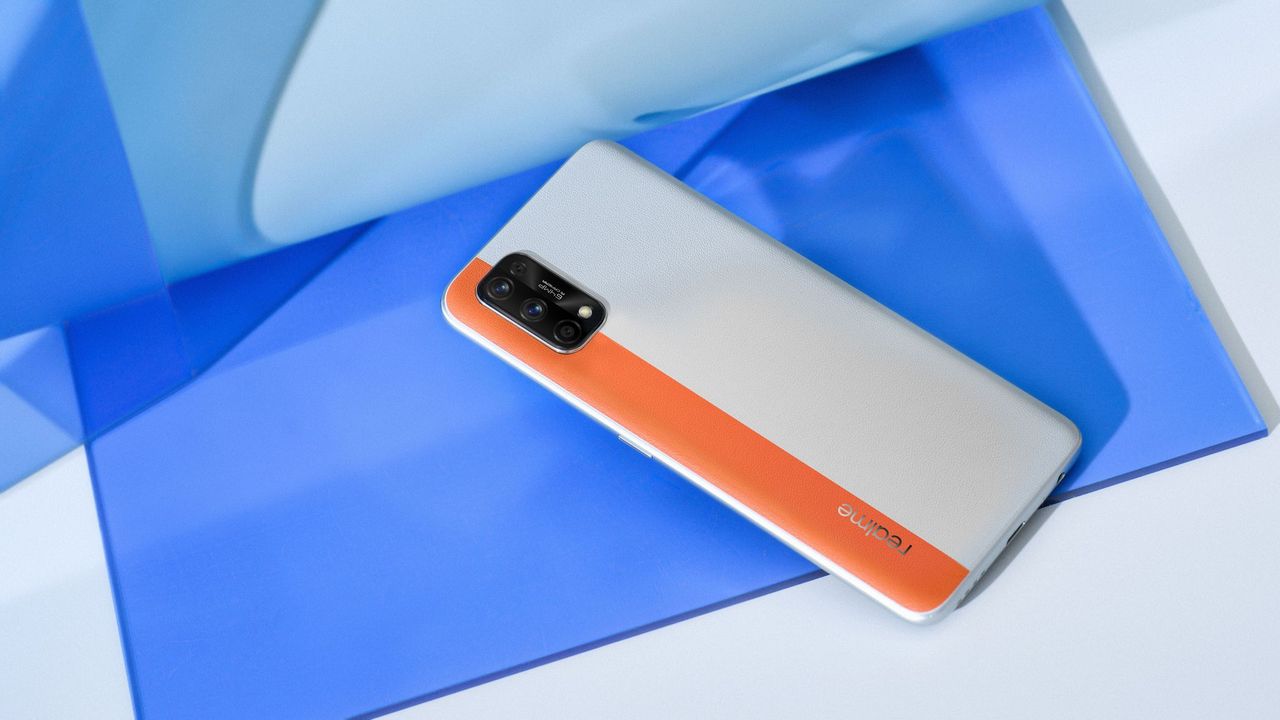
The Realme 7 Pro SE features a white-orange dual-tone rear that is made out of Vegan Multigrain Leather. The elegant and durable leather has a soft finish and it gives a premium look to the device. Its specs are identical to the Realme 7 Pro handset. Hence, the phone comes with a 6.4-inch S-AMOLED that supports full HD+ resolution and a 20:9 aspect ratio, The Snapdragon 720G chipset fuels the smartphone along with up to 8GB of LPDDR4x RAM and up to 128GB of UFS 2.1 native storage.
Realme 7 Pro SE
The Realme 7 Pro SE’s rear-facing camera system has a Sony IMX682 64-megapixel main shooter, an 8-megapixel ultrawide lens with f/1.8 aperture, a 2-megapixel macro camera with a focal length of 4cm, and a 2-megapixel depth sensor. The smartphone runs on Android 10 OS and Realme UI. The device is backed by a 4,500mAh battery and it comes with 65W SuperDart fast charging technology
Realme 7i specifications and features
The Realme 7i is a mid-range smartphone with polycarbonate construction. It flaunts a slightly large 6.5-inch IPS LCD screen. The punch-hole display produces 720 x 1600 pixels HD+ resolution and a 90Hz refresh rate. The Snapdragon 662 chipset fuels the device and it has a 5,000mAh battery with 18W fast charging support. It ships with 4 GB / 6GB of LPDDR4x RAM and 64 GB / 128 GB of UFS 2.1 storage.
Realme 7i in Fusion Blue and Fusion Green colors
The Realme 7 has a Sony IMX471 16-megapixel selfie shooter. Its back panel has a 64-megapixel (Samsung GW1) + 8-megapixel (119-degree ultrawide) + 2-megapixel (macro) + 2-megapixel (depth) quad-camera system.
The Realme 7i has a rear-facing fingerprint scanner. It has a microSD card slot for additional storage, and it is loaded with Realme UI based Android 10 OS. The phone is equipped with support dual SIM, 4G VoLTE, Wi-Fi 802.11ac, Bluetooth, GPS, USB-C, and a 3.5mm audio jack.
Realme 7i and Realme 7 Pro SE pricing and availability in India
The Realme 7 Pro SE comes in 6GB RAM + 128GB storage and 8GB RAM + 128GB storage variants. It is priced at Rs 19,999 (~$272) and Rs 21,999 (~$300), respectively.
The Realme 7i has come to India in two options. The 4 GB RAM + 64 GB storage version of the smartphone is priced at Rs 11,999 (~$163). The higher 6 GB RAM + 128 GB storage edition costs Rs 12,999 (~$177). The Realme 7i comes in two color variants like Fusion Blue and Fusion Green.
Customers who wish to purchase the Realme 7i and Realme 7 Pro SE smartphones can catch hold of the first sale at 12 AM on Oct. 16 through Flipkart and Realme.com.
Google has revealed several security-related features coming in Chrome 86, enhancing the security and usefulness of the Chrome mobile app. One of the highlights includes improved password security for Android as well as iOS application.
The feature has the capability of spotting compromised passwords within the list of saved passwords on Chrome, and then offer users advice on how to fix them. It will crosscheck saved credentials against a list of credentials that are known to be compromised.
For those who are concerned about privacy and security, the company says that usernames and passwords are sent to the company in a special form of encryption so that the company cannot get hold of the data.
If Chrome spots a compromised password, it will offer users an option to directly go to the “change password” form of the associated service or platform.
Another feature is Safety Check, which enables the manual check of compromised passwords, the status of Safe Browsing mode, and the version of the current Chrome app with details about the latest security protections.
For those who are using Chrome on iOS devices, it will now allow users to autofill saved login credentials into other apps and browsers. Users can also enable biometric authentication prompt before Chrome fills passwords, as an improved security feature.
Google will also rollout Enhanced Safe Browsing feature for Android users in which users will be able to choose to be proactively protected against phishing, malware, and other dangerous sites by sharing real-time data with the company’s Safe Browsing service.
At the Redmi Beat Drop virtual event, the sub-brand of Xiaomi launched two new audio products for India – Redmi SonicBass Wireless Earphones and Redmi Earbuds 2C. The former made its global debut last month in Nepal and the latter is nothing but a rebranded Redmi AirDots 2 that was unveiled in the month of July in China.
Redmi SonicBass Wireless Earphones Specifications & Features
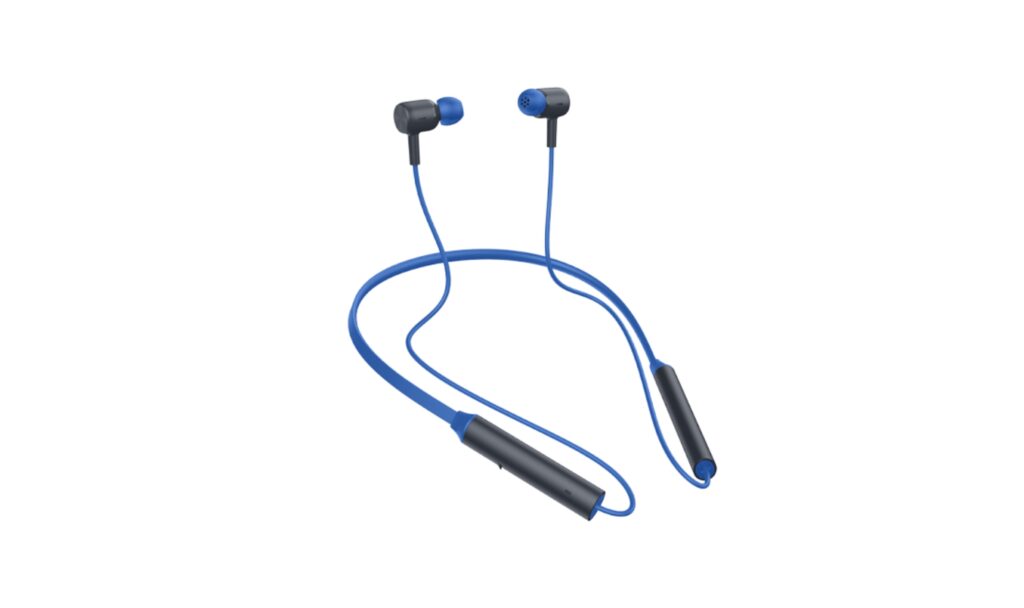
The Redmi SonicBass Wireless Earphones are the first the pair of neckband-style audio product from the brand. Also, it happens to be first earphones from the company to offer dual pairing support so that users can switch between two devices at ease.
It comes with 9.2mm drivers and dual-mic for ENC(Environmental Noise Cancellation). Further, the neckband is flexible, the buds are magnetic and the product as a whole weighs only 21.2g. As a bonus, it is also IPX4-certified for splash and sweat resistance.
Like any other neckband earphones in the market, this model also comes with an inline remote control to power on/off, accept/decline calls, play/pause music, mute/unmute calls, launch voice assistant, switch to phone during calls, and switch between two calls.
The Redmi SonicBass Wireless Earphones uses Bluetooth 5.0 connectivity with a maximum range of 10m and supports HFP, A2DP, HSP, and AVRCP Bluetooth profiles. The brand claims it to offer up to 12-hour battery life from its 0.44Whr battery that charges via MicroUSB port.
Last but not least, buyers can pick it up in either Black or Blue color variant.
Redmi Earbuds 2C Specifications & Features
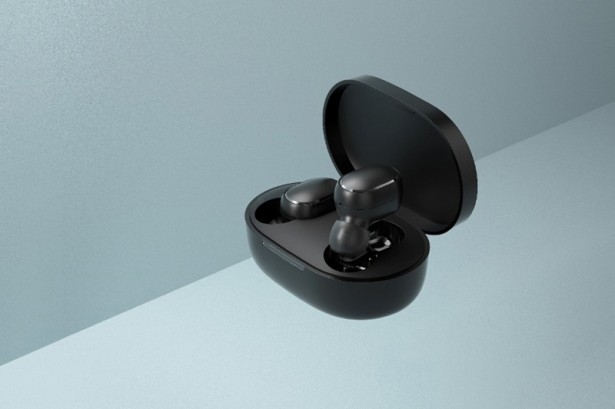
The newly launched Redmi Earbuds 2C is the second true wireless earphones from the brand for India. As we mentioned in the beginning, it is a rebadged Redmi AirDots 2 that debuted in the first half of 2020 in China. What’s more interesting it is identical to the previous model – Redmi Earbuds S (Redmi AirDots S) but still costs less.
Therefore, it features the same 7.2mm drivers and the old school buttons on either bud to play/pause music, accept/decline calls, access voice assistant, mute/unmute during calls, switch between two calls, and switch from earbuds to the device.
Just like the other model, it comes only in black color and is IPX4-certified was splash and sweat resistance. The buds weigh 4.1g each and house a 43mAh battery inside them to provide a maximum playback time of 4 hours. Whereas, with the charging case(300mAh) that charges via MicroUSB port, users can get up to 12-hour battery life, as per the brand.
Lastly, the Redmi Earbuds 2C connects with devices via Bluetooth 5.0 with a maximum range of 10m.
Redmi SonicBass Wireless Earphones/Redmi EarBuds 2C Price and Availability
The newly launched Redmi audio products in India can be yours for the following introductory prices.
Redmi SonicBass Wireless Earphones – ₹999 ($14)
Redmi Earbuds 2C – ₹1,299 ($18)
Both of them will be available to buy starting today (October 7) at 2PM from Mi.com and Mi Home. Further, the neckband can also be bought from Flipkart while the TWS is an Amazon India exclusive.
These two products should also make their way to partnter retail outlets in the coming days.
The global online music streaming revenues have declined 2 percent quarter on quarter but grew by 13 percent over last year at 6.7 billion US Dollars. The fall in music streaming arrives after the sudden surge that occurred earlier this year due to the Coronavirus pandemic.
According to a Counterpoint Research report, the paid subscriptions for online music streaming grew by 29 percent year on year over 35 percent in the previous quarter. Research Analyst Abhilash Kumar stated that “The growth slowed down in the second quarter and, for the first time, the revenues declined sequentially. There are a couple of reasons for the same. Also, the advertisement revenues saw a dip since many companies opted to cut expenditure in view of the COVID-19 pandemic. However, podcasts related to different genres were able to keep people glued, offsetting some of the decline.”
In terms of overall monthly active users, Tencent Music, along with its subsidiaries QQ Music, Kuwo, and Kugoi, led the charts in Q2 2020 with a 26 percent share, followed by Spotify and YouTube Music with 12 to 10 percent shares respectively. However, Spotify led the paid subscriptions numbers, with a 34 percent market share followed by Apple Music at 21 percent and Amazon Music at 15 percent.
Apple Music
For those unaware, while various nations, economies, and industries faced the impacts of the pandemic and the subsequent lockdowns, the online streaming market remained unaffected. Rather, the industry saw a boom during this time in both paid subscribers and overall userbase as people stayed indoors. Although, this surge has already started to decline quarter on quarter and is expected to reach pre COVID-19 levels by Q4 2020.
Social media platform Instagram has announced that the platform’s IGTV and Reels section is getting support for the Instagram Shopping Service. With this, users can now watch a video and then check out a product in a few steps.
This is not a surprising move given that e-commerce has been a part of the company’s growth strategy. The expansion of shopping services across the Instagram platform comes at a time when holiday season shopping is about to begin in the United States.
Commenting on this development, Instagram Chief Operating Officer Justin Osofsky said: “By bringing shopping to IGTV and Reels, we’re making it easy to shop directly from videos. And in turn, helping sellers share their story, reach customers, and make a living.”
In the year 2018, Instagram added a personalized Shopping channel in the Explore section, which was later expanded to Shopping tags to Stories. Last year, the company introduced another feature called Checkout, which enables users to directly transact within the app. Recently, the Shop section on Instagram has been redesigned and the service is powered by Facebook Pay.
Instagram saw the potential for shopping in this short-form video content market and it seems that Walmart is also seeing the potential in “social commerce” as it is acquiring a minor stake in TikTok along with Oracle.
While shopping features are now available for IGTV on the Instagram platform, the company says that Reels will get support for the feature “later this year” but as of now, there’s no specific timeline for it.
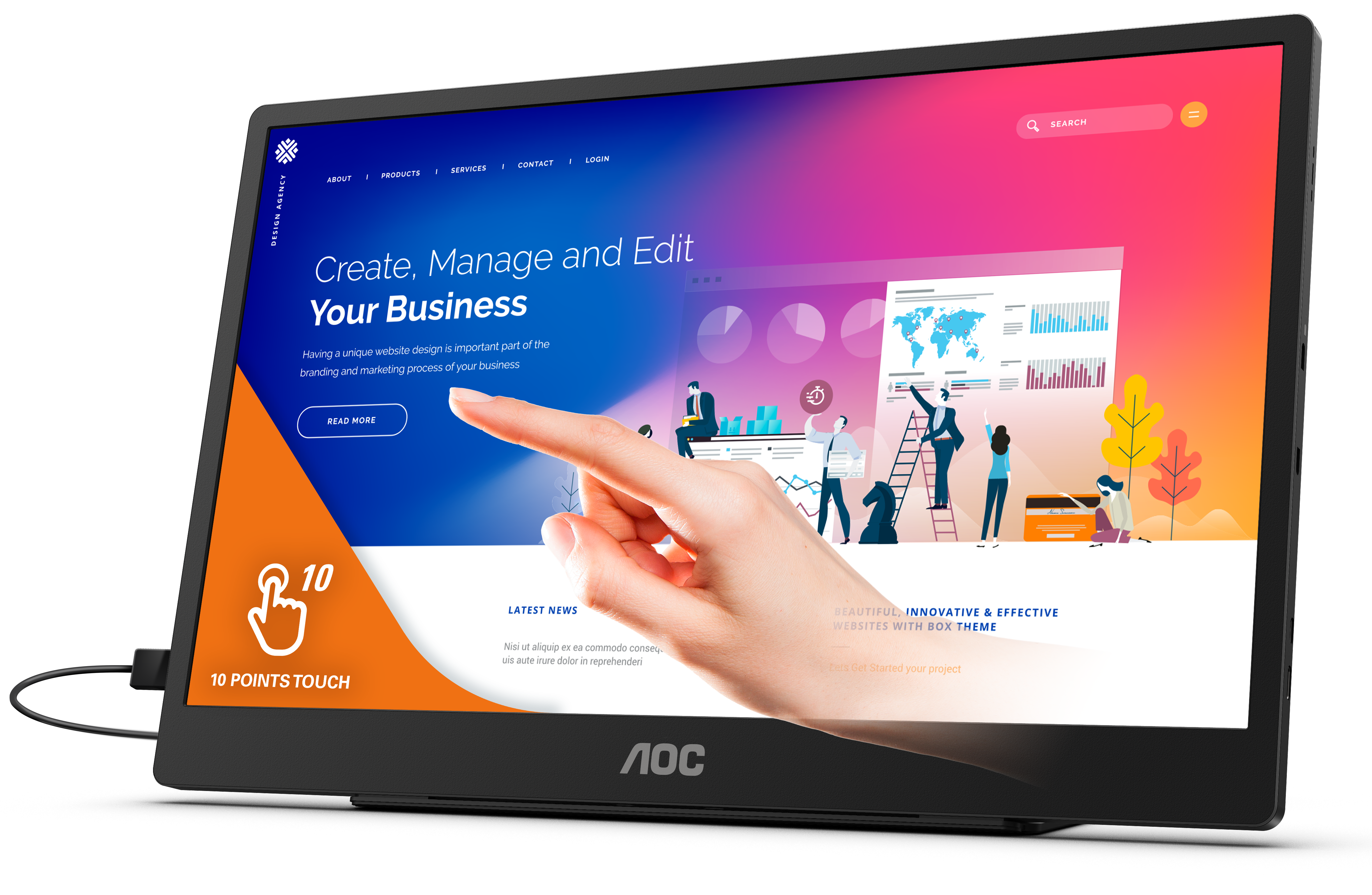
AOC has just announced a new portable touchscreen enabled monitor. The 16T2 arrives with USB Type C connectivity and sports a 15.6 inch display, which is similar to the standard size of laptops.
16T2 display panel features a Full HD resolution and it can be connected to a laptop, desktop, or even a server and smartphone through two USB Type C ports or a Micro HDMI port. Under the hood, an 8,000mAh battery pack powers the portable display that can be used on the go, without requiring a power connection and it can also double as a power bank for charging a smartphone.
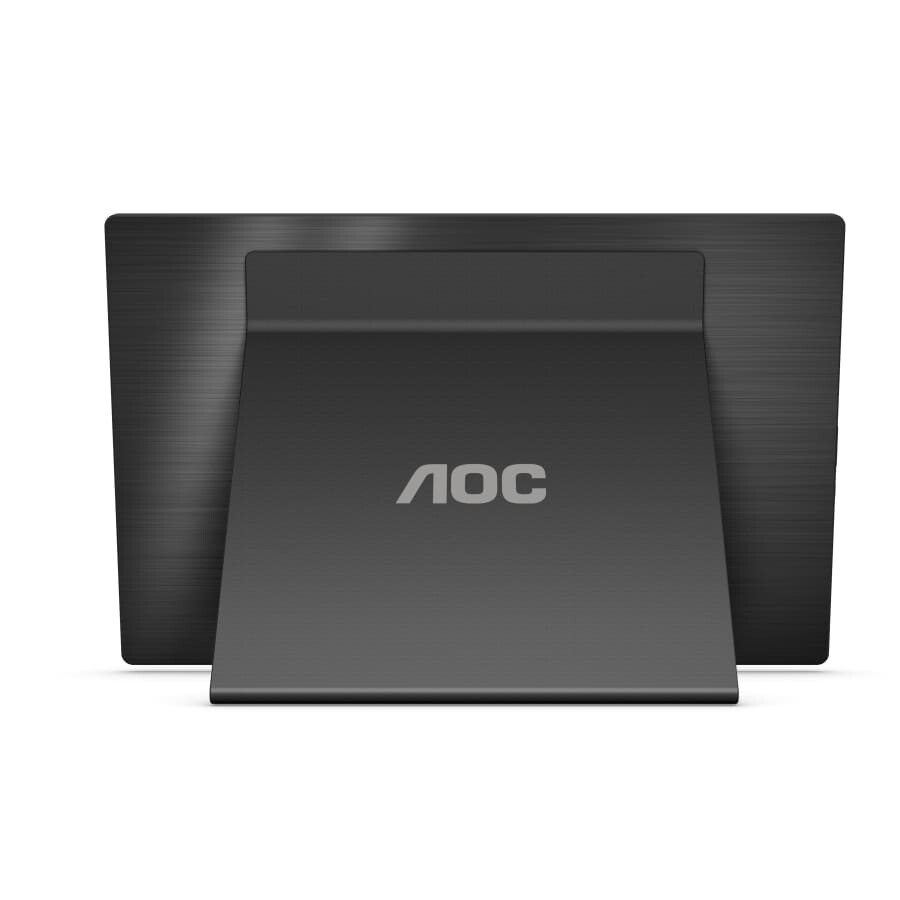
Since it is built with portability in mind, AOC 16T2 is less than a centimeter thick and features a smart foldable cover that allows for both landscape and portrait orientations. Notably, it also supports VESA wall mount options, which also makes it a great tool for students, mobile games, IT administrators, small businesses, and more.
The 16T2 is set to launch sometime later this month of October 2020 and will be priced 279 Pounds Sterling (roughly 360 US Dollars). So, if you are a professional or casual mobile gamer or even someone who watches a movie on their smartphones, a monitor such as this can enhance your overall experience, and as the company puts it, “Sleek, talented, flexible – the best mobile companion for all.”
According to the latest report published by DigiTimes Research, global smartphone shipments are expected to witness double-digit growth in the year 2021 after three consecutive years of decline.
The report adds that shipment in the upcoming year could grow by 150 million units, mainly because of the acceleration of 5G operations in several regions, including the USA, Western Europe, and Japan.
It also estimates that the entry-level 5G smartphones, as well as 4G smartphones, will drive the demand in the emerging markets. The report adds that these devices are expected to reach over 1.5 billion units in 2023 and 1.7 billion units in 2025.
Further, the report goes on to claim that Samsung and Apple will secure the top positions in the year 2021 in terms of smartphone shipments. These companies will be followed by Chinese brands OPPO, Vivo, and Xiaomi. Huawei, which is currently the leading smartphone company in China, will slip to seventh position globally, as per the estimate.
Digitimes Research also expects global shipments of 5G smartphones to reach over 200 million units in 2020 and to expand to over 1.22 billion units in 2025.
Recently, Canalys predicted in its latest forecast report that in 2020, global 5G smartphone shipments will reach 278 million units. It also added that in 2020, smartphone shipments will drop by 10.7 percent compared to 2019, and it is expected to rebound in 2021, with a year-on-year growth of 9.9 percent.
The OPPO A15 is an upcoming entry-level smartphone from OPPO. Amazon recently began teasing its arrival in India. It appears that a couple of other Asian markets will also receive the OPPO A15 as it has been approved by certification bodies of Thailand and Indonesia.
Recently, an OPPO phone with model number CPH2185 was approved by the Federal Communications Commission (FCC). It revealed a few details of the smartphone such as a 4,230mAh battery, 10W charging support, USB-C, and a 3.5mm audio jack. Apart from these details, the FCC documents also carried a schematic of the phone that revealed that it has a square-shaped camera module with three lenses and an LED flash inside it. It also revealed that the phone is flanked with a rear-facing fingerprint scanner.
After that, Amazon India released a teaser of the OPPO A15 phone in India. The poster shared by the retailer giant showcased the rear design of the smartphone. Since it resembled the CPH2185 phone, it was speculated that this device could be arriving in the Indian market as the OPPO A15.
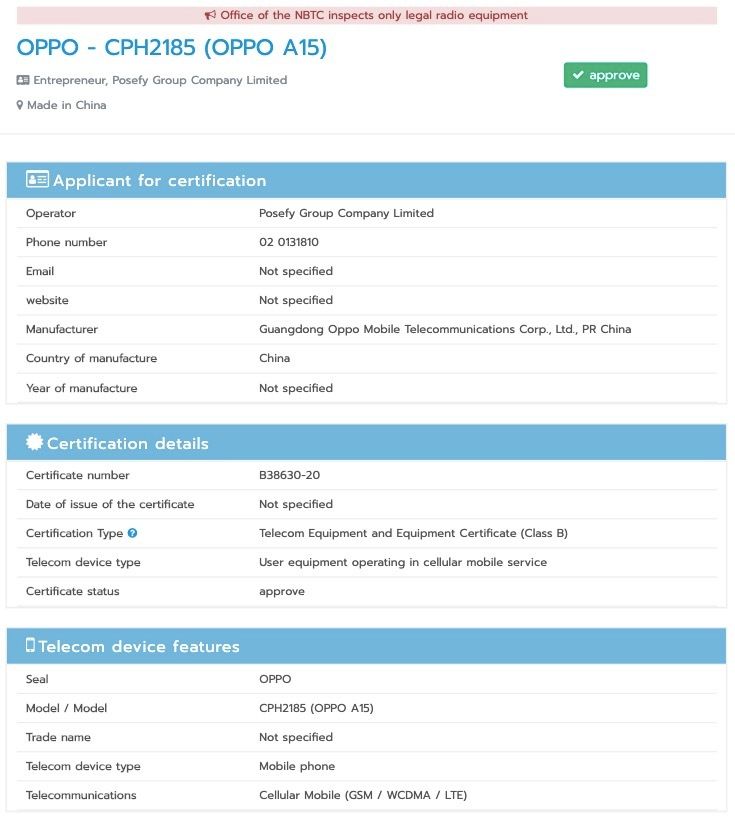
The rumor has now turned out to be true since Thailand’s NBTC certification (spotted by MySmartPrice) has revealed that the CPH2185 model number indeed belongs to the OPPO A15 phone. An Indonesian Telecom certification platform has also certified the OPPO A15. The handset heading to the European markets since it has also received EEC approval in the past.
Shown above is a tweet from a leakster who has revealed the existence of another device called the OPPO A15s. The images shared shows that the OPPO A15s that has a CPH2179 model number has received approval from EEC and IMDA. There is no information on the specs of the OPPO A15s smartphone.
In order to boost domestic smartphone production, the Indian government has approved an incentive plan for 16 companies, which includes the likes of Foxconn, Wistron, and Pegatron, among others.
With this new incentive scheme worth $6.65 billion, India is hoping to become one of the export and manufacturing hubs for smartphones. This is a part of the country’s “Make in India” initiative that aims to promote domestic manufacturing.
The scheme offers a production-linked incentive involving cash worth 4 percent to 6 percent of additional sales of goods made locally over five years, and it is considering 2019-2020 as the base year.
As per the report, to be able to tap into the scheme, the companies need to make an investment. Interestingly, the Indian government has not disclosed what investment Foxconn, Wistron, and Pegatron have made.
However, Reuters reports, citing two people aware of the development, that all three companies are planning to invest around $900 million in total over the course of the next five years to get benefits of the incentive scheme.
Apart from these three companies — Foxconn, Wistron, and Pegatron, which are contract manufacturers of Apple, South Korean giant Samsung has also got approval. Notably, Samsung operates the world’s biggest smartphone manufacturing plant in India.
It is also confirmed that five Indian companies, including Micromax and Lava, has received approval. According to the statement from India’s tech ministry, the approved companies are expected to produce smartphones and components of more than 10.5 trillion rupees, which is approximately $143.05 billion.
Last month, at the Huawei Developers Conference, the company officially unveiled the HarmonyOS 2.0 and also revealed its plan of using the newer version of the self-developed operating system on smartphones.
Now, a new report about the adaptation of HarmonyOS for Huawei and Honor smartphones based on the chipset has leaked online. It claims that the Kirin 9000 will be the first to get the update, which includes the upcoming Huawei Mate 40 lineup.
After that, the next in line to receive the new operating system is Kirin 990 5G that powers the Huawei Mate 30 series, P40 series, Mate Xs, Nove 6 5G, and Honor 30 series. However, not all of these devices are expected to get the update in the first rollout.
In the third batch, the HarmonyOS update will be rolled out to devices powered by the Kirin 990 4G, Kirin 985, and select devices of Kirin 820 SoC. In the fourth batch, all the remaining devices of the chipsets mentioned earlier as well as Kirin 980 will get the update. At last, phones powered by Kirin 810 and Kirin 710 will get the newer version of the OS.
Notably, the list doesn’t include devices powered by the Kirin 970 chipset, which includes the Huawei Mate 10 series, P20 series, and a few other devices. The list seems to confirm that the update will be available for older smartphone models as well.
Previously, the company had revealed that it plans to roll out a beta version of HarmonyOS 2.0 by December exclusively for developers. After initial testing, the software will be available for a few smartphones in Q1 2021.
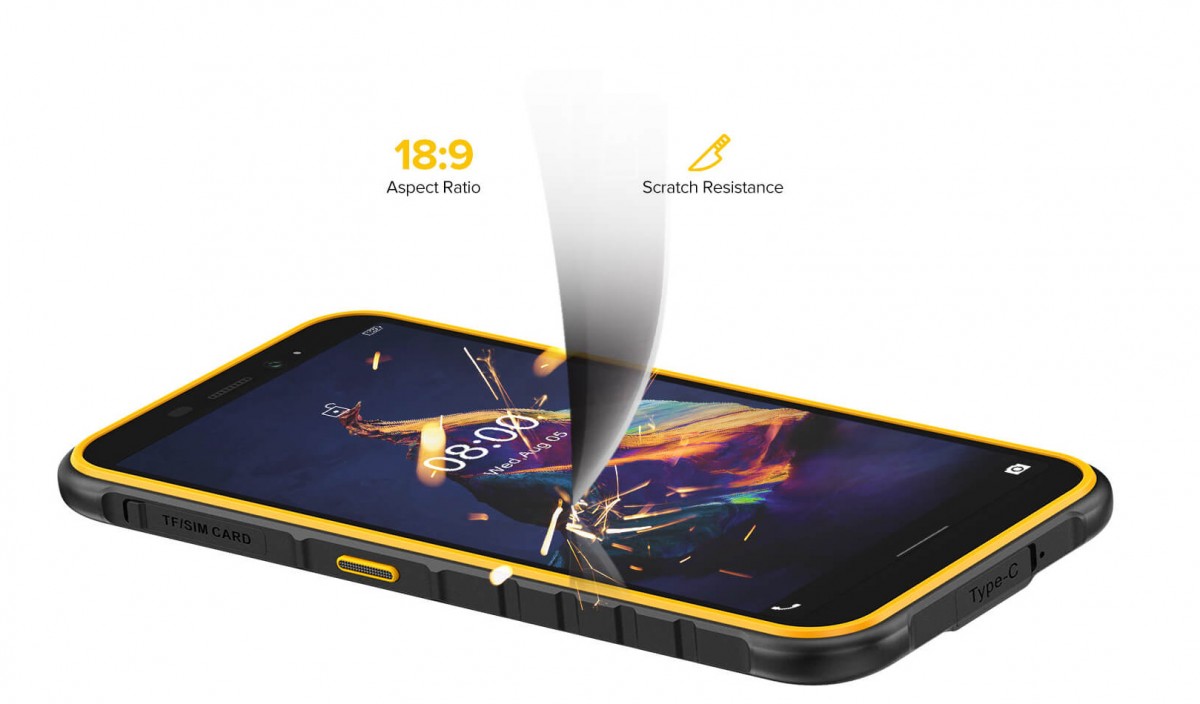
Rugged phone maker Ulefone has over the years garnered a towering reputation for the manufacture of dependable rugged smartphones. the company’s product lineup transcends the flagship line to the mid-range segment and even budget models. Ulefone Armor X8 is the brand’s latest offering which even though is a budget-friendly model, that doesn’t compromise on durability.
The Ulefone Armor X8 sports a 5.7-inch LCD screen with an HD+ resolution. The display is covered by a hardened glass but there are no details on its exact type. However, the display can be operated with gloves without any issues. The device is powered by a MediaTek Helio A25 backed by 4GB of RAM and 64GB of internal storage. For photography, the Armor X8 packs a triple camera setup made up of a 13MP primary camera and two 2MP modules for macro shots and depth data. The phone runs on Android 10 and is powered by a 5,080 mAh battery.
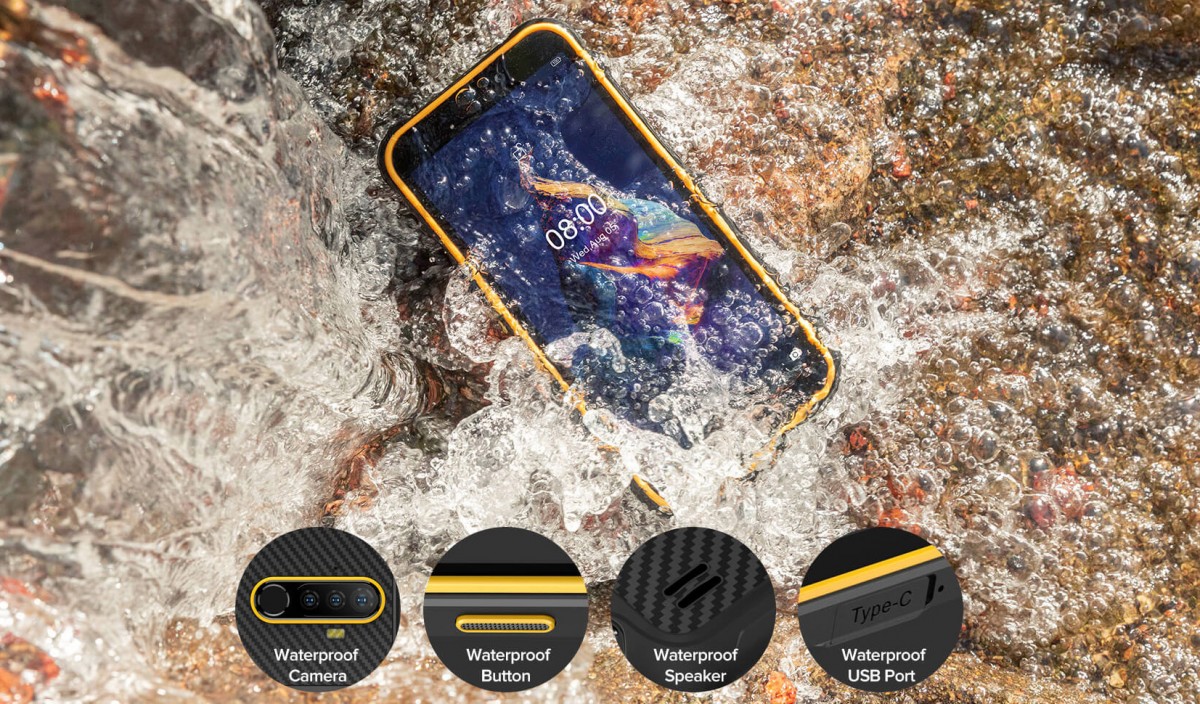
On the physical side, the Armor X8’s casing is made from plastic and feature rubber gaskets for added water protection. It measures 160x79x13.8mm and weighs 256 grams. There’s a programmable key on the left-hand side for easy shortcut toggles as well as a headphone jack and rear-mounted fingerprint scanner.
The phone comes with IP68/IP69K/MIL-STD-810G ratings and can withstand shock, drops, vibration and extreme temperatures. It can survive for 30 minutes when submerged in water at up to 1.5m levels and drops from 1.2 meters on hard ground.
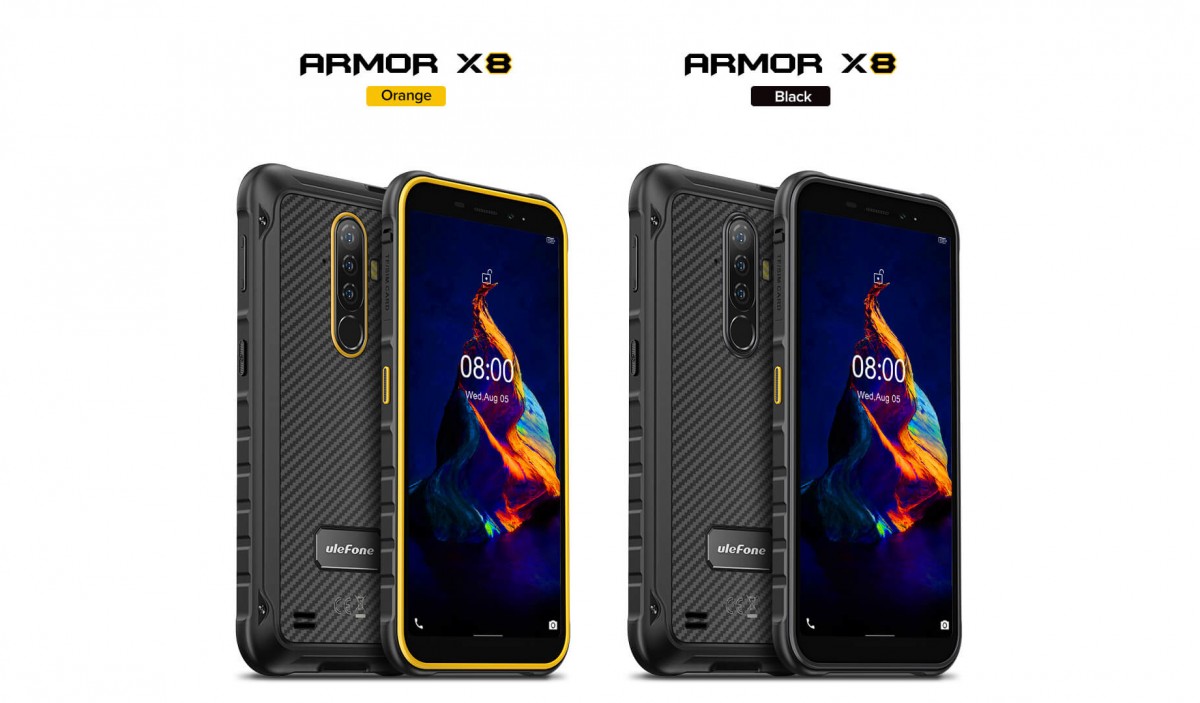
Ulefone Armor X8 comes with a price tag of $180 though a limited time pre-sale promo gets it down to $160. The phone is available in black as well as a black model with an option with orange accents around the display and cameras.
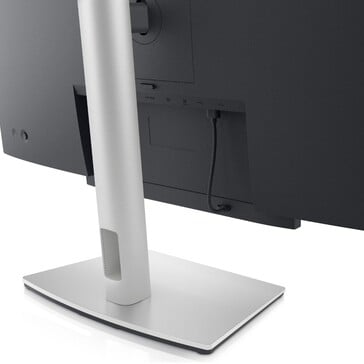
U.S. PC giant Dell recently held a launch event where it announced a number of monitors under the UltraSharp and P-series. The company also unveiled the Slim Soundbar, its latest audio product which is designed as the perfect companion to some of the monitors.
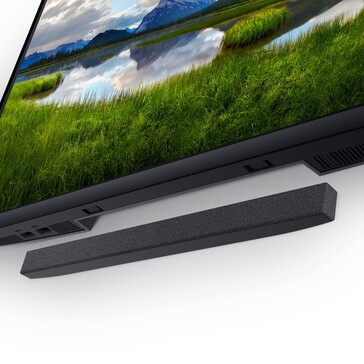
The Dell Slim Soundbar comes with the model number SB521A. It has a built-in magnetic system that allows it to be attached directly to the underside of such a peripheral. The soundbar has a dimension of 298 mm x 18 mm x 24 mm (11.73 inches x 0.71 inches x 0.95 inches), weighing in at 114g.
The Slim Soundbar packs a 3.6W RMS speaker which delivers a wide frequency response range of 180Hz to 20kHz. It connects via USB type-A port which grants the soundbar a seamless plug-and-play interface with effective cable management for its compatible monitors. It is also intended to stay in place relative to these devices with a built-in security chain.
The Dell Slim Soundbar (SB521A) carries a price tag of $54.99 and is available right away globally.
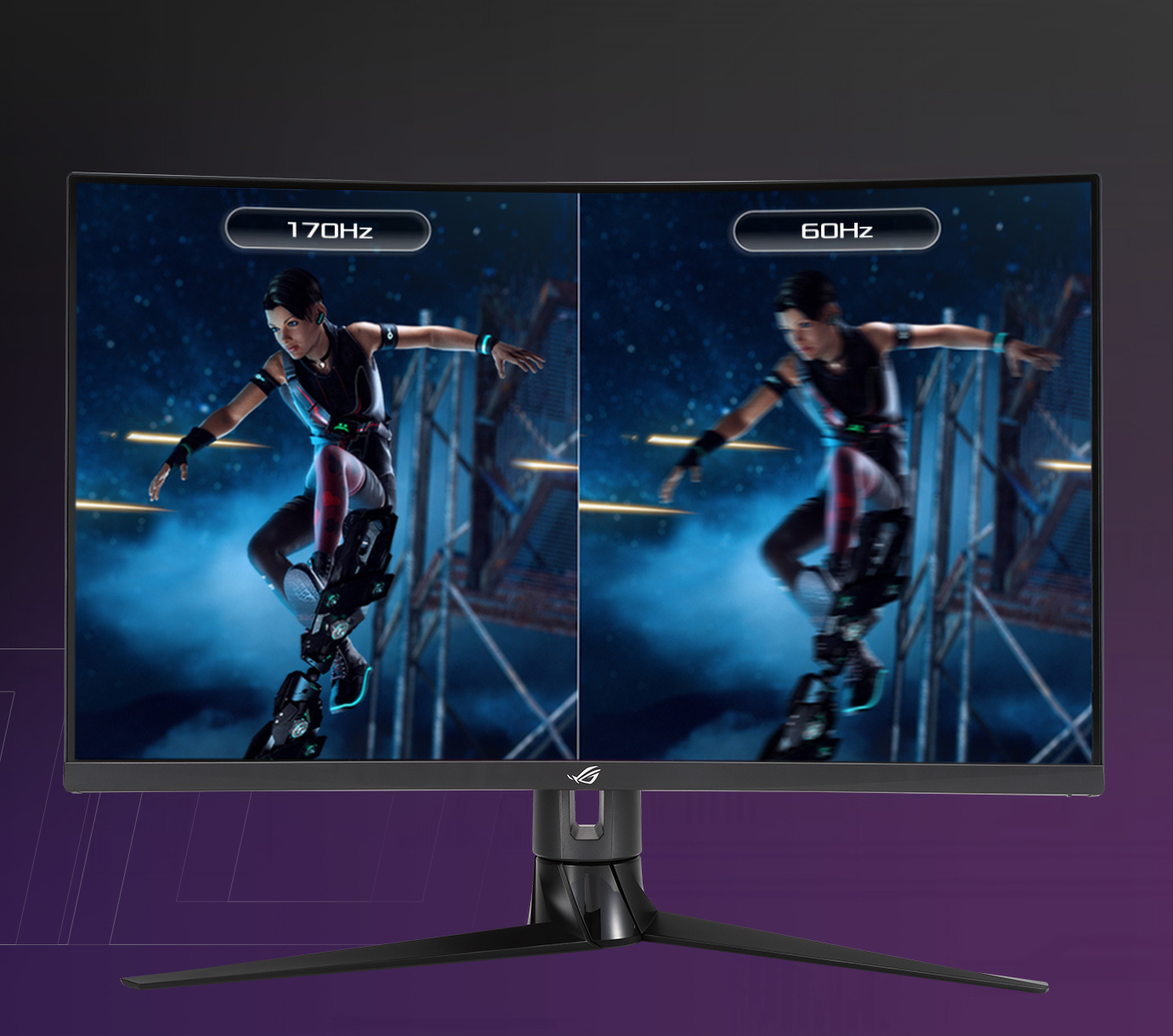
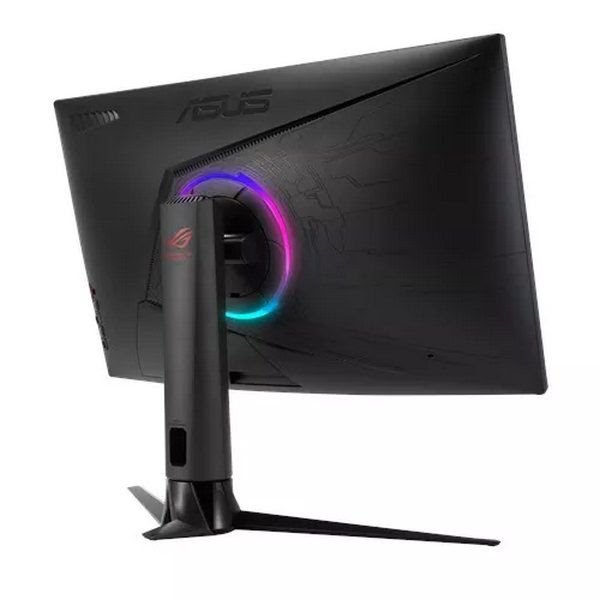
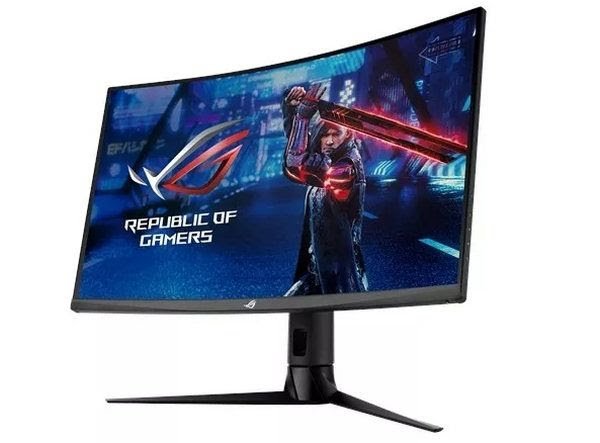
Taiwanese tech giant ASUS has silently launched the ROG Strix XG32VC gaming monitor on its official website. The monitor features a 32-inch panel with WQHD resolution. The price has not yet been announced but there are European retailers who have already listed the monitor, indicating that it would be sold for 569 Euro.
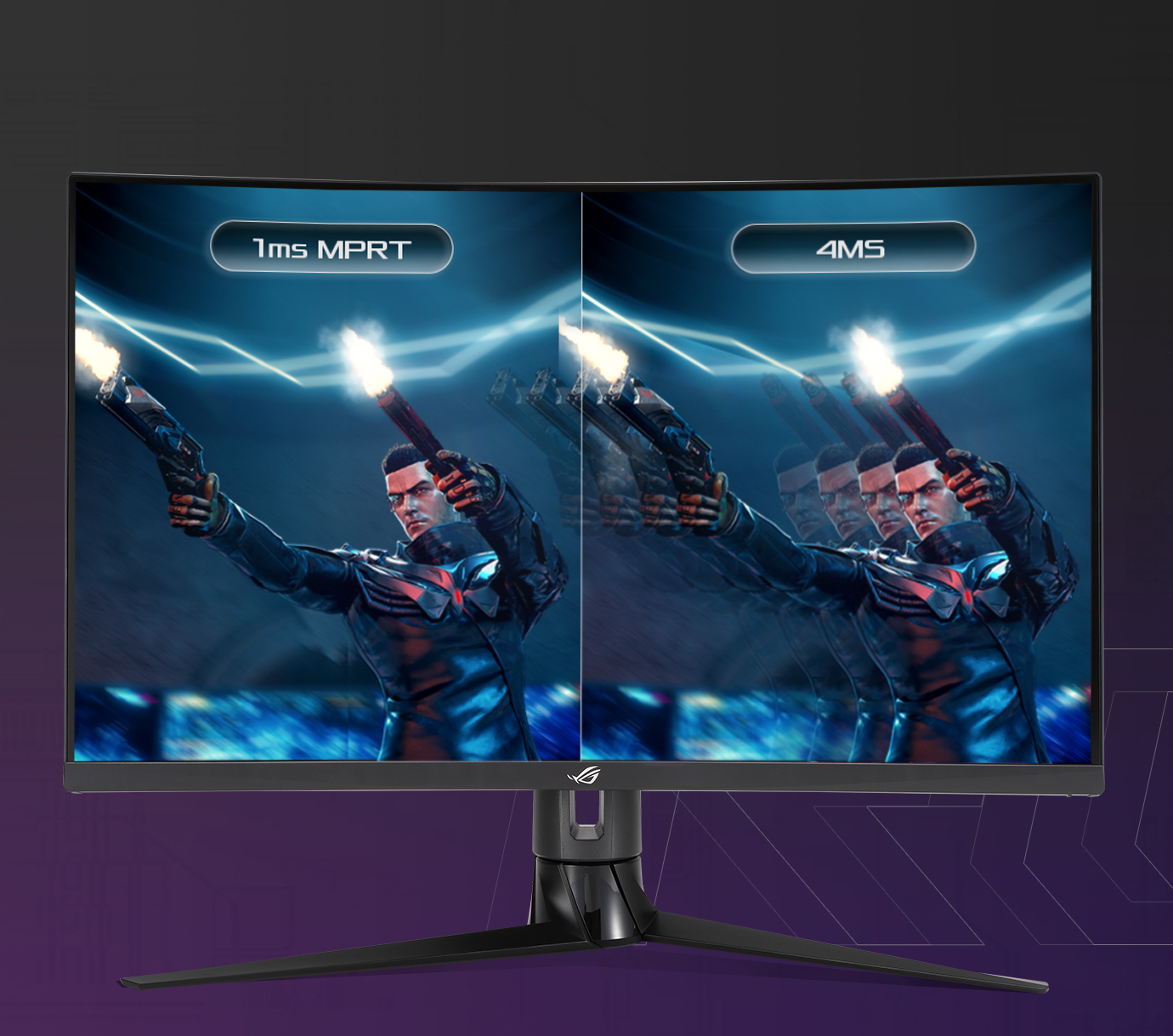
As a gaming monitor, the display has 1.0737 billion colors, a curvature of 1800R. It also provides a viewing angle of 178° horizontal/vertical. The panel supports up to 170Hz refresh rate and has a 1ms MPRT response time, a brightness of 400 cd/m2, and a contrast ratio of 3000:1. It has passed S DisplayHDR 400 certification. The panel also covers 125% of the sRGB color gamut and 90% of the DCI-P3 color gamut. The monitor is also DisplayHDR 400 cewrtified which means you’re getting real HDR performance.
1 of 4
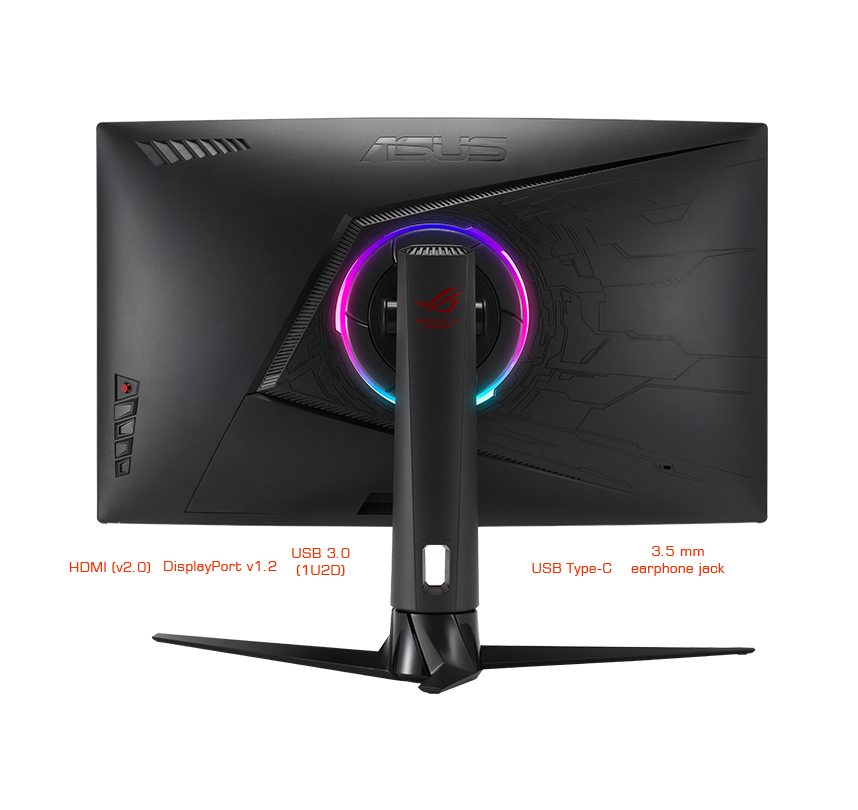
In other aspects, the monitor supports AMD FreeSync Premium Pro synchronous refresh technology and can achieve -5° to 20° tilt, -25 to 25° rotation, 100mm height adjustment, etc., supports VESA 100 wall mounts, and supports various eye protection and gaming functions. It comes with HDMI 2.0 interface, DisplayPort1.2 interface, USB-C and a 3.5mm audio port.
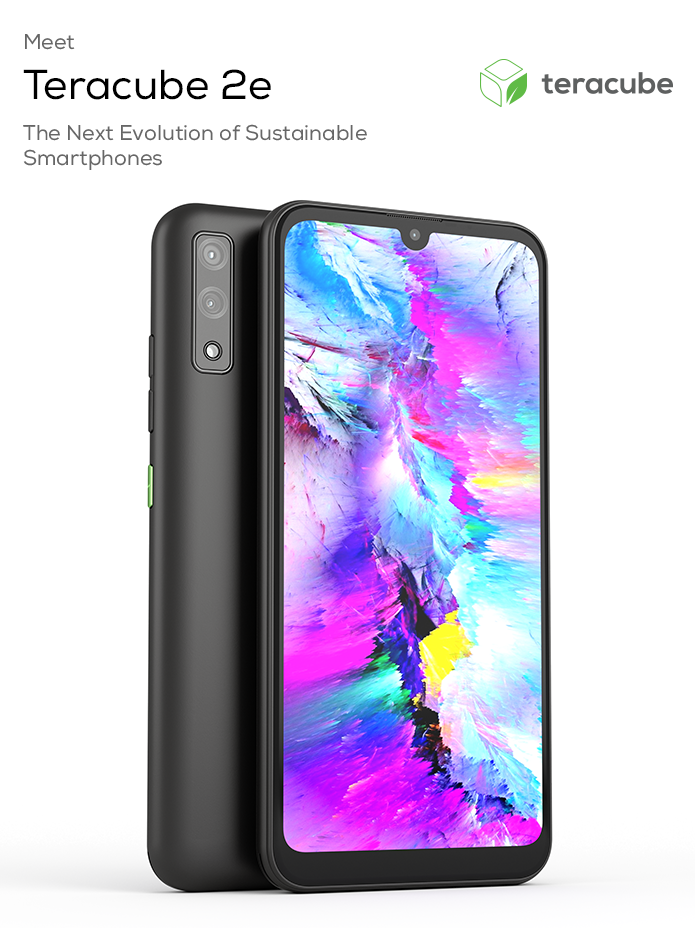
When Apple and Google announced their new products last month, they mentioned how they are built from recycled materials such as recycled aluminum and recycled plastic. This is part of the goal to reduce waste. If you are looking for an affordable Android phone that is also made from recycled materials, then the Teracube 2e might be that device.
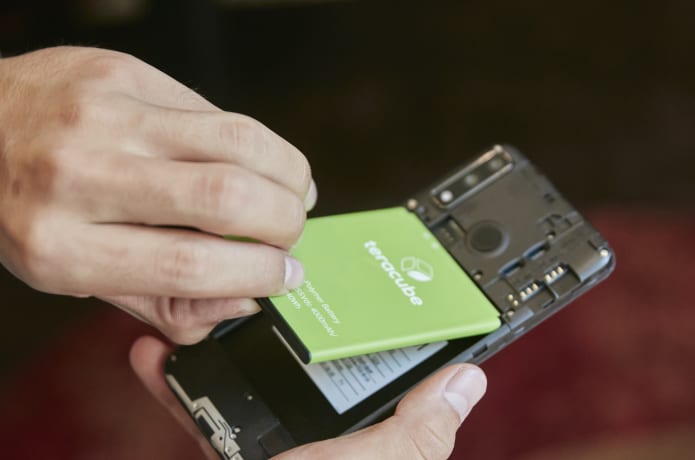
Teracube is an American company, and their new phone, the Teracube 2e is currently on crowdfunding on Indiegogo. The entry-level smartphone is DIY repairable (no glue, just screws), has a fully biodegradable case, a replaceable battery, and a 4-year warranty!
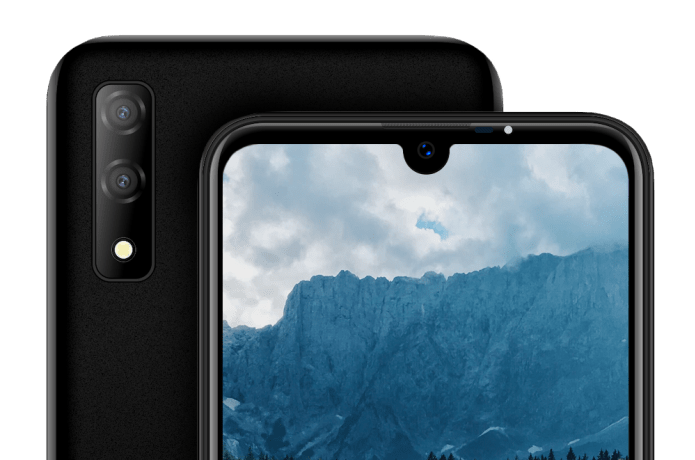
With respect to the specs, the Teracube 2e has a 6.1-inch HD+ display with a waterdrop notch. It is powered by the Helio A25 processor and has 4GB of RAM and 64GB of expandable storage. The selfie camera is an 8MP sensor while the back is home to a 13MP+8MP dual camera setup.
The phone has a rear-mounted fingerprint scanner, face unlock, dual SIM support, a dedicated MicroSD card slot, an audio jack, and a replaceable battery with a 4000mAh capacity. It also has Bluetooth 5.0, NFC, dual-band Wi-Fi, a USB-C port, and runs Android 10 out of the box.
Talking about the box, Teracube will not ship the phone with a charger, earphones, and cable. They have tagged them “redundant accessories” that “most users already have”. They also believe the smaller packaging, which is 50% smaller than that of other phones, reduces carbon emissions from shipping. The Indiegogo page says the packaging is made from recycled paper and printed using soy ink.
As with all crowdfunded items, the price varies. You can grab the super early bird deal for $99. There are only 8 units of that left, and if you are unlucky, the next price tag is $119. There is also a twin pack (2 units) early bird that is $199.
The 4-year warranty is no longer limited to the US and Canada. It is now available to those in France, Germany, Netherlands, Poland, Singapore, Spain, and the UK.
When the Microsoft Surface Duo was announced, I remember seeing several tweets from those who got review units praising how thin the device is. Even when closed, the Surface Duo still manages to be thinner than a lot of other smartphones. It turns out that while the incredible thinness earned it praises, it was actually a demerit in the long run.
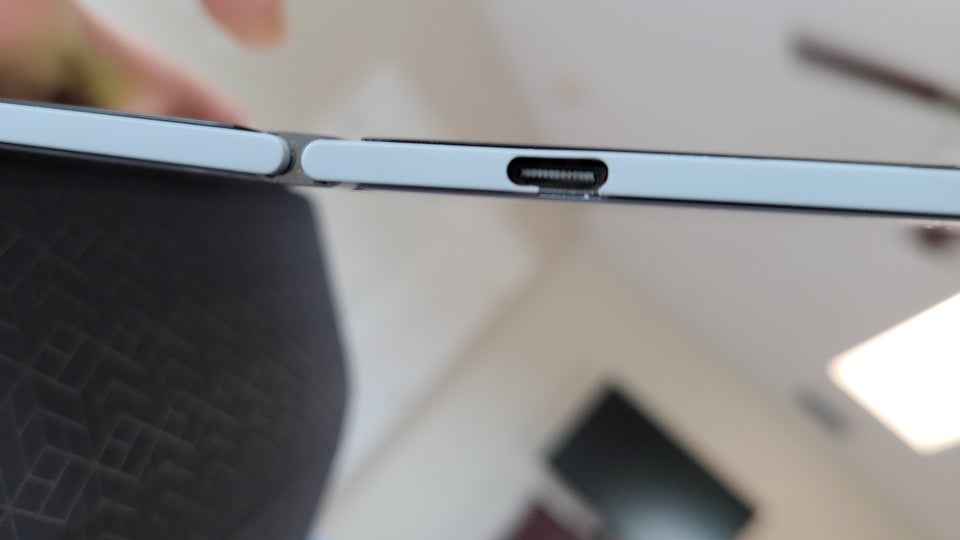
The news is that some users have noticed cracks in the plastic around the charging port of the Surface Duo. We know it is disappointing that the $1400 Surface Duo has a plastic frame! These cracks are said to have occurred while they tried to plug in the charger while others say it cracked when in their pockets. So far, no one has complained about a faulty USB port.
Image source: Reddit (foganime)
The cracks are happening because the plastic around the port is really thin. This problem would also have been avoided if the Surface Duo had a metal frame rather than a plastic one.
Some owners have suggested purchasing a magnetic charging cable whose head sits permanently and the port and thus doesn’t require the user to remove and reinsert just because they want to unplug or charge the device. If you own a Surface Duo and planning to go this route, we advise you to ensure you get a good cable that will not damage your device.
We hope Microsoft learns from this design mistake if and when it plans to launch a second-gen model of the Surface Duo.
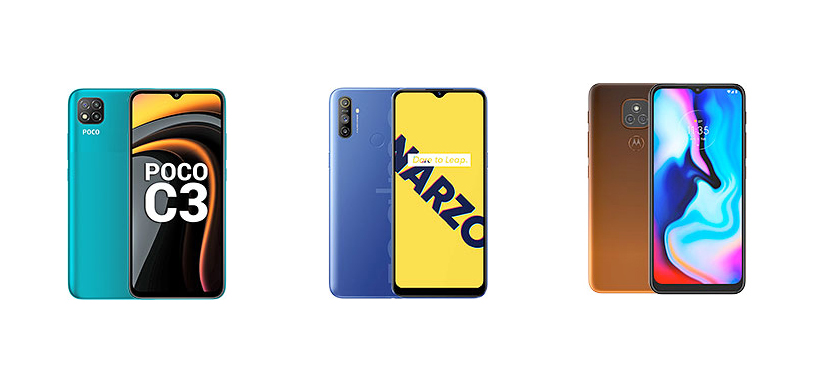
POCO launched its first entry-level phone: the POCO C3. It is a rebranded version of the Redmi 9C for the Indian market. Will the new handset from Xiaomi’s sub-brand conquer the entry-level segment or its competitor are too strong for it to stand a chance? We think there is no better way to find it out than comparing it with the best entry-level phones out there. Two very popular budget phones in India are Motorola Moto E7 Plus and Realme Narzo 10A, and they are popular because of their incredibly high value for money. Let’s see if POCO C3 can beat them.
Xiaomi POCO C3 vs Realme Narzo 10A vs Motorola Moto E7 Plus
Triple 13 + 2 + 2 MP f/2.2 + f/2.4 + f/2.4
5 MP f/2.2 front camera
Triple 12 + 2 + 2 MP f/1.8
5 MP f/2.4 front camera
BATTERY
5000 mAh, charging 10W
5000 mAh
5000 mAh
ADDITIONAL FEATURES
Hybrid Dual SIM slot
Dual SIM slot
Dual SIM slot
Design
I like the design of the POCO C3: it is compact, minimalistic, and well-balanced. The handset is not too heavy and thick, despite it packs a huge battery. And it even comes with great build quality. However, the choice mostly depends on your tastes: all of these phones are made with a polycarbonate body and they are similar. You do not get better materials with any of these devices and they all come with a waterdrop notch. Note that POCO C3 does not feature a fingerprint scanner, unlike Motorola Moto E7 Plus and Realme Narzo 10A. This makes the device sleeker, but you have to renounce to that authentication method.
Display
The displays of these devices are pretty disappointing, but they are more than sufficient for average users. They are classic IPS panels with a below-average HD+ resolution. The Realme Narzo 10A looks more convincing because it has higher brightness, but it remains nothing special. While choosing among these devices, you should not focus on the display. Instead, look at the other specifications and make your own conclusions.
Specs & Software
The Snapdragon 460 chipset found on the Motorola Moto E7 Plus and the Helio G70 SoC found on the Realme Narzo 10A are pretty similar in terms of performances, but we believe most of the people would choose the Snapdragon 460 because it is built with a better production process and because it is a Qualcomm chipset. POCO C3 loses the hardware comparison because it sports a weaker Helio G35 chipset: still a good SoC even for gamers, but way inferior to Helio G70 and Snapdragon 460. These three handsets run Android 10 out of the box and feature up to 4 GB of RAM paired with up to 64 GB of eMMC internal storage.
Camera
Despite it has a lower amount of sensors on the rear side, the Motorola Moto E7 Plus is the best camera phone of the trio. It has a great 48 MP main sensor with a bright f/1.7 focal aperture as the main camera, paired with a 2 MP depth sensor. It even comes with a better 8 MP selfie camera (Realme Narzo 10A and POCO C3 have a 5 MP selfie snapper). The silver medal goes to the Realme Narzo 10A with its 12 MP f/1.8 main sensor paired with a 2 MP macro camera and a 2 MP depth sensor. POCO C3 loses again.
Battery
Motorola Moto E7 Plus, Realme Narzo 10A, and POCO C3 have exactly the same battery capacity: 5000 mAh. We did not test all of them, but we can say the Motorola Moto E7 Plus may last more because it has a more efficient chipset built at 11 nm. However, we are probably talking about marginal differences.
Price
POCO C3 is priced just €86/$100 in India. Motorola Moto E7 Plus costs €150/$175 in the 4/64 GB, while Realme Narzo 10A 3/32 GB costs €130/$152. Due to its better cameras and great chipset, Motorola Moto E7 Plus wins the comparison. But with the POCO C3, you can save a lot of money while still getting a very good entry-level phone. Realme Narzo 10A sits in the middle: it is more affordable than Motorola Moto E7 Plus and inferior to the Moto E7 Plus, but it has better specifications than POCO C3.
It has been more than a month since Samsung launched the Galaxy M51 which packs a massive 7000mAh battery capacity. Now, the Korean giant is ready to announce another M-series smartphone in India which will launch as the Galaxy M31 Prime.
The Galaxy M31 Prime will join the Galaxy M31 and Galaxy M31s that launched earlier this year. Amazon India already has a promo page live on its website that reveals images and some of the upcoming phone’s key specs, however, there doesn’t seem to be any significant difference between the Prime version and the standard version.
The page doesn’t reveal the name of the phone but as shown in the tweet above by Sudhanshu (@Sudhanshu1414), if you sign up to be notified, the email you receive from Amazon reveals the device is the Galaxy M31 Prime.
The design of the Galaxy M31 Prime is practically identical to that of the Galaxy M31. It has a waterdrop notch and the rear cameras and fingerprint scanner are in the same position as that of its sibling.
1 of 3
The Galaxy M31 Prime will be powered by the 10nm Exynos 9611 processor clocked at 2.3GHz. It will have 6GB of RAM with 64GB or 128GB of storage. A dedicated MicroSD card slot is available for storage expansion.
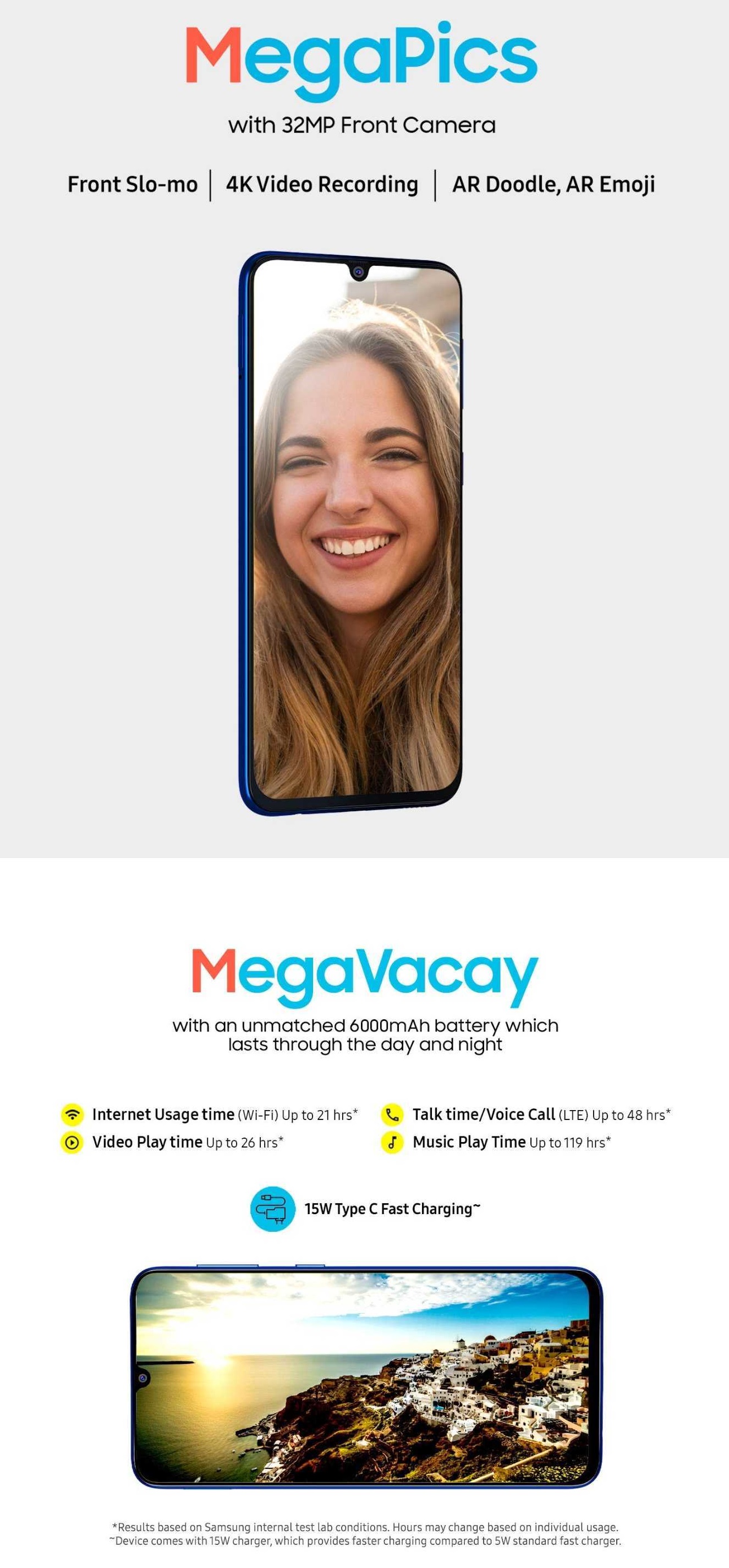
The quad-camera setup is the same 64MP + 8MP ultrawide + 5MP macro + 5MP depth sensor found on the Galaxy M31 and so also is the 32MP sensor. The phone will also have a 6000mAh battery with support for 15W fast charging via a USB-C port.
We are yet to know what new features Samsung has added that warrants it to be called “Prime”. We expect more details to surface before the launch of the phone whose date is also unknown.
Samsung has finally made the OneUI 3.0 Public Beta live for users of the Galaxy S20 series in South Korea. A post on Samsung’s Korean forum says the beta is open initially to limited users but the number will increase in the future.
Samsung confirmed the OneUI 3.0 based on Android 11 back at the event on August 5. Soon after the event, the initial developer build for the Galaxy S20 series was announced in South Korea and US. However, the latest update gives (via Sammobile)every other S20 series customer an opportunity to experience the new UI.
That said, the beta that currently limited to the Galaxy S20 series could extend to Note 20 series and other devices as well. As of now, the eligible devices in South Korea are S20/S20+/S20 Ultra with carriers SKT, KT, LGU+, and Unlocked. To register, users need to download Samsung Members App and click on “Signup for OneUI beta Program” in notice. However, you will need a Samsung account for successful registration. After signing up, users can install the beta by navigating to settings->software update->download and install.
Besides, a changelog of OneUI 3.0 released recently suggests that the new UI will have an overhaul apart from Android 11 features. The changes include Accessibility, Contacts, Bixby routine, Digital wellbeing, revamp to Home, Lock screen, and AOD features. Apart from this, the UI is sure to get many more tweaks like revamped screenshots in the coming versions.
That said, the beta is reportedly coming to the UK, USA, Poland, Germany, China, and India soon. Regarding other devices, we can hope for the Galaxy S20 FE, older S10 series to get it at some point. But nothing is confirmed yet.
Also, the disclaimer on the forums says certain apps like GOM Audio, RAKBANK Digital Banking, Organizing Tasks, and few other apps won’t run after installing the beta. As always, we advise you to take a backup of data before hitting install. If you find face any error while installing, you can easily recover the older firmware by visiting a service center.
Apple has officially announced the date of what could be its biggest ever event in 2020. Through an invite on its events page, the company has scheduled an event on October 13, 2020, with a tagline, “Hi Speed” hinting the arrival of the next iPhones.
Credits: Apple
The event will start at 10 AM PDT in Apple Park. And will be streamed live via its website, Apple TV app, and likely on social media like YouTube. The invite as mentioned above, clearly suggests that the unveiling of the iPhone 12 series. Besides, the “Hi speed” probably means the powerful A14 chip with 5G connectivity that’s coming with iPhone 12. Additionally, the logo has a lot of concentric circles covering it. This could either mean a revamped Siri or the rumored small HomePod but we will have to wait for a week.
Anyways, the showstopper of the event will definitely be the iPhones. The design is likely to get a revamp with similarities to iPad Pro. The company is expected to name the next iPhone series the iPhone 12 with 4 different models. Starting with iPhone 12 Mini, the three other models will likely be iPhone 12, iPhone 12 Pro, and iPhone 12 Pro Max. The display sizes are likely a 5.4-inch for Mini, 6.1-inch for iPhone 12 and Pro. And, a 6.7-inch for the 12 Pro Max. All of them will probably sport OLED displays albeit skipping 120Hz.
As usual, we can expect Face ID to be tucked inside the notches. However, the new powerful A14 SoC will most likely break open the support for 5G connectivity on iPhones. That said, the mmWave band will reportedly be only on the ‘Pro’ models. Apart from this, the Pro models will also get the LiDAR scanner along with other auxillary lenses like the iPad Pro 2020. On the contrary, the entry-level 5.4″ and 6.1″ models might stick to dual-lens setup.
Storage-wise, the first two models will start from 64GB whereas the Pro models will begin at 128GB storage. The invite also has yellow, and blue tints on it suggesting new color variants. Accordingly, iPhone 12 is rumored to sport six colors– Black, White, Blue, Red, Yellow, and Coral. However, the Pro models will likely get Black, Silver, and White alone. That said, the price is expected to start at $649 for the Mini, while the iPhone 12, 12 Pro, and 12 Pro Max will start at $749, $999, and $1,099 respectively.
Apart from iPhones, Apple could also unveil the rumored Airpods Studio, AirTags, a new Siri Remote, and a hint about its future ARM Macs as well.
We use cookies on our website to give you the most relevant experience by remembering your preferences and repeat visits. By clicking “Accept”, you consent to the use of ALL the cookies.
This website uses cookies to improve your experience while you navigate through the website. Out of these, the cookies that are categorized as necessary are stored on your browser as they are essential for the working of basic functionalities of the website. We also use third-party cookies that help us analyze and understand how you use this website. These cookies will be stored in your browser only with your consent. You also have the option to opt-out of these cookies. But opting out of some of these cookies may affect your browsing experience.
Necessary cookies are absolutely essential for the website to function properly. This category only includes cookies that ensures basic functionalities and security features of the website. These cookies do not store any personal information.
Any cookies that may not be particularly necessary for the website to function and is used specifically to collect user personal data via analytics, ads, other embedded contents are termed as non-necessary cookies. It is mandatory to procure user consent prior to running these cookies on your website.