Earlier this week, it was revealed that US regulators are open to making changes that will help in fixing loopholes within the new sanctions that may allow Huawei to still receive US chipsets.
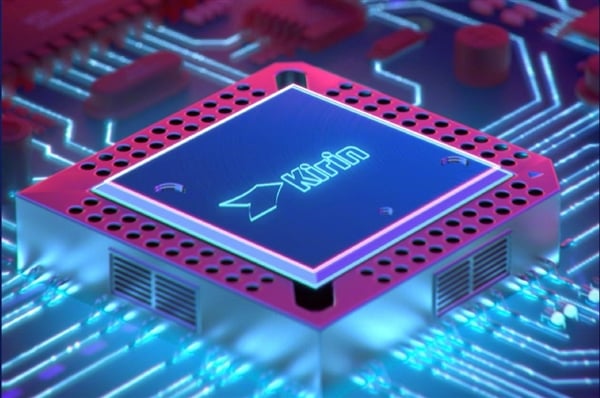
In other words, TSMC is no longer taking orders from Huawei. However, a loophole of this rule is that this rule only covers chips designed by Huawei (HiSilicon Kirin). These do not include shipments that are sent directly to Huawei’s customers, something certain industry lawyers see as a potential loophole. Thus, US regulators are aiming at plugging this gap within the new set of regulations.
According to the US State Department, the new rule will “give us a great deal more information upon which to base export control decisions as we move forward and try to find the right answer to these challenges including by adapting, if we need to, if Huawei tries to work around our rules in some way,” adding that these steps are “necessary,” as the Trump administration looks at the consumer product maker as a security threat.
Last year, Chinese smartphone makers Xiaomi, OPPO, and Vivo had announced an alliance for a cross-device file transfer protocol. Now, four more smartphone manufacturers have joined this alliance — OnePlus, Realme, Meizu and Black Shark.
With these four smartphone brands joining the list, over 400 million users are expected to get benefit of this file transfer service. So now, users of these smartphone companies will soon be able to transfer files among each other quickly without need for third-party apps.
For those who are unaware, the peer-to-peer (P2P) cross-device file transfer protocol allows user to directly and easily share files without need for any of the third-party applications. Think of it as a feature similar to Apple‘s AirDrop for Android smartphones.
Although the file transfer alliance was announced last year, the companies were working on the technology and the official rollout of the feature began earlier this year in February. The feature is soon expected to be available for these four newly joined brands.
The technology uses Wi-Fi P2P and thus allows users to transfer files at speeds of up to 20MB/s. The Wi-Fi P2P feature doesn’t interfere with the Wi-Fi functionality of the devices in any way. The protocol also supports a wide range of file formats including photos, videos, and documents.
While several smartphone brands have their own file transfer service, there was no unified method for cross-brand file transfers. With so many China-based phone makers joining the alliance, Android users will finally get a seamless file transfer feature, at least for those who are using phones from any of these brands.
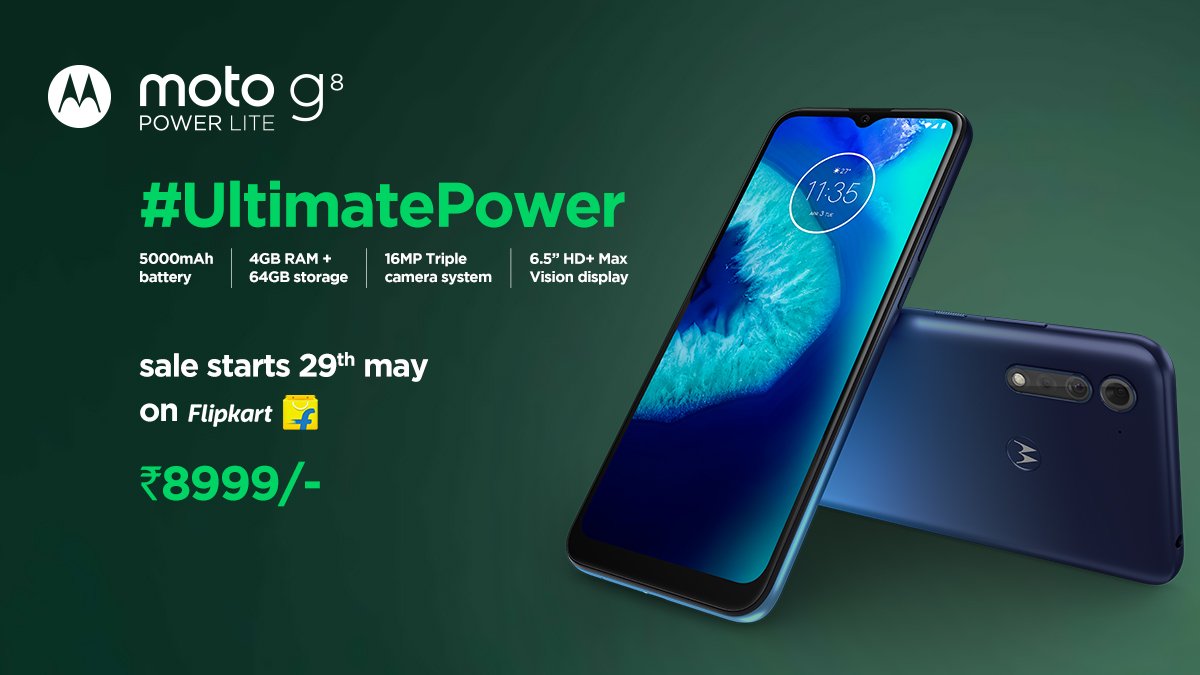
Motorola recently unveiled the Motorola Edge+ flagship phone with a whopping price tag of Rs. 74,999 (~$991). The Lenovo-owned company has announced a new phone called Moto G8 Power Lite in India. The handset had previously launched in Italy in March. Some of its key features include a 6.5-inch display, 16-megapixel triple cameras and 5,000mAh battery. It has arrived with a price tag of Rs. 8,999.
Moto G8 Power Lite specifications
The Moto G8 Power Lite features a Max Vision IPS LCD screen with waterdrop notch. It produces an HD+ resolution of 720 x 1600 pixels and 20:9 aspect ratio. The Helio P35 chipset powers the device with 4 GB of RAM. The phone offers users with a native storage of 64 GB. For additional storage, the G8 Power Lite offers users with a microSD card slot.
The Moto G8 Power Lite has a front-facing f/2.0 aperture 8-megapixel selfie camera. The back panel of the smartphone has a triple camera system. It includes a main lens of 16-megapixel with f/2.0 aperture and PDAF, an f/2.4 aperture 2-megapixel macro shooter, and an f/2.4 aperture 2-megapixel depth sensor.
There is a 5,000mAh battery present inside the Moto G8 Power Lite that supports only 10W charging. Once charged, the phone can last for up to 2 days, says the company. The Android 9 Pie OS comes loaded on the phone. The handset comes with a splash-resistant chassis. The usual connectivity features like dual-SIM support, 4G VoLTE, Wi-Fi 802.11 b/g/n, Bluetooth 4.2, GPS, MicroUSB and 3.5mm headphone slot can be found on the device.
The all-new Moto g8 power lite packs the #UltimatePower of a 5000mAh battery, 4GB RAM + 64GB storage, 16MP triple camera system & more.
The Moto G8 Power Lite has landed in India in two color variants such as Royal Blue and Arctic Blue. The phone is priced at Rs. 8,999 (~$119) and its first sale will be held on Flipkart on May 29 at 12 PM in India.
The recent sanctions employed by the US have made a devastating impact on Huawei‘s operations. The Chinese tech giant has had its crucial mobile chipset supply cutoff from TSMC, the largest contract chipmaker, and is currently investing in Chinese semiconductors for a replacement. Now, a Huawei exec from the US has responded to this crisis, revealing a two way negative effect of this move.
Andy Purdy, the US Chief Security Officer for Huawei, appeared on television (Bloomberg and CNN) and was asked regarding the impacts of this new set of regulations. According to Purdy, the company will survive this event and will eventually adapt to this, the problem will mostly be borne by American employees and companies. He stated that Huawei will face troubles in the short run, due to the forced shift in technology, but the company will eventuall turn things around.
When questioned about the survival and the massive loss of revenue, the Andy Purdy mentioned that the primary concern should fall on the 40,000 to 50,000 employees from both Huawei and the American firms that work with the Chinese company that work will lose their jobs. Furthermore, these 300 or more so American companies that sell to Huawei will also see a drastic impact on their own operations.
Realme is hosting a launch event in China on 25th May where it’ll be unveiling eight new products, including the Realme X50 Pro Player Edition smartphone. On the same day, the company has also scheduled an event in India.
The company has also confirmed that the Realme Smart TV and Realme Watch will get launched in the Indian market on 25th May. Now, it has been confirmed that the Realme Buds Air Neo will also be launched at the same event.
Madhav Sheth, CEO of Realme India has shared a tweet which confirms the launch of Buds Air Neo in India on 25th May. He has also revealed that the company has managed to sell over a million units of smart audio AIoT products so far.
The teaser mentions that the upcoming TWS earbuds from Realme are focused towards youth and thus, we expect them to be priced affordably. In fact, a promotional image of the same has been leaked online, which shows that Realme Buds Air Neo will be priced at ₹2,999 in India, which is about $40.
In terms of design, the upcoming true-wireless earphones from the company seems to be exactly the same as the original model. Further, the teaser confirms three color options — Red, White, and Olive Green.
As per the reports, the earphones will lack USB Type-C port and wireless charging support and instead will have a microUSB port for charging them. It will come with Bluetooth 5.0 to connect with smartphones and other devices.
The earphones will continue to have a dedicated R1 chipset for better audio quality and battery efficiency. However, Buds Air Neo will lack some of the features of the original Buds Air to justify the lower pricing.
The earphones are expected to have the Game Mode which reduces latency by up to 51 percent but reduces the battery life. Coming to the battery, it is expected to offer around 17 hours of battery life with the charging case.
Vivo has planned an event in China on 1st June to launch its latest Vivo X50 smartphone. The company is expected to launch three smartphone in this lineup, including X50, X50 Lite, and X50 Pro.
Now, ahead of the launch, the Chinese company has been sharing teasers on its Weibo account showcasing the camera technology in the phone. In the newly shared teaser video, the company hints at movie mode and sound zoom features.
The advanced camera setup on the upcoming smartphone from Vivo comes with advanced video shooting mode which is like shooting a professional movie. There’s also support for Sound Zoom feature. We expect more details to surface online ahead of the official launch.
Recently, Vivo had confirmed that even though the phone packs an advanced camera module, the smartphone measures just 7.4mm in thickness and weighs just 170 grams. It has also been confirmed that the battery capacity has not been reduced and the device doesn’t use plastic for the middle frame.
Previously, the company had confirmed that the X50 Pro features an ultra-large primary camera sensor with a focal length of 16-135mm and supports 5x optical zoom as well as 10x digital zoom. The company is also expected to be capable of 360-degree movements and offer anti-shake technology.
Thanks to micro-gimbal technology, it has improved shutter level for longer exposure which results in capturing larger amount of incoming light, thus the output offers a better low-light capabilities for the camera.
A leaked image of the smartphone’s promotional material has revealed that the device will come with a punch-hole cutout in the top-left corner of the display for housing the front-facing camera sensor. A teaser shows that at the time of launch, the phone will be offered in at least two color options — Blue and Peach/Pink.
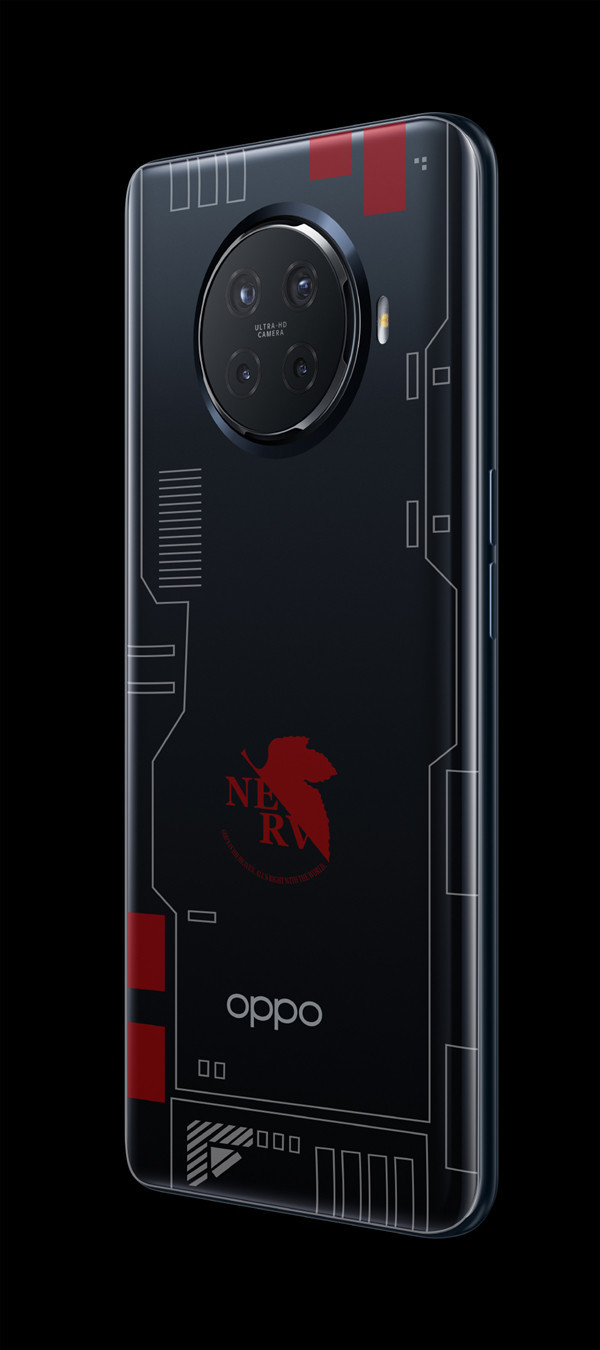
Earlier today (21st May 2020), an upcoming Oppo Ace2 special edition was spotted again on Weibo, a Chinese microblogging website. The device was the Ace2 EVA Transparent Edition, which is based on the popular anime series Neon Genesis Evangelion. While the existence of the smartphone was previously confirmed, it had yet to be launched or seen. Now, we finally have a proper look at the device.
The limited variant of the Oppo smartphone was first shared by @i冰宇宙 on his blog that revealed that the Ace2 EVA Transparent Edition was meant to commemorate the upcoming Evangelion movie. This movie was the final part of a 4 film series that retold the events of the iconic anime and was scheduled for release in June 2020. Unfortunately, this has since been delayed due to the Coronavirus pandemic.
As the name suggests, the special Oppo Ace2 variant features a unique design. On the back, one can observe the nostalgic patterns and design that is a nod to the anime and its EVAs (giant human controlled mechas/robots). The rear panel is mostly covered in a black background over which angular circuitry designs run across the back and with the series logo above the Chinese company’s own brand name.
In recent times, smartphone vendors are increasingly adopting various and popular cinematics IPs for new launches. These handsets are generally limited edition and are said to be quite popular in certain markets. The Oppo Ace2 was launched back in April 2020 and is the flagship entry from the tech giant. Thus, it is no surprise the company would wish to attract consistent sales with a special edition.
Xiaomi-backed Redmi brand is hosting a launch event on 26th May in China where the company will be launching its Redmi 10X series smartphones. Now, with just a few days left for the event, the company has confirmed the launch of RedmiBook at the same event.
The Chinese brand has shared a teaser poster online featuring an outline of a laptop or as the company calls RedmiBook. The caption along with the image goes: “The small screen for games is not fun, and the large screen for office is not portable. What size screen is the perfect size for both?”
The teaser hints that the upcoming RedmiBook, which is set to launch next week, will come with a bigger display than the standard. While the screen size is not yet known, it could be a 16-inch or 17-inch panel.
The company is also reportedly working on new laptops powered by the R5 4500U and R7 4700U processors, coupled with 16GB RAM and 512GB SSD (Samsung PM881) storage. We expect the company to share more information about the RedmiBook in the coming days.
Previously, we reported that the three upcoming laptops from the brand powered by AMD chipsets have already been listed on JD.com — RedmiBook 13 Ryzen Edition, the 2nd-gen RedmiBook 14 Ryzen Edition, and the RedmiBook 16 Ryzen Edition.
As said, the launch event is scheduled on 26th May in China where the Dimensity 820 powered Redmi 10X series as well as these new RedmiBook devices will go official. It remains to be seen if Xiaomi has any other product up its sleeves for the same event.
After teasing it a few days ago, Xiaomi has today officially launched the XiaoAI Art Speaker in its home market. With this launch, it has become the first XiaoAI speaker from the company to come with a metal body.
It has a textured metal body design with 16 million color aurora light strips. The outer body has a matte fine stone pattern and comes with seamlessly integrated touch buttons. The device comes packed with a 2.5-inch full-range speaker.
There’s also a special paper carcass and voice coil and a U-shaped duct for bass enhancement, along with DTS professional sound tuning and Stereo 2.0 support. So, two of these can be connected together for a true stereo sound experience.
Thanks to the XiaoAI, this new smart speaker from the company can also be used to control more than 2000 smart devices using voice commands, which covers and supports more than 1,600 life skills.
For those who are unaware, XiaoAI is a smart AI-powered voice assistant from Xiaomi, similar to Apple Siri and Google Assistant, but it is built specially for Xiaomi and Redmi products and is currently limited to the Chinese market.
The Xiaomi XiaoAI Art Speaker is priced at 349 yuan (approximately $49) but will be available for purchase for 299 yuan from 25th May, which roughly coverts to $42.
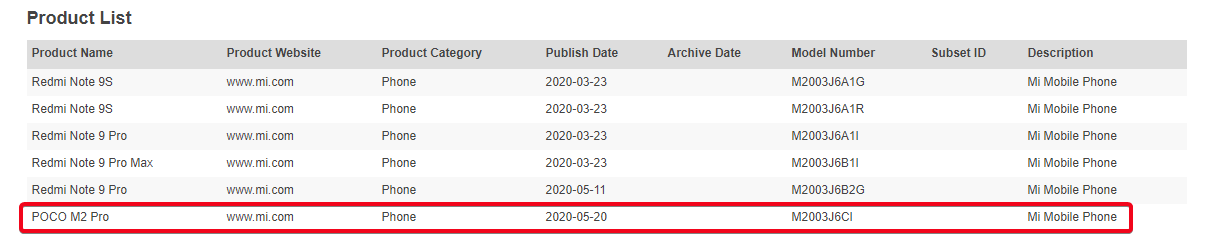
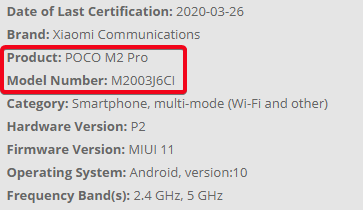
Earlier this month, a new POCO device called M2 Pro popped on Xiaomi India’s RF exposure page. The device was later confirmed by an XDA Developers finding, which suggested this handset with model number M2003J6CI could be a variant of Redmi Note 9 series. Now, the same phone has been spotted once again on Bluetooth SIG and WiFi Alliance.
1 of 2
POCO, a former sub-brand of Xiaomi became a sensation with its POCO F1 smartphone in 2018. The brand emerged once again after nearly two years with its second device called POCO X2. Then, out of nowhere, a new phone called POCO M2 Pro appeared on the web ahead of POCO F2 Pro launch.
The model number M2003J6CI associated with this phone was later traced back to the codename ‘gram’. The same was also found in the kernel source code of Redmi Note 9 Pro. In fact, there’s even a firmware tagged as ‘gram_in_global’ for POCO M2 Pro confirming it to launch in India.
Having said that, there’s no leak or listing of this handset’s specifications yet. But since it is related to Redmi Note 9 Pro, it could be powered by Snapdragon 720G or any other Snapdragon 700 series SoC.
Additionally, POCO is also set to launch its first-ever truly wireless earphones called ‘POCO Pop Buds’. But there’s not a single piece of information available regarding this product.
LG has announced a smartphone named LG Q61 in South Korea. While it may sound like a new device, it is a rebranded version of the LG K61 phone that went official in global markets in February this year. A large-sized punch-hole display and 48-megapixel quad cameras are some of the major attractions of the smartphone.
LG Q61 specifications
The LG Q61 has a 6.5-inch IPS LCD panel. There is a punch-hole positioned at the upper-left corner of its display. The screen supports full HD+ resolution and 19.5:9 aspect ratio.
The modest MediaTek Helio P35 chipset is present under the hood of the LG Q61 smartphone. The 12nm SoC is accompanied by 4 GB of RAM. The native storage of the device is 64 GB. There is a dedicated microSD card slot on the phone for more storage.
The LG Q61 has a front-facing camera of 16-megapixel. The horizontal quad-camera setup placed on the backside of the device has a 48-megapixel main lens, an 8-megapixel ultrawide sensor, a 2-megapixel macro shooter, a 5-megapixel depth sensor and an LED flash unit. The phone draws power from a 4,000mAh battery.
The Android 10 OS comes preinstalled on the LG Q61. The phone features a rear-facing fingerprint sensor and there is a dedicated hardware button for accessing the Google Assistant. The phone has a 3.5mm audio jack and it supports DTS:X 3D Surround technology. Other features of the LG Q61 include MIL-STD 810G certified chassis, Wi-Fi 802.11ac, 4G VoLTE, Bluetooth 5.0, NFC, GPS, and USB-C.
LG Q61 price and availability
The LG Q61 is priced at 369,600 KRW (~$299) in South Korea. The first sales of the phone will begin on May 29 in the home market.
Huawei introduced ‘Celia’, its own voice assistant at the launch of Huawei P40 series with EMUI 10.1. However, it did not make it to the retail units. But now the company’s homegrown assistant is finally here, albeit, it is limited to certain regions for now.
Due to the ban imposed by the US government on Huawei, the Chinese telecom had to rethink its smartphone division. It introduced Huawei Mobile Services (HMS) along with AppGallery to fill the void left by Google Mobiles Services (GMS) and Play Store.
At the Huawei P40 series launch event, the company also announced EMUI 10.1. The latest version of the brand’s mobile software also included ‘Celia’, its new voice assistant for international markets.
For the unaware, Huawei already has a voice assistant called Xiaoyi in China. It is found on the company’s smart speakers like AI Speaker 2, smartphones, and more. We believe the new Celia voice assistant could be based on Xiaoyi itself.
Huawei Celia Voice Assistant
1 of 6
Having said that, if you own a Huawei P40, P40 Pro or P40 Pro Plus, you can use Celia by changing your locale to either UK, France, Spain, Chile, Mexico or Colombia. That is because the assistant is only limited to these regions as of now.
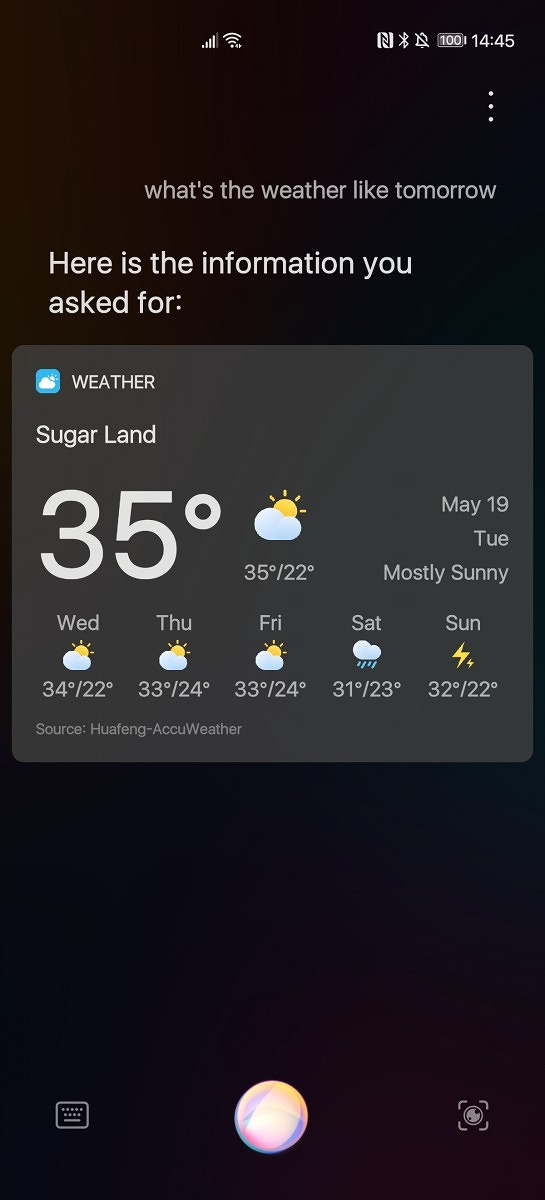
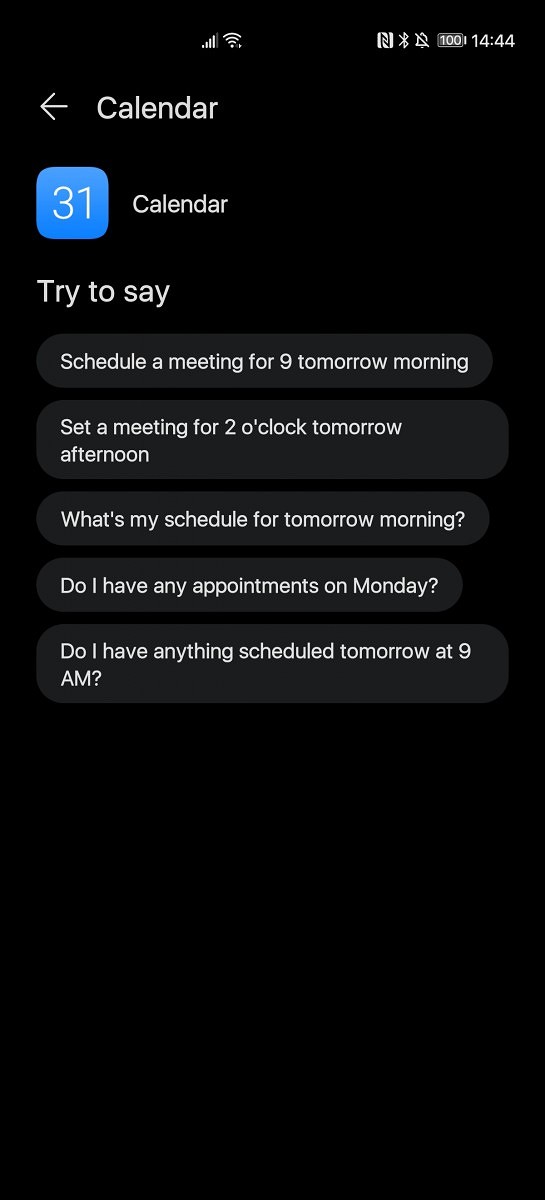
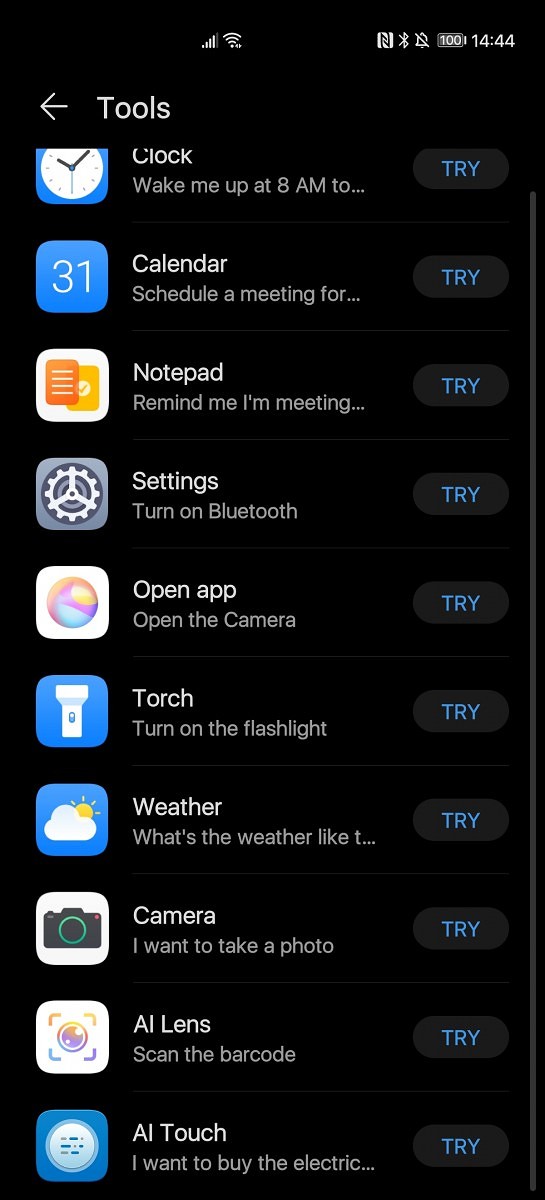
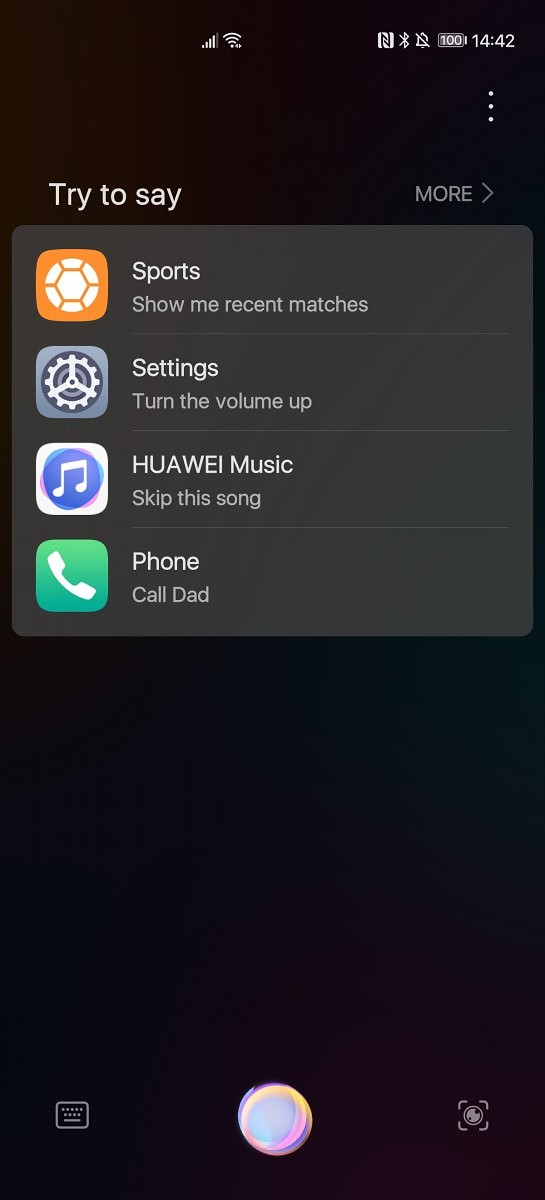
As far as languages are concerned, it can understand English (UK), Spanish, and French for now. Since Celia is intended as a replacement for Google Assitant, its UI is similar to the latter. Further, it also supports HiVision AI Lens and AI touch-shopping.
The Celia voice assistant is expected to be available on multiple Huawei and Honor smartphones with EMUI 10.1 update in the coming weeks.
Realme is now building hype around the new devices that are going to break cover on May 25 in China. One of the devices that is confirmed to get announced on the said date is the Realme X50 Pro Player Edition which is a gaming-focused variant of the Realme X50 Pro 5G flagship phone that debuted back in February. The smartphone has already appeared with all its specs on TENAA. The TENAA listing revealed that it will be borrowing most of its specs from Realme X50 Pro 5G. However, it will be arriving with downgraded cameras. The company has been revealing the gaming-focused features of the X50 Pro Player Edition. Through new posters, Realme confirmed the display details of the Player Edition phone.
The Realme X50 Pro Player Edition has a 6.44-inch S-AMOLED display. The full HD+ resolution supporting screen will offer a 90Hz refresh rate and 180Hz touch sampling rate. The Snapdragon 865 powered phone with a refresh rate display will offer enhanced gaming experience on games like PUBG and King of Fighters ’98.
The Player Edition has an HDR10+ compliant display and it carries support for DCI-P3 color gamut. It delivers a peak brightness of 1,100nits. The presence of E3 luminescent material will reduce the power consumption by the display by 7 percent.
The TENAA listing revealed that the Realme X50 Pro Player Edition has 48-megapixel + 8-megapixel + 2-megapixel + 2-megapixel quad-camera system. At the front, it has 16-megapixel + 2-megapixel dual selfie snapper.
The phone will ship with up to 12 GB of LPDDR5 RAM and up to 512 GB of UFS 3.1 storage. It will be loaded with Android 10 OS. The phone will be powered by a 4,200mAh battery that supports 65W fast charging. Lastly, it has an in-screen fingerprint reader.
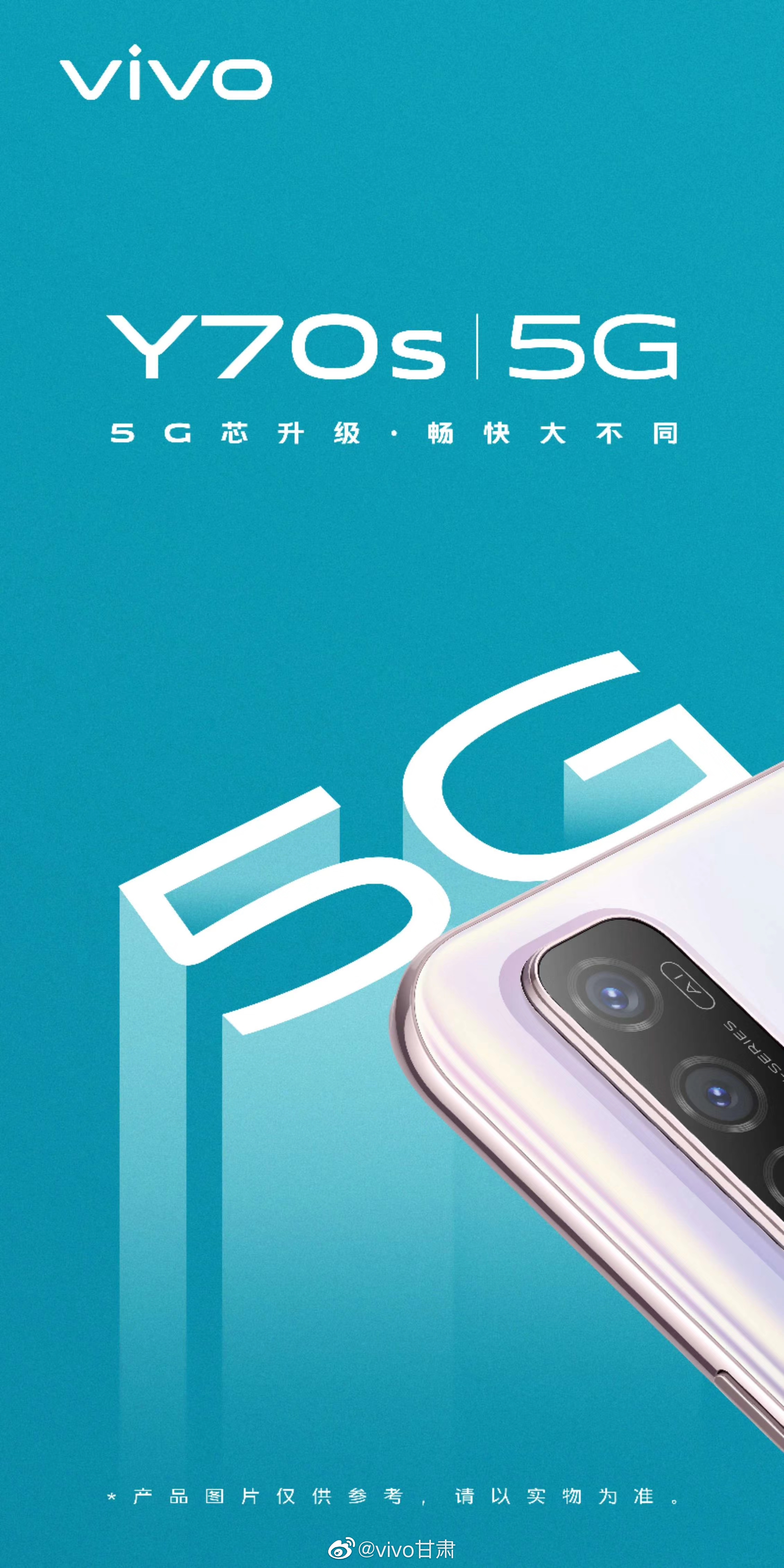
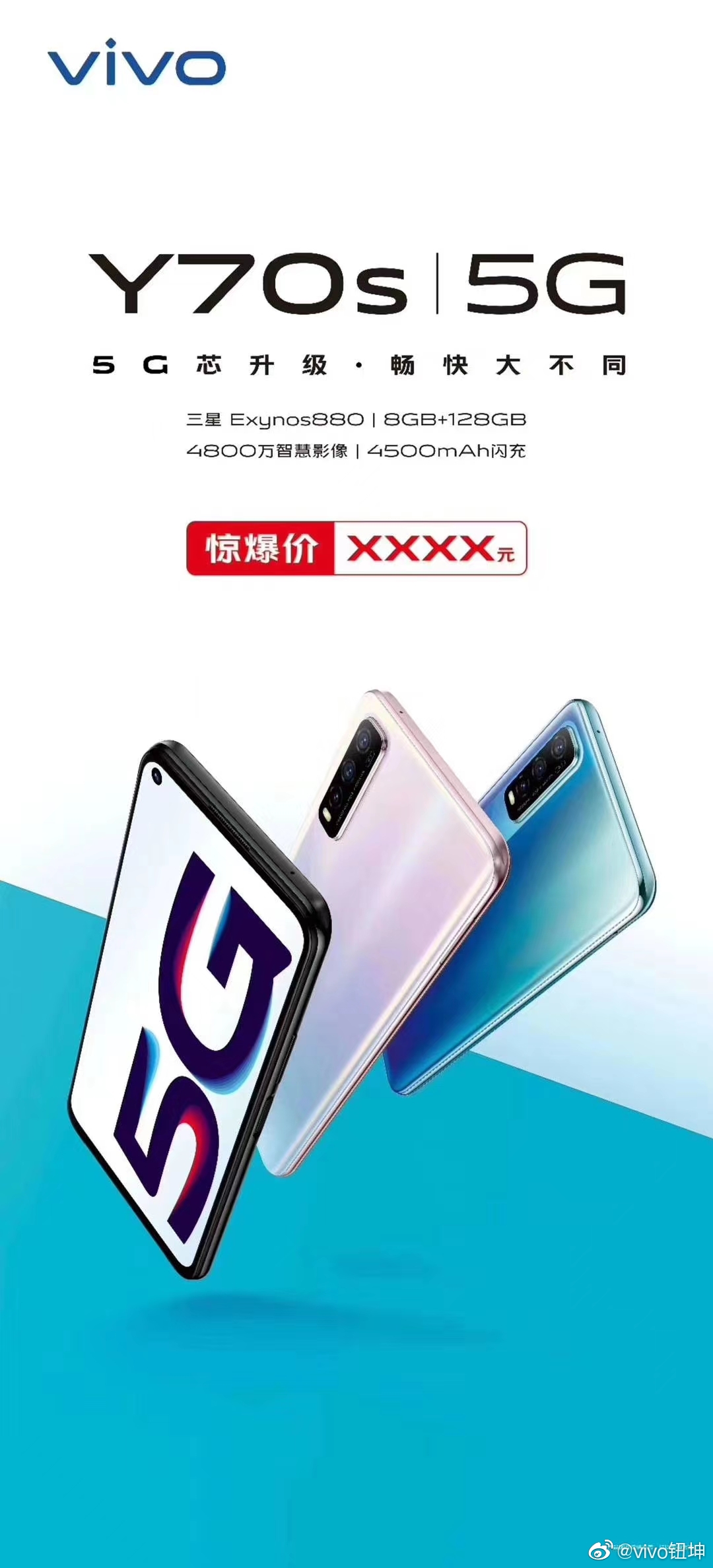
Recently, a Vivo V2002A smartphone was spotted at the Geekbench benchmarking platform. It revealed that the smartphone may debut as the world’s first phone powered by Samsung’s upcoming Exynos 880 5G chipset. The Chinese tipster who spotted the Geekbench listing first revealed that it will be debuting as Vivo Y70s. The Chinese manufacturer has released two posters of the smartphone which suggests that the launch date of the Vivo Y70s is drawing near. The two posters have revealed the appearance and key specs of the smartphone.
Vivo Y70s design and key specs
The posters reveal that the Vivo Y70s will be available in gradient color choices of pink and blue. At the front, the phone is equipped with a punch-hole screen. The presence of a side-mounted fingerprint reader is a good hint that the Y70s is fitted with an LCD panel. The back panel of the device has a triple camera system along with an LED flash.
The Vivo Y70s is now confirmed to arrive with Exynos 880 5G chipset. The SoC is said to be an under-clocked version of the Exynos 980 that was first seen on the Vivo X30 series back in December 2019.
Rumors have it that the Exynos 880 5G is an octa-core chipset featuring two cores of Cortex-A77 clocking at 2.0GHz and six cores of Cortex-A55 CPU working at 1.79GHz. The chipset includes Mali-G76 GPU. On Geekbench 5, the handset scored 641 and 1814 in the single-core and multi-core tests, respectively.
The Vivo Y70s has 8 GB of RAM and a built-in storage of 128 GB. The triple camera setup of the phone features a 48-megapixel main lens. The handset is backed by a 4,500mAh battery. The 3C appearance of the Vivo V2002A had revealed that it could be shipping with an 18W fast charger. Vivo is yet to confirm the launch date of the Vivo Y70s.
In April, Honor introduced the Honor Play 4T and Play 4T Pro budget-friendly smartphones in China. A fresh leak reveals that the Chinese firm is now gearing up to launch a new smartphone called Honor Play4 Pro. A trustworthy tipster from China who first spotted the handset on a Chinese retailer site shared its key specs and renders.
The images show that the Honor Play4 Pro is equipped with a display that has a pill-shaped cutout at the upper-left corner for its dual front-facing cameras. With a slightly thick chin and slim bezels around the display, the Play4 Pro delivers a high screen-to-body ratio.
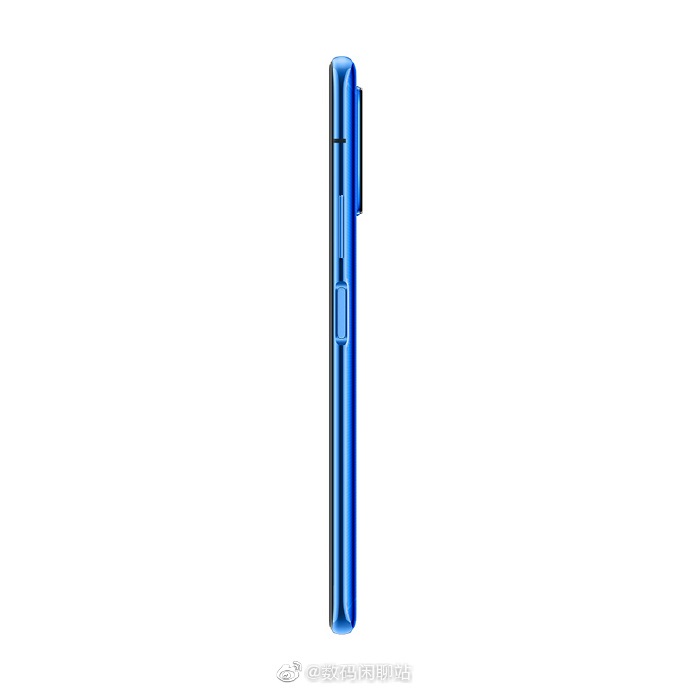
The right edge of the Honor Play4 Pro has a volume rocker. Below it is a fingerprint sensor that is embedded in the power button. The blue colored rear of the phone has a unique futuristic appeal. The top-left corner of the Play4 Pro’s rear shell has a camera module that houses dual lenses and an LED flash. The text imprinted below the cameras show that it is equipped with a 40-megapixel primary shooter.
The tipster revealed that the Honor Play4 Pro is a 5G-ready device. The exact size of its battery size is not known. It is rumored to arrive with support for 40W fast charging. The 40-megapixel lens is a flagship-grade Sony IMX600Y RYYB sensor. The image sensor is available on the Honor X10 5G phone that was announced yesterday in China. It has been previously used on flagship devices like Honor V30 Pro and Huawei Mate Xs.
The only non-flagship 5G-ready Kirin chipset by Huawei is the Kirin 820 5G. With a pricing of 1,899 Yuan, the Honor X10 is the cheapest 5G phone from Honor. The tipster claims that the Honor Play4 Pro is powered by a 5G Kirin chipset. It remains to be seen whether the Kirin 820 will be present under the hood of the Honor Play4 Pro.
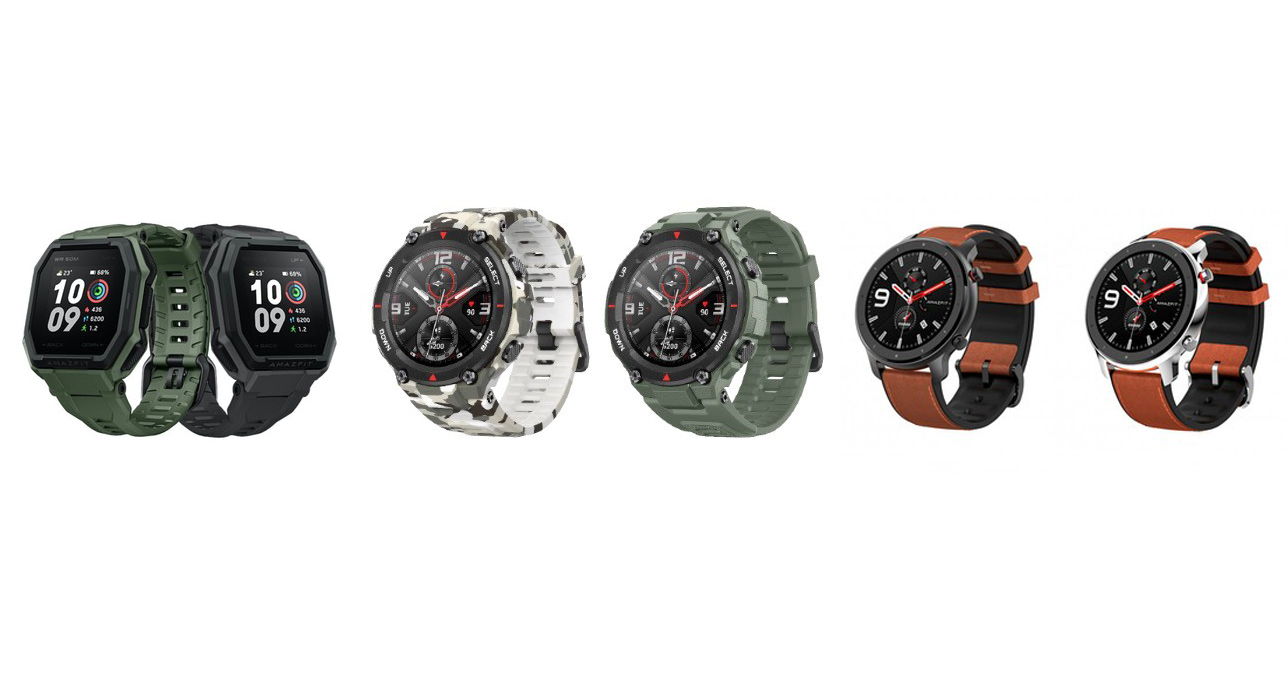
Among the best Xiaomi subsidiaries, there is Huami, a company that quickly became one of the most important manufacturers in the wearable market. Currently, there are a lot of Amazfit smartwatches in the company’s portfolio: the latest one is the Amazfit Ares. It is affordable, it is rugged and it comes with advanced specs sheets. But is it the best choice among the most recent wearables? This “internal” comparison in which we included Amazfit T-Rex and Amazfit GTR will help you find out which is the best Amazfit smartwatch for your needs.
Huami Amazfit Ares vs Huami Amazfit T-Rex vs Huami Amazfit GTR
Huami Amazfit Ares
Huami Amazfit T-Rex
Huami Amazfit GTR
WEIGHT
48 grams
58 grams
up to 40 grams
DISPLAY
1.28 inches, 176 x 176p, LCD
1.3 inches, 360 x 360p, AMOLED
1.39 or 1.2 inches, up to 454 x 454 pixels, AMOLED
RUGGED
Yes
Yes
No
MIL-STD-810G
No
Yes
No
CONNECTIVITY
Bluetooth 4.2 LE, GPS, GLONASS
Bluetooth 5.0 LE, GPS, GLONASS
Bluetooth 5.0 BLE, GPS + GLONASS
BATTERY
200 mAh, 13 days of battery life with 24-hour heart rate monitoring, 90 days in basic mode
390 mAh, 20 days of battery life with regular use, 66 days with basic mode
410 or 195 mAh, up to 24 days of regular usage, up to 72 days with basic usage
The Amazfit Ares and the Amazfit T-Rex are rugged wearables, so you do not get exactly the most elegant design. If you need the most beautiful smartwatch, you should definitely go for the Amazfit GTR. It comes in two variants differing for the materials adopted: there is an aluminum version, a stainless steel version, and even a titanium version. The straps are made either of leather or rubber and the smartwatch is waterproof up to 50 meters deep. But if you need the highest build quality, the Amazfit T-Rex is the best with its military certification, Gorilla Glass 3, resistance to high temperatures, and water up to 5 atm. Amazfit Ares sits in the middle: it is a bit rugged and it is waterproof, but it does not offer any kind of certification against drops.
Display
The most impressive display belongs to the Amazfit GTR: it boasts an AMOLED panel with a 1.39-inch diagonal and a resolution of 450 x 450 pixels (there is also a smaller version). It supports the Always On display mode, it has an oleophobic coating and it is protected by Gorilla Glass 3. Amazfit Ares has a square display that may be more comfortable for a lot of people but makes the design less attractive. Despite it does not reach the same quality as the Amazfit GTR, the Amazfit T-Rex still comes with a stunning AMOLED display with a 390 x 390 pixels resolution and it takes the silver medal.
Hardware & Software
With the Amazfit Ares, you have to renounce to an elegant design, but you get the most advanced hardware features. Just check the table above to realize it. You get more interesting sensors, resulting in features such as FIRSTBEAT and VO2max calculation. But how interesting these features depend on your kind of usage. You might even be more interested in the atmospheric pressure sensor found on the Amazfit GTR. The Amazfit Ares supports up to 70 sports modes, which is the highest number. Make your choice depending on your kind of activity.
Despite it comes with a smaller battery, the Amazfit Ares provides the longest battery life: it delivers up to 90 days on a single charge if you use it in watch mode only. But the battery life decreases a lot and it is inferior to the Amazfit T-Rex with normal usage. While the Amazfit T-Rex reaches 40 days, you can do max 14 days with the Amazfit Ares. The Amazfit GTR lasts 24 days with normal usage.
Price
Amazfit Ares is priced just €65/$71 in China and it is the smartwatch with the best value for money in this comparison. Right Amazfit GTR starts from about €103/$114, while Amazfit T-Rex is priced roughly $116/€105. While Amazfit Ares wins the value for money comparison, Amazfit T-Rex looks like the most complete wearable of this comparison.
Huami Amazfit Ares vs Huami Amazfit T-Rex vs Huami Amazfit GTR: PRO and CONS
Xiaomi, Wednesday, announced its performance report for the first quarter of 2020. The first quarter of the year 2020 was dominated by the Coronavirus epidemic in China which soon spiralled into a global health crisis. Despite the economic challenge posed by the pandemic, Xiaomi’s Q1 performance is pretty impressive as shown in the report. The company’s revenue and profit far exceeded expectations. Its 5G mobile phones also performed very well.
In the first quarter of 2020, Xiaomi Group’s revenue reached 49.7 billion yuan, an increase of 13.6% year-on-year. The company also posted an adjusted net profit of 2.3 billion yuan, representing an increase of 10.6% year-on-year. The smartphone business raked in 30.3 billion yuan, a year-on-year increase of 12.3%. This accounted for 61.0% of the company’s total revenue in Q1.
Xiaomi’s overseas market contributed 24.8 billion yuan to the company’s Q1 2020 revenue, a year-on-year increase of 47.8%. This is the first time Xiaomi’s overseas revenue would reach 50%.
In terms of smartphone units, Xiaomi sold an estimated 29.2 million units which represent a year-on-year increase of 4.7%. According to data from research firm Canalys, Xiaomi’s global market share rose to 11.1% and the company is ranked fourth globally.
Canalys data also shows that the penetration rate of Xiaomi 5G mobile phones in the Chinese market reached 25.9% which is higher than the market average. This penetration is driven by the company’s latest 5G high-end models
The company also posted results from its IoT platform as well as the smart TV business. As of March 31, the number of connected devices on the Xiaomi IoT platform reached 252 million (excluding smartphones and notebooks), a year-on-year increase of 42.6%. The number of users with five or more connected devices on the Xiaomi IoT platform also reached 4.6 million, year-on-year An increase of 67.9%. The XiaoAI voice assistant’s monthly active users reached 70.5 million, a year-on-year increase of 54.9%. Finally, Mijia app’s monthly active users reached 40 million. For the MIUI platform, monthly active users reached 330 million, an increase of 26.7% year-on-year.
The company also posted results from its other product categories. The smart TV business recorded a shipment of 2.7 million units worldwide, ranking among the top five in the world for five consecutive quarters and ranking first in the Chinese mainland market. Xiaomi routers grew 124.0% year-on-year, and Xiaomi true wireless Bluetooth headsets grew 619.6% year-on-year. Mi Band shipment also increased by 56.0% year-on-year while the Mijia electric scooters increased by 40.7%. On its part, the Mijia robot vacuum cleaner recorded an increased shipment of 40.0% YoY.
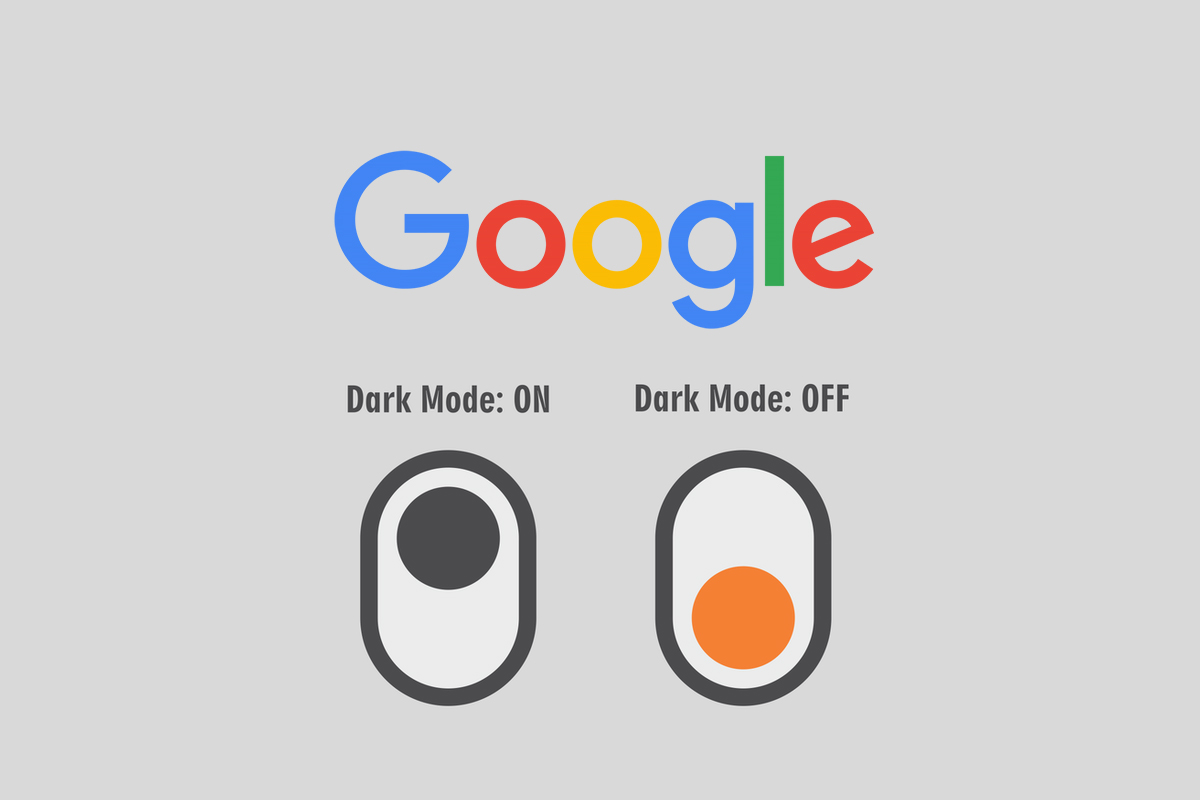
Google introduced a system-wide dark mode with the latest Android 10 operating system. But that has not been very effective considering that some apps don’t support Dark mode including some Google apps. In a bid to expand support for Dark Mode across its app portfolio, Google has announced the roll-out of Dark mode support for the Google App and Google Assistant. The feature is now available on both Android and iOS.
The feature will be available on models running Android 10 and iOS 12/13 and from the look of things, there is no need to update the apps as the update for both apps are server-side. Although the post specified Android 10, some Android 9 users are also reporting that the Dark Mode option is available on their devices.
Starting today & fully rolling out this week, dark mode is now available for the Google App on Android 10 and iOS 12/13. By default, the Google App will reflect your device’s system settings in Android 10 & iOS 13. If that’s set to a dark theme, the app will be in dark mode…. pic.twitter.com/ZqSD33ZhNt
— Google SearchLiaison (@searchliaison) May 19, 2020
For users who have already activated a system-wide Dark Mode, the apps will automatically display a dark theme. This is done by simply converting the white UI elements to black and dark grey ones. Users also have the option of toggling between light and dark mode from the Google App settings.
The new dark theme option started rolling out on May 19 and will gradually expand to more users in the coming week.
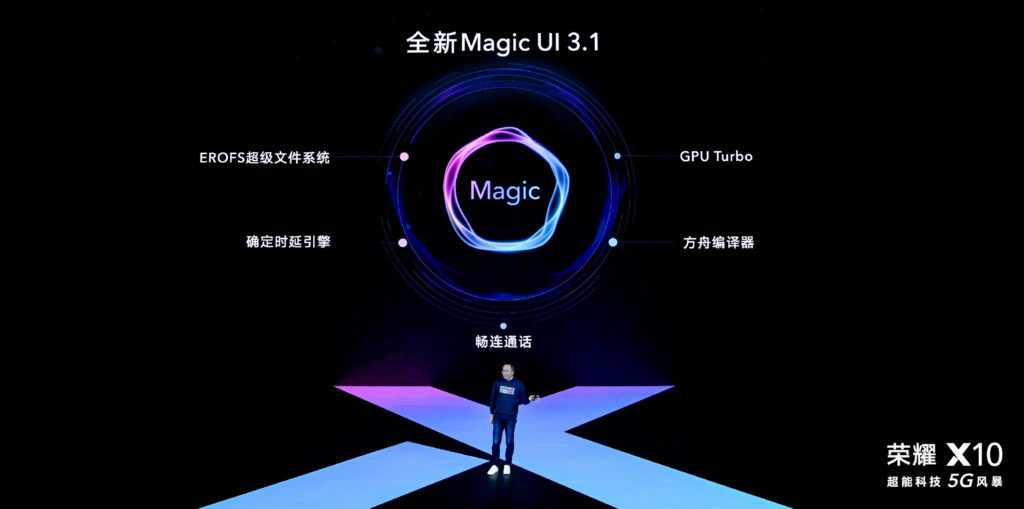
Honor launched the Honor 10X with 5G connectivity in China earlier today for a starting price of 1,899 Yuan ($268). The handset runs Magic UI 3.1, a fork of EMUI 10.1 like other recently launched Honor smartphones. The company is set to deliver its new mobile software to older handsets. Hence, at the event, it also announced the complete list of supported/eligible devices that will be receiving the Magic UI 3.1 update.
Magic UI 3.1 is similar to EMUI 10.1 in all means possible. There’s no major difference between them except for few tweaks here and there. Honor has been seeding out beta builds for eligible devices for over a month now.
Last week, the brand even rolled out the first Magic UI 3.1 Public Beta (Open Beta) build for its phones like Honor 20, Honor 20 Pro, Honor V20, and Honor Magic 2. However, the Honor 9X series received EMUI 10.1 just like during Closed Beta releases.
But now, the company has confirmed that even Honor 9X and 9X Pro will be receiving Magic UI 3.1. We think the system will be updated in the next Open Beta build followed by a stable release for the public.
That being said, here’s the final list of Honor devices that are confirmed to receive the Magic UI 3.1 update in China.
Magic UI 3.1 Supported / Eligible Devices
Honor V30 Pro
Honor V30
Honor V20 Pro
Honor V20
Honor 20
Honor 20S
Honor 20 Lite
Honor Magic 2
Honor 9X
Honor 9X Pro
Honor 9A
Do note the above-listed eligible devices for Magic UI 3.1 update is only limited to China. Honor is yet to reveal the supported devices for global markets.
The Realme X3 SuperZoom is an upcoming flagship phone scheduled to launch next week. It has already been confirmed that the phone will be announced in Europe on May 26. Now, it has been revealed that the device will head to Thailand the following day.
Realme will launch the Realme X3 SuperZoom on May 27 at 15:00 local time. The launch will be live-streamed on Facebook and YouTube. The poster also revealed Lazada and Shopee are partners which means the phone should be available on both platforms.
If you live in India, you will have to wait a few more weeks as a report by 91Mobiles says the phone will not arrive until mid-June There is no exact launch date yet but we are surprised it is not launching on May 25, the day scheduled for the launch of the Realme TV and the Realme Watch in India.
The Realme X3 SuperZoom is reported to come with a 120Hz display with a dual punch-hole. It is also said to have a Snapdragon 855+ processor, quad rear cameras with 60x zoom, and a 4200mAh battery with 30W fast charge.
We use cookies on our website to give you the most relevant experience by remembering your preferences and repeat visits. By clicking “Accept”, you consent to the use of ALL the cookies.
This website uses cookies to improve your experience while you navigate through the website. Out of these, the cookies that are categorized as necessary are stored on your browser as they are essential for the working of basic functionalities of the website. We also use third-party cookies that help us analyze and understand how you use this website. These cookies will be stored in your browser only with your consent. You also have the option to opt-out of these cookies. But opting out of some of these cookies may affect your browsing experience.
Necessary cookies are absolutely essential for the website to function properly. This category only includes cookies that ensures basic functionalities and security features of the website. These cookies do not store any personal information.
Any cookies that may not be particularly necessary for the website to function and is used specifically to collect user personal data via analytics, ads, other embedded contents are termed as non-necessary cookies. It is mandatory to procure user consent prior to running these cookies on your website.