In a recent interview, Steve Mollenkopf, the CEO of Qualcomm, talked about the company’s current relationship with the Cupertino based giant, Apple. The two companies had fought a legal battle but the senior Qualcomm official feels that the relations are “much more natural now.”
For those unaware, Apple had accused Qualcomm of ‘double dipping’ (basically making Apple pay for the sale of chips and its patent license, which is illegal in some cases) and the iPhone maker then proceeded to withhold any payments to the known chipmaker. However, while the accusations had landed both sides to the court, the two sides announced a massive settlement at the very last minute right before the trial actually began. This deal as Mollenkopf puts it, made the relationship between the two companies much more natural.
The Qualcomm CEO further added that “the discussion is really about products and how do we launch products as fast as possible. It’s much more natural.” Notably, Apple is expected to bring 5G networking to the iPhone 12 lineup through Qualcomm modems, so this might be a step towards better cooperation between both sides in the future. The interview was taken by Bloomberg and had Steve Mollenkopf also discuss the effects of the Coronavirus pandemic.
According to the CEO, Qualcomm “saw a pretty substantial drop in the China market. In the month of February, it really dropped pretty significantly. But what was surprising, it actually rebounded pretty quickly as well. It took about five weeks for it to correct itself and get back to a level of sell-in that’s not too different from what it was a year ago. In the process of doing that, it actually transitioned more of the phones as a percentage to 5G.”
Samsung has announced its plan to launch a Samsung Pay debit card this summer. The company says that the card will be backed by a cash management account and will be launched in partnership with personal finance company SoFi.
According to Sang Ahn, Vice President and General Manager of Samsung Pay in North America, the company is developing a “mobile-first money management platform” but has not revealed what features that platform or the upcoming debit card may offer. However, the company said that it will reveal more information about this in the coming weeks.
The development comes after Apple launched its own credit card named Apple Card last year in partnership with Goldman Sachs. There are reports claiming that Google is also working on a debit card of its own and is said to offer spending-tracking tools.
Samsung Pay was launched in 2015 as a way to allow select Galaxy devices to pay at virtually any terminal through Magnetic Secure Transmission (MST). This is different than NFC technology which is what Google Pay and Apple Pay uses.
Following the footsteps of Apple, Chinese giant Huawei has also launched its own Huawei Card in China last month. It is available in both physical and virtual form and the company says that it will wave-off annual fee for the early adopters for the first year.
Huawei’s sub-brand Honor is all set to launch its new Honor X10 5G smartphone in China on 20th May. Ahead of the launch, key specifications and features of the upcoming device have been surfacing online. In the latest development, the camera samples of the smartphone from Everest expedition have been released by the company.
Honor says that Li Pau and Cai Qing from 2020 Everest Survey Mountaineering Team took some stunning images using the Honor 30 Pro Plus and the upcoming Honor X10 5G. Here are the images captured using the new Honor X10 5G smartphone.
The smartphone is expected to come with a triple-camera setup on the back consisting of a 40-megapixel primary sensor, an 8-megapixel secondary lens, and a 2-megapixel tertiary sensor. For the main lens, the company is expected to use Sony IMX600y custom sensor.
On the front side, the device is said to be equipped with a 16-megapixel snapper housed inside a pop-up camera module. The smartphone will reportedly come with a 6.63-inch Full HD+ IPS LCD display with 20:9 aspect ratio and without any notches.
Under the hood, it will be powered by the company’s own Kirin 820 5G chipset, along with 4/6/8 GB of RAM and 64/128/256 GB internal storage. The phone houses a 4,200mAh battery that supports 22.5W fast charging through USB Type-C port.
The Honor X10 5G is expected to be the cheapest 5G-compatible smartphone from the company and is likely to be priced around 2,000 yuan which roughly converts to $282. To know for sure, we’ll have to wait for the official launch on 20th May.
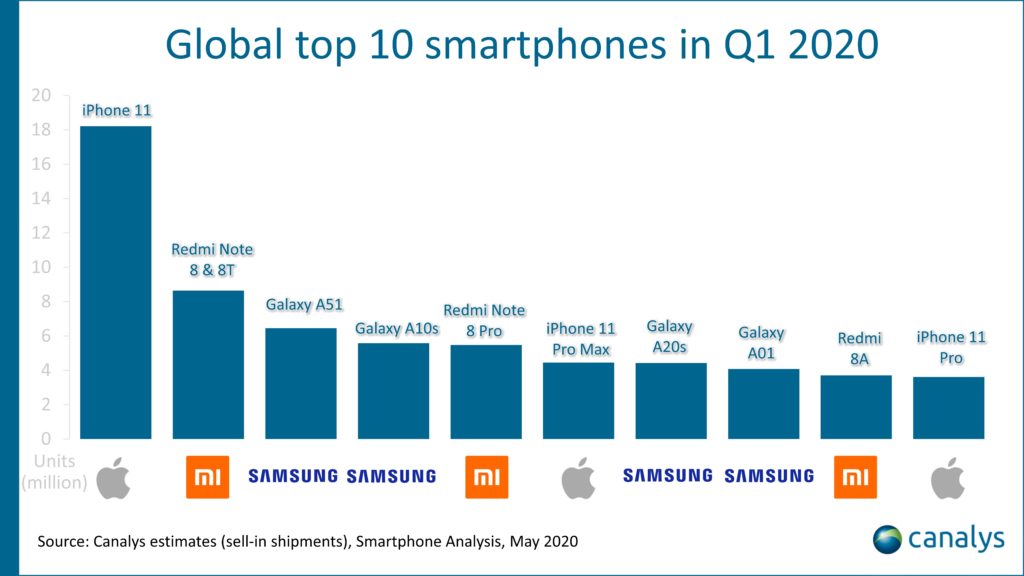
Despite pandemic, some smartphones sold more than others in Q1 2020. Canalys has tweeted an image disclosing the top 10 global smartphone models shipments in that period. Interestingly, only three OEMs make up the whole list namely Apple, Xiaomi, and Samsung.
According to Canalys, Apple was the leading company with its iPhone 11 shipping over 18 million units. The second place was held by Xiaomi’s Redmi Note 8 and Redmi Note 8T with over 8 million units.
Whereas, Samsung Galaxy A51 and Galaxy A10s occupied the third and fourth positions respectively with shipments over 6 and 5 million units.
The fifth place was conquered by another Xiaomi device, Redmi Note 8 Pro with over 5 million units. Then, iPhone 11 Pro Max with over 4 million held the sixth position, followed by two more Samsung handsets, Galaxy A20s and Galaxy A01 at seventh and eighth places with over 4 and 3 million units respectively.
The last two positions were occupied by Redmi 8A and iPhone 11 Pro with over 3 million units each. That said, we don’t have the exact number of shipments as Canalys is yet to reveal it.
Looking at the picture, we can clearly see there’s a huge gap between the first and the second places. Pricing the iPhone 11 aggressively has helped Apple sell a ton of this model. Also, it is interesting to note that more people bought iPhone Pro Max than the standard iPhone 11 Pro.
Further, Xiaomi’s Redmi A series sell more than other models usually but in the last quarter, the Redmi Note 8 series shipped higher than the Redmi 8A. As for Samsung, like always, its budget smartphones, the Galaxy A series to be exact, were the bestsellers occupying four places.
Xiaomi’s Mijia brand has revealed through a new post on Weibo that the company is all set to launch a new home water purifier in China on 11th May.
The company is also promoting the upcoming product with slogans like “good soup, good meal, and good skin.” It also added that this new product is “delicious”. All these claims from Xiaomi hints that the purifier will have a soft water feature.
The water quality in most part of China is hard water containing more mineral content and largely includes more soluble calcium and magnesium compounds. On the other hand, soft water contains low concentrations of ions and is low in ions of calcium and magnesium.
However, the company has not yet announced anything related to this water purifier. It remains to be seen what Xiaomi is planning to offer in terms of features for this upcoming product. To know for sure, we’ll have to wait a couple of days more.
The upcoming product won’t be the first water purifier coming from Xiaomi. The company has launched several such products in India. Last year, in September, the Xiaomi Water Purifier C1 was launched which comes with three faucet outlets and 4-level RO filtration. Recenly, Xiaomi-backed Viomi launched Yunmi S2 600G water purifier.
India went under lockdown on 17th March and since then only essential services related businesses are allowed to operate. However, after extending the lockdown again on 3rd May, the Indian government is loosening up restrictions.
Samsung, which has been severely hit because of the coronavirus pandemic, has now come up with a new solution. As e-commerce deliveries still remain unavailable in various parts of the country because of lockdown, the South Korean giant is bringing the retail stores online for selling phones.
The company has partnered with Benow to bring retailers online and connect them with local customers. Samsung claims that more than 20,000 retailers have already signed up to the platform and says that it’s a win-win for retailers and customers.
For getting registered, Samsung shares dealer’s information with Benow which then shares a registration link and its app. The retailer can then list all the smartphones up for sale and share the store link with others. Customers in the locality of the store can select the smartphone, make the payment and then the retailer will deliver the product to customer.
The move from the South Korean company comes at a time when it needs to boost its own smartphone sales in the Indian market. Samsung, which was once dominating the Indian market in terms of smartphone sales, lost the crown to Xiaomi a few quarters ago. Now, for the first time, Vivo has overtaken Samsung for the second position in the Indian market during the first quarter of this year.
Samsung comes in at the third position with shipment of 6.3 million units and 18.9 percent market share, followed by Realme and OPPO. Vivo nearly doubled its shipments in India year-on-year to 6.7 million units, capturing almost 19.9 percent of the market. Xiaomi remains the leading smartphone brand in the country with 10.3 million units and 30.6 percent market share.
Realme is rumored to be working on the launch of the Realme X3 series. Multiple reports have revealed the existence of a phone called Realme X3 SuperZoom. The moniker suggests that the phone could be equipped with a periscope zoom lens that will bring support for higher zooming capabilities. A tipster has revealed that the Realme X3 SuperZoom will support 60x zoom.
According to the tipster, the 60x zoom feature on the Realme X3 SuperZoom will be called “Starry Mode.” This mode will allow users to capture shots of the Milky Way. At present, there is no word on the camera configurations of the Realme X3 SuperZoom.
In April, the Realme X3 SuperZoom bagged certification from the NBTC certification body of Thailand and it also appeared on Geekbench. The listing at the benchmarking platform revealed that the X3 SuperZoom has 12 GB of RAM, Snapdragon 855 or 855+ and it runs on Android 10 OS. In the same month, the smartphone also received approval from the Bluetooth SIG authority.
This mysterious Realme phone could be Realme X3 series phone
The same tipster who revealed the inclusion of Starry Mode on the Realme X3 SuperZoom recently claimed that it will be arriving with a 4,200mAh battery. He also claimed that the phone will carry support for 30W fast charging. The other specs of the Realme X3 SuperZoom are currently under the wraps.
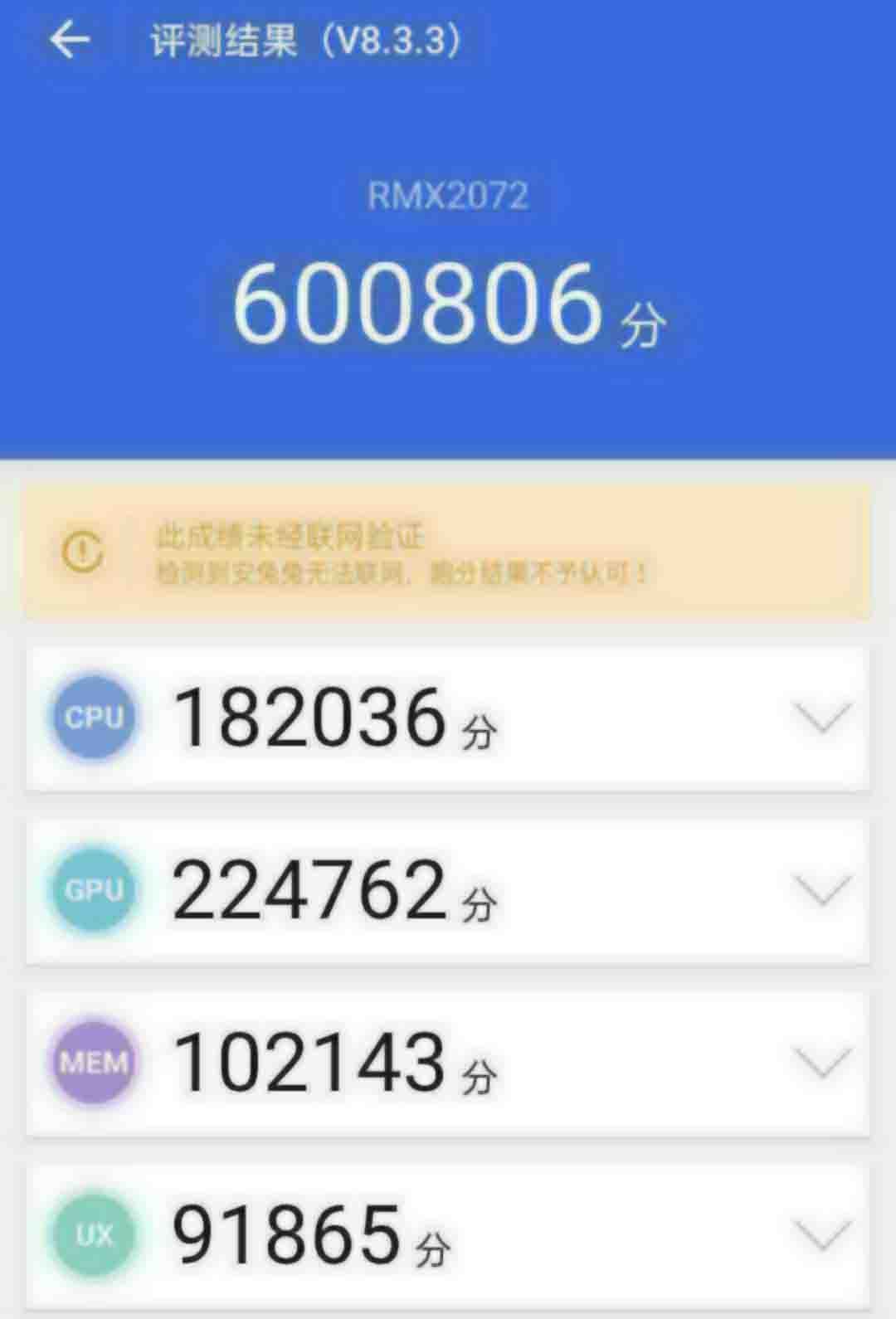
Rumors surrounding the Realme X3 series that it may include three devices. There could be a vanilla model, the Realme X3 SuperZoom phone, and the Realme X3 Pro. The Pro had reportedly appeared on AnTuTu with model number RMX2072 and benchmarking scores of 600,806. The X3 Pro is speculated as the last Snapdragon 865 powered phone for the first half of 2020. Hopefully, more details on the Realme X3 lineup will appear in the coming weeks.
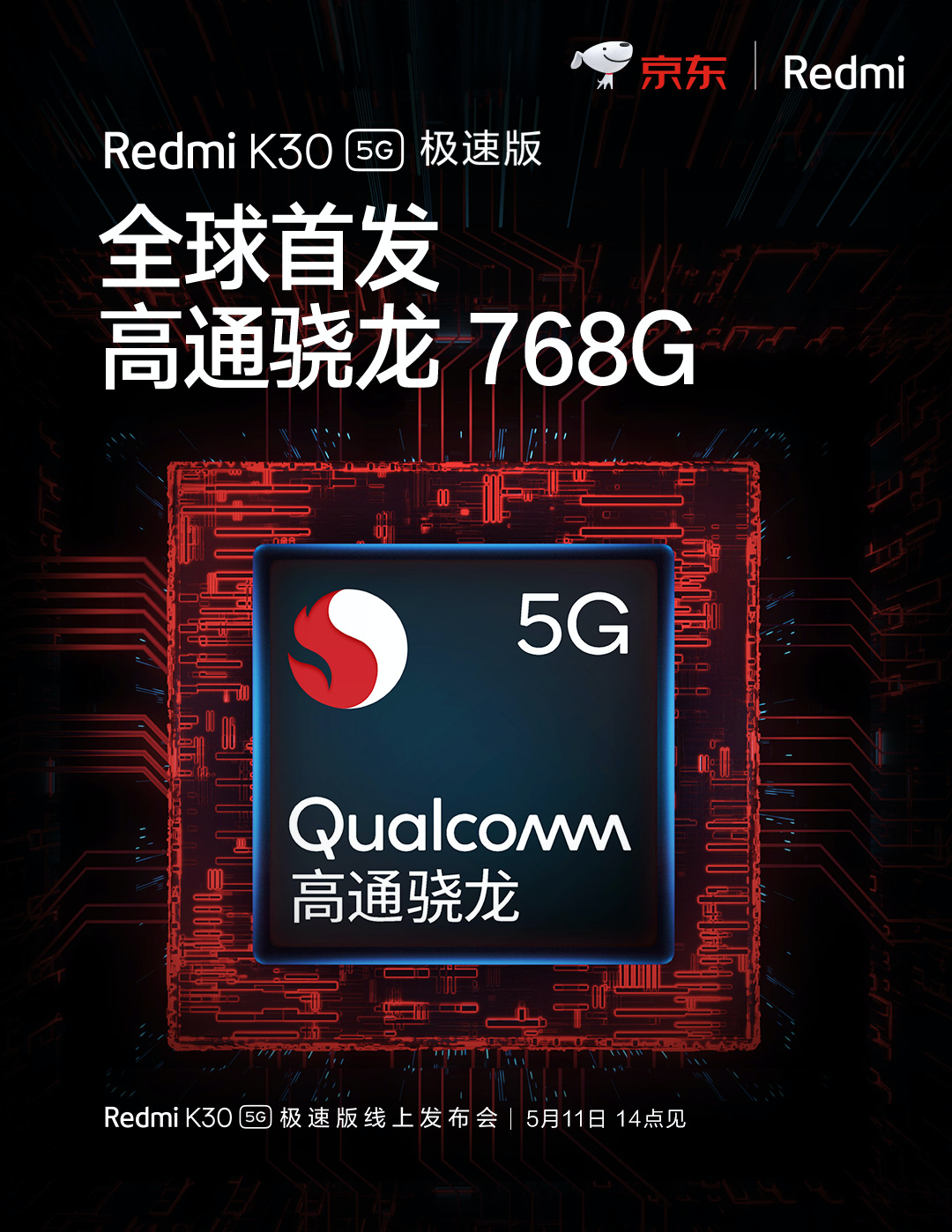
Update: Redmi has released an official confirmation that the Redmi K30 5G Extreme Edition features the all-new Snapdragon 768.
Original story…
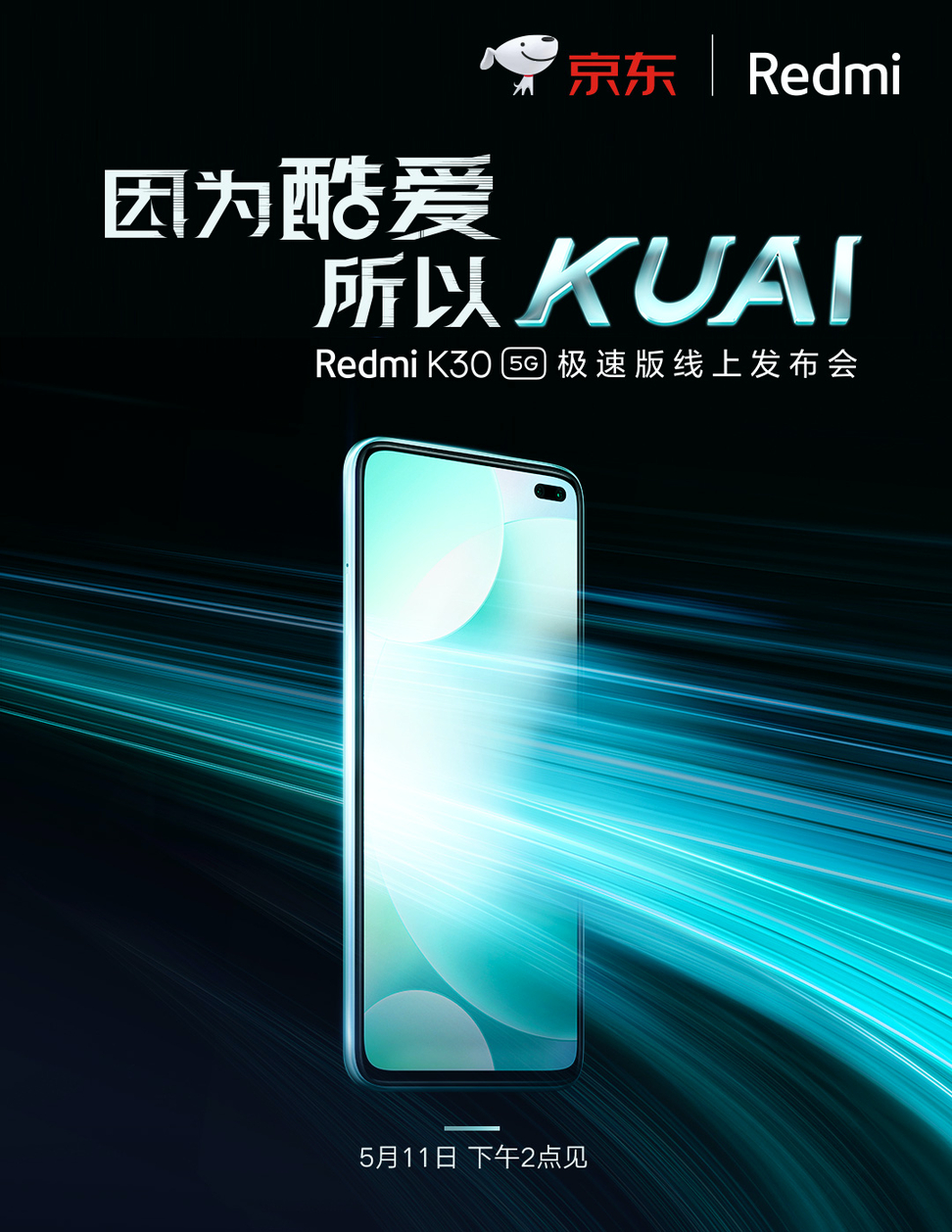
In December 2019, Redmi announced the Redmi K30 5G smartphone. It arrived as the company’s first smartphone with 5G capabilities. It carried a starting price of 1,999 Yuan. Recent reports had revealed that the Chinese brand is working on a slightly weaker version of the phone. The rumor mill even speculated that the device may go official as Redmi K30i. Today, Redmi confirmed through Weibo that it will be unveiling the Redmi K30 5G Extreme Edition on May 11. Probably, it could be the actual name of the rumored Redmi K30i.
First of all, the Redmi K30 5G Extreme Edition moniker itself is a good hint that it is a variant of the Redmi K30 5G phone. The poster reveals that the brand has teamed up with Chinese retailer JD.com for the launch of Redmi K30 5G Extreme Edition. The poster also reveals the handset will be equipped with a dual punch-hole screen like the Redmi K30 5G. Redmi has not revealed any other information about the smartphone. The unveil event of the Redmi K30 5G Extreme Edition will start at 2 PM (local time) in China.
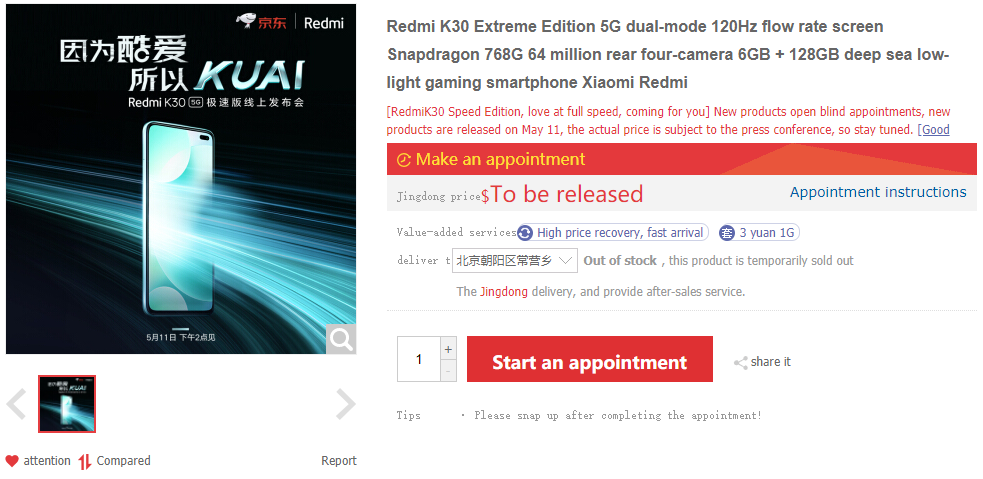
The Redmi K30 5G Extreme Edition is now listed for reservations on JD.com. The listing has revealed some of the key features of the phone. It states that the Redmi K30 5G Extreme Edition’s display supports 120Hz refresh rate and it is fueled by the unannounced Snapdragon 768. The SD768 SoC appears to be an enhanced version of the Snapdragon 765G mobile platform that is present under the hood of the Redmi K30 5G.
The listing further states that the Redmi K30 5G Extreme Edition has 6 GB of RAM. The phone has a native storage of 128 GB. On its rear, it features a 64-megapixel quad-camera system.
It is still unclear whether the Redmi K30 5G Extreme Edition is the rumored Redmi K30i. The reason behind this is that it the K30i was speculated to arrive with a 48-megapixel primary lens on its rear-facing camera system.
Mount Everest has long been closed to expedition both on the Chinese and Nepal side due to the Corovirus pandemic. However, China recently opened its side located in Tibet to a Chinese expedition team. The 30-member team of Chinese surveyors recently set out from the base camp at an altitude of 5,200 metres to a higher altitude in an attempt to reach the summit and re-evaluate the summit’s measurement. Mount Everest’s peak has a height of 8,848 metres from the base. If successful, it is said to go into the record as the first time professional surveyors in China would scale to the summit of Mount Everest.
The team is deploying an unusual tool to help in the measurement – the Mi 10 Pro. Yes, after its exploit in capturing shots from outer space, the camera is again being put to use for the Mount Everest elevation re-testing project.
The Xiaomi Mi 10 Pro comes with an advanced quad-camera setup that includes a 108MP primary camera with a 10X hybrid/50x digital optical zoom lens, a dedicated portrait lens, and a wide-angle lens. Some of the photos captured during the expedition from the base camp as shared by Xiaomi are posted below.
Last week, some variants of the upcoming Samsung Galaxy A21s smartphone received certification from the Bluetooth SIG authority. The smartphone is expected to arrive as an enhanced version of the Galaxy A21 handset that debuted in April. 91mobiles has come across a promo video of the phone through which its key features have been revealed.
The promo video showcases the Live Camera feature that will be available on the Galaxy A21s. It will let users to make use of the default camera app to broadcast live videos on platforms like YouTube, Facebook and Instagram. The phone will also come with AR Doodle feature. The promo video also reveals that the Galaxy A21s will come in color editions like black, white and blue colors.
Samsung is yet to tease the arrival of the Galaxy A21s phone. The rumor mill has already leaked the key specifications of the smartphone. The handset is rumored to house a 6.5-inch IPS LCD that produces HD+ resolution of 720 x 1600 pixels.
It may feature a new chipset called Exynos 850. The phone may come with 3 GB of RAM. It may offer users native storage of 64 GB and carry support for the microSD card slot. The One UI 2.0 based Android 10 OS is most likely to arrive preinstalled on the smartphone.
The Galaxy A21s is likely to feature a 5,000mAh battery. It may possess a front camera of 13-megapixel. The back panel of the phone could be fitted with a 48-megapixel + 8-megapixel + 2-megapixel triple camera system. The phone will come with some other features such as dual-SIM slot, dual 4G VoLTE, Wi-Fi 802.11ac, micro USB, NFC, 3.5mm audio jack, and rear-facing fingerprint reader.
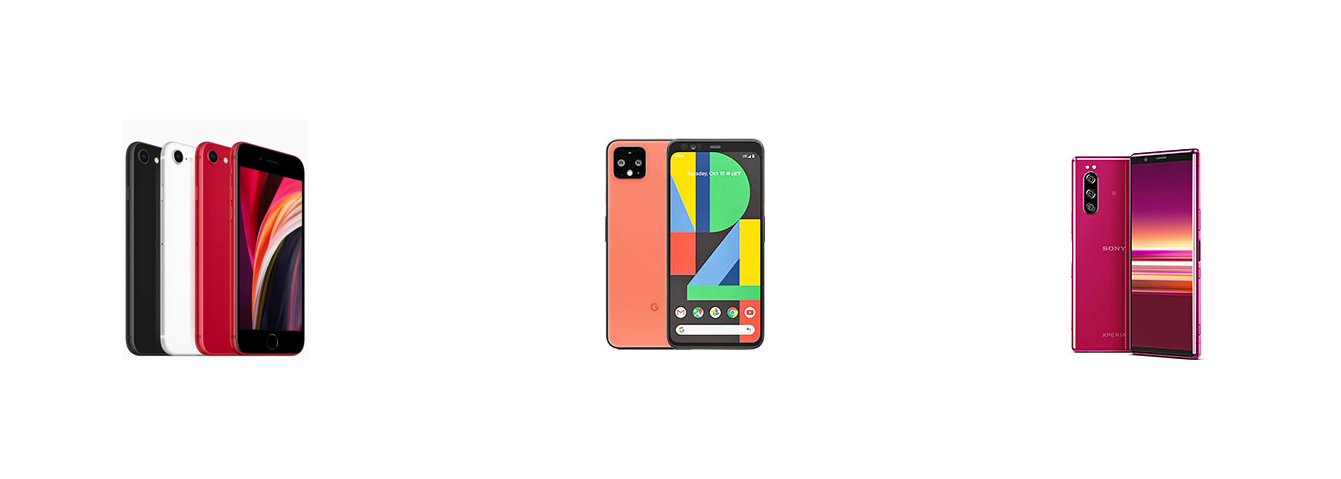
Compact flagships are rare in the actual smartphone market. That is why when one of them gets released there is always an important hype. The latest compact flagship released is the new iPhone SE 2020 by Apple. It promises the same performance as the iPhone 11 series in a compact body and at an affordable price compared to other Apple phones. But is it really the best compact smartphone out there? In order to establish it, we decided to compare it with other recent compact flagships in the Android world: the vanilla Google Pixel 4 and the Sony Xperia 5 which replaced the Xperia Compact series.
Apple iPhone SE 2020 vs Google Pixel 4 vs Sony Xperia 5
Google Pixel 4
Apple iPhone SE 2020
Sony Xperia 5
DIMENSIONS AND WEIGHT
147.1 x 68.8 x 8.2 mm, 162 g
138.4 x 67.3 x 7.3 mm, 148 grams
158 x 68 x 8.2 mm, 164 g
DISPLAY
5.7 inches, 1080 x 2280p (Full HD+), P-OLED
4.7 inches, 750 x 1334p (Retina HD), Retina IPS LCD
Dual 12.2 + 16 MP, f/1.7 and f/2.4
8 MP f/2.0 front camera
Single 12 MP f/1.8
7 MP f/2.2 front camera
Triple 12 + 12 + 12 MP, f/1.6, f/2.4 and f/2.4
8 MP f/2.0 front camera
BATTERY
2800 mAh, fast charging 18W and Qi wireless charging
1821 mAh, fast charging 18W, wireless charging Qi
3140 mAh, fast charging 18W
ADDITIONAL FEATURES
Dual SIM slot, IP68 waterproof, eSIM
IP67 water resistant, eSIM
Hybrid Dual SIM slot
Design
iPhone SE 2020, Google Pixel 4, and Sony Xperia 5 all come with a premium design including a glass back and an aluminum frame. But I define the Sony Xperia 5 as a much more attractive device due to its narrower bezels around the display and its CinemaWide 21:9 aspect ratio. On the other hand, it is the device with the biggest dimensions in this trio. The most compact, lightweight, and thinnest one is the Apple iPhone SE which measures 138.4 x 67.3 x 7.3 mm and weighs just 148 grams. However, it has an outdated design: the same as the iPhone 8 released back in 2017.
Display
Each of these devices offers a pretty nice display panel. But my favorite one belongs to Google Pixel 4. It is the only to offer a 90 Hz refresh rate and, besides providing the OLED technology and a Full HD+ resolution, it is HDR-compliant. Sony Xperia 5 lacks a high refresh rate just like the iPhone SE, but it still offers an amazing OLED display with HDR and advanced technologies borrowed from Sony Bravia TVs. Unfortunately, iPhone SE has an IPS panel with a lower resolution, but it comes with a wider color gamut and the True Tone technology. Further, the handset is the most compact with a diagonal of just 4.7 inches. iPhone SE and Sony Xperia 5 rely on a fingerprint scanner for authentication, while Google Pixel 4 supports 3D facial recognition.
Hardware/Software
The most performing handset here is the iPhone SE: it is equipped with the same Apple A13 Bionic SoC found on the iPhone 11 lineup and the iOS operating system offers a more advanced level of optimization. You should not notice big differences between Google Pixel 4 and Sony Xperia 5 since they pack the same Snapdragon 855 chipset paired with 6 GB of RAM and UFS 2.1 internal storage. Sony Xperia 5 is the only with a micro SD slot to expand the internal storage, but unlike the Google Pixel 4 running Android 10, it runs Android 9 Pie out of the box.
Camera
It is very hard to pick a winner in this trio: all of these devices are amazing camera phones, each with its pros and cons. In my opinion, Google Pixel 4 provides the most amazing image quality in a lot of scenarios, but Sony Xperia 5 is more or less at the same level and, unlike the Google Pixel 4 and the iPhone SE, it packs an ultrawide sensor. iPhone SE shines when it comes to video recording with an awesome stabilization and sharpness. Google Pixel 4 shoots amazing selfies and it is the only with a dual front camera including a TOF 3D sensor.
Battery
The longest battery life is provided by the Sony Xperia 5 which also packs a bigger 3140 mAh battery. But the Sony Xperia 5 does not support wireless charging, unlike Google Pixel 4 and iPhone SE. The silver medal goes to the Google Pixel 4 with its 2800 mAh battery.
Price
iPhone SE starts from €499/$399, Google Pixel 4 begins at $799/€749, and Sony Xperia 5 has an €800/$800 starting price. Thanks to actual street prices, you can get Google Pixel 4 and Sony Xperia 5 at way lower prices. There is not a definitive winner of this comparison. Sony Xperia 5 wins when it comes to battery life, Google Pixel 4 offers a 90 Hz display, iPhone SE has the highest performance. When it comes to cameras, they are all pretty nice. Call me unpopular, but my choice would be Sony Xperia 5 due to its battery. Which one would you pick?
There are indications that Chinese phone maker Realme is presently working on a second smartphone powered by Qualcomm’s latest flagship Snapdragon 865 chipset. A screenshot of the AnTuTu benchmark page for the device bearing the codename RMX2072 has now been spotted online.
The device posted a score of over 600,000 on AnTuTu which is an indication that it is powered by a Snapdragon 865 chipset. The model number is similar to that of the Realme X3 (RMX2141) which was certified by TENAA a few weeks ago. Realme X3 SuperZoom (RMX2086)also leaked recently packing the older Snapdragon 855+ chipset used on the X2 Pro.
This model is speculated to be the Reame X3 Pro. Based on the AnTuTu benchmark memory score, the device will come with UFS 3.1 storage as against the UFS 3.0 flash storage on the X2 Pro. The popular leakster @IceUniverse tips this model to be a gaming phone.
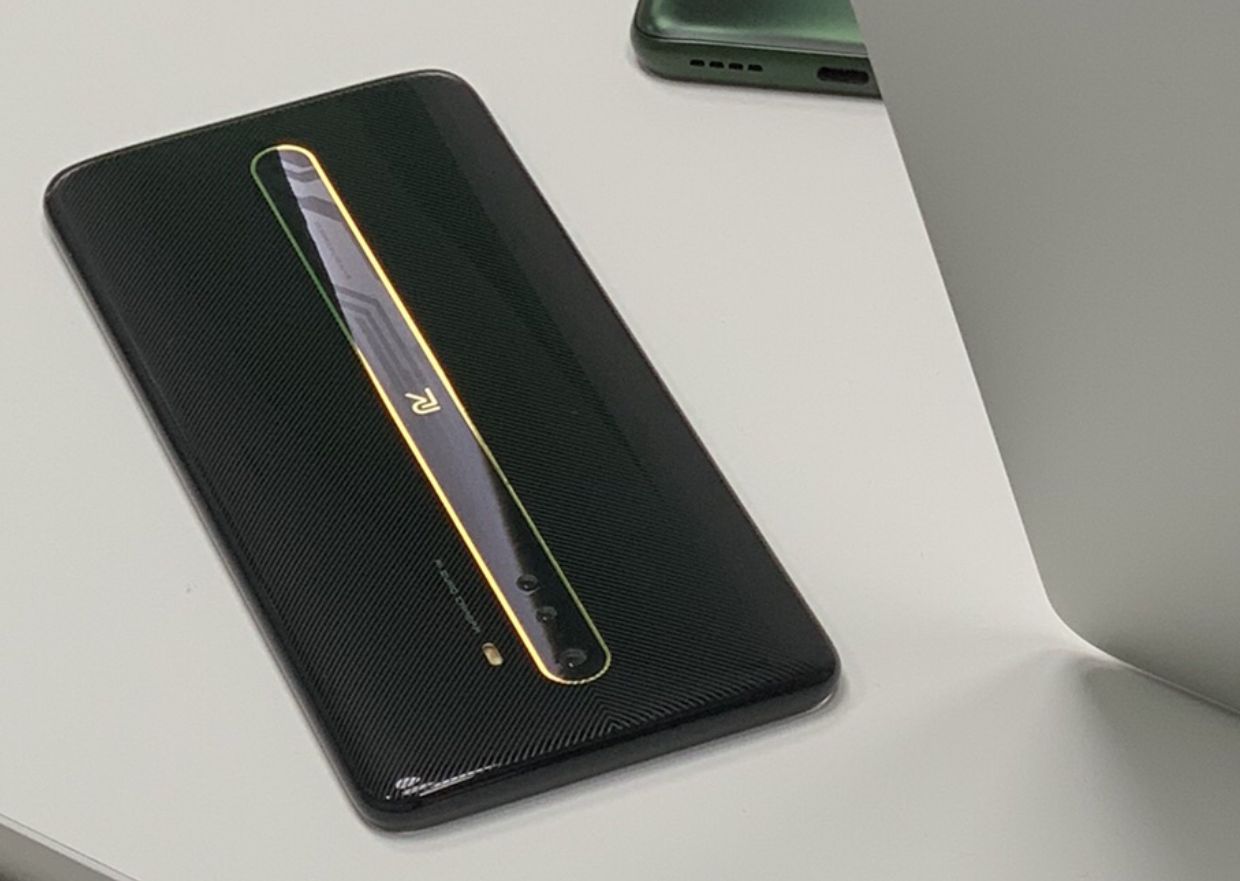
If this is the mysterious Realme phone that leaked back in April, then we expect it to have a distinctive vertical stripe running down the middle of its back. The stripe will hold a triple rear camera and the Realme logo.
Today, MediaTek announced the Dimensity 1000+, a processor that improves upon the Dimensity 1000. The launch of the new processor is weird seeing as the Dimensity 1000 itself is yet to appear in a phone. If you are curious as to what is different between the two processors, this post should help you with that.
The Dimensity 1000+ actually doesn’t differ from the Dimensity 1000 in areas such as CPU and GPU configuration and their respective clockspeeds. The differences are actually in additional features baked into already existing technologies. The table below is a comparison of the two processors:
Dimensity 1000 versus Dimensity 1000+
Dimensity
1000
Dimensity
1000+
CPU
4x Cortex-A77 cores clocked at 2.6GHz
4x Cortex-A55 cores clocked at 2.0GHz
4x Cortex-A77 cores clocked at 2.6GHz
4x Cortex-A55 cores clocked at 2.0GHz
GPU
Mali-G77 MC9
Mali-G77 MC9
Process
7nm
7nm
Display Refresh Rate
120Hz FHD+
90Hz QHD+
144Hz FHD+
120Hz FHD+
90Hz QHD+
MiraVision Engine
Yes
Yes, with the following new features:
AI-PQ - Real time dynamic adjustment of contrast, color, sharpness and color levels of 4K videos.
MiraVision Enhanced HDR10+ (better than HDR10+) Video
Playback
SDR to HDR conversion
HyperEngine 2.0
Yes
Yes, with the following new features:
Resource Management Engine for better game performance with minimal power consumption.
Rapid Response Engine creates lag-free gaming experience with multi-peripheral co-existence and avoidance of interference.
Updated Network Engine allows data connection remains live when a call is received.
AV1 Hardware Decoding
Yes
Yes
AI Processing Unit
APU 3.0
APU 3.0
5G Modem
2 carrier aggregation
SA and NSA network support
Sub-6GHz network support
5G UltraSave Technology
2 carrier aggregation
SA and NSA network support
Sub-6GHz network support
As you can see above, the Dimensity 1000+ brings additional benefits in areas such as the modem with its new UltraSave feature that helps with battery conservation. MediaTek’s MiraVision Engine also brings some improved benefits such as better HDR and SDR to HDR conversion.
Another key addition is the support for displays with a 144Hz refresh rate. iQOO already announced that it will launch a phone powered by the new Dimensity 1000+ chipset. The manufacturer’s latest device is the iQOO Neo 3 which has a 144Hz refresh rate but is powered by a Snapdragon 865 processor. We presume this upcoming device will also have a 144Hz refresh rate since the Dimensity 1000 supports it.
With the Dimennisty 1000+, there is no need for the Dimensity 1000 anymore
One question that the launch of the Dimensity 1000+ brings up is if it is necessary for the Dimensity 1000 to continue to exist. To be honest, we think not.
There is yet to be a single commercially-available phone powered by the Dimensity 1000 which was announced back in November 2019 and scheduled to appear in devices in Q1 2020. Now that the Dimensity 1000+ brings some key improvements over it, it may be wise for MediaTek to forget about the Dimensity 1000.
We do not know how much MediaTek is charging manufacturers for the new chipset but if the margin is pretty small, keeping both processors may cannibalize sales. For example, manufacturers may decide to choose the Dimensity 1000 over the Dimensity 1000+ because they do not plan to launch a device with a 144Hz refresh rate, so while pay extra for a feature they do not need?
However, if it is just the Dimensity 1000+ available, manufacturers don’t have to weigh options and pick the one available which of course is the better chipset.
All of the above is just speculations. However, time will tell which chipset will be chosen by manufacturers. Nevertheless, we think the Dimensity 1000 may just be a repeat of the Helio X30.
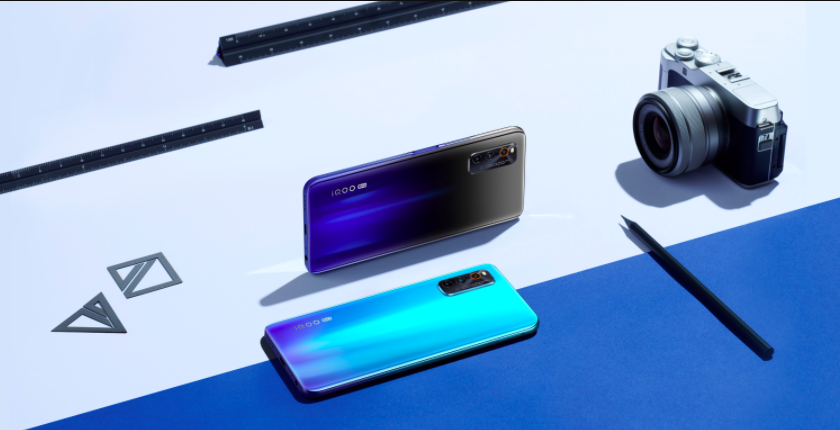
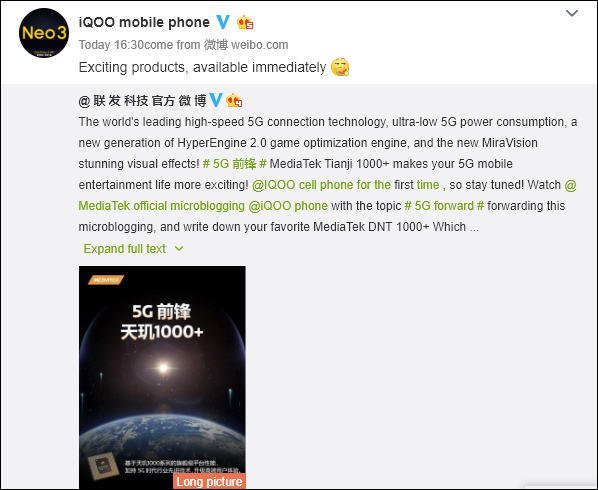
Taiwanese fabless chipmaker MediaTek earlier today announced the Dimensity 1000+ flagship chipset at an online event in China. The company announced via a Weibo post that iQOO mobile phone will be the first to spot the Dimensity 1000+. iQOO has now confirmed via Weibo that it will indeed release a smartphone with MediaTek’s latest chipset and it will be launched soon.
The Dimensity lineup by MediaTek has proven to be a reliable and solid lineup, at least going by benchmark ranking. Unfortunately, most OEMs have continued to boycott the lineup with just a few phones using them, like the OPPO Reno3 which is powered by the Dimensity 1000L. The new Dimensity 1000+ flagship SoC brings several improvements over the Dimensity 1000, one of which is a higher 144Hz refresh rate.
iQOO already has a smartphone that supports 144Hz refresh rate and that is the iQOO Neo3 5G. The new MediaTek Soc also has a new HyperEngine 2.0 which improves the gaming performance in the new chip. The chipset also supports SA and NSA dual-mode 5G networking and is the only chip in the industry that supports 5G + 5G dual SIM/dual standby and is equipped with 5G dual-carrier aggregation technology. Thus, users will always remain online when they get incoming calls.
The phone maker is yet to reveal the name of the phone that would bear the new processor. There are speculations that it will be the iQOO Neo3 Racing Edition or Neo3 Dimensity Edition. Recall that the first-gen iQOO Neo got a Snapdragon 855+ version dubbed iQOO Neo Racing Edition.
Huawei’s Honor brand took the wraps off the Honor 9X Pro smartphone for the global market in February this year. The company is now likely ready to unveil the smartphone in India three months after.
A tweet by Honor India had teased the impending launch of a product powered by a Kirin 810 chipset. However, the company is reported to have accidentally posted the name in a tweet that has since been deleted. The company is yet to announce the launch date but a report by IANS points to a May 12 launch and sales on Flipkart.
The Honor 9X Pro features a 6.59-inch IPS LCD display, along with 19.5:9 aspect ratio and Full HD+ screen resolution. Under the hood, the smartphone is powered by the company’s own Kirin 810 octa-core chipset. It equally comes with up to 8GB RAM and maximum storage of 256GB (UFS 2.1). The smartphone packs an impressive 4,000mAh battery.
The Honor 9X Pro starts at 249 Euros for the 6GB RAM + 256GB storage model. The model is said to be priced between Rs. 15,000 to Rs. 20,000 in India and will come pre-loaded with Huawei AppGallery instead of Google Play Services and Play Store.
According to multiple reports, Google could be soon launching a streaming device by rebranding Android TV to either Nest or Google. It is expected to be a successor to the current-gen Chromecasts with remote control.
Google Chromecast was popular during its early days. But its demand has now faded away with a rise of better competitor products from Amazon and Roku. However, Google’s Android TV platform is doing fine with a partnership with multiple TV manufacturers and cable companies.
But it does not have a flagship streaming device under its own branding. This is what Google is expected to change with a new mystery device.
As per the sources, this upcoming streaming device from the internet search giant will focus more on content than apps. But it will do come with Play Store for apps. Additionally, it is also expected to support Google Stadia, the company’s cloud gaming platform.
Whatever it is, it could have gone official at Google I/O 2020. Unfortunately, that is not happening due to global pandemic. Instead, Google will only live stream Android 11 Beta launch on June 3.
Even if it goes official sometime later this year, it can get delayed due to supply chain issues.
Bolt surged into the ride-sharing scene in 2013 and grabbed some market share from rival Uber especially in major African countries and Eastern Europe. The firm presently has more than 30 million users in over 35 countries. Ride-hailing services have definitely taken a hit by the COVID-19 lockdown and social distancing practices. Thus, Bolt has shifted its attention to yet another transportation service – electric scooter service.
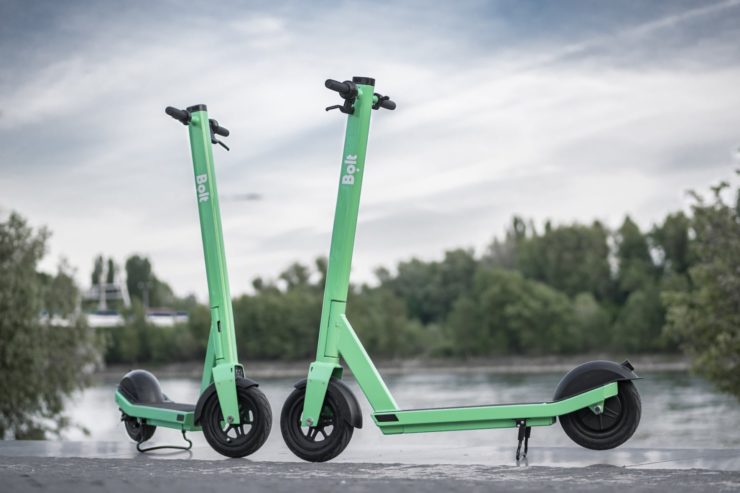
Bold officially unveiled its own electric scooter model on Wednesday. The company also disclosed that it aims to launch the scooter service in more than 45 cities this summer.
“A lean mindset and efficient operations have helped Bolt to bring quick, affordable and reliable urban transport services to millions of people in Europe and in Africa,” Dmitri Pivovarov, head of scooter business at Bolt, said in a statement.
Bolt said its model’s design and engineering are focused around modularity, which makes it easily repairable and lowers the cost of maintenance for the ride-sharing service.
The new scooter weighs 17kg, which makes it the lightest model used in scooter sharing. This reduced weight is achieved through the scooter being made of 90% aluminium.
The scooter features inflatable tires that help ensure better grip and smoother, safer rides. It can go for more than 40km on a single charge. Its maximum speed is 25km/h. But this is obviously limited according to local regulations.
The scooter also features front and rear lights, as well as front and side reflectors to help maintain riders’ safety during dark hours. Scooters come with built-in GPS trackers which provides data about where they are parked and whether they are ready for use.
Bolt had earlier last month launched the scooter service in Bratislava, Slovakia. The scooter app is similar to the taxi service app. It costs €0.50 to unlock a scooter and 15 cents per minute they are used up to €15, which would be the price for a whole day.
The app also has information about the maximum range of the scooters, so as to remove the risk of renting one with a discharged battery.
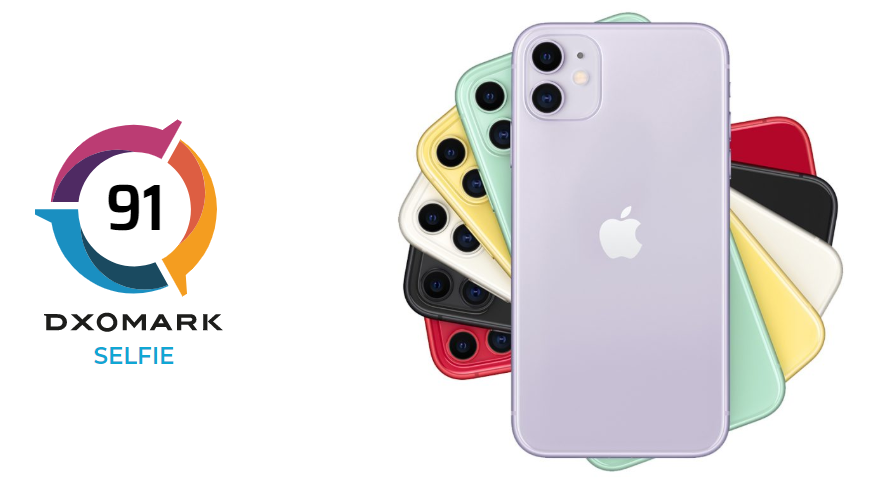
The Apple iPhone 11 is the latest smartphone to be reviewed by DxOMark Selfie team. The handset scores an overall 91 points. Unfortunately, it still does not make it to the top 10. It currently ranks 13th in the list just above Huawei P30 Pro and below Samsung Galaxy Note 9.
According to the testers, the iPhone 11 performs decently with similar outputs like its bigger sibling iPhone 11 Pro series but there are some differences as well.
The selfies from the handset have very good target exposure on faces in almost all conditions. However, it does lack some dynamic range and highlight clippings are visible in images shot under high-contrast conditions.
The phone produces vivid colors with a slightly warm white balance. On the other, skin tones are yellowish on both iPhone 11 and iPhone 11 Pro. Whereas, the pictures from Galaxy S10 Plus have more natural-looking skin tone.
The cheapest iPhone from last year also has a problem with focus. Only the subjects close to the phone have good focus as the phone does not have an autofocus system. The images from the handset have a good amount of details in better lighting. Noise picks up indoors as well as in low-light scenarios.
Flash in the form of screen brightness does work as advertised but there are noise and vignetting effect with lower details. Artifacts in the images are well-controlled but there are visible corner softening, ringing, and anamorphosis.
The bokeh or portrait shots have strong blur even on the things that are in the same focus plane as the subject creating an artificial look. Also, there are visible blurs across the edges of the subject.
As for videos, the Apple iPhone 11 can shoot 4K 30fps clips with good details and lower noise than the iPhone 11 Pro. But the focus issue from pictures is present in videos too.
Also, colors are pleasant with accurate exposure and good white balance. The videos also have smooth transitions in changing lights with well-controlled artifacts. The stabilization is effective as well but it fixates more on the subject than the background.
As a whole, the iPhone 11’s selfie camera performs reasonably well with the focus being its nemesis.
Huawei‘s in-house chip design company Hisilicon has reportedly become the first semiconductor company in mainland China to enter the top 10 in terms of global sales. US semiconductor market research company IC Insights reports that HiSilicon’s sales surged 54 per cent year on year to about US$2.67 billion in the first quarter, placing it in the 10th position for the first time.
The report disclosed that Hisilicon’s surge in sales is attributed to its parent company Huawei. The Chinese smartphone giant has been stockpiling chips designed in-house in case the US government implements new measures to prevent TSMC from providing chip-making services to Huawei. “HiSilicon jumped up five spots in the ranking to 10th place, making it the first [mainland] China-based semiconductor supplier to be ranked in the worldwide top 10 listing,” IC Insights said in its report.
Hisilicon is a fabless chipmaker meaning te fabrication of the chip os outsourced to foundries like Taiwan Semiconductor Manufacturing Company (TSMC). The US is reportedly considering a proposal that would require TSMC to apply for a license if it wants to use US chip-making technology to produce chips for Huawei. Hence, the decision to stockpile chips before that decision becomes implementable.
TSMC’s first-quarter sales jump 45 per cent to US$10.3 billion and the surge in demand by Hisilicon is partly responsible for that.
Huawei is also reportedly moving some of its lower-end chip orders away from TSMC to the Shanghai-based Semiconductor Manufacturing International Corp (SMIC), which currently does not have the capability to fabricate 7nm chips in commercial volumes.
Huawei’s Hisilicon also recently surpassed Qualcomm to become the number one smartphone processor supplier in China for the first time, according to an earlier report by Chinese research firm CINNO.
The other new entrant on IC Insights’ top 10 list was Nvidia, which took ninth spot after posting 37 per cent year-on-year growth in the first quarter. Overall, US chip giant Intel leads the industry with US$19.5 billion in quarterly sales, while South Korea’s Samsung Electronics was second with US$13.9 billion. As a whole, sales of the top 10 semiconductor companies surged by 16 per cent year on year compared with industry-wide growth of 7 per cent year on year.
Smartphone companies in India had shuttered their manufacturing facilities more than a month ago abiding the coronavirus lockdown rules issued by the government. Now, as the MHA (Ministry of Home Affairs) has announced certain relaxation, Oppo has finally managed to get permission in order to begin production from May 8.
Chinese smartphone maker Oppo will be resuming production at its Noida facility from tomorrow. However, only 30% (3,000) employees will work at a time out of its total 10,000 staffs. Additionally, the company will follow all the necessary hygiene and social distancing measures.
Further, the brand has also begun the sales of its products across both offline and online. As of now, 22% of its retail stores are already operational in the green and the orange zones across the country.
Interestingly, Oppo has also announced services to let customers order products through WhatsApp as well via SMS similar to its sister brand Vivo. These services will start in a phased manner from May 8 and May 10 respectively.
Whereas, customers interested in buying phones online can already shop on Flipkart and Amazon India. They will have to check delivery availability to their location by entering their pin codes.
Additionally, Oppo has also introduced special offers like extended warranties for up to ₹2,599 and other perks like cashback and EMI. This offers will be valid until 31st May 2020.
We use cookies on our website to give you the most relevant experience by remembering your preferences and repeat visits. By clicking “Accept”, you consent to the use of ALL the cookies.
This website uses cookies to improve your experience while you navigate through the website. Out of these, the cookies that are categorized as necessary are stored on your browser as they are essential for the working of basic functionalities of the website. We also use third-party cookies that help us analyze and understand how you use this website. These cookies will be stored in your browser only with your consent. You also have the option to opt-out of these cookies. But opting out of some of these cookies may affect your browsing experience.
Necessary cookies are absolutely essential for the website to function properly. This category only includes cookies that ensures basic functionalities and security features of the website. These cookies do not store any personal information.
Any cookies that may not be particularly necessary for the website to function and is used specifically to collect user personal data via analytics, ads, other embedded contents are termed as non-necessary cookies. It is mandatory to procure user consent prior to running these cookies on your website.