Advertisement

Twitter releases an India Gate emoji to commemorate Indian Republic Day

Twitter India released a special emoji that celebrates the 71st Republic Day of India. It is celebrated each year on the 26th of January.

Indian President, Ram Nath Kovind, will be using this emoji for his tweet, according to Twitter India. The emoji will be used as he addresses the nation as people all over the country will also participate in a public conversation in the same thread. Mahima Kaul, Director, Public Policy, India and South Asia, Twitter India stated that the Republic Day emoji was created to “resonate” with the Indian users across different cultures, languages, places. In other words, give the people yet another reason to celebrate and participate in the historic day for the Southeast Asian nation.

Twitter
The India Gate, situated in the capital city, New Delhi

The emoji is currently available on the platform and will remain active until 30th January 2020. It is found in English alongside ten different regional languages which are commonly spoken within the country, including Hindi, Tamil, Telugu, Kannada, Malayalam, Marathi, Bengali, Gujarati, Urdu and Gurmukhi.

Notably, this marks the fifth consecutive year in which the social media giant has supported the Republic Day in India with a custom emoji on its platform. Similarly, Twitter is also known to celebrate other major occasions in the country like Independence Day, Diwali, Republic Day, Gandhi Jayanti and a few other notable milestones in the nation’s history.

Twitter
Twitter India’s special Republic Day emoji

The idea with emojis is to keep Indian cultural identity and sentiments as a large chunk of Twitter’s userbase is from the country. Thus, emojis are designed in such a particular fashion.


(Via)

Realme Buds Air Iconic Cover price and availability in India confirmed

Days after announcing a carrying case for the Realme Buds Air truly wireless earbuds alongside a 10,000mAh power bank at the soft launch of Realme 5i smartphone in India, the Chinese smartphone manufacturer has finally revealed the Iconic cover. While Realme had only revealed the pricing and availability details of the power bank at the time of the announcement, now it has confirmed the cost and sales date of the Iconic Cover.

Realme Buds Air Iconic Cover Price and Availability

The Realme Buds Air Iconic Cover is priced at Rs. 399 (~$6). The cover will be on sale starting at 12.30 PM IST on Jan. 28. It will be available on Flipkart and Realme’s own website.

Realme Buds Air Iconic Cover  Design

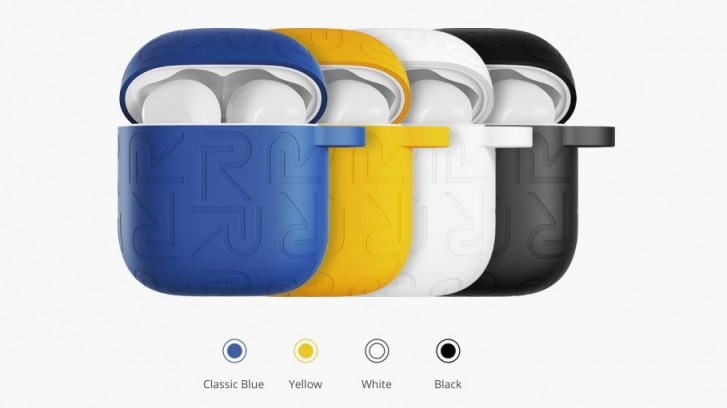
The Buds Air Iconic Cover features Realme’s tailor-made R logo designed by Pentagram. It hugs the charging case perfectly and the silicon protects the case against accidental damage or slides. Realme claims that the cover is composed of a durable material that is soft to the touch. It comes with a metal carabiner for portability. Wireless charging works without removing the cover.

Like the Realme Buds Air truly wireless earphones, the Iconic Cover too draws heavy inspiration from the Apple AirPods design. The charging case supports wireless charging and is rated for up to 17 hours of playback on a single charge. Without the charging case, the device lasts for around 3.5 hours on a single charge.

Realme Classic Blue hue 10,000mAh power bank with yellow accents is priced at Rs. 1,299 (~$18). The power bank is also available in red, yellow, and grey color options. The Buds Air Iconic cover comes in four color variants, namely white, black, yellow, and blue. Realme is yet to divulge plans of selling either product in foreign a market outside India.


POCO X2 is confirmed and it launches next week

After waiting for more than a year, we now have a launch date for a second POCO phone. No, this is not the POCO F2 but the POCO X2! Yeah, we know there is no POCO X1 but there also isn’t a Redmi K10.

The announcement comes via the official POCO Twitter account, and according to the tweet, the POCO X2 arrives next week, Tuesday, February 4, 2020.

In anticipation of the device’s launch, POCO has created the hashtags #SmoothAF and #POCOX2. The former is actually a hint to one of the phone’s features which is its high refresh rate.
Along with the tweet is also a URL to a page where you can check if your device is “Smooth AF”.

POCO X2 refresh rate

If you click on the link, it takes you to a page that automatically detects the refresh rate of your device. You get something like the image above if you visit it on your PC. However, opening the link on your mobile results in the second image below. Yeah, thanks POCO for reminding me my phone is due for an upgrade!

POCO X2 refresh rate mobile

The POCO X2 will have a display with a high refresh rate and since the phone is a rebranded Redmi K30, it means it has a 120Hz refresh rate.

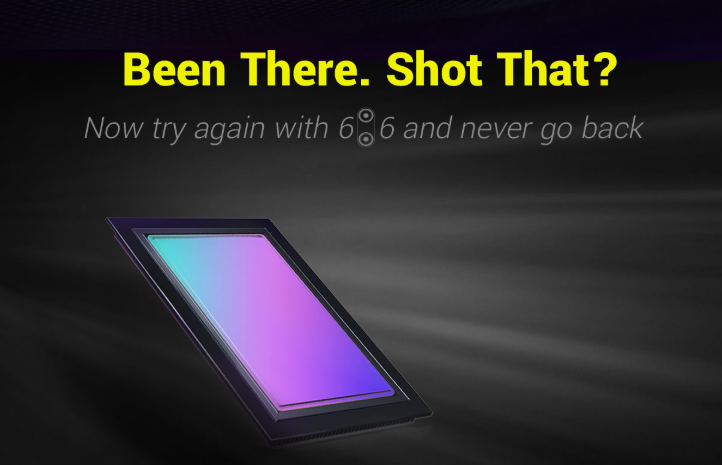
POCO has also teased the phone will come with a Sony IMX686 (64MP) main camera and will have 6 cameras in total (four quad cameras and a dual front-facing camera).

POCO X2 camera

The teaser page also reveals the POCO X2 will have a Snapdragon processor (Snapdragon 730G) inside, liquid cooling, and fast charging. An image of the bottom of the phone further confirms it is a rebranded Redmi K30. Below is the bottom of the POCO X2 (left) alongside that of the Redmi K30 (right). And of course, we now know it will come in gold.

[envira-gallery id=”302378″]

The launch event is scheduled for 12 noon on February 4 but there is no info regarding the venue. However, we expect there will be a livestream too.

Are you excited about the POCO X2 or you are disappointed that it is a rebranded Redmi K30? Let us know what you think in the comment section.


Tetris for mobile is ending service, alternative already available

Tetris is one of the world’s most iconic games. It is both nostalgic due to its very early conception in the gaming industry and classic, seeing as the series still has a sizeable player base. However, EA (Electronic Arts) is shutting down the service for Tetris’ two mobile ports, namely Tetris and Tetris Blitz.

The announcement for the end of both mobile games was shared on Twitter through Tetris Blitz’s official account. It mentioned both games will be taken down by 21st April 2020. The tweet also arrived with a link for any users with any concerns or grievances regarding this decision from the known gaming publisher, EA.

As of right now, it is unclear if the studio plans to end the Tetris series altogether since its deal with Tetris has expired. Hence, we might not see more from entries in the IP being launched from EA. However, N3TWORK, a game developer, has already signed a multi-year agreement with Tetris last year. This means that the game is not entirely dead and still lives on but under a different developer.

N3TWORK is currently working on a couple of different versions of Tetris for the mobile platform and already has a game available for both Android and iOS, which is available for free. Furthermore, the game which is out now is a remake of the original. Thus, it just has one classic mode with a few different themes, unlike the one from EA with multiple modes and options.

Notably, in-app purchases and microtransactions which EA is infamous for, will not be making an appearance again in N3TWORK’s version of the game but will have users pay $4.99 to remove ads. Lastly, another version of Tetris from N3TWORK plans to bring the 100 player Battle Royale genre to the nostalgic game series in the form of a new game. So, for those that wish to play more than just the classic mode can check out Tetris Royale, which is currently in the Beta program and will be released by June 2020.


(Source,Via)

OnePlus promises to add a number of new videography features

OnePlus holds an “Open Ear Forum” across several countries in which the company’s representatives meet with the members of the OnePlus community to take feedback from them to further improve the company’s products.

A similar event was held by the company in New York last month with the videographers to get feedback from them regarding the use of OnePlus phones for their work. Now, the company has shared its findings and replies to all the questions raised during the Forum along with detailing its commitments related to videography.

OnePlus 7T and OnePlus 7T Pro
OnePlus 7T (left) and OnePlus 7T Pro (right)

While the newly launched OnePlus 7T Pro received several updates to improve the camera performance, it still isn’t as soon as the camera of premium smartphones from other brands like Huawei, Google, and Apple.

The company has said that tuning its cameras to have identical exposure and white balance is among OnePlus’ first priority along with faster shutter and skin tone improvement which will be done through a system updates.

It is also upgrading both hardware and software from this year to fix the auto focus-related issues. The company has also added that it is trying to find the new balance between sharpness and noise along with working on Video HDR to solve dynamic range problems.

OnePlus also adds that the company’s future devices will have 4K video super stabilisation support and it is also working on de-flickering solutions to reduce light flickering issue. The company is also working on several new features such as Night Mode for video, zoom-in time-lapse, depth-of-field for tele camera lens, new video editing tools, among others.

(Source)

Pentagon blocks further clampdown on sales to Huawei Technologies

Huawei’s battle against the United States related to the trade ban isn’t coming to an end. However, the company seems to have got a temporary reprieve as a proposal of the U.S. to further restrict sales to Huawei Technologies has encountered objections within the Trump administration and is being held.

U.S. Commerce Secretary Wilbur Ross said on Thursday that new rules were in development that would further limit U.S. companies from supplying Huawei. However, the rules are being opposed by the U.S. Defense Department.

The blocking of the restrictions on Huawei comes at the U.S. Defense Department shares the same concerns that Qualcomm and other U.S. suppliers have been telling the White House that blocking trade with Huawei will cut off revenue that could be used for further product research.

The new rules will make it harder for American companies to sell to Huawei from their overseas facilities. Some US-based firms have been selling to Huawei even after the ban, taking advantage of the exemptions if most work to create the products happens outside the United States. The current threshold permitting sales kicks in when 75 percent of the work occurs overseas but the administration is now debating raising this to 90 percent.

Huawei, which the world’s largest telecoms equipment supplier, is one of the biggest purchasers of chips. Semiconductor makers in the U.S. have argued that a complete clampdown is counterproductive since the parts that Huawei needs can be bought from non-US providers.

Amid all this, the Chinese giant is continuing its efforts to reduce its dependency on US-based technology. The company has already unveiled its completely new operating system named HarmonyOS and is working on HMS as a replacement for Google services.

(Source)

Huawei P30 Pro gets price cut ahead of P40 series launch

Huawei is gearing up to launch its next-generation P-series flagship smartphones — Huawei P40 lineup at a launch event in March this year. Now, ahead of the launch of these phones, the P30 Pro has received a price cut in China.

The Huawei P30 Pro 8GB RAM and 256GB storage model is now available for a price of 4,088 yuan which is roughly $589. When launched in April last year, this particular variant was priced at 5,998 Yuan (~$893).

Huawei P30 PRo featured
Huawei P30 Pro

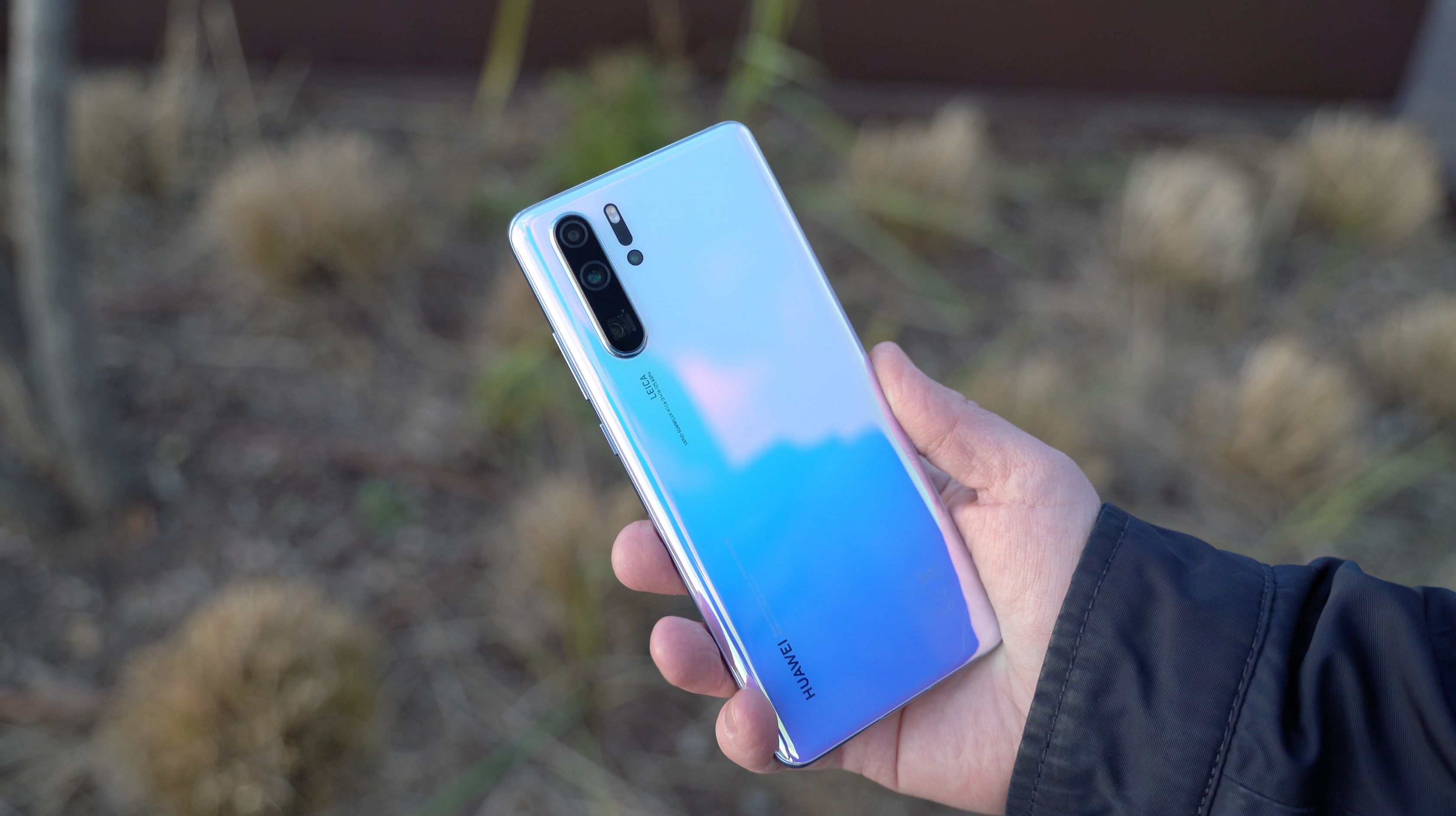
Coming to the specifications, the Huawei P30 Pro flagship phone sports a premium design with glass panels on both side and a metallic frame in between. It features a 6.47-inch curved OLED Full HD+ display, has in-screen fingerprint reader, and can emit sound through the display of the phone.

Under the hood, the device is powered by 7nm Kirin 980 SoC coupled with 8 GB of RAM and 256 GB of internal storage. The phone features a 40-megapixel main sensor along with 20-megapixel ultra wide-angle lens and an 8-megapixel tertiary sensor.

On the front side, there’s a 32-megapixel selfie shooter. It runs Android 9 Pie OS out-of-the-box and is powered by a 4,200mAh battery and comes with 40W SuperCharge fast charging support.

As for its successor, reports indicate that the Huawei P40 Pro will come with a 40MP Cine (ultrawide) camera with a 1/1.5” sensor size which will be paired with a 52MP main camera having a 1/1.3” sensor size. Rather than a telephoto camera, Huawei is going with a periscope zoom lens like that of the Huawei P30 Pro. This will offer more optical zoom, at least 5x, and of course more digital zoom. Further, it is said that the device will also comes with a 3D ToF camera.

Recently, it was revealed that the Chinese giant is planning to launch three P-series flagship smartphones — P40, P40 Pro, and P40 Pro Premium. The major factor of differentiation between the phones will be the rear camera setup.

While the P40 Pro will come with four camera sensor on the back panel, the Pro Premium variant is said to feature a penta-camera setup. As for the other specs, the smartphones are expected to come powered by the company’s own Kirin 990 flagship processor with support for 5G connectivity.

(Via)

Several Chinese smartphone brands donate up to 30 million yuan to fight coronavirus

In order to support the fight against coronavirus in the hardest-hit city of Wuhan, several Chinese smartphone makers have started donating money. So far, the list of companies who have contributed includes Huawei, OPPO, Vivo, Nubia, Realme, TCL, and Meizu.

Along with donating 30 million yuan to Wuhan Charity Federation for epidemic prevention and control, Huawei has also completed the setup of 5G base stations at the Wuhan Vulcan Mountain Hospital. Other smartphone makers, OPPO and Vivo have also donated 30 million yuan while TCL has donated 10 million yuan.

Huawei Donation to Coronavirus

TCL has said that it is also providing other necessary products, including public display LCD panels, air conditioners, refrigerators, washing machines, etc. as per the requirement by Raytheon Hospital.

On the other hand, Nubia, a sub-brand of ZTE has said that it has contributed 600,000 yuan to fight against this virus whereas Realme, which is backed by OPPO, has donated 500,000 yuan and Meizu has donated 300,000 yuan.

Apart from these brand, other companies have also contributed, including Xiaomi, Lenovo, and many more. Xiaomi has supplied medical protective materials in the first batch which are worth around 300,000 yuan while Lenovo is providing all IT support equipment needed for emergency assistance to Wuhan Emergency Medical Engineering.

Along with these smartphone brands, several leading companies in China are contributing to fight against coronavirus, including the likes of Alibaba, Tencent, JD.com, Kuaishou, Douyu, Midea, SF, Suning, Cainiao, and Taobao, among others.

For those who are unaware, the coronavirus causes pneumonia and those who suffered from it reported to have symptoms like coughs, fever and breathing difficulties. In severe cases, it also leads to organ failure.

As this is viral pneumonia, antibiotics are of no use and the antiviral drugs against flu are also not working. Patients admitted to the hospital get support for lungs and other organs but the recovery is dependent on their immune system.


Motorola Razr 5G edition showcased in China

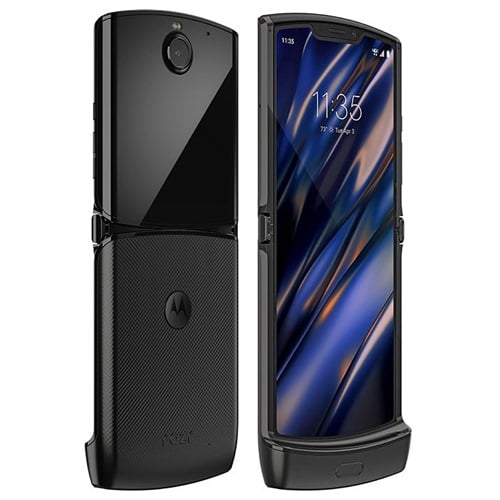
Lenovo-owned Motorola had announced the Motorola Razr clamshell flagship phone with a foldable screen in November. At that time, it was reported the Motorola Razr 2019 won’t be releasing in China. However, at the Consumer Electronics Show (CES) 2020 tech trade show that was held earlier this month, the company confirmed that the Motorola Razr with 5G support will be arriving in Q2 this year in China. A fresh repot on a Chinese tech blog reveals that the Motorola Razr 5G was showcased at the Wuhan International Expo Center in China.

The Motorola Razr 5G is being manufactured at the Wuhan facility of the Lenovo Group. The regular Razr phone that comes without 5G support ships with Snapdragon 710. Its 5G version seems to be equipped with a 5G-ready chip. Hence, it could be driven by Snapdragon 765 or Dimensity 5G chipsets. Motorola has recently released phones with Exynos chipsets from Samsung. Hence, there is a possibility that the Razr 5G could be equipped with Exynos 980. Hopefully, more information on the device will surface as its China launch draws near.

Motorola Razr 2019

Motorola is currently working on the global release of Motorola Razr. The clamshell is now up for pre-orders in the U.S and the U.K. The shipments of the device are expected to begin in the U.S. from Feb. 6. The company intends to sell the phone in other markets such as Canada, India, Australia, the Middle East, Africa and some European countries. At present, there is no word on whether the Motorola Razr 5G will be made available outside of China.

Soon after the announcement of Razr 5G’s arrival in China at the CES 2020, Motorola had teased images of its retail package and production unit. The model number of the China is XT2000-2. The retail box image revealed that the Motorola Razr 5G for China has 6 GB of RAM and 128 GB of storage. Its other details are currently under the wraps.

Motorola Razr specifications and price

The Motorola Razr 2019 comes with a 6.2-inch foldable inner P-OLED display. It has an external display of 2.7 inches. The Snapdragon 710 powers the device with 6 GB of RAM and it has an internal storage of 128 GB. It lacks support for microSD. The handset comes loaded with Android 9 Pie OS.

The Razr has a selfie camera of 5-megapixel and it has a rear camera of 16-megapixel. The phone is backed by a 2,510mAh battery that supports 15W charging. It does not feature a 3.5mm audio jack.


(source|via)

Xiaomi Redmi 8A Android 10 update could be nearing, reveals Geekbench listing

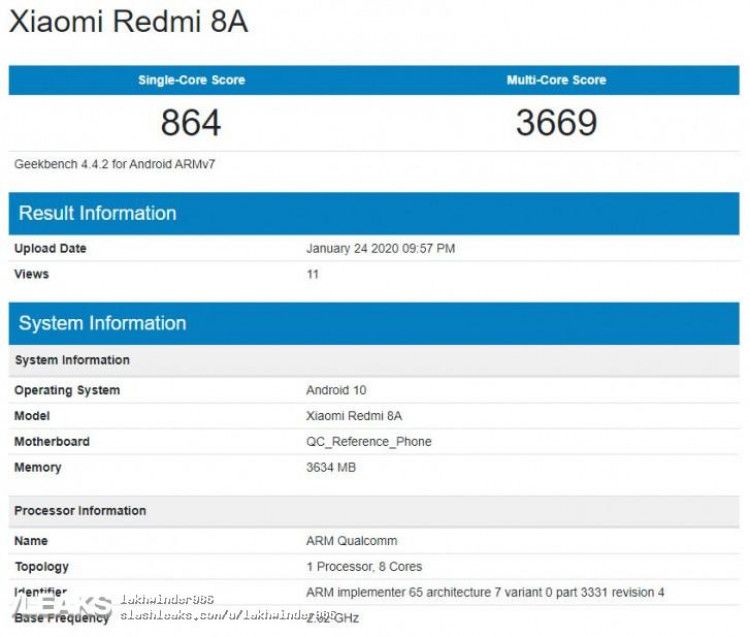
In the past few months, Xiaomi has rolled out Android 10 update with MIUI 11 skin for smartphones like Xiaomi Mi 3, Mi 2S, Mi 8, Mi 8 SE, Redmi K20 Pro, K20, Note 8 Pro, Note 7 and some devices in China. The update was recently released for Xiaomi Mi A2 users in global markets. The Chinese firm has confirmed that Xiaomi Mi A3 users will be treated with Android 10 update in February. It appears that the Redmi 8A users in China could be soon blessed with the latest version of Android OS as it has been spotted with Android 10 on Geekbench benchmarking site.

As it can be seen in the screenshot, the 4 GB RAM variant of the Redmi 8A phone has surfaced with Android 10 OS on Geekbench. The smartphone was introduced with Android 9 Pie OS. While India was the first market to receive the Redmi 8 and Redmi 8A phones, the 8A did not arrive in the country in 4 GB RAM edition.

Xiaomi Redmi 8A Android 10 Geekbench

In China, the company is selling the smartphone in 4 GB RAM + 64 GB storage version. Hence, there is a possibility that the 4 GB RAM edition Redmi 8A that has been benchmarked on Geekbench could be a China country variant. The Android 10 update for it will mostly likely be skinned with MIUI 11.

Xiaomi Redmi 8A specifications and price

The Redmi 8A comes with a 6.22-inch IPS LCD display with waterdrop notch. It supports HD+ resolution of 720 x 1520 pixels. The display of the device is protected by Gorilla Glass 5. The modest Snapdragon 439 mobile platform is present under the hood of the device.

It has a rear camera of 12-megapixel that offers features like dual pixel AF and LED flash. It has a front-facing camera of 8-mgeapixel. The device is backed by a 5,000mAh battery that supports 18W fast charging through USB-C.

Redmi 8A
Redmi 8A

In China, it was introduced with a price tag of 699 Yuan (~$100) for its 3 GB RAM + 32 GB storage version and 799 Yuan (~$115) and 4 GB RAM + 64 GB storage edition. These models are now selling at respective price tags of 599 Yuan (~$86) and 699 Yuan (~$100). In India, its 2 GB RAM and 3 GB RAM editions that come with 32 GB of storage are respectively priced at Rs. 6,499 and Rs. 6,999.


(via)

RMX2063 and RMX2001 mysterious Realme phones specs leaked through FCC filings

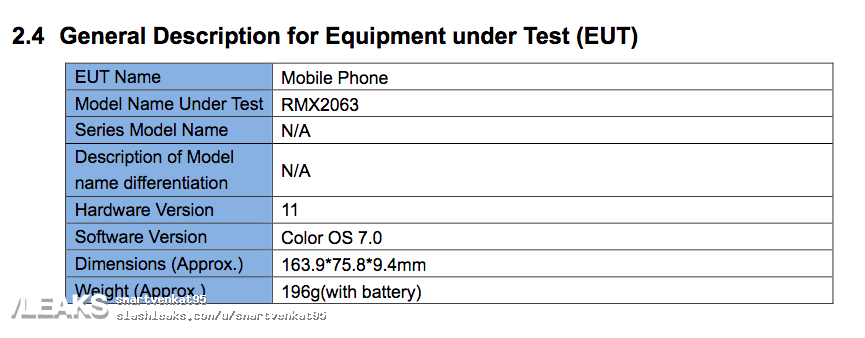
The upcoming Realme C3s smartphone that has a model number of RMX2020 was recently approved by the Federal Communications Commission (FCC) in the U.S. The FCC authority has also approved has approved two new Realme phones with model numbers RMX2063 and RMX2001. In December, the RMX2063 and RMX2001 were spotted with RMX2020 (Realme C3s) and RMX2040 at the database of Eurasian Economic Commission (EEC) in Russia. It was recently revealed through Thailand’s NBTC and Singapore’s IMDA certifications that the RMX2040 is the forthcoming Realme 6i smartphone. It has been also certified by the Bureau of India Standards (BIS) in India. However, the identities of the RMX2063 and RMX2001 phones are currently under the wraps.

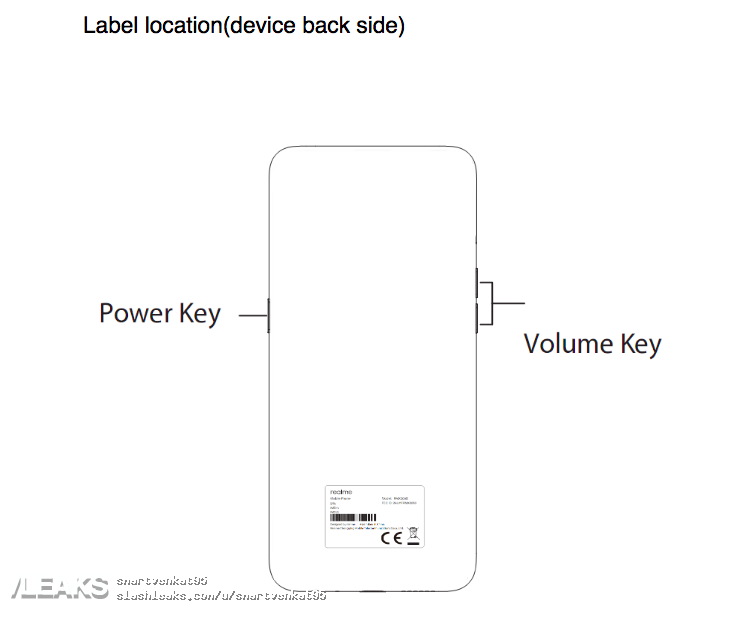
Realme RMX2063

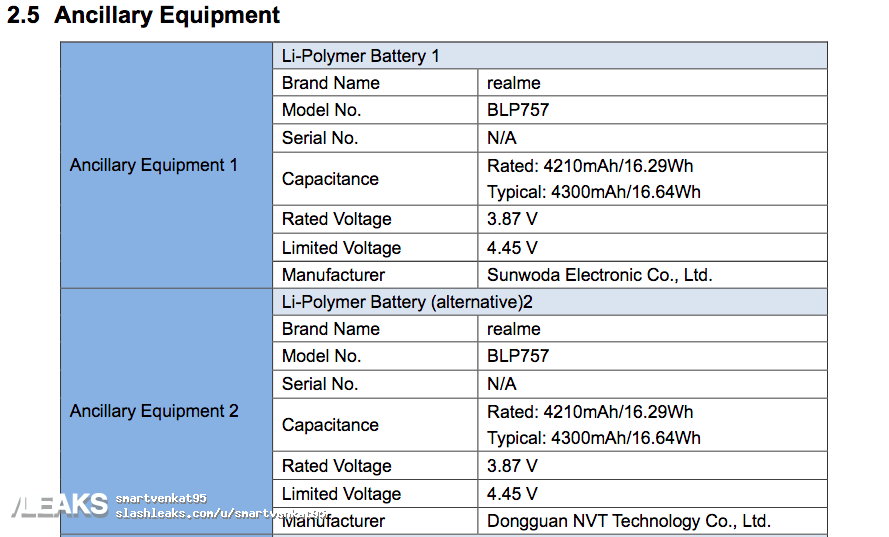
The Realme RMX2063 measures 163.9 x 75.8 x 9.4mm and it weighs 196 grams. These dimensions suggest that the device could be housing a display of around 6.5 inches. The handset is equipped with a 4,300mAh battery and it is loaded with ColorOS 7. The schematics of the phone does not reveal much on its features. It shows that the right side of the phone has a power button and left side rocks a volume controller. A rumored variant of the same phone with model number RMX2061 was recently approved by BIS in India.

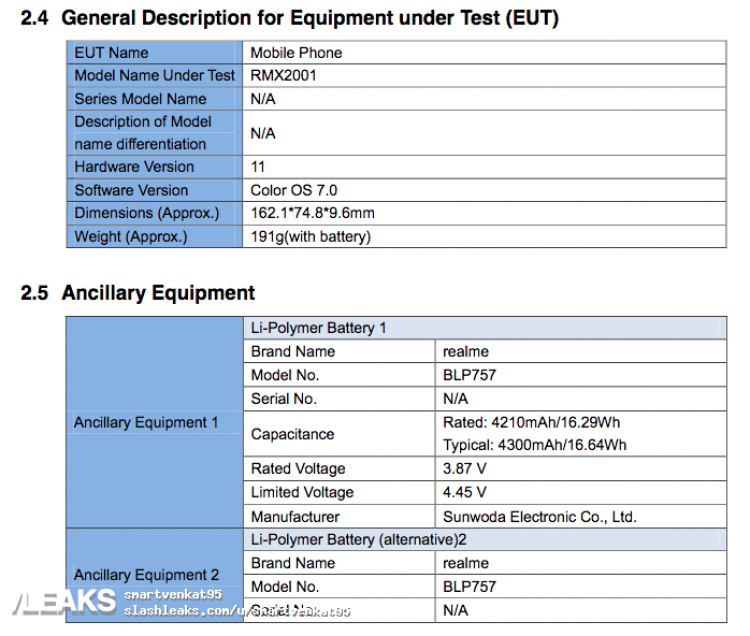
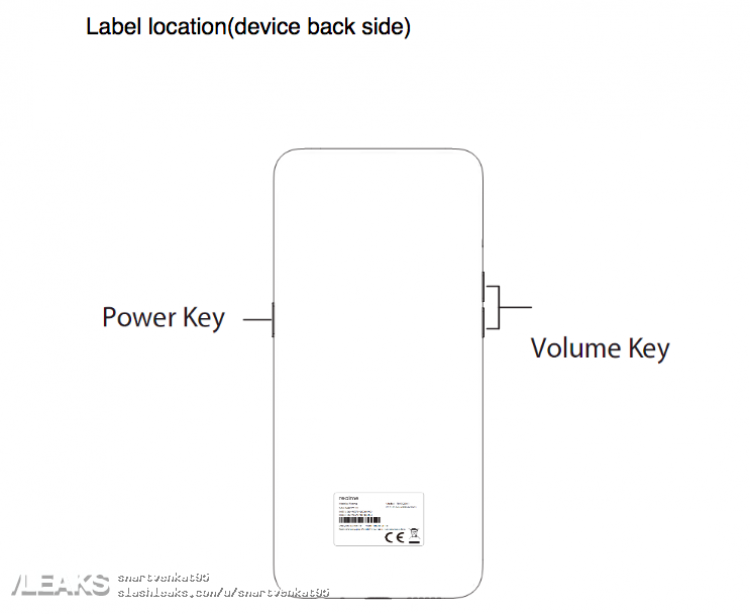
Realme RMX2001

The Realme RMX2001 smartphone has 162.1 x74.8 x 9.6mm dimensions and it weighs 191 grams. It could be fitted with a display that is slightly smaller than of the RMX2063 phone. It is also packed with a 4,300mAh battery and is preinstalled with ColorOS 7.

Its schematics show that the Realme RMX2001 has volume up and down buttons on the left and a power key on the right. The image does not show the presence a rear-facing fingerprint reader.

The schematics of the Realme C3s showcased the presence of a rear-facing fingerprint reader. However, the rear diagrams of the Realme RMX2063 and RMX2001 does not show a fingerprint reader. Hence, it is difficult to determine whether the RMX2063 and RMX2001 are high-end smartphones with in-display fingerprint sensor or low-budget phones that lacks a rear fingerprint reader.

There is a possibility the Realme RMX2063 and RMX2001 could be the forthcoming Realme 6 or U series devices. The Realme RMX2071 smartphone that is believed to powered by the Snapdragon 865 mobile platform was recently seen with highest scores on AnTuTu benchmarks. The Realme RMX2071 could be the upcoming Realme X50 Pro smartphone. There is another mysterious device with model number RMX2076 in works. It could be a variant of the RMX2071. Lastly, a 5G phone with RMX2025 model number was spotted on China’s MIIT database. It is speculated that it could be the 5G version of the Realme X50 Pro 5G. The flagship phone from Realme is expected to get announced at the Mobile World Congress (MWC) 2020 tech trade show in the coming month.


(via 1, 2)

Redmi K20 Pro Premium Edition price slashed in China; Redmi K30 Pro 5G could be coming

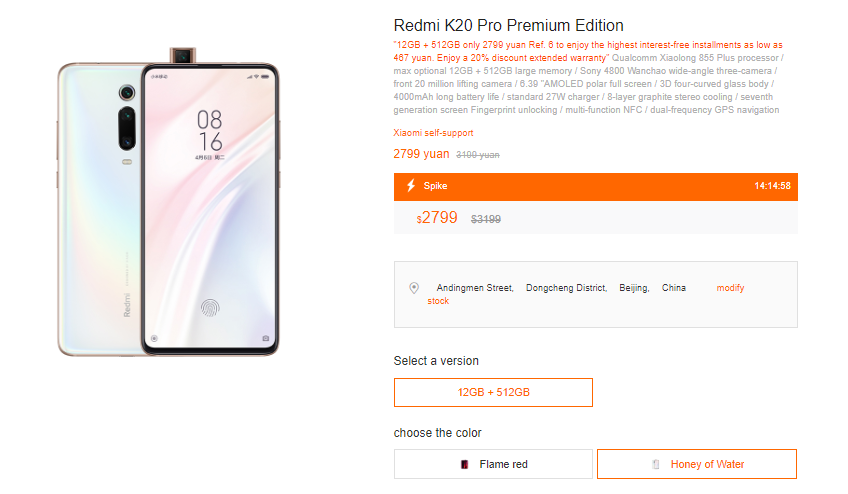
Few months after launching the Redmi K20 and Redmi K20 Pro smartphones last year, Redmi announced the RedmI K20 Pro Premium Edition with a price tag of 3,299 Yuan (~$475) for its 12 GB RAM + 512 GB storage variant. Its price was reduced to 2,999 Yuan (~$432) in December and now it has further slashed to 2,799 Yuan (~$403). It seems to be a permanent price cut on the phone as the company could be clearing its existing to make way for the upcoming Redmi K30 Pro 5G.

The Redmi K20 Pro Premium Edition is the last 4G flagship phone from the company. Xiaomi co-founder, the vice chairman of the Xiaomi Group and President of the mobile division had stated in the recent past starting from Redmi 30, all the forthcoming flagship phones from Xiaomi will be equipped with support for dual-mode NSA and SA 5G networks.

The K20 Pro Premium Edition was introduced in two 8 GB RAM versions with 128 GB and 256 GB storage choices. However, these models are no longer available for purchase. Currently, only the 12 GB RAM + 512 GB storage edition is available with a 2,799 Yuan (~$403) price tag. It can be bought only in Red and White color editions.

Reports have claimed that Redmi could be announcing the Redmi K30 Pro by March this year. The handset was recently spotted on Geekbench benchmarking platform which indicated that the company could be internally testing it with Snapdragon 865 mobile platform. The phone was found to be equipped with Android 10 OS and 8 GB of RAM.

Xiaomi is expected to announce the Xiaomi Mi 10 and Mi 10 Pro smartphones in China in early February. The series is said to be priced between 3,500 Yuan and 5,000 Yuan. The Chinese firm may not want the SD865 powered Redmi K30 Pro 5G to arrive soon and disturb the sales of Mi 10. Hopefully, the Redmi K30 Pro 5G could be priced less than 3,500 Yuan.

In related news, Xiaomi’s sub-brand POCO has confirmed that it will be launching a new phone in February and it won’t be the POCO F2. Reports have claimed that it could be announcing the Indian version of the China’s Redmi K30 4G as POCO X2. It remains to be seen whether the POCO F2 arrives with Snapdragon 865 mobile platform onboard or it could be a rebranded version of the Snapdragon 855+ powered Redmi K20 Pro Premium Edition which did not launch in India.


Nokia 9.2 with Snapdragon 865 may launch in 1H 2020

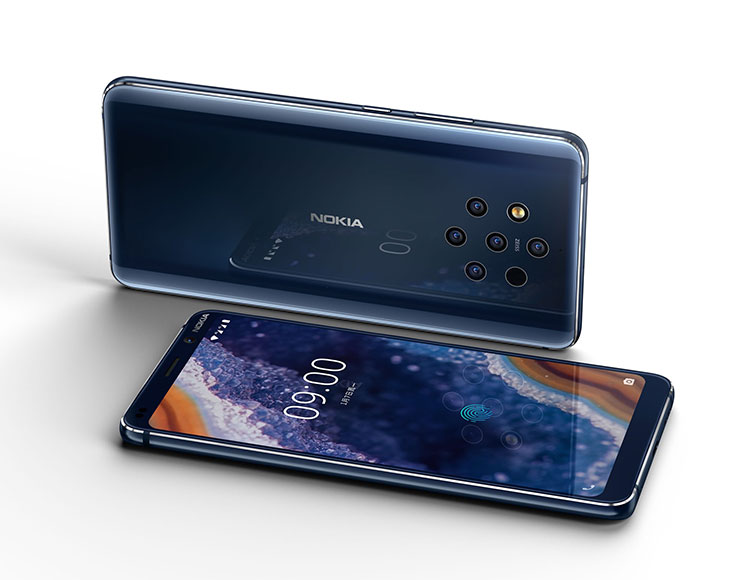
HMD Global had launched the Nokia 9.1 PureView as the world’s first smartphone with penta-lens setup in February 2019. Since it was powered by the older Snapdragon 845 mobile platform, rumors had claimed that the company could be launching a more edition of the phone featuring the SD855 SoC. However, it did not happen. Earlier this month, it was reported that the company may launch the successor of Nokia 9 PureView with Nokia 9.2 (or Nokia 9.2 PureView) moniker. A newer report by Nokia Power User Power also states that the plans to launch Nokia 9.1 PureView with SD855 have been shelved. Instead, the company is reportedly focusing on Nokia 9.2 with SD865. Another source claims that the Finnish firm is also working on a foldable phone.

Citing information from a known source, NPU has reported that HMD Global may not launch the Nokia 9.1 PureView at the Mobile World Congress (MWC) 2020 tech exhibition in the coming month. Instead, the company may introduce the Nokia 9.2 with Snapdragon 865 onboard around 4 to 5 months later. It is expected to break cover in the first half of 2020.

The source has further stated that the Nokia 9.2 won’t be equipped with “Light camera technology” mainly because of the lack of post-launch support for the Nokia 9 PureView. Probably, the company may team with an older partner like Toshiba for offering stellar photography experience on the Nokia 9.2. The phone may carry a pricing similar to the Nokia 8 to achieve more sales.

Nokia 9 Pureview

Another site Nokiamob.net has reported that the Nokia 9.2 could be arriving with a bezel-less display and it may sport a 32-megapixel or 48-megapixel frontal shooter. The configurations of the rear camera system of the Nokia 9.2 are not known yet. The phone may lack support for 3.5mm audio jack and it may carry support for wireless charging.

The Finnish firm has reportedly cancelled some accessories like two smartwatches, a fitness tracker, a mini projector, a selfie light, a power bank, and a mini printer. It is said to be currently working on wireless charger pods. The report states that the company may unveil a wearable device at MWC 2020. As the company confirmed in December, it may showcase a Nokia 5G phone with Snapdragon 765 onboard at MWC.

There could be some delay in the shipments of Nokia devices that are slated to go official in Q1 due to coronavirus issue in China and because of the company’s plans to shift its business to Europe. It is said to be in the process of reducing its staff in China to focus on other markets like India, Europe, other regions in Asia, Latin America, Australia, the U.S and New Zealand.

The report further states that the company could be working on a foldable phone. However, no details have been revealed on it yet. It may debut in late 2020 or early 2021.


(source 1, 2)

Redmi Fitness Tracker’s design and features revealed by Mi Fit app; gets certified in India

Last November, Lu Weibing, the general manager of Redmi teased that the company will launch a smartwatch in the future. However, it turns out we may be getting a fitness tracker first.

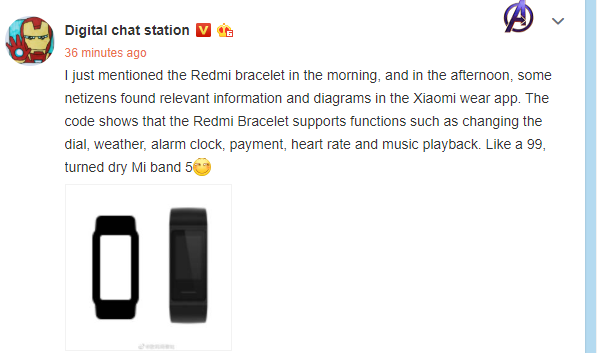
Chinese leaker @Digital Chat Station has shared details of the upcoming Redmi Fitness Tracker (not the official name) on Weibo. According to the post, the design and features of the device were found in the Mi Fit app by some unnamed individuals.

Redmi Fitness Tracker
Alleged image of Redmi’s upcoming fitness tracker

The image shows the Redmi Fitness Tracker will come in black and have a small display surrounded by thick bezels. It will also have a capacitive button at the bottom of the screen which is visible as a thin white line.

Info found within the app says the fitness tracker will have changeable watch faces that display details such as the weather. It will have an alarm function, a heart rate sensor, support for payment (via NFC), and also support controlling music playback.

Redmi Fitness Tracker features

The Redmi Fitness tracker should be inexpensive and might even have a price tag lower than that of the Mi Band series. There is no info on when it will launch but more details should surface in the coming weeks.

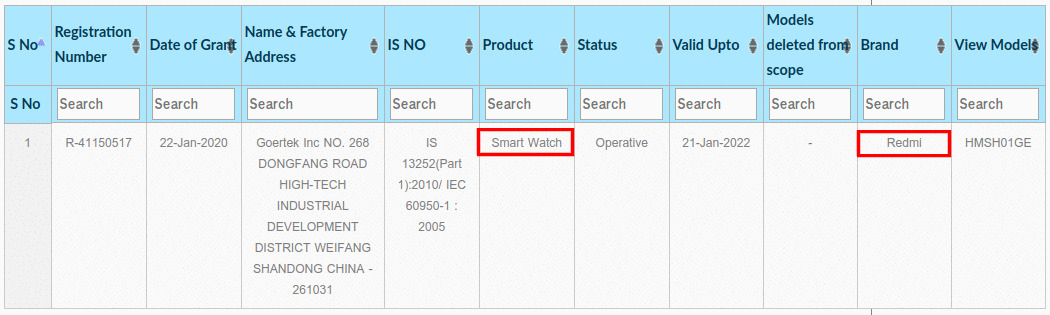
In related news, Redmi has also received certification from the Bureau of Indian Standards for a “smart watch” with model number HMSH01GE. The certificate was issued on Wednesday, January 22, 2020.

Redmi Smartwatch BIS certificate

Although the certificate says it is a smartwatch, there is a possibility it is the fitness tracker above and BIS groups all smart wearables under smartwatches. Nevertheless, the certificate reveals that Redmi will be bringing its upcoming wearable to India.


(Sources: 1, 2)

OPPO’s smartwatch will have ECG function (UPDATED)

UPDATE:

The source has taken down the Weibo post. It could be either because it was false information or someone forced him to delete it. Whatever the case, please take this story with a pinch of salt.

Original article as follows.


It has been reported that OPPO will announce its first smartwatch this year. OPPO itself confirmed that its smartwatch will be announced in the first quarter of 2020, which means we have between now and the end of March for the watch to launch.

We already know the upcoming smartwatch will have a rectangular/square dial just like that of the Xiaomi Mi Watch. Last year, OPPO’s Vice President, Brian Shen, made a post on Weibo around the time the Mi Watch was taking flak for its similarity to the Apple Watch Series 5.

The company executive said a rectangular dial is better than a circular dial as it can display more information than the latter. However, he did add that a circular dial (for a smartwatch) is better in terms of aesthetics since it looks like a traditional watch.

OPPO Smartwatch ECG

Now, a leak from Digital Chat Stations has revealed that the OPPO smartwatch will be able to measure ECG/EKG. With an ECG, owners will be able to carry out a test to see if their heart has any abnormalities or has an irregular rhythm. This a more advanced feature than just measuring the owner’s heart rate.

There are other smartwatches that have ECG technology built-in. The popular ones are the Apple Watch Series 5, the Samsung Galaxy Active 2, Withings Move ECG, and the Amazfit Verge. So while having ECG is great, the OPPO Smartwatch will have to pack extra features to give it an edge over its competitors.

There is no specific time for the launch but we won’t put it past OPPO to announce it along with the Find X2 flagship which will also be announced this quarter.


(Source)

Samsung Galaxy S10 Lite vs Vivo X30 Pro vs Oppo Reno3 Pro: Specs Comparison

With the new Galaxy S10 Lite just launched in the Indian market, Samsung is aiming to beat Chinese manufacturers even in the segment of affordable flagship smartphones. While Samsung launched an affordable flagship, Oppo and Vivo recently came up with some of the first upper-midrange devices with 5G support, and they come with not so different prices. Should you go for the Galaxy S10 Lite or a 5G device like the Vivo X30 Pro and Oppo Reno3 Pro represents a better choice? This specs comparison will clear your ideas.

Samsung Galaxy S10 Lite vs Vivo X30 Pro vs Oppo Reno3 Pro

Oppo Reno3 Pro Samsung Galaxy S10 Lite Vivo X30 Pro
DIMENSIONS AND WEIGHT 159.4 x 72.4 x 7.7 mm, 171 g 162.5 x 75.6 x 8.1 mm, 186 grams 158.5 x 74.1 x 8.8 mm, 198.5 g
DISPLAY  6.5 inches, 1080 x 2400p (Full HD+), AMOLED 6.7 inches, 1080 x 2400p (Full HD+), Super AMOLED 6.44 inches, 1080 x 2400p (Full HD+), Super AMOLED
PROCESSOR Qualcomm Snapdragon 765G, octa-core 2.4 GHz Qualcomm Snapdragon 855, octa-core 2.84 GHz Samsung Exynos 980, octa-core 2.2 GHz
MEMORY 8 GB RAM, 128 GB – 12 GB RAM, 256 GB 6 GB RAM, 128 GB – 8 GB RAM, 128 GB – micro SD slot 8 GB RAM, 128 GB – 8 GB RAM, 256 GB
SOFTWARE  Android 10, ColorOS Android 10, MIUI Android 9 Pie, Funtouch OS
CONNECTIVITY  Wi-Fi 802.11 a/b/g/n/ac, Bluetooth 5.0, GPS Wi-Fi 802.11 a/b/g/n/ac, Bluetooth 5.0, GPS  Wi-Fi 802.11 a/b/g/n/ac, Bluetooth 5.0, GPS
CAMERA  Quad 48 + 13 + 8 + 2 MP, f/1.7, f/2.4, f/2.2 and f/2.4
32 MP f/2.4 front camera
Triple 48 +12 + 5 MP, f/2.0, f/2.2 and f/2.4
32 MP f/2.2 front camera
Quad 64 + 13 + 32 + 8 MP, f/1.8, f/3.0, f/2.0 and f/2.2
32 MP f/2.4 front camera
BATTERY  4025 mAh, fast charging 30W with VOOC Flash Charge 4.0 4500 mAh, fast charging 4350 mAh, fast charging 33W
ADDITIONAL FEATURES  Dual SIM slot, 5G Dual SIM slot Dual SIM slot, 5G

Design

The design of a smartphone is not all about looks: it is also about dimensions and thickness. And I think Oppo Reno3 Pro is the handset that mostly meets the requirements for the best design award. Despite it includes a battery above 4000 mAh, it still comes with an incredibly thin design: just 7.7 mm, as well as a lightweight body with just 171 grams. Further, it has a cleaner glass back thanks to the camera module including all the camera elements, and very narrow bezels thanks to its punch-hole display. Oppo Reno3 Pro is the device attracting me the most, but Vivo X30 Pro and Samsung Galaxy S10 Lite remain two smartphones with amazing aesthetics. The former is even more compact than Oppo Reno3 Pro (but it is thicker and heavier).


Display

Oppo Reno3 Pro is the device offering the most advanced display experience. It is the only to support a high 90 Hz refresh rate, it has a very nice image reproduction thanks to HDR and high DCI-P3 coverage, and even a high brightness. But you should not underestimate the image quality provided by the Super AMOLED Plus panel found on the Samsung Galaxy S10 Lite. Even the Vivo X30 Pro sports a great display, but I personally prefer the Oppo Reno3 Pro due to its high refresh rate.


Hardware/Software

It is not very common to see a Samsung smartphone with higher performance than other devices in the same price range. But thanks to the Snapdragon 855 chipset, Samsung Galaxy S10 Lite is faster and more powerful than both Oppo Reno3 Pro and Vivo X30 Pro. But there is a con: unlike its rivals, it does not support 5G. Both Oppo Reno3 Pro and Vivo X30 Pro boast 5G connectivity, but their chipsets are not the most powerful in the market (they are upper-midrange-class mobile platforms). Whether you should go for a 5G device or not depends on the country you live in and how much time will pass before changing your device. Samsung Galaxy S10 Lite and Oppo Reno3 Pro have Android 10 out of the box, while Vivo X30 Pro is still based on Android Pie.


Camera

The most impressive camera on the paper belongs to the Vivo X30 Pro. It has a quad camera composed of a main 64 MP sensor with OIS, a 32 MP portrait lens, a 13 MP periscope sensor with up to 5x optical zoom and an ultrawide sensor. But the fact that it boasts the most impressive cameras on the paper does not mean it provides the best photo quality in every scenario. Oppo Reno3 Pro is another amazing device for photos thanks to its 48 MP main sensor with OIS, while Samsung Galaxy S10 Lite should be impressive for video recording due to its new Super Steady OIS. We will be able to tell you more after testing it thoroughly.


Battery

The king of battery life is Samsung Galaxy S10 Lite with its 4500 mAh battery, followed by Vivo X30 Pro and its 4350 mAh unit.


Price

Samsung Galaxy S10 Lite costs €649 globally, Vivo X30 Pro starts from about $585 in China, and Oppo Reno3 Pro starts from about €520 in China. With Samsung Galaxy S10 Lite you lose 5G, but you get better performance and longer battery life. If you get a unit of the Oppo Reno3 Pro, you will get the most amazing design and display, as well as 5G and Android 10 out of the box, while Vivo X30 Pro has the most impressive camera department.


Samsung Galaxy S10 Lite vs Vivo X30 Pro vs Oppo Reno3 Pro: PRO and CONS

Samsung Galaxy S10 Lite

PROS

  • Great display
  • Bigger battery
  • Best performance
  • Wide display

CONS

  • No 5G


Vivo X30 Pro

PROS

  • Amazing cameras
  • 5G
  • 33W fast charging
  • Compact

CONS

  • Nothing particular


Oppo Reno3 Pro

PROS

  • Good cameras
  • 5G
  • Stereo speakers
  • Good design and build quality
  • Great display

CONS

  • Smaller battery


Leak: official render of upcoming Motorola phone with a stylus

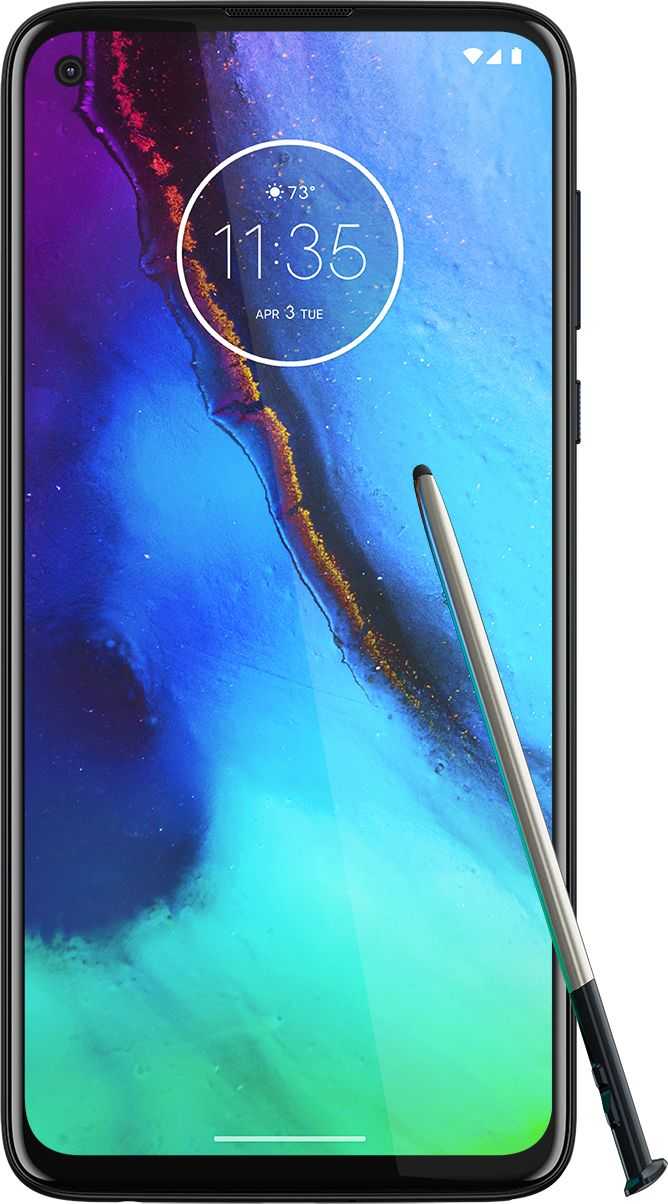
Samsung’s Galaxy Note series is the most popular line of smartphones that have a stylus, however, there are other manufacturers that make phones with a stylus too. LG has its Stylo series and there is also Infinix‘s (one of the companies owned by Transsion Mobiles) Note series which borrows more than a leaf from Samsung’s own line. This year, we may be getting a stylus-toting phone from Motorola, and now we know what the device looks like thanks to a leak by Evan Blass.

The unknown device is shown to have a display with a punch hole at the top left corner. The display is curved at the corners and there is a bit of bezel at the bottom of the screen. There is also a slit for the earpiece at the top between the glass covering the display and the frame.

Motorola phone with stylus

Coming to the stylus, it appears to be a capacitive stylus and not an active stylus like that of the S Pen of the Galaxy Note series. It has a rubber tip and should work well as an alternative to your finger for touch input and also for doodling, coloring, and drawing.

The name of the phone is unknown but Evan Blass says it is not the Motorola Edge+. The specs of the phone are also unknown but we would not put it beyond being a mid-range device. When it launches, the phone should run Android 10 out of the box.

Will this be the first of a new line of stylus-toting Motorola phones or just a one-off device? Only time will tell.


(Source)

Samsung will include free Galaxy Buds+ with Galaxy S20+ and S20 Ultra pre-orders

Samsung will announce a new pair of wireless earbuds alongside the Galaxy S20 series come February 11, 2020. The earbuds which will launch as the Galaxy Buds+ will have the same design as the original Galaxy Buds but will come in new colorways. While we expect the price of the new earbuds to be the same as that of last year’s model, though there are speculations it may cost more too, there is a way to get them for free.

A promotional poster leaked by Evan Blass (@evleaks) has revealed that Samsung will include a free pair of the Galaxy Buds+ with all pre-orders of the Galaxy S20+ and Galaxy S20 Ultra. The image shows the Galaxy S20+ in Cloud blue, the Galaxy S20 Ultra in Cosmic Gray, and the Galaxy Buds+ in Aura Glow.

Galaxy Buds+ pre-order

We do not know why Samsung is limiting the free earbuds to the Galaxy S20+ and Galaxy S20+ Ultra and not including the base model Galaxy S20. Last year, those who pre-ordered any of the Galaxy S10 phones including the Galaxy S10e got the Galaxy Buds. Hopefully, Samsung includes it with all the models.

It has been reported that the Galaxy Buds+ will come with a better battery life. Not that the original Galaxy Buds itself didn’t have a good battery life but that of its case paled in comparison to that of other wireless earbuds.


(Source)

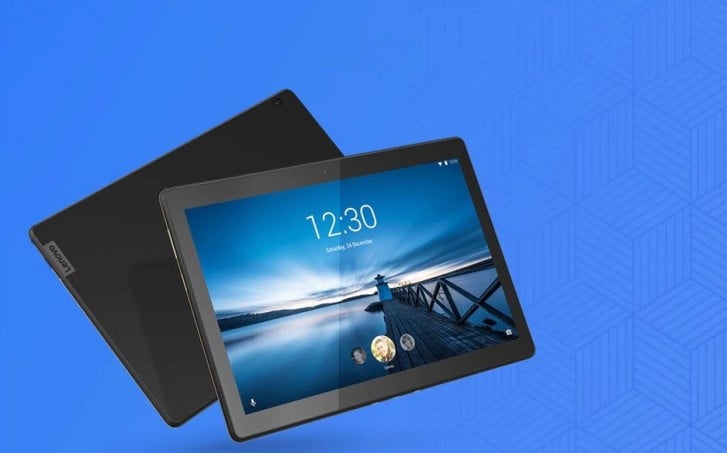
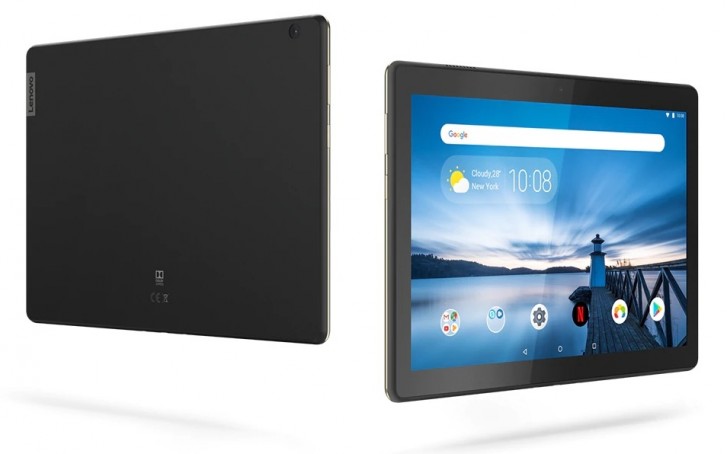
Lenovo M10 FHD REL tablet launched; 10.1-inch display, SD450 and 7,000 mAh battery

Lenovo mobile phones haven’t got a presence in India but the brand’s Android tablet line has continued to coast on stronger. The line has got a new product dubbed Lenovo M10 FHD REL. Let’s take a look at the specification and design of the tablet.Lenovo M10 FHD REL tablet

The Lenovo M10 FHD REL tablet features a 10.1-inch IPS LCD panel with fairly thick bezels on all sides. The display comes with a Full HD resolution.  The device equally packs a 5MP camera at the front for selfies. The camera is placed in a landscape direction. It is also equipped with dual front-facing speakers. The device packs a single 8MP rear camera located at the top-right edge when the tablet is placed in the landscape orientation.Lenovo M10 FHD REL tablet

Specs-wise, the Lenovo M10 FHD REL tablet is powered by a Snapdragon 450 chipset paired with 3GB RAM. There is also 32GB of internal storage onboard which can be expanded via the microSD slot. The device runs on Android 9.0 Pie right from the go. Crammed inside the tablet is a mammoth 7000mah battery but there is no fast charging support as the M10 presents with a micro-USB port. Other notable features include dual-band Wi-Fi, a 3.5mm audio jack and an FM Radio tuner. Sadly, the tablet is a WiFi-only tablet as it doesn’t have a SIM slot.

As for the price, the M10 FHD REL is already available online in India via Flipkart for Rs. 13,990 (~$196). Lenovo is yet to say when the device will be available in other regions.


(source)


Apple was one of the fastest growing brands in India in Q4 2019, should OnePlus worry?

Apple seems to have made a comeback in India in Q4 2019, according to the latest Counterpoint Research report. The Cupertino giant was one of the fastest-growing brands in India in the last quarter of the year, threatening the current premium segment leader, OnePlus.

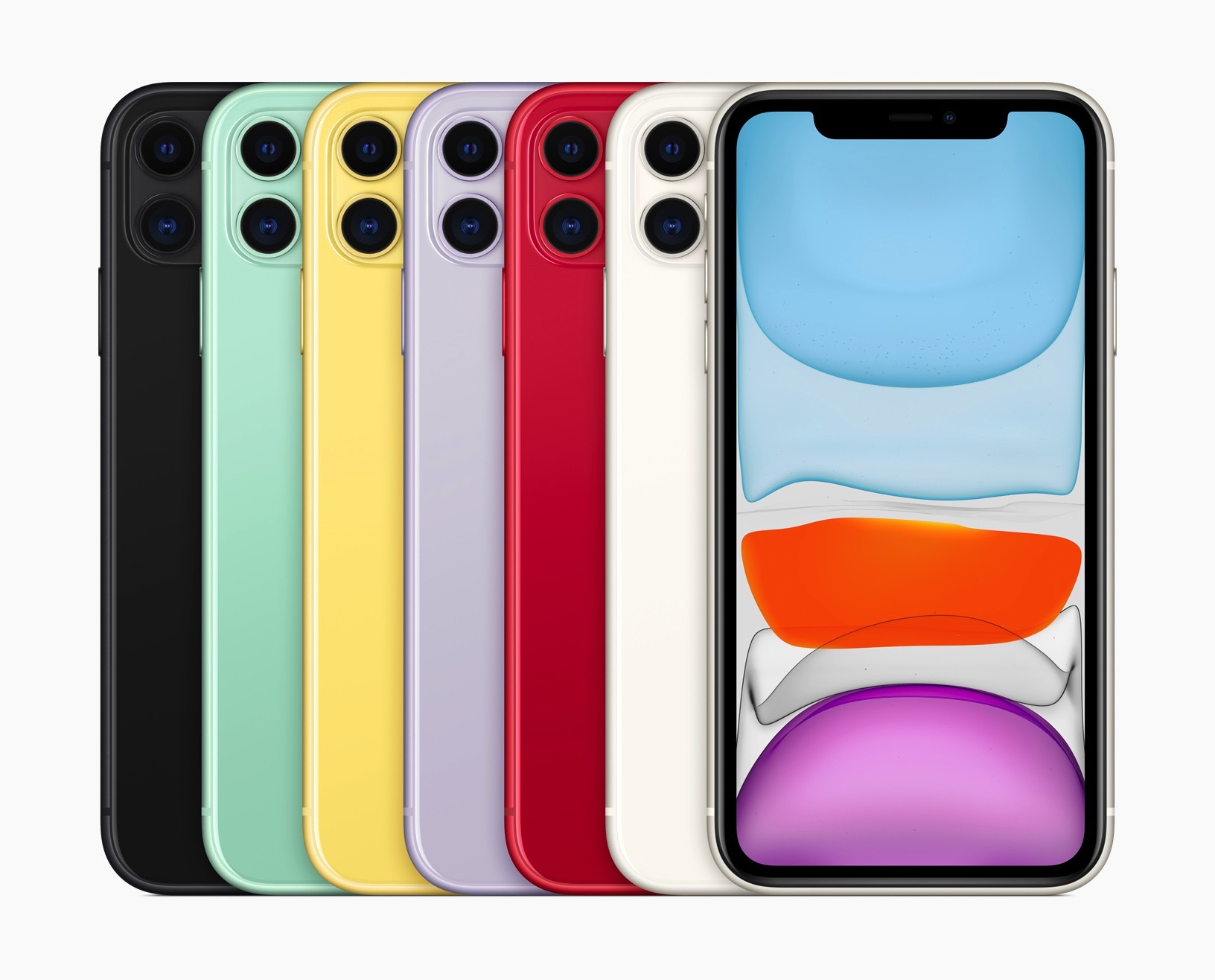
iPhone 11 featured
Apple’s iPhone 11 was cheaper than last year’s iPhone XR at launch

According to Counterpoint, Apple’s iPhone XR and the iPhone 11 have sold really well in the country. The company reportedly registered a staggering 41% YoY growth in Q4 2019, grabbing a 2% market share of the highly competitive Indian market. In comparison, Apple’s shipments had declined by nearly 43% in India in 2018.

Apple’s aggressive pricing and channel strategies seem to have paid off. First, the price cut on its iPhone XR model made it the best selling iPhone in Q2 and Q3 of 2019 in India. Then, the company released the new iPhone 11 series in September, making it the fastest rollout of a new iPhone lineup in India! This, paired with the no-cost EMI and HDFC festive cashback offers on the new iPhone 11 models helped Apple grab a small chunk of the market share in India at the end of last year.

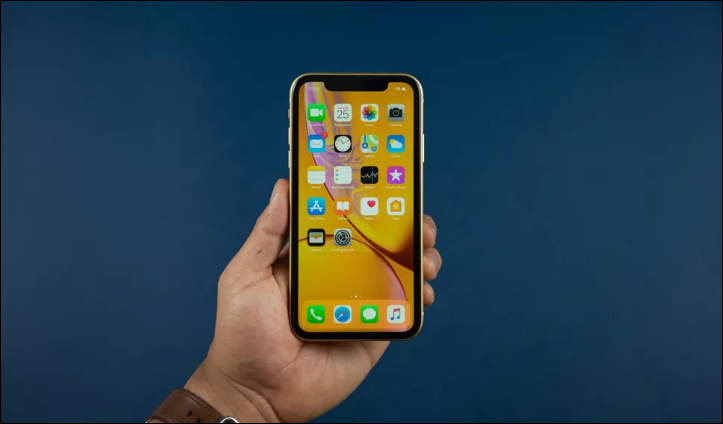
iPhone Xr
iPhone XR is currently being assembled in India

Local manufacturing was one of the biggest changes made by Apple in 2019. Foxconn’s Sriperumbudur factory in Chennai is assembling the iPhone XR while Wistron’s Bengaluru facility is assembling the iPhone 7. Local manufacturing has helped the company offer aggressive price cuts as well as offers to woo in more sales in the festive period. Also, the new iPhone 11 was launched at a cheaper price point than the 2018’s iPhone XR, further boosting Apple’s sales in the last quarter of the year.


(Via)