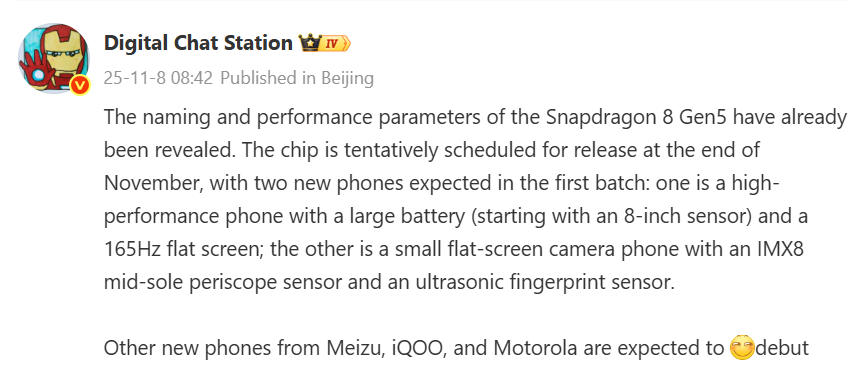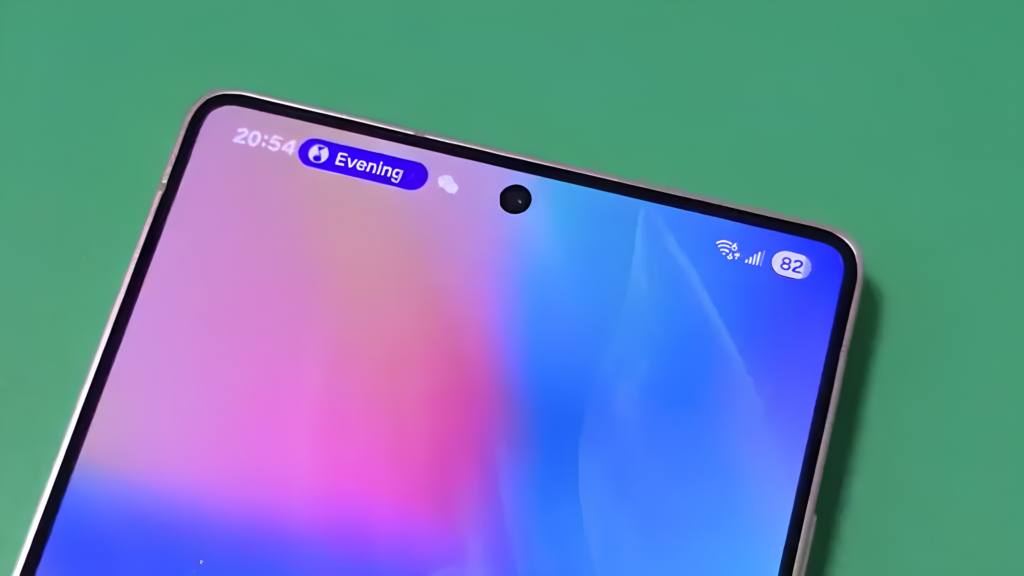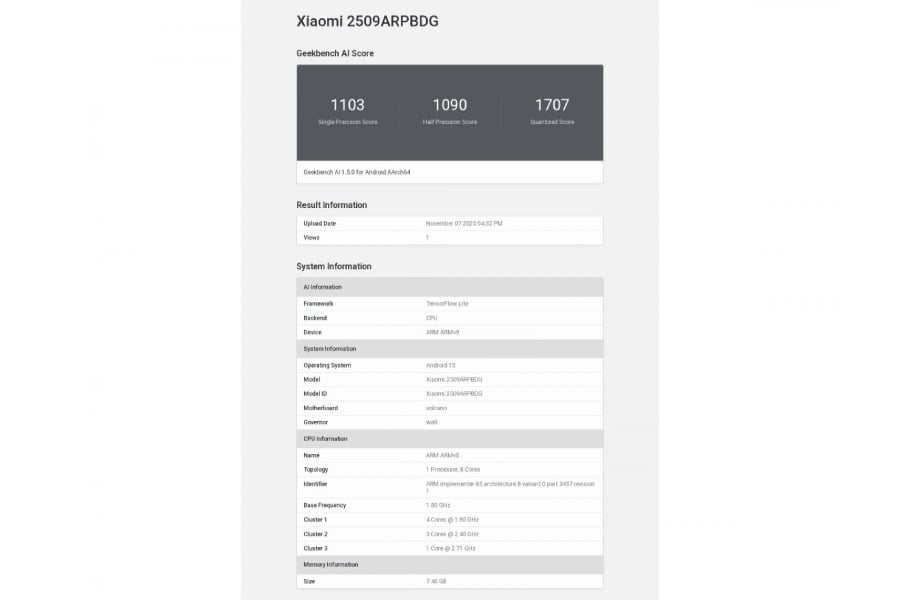
Early leaks claimed that the Oppo Find X9 series would include at least four models, such as the Find X9, Find X9 Plus, Find X9 Pro, and Find X9 Ultra. The X9 was said to be a new compact phone, whereas the X9 Plus was being considered as a successor to the Find X8. However, recent reports have revealed that the compact model will debut next year with the Ultra edition, whereas the Plus version will debut as the regular Find X9. To clear up the confusion, recent leaks suggest that Oppo may unveil the Find X9 and X9 Pro in October of this year. Recently, reliable tipster Digital Chat Station shared the key specifications of the Pro edition. Now, he is back with a new Weibo post that reveals previously unknown details about the standard X9.
Oppo Find X9 specifications (rumored)
Oppio Find X9 specs leak by DCS
The new leak suggests that the Dimensity 9500-powered Find X9 will feature a 6.59-inch flat OLED 1.5K resolution panel with extremely thin bezels on all four sides. The screen will come integrated with an ultrasonic in-screen fingerprint sensor.
DCS revealed that the Find X9 will pack a super large battery, which is said to be around 7,000mAh in size. The tipster did not mention the wired charging capabilities of the device but claimed that it will support 50W wireless charging.
The X9’s rear camera setup will feature a 50-megapixel periscope telephoto camera. It is also said to feature a metal middle frame. While he did not say anything about the device’s OS, it is expected to run on the upcoming ColorOS 16-based Android 16.
As can be seen above, he added that the Oppo Find X9 series will be unveiled after China’s National Day holidays. This indicates that the X9 lineup will go official in October this year.
For more daily updates, please visit our News Section.
A recent report revealed that Samsung may unveil the Samsung Galaxy S25 Fan Edition later this month or by early September. The rumour mill has already leaked details about the FE model in bits and pieces. Now, a new report courtesy of AndroidHeadlines has revealed almost everything about its specifications.
Samsung Galaxy S25 FE specifications (rumored)
Samsung Galaxy S25 FE CAD renders by Sammy Guru and OnLeaks
As per the report, the Galaxy S25 FE will measure 161.3 x 76.6 x 7.4mm and weigh 190 grams, making it slightly slimmer than its predecessor. It will feature a 6.7-inch Dynamic AMOLED 2X screen that offers an FHD+ resolution and a 120Hz refresh rate. In terms of durability, the device will carry an IP68 rating and have Gorilla Glass Victus protection for the screen.
The Galaxy S25 FE will feature the Exynos 2400 chipset. It will be available in two configurations: 8GB+128GB and 8GB+256GB. The S24 FE packed a 4,500mAh battery, whereas its successor is said to feature a larger 4,500mAh battery. It will support 45W wired and 15W wireless charging.
Moving on to the camera department, the Galaxy S25 FE will feature a 12-megapixel camera for selfies and video calls. It will feature a 50-megapixel main camera with OIS support, a 12-megapixel ultra-wide lens, and an 8-megapixel telephoto camera with 3x optical zoom and OIS.
The Galaxy S25 FE will come with the latest Android 16, which will bring along the latest One UI 8 and Galaxy AI. According to a report from last month, the S25 FE will come in shades like Icy Blue, Jet Black, White, and Navy. The device may come with a starting price of around $600.
For more daily updates, please visit our News Section.
For the past few days, Infinix has been teasing the upcoming Infinix GT 30 in India. While its landing page is live on the company’s official website and Flipkart, it is yet to reveal its launch date. A new report by GSMArena claims that the device may debut next week in India.
Infinix GT 30 launch date
Infinix GT 30 5G
As per the report, the Infinix GT 30 will debut on Aug. 8 In India. The leaked renders of the phone, shared by the publication, revealed that it will be available in a green shade, equipped with customizable LED strips and GT shoulder buttons for gaming. The phone is expected to offer 90fps gameplay experience on BGMI.
Infinix GT 30 specifications
According to previous reports, the Infinix GT 30 will feature a 6.78-inch AMOLED display that supports a 1.5K resolution and a 144Hz refresh rate. The device is expected to run on Android 15 with a layer of XOS 15 on top.
The device is expected to come equipped with the Dimensity 7400 chipset and 8GB of RAM. Likely, the phone will offer up to 256GB of storage. It is likely to draw power from a 5,200mAh battery, which will support 45W charging. At present, there is no concrete information about the camera capabilities of the device.
Considering that the Infinix GT 30 Pro is selling for Rs 24,999 (~$285) in India, it is likely that the upcoming standard model could be priced at around Rs 20,000 (~$230).
For more daily updates, please visit our News Section.
All that nonsense about “Don’t buy gaming chairs—it’s a gimmick, and you’re an idiot if you do” pushed me to check them out for myself. I used to be very biased about gaming chairs. I always thought spending big money on a ‘flashy’ chair wasn’t as practical as getting a regular ergonomic one.
I might never have tried a gaming chair without getting this DXRACER Martian Pro. The world is advancing so fast, and the massage gaming chair has renewed my imagination of the future of furniture/officing equipment, which can also be luxurious and provide the ultimate in enjoyment. In this review, I’ll share my most genuine experience with it. I hope this review could bring some new ideas if you are holding the same opinion as I did.
Unboxing
The chair comes in a huge box, just as heavy as it looks, but less bulky than traditional massage chairs. So when the Martian Pro arrives, I’d truly recommend having extra help (one more adult would be fine). Once you open it up, the parts are neatly organized, and the instruction manual will guide you through each step. Even the ports and connectors are labeled, which makes things way easier. As someone new to furniture assembly, I put it together in about 25 minutes, and it wasn’t nearly as much of a hassle as I’d imagined.
Intelligent Temperature Control and Comfort System
Once assembled, the chair’s “smart features” immediately caught our attention—and rightfully so, since “temperature control and comfort” are the standout selling points. Let’s start with the daily experience: how it feels to sit on it and how it handles temperature control. Right away, it felt noticeably different from clunky office chairs. We asked our colleague Holly to test it out—she was wearing thick pants that day, and within 5 seconds of turning on Level 1 cooling, she said she picked up on a faint breeze around her lower back and thighs.
We ran a real-world test: in a 26°C room, after sitting there for 1 hour, a regular office chair’s seat hit 35°C, while the Martian Pro (on Level 2 cooling) stayed steady at 28°C. That 4-6°C difference was a huge surprise—no sticky, hot feeling, and even after a full day, the seat stayed dry. No more sweaty, sticky gaming marathons—guaranteed.
This all comes down to its active cooling tech. If you’re familiar with the model, you’ll know the 3-level adjustable ventilated seat is a Pro exclusive. Picture this: small fans are hidden under the seat, paired with a honeycomb airflow layer—hundreds of tiny vents spread air evenly. The fans push air through these holes, circulating evenly instead of blasting in one spot. Clever, right? It’s a total game-changer compared to standard chairs.
On the flip side, it also has 3-level heating for cold days—heats up in just 2 seconds, with three temperature settings. It warms you up fast in winter, upping the comfort factor in a way ergonomic chairs can’t compete.
Beyond that, you get no “pinched” feeling with some chairs. And comfort doesn’t stop at the seat—its built-in back massager is a standout bonus for beating fatigue. The 8-point massage targets the key tension spots on the back, with six vibration modes—all controlled by a single button. It takes the edge off, keeping your back loose even after hours.
Electric adjustment and ergonomic support
This chair checks all the boxes for me. It’s comfortable, sturdy, and looks good too. Plus, I can recline it back, crush a few gaming rounds, then take a quick nap whenever I want—a total game-changer.
It doesn’t have that “sink-into-cotton” softness. The high-density material prioritizes support over that squishy feel, so it’s a little firm initially. But you get used to it after a couple of days, and the upside is that it won’t sag or lose shape over time. Instead, it’s got an electric reclining backrest that lets you dial in that perfect comfort zone. You can adjust it anywhere from 90° to 135° with a button on the left—super easy.
At 135°, the backrest is almost flat. Pair it with the headrest; your head can rest naturally, with your knees slightly higher than your hips. This “slight bend” feels natural for relaxing. I even napped in it for 30 minutes—no weird ‘floating’ feeling in my lower back, which is enormous. Only a tiny letdown? No footrest. If you want to stretch out at 135° fully, your legs have to stay straight—it would’ve been even better with something to prop your heels on.
At 90°, the backrest forms a right angle with the seat, and two small airbags are in the lower back. Hit the button, and they puff up slowly. It feels like a soft hand cupping your lower back, with no pressure. Whether you’re leaning forward or sitting up straight, they perfectly fill the gap between your back and the chair, custom-fit. Massive upgrade from those chairs with stiff, fixed lumbar pillows.
Some might wonder: Is it truly ergonomic? Will it keep you in a healthy posture? It outshines a lot of so-called ergonomic chairs. Take the 4D armrests with their quick-swap tops, for example. They adjust up and down to match your desk height, slide forward and back so your elbows rest naturally, swivel left and right, and shift side to side to fit different shoulder widths.
Then there’s the innovative airbag lumbar support. Those two built-in airbags hug the curve of your spine. Tweak how much they inflate, and they fill exactly the gap between your lower back and the chair—total personalized support, no guesswork. It takes a ton of pressure off your lower back.
The armrests move in four directions: up/down, forward/back, left/right, and swivel. Pair that with the magnetic quick-swap tops—they snap into place perfectly every time, no fumbling—and your wrists and elbows get just the proper support.
Battery Life & Charging Design
Another strength of the Martian Pro is the 5000mAh Li-ion battery, which can support over 360 hours per charge. That’s two full weeks of use, saving the trouble of charging it every other day.
Charging’s very easy too. A built-in retractable cable (1.5-2.5m) pulls out when you need it—plug into the adapter, or get the battery out to charge separately.
Durability & Structural Safety
For Heavier people, you may ask, ‘Can this chair hold up to my weight?’ I checked, and it says it’s built with automotive-grade steel and certified by BIFMA. I think of that as the gold standard for furniture safety. The official max weight? 300 pounds, around 136 kg.
There are two materials available: EPU leather or woven fabric. EPU leather is tougher than average PU. We run a key through it, scraped hard, with nearly no scratches. Impressive. Woven fabric is breezier. I sat in 35°C heat for an hour, and my back sweat was way less than the EPU’s. No sticky mess. Plus, it comes with a 200ml leather care kit to keep it looking fresh.
Little Extras & Nice Touches
Beyond the basics, the Martian Pro has some “human-centric” details, starting with the headrest. The headrest has a magnet, so it clings to the backrest like glue—twist it, move it, and stay put. The foam is soft enough that your head sinks slightly, like a gentle support keeping your neck from straining during long screen time—no more constant readjusting.When you recline the backrest, a yellow LED strip lights up automatically. It gives your gaming corner that futuristic vibe.
Wrap-Up
The Martian Pro’s intelligent temperature control and comfort features are total game-changers—my back and legs stay way more relaxed than in regular chairs. It checks all the boxes from comfort to adjustability, battery life to durability.
Honestly, it’s more than just a ‘comfortable gaming chair’—it’s a supremely versatile seat for any purpose, inspired by luxury cabins. Support while you work, crash for a nap, get rid of sweat while gaming, or watch episodes in the living room. Whatever you want to do, it works, and works with great comfort and relaxation for you.
What’s the best way for a smartphone company to show it’s made it? Undoubtedly, by launching a flagship. For most brands, that’s the big milestone, a premium device that says, “We belong.”
Nothing is doing just that with the new Phone (3). At $799 / €799 / £799, this is the company’s first attempt in years at making a high-end Android phone. And with this, it wants to attract the same crowd who might otherwise buy a Pixel 9, a Galaxy S25, or even the baseline iPhone 16.
But despite its more premium pricing and upgraded specs, the Phone (3) is still very much a Nothing device, which is to say, different for the sake of being different. So, who exactly is it for?
The Phone (3) doesn’t lack on paper. You get a 6.67-inch OLED display with 120Hz refresh rate, 1B colors, HDR10+ support, and up to 4,500 nits of peak brightness.
Powering the phone is Qualcomm’s Snapdragon 8s Gen 4, which sits slightly below the top-tier Snapdragon 8 Gen 4 Elite. This is a 4nm chip, paired with either 12GB or 16GB of LPDDR5 RAM and UFS 4.0 storage (256GB or 512GB). Unsurprisingly, the Phone (3) delivers smooth performance, with Nothing OS 3.5 (based on Android 15) taking care of software optimization.
The Phone (3)’s 5,150mAh battery easily gets you through a full day with moderate use. For charging, it supports 65W wired, 15W wireless, and Power Delivery 3.0. However, you’ll need to bring your own charger as it’s not included in the box.
The phone is also IP68 rated, made of Gorilla Glass and an aluminum frame, and supports two physical SIMs plus eSIM. And no, there’s no headphone jack.
2. Cameras are a mixed bag
There are three 50-megapixel sensors on the back: a wide, a 3x periscope telephoto, and an ultrawide. The main sensor does most of the heavy lifting and delivers good results with detail and color.
The telephoto lens retains sharp detail at 3x zoom and performs reasonably well up to 6x, with a noticeable drop-off beyond that. The 50MP ultrawide sensor offers a 114-degree field of view, producing decent wide-angle shots.
Up front, a 50MP selfie camera handles self-portraits and supports 4K video recording at 60fps.
3. The Glyph is no longer a gimmick, or is it?
Nothing is probably the only brand in the smartphone space that consistently tries to do something different, and the original Glyph interface was a result of that mindset. It’s a fun feature to show off to friends, though the LED lights on the back have limited practical use.
As a result, the Phone (3) introduces a dot-matrix-style mini-display made up of 489 LEDs in the corner of the rear panel. This “Monochrome LED Display,” as the company calls it, can now show simple graphics and app icons.
It’s still a bit gimmicky in some ways, though. For instance, features like the Magic 8-Ball or spin-the-bottle probably won’t get much use, but other functions are more practical. You can view the time, charging status, or volume level without flipping the phone over. The back is also touch-sensitive, allowing interaction with certain widgets directly from the Glyph interface.
Overall, it’s a meaningful upgrade over the original Glyph lights. But the real question is whether this second screen will gain broader utility or remain a niche feature.
4. Clean, uncluttered software
Nothing OS 3.5, based on Android 15, leans hard into the retro-dot-matrix look, but under the hood, it’s clean, smooth, and remarkably lightweight. It’s one of the more streamlined Android experiences out there, closer to what you’d find on a Pixel than on a Galaxy.
There are also a few thoughtful extras. Essential Space, introduced earlier with the Phone (3a) Pro, is back; it lets you record voice memos while the phone is facedown, with visual feedback displayed on the Glyph screen. Essential Search is another AI-powered feature that scans your phone’s contents to answer simple queries quickly.
The company promises five years of Android version updates and seven years of security patches.
5. So, who’s this for?
The Phone (3) isn’t the best phone at $799. You can get better cameras on the Pixel 9 Pro, better performance on a Galaxy S25+, and more consistent software updates from both. But if you’re bored with the usual players and want something that looks and sometimes feels a bit different, this might be for you.
It’s for people who care about design but don’t mind asymmetry. People who like the idea of a notification light that doubles as a visual status monitor. People who like Android but find most Android phones too cluttered.
It’s not for gamers who want top thermal performance. It’s probably also not for photographers who demand perfect color accuracy from every lens.
The Phone (3) makes more sense if you’re already in the Nothing ecosystem. If you own Nothing Ear earbuds or the company’s older phones, the continuity is appealing. But for someone switching from Apple or Samsung, it’s more of a leap.
If you own a Lenovo device or just enjoy free stuff, you’re in luck. The company has just announced its video game giveaways for this month. These are the latest free games that will be available to the brand’s Legion Gaming Community platform, so let’s check them out.
Lenovo Legion Video Game Giveaway: Everything you need to know
Ultra Street fighter IV
The brand just announced two titles that will be available for free on its Legion Gaming Community, which includes a fighter game and a retro game reboot. First we have the Ultra Street Fighter IV. This title from Capcom includes the entire roster available in the base Street Fighter IV along with five new characters and six more stages. It isn’t one of the latest game in the series, but it is still a modern entry in the franchise.
On the other hand, Strider is a reboot of the original 1989 game, bringing the arcade style of fighting to modern systems. This game went on to inspire a whole genre of games, including big names like Ninja Gaiden and Devil May Cry. Lenovo’s Legion Gaming Community can claim these games on 6th August 2025.
Strider 2014 Reboot
In related news, the Chinese tech giant’s Legion Go 2 prototype was recently spotted in early gaming benchmarks. The brand is also gearing up to launch the new Xiaoxin Pro GT gaming tablet for a budget price tag soon, while its subsidiary just unveiled a powerful new mini PC that is powered by AMD’s flagship Strix Halo APUs.
For more daily updates, please visit our News Section.
While Xiaomi may unveil the Xiaomi 16 series in September as the world’s first smartphones powered by the Snapdragon 8 Elite 2 chipset, October could see the launch of the Redmi K90 series in China. Today, tipster Digital Chat Station shared new information via a Weibo post, revealing key battery and charging specifications for the upcoming Redmi K90 and K90 Pro models.
Redmi K90 series battery, charging details (rumored)
According to the leak, the Redmi K90 will likely feature a 7,100mAh battery, while the K90 Pro may come with a slightly larger 7,500mAh unit. Both devices are expected to use single-cell silicon-carbon battery technology and support fast 100W charging.
Previous leaks indicate that the Redmi K90 Pro and K90 will be powered by the Snapdragon 8 Elite 2 and Snapdragon SM8845 chipsets, respectively. As per a new leak, the SM8845 chip will be called the Snapdragon 8 Gen 5 when it hits the market.
The series may feature a 6.59-inch flat RGB OLED LTPS screen offering a 2K resolution and a smooth 120Hz refresh rate. The Pro model is expected to arrive with features like a periscope telephoto camera, an ultrasonic under-display fingerprint sensor, dual stereo speakers, a premium metal mid-frame, and an x-axis linear motor for enhanced haptics.
Poco F8 series expected as global counterpart
Reports suggest that the Redmi K90 and K90 Pro could be rebranded as the Poco F8 Pro and Poco F8 Ultra for international markets. Additionally, the standard Poco F8 is tipped to launch in Q2 2026, potentially as a rebadged version of the Redmi Turbo 5 Pro, which is rumoured to debut with the Snapdragon 8s Gen 5 chipset.
Alongside its flagship offerings, Redmi is also working on budget-friendly models. The brand is expected to announce the Redmi 15 series and the Redmi Note 15 series later this month and in September in China.
For more daily updates, please visit our News Section.
Samsung is making some bold changes to how it rolls out major One UI updates. Spoiler: the changes are beneficial for Galaxy users. Thanks to the latest move, the brand was able to make a quick turnaround with the One UI 8 release after a much-delayed One UI 7 release, and it appears things are only going to get better with upcoming One UI releases.
Samsung has made two major changes that impact the development of One UI, as well as its rollout. The brand is adopting Google’s Trunk Stable model for faster development, and secondly, it won’t be releasing new One UI versions with the latest Galaxy S-series models, but the Galaxy foldables will receive the first bite going forward. Let’s talk about them in detail.
Samsung is adopting Google’s faster development model
Google used to rely on a branch-based model for Android development. This approach needed each major Android version to be built in a separate branch and then merged into the main codebase when complete. While it worked well, it was not without problems. Merging large chinks of new code used to cause bugs and delays.
For Android 16, Google moved to a Trunk Stable model. It doesn’t require separate benches, but all development happens in a single, always-stable codebase. New features are hidden behind “feature flags,” and only appear in public builds once they’re fully ready.
The switch to the Trunk Stable model helped Google release Android 16 almost a quarter earlier than the usual release timeline. Samsung has also utilized Google’s Trunk Stable method for One UI 8 development, which is why it was able to achieve a major turnaround with a much faster release of One UI 8.
According to Samsung’s Sally Hyesoon Jeong — Executive VP and Head of Framework R&D at the Mobile eXperience division — Samsung’s long-term goal is to match Google’s pace for rolling out new Android versions with One UI at the top. This means we could see future One UI updates, such as One UI 8.5 and One UI 9, arriving much sooner than we are used to. This move by Samsung brings another significant change to who gets the first bite (more details below).
Samsung foldables will now launch with major One UI versions
So far, the latest Galaxy S-series have been getting the first bite of major One UI releases early in the year, while the newest foldables have debuted later in the year with a slightly updated One UI x.1.1 version. Well, that seems to be changing soon as Samsung is reportedly making changes to One UI releases.
According to a well-known tipster @UniverseIce, Samsung will debut major Android and One UI versions in the middle of the year alongside the newest foldable phones. Meanwhile, the Galaxy S-series phones launching early in the year will ship with an incremental software, likely One UI x.5.
Samsung hasn’t confirmed this just yet, but it seems fairly accurate. That’s because the brand usually launches new foldables around the same time Google releases a new version of Android. Since the brand is aiming to sync major software releases with Google, it’ll likely release the newest foldables with the latest OS and an incremental update a few months later for the Galaxy S series. This should also mean a faster-than-usual One UI rollout for older Galaxy devices.
The Redmi A27 2026 monitor has been launched in China for everyday use. It is now available for pre-orders in the country. Continue reading ahead to learn about the specifications, features, and price of the device.
Redmi A27 2026 specifications and features
Redmi A27 2026
The Redmi A27 2026 features a 27-inch IPS screen with a resolution of 1920×1080 pixels and a refresh rate of 144Hz, promising smoother document scrolling and casual gaming. The wide 178-degree viewing angle is ideal for multi-monitor setups or shared viewing.
The A7 2026 supports 99% of the sRGB color gamut and can display 16.7 million colors. Each unit is factory-calibrated with a claimed ΔE of less than 1, ensuring accurate color output for basic design or media tasks.
Redmi A27 2026
The display reaches a maximum brightness of 300 nits and offers a 1500:1 static contrast ratio. Design-wise, the A27 2026 adopts a minimalist “three-side narrow bezel” layout, making it suitable for multi-screen configurations. The tilt-adjustable stand supports angles from 5° forward to 15° backward and is also VESA wall-mount compatible. Other hardware specs include a 6ms response time and support for an 8-bit color depth (via 6-bit+FRC).
Redmi A27 price and availability
The Redmi A27 2026 is currently available for pre-order in China through major online retailers. It is priced at CNY 649, with a limited-time pre-sale price of CNY 469, which is approximately $90 and $65, respectively. The monitor is available in a sleek black finish. There is no official word yet on its availability outside the Chinese market.
For more daily updates, please visit our News Section.
After teasing for the past few days, Vivo has now officially revealed the launch date for next V-series phone in India. The announcement was made through a new post on the brand’s social media, confirming what was previously only speculated. The device in question is the Vivo V60, which is expected to pack a mix of high-end camera hardware, premium design, and a long-lasting battery.
Vivo V60 India launch date
The finish, the shine, the design, everything reflects the beauty of Auspicious Gold in the all-new vivo V60.
According to Vivo India’s latest update, the Vivo V60 will be launched in the country on Aug. 12. The phone is already being promoted as the slimmest device in its segment, despite carrying a large 6500mAh battery. One of its key attractions will be its rear camera system, developed in collaboration with ZEISS, which supports up to 100x digital zoom. The brand has also confirmed the color variants of the device.
The triple-lens setup is expected to include a 50-megapixel main camera, an 8-megapixel ultra-wide sensor, and a 50-megapixel 3x telephoto unit. On the front, a 50-megapixel selfie camera is likely to be part of the offering.
If the rumors hold true, the V60 will feature a 6.67-inch AMOLED screen with 1.5K resolution and 120Hz refresh rate. The Snapdragon 7 Gen 4 chipset could power the device, alongside LPDDR4x RAM and UFS 2.2 storage. It may also offer dual stereo speakers, an in-display fingerprint scanner, and IP68/IP69 protection. The phone will run on Android 15 and bring overhaul improvements to FunTouch OS expereince.
Vivo V60 price, color options
The Vivo V60 is expected to be priced between Rs 37,000 and Rs 40,000. It will come in Auspicious Gold, Moonlit Blue, and Mist Gray. Meanwhile, Vivo recently launched the Vivo T4R for Rs 19,499 and is preparing to unveil the Vivo Y400 5G on Aug. 4.
For more daily updates, please visit our News Section.
The iQOO Z10 Turbo+ is scheduled to launch on Aug. 7 in China. Ahead of the launch, the brand has released a new poster to highlight all the key specs that it has officially confirmed about the Z10 Turbo+. Here’s a look at what’s known about the next Turbo-branded iQOO phone for the Chinese market.
According to the brand’s teaser, the iQOO Z10 Turbo+ will debut with an 8,000mAh battery packed into an 8.16mm slim profile. This is being promoted as the brand’s largest battery ever, and it’s not just about size. The company claims the battery can support up to 20 hours of MOBA gaming or 22.2 hours of short video playback.
One of the highlights is its ability to function efficiently even in extreme conditions. iQOO says the phone can manage 20.8 hours of video playback at -20°C, made possible by a semi-solid-state battery solution. This technology could offer users greater dependability in cold weather, a common challenge for conventional lithium-ion cells.
Charging the phone for 9 minutes will allow users to enjoy MOBA games for around three hours. It also supports 55W PD/PPS and 44W UFCS protocols, allowing the bundled charger to work with various devices. Even with just 1 percent battery left, the phone reportedly manages 5.6 hours of standby time.
As far as other specs are concerned, the iQOO Z10 Turbo+ is officially confirmed to feature a flat OLED panel that supports up to 2000nits of peak brightness and a Dimensity 9400 Plus chipset. It will come in three shades such as Cloud Sea White, Desert Sand, and Polar Grey. The Aug. 7 event will also see the arrival of the TWS Air 3 Pro and a 22.5W power bank.
For more daily updates, please visit our News Section.
itel S9 Star has been launched in India. The new wireless earbuds aim to deliver a refined balance between performance, durability, and everyday convenience. Here’s a look at its specifications, features, and price.
Itel S9 Star specifications and features
itel S9 Star
The itel S9 Star is equipped with 10mm drivers that deliver strong, immersive 360-degree bass and refined audio output for music and calls. For clearer conversations, it features AI Environmental Noise Cancellation (AI ENC) that helps suppress background sounds, making voice transmission more precise even in crowded environments. These features aim to enhance the audio experience for both entertainment and communication.
Built with IPX5-rated water and sweat resistance, the S9 Star is intended for active use, whether during workouts or commutes. It also offers a long-lasting battery experience, delivering up to 30 hours of total playback time with its 400mAh charging case and 28mAh earbuds.
The S9 Star supports Bluetooth 5.3 for stable wireless connectivity and includes intuitive touch controls for easy operation. Voice activation is also supported for added convenience, making it a versatile companion for varied use cases.
itel S9 Star price in India, availability
The itel S9 Star is priced at Rs 899 and is now available at retail stores across India. Buyers can choose from four colour variants: Black, Midnight Blue, Brown, and White.
Asus has made two key announcements for customers in India. First, it has introduced a new Drop Zone initiative to make laptop servicing more accessible. Second, the brand confirmed its participation in the Flipkart Freedom Sale 2025, offering significant discounts on the newly launched ExpertBook P series laptops.
Drop Zone improves repair convenience across key cities
Asus Drop Zone
The newly launched Drop Zone concept allows users to drop off their laptops at select Asus Exclusive Stores without needing to visit a separate service centre. Currently live in cities like Delhi, Mumbai, Kolkata, Coimbatore (Tirupur), and Nagpur, the initiative aims to reduce the turnaround time for servicing and simplify repair logistics.
The Drop Zone process starts with a physical assessment, followed by coordination with the main service centre, and ends with customers collecting their repaired devices from the same store. Initially available for in-warranty laptops, ASUS plans to expand the coverage further into tier-2 and tier-3 regions.
Freedom Sale brings major discounts on ExpertBook P series
During the Flipkart Freedom Sale starting today (Aug. 1), Asus is offering deals on its ExpertBook P1, P3, and P5 laptops. These AI-enhanced models are built with features like enterprise-grade durability, up to 32GB RAM, 1TB SSDs, and latest-gen Intel processors. For example, the ExpertBook P5 with Core Ultra 7 and 32GB RAM is now available at Rs 1,10,990, after a Rs 9,000 discount.
Entry-level business users can opt for the P1 model with i5-13420H, 16GB RAM, and 512GB SSD for Rs 50,990. These laptops are designed for professionals, startups, and educators seeking high performance with added security and support benefits.
For more daily updates, please visit our News Section.
Infinix has started teasing the arrival of the Infinix GT 30 5G in India. Its landing page available on Flipkart gives a hint that its launch may not be far away. A new report released by GSMArena gives the first look at the device’s design.
Infinix GT 30 design
Infinix GT 30 5G
The Infinix GT 30’s design is almost identical to the Infinix GT 30 Pro, which debuted in June. There have been speculations that the standard model may not feature gaming trigger buttons that are available on the Pro model. However, the image below confirms that the non-Pro version will also feature gaming trigger buttons.
The Infinix GT 30 also features customizable LED light strips on the back, like the Pro version. There’s a dual camera setup with an LED flash at the upper-left corner. While its front has not been revealed yet, it is likely to feature a flat OLED panel.
Infinix GT 30 specifications, price (rumored)
Infinix GT 30 5G
Infinix is yet to reveal the technical details of the Infinix GT 30. Recent reports have revealed that the device’s display will support a 1.5K resolution. It will be powered by the Dimensity 7400 chipset, 8GB of RAM, and Android 15. It is expected to pack a 5,200mAh battery with 45W charging support.
As far as gaming is concerned, the device is said to have received a certification from Krafton to support 90fps gaming on BGMI.
The Infinix GT 30 will be positioned lower than the Pro version. Therefore, it is likely to cost around Rs 20,000 in India. The phone is also expected to debut in other markets in the coming days.
For more daily updates, please visit our News Section.
London-headquartered tech company Nothing has introduced a new competition in India called the Nothing Incubator. According to the brand, the initiative is designed to encourage bold thinking among young innovators and aims to tap into India’s growing role in shaping global tech culture.
Nothing Incubator: What is it?
Nothing Incubator
The Nothing Incubator, a competition designed for Indian students, is open to full-time undergraduate and postgraduate students from over 60 leading Indian institutions, including IITs, IIMs, BITS Pilani, FMS, and others. Participants are invited to form teams of up to three members from the same college, with interdisciplinary collaboration welcomed. The theme of the competition is “Making Tech Fun Again,” and the program is structured in three rounds.
The first round, which is now live, requires teams to submit a single-slide idea pitch based on the theme. Shortlisted teams will then move to the second phase, where they are expected to design a three-year vision and go-to-market strategy. In the final stage, selected teams will present their ideas live to a panel of experts, including venture capitalists, startup mentors, and industry professionals.
Prizes and future opportunities
The winning team will receive Rs 2 lakh in prize money, the latest Nothing Phone (3), and an official certificate. Runners-up will also earn certificates and Nothing products. Importantly, students who display exceptional potential during the competition could be considered for future roles at the company.
Registrations for the competition are now open via Unstop. More than just a contest, the Nothing Incubator presents a chance for students to transform bold ideas into actionable solutions while gaining real-world visibility.
For more daily updates, please visit our News Section.
According to an official announcement from Meizu, the Meizu 22 will be formally introduced in August. The company has started accepting pre-orders across online and offline platforms. The announcement also coincided with a live hands-on demo of the device at the ChinaJoy 2025 expo, which is being held from August 1 to 4.
Meizu 22: Compact design with industry-first ultra-narrow bezels
Meizu 22 to debut in August in China.
Meizu is positioning the Meizu 22 as a pro-level compact flagship, featuring a 6.3-inch display with a design goal of achieving 1.22mm symmetrical bezels on all four sides. According to the brand, this is made possible through its in-house LIPO technology. The team reportedly focused on enhancing the in-hand feel, aiming to deliver what it claims is the narrowest physical four-sided bezel on a smartphone to date.
In an added design twist, the phone will come with a white front panel, a challenging aesthetic to pull off with such narrow bezels. This combination is meant to appeal to users who appreciate minimal bezels without compromising on visual clarity or touch accuracy.
The Meizu 22 will also be the company’s first phone to feature a periscope telephoto camera, suggesting serious efforts towards improved mobile photography. Meizu has indicated it will not cut corners when it comes to camera investment for the 22 series.
The Meizu 22 is expected to come equipped with the Snapdragon 8 Elite. Also, the brand recently confirmed that it has no plans to launch as Meizu 22 Pro as the standard model can deliver pro-level performance.
At the ChinaJoy expo, Meizu held a “first feel” event with four dummy units labelled A to D. Only one represents the final design. Attendees were invited to guess which was real. However, some tech bloggers suggested that all the dummy models resemble devices already launched by other brands, expressing scepticism about whether the final product will stand out in a crowded market.
For more daily updates, please visit our News Section.
Battery innovation doesn’t always get the spotlight, but maybe it should. After all, it’s one of the few things that truly defines the day-to-day user experience. Over the years, smartphone processors got faster, displays turned fluid and vibrant, and cameras reached near-DSLR quality. But battery life? Mostly stagnant. Until now. A quiet revolution is unfolding in battery chemistry, and it’s called silicon-carbon.
Modern smartphones, laptops, and EVs have relied on lithium-ion batteries for decades. The technology is built around a graphite anode, a safe, stable material with one critical downside: it’s maxed out.
Graphite holds lithium ions well, but its theoretical capacity (372mAh/g) is a hard ceiling. Over the past few years, we’ve only seen incremental gains, maybe 3-5% per generation. That’s not enough when users want thinner devices and longer runtimes.
2. Silicon-Carbon Steps In
Silicon changes the game. It can absorb nearly 10 times more lithium than graphite, theoretically enabling 4,200mAh/g. But the catch is brutal: silicon expands 300-400% when charged. That’s a recipe for cracked electrodes, broken internal structure, and batteries that degrade in months. No one wants a swollen phone after six months.
That’s where the silicon-carbon (Si/C) composite comes in, a hybrid solution that mixes small amounts of nano-silicon into a conductive carbon matrix. The carbon scaffold gives structure and stability. The silicon delivers a bump in capacity. Instead of 100% silicon, most Si/C anodes use 5-15% silicon, enough to boost energy density by 10-20% without the destructive swelling.
3. How It Actually Works
In traditional lithium-ion batteries, lithium ions move between the cathode and anode during charge and discharge cycles. Silicon-carbon (Si/C) batteries follow the same process, but the anode’s improved structure stores more ions within the same volume. That means a 5,000mAh battery can now deliver 5,500 or even 6,000mAh, without any increase in physical size.
Alternatively, you can shrink the battery to make the phone slimmer without compromising on battery life.
It’s not just about size. Silicon-carbon batteries also charge faster, perform better in the cold, and retain more usable power at lower voltages. In one case, Honor’s tests showed 240% more remaining capacity at 3.5V compared to standard Li-ion batteries. That translates to more screen-on time near the end of a battery cycle.
4. Why You’re Seeing It Now
Honor was the first to introduce a Si/C battery in a smartphone back in 2023. Since then, brands like Xiaomi, OnePlus, Vivo, Oppo, and even Huawei’s budget lineup have adopted the technology. And then came the foldables, which saw the most dramatic gains. Devices like the Honor Magic V2 and Vivo X Fold 3 Pro began offering all-day battery life in sub-10mm bodies, something that felt out of reach just a few years ago.
By 2025, mainstream flagships such as the OnePlus 13 and Xiaomi 15 Ultra packed 6,000mAh silicon-carbon batteries without any increase in thickness. Huawei surprised the market with a $170 phone housing a massive 6,620mAh Si/C cell, while Honor’s Power series managed to squeeze in 8,000mAh into a body under 8mm.
The trend has only accelerated. Xiaomi’s Mix Flip 2 ships with a 5,165mAh battery, the Honor Magic V5 includes a 6,100mAh unit, and the Vivo X Fold 5 packs in 6,000mAh, all while pushing foldable thickness to record lows. Thanks to silicon-carbon tech, the old trade-off between slimness and battery life is finally being rewritten.
5. So Why Aren’t Apple and Samsung Onboard?
In short: caution. Apple and Samsung prioritize long-term reliability, and early Si/C cells degrade slightly faster than traditional Li-ion. There’s also logistical overhead: large single-cell batteries over 20Wh are tricky to ship globally. Most Si/C phones today are China-first or split into dual-cell configurations to dodge regulation headaches.
That’s changing, though. Samsung is reportedly testing the tech for the Galaxy S26. Apple, meanwhile, is likely waiting until Si/C batteries hit its benchmark of 80% capacity after 500 cycles. Once that happens, you can bet they’ll rebrand it as a breakthrough.
6. The Road Ahead
Silicon-carbon isn’t the final form. Solid-state and sodium-ion batteries are coming, but they’re not ready yet. Right now, Si/C is the best blend of innovation and practicality. It supercharges lithium-ion without rewriting the rulebook. In a world of foldables, ultra-thin phones, and AI-powered features that drain batteries fast, this tech couldn’t have come at a better time.
For users, it means this: slimmer phones, longer battery life, and a lot less anxiety about hitting 10% by dinner. It’s not magic. It’s chemistry, refined. And it’s already changing what smartphones can be.
For more daily updates, please visit ourNews Section.
Apple’s upcoming iPhone 17 Pro Max is shaping up to be one of the most ambitious flagships in recent memory. It’s expected to launch in the second week of September, bringing with it a slew of design and hardware changes, some long overdue, others aggressively forward-looking.
But while Apple readies its next-generation device, Huawei has already thrown down the gauntlet with the Pura 80 Ultra, a photography powerhouse with cutting-edge optics and top-tier performance, already available in global markets.
So, the question is inevitable: can Apple’s next Pro Max actually compete with Huawei’s latest Ultra?
Huawei’s Pura 80 Ultra is bold and unapologetically premium. It retains a modernist aesthetic, with real engineering feats inside. The hefty 233.5g chassis conceals a complex quad-camera system, IP68/IP69 water resistance, and dual telephoto shooters, all integrated into a single rear housing.
Apple, by contrast, is reportedly pulling back from titanium and returning to an aluminum frame for the iPhone 17 Pro Max. That may sound like a step down, but it’s not without purpose. Apple’s new half-glass, half-aluminum back is aimed at improving durability while supporting MagSafe wireless charging.
The horizontal rectangular camera bump, now reportedly aluminum, suggests Apple is finally breaking away from the classic triple-lens square module. Add in new colorways, including an iridescent white and coppery orange, and it’s clear Apple wants the Pro Max to look fresh without straying too far from the brand’s core identity.
2. Cameras
Huawei’s camera specs are impressive on paper. It features a 1-inch 50MP primary sensor with variable aperture, a 50MP ultra-wide lens, and dual telephoto cameras, 12.5MP at 9.4x and 50MP at 3.7x, supported by advanced sensor-shift stabilization. The system offers up to 100x digital zoom and integrates one of the most sophisticated image pipelines in the industry.
The iPhone 17 Pro Max is expected to feature a triple 48MP setup for the wide, ultra-wide, and telephoto cameras, marking the first time Apple will match sensor resolution across all three lenses. It may also introduce a new variable mechanical aperture and support for 8K video capture, signaling significant improvements in computational photography. There’s even talk of dual video recording, a nod to the creator-first tools Huawei already enables.
Still, Huawei maintains the upper hand in optical zoom flexibility. Apple is sticking with 5x telephoto for the Pro Max, but Huawei’s dual periscope setup offers both short and long-range zoom without compromise.
3. Display and Performance
The iPhone 17 Pro Max is said to house a 6.9-inch XDR OLED display with ProMotion (120Hz) and always-on functionality, powered by a custom A19 Pro chip on TSMC’s latest 3nm process. Apple is also bumping RAM to 12GB and offering a 5,500mAh battery with 25W MagSafe and Qi2 wireless charging.
Huawei’s display matches Apple’s fluidity with a 6.8-inch LTPO OLED panel (1-120Hz), but where it surprises is in thermal and charging performance. The 5170mAh battery supports a staggering 100W wired and 80W wireless charging. In comparison, Apple’s charging speeds feel conservative, though battery life is expected to improve with new adhesive tech and increased capacity.
Huawei’s Kirin 9020 chip isn’t as efficient or fast as Apple’s silicon on paper, but real-world use cases, especially camera processing and multitasking, still make it feel like a high-performance flagship, especially in regions where HarmonyOS has been replaced with EMUI 15 for better app support.
4. Connectivity and Ecosystem
Both phones bring Wi-Fi 7, Bluetooth 5.3, and full IP68 certification, but there’s a notable difference in their approach to 5G. Apple is still relying on Qualcomm modems for most models, with its own modem debuting only on the iPhone 17 Air. Huawei’s Pura 80 Ultra, on the other hand, doesn’t support 5G due to U.S. trade restrictions, arguably its biggest Achilles’ heel in global comparisons.
That limitation is hard to ignore, especially for power users and travelers. Apple’s continued dominance in global 5G rollout gives it a tangible edge, especially in Western markets.
5. Verdict
Huawei’s Pura 80 Ultra is a technological marvel, especially when it comes to camera versatility and charging speeds. It’s already out and impressing users with some of the most advanced mobile photography tools available.
The iPhone 17 Pro Max, however, is not just another spec bump. Apple is finally rethinking materials, aesthetics, and core hardware while leaning into new camera capabilities and battery improvements. The 17 Pro Max will likely be the more balanced device globally, especially when factoring in software longevity, 5G, and ecosystem integration.
In China and camera-first markets, Huawei might still hold the crown for flagship innovation. But in most international markets, the iPhone 17 Pro Max will probably outpace it with broader appeal and tighter integration with Apple’s ever-expanding ecosystem.
For more daily updates, please visit ourNews Section.
Samsung’s newest foldable flagship, the Galaxy Z Fold 7, has struck a chord with Indian consumers, selling out in several regions just weeks after launch. The high-end device, which officially debuted on July 9, is reportedly seeing stronger-than-expected interest—surpassing even its more affordable sibling, the Galaxy Z Flip 7.
Samsung Galaxy Z Fold 7
Samsung India confirmed (via SamMobile) that the Galaxy Z Fold 7 sold out in select markets across the country due to “unprecedented demand.” It’s a notable shift from previous years, where the clamshell-style Flip models typically outsold the Fold.
Samsung revealed that it received a record-breaking 210,000 pre-orders for its new foldables—including the Z Fold 7, Z Flip 7, and Z Flip 7 FE—within the first 48 hours. To meet demand, the company is increasing production at its Noida factory and working to restock both online and offline channels.
Retailers reported that initial stocks sold out within hours, not just in metro cities but also in smaller Tier 3 and Tier 4 towns. Samsung’s Senior VP for Mobile Experience, Raju Pullan, called the response a “blockbuster start” and thanked Indian consumers for their enthusiasm. The Fold 7’s early momentum suggests that foldables are moving beyond the niche category in India.
This is surprising
This demand is coming from a price-sensitive market, where the ₹1,74,999 price tag would typically be a major hurdle. The fact that the Fold 7 still managed to sell out speaks volumes about how well Samsung’s improvements this year—be it in design, performance, or durability—have resonated with buyers. As more consumers warm up to the foldable form factor, Samsung’s strong start could help further popularize premium foldables in one of the world’s most competitive smartphone markets.
A new incremental rollout of OxygenOS 15.0.0.840 has begun for the OnePlus 11, specifically for Indian users (model CPH2447). The update is being distributed in phases, so some users may receive it ahead of others over the next few days.
This build introduces several new features across various apps and system functions. The Mind Space app now has a “Save to Mind Space” feature, allowing users to add screen content as memories, which are summarized and archived automatically.
In the Camera app, a soft light filter has been added to Portrait and Photo modes, intended to produce different visual effects. A new AI Perfect Shot feature is available in the Photos app, designed to recognize and replace facial expressions in group shots. Additional editing options now make it possible to export videos as live photos, or save either videos or live photos as high-resolution images. Users can also hide the contents of specific albums from the main gallery view.
The Clock app’s alarm supports gradual volume increase, and the Recorder app introduces customizable grouping for better file management. Recordings made in particular modes are automatically sorted into a new In-person recordings group.
At the system level, fonts like OnePlus Sans and One Sans are now available in more languages. Widget stacking is enabled by dragging together same-sized widgets. Multi-screen control allows for simultaneous use of a fullscreen app alongside a floating window. A new option for temporarily blocking notification banners during games or videos has been added. There is also a shortcut for restarting directly from Quick Settings, and mini windows can now be dragged to the bottom of the screen.
This release includes the Android security patch for July 2025. Various usability improvements and bug fixes, such as addressing display issues involving mini windows, are also part of the package.
Bug reporting for users in India is available through the OnePlus Community App or via *#800#, while users from other regions can use the company’s Feedback form. Users can check for updates by going to Settings > System > System Update.
For more daily updates, please visit our News Section.
We use cookies on our website to give you the most relevant experience by remembering your preferences and repeat visits. By clicking “Accept”, you consent to the use of ALL the cookies.
This website uses cookies to improve your experience while you navigate through the website. Out of these, the cookies that are categorized as necessary are stored on your browser as they are essential for the working of basic functionalities of the website. We also use third-party cookies that help us analyze and understand how you use this website. These cookies will be stored in your browser only with your consent. You also have the option to opt-out of these cookies. But opting out of some of these cookies may affect your browsing experience.
Necessary cookies are absolutely essential for the website to function properly. This category only includes cookies that ensures basic functionalities and security features of the website. These cookies do not store any personal information.
Any cookies that may not be particularly necessary for the website to function and is used specifically to collect user personal data via analytics, ads, other embedded contents are termed as non-necessary cookies. It is mandatory to procure user consent prior to running these cookies on your website.