Advertisement

Honor is testing four OmniVision camera sensors, including the 200MP OVB0D

Honor is testing a new set of OmniVision image sensors, according to tipster Digital Chat Station. It covers the main, telephoto, and front cameras.

The tipster hasn’t named the phone behind these tests. Since the Honor Magic 9 and Magic 9 Pro Max have already launched, the new camera hardware could be part of Honor’s early preparations for the Magic 10 series, which is rumored to arrive in 2027. However, there is no confirmation of that yet.

Honor OmniVision camera sensors testing leak

What Honor is testing

Here is the full list from the tipster:

  • Top main camera: 200MP, 1/1.12-inch OVB0D LOFIC, 1X-2X
  • Mid-to-high-end main camera: 200MP, 1/1.55-inch OV52F
  • Mid-to-high-end periscope telephoto: 64MP, 1/2-inch OV64D
  • Front camera: 68MP native square OV68F

The OVB0D from OmniVision launched last December to take on the Sony LYTIA 901. It features a full-well capacity of 400,000 electrons, meaning each pixel can hold more charge before becoming saturated. The sensor also supports 108dB of dynamic range and second-generation dual conversion gain (DCG), both of which help preserve details in scenes with significant differences between bright and dark areas.
Honor Magic 9
Honor Magic 9

Another important part of the OVB0D is its LOFIC technology, short for lateral overflow integration capacitor. It gives each pixel additional space to store excess charge, helping prevent bright areas from becoming overexposed. 

The telephoto in testing is the OmniVision OV64D. We first heard about it in a May report about the Honor Magic 9 and its square selfie camera. However, Honor did not use in any Magic 9 phones.

Meanwhile, the OV68F is said to be a native square sensor, suggesting Honor is continuing to experiment with square-format front cameras.

Honor hasn’t confirmed any of these camera tests, and there is no guarantee the sensors will make it into a retail device. For now, the list gives an early indication of the camera hardware the company is evaluating, rather than a confirmed specification sheet for the Honor Magic 10 series.
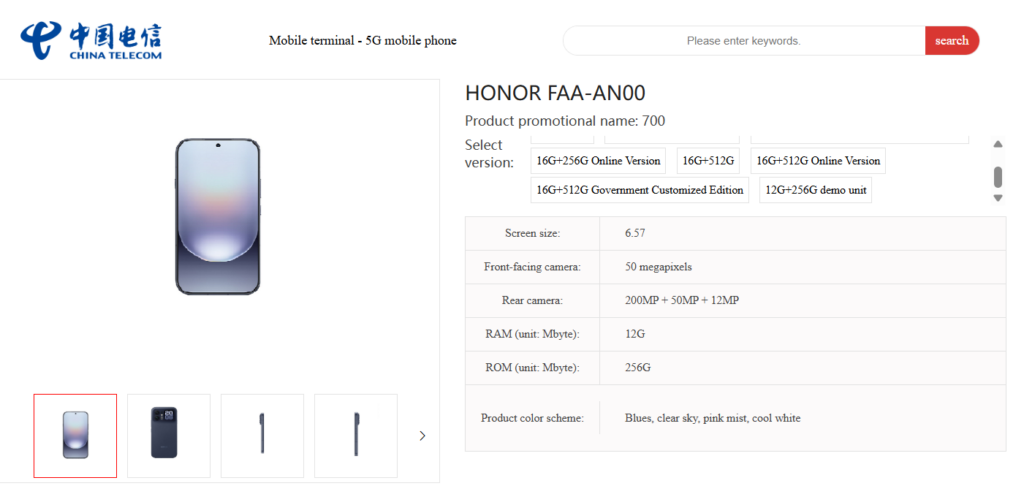
Honor 700, 700 Pro, and 700S full specs emerge via premature listings well before November 23 launch

Honor has listed the Honor 700 series in China Telecom’s product library ahead of its China launch. The pages cover the Honor 700, Honor 700 Pro, and Honor 700S, with a market date of November 23. That matches the already confirmed launch event in Wuhan. The three models are set to launch there together.

Honor 700 series specifications leaked

Honor 700 Pro China Telecom listing

The Honor 700 Pro is listed as FAP-AN00 with a 6.57-inch display. While the resolution is not mentioned in the listing, it may offer 1.5K like the previous generation, and the cameras are a 50-megapixel front unit plus a rear 200-megapixel, 50-megapixel, and 12-megapixel setup. Official renders already show a rear display, but the library image does not, so that shot may be inaccurate.

It uses the Snapdragon 8 Gen 5, peaking at 3.8GHz, matching a recent Geekbench result for the Pro. The battery is rated at 9,000mAh, and charging speed is not shown, but earlier 3C certification pointed to 80W wired charging. Retail configurations are 12GB + 256GB, 12GB + 512GB, and 16GB + 512GB, in Blue Tone, Clear Sky, Pink Mist, and Cold White.

Honor 700S China Telecom listing

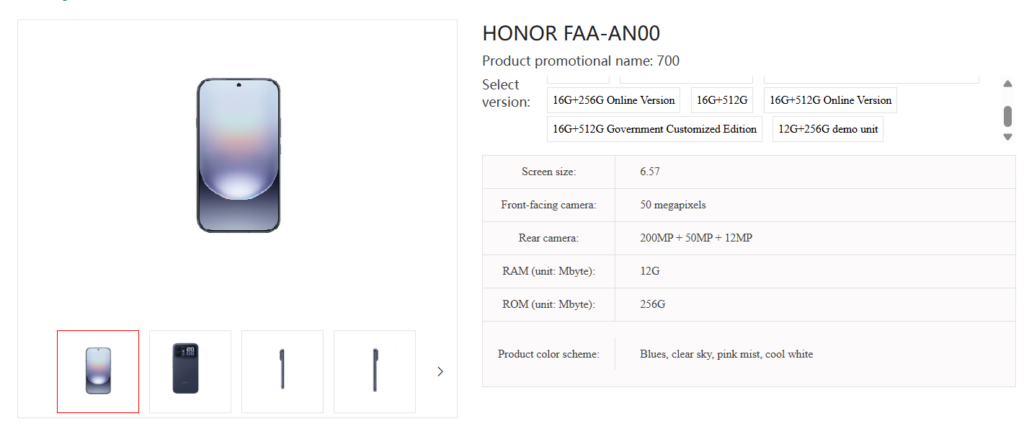
The standard Honor 700 is listed as FAA-AN00 with the same 6.57-inch display. Resolution is blank again, and this model may also offer 1.5K like the previous generation. It shares the Pro’s cameras: a 50-megapixel front camera and a rear 200-megapixel, 50-megapixel, and 12-megapixel setup.

It uses a Snapdragon 8s Gen 4 peaking at 3.2GHz. The battery is also listed at 9,000mAh, with the same certification pointing to 80W wired charging. Memory options are 12GB + 256GB, 12GB + 512GB, 16GB + 256GB, and 16GB + 512GB, in the same four colors, and the listing image shows a rear display in the camera island.

Honor 700S China Telecom listing

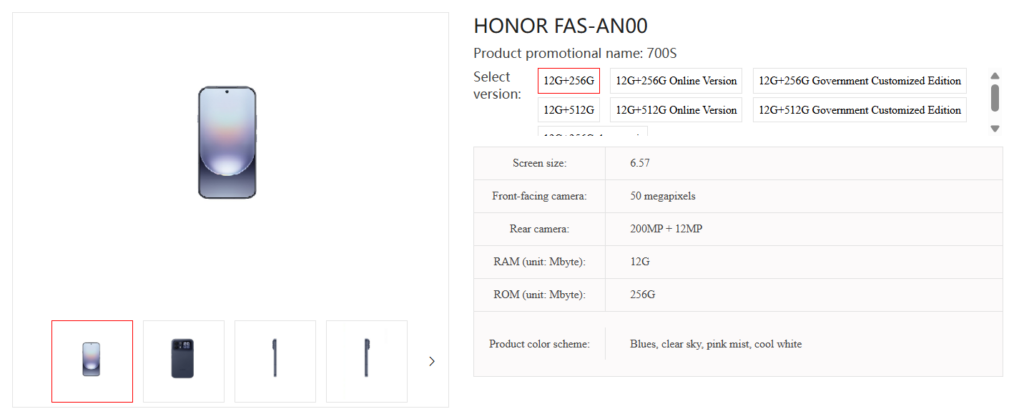
The Honor 700S is listed as FAS-AN00 with the same 6.57-inch screen size, though the listing does not reveal the resolution. It has a 50-megapixel front camera, and the rear setup is listed as a 200-megapixel and 12-megapixel combination, with no third rear camera.

It uses a Snapdragon 7 Gen 4 peaking at 2.8GHz. The battery is listed at 9,000mAh, and the same certification also points to 80W wired charging. Retail memory options are 12GB + 256GB and 12GB + 512GB, in the same four colors, and the listing image shows a rear display in the camera island. All three phones are listed with MagicOS 11 based on Android 17.

For daily updates, please visit our News Section.

(via)

Oppo Reno 17, Reno 17 Pro full specs leaked ahead of launch

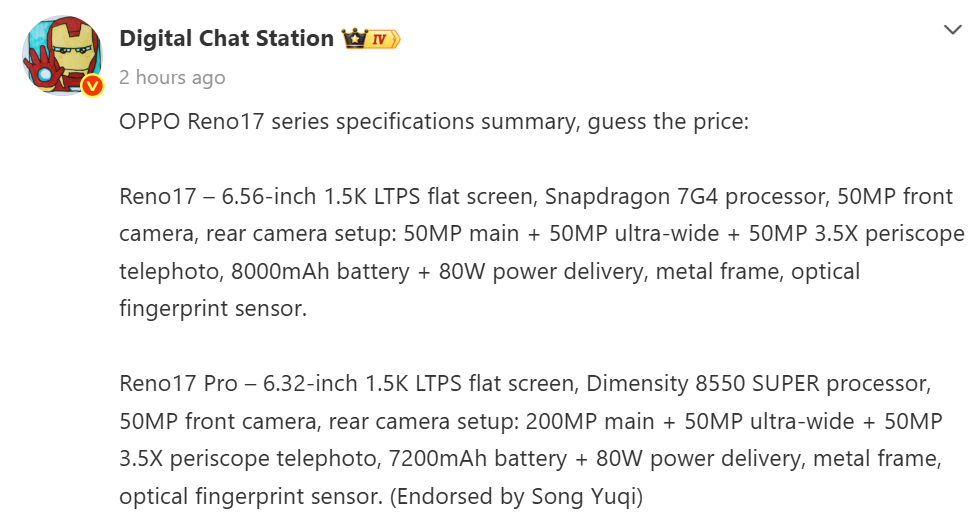
Oppo is gearing up for its next launch event in China, scheduled for November 16 at 7 PM local time. The brand is expected to unveil the Reno 17 and Reno 17 Pro smartphones at the event, alongside the Pad Air 6 tablet and the Watch 5 smartwatch. Ahead of the official unveiling, a new leak courtesy of Digital Chat Station has revealed almost everything about the lineup.

Oppo Reno 17 specifications (rumored)

Oppo Reno 17 series
Oppo Reno 17 series

The standard Reno 17 is tipped to use a 6.56-inch 1.5K LTPS flat display and Qualcomm’s Snapdragon 7 Gen 4. That screen size is a slight change from earlier reports that pointed to a 6.59-inch 1.5K OLED panel, though the Snapdragon 7 Gen 4 chip is unchanged. The leak also lines up with Oppo’s recent confirmation that this model uses four 50-megapixel cameras, listing a 50-megapixel front camera and a rear 50-megapixel main, a 50-megapixel ultra-wide, and a 50-megapixel 3.5x periscope telephoto.

Power comes from an 8,000mAh battery with 80W charging, and the phone is said to have a metal frame and an optical fingerprint sensor. Previous reports already pointed to the same 8,000mAh-class battery on the standard model, and they also sketched a shared memory lineup of 8GB+256GB, 12GB+256GB, and 12GB+512GB for both phones. Those earlier configuration leaks have not been confirmed by Oppo, and pricing remains unannounced.

Oppo Reno 17 Pro specifications (rumored)

The Reno 17 Pro is described as the more compact of the two, with a 6.32-inch 1.5K LTPS flat display and MediaTek’s Dimensity 8550 Super chip. That screen size matches earlier leaks, which had already pointed to a 6.32-inch 1.5K flat panel on the Pro. The camera setup is the main split from the standard model, pairing a 50-megapixel front camera with a 200-megapixel main, a 50-megapixel ultra-wide, and a 50-megapixel 3.5x periscope telephoto on the rear.

The Pro is tipped to use a 7,200mAh battery with the same 80W charging, plus a metal frame and an optical fingerprint sensor. Earlier reports had put its battery around 7,000mAh to 7,200mAh. Previous leaks also assigned the Pro the same 8GB+256GB, 12GB+256GB, and 12GB+512GB memory options as the standard model, and the tipster notes that Song Yuqi is endorsing the Pro.

For daily updates, please visit our News Section.

Huawei announces Sense G1 as company’s first continuous glucose monitor

Huawei has officially unveiled the Huawei Sense G1, its first continuous glucose monitoring (CGM) device. It is an arm-worn sensor that tracks glucose levels throughout the day and night. It can alert users when readings fall outside normal ranges, and you can check your numbers on your phone or your smartwatch.

Huawei Sense G1 Features

What the Huawei Sense G1 brings

The teaser poster shows a small, round sensor that looks somewhat like an Apple AirTag. It attaches directly to the arm, with a tiny needle sitting beneath the skin to collect readings from the fluid surrounding cells. 

The sensor uses glucose oxidase and electrodes to measure glucose levels in this fluid and convert the results into blood sugar readings. Unlike traditional glucose meters, there is no need to prick your finger for each measurement.

Huawei has also shared a few details about everyday use. The Sense G1 is intended for a single user, requires no calibration, and has a sensor lifespan of up to 16 days.

As for accuracy, a report suggests the Sense G1 has a mean absolute relative difference (MARD) below 10%. This figure measures how closely a CGM’s readings match laboratory reference measurements, with a lower percentage indicating better accuracy. The tipster also claims glucose readings can lag behind actual blood sugar levels by around 5 to 15 minutes.

Huawei Sense G1 Launch Specs Price

There is already some confirmation of its medical credentials. China’s National Medical Products Administration approved the Huawei Sense G1 as a Class III medical device. 

Class III is the country’s highest medical device risk category, which also covers products such as cardiac stents and artificial joints. It is the first Class III medical device from Huawei’s consumer hardware business.

Li Xiaolong, CTO of Huawei Terminal BG, says the Sense G1 has been the longest development project the company has undertaken. He first wore a test version in December 2023, giving the device roughly 35 months of testing and development.

Huawei has been building up its health monitoring technology for some time. The company introduced its TruSense health monitoring system in 2024, and its smartwatches can already assess diabetes risk. However, those watches cannot directly measure glucose levels, which is where the Sense G1 comes in.

Huawei hasn’t announced how much the Sense G1 will cost or when it will go on sale. The company could reveal more about it at an event later this month, where it may also introduce the Huawei Mate X8 foldable and MateBook Fold S. The latter is expected to follow the original MateBook Fold Ultimate Design.

RedMagic 12 Pro+ vs Xiaomi 18 Pro: Which Flagship Is Worth Buying?

RedMagic 12 Pro+ and Xiaomi 18 Pro target two very different types of flagship buyers. One prioritizes gaming performance, advanced cooling, and an exceptionally fast display, while the other focuses on versatile photography, premium display technology, and everyday flagship convenience. Despite sharing powerful Snapdragon hardware, their differences make this comparison particularly interesting.

RedMagic 12 Pro+ vs Xiaomi 18 Pro

1. Major Features:

CategoryRedMagic 12 Pro+Xiaomi 18 ProWinner & Reason
BuildGorilla Glass 7i, aluminum frameDragon Crystal Glass 3, aluminum frameXiaomi – Premium glass
Water ResistanceIP68/IP69IP68RedMagic – Higher protection
Gaming FeaturesBuilt-in cooling fan, 700Hz pressure zonesStandard gaming featuresRedMagic – Dedicated gaming hardware
Display TypeAMOLEDLTPO AMOLEDXiaomi – LTPO technology
Display Size6.85 inches6.4 inchesRedMagic – Larger screen
Resolution1216 x 2688 pixels1120 x 2436 pixelsRedMagic – Higher resolution
Refresh Rate185Hz120HzRedMagic – Smoother gaming
Peak Brightness5000 nits4000 nitsRedMagic – Brighter peak
Secondary Display–2.7-inch rear AMOLEDXiaomi – Additional display
ProcessorSnapdragon 8 Elite Extreme Gen 6Snapdragon 8 Elite Gen 6RedMagic – More powerful chipset
GPUAdreno 850AdrenoRedMagic – Higher-tier GPU
RAM12GB/16GB12GB/16GB–
Storage256GB/512GB/1TB UFS 4.1 Pro256GB/512GB/1TB UFS 4.1RedMagic – Faster storage variant
Rear Camera50MP + 50MP200MP + 200MP + 50MPXiaomi – More versatile camera system
Main Camera50MP, OIS200MP, OISXiaomi – Higher resolution and larger sensor
Telephoto Camera–200MP periscope, 3.2x optical zoomXiaomi – Dedicated optical zoom
Ultrawide Camera50MP50MP–
Rear Video8K@30fps, 4K@120fps8K@30fps, 4K@120fps–
Selfie Camera16MP under-display50MP with PDAFXiaomi – Higher resolution and autofocus
Selfie Video1080p@60fps4K@60fpsXiaomi – Higher video resolution
AudioStereo speakers, Dolby Atmos, 32-bit/384kHzStereo speakers, Dolby Atmos, 24-bit/192kHzRedMagic – Higher-resolution audio
Wi-FiWi-Fi 7, tri-bandWi-Fi 7, dual-bandRedMagic – Tri-band support
Bluetooth6.06.0–
ConnectivityNFC, IR, USB-C 3.2 Gen 2, DisplayPortNFC, IR, UWB, USB-C 3.2, DisplayPortXiaomi – UWB support
Battery8400mAh7000mAhRedMagic – Larger capacity
Wired Charging120W100WRedMagic – Faster charging
Wireless Charging80W50WRedMagic – Faster wireless charging
Reverse Charging22.5W wired27W wirelessXiaomi – Wireless reverse charging
Operating SystemAndroid 17, RedMagic OS 12Android 17, HyperOS 4–
Price$1,000 / ₹1,00,000$1,000 / ₹1,20,000RedMagic – Lower estimated Indian price
OverallGaming-focused flagshipPhotography-focused flagshipRedMagic – Better gaming value
Disclaimer: Specs are based on available data. Actual performance may vary. Verify details from official sources before buying.

2. Design and Display

Build and Feel

The RedMagic 12 Pro+ embraces a gaming-focused design with an aluminum frame, Gorilla Glass 7i protection and pressure-sensitive gaming zones supporting 700Hz touch sensing. Its built-in cooling fan is another distinctive addition, while IP68/IP69 protection provides impressive resistance against dust and water. The Xiaomi 18 Pro takes a more conventional premium approach with Dragon Crystal Glass 3, an aluminum frame and IP68 protection. Its cleaner design feels better suited to users who prefer understated flagship styling over gaming aesthetics.

Display Quality

The RedMagic 12 Pro+ features a 6.85-inch AMOLED display with a 185Hz refresh rate, 5000-nit peak brightness and 1216 x 2688 resolution. It is particularly appealing for competitive gaming and exceptionally smooth interactions. The Xiaomi 18 Pro counters with a 6.4-inch LTPO AMOLED panel featuring a 120Hz refresh rate, Dolby Vision, HDR10+ and 4000-nit peak brightness. Its secondary 2.7-inch rear display adds practical functionality. Xiaomi offers a more versatile viewing experience, although RedMagic clearly prioritizes gaming responsiveness.

Verdict

The RedMagic 12 Pro+ wins for gaming enthusiasts with its 185Hz display and cooling hardware. However, Xiaomi delivers a more versatile flagship experience with LTPO technology and its secondary rear display.

3. Specifications Including Battery

Performance

Both smartphones feature 2nm Snapdragon 8 Elite Gen 6 processors, making them formidable flagship performers. However, the RedMagic 12 Pro+ uses the Snapdragon 8 Elite Extreme Gen 6, paired with an Adreno 850 GPU and UFS 4.1 Pro storage. Its dedicated cooling fan and pressure-sensitive gaming zones provide a meaningful advantage during extended gaming sessions. The Xiaomi 18 Pro features the standard Snapdragon 8 Elite Gen 6, Adreno graphics and UFS 4.1 storage. Both offer configurations with up to 16GB RAM and 1TB storage. Xiaomi should comfortably handle demanding applications, but RedMagic feels better equipped for sustained gaming workloads.

Battery and Charging

The RedMagic 12 Pro+ packs an enormous 8400mAh silicon-carbon battery with 120W wired and 80W wireless charging. It also supports 22.5W reverse wired charging. The Xiaomi 18 Pro features a 7000mAh silicon-carbon battery with 100W wired, 50W wireless and 27W reverse wireless charging. Both offer impressive charging flexibility, but RedMagic has the advantage in battery capacity and charging speeds. Its larger battery makes considerably more sense for gamers who spend extended hours away from a charger.

Verdict

The RedMagic 12 Pro+ takes the performance and battery crown with its more specialized chipset, active cooling, larger battery and faster charging. Xiaomi remains a capable everyday flagship.

4. Camera

Main and Secondary Lenses

The Xiaomi 18 Pro has a substantial advantage in photography, featuring a 200MP main camera with OIS, a 200MP periscope telephoto camera with 3.2x optical zoom and a 50MP ultrawide lens. Leica optics, laser autofocus and a color spectrum sensor further strengthen its photography capabilities. The RedMagic 12 Pro+ takes a simpler approach with a 50MP OIS-equipped primary camera and a 50MP ultrawide sensor. While its main camera supports 8K video recording and up to 120fps 4K capture, it lacks a dedicated telephoto lens. Xiaomi is clearly the more complete camera phone, particularly for portrait photography, distant subjects and creative shooting.

Selfie Camera

The Xiaomi 18 Pro features a 50MP front camera with autofocus, HDR and panorama support. It also records 4K video at up to 60fps, making it considerably more versatile for selfies, video calls and content creation. The RedMagic 12 Pro+ uses a 16MP under-display selfie camera, prioritizing uninterrupted screen space over traditional camera performance. Although the under-display implementation is appealing for gaming and media consumption, its lower resolution makes Xiaomi the more practical option for front-facing photography. Xiaomi also offers better video flexibility for users who regularly create social media content.

Verdict

The Xiaomi 18 Pro wins comfortably with its dual 200MP cameras, dedicated periscope zoom, Leica optics and a significantly more capable selfie camera.

5. Pricing

The RedMagic 12 Pro+ is priced around $1,000 (₹1,00,000), positioning it as a premium gaming flagship with specialized hardware. The Xiaomi 18 Pro is also priced around $1,000, although its estimated Indian price is approximately ₹1,20,000. This creates a considerable difference in the Indian market despite their similar dollar pricing. 

RedMagic offers a more affordable entry point alongside a larger battery, faster display and dedicated cooling system. Xiaomi commands a higher estimated price but provides a considerably more advanced camera setup and additional everyday flagship features.

Verdict

The RedMagic 12 Pro+ offers better value for money, particularly in India, where its estimated price is considerably lower than Xiaomi’s.

Disclaimer:
Prices are approximate and may vary based on country, region, launch timing, and applicable taxes. Always check whether the listed price is for a China unit or a global/international variant when purchasing.

6. Conclusion

The RedMagic 12 Pro+ stands out with its built-in cooling fan, 185Hz AMOLED display, pressure-sensitive gaming zones, 8400mAh battery and 80W wireless charging. These features make it a specialized flagship designed around demanding gaming requirements. 

The Xiaomi 18 Pro brings a different set of advantages, including dual 200MP rear cameras, Leica optics, a 3.2x periscope telephoto lens, a 50MP autofocus selfie camera and a secondary rear display. Its combination of photography hardware and premium display technology makes it a more versatile everyday smartphone. 

Verdict

RedMagic 12 Pro+ is the overall winner for gaming, battery endurance, cooling and value. However, the Xiaomi 18 Pro is the better choice for photography and everyday flagship versatility.

Disclaimer: Prices, specifications, and availability may vary by region and retailer. Recommendations in this article are based on editorial opinion, feature-based value, and market positioning at the time of writing. Readers are advised to do their own research before making a purchase.

Read More:

Your OnePlus phone and tablet can now auto-unlock your PC

OnePlus 15T

Android devices and PCs have some cross-connectivity capabilities, but there’s still a lot of work to do. Microsoft has been making some progress through features like Phone Link that lets users take phone calls using their PC and perform some actions on their phone without touching it. Meanwhile, Android brands are stepping up to bridge this gap even further.

OnePlus is rolling out a new update that allows users to automatically unlock their computers with compatible mobile phones and tablets. This new “Automatically unlock when connected” feature comes with the November update. The firmware version to look out for is C20P01(BRB1EX01) on supported phones and C20P01(BRB3EX01) on supported tablets.

According to the official changelog, the “Automatically unlock when connected” feature lets you automatically unlock your PC while it’s remotely connected to your phone using a saved password. To enable this feature, tap the More icon on the floating ball during a remote connection, tap “Unlock PC” and turn on “Automatically unlock when connected.”

In an announcement post on the official community, OnePlus has mentioned that the feature will be rolled out to phones and tablets running OxygenOS 16 or above.

Here’s the list of eligible devices:

  • OnePlus Open
  • OnePlus 15 series
  • OnePlus 13 series
  • OnePlus 12 series
  • OnePlus 11 series
  • OnePlus 10 Pro
  • OnePlus Nord 6
  • OnePlus Nord CE6 series
  • OnePlus Nord 5
  • OnePlus Nord CE5
  • OnePlus Nord 4
  • OnePlus Nord CE4 series
  • OnePlus Nord 3
  • OnePlus N6x
  • OnePlus Pad 4 / OnePlus Pad 3 / OnePlus Pad 2 / OnePlus Pad
  • OnePlus Pad Go 2

OnePlus started rolling out the update on October 27, but it’s rolling out in stages. That means it can take a while to reach all the devices. If you still haven’t received the update, the wait shouldn’t be long, as OnePlus promises to update all eligible devices by around November 19, 2026.

Head over to the Settings app and go to System & Update > Software Update to manually check for the latest update if the update notification is yet to reach your OnePlus device.

This new auto-unlock feature would be helpful for plenty of people like me who need to unlock the computer dozens of times every single day. I would expect other Android brands to implement a similar feature, and work more aggressively towards a seamless cross-connectivity with PCs.

Nvidia reportedly canceled RTX 5080 24 GB due to insanely expensive 3 GB GDDR7 module

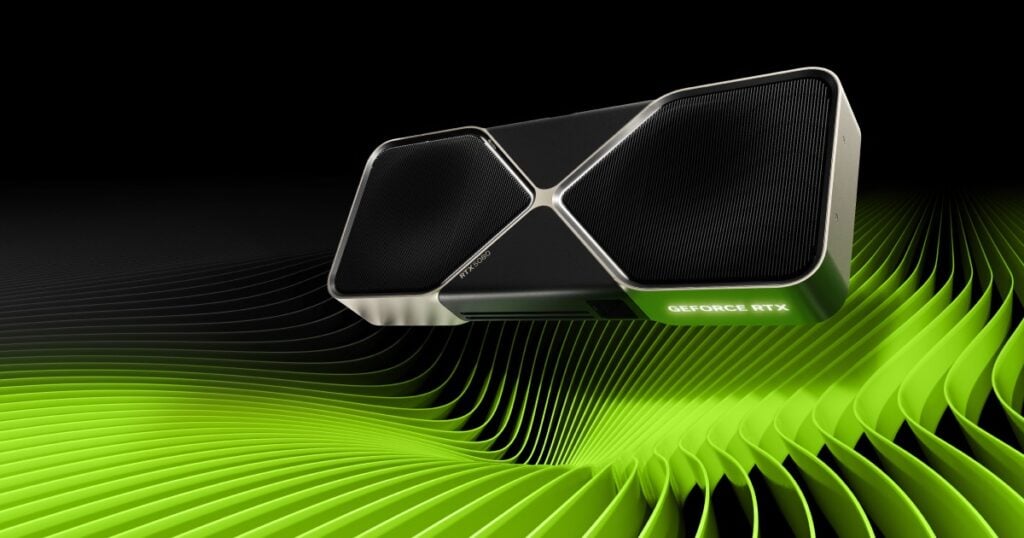
Nvidia is reportedly making a U-turn on its plan to release the 24 GB variant of RTX 5080. The company is finding it difficult to secure 3 GB GDDR7 memory modules for cheap, and that has reportedly forced the company to cancel the release.

Previously, it was reported that Nvidia will discontinue the RTX 5080 16 GB variant and replace it with the 24 GB version, but the soaring VRAM prices is making it difficult for the company to sustain enough chips for its graphics cards. Consequently, the company will continue to produce the 16 GB variant.

The 24 GB variant was expected to launch in China as early as December 2026. According to Gazlog, the development documents for the chip, which include everything partners need to design, engineer, test, and mass-produce their own custom circuit boards and cooling solutions for a new graphics card, was supposed to be distributed to Add-in Board (AIB) partners in October, but it had not arrived by the end of October, putting the release in doubt.

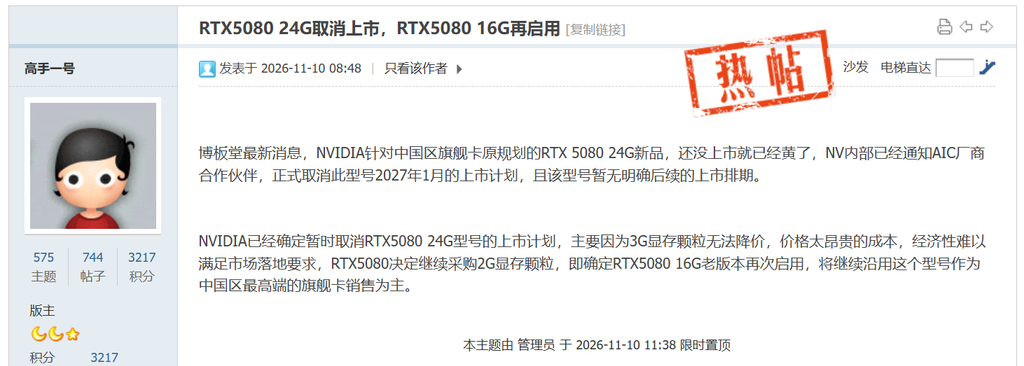
According to China’s Bobantang (Board Channels), Nvidia has officially notified AIB that it has canceled its plans to release RTX 5080 24 GB in China in January 2027 without an alternate date.

Bobatang RTX 5080 24 GB

The RTX 5080 with 24 GB VRAM would reportedly use 3 GB GDDR7 memory modules instead of the 2 GB modules used in the entire RTX 50 series. However, doing so would have increased the price of RTX 5080 24 GB significantly. One report mentioned that the RTX 5080 24 GB could launch at about $2000, which would be twice the MSRP of the RTX 5080 16 GB Founders Edition. This would have a greater impact on sales, and so, Nvidia decided to ditch the release plan.

Nvidia will now continue the production of RTX 5080 16 GB, which was previously rumored to have been canceled. In fact, it was delisted from the official Nvidia marketplace, but that is quite common for brands to list and delist GPUs. Soon, the prices could hit $3000 as MSI is reportedly increasing its price by up to $1200.

source/via: Gazlog, Wccftech

Xiaomi Clip listed on global website with 9h/38h battery, 11 mm drivers, Apple Find My support

Xiaomi has now listed its first clip-on earbuds, the Xiaomi Clip on its global website, nearly six months after they first showed up in China. Instead of sitting inside your ear canal like regular earbuds, these clip onto the outer edge of your ear. That keeps the ear canal open so you can still hear what’s going on around you. This is handy if you’re walking outside, working out, or just don’t want to feel sealed off.

Xiaomi Clip

Each bud weighs just 5.5 grams and uses a high-performance titanium wire bridge with shape-memory alloy for a secure, adaptive fit. Xiaomi says the design follows the natural contours of the ear and should stay comfortable even during longer wear.

Battery life is solid: up to 9 hours on a single charge, and the case brings the total to 38 hours. A quick 10-minute charge gives you around 3.5 hours of playback.

Xiaomi Clip with its case

Sound comes from 11 mm dynamic drivers with a claimed 20Hz–48kHz frequency range when using the LHDC 5.0 codec (plus the usual AAC and SBC). They connect over Bluetooth 5.4 with multipoint pairing, so you can stay connected to two devices at once. The four-mic system includes a bone-conduction voice pickup unit and wind-noise reduction for clearer calls, and the directional sound design helps limit leakage for a bit more privacy.

Exploded view showing the internal components of a Xiaomi Clip earbud driver assembly.

Other practical extras include Apple Find My support for the charging case, an IP57 rating for dust and water resistance, and a recording feature that lets you start or stop recording by triple-pressing the case or earbuds (live, call, or video audio). There’s also audio sharing and seamless switching between compatible Xiaomi HyperOS devices, plus a companion Xiaomi Earbuds app for customizing controls.

Color options are Sand Gold, Pearl White, Frost Purple, and Graphite Black. The case itself has a refined, jewellery-box-style design wrapped in soft vegan leather with a simple lift-out mechanism.

Exact pricing and global availability should be announced at Xiaomi’s Global Launch event on November 17. In China they’re currently selling for CNY 849 (about $127).

(Source: Xiaomi)

Honor 700 series launch event officially set for November 23

Honor has officially confirmed that the Honor 700 series will launch in China on November 23. We previously reported that the Honor 700, Honor 700 Pro, and Honor 700S were launching today, but the brand has now set the event for 2:30 PM China time in Wuhan. Reservations for all three models remain open in China, including on JD.com.

Honor confirms a November 23 launch event in Wuhan

Official Honor 700 series launch poster announcing the November 23 event at 2:30 PM, with brand ambassador Ju Jingyi holding a light blue Honor 700
Official Honor 700 series launch poster

Honor CEO Li Jian announced the November 23 date in an official post and introduced actress and singer Ju Jingyi as the Honor 700 series brand ambassador. The official poster lists the event at 2:30 PM China time, and Honor has confirmed Wuhan as the venue.

The company already previewed the lineup at a media briefing in Beijing on November 12, calling this its strongest digital series to date. The Honor 700, Honor 700 Pro, and Honor 700S share an AI-powered rear display, a 9,000mAh Qinghai Lake battery, and Snapdragon chips. Honor is also introducing 4K cinematic Live photos across the series.

Honor has confirmed Snapdragon 8 flagship chips for the Honor 700 and Honor 700 Pro, matching earlier reports that the Pro uses the Snapdragon 8 Gen 5 and the standard model uses the Snapdragon 8s Gen 4. A recent Geekbench listing for the Pro also pointed to the Snapdragon 8 Gen 5, 16GB of RAM, and Android 17. Honor has not named the exact processor in the Honor 700S beyond the series-wide Snapdragon confirmation.

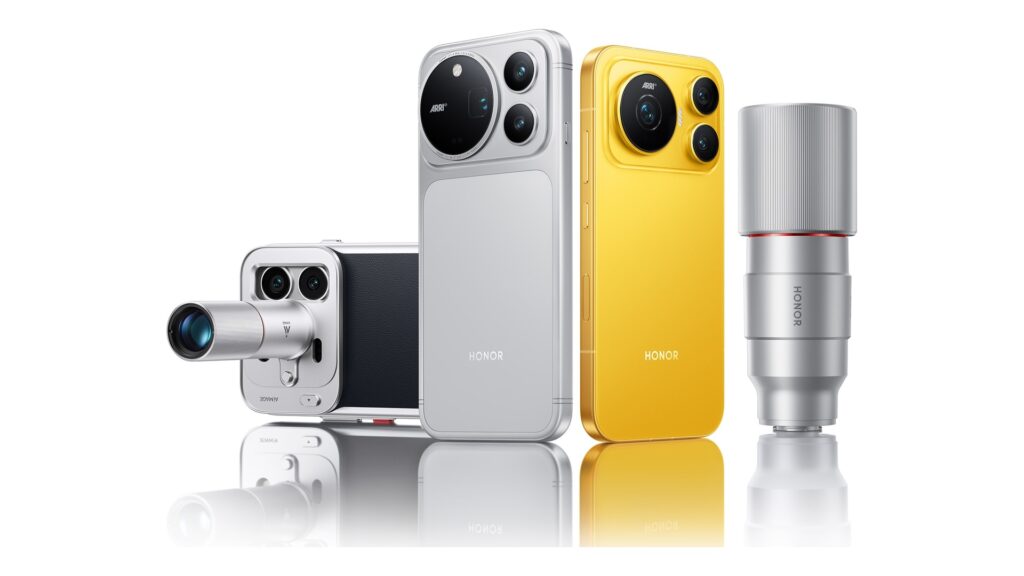
All three phones will use a 200-megapixel main camera. The Honor 700 and Honor 700 Pro add a 50-megapixel periscope telephoto with 3.5x optical zoom, and both models will support an 88g G200 telephoto extender as a separate accessory. The series also includes Honor’s third-generation C3 RF chip.

Official product pages already list the colors as Clear Sky, Pink Mist, Cold White, and Blue Tone. Honor opened reservations when it revealed the three models last week, but pricing and a full official spec sheet remain under wraps ahead of the November 23 launch.

For daily updates, please visit our News Section.

Huawei Mate X8 appears in Richard Yu’s hand as a late-November launch nears

A light purple foldable has been spotted in Richard Yu’s hand, and it appears to be the Huawei Mate X8. The Consumer Business Group chairman was photographed walking with the unreleased phone, and the circular camera module is back. The sighting comes as a late-November launch for the successor to last year’s Mate X7 is drawing near.

Photos show the Huawei Mate X8 with a circular camera module

Richard Yu walking with a light purple Huawei Mate X8 that has a circular camera module
Richard Yu holding the Huawei Mate X8

The photos show a textured, light purple back and a large circular camera module. Earlier leaks already pointed to a late-November debut, a cover display of about 6.5 inches, an 8.15-inch inner screen with ultra-thin glass, and a battery over 6,000mAh. The Mate X7 has a 6.49-inch cover display and an 8-inch inner panel, so the rumored screens would be a small step up, with a clearer gain in battery capacity.

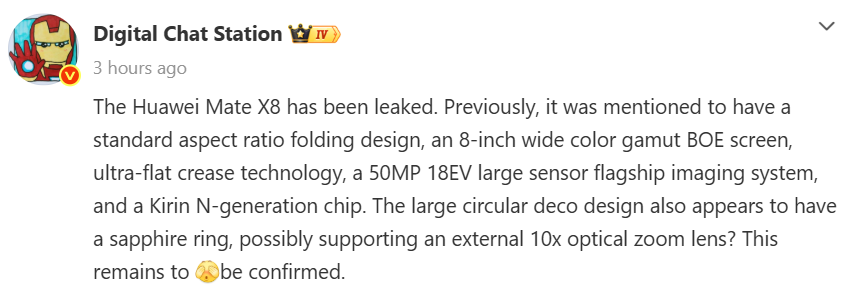
Digital Chat Station has now shared more detail, describing the Mate X8 as a large foldable with a standard aspect ratio, an 8-inch wide color gamut BOE inner display, and ultra-flat crease technology. The tipster also lists a 50-megapixel 18EV large-sensor flagship camera system, a Kirin N-generation chip, and a large circular decoration that appears to include a sapphire ring. That 8-inch figure sits slightly below the 8.15-inch inner panel mentioned in earlier reports, so the final size is still unconfirmed.

Digital Chat Station Weibo post outlining Huawei Mate X8 display, camera, and Kirin N-generation chip details
Digital Chat Station Weibo post

DCS also says the phone may support an external 10x optical zoom lens, though the tipster marked that claim as unconfirmed. A separate leak has suggested the series could work with Huawei’s Ruiying Z10 10x modular camera, but that support has not been verified and may not apply to every model. Earlier tips already described a 50-megapixel main camera and a 50-megapixel RYYB periscope, along with the Kirin 9050 Pro already used in the Mate 90 series.

The launch could come later this month, and one unconfirmed report even points to November 24. Last year’s Mate X7 went on sale in China on November 26, so a similar window would keep the yearly cadence. Huawei has not announced a date, a price, or official specifications.

For daily updates, please visit our News Section.

Samsung may be the reason behind iPhone 18’s launch delay

iPhone 17
iPhone 17

Apple didn’t launch the base iPhone 18 at its September event, and it came as no surprise. The information had been making the rounds online for months. While the delay was initially believed to be driven by rising memory prices and supply chain bottlenecks—a logical assumption given market conditions—it turns out Samsung may be the primary reason behind the shift.

According to a report from the Japanese publication Semiconportal, Apple pushed the launch of the iPhone 18 to give Samsung sufficient time to manufacture enough camera sensors for the device.

Sony has long served as the primary supplier of camera sensors for iPhones, but its exclusive deal is coming to an end this year. So, Apple struck a deal with Samsung last year to source camera sensor chips for future iPhones.

Samsung reportedly began prototyping new high-performance camera sensors for the iPhone in the spring, which pushed the mass production to fall. To make sure the company has enough supply for the iPhone 18, Apple reportedly made the decision to stagger the release and push the launch to early next year.

Although Sony’s decade-long near-monopoly on supplying CMOS image sensors for iPhones has officially ended, the company is not leaving Apple’s supply chain entirely. Instead, Apple is transitioning to a dual-supplier strategy, which serves two major objectives.

This strategy serves two goals

First, the strategy aligns with Apple’s American Manufacturing Program (AMP), as the new camera sensor chips will be produced at Samsung’s facility in Texas. This initiative forms part of Apple’s pledge, announced last year, to invest $100 billion in US manufacturing.

Second, it creates price competition. Adopting a dual-supplier model should help Apple lower component costs for future iPhones, though it is unlikely to reduce the retail price of the iPhone 18 due to rising memory costs and chip fabrication expenses.

Holding back the launch of the base iPhone 18 does not appear to have hurt Apple’s bottom line, as the company still achieved its highest September quarter revenue to date.

If you’re considering waiting for the iPhone 18, check out this article to determine whether the upcoming upgrades and price hikes justify the delay.

Samsung intelligent eyewear set for December 10 launch, pre-orders now open

Samsung has confirmed that its intelligent eyewear will go on sale in the United States and South Korea on December 10, with pre-orders open. The collection was developed with Google and has Gemini built in, and it comes in 30 designs from Gentle Monster and Warby Parker. Samsung first previewed the project around Google I/O and unveiled the Android XR glasses in July, before a date or price was set.

Pre-orders are open ahead of the December 10 release

Official campaign image of Samsung Intelligent Eyewear from Gentle Monster and Warby Parker
Gentle Monster and Warby Parker Intelligent Eyewear

Gentle Monster has 16 variations across six frame styles, and Warby Parker has 14 based on three designs, in a range of shapes, colors, sizes, and lens treatments. The frames weigh around 41 grams. In the U.S., Warby Parker frames start at $395 and Gentle Monster frames range from $449 to $489, with Gentle Monster also going on sale in Korea.

With Gemini built in, wearers can ask about what they see, capture a whiteboard for a summary in Samsung Notes, translate a menu, or get turn-by-turn directions from Google Maps. Notifications can be grouped and summarized, read aloud, and answered by voice, so calls and messages can be handled without pulling out a phone.

Specs, battery life and phone compatibility

Three people wearing Warby Parker Intelligent Eyewear frames
Warby Parker Intelligent Eyewear

A 12-megapixel HDR camera supplies visual context for Gemini and shoots photos and video, with open-ear speakers and a four-microphone array. Powered by the Snapdragon AR1 Gen 1 platform, the glasses last up to nine hours on a charge, or up to 72 hours with a fully charged case.

The glasses work with Galaxy S, S FE, Z Fold, Flip, and Fold Ultra phones on One UI 9.0 or later, Pixel 7 and later with the September 2026 Android 17 update, and iPhone 13 and later with at least 6GB of RAM on iOS 26.6 or later. Bixby works only with Galaxy phones. An LED, inner light, and sound mark when the camera is recording, and capture stops if the LED is covered or fails.

The eyewear will be sold through Warby Parker’s retail and online stores and Gentle Monster’s online store, with demonstrations at select Samsung stores from December 10. It is intended for users aged 18 and over, and visuals collected by Gemini are not used for AI model training or ad targeting.

For daily updates, please visit our News Section.

[Update] Oppo has a pocket gimbal camera, a new foldable, and a wide flagship in the works

Update: We initially misidentified the leak as being about Vivo, but it is actually about Oppo and its future products. We have corrected the headline and updated the article with the right company and product details.

Oppo is reportedly preparing three new flagship products, including a pocket gimbal camera, a wide-screen foldable, and a new smartphone with an unusual 16:9 display. A fresh leak from China has revealed some of the hardware details, along with a possible launch window for the first device.

The information comes from Digital Chat Station; however, Oppo has yet to confirm any of it.

What’s coming

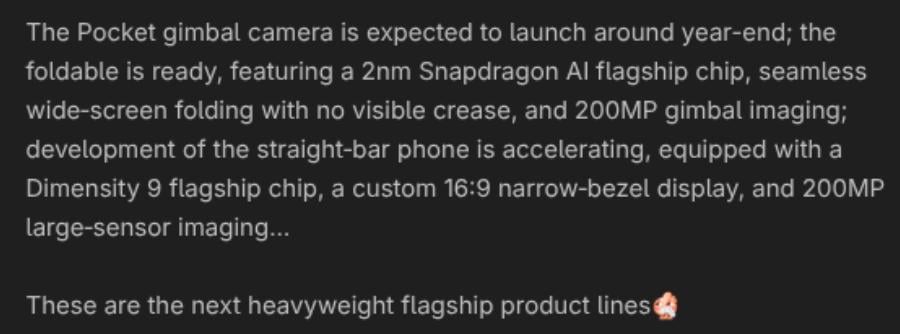
The pocket gimbal camera is expected to arrive around the end of this year. Per previous reports, the device bears the codename Fuyao and could feature a 200MP sensor in a 1/1.12-inch format, along with Hasselblad branding.

Unlike the gimbal stabilization found in smartphones, this would be a standalone camera. Interestingly, Oppo may not be the only company working on such a device. An earlier leak suggested Vivo is developing a similar pocket camera with the same sensor size.

Vivo product lineup leak

The second product is a new foldable, which the tipster says is already ready. It reportedly runs on a 2nm Snapdragon processor with AI-related features and folds into a wider screen format without a visible crease. The leak also mentions a 200MP camera with gimbal imaging.

These details line up with earlier reports about the Oppo Find N7. The Find N7 is reportedly being tested with a 2nm Snapdragon chip and could launch in the first quarter of 2027. 

The third device is a wide smartphone, whose development is reportedly moving ahead quickly. It is said to feature a flagship Dimensity 9-series processor, a custom 16:9 display with narrow bezels, and a 200MP camera with a large sensor.

The leak does not identify the processor or give the phone a name or launch date. A 16:9 display would also be quite different from the tall screens found on most current flagship smartphones, giving the device a noticeably wider appearance.

All three products are reportedly built around 200MP camera sensors, although the exact specifications and launch plans remain unconfirmed. Oppo has not shared any official details about the devices.

Redmi Note 18 makes its first appearance online, confirming charging speed

Xiaomi’s new phone with model number M841EE has passed 3C certification at China’s Ministry of Industry and Information Technology. The listing confirms the phone supports 67W wired charging. Tipster Digital Chat Station says the device is likely part of the Redmi Note 18 series.

The same tipster says three Redmi Note 18 models are registered so far. The top model should be the Redmi Note 18 Pro Max, and you can expect a battery in the 10,000mAh range on that one. 

Redmi Note 18 3C charging 67W

Digital Chat Station also says Xiaomi has several more products coming before the end of the year.

What we know about the Redmi Note 18 series

The certification listing doesn’t say which of the three models carries M841EE. You can’t tie the 67W figure to a specific phone yet. It does match the Redmi Note 17 Pro, which launched with 67W wired charging and a 9,000mAh battery.

Meanwhile, the Redmi Note 17 Pro Max has a 10,000mAh battery. A similar capacity on the Redmi Note 18 Pro Max would mean Xiaomi is holding its battery size steady. The tip doesn’t name a charging speed for the Pro Max.

Xiaomi launched the Redmi Note 17 series in July. That gives you a baseline for what comes next. The Redmi Note 17 Pro has a 6.83-inch 1.5K display with 3,500 nits of peak brightness. The frame has four micro-curved sides. The back has a rectangular camera module with a 50MP main camera.

The global Redmi Note 17 Pro launched in late August with a smaller 8,340mAh battery.

The tip doesn’t include a launch date or final names for the Redmi Note 18 series. Treat the details as unconfirmed for now.

Philips launches new 1440p 360Hz QD-OLED gaming monitor with AI presence detection

Philips has launched its new Evnia 27M4N8500V 27-inch gaming monitor in China, where it is available on JD.com for 3,499 yuan ($525).

Philips Evnia 27M4N8500V Monitor

Philips Evnia 27M4N8500V Specifications

The monitor features a 26.5-inch QD-OLED panel with a 2K resolution, 360Hz refresh rate, and 0.03ms response time. It supports Adaptive Sync and Nvidia G-Sync, with HDR peak brightness of 1,000 nits. The anti-reflective coating reduces screen reflectivity to 1.3% and offers 3H surface hardness.

To manage heat and reduce standard OLED burn-in risks, the monitor relies on a passive cooling system made from aluminum and graphene. This is paired with a temperature management system that monitors the panel to limit heat buildup during use. Philips is providing a three-year burn-in warranty for the device.

Philips Evnia 27M4N8500V Monitor

The monitor also includes a built-in CMOS sensor that detects human presence. It works by automatically dimming or turning off the screen when the user walks away from the desk. According to Philips, this data is processed locally on an NPU rather than being stored or uploaded. The sensor operates alongside ambient light sensors to adjust the display’s brightness and color temperature based on the room’s lighting conditions.

For competitive shooters, the monitor includes a variable resolution feature. This allows the display to be cropped down to a 24.5-inch 1080p window with 1:1 pixel mapping. In terms of color, the panel covers 99% of the DCI-P3 gamut and comes factory-calibrated with a Delta E of less than 2 for sRGB.

Philips Evnia 27M4N8500V Monitor

For connectivity, the monitor equips two HDMI 2.1 ports, one DisplayPort 1.4, two USB-A ports, one USB-B upstream port, and a USB-C port with 15W power delivery. It also features dual 5W speakers, Ambiglow rear lighting, and an adjustable stand with height, tilt, swivel, and pivot support.

In related news, KTC has recently launched a new 24-inch gaming monitor with a whopping 600Hz refresh rate.

(JD)

Casio unveils two new Edifice EFR-539G chronographs in rose gold and gold finishes

Casio is preparing to launch two new watches in its Edifice chronograph lineup this November: the EFR-539G-2AV and EFR-539G-3AV. Both models are now listed on the company’s global and Singapore websites, indicating an imminent launch in various markets later this month.

Casio EFR-539G watches
Edited

Design Details

From a hardware perspective, these are large, heavy watches. Both models measure 54.1 x 49.5 x 11.7 millimeters and weigh 184 grams. The case and bezel are made from a combination of stainless steel and aluminum. The primary difference between the two new models comes down to the color palette.

The EFR-539G-2AV pairs a dark navy dial with rose gold ion plating on the bezel and the center links of the stainless steel band. The EFR-539G-3AV uses a green dial and replaces the rose gold with a standard gold ion-plated finish.

Both watches use mineral glass over the dial and feature a screw-lock back plate. The stainless steel bracelet secures with a standard one-touch, three-fold clasp, which is designed to fit wrist sizes ranging from 150 to 205 millimeters.

Like most watches in the Edifice series, they carry a 10-bar water resistance rating, meaning they can handle depths up to 100 meters and are fine for everyday water exposure or swimming.

Internally, there are no changes to the standard quartz movement. The watches run on a single SR920SW battery, which Casio estimates will need to be replaced every two years. Timekeeping accuracy is standard for this category, rated at plus or minus 20 seconds per month.

The dial features three central hands for hours, minutes, and seconds, along with a date display. It also includes three subdials for the chronograph function, measuring 1/10th of a second, minutes, and seconds. The stopwatch can measure up to 59 minutes and 59.9 seconds, with support for elapsed time, split time, and first- and second-place time measurements.

Pricing

Both models are currently listed on the Casio Singapore website for S$259.00 ($201) and are expected to launch in other countries soon.

In related news, Casio has recently launched four new analog-digital Vintage watches in the US, alongside the metal-clad G-Shock GM-6900XG-8 collaboration watch featuring a translucent band.

(Casio 1,2)

Samsung’s vertically expandable phone switches between 16:9 and 21:9 aspect ratio

According to the usual rumor mill (this time via Ice Universe), Samsung is working on a smartphone that uses a vertically expandable OLED. When it’s closed, it sticks to a regular 16:9 aspect ratio. Unroll it and it stretches into a taller 21:9 display. You’re also supposed to be able to stop partway, so you can choose how much extra screen you actually need depending on what you’re doing.

Samsung's vertically expandable phone

The big selling point here is the compact size when it’s rolled up. It’s expected to be more pocket-friendly than a lot of today’s foldables, such as the Galaxy Z Fold 8 Ultra, while still giving you extra real estate when you want it.

The catch? All the mechanical components needed to make the screen roll in and out are going to take up quite a bit of internal space. Samsung spent years fine-tuning its foldable hinge mechanism, but this is an entirely different challenge. The phone will also need to keep up with today’s foldables when it comes to battery life. Balancing the weight as the phone physically expands could be another engineering headache.

Samsung Slidable Solo prototype

Some earlier reports have floated a possible launch in 2028, a year after the rumored launch of the horizontally expanding “Galaxy Z Slide.” But plans can (and often do) change. Samsung Display has shown related prototypes before, and the company has filed patents for similar sliding and rolling ideas, so the idea isn’t coming out of nowhere.

Foldable phones have already found their audience, but a proper rollable smartphone still hasn’t made it into consumers’ hands. Oppo actually showcased a rollable smartphone prototype before Samsung, called the Oppo X 2021, back in 2020. However, it never made it to store shelves.

Oppo X 2021

If Samsung can actually solve the mechanical complexity and possible battery life issues, this form factor could feel like a genuinely different alternative. It could allow near-continuous adjustments to the screen’s aspect ratio, letting content fill as much of the display as possible without leaving black bars. This would require Samsung to master the mechanics behind the new moving components, but it could also enable something existing foldables cannot achieve.

(Source: Ice Universe)

Casio launches four new analog-digital Vintage watches in the US

Casio is expanding its Vintage collection in the US with four new analog-digital watches. The new models, the AQ230GA-3A, AQ240EG-3A, AQ240E-2A2, and AQ240E-1A, were originally released in Japan last month and are now available to purchase through Casio’s US website.

Casio Vintage AQ240E watches

Pricing and Design Details

The lineup focuses on a straightforward retro aesthetic, combining angular cases with adjustable stainless steel bands. Rather than using solid metal cases, Casio is using resin treated with either gold-tone or chrome plating.

This keeps the overall weight of the watches down and allows the pricing to remain under $100. All four models feature a hybrid display, pairing a traditional two-hand analog clock with a small digital screen positioned at the bottom of the dial.

Casio Vintage AQ240E watches

The collection is split into two distinct sizes and a few different color profiles. The AQ230GA-3A is the smallest watch in the group, measuring 38.8 x 29.8 x 8.1mm and weighing 47 grams. It features a gold-tone case, a gold ion-plated band, and a green sunray dial, and it is priced at $79.95.

The other three models share a slightly larger case footprint, measuring 40.9 x 35.8 x 8.1mm and weighing 51 grams. The AQ240EG-3A ($94.95) shares the exact same gold and green color scheme as the smaller model but scales it up to the larger case format.

Casio Vintage AQ240E watches

For those looking for silver-tone options, Casio is offering two chrome-plated versions: the AQ240E-2A2, which has a navy blue dial, and the AQ240E-1A, which features a standard black dial. Both of the silver models are priced at $69.95.

Casio Vintage AQ240E watches

Internally, the hardware and feature sets are identical across the board. The watches run on a standard SR920W battery, which Casio says will last for approximately three years. The digital display adds typical digital watch functionality to the analog face, including a 1/100-second stopwatch, a daily alarm, an hourly time signal, and dual time capabilities.

They also include an auto-calendar, though it is only programmed for 28 days in February, meaning manual adjustment will be required during leap years. All four watches include basic water resistance for daily wear and use standard resin glass over the dial.

In related news, Casio has recently launched a metal-clad G-Shock GM-6900XG-8 collaboration watch with a translucent band.

(Casio 1,2,3,4)

Citizen launches limited-edition Star Wars Eco-Drive watch with a Death Star moonphase display

Citizen has officially launched its limited-edition Attesa Death Star II watch in the US. It is available now through the company’s US website for $1,500. The timepiece combines premium materials with official Star Wars branding, with production limited to just 400 units worldwide.

Citizen Attesa Death Star II watch

Design Details

The hardware is built around a 41.5mm case and a matching bracelet, both constructed from Citizen’s proprietary Super Titanium. To increase durability and scratch resistance, this base material is treated with a gray Duratect Diamond-Like Carbon (DLC) coating.

Citizen Attesa Death Star II watch

According to Citizen, this specific material combination results in a chassis that is 40% lighter and five times harder than standard stainless steel. The watch is secured with a fold-over clasp featuring push buttons, and the dial is protected by an impact-resistant, anti-reflective sapphire crystal.

Visually, the black dial incorporates a 3D inkjet-printed graphic of the second Death Star mid-construction. The most interesting custom design element is the watch’s lunar phase complication. Instead of a traditional moon graphic, the sub-dial displays a rotating Death Star to track the lunar cycle. This rotation is mathematically calculated and synchronized via the watch’s radio wave reception capabilities.
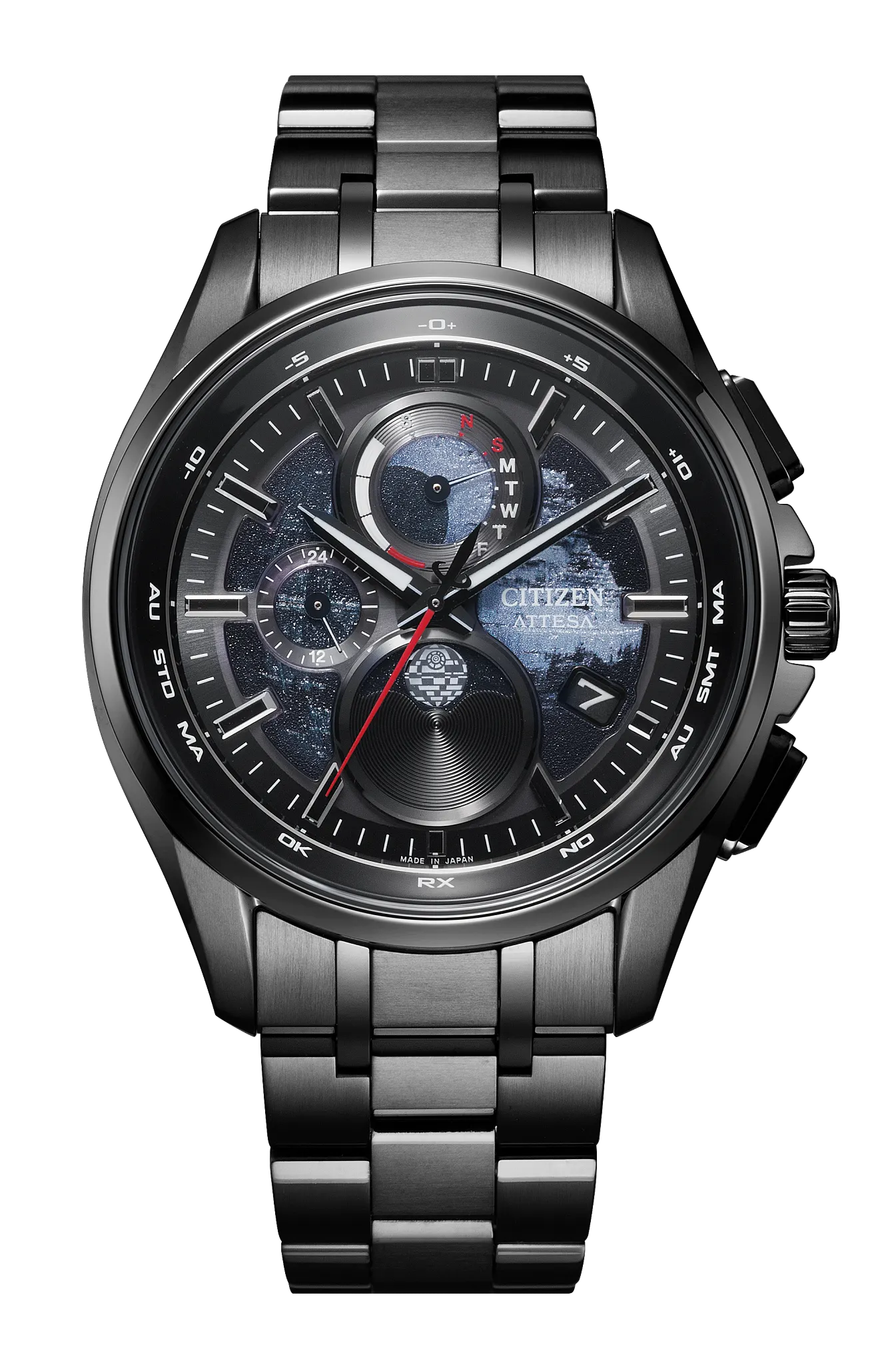
Internally, the Attesa Death Star II (model BY1004-50E) is powered by Citizen’s H874 Eco-Drive movement. This solar-powered caliber continuously charges from any natural or artificial light source, eliminating the need for traditional battery replacements.
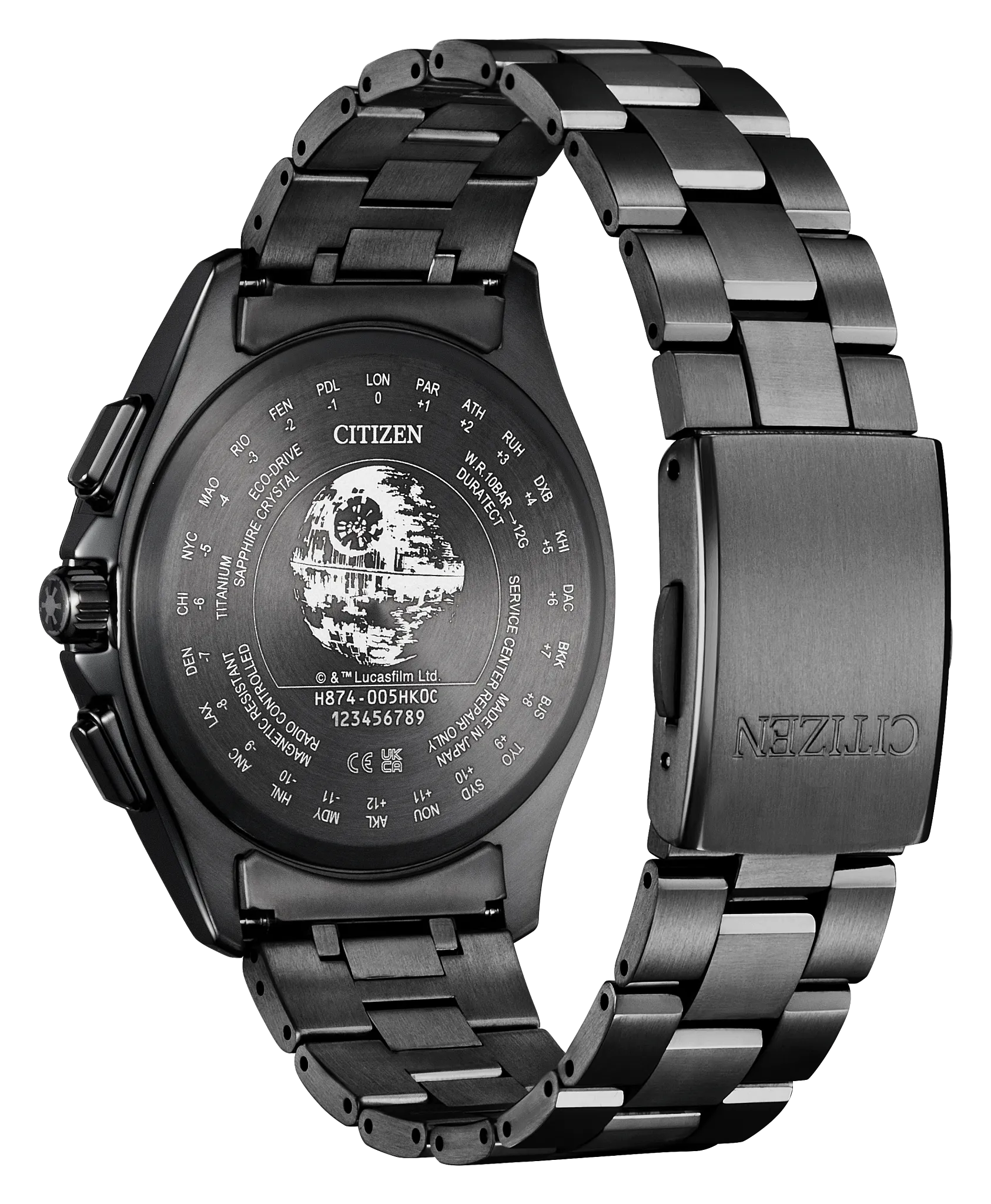
It also features multi-band atomic timekeeping, which uses standard radio signals to automatically correct the time across 26 time zones. The watch additionally includes a perpetual calendar, day-date display, and power reserve indicator.
The watch is rated for 100 meters (10 Bar) of water resistance, which is sufficient for standard swimming and snorkeling.

In related news, Citizen has recently launched Promaster Dive Uncharted Waters watches with Eco-Drive and sapphire crystal, alongside a limited-edition Disney watch featuring Mickey Mouse floating over New York City.

(Citizen)

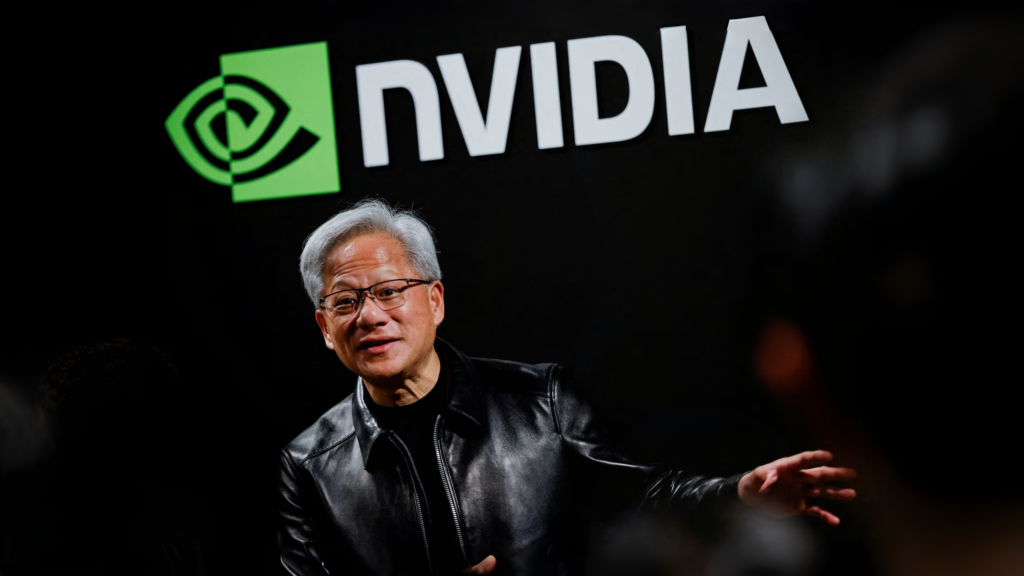
Jensen Huang steps down as Nvidia CEO, board backs interim successor

Nvidia just went through a major leadership shift. After 33 years at the helm, co-founder Jensen Huang has stepped down as President, CEO, and board member, effective immediately.

Jensen Huang, former Nvidia CEO and co-founder

The board has named Colette Kress, the company’s longtime Executive Vice President and Chief Financial Officer, as Interim CEO. She’ll keep handling her CFO responsibilities while leading the company until a permanent replacement is chosen. The board has already started a search that will look at both internal and external candidates.

Kress joined Nvidia back in September 2013 and has guided the finance side through the company’s massive growth years. Before that she spent nearly 25 years in senior finance roles at places like Cisco and Microsoft. In her statement she said the focus will be on building on the foundation Huang put in place and keeping Nvidia moving forward in accelerated computing and AI.

NVIDIA Interim CEO Colette Kress (left) and Board Chair Harvey C. Jones (right)

In a related move, the board also appointed Harvey C. Jones as its first-ever Chair of the Board. Jones has more than 30 years of experience as a tech executive, entrepreneur, and investor, including time as CEO and Executive Chairman of Synopsys, and he’s been a longtime Nvidia director.

The board said it has full confidence in Kress and the current leadership team, and that it doesn’t expect any disruption to operations, customer commitments, or the product roadmap. Nvidia is still set to report its third-quarter fiscal 2027 results on November 17, followed by the usual earnings call.

This ends a long chapter under Huang’s leadership and marks a carefully planned handoff, with a familiar internal executive taking the interim role and a formal board chair position now in place.

(Source: Nvidia)