On March 4, Realme had launched the Realme 3 smartphone and its first sale was carried out on March 12. Realme had confirmed that it had sold 210,000 units of the phone through its first sale. Realme had once again carried out the sale of the smartphone yesterday. The company has confirmed through a tweet that it has sold more than 500,000 units of the Realme in a short span of three weeks. The sales of the phone are being carried out through its official online store and Flipkart.
Realme 3 Specifications
The Realme 3 had arrived as the successor of the Realme 2 phone from last year. The Realme 3 features a waterdrop-style notched IPS LCD screen of 6.2 inches. It carries support for HD+ resolution of 720 x 1520 pixels. It offers an aspect ratio of 19:9. The ColorOS 6 based Android 9 Pie OS runs on the device.
The MediaTek Helio P70 powers the 3 GB RAM + 32 GB storage and 4 GB RAM + 64 GB storage editions of the Realme 3. It is equipped with a microSD card slot for additional storage. The 13-megapixel + 2-megapixel dual camera and a selfie camera of 13-megapixel are available on the device for photography. Its backed by a big battery of 4,230mAh capacity. The 32 GB and 64 GB Realme 3 editions are respectively priced at Rs. 8,999 (~$131) and Rs. 10,999 (~$160).
Realme 3 Pro Coming Soon
During the launch event of the Realme 3, the company had confirmed that it will be announcing the Realme 3 Pro smartphone in April. It will be arriving to rival with the Xiaomi Redmi Note 7 Pro in India. The specifications of the Realme 3 Pro are still under the wraps. Some rumors have claimed that it will be featuring a 48-megapixel rear camera. Also, it is likely to carry support for VOOC fast charging technology.
Realme is expected to confirm on the Realme 3 Pro launch date in the next few days. However, some rumors are claiming that the smartphone may get announced on April 27. It is also speculated that the base model of the phone could be priced at Rs. 12,999 (~$189).
With the usage of OLED panels increasing in smartphones, DC dimming control has been gaining a lot of attention because of being a more effective way of controlling the light output of an LED fixture. Recently, Oppo showcased the DC Dimming feature which will be present in the company’s upcoming ‘Reno’ lineup.
Now, Chinese smartphone maker OnePlus has said that it will soon roll out DC Dimming feature which will be available for users who are willing to test the feature early. It is expected to be available in the lab or in the developer preview version. The company has reportedly completed testing the DC dimming feature with its engineering demo.
The DC Dimming technology uses a DC voltage between 0 and 10 to control the light output of the LED fixture. As the voltage goes up or down, the corresponding 0-10V dimmable driver matches the light output of the fixture to increase or decrease up to a certain percentage.
Basically, DC dimming is a feature that automatically adjusts and dims the brightness of the phone’s display according to the ambient environment. It is one of the simplest and most popular dynamic lighting controls used in offices, retail spaces, and homes but the feature is just gaining traction in smartphones.
The feature is already available in Xiaomi Black Shark 2 gaming smartphone. The Xiaomi Mi 9 has already received the support for this feature in a new MIUI 10 beta update. Companies like Meizu, Oppo, and Vivo’s IQOO have already confirmed that their new phones will support this DC Dimming feature.
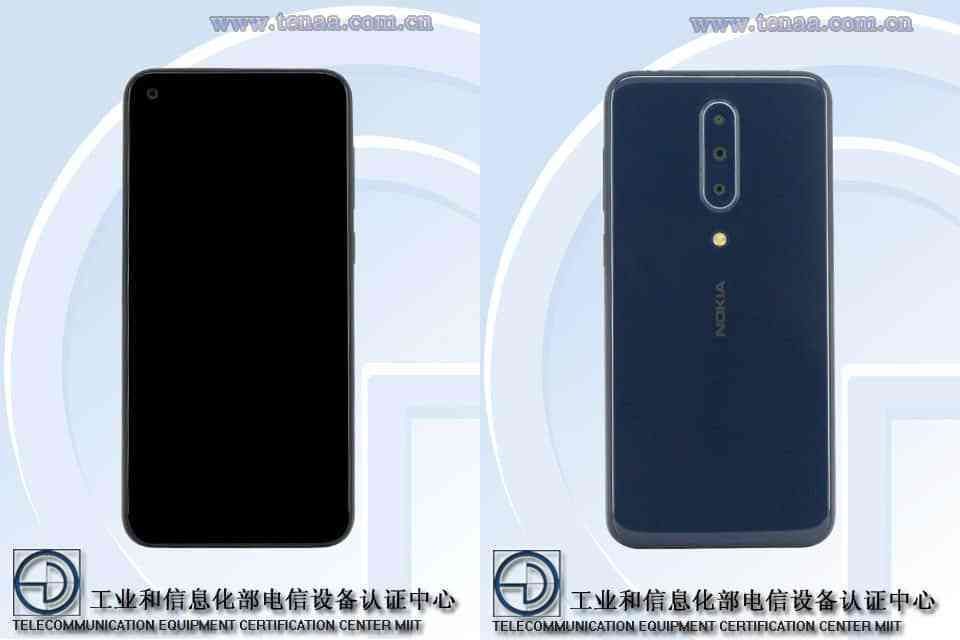
The Nokia X71 smartphone was announced yesterday in Taiwan. The two USPs of the phone are punch-hole display and triple rear cameras. Some reports have claimed that the handset will be releasing outside of Taiwan as Nokia 8.1 Plus. The renders of the Nokia 8.1 Plus that had surfaced in January had revealed that it will come equipped with a punch-hole display, a fingerprint reader and triple rear cameras. There is no fresh news on whether such a device will release. Images of Nokia phone with model number TA-1188 had reportedly appeared on TENAA. At the same time, a user manual of the Nokia 8.1 Plus has been spotted on the official website. The user manual states that the TA-1188 model number belongs to the Nokia 8.1 Plus.
Nokia 8.1 Plus Images
The Nokia TA-1188 TENAA listing is inaccessible. However, the images that had surfaced on its was first spotted by a French site SumoMobiili. The TENAA images show that it will be the second smartphone with in-display fingerprint scanner from HMD Global after the Nokia 9 PureView penta-lens camera phone that was unveiled recently.
Also, it is equipped with a punch-hole display and its rear is fitted with a vertically arranged triple camera setup. Below the camera module is an LED flash followed by the brand name of the company.
The publication has shared a leaked official render of the phone. It shows that the punch-hole screen will be surrounded by ultra-thin bezels and a slightly thick chin. The handset may come in colors like Blue and Maroon.
Nokia 8.1 Plus User Manual
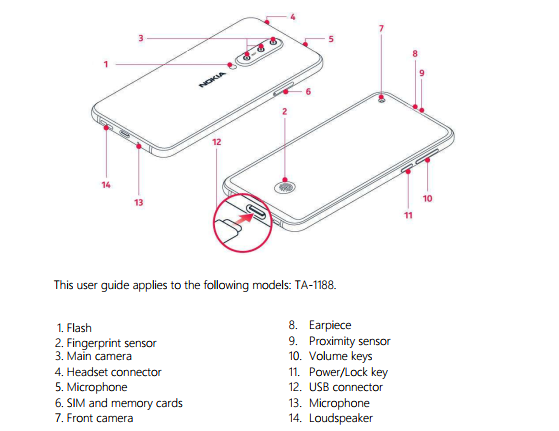
The user manual of the phone has been taken down. However, a snapshot of the user manual clearly reveals that the Nokia TA-1188 is the upcoming Nokia 8.1 Plus. The specifications of the phone are not known yet. Judging by the above shown images, it appears that the Nokia 8.1 Plus could be a higher edition of the Nokia X71 phone.
The user manual reveals that the bottom edge of the Nokia 8.1 Plus is fitted with a loud speaker, a USB-C port and a microphone. The right edge of the phone has volume keys and power/lock key. On the topside of the phone is a 3.5mm audio jack and another microphone. Placed on the left side of the device is a hybrid SIM slot. The earpiece is placed on the very thin top bezel of the phone.
Xiaomi recently launched its flagship smartphone — Mi 9, which comes with an impressive set of features and specifications given its price tag. While the phone’s demand has been high ever since it went on sale soon after its launch, the company hasn’t been able to meet the supply with demand.
However, the company has been making every efforts to make sure that it manages to meet the demand. It recently revealed that the supply of Mi 9 will certainly exceed 1.5 million units by the end of March.
Now, Xiaomi’s executive has revealed why the company wasn’t able to meet the demand of the Mi 9 smartphone. He says that the issue was with the production of the Mi 9’s rear camera module which features three sensors with the 6P lens, which has a complex system. He adds that the production of the Mi 9 Transparent Edition’s camera module is even more difficult.
However, he said that the Foxconn’s production line for the Mi 9 has sorted out all the issues. It is working in two shifts and is currently able to produce over a million units of the smartphone in a month. Thus, the company will now be able to meet the customer’s demand for Mi 9 from this month.
This news comes on the heels of the announcement from the company which claims that it has sold over 1 million units of Xiaomi Mi 9 flagship smartphone in just a month since its launch in February 2019.
As for the specifications, the Xiaomi Mi 9 comes with a 6.39-inch S-AMOLED display with Full HD+ resolution, Gorilla Glass 6 and in-display fingerprint reader. It is powered by the Qualcomm Snapdragon 855 SoC and comes in two variants — 6 GB RAM + 64 GB storage and 8 GB RAM + 128 GB storage.
It is equipped with 48-megapixel + 16-megapixel + 12-megapixel triple camera setup on the back and features a 20-megapixel selfie snapper. The MIUI 10 based Android 9 Pie OS is loaded on the device. It packs a 3,300mAh battery that supports 27W fast charging and 20W wireless charging.
The Xiaomi Mi 9 comes in colors like Lavender Violet, Ocean Blue, and Piano Black. The base model of the Mi 9 is priced at 2,999 Yuan (~$447) and the top-end Transparent Edition with 12GB RAM costs 3,999 Yuan (~$596).
Huawei recently took the wraps off its flagship smartphone lineup which includes Huawei P30 and P30 Pro. Now, the company seems to be all set to launch the Huawei P30 Pro smartphone in the Indian market.
The landing page for the P30 Pro is now live on Amazon India website, which hints that the device could go on sale exclusively through Amazon.in in India. However, no launch date has been revealed by the company yet.
But, there are several reports indicating that the launch of P30 Pro in India could take place next week. Also, there are reports suggesting that the P30 Lite could also be launched in India along with the Pro model.
Coming to the specifications, the Huawei P30 Pro features a 6.47-inch Full HD+ curved OLED display. The phone doesn’t have an earpiece, instead, it uses Acoustic Display Technology which emits sounds through the display using magnetic levitation.
Under the hood, the device is powered by the company’s own HiSilicon Kirin 980 octa-core processor along with 8GB of RAM and up to 512GB of internal storage. There is support for storage expansion using Huawei’s NM Card.
Huawei has redesigned the tray: rather than a SIM tray where the two SIMs and or the NM Card are side-by-side, the tray of the P30 series is designed to fit in one Nano SIM on top and the NM Card or a second Nano SIM underneath.
In terms of optics, the P30 Pro has four camera sensors on the back panel – a 20MP f/2.2 ultra wide angle lens, a 40MP f/1.6 wide-angle lens, an 8MP f/3.4 5X telephoto, and a ToF depth-sensing camera. For selfies, it comes with a 32MP sensor with AI HDR+.
The IP68 rated smartphone also comes with an in-display fingerprint scanner which is claimed by the company to be 30% faster than that of the previous generation. The P30 Pro runs Android 9 Pie-based EMUI 9.1 custom interface and is powered by a 4,200mAh battery with support for 40W fast-charging and support for 15W wireless fast charging.
While the company has not yet revealed which memory variants will make it to the Indian market, it’s confirmed through the Amazon landing page that the 8GB RAM and 256GB storage model will be launched in India.
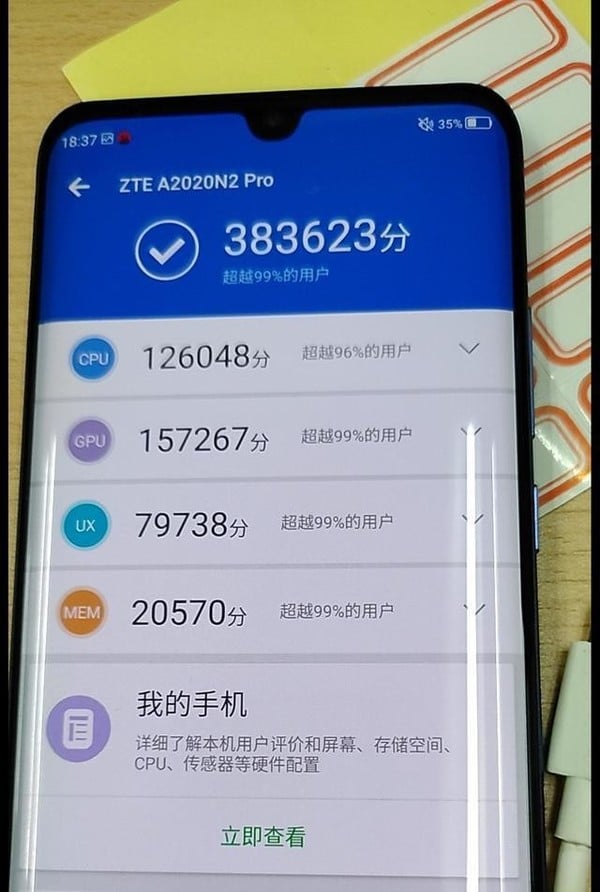
ZTE announced its first 5G mobile phone which adopts the moniker Axon 10 Pro, at the Mobile World Congress 2019. The device features a Qualcomm Snapdragon 855 chipset and we have already seen how it performs on GeekBench. However, the Axon 10 Pro has run through the AnTuTu benchmark app and the score leaked online.
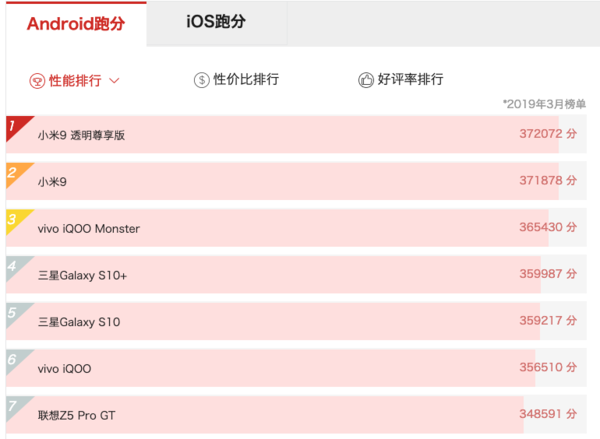
The leaked photo of the Axon 10 Pro shows the phone’s screen with the AnTuTu score on the screen. The device attained a total score of 383623 points. This score is higher than those of other Snapdragon 855-powered models that have been released so far. The Mi 9 Transparent Edition tops the chart with a score of 372072 points with the regular Mi 9 following behind with 371878 points. The easiest explanation to the towering score ascribed to the Axon 10 Pro is that the clock frequency may have been increased. ZTE’s R&D team did disclose that the device uses liquid-cooled technology and composite heat-dissipating heat storage materials to enable the processor to maintain high-frequency of operation for a long time.
ZTE is yet to release details about the phone’s memory configuration, including RAM and internal storage as well as other connectivity features. The Axon 10 Pro will be available in the second quarter of this year.
Last week, two OPPO devices with model numbers PCAT10 and PCAM10 were seen on TENAA’s website. The two phones are believed to be the OPPO Reno Lite which will come with an Helio P70 chipset. When they were listed last week, there were no images. TENAA has now updated the listing, thereby giving us an early look at the design.
[envira-gallery id=”244598″]
The OPPO Reno Lite has a large 6.5-inch display. We brightened up the photo of the front and was able to see it has a notch for the selfie camera. The rear of the device is home to dual cameras (16MP + 2MP) positioned in the middle of the device and stacked on top of each other. There is an LED flash below the sensors while a fingerprint scanner comes next.
The Reno Lite will not only be missing out on the pop-up selfie camera action. It will also not have an in-display fingerprint scanner. Nevertheless, it should be the cheapest model.
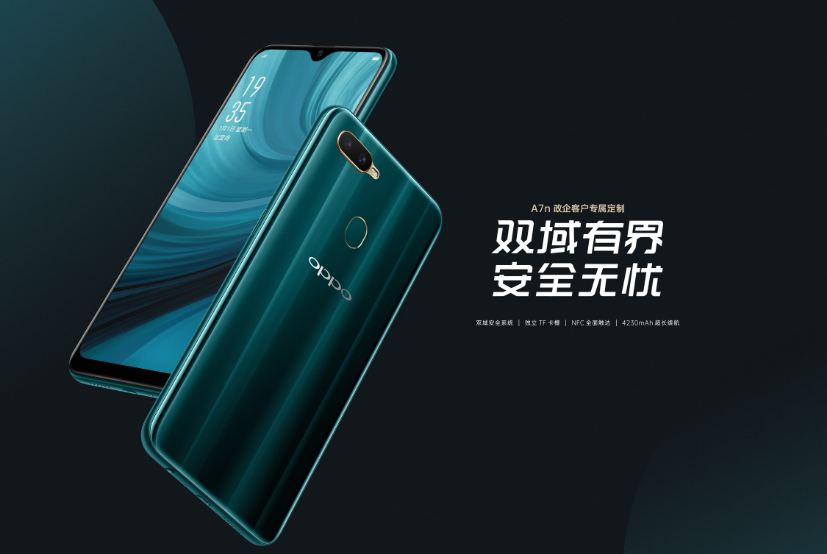
The OPPO A7n is a new mid-range phone from OPPO. It was silently announced today in China and can simply be referred to as a MediaTek version of the OPPO A7 which launched in India last November.
The OPPO A7n has a 6.2-inch 1520 x 720 display with a waterdrop notch and a screen-to-body ratio of 88.3%. The back is covered in a special 3D material (we are not sure if its glass) that gives it a unique appearance when light rays hit it. The curved back also allows for a firm and more comfortable grip.
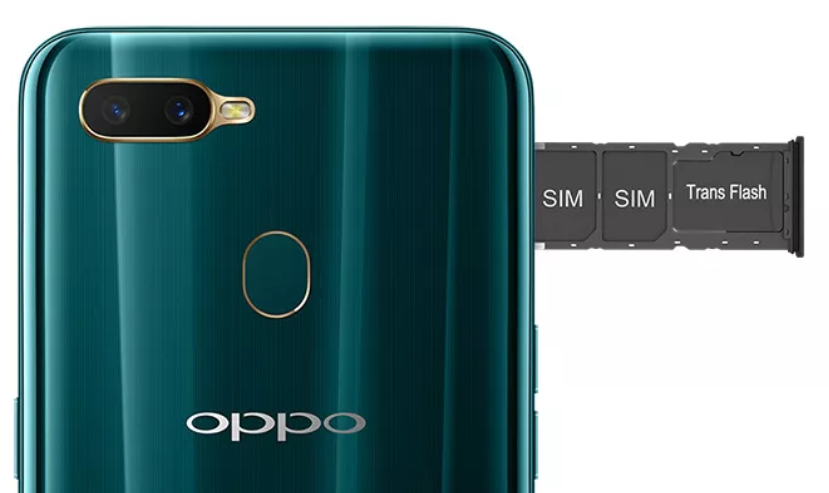
As said above, this can be called a MediaTek version of the OPPO A7. OPPO has replaced the Snapdragon 450 processor of the A7 with the Helio P35. There is 4GB of RAM and 64GB of storage. A triple card slot allows you to use a MicroSD card (256GB max.) alongside two nano SIM cards.
The OPPO A7n has dual rear cameras – a 13MP f/2.2 primary sensor and a 2MP f/2.4 depth sensor. There is a 16MP f/2.0 AI camera in front for selfies with lots of features including portrait mode and beauty mode. The rear cameras can also record time-lapse videos.
The phone has Bluetooth 4.2, dual-band Wi-Fi, and even NFC (missing on the A7) for different forms of cardless payments. There is a fingerprint scanner on the back, a 3.5mm audio jack at the bottom, and a 4,230mAh battery that charges via MicroUSB. With OPPO’s “app freezing” feature, your battery should last longer since no background apps are drawing power.
One neat feature the OPPO A7n also has is a one-touch key that lets you switch between a private mode and a regular (public) mode. The feature is useful in case you want to hand someone your phone to use. Just like the OPPO A7, it also runs ColorOS 5.2.1 based on Android 8.1 Oreo.
The OPPO Reno is one of the most talked about phones from China in recent times even though it is yet to launch. Thanks to a leak that revealed the phone will come with an unusual selfie camera design, the phone has even become more popular. However, in a surprising turn of events, OPPO is taking legal actions against the original source of the leak.
Apparently, OPPO’s plan was to keep the design of the selfie camera a secret until the launch. Yes, we know OPPO itself has been releasing details about the phone but for this particular one, it is not happy it got out.
Today, an internal memo from OPPO detailing the sanctions that should be carried out against those involved in the leak was shared on the web.
The memo says the original source of the leak will pay a fine of CNY 500,000 (~$74,368). It is also requesting for a full report about the incident and a promise not to spread details about new products. OPPO also requests legal actions to be taken against the dealers and clerk of the store that shared the info in the first place.
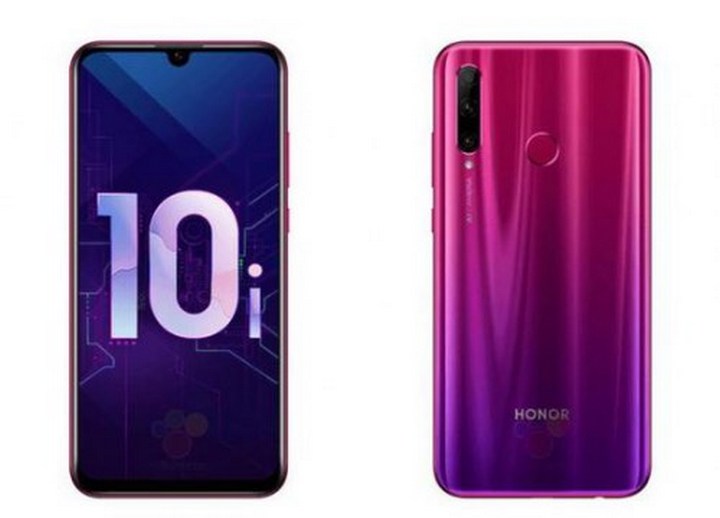
Honor 10 was last year’s Honor flagship which came with several iterations such as Honor 10 GT and Honor 10 Lite. Honor is about adding a new model known as Honor 10i. Images of the unannounced model appeared in Russia last month. The Honor 10i has now been certified by China’s TENAA.
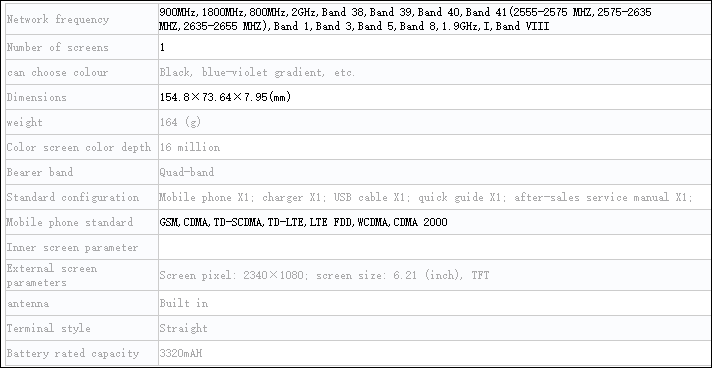
The model appears with model number HRY-TL00T and HRY-AL00Ta, and the major difference from what we already know is that the device will also have 6 GB of RAM. hile the HRY-TL00T variant is listed with only 4/128 GB, the HRY-AL00Ta has more memory options, such as 4/64 GB, 6/64 GB, and 6/128 GB. The rest of the specifications remain the same.
As a reminder, the Honor 10i features a 6.21-inch LCD display with a waterdrop notch that houses a 32MP selfie camera. The device is powered by a Kirin 710 chipset. Te Honor 10i also sports a triple camera setup on the back. The camera consists of a 24 MP f/1.8 main camera sensor teaming up with an 8 MP f/2.4 ultra-wide-angle shooter and a 2 MP depth sensor. The device will run Android Pie-based EMUI 9.0 out of the box. The Honor model was said to have a price tag of around $300 in Russia. The price in China is expected to be slightly cheaper.
HMD Global announced a brand new midrange for the Asian market which will probably hit the global market soon under another moniker. The Nokia X71 is a very interesting handset for both its aesthetics and camera department, and it will be an important competitor of both the Huawei P30 Lite and the Xiaomi Mi 9 SE that represent some of the most important mid-end devices of the moment. Here is a specs comparison that will clear your ideas about these three well-balanced phones. After reading the comparison and discovering who is the winner, you can let us know if you agree with us by using the comment box under the article.
Triple 48 + 8 + 5 MP f/1.8 and f/2.4
16 MP f/2.0 front camera
Triple 24 + 8 + 2 MP f/1.8 and f/2.4
32 MP f/2.0 front camera
Triple 48 + 13 + 8 MP f/1.8, f/2.4 and f/2.4
20 MP f/2.0 front camera
BATTERY
3500 mAh, fast charging 18W
3340 mAh, fast charging 18W
3070 mAh, Fast Charging 18W
ADDITIONAL FEATURES
Hybrid Dual SIM slot
Hybrid Dual SIM slot
Dual SIM slot
Design
When it comes to the look it is all about tastes, but I personally prefer the most innovative designs made with the best material. And that is why I would go for the Nokia X71. It is the first Nokia phone to come with a punch-hole display, something that Xiaomi still did not try. It boasts a glass back and a solid aluminum frame. But someone may prefer the Xiaomi Mi 9 SE due to its clean and reflective glass back, as it comes with an in-display fingerprint scanner and wonderful gradient colors. Even Huawei P30 Lite is all but an ugly phone with its amazing glass back and a high screen-to-body ratio. But the punch-hole display makes me go for the Nokia X71.
Display
While Nokia X71 provides the most gorgeous front panel thanks to the punch-hole display, the phone with the best display quality is definitely the Xiaomi Mi 9 SE. It is the only to boast a Super AMOLED panel made by Samsung which provides more vivid colors as well as deeper blacks. This display is even HDR-compliant, so it comes with outstanding color reproduction, especially in video contents. Nokia X71 and Huawei P30 Lite are more or less at the same level when it comes to the display quality, but the Huawei P30 Lite comes with a smaller display that may be less comfortable for productivity but it is also easier to use with one hand.
Specs & Software
Besides being the clear winner of this comparison, Xiaomi Mi 9 SE is also one of the most performing midrange smartphones in the whole market. It is equipped with the best midrange chipset by Qualcomm, which is also the best San Diego giant’s chipset if we exclude the 800 series. That is the reason why Xiaomi Mi 9 SE will be faster and smoother than Nokia X71 and Huawei P30 Lite in most of the scenarios, including gaming. I want to give the second place to the Nokia X71 because, even though the Snapdragon 660 chipset is more or less at the same level as the Kirin 710, it comes with a better GPU. Further, Nokia X71 comes with a stock Android version which is lighter than Huawei’s and Xiaomi’s customized user interfaces.
Camera
Unfortunately, we still did not test the impressive triple camera of the Nokia X71 equipped with Carl Zeiss lenses, but on the paper, Xiaomi Mi 9 SE seems to be a most convincing camera phone. It boasts a main 48 MP sensor with an f/1.8 aperture, a 13 MP ultrawide sensor and a telephoto lens for optical zoom. Nokia X71 is not so different as it comes with a similar setup but it has a lower resolution for the ultrawide lens, as well as a lower resolution for the front camera (16 MP vs 20 MP). Huawei P30 Lite may be a better phone for selfies given its whopping 32 MP front camera, but its rear camera should be inferior to both Xiaomi Mi 9 SE and Nokia X71.
Battery
With its bigger 3500 mAh battery, Nokia X71 should be able to last more. Huawei P30 Lite stops at the average capacity of 3340 mAh, while Xiaomi Mi 9 SE’s battery is definitely its weakest point with just 3070 mAh.
Price
Nokia X71 debuted in Taiwan with a price tag of about €350/$392, Huawei P30 Lite costs just €290/$325 globally and Xiaomi Mi 9 SE is available in China for about €300/$335. Overall, Xiaomi Mi 9 SE wins the comparison with a better display, a higher-end chipset and an amazing camera department.
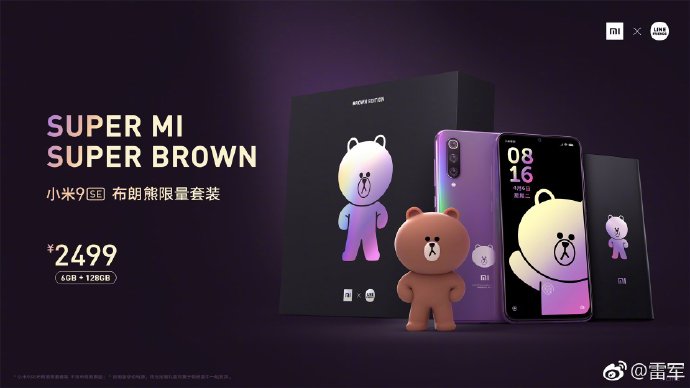
The Mi 9 SE Brown Bear Limited Editon was one of the products released yesterday by Xiaomi. The phone is the result of a partnership between Xiaomi and LINE Corporation. Brown, the character on the phone, was originally a sticker from the LINE messaging app. He is a member of the LINE FRIENDS. There are physical stores around the world based on the characters from LINE FRIENDS.
The Mi 9 SE Brown Bear Limited Edition doesn’t look different from the Holographic Purple of the standard Mi 9 SE save for the Bear logo on the back, it is actually quite different on the inside. There are custom wallpapers and themes made after the character and his friends. You can also play with the character by calling up the assistant. You will be able to ask it fun questions and even ask it to dance.
Unboxing photos of the phone shows what you get when you purchase this limited edition Mi 9 SE. The box itself is black with Brown Bear on the top in a holographic purple. There is Brown Edition written at the top and Xiaomi and LINE’s logos at the bottom. The box contains the phone itself, a cute protective case, a branded 10,000mAh power bank, and a bag of stickers.
[envira-gallery id=”244537″]
The Mi 9 SE Brown Bear Limited Edition costs ¥2499 (~$370), it has the same configuration as the 6GB RAM + 128GB Mi 9 SE which sells for ¥2299 (~$340). Just like the standard edition, it has a 5.97-inch FHD+ AMOLED display supplied by Samsung and is covered with Gorilla Glass on both sides. There is a Snapdragon 712 processor under the hood and a 5th generation in-display fingerprint scanner for security. It also has Face Unlock.
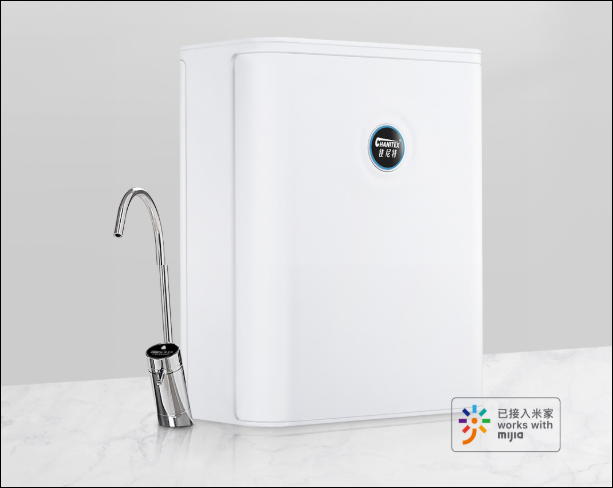
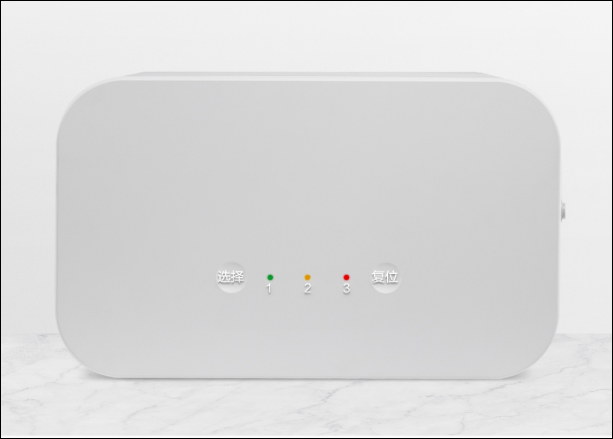
Xiaomi has launched a new product dubbed Chanitex Smart Water Purifier under the Youpin crowdfunding platform. The product is different from the regular water purifier in several ways. First, it comes with an ultra-durable filter which you won’t need to change for three years. The product also comes with support for Mijia app control making it possible to operate the device remotely from your smartphone. The device comes with a price tag of 2499 yuan ($372). The price includes on-site installation service fees and the gadget is expected to start shipping on April 22.
Chanitex Smart Water Purifier
The Chanitex Smart Water Purifier is a product of AO Smith Environmental Appliance Global Research and Development Base and they also provide comprehensive after-sales services. The company has a multi-functional laboratory for water treatment constructed in accordance with NSFCNAS accreditation standards, including 18 modules for precision instrumental analysis laboratories that can detect heavy metals, antibiotics, microorganisms, and disinfection by-products. The firm currently has more than 140 patented technologies.
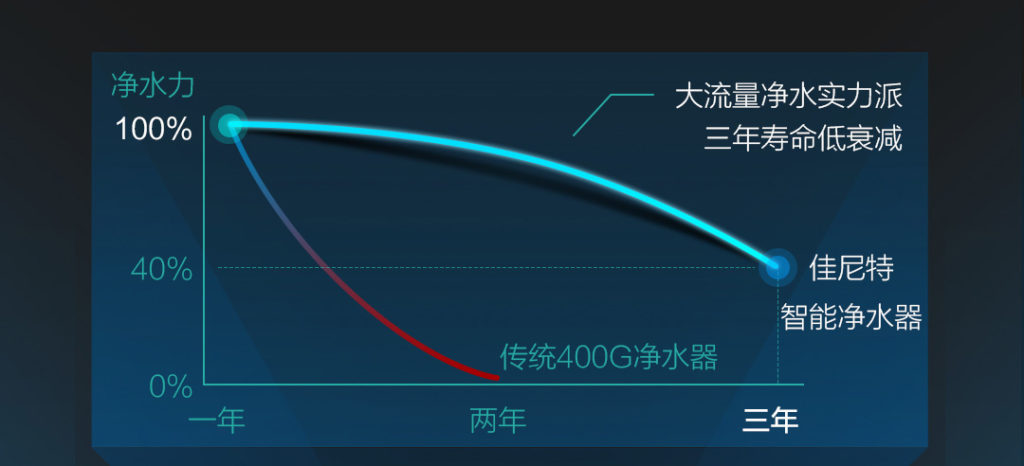
The Chanitex Smart Water Purifier uses a 550-gallon high-throughput reverse osmosis filtration system that increases the water purification membrane area by 30% compared to conventional 400 water vessels. The water output per minute is as high as 1.6 liters which translates to outputting a cup of fresh water in 7.5 seconds. Compared to the traditional 400G water purifier, the water output per minute increased by 60%.
The purifier adopts a barrelless design, that is, it can be filtered and ready to drink without a storage chamber. Thus, when the tap is turned on, the water flows through the purifier and fresh water is immediately delivered, reduce waiting time. This design effectively removes the risk of secondary pollution that may arise from the water storage tank.
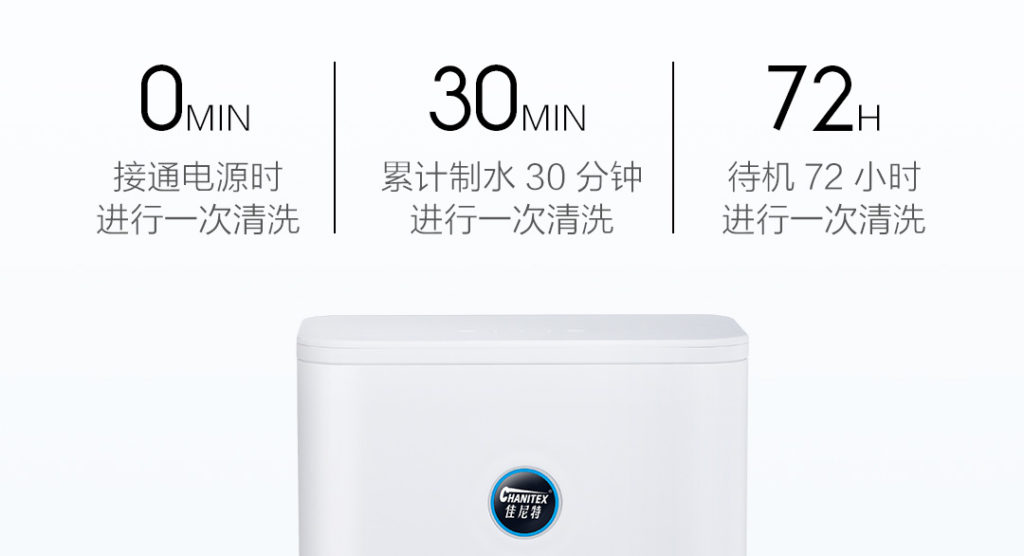
Further, the Chanitex smart water purifier adopts the patented long-acting RO (Reverse osmosis) membrane independently developed by the company. Under the condition of ensuring fresh and safe water quality, the membrane service life is up to 3 years, and the annual total water purification is improved compared with the traditional 400G water purifier by four times, reaching a total of 5500L of clean water. It has a five-stage layer filtration system, which can effectively remove rust, scale, heavy metals, residual chlorine, impurities from the regular water supply at home. It also removes odour and improves the taste. The patented technology of smart self-flushing automatically flushes out water caught up midway when power goes out.
Xiaomi makes very little profit from its smartphone sales. A large percentage of its profits come from ads which run on its MIUI Android-based operating system. Some of these ads are inappropriate and a lot are intrusive, interrupting games and even showing up under the settings menu. The company’s CEO, Lei Jun has revealed there will be a revamp that addresses these key issues.
Mr. Lei Jun revealed via a Weibo post today that he has had an extensive discussion with the head of MIUI to work on key issues associated with the OS. The official MIUI account already listed six main issues it got as feedback from users. These issues include support for QQ call recording, a local recycle bin where deleted items are temporarily stored and then automatically deleted after three days, a magnifying glass feature, and an ultra-low-power mode where only calls and SMS works e.t.c.
The CEO retweeted the original post and then added that they will also work on ads which a lot of users have complained about. He disclosed that inappropriate and intrusive ads which are some of the key complaints from users will be removed. However, he didn’t say all ads will be completely removed.
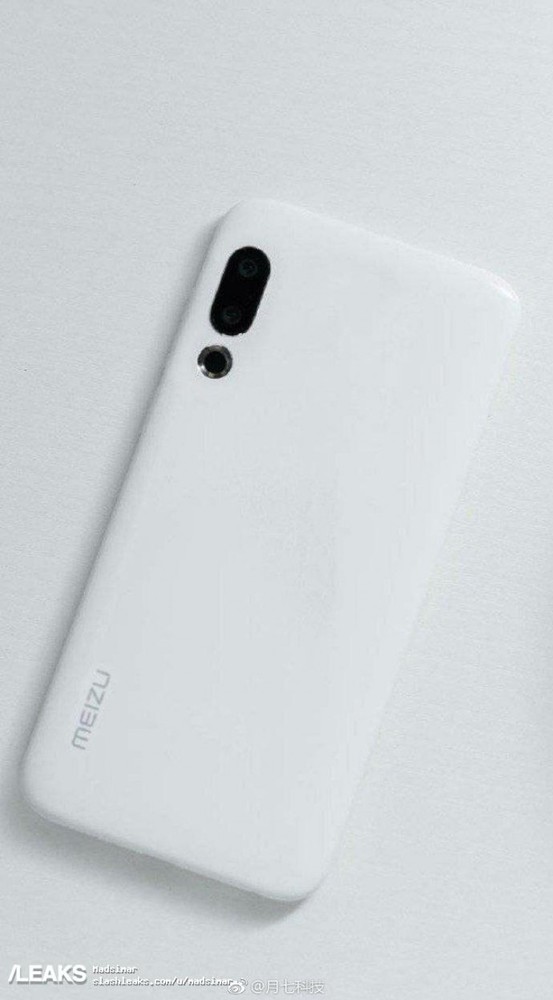
The Meizu 16s is Meizu‘s upcoming flagship phone. In the past few weeks, there have been images of the phone across the web. Yesterday, its AnTuTu score was also revealed. Today, an image showing us the rear of the white variant has surfaced on the web and it confirms what we have seen with respect to design.
The Meizu 16s might not be easily distinguishable from its predecessor when you compare the front of both phones, but they are quite different on the rear. Unlike the Meizu 16 which has its cameras positioned in the middle of the phone, the cameras of the 16s are on the left of the phone. The signature ring flash sits below the setup and at the bottom is the manufacturer’s name.
The position of the cameras is not the only change. The sensors are also different. The primary camera is the 48MP Sony IMX586 and it has optical image stabilization.
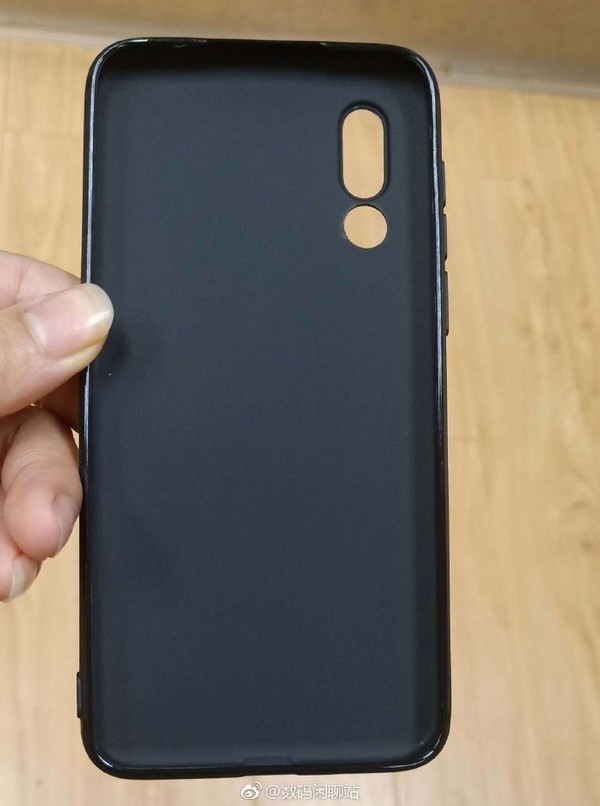
Alongside the image of the white variant is also a picture of a silicone case. The case which is black has cut-outs for the camera and LED flash which matches those on the phone above. The volume control buttons and the power button are on the right side of the phone.
According to a report from Aowei Cloud Network (AVC), Xiaomi is labeled as the most popular TV brand in 2019 with increased shipments this February. Along with Xiaomi, other TV manufacturers such as Skyworth, Hisense, Haier, and TCL remained in the top 5 list.
Xiaomi is the most popular TV Brand in 2019 (February).
Xiaomi TV shipments touched 8.4 million with a year-on-year increase of 225.5% in the fourth quarter of 2018. Such a surge in the Xiaomi TV sales has led them to remain at number one position in the China TV market. The affordability, high-end performance and several other reasons are undoubtedly driving Xiaomi TV sales in China.
In a recent year-end festival, Xiaomi managed to escalate TV sales by offering huge discounts along with other offers. For example, Xiaomi Mi TV 4A 65-inch version was available on discount for 2999 Yuan (~$446) from its original price of 3699 Yuan (~$550).
The Chinese TV market witnessed a downfall by -29.2% year-on-year basis and constituted only 2.35 million unit sales in February 2019. Overall revenue also dropped to 6.4 billion Yuan with a decline of 38.7% on a yearly basis.
Domestic brands constituted 67% of total sales in China, while Japanese and Korean brands managed to get 6% and 1% share respectively. Among the TV sizes, 55 inch TVs remained on the top with a 29.4% share, 32 inches also fared well with 15.5%, and 43 inch TVs grabbed 14.6% market share.
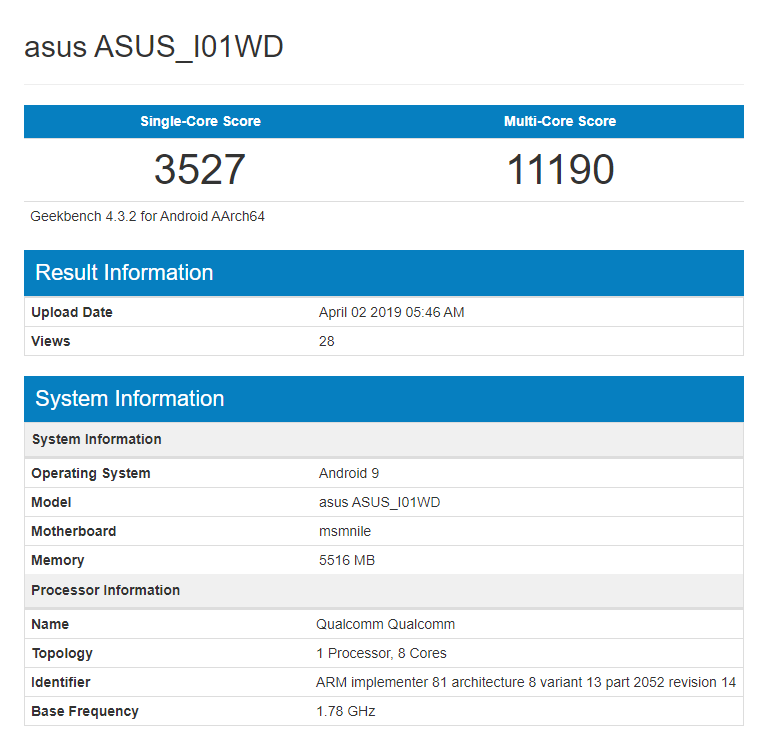
The successor to the Zenfone 5z will be arriving a little late this year but that should be a good thing if it is available for purchase right after its launch instead of nearly four months later like the Zenfone 5z. The phone which is expected to launch as the Zenfone 6z has now been spotted on Geekbench.
Benchmarked as the “asus ASUS_I01WD”, the Zenfone 6z runs Android 9 Pie. It has 6GB of RAM and is powered by the Snapdragon 855 processor. The phone scored 3527 points in the single-core test and 11190 in the multi-core test.
There is still a lot we do not know about the phone most especially its design. Last year, there were leaks showing off prototypes of the Zenfone 6. One had a punch hole display, another had a waterdrop notch, and a third had an unusual notch at the right corner.
We also do not know if ASUS will be joining the triple camera train this year or even surprise us with a quad camera setup. Nevertheless, we are excited to see what ASUS comes up with.
OPPO will be taken the veil off the Reno series this month and ahead of that, the company continues to hype the device. OPPO’s VP Bryan Shen has been very generous with details of the model, ensuring that almost all the details are out in the open at this moment. The OPPO exec has shared a short video demonstration of the Reno’s DC dimming feature.
With the rise of LED technology, DC dimming control has been gaining a lot of attention as a more effective way of controlling the light output of an LED fixture. The technology uses a DC voltage between 0 and 10 to control the light output of the LED fixture. As the voltage goes up or down, the corresponding 0-10V dimmable driver matches the light output of the fixture to increase or decrease up to a certain percentage. DC dimming is one of the simplest and most popular dynamic lighting controls used in offices, retail spaces, and homes but the feature is just gaining traction in smartphones. But that of the Reno is not hardware DC dimming but a software pattern to reduce the low-brightness strobe.
In the short video, we can see how the feature is activated, turning on the strobes and when it is deactivated, the strobes disappears. The feature brings about stroboscopic eye protection. Earlier leaks and releases show the Reno will be equipped with a Snapdragon 855 processor, which uses a combination of 10x hybrid optical zoom and 4065mAh battery. Further details emerged showing the device will be arriving in three models such as Snapdragon 710 CPU variant, Snapdragon 855 CPU model with support for only 4G networks and Snapdragon 855 edition with 5G support. The Reno will also be arriving in four color choices such as fog sea green, black night mist, pink mist and nebula purple.
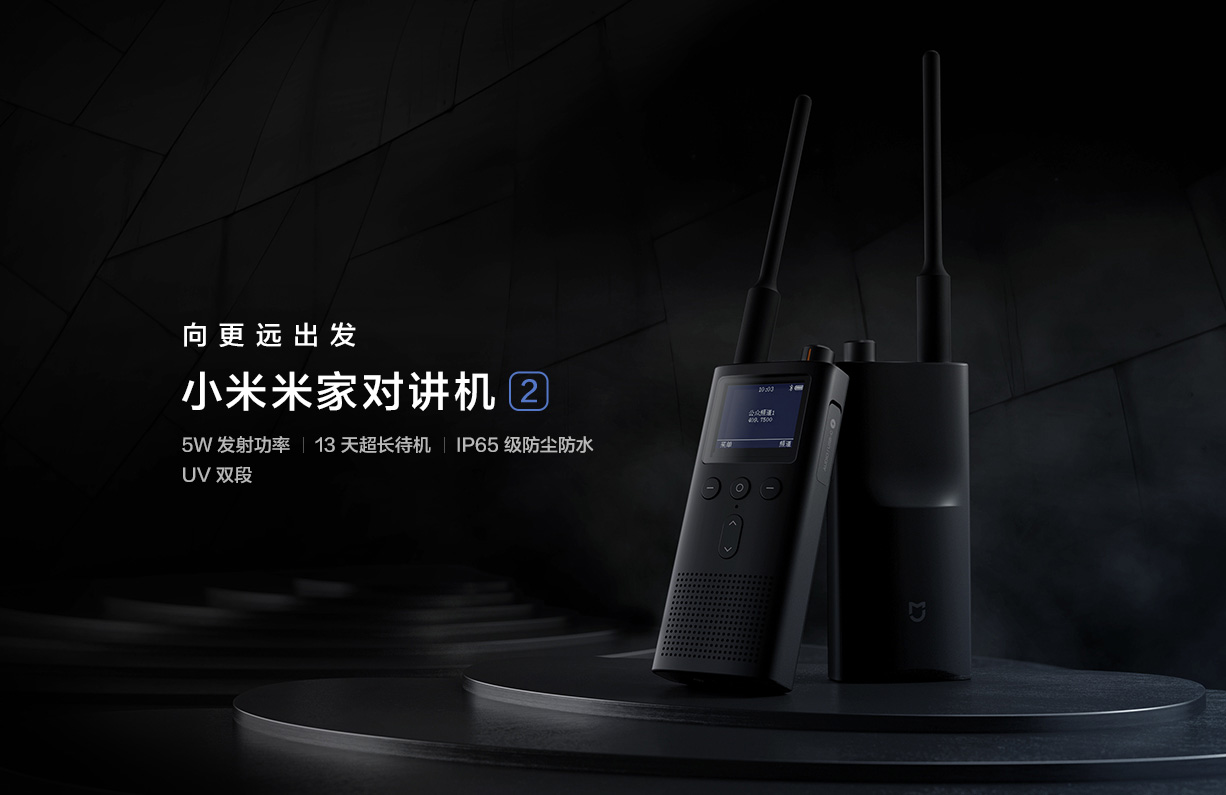
Xiaomi launched its first walkie talkie back in 2017. Last October, it followed it up with the Mijia Walkie Talkie 1s which has more features than the original but retained its launch price. Now, the Mijia Walkie Talkie 2 has been announced. While the price is nearly double that of the 1s, it does pack some new features.
The Mijia Walkie Talkie 2 has a screen too like the 1s but its LCD and not a dot matrix display. The 1.77-inch screen displays more characters and information such as the battery level and is also visible under the sun.
It supports UHF-VHF dual-band and has a 5W transmission power which allows you to communicate between a distance of 1-6km. Positioned beside the antenna is a knob for controlling the volume level.
Another big upgrade of the Mijia Walkie Talkie 2 is its bigger battery capacity. It packs a 5,200mAh battery which is more than double that of the Mijia Walkie Talkie 1s’ 2190mAh battery. It will last 13 days on standby and provide up to 15 hours of talk time on a full charge. It also charges via USB-C (5V/2A) and can be recharged using a power bank.
[envira-gallery id=”244500″]
There is Bluetooth support and an audio jack if you haven’t gone wireless yet. There is an audio processing chip for clear audio when outdoors. The speaker is also bigger and said to be 22% louder than that of the previous generation. The Mijia Walkie Talkie 2 has an IP65 rating so you don’t have to worry about it getting damaged by the rain if you are out hiking. There is also location sharing which can be viewed on the app.
After a month of its launch, Xiaomi shipped 1 million units of the Xiaomi Mi 9. The Chinese smartphone company is making every effort to match the demand for the new smartphone. In China, it was made available for purchase within a few days of launch. The high-end specifications, availability, and premium design of Mi 9 have helped to generate over a million sales within a month.
Xiaomi Mi 9 is retailing throughout the world in selected countries. In Europe, it is available for €449, while in India it will start retailing for INR 35990 (expected), and in some other countries with a similar price tag.
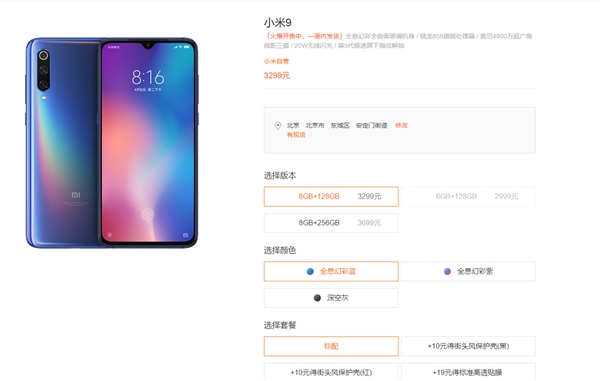
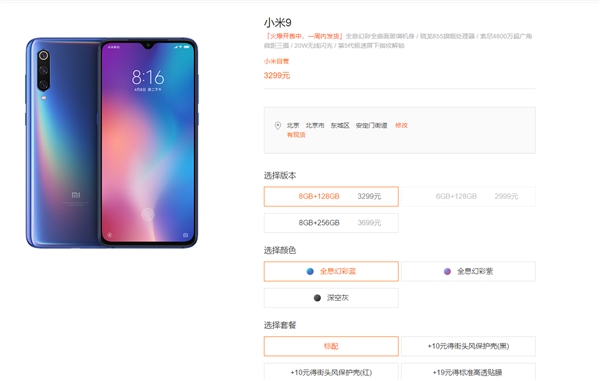
As according to official Mi Store in China, the Mi 9 delivery information is changed to “within a week” timeframe from the earlier three weeks time period. In China, the 6GB+128GB is available for 2999 Yuan(~$446), 8GB+128GB version for 3299 Yuan(~$490) and 8GB+256 GB is going for 3699 Yuan(~$550).
Additionally, Xiaomi Mi 9 features an impressive 6.4 inch AMOLED display, Qualcomm Snapdragon 855 SoC coupled with Adreno 630 graphical processing unit. Further, it is available in three different storage variants – 6GB+128GB, 8GB+128GB and 8GB+256GB. It comes with Android 9.0 Pie based MIUI 10 on board for smooth smartphone functioning.
A 3500 mAh Li-Polymer battery is present with rapid 20W wireless charging. Xiaomi Mi 9 is available in four different colors black, blue, white and gold.
We use cookies on our website to give you the most relevant experience by remembering your preferences and repeat visits. By clicking “Accept”, you consent to the use of ALL the cookies.
This website uses cookies to improve your experience while you navigate through the website. Out of these, the cookies that are categorized as necessary are stored on your browser as they are essential for the working of basic functionalities of the website. We also use third-party cookies that help us analyze and understand how you use this website. These cookies will be stored in your browser only with your consent. You also have the option to opt-out of these cookies. But opting out of some of these cookies may affect your browsing experience.
Necessary cookies are absolutely essential for the website to function properly. This category only includes cookies that ensures basic functionalities and security features of the website. These cookies do not store any personal information.
Any cookies that may not be particularly necessary for the website to function and is used specifically to collect user personal data via analytics, ads, other embedded contents are termed as non-necessary cookies. It is mandatory to procure user consent prior to running these cookies on your website.