The Huawei Nova 4e is scheduled to go official on March 14 in China. Several details on its specs have already appeared in recent reports. As far as the appearance of the phone is concerned, a couple of case renders have appeared in the recent past to reveal that it will be equipped with a waterdrop-style notch screen and a rear-mounted triple camera setup. Ahead of tomorrow’s launch, the renders of the Nova 4e have appeared to reveal its color variants and design.
The Huawei Nova 4e will be available in three colors in China such as Pearl White, Magic Night Black and Garnet Blue. The images confirm the presence of a waterdrop notch enabled display and a glass rear featuring a vertical triple camera setup and a regular fingerprint reader. The Garnet Blue edition is a gradient color that appears blue at the top and purple towards the bottom.
Recent reports have revealed that the Huawei Nova 4e will be equipped with a 6.15-inch IPS LCD display that will offer full HD+ resolution of 1080 x 2312 pixels. The Kirin 710 SoCv that works at a clocking speed of up to 2.2 GHz powers the smartphone.
The EMUI 9 based Android 9 Pie is expected to arrive preloaded on the Nova 4e. The smartphone will be packed with a 3,240mAh battery that will come with support for 18W rapid charging. For capturing selfies, the Nova 4e will be featuring a front-facing camera of 32-megapixel. The back panel of the phone could be equipped with 24-megapixel + 8-megapixel + 2-megapixel triple camera setup.
The Nova 4e is expected to release in China in two models such as 4 GB RAM + 128 GB storage and 6 GB RAM + 128 GB storage. The pricing of these variants are currently under the wraps. The same handset is expected to sell as Huawei P30 Lite in European markets. The Chinese manufacturer will be launching the Huawei P30 and P30 Pro flagship phones on March 26 in Paris, France. It is speculated the P30 Lite mid-ranger may also debut alongside the P30 and P30 Pro on the said date.
With Spring just around the corner, it is imperative for you to consider buying products that make you keep your home and garden well-groomed and tidy.
Taking that into consideration, AliExpress has launched a new promotion, wherein the Alibaba-owned online retail service will be doling out noteworthy discounts on a wide range of products that come in handy in day to day life.
Dubbed as ‘Create an Inviting Space,’ this recently kicked-off promo offers up to a whopping 59 percent off on home and garden items. In order to ensure users can effortlessly find what they’re looking for, items bearing discounted prices have been split into various categories.
The first section dubbed ‘Top Stores’ features multiple stores that you can visit to avail noteworthy discounts on specific brands. For the sake of an instance, you can visit the LOMVUM store and check out the brand’s top selling items. Likewise, you can visit the Prostomer Tool store and get great discounts on a slew of products.
The next category on the promotion page is called ‘The Bestsellers’ and it features select items that have gone up for sale bearing reduced prices. Aside from that, you can check out the rest of the categories including Tools, Home & Garden, Home Improvement, Lights & Lighting, and Furniture.
More importantly, all items included in the aforesaid categories are currently up for grabs bearing heavily discounted prices. For example, the 3D DIY Family Wedding Photo tree which is added under the ‘Home & Garden’ section is now available for a lowered price of just $8.80. This is a 20 percent drop in the item’s original selling price of $11.
Similarly, you can grab significant discounts on other items that have been included in the other categories. You can follow this link to visit the promotion page and take full advantage of the discounts before the promo comes to an end.
The rumor mill has been claiming since the past few days that Vivo will be introducing a new S-series of smartphones by launching the Vivo S1. In fact, the Vivo V1831A/T smartphone that has been recently approved by China’s TENAA authority is believed to be the Vivo S1 phone. A Vivo India executive whose name has been withheld for obvious reasons has revealed to 91mobiles that the company is planning to launch the S lineup of phones In India too.
Vivo’s Y and V series of smartphones are available for purchase both online and offline. However, the upcoming Vivo S-series will be reportedly sold as online-exclusive products. The S lineup is expected to rival with Realme and Xiaomi devices. The Vivo S1 is speculated to be priced between Rs. 10,000 (~$145) and Rs. 15,000 (~$215).
It has been also revealed that the specifications and features of the Vivo S1 will be more or less same as the Vivo V15 that is scheduled to go on sale in India on March 15. The V15 will be selling in the country for Rs. 22,990 (~$330). There is a possibility that the Vivo S1 will be equipped with a notch-less display, a triple camera setup and a pop-out selfie shooter. Since it is expected to cost under Rs. 15,000 (~$215), it may come with inferior specs compared to the Vivo V15.
Recent reports have revealed that Vivo may announce the Vivo S1 smartphone in China alongside the Vivo X27 series of smartphones on March 19. The TENAA appearance of the Vivo V1831A/T has revealed that it comes with a 6.59-inch IPS LCD display that supports full HD+ resolution. The Helio P70 SoC is expected to power the device with 6 GB of RAM. It may include an internal storage of 128 GB. For more storage, it will come with a microSD card slot. The smartphone will be drawing power from 4,000mAh battery.
Instead of the 32-megapixel front camera available on the Vivo V15, the Vivo S1 is expected to arrive with a lower 24.8-megapixel selfie snapper. The back panel of the phone will include triple rear cameras and a fingerprint scanner. Its triple camera setup will include a 12-megapixel lens, an 8-megapixel sensor and a 5-megapixel sensor. In China, it could be priced under 2,000 Yuan (~$298).
While there’s no dearth of household products that can transform your home into a smart home, these devices aren’t easy on the pocketbook. In a bid to make top-end smart devices available to its cost-conscious users, Banggood has now launched a new promo.
Dubbed as ‘Home Smart,’ the recently kicked-off promo gives Banggood users an unmissable chance to get their tech greedy hands on a wide range of smart home devices.
On top of that, those buying two items on the promotion page will be eligible to receive an extra 10 percent discount.
In order to make the search process simple and quick, Banggood has split all smart home products featured on the promo page into different categories. More importantly, all items included in the aforesaid categories are now available for considerably reduced prices.
The ‘Recommended’ section features the DIGOO DG-TH1180 LCD Negative Indoor Outdoor Digital Thermometer, the Xiaomi Mijia Smart Home Zigbee Wireless Smart Switch, the DIGOO DG-C11 Hygrometer Clock Digital Thermometer and lots more.
You can grab noteworthy discounts on all items included in the above-mentioned section.
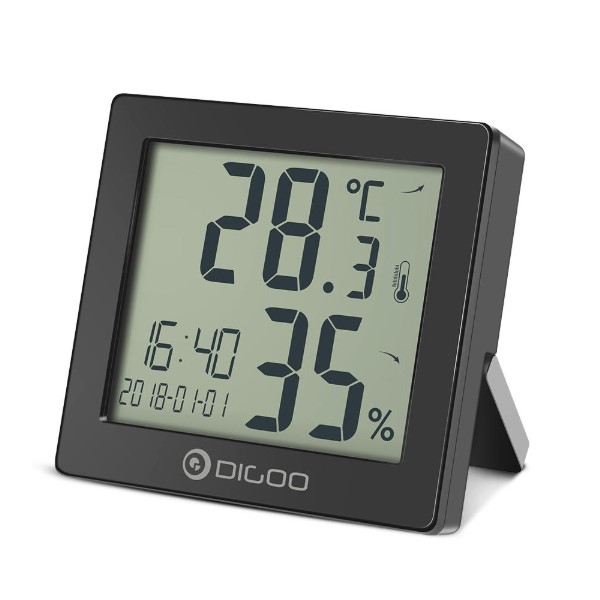
For instance, the DIGOO DG-C11 would normally set you back $12.75, but you can now buy it for only $5.99 on Banggood. This is a noteworthy 53 percent reduction in the device’s original asking price. If you have restlessly been waiting to get your hands on a cost-effective weather station that doesn’t compromise on quality, you can head straight to the next category called ‘Weather Station.’ The section is rife with Digoo branded weather stations that you can buy without emptying your pocket.
If you fancy protecting your home with a home security system, you’re highly likely to end up spending a lot of money, but that’s about to change. Banggood is doling out significant discounts on a slew of devices that secure your family and property.
For example, the DIGOO W01f WIFI Security IP camera usually retails for $45.59, but it is currently available bearing a $34.16 price sticker under the ‘Home Security System’ section. Likewise, you can get great discounts on the rest of the products included in the category.
The ‘Smart Home System’ section features all sorts of items including the Digoo RC-13 Smart RF Controller, Digoo DG-ROSA 433MHz Wireless DIY Standalone Alarm Siren, Broadlink MP1 Smart Home Wifi Timing Plug Power Strip 4 Ports and lots more. Banggood users will be able to purchase these items as well as all the other items included on the promotion page at lowered prices.
You can visit the promotion page and check out all the smart home products by following this link. Note that the discounts will only be valid for a limited period of time.
Xiaomi took the wraps off its long-awaited Mi 9 smartphone in February this year and was made available to the public earlier this month. Following in the footsteps of its well-received predecessors, the Mi 9 became an instant hit among Xiaomi fans. The phone boasts an impressive array of features including a mammoth screen that made an instant hit among those who fancy watching their favorite videos and playing popular games on a big-screen mobile device. Aside from that, it packs a powerful processor and a highly competent GPU, under the hood.
If you have restlessly been waiting to get your hands on the recently unveiled handset, it might interest you to know that the Xiaomi Mi 9 has gone up for sale on Giztop. The Chinese online store is offering the global version of the Mi 9 for $499.
The Mi 9 global version ships with 6GB of RAM and offers 64GB of internal storage capacity for you to save your favorite multimedia content. Here are the rest of the features that are likely to sweep you off your feet.
6.39-inch AMOLED screen, FHD+ display with 2340×1080 pixels resolution
7nm Qualcomm Snapdragon 855 Kryo 485 processor, up to 2.84GHz
Adreno 640 GPU
Sony 48MP+16MP+12MP Triple rear cameras
20MP AI selfie camera
6GB LP-DDR4X 2133MHz RAM
64GB/128GB UFS2.1 flash storage
MIUI 10 based on Android 9.0 Pie OS
3300mAh battery with 20W wireless charging and super-fast 27W wired charging
You can head straight to this link in order to check out the rest of the specifications and get your hands on the Xiaomi Mi 9 Global Version from Giztop without wasting time.
After first showing it off at CES 2019 back in January, Hisense is finally ready to bring the Hisense U30 to the market.
The Hisense U30 is technically the first phone powered by the Snapdragon 675 processor but the delay in coming to the market has seen it get overtaken by the Redmi Note 7 Pro and the Meizu Note9.
Hisense released a short video today on its Weibo page announcing it has a launch event scheduled for March 14. Although the video and the original Weibo post didn’t specify it is the Hisense U30, the video shows the back of the device and one can see the familiar leather back of the Hisense U30.
The event will actually take place during the 2019 edition of the Appliance and Electronics World Expo (AWE) which will begin on Thursday, March 14 and run till Sunday, March 17.
The Hisense U30 will come with a 6.3-inch 1080 x 2340 display with a punch hole for the front camera. It will have up to 8GB of RAM and 256GB of storage. On its back are dual cameras – a 48MP primary sensor and a 5MP secondary depth sensor. Its front-facing camera is a 20MP sensor.
We still have two more weeks before the launch of the Huawei P30 and Huawei P30 Pro. We already know some of its specs but others are still under wraps. While we wait for the launch day to arrive, the P30 Pro has been spotted on Geekbench.
Benchmarked as the Huawei VOG-L29 (VOG is short for Vogue, its codename), the P30 Pro runs Android 9 Pie. It has 8GB of RAM and its processor has a base frequency of 1.80 GHz. This is the Kirin 980 even though the benchmark result doesn’t specifically say so.
[envira-gallery id=”240821″]
There are two results on Geekbench. In one, the Huawei P30 Pro scored 3289 points in the single-core test and 9817 points in the multi-core test. For the second result, the scores are a bit lower – 3251 points for the single-core test and 9670 points for the multi-core test.
Samsung totally renewed the Galaxy A series with completely different devices. Among the first ones from the renewed line-up, there is Samsung Galaxy A50, which the Korean giant just launched in the global market. Given its several impressive specifications and its interesting price, we think it is worth comparing the new A50 with two important devices released in the last period. We are talking about the Oppo F11 Pro and Vivo V15 Pro, two amazing upper-midrange phones with pop-up cameras. Is Samsung at the same level as its Chinese competition with its midrange offer? With this specs comparison, we will help you find out.
Samsung Galaxy A50 vs Oppo F11 Pro vs Vivo V15 Pro
Samsung Galaxy A50
Oppo F11 Pro
Xiaomi Redmi Note 7 Pro
DIMENSIONS AND WEIGHT
158.5 x 74.7 x 7.7 mm
161.3 x 76.1 x 8.8 mm, 190 grams
157.3 x 74.7 x 8.2 mm, 185 grams
DISPLAY
6.4 inches, 1080 x 2340p (Full HD+), 403 ppi, Super AMOLED
Triple 25 + 8 + 5 MP f/1.7 and f/2.2 and f/2.2
25 MP f/2.0 front camera
Dual 48 + 5 MP f/1.8 and f/2.4
16 MP f/2.0 front camera
Triple 48 + 8 + 5 MP f/1.8 and f/2.2 and f/2.4
32 MP f/2.0 front camera
BATTERY
4000 mAh, fast charging 15W
4000 mAh, fast charging with VOOC 3.0
3700 mAh, Fast Charging 18W
ADDITIONAL FEATURES
Dual SIM slot
Dual SIM slot, pop-up front camera
Dual SIM slot
Design
Oddly, despite being upper-midrange devices, all these handsets come with a plastic body, and that is not the top of elegance. But Oppo F11 Pro and Vivo V15 Pro have an important added value: the pop-up camera which makes the design cleaner and the screen-to-body ratio very high without the need for a notch. I personally like the Vivo V15 Pro more because, besides having a pop-up camera and no notch, it even comes with an in-display fingerprint scanner which makes the rear side even cleaner. I even like more its gradient color variant.
Display
It is a hard fight between Samsung Galaxy A50 and Vivo V15 Pro, even though the Oppo F11 Pro has the advantage of boasting a bigger panel. Vivo V15 Pro comes with the Super AMOLED technology and 100 percent of DCI-P3 coverage, so it should offer a better color reproduction. Further, it does not have a notch, unlike the Samsung Galaxy A50.
Specs & Software
Vivo V15 Pro wins even when it comes to the hardware side. It has a definitely more powerful chipset: the new Snapdragon 675 that is also found on the Xiaomi Redmi Note 7. It is the best midrange SoC by Qualcomm alongside the Snapdragon 710 and it offers blazing speeds. Further, the Vivo V15 Pro is the only phone of this trio to come with up to 8 GB of RAM. And it also has a micro SD dedicated slot that allows using the dual SIM slot and the micro SD at the same time. The second place goes to Samsung Galaxy A50 and its Exynos 9610 built with a 10 nm production process. I would not go for the Oppo F11 Pro because it does not have a micro SD slot. All the handsets run a customized Android version, but I personally prefer Samsung’s one due to its smarter additional features, even though a lot of people think it is too heavy.
Camera
On the paper, the most impressive cameras belong to the Vivo V15 Pro. First of all, it comes with an amazing triple camera on the rear side, composed of a main 48 MP sensor, a secondary ultrawide sensor and a depth sensor, which can record video with 4K resolution. Further, it has a stunning 32 MP front camera for selfies which allows capturing very high definition photos. It is still a midrange setup, but it remains impressive. We give the second place to the camera department of the Samsung Galaxy A50 with a bright aperture for the main 25 MP sensor, a secondary ultrawide lens, and a depth sensor. The last place goes to the Oppo F11 Pro, but it does not mean that it is disappointing. It still has a great dual camera with a 48 MP main sensor just like the Vivo V15 Pro.
Battery
The battery life is a strong point of all of these handsets. Samsung Galaxy A50 and Oppo F11 Pro should be the longest lasting ones because they boast a big 4000 mAh battery. Given the AMOLED display and the SoC built with a 10 nm production process, Samsung Galaxy A50 should have a slightly longer battery life than Oppo F11 Pro. Vivo V15 Pro has a smaller 3700 mAh battery, so it is unlikely that it will reach its opponents. All the devices are equipped with a fast charging technology, but Vivo V15 Pro should be able to charge faster due to its smaller battery size and higher power for the fast charging technology (18W). According to the company, Vivo V15 Pro can reach 24 percent in just 15 minutes of charging.
Price
Vivo V15 Pro wins this comparison because of its better performances, amazing cameras, and innovative design, but it costs more: about €360/$405 in Asia. You can grab a unit of the Samsung Galaxy A50 in the global market for €350/$395, while Oppo F11 Pro costs about €320/$360.
According to reports, Xiaomi has started internal testing of Android 9.0 Pie update for Mi 6X in China. It is rolling out to the beta testers who have signed up for the beta update program few months ago. The Mi 6X started receiving MIUI 9.2.11 China nightly build from 11 March 2019.
As per changelog, the Xiaomi Mi 6X has received few system optimisations along with improved system security and stability. Users can see some design changes in the Settings menu of the device. Xiaomi has confirmed that some Android P features may not work. The closed beta release is not intended for public rollout, as it may carry some serious bugs and other instabilities.
Additionally, the device was launched in April 2018 with MIUI 9.5 based on Android 8.1 Oreo. It carries same specification as like of Mi A2 which runs on Android One. It sports 5.99 inch LCD capacitive display featuring 2160 x 1080 pixels resolution. Xiaomi Mi 6X is powered by an octa-core Snapdragon 660 SoC coupled with 4GB RAM.
In the camera department, you will find a dual camera module consisting of a 12-megapixel camera with an f/1.8 aperture and a 20-megapixel secondary camera. It carries a 20-megapixel camera on the front side for selfies with an f/1.8 aperture. There’s a 3010 mAh battery with adaptive battery saving + fast charge 3.0 technology.
UPDATE: Huawei has released the following statement to theVerge regarding this matter.
We’ve been made aware that there might have been some misunderstanding regarding our recent HUAWEI P30 Series teaser posters. We would like reiterate that those are, in fact, only teaser posters, and are only intended to hint at the unique new features that will come with the HUAWEI P30 Series. Huawei has acquired the licenses to the original images and the posters are artistic renditions of said features only.
We’d like to take this opportunity to thank the media for their interest in our posters. We have much to announce in the coming weeks. Please stay tuned!
In a recent P30 teaser, Huawei has put some light on its super zoom capabilities. Everyone was quite stunned after looking at the impressive shot that was seen in the teaser. They are continuously teasing the shining features of the smartphone via multiple teasers. Last week they shared a video showing its periscope “Super Zoom” camera. However, this time users caught Huawei red-handed with the alleged use of DSLR photo to represent P30 camera samples.
Image Source: Jack Olson
As revealed by GSMArena, the camera samples aren’t taken from the P30 or P30 Pro. These images, in turn, were shot on a DSLR camera and belong to some professional photographers. A volcano image was taken from Getty images – a supplier of professional photographs and stock images. Similarly, the beautiful image of kids with duck was taken from Jake Olson, a professional photographer. Some other samples were also used under the same fate and were shot by some other camera.
Well, this isn’t new as we have previously found the company marketing DSLR photos as their smartphone camera samples. Last year, they posted a DSLR shot claiming it to be taken from Nova 3. In another incident, a Canon EOS 5D Mark III photo was promoted as taken from Huawei P9’s Leica certified camera. Huawei’s VP of Global Product Marketing, Clement Wong also teased a photo of the moon last month and claimed it to be taken from P30 camera without any additional support.
The Huawei P30 Pro is expected to come with Quad rear cameras with its new 10x hybrid zoom capabilities, 12 GB RAM and a 6.5-inch display. Its sibling P30 will sport a rear triple-camera setup, a 24-megapixel selfie shooter, 6.1-inch OLED panel, 8GB RAM and expected to be a 5G ready device. Both the devices will feature waterdrop-style notch and an optical in-screen fingerprint sensor. All three siblings – Huawei Mate 30, Mate 30 Pro and Mate 30 Lite reported to launch on March 26 this year.
Samsung Galaxy S10 series launched last month, and it carries a hefty price tag of $1000. There are many advancements that these new flagships carry, but it appears Samsung has once again compensated on durability. In a drop test by SquareTrade, all three devices – Galaxy S10, Galaxy S10e, and Galaxy S10+ were compared against each other and the iPhone X lineup.
The new Galaxy S10 series failed to impress the audience in the drop test. It had broken glass on the front and rear sides. All other variants except the Galaxy S10 became unusable after thrown from a 6-feet height. The drop test discovered that the new Galaxy S10 series is no better than its predecessors. Despite its hefty price tag, all glass design follows the same technology as embraced by other manufacturers.
Among all the devices, Galaxy S10e fared worst after becoming unusable on a single drop. Its display shattered, screen malfunctioned, and the rear camera was damaged. The regular Galaxy S10 did better than its siblings as well as iPhone X since the latter remained functional. It witnessed a damaged corner and cracked screen. Galaxy S10+ also kept on working albeit shattered glass on both sides.
However,iPhone XS Max along with Galaxy S10e were both unusable after a single drop test.
We agree that with a single test we can’t actually bet on the devices’ durability. Moreover, a teardown by iFixit termed the trio devices as difficult to repair. We suggest you to protect it in advance with a case or cover. You could even get insurance to save additional repair costs.
Samsung is making the new flagships available across 130 countries by the end of this month.
The Honor 10 series might be getting a sibling soon as specifications and images of a new phone said to be the Honor 10i has surfaced online.
The Honor 10i adopts the design language of a lot of Huawei and Honor phones we have seen on the market in recent times. There is a Dewdrop notch at the top of the display and there are triple rear cameras on the back.
[envira-gallery id=”240806″]
According to hi-tech, the source of the leak, the Honor 10i will have a 6.2-inch FHD+ IPS display. It will be powered by the Kirin 710 processor paired with 4GB of RAM and 128GB of storage.
For the cameras, the Honor 10i will come with a 24MP primary sensor paired with an 8MP sensor and a 2MP depth sensor. The selfie camera housed inside the notch is said to be a 32MP sensor!
There is no info on battery capacity but it is said to have NFC for mobile payments. It should also come with EMUI 9 based on Android Pie out of the box.
With respect to design, the Honor 10i in the images is blue with a reflective finish. There is a bit of bezel in front and those on the sides don’t appear to be super thin too. The rear cameras are arranged vertically and share the same housing and there is a fingerprint scanner on the back too.
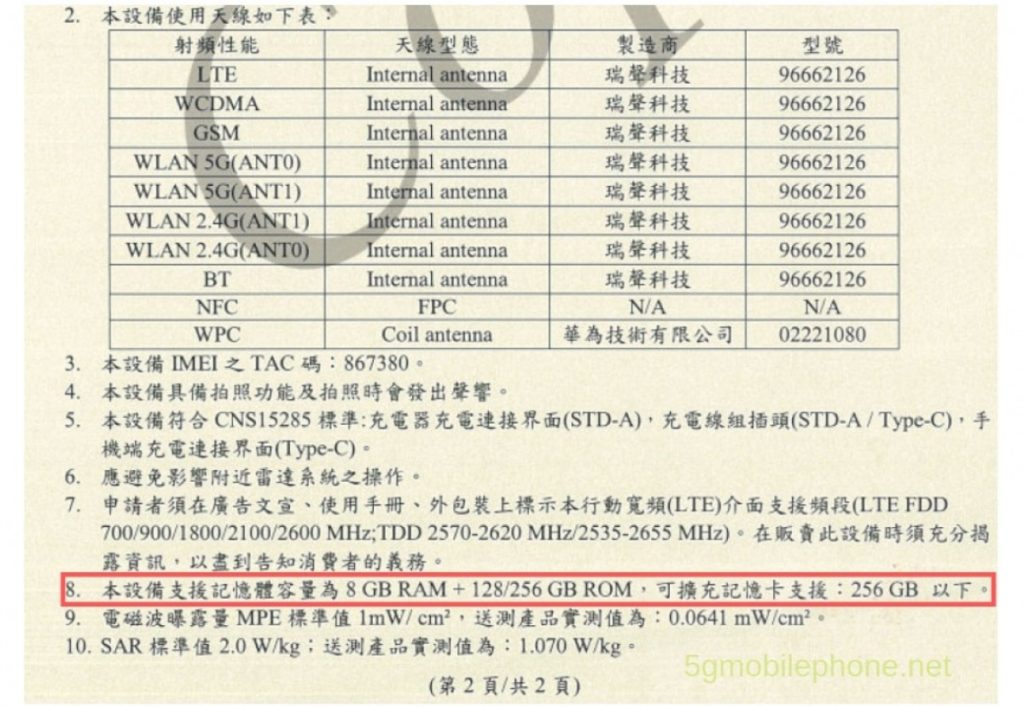
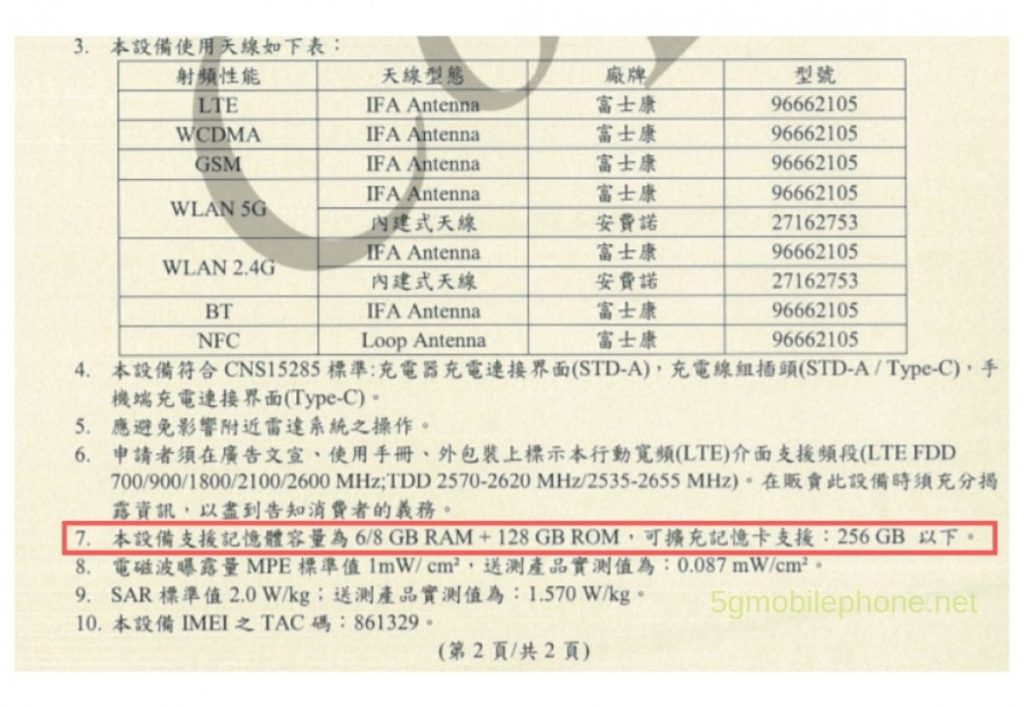
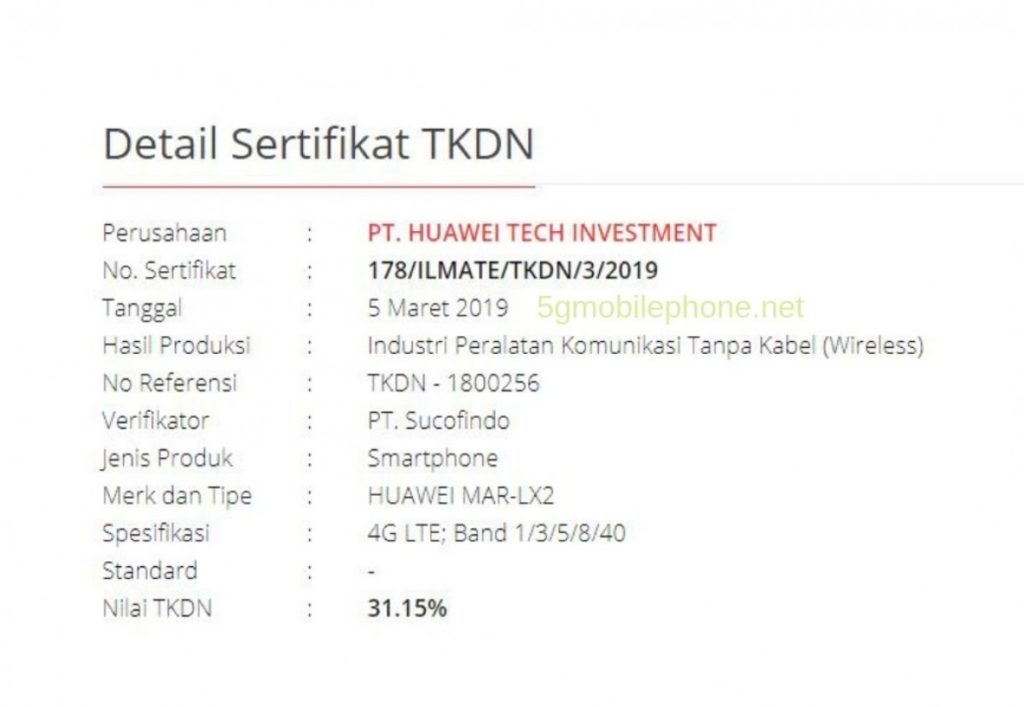
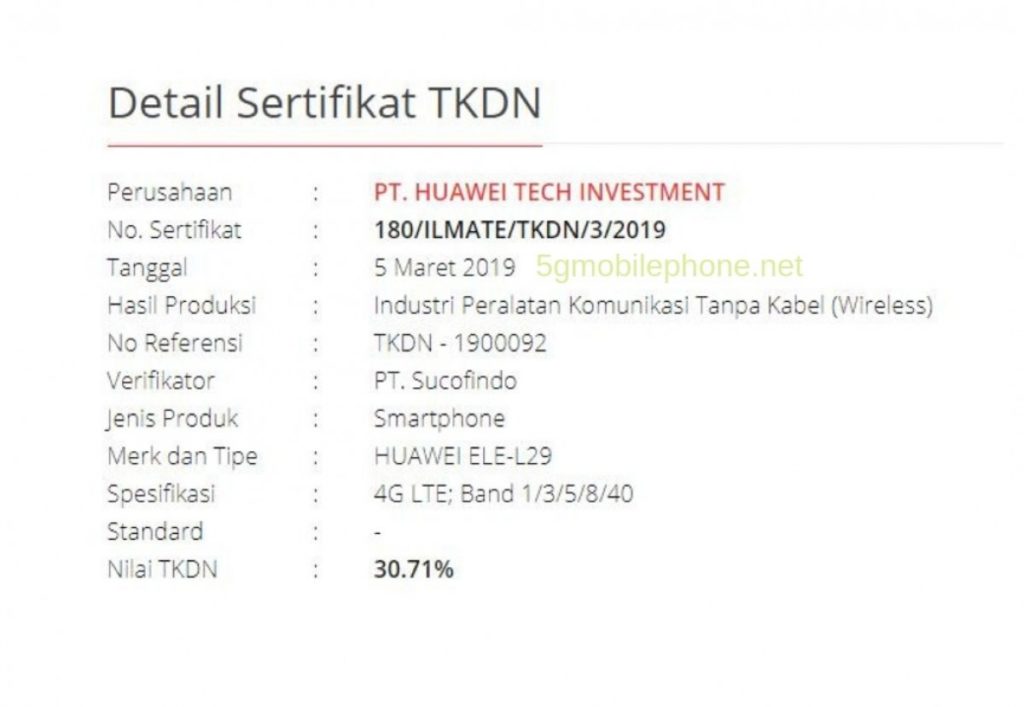
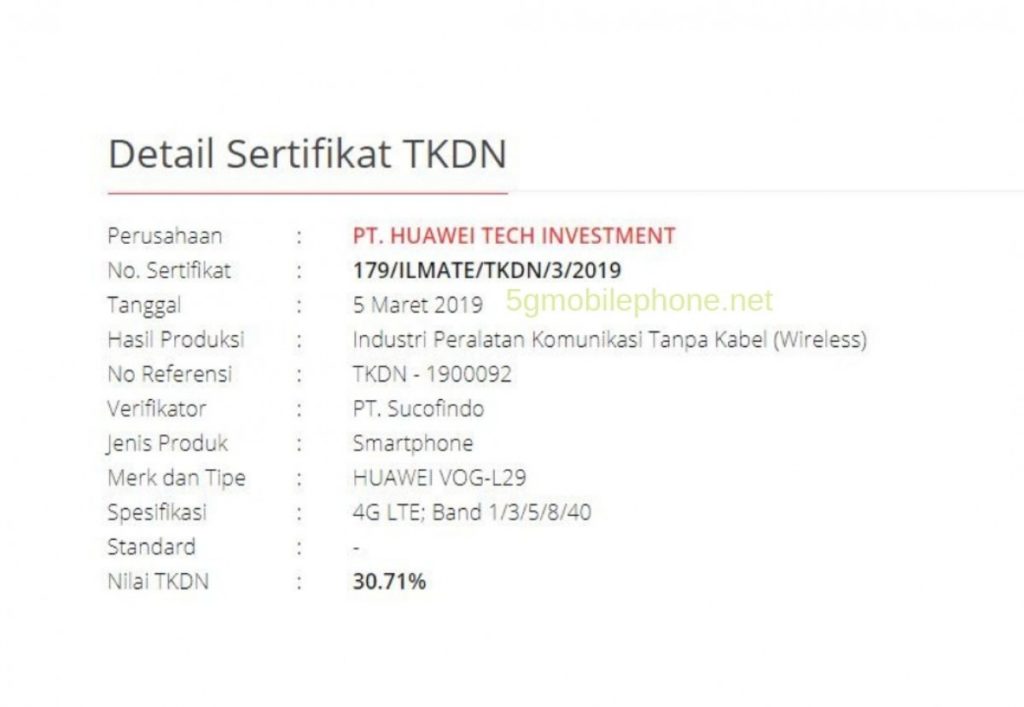
Huawei is expected to officially unveil the P30 series on March 26 in Paris, France. The P30 series comprises of the Huawei P30, P30 Lite and P30 Pro. All three models have now been certified in Indonesia and Taiwan. Along with the certification listing, comes some of the specs of the models.
The Huawei P30 is listed with the model number ELE-L29 and will have 6/8GB of RAM and 128GB of storage onboard. On the other hand, the P30 Pro appears with the model number VOG-L29 and is listed with just an option of 8GB RAM with 128GB and 256GB storage options. The third model suspected to be the Huawei P30 Lite has the model number MAR-LX2.
Huawei P30 certification
The three models are all certified to feature 4G networks but it is unexpected that the 5G Balong 5000 modem that will accompany the Kirin 980 chipset onboard will ever go to work since Indonesia and Taiwan are yet to build their 5G infrastructures. Other specifications of the models are still sketchy but the P30 Pro is said to pack a periscope camera on the back. Leaked renders also suggest the device will be available in Black, Twilight, and Aurora Blue colors. The renders also point to the presence of the under-display fingerprint scanner. This may not be the case with the P30 Lite, though.
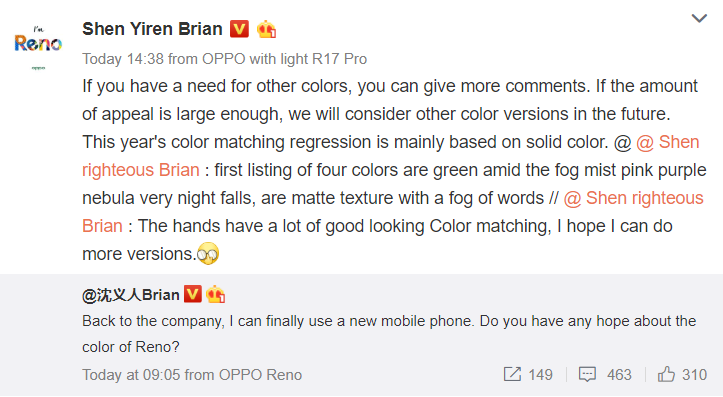
The OPPO Reno will launch next month as OPPO’s first flagship phone of 2019. Details of the phone have been pouring in since yesterday. Today, OPPO’s VP, Brian Shen, revealed details about the phone’s color variants on Weibo.
The OPPO Reno will come in four color variants according to the company executive. They are Fog Green, Pink Mist, Night Black, and Nebula Purple. He also adds that they will all have a matte finish.
An image of the Fog Green version leaked online yesterday. The photo confirms the phone will have triple rear cameras set up in a vertical arrangement and in a black housing. There is an LED flash below the sensors and the text “Designed by OPPO” and “OPPO” written on the phone too.
The OPPO Reno is expected to be powered by the Snapdragon 855 processor and has a 48MP primary rear camera, a telephoto lens, 10x optical zoom, and a 4065mAh battery. However, a leak from earlier today revealed there is another OPPO Reno phone that has dual rear cameras, a Snapdragon 710 chipset, and a 6.4-inch display.
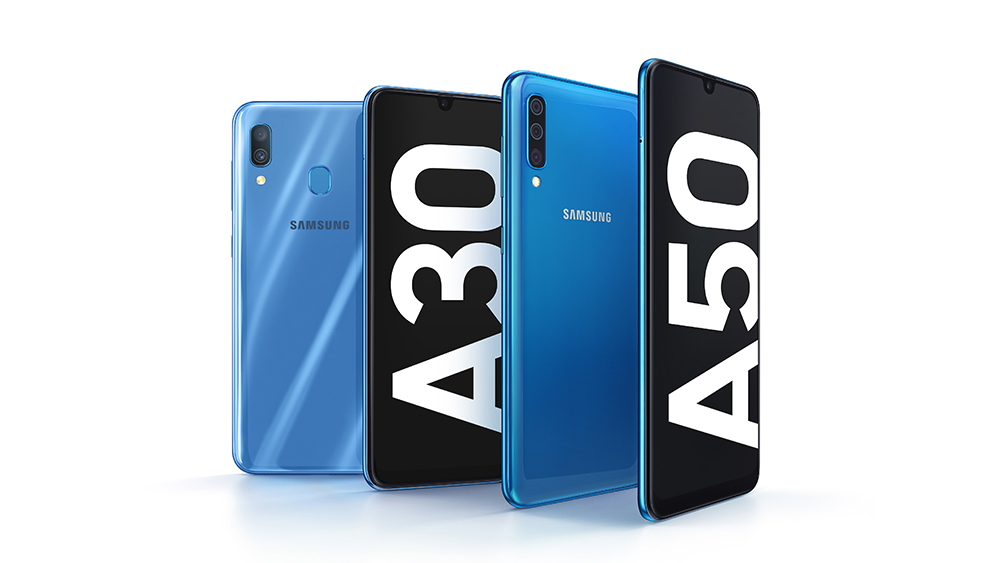
Samsung‘s resurgence in the midrange market is piloted by the premium mid-range models that the company has announced in recent times. At the Mobile World Congress 2019, the tech giant announced the Galaxy A30 and A50 premium mid-range models. The Galaxy A50 is now tipped to go on sale in Europe on March 18.
According to Lithuanian carrier Tele2, the phone will come with a price tag of 349 Euros for those who wish to buy the phone outright. There is also the option of paying in several instalments. In that case, the intending buyer will need to make an initial deposit of €52 and then monthly payments of €12.37 for 24 months. Tele2 is already accepting pre-orders for the device with deliveries for the black variant set for March 18 while the blue and white variants will go on sale on March 25. The pink variant is expected to go on sale on April 1. Apart from Lithuania, there is no information on when the device will be available in other parts of Europe.
As a reminder, the Samsung Galaxy A50 features a 6.4-inch 1080×2340 AMOLED touchscreen. The premium mid-ranger is powered by a Samsung Exynos 9610 Octa chipset, paired with 4GB of RAM and 128GB of storage. On the camera end, the Galaxy A50 packs a triple rear camera setup comprising a 25 MP f/1.7 sensor, an 8 MP ultrawide snapper, and a 5 MP depth sensor. For selfies, the device features a 25 MP f/2.0 camera. The Galaxy A50 gets its interface from Google’s latest Android 9 Pie OS and it crams a big 4,000 mAh battery under the hood.
Xiaomi‘s Redmi brand is known for its affordable smartphones but is it possible that they may begin making other products too? There is a chance that might happen according to recent reports.
A Weibo post by the official Redmi account hints at the March 18 launch bringing more than just the Redmi Note 7 Pro and the Redmi 7.
A rough translation of the Weibo post says “Who said Redmi is just a mobile phone?” which some have reported means that the Redmi brand is not just a phone company. We have no idea what other product(s) might be announced alongside the two phones but we can’t wait for the launch to be here to see what Redmi has in store for us.
On the other hand, the image attached to the post teases the features of the Redmi Note 7 Pro which includes a Snapdragon 675 processor, a 48MP primary rear camera, a 4,000mAh battery, P2i hydrophobic nanocoating for protection against splashes, and Gorilla Glass 5 protection etc.
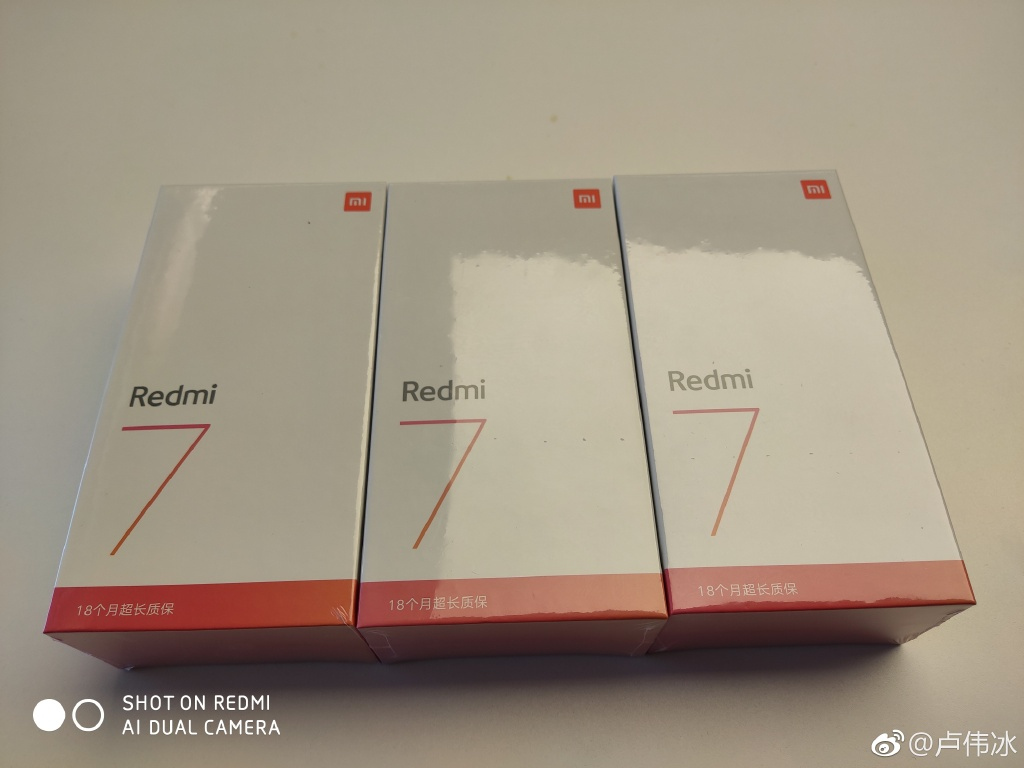
In other news, the Redmi General Manager Lu Weibing shared an image of the retail box of the Redmi 7 on his Weibo page.
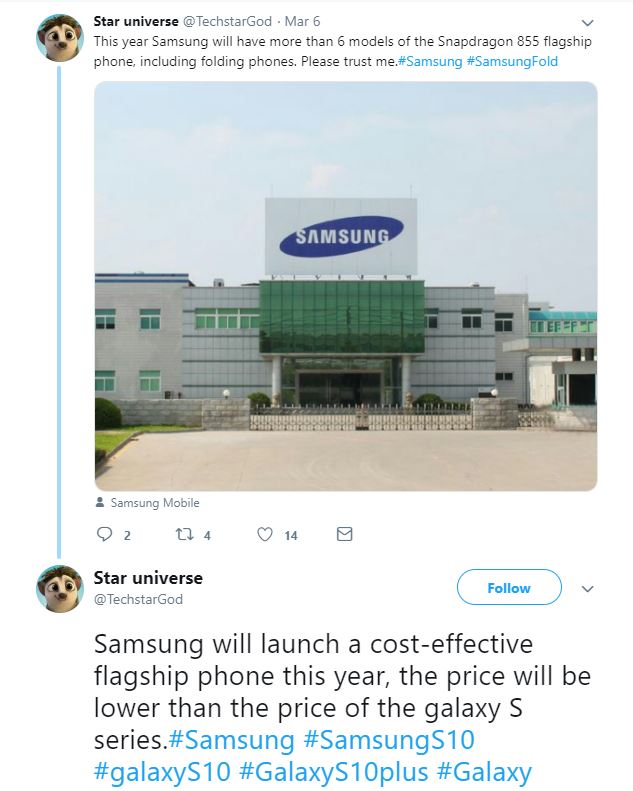
Samsung took the wraps off its 2019 Galaxy S10 flagship models last month in New York. The Galaxy S10 models include the Galaxy S10, S10 5G, Galaxy S10 Plus and Galaxy S10E. The Galaxy S10E happens to be a trimmed down version of the models with a starting price tag of $749. That may not look cheap but when compared to the s10 and S10 Plus, the price is cheaper. Samsung has been implementing some changes in its approach to the market with more focus on the mid-range to the budget market. There are rumours the South Korean company will also adjust its approach in the flagship segment by launching a more cost-effective flagship. The flagship is said to come with a cheaper price tag than the Galaxy S10E.
The information was shared by a tipster of Twitter, who also hinted that the tech giant will launch more than six flagships powered by the Snapdragon 855 chipset this year. Samsung was expected to release a total of six flagships this year and these include the new Galaxy S10 series (Galaxy S10, S10+, S10e), the upcoming 5G-enabled Galaxy S10 and Galaxy Fold. Samsung will also launch the Galaxy Note 10 later in the year. Going by this new tip, the Chinese tech giant may be planning to release more flagships.
Such rumours should be received with a pinch of salt, though. This is because Samsung is already focusing on boosting the mid-range segment and so, may not have such plans in sight. In another light, the Galaxy S10E may have been released just to test the water, considering how it comes with a Snapdragon 855 and misses out on some features like on-screen fingerprint and edge-to-edge display. The success of the model may determine the next step the company will take.
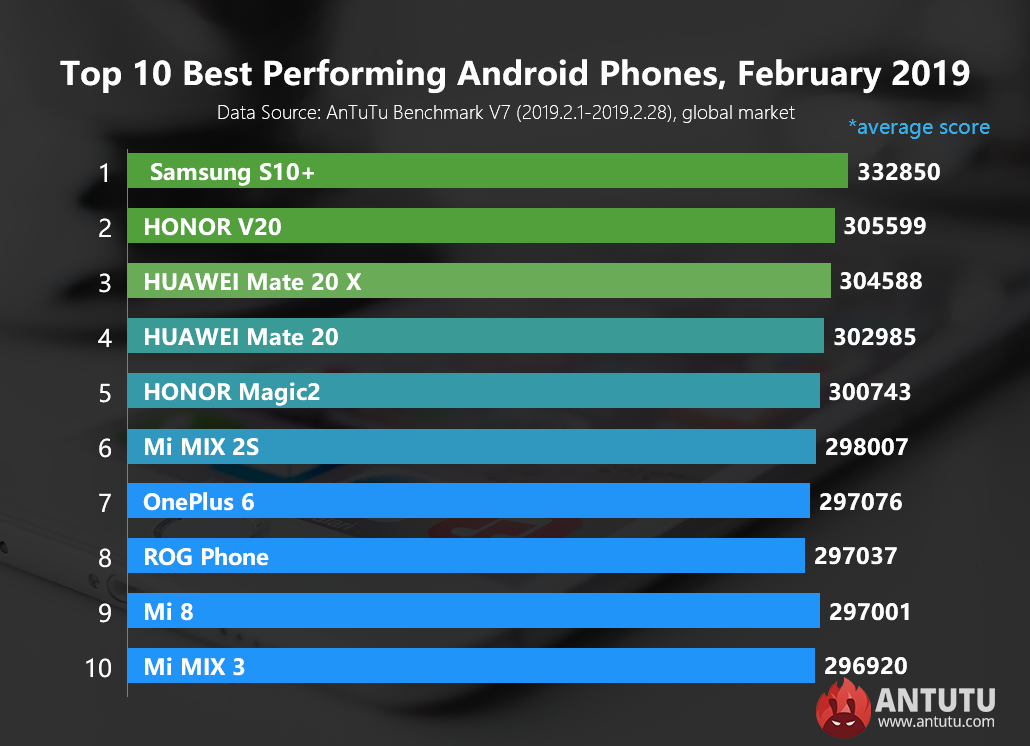
AnTuTu benchmarking platform has released the list of the top 10 best performing Android phones in the global market for February 2019. The list has been compiled considering the average benchmarking score of each smartphone between Feb. 1 and Feb. 28 on the AnTuTu Benchmark v7 app. AnTuTu claims that it has tested at least 1,000 units of each model that have been included in the top 10 list. The list is led by 8nm Exynos 9820 powered Samsung Galaxy S10+ with an average benchmarking score of 332,850.
The second spot goes to the Honor V20 that has recorded an average benchmarking score of 305,599. The Huawei Mate 20 X is placed on third spot with an AnTuTu score of 304,588. The fourth position goes to Huawei Mate 20 that has recorded a score of 302,985. Sitting on the fifth spot is the Honor Magic 2 with 300,743. These Huawei and Honor phones are powered by 7nm Kirin 980 SoC.
The Xiaomi Mi MX 2S powered by Snapdragon 845 is on the sixth place with 298,007 AnTuTu score. The OnePlus 6, ASUS ROG Phone and Xiaomi Mi 8 have respectively bagged seventh, eighth and ninth positions. These phones have respectively scored 297,076, 297,037 and 297,001. The Xiaomi Mi MIX 3 slotted on the tenth position is yet another Snapdragon 845 powered Xiaomi phone in the list. With multiple SD855 fueled phones coming to the market, it is likely that smartphones driven by it may rank higher in the top 10 list of best performing Android phones in the coming months.
AnTuTu has got a brand new update, version 7.2.6, and the changelog mentions a very important point. The new version which was released earlier today, mentions that it will “fix the issue of an abnormal running score of UX caused by malicious exploitation of system permissions by some manufacturers”.
In the past few years, it has become a trend for manufacturers to boasts about their smartphone’s AnTuTu scores, even at their launch events. This is especially true in smartphone launches in China. Such is the importance that we give to this benchmarking tool.
And in the process, we have often seen manufacturers tweak their smartphones to score better than others. OnePlus, Meizu, OPPO, Huawei have all been found cheating on AnTuTu in the past. This isn’t really surprising given that users often assume a higher AnTuTu score is synonymous to a faster and more powerful smartphone.
The usual method of cheating on AnTuTu has been to tweak the smartphones to detect when the app is running and unleashing the full power of the CPU without any regard for efficiency, which it usually would, under normal use case scenario.
AnTuTu 7.2.6 update doesn’t really explain how it would stop such cheating from manufacturers, but if you were worried that you could be fooled, at least know that AnTuTu is trying something from their end.
Personally, I believe we should always take AnTuTu scores for the sake of reference, instead of pitting two phones with minute differences against each other to hail one as the ultimate winner.
Currently, the AnTuTu 7.2.6 version is only available via its Chinese website (link here!). The one on the app store is still v7.0.
In the recent past, TENAA telecom body from China had approved the Vivo V1829A/T smartphone. The V1829A/T is expected to debut as the Vivo X27. Also, the Vivo 1831A/T phone that was recently approved by TENAA is rumored to launch as Vivo S1. A new Vivo device with model number Vivo V1838A has been spotted on TENAA today. The specs of the V1838A listed on TENAA reveals that it features a weaker chipset and lower triple camera sensors than the Vivo V1829A/T Vivo X27 smartphone. The rest of the specs of both smartphones are identical. Hence, it appears that the Vivo V1838A could be a lower edition of the Vivo X27.
The images of the Vivo V1838A are not available yet on its TENAA listing. However, it appears to be featuring the same 6.39-inch notch-less AMOLED display with full HD+ resolution like the Vivo X27 and Vivo V15 Pro smartphone. The display of the phone is embedded with a fingerprint sensor. The handset measures 157.66 x 74.26 x 8.95mm and it may weigh 188.3 grams. The TENAA listing states that it will be available in Gold color.
The Vivo V1838A is fueled by 2.0 GHz octa-core processor. The Vivo V1829A/T Vivo X27 has 2.2 GHz octa-core processor onboard which is nothing but the Snapdragon 710 mobile platform. Hence, the Vivo 1838A that is speculated to debut as a lower edition of Vivo X27 could be powered by Snapdragon 675.
The minimum capacity of Vivo V1838A is of 3,920mAh, but its typical size could be 4,000mAh. It will carry support for rapid charging technology. It will be available in two models such as 6 GB RAM + 128 GB and 8 GB RAM + 256 GB storage. The handset is loaded with Android 9 Pie OS. It lacks support for microSD card slot.
The Vivo V1829A/T features 48-megapixel + 13-megapixel + 5-megapixel rear-mounted triple camera unit and a frontal shooter of 16-megapixel. The newly approved Vivo V1838A smartphone has 12-megapixel + 13-megapixel + 5-megapixel triple camera module and a selfie snapper of 16-megapixel. The selfie shooter could be available on the device as a pop-up camera like the Vivo V15 Pro.
We use cookies on our website to give you the most relevant experience by remembering your preferences and repeat visits. By clicking “Accept”, you consent to the use of ALL the cookies.
This website uses cookies to improve your experience while you navigate through the website. Out of these, the cookies that are categorized as necessary are stored on your browser as they are essential for the working of basic functionalities of the website. We also use third-party cookies that help us analyze and understand how you use this website. These cookies will be stored in your browser only with your consent. You also have the option to opt-out of these cookies. But opting out of some of these cookies may affect your browsing experience.
Necessary cookies are absolutely essential for the website to function properly. This category only includes cookies that ensures basic functionalities and security features of the website. These cookies do not store any personal information.
Any cookies that may not be particularly necessary for the website to function and is used specifically to collect user personal data via analytics, ads, other embedded contents are termed as non-necessary cookies. It is mandatory to procure user consent prior to running these cookies on your website.








 If you have restlessly been waiting to get your hands on a cost-effective weather station that doesn’t compromise on quality, you can head straight to the next category called ‘Weather Station.’ The section is rife with Digoo branded weather stations that you can buy without emptying your pocket.
 The phone boasts an impressive array of features including a mammoth screen that made an instant hit among those who fancy watching their favorite videos and playing popular games on a big-screen mobile device. Aside from that, it packs a powerful processor and a highly competent GPU, under the hood.