Ulefone has announced the launch of its latest rugged device, the Armor 29 Pro Thermal Version, which comes with professional-grade thermal imaging capabilities. Building on the success of the Armor 28 Ultra Thermal, this new model introduces improved clarity and smoother imaging, making it highly suitable for industrial, emergency, and outdoor use cases.
Powerful Thermal Imaging Technology
The Armor 29 Pro Thermal Version is equipped with the ThermoVue T2 thermal sensor, the same high-performance component used in the previous generation. It delivers a resolution of 640 × 512, ensuring industry-leading clarity for identifying heat signatures in different environments. With a 25Hz refresh rate, the camera offers real-time smooth thermal imaging.
The system is enhanced by SharpenAI, which improves image details, and FusionAI, which boosts precision. These technologies work together to provide clear, reliable results, whether for professional inspections or outdoor adventures. The built-in thermal camera is capable of supporting multiple applications, including detecting overheating equipment, identifying leaks, and even tracking wildlife.
Real-World Applications
Industrial & Commercial Use
For businesses and professionals, the thermal camera can help detect hot spots in electrical and mechanical systems, preventing failures before they happen. It can also spot gas or fluid leaks through temperature variations and assess pipelines, tanks, and structural weaknesses with ease.
Emergency Response
In critical rescue situations, the Armor 29 Pro can assist firefighters in identifying fire sources through smoke and give rescuers the ability to see clearly in total darkness. This makes it a valuable tool for search and rescue missions.
Outdoor Exploration
Adventure seekers can use the device to observe wildlife without disturbing them, navigate in the dark using thermal signatures, and even monitor campsite safety by tracking heat from campfires or nearby activity.
Building Inspections
The thermal sensor helps professionals identify energy loss from poor insulation, hidden water damage, and thermal inefficiencies in walls and ceilings. This makes it useful for construction and real estate industries.
Privacy, Security & Electronics
Another unique use case is detecting hidden surveillance devices, such as cameras or recorders, by spotting their heat output. For technicians, the device aids in electronics repair, pinpointing overheating components and identifying faulty circuits in gadgets like laptops and smartphones.
Hardware and Design
Beyond its thermal imaging power, the Armor 29 Pro Thermal Version packs robust hardware. It comes with a massive 21,200mAh battery and supports 120W ultra-fast charging, ensuring long-lasting use even during fieldwork. The device features a 6.67-inch AMOLED display with a 120Hz refresh rate for smooth visuals, along with a 1.04-inch rear sub-display for quick notifications and controls.
Product Variants and Availability
Ulefone is releasing two versions: the Armor 29 Pro Thermal Version with the built-in thermal camera, and the standard Armor 29 Pro without thermal imaging. Both models retain rugged durability, but the Thermal Version stands out as a professional-grade tool.
The smartphones will be available from mid-September through AliExpress, Amazon, and Ulefone’s official online store. Pricing details will be revealed closer to the launch, with a special introductory offer expected for early buyers.
With the Armor 29 Pro Thermal Version, Ulefone has brought thermal imaging from specialized tools into everyday rugged smartphones. Its combination of advanced sensor technology, AI enhancements, and practical use cases makes it more than just a phone, it is a versatile professional tool for industries, rescuers, and explorers alike.
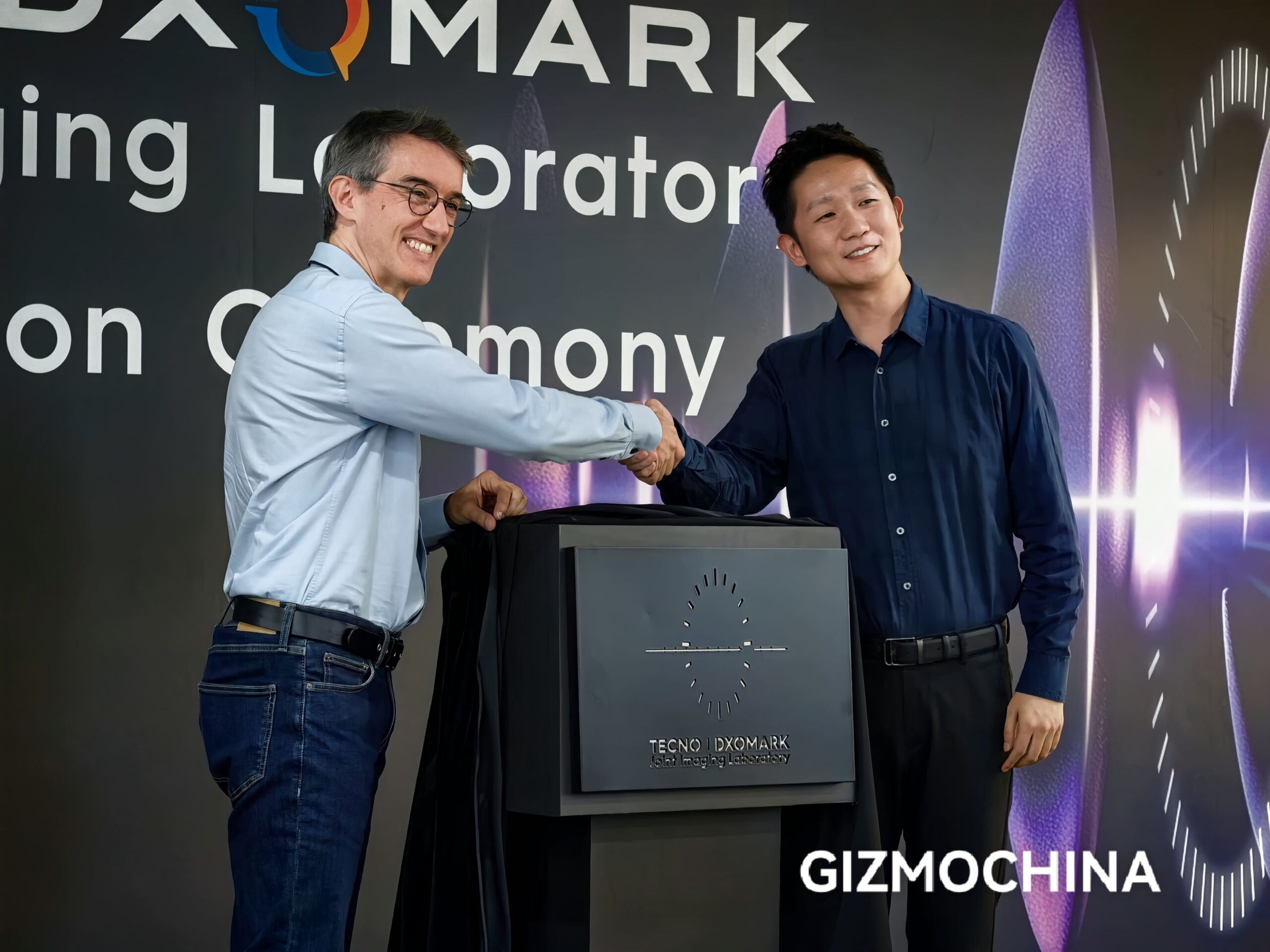
Global AI-driven technology brand TECNO, in partnership with DXOMARK, the internationally recognized authority in imaging testing, today announced the official opening of their joint imaging laboratory in Chongqing. This state-of-the-art facility is the world’s first fully automated imaging lab built entirely around DXOMARK’s sixth-generation Smartphone Camera Evaluation Protocol, designed to drive innovation, precision, and inclusivity in smartphone photography.
The inauguration ceremony brought together key executives from both companies and media representatives to witness a new chapter in imaging technology collaboration. The lab represents a significant milestone in TECNO’s commitment to delivering exceptional image quality tailored to diverse global users.
Inside the Lab: A Fully Automated Imaging Wonderland
During the media tour following the ceremony, journalists were granted exclusive access to the revolutionary testing facility. The laboratory represents a leap forward in imaging evaluation technology:
Complete Robotic Automation
The lab operates with zero human intervention in the testing process. Precision robotic arms smoothly handle device positioning and angle adjustment, while motorized sliders and gimbals simulate every possible shooting scenario—from handheld motion to tripod-stable conditions. This eliminates human variability and ensures perfectly consistent test conditions.
Advanced Lighting Systems
Flanking both sides of the testing area are professional-grade lighting arrays capable of replicating everything from bright sunlight to subtle indoor illumination. These systems can simulate the full spectrum of natural lighting conditions, from the harsh midday sun to the golden hour glow, allowing TECNO to optimize camera performance for any lighting environment users might encounter.
Comprehensive Testing Scenarios
The lab features an extensive collection of test charts and human models that cover every aspect of image quality evaluation. Dozens of specialized color charts, texture plates, and multi-tone calibration targets enable precise measurement of color accuracy, detail preservation, and noise performance. The collection of realistic human head models spanning the full range of global skin tones ensures that TECNO devices deliver natural and flattering results for all users.
Video Stabilization Simulation
Beyond photography, videography is a crucial part of a mobile camera system. Behind the robotic arm in the lab is a platform that provides sustained vibration, capable of shaking every phone with the same amplitude. Compared to manual testing, this approach saves significant time and, more importantly, ensures perfect consistency and repeatability across all tests.
Three Breakthroughs: Automation, Inclusion, and Customization
1. Full Automation for Unmatched Precision
The lab eliminates human error and variability through fully automated workflows. Robotic systems handle device positioning, lighting control, scene switching, and image capture with micron-level precision. This allows TECNO to execute thousands of test cases consistently and rapidly, significantly accelerating R&D cycles.
2. Inclusive Testing for Global Users
To address the diverse skin tones and cultural preferences of users across over 70 markets, the lab features six realistic human head models spanning a wide range of skin tones, complemented by multi-tone calibration charts. This ensures that TECNO devices deliver accurate, flattering, and natural-looking skin tones for everyone.
3. Region-Specific Customization
The lab enables hyper-localized tuning based on regional preferences. For example:
In African markets, users prefer authentic skin tone reproduction.
In Southeast Asia, clarity and bright exposure are prioritized.
TECNO can now generate customized evaluation reports per region, ensuring each device meets local expectations.
Q&A Highlights: Addressing Key Industry Questions
Q: What are the main advantages of a fully automated lab compared to manual testing?
A: Beyond efficiency gains, automation ensures perfect consistency and repeatability over time. Complex test setups that previously took hours to configure manually can now be completed in minutes with robotic precision. This eliminates technician dependency and ensures testing standards remain unchanged for years.
Q: Why did TECNO choose to partner with DXOMARK instead of local studios?
A: While we work with local studios for regional style preferences, DXOMARK provides scientific fundamentals, global standards, and transparent evaluation systems that help us build truly world-class products. Their scoring systems and software tools bring tangible benefits to our product development process.
Q: How will end-users perceive these technical improvements?
A: Users will experience more stable performance across all lighting conditions, more accurate skin tones, faster autofocus, and better HDR processing. Our testing methodology is based on real user preferences—for example, color scoring is calibrated through global user surveys to ensure we deliver what people actually want to see.
Q: Which test scenarios received the most investment?
A: The “All in One Portrait” setup is our most complex and important configuration, simulating real-world person photography. It uses AI-trained models based on millions of images to evaluate facial detail preservation, exposure, HDR, noise, and timing. Additionally, the DMC chart setup with realistic objects allows us to measure texture noise and color accuracy in unprecedented ways.
Q: Does TECNO aim to top DXOMARK rankings?
A: While we’re proud that our TECNO CAMON 40 Pro previously achieved top scores under $600 and received the DXOMARK 2025 Smart Choice Label Award, our focus remains on delivering stable, reliable camera experiences that exceed user expectations in daily life. We’re committed to breaking technical limitations rather than chasing scores.
DXOMARK’s Role: Science-Driven Innovation
DXOMARK brings over 25 years of imaging expertise, scientific rigor, and global benchmarking standards to the partnership. The Camera V6 protocol—a comprehensive revision focused on real-world usage—forms the foundation of the lab’s testing methodology. “We are not just measuring performance; we are defining what excellence looks like,” said the Scientific Director of DXOMARK. “Our tools and metrics are designed to reflect how people actually use their cameras—in portraits, low light, zoom, video, and HDR scenarios.” The lab also fully supports HDR photo and video evaluation, a first in the industry, ensuring TECNO devices are future-ready for next-generation imaging formats.
Looking Ahead: Collaboration and Future Roadmap
The joint lab is just the beginning of a long-term partnership between TECNO and DXOMARK. Both companies plan to:
Explore AI-enhanced image quality algorithms.
Develop next-generation evaluation methods.
Introduce real-world perceptual metrics beyond traditional lab tests.
Promote transparency and open standards in the imaging industry.
About TECNO
TECNO is an AI-driven, innovative technology brand with a presence in over 70 markets across five continents. Committed to transforming the digital experience in global emerging markets, TECNO relentlessly pursues the perfect integration of contemporary aesthetic design with the latest technologies and artificial intelligence.
About DXOMARK
DXOMARK is a French independent engineering company that has been a global leader in objective and scientific testing of cameras, displays, and audio systems for over two decades. Its benchmarks are trusted by manufacturers and consumers worldwide.
Sennheiser is turning 80 years old, and to celebrate the milestone, the German audio giant has unveiled a special edition of its Momentum 4 Wireless headphones. These are a pair of high end over-the-ear headphones, which get a refreshing new look thanks to an artist collaboration.
Sennheiser’s 80th Birthday Gift? A Special Edition Momentum 4 Wireless
What makes these Sennheiser Momentum 4 Wireless Headphones special is the design. Serving more as a collectable item to celebrate its 80th anniversary, the known audio brand worked with German graffiti artist Bond Truluv for a street art styling. Truluv brings his signature art design to both earcups, with the left side featuring the “throwie” style tag, while the rear has abstract work that is inspired by audio waves.
The 80th Anniversary Edition of the Momentum 4 Wireless is predominantly gray with bright yellow accents that bring a sharper contrast. These yellow details also pay tribute to the iconic HD 414 headphones. Apart from the design, the headphones have the same features as the regular Momentum 4 Wireless. So you get large 42mm dynamic drivers for clear audio. On a single full charge, the hearables can last for up to 60 hours.
For better control over sound, buyers can use the Smart Control Plus app for the equalizer along with multiple presets. Other notable features include padded headband with soft cushioned earpads, Bluetooth 5.2, SBC, AAC, aptX, and aptX adaptive audio codecs support. Sennheiser just unveiled the Momentum 4 Wireless 80th Anniversary Edition Headphones on the brand’s official website, Amazon, and Flipkart for 26,990 INR.
Oppo has officially launched the A5i Pro in the global market, delivering rugged reliability without breaking the bank. Packed with military-grade durability, a huge battery, and more, the A5i Pro is designed for users who want a dependable daily driver on a strict budget.
Oppo A5i Pro Arrives on a Budget with Rugged Design & Big Battery
The Chinese brand’s latest affordable phone arrives with a MIL-STD-810H certification for military grade durability for drop and impact resistance. It sports a tall 6.67-inch LCD panel with a 120Hz refresh rate, 240Hz touch sampling rate, HD+ resolution, 1000 nits of peak brightness, and Corning Gorilla Glass 7i for protection. The Oppo A5i Pro also comes with an IP65 rating for water and dust resistance.
Oppo A5i Pro
This is a 5G smartphone that packs the MediaTek Dimensity 6300 SoC. The chip is paired with up to 8GB of LPDDR4X RAM and 256GB of UFS 2.2 storage, which can be expanded via a microSD card slot. A massive 6,000mAh battery pack powers this device, which supports 45W wired fast charging. For photography, the rear features a 50MP + 2MP dual camera setup, with the front housing an 8MP selfie shooter.
Out of the box, this device runs on the Android 15 OS based ColorOS 15.0.1 custom skin. Other notable features include Bluetooth 5.4, WiFi 5, NFC, a 3.5mm audio jack, and Bluetooth 5.4 with multiple audio codec support. Despite the large battery pack, it only measures 7.99mm in thickness and weighs 194 grams. Oppo announced the A5i Pro in two color options, namely Breeze Blue and Midnight Purple. While it has debuted globally in 4GB + 128GB and 8GB + 256GB storage variants, the pricing for only the 8GB + 256GB has been announced in Malaysia. It is listed for RM 799, which is around 189 US Dollars.
For more daily updates, please visit our News Section.
Narwal has officially launched the Freo 002 Max robot vacuum cleaner in China. The device features a suction power of up to 25,000Pa, an advanced self-cleaning system, and a new sterilization feature powered by dynamic electrolyzed water.
The standard model with a regular water tank is priced at 4,699 yuan ($658), while the slim version with automatic water supply and drainage is priced at 5,299 yuan ($743).
Narwal Freo 002 Max Specifications
The Freo 002 Max comes equipped with Narwal’s latest bionic AI visual system, which includes dual RGB wide-angle cameras and a 10TOPS processing chip. This system enables the robot to recognize more than 250 types of objects and map surroundings with a depth accuracy of up to 5mm. Narwal claims this approach surpasses conventional LIDAR or structured-light navigation systems in terms of recognition precision and environmental understanding.
The robot features a slim 9.5cm body that allows it to clean under low-clearance furniture and cross obstacles up to 40mm. It uses 75mm dual-sided brushes and offers three intelligent edge-tracing modes: close-follow, safe-distance, and smart detour. These features help it deliver near-complete coverage around edges and corners.
Narwal has implemented an adaptive cleaning system that adjusts suction power and mop pressure based on detected dirt type. The device uses a tread-style roller mop system with constant surface pressure up to 12N. The mop head receives a steady spray of 45°C heated water for stain removal. The robot also supports zero-tangle cleaning through redesigned anti-hair-wrapping brushes and cyclone-guided suction, certified by SGS.
Narwal has added the Pet Mode 1.0 Pro, which detects and avoids pet pads while supporting interactive voice responses that simulate the owner’s voice. The robot is powered by a 6,400mAh battery that provides up to 3.8 hours of cleaning. It carries a 475mL clean water tank and a 500mL wastewater tank onboard.
The Freo 002 Max integrates NarGPT 2.0, an upgraded AI voice assistant capable of understanding complex commands such as “clean under the sofa in the living room” or “clean the carpeted room.” This assistant supports hierarchical map awareness and flexible zone targeting.
The base station features automatic hot water rinsing of internal parts using 80°C water, electrolyzed water-based sterilization, and 45°C warm air drying for the mop, pipes, and dust box. It also includes a disposable dustbin liner system with UV sterilization. The base can handle up to 120 days of usage with a 2.5L dust bag and supports full auto-refill and drainage.
The device features clean and dirty dual water tanks and a self-agitating system inside the dirty tank to prevent sediment buildup. It also supports multi-map 3D mapping, smart scheduling, cliff and overflow detection, zigzag cleaning patterns, and consumables tracking.
The robot measures 35.12 x 36.35 x 9.5 cm, while the base station comes in two sizes: 43 x 40.2 x 46.1 cm for the water tank version, and 41 x 43.3 x 28 cm for the ultra-slim base.
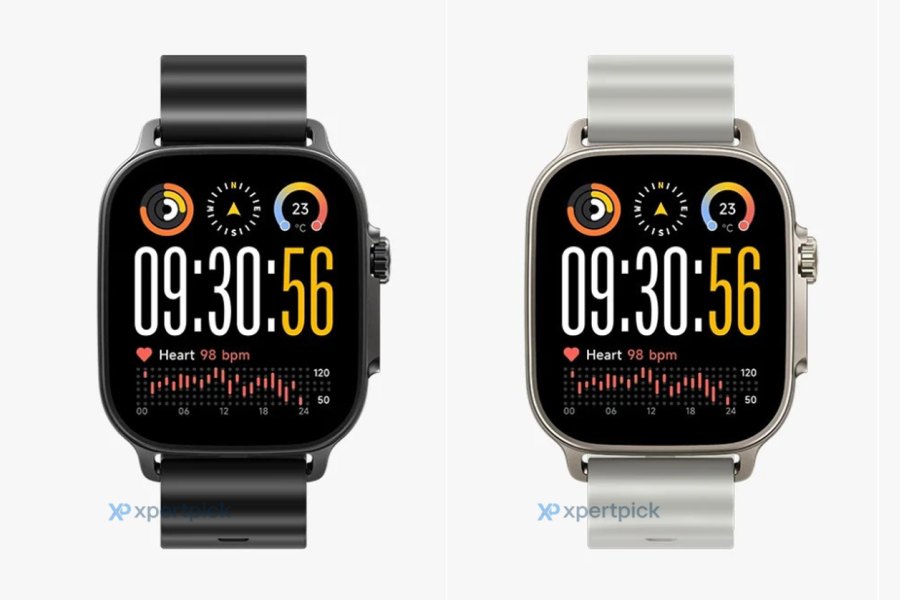
Realme hasn’t launched a smartwatch in over a year, but it looks like the company is ready to make a comeback with the Realme Watch 5. The new smartwatch has been revealed in a leak from Sudhanshu Ambhore (via XpertPick).
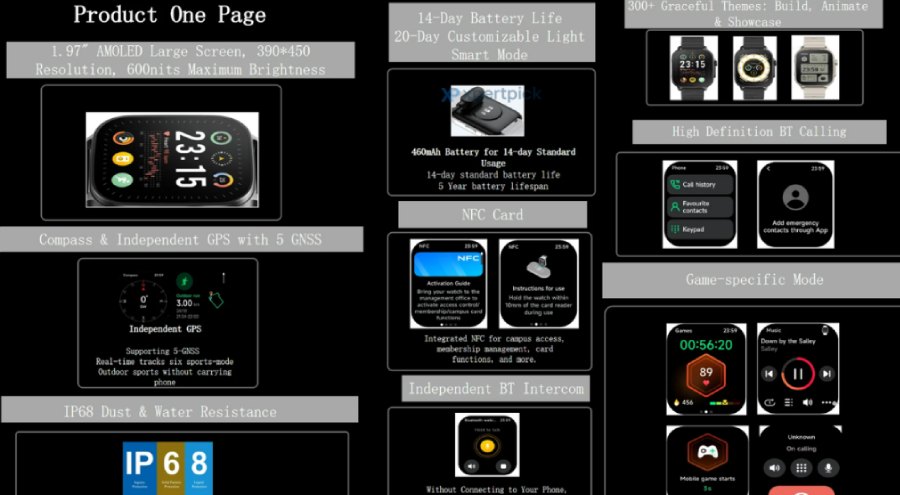
The leak includes polished marketing shots and what appears to be a full spec sheet of the wearable.
Realme Watch 5 Specifications
So the Watch 5 features a 1.97-inch AMOLED display with a 390 x 450 resolution. Its brightness peaks at 600 nits, enough for outdoors, and users will have access to more than 300 watch faces to choose from.
Design-wise, the Watch 5 has more than passing resemblance to Apple’s Watch Ultra 2. And even the straps look similar. Nonetheless, it is expected to come in two finishes: black and silver.
As for the battery, it will carry a 460mAh pack inside, which is rated to offer up to 14 days of runtime, or 20 days in “Light Smart Mode.” The battery also has a promised five-year battery lifespan. The watch retains its IP68 rating for dust and splash resistance, though that doesn’t make it a full swim-proof device.
For fitness and navigation, the Watch 5 packs multi-band GNSS support covering five satellite systems for more accurate outdoor tracking. That’s an upgrade over the Watch 3 Pro, which introduced GPS but with more limited support.
And of course, you get all the usual health sensors like heart rate monitoring, SpO2, and accelerometer.
Other specs of the smartwatch will include high-definition Bluetooth calling and even a new Bluetooth intercom mode, which could allow direct communication with other devices without needing a smartphone. There’s also mention of NFC for payments and access cards, plus a built-in compass.
Perhaps the most unique addition on a smartwatch is a game-focused mode, which displays simplified stats and shortcuts for quick interactions during mobile gaming.
Realme hasn’t officially confirmed the Watch 5, but with the amount of detail in this leak, an announcement doesn’t seem far off. We will keep you updated as we hear more about it.
After teasing its ultra-thin concept phone earlier this year, Tecno has officially launched the Tecno Spark Slim and Tecno Pova Slim. Both devices keep the spotlight on thinness, while still packing in surprisingly powerful hardware.
The Spark Slim measures just 5.75mm, nearly identical to the concept version shown off months ago. Inside that frame, Tecno managed to squeeze in a 5,160mAh battery, made possible by its custom Honeycomb space stacking technology.
The battery itself is just 4.04mm thick, while the phone also has a razor-thin 0.3mm vapor chamber that helps keep thermals under control. To top it off, both phones use an aerospace-grade fiberglass back measuring only 0.36mm.
On the outside, the Spark Slim also gets a unique touch: a Mood Light LED bar that brings multi-scene lighting effects and animated notifications. Both phones share a 50MP main rear camera, but Tecno seems to be betting more on design and display than on a heavy camera system.
Speaking of display, both the Spark Slim and Pova Slim come with curved AMOLED screens, offering a smooth 144Hz refresh rate and an impressive 4,500 nits peak brightness. Under the hood, the Spark Slim runs on MediaTek’s Helio G200, while the Pova Slim is powered by the Dimensity 6400, giving it 5G support out of the box.
The phone supports 45W wired charging and 10W reverse wired charging, and boots on Android 15 (HiOS skin), complete with Tecno’s latest AI-powered features.
The company has not revealed the price or availability details yet. Tecno has an event scheduled for September 4 for this.
After a series of teasers, Motorola has brought the shiny special editions of the Moto Buds Loop and Motorola Razr 60 to the Indian market. The smartphone and earbuds bring Swarovski crystals and a premium new look, so here are all the details.
Motorola Adds Sparkle to Razr 60 & Moto Buds Loop with Swarovski Crystals
Motorola x Swarovski Razr 2025 and Buds Loop
The latest special edition brings a touch of sparkle to both the Motorola Razr 60 flip phone and Moto Buds Loop open-ear earbuds, blending high-end tech with luxury fashion. Motorola brought the duo under “The Brilliant Collection” which is studded with Swarovski crystals. These models have previously debuted globally and are finally making their way to India. Apart from these crystals, both devices come in the new Pantone Ice Melt color.
The flip phone features 35 Swarovski crystals, along with a larger 26-facet crystal on the hinge. This is paired with vegan leather on the external panel, adding to its premium look and feel. Similarly, the Moto Buds Loop now arrive in Silver and Gold color options, with the loop featuring the Swarovski crystals. So the TWS earbuds can double as a fashion accessory as well.
Motorola unveiled the Razr 60 Ice Melt edition for 54,999 INR for the lone 8GB + 256GB model. Meanwhile, the Moto Buds Loop Silver Version with Swarovski Crystals goes for 24,999 INR. Both of these will be available for purchase via Flipkart on 11th September 2025. Keep in mind that apart from their design, there is no difference in terms of specs and features.
For more daily updates, please visit our News Section.
The upcoming OnePlus 15 marks a major shift in the company’s flagship smartphone strategy. For years, OnePlus partnered with Hasselblad for tuning the camera systems of its premium devices. However, this might not be the case with the next generation flagship.
OnePlus 15 Drops Hasselblad for In-House Camera Engine
To recall, the collaboration between OnePlus and Hasselblad brought a distinct look with improvements in color science and image processing. But a new report from SmartPrix claims that the OnePlus 15 will be the first to break away from this partnership. This move signals OnePlus’s confidence in developing proprietary imaging technology, aiming to deliver more consistent photography and videography while fully controlling the direction of its mobile cameras.
OnePlus 15 Render (Unconfirmed)
The in-house imaging engine would replace the Hasselblad tuning, similar to Huawei’s impressive XMAGE camera tech. Huawei previously worked with Leica (like Xiaomi now) before developing its own imaging engine. This isn’t the first time we’ve seen such news, with one of our previous reports also covering a leak from a Chinese tipster. Keep in mind that this is still just an unconfirmed report, so take this news with a pinch of salt.
Based on what we know so far, the OnePlus 15 may sport a 6.78-inch flat display with 1.5K resolution. It will use LIPO screen packaging technology, which enables ultra-thin bezels and better display integration compared to older methods like COG and COF. Under the hood, it is likely equipped with the Snapdragon 8 Elite 2 chipset. A massive 7,000mAh battery could power this flagship with 100W wired and 50W wireless charging support.
For more daily updates, please visit our News Section.
Bengaluru-based Indkal Technologies, the company behind the Indian TV brand Wobble, has revealed a major step forward in the consumer electronics space. The company has introduced a new product in its Maximus Series that aims to redefine what home entertainment can look like. The source highlights that this launch is focused on a display of unprecedented scale, setting a fresh benchmark for the Indian television market.
Wobble Maximus Series TV key specifications, features
Wobble Maximus Series TV comes in 86-inch, 98-inch, and 116-inch display options
The new Wobble Maximus Series television comes with a massive 116.5-inch display, making it the largest consumer television currently available in India. It is also the first in the country to combine QLED with MiniLED technology at this size. This approach merges vivid quantum dot colour precision with advanced MiniLED backlighting to deliver more accurate tones and deeper contrast levels.
Running on Google TV 5.0 with Android 14, the Maximus Series integrates a modern smart TV ecosystem that brings seamless access to apps and content across platforms. The panel supports Dolby Vision Atmos for immersive viewing and delivers a peak brightness of 2000 nits, ensuring clear visibility and superior HDR quality. Gamers are catered to as well, with a 4K resolution panel supporting a 144Hz refresh rate for smooth responsiveness on next-generation consoles and PCs.
To match the visuals, the Maximus Series is equipped with a 240W 6.2.2 channel speaker array that includes two dedicated woofers. This configuration is designed to produce cinema-like audio with wide dynamics and three-dimensional sound effects, turning home spaces into theatre-style setups.
Wobble Maximus Series TV price and availability
As can be seen in the above poster, the Wobble Maximus Series will be available in 86-inch, 98-inch, and 116-inch screen size options. However, the brand is yet to confirm the pricing and availability details of the Wobble Maximus Series Google TV. More information is expected to surface in the coming days.
For more daily updates, please visit our News Section.
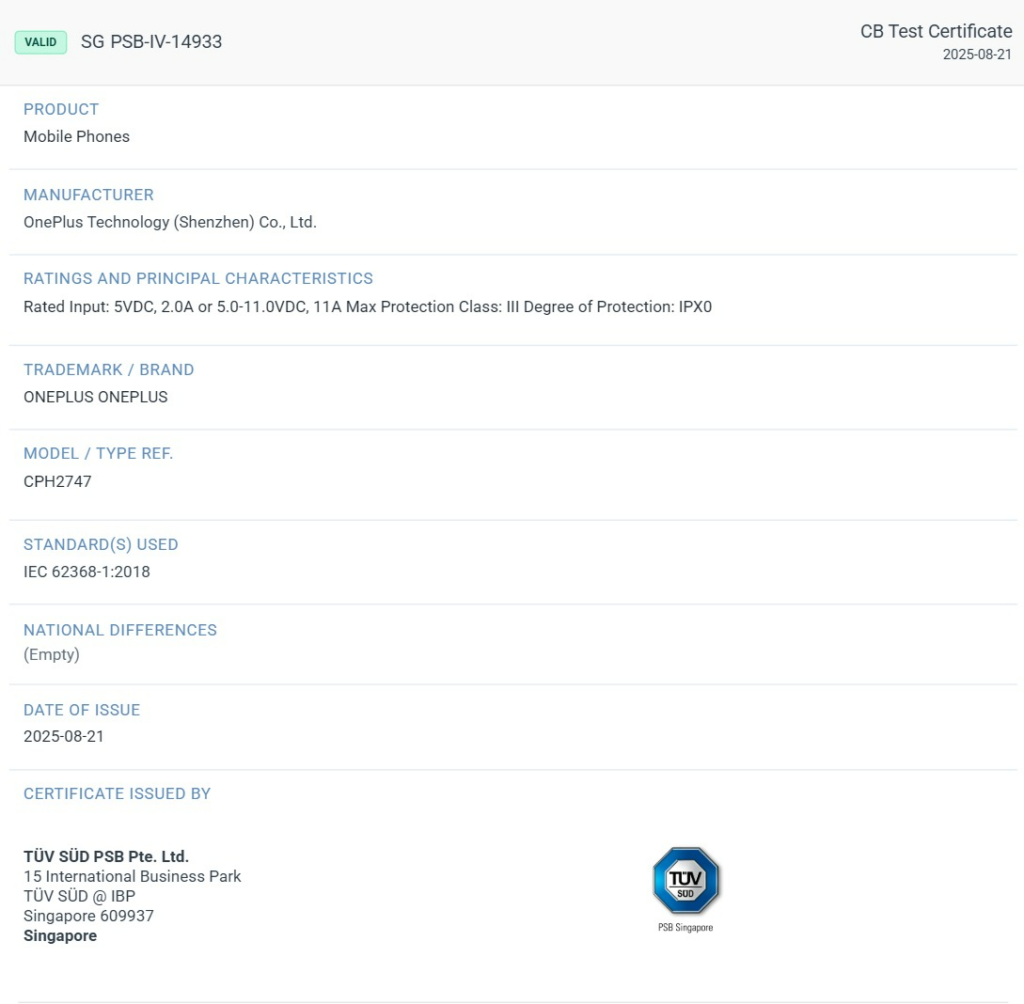
OnePlus is expected to unveil the OnePlus 15 and OnePlus Ace 6 in October this year in China. The Chinese edition of the OP15, bearing the model number PLK110, has already appeared in Geekbench’s database. Now, a OnePlus device meant for the global market with the CPH2747 model number has recently received approval from TUV Rheinland. While the official moniker is not known yet, it could be the global version of the OnePlus 15.
OnePlus 15 fast charging capabilities revealed
OnePlus 15 TUV listing
The above screenshot confirms that the OnePlus CPH2747 phone certified by the TUV authority may support 121W fast charging. This will be a slight upgrade compared to the 100W charging available on the OnePlus 13.
A OnePlus enthusiast has claimed that the model numbers PLK110, CPH2745, CPH2747, and CPH2749 all belong to the upcoming OnePlus 15, tied to the same project under PJ code 24831. Among these, PLK110 is reportedly the Chinese version, while CPH2745/47/49 are believed to represent the global editions.
The Chinese edition was recently spotted on Geekbench with the Snapdragon 8 Elite Gen 5 (also known as the Snapdragon 8 Elite 2) chipset. The listing also revealed that the device has 16GB of RAM and runs on Android 16.
Reports have revealed that the OnePlus 15 will have a 6.78-inch flat OLED LTPO 1.5K 165Hz display. It may house a 7,000mAh battery with 50W wireless charging. For photography, it is expected to feature a square camera island equipped with a 50-megapixel (main) + 50-megapixel (ultra-wide) + 50-megapixel (3x periscope) triple camera unit.
OnePlus 15 (AI-generated image)
A recent leak revealed that the OP15 will arrive in multiple variants, such as 12GB+256GB, 12GB+512GB, 16GB+256GB, 16GB+512GB, and 16GB+1TB in China. It will be sold in shades like Black, Purple, and Titanium.
While it is expected to launch in October in China, the global market may receive it in January 2026.
For more daily updates, please visit our News Section.
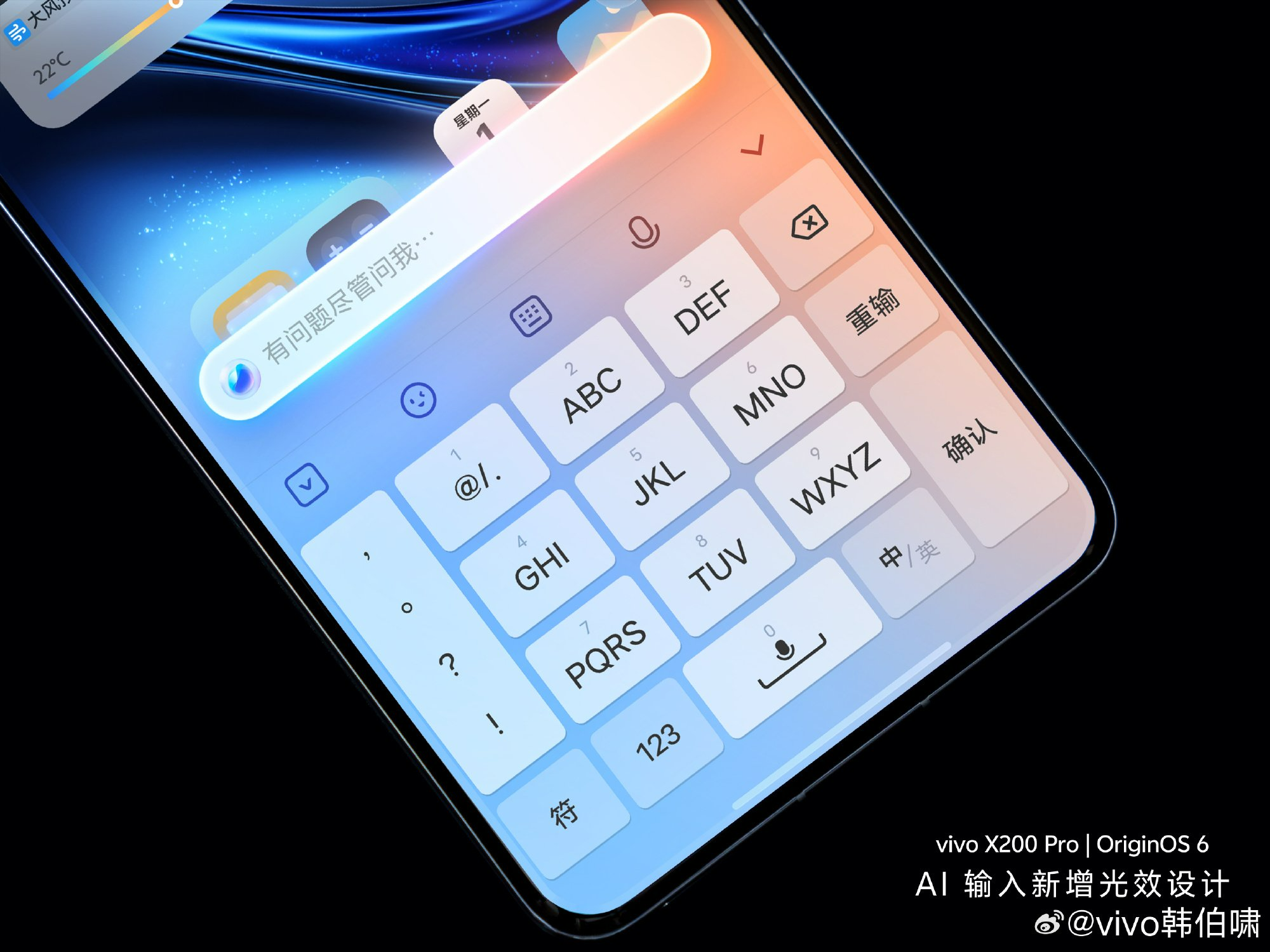
Vivo recently began the OriginOS 6 beta testing on the Vivo X200 Pro and iQOO 13 in China. The new Android skin is expected to bring significant upgrades over last year’s OriginOS 5. Scheduled to officially launch this month in China, OriginOS 6 will be available preinstalled on the upcoming Vivo X300 series. Today, Vivo Product Manager Han Boxiao released a Weibo post to give a sneak peek at the design elements of OriginOS 6.
OriginOS 6 first look
Boxiao said that OriginOS 6 brings a major design upgrade built on the brand’s atomic design system. The update introduces the concept of “Light & Shadow Space,” focusing on enhanced light-shadow effects and a stronger sense of spatial order to create a more natural and comfortable user experience.
The system also debuts a redesigned control centre, customizable lock screen clocks, and new charging animations, with refinements across the interface aimed at greater visual harmony.
Boxiao confirmed that OriginOS 6 will make its first appearance on the upcoming Vivo X300 series, highlighting that the team has also worked on significant improvements in operational smoothness, heavy-load handling, and long-term fluidity. He added that Vivo’s goal with this release is to deliver the best-ever version of OriginOS, designed to meet user expectations.
It is worth noting that OriginOS is restricted to the Chinese market for Vivo and iQOO phones, while global models continue to run on Funtouch OS. There has been some chatter that Vivo may soon bring OriginOS to global devices. However, there is no official confirmation yet. It remains to be seen whether the Vivo X300 series will debut with OriginOS 6 or Funtouch OS 16 globally.
For more daily updates, please visit our News Section.
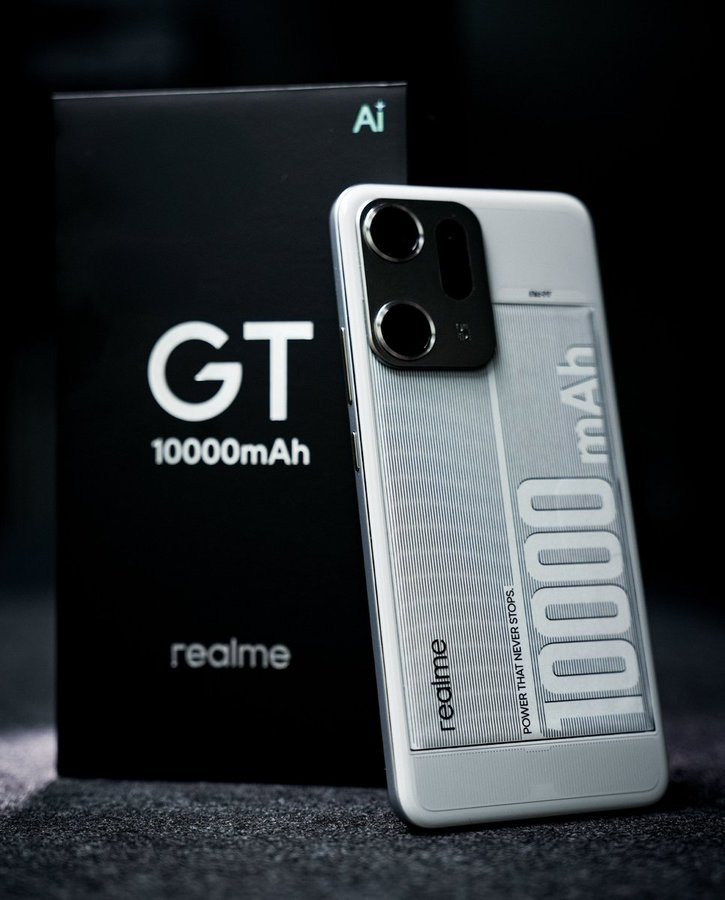
Earlier this year, Realme showcased a GT-series concept phone powered by a 10,000mAh battery. Last week, the brand unveiled a concept phone featuring an even bigger 15,000mAh battery. Now, a Weibo post released by Realme Vice President and President for Global Marketing, Xu Chase, has revealed that the company will commercially release a 10,000mAh battery phone next year.
Realme’s 10,000 mAh battery phone launch is a few months away
Realme 10,000mAh battery phone coming soon
According to Realme’s Vice President Chase Xu the company is on track to bring a 10,000mAh phone to the market in early 2026. However, he did not reveal anything else about the device.
The new development follows Realme’s recent showcase of a 15,000mAh concept phone during its annual fan festival in China. That prototype featured a 100 percent silicon anode battery with a record energy density of 1200Wh/L, all packed into a design with less than 9mm thickness.
The 10,000mAh model is reportedly more refined, with thickness expected to stay under 8.5mm and a weight close to 210 grams. At present, there is no clarity about the phone’s final moniker.
Realme GT 10000mAh concept phone
While the brand is expected to announce the Realme GT 8 series of flagship phones in October in China, it is also said to be working on the Realme Neo 8 lineup. Recent reports have revealed that the Neo 8 could be equipped with an OLED LTPS 1.5K resolution screen, an ultrasonic in-screen fingerprint sensor, and an 8,000mAh battery. The device could be powered by the Dimensity 9500e and Snapdragon 8 Gen 5. For those who don’t know, these chipsets haven’t launched yet.
It remains to be seen whether Realme’s 10,000mAh battery phone launches as the Realme Neo 8 Pro or under a different name. This device is expected to rival the Honor Power 2, which is said to feature a 10,000mAh battery, a 6.79-inch display, and a Dimensity 8500 SoC.
For more daily updates, please visit our News Section.
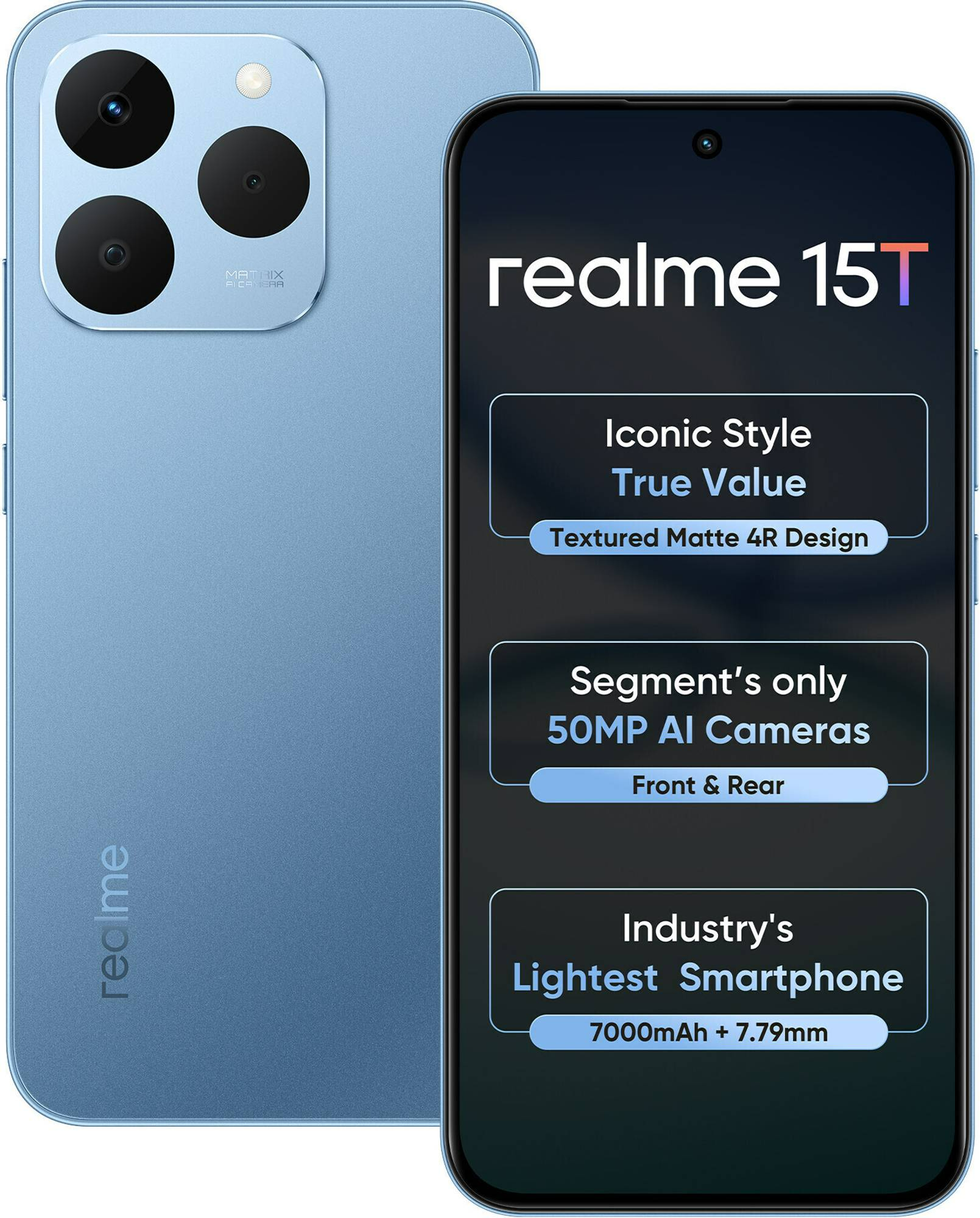
In July, Realme unveiled the Realme 15 5G and Realme 15 Pro 5G smartphones in India. Today, the brand unveiled the Realme 15T as the entry-level offering in the Realme 15 series. The key highlights of the phone include a comparatively smaller display as compared to the 15 and 15 Pro, a massive 7,000mAh battery, and the latest Dimensity 6000-series chipset. Here’s a look at the specifications, features, and price of the 15T.
Realme 15T 5G specifications and features
Relame 15T
The Realme 15T 5G is fitted with a 6.57-inch flat AMOLED display offering a resolution of 2372 x 1080 pixels (FHD+), 120Hz refresh rate, 1400 nits HBM brightness, 4000nits max brightness, and 2160Hz PWM dimming. For selfies, the 15T offers a 50-megapixel OmniVision OV50D40 front-facing camera.
On the rear, it comes with a dual-camera setup featuring an EIS-assisted 50-megapixel OV50D40 primary camera and a 2-megapixel monochrome sensor. Like the Realme 15 and 15 Pro, the 15T comes with AI Edit Genie that allows users to do modify images with AI-powered commands via text or voice.
Powering the device is the MediaTek Dimensity 6400 Max. The SoC is paired with LPDDR4X RAM, UFS 2.2 storage, and a large 7,000mAh battery that supports 60W fast charging and 6W reverse charging. A 6,050mm² VC cooling system ensures sustained performance.
The Realme 15T runs on Android 15 with Realme UI 6. It is confirmed to receive three years of Android OS upgrades and four years of security updates. The device includes dual SIM 5G, Wi-Fi 6, Bluetooth 5.3, USB-C, dual speakers, a microSD card slot, and an in-screen fingerprint sensor. It has a plastic frame and carries IP66, IP68, and IP69 ratings for dust and water resistance. The 15T measures 158.36 x 75.19 x 7.79mm and weighs between 181g and 183g depending on the variant.
Realme 15T 5G price in India, availability
The Realme 15T 5G is priced at Rs 20,999 for the 8GB+128GB model, Rs 22,999 for the 8GB+256GB version, and Rs 24,999 for the 12GB+256GB variant. It will be available in Suit Titanium, Silk Blue, and Flowing White color options.
Preorders are live on Flipkart and Realme India’s website and its set to go on sale from Sept. 5. Those who pre-book the device via Realme website will receive a free pair of Realme Buds T01 earbuds.
For more daily updates, please visit our News Section.
An upcoming Oppo phone for the global market bearing the model number CPH2791 has appeared in the databases of the Geekbench benchmarking platform and TUV certification. The Geekbench listing reveals that the device is equipped with the Dimensity 9500, which suggests that the CPH2791 model number could be associated with the global version of the Find X9 and X9 Pro.
Oppo Find X9 Geekbench, TUV listings
Oppo Find X9 / X9 Pro GeekbenchOppo Find X9 / X9 Pro TUV listing
The global Oppo Find X9 / X9 Pro’s Geekbench listing reveals that it is powered by a MediaTek chip that comprises one core working at 4.21GHz, three cores operating at 3.50Ghz, and four core running at 2.70GHz. For graphics, it is equipped with the Mali-G1-Ultra MC12 GPU.
The CPU and GPU details suggest that the device is powered by the Dimensity 9500. For those who are unaware, MediaTek is expected to announce this flagship chip on Sept. 22 in China. The Geekbench listing further reveals 16GB of RAM and Android 16, which may have the ColorOS 16 skin on top. Let’s ignore the benchmarking scores for now as they do not seem to be accurate.
The same device was also certified by the TUV Rheinland earlier this month. As can be seen, the listing suggests that the device may support 80W fast charging.
Oppo Find X9 specifications (rumored)
Reports suggest that the Find X9 may feature a 6.59-inch flat OLED LTPO display with 1.5K resolution and 120Hz refresh rate. Powering the device will likely be the Dimensity 9500 chipset, paired with up to 16GB LPDDR5x RAM and as much as 1TB UFS 4.0 storage. A large 7,025mAh battery with 80W wired and 50W wireless charging could back it.
For photography, it may include a 50-megapixel selfie sensor and a triple 50-megapixel setup on the rear: a Sony LYT-808 main lens with OIS, a Samsung JN5 ultra-wide, and a Samsung JN9 3x periscope telephoto. Other expected features are Android 16 with ColorOS, Hasselblad and Lumo imaging, ultrasonic fingerprint security, and an IP68/69-rated build.
The Oppo Find X9 series is tipped to launch in China by mid-October. Likely, it may hit the global market by November or December this year.
For more daily updates, please visit our News Section.
Earlier this year, Vivo unveiled the Vivo S30 series, which included the Vivo S30 and S30 Pro Mini. The latter arrived as a photography-focused affordable flagship phone with a compact design. A new leak that has surfaced on Weibo has revealed the key specifications of what appears to be the Vivo S50 Pro Mini.
Alleged Vivo S50 Pro Mini specifications tipped
Alleged Vivo S50 Pro Mini leak by Smart Pikachu
The hashtag used by tipster Smart Pikachu in the above post suggests that the next S-series Vivo phone will be dubbed the Vivo S50 instead of Vivo S40, the most likely reason being that the number ‘4’ is considered a bad omen in some Asian markets, including China.
The leak reveals that an upcoming S50-series phone will feature a 6.3-inch flat display with a new aspect ratio, a Dimensity 9400 series chipset, and a triple camera unit featuring a periscope telephoto camera. The engineering prototype is said to include an ultrasonic in-screen fingerprint sensor.
The tipster has not specified the final moniker of the device. However, considering the display size, it appears to be a successor to the Vivo S30 Pro Mini. However, it remains to be seen whether it will be dubbed the Vivo S50 Pro Mini or just Vivo S50.
The reason behind this is that last year Vivo unveiled the Vivo X200 Pro Mini with a compact design featuring a 6.3-inch screen. Reports suggest that this year, there will not be a Vivo X300 Pro Mini; instead, the Vivo X300 featuring a 6.3-inch screen will succeed the X200 Pro Mini. Therefore, it is unclear whether the upcoming S50 series will have a “Pro Mini” branding.
Vivo S30 Pro Mini
As far as the launch is concerned, the Vivo S50 is expected to launch in November this year in China. This means the series will face competition from the likes of the Oppo Reno 15 series and the Honor 500 series, which are expected to break cover around the same time in China.
The Vivo S30 Pro Mini was rebranded as the Vivo X200 FE in markets outside of China. Therefore, it remains to be seen whether the alleged S50 Pro Mini gets rebadged as the Vivo X300 FE globally.
For more daily updates, please visit our News Section.
While Vivo is confirming the key details about the Vivo X300 series ahead of its October launch, the rumor mill is also working hard to share new information about it. In a recent Weibo post, well-known tipster Digital Chat Station revealed early design details of Vivo’s upcoming X300 series. The source indicates that the new range will bring noticeable design changes, a refreshed display approach, and upgraded imaging hardware. Here’s a look at what the tipster said.
Vivo X300 series design leak
Vivo X300 series design leak by DCS
According to DCS, the Vivo X300 series will adopt a large circular rear camera module with a smaller decorative ring compared to its predecessor, giving it a cleaner look. Both the Vivo X300 and X300 Pro models are expected to feature flat displays with large-radius corners. The bezels are said to be narrower than those on the iPhone 16 Pro Max. The source also mentioned that the devices will run on a redesigned interface described as having an “Apple-like” feel.
Vivo X300 series key specifications (rumored)
Vivo X200 Pro
The Vivo X300 and X300 Pro are expected to debut as the world’s first phones with the Dimensity 9500 chipset. The standard X300 could feature a 6.3-inch 1.5K display, a 200-megapixel Samsung HPB main sensor (1/1.4-inch), a 50-megapixel ultrawide lens, and a 50-megapixel periscope telephoto lens with 3x optical zoom.
Reports suggest the lineup will consist of the X300, X300 Pro, and X300 Ultra, with the first two arriving in October and the Ultra launching next year.
For more daily updates, please visit our News Section.
Vivo’s executive on Weibo has confirmed that the upcoming X300 Pro will feature a 200MP Samsung HPB sensor for its telephoto duties. Product manager Han Boxiao revealed today that the lens will have Zeiss T* coating, fluorite glass elements, and APO certification to cut down on chromatic aberration.
The sensor itself is 1/1.4-inch in size and provides an equivalent 85mm focal length, which makes it ideal for portraits and long-range detail shots.
Vivo X300 Pro’s telephoto excels in four areas
Han noted that while the X300 Pro might not rival Vivo’s current top crop X200 Ultra in every aspect, it excels in four major areas: stability, speed, clarity, and transparency. The telephoto lens reportedly supports CIPA 5.5-level stabilization, the highest rating in the industry at present.
The phone also has a unique focus tracking engine, co-developed with partners, that promises to make long-distance motion capture faster and more reliable.
Meanwhile, Vivo’s in-house “Blueprint” algorithm works alongside the new hardware to produce sharper telephoto images without relying heavily on AI tricks. And with the Zeiss coating and advanced optics, the company claims you’ll get cleaner, purer images with less distortion and better color accuracy.
Beyond the telephoto hype, the X300 Pro is expected to be powered by MediaTek’s Dimensity 9500 chipset. The main shooter, the Sony LYT828, is a 50-megapixel sensor with a 1/1.3-inch size and strong HDR performance.
Looking ahead, Vivo says it wants to integrate AI in more creative ways. At its Vision Conference, the company teased that the X300 series will eventually support AIGC-powered landscape creation and personalized beauty modes.
The X300 series is tipped to launch in October after MediaTek announces the Dimensity 9500.
For more daily updates, please visit our News Section.
Oppo recently unveiled the Oppo A6 Max 5G in China. Now, a rebranded version of the same phone has arrived in China with the Oppo A6 GT branding. While the A6 Max comes in a single 8GB+256GB version for 1,599 Yuan (~$225) and Streamer White and Rock Mist Blue colour options, the GT edition comes in multiple configurations and three color options. Here’s a look at the specifications, features, and price of the GT edition.
Oppo A6 GT 5G specifications and features
Oppo A6 GT 5G
The Oppo A6 GT 5G is equipped with a 6.8-inch flat AMOLED flexible screen with a 1.5K resolution of 2800 x 1280 pixels, up to 120Hz refresh rate, 240Hz touch sampling rate, and offers a peak brightness of 1,600 nits. Security is handled by an under-display optical fingerprint scanner, and the device also supports AI face unlock. The phone boots Android 15-based ColorOS out of the box.
At its core, the device is powered by the older Snapdragon 7 Gen 3 chipset. It is paired with LPDDR4X RAM, UFS 3.1 storage, and comes in up to 12GB+512GB configuration. Fueling the handset is a massive 7,000mAh battery with support for 80W Super Flash Charge.
For photography, the Oppo A6 GT 5G sports a dual rear camera system consisting of a 50-megapixel wide-angle camera with OIS and a 2-megapixel monochrome sensor. On the front, there is a 32-megapixel selfie camera with support for 4K video recording.
Other highlights include dual-SIM support, NFC, Bluetooth 5.3, Wi-Fi 6, and USB Type-C connectivity. The device measures 163.13 x 77.58 x 7.7/7.86mm, depending on the variant and weighs between 198 grams and 204 grams.
Oppo A6 GT 5G price
The Oppo A6 GT 5G is priced at 1,699 Yuan ($240) for the 8GB+256GB model, 1,899 Yuan ($270) for the 12GB+256GB variant, and 2,099 Yuan (~$300) for the 12GB+512GB version. It comes in three colour options: Rock Mist Blue, Luminous White, and Fluorescent Pink.
Based on reports, it appears that the Oppo A6 GT 5G / A6 Max 5G will be rebranded as the Oppo F31 Pro+v in India later this month.
For more daily updates, please visit our News Section.
Update: DCS has removed the Oppo Find X9 render, citing slight discrepancies in the camera lens arrangement in the image.
Original story continues…
Tipster Digital Chat Station has shared what is claimed to be the latest render of the Oppo Find X9. While the image itself offers only a glimpse, the insider has provided key details about the upcoming smartphone’s design changes. According to him, Oppo is making significant refinements to the camera housing and overall feel of the device.
Oppo Find X9 render
Oppo Find X9 render by DCS
As per the leak, Oppo is moving away from the large circular camera module seen in previous generations, like the Find X8 and Find X7 series. The Find X9’s render reveals a rectangular camera housing placed at the top left corner, which is expected to make the phone appear more balanced and elegant.
The new arrangement also gives the device a smoother in-hand feel and improved texture. Despite its smaller footprint, Oppo has reportedly managed to stack higher-grade camera specifications into this module, making it a step ahead of its predecessor.
Another notable detail is that the handset could include the same full-colour lens found on the Ultra variant. Alongside these changes, the Find X9 might also come in a titanium color option, which was highly requested last year. DCS hinted that this design version is finalized for the series, including both standard and higher-end editions.
Oppo Find X9 specifications (rumored)
As per reports, the Oppo Find X9 will feature a 6.59-inch flat OLED LTPO panel that supports a 1.5K reoslution and a 120Hz refresh rate. Under the hood, it will feature the Dimensity 9500 chipset, up to 16GB of LPDDR5x RAM, up to 1TB of UFS 4.0 storage, and a 7,025mAh battery with 80W wired and 50W wireless charging.
The Find X9 will feature a 50-megapixel front camera, and its rear camera setup will include an OIS-assisted 50-megapixel Sony LYT-808 main camera, a 50-megapixel Samsung JN5 ultra-wide lens, and an OIS-enabled 50-megapixel Samsung JN9 3x periscope camera. It is also expected to come with other features, such as Android 16 with ColorOS on top, Hasselblad and Lumo Imaging optimization, an ultrasonic in-screen fingerprint sensor, and an IP68/69 rated body.
As far as launch is concerned, the Find X9 series is expected to debut by mid-October in China.
For more daily updates, please visit our News Section.
We use cookies on our website to give you the most relevant experience by remembering your preferences and repeat visits. By clicking “Accept”, you consent to the use of ALL the cookies.
This website uses cookies to improve your experience while you navigate through the website. Out of these, the cookies that are categorized as necessary are stored on your browser as they are essential for the working of basic functionalities of the website. We also use third-party cookies that help us analyze and understand how you use this website. These cookies will be stored in your browser only with your consent. You also have the option to opt-out of these cookies. But opting out of some of these cookies may affect your browsing experience.
Necessary cookies are absolutely essential for the website to function properly. This category only includes cookies that ensures basic functionalities and security features of the website. These cookies do not store any personal information.
Any cookies that may not be particularly necessary for the website to function and is used specifically to collect user personal data via analytics, ads, other embedded contents are termed as non-necessary cookies. It is mandatory to procure user consent prior to running these cookies on your website.