iQOO’s latest official teaser for the Neo11 Ultra is all about the camera. They’ve confirmed a 50MP “ultra-stabilized” large Sony sensor as the main camera. The teaser also mentions “new native light and shadow effects,” which probably points to smarter image processing. Overall, it hints at more realistic depth and contrast.
The Live Photo feature gets a proper upgrade too: higher quality, plus support for stabilization, beautification, and filters. The main camera is paired with an 8MP ultrawide, while selfies are handled by a 16MP front camera. So it’s a simple dual-rear setup on the back, but the brand is clearly focusing on the main camera hardware and the processing improvements.
As proof, the teaser includes three high-resolution images, most likely shot on the main camera, including a night shot. The first photo is a portrait. Only when you zoom in do you notice a bit of overlap on some individual strands of hair. Apart from that, the subject separation looks clean, and the colors and noise control are both impressive. There’s no major over-sharpening anywhere in the frame.
The second shot is outdoors in daylight, and as expected it looks solid. Saturation and texture on the subject are nicely balanced, the kind of photo you’d share without touching it. The third image has a bit more colour punch, but it doesn’t tip into looking oversaturated or dull.
It’s hard to judge the exact colour temperature in the yellow-light areas, but overall it still looks good enough to post as-is. The Live Photo sample also holds up well, with a decent amount of detail visible in the individual frames.
The phone goes on sale on August 18 in China. From the specs that have been floating around (and the earlier official teases), it’s very much a performance-first device. It’s powered by the Dimensity 9500M with an 11-core GPU, plus iQOO’s own Q2 gaming chip for an extra boost in games. The display is a 6.83-inch 2K 144Hz LTPS flat panel using Visionox’s F2 material, and it can hit 1,000 nits full-screen when you max the brightness manually. Touch is handled by a Synopsys S3910V controller.
Timex has just released three new watches in its Quartz E Line, bringing back a design originally introduced in 1983. The defining feature of these new models is the rounded square case, a shape watch enthusiasts often refer to as the TV Dial because of its resemblance to old cathode-ray tube televisions.
Instead of scaling the watch up to fit modern oversized trends, Timex has gone smaller. These new E Line models feature a compact 30mm stainless steel case. It is a straightforward, retro-leaning dress watch that fits into the recent industry shift back toward smaller, more wearable case sizes.
There are three specific models in this release. The base version (TW6A01000) comes in a standard brushed and polished silver-tone stainless steel finish with a light pink sunray dial, and it is priced at $269. For a slight premium at $289, you have two additional options: a full gold-tone version (TW6A00900) and a two-tone silver and gold variant (TW6A00800). Both of the $289 models are paired with a champagne sunray dial.
Inside, the hardware is very standard. The watches run on a basic battery-powered quartz movement, so they will keep accurate time without needing to be wound. The case dimensions are fairly slim, measuring 8.5mm thick with a 36.5mm lug-to-lug distance, meaning they will sit flat against the wrist. The dial is protected by a flat mineral glass crystal and features simple hour markers alongside a basic printed minute track.
For the strap, Timex is using a 10mm stainless steel bracelet that secures with a butterfly deployant clasp. This type of clasp folds inward on both sides, which hides the locking mechanism and makes the bracelet look like one continuous piece of metal when it is closed. According to Timex, the band is adjustable to fit wrist sizes between 5.3 and 7.5 inches.
As for everyday durability, the watches have a 50-meter water resistance rating. That is enough to survive washing your hands, getting caught in the rain, or some very light swimming, but it is not built for snorkeling or diving.
Vivo is apparently preparing a follow-up to last year’s Y31 for the Indian market. Early images and specs that have surfaced point to a phone focused on battery life and durability in the affordable segment. A leaked rear render has also appeared, giving the first look at what the device might look like before its official reveal.
According to the leak, the Vivo Y31T will have a 6.75-inch LCD display with HD+ resolution and peak brightness of 1,250 nits. Power comes from Qualcomm’s Snapdragon 4 Gen 2 chipset paired with UFS 2.2 storage. Memory options are expected to include 4GB/128GB, 6GB/128GB, and 6GB/256GB. The big highlight is a hefty 7,200 mAh battery with 44W fast charging, which should easily handle all-day use and possibly stretch into a second day for lighter users. Colour options listed so far are Crimson Red, Gold Mist, and Seashore Green.
On the camera side, there’s a 50MP main sensor on the back along with a 2MP secondary unit (mostly decorative), while an 8MP camera handles selfies. The phone is said to measure 8.39 mm thick and carries both IP66 and IP68 ratings for dust and water resistance. Compared with the original Y31, the Y31T brings a slightly larger and brighter screen plus a much bigger battery.
It’s apparently being positioned against phones like the Oppo A6 5G, which suggests a price below ₹30,000. That puts it in the value mid-range category in 2026. Official confirmation and the full details, including software, exact launch date, and final pricing, are still pending.
The leaked package paints the Y31T as a practical daily driver that prioritises longevity and durability. More information should emerge as we get closer to the launch.
The Oppo A7 Pro Max has raised the bar for battery-focused smartphones with its massive 10,000mAh battery, 80W charging and Snapdragon 4 Gen 5 chipset. It also packs a 6.78-inch 1.5K 120Hz OLED display and 50-megapixel cameras, making it an interesting option for users who prioritise endurance. However, the phone is currently limited to China, making alternatives more practical for buyers in other markets.
Oppo A7 Pro Max
If you like the idea of a phone that can last for days but want stronger performance, different camera capabilities or a device that is already available in more markets, there are several alternatives worth considering. Here are five options that offer a different take on the A7 Pro Max formula.
The upcoming Oppo F35 Pro could be particularly interesting because it is expected to follow a similar formula to the A7 Pro Max, with reports pointing to a 10,000mAh battery and Snapdragon 4 Gen 5 chipset. The Motorola Edge 70 Fusion is another option to watch, while last year’s Poco F7, Realme GT 7T and Oppo K13 Turbo Pro remain relevant alternatives with batteries of around 7,000mAh alongside significantly more powerful chipsets. These models offer a better balance between battery endurance and performance, making them worth considering for users who want strong gaming and everyday performance without giving up the benefits of a large battery.
For more daily updates, please visit our News Section.
Krafton India has announced that Battlegrounds Mobile India (BGMI) Lite is officially in the works and slated for release by the end of 2026. It is a quiet confirmation of something the Indian mobile gaming community has been asking for since the original game was rebranded and brought back post-ban. But the real story here isn’t just that a lighter version of a popular battle royale is launching; it is about why it is happening right now.
For a few years, the standard version of BGMI ran perfectly fine on most mid-range and budget Android devices. However, the smartphone hardware market has hit a strange bottleneck recently. Driven by the mobile industry’s current obsession with integrating expensive AI-specific silicon, combined with a massive surge in global memory and RAM pricing, smartphone manufacturers have been forced to cut corners. The result is that the current crop of budget-tier smartphones actually offers worse raw gaming performance than devices released a couple of years ago.
According to us, this hardware regression makes a Lite version a practical necessity rather than just a portfolio expansion. Before the sweeping 2020 ban on apps with Chinese ties, PUBG Mobile Lite was incredibly popular in India, catering specifically to the massive demographic using entry-level hardware. When Krafton successfully navigated regulatory hurdles to relaunch the main game as BGMI, the Lite counterpart was left behind. At the time, it didn’t seem to matter much because budget phones were getting increasingly capable. That is simply no longer the case.
In its announcement, Krafton kept the specifics light, stating only that the game will arrive by the end of 2026 and aims to make the BGMI experience accessible to an even wider community of players. The company has not yet detailed exactly what graphical compromises, map size reductions, or gameplay tweaks will be made to accommodate lower-end hardware, noting that those specifics will be shared closer to the launch date.
Ultimately, launching BGMI Lite is a straightforward retention strategy. As the cost of entry for decent mobile gaming hardware creeps up, Krafton needs a way to keep its massive Indian player base engaged without relying on them to upgrade their phones. It is a pragmatic response to a smartphone market that has temporarily sacrificed budget gaming performance for AI features and component costs.
In related news, Ayaneo has recently launched the Konkr Pocket Advance retro handheld, featuring PS2 emulation in a compact GBA-inspired design.
For more daily updates, please visit our News Section.
Xiaomi has reportedly pulled the plug on the Xiaomi 18 Ultra, and you might see the word Ultra disappear from a lot more Chinese flagships next year.
Words for this come from tipster Kartikey Singh on X, who claims that Xiaomi has decided to scrap the Ultra model for its next flagship smartphone series.
As a result, instead of the usual four-way lineup with a camera-focused Ultra at the top, we’ll only get the Xiaomi 18, the Xiaomi 18 Pro, and the Xiaomi 18 Pro Max.
Previous reports point to soaring memory chip prices as the main reason. DRAM and NAND costs have climbed sharply in 2026 on the back of AI demand, and squeezing in Ultra-tier hardware like a 200MP quad-camera system would have pushed the price well past what most buyers would pay. The good news, if you can call it that, is that the Ultra isn’t gone forever.
Xiaomi is expected to bring it back with the Xiaomi 19 Ultra sometime in late 2027 or early 2028, once component costs settle down. Until then, the Xiaomi 18 Pro Max is tipped to be the top-of-the-line model from the brand.
On the other hand, Oppo Find X10 Ultra and Vivo X300 will remain exclusive to China
Xiaomi isn’t alone here. Rising memory costs have reportedly made Oppo and Vivo rethink their own next-generation Ultra phones as well. Their current Ultra models, the Oppo Find X9 Ultra and the Vivo X300 Ultra, made it to global markets this year. But according to Singh, their successors, the Oppo Find X10 Ultra and the Vivo X500 Ultra, might stay limited to China when they launch in the first half of 2027.
Neither company has confirmed that yet, so treat it as an early claim.
At last, Xiaomi scrapped the 18 Ultra, OPPO/Vivo decided not to launch next generation Ultra's in Global markets. Samsungs Ultra might be the only one available globally. All others will jump to Pro Max.
The shower of Pro Max smartphones is coming soon. However, these Pro Max…
If that does happen, Samsung’s Galaxy S27 Ultra would be left as the only true Ultra-branded flagship you can actually buy outside China. Everyone else will compete with their Pro Max model in the flagship segment.
For more daily updates, please visit our News Section.
Losing your keys used to mean checking every couch cushion, drawer, and jacket pocket in the house. Now, you can clip a small tracker to your keys, bag, or wallet and use your phone to find it.
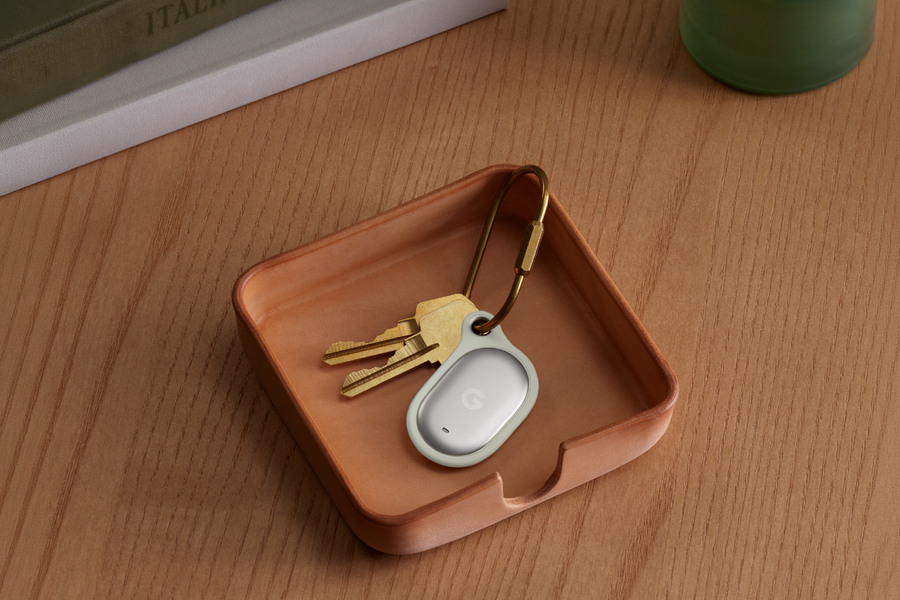
Apple popularized this category with the AirTag, and we have since seen several makers — smartphone and not — launching their own tracking devices. That market now has a new big name. At the Made by Google event alongside the Pixel 11 series, Google launched its first item tracker, the Pixel Tag. It will go on sale on November 11.
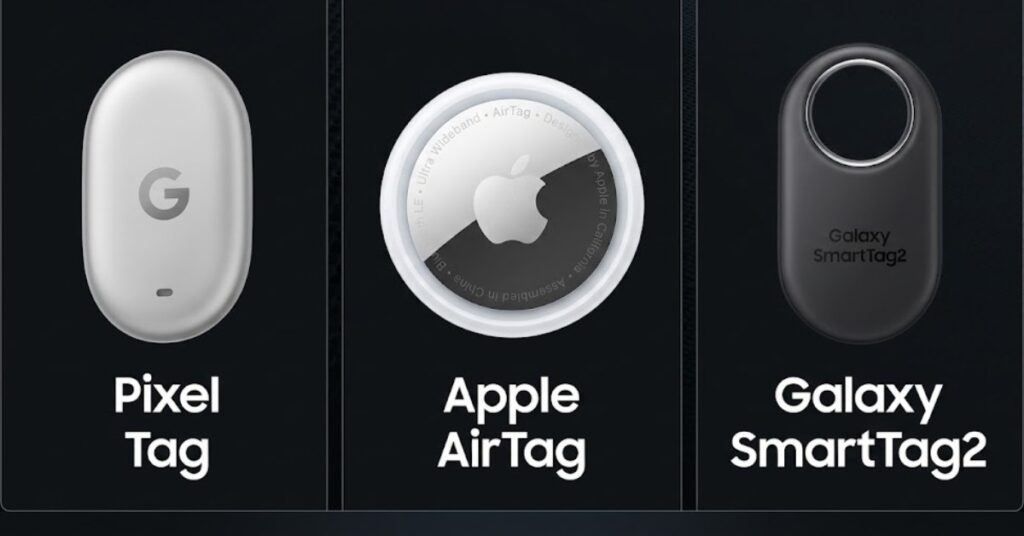
Apple has had the AirTag since 2021 and updated it earlier this year, while Samsung has offered the Galaxy SmartTag2 since 2023. All three do the same basic job, but they work very differently depending on which phone you use.
Here’s a comparison of the Google Pixel Tag, Apple AirTag, and Samsung Galaxy SmartTag2 to help you decide which one makes the most sense for you.
The three trackers are priced almost the same. The Pixel Tag costs $29 for one or $99 for a four-pack, matching the AirTag. The Galaxy SmartTag2 costs $30 for one or $100 for four.
For a broader look at pricing across the category, see our roundup of Bluetooth tracker options for 2026.
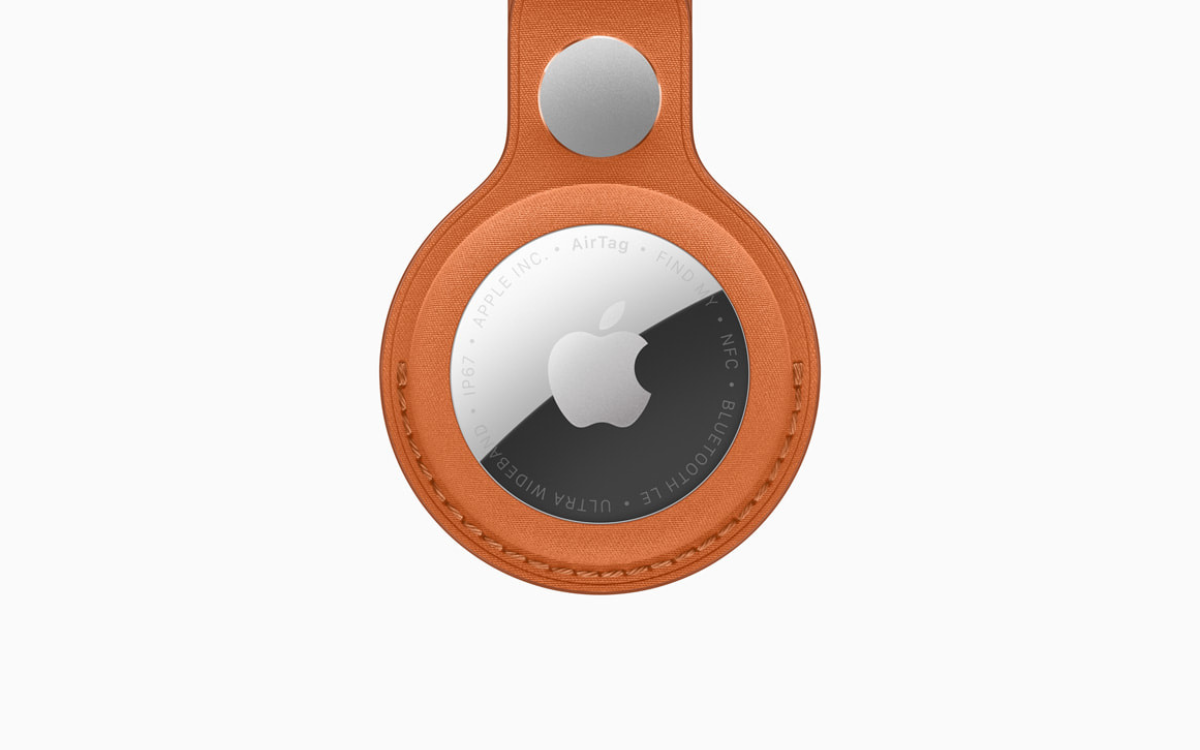
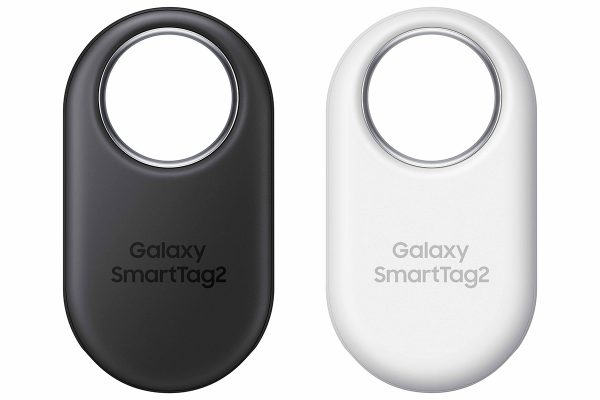
Visually, they look different. AirTag is a small, flat, round disc, closer to the size of a large coin. The Galaxy SmartTag2 is pill-shaped with a large metal ring loop built into one end, so it clips onto keychains without needing a case. The Pixel Tag also uses a pill-shaped, pebble-like body, measuring about 46 x 28 x 5.4mm and weighing under 12 grams, but it has no built-in loop, so you’ll likely need a case or holder to attach it to keys. For now, it comes in just one color called Fog, which is a light gray.
All three use a replaceable CR2032 coin battery, so users can replace the battery when it runs out instead of buying a new tracker.
Google and Apple say their trackers can last more than a year on a single battery with normal use. Samsung claims up to 500 days of battery life in normal mode, or up to 700 days with power-saving mode enabled.
They are also similarly durable. All three have an IP67 rating, meaning they are protected from dust and can survive being submerged in up to about a meter of water for a short time. So a little rain or a wet backpack shouldn’t be a problem.
2. How they find your stuff
Each tracker has its own strength and/or weakness in how they work. All three use two main ways to find your belongings. They can connect directly to your phone when you’re nearby, or use a larger network of other phones to find the tracker when it’s far away.
AirTag
The latest AirTag uses Ultra Wideband (UWB) to help you find a lost item when you’re nearby. Your iPhone can show you which direction to walk and how far away the tracker is. Speaking of which, the Precision Finding on the new AirTag covers 50% more range than the previous generation, thanks to Apple’s second-generation UWB chip.
Apple also made the new AirTag’s speaker louder by 50%, which the company claims can be heard from up to twice as far away. And when you’re too far away for a direct connection, AirTag uses Apple’s Find My network, so that other nearby Apple devices can detect the lost AirTag and anonymously send its location to its owner.
Pixel Tag
The Pixel Tag works similarly, but uses Google’s Android ecosystem. It uses both UWB and Bluetooth Channel Sounding for precision finding, but the exact features you get depend on your phone’s hardware and software.
UWB uses a dedicated ultra-wideband chip to provide more precise distance and directional information, while Bluetooth Channel Sounding uses newer Bluetooth technology to measure distance without requiring UWB hardware. However, Channel Sounding requires a compatible phone running Android 16 or newer with Bluetooth 6.0 or later, while UWB also requires a phone with a UWB chip.
When the tracker is out of direct range, it switches to Google’s Find Hub network, which relies on participating Android devices to detect lost items. Android smartphone pool is much bigger compared to Apple, and such a large network could be a major advantage in crowded places like airports, shopping centers, and city streets. The more Android devices nearby, the better the chance that one of them will detect your lost tracker.
Galaxy SmartTag2
Samsung Galaxy SmartTag 2
Samsung’s Galaxy SmartTag2 also combines Bluetooth and UWB. Samsung claims a Bluetooth range of up to 120 meters under ideal conditions. However, the most accurate UWB tracking only works if your Galaxy phone has a UWB chip. Not every Samsung phone has one, so some cheaper Galaxy A-series phones and certain other models won’t offer the full tracking experience.
For finding lost items from a distance, the SmartTag2 uses Samsung’s SmartThings Find network. Unlike Google’s network, this is limited to Samsung Galaxy devices.
3. The ecosystem problem
This is probably the most important thing to consider before buying any of these trackers. The three trackers don’t work together, and two of them are heavily tied to their own phone brands.
The Galaxy SmartTag2 is the most restrictive. It works with Samsung Galaxy phones and tablets through the SmartThings Find app. If you use a Pixel, OnePlus, or iPhone, you can’t use it as your everyday tracker.
AirTag has a similar limitation on the Apple side. You need an iPhone or iPad for setup and regular tracking. Android phones can scan a lost AirTag using NFC and see the owner’s contact information if Lost Mode is enabled, but Android users don’t get the full tracking experience.
The Pixel Tag is more flexible and works with Android phones running Android 9 or later, although some advanced finding features require newer hardware and software. This gives Google a much wider reach than Samsung. However, it still doesn’t work as a full-featured tracker with iPhones.
So the real choice is fairly simple. AirTag for Apple users, Pixel Tag for most Android users, and SmartTag2 for Samsung Galaxy users.
4. Which one should you buy?
If you use an iPhone, the AirTag is still the obvious choice. Apple’s Find My network is large and well established, while the new UWB chip and louder speaker make it easier to locate the tag when you’re nearby.
If you use a Samsung Galaxy phone, the Galaxy SmartTag2 is a good option. It has excellent battery life and works well within Samsung’s ecosystem. Just remember that the best tracking features depend on your specific Galaxy phone.
For other Android users, the Pixel Tag makes the most sense. It works across a much wider range of Android phones, costs about the same as an AirTag, has an IP67 rating, and uses Google’s Find Hub network, which the company says covers more than a billion devices. However, note that Pixel Tag doesn’t go on sale until November 11, so you will have to wait if you’re willing to get one.
If you want something thinner or designed specifically for wallets, third-party trackers such as the Ugreen FineTrack Slim Duo 2 are also worth considering. But for a simple first-party option, the Pixel Tag fills a gap Android users have had since the AirTag launched in 2021.
Citizen has updated its Rolan watch collection in the United Kingdom with a new color configuration. The new model, officially listed as the AW2113-16X, pairs a brown metal dial with a rose gold-tone stainless steel case and a standard brown leather strap. It is available now directly through Citizen’s UK website for £199.00.
The AW2113-16X joins an established lineup of Rolan variants, expanding a catalog that already includes dial options in blue, mother-of-pearl, salmon, and black. From a hardware perspective, this new release does not alter the physical dimensions of the series.
The case measures 41mm in diameter, placing it in the standard middle ground of modern watch sizing. It features a basic three-hand dial layout, which is protected by a mineral crystal.
The tech driving the watch remains Citizen’s proprietary Eco-Drive movement. Instead of using a traditional replaceable silver-oxide battery, the Eco-Drive system utilizes a specialized solar panel situated beneath the dial to draw power from both natural and artificial light sources.
This energy is stored in an internal rechargeable cell. For the end user, this means the watch can run continuously without requiring routine battery swaps, provided it receives regular exposure to light.
In terms of durability, the official technical specifications list the watch with a water resistance rating of 50 meters, or 5 Bar. This rating means the hardware is sealed well enough to handle surface swimming, rain, and general water exposure, though it is not rated for high-pressure water activities or diving.
When you hear the term Android laptop, it is easy to picture a tablet with a keyboard case attached to it. For a long time, that is exactly what the budget Android computing space offered. You usually had to choose between a low-cost Windows machine that might struggle with basic updates or a Chromebook that relies heavily on an internet connection.
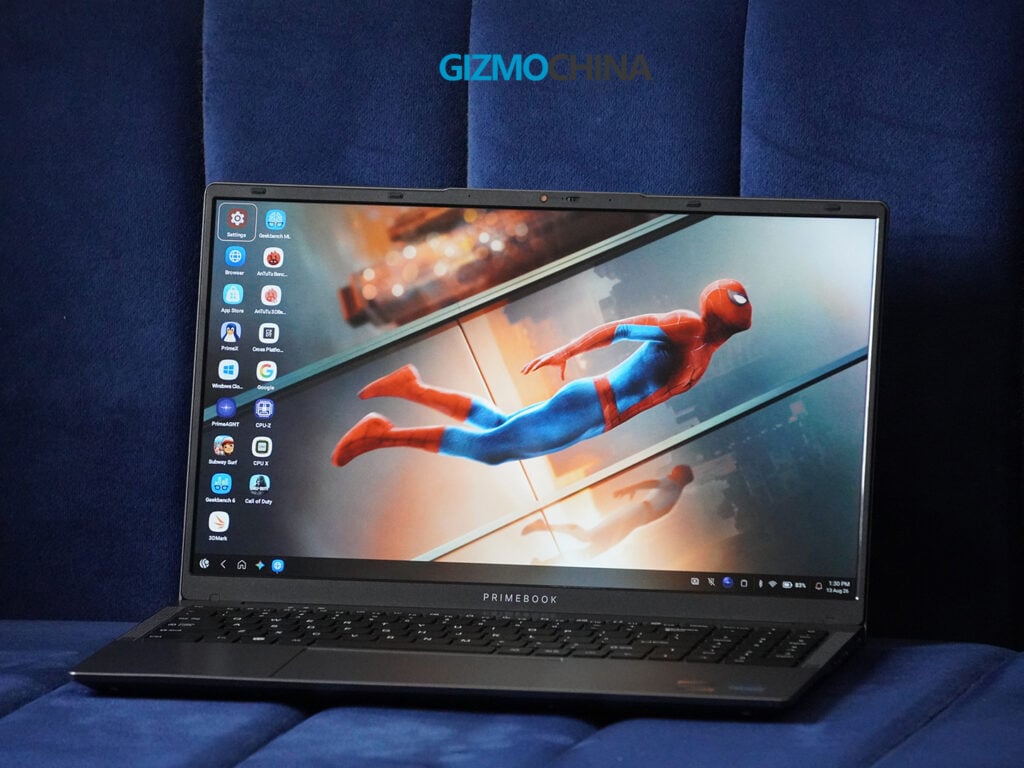
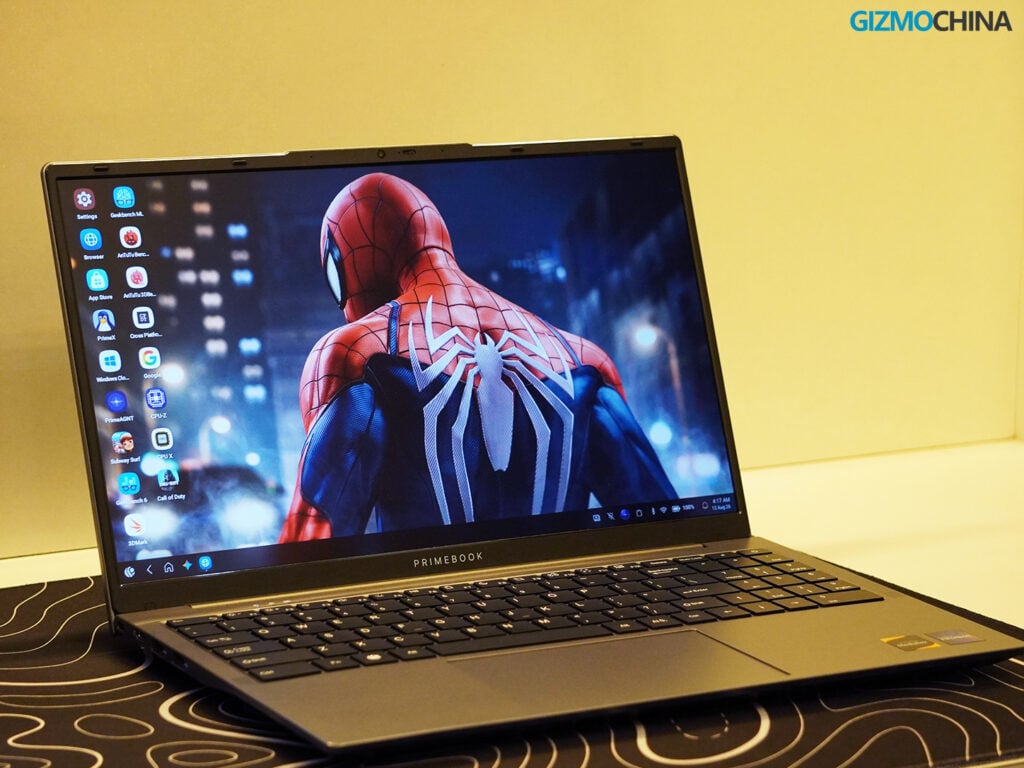
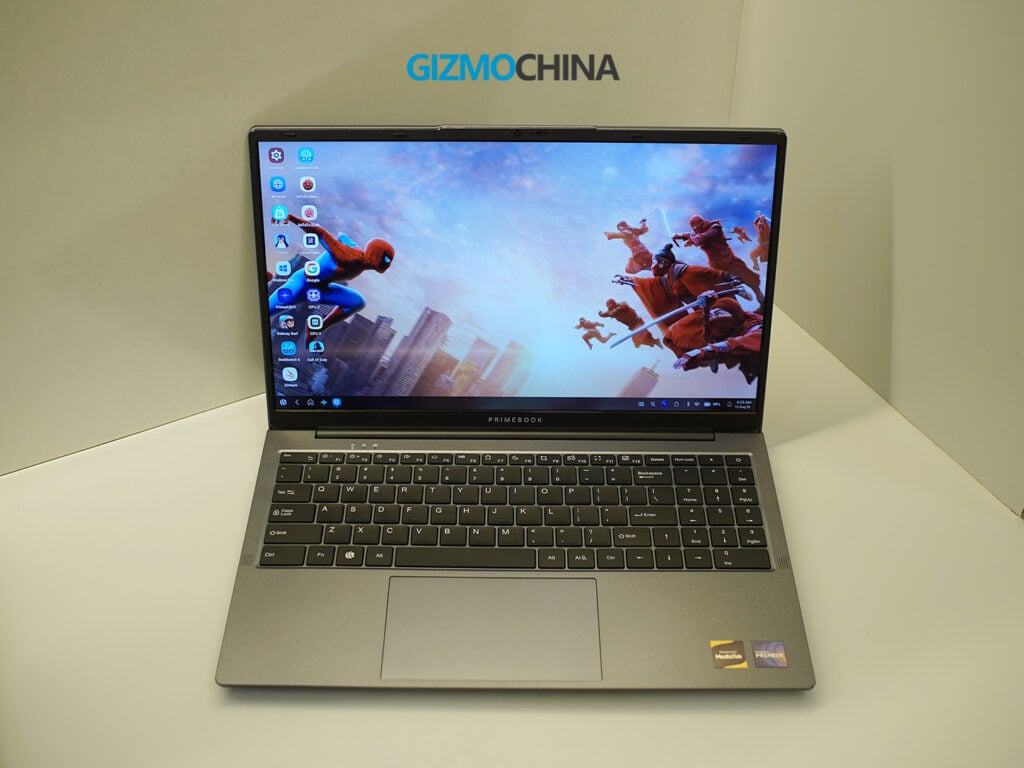
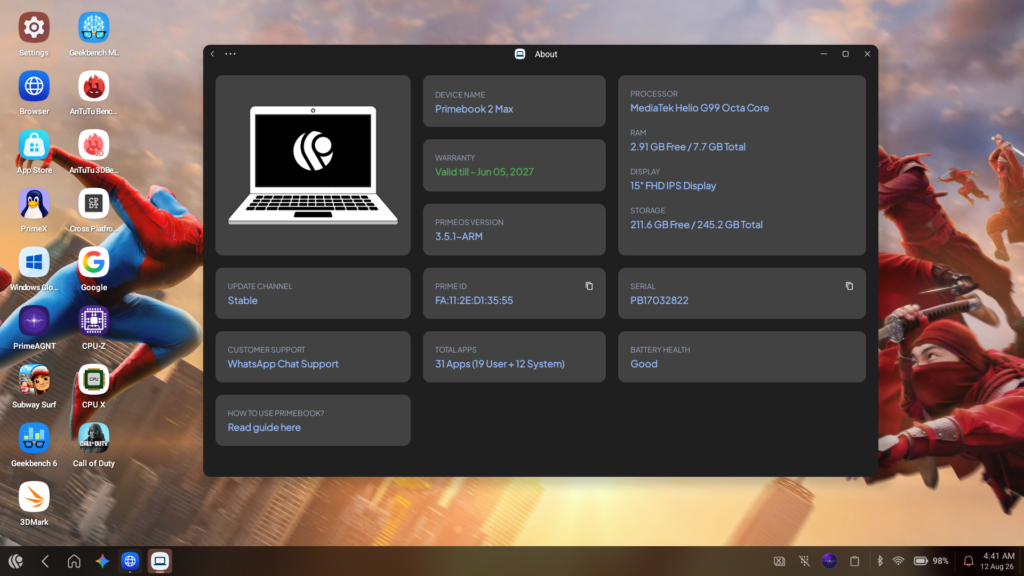
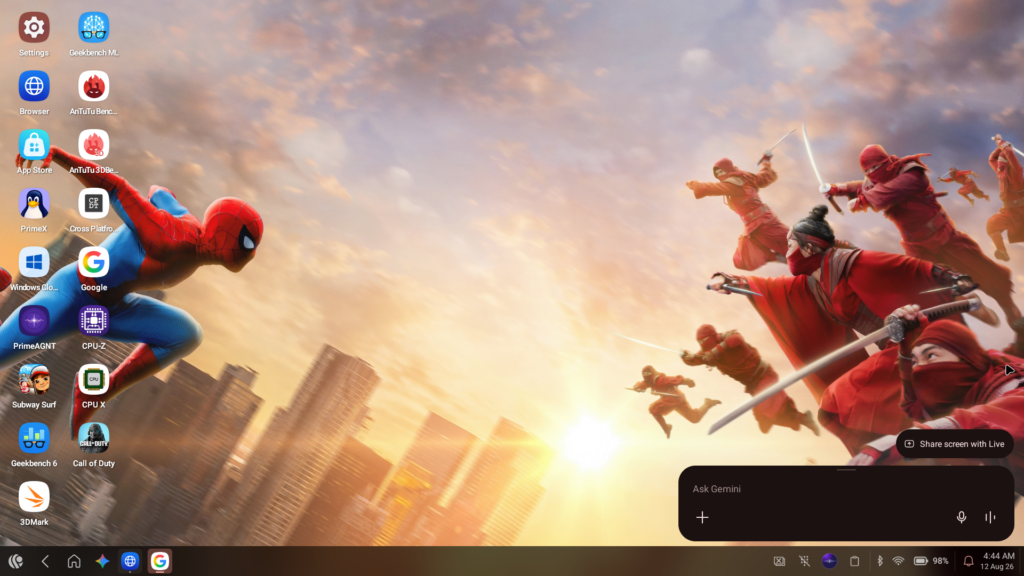
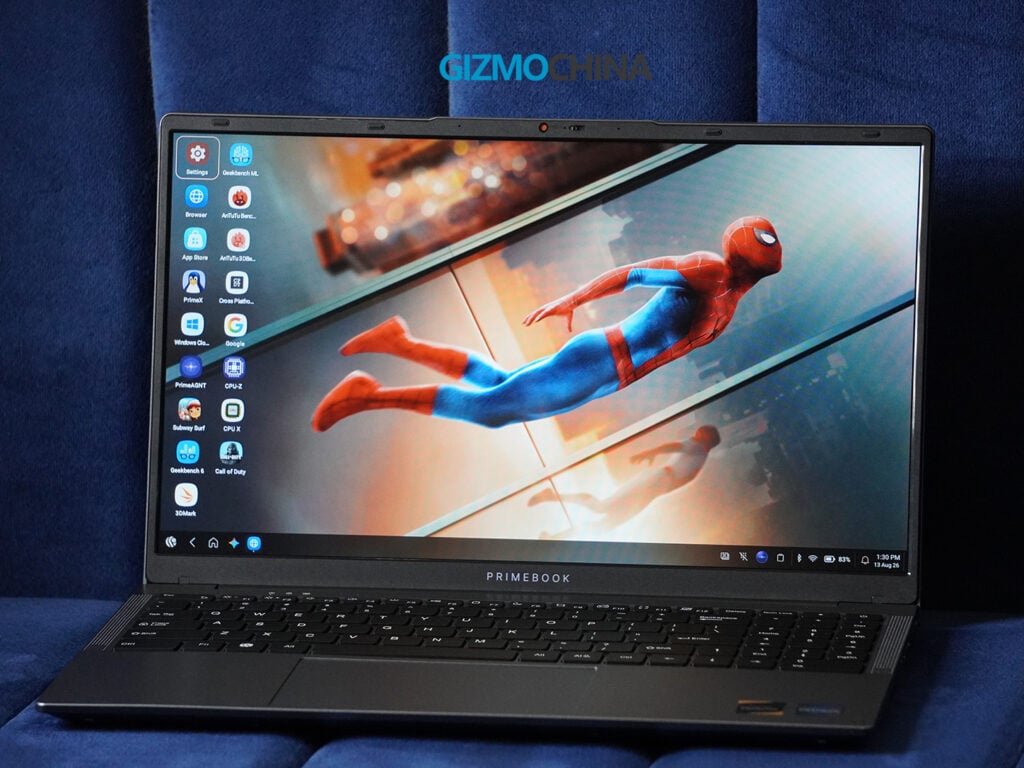
Recently, Primebook sent me their new Primebook 2 Max (2026) to test. Priced at Rs. 27,990, it takes a different approach. Instead of trying to run Windows on entry-level hardware, it uses PrimeOS 3.0, an operating system based on Android 15 but designed to look and function like a traditional desktop. It comes with an integrated AI tool, a 15.6-inch screen, and a MediaTek Helio G99 processor.
I went into this review with moderate expectations. I have used the Helio G99 in budget tablets, where it performs adequately, but a laptop environment is usually more demanding. After using the Primebook 2 Max as my primary computer for the past two weeks, I am really surprised and found it to be a capable machine. It has clear limitations, but it also offers a practical alternative for people who primarily need a device for basic tasks and long battery life. Here is a detailed look at how it holds up in daily use.
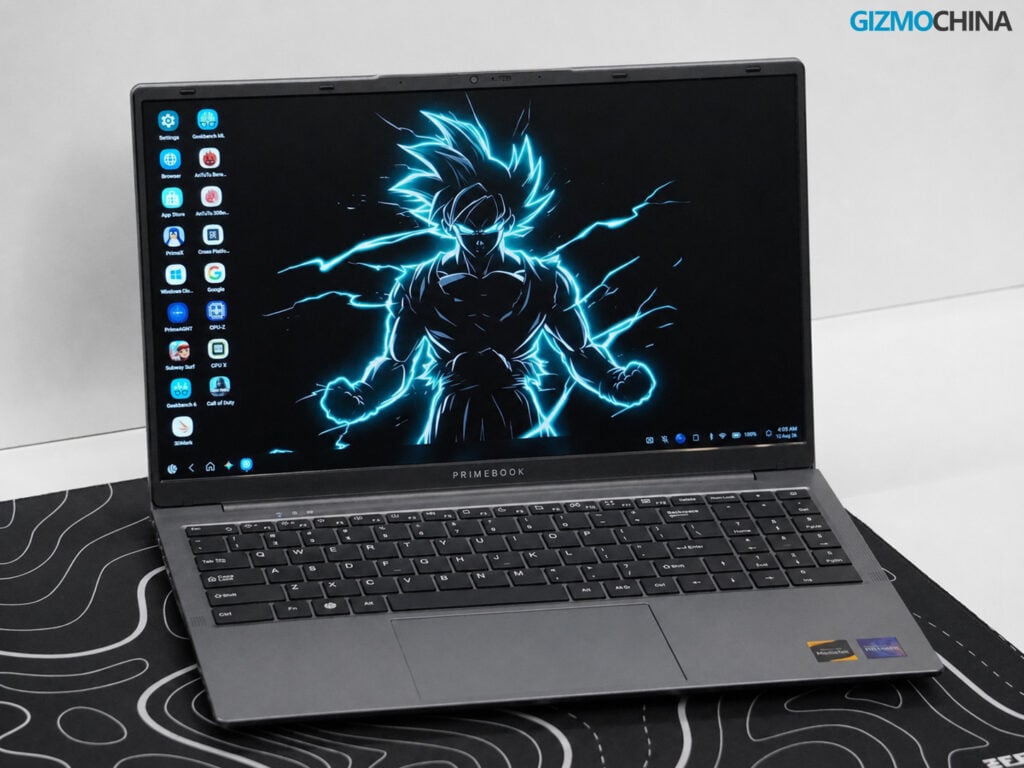
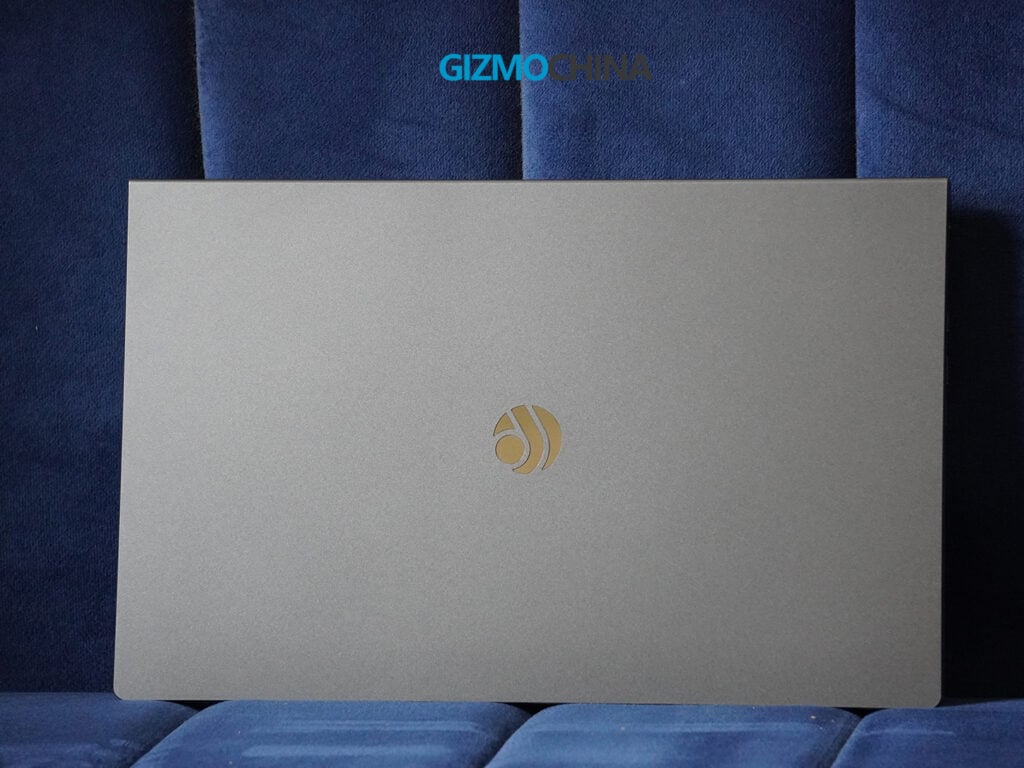
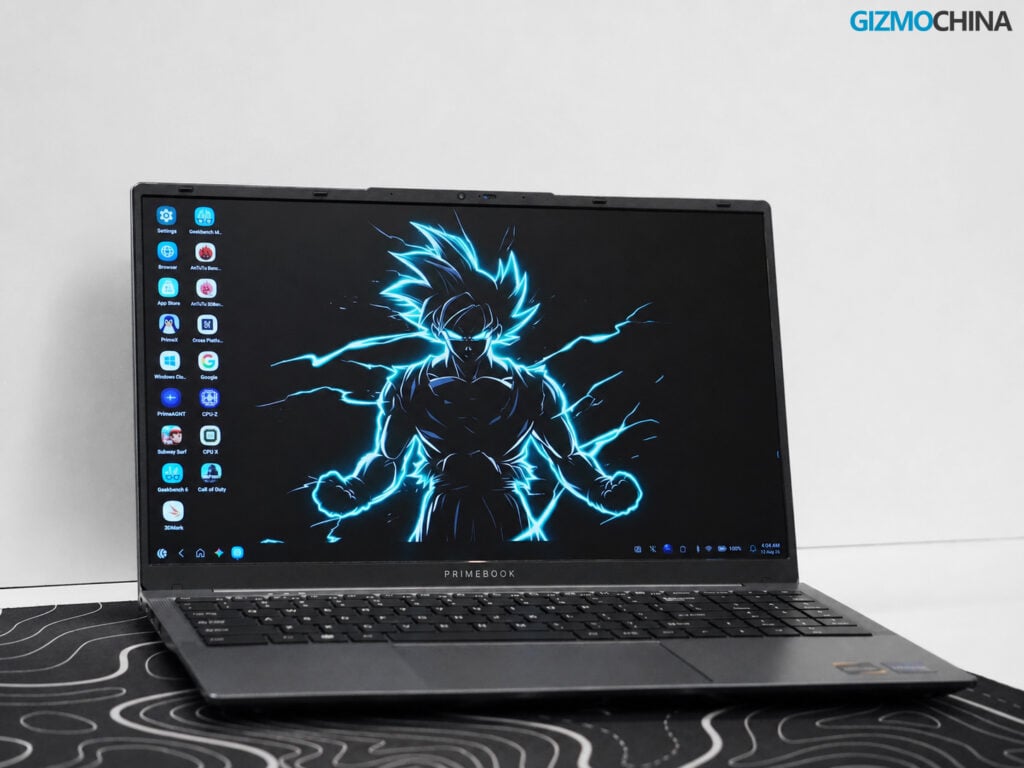
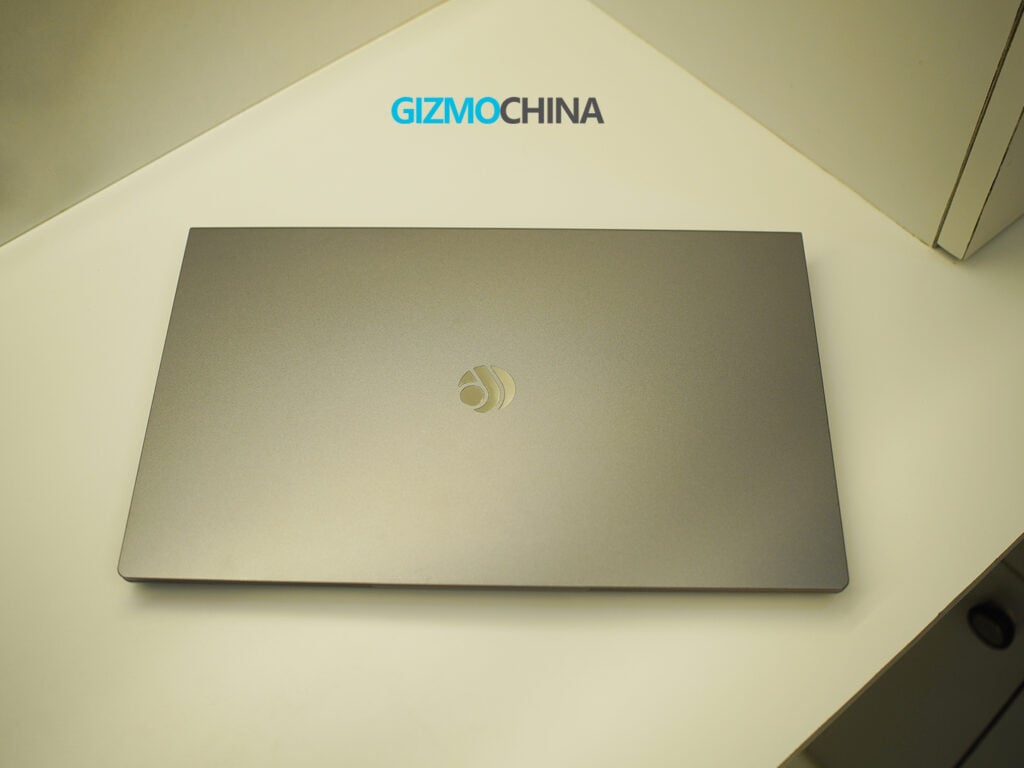
The Primebook looks just like any other laptop. It weighs 1.61 kg and is 20mm thick, making it relatively easy to carry around in a backpack. The chassis is made entirely of plastic. It feels reasonably sturdy for the price, without too much creaking when you rest your wrists on it.
The model I tested comes in a matte Chill Grey finish. It looks clean out of the box, but the review unit I received had a bit of a scratch near the logo. I am not so sure about how scratch-proof it is since I use my devices very carefully, but I hope the paint stays like this for a long time.
Now, coming to another part which you might not expect in this price range is the hinge. The laptop can actually open a full 180 degrees, so it can lie completely flat.
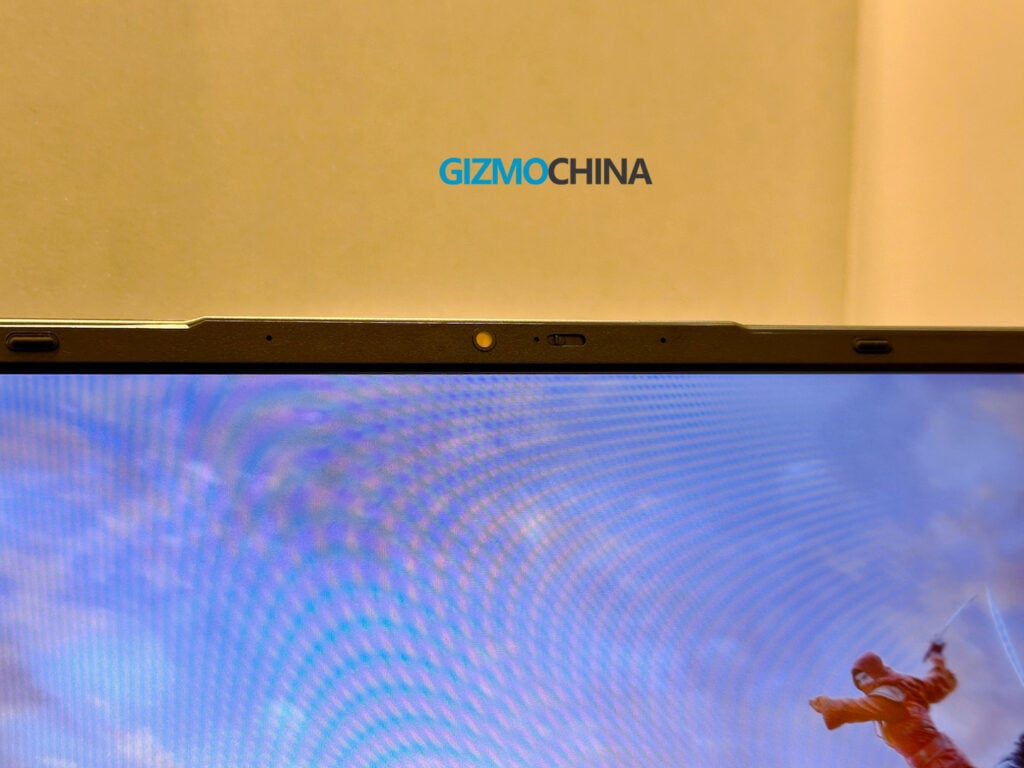
However, you can’t open the lid one-handed, as the base lifts off the table when you try, but the small notch at the top makes it easy to open with both hands. That notch also houses a 1440p webcam. The camera quality is good enough for video calls, and it includes a physical privacy shutter, which is a practical addition.
Display
The laptop features a 15.6-inch Full HD (1920 x 1080) IPS LCD screen with a standard 16:9 aspect ratio. For a laptop that costs under Rs. 30,000, the display is decent. It has a matte, anti-glare finish, which I prefer for working because it cuts down on reflections from overhead lights.
The colors (covering 45% of the NTSC color space) are fine for everyday tasks like reading, writing, and watching casual videos. The viewing angles are also good; the screen remains readable even if you look at it from the side. However, if you are watching dark scenes in a movie, you might notice some color banding, which is typical in this price range.
The main limitation is the brightness. The panel maxes out at 250 nits. This is perfectly adequate for indoor use, but if you try to work outside, you will likely struggle to see the screen clearly.
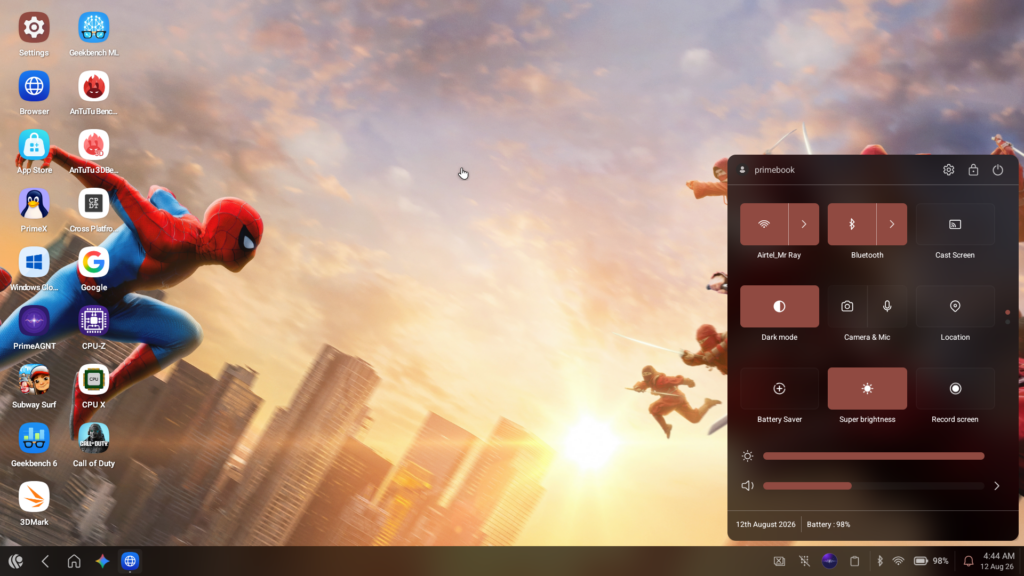
There is a Super Brightness setting in the software that helps slightly, but it is still primarily an indoor display.
Keyboard and Trackpad
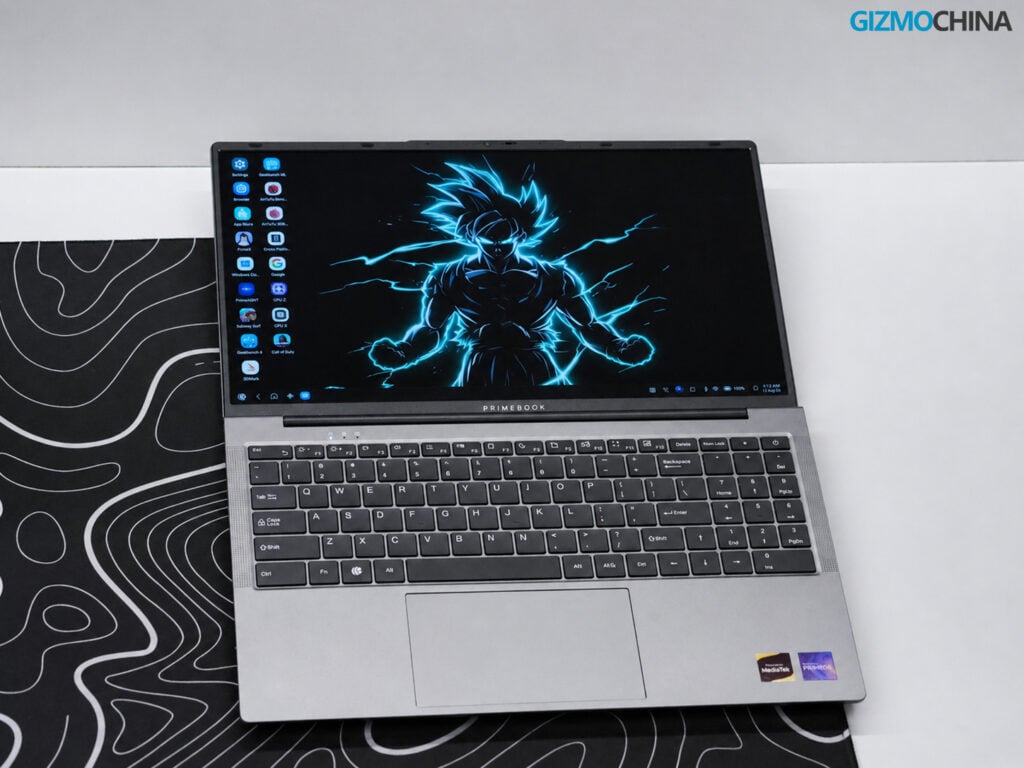
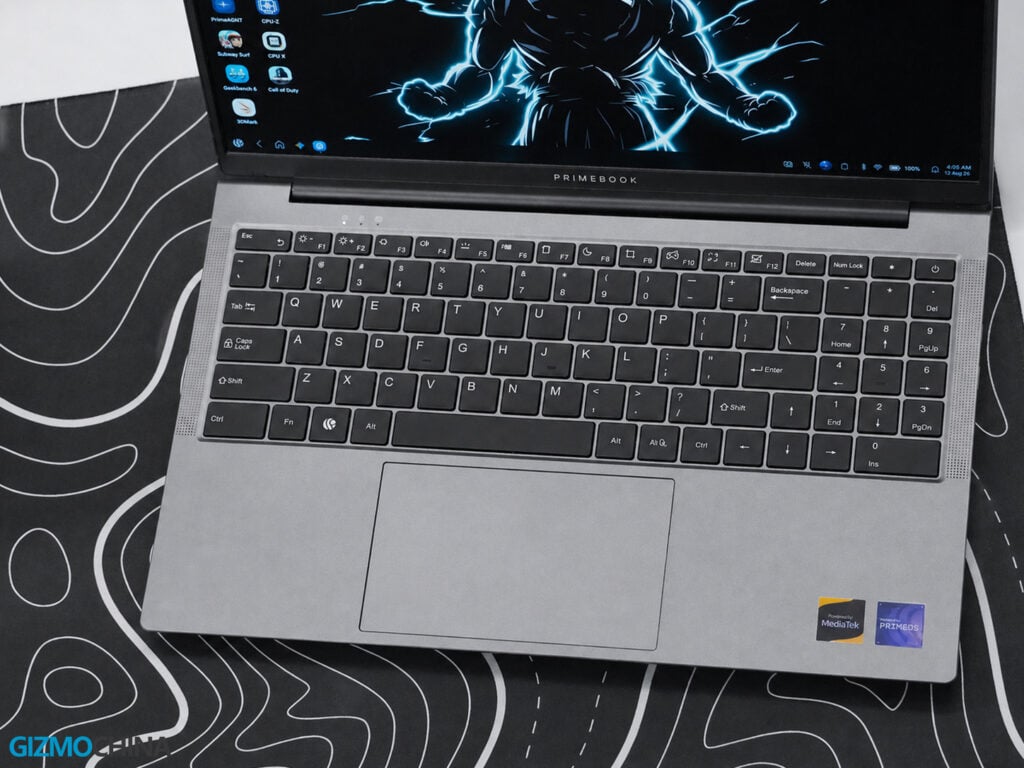
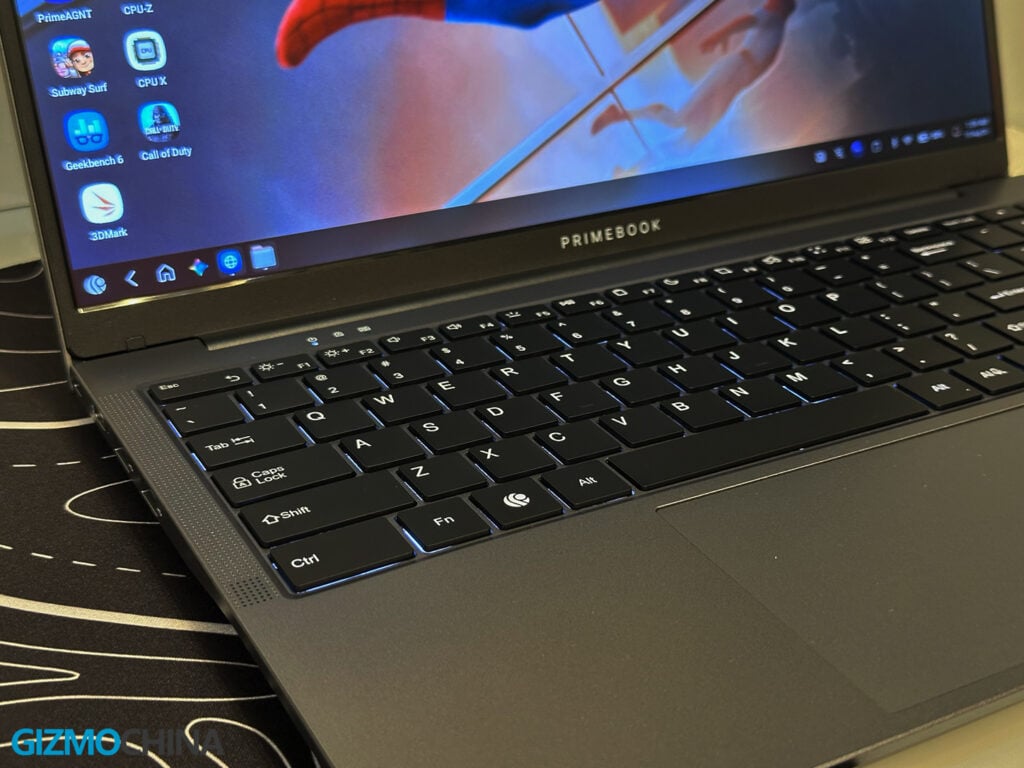
The keyboard on the Primebook 2 Max is an absolute delight. It’s a full-sized chiclet keyboard complete with a number pad, which is a massive win for students dealing with spreadsheets. It’s also backlit, a feature that is criminally omitted from many budget laptops.
Because this is an Android-first machine, the function row is populated with a different set of shortcut keys tailored specifically to the OS. I found these incredibly useful for daily tasks, allowing me to quickly manage my system without diving into menus.
The key travel is comfortable, and the typing experience is silent, perfect for quieter environments like libraries or late-night dorm rooms. If you’re coming from a standard Windows keyboard, it might take a day or two to adjust your muscle memory, but once you do, it’s smooth sailing.
The trackpad, however, is a slightly different story. Physically, it’s great. It’s a large, expansive surface area, and my fingers hovered and swiped across it without any physical friction. But in practice, the mouse pointer feels just a bit sluggish. It’s not exactly where I want it to be at the exact right time.
I often found myself having to wait a fraction of a second to click on something because my fingers had already completed the swipe, but the on-screen pointer was playing catch-up. It’s not a total dealbreaker, but it is noticeable. I’m hoping this is just a software quirk that Primebook can patch in a future update, rather than a hardware polling limitation.
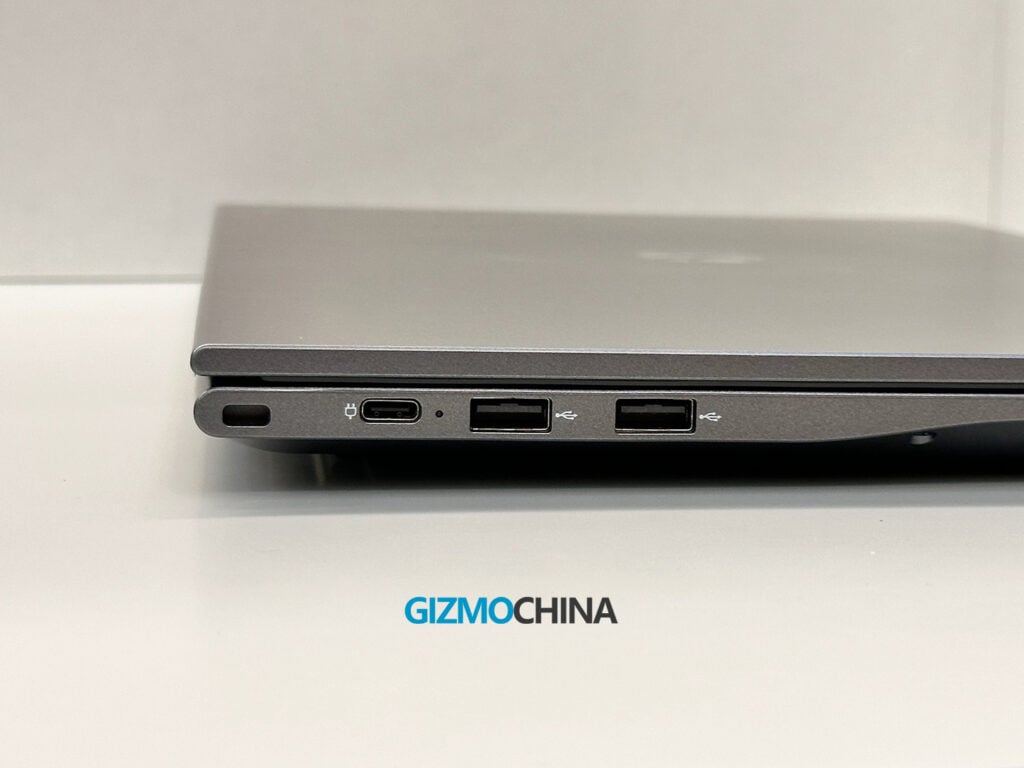
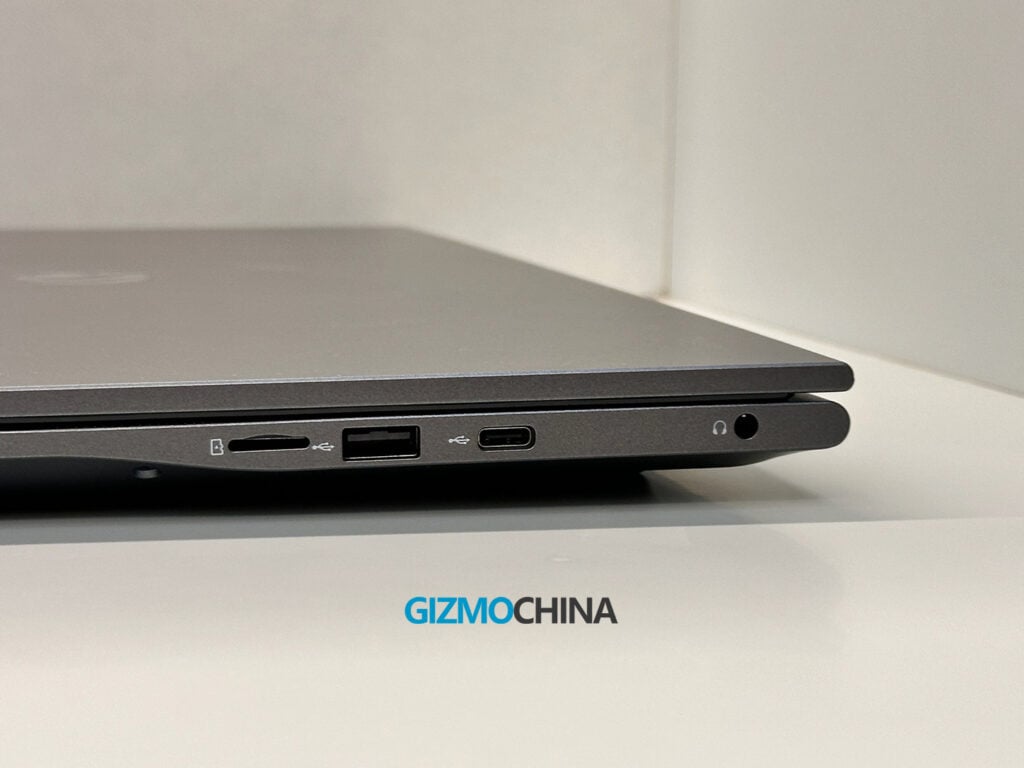
The Primebook 2 Max includes a standard set of ports. On the right side, there is a 3.5mm audio jack, a USB-C port (which supports data and OTG), a USB Type-A 2.0 port, and a microSD card slot that can read cards up to 1TB. On the left side, you will find a dedicated USB Type-C port used specifically for charging, along with two more USB Type-A ports.
For wireless connections, it supports dual-band Wi-Fi and Bluetooth 5.1. I had no issues maintaining a stable internet connection or pairing wireless headphones. Because it runs on Android hardware, the laptop also includes a built-in GPS and a gyroscope, which allows certain mobile apps to function as they would on a phone.
There are a couple of omissions to note. The USB-C ports do not support DisplayPort output, meaning you cannot easily connect the laptop to an external monitor using a standard Type-C cable. Also, it lacks a native wireless file-sharing feature like Quick Share.
Performance and Benchmarks
Inside, the laptop runs on a MediaTek Helio G99 processor, paired with 8GB of LPDDR4X RAM and 256GB of UFS 2.2 storage. This is hardware you typically find in mid-range Android tablets.
In practice, the performance is suitable for basic computing. It boots up quickly, and navigating the desktop interface is generally smooth. I was able to use a web browser with several tabs open, type up documents, and listen to music at the same time without much issue.
However, you will notice the hardware limits if you try to push it. If you open more than ten heavy browser tabs or try to run multiple demanding Android apps in the background, the system starts to slow down. The animations become less fluid, and switching between apps takes longer.
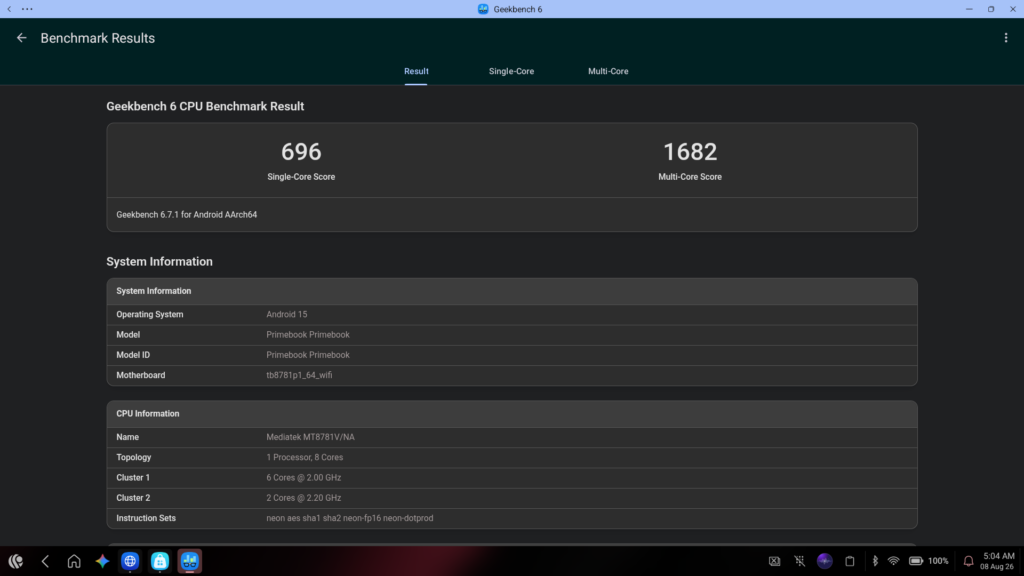
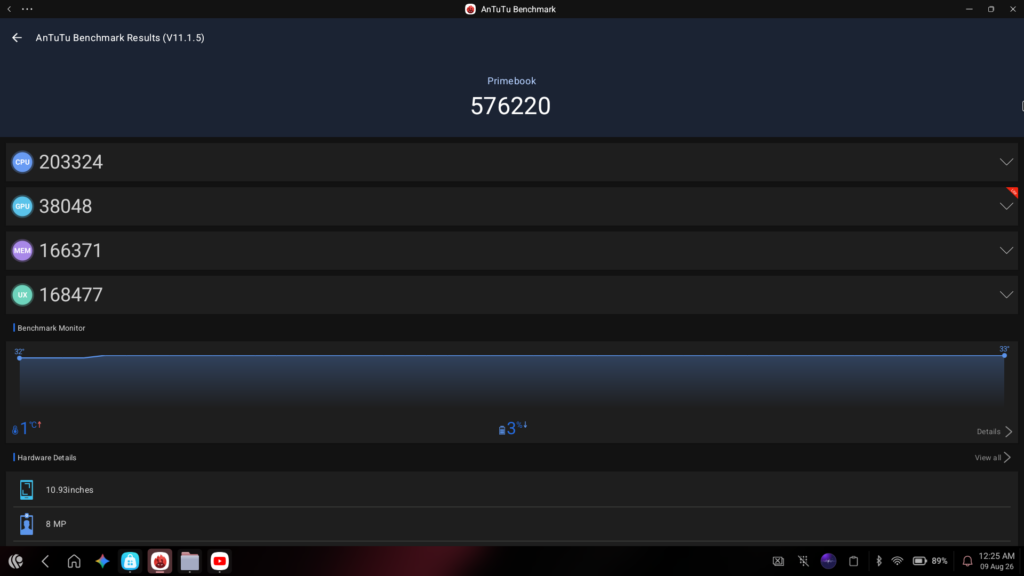
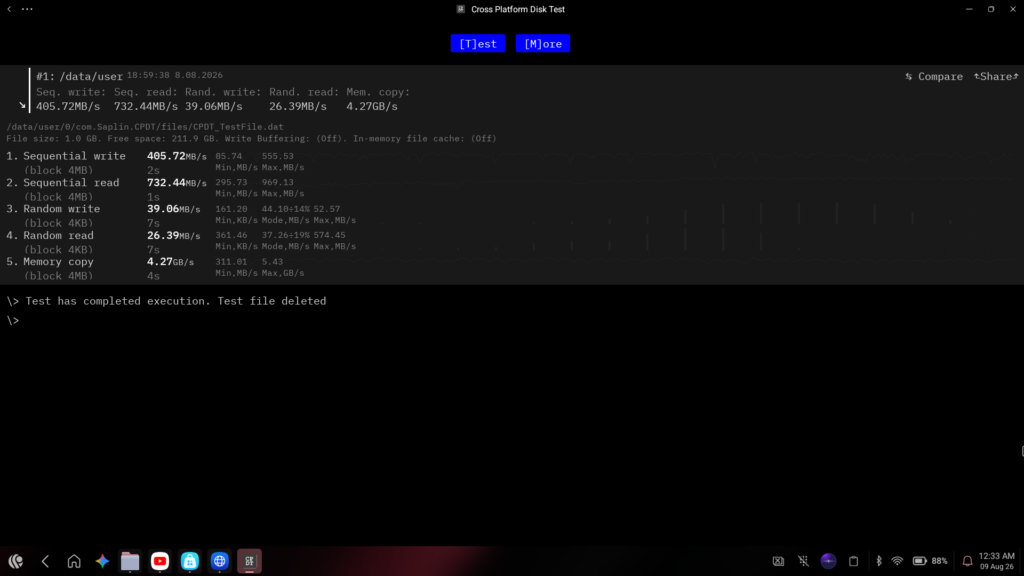
The benchmark numbers reflect this experience. In Geekbench 6, it scored 696 in single-core and 1,682 in multi-core. In AnTuTu, it reached a total score of 576,220. Storage speeds are reasonable for the price, with sequential read speeds around 732 MB/s and write speeds around 405 MB/s, which helps apps load relatively quickly.
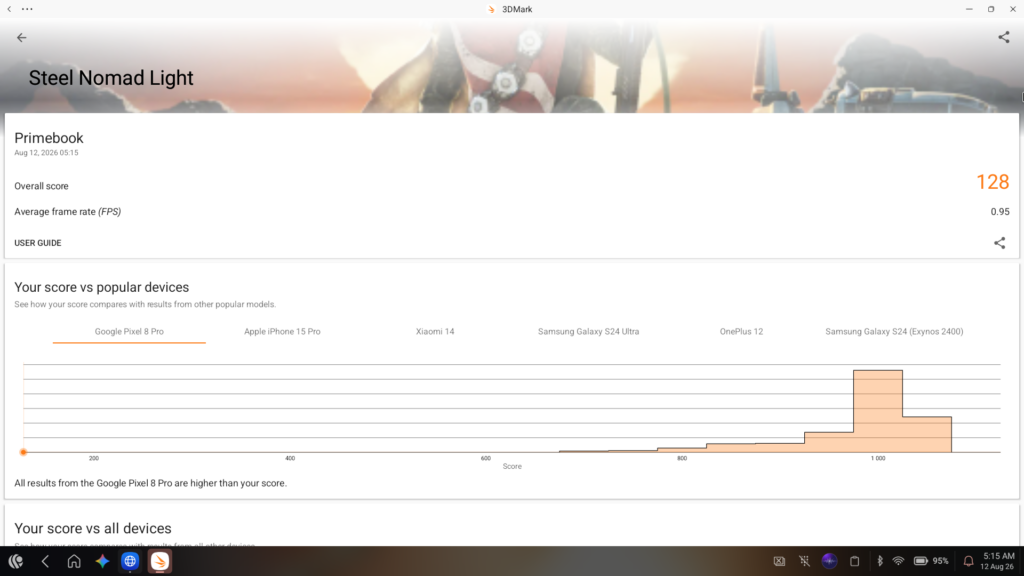
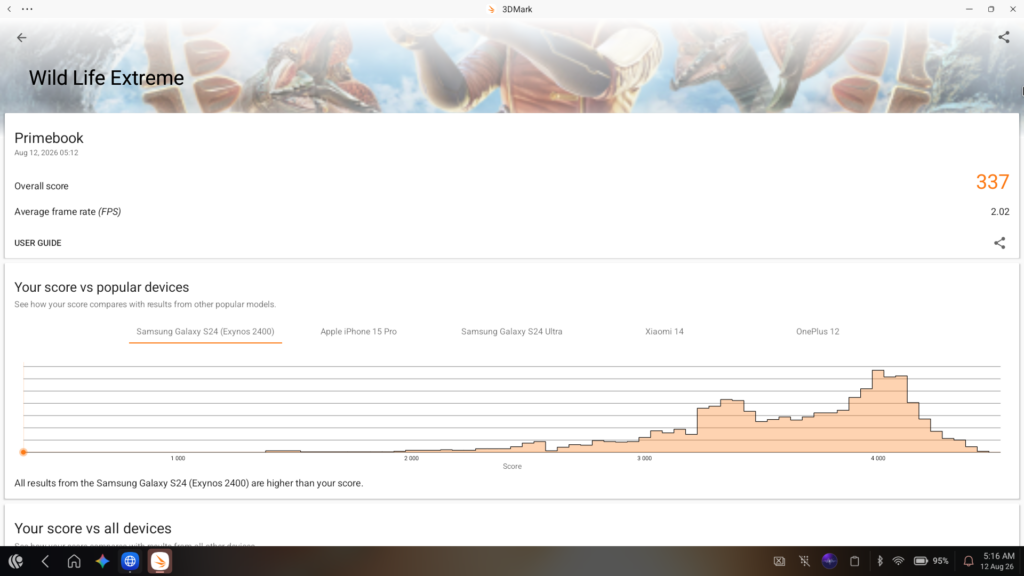
Graphics performance is where the hardware struggles the most. In the 3DMark Wild Life Extreme test, it scored just 337, averaging about 2 frames per second. This means the laptop is not meant for heavy 3D gaming.
You can play standard Android games like BGMI, Call of Duty, or Subway Surfers, but you will need to keep the graphics settings on low or medium for a smooth experience. The built-in keymapping software is quite helpful here, allowing you to assign keyboard keys to on-screen touch controls.
Software and AI
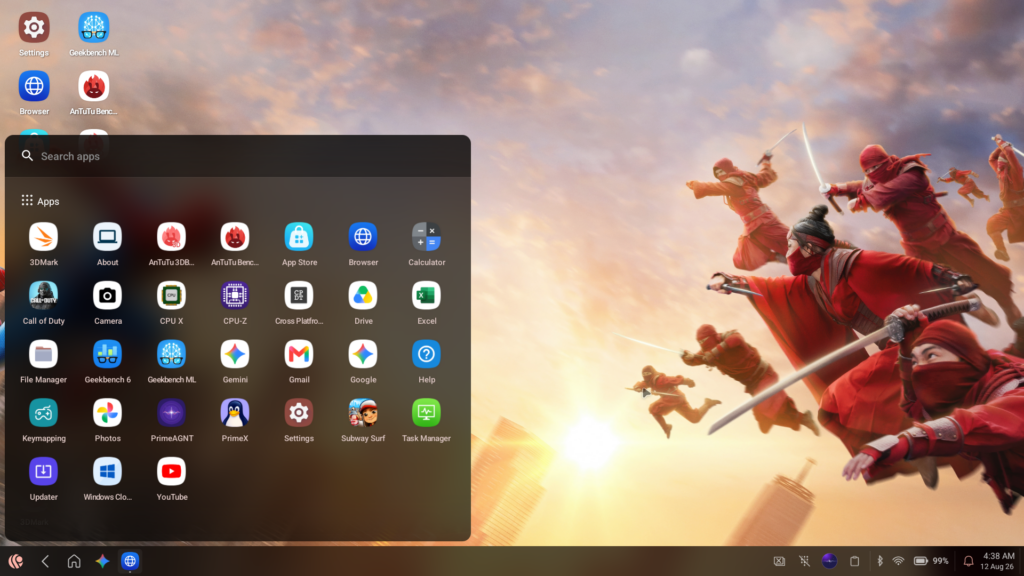
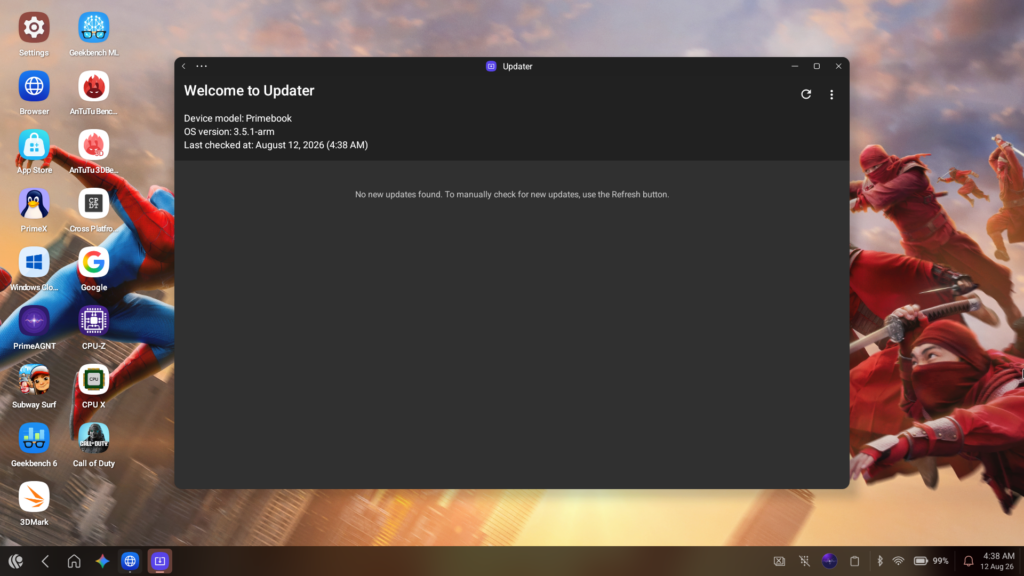
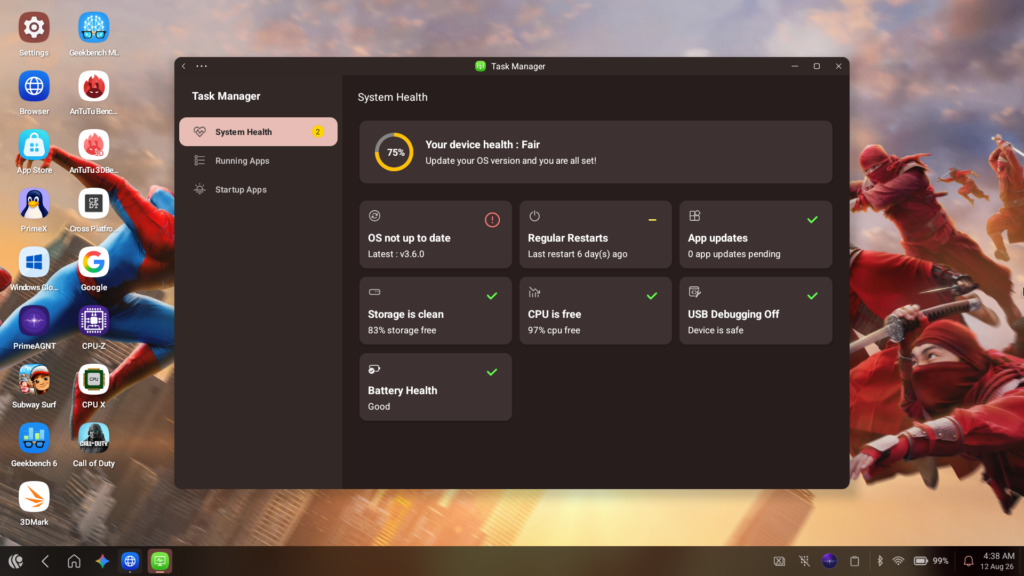
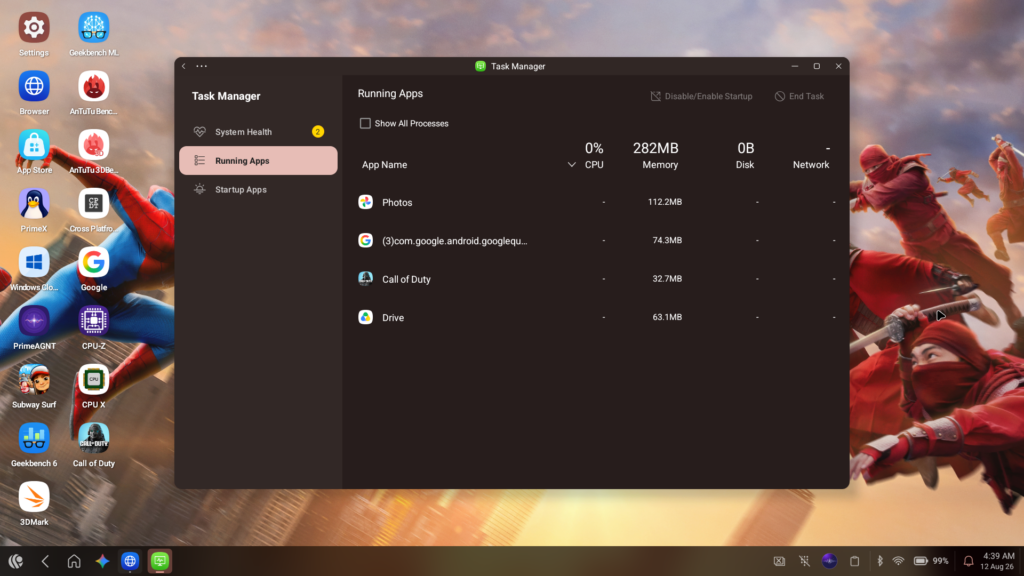
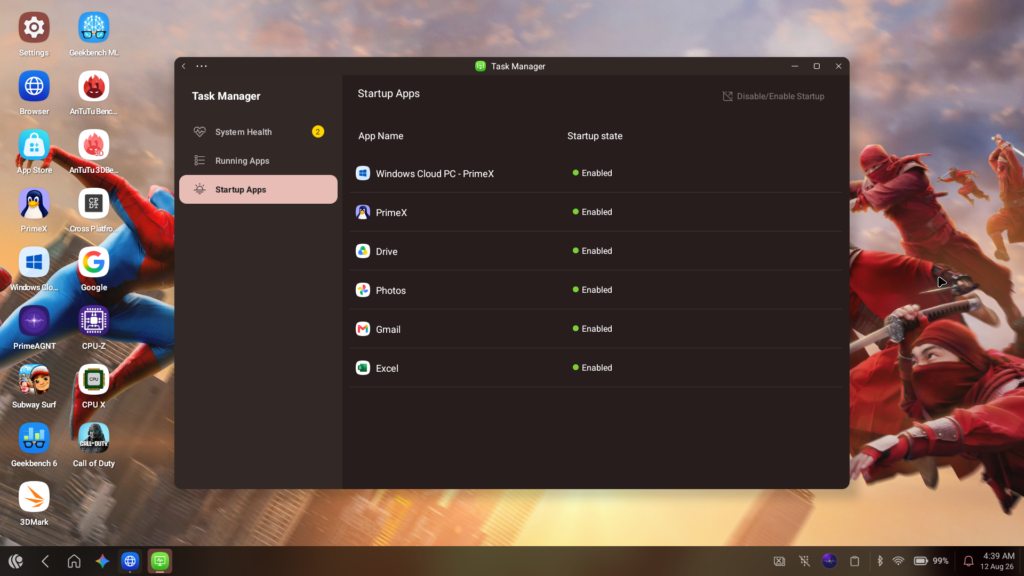
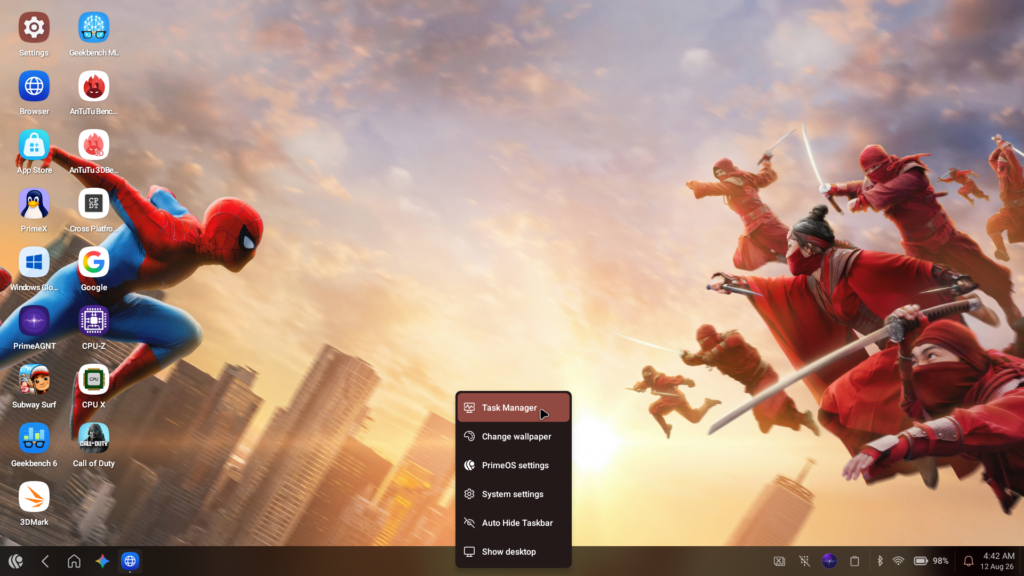
The software is the most interesting part of this laptop. It runs PrimeOS 3.0, which is based on Android 15 but modified to look and act like a desktop operating system. You get a taskbar, a start menu, and a task manager. You can open apps in resizable windows, snap them to the sides of the screen, and use familiar keyboard shortcuts like Alt+Tab.
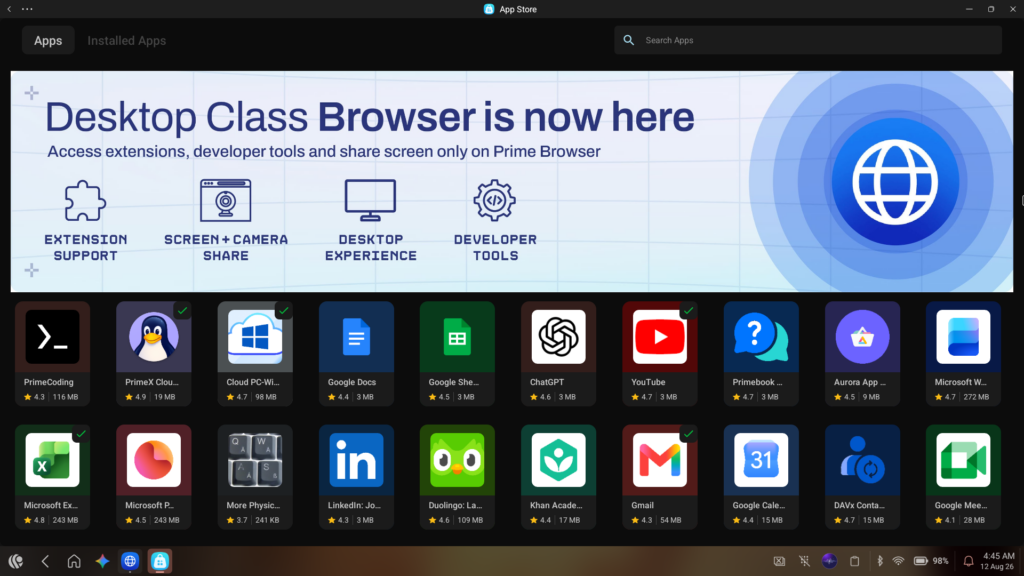
Because it is a custom OS, it does not come with the Google Play Store. Instead, you download apps from the Primestore. The store has a good selection of common apps, and there is an option to request apps that are missing.
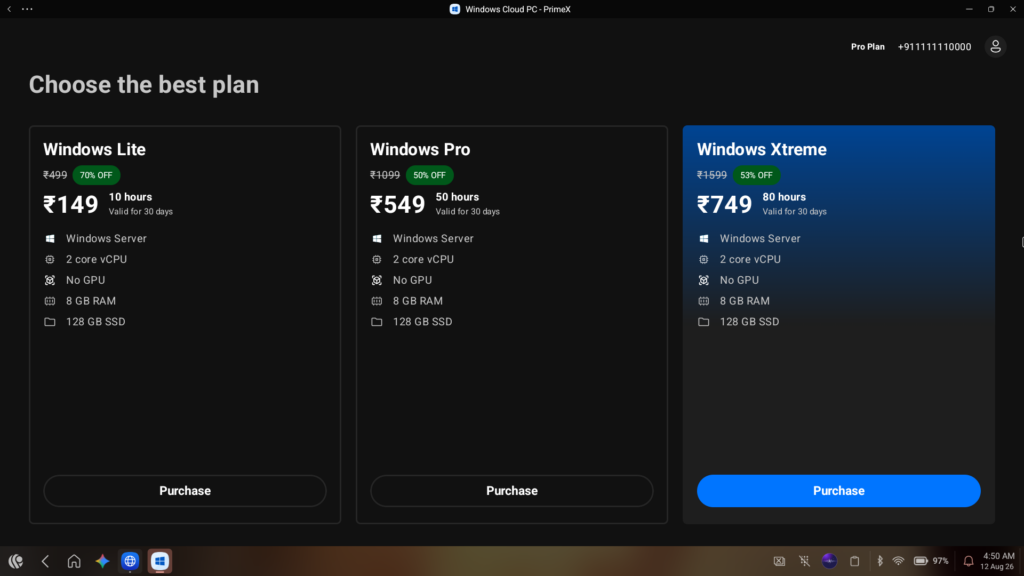
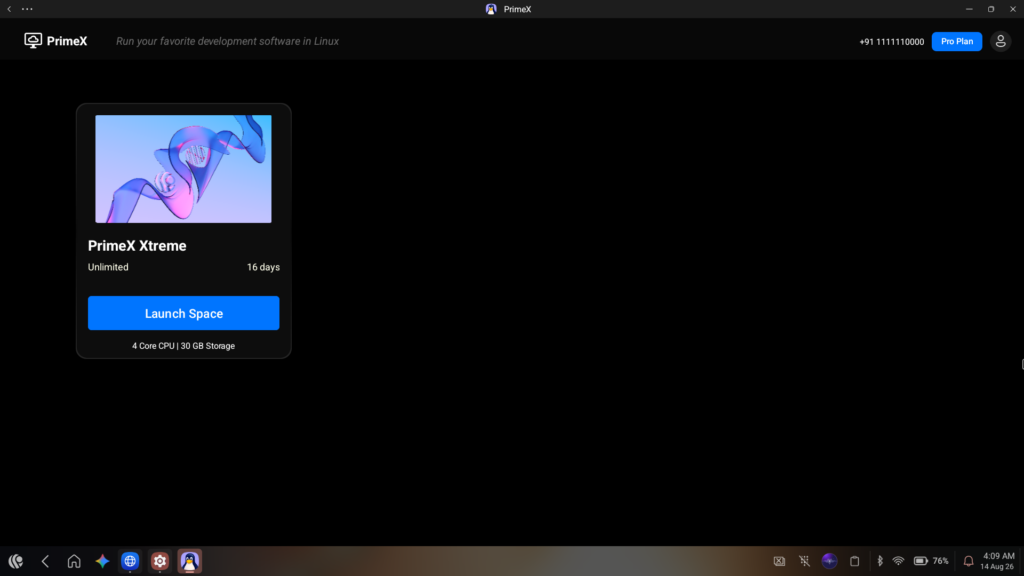
If you occasionally need to use full Windows or Linux applications, Primebook offers a feature called PrimeX, which is a Cloud PC service. By paying a subscription fee (starting at Rs. 499 per month), you can stream a virtual desktop to the laptop. I tried this on a stable Wi-Fi connection, and it worked well enough for running desktop software.
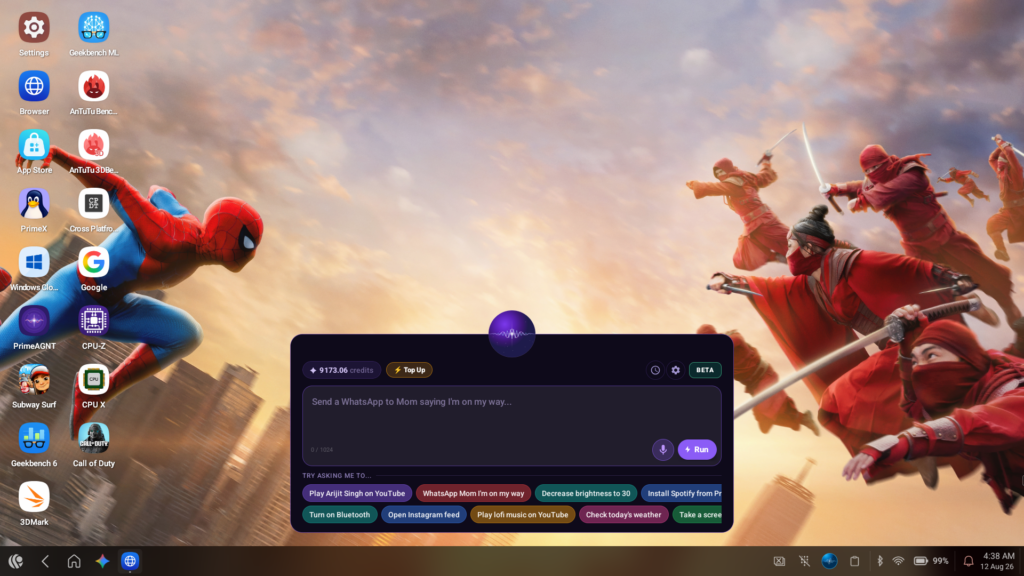
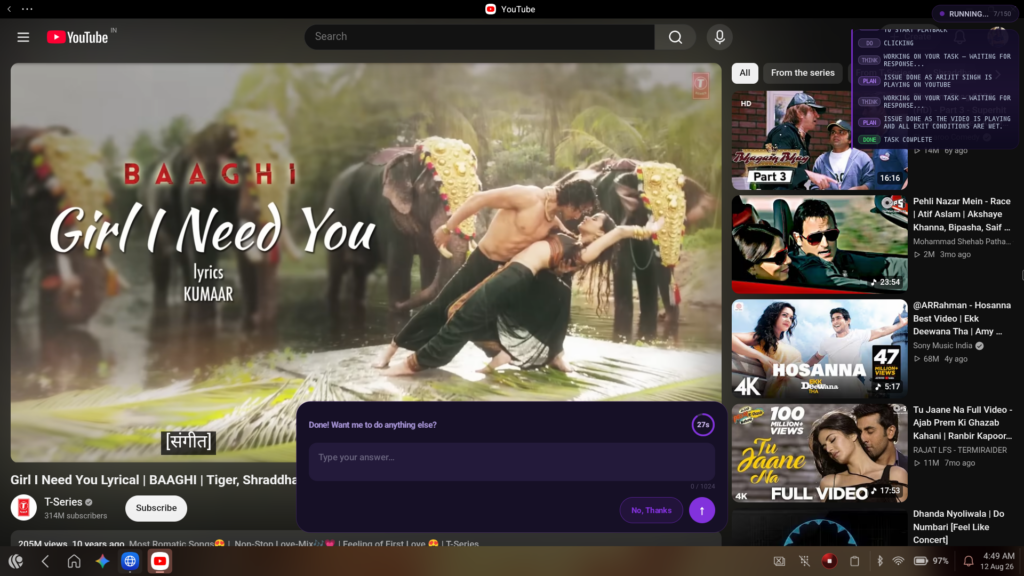
The OS also includes an AI feature called PrimeAGNT. It is powered by models like Gemini and Qwen and can perform tasks like reading your screen, summarizing text, or changing system settings. It operates on a credit system; the laptop comes with a set amount of free credits, and once you run out, you have to purchase more. It is a neat addition for basic automation, though it feels like a feature that is still evolving.
One notable software limitation is media streaming. The laptop only has Widevine L3 certification. This means that if you watch Netflix or Amazon Prime Video, the stream will be capped at standard definition (480p or 540p). It can play local 1080p video files perfectly fine, but the lack of high-definition streaming for major platforms is a drawback if you watch a lot of movies online.
Sound and Battery Life
The audio comes from dual stereo speakers located on the bottom, with secondary grilles near the keyboard. They get quite loud and are fine for watching YouTube videos or attending online meetings in a quiet room. However, they lack bass, and if you turn the volume up past 80%, the sound begins to distort.
Battery life is easily the laptop’s strongest feature. It has a 60.3Wh battery, and because the mobile processor is quite power-efficient, it lasts a long time. In my daily use, which consisted of web browsing, writing, and watching some videos, I consistently got around 10 to 12 hours of screen-on time. If you use it lightly, you can easily go a couple of days without plugging it in.
Charging, on the other hand, is less convenient. The laptop comes with a proprietary 36W charger, and it takes about two and a half hours to charge from zero to full. It does not support USB Power Delivery (PD) charging, which means you cannot use a standard high-speed Type-C phone or laptop charger to power it up. You have to carry the specific Primebook charger with you.
Verdict
The Primebook 2 Max (2026) is a practical machine that knows its target audience. By combining an Android-based operating system with a traditional laptop form factor, it offers a functional environment for people whose daily tasks revolve around web browsing, document editing, and mobile apps.
It gets the basics right: the screen is comfortable to look at, the keyboard is suitable for typing, and the battery life is excellent. The desktop-style interface of PrimeOS 3.0 makes navigating Android apps much easier than on a standard tablet.
It is not a laptop for power users. However, at Rs. 27,990, it provides a viable option for students or casual users who want a device with a long-lasting battery for basic daily work. If your computing needs are light and you want to avoid the sluggishness of entry-level Windows laptops, the Primebook 2 Max is worth considering.
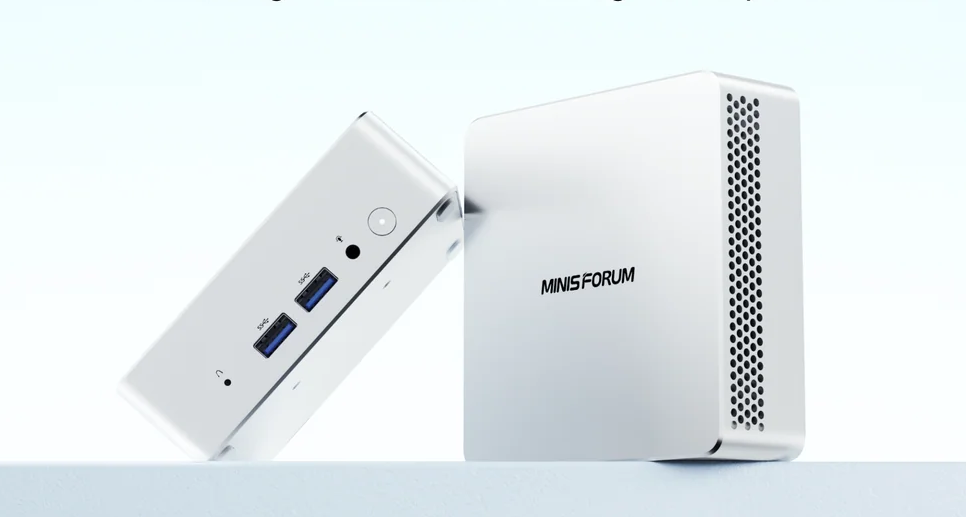
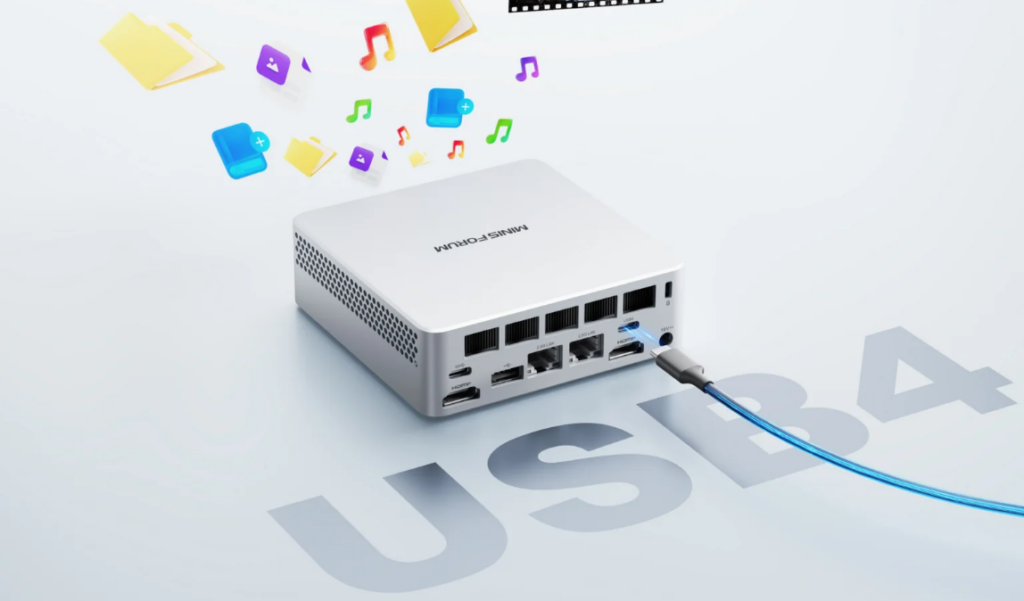
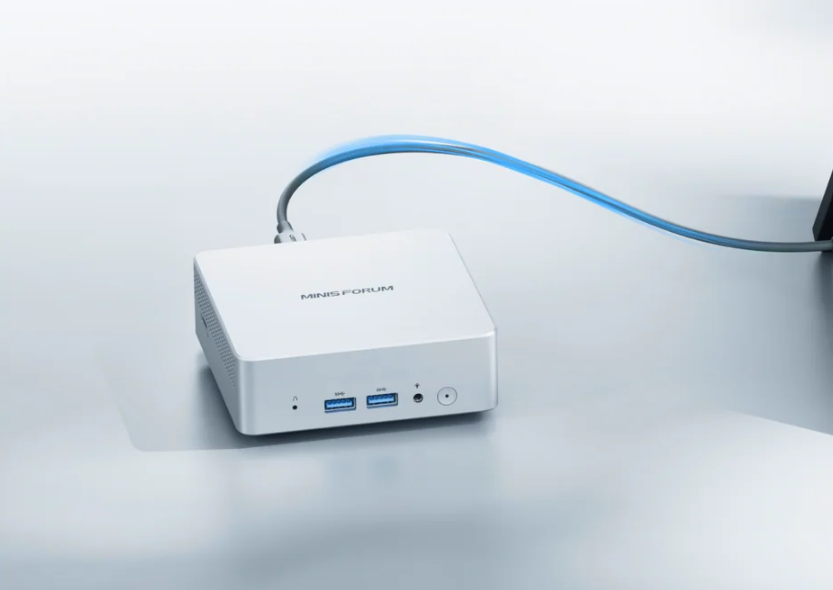
Minisforum has released the Elite Mini M2 Air-304, a new compact desktop PC that focuses on quiet operation and networking capabilities. It is currently available for preorder starting at $263 for the barebones model, with shipping expected in early September.
The M2 Air-304 is built around the Intel Core 3 304, a processor from Intel‘s Wildcat Lake lineup. It features five cores and five threads, with a maximum turbo frequency of 4.3GHz. This isn’t a machine built for heavy gaming or intensive video editing. Instead, Minisforum is positioning it as a practical option for standard office work, retail point-of-sale systems, and home media setups.
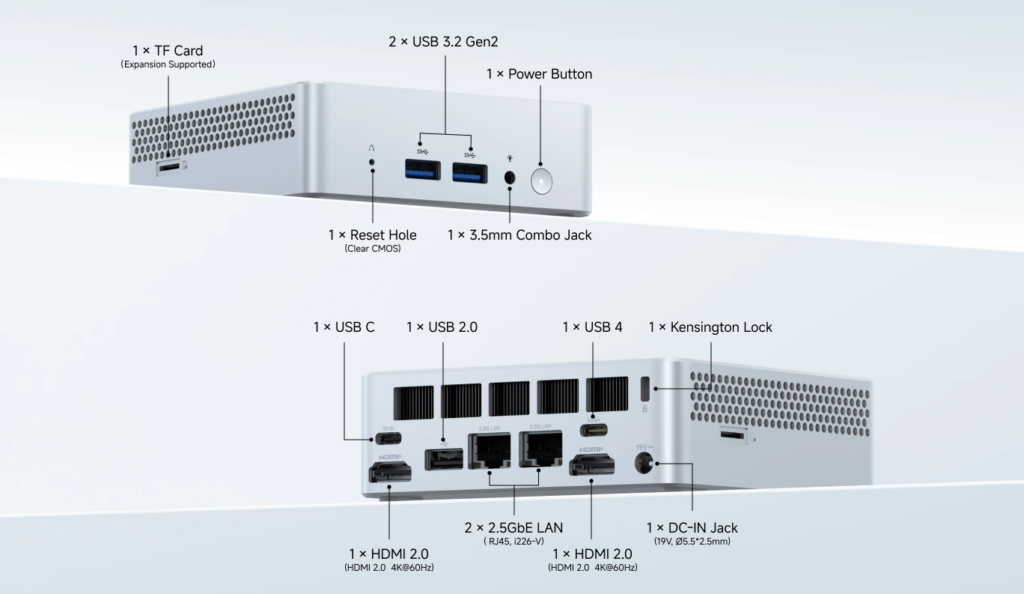
Inside the 0.47-liter case, which measures 112 x 112 x 37.15mm, there is room for up to 64GB of DDR5 memory. While the motherboard supports memory speeds up to 6400 MT/s, the pre-configured models will ship with 5600 MT/s RAM. For storage, the system includes a single M.2 2280 PCIe 4.0 NVMe slot, along with a TF card slot for additional storage expansion.
The M2 Air-304 includes two 2.5GbE LAN ports with Intel I226-V controllers, making it suitable for soft routers, network segmentation, and lightweight network nodes. It also supports Wi-Fi 6E and Bluetooth 5.4.
For connectivity, the front of the device has two USB-A 3.2 Gen 2 ports and a 3.5mm audio jack. The back panel includes a USB4 port that supports 40Gbps data transfer and power delivery, a 10Gbps USB-C port, one standard USB 2.0 port, and two HDMI 2.0 outputs. By using the HDMI and USB4 ports together, the computer can output to three 4K displays simultaneously at 60Hz.
The PC uses a standard blower fan and phase-change material for cooling. In its 15W Silent Mode, the company says it produces about 28.1dB of noise under full load. In the 28W Balanced Mode, that goes up to 32.7dB, keeping CPU temperatures between 72 and 80 degrees Celsius.
The barebones M2 Air-304 is currently discounted to $263 (down from its regular $329 price tag), while a fully configured model with 16GB of RAM and a 500GB SSD is priced at $559.
In related news, Acemagic has recently unveiled the F9A Mini PC with AMD Ryzen AI Max+ 395, up to 128GB RAM, and Oculink eGPU support.
Rising component costs are quietly reshaping the cheap end of the American smartphone market in ways most people didn’t see coming a year ago. The ultra-affordable segment is thinning out fast, leaving fewer choices for buyers on a tight budget.
According to Counterpoint Research, sales of phones under $100 in the US dropped 64% year-over-year in the second quarter of 2026. That put volume in the segment at roughly one-third of what it was a year earlier. The main culprit? Skyrocketing memory chip prices.
Manufacturers have been forced to either raise retail prices or just stop shipping the cheapest models. Memory and storage now eat up a much bigger chunk of the bill of materials on budget phones, so the old rock-bottom price points are getting harder to hit.
Overall US smartphone sales fell 5% in the quarter. The top four brands, Apple, Samsung, Motorola, and Google, only dropped about 4% combined. Everyone else? Their sales plunged 45%. Smaller and niche players that depended on thin margins from low-cost devices are feeling the heat the most. Some, like HMD, had already pulled back or left the US market last year because of weakness in the prepaid channel and tariff uncertainty. Higher memory and storage costs have only made things tougher.
Prepaid smartphone sales themselves were down 11% year-over-year. But inside that shrinking channel, Samsung and Motorola actually gained ground. Samsung’s share of the US prepaid market jumped nine percentage points to 47%, while Motorola picked up four points to hit 32%. Carriers are leaning harder on Samsung’s Galaxy A series and Motorola’s Moto G lineup to keep customers as the cheaper alternatives disappear. With fewer options left, the prepaid space has pretty much narrowed down to these two brands.
The end result: the cheapest phones are becoming harder to find and more expensive. As long as memory costs stay high, that pressure on the budget tier isn’t going away anytime soon.
1MORE has released the AiClip S52, a new pair of open-ear wireless earbuds that integrate AI productivity software. The earphones are currently available in China for a standard price of 698 yuan ($103), with a launch discount bringing them down to 628.2 yuan ($93).
The S52 uses a clip-on form factor that leaves the ear canal open. The earbuds attach using a 0.5mm titanium alloy C-shaped bridge and a four-point support system designed to keep them stable during movement.
To address the sound leakage that typically affects open-ear designs, 1MORE included directional audio transmission technology, which the company says limits leakage to between 10 and 15 decibels. The earbuds are rated IPX5 for water resistance, meaning they can handle sweat and light moisture.
Internally, the earbuds use 11mm composite-diaphragm dynamic drivers. They support standard SBC and AAC codecs, as well as LDAC for higher-resolution audio, and include spatial audio processing.
For connectivity, the S52 adopts the Bluetooth 6.0 standard. This allows for a 10-meter connection range and dual-device multipoint pairing, letting users stay connected to two devices simultaneously with automatic switching.
The earbuds focus on AI-powered software integration through the 1MORE companion app, connecting to models like DeepSeek, Tencent Hunyuan, and Doubao for meeting transcription, summaries, and mind-map generation.
The software also includes a translation tool for face-to-face conversations, supporting simultaneous interpretation across 17 languages. To capture audio for these features and standard phone calls, the earbuds use a four-microphone array with wind-noise reduction.
Battery life is listed at up to 10 hours of playback per charge from the 40mAh batteries in each earbud. The 400mAh USB-C charging case extends the total usage time to 45 hours. Playback, calls, and the voice assistant are managed through standard touch controls on the earbuds, which can be customized in the app.
In related news, QCY has launched the affordable T13 Pro earbuds with 50dB ANC, 13mm drivers, and up to 49 hours of battery life. Edifier has also introduced new wired gaming earbuds featuring Hi-Res Audio and hybrid triple drivers.
Poco is adding another phone to its lower mid-range lineup. A new member of the M8 family has started showing up online, and it looks like it’s aimed squarely at people who want 5G at an affordable price.
The company has begun teasing the M8x 5G on Flipkart. The teaser reveals part of the rear design of the phone. Unlike the Poco M8 Power, it features a smaller camera island.
Based on the teaser, the device appears to have two rear camera cutouts. However, it wouldn’t be surprising if only one of those cameras turns out to be truly useful. For reference, the Poco M8 Power packs a 50MP main camera paired with a low-resolution auxiliary sensor.
The Poco logo sits right in the middle near the bottom. The flat middle frame also appears to have a gold accent, just like the camera module. Overall, it’s a pretty clean, straightforward look.
Beyond the rear design and the confirmation that it’s 5G, Poco hasn’t shared much else yet. Specs, price, and a firm launch date are still under wraps, though more details should drop in the next few days.
For context, the M8 Power has a 6.9-inch FHD+ AMOLED screen with 120Hz refresh rate, a Snapdragon 4 Gen 4 chip, an 8,000mAh battery, up to 8GB of LPDDR4X RAM, and 128GB of UFS 2.2 storage. It launched at ₹24,999. The upcoming M8x will probably land in a similar price range or a bit lower, sticking to Poco’s usual playbook of packing decent hardware into affordable phones.
The fact that a dedicated Flipkart page is already live usually means the official announcement isn’t far off. India’s budget 5G segment is already crowded, and the M8x looks set to jump into that mix with the usual focus on everyday performance, solid battery life, and no-frills design.
Fresh patent images that popped up in the WIPO Global Design Database show what could be the Galaxy S27’s rear cameras. The line drawings show three sensors lined up side by side inside one long horizontal bar.
It looks a lot like the camera bar on Google’s Pixel 11 series, and it also brings back memories of the more integrated module Samsung used on the old Galaxy S10.
One of the line drawings shows the camera island sitting almost flush with the back glass instead of sticking out in a big bump. Don’t take that part too seriously, though. Patent drawings usually don’t show real dimensions, so the “almost flat” look could just be simplified for the filing.
It’s also pretty unlikely the protrusion would suddenly vanish completely. That kind of change would generally mean smaller optics, which most people would read as a camera downgrade.
Still, a lower bump than what we’ve got now could make the phone look and feel a bit cleaner and play nicer with magnetic cases and accessories.
Everything else about the phone looks pretty familiar: rounded corners, flat sides, the same overall shape we’ve come to expect from the Galaxy S line. Samsung doesn’t seem to be redesigning the whole body, just rethinking how the cameras sit on it.
Of course, take these patents with a grain of salt. Companies file all kinds of designs that never see the light of day. This horizontal bar might just be one idea they’re playing with. Still, it lines up with earlier rumors about Samsung moving to a more “unified” camera module and ditching the floating-ring look that’s been around since the S22.
Some reports have also tied possible camera changes to practical stuff, like making room for magnetic wireless charging coils. Whether that’s the real reason or not is still up in the air. What we do know is the Galaxy S27 series isn’t expected until early 2027, so Samsung still has some time to tweak things or scrap the idea completely.
If this horizontal bar actually makes it to the final phone, it would be one of the more noticeable design shifts the Galaxy S series has had in a while: not a total overhaul, but different enough that you’d notice it next to the phones people are carrying right now.
The 360 camera market just had its biggest week of the year. Insta360 launched the X6 on Wednesday, and DJI followed less than a day later with the Osmo 360 II. Both replace flagship models that have been at the top of the category, and both bring noticeable improvements in image quality.
This doesn’t mean you should ignore the older models, though. If you’re on a tighter budget, the previous-generation cameras are still very capable and should be available at a discount too.
The biggest advantage of a 360 camera is simple; you don’t have to worry about framing while recording. Just hold the camera up, hit record, and choose the best angle later on your phone or laptop. You can capture everything around you and decide what the final shot should look like afterward.
Here are the best 360 cameras for panoramic shots that you can get in 2026.
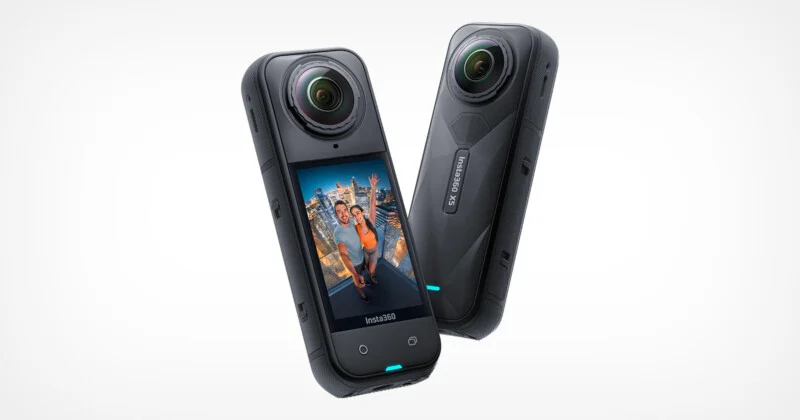
The X6 is now Insta360’s flagship offering, and it’s a major upgrade over the X5 rather than a small refresh. It uses two Sony 1/1.1-inch square sensors that deliver full 1-inch-equivalent 360 imaging. The sensors also offer 33% more area than those in the X5 and can capture much more light for brighter shots.
The X6 can record 8K video at 50fps, up from the X5’s 30fps at 8K, and can also capture 120MP photos. For processing, it has a triple-chip system built around an 8-core, 4nm processor. Insta360 says the X6 has about five times the computing power of the X5.
Other features include 10-bit color, Dolby Vision, an improved PureVideo low-light mode, and the new Replaceable Lenses 2.0 system. It also has 47GB of usable internal storage, which is a first for the X series and means you don’t always need a memory card.
The camera uses a 2,600mAh battery and is rated for up to 140 minutes of continuous 8K recording. The X6 starts at $699.99 for the Standard Bundle and $799.99 for the Essentials Bundle in the US. That’s $150 more than the X5’s starting price.
If $699.99 is too much, the X5 is still a very good option. It uses two 1/1.28-inch sensors and can record 8K video at 30fps while capturing 72MP photos. You also get Insta360’s PureVideo low-light mode, replaceable lenses, a built-in wind guard, and waterproofing down to 49 feet without a case.
The X6 has the advantage in sensor size, frame rate, and processing power. But for travel videos, vlogging, and everyday action footage, the X5 still does a good job.
At $549.99, it also offers better value now that the X6 is available. Insta360 also sells a BMW Motorrad edition of the X5 aimed at motorcycle riders. It comes with features such as handlebar controls and an extended battery.
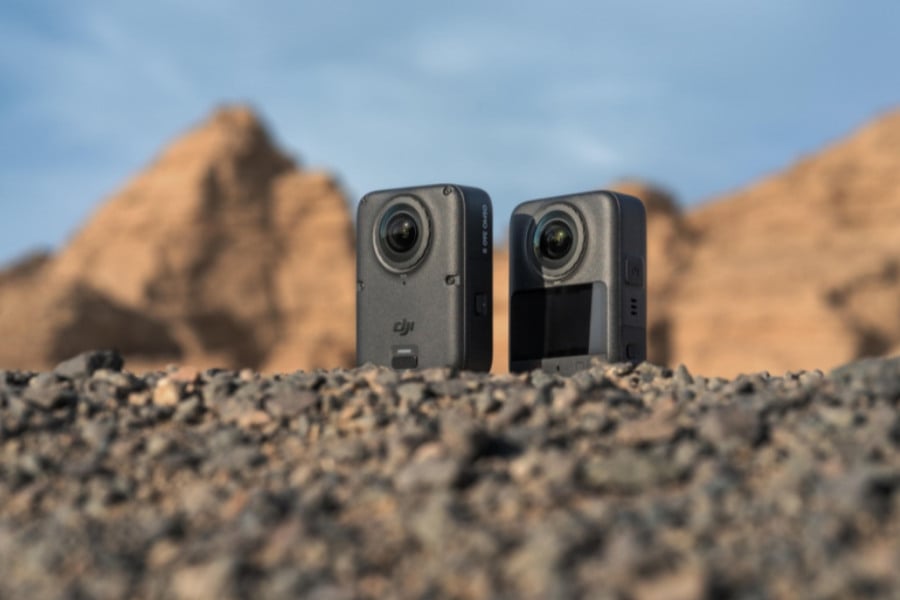
DJI responded to Insta360 less than a day later with the Osmo 360 II. The camera uses the same 1/1.1-inch sensor class as the original Osmo 360 but increases 8K panoramic video to 60fps. That gives it a slight advantage over the X6’s 8K50 recording.
DJI has also increased dynamic range to 14.5 stops in D-Log M, compared with 13.5 stops on the original model. The camera still captures 120MP shots, but the II adds HDR and RAW photo capture.
The battery is larger at 2,150mAh, compared with 1,950mAh on the first model. It also supports 27W USB-C fast charging. Another important upgrade is user-replaceable lenses.
The Osmo 360 II also has NFC for quick pairing and 105GB of internal storage, which is carried over from the original model. In China, the standard bundle costs around 3,299 yuan, or roughly $460.
The biggest problem right now is availability. DJI has only confirmed the China launch so far, and there is no listing for the Osmo 360 II on DJI’s US store. With the restrictions affecting DJI products in the US, it isn’t clear when the camera will officially arrive there.
4. DJI Osmo 360
DJI Osmo 360
The original Osmo 360 is still available and is now cheaper in markets where the II has launched. It offers dual 1-inch square sensors, 8K video at 50fps, 13.5 stops of dynamic range, and up to 100 minutes of 8K recording on one charge.
The camera also uses the same battery and magnetic mounting system as the DJI Osmo Action 5 Pro. That is useful if you already own DJI action-camera accessories.
The original Osmo 360 is also officially available in the US, making it the more practical DJI option for American buyers right now. It costs around $549.99.
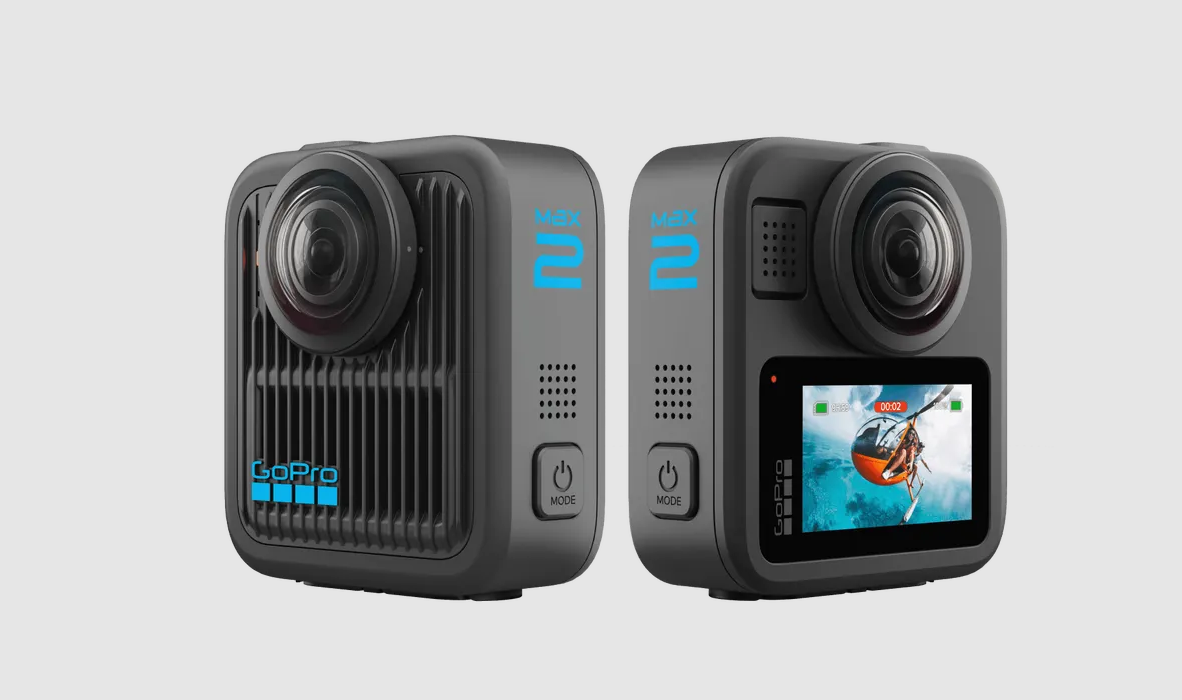
GoPro stayed out of the 360 camera race for years while Insta360 and DJI moved ahead. The company finally returned with the MAX2 last year.
GoPro calls it the only “True 8K” 360 camera, based on how it calculates resolution. The MAX2 records 8K 360 video, as well as 5.6K at 60fps and 4K at 100fps. Its biggest advantage over the newer Insta360 and DJI models is built-in GPS.
The MAX2 also brings back GoPro’s replaceable lens system and uses a 1,960mAh Enduro battery designed to work in cold weather. It’s rugged, waterproof, and supports 16 mounting accessories made specifically for the camera. At $499.99, it has the lowest starting price among the flagship-level 360 cameras on this list.
Not everyone shooting 360 content needs video, and for stills-first work like real estate listings and virtual tours, the Ricoh Theta X is the camera most professionals reach for. It pairs dual 48MP sensors to produce spherical stills at up to 60MP, or 11K resolution, well beyond what any of the action-camera-style 360 shooters above offer for photos. The video tops out at 5.7K at 30fps.
Ricoh Theta X
What sets the Theta X apart is how it’s built to be used on its own. It has a 2.25-inch color touchscreen that lets you preview shots, adjust settings, and review captures without pulling out your phone, and it’s the first Theta model with an interchangeable battery and a microSD card slot instead of fixed internal storage.
It also has built-in GPS that geotags your shots automatically, and the camera runs on Android, so it accepts third-party plug-ins for things like automatic face blurring or wireless livestreaming.
Ricoh also added HDR RAW capture in DNG format for professionals who edit files afterward instead of working from flattened JPEGs. Its pricing starts at $649.
To get the best 360 camera for your needs, start with your budget and think about what you plan to shoot. If you want the best overall image quality and don’t mind spending $699.99 or more, the Insta360 X6 is the easiest recommendation. The DJI Osmo 360 II is also very competitive on paper, especially with its 8K60 recording, but its availability is still limited.
If you want to save money, the Insta360 X5 and original DJI Osmo 360 are still strong choices. Both can record 8K video and offer enough quality for travel, vlogging, and everyday shooting.
The GoPro MAX2 is the cheapest flagship-level option. It’s also the obvious choice if built-in GPS is important to you or you’re already using other GoPro products. And if you’re shooting stills for real estate rather than video, skip the action-camera crowd entirely and go with the Theta X.
iQOO has once again raised the cost of a few of its popular models. The latest increases hit the flagship iQOO 15, along with the 15R and Neo 10, and they reflect the same industry-wide pressure we’ve been seeing.
The biggest jump is on the iQOO 15. The 12GB + 256GB version has gone from ₹76,999 to ₹85,999 (a ₹9,000 hike), while the 16GB + 512GB model jumped from ₹83,999 to ₹93,999 (₹10,000 more). From its original launch price of ₹72,999 for the base model, the phone is now ₹13,000 more expensive overall.
The iQOO Neo 10 got smaller ₹2,000 bumps on both variants, taking the 8GB + 256GB to ₹43,999 and the 12GB + 256GB to ₹48,999. Still, its base price has climbed a full ₹10,000 from the original ₹33,999 launch tag.
This isn’t just an iQOO thing. Memory makers have been prioritizing higher-margin AI server chips, which has tightened supply and pushed up DRAM and NAND prices for phones. Several brands have already made similar adjustments through 2026.
Xiaomi’s Redmi Turbo 5 is another example. It launched in mid-June at ₹37,999 (8GB + 256GB) and ₹40,999 (12GB + 256GB), but those same models are now listed at ₹41,999 and ₹46,999 on Amazon, hikes of ₹4,000 and ₹6,000. What’s interesting is that the nearly identical POCO X8 Pro is still available at lower prices, sometimes dipping under ₹33,000 during sales.
One small silver lining for anyone eyeing the iQOO 15: the Legend edition 12GB + 256GB variant is still showing the older ₹76,999 price on Amazon at the time of writing. Both the Legend and Apex editions use the same hardware, so if that listing is still live, it could be a temporary window to grab it at the previous rate before everything gets updated.
The Redmi K100 Pro Max raises the bar for performance-focused smartphones with an unusually large battery, high-refresh-rate display, and flagship-grade hardware. However, its availability outside China remains uncertain, leaving buyers looking for similar options with broader availability.
Redmi K100 Pro Max
The phone features a 1.5K 185Hz OLED display, Snapdragon 8 Elite Gen 5 chipset, 200-megapixel triple rear cameras and a huge 9,070mAh battery. In China, it is priced between roughly $600 and $850 depending on the configuration. If you want similar performance without waiting for a wider K100 Pro Max rollout, these five phones are worth considering.
For how these gaming-leaning picks compare with the broader field, check our list of best flagship phones of 2026.
An upcoming option that could be the closest alternative because it is essentially the same hardware platform in a different package.
The Poco F9 Ultra is the unusual entry on this list because it has not been released yet. Its inclusion makes sense because the phone is expected to be based on the Redmi K100 Pro Max, meaning much of the core hardware is expected to remain unchanged. The main reported difference is an 8,050mAh battery, which would still give it a substantial capacity for a flagship smartphone.
The F9 Ultra is therefore expected to retain the performance-focused hardware, display and camera characteristics associated with the Redmi model, while carrying Poco’s software and branding. The existing F8 Ultra received four major Android OS upgrades and six years of security patches, setting a useful benchmark for what could be expected from its successor. For anyone specifically interested in the K100 Pro Max but concerned about availability, the F9 Ultra could ultimately be the most interesting alternative.
Which of these five phones would you pick over the Redmi K100 Pro Max, and what matters most to you in a performance-focused flagship?
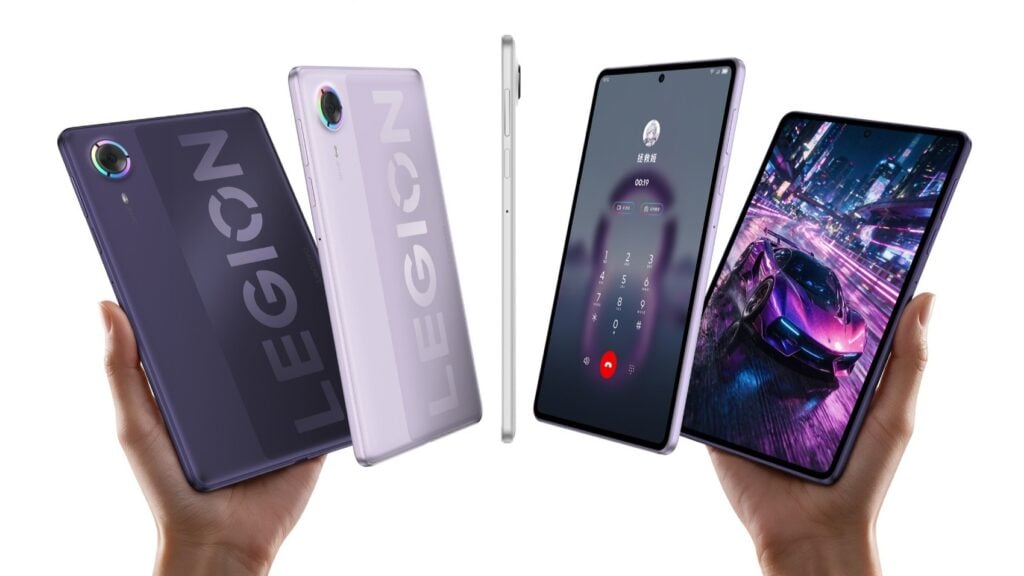
The Lenovo Legion Y700 Infinite is set to launch in China on August 25, and the specs sheet just got a lot more detailed. Prolific tipster Digital Chat Station took to Weibo today to reveal the full specs of the tablet.
According to the reveal, the Y700 Infinite will feature an 8.4-inch OLED panel running at 2560 x 1600 resolution with a 165Hz refresh rate. The Legion Y700 Gen 5 has an LCD screen, by comparison.
On the memory front, you get LPDDR5T RAM rated at 10667MT/s alongside UFS 4.1 Pro storage.
Powering the chip will be a 7470mAh cell with 68W fast charging, so a full top-up won’t eat into your gaming time. On the camera side, there’s an 8MP front shooter for calls and a 50MP rear camera for quick photos, though this remains a tablet built for performance, not photography.
Storage options run from 12GB+256GB up through 16GB+512GB and 24GB+1TB, and every configuration takes a SIM card. That’s the headline change here: this tablet supports the N79 5G band, making it the first in the Legion Y700 line with native cellular instead of Wi-Fi only.
For gaming feel, you get dual X-axis motors, dual speakers, and dual USB-C ports, plus fingerprint unlocking built into the frame. Lenovo has kept the body slim too, at 6.5mm thick and 298g, with equal-width bezels of about 2.89mm on all four sides for a symmetrical look.
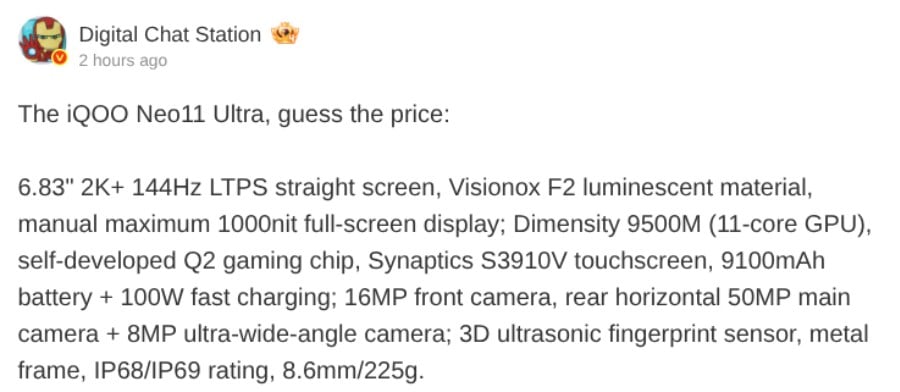
The iQOO Neo 11 Ultra is almost here, and a fresh leak from tipster Digital Chat Station lays out nearly everything the phone will offer before it goes on sale on August 18 in China.
To start with the screen, you get a 6.83-inch 2K flat display running at 144Hz, built with Visionox’s F2 luminescent material and capable of hitting 1000 nits in manual mode across the full panel. iQOO has already teased these display specs ahead of launch, so this leak lines up with what the company itself has shown.
Power comes from a Dimensity 9500M paired with an 11-core GPU, plus iQOO’s own Q2 gaming chip and a Synaptics S3910V touch controller for faster response during gaming sessions. The combo sits inside a metal frame that carries both IP68 and IP69 ratings. The body is 8.6mm thick and weighs 225 grams.
As for the battery, you’re getting a massive 9100mAh cell with 100W wired charging. iQOO confirmed this alongside the Neo 11 Ultra’s design earlier this month.
On the camera side, you get a 16MP front shooter for selfies, while the back houses a 50MP main sensor next to an 8MP ultra-wide lens, arranged horizontally rather than in the vertical stack you’d have seen on the standard Neo 11. Security comes from a 3D ultrasonic fingerprint sensor built into the display.
iQOO Neo 11 Ultra color options
iQOO plans to sell the Neo 11 Ultra in Wind Chaser, Shadow Black, and Light White colorways, and the company is already calling it the only 2K-screen flagship with a 9100mAh battery. The hands-on images of the Light White version show a new 3D flowing light effect that shifts its sheen depending on the angle and lighting.
You know a brand is feeling confident when it starts building phones to show off what it can do. That’s exactly what iQOO is doing with its new concept device, the iQOO X. The company reportedly showed off the phone internally yesterday, with specs that exist only on paper for now.
The chipset alone tells you this is a look further down the road rather than anything close to shipping. The iQOO X runs on a Snapdragon 8 Elite Gen10 Pro, paired with a self-developed e-sports chip called QX.
For what it’s worth, Qualcomm is only just preparing the Snapdragon 8 Elite Gen 6 Pro for its next real flagship platform, so a Gen10 Pro chip puts this concept phone several generations into the future.
The iQOO X also packs a 15,000mAh all-solid-state battery, nicknamed the “Blue Ice Battery.” Solid-state batteries with that kind of capacity aren’t something you’ll find in any phone on shelves right now, which is part of the point of a concept device like this.
The display is a 7-inch true full-screen LTPO 6.0 panel with 2K+ resolution and a 240Hz refresh rate, backed by a half-screen ultrasonic fingerprint sensor. It also has a 4,800Hz sampling rate for near-instant input, along with AI dynamic partition refresh that allows different parts of the screen to refresh independently.
On the camera side, the setup includes a 200MP Sony main sensor, a 200MP Samsung periscope telephoto lens, and a 50MP Samsung ultra-wide sensor. iQOO also brought physical prototypes to the event for a first look at how the design and structure might actually come together.
Usually, brands don’t announce pricing for concept devices, but iQOO went ahead and shared pricing anyway. The base 12GB+512GB model comes in at ¥6,999 (around $1,038), while the 16GB+512GB version steps up to ¥7,399 (about $1,097). A 16GB+1TB model costs ¥7,799 (roughly $1,157), and the top-tier 24GB+1TB configuration tops out at ¥8,599 (close to $1,275).
We use cookies on our website to give you the most relevant experience by remembering your preferences and repeat visits. By clicking “Accept”, you consent to the use of ALL the cookies.
This website uses cookies to improve your experience while you navigate through the website. Out of these, the cookies that are categorized as necessary are stored on your browser as they are essential for the working of basic functionalities of the website. We also use third-party cookies that help us analyze and understand how you use this website. These cookies will be stored in your browser only with your consent. You also have the option to opt-out of these cookies. But opting out of some of these cookies may affect your browsing experience.
Necessary cookies are absolutely essential for the website to function properly. This category only includes cookies that ensures basic functionalities and security features of the website. These cookies do not store any personal information.
Any cookies that may not be particularly necessary for the website to function and is used specifically to collect user personal data via analytics, ads, other embedded contents are termed as non-necessary cookies. It is mandatory to procure user consent prior to running these cookies on your website.