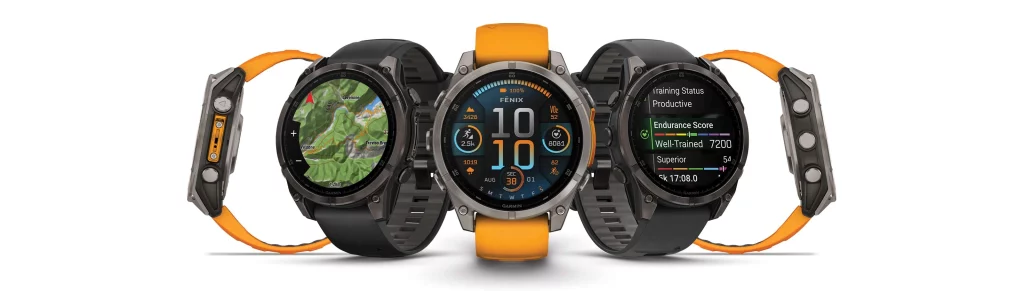
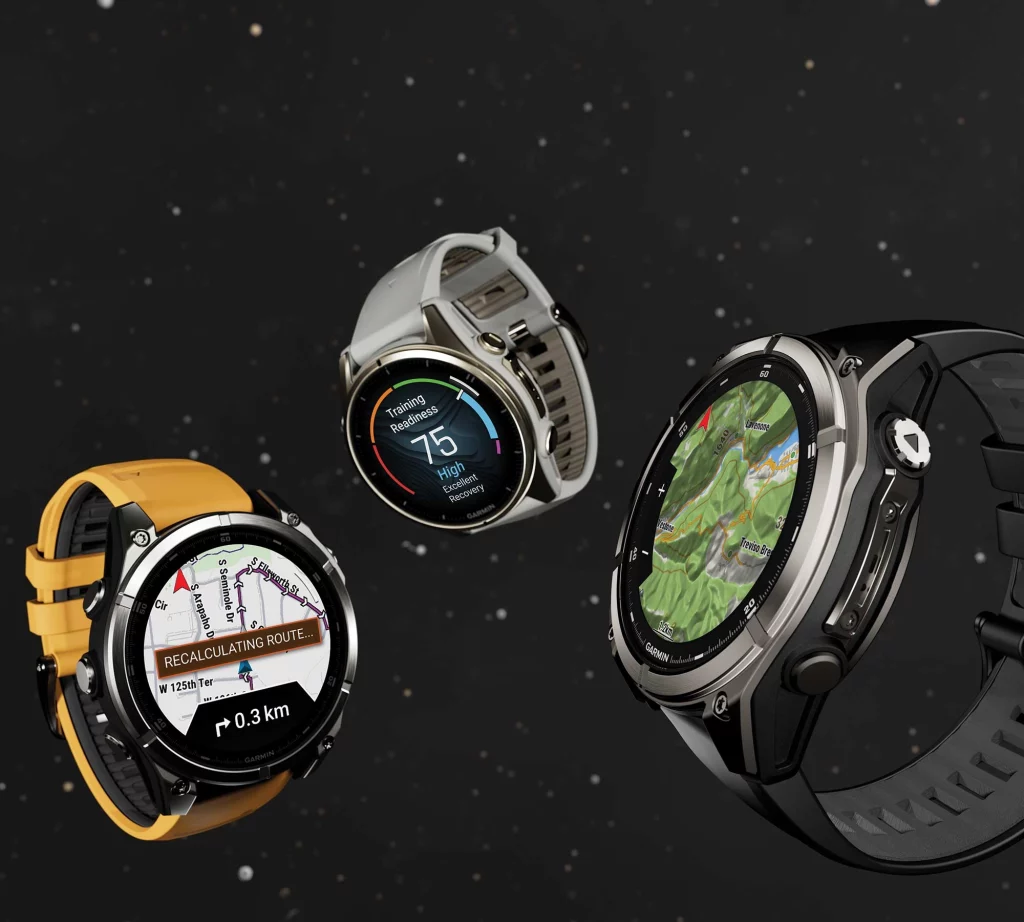
Garmin has launched its new Fenix 8 series smartwatches in India, aimed at athletes, fitness enthusiasts, and adventure seekers.
Built for Tough Conditions
The Fenix 8 is made for endurance and outdoor activities. Its dive-ready design features leakproof buttons and a metal sensor guard for durability. Users can choose between stainless steel and titanium bezels, with options for scratch-resistant lenses. Tested to U.S. military standards, the watch withstands extreme heat, cold, water, and impact.
The 1.4-inch AMOLED display ensures clear visibility in all conditions. Garmin offers multiple strap options—silicone, leather, and metal—to match user preferences.
Advanced Training Tools
The Fenix 8 focuses on performance with tools that help users track, plan, and improve workouts. Daily suggested workouts adapt to previous activities, keeping training efficient. Key features include:
Endurance Score: Combines VO2 max and training load to track long-term performance.
Visual Race Predictor: Estimates race times for distances like 5Ks and marathons.
Training Readiness: Evaluates sleep and recovery to suggest workout intensity.
ClimbPro Feature: Provides real-time information on current and upcoming climbs.
PacePro Technology: Guides users with GPS-based pace tracking for races or specific courses.
These tools help athletes push their limits without risking overtraining.
Navigation for Outdoor Adventures
The Fenix 8 offers reliable GPS tracking and built-in maps, designed for activities like hiking, skiing, and biking. It includes multi-band GPS for precise location tracking, even in remote areas. Users can plan distance-based routes, with return paths automatically suggested. Key navigation tools include:
NextFork Map Guide: Highlights nearby trails and forks.
Altimeter, Barometer, and Compass: Provide real-time environmental data.
SATIQ Technology: Optimizes GPS usage to extend battery life.
The watch also comes with TopoActive maps and preloaded maps for golf courses and ski resorts worldwide.
Health Monitoring
Garmin has equipped the Fenix 8 with tools to monitor physical and mental health. A daily morning report gives a summary of sleep quality, heart rate variability (HRV), and stress levels. Other health features include:
Body Battery Monitoring: Shows energy levels throughout the day.
Women’s Health Tracking: Monitors menstrual cycles and pregnancy.
Smart Features and Connectivity
The Fenix 8 supports phone calls and text replies via voice commands when paired with a smartphone. It has a built-in flashlight with adjustable brightness levels, including a red safety light, which ensures visibility during night activities.
Other key features include:
Garmin Pay: Enables contactless payments.
Music Control: Manages music from the wrist.
Garmin Connect and Messenger Apps: Sync data and send messages.
Third-Party Apps: Available via the Connect IQ store.
Long Lasting Battery Life
The Fenix 8 series offers long battery life, making it suitable for extended activities. In smartwatch mode, it lasts up to 29 days (13 days with always-on display). For heavy GPS use, Max Battery GPS mode provides up to 145 hours, while Expedition GPS mode stretches battery life to 31 days.
Pricing and Availability
The Garmin Fenix 8 series starts at Rs. 86,990 and includes a two-year warranty. It is available at premium retail outlets and on the Garmin India website.
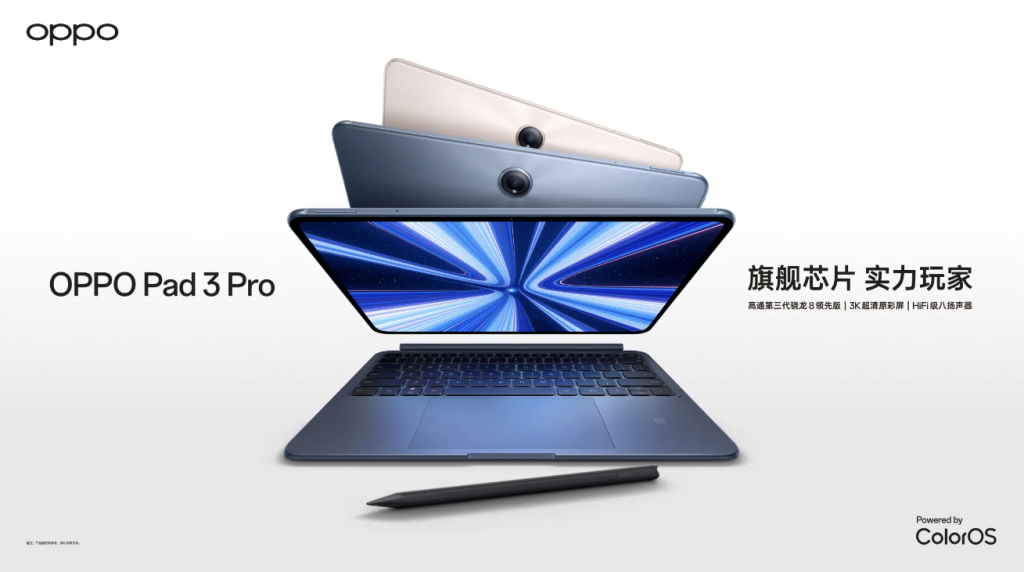
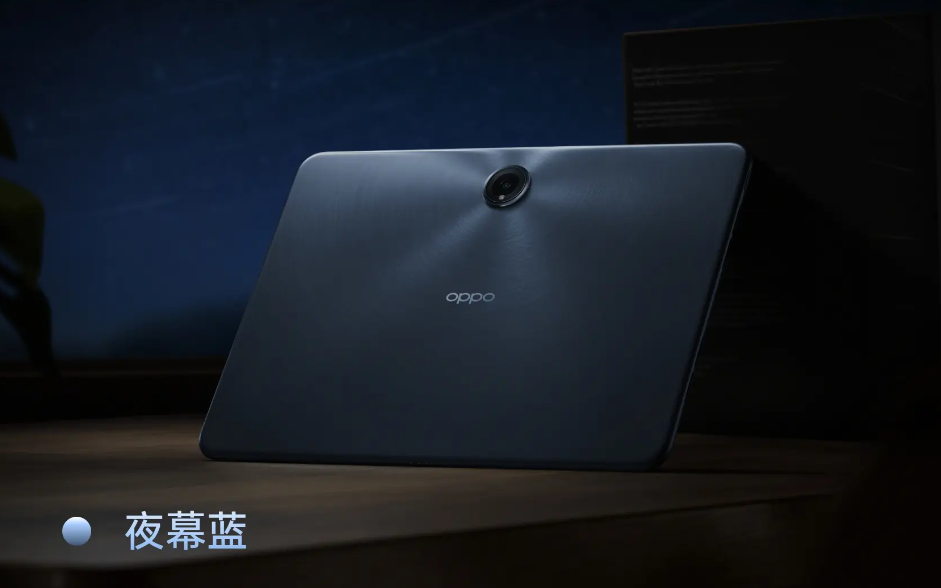
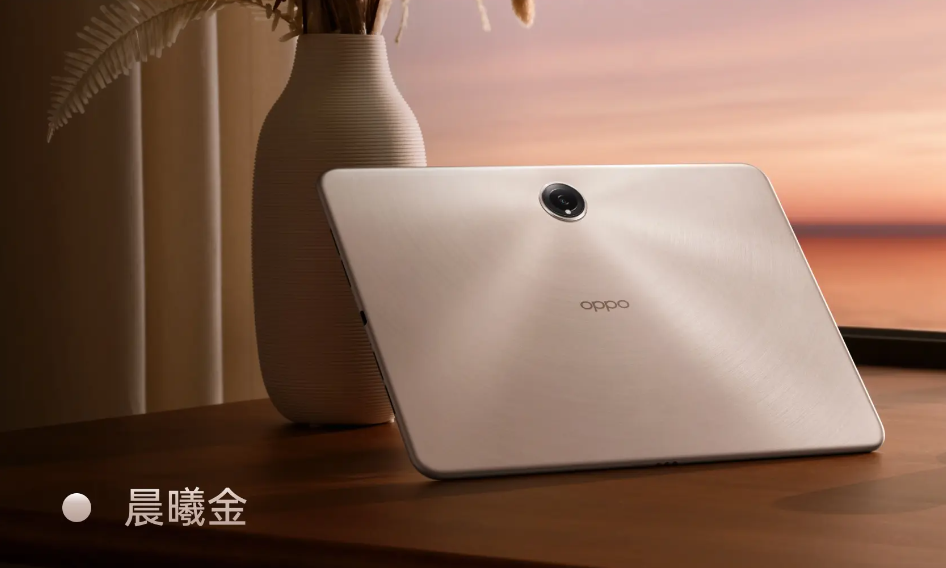
OPPO has unveiled its latest tablet, the Pad 3 Pro, in China. This is yet another premium tablet from the Chinese smartphone giant, boasting top-of-the-line specifications and features at an attractive price point.
OPPO Pad 3 Pro features
The Pad 3 Pro features a large 12.1-inch 2K 144Hz LCD display with a 7:5 aspect ratio, offering a comfortable viewing experience for content consumption and productivity. The screen supports Dolby Vision and HDR10+, delivering vibrant and immersive visuals with deep blacks, bright whites with 600 nits peak brightness, and a wide color gamut. The tablet also features six speakers with Dolby Atmos, providing rich and immersive audio with clear dialogue, powerful bass, and surround sound effects.
At the heart of the Pad 3 Pro is a Snapdragon 8 Gen 3 Leading processor, paired with up to 16GB of LPDDR5X RAM and 1TB of UFS 3.1 storage. This powerful combination ensures smooth performance for demanding tasks and multitasking, whether you’re editing videos, playing games, or browsing the web.
The tablet runs on Android 14-based ColorOS 14.1, providing a user-friendly interface and a host of customization options, including themes, app icons, and gestures. We can also expect the tablet to be among the first in line to get the Android 15-based ColorOS 15 update, which was recently unveiled by the brand.
For photography and video recording, the Pad 3 Pro offers a 13MP rear camera with autofocus and LED flash, capable of capturing high-quality photos and videos in various lighting conditions. The 8MP front-facing camera is ideal for video calls, selfies, and face unlocking. The tablet also features a USB Type-C audio jack, allowing you to connect external headphones or speakers for a more immersive audio experience.
The Pad 3 Pro packs a massive 9510mAh battery that supports 67W SuperVOOC fast charging, ensuring long battery life even with heavy usage. You can enjoy hours of uninterrupted entertainment, productivity, or gaming without worrying about running out of power.
The Pad 3 Pro is compatible with the Smart Touch Keyboard and Pencil 2 Pro stylus, enhancing its productivity capabilities. The stylus supports 10,000 levels of pressure sensitivity, providing an improved writing and drawing experience. The Smart Touch Keyboard offers a comfortable typing experience with its full-size keys and precise feedback.
Pricing & availability
The OPPO Pad 3 Pro is available in China starting at 3299 yuan (approximately USD 463) for the 8GB + 256GB model. The tablet is also offered in 12GB + 256GB, 16GB + 512GB, and 16GB + 1TB combinations, costing 3599 yuan (US$505), 3999 yuan (US$561), and 4499 yuan (US$632), respectively. The tablet will go on sale starting October 30. The brand has yet to reveal any details about a global launch.
OnePlus has rolled out OxygenOS 15, bringing a smoother mobile experience with faster performance, more customization options, and enhanced AI tools. It builds on OxygenOS 14, adding practical features that make it easier to get things done and stay creative.
Performance Boost with Smoother Animations
OnePlus sticks to its “Fast and Smooth” approach by adding Parallel Processing to its animations. This means everything, from widgets to app folders, moves fluidly, even during interruptions. The update also ensures consistent swipe gestures across third-party apps, making your interactions feel seamless throughout the system.
Fresh Design for Everyday Use
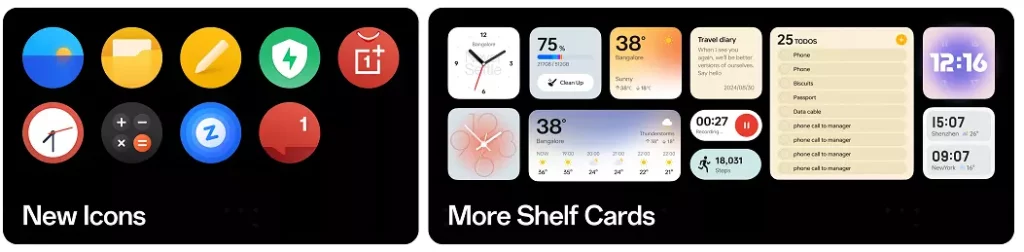
OxygenOS 15 brings a subtle design update. Icons on the home screen now have sharper colors and better proportions, making them easier to look at. The Shelf widget has been revamped, offering more card options and localized features for quicker access to information.
A key feature in this update is Split Mode, which separates notifications from quick settings. Swiping down from the top left shows notifications, while swiping from the top right brings up quick settings—making it easier to navigate both.
More Ways to Personalize Your Phone
Customization takes a step forward with OnePlus OneTake, allowing users to create a connected look across the Always-On Display, lock screen, and home screen. The Depth feature adds layers to wallpapers, creating a more dynamic feel by separating the subject from the background.
The lock screen also supports more customization, with options like glass textures, blurred wallpapers, and AI-driven auto-fill settings.
AI Tools for Better Photos and Productivity
OxygenOS 15 brings several AI-powered tools to help improve your photos and writing. AI Eraser and AI Reflection Eraser let you clean up pictures by removing unwanted objects or reflections, while AI Unblur makes sure action shots stay sharp. The AI Detail Boost feature keeps zoomed-in photos crisp.
On the productivity side, AI Notes helps structure and refine content. It can summarize articles, tidy up fragmented text, and even suggest quick responses for messaging apps like WhatsApp. The AI Reply feature generates responses based on the conversation, making it easier to stay on top of messages.
The Circle to Search tool adds a quick way to search for content on your screen using gestures, whether you need to find a product or translate text on the spot.
Improved Security and Privacy Controls
This update strengthens security with features that prevent theft and monitor apps for suspicious activity. Google Play Protect Live Threat Detection keeps an eye on apps for malware, blocking any that seem harmful.
The new theft protection system allows you to lock your phone remotely through the Find My Device portal, even without a password. The phone can also auto-lock if it detects unusual activity, such as sudden movement. It can be locked remotely using just your phone number and will automatically lock itself if the SIM card is removed or too many incorrect passwords are entered.
Easier Multitasking with Open Canvas
The new Open Canvas feature improves multitasking by supporting a three-app split-screen mode. Unlike traditional split screens that shrink apps, Open Canvas lets two apps stay at their normal size while switching between them smoothly.
Smoother Cross-Platform File Sharing
With OnePlus Share, users can now transfer files seamlessly between OnePlus and iOS devices. Whether you’re sharing photos, videos, or documents, the process is quick and easy.
Fluid Cloud ensures that your data syncs smoothly across apps like Spotify and Zomato, while notifications expand into detailed cards with a tap, helping you stay on top of multiple activities at once.
Availability
OnePlus has announced that the beta testing of OxygenOS 15 will kick off by the end of this month (October 30), starting with the OnePlus 12 series. The brand has yet to share any details about a wider stable release of the new software.
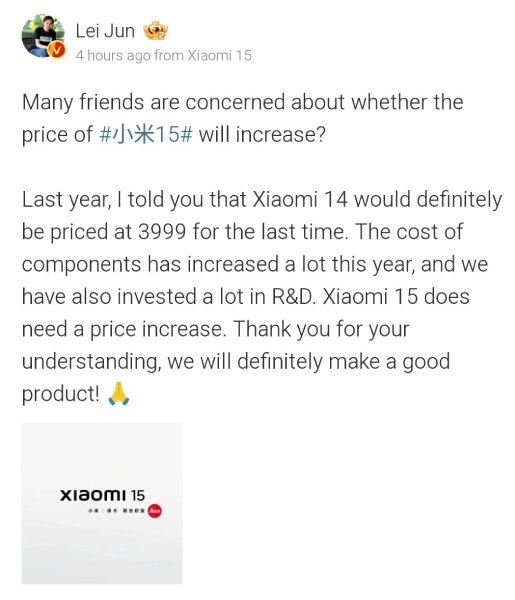
Xiaomi CEO Lei Jun confirmed the news in a post on the Chinese social media platform Weibo, explaining, “The cost of components has increased a lot this year, and we’ve also invested heavily in R&D. So, the Xiaomi 15 does need a price increase.”
This price hike isn’t entirely unexpected. Last year, Jun hinted that the Xiaomi 14 would be the last flagship to start at 3,999 yuan (around $562).
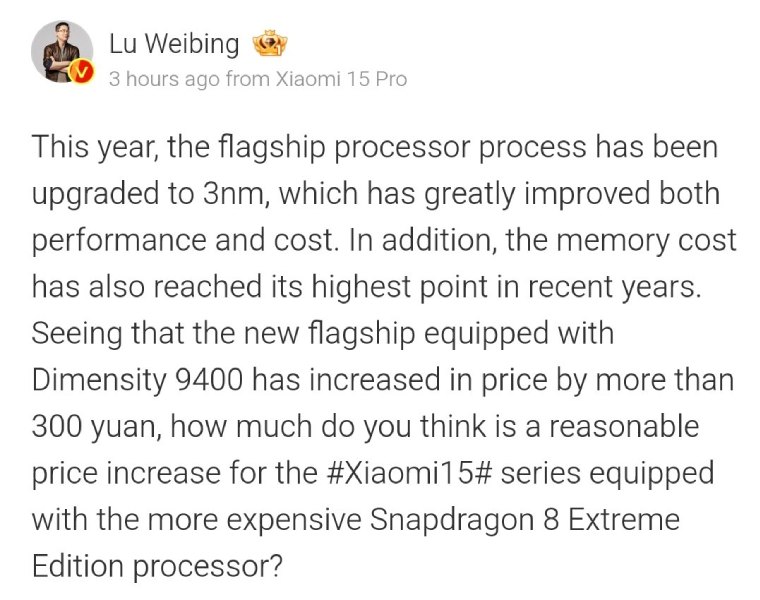
Xiaomi’s president, Lu Weibing, echoed these statements, citing that the new flagship processor brings both improved performance and higher costs. He also cited rising memory prices as another factor behind the price increase.
Xiaomi 15 may start from 4299 yuan
While not explicitly stating a price point, Lu drew a comparison to the Vivo X200, a competitor flagship equipped with the new Dimensity 9400 chip. The price of that phone has increased by “more than 300 yuan,” he noted, asking, “What do you think is a reasonable price increase for the Xiaomi 15?”
This hint suggests the Xiaomi 15 series may see a similar 300 yuan (about $43) increase, potentially raising the starting price to 4,299 yuan ($604).
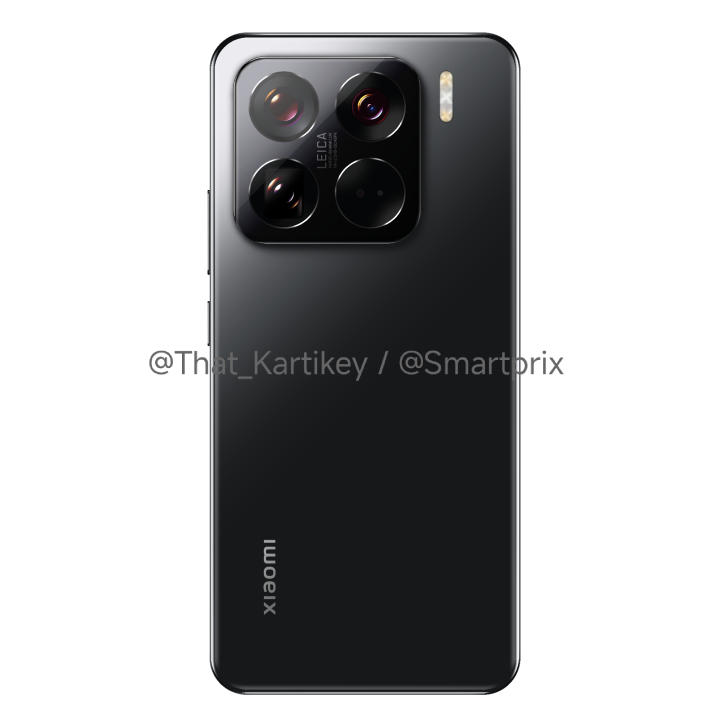
Xiaomi 15 Pro render
As expected, this news follows months of leaks predicting an uptick in smartphone prices due to rising costs of flagship processors and key components. And Xiaomi’s confirmation now serves as a concrete example.
Additionally, leaked pricing for the OnePlus 13, another phone powered by the Snapdragon 8 Elite chip, also indicates a price hike compared to its predecessor.
As far as specs are concerned, both the Xiaomi 15 and 15 Pro will have Snapdragon 8 Gen 4 at their core and a triple-camera sensor on the back, with each sensor boasting 50 megapixels.
Design-wise, they are likely to resemble their resemble their predecessors. Xiaomi will also introduce a Titanium version of the Xiaomi 15 Pro with satellite communication support. But both the 15 Pro and 15 Pro Titanium are said to be China-exclusive, like their predecessors.
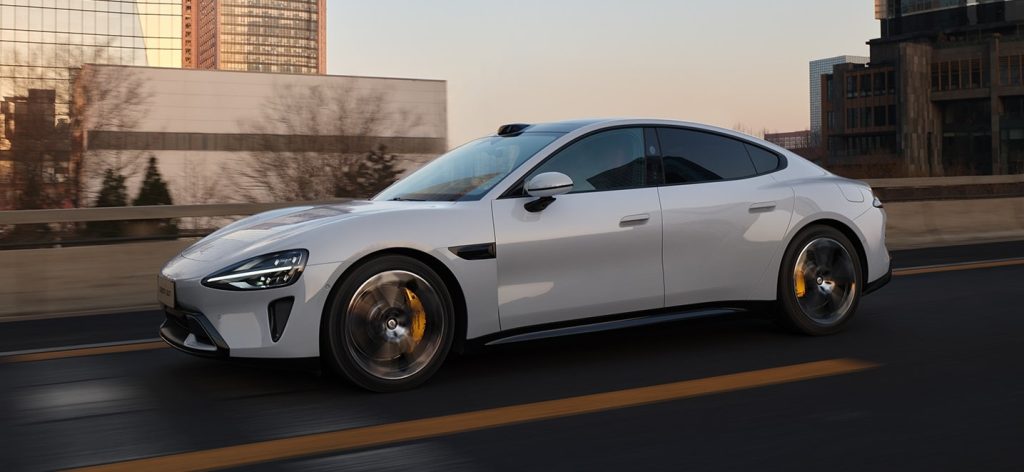
In a surprising turn of events, Ford Motor Company CEO Jim Farley recently revealed on the Everything Electric Show podcast that his daily driver for the past six months hasn’t been a Ford at all, but a Xiaomi SU7, the electric sedan from the Chinese tech giant.
Farley, known for his focus on electrification within Ford, admitted his usual aversion to discussing competitors. However, his extended experience with the SU7 prompted him to share his thoughts.
“We flew one from Shanghai to Chicago and I’ve been driving it for six months now, and I don’t want to give it up,” Farley said on the podcast.
“It’s fantastic. They sell 10,000, 20,000 a month. They’re sold out for six months,” Farley said of Xiaomi’s success with the SU7 earlier in the interview.
Xiaomi SU7 is the company’s first car!
Xiaomi, primarily known for its dominance in the smartphone and consumer electronics space, announced its entry into the electric vehicle market in 2021.
The SU7, their first model launched just this year, is a full-size sedan priced competitively around $30,000. Despite its affordability, the car boasts features like air suspension, adaptive dampers, and active aero – all contribute to an exciting driving experience.
Additionally, Xiaomi’s in-house Level 2 and NoA (navigate on autopilot) system offers convenience, though its certification is currently limited to 100 Chinese cities.
The SU7’s popularity in China has been nothing short of phenomenal. The entire 2024 production run reportedly sold out on the first day, with Xiaomi claiming to have pre-sold 100,000 units before the first car even rolled off the assembly line.
While sampling competitor vehicles is a common practice within the automotive industry, Farley’s effusive praise for the SU7, especially considering his reluctance to discuss competition, is noteworthy. This could signal a shift in Ford’s strategy as they navigate the increasingly crowded EV market dominated by aggressive Chinese companies like BYD.
Samsung has officially unveiled its latest mid-range mobile processor, the Exynos 1580. The chip succeeds the Exynos 1480 and promises modest performance improvements across the board. The Exynos 1580 is likely destined for the upcoming Galaxy A56 smartphone.
Built on Samsung’s third-generation 4nm EUV FinFET process, the Exynos 1580 introduces a new CPU architecture. It uses a tri-cluster design with one high-performance Cortex-A720 core clocked at 2.9 GHz and three additional Cortex-A720 cores running at 2.6 GHz.
Rounding out the CPU are four energy-efficient Cortex-A520 cores clocked at 1.95 GHz. The switch to ARMv9 cores brings better efficiency and performance compared to the ARMv8 architecture in the Exynos 1480.
The Exynos 1580’s graphics processing unit (GPU) also gets an upgrade. Based on AMD’s RDNA 3 architecture, it features double the Work Group Processors (WGUs) of the Exynos 1480, delivering a 37% boost in peak performance and a 20% improvement at the same power level. The GPU has also increased the GL2 cache to improve graphics performance further.
2. NPU
The Neural Processing Unit (NPU) in the Exynos 1580 offers 14.7 TOPS of performance. Though Samsung hasn’t revealed major differences in architecture from the Exynos 1480’s NPU, both use “6K MAC” units, suggesting similar core performance. However, the Exynos 1580’s larger 2MB NPU cache improves AI processing efficiency for demanding applications.
3. Connectivity and Display
For connectivity, the Exynos 1580 includes support for 5G (both sub-6GHz and mmWave), Wi-Fi 6E, and Bluetooth 5.4. Notably, the chip lacks an AV1 decoder, a feature more common in higher-end processors.
Display and camera support remain similar. The chip supports displays with up to 1080p+ resolution at 144Hz and cameras with up to 200MP for single sensors or dual 32MP sensors at 30fps.
While a 200MP camera on the Galaxy A56 is unlikely, Samsung claims the Exynos 1580 offers improved image processing capabilities compared to its predecessor.
4. Exynos 1480 vs Exynos 1380: Specifications
Exynos 1480
Exynos 1580
Node
4nm EUV
4nm EUV
CPU (prime)
–
1x Cortex-A720 @ 2.9GHz
CPU (big)
4x Cortex-A78 @ 2.75GHz
3x Cortex-A720 @ 2.6GHz
CPU (small)
4x Cortex-A55 @ 2.0GHz
4x Cortex-A520 @ 1.95GHzortex-A520 @ 1.95Ghz
GPU
Xclipse 530RDNA 3, 1x WGP
Xclipse 540RDNA 3, 2x WGP
NPU
6K MAC
6K MAC (14.7 TOPS)
RAM
LPDDR4X, LPDDR5
LPDDR5
Storage
UFS 3.1
UFS 3.1
Screen
1080p+ @ 144Hz
1080p+ @ 144Hz
Camera
200MP, 4K @ 60fps
200MP, 4K @ 60fps
5G
NR (5.1Gbps down, 1.28Gbps up)mmWave (4.84Gbps down, 0.92Gbps up)
NR (5.1Gbps down, 1.28Gbps up)mmWave (4.84Gbps down, 0.92Gbps up)
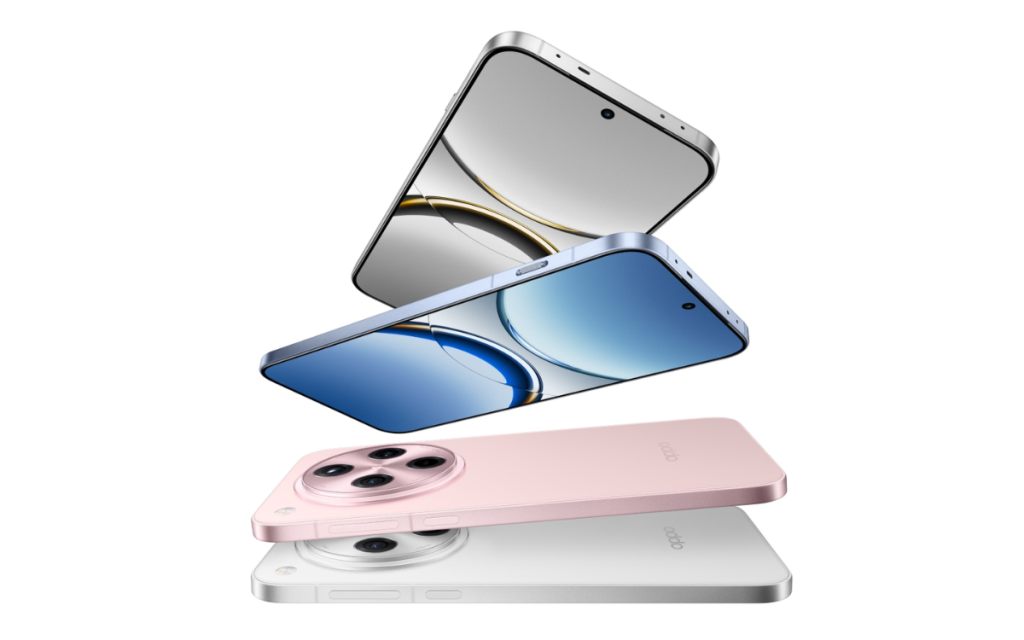
Oppo has officially launched its flagship smartphones, the Find X8 and Find X8 Pro, in China. These models come with impressive upgrades in display, performance, and camera technology, making them strong contenders in the premium segment. With global availability also confirmed, here’s what the latest Oppo flagships offer.
Oppo Find X8 Pro
Oppo Find X8 Series Specifications
The Find X8 features a 6.59-inch 1.5K (2760 × 1256 pixels) adaptive 1Hz-120Hz LTPO OLED flat display from Tianma, offering ultra-narrow 1.45mm bezels and a peak brightness of 4,500 nits.
Meanwhile, the Find X8 Pro boasts a slightly larger 6.78-inch (2780×1264 pixels) 1.5K LTPO OLED micro-quad curved screen from BOE, also capable of adaptive refresh rates between 1Hz and 120Hz and the same brightness. Both models support Dolby Vision and Oppo Crystal Shield protection, promising vibrant visuals and robust durability.
Both smartphones are powered by the latest MediaTek Dimensity 9400 SoC, built on a 3nm architecture. The devices offer up to 16GB of LPDDR5X RAM and UFS 4.0 storage, ensuring swift performance and ample space for apps, photos, and videos. They include ultra-large-area VC cooling for sustained performance, scoring over 3.1 million on AnTuTu.
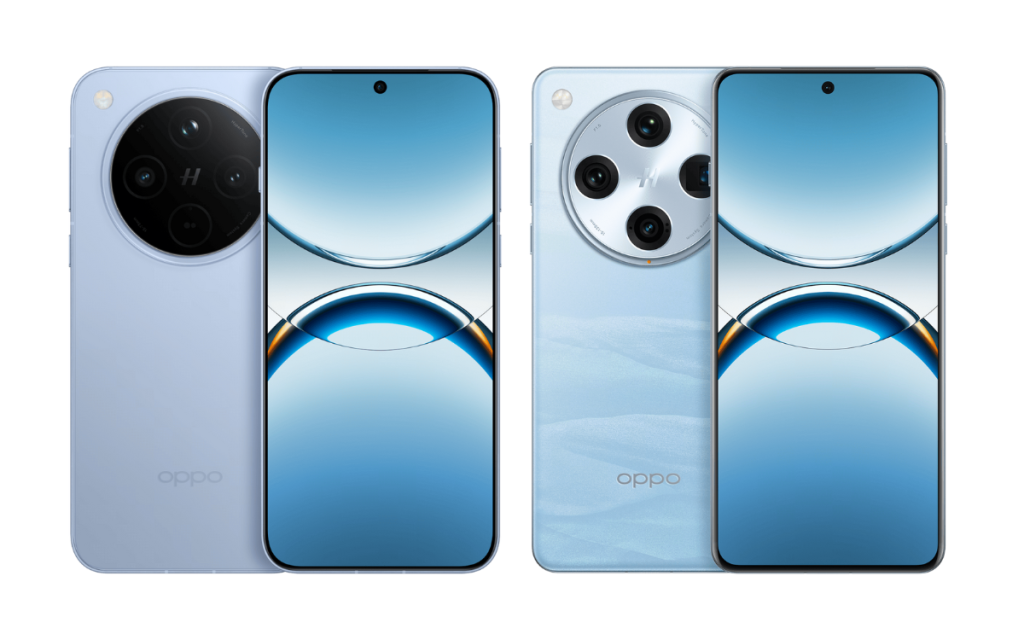
Oppo Find X8 Series (Left – nonPro / Right- Pro)
Both models run on Android 15 with ColorOS 15. The new ColorOS version comes with a host of AI features and a refreshed design, aiming to enhance the user experience.
Coming to the cameras, the Find X8 has a triple 50MP rear camera setup, including a main Sony LYT-700 sensor, a 50MP ultra-wide camera, and a 50MP 3x periscope telephoto lens. The Find X8 Pro, on the other hand, features a quad-camera system with an additional 50MP 6x periscope lens. The Pro model’s primary camera boasts a larger 1/1.4” Sony LYT-808 sensor, enhancing the low-light performance.
Both models support 120x digital zoom, a HyperTone image engine for improved clarity, and Hasselblad Portrait Mode. They also feature AI capabilities like AI Erase, AI Anti-Reflection, AI De-Blur, and AI Super Resolution.
The Find X8 comes with a 5,630mAh battery, while the Find X8 Pro houses a 5,910mAh cell. Both devices support 80W SuperVOOC fast charging, 50W wireless charging, and 10W reverse wireless charging, ensuring users have multiple charging options to keep their devices powered throughout the day.
Oppo Find X8
The Find X8 series offers dust and water resistance with IP68 and IP69 ratings, making them suitable for rugged use. Both models feature an in-display fingerprint sensor, dual SIM capability, stereo speakers, and support for Wi-Fi 7, Bluetooth 5.4, and dual-antenna NFC. The Find X8 Pro also introduces a Quick Button, doubling as a camera shutter and alert slider, providing quick access to essential functions.
Pricing & Availability
The Find X8 is available in Starfield Black, Floating Light White, Chasing Wind Blue, and Bubble Pink, with pricing starting at 4,199 Yuan ($589) for the 12GB/256GB variant, reaching up to 4,999 Yuan ($702) for the 16GB/512GB model.
The Find X8 Pro is offered in Hoshino Black, Cloud White, and Sky Blue, starting at 5,299 Yuan ($744) for the 12GB/256GB variant, with the 16GB/1TB Satellite Edition priced at 6,999 Yuan ($983).
Shipments in China will begin on October 30, with global availability expected soon, although Oppo has not confirmed specific dates yet.
For years, Google’s Tensor chips have been manufactured in collaboration with Samsung Foundry, but that might change with the upcoming Tensor G5, expected to debut with the Pixel 10 series. A recent leak from Google’s gChips division, shared via Android Authority, indicates that Google is opting for TSMC’s advanced 3nm process for the next-gen chip, potentially leading to enhanced efficiency and performance.
Redesigned CPU, a new GPU, and slightly improved AI capabilities
One of the significant changes with the Tensor G5 is its revamped CPU layout. Unlike its predecessor, the Tensor G4, which showed only a minor boost in performance, the G5 maintains a primary Cortex-X4 core but introduces a reconfigured mid-cluster.
The new design comprises five Cortex-A725 cores, an increase from three Cortex-A720 cores, while the little cluster has been reduced to two Cortex-A520 cores.
This alteration suggests that Google is aiming for a better balance between performance and power consumption, although sticking to the Cortex-X4 instead of adopting the latest Cortex-X925 is an intriguing choice.
The Tensor G5 also breaks tradition by moving away from the ARM Mali GPU, featuring a new GPU from Imagination Technologies (IMG), the DXT-48-1536. This GPU introduces ray tracing support—a first for Tensor chips—along with GPU virtualization capabilities, which could enhance graphics performance for gaming and other intensive tasks.
While Google’s new TPU in the Tensor G5 brings a 40% increase in TOPS (Trillions of Operations Per Second), internal benchmarks suggest a more modest 14% improvement in real-world scenarios. Additionally, the TPU now supports on-device training and features embedded RISC-V cores, enabling operations that weren’t previously possible, potentially broadening its AI capabilities.
Good news for those waiting for the Pixel 10 series
The Pixel 10, anticipated to launch in the second half of next year, will be the first device to feature the Tensor G5. This shift to TSMC’s 3nm process could significantly enhance power efficiency, addressing past criticisms of the Tensor lineup, particularly issues related to thermal management and performance lags. Reports suggest that Google is looking to better compete with Snapdragon-powered smartphones by making this strategic switch, as TSMC’s fabrication technology has been a cornerstone for Qualcomm’s recent successes.
Overall, these updates hint at Google’s ambitious plans to position the Pixel 10 series as a stronger contender in the flagship smartphone market.
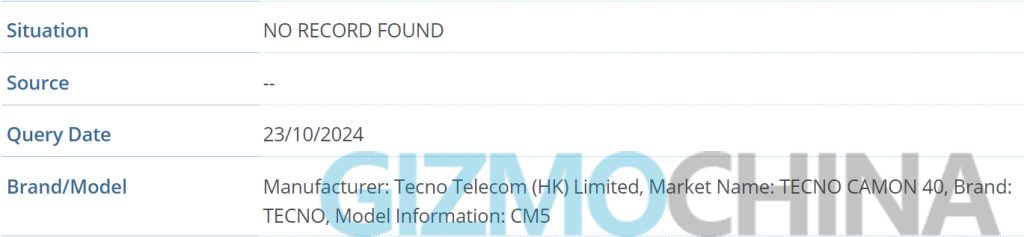
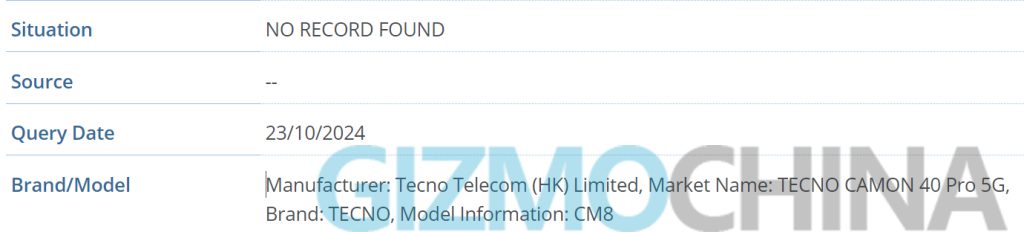
One of the most popular manufacturers of the last period, Tecno continues to offer smartphones for every budget. The brand’s new Camon series Tecno Camon 40 models have appeared in our IMEI database. This series will consist of three different models: Tecno Camon 40 Pro 5G, Tecno Camon 40 Pro 4G, and Tecno Camon 40.
Tecno Camon 40 series is coming
According to the IMEI Database, the model numbers of Tecno Camon 40 models are as follows: Tecno Camon 40 Pro 5G will have the model number “CM8,” Camon 40 Pro 4G “CM6,” and Camon 40 “CM5.” There is no official information about the technical specifications of these models yet. To get an idea of what the Tecno Camon 40 series has to be offer, let’s take a look at the features of the previous Camon 30 series.
The Tecno Camon 30 Pro 5G features a 6.78-inch AMOLED display with a 144Hz refresh rate. The device comes with a MediaTek Dimensity 8200 Ultimate processor. 12GB RAM and up to 512GB storage capacity. However, there is no memory card support.
On the back, a triple camera setup draws attention; 50MP OIS-supported main camera, 50MP ultra-wide angle camera and 2MP depth camera. There is a 50MP selfie camera on the front. 4K@60FPS video recording is possible with all these cameras. There is a 5000mAh battery and 70W fast charging support. Out of the box, the device comes with the Android 14-based HiOS 14 interface. Under-screen fingerprint reader offers practical security.
In addition, Tecno Camon 30 4G comes with a 6.78-inch AMOLED display. The screen offers a refresh rate of 120Hz. Powered by the MediaTek Helio G99 Ultimate processor. There’s up to 12GB of RAM and 256GB of storage capacity. In addition, this model has memory card support up to 1TB.
The camera lineup is complete with a 50MP OIS-supported main camera, a 2MP depth camera, and a light sensor. There is also a 50MP selfie camera on the front. The device pleases its users with its 5000mAh battery and 70W fast charging support. The under-screen fingerprint reader is also available in this model and the device works with Android 14-based HiOS 14.
The upcoming Tecno Camon 40 Pro 5G has the potential to be a strong competitor in the mid-upper segment. The Tecno Camon 40 Pro 4G model is expected to have similar features, only with a different processor. The Tecno Camon 40 will be a model that will heat the competition in the middle segment with more trimmed features. Tecno will continue to offer powerful devices that appeal to both the middle segment and the upper segment with this new series.
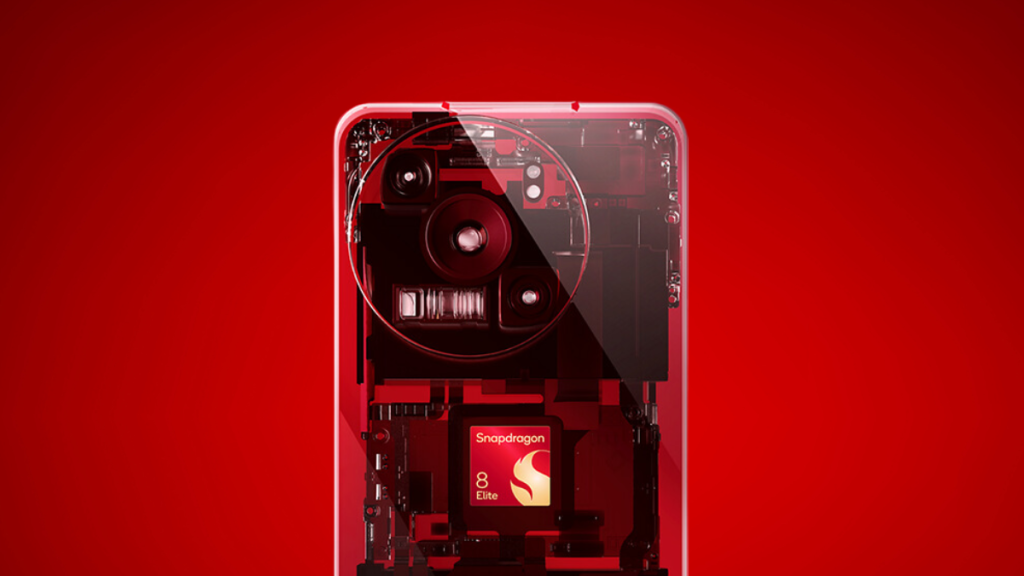
Qualcomm recently unveiled its newest flagship chip, Snapdragon 8 Elite, which will be the driving force behind most of the top-tier Android devices heading into 2025. The chip brings noticeable upgrades that put the Dimensity 9400 and Apple’s A18 Pro on high alert.
Qualcomm makes big claims for the Snapdragon 8 Elite in terms of its performance, efficiency, and AI capabilities. But how does it compare with its predecessor, Snapdragon 8 Gen 3, and is upgrading to Elite a worthwhile decision? Let’s compare them to help you pick the right chipset for your next smartphone.
Snapdragon 8 Elite vs. 8 Gen 3: spec sheet
Snapdragon 8 Elite
Snapdragon 8 Gen 3
Announced
October 2024
October 2023
Part number
SM8750-AB
SM8650-AB, SM8650-AC
Process node
3nm
4nm
Manufacturer
TSMC
TSMC
CPU
2 x Oryon @ 4.32GHz 6 x Oryon @ 3.53GHz
1 x Cortex-X4 @ 3.3GHz 3 x Cortex-A720 @ 3.15GHz 2 x Cortex-A720 @ 2.96GHz 2 x Cortex-A520 @ 2.27GHz
GPU
Adreno 830 GPU Unreal Engine 5.3 running Nanite on smartphones Qualcomm Adaptive Performance Engine 4.0 Hardware accelerated ray tacing Snapdragon Game Super Resolution 2.0 Adreno Frame Motion Engine 2.0
Adreno 750 GPU Support for Unreal Engine 5.2 Lumen Hardware accelerated ray tracing Snapdragon Game Super Resolution Adreno Frame Motion Engine 2.0
NPU
Qualcomm Hexagon NPU
Qualcomm Hexagon NPU
Camera
Qualcomm Spectra AI Triple 18-bit ISP Limitless real-time semantic segmentation Up to 320MP single camera Up to 108MP single camera at 30fps with zero shutter lag Up to 48MP triple camera at 30fps with zero shutter lag 8K/60fps video recording 1080p/480fps slow-mo video recording
Qualcomm Spectra Cognitive Triple 18-bit ISP Real-time semantic segmentation (max 12 layers) Up to 200MP single camera Up to 108MP single camera at 30fps with zero shutter lag Up to 64MP+36MP dual camera at 30fps with zero shutter lag Up to 36MP triple camera at 30fps with zero shutter lag 8K/30fps or 4K/120fps video recording 720p/960fps slow-mo video recording
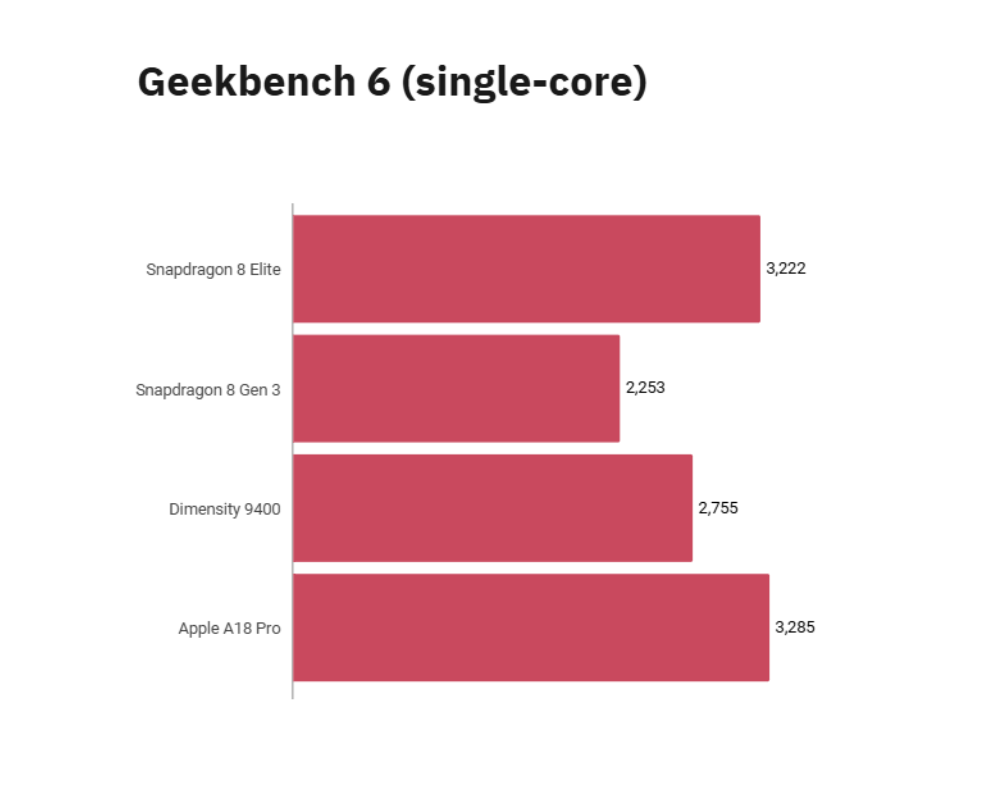
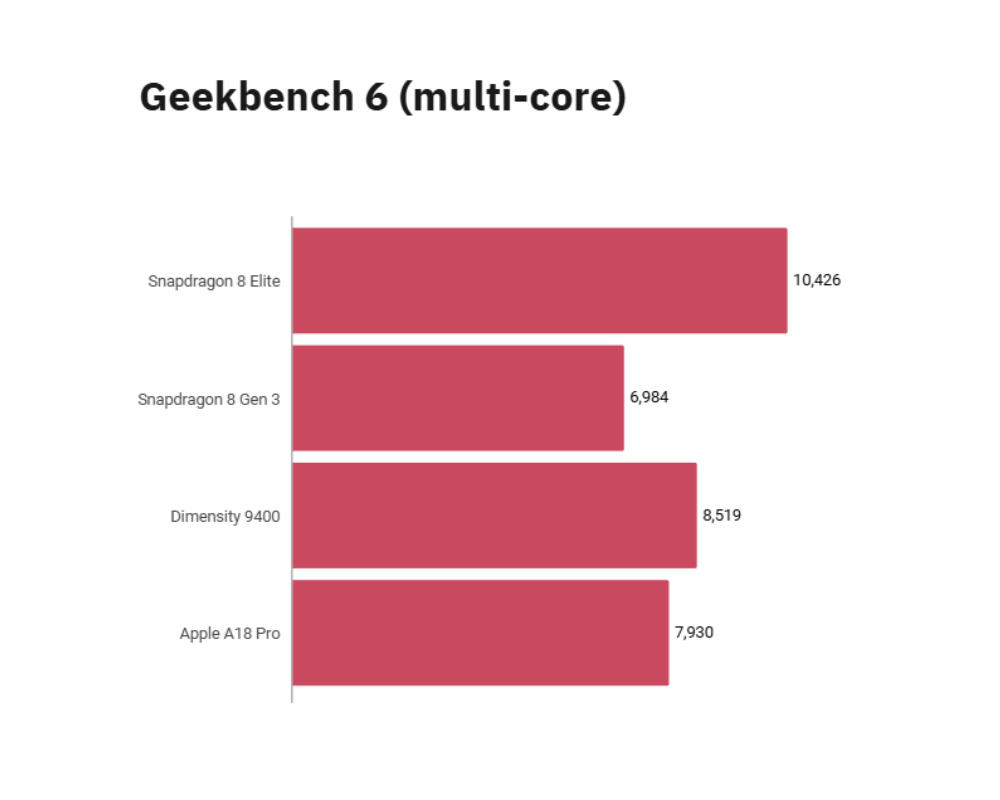
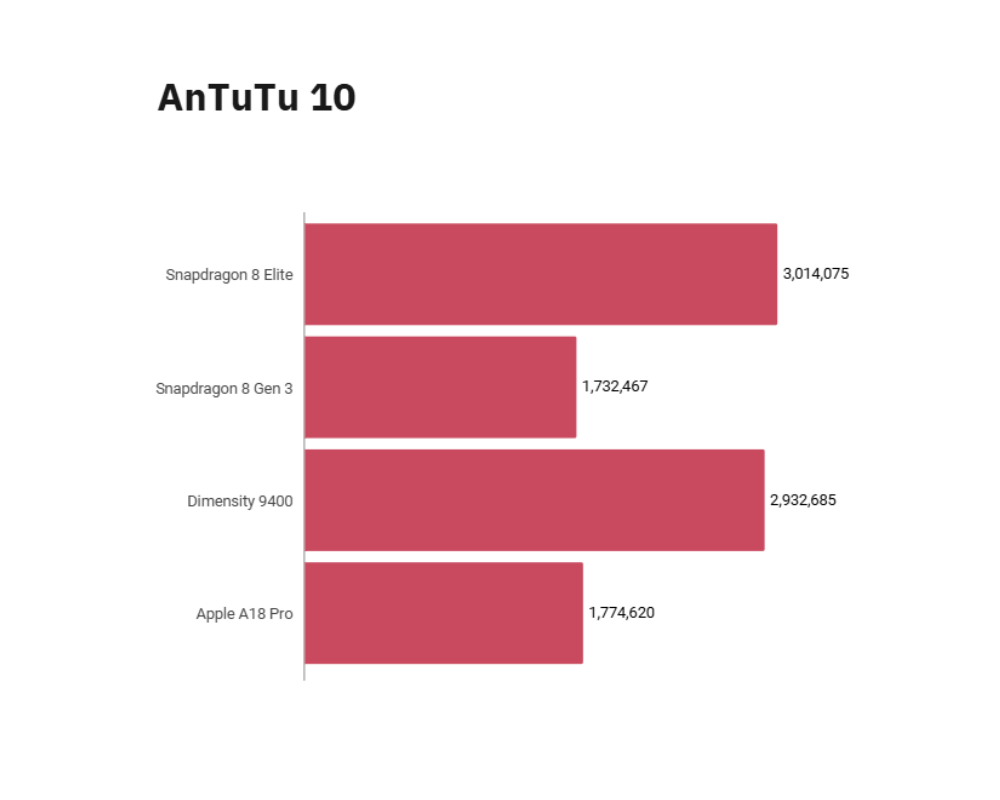
For benchmark comparison, we have taken into account results provided by Qualcomm for the Snapdragon 8 Elite. For Snapdragon 8 Gen 3, we have the Galaxy S24 Ultra.
The Snapdragon 8 Elite is significantly ahead of the Snapdragon 8 Gen 3. However, it couldn’t defeat the Apple A18 Pro, though it handsomely leaves behind the MediaTek Dimensity 9400.
The Snapdragon 8 Elite shines in its full glory when it comes to multi-core results on Geekbench. Not only does it outperform the Snapdragon 8 Gen 3, but also the Apple A18 Pro, and that too by a good margin.
The Snapdragon 8 Elite is leading the chart again. Interestingly, MediaTek Dimensity 9400 is neck-to-neck with the Elite chip. However, both chips are powerful enough to beat the Snapdragon 8 Gen 3 and Apple A18 Pro by a significant margin on AnTuTu.
Snapdragon 8 Elite vs. 8 Gen 3: CPU
The Snapdragon 8 Elite is fabbed on TSMC’s 3nm process, while its predecessor uses a 4nm process node. This fabrication node shift benefits raw performance and power efficiency.
Another big change to the Snapdragon 8 Elite is the debut of Qualcomm’s Oryon cores. Oryon came into existence earlier this year for Windows laptops, which surprised with power efficiency. Now, Qualcomm is bringing that performance and efficiency leap to mobile devices with the Snapdragon 8 Elite. Notably, the Snapdragon X Elite and X Plus chips for laptops use first-gen Oryon cores. However, the Snapdragon 8 Elite uses second-gen Oryon cores.
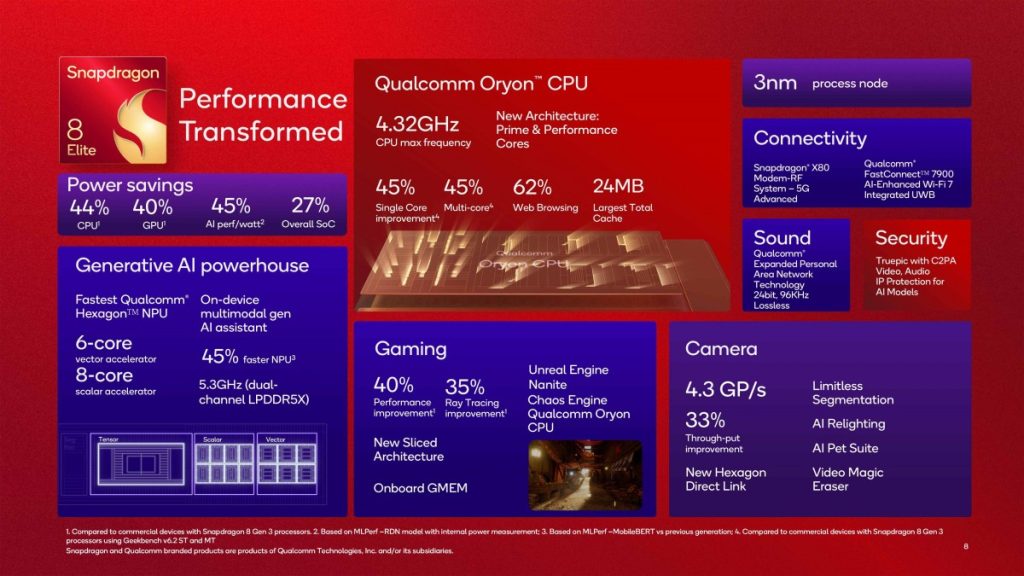
The Prime Oryon core inside the Snapdragon 8 Elite has a 4.32GHz peak clock speed (vs. 3.3GHz on the Snapdragon 8 Gen 3). The other six cores also run at a higher clock speed. Snapdragon 8 Elite has 24MB of cache memory, the largest on a mobile chipset.
Qualcomm makes big claims for the Snapdragon 8 Elite — a 45% performance boost and 44% more power saving over its predecessor.
Snapdragon 8 Elite vs. 8 Gen 3: GPU
The Snapdragon 8 Elite isn’t all about CPU; it brings serious upgrades to the GPU as well. It ships with the Adreno 830 GPU, which offers a 40% performance uplift compared to Adreno 750 inside the Snapdragon 8 Gen 3.
Increased performance results in faster battery consumption, but thanks to the sliced architecture, the GPU offers 40% energy efficiency over its predecessor. In fact, Snapdragon 8 Elite is the first Qualcomm chip with sliced architecture. The chip giant also promises 35% better ray tracing performance.
The Snapdragon 8 Elite brings Unreal Engine 5’s Nanite solution to mobile devices, enabling film-quality 3D environments in smartphone gaming.
Snapdragon 8 Elite vs. 8 Gen 3: AI
Qualcomm is improving AI capabilities with each upgrade, and Snapdragon 8 Elite is no different. However, this time, more areas are exposed to AI, including cameras.
The Snapdragon 8 Elite has a next-gen Hexagon NPU, which claims to be 45% faster and delivers 45% higher performance per watt. The new NPU has an enhanced token limit, meaning on-device AI assistants can process more complex and longer inputs.
The chip continues to support on-device multi-modal AI assistants, allowing users to execute complex tasks without relying on an internet connection.
Snapdragon 8 Elite vs. 8 Gen 3: Camera
Qualcomm has also enhanced camera capabilities on the Snapdragon 8 Elite. It ships with a triple 18-bit AI ISP, while its predecessor has the Cognitive ISP. The new chip supports a 320MP single camera, up from 200MP limit on the Snapdragon 8 Gen 3. With Zero Shutter Lag (ZSL) enabled, the ISP now supports triple 48MP capture, up from 36MP capture from its predecessor.
The standout camera upgrade to the Snapdragon 8 Elite is its ability to perform limitless real-time segmentation, while it is limited to 12 layers on the Snapdragon 8 Gen 3. In simple words, this means the new chip can identify far more objects in a frame and can accurately apply blur, bokeh effects, color adjustments, and other variables that can drastically improve the accuracy and quality of images and videos.
Snapdragon 8 Elite natively supports 8K HDR videos at 60fps, and the slow-mo video recording has gone up to 1080p, from 720p on Snapdragon 8 Gen 3. With the new chip, Qualcomm promises massive improvements in video quality in extremely dark surroundings.
Snapdragon 8 Elite vs. 8 Gen 3: Connectivity
The new Snapdragon X80 5G Modem-RG System promises a 30% increase in location and position accuracy, although the peak download and upload speeds haven’t gone up. The chip also includes a new Qualcomm FastConnect 7900 Mobile Connectivity System, which offers AI-enhanced Wi-Fi 7 with better energy efficiency.
The Snapdragon 8 Elite supports Bluetooth 6, while the Snapdragon 8 Gen 3 is limited to Bluetooth 5.4. It also supports Ultra Wideband (UWB) for enhanced location tracking.
Snapdragon 8 Elite vs. 8 Gen 3: Early take
Even though we have yet to test a Snapdragon 8 Elite device, early benchmark results and Qualcomm claims promise significant strides in performance and efficiency. From what we know, it could be the best chip for Android devices, and Apple’s A-series processors aren’t untouched, as it also outperforms the flagship A18 Pro on benchmarks.
Xiaomi 15 will be the first phone to launch with Snapdragon 8 Elite, followed by other brands such as Realme, iQOO, Honor, and Samsung.
OnePlus is set to launch its flagship OnePlus 13 on October 31st. Ahead of the release, the company has shared high-resolution image samples highlighting the phone’s camera capabilities. The images demonstrate its ability to capture fast-moving subjects and detailed portraits, reflecting OnePlus’ focus on improved image processing.
According to OnePlus, the phone can handle dynamic scenarios, capturing moments as fast as 1/10,000 of a second without motion blur. This capability was emphasized in a recent Weibo post, suggesting that users can capture crisp, clear images even in fast-paced environments, such as pets or sports events.
The phone features “Hasselblad Master Images,” which promise natural skin tones, textures, and balanced light and shadow in portrait shots, reflecting the expertise of Hasselblad’s camera technology. Closer observation of the samples reveals impressively good retention of details along with vibrant yet natural colors.
However, the shared images were taken in bright lighting conditions, which are less likely to introduce motion blur, so performance in low light remains to be tested.
The OnePlus 13 is equipped with a triple-camera system, featuring three 50MP sensors. This includes a 50MP main camera, a 50MP ultra-wide lens, and a 50MP telephoto lens, ensuring flexibility and high detail across various shooting modes.
Design, display, and performance:
The phone also sports a sleek design with a flat display with micro-quad-curved glass on top, and slim and symmetrical bezels, as confirmed by an official video.
It will be available in multiple color variants, including glossy black and white. According to a previous leak, the OnePlus 13 boasts a 6.8-inch 2K BOE X2 AMOLED panel with a 120Hz refresh rate, enhancing the viewing experience for photos and videos.
Under the hood, the OnePlus 13 is powered by Qualcomm’s Snapdragon 8 Elite chipset. It includes the Qualcomm Spectra Cognitive AI ISP, enabling real-time semantic segmentation to enhance photo and video frames. This advanced ISP provides features like real-time skin and sky adjustments, helping create natural lighting and colors even in complex lighting conditions.
Overall, with its improved camera setup, sleek design, and robust processing power, the OnePlus 13 aims to deliver a flagship experience for photography enthusiasts.
Noise has launched the NoiseFit Diva 2, expanding its women-focused smartwatch lineup in the Indian market. As the successor to the NoiseFit Diva which launched last year, the Diva 2 features improved performance, enhanced health functionalities, and a sleek design tailored to meet women’s needs.
NoiseFit Diva 2 Specifications
The Diva 2 features a premium metal build with a functional crown, combining durability with style. It boasts a 1.43-inch AMOLED display with 460×460 resolution, 600 nits brightness, and Always-On Display.
To boost productivity, the smartwatch comes with Productivity Suite which includes reminders, stopwatch, alarm, weather updates, voice assistant, music controls, and Bluetooth v5.3 for stable calling. It offers 100+ sports modes and integrates with the NoiseFit App for goal setting, progress tracking, and community engagement.
The smartwatch features the Noise Health Suite which offers heart rate, SpO2, sleep, and stress monitoring. It also includes the Advanced Female Health Suite, offering Improved Female Cycle Tracking, Advanced Cycle Analysis, Phase-Specific Tips, and a Detailed Cycle Calendar for comprehensive reproductive health monitoring.
The smartwatch has an IP68 rating for water and dust resistance and offers up to four days of battery life on a single charge, making it suitable for active users.
Pricing and Availability
The NoiseFit Diva 2 is available in five stylish variants: Rose Pink, Silver Blue, Classic Black, Rose Link, and Black Link.
As part of the launch offer, the Rose Pink, Silver Blue, and Classic Black models are priced at Rs. 4,499 ($54), while the Rose Link and Black Link variants come in at Rs. 4,999 ($59).
Please Note: When you buy something using the links in our articles, we may earn a small commission at no cost to you.
The smartwatch will be available for purchase from October 29 via Noise’s official website and major e-commerce platforms, with a 1-year warranty to ensure peace of mind.
After Xiaomi announced the launch date of the Xiaomi 15 series, it also confirmed that the Xiaomi Pad 7 series will be launching alongside these flagship phones. So what can we expect from the high end tablets? Read on to find out.
1. Xiaomi Pad 7 Series: Premium Design & Tall Display
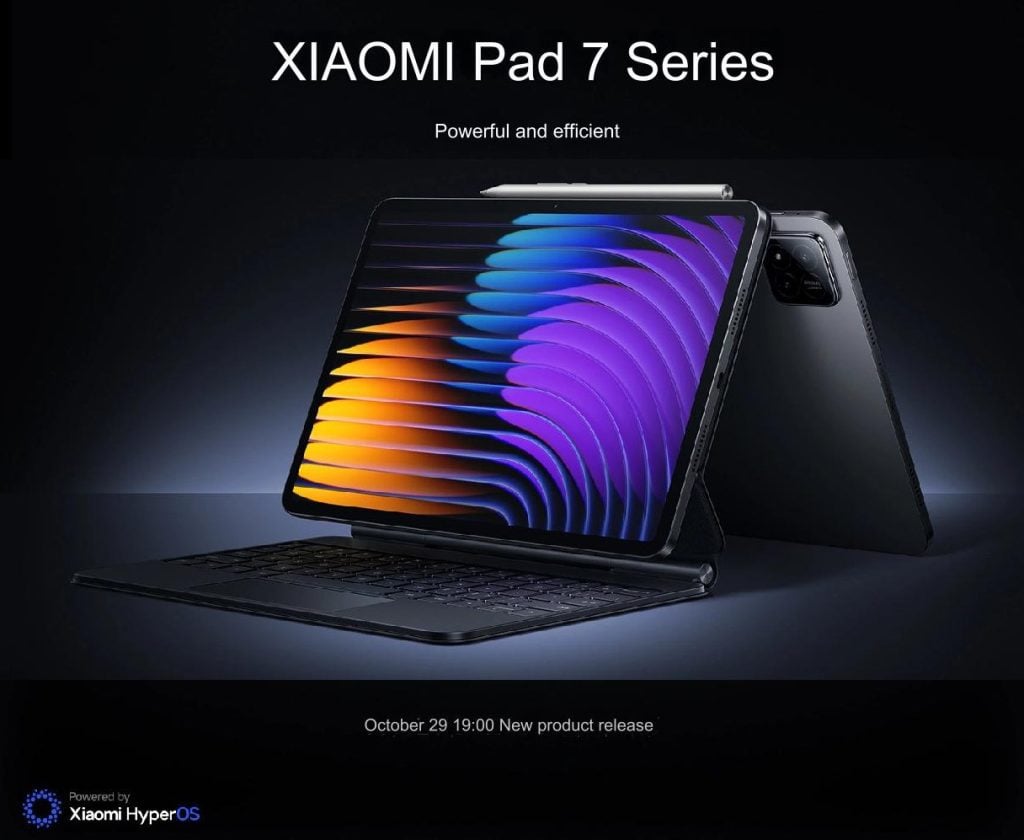
The Chinese tech giant’s new tablets are expected to launch with a premium design. Rumors have hinted that the Xiaomi Pad 7 and Xiaomi Pad 7 Pro feature an all-metal body, which isn’t surprising since these are a part of the brand’s flagship lineup. Looking at the image, we can see that the tablets would even come with a stylus.
On the front, the vanilla Xiaomi Pad 7 is rumored to sport a tall 11.16-inch panel that offers 3.2K resolution, a high refresh rate, and DC dimming. To recall, DC dimming basically helps reduce flicker and minimize eye strain. Similar to its predecessor, the base model still features an LCD panel over an OLED panel. On the other hand, the Xiaomi Pad 7 Pro will have an OLED panel of a similar size and resolution, along with a 144Hz refresh rate and DC dimming.
2. High End Specifications
Xiaomi is set to launch the Xiaomi Pad 7 Series with Qualcomm’s Snapdragon processors. The base model is expected to be equipped with the Snapdragon 7+ Gen 3 SoC (previously rumored with the Snapdragon 8 Gen 2), while the Pro option has a Snapdragon 8s Gen 3 chipset. Both tablets are expected to house a massive 10,000mAh battery pack. A 3C certification sighting confirmed 67W (Pro) and 45W (Base) wired charging support.
The duo are also expected to run on the Android 15 OS based HyperOS 2.0 custom skin out of the box. For optics, the Xiaomi Pad 7 Pro may feature a 50-megapixel primary sensor along with a secondary depth shooter. Other notable features include 5G support, WiFi 7, USB Type C 3.2 ports, and a side mounted fingerprint scanner for security.
3. Launch Date
In one of the latest teasers, the Xiaomi Pad 7 series is confirmed to launch along with the Xiaomi 15 series on 29th October 2024. Notably, a tipster on Weibo recently hinted at the existence of the Xiaomi Pad 7 Ultra. This tablet may pack the Snapdragon 8 Gen 3, making it the top end model of the Pad 7 series. Unfortunately, the Pad 7 Ultra might only debut alongside a Redmi gaming tablet sometime next year.
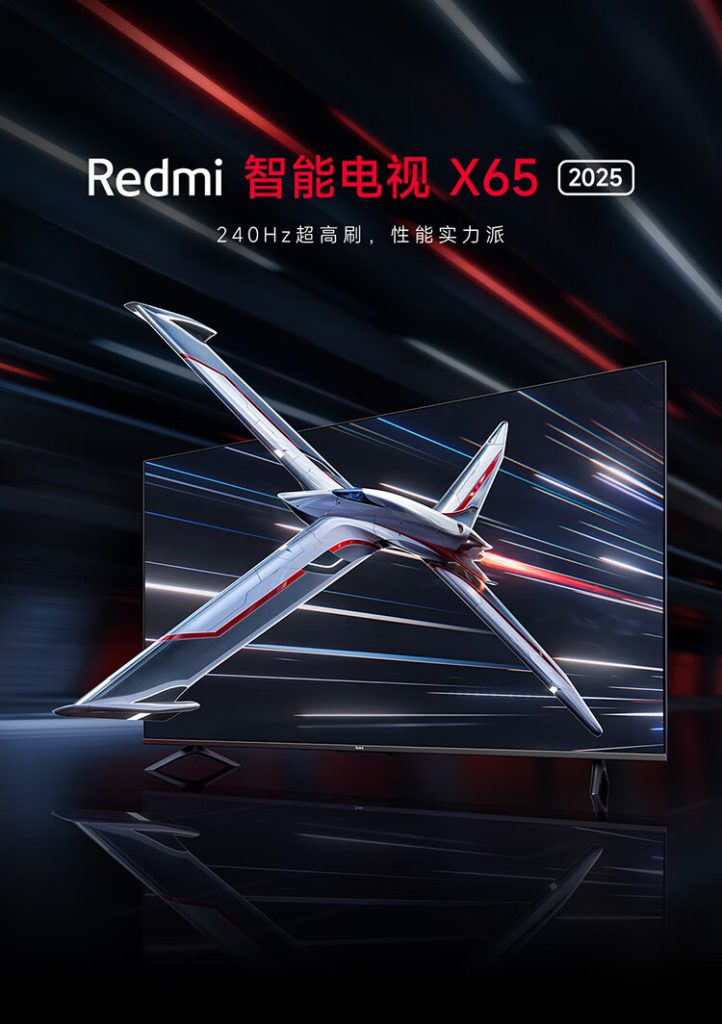
Xiaomi is back with its new Redmi Smart TV X 2025 series, aiming to redefine the viewing experience with a blend of high-end features and affordability. This launch includes four screen sizes – 55 inches, 65 inches, 75 inches, and 85 inches, catering to a variety of home setups. Let’s dive into the specifications and what makes the Redmi Smart TV X 2025 series a compelling choice.
Redmi Smart TV X 2025 Specifications
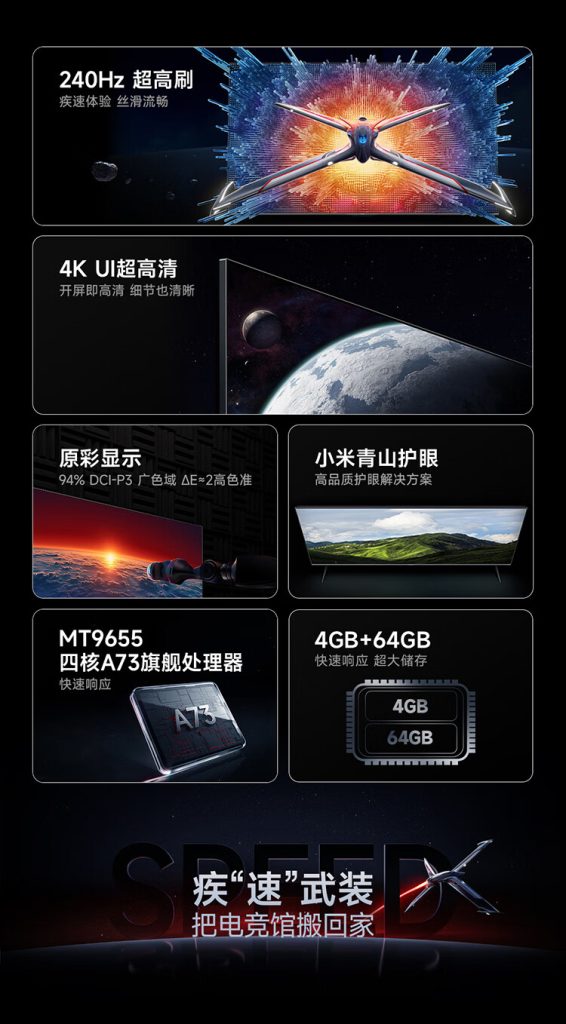
The Redmi Smart TV X 2025 series is equipped with a native 4K display (3840×2160), supporting a refresh rate of up to 144Hz. It boasts a 240Hz refresh rate, making it suitable for gaming. It supports HDR and AI-SR Super Resolution, which upscales lower-resolution content to near-4K quality. To enhance the viewing experience further, it includes MEMC motion compensation, which ensures minimal blur in fast-paced content.
The TV series features a wide color gamut with 94% DCI-P3 coverage and professional-grade color accuracy rated at ΔE≈2. It also incorporates Xiaomi’s proprietary display technologies, including the “Qingshan Eye Care” solution, which reduces eye strain for a more comfortable viewing experience, as certified by Chinese health standards.
The TV is powered by the MediaTek MT9655 processor, a quad-core Cortex-A73 CPU, paired with 4GB of RAM and 64GB of internal storage. It also supports Wi-Fi 6 for faster and more stable connectivity.
For connectivity, the Redmi Smart TV X 2025 series is well-equipped with three HDMI 2.1 ports, one of which supports eARC for enhanced audio output.
It also supports Variable Refresh Rate (VRR), Auto Low Latency Mode (ALLM), and features Bluetooth 5.2, S/PDIF, LAN, AV input, and two USB ports (one USB 3.0 and one USB 2.0).
The audio system includes dual 25W speakers with Dolby Vision and DTS support, promising an immersive audio-visual experience.
The TV runs on Xiaomi’s latest HyperOS, featuring Xiao Ai, an AI assistant for voice control, and seamless integration with the Mi Home app for smart home control. It supports NFC-based screen casting, making it easier to mirror content from compatible smartphones.
Pricing & Availability
The Redmi Smart TV X 2025 series starts at 2,199 Yuan ($309) for the 55-inch model, while the 65-inch model is priced at 2,799 Yuan ($393). The larger 75-inch version is available for 3,799 Yuan ($533), and the 85-inch model will be available at 4,799 Yuan ($674). Pre-sale starts tonight, and the TV will soon be available through Xiaomi’s official channels and authorized retailers.
Global availability details are still unknown. In August this year, Xiaomi introduced its Smart TV X Series 2024 in India, suggesting that the new iteration might debut in India next year.
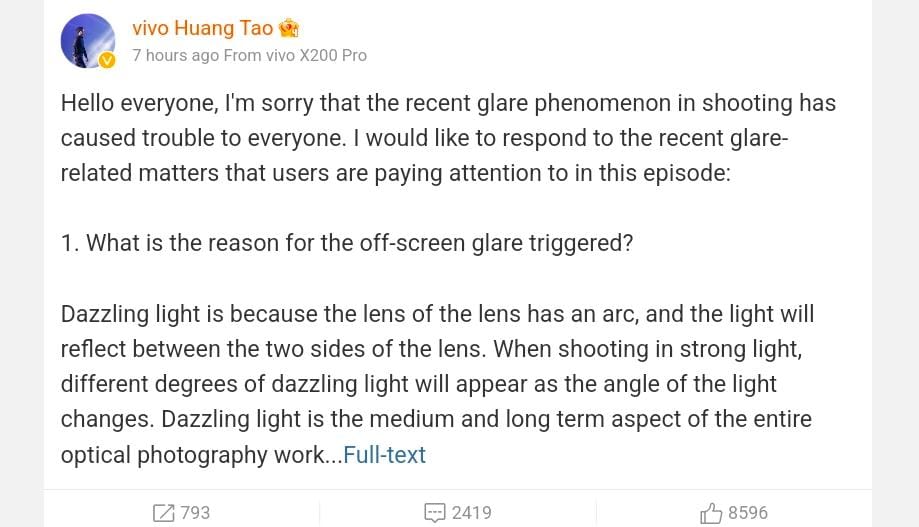
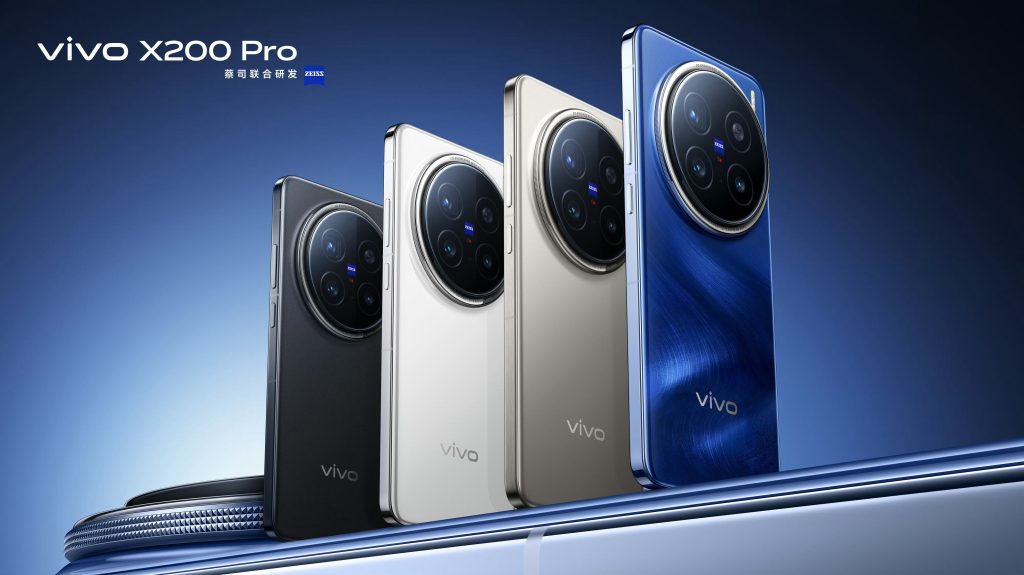
Vivo recently launched its flagship devices, the X200 and X200 Pro, with a focus on advanced camera and AI capabilities. However, soon after the release, several users reported issues with excessive lens flares when using the X200 Pro’s main camera, sparking discussions across social media. The company’s Vice President, Huang Tao, has since addressed these concerns, offering insights into the cause and potential solutions.
According to Huang Tao, the lens flare issue is due to the phone’s large f/1.57 aperture, which, while improving low-light performance, makes the camera more susceptible to lens flares caused by bright light sources outside the frame (also noted as off-screen glare). The issue is particularly noticeable when light hits the lens at specific angles, causing off-screen glare that appears more prominent than in other devices.
This is compounded by changes to the camera’s coating technology. While the new coating reduces typical radial or petal glare, it compromises on handling blue spectrum light, which contributes to the visible flares.
Fortunately, Vivo is working on a fix
Huang Tao acknowledged the oversight, mentioning that the problem was not adequately identified during initial testing. To address this, Vivo is preparing an OTA software update that aims to reduce the severity of these flares through optimization.
Additionally, the company plans to introduce hardware adjustments for users facing persistent issues, including peripheral accessories to further mitigate the problem.
Vivo X200 Pro key specifications
Despite the lens flare issue, the X200 Pro continues to impress with its robust camera setup. It features a brand new 50MP main sensor measuring 1/1.28″, a 200MP periscope telephoto lens (3.7x) with Zeiss optics, and a 50MP ultra-wide sensor, delivering high-quality images across various scenarios.
The device is equipped with a 6.78-inch 2K AMOLED display, boasting a 120Hz refresh rate and impressive peak brightness of up to 4500 nits. Powered by MediaTek’s latest Dimensity 9400 chipset, the X200 Pro promises improved performance and power efficiency over previous models.
Earlier today (24th October 2024), Xiaomi officially announced the launch date for the Xiaomi 15 series. The brand’s flagship smartphone is expected to launch with cutting edge technology and new features. So here’s what we expect from the upcoming Xiaomi 15 and Xiaomi 15 Pro.
The Chinese tech giant is gearing up to launch the Xiaomi 15 series, but ahead of the announcement, it teased the design of the upcoming phones. Both models will feature a flat middle frame and back panel for a seamless look. These are premium devices so it arrives with metal frames. There are also changes in the design of the camera island on the rear, which now softly blends into the back plate.
The base model of the upcoming flagship is expected to be a new compact smartphone. It will sport a 6.36-inch AMOLED screen with a 1.5K resolution, a 120Hz refresh rate, Dolby Vision, and a brighter screen than its predecessor. On the other hand, the Xiaomi 15 Pro is rumored to feature a tall 6.78-inch curved AMOLED screen with a 2K+ resolution, a 120Hz refresh rate, and Dolby Vision. Panels on both models are expected to use TCL’s C9 luminescent material for higher brightness and accurate colors for an improved viewing experience.
Xiaomi 15 Pro
2. Snapdragon 8 Elite-Powered Flagship
The Xiaomi 15 series is one of the first of the new generation of high end smartphones to feature Qualcomm’s Snapdragon 8 Elite. This processor is built on TSMC’s new 3nm process, bringing in significant improvement in CPU, graphics, and AI processing speeds. The chip is expected to be paired with at least 12GB of RAM and 256GB of internal storage. The vanilla model is rumored to house a 5,500mAh battery pack, while the Pro variant may be powered by a massive 6,000mAh cell.
Both devices will support wired and wireless fast charging, with the Xiaomi 15 Pro reportedly offering 80W wired charge speeds. For optics, the Xiaomi 15 series continues the brand’s Leica collaboration. We can expect to find a 50-megapixel triple camera setup on the duo, which includes an ultra wide angle lens and a periscope telephoto shooter as well. Other notable features include the Android 15 OS based HyperOS 2.0 custom skin out of the box, new AI features, an in-display fingerprint scanner and an IP68/69 rating for water and dust resistance.
3. Launch Date: When does it launch in China (and India)?
Xiaomi has officially announced the Xiaomi 15 and Xiaomi 15 Pro will be unveiled in the Chinese market on 29th October 2024. However, its Indian release is rumored to be beyond January 2025. The Xiaomi 14 arrived in March of this year, so we can expect it to have a similar launch timeline.
Earlier this week, OnePlus finally confirmed the launch date for the highly anticipated OnePlus 13. Its next gen flagship smartphone is set to be announced on 31st October 2024. The company has already begun showcasing key specs and features ahead of the launch with the latest teaser revealing the camera details. So let’s check it out.
OnePlus 13 with 50MP Triple Cameras Teased
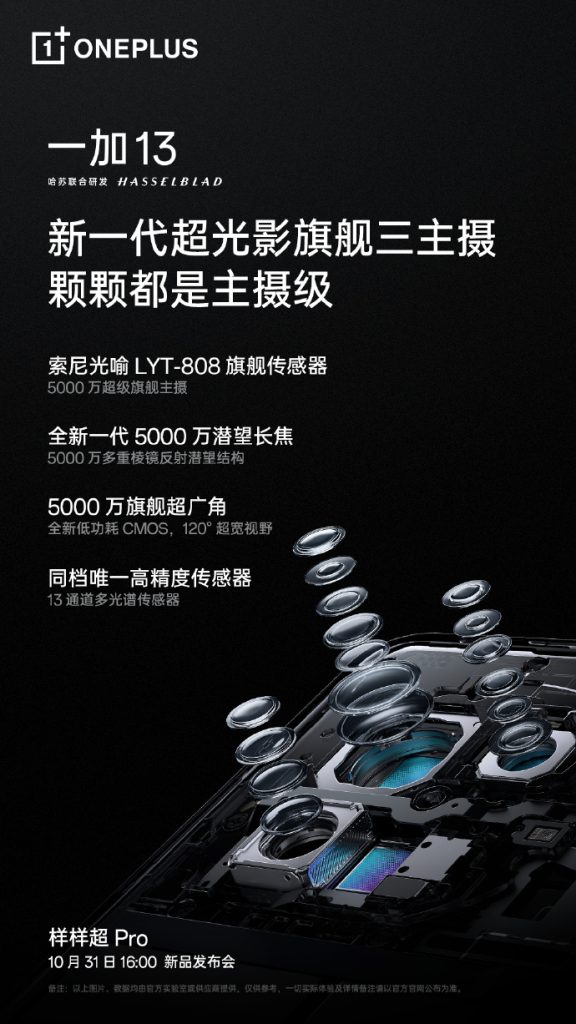
The OnePlus 13 will be announced along with Qualcomm’s brand new Snapdragon 8 Elite SoC. This model was even seen in a recent unboxing video and another teaser that showcased its cooling system. After all of these reveals, the latest info regarding the OnePlus 13 arrives from new Weibo teasers. Just like its predecessor, the OnePlus 13 also features Hasselblad triple camera module on the rear. So you still get the unique Hasselblad color texture in the next gen flagship.
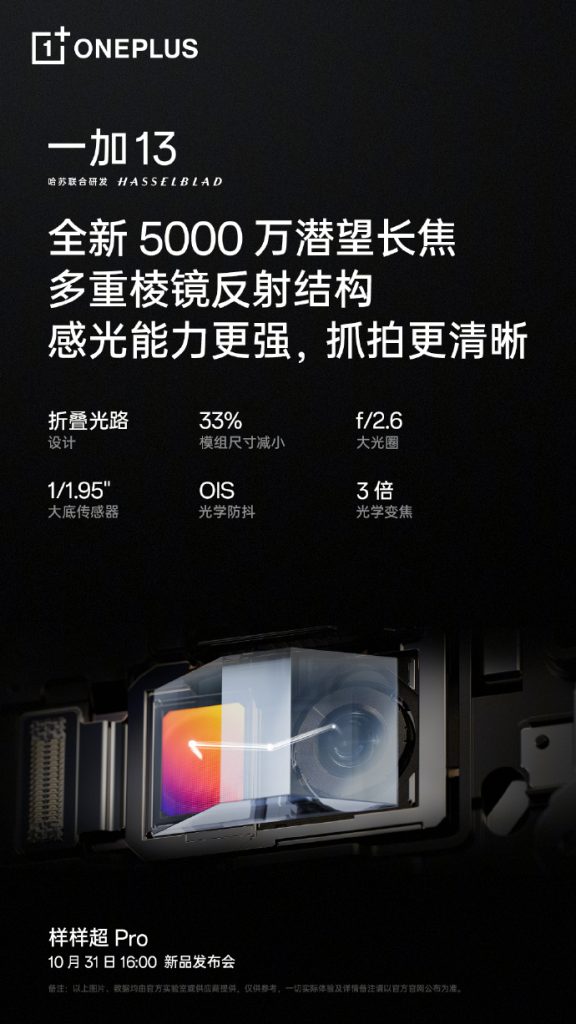
The OnePlus 13 retains the 50-megapixel Sony LYT808 primary sensor on the back, which supports OIS (Optical Image Stabilization). It is paired with a 50-megapixel Samsung JN5 ultra wide angle lens that has a 120 degree FOV. The OnePlus 12 launched with a 64-megapixel OV64B periscope telephoto shooter, but this is replaced with a new 50-megapixel Sony LYT600 telephoto lens with the OnePlus 13. This camera sensor has a f/2.6 aperture, OIS support, and 3x optical zoom.
OnePlus claims that the OnePlus 13 has a thinner and lighter periscope telephoto shooter than previous generations. Showing off the camera system’s prowess, the brand also shared a couple of images from the telephoto shooter. You can see it in Master mode, which brings out natural lighting while maintaining great details of the subject. While the Chinese launch is set for later this month, the OnePlus 13 is rumored to arrive in India around the end of January 2025.
Xiaomi confirms that it will launch its Pad 7 series tablet at the same event as the Xiaomi 15 series. The new tablet lineup will likely include a standard and a Pro model.
A prolific Weibo tipster who goes by the name Digital Chat Station (DCS) has revealed the specs of the high-end tablet in a leak today.
Xiaomi Pad 7 Pro Specs
According to the leak, the tablet will feature a large 11.16-inch display with a 3.2K resolution, likely around 2880 x 1800 pixels.
The display is reportedly still LCD like its predecessors, not AMOLED as previous rumors suggested, but it includes the benefit of full DC dimming—a feature typically found in high-end OLED displays. DC dimming helps reduce flicker and minimize eye strain.
Under the hood, the tablet will run on a Qualcomm Snapdragon 8s Gen 3 processor. While not the top-tier SoC from the chipmaker, it’s still powerful enough to handle demanding tasks. The leak also mentions 67W fast charging.
For cameras, the Pad 7 Pro may sport a 50-megapixel main sensor, possibly paired with a secondary depth sensor. While tablets aren’t known for exceptional camera performance, a good main sensor could be useful for scanning documents or taking quick snapshots.
The leak also highlights an all-metal integrated body for the Pad 7 Pro, and it is expected to come pre-installed with Xiaomi’s HyperOS 2, based on Android 15.
As AI becomes more common in products in 2024, the Pad 7 series is no exception. The leak mentions “AI and deep interconnection” as key features of the Pad 7 Pro.
Additionally, earlier reports suggest the Pad 7 series packs a 10,000mAh battery. The tablets are likely to have a side-mounted fingerprint sensor for security.
While it’s unclear if Xiaomi will offer 5G or cellular connectivity, the tablets are expected to support WiFi 7 and include a USB Type-C 3.2 port for fast data transfers.
Xiaomi just announced the launch date for its new flagship smartphone series, the Xiaomi 15 series. The upcoming premium devices are set to launch on 29th October 2024. However, the smartphones aren’t alone as the company also plans to unveil the Xiaomi Pad 7 series and Xiaomi Band 9 Pro next week as well.
Xiaomi Pad 7 Series & Smart Bank 9 Pro Launch Date
Xiaomi Pad 7 Series
The Chinese tech giant has confirmed that the Xiaomi Pad 7 Series and Xiaomi Smart Band 9 Pro will launch alongside the Xiaomi 15 series on October 29. Fresh teasers were shared recently, showcasing the design of the new tablets and smart wearable. The Xiaomi Pad 7 series can be seen with a tall display with a stylus. We covered a leak earlier this month, which revealed some of its key specs and features. It may sport an 11.16-inch LCD panel with a 144Hz refresh rate. Although, the Pro model might offer an OLED screen.
The higher end model is rumored to pack the Snapdragon 8s Gen 3 SoC, while the base variant could offer the Snapdragon 7+ Gen 3. These differences also carry forward with the charging speeds. A 3C certification sighting confirmed 67W and 45W wired charging support respectively. The series may run on a massive 10,000mAh battery pack and run on the Android 15 OS based HyperOS 2.0 custom skin out of the box.
Xiaomi Band 9 Pro
Around two weeks ago, the Xiaomi Smart Band 9 Pro renders surfaced in a leak. But the design of this wearable has been officially revealed. It is expected to feature a 1.74-inch AMOLED display with a 336 x 480 resolution, 60Hz refresh rate, and peak brightness of 600 nits. The Smart Band 9 Pro likely offers various health and fitness tracking functions like heart rate tracking and blood oxygen monitoring. So stick around for more as we will be covering the launch event on October 29.
Xiaomi has officially unveiled the design of its upcoming flagship smartphones, the Xiaomi 15 and Xiaomi 15 Pro. As confirmed by a company representative, the new models will be the first to feature Qualcomm’s Snapdragon 8 Elite chipset. The phones come with a modern, refined design, with the Xiaomi 15 sporting a completely flat display, while the 15 Pro opts for a micro-quad-curved glass design on the front.
Both models feature a sleek flat middle frame and back panel, giving them a seamless look. Being a flagship, both phones use metal frames (evident from the presence of the antenna lines). Overall, the phones come in a flat design with a flat middle frame and back panel.
One of the most notable design changes is the camera island, which now softly blends into the back plate. This not only improves aesthetics but also helps in keeping the area clean and free of dust, a practical touch for users. Additionally, the official source claims that the new design enhances the in-hand experience, making the phones feel more ergonomic.
Xiaomi 15/Pro rumored specifications:
Under the hood, the Snapdragon 8 Elite chipset powers both models, providing a substantial boost in performance and power efficiency. Built on a 3nm process, it delivers a 56% improvement in graphics performance compared to its predecessor, thanks to the new Adreno 830 GPU. CPU performance has also seen a significant upgrade, with a reported 35% increase in single-core tasks and a 30% boost in multi-core performance. These enhancements promise a faster, smoother user experience across various applications.
Xiaomi 15 will debut with HyperOS 2.0, a custom skin based on Android 15. This update is expected to bring smoother animations, improved multitasking, and better battery management. In addition to software enhancements, both models also boast impressive displays.
The standard Xiaomi 15 will feature a compact 6.36-inch flat AMOLED screen, while the Pro model is set to have a larger 6.78-inch curved display with a 120Hz refresh rate and advanced features like Dolby Vision. The use of TCL’s C9 luminescent material ensures higher brightness and more accurate colors, offering an improved viewing experience.
Battery life is another area of interest. Rumors suggest that the Xiaomi 15 Pro might come with a 6000mAh silicon-carbon anode battery, although this remains unconfirmed. The Pro model is also expected to support faster charging speeds. According to a previously leaked spec sheet, the Pro model supports 80W fast charging.
Lastly, the camera setup on the Xiaomi 15 Pro will likely include a 50-megapixel main sensor, a 5x optical zoom telephoto lens, and an ultra-wide sensor, promising versatile photography capabilities.
We use cookies on our website to give you the most relevant experience by remembering your preferences and repeat visits. By clicking “Accept”, you consent to the use of ALL the cookies.
This website uses cookies to improve your experience while you navigate through the website. Out of these, the cookies that are categorized as necessary are stored on your browser as they are essential for the working of basic functionalities of the website. We also use third-party cookies that help us analyze and understand how you use this website. These cookies will be stored in your browser only with your consent. You also have the option to opt-out of these cookies. But opting out of some of these cookies may affect your browsing experience.
Necessary cookies are absolutely essential for the website to function properly. This category only includes cookies that ensures basic functionalities and security features of the website. These cookies do not store any personal information.
Any cookies that may not be particularly necessary for the website to function and is used specifically to collect user personal data via analytics, ads, other embedded contents are termed as non-necessary cookies. It is mandatory to procure user consent prior to running these cookies on your website.