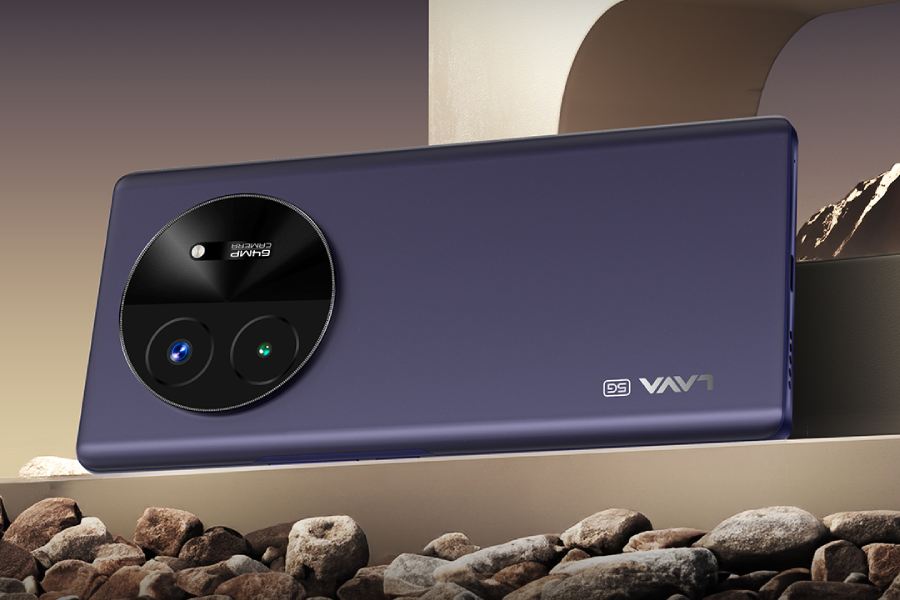
Lava plans to unveil the Blaze X in India next week. The upcoming mid range smartphone was teased earlier this week but a lot of its specs were still at large. Now, a fresh report recently surfaced that confirms its processor and storage configurations. This upcoming model supports 5G networking thanks to a MediaTek chip. So let’s check it out.
Lava Blaze X Leak: Dimensity 7050 & up to 256GB Storage
The news arrives from a YTECHB report, which claimed that the company is bringing back the MediaTek Dimensity 7050 SoC. Lava launched the Blaze Curve with this chip back in March, and it is now returning on the Blaze X as well. The processor isn’t high-end but it is capable of handling your daily use. We also get a fair idea that the smartphone wouldn’t target the budget mid-range category with a sub 20,000 INR pricing.
The report adds that the chipset will be paired with either 128GB or 256GB of internal storage. Lava previously confirmed the RAM variants, namely 4GB, 6GB, and 8GB. The 6GB and 4GB RAM options are likely for the 128GB configuration while the 8GB variant is paired with the 256GB model. Another feature that is officially confirmed is support for virtual RAM expansion of up to 8GB. Launch for the new device is set for 10th July 2024 via Amazon India, although rumors indicate that offline availability will kick off sometime in August.
Our recent reports have covered some of its other hardware, which hints at the Blaze X being the cheapest G phone with a curved AMOLED display. Color options include a Dark Violet and a Gray model. First sale will go live along with the Amazon Prime Day Sale that is set for July 20. So stay tuned for more as we will be covering the launch.
Boat has launched the Bassheads 122 ANC, wired earphones featuring Active Noise Cancellation (ANC) for under Rs. 1,000. These earphones target users looking for a balance of affordability and features.
The Bassheads 122 ANC sport a secure, in-ear fit for workouts and travel. 13mm drivers promise deep bass, clear mids, and crisp highs, while ANC reduces ambient noise by up to 25 dB. An ambient mode allows users to stay aware of their surroundings.
An inline microphone facilitates clear voice calls, and the USB Type-C connector ensures wide device compatibility. In-line controls manage music, calls, and ANC conveniently. The earphones are compatible with various devices including phones, tablets, and laptops.
The Bassheads 122 ANC has a lightweight design (35g), a 1.1m USB Type-C cable, and comes in black. Additionally, It carries a one-year warranty.
Pricing & availability
Priced at Rs. 999, the Boat Bassheads 122 ANC can be purchased from Boat’s official website, Flipkart, Amazon.in, and select retail stores like Reliance Digital, Croma, and Vijay Sales.
In related news, boAt has also launched the Lunar Oasis smartwatch, which features an AMOLED display with a peak brightness of 600 nits. It comes with a comprehensive health monitoring setup that includes a heart-rate monitor, SpO2 sensor, stress tracker, and sleep tracker. The smartwatch also offers emergency SOS, a QR tray for receiving payments, built-in games, and controls for the camera and music. Powered by a 300mAh battery, it is claimed to provide up to 7 days of usage.
Bharti Airtel, a leading Indian telecommunications company, is facing allegations of a data breach impacting a staggering 375 million users. The company, however, has vehemently denied these claims, calling them a “desperate attempt to tarnish Airtel’s reputation by vested interests.”
Dark Web Informer on X.com reported that an anonymous seller known as “xenZen” has made the data of 375 million Airtel subscribers available for sale on a hacker forum called BreachForums.
The data supposedly included sensitive details like names, family information, contact details, and even Aadhaar numbers, a unique 12-digit identification number assigned to Indian citizens.
Airtel responded swiftly to the allegations with a statement from a spokesperson, asserting, “There has been an ongoing report alleging that Airtel customer data has been compromised. This is nothing short of a desperate attempt to tarnish Airtel’s reputation by vested interests. We have done a thorough investigation and can confirm that there has been no breach whatsoever from Airtel systems.”
Unimpressively, xenZen also claimed responsibility for another recent data leak involving the Indian Ministry of External Affairs (MEA). This breach, identified in late June, reportedly exposed data from around 200,000 users registered on the MEA’s eMigrate portal. However, the authenticity of both these claims remains unverified.
While the truth behind these allegations is yet to be determined, it reminds us of the constant threat of cyberattacks. Here are some steps to protect your personal information:
Be cautious about the information you share online. Limit the amount of personal data you share on public platforms and websites.
Use strong and unique passwords for all your online accounts. Consider using a password manager to generate and store complex passwords.
Enable two-factor authentication (2FA) wherever possible. This adds an extra layer of security by requiring a second verification code in addition to your password when logging in.
Be wary of phishing attempts. Don’t click on suspicious links or attachments in emails or text messages, even if they appear to be from legitimate sources. pen_spark
By following these basic security practices, you can help safeguard your personal information and minimize the potential fallout from a data breach.
Samsung is set to announce the Galaxy M35 5G smartphone in India on July 17. It is arriving as the successor to the last year’s Galaxy M34. The upcoming device has already debuted in a select few markets. It is confirmed to be available from Amazon in India. The e-commerce platform has put up a dedicated microsite of the Galaxy M35 5G revealing its key specifications and features. Read on to know the details.
Samsung Galaxy M35 5G specs confirmed
The Samsung Galaxy M35 5G is confirmed to feature a flat frame design with a side-mounted fingerprint scanner embedded in the power button. There are three vertically stacked sensors on the back panel including a 50MP OIS camera, 2MP macro, and an 8MP ultra-wide-angle lens. On the front, the smartphone has a centre-aligned punch-hole cutout display surrounded by bezels. The screen features an sAMOLED panel with a 120Hz refresh rate, FHD+ resolution, and 1,000 nits peak brightness. The device will be shielded by Gorilla Glass Victus for protection against accidental damages and scratches.
The microsite also confirms that the Samsung Galaxy M35 5G will be eligible for four years of OS updates and security patches. It will come with a Samsung Wallet and a convenient tap-and-pay feature. The upcoming offering will be powered by an Exynos 1380 processor and come with a vapour cooling chamber for heat dissipation. The device is already confirmed to be backed by a 6,000mAh battery unit with support for 25W fast charging.
The Samsung Galaxy M35 5G will be available in Light Blue, Dark Blue, and Grey color options. Now, only the pricing and availability of the smartphone remain to be revealed. We should learn these details on July 16.
OnePlus ACE 3 Pro, the latest OnePlus device was launched last week. The new phone is another OnePlus’ mid-ranger (or flagship killer) powered by Snapdragon 8 Gen 3. As using the OnePlus-family design, it is easy to get confused with the OnePlus 12, both inside and out. After we’ve done some tests, it is found that the ACE 3 Pro actually is slightly different from the brother. It is a decent phone with great performance and, most interestingly, can last long live with a huge 6100mAh battery.
But I’m still pondering whether it’s worth buying or not, for example, for just a tiny bit more money you can buy the OnePlus 12 on GeekWills and get a better camera, screen, motor, and USB 3.2 etc.
Unbox
Like almost all OnePlus phones, the ACE 3 Pro comes in the same red packaging with an A to C cable, 100W charger, and a regular phone case. The 3 colors actually come with 3 different back cover materials this time, with the green vegan leather version being the lightest, and the white ceramic variant being special.
Design
Design for OnePlus phones never change, at least not for the first half of 2024. So the ACE 3 Pro looks almost the same as the OnePlus 12 at first glance, except for the varied cover materials. Similar camera module and slightly-curved screen. No matter how many rear cameras were set on the island, the four black holes are just so stubborn, like they’re making a statement that they exist because of some aesthetic principles.
But if you look closely, the camera design has changed quite a bit, it removes the bracket structure next to the camera, and puts the lines there instead. That’s probably all difference I can show here.
Personally, I’m not really a fan of the OnePlus-family design, but honestly I’m completely used to it (or I just gave up to judge). The design now is at least quite recognizable as a phone made by OnePlus – solid and consistent.
I got the green version – The bright color and pattern look so impressive. But I must admit that the green version of the OnePlus 12 is more refined. The ACE 3 Pro has a leather-like back cover with a pattern feels like wooden surface. When running the finger over the surface, it feels more like the leaf-vein texture.
The Ace 3 Pro comes with a metal frame, and the 3-stage button has been inherited. So we really are not going to pick on it in terms of texture. At the same time, it also has a high quality linear motor that provides a very fine vibration for various scenarios.
The Ace 3 Pro uses a curved 1.5K (FHD+) resolution screen, and if you only look at the front, it’s hard for me to tell it apart from the OnePlus 12. So in terms of holding experience, the Ace 3 Pro maintains the same high standards that OnePlus has been known for.
About more important features, we’ve also summarized some of the them we care about for you.
Performance
The Ace 3 Pro is powered by the Snapdragon 8 Gen3. No doubt it is easy to guarentee a excellent performance.
It performed even better than the OnePlus 12 in the Genshin Impact test. It runs the game at 60 fps almost the entire running, so I was very happy with the gaming experience.
On top of that for gaming, it has a custom resolution and frame interpolation feature. We’ve tried similar features before on other phones. And I was able to get a 120fps gaming experience. No exception for the ACE 3 Pro.
And OnePlus did more than that though, we all know that frame interpolation adds latency and you have to wait for two frames to be rendered out before you can do the calculations, which is dictated by the principle. This time the Ace 3 Pro has worked with Genshin Impact, optimizing the latency up at an undetectable level. In actual gaming I could barely feel the latency, which is absolutely great.
BUT since it requires a partnership with the game developers, this is currently only available in Genshin Impact. In other games with frame interpolation activated, the latency is no different from what we experienced on other phones.
And one thing to note here: If the phone’s temperature gets high with the frame interpolation on, the frame rate will drop from 120 to 90, which feels like some sort of throttling.
In addition to Genshin Impact, I also tried the newest and very popular Wuthering Waves, a game known for its poor efficiency, so it was more challenging than Genshin Impact.
I ran it on high graphic settings, but not the highest graphics, and the average frame rate was 57 fps with obvious fluctuation.
But due to the poor optimization done by the game developers, the actual gaming experience was not that smooth, but of course this is not this phone’s problem.
So, there’s no doubt that the Ace 3 Pro has an even better gaming experience than the OnePlus 12. The bigger battery also allows it to run games longer. As for other games with lower loading, that’s too easy for this phone.
Screen
The Ace 3 Pro uses a BOE 1.5k screen with LTPO support, a manual maximum brightness of 800nit, and a full screen peak brightness of 1600nit, which is slightly behind the OnePlus 12 on paper, but it’s still a very good screen. At least, it would be difficult to detect the gap.
In terms of dimming, DC-like dimming for medium and high brightness, 2160hz PWM dimming for low brightness.
Carmera
The Ace 3 Pro’s main Camera is the IMX890, an old but popular sensor you can find in the Ace 2. Well I mean, it’s popular among the brands.
The 8MP Ultra wide Camera and Macro Camera are not quite competent. You can take this phone as only having a MAIN Camera, the other two cameras are more of a decoration. The camera-island design seems to indicate the powerful camera setup. But unfortunately, on the ACE Series, which houses a mediocre setup, the camera module just looks a bit funny.
We shot some samples here. Anyway, the main camera is not bad and is perfectly fine for everyday shooting.
Battery & Charging
The biggest highlight of this phone is of course the big 6100mAh battery, which is not only thinner but also bigger thanks to the new materials. In real life use it is amazing and without a doubt the strongest battery performance of any regular Phone I’ve tested.
In addition to the large battery, the Ace 3 Pro also supports 100W fast charging, it only takes 38 minutes to fully charge this battery. gaming phones don’t even have this Crazy efficiency!
Verdict
So it is pretty obvious here, if you want a phone with great performance, a very big battery for long-lasting gaming and daily uses, and don’t care that much about the camera, then the Ace3 Pro is a great fit. But if you want a more balanced flagship, then the OnePlus 12 is now priced right. If you’re looking to buy either of these phones, Geekwills have you covered.
Motorola is expanding its home entertainment portfolio in India with the new AmphisoundX 600W Soundbar. These are its latest audio products, with the sale set to kick off later this week. The brand is promising powerful bass, Dolby Atmos support, and much more. So here’s everything you need to know about its specs, features, pricing, and availability.
Motorola AmphisoundX 600W Soundbar India Launch
As the name suggests, the AmphisoundX consists of a soundbar along with satellite speakers. The main soundbar unit promises to offer 600W output from its 3 front firing and 2 top firing drivers. On the other hand, the satellite speakers offer 40W output. Motorola aims to bring a true cinematic experience with these speakers, which is complemented by three dedicated audio modes. Marketing material showcases this device with up to 4K audio and an ultra premium design.
Motorola AmphisoundX 600W Soundbar Speakers
Apart from all this, Motorola brings support for Dolby Atmos and 3D surround sound for a more immersive listening experience. This joins the original AmphisoundX and AmphisoundX Vibe, which are soundbar speakers similar to the latest 600W model. Moto’s new AmphisoundX 600W soundbar will officially go on sale in India on 7th July 2024. It is already listed on Flipkart, a popular e-retailer in India.
Motorola AmphisoundX 600W carries a price tag of 17,999 INR (roughly 215 US Dollars). For the first 10 customers that purchase these new soundbars through Flipkart, you also get free Soundcore Life Note 3 TWS earbuds. These wireless earphones are worth 7,999 INR (roughly 96 US Dollars). Its new soundbar arrives just after its flagship foldable phone, the Razr 50 Ultra. In the hearables category, the company unveiled the Moto Buds and Moto Buds+ in the region back in May 2024 with ANC, Dolby Head Tracking, and Bose Sound.
Redmi launched the G Pro 2024 gaming laptop with the back in March this year with with i9-14900HX + RTX 4060 for a price tag of 8,999 Yuan (~$1250). While this product is very capable, many customers believe that the price-to-performance ratio is average. To make it more appealing, now the company has released a i7-14650HX-powered version of the machine, that can still meet the performance requirements of most of the customers.
Core i7-14650HX + RTX 4060 with the same 210W total performance release
Unfortunately, the company has yet to reveal the price tag of the new product. This new i7 version of the G Pro 2024 laptop will go on sale at 10 am on July 12 in the home country.
The new i7-powered machine still comes with the same 210W total performance release, 2.5K 240Hz display and the RGB lights on the keyboard and the back. You can get a better idea of the design from the image below.
For those unfamiliar, the Core i7-14650HX processor equips 16 CPU cores and 24 threads with a performance release of 130W. The new version still boasts the RTX 4060 graphics that comes with a performance release of 140W. This is paired with 16GB DDR5 RAM and 1TB PCIe 4.0 SSD.
The display of this gaming-centric laptop is measured at 16″ and comes with a response speed of 3ms and support for G-SYNC technology. The panel reaches a peak brightness of 500 nits, supports 10-bit color depth, and DC dimming, and covers a 100% sRGB color gamut. You can also easily adjust the RGB effect with a single key on this device. This laptop comes with Xiaomi’s smart connectivity features such as a cross-device camera, keyboard and mouse sharing, and more. Speaking of ports, you get the following:
Honor has officially announced the launch date of its upcoming smartphones. The Honor 200 series is set to debut in India later this month. The lineup is confirmed to comprise of the Honor 200 and Honor 200 Pro. Both smartphones have already debuted in the global markets. Notably, they will be the third and fourth smartphones to launch in India after the brand’s re-entry in the Indian market.
Honor 200 series India launch date announced
The Honor 200 series is confirmed to debut in India on July 18, Thursday. The upcoming smartphones are already confirmed to be available from Amazon along with mainline stores and the brand’s official website. The standard model will come in Classic Black color whereas the pro variant will be offered in Moonlight White hue. The Honor 200 duo will feature a pill-shaped camera module and an ultra-slim design measuring just 7.7mm thick.
Honor has collaborated with a Paris-based photography studio called Studio Harcourt. The brand is teasing the device as ‘The Portrait Master’. The Honor 200 series will feature a 50MP portrait camera with OIS. The smartphones are confirmed to run on MagicOS 8.0 based on Android 14. It will pack various AI features that include the brand’s MagicLM on-device language learning model.
The Indian variants of the Honor 200 and 200 Pro are expected to retain the same specifications as their global counterparts. Both phones feature a 6.7-inch curved AMOLED screen with a 1.5K display resolution and a 120Hz refresh rate. The standard and pro models are equipped with Snapdragon 7 Gen and Snapdragon 8s Gen 3 chipsets respectively. They are backed by 5,200mAh battery units with support for 100W wired charging. The Pro model also supports 66W wireless charging.
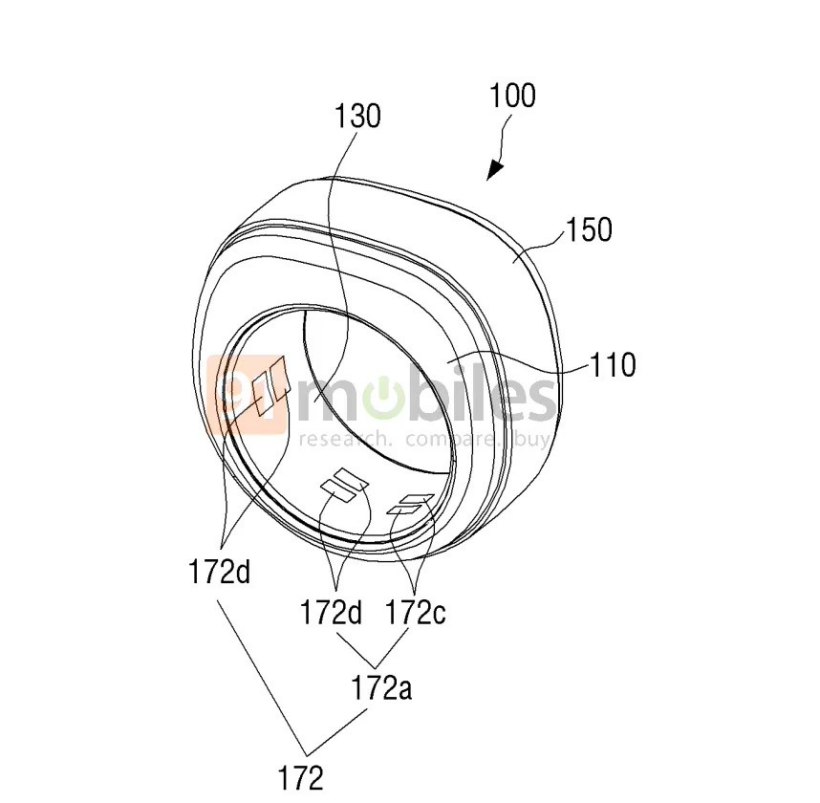
Samsung is about to launch a wearable smart ring on the upcoming Galaxy Unpacked event, scheduled for July 10. However, a new patent application hints that Samsung is working on another smart wearable ring that has a different design. The patent application was filed at the United States Patent Application Publication in May 2024.
The second-generation Galaxy Ring could pack a display
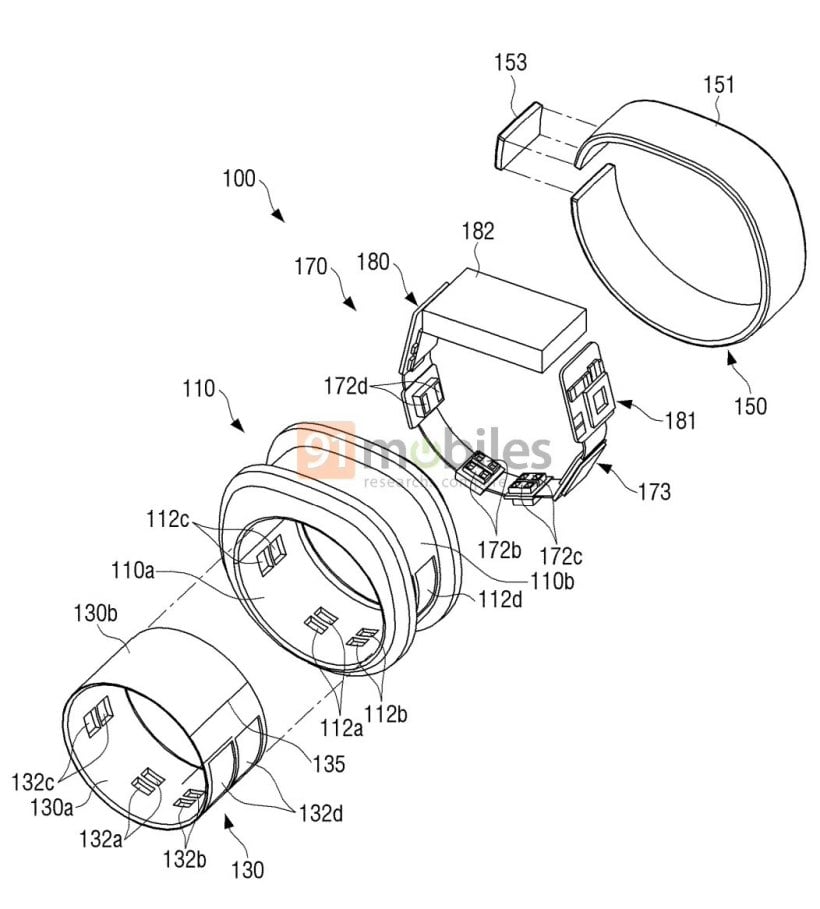
As you can see from the image above, the new smart ring (probably the second generation Galaxy Ring) will have a flat side on the outer layer while the inner layer will be circular. It is speculated that the flat side of the outer layer will equip a display while the inner side will house the sensors. One of the images also support this speculation, which you can see below.
Additionally, it’s rumored that the second-generation ring could come with two displays: one for app icons and another for showing content or information when an app icon is clicked. Both screens would function together based on user input. However, the patent application images do not explicitly show multiple displays on the device.
The display could help you easily check some key information such as stats of workouts, and heartbeat rate without having to touch your phone. It may inform you about incoming calls and notifications.
It’s also clear from the images that the second-generation ring could have significantly higher internal volume as compared to the first-generation Galaxy Ring. It hints that the next ring will have more resources inside (such as higher battery capacity or additional sensors) for improved functionality.
According to the patent listing, the Galaxy Ring will support Galvanic Skin Response (GSR), SPO2, PPG, and ECG measurement. It will also equip a temperature sensor, acceleration sensor, fingerprint sensor, and a switch. The use of more sensors could be a reason behind increasing the internal volume of the device.
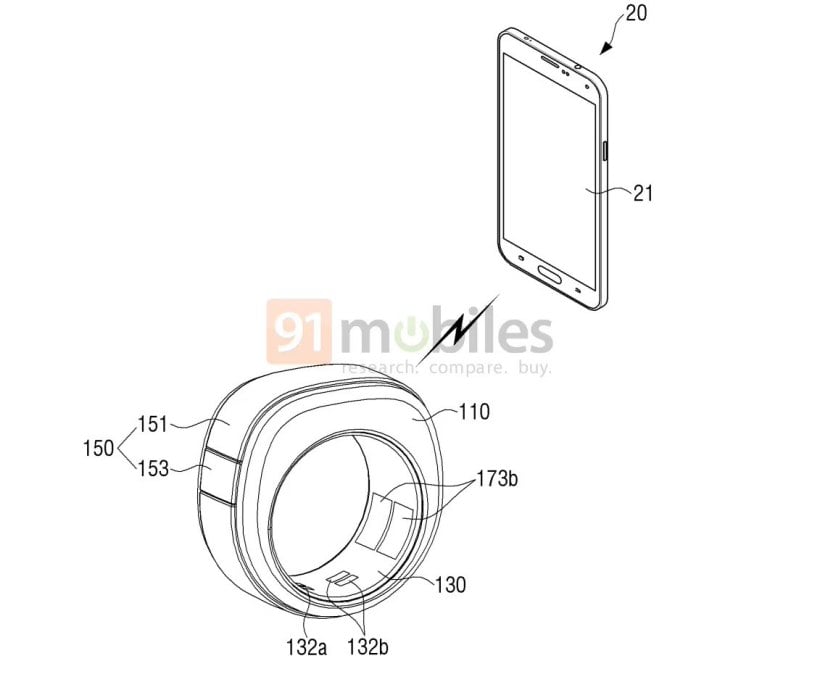
Nonetheless, this device will still need to communicate with the phone and will likely use Bluetooth the connectivity. It’s also speculated that the device could support Wi-Fi, NFC, and MST (magnetic secure transmission) for payments.
According to the patent, this second-generation ring will also come in multiple sizes. There will be 27 ring sizes in South Korea and 65 sizes in the US. Speaking of the launch of the product, it’s still in its early development stage, and whether the company will release the product or not depends on the success of the development. We will share more information as they become available.
Red Magic recently unveiled the Red Magic 9S Pro and 9S Pro+ smartphones in China featuring an overclocked Snapdragon 8 Gen 3 SoC, a new ICE 13.5 cooling system, and AI features to aid gaming. Through its global website, the brand has now announced July 16th as the official global launch date for the Red Magic 9S Pro.
The microsite confirms that the global model of the Red Magic 9S Pro will be using the Snapdragon 8 Gen 3 “Leading Version” which is nothing more than an overclocked variant of the chip. Along with the new smartphone, the brand also plans to launch its recently unveiled Red Magic Titan 16 laptop in the global market.
Red Magic 9S Pro specs:
The Red Magic 9S Pro features a 6.8-inch Full HD+ OLED display with a resolution of 2480 x 1116 pixels and a 120Hz refresh rate. It supports 10-bit color depth, covers 100% of the DCI-P3 color gamut, and has a peak brightness of up to 1600 nits. The display also includes DC dimming and 21600Hz PWM dimming.
The phone is powered by the Octa-Core Snapdragon 8 Gen 3 Leading version and an Adreno 750 GPU. It comes with memory options of 12GB, 16GB, or 24GB of LPDDR5X RAM and storage choices of 256GB, 512GB, or 1TB UFS 4.0.The Red Magic 9S Pro runs on Android 14 with Redmagic OS 9.5 and supports dual SIM cards. It has a 6500mAh battery with 80W fast charging.
It has a triple camera setup on the back, including a 50MP main sensor (Samsung GN5), a 50MP 120-degree ultra-wide lens (Samsung JN1), and a 2MP macro camera (GigaDevice GC02M1). The front camera is a 16MP under-display unit. The phone also features an in-display fingerprint sensor, a 3.5mm audio jack, dual 1115K speakers with DTSULTRA, and three microphones.
For connectivity, the device supports 5G NSA/SA, dual 4G VoLTE, Wi-Fi 6E (2.4GHz, 5GHz, and 6GHz bands), Bluetooth 5.4, GPS (L1/L5) + GLONASS, USB Type-C, and NFC. The dimensions are 163.98 x 76.35 x 8.9mm, and it weighs 229g.
Huawei has confirmed that its upcoming Mate 70 series will be the first to launch with the official version of its in-house operating system, HarmonyOS NEXT. The announcement came during the HDC 2024 Huawei Developer Conference, which also revealed an expected release window in the fourth quarter of this year (October to December).
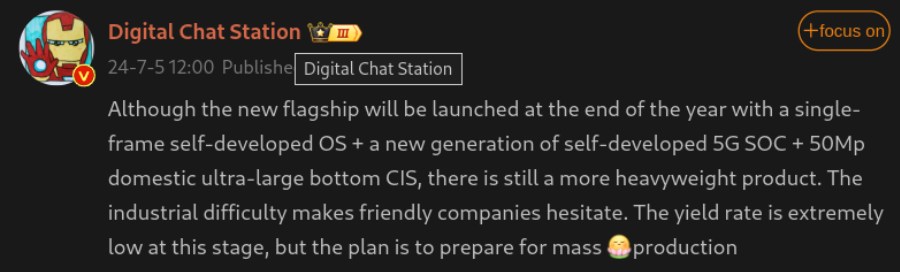
Now a fresh new leak by prolific tipster Digital Chat Station suggests the Mate 70 will feature a new generation of HiSilicon Kirin 5G SoC, signifying Huawei’s continued commitment to its in-house chipset development.
The phone is also rumored to feature a domestically produced 50-megapixel ultra-large-bottom CMOS image sensor likely from OmniVision.
Additionally, Digital Chat Station hints that Huawei is working on a more “heavyweight product.” However, this product is reportedly facing production difficulties due to an extremely low yield rate. While it’s unclear exactly what this product is, it could be a new top-tier model in the Mate 70 series.
Another positive sign for the HarmonyOS ecosystem comes from comments made by the tipster. They claim that WeChat, China’s ubiquitous messaging and social media app, is working on developing a native app for the HarmonyOS NEXT consumer version.
As the official launch window approaches, more details about the Mate 70 series are likely to emerge in the coming months. We will keep you updated on it.
For those interested to recap the specs of the Mate 60 series, here they are:For those interested in the specifications of the Huawei Mate 60 and Mate 60 Pro, here they are:
Realme recently hosted an AI Imaging Media preview event in Bangkok, Thailand, where it revealed the camera capabilities and AI features of the upcoming Realme 13 Pro series.
The highlight of the event was the reveal of the Realme 13 Pro+’s dual main camera system. The primary camera features a 50MP sensor with Optical Image Stabilization (OIS) and the industry-first Sony LYT-701 sensor. It is paired with a 50-megapixel Sony LYT-600 periscope telephoto lens that offers 3x optical zoom for capturing distant objects with clarity.
Beyond the hardware, Realme also announced HYPERIMAGE+ which it is touting as the industry’s first AI photography architecture. It’s a three-layer system that combines high-quality optics with on-device AI processing and cloud-based AI image editing capabilities.
One of the key AI features of HYPERIMAGE+ is the AI HyperRAW Algorithm, designed to improve image clarity and dynamic range. It allows the camera to capture more natural light and shadow details, resulting in more realistic photographs.
The Realme 13 Pro series also boasts a suite of AI-powered photography functions for portrait shots. These include AI Pure Bokeh, AI Natural Skin Tone, and AI Ultra Clarity.
AI Pure Bokeh is claimed to accurately differentiate foreground, midground, and background elements, along with the subject, for precise object segmentation. This allows for targeted algorithmic processing, creating a natural bokeh effect for professional-looking portraits in a short time.
Realme further emphasized the camera system’s quality by highlighting its TÜV Rheinland certification for High Resolution Camera.
The company also mentioned two additional AI features, AI Group Enhance and AI Smart Removal. However, details about these features remain unclear. More information is expected as the official launch of the Realme 13 Pro series approaches later this month.
In a significant move announced last month, Apple will get an observer role on OpenAI’s board. This strategic partnership aims to bolster Apple’s AI capabilities and position in the tech landscape. The role, filled by Phil Schiller, the head of Apple’s App Store and former marketing chief, will officially start later this year.
Phil Schiller will attend OpenAI’s board meetings, gaining valuable insights into the decision-making processes without having the power to vote or make decisions. This role provides Apple with a deeper understanding of OpenAI’s strategies and developments.
This move places Apple on par with Microsoft, OpenAI’s largest supporter and main AI technology provider. It allows Apple to stay competitive in the rapidly evolving field of artificial intelligence.
The partnership could lead to complications, given the long-standing rivalry between Microsoft and Apple. Microsoft might want Schiller excluded from discussions about future AI initiatives involving both companies.
Phil Schiller, an Apple Fellow, oversees the App Store and manages product launch events. He stepped down as head of marketing in 2020 but remains a key figure at Apple. Additionally, he serves as a director at the medical technology company Illumina.
Integration of ChatGPT with Apple Devices
At the WWDC 2024 event in June, Apple announced the integration of ChatGPT into iPhones, iPads, and Macs as part of its AI features suite. The upcoming iOS 18 will see enhanced AI capabilities on Apple devices. ChatGPT will handle complex tasks, while smaller tasks will be managed by on-device AI models.
This partnership is not about money. Instead, OpenAI gains access to millions of Apple users, and Apple benefits from integrating ChatGPT, potentially offering a paid version of ChatGPT that could generate revenue through App Store fees.
Future AI Collaborations
Apple is also in talks with other AI developers, including Google, start-up Anthropic, Baidu, and Alibaba Group Holding, to explore additional chatbot integrations. The new AI features, branded as “Apple Intelligence,” are expected to launch first in American English, with plans for an international rollout.
OpenAI has faced several controversies, including the brief ousting of CEO Sam Altman and criticisms over AI safety. For Apple, securing an observer role in a high-profile partner like OpenAI is a rare move, highlighting the significance of this partnership.
Apple’s observer role on OpenAI’s board and the integration of ChatGPT into its devices signify a major step in Apple’s AI strategy. This partnership enhances AI capabilities on Apple devices, offering users advanced features and setting the stage for future innovations in artificial intelligence.
Following user frustrations with the under-display fingerprint sensor introduced on the Pixel 6, Google appears to be making a change with the Pixel 9 series.
According to a report by Android Authority, the Pixel 9 and 9 Pro will replace the current optical sensor in favor of an ultrasonic fingerprint reader. The Pixel 9 Pro Fold, however, is expected to maintain its side-mounted capacitive sensor.
Ultrasonic fingerprint technology utilizes inaudible sound waves to map a user’s fingerprint. This method offers several potential advantages over the optical sensors used in previous Pixels.
Unlike optical sensors that rely on light and can be hampered by screen protectors, ultrasonic sensors can create a more detailed “reproduction” of the fingerprint ridges and valleys, leading to faster and more reliable unlocking.
The specific ultrasonic sensor rumored for the Pixel 9 is the Qualcomm 3D Sonic Gen 2 (QFS4008). Introduced in 2021, this sensor boasts a larger surface area (8x8mm) compared to its predecessor which allows for easier finger placement and captures more biometric data for improved accuracy.
Additionally, the QFS4008 is claimed to be faster than previous solutions, particularly when fingers are wet – a common pain point for optical sensors. It’s the same sensor used on the Galaxy S24 Ultra.
Google’s decision to switch to fingerprint sensor technology is not surprising. Since the Pixel 6, users have reported inconsistent performance with the under-display sensor, especially compared to the highly regarded rear-mounted Pixel Imprint scanner used on earlier models.
While Google made improvements with the Pixel 6a sensor, limitations like a reduced number of registerable fingerprints remained.
The delay in adopting ultrasonic technology is somewhat puzzling. Fortunately, there is universal face unlock on the Pixel 8 that worked quite well. However, face unlock has its limitations.
Its reliance solely on the front camera renders it unusable in low-light conditions, highlighting the need for a robust alternative like a reliable fingerprint sensor.
Remember when we thought the chip industry was in a slump? Well, Samsung just blew that notion out of the water with a profit surge that’s making waves across the tech world. And it’s not just about the numbers – it’s a testament to the power of AI and the rebounding chip market.
But that’s just the beginning. We’ve got the scoop on Google’s ambitious ‘Make in India’ plans that could reshape the global smartphone market. Plus, there’s drama brewing at OnePlus India, and Huawei might just flip the script on foldable phones.
From AI-powered chips to leadership shake-ups, read on to learn more about what happened in the tech world in the past 24 hours.
Samsung Electronics has announced an expected 13-fold increase in its second-quarter profit, a remarkable turnaround compared to the same period last year. The company’s estimated operating profit for Q2 2024 is set to reach 8.8 trillion won ($6.34 billion), up from just 670 billion won in Q2 2023. This marks the highest profit for Samsung since the third quarter of 2022.
Earlier, it was rumored that the Huawei Nova series flip phone could be released in July. However, a new leak claims that the phone could be released in early August.
Chinese smartphone giant OnePlus is undergoing a leadership reshuffle in India, with veteran Robin Liu returning to head its operations. This comes amidst a boycott from offline retailers and the Indian government’s push for local talent in leadership roles.
Google is apparently planning on exporting its Pixel series of smartphones to the US and Europe from India. It is looking to establish the region as a key export hub with its commercial production set to kick off soon from two of its contract manufacturing partners.
Both the Vivo X100 and X100 Pro, which made their debut in China in October 2023, feature a 6.78-inch curved-edge OLED panel and a Dimensity 9300 chipset. It appears that while the X200 Pro will continue to feature a larger display of around 6.7 inches, reliable tipster Digital Chat Station recently hinted that the X200 may end up as a compact phone with a flat display. In a new Weibo post too, the tipster seems to have reiterated the compact form factor along with some details about its display.
Alleged Vivo X200’s key details leaked
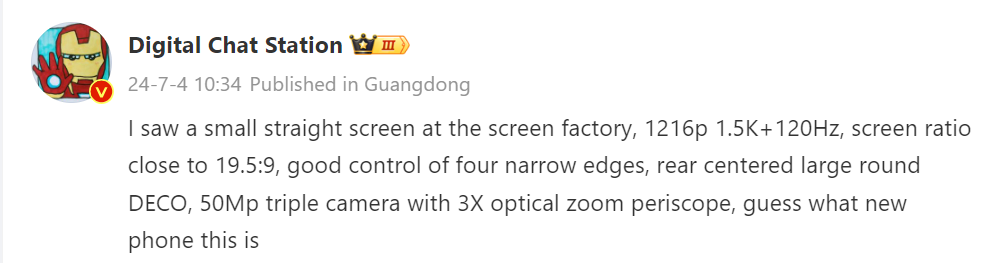
In the above leak, the tipster mentions a compact smartphone featuring a flat display. Although he did not specify the device’s name, it is likely he is referring to the X200. The leaker previously revealed that the device might feature a 6.4-inch or 6.5-inch flat display.
It seems that the Vivo X200’s display will have narrow bezels on all four sides. It will offer a 1.5K resolution (1216 pixels), a 120Hz refresh rate, and an aspect ratio of around 19.5:9. The rear panel of the device will have a large circular camera module housing a triple camera unit. It will feature a 50-megapixel primary camera and a periscope telephoto camera with 3x optical zoom.
As per other reports, the Vivo X200 will have Vivo’s self-developed imaging chip for enhanced photography and an optical in-display fingerprint scanner. In addition, it will feature the Dimensity 9400 chip, which will also power the X200 Pro. The 6.7-inch display phone in the Pro model is rumored to have an ultrasonic in-screen fingerprint sensor.
Since the leaker has not explicitly mentioned the device’s name, readers should approach this report with caution.
Redmi will unveil the Redmi K70 Ultra this month (July) in China. The company will probably announce its launch date next week. A new leak on Weibo revealed the device’s configuration before its official announcement. The same leak has also revealed the variants of the Xiaomi Mix Flip, which is expected to debut next month (August) in China.
Redmi K70 Ultra
As per the leak, the upcoming Xiaomi phone with model number 2407FRK8EC will be available in four configurations, such as 12 GB RAM + 256 GB storage, 12 GB RAM + 512 GB storage, 16 GB RAM + 512 GB storage, and 16 GB RAM + 1 TB storage. The 2407FRK8EC phone is nothing but the Redmi K70 Ultra.
Recent reports have claimed that the K70 Ultra has an OLED panel that offers a 1.5K resolution, a 144Hz refresh rate, a dedicated X7 graphics chip, and an in-screen fingerprint sensor. Under the hood, it will have the Dimensity 9300+ chipset, LPDDR5x RAM, UFS 4.0 storage, and a 5,500mAh battery with 120W fast charging support. It will feature a 20-megapixel front camera and a 50-megapixel + 8-megapixel + 2-megapixel triple camera unit. For durability, it will offer an IP68-rated body equipped with a metal frame.
Xiaomi Mix Flip
The Xiaomi Mix Flip, which bears the 2405CPX3DC model number, will also be available in the same variants as the K70 Ultra, such as 12GB+256GB, 12GB+512GB, 16GB+512GB, and 16GB+1TB.
As per reports, the Mix Flip will have a Snapdragon 8 Gen 3 chip and a cover display of around 4 inches. Its rear camera setup includes an OIS-enabled 50-megapixel primary camera and a 60-megapixel OmniVision OV60A telephoto camera with 2x optical zoom. It is also expected to support 67W fast charging.
Honor Magic V3 series of foldable phones will be announced on July 12 in China. Yesterday, the company released a poster to showcase the design of the device. It showed a brown variant with a leather finish. Today, the brand released the following images to showcase the three other color variants of the Magic V3.
Honor Magic V3 color options
Honor Magic V3
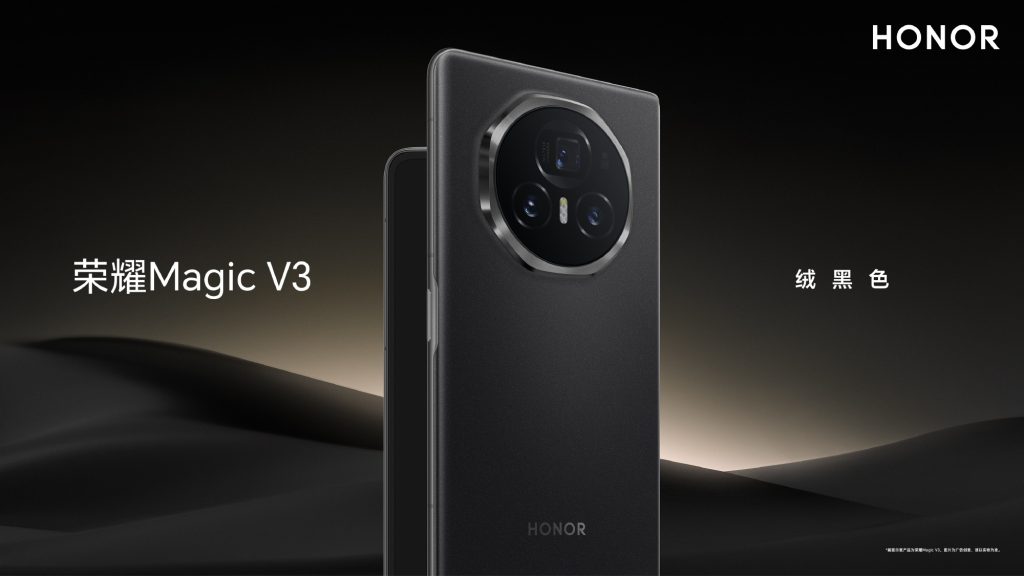
The new images showcase the Magic V3 in three shades, such as Tundra Green, Qilian Snow, and Velvet Black. Compared to the Magic V2 from last year, the V3 offers a major upgrade in the design of its rear camera module. It features a prominent octagonal base that houses three triangular cameras and an LED flash.
Honor Magic V3
The company is yet to disclose the camera details of the Magic V3, but it’s said to feature a periscope telephoto camera with 3.5x optical zoom support. Under the hood, the device will feature a Snapdragon 8 Gen 3 chipset and a battery of around 5,000mAh capacity. According to reports, the device will support 66W fast charging and offer two-way satellite connectivity. It is expected to be slimmer than the Magic V2, which measures 9.9mm in the unfolded state.
Honor Magic V3
The Honor Magic Vs3, which will launch with the Magic V3, is said to be an affordable foldable phone. It may come equipped with the Snapdragon 8 Gen 2 chip and compete with the Vivo X Fold 3. A recent leak suggested that the device may come in color options, such as black, white, and green.
The July 12 launch event in China will also see the arrival of the MagicBook Air 14 laptop and the MagicPad 2 tablet. The latter is expected to feature the Snapdragon 8s Gen 3 chipset.
OnePlus recently launched the OnePlus Ace 3 Pro with the Snapdragon 8 Gen 3 chipset and a massive 6,100mAh battery. A new leak, courtesy of tipster Digital Chat Station, suggests that the Ouga group of companies, which mainly includes Oppo and OnePlus, will launch a 6,500mAh battery. Furthermore, the tipster leaked some information about what appeared to be the OnePlus 13 and Ace 4.
OnePlus phones with up to 6,500mAh battery in works
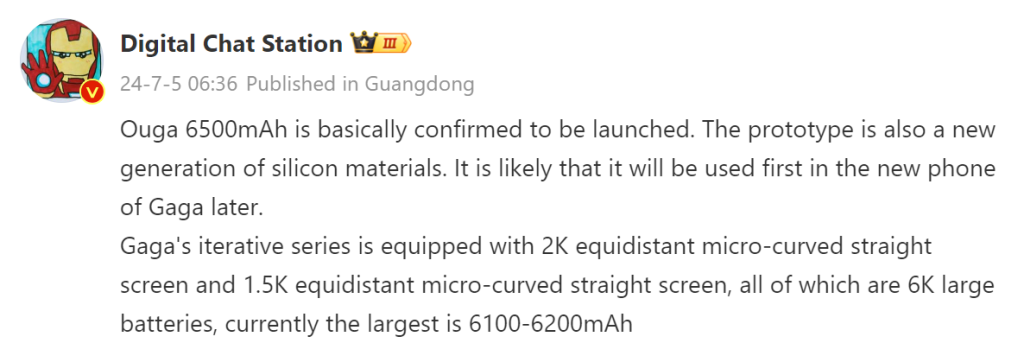
According to DCS, the Ouga group will launch a phone with a 6,500mAh battery. The company is currently testing prototypes with this new battery. He added that a OnePlus phone coming in future will be the first to feature it.
It can be said based on DCS’ Weibo post that the two upcoming OnePlus will have a 1.5K and 2K resolution micro-curved flat displays. These appear to be the OnePlus Ace 4 and OnePlus 13, respectively. Both of which are packed with 6,000mAh batteries, with capacities ranging from 6100mAh to 6200mAh.
The OnePlus 13 is likely to feature the Snapdragon 8 Gen 4 chipset, whereas the Ace 4 may come equipped with the Snapdragon 8 Gen 3. There is a possibility that the Ace 4 may get rebranded as the OnePlus 13R in the global market. These are just assumptions based on OnePlus’ phone launch patterns.
As far as the OnePlus phone with a 6,500mAh battery is concerned, it could be the OnePlus Ace 4 Pro, which is expected to arrive in mid-2025 in China.
Readers should note that since the tipster has not mentioned the names of the devices in the leak, it is advisable to take the report with a grain of salt and wait for further updates.
Foxconn is setting foot further into Vietnam with a huge $551 million investment (roughly 4.013 billion Yuan) in two new projects situated in Quang Ninh Province, northern Vietnam. These projects are slated for completion in July 2026 and will focus on smart technology production.
The company’s facilities will manufacture smart entertainment products and system equipment
The first project, located in Song Khoai Amata Industrial Park, will see an investment of US$263.7 million (approximately 1.92 billion Yuan). This facility will churn out smart entertainment products, aiming for an annual production capacity of 4.18 million units.
The second project is situated in Bac Tien Phong Industrial Park and boasts an investment of US$287.2 million (approximately RMB 2.092 billion). Spanning 12.4 hectares, this location will concentrate on producing intelligent system equipment. Following a period dedicated to installing machinery and testing everything out, official production is expected to kick off in May 2027.
We use cookies on our website to give you the most relevant experience by remembering your preferences and repeat visits. By clicking “Accept”, you consent to the use of ALL the cookies.
This website uses cookies to improve your experience while you navigate through the website. Out of these, the cookies that are categorized as necessary are stored on your browser as they are essential for the working of basic functionalities of the website. We also use third-party cookies that help us analyze and understand how you use this website. These cookies will be stored in your browser only with your consent. You also have the option to opt-out of these cookies. But opting out of some of these cookies may affect your browsing experience.
Necessary cookies are absolutely essential for the website to function properly. This category only includes cookies that ensures basic functionalities and security features of the website. These cookies do not store any personal information.
Any cookies that may not be particularly necessary for the website to function and is used specifically to collect user personal data via analytics, ads, other embedded contents are termed as non-necessary cookies. It is mandatory to procure user consent prior to running these cookies on your website.