
Add GIZMOCHINA as Preferred Source on Google
Honor‘s upcoming 300 series is set to launch on December 2. The company has already officially revealed the design language of the Honor 300 Ultra while the promotional images of the standard model were leaked previously.
Now the alleged Honor 300 Pro has surfaced on Geekbench. We previously knew the phone was going to use last year’s flagship Snapdragon 8 gen 3 chip, but the listing reveals some unexpected insights. Let’s take a look at the clock speeds first.
Details of Honor 300 Pro’s Snapdragon 8 Gen3 chip
The model uses a configuration with one 3.05 GHz X4 super core, five 2.96 GHz A720 large cores, and two 2.04 GHz A520 medium cores.
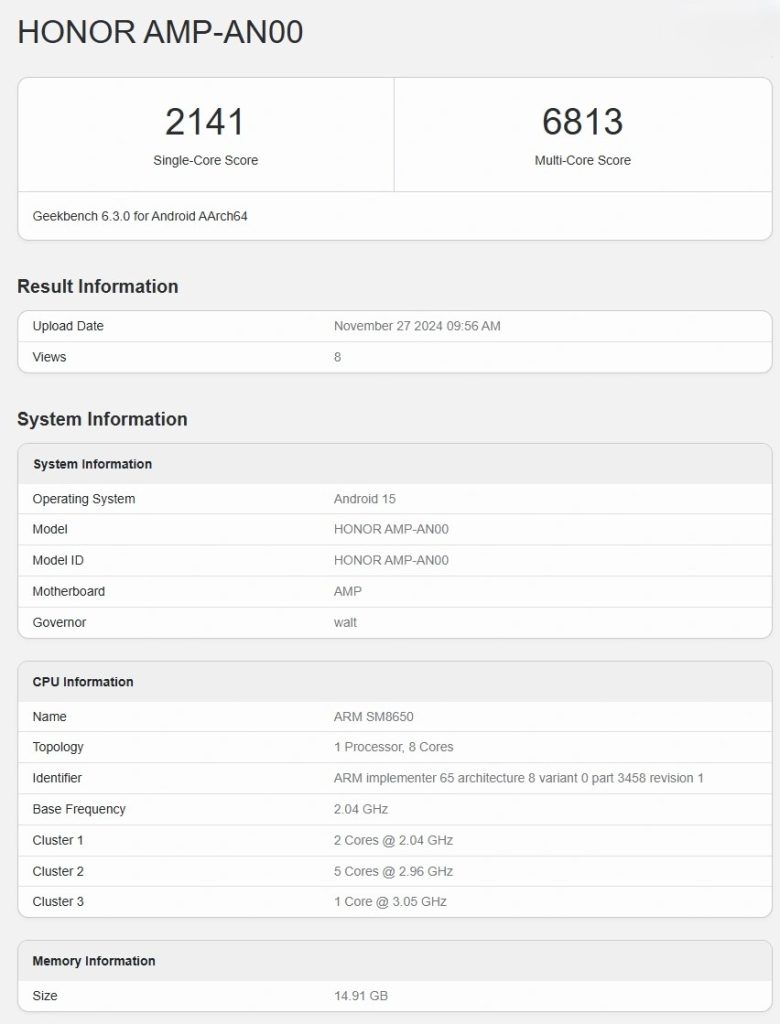
In contrast, the standard Snapdragon 8 Gen3 configuration includes a 3.3 GHz X4 core, three 3.2 GHz A720 cores, and two 3.0 GHz A720 cores, with two 2.3 GHz A520 cores. The GPU is the same Adreno 750 in both variants.
So all the CPU cores on the alleged Honor 300 Pro have significantly lower clock speeds than the regular configuration of the chip. Remember the Snapdragon 8 Gen 3 is a flagship chipset from last year and can handle almost all the heavy titles, while the Honor 300 series belongs to the mid-range segment.
This is likely that the phone does not pack the best available cooling solution (which might be necessary for the peak clock speeds of the 8 Gen 3 chip) and the downclocking is likely intended to hit the sweet spot between performance and thermal management for the device.
How do the scores compare and what to expect?
The Honor 300 Pro test model is equipped with 16GB of memory and runs on Android 15. The device achieved a single-core score of 2141 points and a multi-core score of 6813 points.
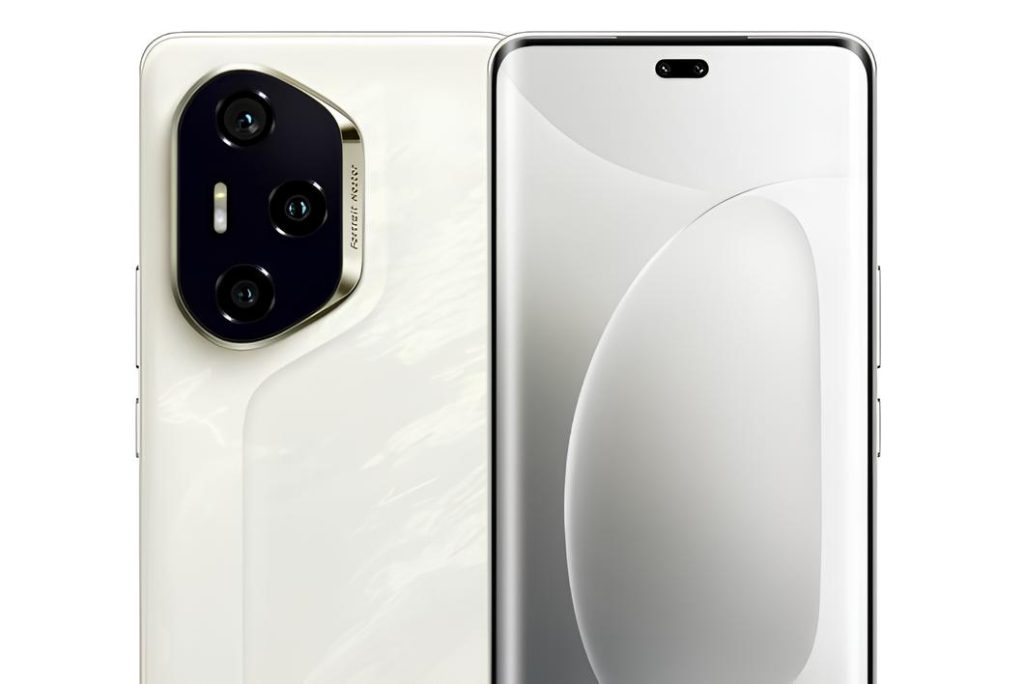
For comparison, the Xiaomi 14 Pro, which also uses the Snapdragon 8 Gen3, has a single-core average score of 2066 points and a multi-core average score of 6556 points, with some peaks reaching up to 2300 points and 6900 points, respectively.
It’s important to note that in most real-world usage scenarios, smartphones rarely hit the peak clock speeds of their processors. Geekbench measures the peak performance of the chip in a controlled environment, but in everyday tasks, users are unlikely to see a significant difference in performance compared to higher-clocked models.
Thus, the downclocking of the Snapdragon 8 Gen3 in the Honor 300 Pro may not result in a noticeable performance drop for typical users. Instead, it will likely offer a more power-efficient, thermally stable experience, making it a good choice for users who want strong performance without the drawbacks of overheating.
(Via)




Comments