Add GIZMOCHINA as Preferred Source on Google
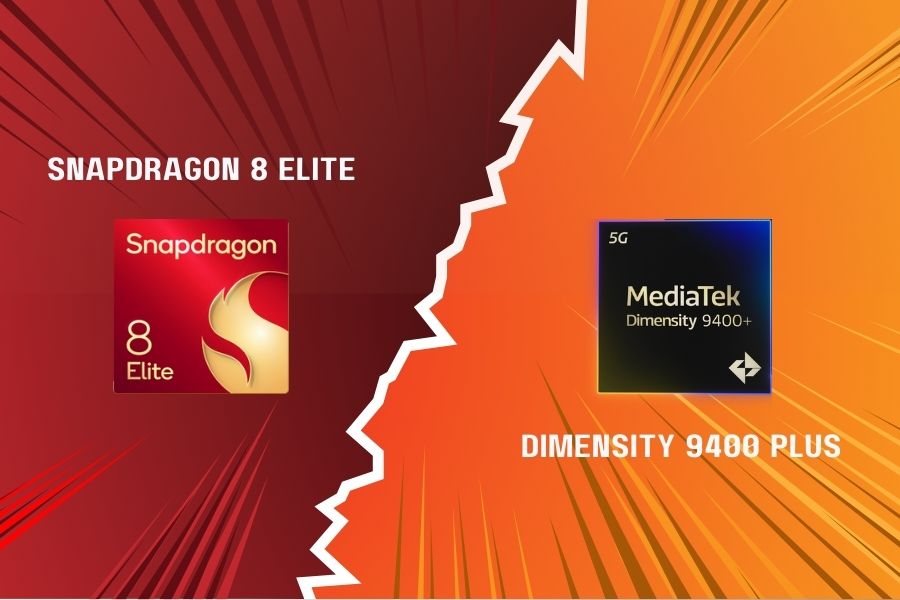
MediaTek has officially announced the Dimensity 9400 Plus as a high-bin version of the regular 9400. Its closest rival is the Snapdragon 8 Elite chip, which was released in October of last year.
Both chips are flagship SoCs built on the same 3nm TSMC process node—specifically the N3E variant—but have very different architectures, design priorities, and implementations.
The Dimensity 9400 Plus runs on ARM Cortex cores, whereas the Snapdragon 8 Elite has its own Oryon cores. Let’s look at the main differences between the two, from raw specifications to on-device impact.
1. CPU Architecture and Performance
Based on Arm’s latest Cortex cores, the Dimensity 9400 Plus is an improved version of the standard 9400. It features one Cortex-X925 core running at up to 3.73GHz, paired with three Cortex-X4 cores and four Cortex-A720 cores.
That’s a typical big.LITTLE structure which leans heavily into high-performance cores. It has eight CPU cores in total, supported by 10MB of system-level cache (SLC) and 12MB of L3 cache.
The Snapdragon 8 Elite, meanwhile, opts for a full custom Oryon CPU design. It uses eight 2nd-gen Oryon cores including two “Prime” cores clocked up to 4.32GHz, and six performance cores reaching 3.53GHz. The architecture also features a substantial 24MB of L2 cache, double that of the Dimensity 9400 Plus.
Although Qualcomm’s twin Prime core configuration theoretically offers higher raw power, flagships shouldn’t bother about benchmarks. But in real-world use, that difference may not be noticeable for most users.
2. GPU and Gaming Capabilities
On the GPU front, the Dimensity 9400 Plus uses the 12-core Arm Immortalis-G925, a unit MediaTek claims brings “PC-level features” to mobile including hardware-based ray tracing with opacity micromap support. This GPU is said to offer a 40% improvement in power efficiency over the previous generation and double the effective FPS for long gaming sessions.
Qualcomm uses its Adreno 830 solution which is claimed to deliver up to 40% better performance and power efficiency compared to the Adreno 750 used in Snapdragon 8 Gen 3.
It also supports ray tracing which is reportedly improved by 37%. And there is even support for Unreal Engine 5.3, Nanite rendering, and Qualcomm’s latest graphics optimization frameworks like Game Super Resolution 2.0 and Frame Motion Engine 2.0.
3. AI and NPU Capabilities
The AI story is central to both chips. The Dimensity 9400 Plus includes the MediaTek NPU 890 which supports DeepSeek R1 (a local LLM (large language model).
It also incorporates support for several key AI features like Mixture of Experts, Multi-Token Prediction, Multi-Head Latent Attention, and FP8 precision. MediaTek says the NPU offers “exceptional edge-AI performance” with reasoning speed and generative model improvements of up to 20% over the original 9400.
Qualcomm’s answer to this is the revamped Hexagon NPU claimed to be 45% faster than its predecessor and more power-efficient. It includes a 6-core vector engine and 8-core scalar engine, designed to support on-device multimodal generative AI.
In practical terms, neither chip’s AI engine has been extensively benchmarked in public yet. Until we see side-by-side comparisons using real-world AI workflows — like camera assistance, speech recognition, or on-device assistants — the differences remain theoretical.
4. Camera and ISP
Both SoCs support camera sensors up to 320MP and can record 8K video at 60fps. MediaTek includes its Imagiq 1090 ISP with support for HDR video across the zoom range, and Smooth Zoom for more fluid transitions in video capture. Qualcomm’s Spectra AI ISP takes a more AI-heavy approach and offers real-time segmentation, ultra-low-light capture, and video tools like semantic relighting and object erasure.
Qualcomm also brings support for Truepic’s cryptographic seal, a privacy-and trust-focused feature that may appeal to journalists and creators needing to verify the authenticity of photos.
5. Connectivity
Both chipsets offer support for Wi-Fi 7 and Bluetooth 6.0, but the Snapdragon 8 Elite has an edge in modem performance. It includes the Snapdragon X80 5G modem which gives download speeds up to 10Gbps and satellite connectivity via Snapdragon Satellite. Qualcomm also touts a more advanced AI-based location engine and dual-SIM capabilities with global 5G multi-SIM support.
MediaTek integrates a BeiDou GNSS system with a 60% speed boost over the 9400, and Bluetooth range extended to 8km for direct phone-to-phone connections. These are niche advantages that may matter for specific regions or use cases, but they don’t fundamentally alter the connectivity equation for most users.
6. Memory, Storage, and Display
Both chips support LPDDR5X RAM and the Dimensity 9400 Plus offers peak memory speeds of 10667 Mbps. Snapdragon 8 Elite doesn’t quote memory speed figures as aggressively, but pairs with the same LPDDR5X spec and UFS 4.0 storage.
In terms of display, the Dimensity chip supports up to WQHD+ at 180Hz and is designed for tri-fold displays via triple-port MIPI support. Snapdragon 8 Elite, by contrast, can drive QHD+ panels at up to 240Hz and supports external 8K displays — a specification more relevant for future hybrid mobile-desktop form factors.
7. Final Thoughts
There’s no single winner here—both chips are highly competent, deeply optimized, and designed to anchor flagship devices well into 2025.
The Snapdragon 8 Elite has a performance edge in CPU benchmarks, a more integrated AI ecosystem for user-aware experiences, and a well-rounded gaming and imaging stack. It’s the safer pick for premium flagships and gaming phones looking for every advantage.
The Dimensity 9400 Plus, while not the chart-topper in raw CPU speeds, brings an incredibly efficient GPU, smart integration with next-gen AI models like DeepSeek R1, and notable innovations in satellite and peer-to-peer communication. It’s also likely to appear in a more diverse set of devices due to MediaTek’s broader OEM partnerships.
For most consumers, the decision won’t likely be about which chip is better on paper. It will come down to the devices that integrate them, the thermal designs, and how well OEMs optimize performance. As always, specs can’t tell the full story. But they’re still worth paying attention to.
8. MediaTek Dimensity 9400 Plus vs Snapdragon 8 Elite
| Feature | Dimensity 9400 Plus | Snapdragon 8 Elite |
| Process Node | TSMC 3nm | TSMC 3nm (N3E) |
| CPU Architecture | – 1x Cortex-X925 @ 3.73GHz – 3x Cortex-X4 – 4x Cortex-A720 | – 2x Oryon Prime @ up to 4.47GHz – 6x Oryon Performance @ 3.53GHz |
| CPU Cache | 2MB L2 (X925), 1MB L2 (X4), 512KB L2 (A720)12MB L3, 10MB SLC | 12MB L2 (shared across cores) |
| GPU | Arm Immortalis-G925 MC12 | Qualcomm Adreno 830 |
| Ray Tracing | Supported (with opacity micromap) | Supported, 35% improved over Gen 3 |
| AI Engine | – MediaTek NPU 890 – Supports DeepSeek R1 (MoE, MHA, MTP, FP8) | – Hexagon NPU (45% faster than Gen 3) – 6-core vector, 8-core scalar accelerators |
| Memory Support | LPDDR5X @ 10667 Mbps | LPDDR5X @ 5.3 GHz |
| Storage | UFS 4.0 + MCQ | UFS 4.0 |
| Camera Max Sensor Support | 320MP | 320MP |
| Video Recording | 8K @ 60fps, 10-bit decode (HEVC/AVC/VP9/AV1) | 8K @ 30fps, Dolby Vision®, HDR10+, Google Ultra HDR |
| AI ISP Features | Imagiq 1090, Smooth Zoom | – Spectra AI ISP – Semantic Segmentation, AI Relighting, Truepic |
| Display Support | WQHD+ @ 180Hz | QHD+ @ 240Hz (On-device)8K @ 30Hz (External) |
| Connectivity | – 5G/4G Dual SIM Dual Active – Wi-Fi 7 @ 7.3 Gbps – Bluetooth 6.0 (dual engine) | – Snapdragon X80 5G Modem – Wi-Fi 7 @ 5.8 Gbps – Bluetooth 6.0 |
| Location/GNSS | GPS, BeiDou, Glonass, Galileo, QZSS, NavIC | Snapdragon Location Suite, Sidewalk-level accuracy |
| Satellite Comms | BeiDou connection (60% faster) | Snapdragon Satellite |
| Bluetooth Range | Up to 8km phone-to-phone | Not specified |
| AI Model Types Supported | Generative AI, Agentic AI, On-device LLMs | Generative AI, Multimodal, Real-time semantic segmentation |
Stay ahead in tech! Join our Telegram community and sign up for our daily newsletter of top stories!
For more daily updates, please visit our News Section.