Add GIZMOCHINA as Preferred Source on Google
Google’s Pixel 9a and Apple’s iPhone 16e are each company’s latest attempts to appeal to the broader mid-range market. Both are cut-down versions of their flagship counterparts and both lean on custom, in-house silicon for raw horsepower—Tensor G4 on the Pixel 9a and Apple’s A18 for the iPhone 16e.
That’s about where the similarities end.
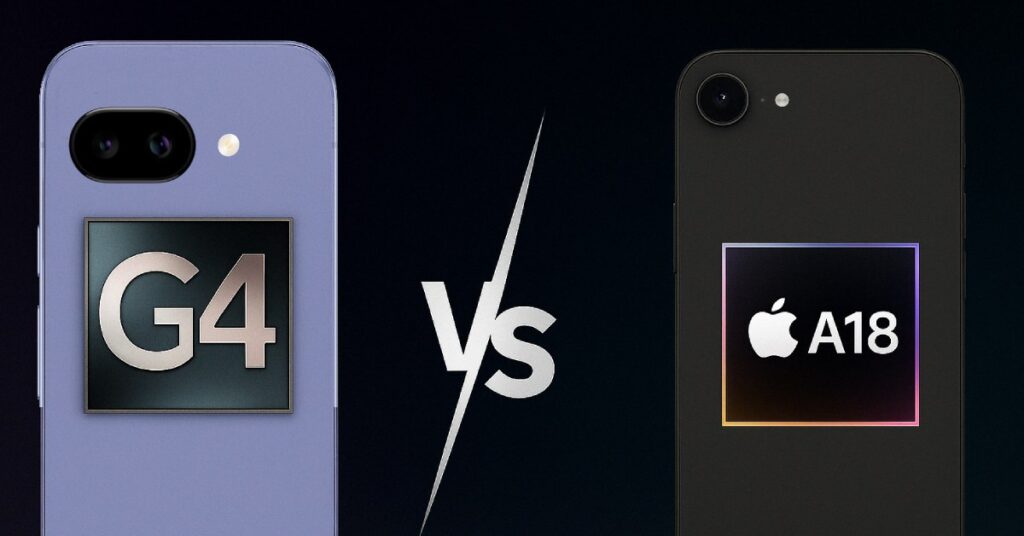
The two chips bring very different visions for what smartphone performance should look like in 2025. Google’s chip emphasizes AI performance while Apple’s solution focuses on raw power and power efficiency.
So, how do these custom chips actually stack up? Let’s break down the key differences.
1. Performance: Still No Contest
Google’s Tensor G4 is, at least on paper, a mild upgrade over last year’s G3. It still relies on a semi-custom design, again developed in collaboration with Samsung. Built on Samsung’s 4nm process, the G4 doesn’t bring a significant leap in performance.
It has an octa-core CPU configuration with one high-performance Cortex-X4 core, four Cortex-A720 performance cores, and four Cortex-A520 efficiency cores.
In practice, that translates to performance that is adequate for day-to-day tasks like browsing, app switching, and media consumption.
Benchmark results show the G4 performing somewhere between Qualcomm’s Snapdragon 8 Gen 2 which makes sense given the chip’s architecture and thermal limitations in a mid-range phone.
Apple’s A18, on the other hand, maintains the company’s lead in chip design. Built on TSMC’s second-gen 3nm (N3E) process, it offers better efficiency and performance headroom than the previous A17. It features two high-performance cores and four efficiency cores, with a 4-core GPU.
That’s still a less GPU core than a regular iPhone 16’s A18 chip. Even then, the A18’s single-core, multi-core, and GPU performance is well ahead of the G4 and even ahead of many Android flagships running Snapdragon processors.
| Tensor G4 | Apple A18 | |
| Single core | 1,917 | 3328 |
| Multi core | 4,526 | 8132 |
| 3DMark Wild Life Extreme Stress Test (Best loop score) | 2590 | 3293 |
| Preview | Product | |
|---|---|---|

|
Google Pixel 9a with Gemini – Unlocked Android Smartphone with Incredible Camera and AI Photo… | Check Price on Amazon |
Please Note: When you buy something using the links in our articles, we may earn a small commission at no cost to you.
| Preview | Product | |
|---|---|---|

|
iPhone 16e 128 GB: Built for Apple Intelligence, A18 Chip, Supersized Battery Life, 48MP Fusion…. | Check Price on Amazon |
Please Note: When you buy something using the links in our articles, we may earn a small commission at no cost to you.
2. AI Features
The Tensor G4’s main selling point isn’t raw horsepower. It’s machine learning. Google has doubled down on AI-first features, and the Pixel 9a understandably benefits from that.
It has AI features like Best Take, Magic Editor, on-device transcription, and translation are all supported by the G4’s dedicated TPU. For users who care about AI tools more than gaming frame rates, Pixel 9a delivers a compelling experience.
The A18 integrates Apple’s latest 16-core Neural Engine, which processes over 35 trillion operations per second. While Apple doesn’t highlight its AI capabilities as loudly as Google does, iOS 18 brings new AI enhancements to Siri, Photos, and on-device summarization.
In raw numbers, Apple’s Neural Engine is faster, but Google uses its TPU more aggressively throughout the UI. Still, the experience depends on whether you want your phone to guess your intent or stay out of the way.
3. Camera Processing
Google has long relied on computational photography to deliver strong camera performance even on budget models, and the 9a is no exception.
The Tensor G4 enables real-time HDR, Super Res Zoom, and Night Sight, features that now run faster and more consistently. Image processing is still tuned for dramatic contrast and clarity, with a slight overprocessing bias. But it’s effective—and again, much of this happens thanks to the TPU, not the CPU or GPU.
Apple’s A18 powers a 48MP camera in the iPhone 16e and brings improvements to Smart HDR and Deep Fusion resulting in more natural images. Apple’s photos should be more balanced and with more realistic color reproduction.
4. Battery Life and Efficiency
Samsung’s 4nm node continues to be a weakness for Google’s silicon. The Tensor G4, while better than its predecessors in heat management, still lags behind Apple in power efficiency.
Apple’s A18 benefits from the more efficient N3E node and a mature power management strategy.
On paper, that means the iPhone 16e should outlast the Pixel 9a when it comes to battery efficiency. Of course, real-world results will vary depending on how people use their phones and the types of apps they run. However, from a purely technical standpoint, Apple’s A18 is clearly ahead of Google’s Tensor G4 in the efficiency game.
5. The Broader Picture
If there’s one thing the Tensor G4 and Apple’s A18 make clear, it’s that these two companies are playing very different games. Google is all-in on AI and software-first experiences, while Apple wants to lead on performance and efficiency at the silicon level.
That said, value still matters. The Pixel 9a costs around $499, while the iPhone 16e starts at $599. For many, the price difference, plus the suite of Google’s AI features, may be enough to make the 9a a smart buy. But for those looking for top-tier performance, the iPhone 16e makes more sense.
Still, there’s more to these phones than just chips. Be sure to check out our full comparison for a deeper dive into cameras, displays, and everything else that matters.
Tech enthusiast? Get the latest news first! Follow our Telegram channel and subscribe to our free newsletter for your daily tech fix!
For more daily updates, please visit our News Section.