Add GIZMOCHINA as Preferred Source on Google
As an Amazon Associate, Gizmochina earns from qualifying purchases. Links on this page may earn us a commission at no extra cost to you.
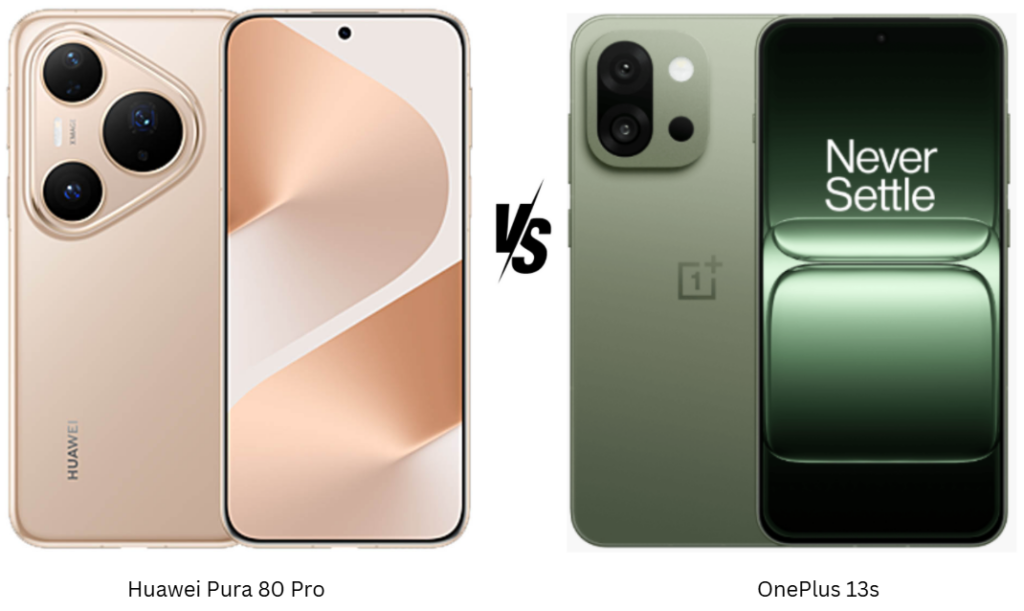
Huawei Pura 80 Pro and OnePlus 13s represent two distinct flagship philosophies, one built for ultimate versatility with satellite connectivity and advanced zoom, and the other focused on cutting-edge performance and value. This comparison matters because both phones cater to premium buyers but differ significantly in priorities like camera innovation, design durability, and pricing. Choosing the right one depends on whether you seek feature-loaded versatility or raw power at a better price.
1. Design and display
Build and Feel:
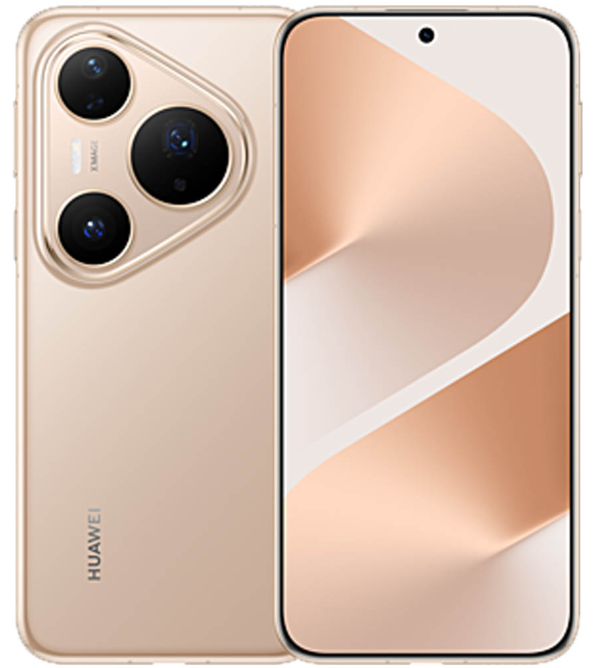
Huawei wraps the Pura 80 Pro in glass and polished aluminum, then pairs that with the company’s famously tough Kunlun Glass 2 and an IP68/IP69 seal that survives both immersion and high-pressure jets. The result is a chassis that feels reassuringly solid, delivering a premium, almost camera-centric heft that signals longevity.
OnePlus opts for a lighter aluminum alloy frame protected by Crystal Shield Glass and an IP65 rating, making the 13s noticeably slimmer in the pocket and easier to wield one-handed during long commutes.
The trade-off is straightforward: Huawei provides superior environmental protection and an unmistakably luxurious density, while OnePlus’s reduction in girth and weight promotes everyday comfort. Consumers who equate mass with durability will favor the Pura 80 Pro, whereas minimalists looking for effortless carry will lean toward the 13s.
Display Quality:
Huawei’s 6.8-inch LTPO OLED stretches viewing real estate and hits a blinding 3000-nit peak, so maps and notifications stay visible even under harsh midday sun. Its 1-billion-color depth and gentle 1 440 Hz PWM dimming further enhance eye comfort during extended browsing.
OnePlus counters with a 6.32-inch LTPO AMOLED that deploys Dolby Vision, a faster 2 160 Hz dimming cycle, and exceptional color calibration that makes HDR movies pop with cinematic nuance. Although its peak brightness tops out below Huawei’s, real-world contrast is superb, and the slightly higher pixel density keeps fine text razor-sharp.
Outdoor adventurers and mobile photographers gain more from Huawei’s brighter, broader canvas, while streaming enthusiasts may prefer OnePlus’s Dolby-tuned accuracy.
Verdict:
Between tougher build materials, higher ingress protection, and the brightest panel in its class, Huawei edges ahead as the choice for durability-minded users who spend ample time outdoors. OnePlus nevertheless secures crucial wins in portability and HDR fidelity, offering a friendlier grip and arguably richer video playback.
2. Specifications

Performance:
OnePlus arms the 13s with Qualcomm’s 3 nm Snapdragon 8 Elite, whose Oryon V2 big cores crest 4.32 GHz and whose Adreno 830 GPU delivers console-level effects with minimal thermal throttling. Backed by UFS 4.0 storage, heavy apps open instantly and multitasking feels desktop-like.
Huawei’s octa-core platform, likely the Kirin 9010, keeps everyday scrolling fluid but trails in raw graphics throughput and AI workloads, so high-frame-rate shooters and on-device editing finish faster on the OnePlus. For users prioritizing maximum horsepower, the 13s offers a sharper edge.
Battery and Charging:
Endurance compares closely: OnePlus packs a 5850 mAh cell, about three percent larger, and leverages its more efficient silicon for notably longer screen-on time. Huawei replies with faster energy replenishment: 100 W wired tops the pack in roughly 30 minutes, while 80 W wireless cuts the cable without a huge sacrifice.
OnePlus sticks to 80 W wired but adds broad PPS/PD support for universal chargers; however, its 33 W PPS cap and 5 W reverse wired leave it lagging in cable-free convenience.
Verdict:
OnePlus dominates raw performance and extends battery life a little further, making it the go-to for gamers and content producers. Huawei counters with the swiftest wired and wireless charging combination on the market, ensuring even intensive days never outpace a quick coffee-break refill.
Choose OnePlus for speed and longevity; choose Huawei for charging freedom and reduced downtime.
3. Camera
Main and Secondary Lenses:
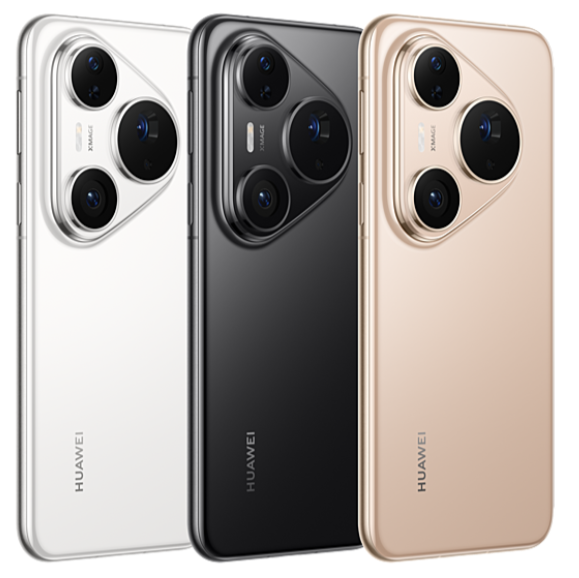
Huawei equips a one-inch-type 50 MP sensor with variable aperture for shallow-depth portraits and brighter night scenes, plus a 48 MP periscope delivering crisp 4× optical zoom and a 40 MP ultrawide with autofocus for macro versatility. Real-world shots show cleaner shadow detail and less noise after dark, while the longer reach simplifies wildlife and stage photography.
OnePlus has dual 50 MP sensors, the primary capturing excellent color consistency and the telephoto doubling as a flattering portrait lens at 2×. Its multi-directional PDAF yields fast locks, yet crop-zoom cannot fully match Huawei’s optical magnification.
Serious photographers who need reach and low-light prowess gain more from the Pura 80 Pro.
Selfie Camera:
The 13 MP ultrawide on Huawei fits an entire group without an extender, and autofocus keeps faces sharp at arm’s length. OnePlus answers with a 32 MP unit that doubles the resolution and records 4 K video, preserving hair texture and skin tone for solo vloggers.
While Huawei captures more people, OnePlus delivers crisper detail per face, so social media creators will value the 13s’s pixel advantage.
Verdict:
Huawei claims the rear camera crown through bigger sensors, superior zoom, and macro agility. OnePlus gains with a selfie system that outperforms in sharpness and vlogging flexibility.
Overall, imaging enthusiasts who depend on rear optics should look to Huawei, while content creators focusing on front-facing footage will feel well served by OnePlus.
4. Pricing
With an approximate launch price of $1000, Huawei positions the Pura 80 Pro among ultra-premium flagships, banking on its satellite messaging, variable-aperture optics, and rapid wireless charging to justify the tag. The OnePlus 13s arrive at roughly $700, undercutting by about 30 percent while still bundling a cutting-edge chipset, HDR-rich display, and ample battery capacity.
| Preview | Product | |
|---|---|---|

|
OnePlus 13s | Snapdragon® 8 Elite | Smarter with OnePlus AI | Lifetime Display Warranty |… | Check Price on Amazon |
Please Note: When you buy something using the links in our articles, we may earn a small commission at no cost to you.
For cost-conscious buyers, OnePlus delivers markedly better value per dollar; Huawei’s higher outlay makes sense only for users who will fully exploit its advanced camera and durability extras.
5. Conclusion

Huawei’s BDS two-way satellite messaging (China), DisplayPort 1.2 monitor output and 80 W wireless charging collectively cater to adventurers and power users who may find themselves off-grid yet still needing high-bandwidth connectivity or swift energy top-ups. OnePlus highlights software niceties such as Circle to Search and broader Bluetooth 6.0 codec support, plus Wi-Fi 7 for ultra-stable home networking, all wrapped in a chassis that feels feather-light despite flagship internals.
Verdict:
Buy the Huawei Pura 80 Pro if rugged water resistance, elite optical zoom, lightning-fast wireless charging, and emergency satellite texts rank high on the checklist. Go for the OnePlus 13s when flagship-class speed, lighter ergonomics, a superior selfie experience, and a more approachable price matter more.
Read More:
- Huawei Pura 80 Ultra vs Xiaomi 15 Ultra – Which Flagship Offers the Best Value for Money?
- Huawei Pura 80 Ultra vs Pro+: Does the Ultra Justify the Higher Price?
- Oppo Find X8s+ vs Vivo X200s: Who Has the Best Premium Value in 2025?