Add GIZMOCHINA as Preferred Source on Google
Wireless charging has been around for more than a decade now, yet I still find myself reaching for a cable every single time I have to charge my phone.
It’s not that I don’t understand the appeal. The convenience it offers is real. Just place your phone on a pad and let it charge. No plugging, no wear and tear on your charging port, and no need to find the right orientation in the dark. But even after all these years, wireless charging still feels more inconvenient than it’s worth.

It’s just… frustrating. In small but constant ways. And that’s why, even with wireless charging support baked into almost every flagship phone I’ve used so far, I never really got used to it.
1. It’s not wireless, is it?
I don’t think it’s a hidden fact, but wireless charging still needs wires. Not for your phone, sure, but for the charger. You still have to find an outlet, plug in a pad or a stand, and place it exactly right.
So instead of skipping the wire completely, you just move it a level down, from the phone to the furniture. This sounds convenient until you realize that the charger is now part of your table setup. You can’t walk away with it. You can’t lend it to a friend. And once you’ve placed your phone on it, you kind of have to leave it there.
Wireless charging, in its current form, is more like “contact charging.” And while that’s technically true, the branding still feels a little too optimistic.
2. The alignment game
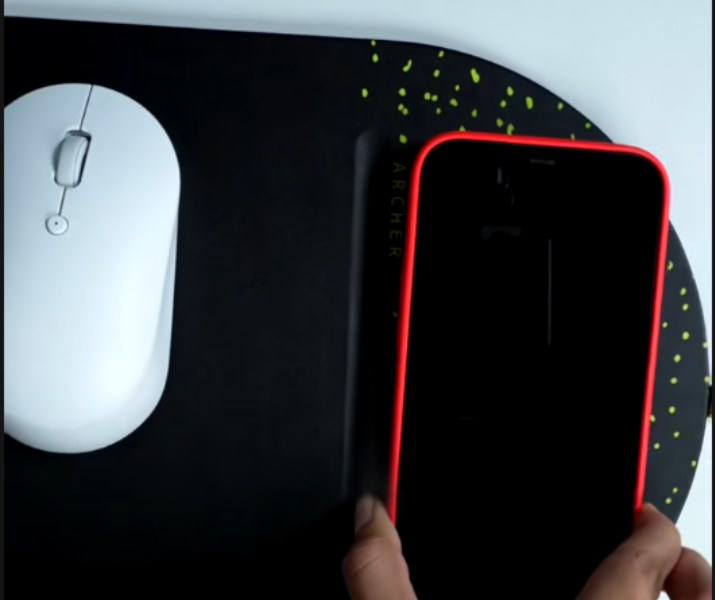
If you’ve used a flat wireless charging pad, you already know the drill. Your phone has to sit in the exact right spot to actually charge. You miss by a centimeter, and it stops charging.
I picked up a mousepad with a built-in wireless charger, thinking it would keep my phone juiced up while I worked at my PC. But even at my slightest (unknowing) nudge knocks it off alignment, and suddenly, it’s not charging anymore.
It’s especially frustrating when I’m relying on it with a low battery, only to realize later that the phone’s been sitting there, doing absolutely nothing.
3. You can’t really use the phone while it’s charging
This might be my biggest deal-breaker.
With a wired charger, I can still hold the phone, doomscroll Instagram, respond to messages, or check the weather. The cable might get in the way sometimes, but it’s manageable.
However, that’s in no way possible with wireless charging. That would be fine if I were the kind of person who put my phone down and left it alone. But I’m not. I use my phone constantly. I don’t want to wait until it finishes charging to use it, and I certainly don’t want to keep picking it up and placing it back like I’m playing a game of hot potato.
Yes, some wireless stands allow for better ergonomics, but they still limit the angles and the convenience. If I’m trying to use my phone while watching something or following a recipe, I want flexibility. Not constraints.
4. It isn’t built for a tropical climate
If you live somewhere hot and humid, like much of South Asia, South America, or parts of Africa, wireless charging starts to feel like a bad idea.
These chargers already generate heat under normal use. However, in places where the ambient temperature is regularly above 30°C (86°F), the heat builds up even more quickly.
Phones tend to throttle charging speeds when they get too hot. Some even stop charging completely. I’ve seen phones on wireless chargers become too hot to touch, especially during the day when the room is already warm. In some cases, the phone doesn’t just charge slower, it warns you to cool it down before continuing.
That’s not to say wired charging doesn’t heat up the phone. However, refueling is more efficient this way, and you can unplug the phone as soon as it’s full. It makes more sense in hot places where managing temperature is part of daily life.
5. It doesn’t travel well
Wireless chargers are also not portable. Yes, technically, you can carry them. But do you want to?
They’re often bulkier than a standard cable, harder to pack, and require their own power bricks. And if you’re staying somewhere that doesn’t have a flat surface near an outlet, or any outlet at all, you’re out of luck.
Meanwhile, a single USB-C cable and a compact adapter can do everything: charge your phone, your tablet, your earbuds, even your laptop.
Wireless charging doesn’t replace that versatility. It just adds another layer of stuff to carry.
6. The ecosystem tax
Wireless charging accessories are usually more expensive than their wired counterparts. A basic fast charger costs $15–20. But a decent wireless pad will set you back somewhere between $40–60.
And let’s not forget the constant compatibility issues. Apple’s MagSafe doesn’t always play nice with Qi chargers. Samsung’s fast wireless chargers won’t deliver top speed to other brands. And budget phones often have the hardware but not the firmware to unlock the full speeds.
7. It doesn’t solve a real problem
When I think about why I never adopted wireless charging, it really comes down to this: it doesn’t fix anything that was broken.
Plugging in a phone was never a major issue. USB-C is a reversible, fast, and reliable solution that doesn’t demand extra care.
Wireless charging doesn’t make it dramatically better. It makes it different. More futuristic-looking, sure. But in everyday life, I feel it’s more restrictive, at least for me.
I don’t mind seeing wireless charging grow and evolve. I think it’s great that the tech is moving forward. But it’s telling that after all these years, it’s still not the default way most people charge their phones, because it’s not better. Just newer.
Don’t miss a thing! Join our Telegram community for instant updates and grab our free daily newsletter for the best tech stories!
For more daily updates, please visit our News Section.