
Add GIZMOCHINA as Preferred Source on Google
As an Amazon Associate, Gizmochina earns from qualifying purchases. Links on this page may earn us a commission at no extra cost to you.
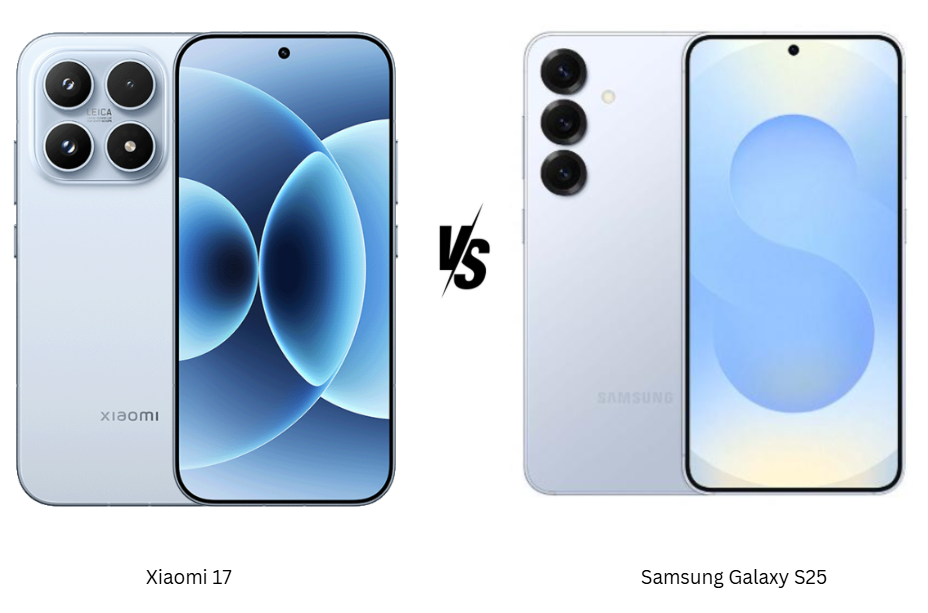
Xiaomi 17 and Samsung Galaxy S25 are two powerful flagship phones released in the same segment. This comparison matters because Xiaomi focuses on top-end performance and battery power, while Samsung delivers a sleek design and strong software support. It’s a clear clash between power and polish, helping users choose what fits them best.
1. Design and display
Build and Feel:
Xiaomi 17 uses a glass front with Dragon Crystal Glass and an aluminum frame, while Samsung Galaxy S25 features Gorilla Glass Victus 2 on both sides with an Armor Aluminum 2 frame. Both offer IP68 water resistance. The Xiaomi’s slightly thicker frame gives it a more solid, premium hand feel, whereas Samsung’s sleeker profile and lighter build make it more comfortable for one-handed use. Samsung also adds eSIM flexibility, which gives it an advantage in terms of connectivity and travel readiness.
Verdict: Xiaomi feels more solid and rugged, but Galaxy S25 offers better ergonomics and eSIM support. Galaxy S25 has a slight edge for overall practicality.
Display Quality:
Xiaomi offers a 6.3-inch LTPO AMOLED with a 120 Hz refresh rate, Dolby Vision, HDR Vivid, HDR10+, and a peak brightness of 3500 nits, making it exceptionally bright and color-rich. Samsung uses a 6.2-inch LTPO AMOLED 2X panel with HDR10+ and 2600 nits peak brightness. While Xiaomi is brighter and richer in dynamic range, Samsung delivers a cleaner calibration with excellent outdoor legibility. Xiaomi also supports Dolby Vision playback, which enhances HDR streaming.
Verdict: Xiaomi provides a more immersive and brighter display, making it better for multimedia consumption, though Samsung’s panel is still excellent in everyday use.
| Preview | Product | |
|---|---|---|

|
Samsung Galaxy S25 5G AI Smartphone (Silver Shadow, 12GB RAM, 256GB Storage), 50MP Camera with… | Check Price on Amazon |
Please Note: When you buy something using the links in our articles, we may earn a small commission at no cost to you.
2. Specifications
Performance:
Xiaomi runs on the newer Snapdragon 8 Elite Gen 5 with Adreno 840 GPU, compared to Samsung’s Snapdragon 8 Elite Gen 3 (Adreno 830). The upgraded chip on Xiaomi delivers stronger peak performance, better AI acceleration, and higher GPU clock speeds, making it superior for gaming and demanding multitasking. Samsung still maintains excellent optimization through its software, ensuring smooth day-to-day performance, but Xiaomi holds the raw power advantage.
Verdict: Xiaomi clearly leads in performance, offering more future-proof power for intensive users.
Battery and Charging:
Xiaomi packs a massive 7000 mAh battery with 100 W wired and 50 W wireless charging, while Samsung has a smaller 4000 mAh cell with 25 W wired and 15 W wireless charging. This difference is significant in endurance and charging speed. Xiaomi can comfortably last two days with heavy usage and recharge fully in around 20–25 minutes, while Samsung’s smaller capacity limits it to around a day of moderate use.
Verdict: Xiaomi dominates in battery life and charging, offering a far superior power experience.
3. Camera
Main and Secondary Lenses:
Xiaomi has a triple 50 MP setup with Leica optics, offering wide, telephoto (2.6×), and ultrawide lenses with advanced HDR and LOG video. Samsung has a 50 MP wide, 10 MP telephoto with 3× optical zoom, and 12 MP ultrawide. Samsung’s zoom capabilities are slightly stronger, but Xiaomi’s larger sensor size, better dynamic range, and Leica tuning deliver more cinematic photos and richer contrast. Xiaomi also supports 8K HDR Dolby Vision recording, adding more flexibility for content creators.
Verdict: Xiaomi edges ahead with more professional-grade optics and video features, though Samsung maintains solid zoom performance.
Selfie Camera:
Xiaomi uses a 50 MP front sensor with 4K HDR10+ recording, while Samsung features a 12 MP front camera with similar 4K support. Xiaomi’s higher resolution and PDAF give it better detail and clarity in varying lighting conditions. Samsung’s front camera still offers natural skin tones and excellent HDR tuning, but falls behind in sheer resolution and flexibility.
Verdict: Xiaomi delivers sharper and more versatile selfie performance, making it better for vloggers and social media users.
4. Pricing
Xiaomi is priced around $700, whereas Samsung comes in at $800. This $100 difference makes Xiaomi more competitive, considering its higher battery capacity, more powerful chipset, and brighter display. Samsung, however, justifies its price with a more refined design, lighter build, eSIM versatility, and longer software support (7 major upgrades).
Verdict: Xiaomi offers stronger hardware value at a lower price, while Samsung provides better long-term software assurance.
5. Conclusion
Xiaomi brings standout advantages with a larger battery, faster charging, brighter display, and more powerful processor, making it ideal for performance-focused users and content consumers. Unique features like Leica optics, Dolby Vision recording, and 100 W wireless charging make it an aggressive flagship competitor. Samsung’s strengths lie in its lightweight design, excellent optimization, DeX support, and long software longevity.
Verdict: Xiaomi is better suited for power users and media enthusiasts, while Galaxy S25 is ideal for those who prefer a lighter, refined device with excellent software support.
Read More;

Comments