
Add GIZMOCHINA as Preferred Source on Google
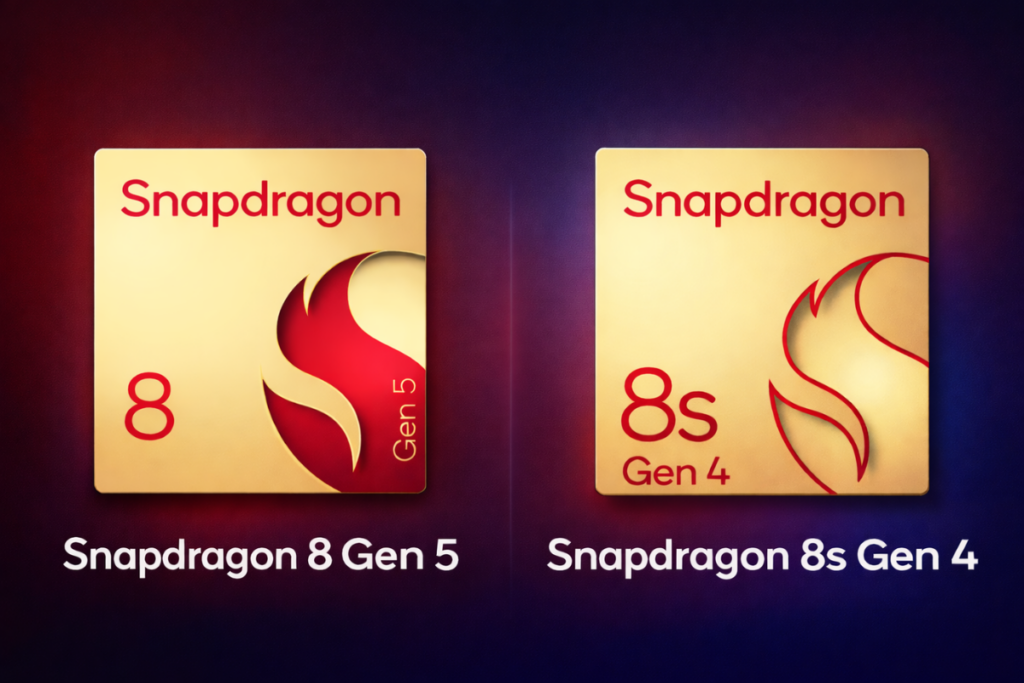
The Snapdragon 8 Gen 5 was announced in November, and the major highlights were the Oryon cores, which were previously exclusive to “Elite” chips. It’s a slightly toned-down version of the Snapdragon 8 Elite Gen 5 chip, but still a flagship SoC with plenty of power and capabilities.
The Snapdragon 8s Gen 4, on the other hand, is also a flagship-grade chipset and the last Snapdragon 8-series chipset to feature ARM cores, at least at the time of writing this post. From the name itself, it’s clear that the 8s Gen 4 sits under 8 Gen 5, but we’re more interested in learning about the performance gap and other major differences. So, let’s dig further to find out.
Let’s begin with the spec sheet:
| Snapdragon 8 Gen 5 | Snapdragon 8s Gen 4 | |
|---|---|---|
| Announced | November 2025 | April 2025 |
| Process node | TSMC’s 3nm (N3P) | TSMC’s 4nm (N4P) |
| CPU cores | 8-core | 8-core |
| CPU cores | 2 x 3.8GHz — Oryon (3rd gen) 6 x 3.32GHz — Oryon (3rd gen) | 1 x 3.21GHz — Cortex-X4 3 x 3.0GHz — Cortex-A720 2 x 2.8GHz — Cortex-A720 2 x 2.02GHz — Cortex-A720 |
| GPU | Qualcomm Adreno 840 GPU Ray tracing support Snapdragon Elite Gaming features | Qualcomm Adreno 825 GPU Ray tracing support Snapdragon Elite Gaming features |
| NPU | Qualcomm Hexagon NPU Agentic AI support | Qualcomm Hexagon NPU |
| Memory | LPDDR5x, up to 4.8GHz | LPDDR5x, up to 4.8GHz |
| Storage | UFS 4.1 | UFS 4.0 |
| Camera | Qualcomm Spectra triple AI ISP (20-bit) Up to 320MP single camera up to 108MP single camera with zero shutter lag up to 48MP triple cameras with zero shutter lag real-time semantic segmentation (limitless) 4K/120fps video recording 1080p/480fps slow-mo video recording | Quacomm Spectra triple AI ISP (18-bit) up to 320MP single camera up to 108MP single camera with zero shutter lag up to 36MP triple cameras with zero shutter lag real-time semantic segmentation (up to 250 layers) 4K/60fps video recording 1080p/480fps slow-mo video recording |
| Connectivity | Snapdragon X80 5G modem download speed: 10 Gbps (peak) upload speed: 3.5 Gbps (peak) Wi-Fi 7 (peak speed: 5.8 Gbps) Bluetooth 6.0 | Snapdragon X75 5G modem Download speed: 4.2Gbps (peak) upload speed: – Wi-Fi 7 (peak speed: 5.8Gbps) Bluetooth 6.0 |
Snapdragon 8 Gen 5 vs 8s Gen 4: Benchmark score
Note: The benchmark tests were performed on the OnePlus 15R (powered by the Snapdragon 8 Gen 5) and the iQOO Neo 10 (powered by the Snapdragon 8s Gen 4)
Snapdragon 8 Gen 5 vs 8s Gen 4: Geekbench score
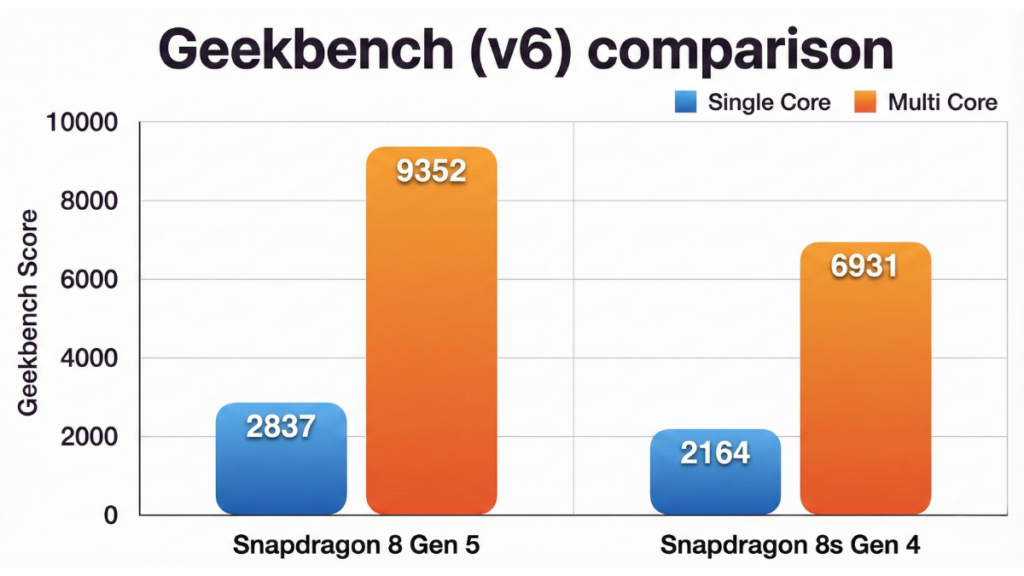
Thanks to powerful Oryon cores, the Snapdragon 8 Gen 5 achieves significantly higher scores on Geekbench than the 8s Gen 4. The single-core score is 2,837, which is 31% higher than the 8s Gen 4’s 2,164 points.
The gap widens further in multi-core performance, with the 8 Gen 5 achieving 9,352 points, while the 8s Gen 4 only manages 6,931 points. That’s an impressive 34% boost for the Gen 5 chipset.
| Snapdragon 8 Gen 5 | Snapdragon 8s Gen 4 | |
| Single core | 2,837 | 2,164 |
| Multi core | 9,352 | 6,931 |
Snapdragon 8 Gen 5 vs 8s Gen 4: AnTuTu score
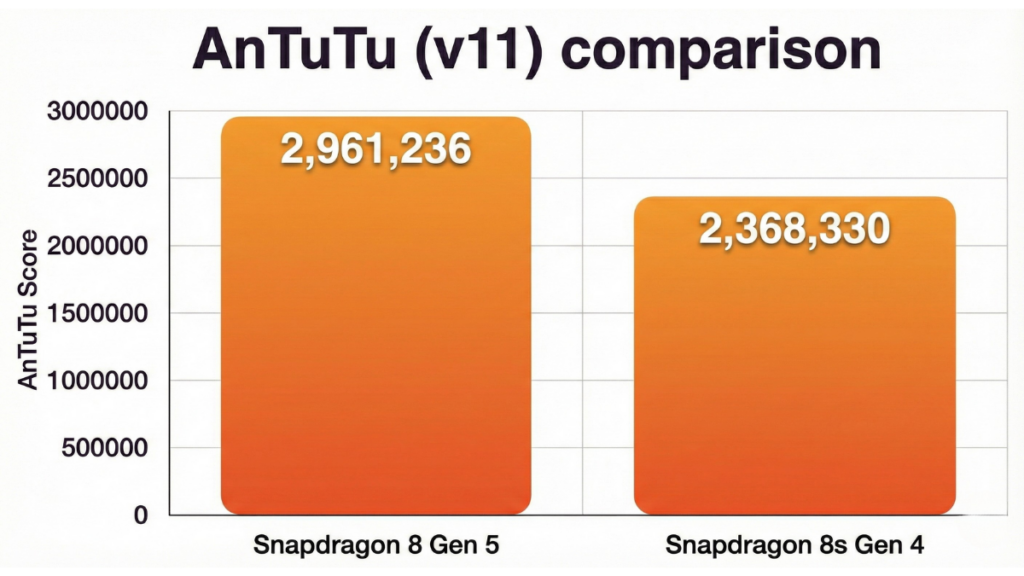
The Snapdragon 8 Gen 5 on AnTuTu almost reaches the 3 million mark, whereas the 8s Gen 4 couldn’t surpass 2.4 million in total AnTuTu score. That gives the 8 Gen 5 a 25% boost in the overall score.
The breakdown reveals that the 8 Gen 5’s CPU achieves a 32% higher score (914,878 vs. 688,724) and the GPU performance receives a 22% uplift (799,818 vs. 974,402). The memory and user experience performance also favor the newer chip.
| Snapdragon 8 Gen 5 | Snapdragon 8s Gen 4 | |
| AnTuTu score | 2,961,236 | 2,368,330 |
| CPU | 914,878 | 688,724 |
| GPU | 974,402 | 799,818 |
| Memory | 382,729 | 359,695 |
| UX | 689,228 | 520,093 |
So, the Snapdragon 8 Gen 5 easily outperforms the 8s Gen 4 on synthetic benchmarks. In the real world, the results are mostly the same.
Beyond performance, these benchmarks do not reveal many details. So, let’s look at the major differences to get a better picture.
Related: Snapdragon or MediaTek: which chip should you really choose for your next upgrade?
Snapdragon 8 Gen 5 vs 8s Gen 4: Major differences
The newer 8 Gen 5 uses the advanced 3nm (N3P) process node from TSMC, which offers better performance and power efficiency compared to TSMC’s 4nm (N4P) node used for 8s Gen 4. The chip also benefits from powerful third-gen Oryon cores, the same cores from the top-tier Snapdragon 8 Elite Gen 5 flagship.
The 8 Gen 5’s octa-core CPU has two prime cores clocked at 3.8 GHz and six performance cores at 3.32 GHz. In contrast, the 8s Gen 4 features one prime Cortex-X4 core at 3.21 GHz, five performance Cortex-A720 cores (three at 3.0 GHz and two at 2.8 GHz), and two power-efficient Cortex-A720 cores at 2.02 GHz. The 8 Gen 5 not only benefits from higher CPU speed, but the Oryon cores are also more powerful and power-efficient than 8s Gen 4 cores, which also reflects in the benchmark score.
The two Snapdragon chips also differ in terms of GPU capabilities. For instance, the 8 Gen 5 rocks an Adreno 840 GPU, offering smoother gaming performance and better power efficiency compared to the Adreno 825 GPU on the 8s Gen 4. Furthermore, the chip offers newer versions of the gaming features as part of Snapdragon Elite Gaming suite.
The Snapdragon 8 Gen 5 and 8s Gen 4 feature dedicated Qualcomm Hexagon NPUs and Qualcomm AI Engine for advanced AI capabilities. The 8 Gen 5 also offers agentic AI capabilities and integrates hardware matrix acceleration.
The newer Snapdragon chip also excels in network and connectivity, as it features a newer modem with higher download and upload speeds. It also leads the camera aspect with advanced video recording capabilities and limitless semantic segmentation.
Snapdragon 8 Gen 5 vs 8s Gen 4: Which chip should you choose?
Whether big or small the differences are, the Snapdragon 8 Gen 5 outperforms the 8s Gen 4 in almost every aspect. So, if you’re a power user with gaming being a primary concern, the 8 Gen 5 is a no-brainer pick. That said, the 8s Gen 4 isn’t bad for gaming, but the newer chip offers better performance.
If extensive gaming sessions aren’t your thing, the Snapdragon 8s Gen 4 won’t disappoint you. In fact, most users wouldn’t even notice a performance gap on day-to-day tasks like browsing the internet, scrolling through social media apps, and playing videos.
Popular SoC comparisons:
1. Snapdragon 8 Gen 5 vs Snapdragon 8 Elite
2. Snapdragon 8 Gen 5 vs Snapdragon 8 Elite Gen 5
3. Snapdragon 8s Gen 4 vs Snapdragon 8 Gen 3



Comments