
Add GIZMOCHINA as Preferred Source on Google
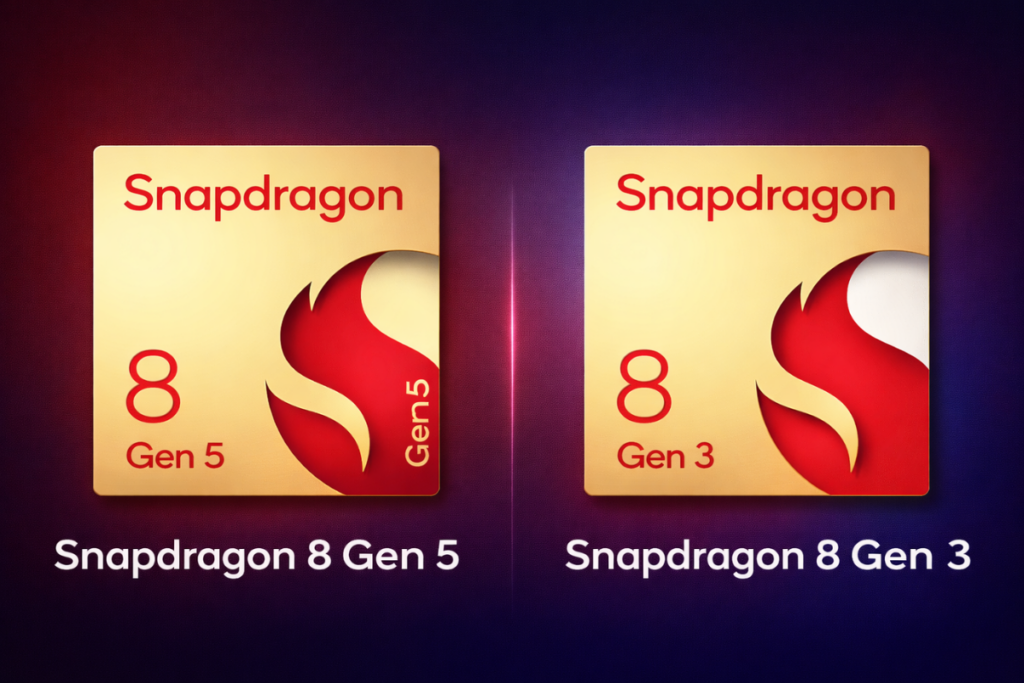
The Snapdragon 8 Gen 5, announced in November, features powerful and power-efficient Oryon cores for the first time in a non-Elite chipset. It borrows more features from the flagship 8 Elite Gen 5 chipset, including the Adreno 840 GPU with sliced architecture, agentic AI, and a 20-bit triple ISP. It’s indeed a powerful smartphone chipset with flagship capabilities.
On the other hand, the Snapdragon 8 Gen 3 was announced two years ago, but it’s still a capable chipset that offers smooth performance and flagship-grade specs. From the name itself, it’s clear that the 8 Gen 5 has better capabilities, but the real question is: how significant an upgrade is the 8 Gen 5 over the 8 Gen 3? Let’s dive into benchmarks and real-world differences to find out.
| Snapdragon 8 Gen 5 | Snapdragon 8 Gen 3 | |
|---|---|---|
| Announced | November 2025 | October 2023 |
| Process node | TSMC’s 3nm (N3P) | TSMC’s 4nm (N4P) |
| CPU | 2 x 3.8GHz — Oryon (3rd gen) 6 x 3.32GHz — Oryon (3rd gen) | 1 x 3.3 GHz — Cortex-X4 3 x 3.15 GHz — Cortex-A720 2 x 2.96 GHz — Cortex-A720 2 x 2.27 GHz — Cortex-A520 |
| GPU | Qualcomm Adreno 840 GPU ray tracing support Snapdragon Elite Gaming features | Adreno 750 ray tacing support Snapdragon Elite Gaming features |
| NPU | Qualcomm Hexagon NPU agentic AI support | Qualcomm Hexagon NPU |
| Memory | LPDDR5x, up to 4.8GHz | LPDDR5x, up to 4.8GHz |
| Storage | UFS 4.1 | UFS 4.0 |
| Camera | Qualcomm Spectra triple AI ISP (20-bit) up to 320MP single camera up to 108MP single camera with zero shutter lag up to 48MP triple cameras with zero shutter lag real-time semantic segmentation (limitless) 4K/120fps video recording 1080p/480fps slow-mo video recording | Quacomm Spectra triple AI ISP (18-bit) up to 200MP single camera up to 108MP single camera with zero shutter lag up to 36MP triple cameras with zero shutter lag real-time semantic segmentation (up to 12 layers) 8K/30fps or 4K/120fps video recording 720p/960fps slow-mo video recording |
| Connectivity | Snapdragon X80 5G modem download speed: 10 Gbps (peak) upload speed: 3.5 Gbps (peak) Wi-Fi 7 (peak speed: 5.8 Gbps) Bluetooth 6.0 | Snapdragon X75 5G modem Download speed: 10 Gbps (peak) Upload speed: 3.5 Gbps (peak) Wi-Fi 7 (peak speed: 5.8 Gbps) Bluetooth 5.4 |
Snapdragon 8 Gen 5 vs 8 Gen 3: Benchmark score
Note: The benchmark tests were performed on the OnePlus 15R (powered by the Snapdragon 8 Gen 5) and the OnePlus 13R (powered by the Snapdragon 8 Gen 3).
Geekbench score
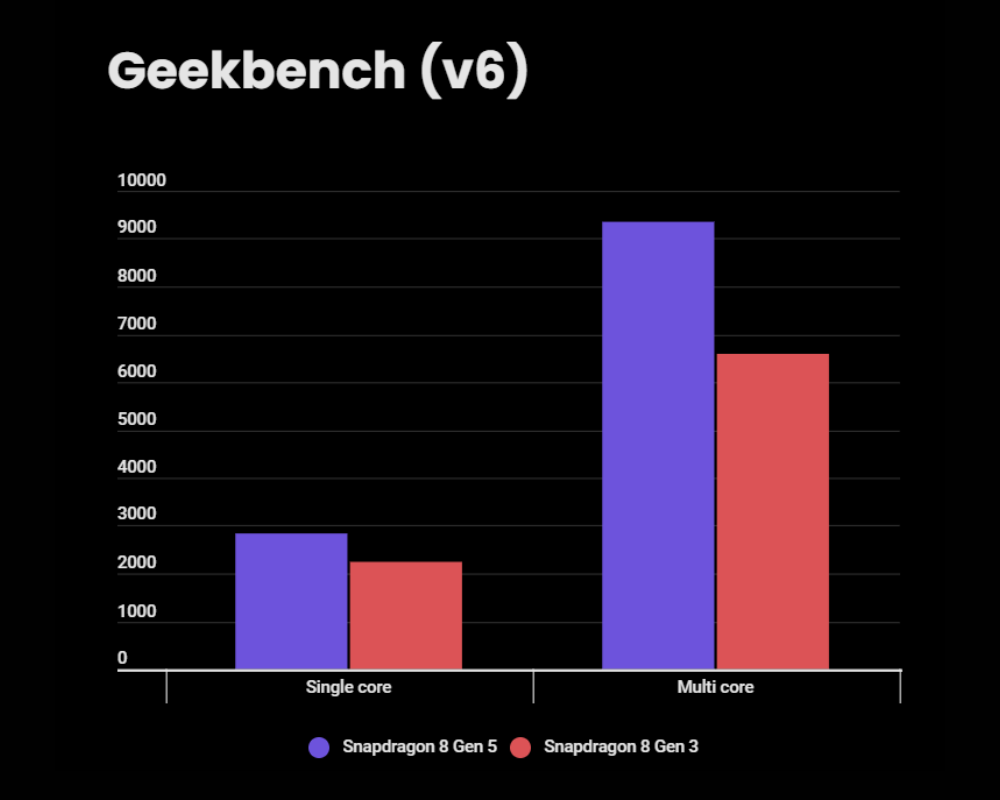
Thanks to powerful third-gen Oryon cores, the Snapdragon 8 Gen 5 is able to pull off much higher Geekbench scores than the 8 Gen 5. In the single-core test, it achieves 2,837 points, whereas the 8 Gen 3 touches 2,243. That’s a 26% uplift for the newer chip. The difference only widens in multi-core performance.
The 8 Gen 5 achieves 9,352 multi-core points, while the 8 Gen 3 gets 6,591 points, resulting in a 42% performance boost for the former chip in tasks that require multiple cores to work together, such as multitasking, video editing, and other demanding workloads.
| Snapdragon 8 Gen 5 | Snapdragon 8 Gen 3 | |
| Single core | 2,837 | 2,243 |
| Multi core | 9,352 | 6,591 |
AnTuTu score
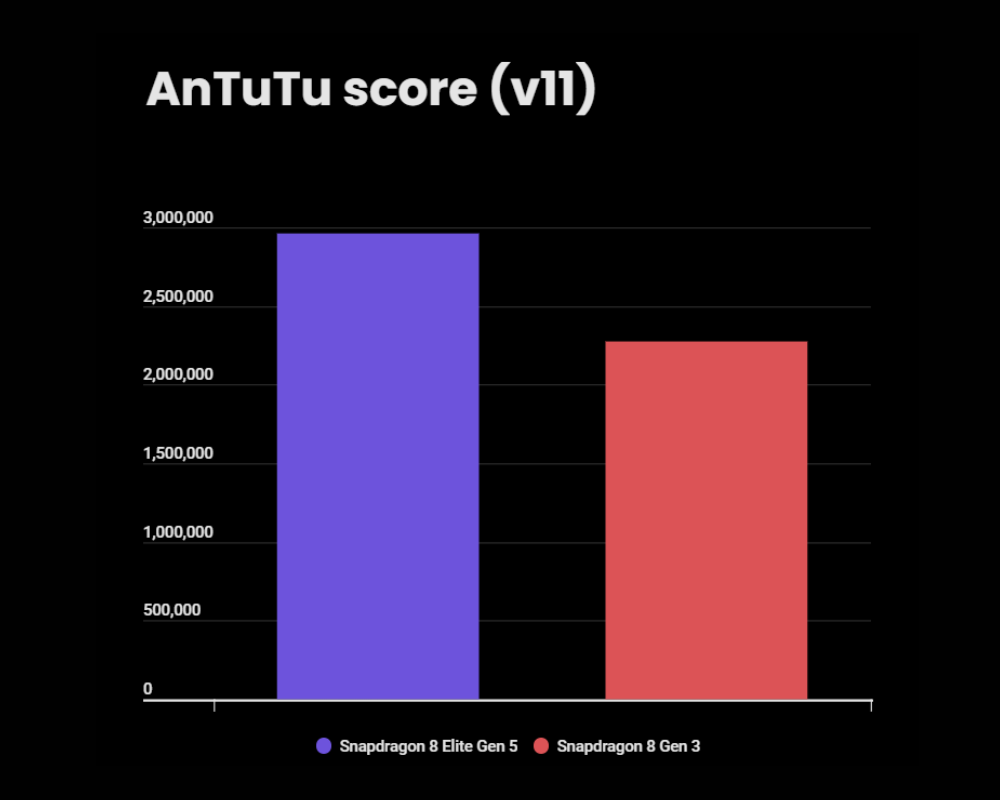
On the AnTuTu v11 platform, the Snapdragon 8 Gen 5 achieves nearly 3 million points, whereas the 8 Gen 3 only reaches 2.27 million points. That’s a 30% boost for the newer chip.
The breakdown reveals a 50% higher CPU score and a 22% increase in the GPU score for the 8 Gen 5. It also gains higher scores in memory and UX tests.
| Snapdragon 8 Gen 5 | Snapdragon 8 Gen 3 | |
| AnTuTu score | 2,961,236 | 2,274,520 |
| CPU | 914,878 | 607,409 |
| GPU | 974,402 | 796,782 |
| Memory | 382,729 | 353,279 |
| UX | 689,228 | 517,050 |
In short, the Snapdragon 8 Gen 5 strongly outperforms the 8 Gen 3 on benchmarks. However, there’s more to consider than just benchmark scores to get the complete picture, such as connectivity and camera quality. (more on that below)
Snapdragon 8 Gen 5 vs 8 Gen 3: Major differences
The 8 Gen 5 uses an advanced TSMC’s 4nm (N3P) process node, which offers better performance and power efficiency over the 8 Gen 3’s 4nm (N4P) node. Furthermore, the chip benefits from Qualcomm’s latest Oryon cores (third-generation), the same cores found in the flagship 8 Elite Gen 5 chip.
On the other hand, the 8 Gen 3 features ARM cores: 1 x Cortex-X4, five Cortex-A720, and two Cortex-A520. Qualcomm claims a 36% performance boost for the 8 Gen 5 compared to 8 Gen 3. Further, the 8 Gen 5 features an upgraded Hexagon NPU that delivers 46% faster performance.
The 8 Gen 5 features an Adreno 840 GPU (with sliced architecture) that offers greater capabilities than the Adreno 750 inside the 8 Gen 3. It uses the new GPU architecture with dedicated memory per slice. The 8 Gen 5’s Adreno 840 GPU promises 11% faster graphics rendering and a 13% improvement in power efficiency. Additionally, it also offers improved ray tracing and Snapdragon Elite Gaming features.
The camera also receives notable upgrades. The Gen 5 chip uses a 20-bit Spectra Triple ISP with AI capabilities. It offers features like real-time tone control and Night Vision 3.0. Additionally, it features Snapdragon Audio Sense, which can record HDR audio while eliminating background wind noise.
Both chips offer the same peak download/upload speed over 5G and Wi-Fi connections, but the underlying hardware has been upgraded. The newer X80 5G modem, part of the 8 Gen 5 upgrades, enhances the Sub-6GHz configuration to 4×6 MIMO, improving speed and reliability compared to the 4×4 MIMO in the Gen 3’s X75 modem.
The newer chip also offers AI-assisted beam management, Bluetooth 6.0 (vs 5.4), and a newer FastConnect 7900 connectivity suite (vs FastConnect 7800).
Snapdragon 8 Gen 5 vs 8 Gen 3: Which one should you choose?
The Snapdragon 8 Gen 5 offers clear advantages over the 8 Gen 3 in almost every aspect. It’s got a faster CPU, a reliable GPU with higher rendering and battery efficiency, an improved ISP with AI-assisted features, and enhanced connectivity features.
Between the two, the choice isn’t difficult: the Snapdragon 8 Gen 5 does everything better, and therefore is an easy pick. But the 8 Gen 3 still delivers excellent performance and power efficiency. You’ll hardly notice any performance difference in day-to-day usage. It also offers excellent gaming performance, but for longer sessions, you may want a more powerful chip. If you can find a Snapdragon 8 Gen 3 phone that’s significantly cheaper than the 8 Gen 5 phone, the deal would be hard to ignore.



Comments